CindySadnya
Author:
Organizational:
Audience Rating:
CindySadnya
Strand by Strand - Chapter 1
Author:
Audience Rating:
Publication:
Genre:
Character Age:
TG Themes:
TG Elements:
Other Keywords:
Permission:
Reposting this as it wasn’t posted before sequentially. Other chapters were posted before. I am first time author and would appreciate feedback / comments!
Chapter One: The Unexpected Beginning
Arjun Patel had always lived his life along carefully drawn lines.
He was the kind of man who measured his days in deadlines and conference calls, whose tidy apartment in suburban New Jersey reflected his tidy sense of identity. Thirty-two years old, with an engineering degree from Mumbai and a green card secured after years of grinding away in the corporate world, he was exactly what his parents back in India had wanted him to be: respectable, reliable, unremarkable.
Or so he thought.
It was on an ordinary Saturday in early spring—sunlight slanting through his blinds, a pile of laundry waiting to be folded—that his life tilted in a direction he could never have anticipated. His neighbor, Melissa, a fashion photographer, knocked on his door in a mild panic.
“Arjun! I know this is the strangest request, but you’re the same build as the model who just canceled on me, and I have a client waiting in my studio. Would you—just for the shoot—stand in? It’s just some test shots, nothing serious.”
He blinked. “Melissa, I… I’m not exactly model material.”
She grinned, breathless. “Trust me, it’s perfect. We just need the outfit to fit, and you’ll be in full makeup. Honestly, nobody will even know. You’d be saving me.”
He wanted to say no. It was absurd. Him? Dressed as a woman for some fashion test? But the panic in her eyes softened something in him, and against all reason, he heard himself mutter, “Fine. Just this once.”
Within minutes, Melissa had whisked him into her loft-like studio. On a rack hung the outfit in question: a sleek, knee-length sheath dress in pale lavender silk, paired with a delicate jacket and impossibly high heels. His pulse jumped.
“Melissa, I can’t—”
“You can,” she said firmly, ushering him into a chair. “Sit. Let me work.”
She moved with practiced efficiency, brushing foundation across his skin, darkening his eyes with liner, softening his mouth with gloss. Arjun stared at his reflection as it shifted, feature by feature, until the man he knew blurred. The sensation was… unsettling. Yet when Melissa fitted a chest plate beneath the dress, cinched a waist with padding, and finally zipped the lavender silk around his frame, a strange thrill chased through him.
The wig was the last touch—dark waves that cascaded to his shoulders. She fluffed it, stepped back, and smiled.
“Aria,” she whispered, christening him with a name that wasn’t his. “You look incredible.”
Arjun—Aria—stood, legs shaky on the heels, the fabric hugging him in ways he’d never felt before. His reflection in the mirror was startling. Not a joke. Not a caricature. But a woman, elegant and poised.
The camera clicked. Lights flared. Melissa called out gentle instructions—tilt your chin, soften your smile, let the jacket slip from one shoulder. He obeyed, awkward at first, then with growing confidence. Something inside him unfurled, a quiet part that had never been given air.
And when the shoot ended, when Melissa thanked him profusely and promised the images would never leave her client’s folder, he found himself lingering before the mirror. Running his fingers along the silk. Tasting the gloss on his lips.
He should have felt foolish. Instead, he felt… alive.
That night, back in his apartment, he couldn’t stop replaying the sensation—the weight of the wig, the brush of fabric against skin, the strange, liberating surrender of slipping into another self. A self that wasn’t burdened with expectations. A self that could be someone else entirely.
It was supposed to be a one-time accident. But the seed had been planted. And as the weeks passed, Arjun found himself searching online—quietly, secretly—for makeover studios in the city. Places where professionals could transform him again, properly, completely.
Because deep down, he knew: he wanted to see Aria again
Strand by Strand - Chapter 2
Author:
Audience Rating:
Publication:
Genre:
Character Age:
TG Themes:
TG Elements:
Other Keywords:
Permission:
Chapter Two: The Appointment
The website looked discreet but warm: Ava & Co. Transformations—NYC’s Premier MTF Makeover Studio. Tasteful before-and-afters. Testimonials that sounded like whispered confessions. A calendar widget with a few weekday openings and a handful of Saturday slots that vanished as he hovered over them, like they were frightened of his indecision.
Arjun booked a Tuesday evening under the name “A. Patel.” It took him half an hour to press confirm and three seconds to pray he hadn’t made a terrible mistake.
The studio sat on the third floor of an old brick building near Union Square, with a buzzer that announced visitors in a confident little trill. When the door clicked, he climbed the stairs with a thrum in his chest, palms damp, collar too tight. He’d worn a navy polo and chinos, the most invisible version of himself. On the landing he paused, drew a breath, and opened the final door.
Inside: soft lights, a faint scent of powder and something floral, music just on the edge of hearing. The space felt like a cross between a salon and a boutique—mirrors with bulbs like halos, racks of clothes organized by color, and a small sitting area with a velvet loveseat and a vase of peonies blooming like secrets.
“Aria?” The woman at the desk stood and smiled, the sort of smile that meant your name—your chosen name—would be safe here. She was tall and willowy, late thirties perhaps, with a platinum bob and keen, kind eyes. “I’m Ava. Welcome.”
Arjun felt the name slide over him like a sigh of relief. “Hi. Yes. I, um… thanks for seeing me.”
“Of course.” She glanced at her tablet, then back at him. “This is your first time with a professional studio, yes? We’ll go slow. You’re here for the Signature Transformation: consultation, makeup, hair, pads and cinching if you want them, two outfits, and a mini shoot to help you remember how stunning you are.”
The word stunning made something in his stomach flip. He followed her past a curtain into a private dressing room with a full-length mirror and a small table laid out like an altar: foundation palettes, lipsticks, false lashes. “You can hang your things there,” she said. “There’s water, and tea, and—” she tilted her head— “permission to breathe.”
He laughed, a little ragged. “I didn’t know I needed that.”
“We all do.” Ava handed him a silk robe. “If you’re comfortable, change into this. I’ll get your forms and a couple of corset options. Your measurements are close to a few of our sample sizes—lucky you.”
While she slipped away, Arjun undressed, folding his polo with his usual neatness, and put on the robe. The silk hugged his shoulders, cool at first and then warm with his skin. He looked in the mirror. Without the armor of clothes, without any illusion yet in place, he still saw Arjun: precise, careful. But the robe did something to his posture, and the way the sash knotted at his waist hinted at lines he’d only imagined.
Ava returned carrying a tidy stack: a nude silicone breastplate, two pairs of foam hip pads, and two corsets—one matte black, one a ridiculous, glorious blush with satin laces. “We’ll try both,” she said, clinical and gentle. “Tell me if anything pinches. Consent is our most important tool.”
He nodded, heat rising to his face at the word breastplate. He’d read about them. Melissa had used something more basic for the lavender dress—the thought sent a flash of silk down his spine—but this was… serious. Ava’s hands were deft but respectful as she showed him how to roll the silicone over his shoulders, how to settle the weight so it felt like part of him and not a costume. The sudden heaviness made him gasp; the way it lay against his sternum felt intimate, like a secret hand.
“You okay?” Ava asked, watching his reflection rather than his face.
“Yes,” he said, quieter than he meant to. “More than okay.”
“Good.” She slid the matte corset around his waist. “Exhale for me.” He obeyed, and the laces pulled, a steady tug that narrowed him into an hourglass he’d only seen in silhouette. The pressure was firm and encompassing, a hug that wouldn’t let go. Arjun found his breath coming smaller, higher, and strangely—it soothed him. “Too tight?” she asked.
“No,” he said, and surprised himself with the yearning in his voice. “Maybe a little more.”
Ava’s brow lifted, approving. “You’ll be a quick study.” She finished the lacing, then set the hip pads against him, shaping a curve from waist to thigh. Suddenly the robe hung differently, skimming contours that had never been there. He swallowed, watching his body reorganize itself into something that made sense in a way he’d never articulated. It felt like the answer to a question he hadn’t known he’d asked.
“Makeup next,” Ava said. “Come sit.”
He settled into the chair; it embraced him like it had been waiting. Ava’s touch moved across his face with the focus of a ritual—primer smoothing the canvas, foundation melting away the day, contour carving cheekbones he’d never seen, a hint of peach correcting the blue of his beard shadow. “Close your eyes,” she murmured, and he did, surrendering to the sweep of a brush, the slick coolness of cream on his lids, the tickle of mascara. She filled in his brows with feathery strokes that softened his whole expression; he felt his mouth loosen, his jaw unclench. When she painted his lips—a precise bow, a little fuller than his natural shape—the first swipe made his breath hitch. He tasted vanilla and something like rose, felt the pad of her thumb press the color into place.
“You’re doing beautifully,” she said. “Look.”
In the mirror: a face that belonged to him and not to him, as if he were meeting an old friend. The eyes were his—curious, careful—but framed in a way that drew them out, made them speak. The mouth… it almost smiled on its own.
“Hair,” Ava said, and set a wig stand beside the station. “We’ll try a few. Shoulder-length to start—soft layers, side part.” The wig she chose was a deep, glossy brown, not quite black, and the way it caught light reminded him of monsoon evenings on the balcony when he’d been a boy, watching rain braid the air. She adjusted a cap over his hair, set the lace front along his forehead, and pressed, blending. When she clipped a few pieces back to shape the face, he watched his reflection steady, align. She teased the crown, sprayed, then released the clips. Hair fell in a gentle curtain along his jaw and neck. It did something to his posture again; he sat taller.
“First outfit,” Ava said, almost businesslike—as if they hadn’t just rewritten reality. She led him to the racks and pulled three options. “A navy sheath with a neckline that spotlights your collarbones; a blush wrap dress that’s very forgiving and very dangerous; or a black pencil skirt with a silk blouse that says CFO by day, thief of hearts by night.”
Arjun laughed, arousal and nerves threaded together. “Wrap dress,” he said, surprising himself again.
“Excellent.” She handed it to him, along with a matching set of lingerie—simple but pretty, with a whisper of lace. “These are sanitized and laundered; if you like anything, we can sell you a fresh set. I’ll step out.”
He changed slowly, a minute stretching long enough to fit new skin. The panties slid up his thighs and settled around the shape Ava had made for him; the bra clasped and hugged the silicone forms until they felt, even more than before, like they’d grown there. The wrap dress swished as he drew it around himself, tied at the waist, and then—he turned. The mirror reflected a woman lines had been written for. The color made his skin look luminous. The neckline was modest until he moved; then the hint of a V suggested secrets. He touched the fabric without thinking, fingertips gliding over the place where breast met silk, and a pulse of heat unfurled low and insistent.
A knock. “Ready to show me?” Ava’s voice held a smile.
“Yes,” he said, and it came out husky.
She stepped in and paused, taking him in with a professional’s calibration and a friend’s pleasure. “Aria,” she said softly, “you’re breathtaking.”
The word landed like a hand on his back, encouraging him forward. She brought out heeled sandals—two inches, a good training height—and guided him through a few steps, hips remembering the new geometry. “Think about lengthening,” she coached. “Your knees brush past each other, your steps are a little narrower. Imagine you’re pouring yourself forward.”
He moved, and the dress swayed like it was applauding. Ava stood close to adjust his posture, one palm at his shoulder blade, the other hovering near his hip—not touching, not quite. The nearness felt electric. He caught her eyes in the mirror, saw the way her pupils dilated just slightly, and felt the answering warmth bloom again. This was practice, yes, but it was also… attention. Being seen with a kind of precision that felt like desire wearing a lab coat.
“Second outfit,” she said after a breath that seemed to belong to both of them. “Let’s do the pencil skirt. It will change your gait again.”
He changed, more confident now, sliding into a black skirt that hugged his new hips and a cream silk blouse whose buttons were small and fussy and worth every second. Nude tights. Closed-toe pumps. When he turned, the skirt turned a half-beat later, like the tail of a comet. Ava selected a delicate pendant, fastened it at his nape, and let her fingers linger—a half-second longer than necessary—on his skin. His breath hitched again.
“We’ll do a few photos,” she said, voice a touch lower. “Nothing you’re not comfortable with.” She switched on a softbox; light bloomed. “Lean on the stool. Cross your ankles. Perfect. Tilt your chin to the light… yes.”
The camera clicked. He felt oddly powerful and strangely submissive at once; the lens asked, and he gave. Ava’s direction was a murmur, a wave to ride. “Imagine you’re waiting for someone who always arrives a few minutes late, and every minute makes you want them more. That’s it. Soften your mouth. Let your eyes ask the question.”
He didn’t need to imagine too hard. The studio felt cocooned, the world beyond the door unreal. He could feel the corset, the cadence of the pumps, the line of the skirt when he shifted his weight. He could feel—clearly—the way desire changed the way he occupied space, the way it softened his wrists, the way it made his breath come in that higher register he’d first noticed when she tightened the laces.
Between shots, Ava stepped in to smooth a flyaway. The brush of her knuckles along his jaw was so featherlight that he swayed. She steadied him with a hand at his waist—pressure firm through silk and whalebone—and for a heartbeat their faces were close enough that he could see the tiny flecks of gold in her eyes, smell the faint sweetness of her perfume.
“Is this okay?” she asked, the question wrapped around more than posture.
“Yes,” he said. The word felt like opening a window.
They didn’t do more than that—no sudden kiss, no transgression. Instead she stood a fraction closer than she needed to for the rest of the session, and he floated in the charged space between their bodies, aware of every adjustment as if it were a sentence written on him. The photos became a dialogue: his mouth a little parted, her whisper a little warmer, his hand resting at the hollow of his throat as if cradling something tender and new.
When the last shutter fell, Ava lowered the camera slowly. “Would you like to see?”
He nodded. She scrolled through the images on the tethered screen. There he was—Aria—in the wrap dress, a softness in her eyes that made his own sting; in the skirt and blouse, a precise, poised want in the angle of her hip. He felt simultaneously exposed and protected—like the pictures had captured a truth and framed it safely. He couldn’t look away.
“You’re… real,” he said, barely above a whisper, not sure whether he meant the woman on the screen or the feeling in his chest.
“You are,” Ava said, and her hand found his forearm, warm and grounding. “That’s the only rule that matters here.”
They lingered. She showed him how to remove the wig carefully, how to cleanse the makeup without angering skin, how to unlace the corset slowly so the world didn’t rush back in too fast. He stood in the robe again, hair damp from a warm cloth, his face bare. He expected the crash—the sudden shame, the embarrassing clarity—but it didn’t come. He felt… tender, yes, but not foolish. Not at all.
At the front desk, Ava placed a small envelope in his hand. Inside was a card with a neat list—his foundation shade numbers, the brand of the lipstick they’d used, the wig style and code, the corset size. “So you don’t have to guess later,” she said. “And a link to your private gallery. Password protected.”
He swallowed. “Thank you. For all of this.”
“My pleasure,” she said, and there was warmth in the word that made him flush. “If you want to come back, I do a Friday night Salon once a month—small group, champagne, a chance to practice walking and chatting as your femme self. Low pressure. High sparkle.”
He tucked the envelope inside his jacket—still Arjun’s jacket, for now—and smiled. “I think I’d like that.”
On the train home, the city smeared by the window like wet paint, he could still feel the ghost of the corset, the phantom swing of the skirt, the way Ava’s fingers had steadied him at the waist. The gallery password sat in his pocket like a promise.
That night, he stood at his bathroom mirror and washed his face again, though it was clean, as if the ritual were part of keeping the feeling bright. He brushed his short hair and imagined the weight of the wig. He tried the wrap of a bath towel like a dress and laughed at himself, and then didn’t laugh, because the tug in his stomach wasn’t a joke.
He opened the envelope and ran a thumb along the list like it was a spell. He could buy one lipstick, he thought. Just one. A small, private ember he could cup in his palm. He imagined opening the tube, twisting it up, pressing color to his mouth, and the quiet sound he made startled him—part need, part relief.
Before sleeping, he opened the gallery link on his phone. The first photo filled the screen: Aria seated on the stool, ankles crossed, the pendant glinting at her throat. The expression in her eyes was a question and an answer.
He pressed the screen to make it bigger, and the room seemed to tilt. His body answered with a bright, insistent heat, a flush that rolled through him. He let his hand drift over his chest, found the remembered ache of where the forms had been, slid lower. The sensation brought him to the edge quickly, almost embarrassingly, and he let himself tip, eyes half-closed, breath catching just the way it had when Ava had cinched the corset. It was tender and hungry at once, the kind of release that felt like a confession.
After, he wiped his hand and laughed softly at himself—shy, delighted. He looked at the photo again and didn’t feel foolish. He felt claimed.
He dreamed of a room with soft light and peonies, of a woman with a platinum bob and gold in her eyes, of a shape in the mirror that belonged, and of a future where his hair grew and fell along his neck, where a pandemic would slow the world enough that the person inside him could catch up. In the morning, he woke with the taste of rose on his lips and the sure knowledge that he would return.
Strand by Strand - Chapter 3
Author:
Audience Rating:
Publication:
Genre:
Character Age:
TG Themes:
TG Elements:
Other Keywords:
Permission:
This is my first attempt at writing a torte. Please provide feedback and comments - they make it worth writing such stories.
Chapter Three: Growing Out
The first weeks after his appointment with Ava felt like a secret season in Arjun’s life. He went to work as usual, logged into Zoom calls with his team, exchanged perfunctory greetings in the apartment lobby. Nothing looked different to anyone else. And yet—he felt different.
The lipstick Ava had written on the card arrived in a discreet black box a few days later. He ordered it late at night, heartbeat quick, then nearly canceled the purchase the next morning. But when the package came, nestled in tissue, he opened it with trembling fingers. The shade was called Peach Whispers. He tried it immediately, his reflection smiling back with a softness that was his and not his. He wiped it off quickly, scrubbing the sink like he’d spilled something illicit, but the faintest stain lingered in the corners of his mouth, and he caught himself touching it, tracing it.
When COVID hit, the city emptied, and offices closed, the world contracted into his apartment. What should have been loneliness became—strangely—a cocoon. His hair, usually trimmed every three weeks, began to grow. At first it was just a matter of barbershops being closed. But as the days stretched into months, he decided to let it happen. Each morning he brushed it flat; each evening he let it fall untamed. Soon it grazed his ears, then brushed his collar, then curled onto his forehead.
He found YouTube tutorials—makeup basics, hair care, beginner feminization voice training. In the privacy of quarantine, he practiced speaking in a higher pitch, modulating vowels, softening consonants. At first it sounded ridiculous, a parody. But repetition sculpted possibility.
One night he dug the wrap dress out of a plastic garment bag Ava had sold him, along with a simple bra and panties. He hadn’t dared try them at home before. But something about the empty city streets below emboldened him. He shaved carefully, laced himself into the garments, tied the dress, and applied Peach Whispers. He didn’t have a wig yet, only his own growing hair, parted in the middle and coaxed with a brush.
He stood before the mirror and whispered: “My name is Aria.” The sound was shaky but carried. He said it again, higher, gentler: “My name is Aria.”
That night, she fell asleep in the dress, curled around herself, the fabric like a lover’s arm.
By midsummer, Melissa—the neighbor who had first dressed him for that shoot—caught him in the hall, mask tugged beneath her chin, eyes crinkling.
“Arjun! Or should I say… Aria?”
He froze, pulse hammering. “What?”
She laughed, kind, not cruel. “Relax. I saw the lipstick stain one day when you took out the trash. Same shade we used for the lavender dress. You don’t need to hide from me.”
The relief came hot, followed by embarrassment. “I… it was just for fun.”
She tilted her head. “Then why’s your hair halfway to fabulous?”
He couldn’t answer. She touched his shoulder gently. “Hey. I think it’s wonderful. If you ever want help styling it, I’m just across the hall. And if you ever want company when you go back to Ava’s salon—I’ve been there too, for shoots. You’d be surprised how many of us need a little transformation now and then.”
Her words were like a key turning in a lock. Arjun—no, Aria—felt something unclench inside.
When Ava’s studio reopened with masks and sanitizer and cautious protocols, he booked immediately. This time, Melissa came along, chatting with Ava like an old friend while Aria was fitted with a longer, layered wig that matched her real hair’s new length.
“You’ll be able to grow into this,” Ava said, brushing it smooth. “Another six months, maybe, and you won’t need the wig at all. But tonight—” she adjusted it, her hands warm— “you get to see the future version of yourself.”
Melissa clapped, grinning. “She looks like trouble. In the best way.”
Aria blushed, heart racing. The pencil skirt, the silk blouse, the pendant—they all returned, but now with her own hair peeking beneath the wig, with a confidence that hadn’t been there the first time. Ava’s gaze lingered a fraction too long on her reflection, and Aria felt the same charge as before, that subtle almost-touch of desire folded into professionalism.
The mini shoot was different this time. Aria didn’t need as much coaching. Her body remembered. She leaned, crossed, arched—not because Ava told her to, but because it felt natural. Melissa cheered from the sidelines, snapping her own photos with her phone.
When they finished, Ava walked her back to the dressing room. “You’ve grown,” she murmured, fingertips brushing Aria’s wrist as she adjusted a bracelet. “Not just your hair.”
The words stayed with her all night, echoing long after she shed the wig, the forms, the clothes. They rang louder than the city’s empty silence, louder than the headlines, louder than the old voice of Arjun.
That fall, as leaves turned and days shortened, Aria began spending whole weekends as herself. She ordered clothes online: soft cardigans, flowing skirts, jeans cut to flatter hips padded with foam. She practiced walking in the privacy of her living room, the click of heels on hardwood like music. Sometimes Melissa joined her, sipping wine, showing her how to curl hair, paint nails, sit with a casual grace that looked effortless and was anything but.
One evening, Melissa said, almost casually, “You know, Ava’s salon isn’t just about makeovers. There’s a Friday salon night coming up. Small crowd, champagne, a chance to meet others like you. I think you should go.”
Aria hesitated. “Others like me?”
Melissa nodded. “People discovering themselves. People living fully. And… people who might see you the way you want to be seen.”
The suggestion lingered like a kiss not yet given.
By winter, Aria’s hair reached her shoulders. She booked another session with Ava—this time not for transformation, but for styling her own hair, blending it into something undeniably feminine. Sitting in the chair, cape snug, the sound of scissors whispering, she watched locks fall and new lines emerge.
When Ava spun her around at the end, Aria gasped. No wig. No illusion. Just herself, framed by layers that swung as she turned her head.
“You’ve arrived,” Ava said softly, her eyes meeting Aria’s in the mirror. “And you’re beautiful.”
The compliment came with a pause that was heavier than friendship, heavier than professionalism. For a moment neither looked away.
And in that silence, Aria felt the first flicker of something she hadn’t dared hope for: not just self-discovery, but romance.
Strand by Strand - Chapter 4
Author:
Audience Rating:
Publication:
Genre:
Character Age:
TG Themes:
Permission:
Reposting this as prior chapters were not showing up sequentially (new author syndrome:) ). Would appreciate feedback / comments. Also suggestions if should post it on kindle and the process for it.
Chapter Four: The Salon Night
The night of Ava’s salon gathering, Aria almost canceled twice. She stood in her bedroom, staring at her closet. It wasn’t about the clothes—she had options now. The soft blush wrap dress hung like an old friend, the black pencil skirt like a promise. Her hair had been styled by Ava just a week before, grazing her shoulders in neat layers. She had heels she could walk in without wobbling.
What terrified her was the company. She had only ever been Aria in controlled spaces: Melissa’s apartment, her own living room, Ava’s studio. Tonight meant being seen—not just by one friend or one mentor, but by strangers.
The doorbell rang. Melissa leaned in, her curls pinned up, wearing a green satin jumpsuit that seemed to pour over her frame. “You look amazing,” she said at once, sweeping her eyes over Aria’s blush wrap dress and delicate necklace. “Stop doubting. Let’s go.”
⸻
Ava’s studio had been rearranged for the event. The racks of clothing were pushed to the sides, mirrors glowing in soft light. A bar cart gleamed with bottles of champagne and slender flutes. Small clusters of people—five, maybe six—stood chatting in low voices, the air threaded with laughter.
Every person there was transformed in some way. A tall blonde in sequins leaned against a mirror, a petite brunette in floral chiffon sat curled on the velvet loveseat, two others in jeans and heels perched at the bar. Some were clearly trans women, some crossdressers, some perhaps drag artists—but each one radiated a sense of being at home.
And then there was Ava, gliding toward them in a black satin slip dress, a glass of champagne in hand. Her platinum hair shimmered under the lights, and her smile—when she saw Aria—was warm enough to melt every nerve.
“Aria,” she said, kissing her cheek lightly. “You came.”
“Yes,” Aria managed, her voice higher now, practiced but natural. “I… wanted to see.”
“And be seen,” Ava added softly, handing her a glass. Their fingers brushed, lingered a moment too long.
Melissa winked, drifting off toward the bar to greet someone she knew. Aria sipped, the bubbles tickling her throat, and turned to watch the room. She felt herself exhale. Nobody stared at her with suspicion. Nobody saw “Arjun.” They saw Aria, as she was dressed, as she felt.
Ava stayed by her side, introducing her to the others—Janelle, who worked in finance and wore sequins with the confidence of a queen; Priya, whose soft floral dress matched her shy smile; Sasha and Mia, partners who had both transitioned years ago and radiated ease. Each conversation was brief but kind, like being welcomed to a table she hadn’t realized existed.
By the second glass of champagne, Aria found herself laughing. Her body moved differently—hips loose, hands expressive. When she crossed her legs, it felt unstudied. She belonged.
⸻
Later, when the group had thinned, Ava touched her elbow. “Come,” she said, leading her to the smaller dressing room at the back, away from the hum of voices.
Aria’s pulse raced. “Is everything okay?”
Ava closed the curtain behind them. The light was softer here, golden. “Yes. I just wanted you to have a moment. You’ve been glowing all night.”
Aria flushed, reaching to touch her hair self-consciously. “I’ve never… felt like this before.”
“I know,” Ava said. She stepped closer, eyes steady, voice low. “I see it in you. The way you carry yourself now. The way you allow yourself to be.”
For a moment they stood so near that the warmth of Ava’s body brushed against Aria’s arm. She could smell her perfume again—amber and something faintly sweet. Her heart drummed.
“You’ve been my client,” Ava continued. “But tonight, I didn’t just see a client. I saw someone unfolding. Someone beautiful.”
The words trembled inside Aria, knocking loose a dam of feeling. “Ava… I don’t know where this is going. I don’t even know if I can—”
Ava silenced her with a fingertip against her lips. Not a command, but a gentle pause. “Shh. You don’t need to know yet. You just need to feel.”
Aria’s breath caught. She felt the faint pressure of Ava’s finger, the intimacy of being held still without force. Her lips parted slightly. When Ava withdrew her hand, the air between them seemed to spark.
Slowly, giving Aria every chance to retreat, Ava leaned closer. Their lips brushed—a whisper, not a claim. The first taste was champagne, cool and sharp. The second was warmer, lingering, a question that answered itself.
Aria swayed into it, her hand rising almost without permission to rest against Ava’s waist, feeling the satin beneath her fingers. Ava’s hand came to rest on Aria’s cheek, steadying her, deepening the kiss just enough to send a shiver spiraling down her spine.
When they parted, Aria’s chest rose and fell rapidly, corset pressing with each breath. Ava smiled softly. “See? Feeling is enough.”
Aria laughed shakily, lips tingling, the mirror beside them reflecting not just her dress and her hair, but the unmistakable flush of being desired.
⸻
Back out in the studio, Melissa caught her eye and raised a brow knowingly, but said nothing. The party wound down, people drifting out into the night, voices echoing down the stairwell.
Ava lingered by the door as Aria slipped on her coat. “Salon nights aren’t just for transformation,” she said quietly. “They’re for connection. I think you found both tonight.”
Aria met her gaze, pulse still fluttering from the kiss. “I think I did.”
The city air outside was cold, but Aria felt lit from within, as though she carried her own warmth. For the first time since the lavender dress in Melissa’s studio, she didn’t wonder whether this path was real or ridiculous. She knew.
And she knew, too, that the journey wasn’t only about clothing or hair or makeup. It was about intimacy. About being touched, seen, wanted.
That night, she lay in bed replaying the kiss until sleep claimed her, lips still tasting of champagne and rose.
Strand by Strand - Chapter 5
Author:
Audience Rating:
Publication:
Genre:
Character Age:
TG Themes:
TG Elements:
Other Keywords:
Permission:
Chapter Five: Unfolding
The week after the salon night stretched like a taut string. Aria returned to her daily rhythms—emails, project deadlines, cooking lentils in her tiny kitchen—but everything felt changed. When she brushed her teeth in the morning, she remembered the pressure of Ava’s finger on her lips. When she sat on a Zoom call, she caught herself touching the ends of her hair, twisting them the way she’d seen Melissa do.
And at night, when she looked at the photo gallery Ava had given her, she no longer saw “costume.” She saw herself, whole and luminous.
⸻
It was Melissa, of course, who nudged her again. “You’re glowing,” she said one evening, handing Aria a glass of wine as they lounged on her couch. “And don’t tell me it’s the serum I gave you. That’s the look of someone who’s been kissed.”
Aria blushed, hiding her smile behind the rim of the glass. “Maybe.”
Melissa grinned. “She’s good for you. Just… be careful, okay? Falling for your makeover artist is a cliché, but sometimes clichés happen for a reason.”
Aria turned the words over. Was she falling? Or was she simply intoxicated by being seen for the first time? The truth hovered somewhere in between.
⸻
Ava texted two days later:
Would you like to come by Thursday night? After hours. No clients. Just us.
The message made Aria’s fingers tremble. She typed back before she could second-guess: Yes.
⸻
The studio at night was different—darker, quieter, lit only by lamps and the glow of the city outside. Ava had set out a bottle of wine, two glasses, and a playlist that whispered low jazz. She wore wide-legged trousers and a silk camisole, her platinum hair tucked behind one ear. The look was casual, but every line of her body was deliberate.
“You came,” she said softly as Aria stepped inside.
“I couldn’t not.”
They drank, they talked—about books, about India, about how Ava had started the studio as a refuge for people who needed more than beauty, who needed affirmation. The conversation slid closer and closer, their knees touching on the loveseat, until finally Ava reached out, tucking a strand of Aria’s hair behind her ear.
“You’ve been practicing,” she said.
Aria nodded. “I want to be… more real.”
“You already are.” Ava’s thumb brushed her cheek. “But I can help you feel it more deeply. If you want.”
Aria swallowed hard. “Show me.”
⸻
Ava stood, leading her toward the mirrors as though guiding her into ritual. “Take off your coat. The dress too, if you’re comfortable. I want you to see yourself emerge.”
Aria hesitated, then slipped the blush wrap dress from her shoulders, standing in the bra and panties Ava had chosen months ago. The reflection startled her—not just because of the pads and the breast forms, but because of the way her body carried itself now, hips tilted, chest lifted.
Ava came behind her, arms sliding around her waist, her lips grazing Aria’s shoulder. “See?” she whispered against her skin. “You’re already here.”
Aria closed her eyes, shivering at the warmth, the press of Ava’s body against her back. She could feel the outline of Ava’s breasts, the curve of her hip, the deliberate slowness of her movements.
“Do you like this?” Ava asked, her hands resting just above the corset line.
“Yes,” Aria breathed. “So much.”
Their eyes met in the mirror—Aria’s wide, Ava’s steady, pupils dark with hunger. The sight of herself, desired, was almost more intoxicating than the touch.
Ava kissed her neck, trailing upward until their mouths found each other again. This time the kiss was not tentative. It was slow, deep, her tongue sliding against Aria’s, coaxing rather than demanding. Aria moaned softly, surprised at the sound, at how natural it felt in her higher voice.
Ava turned her gently, guiding her back to the loveseat. They sank down together, lips never parting for long. Hands traced silk and lace, fingertips grazing skin. Aria felt herself melting, every line of her body yielding into Ava’s.
“Relax,” Ava murmured, slipping a hand along Aria’s thigh, squeezing gently. “You don’t have to perform. Just feel.”
Aria did. She let go of the old fear, the old voice that called this indulgence. She let herself arch into Ava’s touch, let her mouth open in soft gasps, let herself be undone.
It wasn’t hurried. Ava took her time, alternating between kisses and whispers, between guiding Aria’s hands over her own body and drawing out sounds that surprised them both. Aria’s body responded with urgency, need rising until it spilled out in waves. When she finally collapsed against Ava, breathless and trembling, she felt no shame—only release, only sweetness.
They sat together in the afterglow, Aria’s head on Ava’s shoulder, Ava stroking her hair. The city hummed outside, indifferent and eternal.
“You’re beautiful when you let go,” Ava said softly.
Aria smiled sleepily. “I want to keep letting go.”
“Then we’ll keep going. One step at a time.”
⸻
On the subway home, Aria replayed the night in fragments: Ava’s voice in her ear, the heat of satin under her palms, her own reflection flushed with pleasure. For the first time, she didn’t feel like she was trying to become someone else. She felt like she was uncovering someone who had been waiting all along.
And as the train clattered into the dark, she knew she would never go back.
Strand by Strand - Chapter 6
Author:
Audience Rating:
Publication:
Genre:
TG Themes:
TG Elements:
Other Keywords:
Permission:
Comments / feedback appreciated !
Newbie author here.
Chapter Six: Out in the Open
Their next meeting wasn’t at the studio. It was a small wine bar in the West Village with candles guttering in old glass bottles and a chalkboard menu that changed with the weather. Ava arrived first and texted a photo of the corner table; Aria stared at the image, at the two empty glasses catching candlelight, and felt the quiet throb of possibility.
She dressed with hands that were steady only because they’d practiced. High-waisted dark jeans that hugged the pads just right, a soft cream blouse, the pendant Ava loved. Her own hair—layered, shoulder-skimming—she coaxed into a gentle bend with a round brush. Mascara, a fingertip of shimmer at the inner corners, Peach Whispers pressed on lightly. A long, camel coat. The woman in the mirror was new and not new at all.
On the sidewalk, February air bit at her cheeks. She tucked her hands into her pockets and felt the small thrill of being outside as Aria. Not a salon cocoon, not Melissa’s couch: the city itself, indifferent and generous.
Ava stood as she entered, smile unfurling. “Look at you,” she murmured when Aria slipped out of her coat. The words landed like warm hands at her waist.
They talked: the neighborhood, a silly viral video, a client who’d discovered winged eyeliner at forty-nine and cried happy tears. The ordinary texture of conversation wrapped around the extraordinary fact of who Aria was, here, in public, without flinching. A couple at the next table glanced over once, then went back to their own orbit. A server complimented Aria’s blouse. Each tiny moment rewrote some old script in her chest.
“Do you ever get scared?” Aria asked, halfway through her glass.
Ava’s thumb traced the rim of hers. “Of what?”
“That someone will read me before I read myself. That I’ll do it wrong. That I’ll…disappoint the version of me I’m trying to meet.”
Ava considered. “Fear likes to sound like a prophecy. Mostly, it’s a bad weatherman.” She smiled. “The only person who decides if you’re doing it ‘right’ is you. And she”—Ava tipped her glass toward Aria—“is doing beautifully.”
The compliment folded heat beneath Aria’s sternum. “When you say ‘she,’ I—” She shrugged, at a loss, and Ava reached across the table, palm up. Aria set her hand there, surprised at her own boldness. Their fingers threaded.
“Let me show you something corny,” Ava said, laughing at herself. She pulled a small compact from her bag and opened it so the mirror caught both their faces. In the dim light, their reflections hovered: Aria’s mouth soft, Ava’s eyes steady. “She’s here,” Ava said to the glass, to Aria, to the air. “You don’t have to chase her anymore.”
The silliness of it made Aria want to cry. She didn’t. She squeezed Ava’s hand instead.
They wandered after dinner, coats tucked close, heels clicking in sync. On Christopher Street, a storefront window held a mannequin in a silk slip the color of old champagne. “Trouble,” Ava said. “Want to try?”
The boutique was nearly empty; a clerk with silver hair greeted them as if this were the most natural errand in the world. Aria stepped into the slip in a small dressing room, the satin whispering as it fell. When she looked up, the mirror offered her something precise and devastating. The fabric turned her into a line drawn with a confident hand. She touched the strap at her shoulder and felt her breath climb higher, that nervous, lovely register Ava always noticed.
Ava’s voice came through the curtain, a low hum. “How’s it feel?”
“Like crossing a bridge,” Aria said, then laughed at the drama of it, then stopped laughing because it was true. She opened the curtain a hand’s width. Ava’s gaze slid over her with reverence, not hunger, and the reverence was hunger enough.
They didn’t buy the slip—Aria wasn’t ready for that particular plunge—but they bought a silk scarf, palest pink, that Ava tied loosely at Aria’s throat on the sidewalk. “A promise,” she said, tucking the ends just so.
Work settled into its winter rhythm. On camera, she was Arjun: neat button-downs, tidy bookshelf, dependable analysis. Off camera, the boundary thinned. Aria’s hair brushed her collar during meetings; she let it. She dabbed clear balm on lips that remembered peach. She practiced her voice while cooking, letting vowels lean into tenderness.
One afternoon, her manager asked if she’d be willing to join a client dinner when travel resumed in spring. The word spring landed with a flutter and a weight—how far would she have traveled by then? She typed yes, then sat back and watched her reflection in the laptop screen, a faint ghost overlaying spreadsheets.
That night, Melissa knocked with a new curling iron and gossip. “Date?” she teased, eyeing the scarf now often looped at Aria’s neck.
Aria rolled her eyes. “We’re…careful.”
“Careful is good,” Melissa said, then gentled. “But you’re allowed joy, you know.”
They practiced soft curls and sat on the floor surrounded by bobby pins. “My parents called,” Aria said suddenly, surprising herself. “They asked why my hair is long.”
Melissa’s brows arched.
“I told them barbers were chaos during COVID,” Aria said, then exhaled. “It’s not a lie, exactly. But it’s not… truth.”
“Truth can arrive in layers,” Melissa said. “Like hair.”
Aria laughed, grateful. Still, after Melissa left, she stood before her phone as if it were a gate. She recorded herself saying, “Hi, Ma. Hi, Papa,” in her everyday voice, then in the softened cadence that felt like hers. She didn’t send either clip.
Ava texted on a Sunday: Come with me to the museum? Daylight date. If you want it to be called that.
She wanted. They walked through rooms of color and ache. In front of a portrait of a woman whose eyes were painted with delicate cruelty, Ava leaned close. “She looks like she knows too much,” she whispered.
“What do I look like?” Aria whispered back.
Ava studied her—not the portrait, not the room, just Aria. “Like you’re learning to be kind to yourself.” A beat. “And like I want to kiss you in a room full of Van Goghs, which feels criminal.”
They didn’t. Not there. But in the museum café, Ava brushed a crumb from Aria’s lip with her thumb, and the tiny intimacy felt louder than any kiss.
Outside, January sun made everything crisp. “Come over,” Ava said, casual as breath.
Aria’s heart took a bright, startled step. “Yes.”
Ava’s apartment surprised her—plants without drama, art that wasn’t about faces, a kitchen where the knives were actually sharp. They cooked together, hips touching in the slow choreography of making room. Later, on the couch, they kissed with a patience that knew it had time. Hands learned curves like reading Braille. When Ava guided Aria’s hand under the hem of her sweater, skin met skin, and the heat that rose was sure and almost solemn.
“Okay?” Ava asked into her hair.
“More than,” Aria said, and meant it.
They didn’t rush past the sweet parts. The sigh when a button slips; the hush when a zipper yields; the tiny, breathy laugh when two noses bump; the quiet terms of consent, offered and accepted without fanfare. Aria found that pleasure expanded when she could hear herself—the higher, honest sound she made when Ava’s mouth drifted down her throat; the small, helpless exhale when Ava’s palm bracketed her waist and the world narrowed to the span of a hand. Nothing explicit, and yet everything was clear.
After, they nested into each other, the room dim, the city a velvet rumor beyond the glass.
“What do you want, Aria?” Ava asked into the quiet, not rhetorically, not as a test.
Aria watched the ceiling until the shape of the answer appeared. “To keep going,” she said. “To keep choosing this. To show up as me more places than I don’t.” She paused. “To not be alone in it.”
“You’re not,” Ava said, so simply that Aria believed her before she thought to argue.
The first small test came a week later. Melissa’s friend hosted a birthday in a backyard strung with lights, a dozen people max, proof of vaccination checked at the gate. “Low stakes,” Melissa promised. “You’ll know three people. The rest will be too busy with the cake.”
Aria wore a navy sweater dress and ankle boots. At the gate, her hands shook a little. Inside, nobody flinched. Someone complimented her boots. Someone asked if she wanted seltzer or wine. A woman named Dani launched into a story about a cat that had learned to open doors. Normality unfolded like a soft blanket.
Halfway through the night, a man at the drinks table looked at Aria’s face with a tilted curiosity, the kind that used to unspool her. “I know you from somewhere,” he said.
Aria’s throat tightened—then loosened. “Maybe Zoom,” she said, light. “I do a lot of meetings.”
He snapped his fingers. “That’s it! Finance guy. You asked about our Q3 churn. You were right, by the way.” He poured tonic water. “You look great, man.”
Aria smiled, let the man slide past like a leaf on water, and didn’t pick it up. “Thanks,” she said, and drifted back to Melissa, who squeezed her hand hard once and let go.
Later, under the lights, Ava texted a single line: Proud of you. Aria’s chest went warm. She sent a photo of the lights, the boots, the edge of her dress. Wish you were here. Three dots. Soon.
The next boundary was family. A video call; a scarf at her throat; hair down; a camera angled so she could be both brave and careful. “You look different,” her mother said immediately, not accusatory, just precise.
“Healthier,” her father added, surprising her.
Aria smiled, heart a rabbit. “I am,” she said, and it was true. She didn’t step farther that day; she didn’t lie, either. When the call ended, she cried—quiet, relieved tears that felt like a tide going out.
She sent Ava a voice note, speaking in the cadence she saved for herself. “Small steps,” she said. “But mine.”
Ava replied with a soft hum and a “Good girl,” the words drifting through Aria like smoke and sunlight.
February tipped toward March. The city stretched. Aria did too. She ordered her first blouse in her size rather than a wish. She booked a hair appointment under the name on the card Ava had made for her. She practiced saying “Aria Patel” to empty rooms until the rooms felt full.
On a night when rain slicked the streets and every car threw a river of light, she and Ava walked without umbrellas, laughing, coats drawn tight. At the corner, Ava tugged her close by the scarf, kissed her with the easy hunger of the well-matched, and Aria kissed back, public and unafraid. A taxi honked, not disapproving, just being a taxi. They broke apart, foreheads touching, breath fogging the air between them.
“This is what I want,” Aria said, the words coming out like a vow.
Ava’s thumb found the hollow of her throat where the scarf lay. “Then this is what we’ll keep choosing.”
And in the mirror of a rain-spattered window, Aria saw them: two women gleaming under streetlights, ordinary as weather, miraculous as arrival.
Strand by Strand - Chapter 7
Author:
Audience Rating:
Publication:
Genre:
Character Age:
TG Themes:
TG Elements:
Permission:
Reposting this as prior chapters were not showing up sequentially (new author syndrome:) ). Would appreciate feedback / comments. Also suggestions if should post it on kindle and the process for it.
Chapter Seven: The Length of a Promise
(Ava’s perspective)
Aria’s hair reached her elbows the winter I realized I was in love with her.
Hair tells stories if you listen: how it’s handled, how it’s hurried, how it’s cherished. Aria’s told me about patience. About the quiet, daily choosing of herself.
She’d been growing it since those first lockdown months—through awkward stages and well-meaning questions, through trims and second thoughts. I coached the routine, but she did the devotion: a few drops of warm coconut and argan oil massaged into the scalp on Sunday nights; a sulfate-free wash twice a week; conditioner combed through with a wide-tooth comb in the shower; microfiber towel, never terry; leave-in on the ends; a silk scarf for sleeping or a satin pillowcase when it felt like too much fuss. She learned to detangle from the tips up, to braid loosely before bed so the strands wouldn’t snarl, to use heat protectant if a curling iron called her name. Every six weeks we did micro-trims—just enough to keep the ends honest while the length kept its promise.
Elbow-length hair changes how a person moves. You learn to lift it before you zip a dress. You tilt your head to let it fall like a curtain when you want to hide, or a banner when you don’t. On Aria, it looked like a river that had finally found its bed.
One Tuesday, she came to the studio between meetings, laptop still warm in her tote. I sat her in my chair, parted the hair with practiced fingers, and worked in a nourishing mask from mid-shaft to ends. She closed her eyes, breathed, and the line between my hands and her pulse grew thin.
“Still planning that ‘low-pressure’ weekend?” I teased.
She smiled. “Low pressure meaning three events, two outfits, and one girlfriend who won’t let me forget heat protectant.”
I kissed the corner of her mouth. “She sounds bossy.”
“She’s the good kind,” Aria murmured, and something inside me knocked softly, like love asking to be named.
⸻
Melissa texted later that week with the sort of message that makes a stylist’s heart race and a lover’s skip:
M: Wild request. Client saw those lavender test shots from forever ago. Wants a boudoir set with “the same model if possible.” Three looks:
1. Indian wedding saree
2. Western wedding dress w/ high updo
3. Sleek jumpsuit
They’re paying. You in for makeup/hair?
I read it twice, then a third time. The photograph that had started everything—Arjun in lavender silk, the last second before Aria named herself—had been a spark for someone else now. The circle closed.
Me: In. Absolutely. Let’s make her a legend.
I called Aria. “How do you feel about stepping back in front of a camera?”
There was a beat—surprise, fear, a flicker of pride. “With you? Yes.”
I could hear her breathing steady. “Three looks,” I said. “We’ll storyboard. We’ll build you a runway out of the life you’ve made.”
“What about the hair?” she asked, and I could picture her fingers slipping down the length, counting inches like blessings.
“We’ll revel in it,” I said simply.
⸻
We set the studio like a shrine. Melissa’s eye for light is a blessing; she made the air itself look expensive. For Look One—the Indian wedding set—we layered a low divan with embroidered throws and scattered marigolds like captured suns. I’d begged a traditional red benarasi saree from a dear auntie who understood that fabric can hold both memory and reinvention. The blouse was modern—deep back, tie strings that could be coaxed into a bow; the jewelry was heirloom: a kundan choker, matching earrings, and a simple nath we would not wear, because Aria’s face needed only itself.
When Aria arrived, she stood very still at the threshold, as if crossing into a temple. I watched her watch the saree, the marigolds, the mirror. I’ve seen nervousness in a hundred forms; hers tasted like reverence.
“Ready?” I asked, and when she nodded, I began.
Base as sheer as truth; soft correction for beard shadow; peach along the cheeks to echo breath; kajal-inspired liner that lifted at the outer corners without tipping into cosplay; a red lip with a drop of brown to make it belong to her skin. I threaded jasmine (gajra) into a half-up style: the crown lifted just enough to honor the jewelry, the rest of her hair in a long, glossy cascade to her elbows, the flowers scenting the room like a memory of monsoon weddings and laughter in kitchens.
Draping a saree is choreography. We pleated at the waist together—six, seven neat folds like notes in a raga—pallu sweeping over the shoulder, anchored with an invisible stitch. I adjusted the fall so one slip of movement would show the suggestion of a leg, not a secret spilled. When she stood and turned, the fabric obeyed her. Not an impersonation. An inheritance, retold.
Melissa lifted her camera. “Aria,” she said, soft as wind. The first frames were careful; the next, inevitable. Aria’s chin found that quiet angle that says I know myself; her hands settled at the edge of the pallu with that feminine economy I love; her eyes—my God, her eyes—found the lens and met it like a mirror that finally told the truth.
Between shots, I slid in to nudge a pleat, to press a curl, to whisper, “Beautiful, Mrs. Universe,” and she bit back a smile that made the red lip immortal.
⸻
Look Two needed architecture. We built it with hair.
I brushed her lengths into a high, clean ponytail first—temple lift, crown smooth—then twisted and pinned into a classic chignon seated high enough to elongate the neck but low enough to feel bridal, not ballerina. I left out two face-framing tendrils and coaxed them into loose S-waves. A few strategically placed bobby pins and a prayer, and the updo looked like it had been born that way. I misted shine over the surface until it caught light like porcelain.
Makeup: luminous skin, champagne lid, a cat-eye as thin as intention, soft rose mouth. Dress: a minimal column with a square neckline that made her collarbones into a thesis statement. I fastened a veil and watched her reflection go very still.
“How do you feel?” I asked, hands at her shoulders, thumbs finding the notch where pulse meets bone.
“Like I stole my own wedding,” she said, and laughed, and then blinked fast. “In a good way.”
We shot her against a grey backdrop that Melissa made look like cloud. The updo gave her posture an exclamation point. When she turned her head, the tendrils moved like punctuation—commas where we needed breath. I kept stepping in to smooth, to straighten, to touch. Stylists pretend it’s all utility. Sometimes it’s devotion in disguise.
During a break, Melissa lowered her camera and looked at us with that half-smile she gets when a picture is already hanging in her mind. “You know,” she said, almost idly, “I was there the first time you two met. Lavender silk, a wig too good for a ‘test.’ Feels like I’ve been third-wheeling a great love story.”
Aria flushed. I kept my hands busy with a pin I didn’t need. Great love story. The words lodged and glowed.
⸻
Look Three was permission.
We slid Aria into an ivory tailored jumpsuit that treated her like an equal, not a bride. Pleated front, sharp shoulder, a waist that understood geometry. I straightened her hair within an inch of its life—glass-sleek from crown to elbow, parted dead center—and gathered the front into a severe half-up panel that felt editorial. For makeup, I went modern: sculpted cheek, glossy nude mouth, liner that tightened the lash line without announcing itself. The jewelry pared down to a single knife-thin cuff.
After two frames, we knew we had it. The jumpsuit moved when she did—long stride, long line, long breath—and the camera said thank you. Melissa tossed me a look: Are you seeing this? Of course I was. I was witnessing a woman occupy her power without asking anyone’s permission—including mine.
Between setups, I found myself cataloguing, as lovers do, the proofs that had brought me here. The first time Arjun sat in my chair and asked for “maybe a little more” on the corset—how the plea wasn’t about the laces but about relief. The careful way he followed instruction, eyes darting to the mirror as if worried he was stealing from it. The first salon night when Aria’s laugh came from a higher place, uncoached. The museum café where a crumb at her lip undid me. The scarf on a rainy corner and the way she lifted it to invite a kiss.
What did I like in Arjun? His rigor. His consent. The kindness in his questions. What do I love in Aria? The courage in her softness. The way she makes femininity an unhurried choice, not performance. The gratitude she shows to every object that helps her—brush, pin, satin, light.
When the last shutter clicked, Melissa exhaled like a sprinter at the tape. “We’ve got a book,” she said. “Client’s going to cry.”
Aria and I didn’t linger in the applause. There are moments that need stillness to land.
⸻
After the shoot, I brought her to my place because there was nowhere else for all that beauty to go but home.
I set the saree, the veil, the jumpsuit on a chair with the sort of care priests give chalices. Aria stood in my bathroom, bare-faced now, hair down again, damp at the temples from the pins’ release. Elbow-length strands fell like night over her shoulders. I handed her a wide-tooth comb, and she drew it through slowly, patient as prayer.
“Stay,” I said, the word more vow than invitation.
“I wasn’t planning to leave,” she answered, and the steadiness of her voice made my knees a little traitorous.
We didn’t rush; we never do. We cooked something simple—garlic, tomatoes, basil—standing too close at the stove. We ate on the couch, knees touching, as if the day might spill if we moved apart. When the plates were empty, I took the comb from her hand and resumed the long, slow strokes, careful at the ends, my palm following to smooth the hair like silk back into silk. The room narrowed to breath and the soft rasp of teeth through strands.
“I love your hair,” I said finally. “But not like people say they love long hair. I love what it taught you to keep.”
She turned, eyes bright. “It taught me to stay.”
“Stay,” I repeated, because sometimes echo is the truest answer.
We kissed, and the whole day came with us.
I won’t give you choreography; lovers don’t need maps. I’ll give you textures and terms, because they are the architecture of trust.
The first sweetness: the taste of tomato and basil giving way to her. The way her higher voice softened into small sounds when I traced the place where neck becomes shoulder. The silk scarf—pale pink—looped loose at her throat from the museum gift shop, now an anchor for my fingers, not a tether. “Okay?” I asked as I slipped a hand along her waist, and she answered with a yes that sounded like a door opening.
The second sweetness: the patience. The zipper that went slow because going slow is part of telling the truth. The way her hair slid over my hands like water as I lifted it aside to kiss the bump of her spine. The hush between our bodies when we paused to smile because joy kept interrupting us.
The third sweetness: consent spoken like poetry. “Here?” “There.” “More?” “Yes.” “Stop?” “Don’t.” We built a rhythm, swapping lead and follow without notes, listening for the quiver in breath that says this, this is the place.
I learned the topography of her—how the curve of corset had taught her where to be held, how without it her waist asked for a firmer palm; how her mouth opened when I said her name low; how her hips, once trained by pencil skirts, now moved with a freedom that made the couch, the room, the world feel like the background to a foreground that was only us. She learned me back—where the nape yields, how the flutter at my wrist telegraphs yes, how the word “good” in my ear unthreads me.
When pleasure came, it was not sharp so much as tidal, rising in language and breath until it spilled—first for her, then for me, then woven, a braid we finished together. We held on after, not because we were falling, but because it felt holy to hold what we’d made.
Her hair—beloved, heavy—pooled over my shoulder and across my chest. I stroked it idly, counting nothing, touching everything.
“Do you ever miss him?” I asked into the quiet, because love needs the question.
She thought. “Arjun built the bridge,” she said. “Aria walks it.”
“Then I love the engineer,” I said, kissing her temple, “and the woman who crosses.”
She laughed that small, astonished laugh that still makes me want to cry. “Is this the part where you say ‘happily ever after’?”
“No,” I said. “This is the part where I say: tonight, and tomorrow, and the next day, we choose again.”
She lifted her head, eyes steady, and nodded like someone hearing a language she already speaks. Outside the window, the city hummed its endless, indifferent song. Inside, we wrote our own: hair drying in long, dark waves; skin cooling in the wake of warmth; two women who had met as a project and arrived as a pair.
Later, as she fell asleep with her silk-wrapped hair splayed like ink across my pillow, I watched the length of it and thought: this is what devotion looks like when it grows—patient, daily, tender, fierce. The length of a promise kept. The length of a life we are building strand by strand.
And in the morning, when she woke, I braided it for her—loose, romantic, jasmine tucked just above the ear—because some vows are made out loud, and some are made with hands.
The Other Side of Us - Chapter 1 to 4
Author:
Audience Rating:
Publication:
Genre:
Character Age:
TG Themes:
TG Elements:
Permission:
Chapter 1 — The Job Nobody Expected
The advertisement had been sitting on Maya’s monitor for less than thirty seconds when she looked across the desk at Evan and said, “Absolutely not.”
Evan had known her long enough to recognize the expression. Maya worked for a staffing agency, which meant that when she looked at a computer screen that way, she had either found precisely the wrong job for someone or precisely the right job for the wrong person.
“What?”
“Nothing.”
“You’re smiling.”
“I smile.”
“Not like that.”
Maya minimized the window, which effectively guaranteed that Evan would now need to know what had been on it. He leaned across the desk and tapped the trackpad before she could stop him.
The listing returned.
EXECUTIVE SECRETARY — SIX-MONTH CONTRACT
The salary caught his attention immediately. It was nearly twice what the customer-service position they’d just discussed would pay, and the office was less than twenty minutes from his apartment.
He read farther.
Calendar management. Correspondence. Travel arrangements. Client reception. Preparing documents and presentations. Evan had done almost all of those things in his previous job.
Then he reached the final requirement.
Female applicants only, per client request.
“Oh.”
“Exactly.”
Maya turned the monitor away.
Evan had been unemployed for six weeks. His marketing company had lost two large clients and eliminated nearly a quarter of its staff, including him. For the first two weeks, unemployment had felt almost luxurious. By the sixth, watching his savings account diminish had transformed leisure into arithmetic.
Still, there were limits.
“I’m not applying for a job as a woman.”
“I didn’t ask you to.”
“You were thinking it.”
“I absolutely was not.”
Evan looked at her.
Maya looked at Evan.
Then her eyes drifted upward toward his hair.
“No,” Evan said.
“I still haven’t said anything.”
“You don’t need to.”
His hair had been long since college, dark brown and almost straight, reaching several inches below his shoulders. It had begun as youthful rebellion and remained because he simply preferred it. Combined with his lean frame and relatively fine features, it occasionally caused strangers approaching him from behind to mistake him for a woman. Evan had always found those incidents amusing.
Maya stood and walked around him.
“Stand up.”
“No.”
“Scientific curiosity.”
“Maya.”
“Stand up.”
Ten minutes later, what had begun as a ridiculous observation had become an argument involving measurements, Evan’s bank balance and the phrase six months isn’t forever.
That evening Maya texted him.
Come over tomorrow. Claire’s helping.
Evan stared at the message.
Helping with what?
Scientific curiosity.
He should have refused.
Instead he wrote:
You’re buying dinner.
⸻
Maya’s sister Claire worked at a cosmetics counter and possessed considerably more enthusiasm for the experiment than Evan considered appropriate.
The transformation wasn’t instantaneous. That surprised him.
Claire shaved him again, then used color correction to soften the faint darkness around his jaw. Foundation followed, then subtle contouring. She cleaned beneath his brows and reshaped them just enough to alter how his eyes appeared. Eyeliner, mascara and understated shadow made those eyes seem larger.
“Don’t try to erase his face,” Claire told Maya while she worked. “That’s the mistake. We’re not building somebody else.”
Evan watched himself gradually changing in the mirror.
That observation stayed with him.
They weren’t building somebody else.
Claire styled his own hair rather than using a wig. A cream blouse and charcoal pencil skirt changed the proportions of his body, while carefully chosen undergarments provided just enough shape beneath the clothing to make the silhouette plausible.
The result wasn’t perfect.
His jaw remained a little broader than Claire’s or Maya’s. When he tilted his chin, a small prominence remained visible at his throat. His shoulders were somewhat wider than those of most women his size, and his hands looked large around the delicate handbag Maya gave him.
Yet none of those details destroyed the overall impression.
They made the person in the mirror strangely compelling.
Evan could see himself beneath her.
That was what he hadn’t expected.
He stepped closer to the mirror, studying the softened jaw, the familiar brown eyes and the throat that remained subtly masculine beneath the open collar of the blouse.
“I still look like me.”
Claire smiled. “Of course you do.”
“I thought I’d look like I’m wearing a costume.”
“You don’t.”
Maya came beside him.
“No,” she agreed. “You really don’t.”
The delivery driver provided the first test.
When the Thai food arrived, Maya insisted that Evan answer the door. His heart hammered while he walked across the apartment in low heels, convinced that the stranger outside would immediately see everything Maya and Claire had attempted to conceal.
Instead the driver handed over the bags and said, “Have a good night, ma’am.”
The door closed.
Evan remained there for several seconds.
It wasn’t merely that he’d fooled someone. The driver hadn’t behaved like someone being fooled. He had simply seen a woman answering the door and moved on with his evening.
That distinction fascinated Evan.
Later, standing before the mirror again, Maya asked what they should call her.
“She’s me.”
“I know.”
“Then Evan.”
Claire considered his reflection.
“Eva.”
Something about the name landed differently.
Eva.
Close enough to his own that it didn’t feel like another person.
Evan rolled his eyes, but his reflection was smiling.
⸻
Two days later, Eva interviewed with Margaret Halpern.
The interview lasted forty minutes. Within ten, Evan had almost forgotten about the skirt and makeup because Margaret was considerably more interested in whether he could manage two calendars simultaneously and prevent people she disliked from reaching her by telephone.
At the end she closed Evan’s résumé.
“When can you start?”
He blinked.
“Monday.”
“Monday it is.”
Evan waited until he reached the parking garage before calling Maya.
“I got it.”
Her scream forced him to move the phone away from his ear.
Afterward he caught Eva’s reflection in the darkened window of his car. The makeup hadn’t changed the underlying structure of his face. His jaw was still his jaw. Beneath the delicate necklace, the slight rise at his throat remained visible if one knew to look.
But the total effect was unmistakable.
Evan adjusted a strand of hair against his cheek.
“All right, Eva,” he whispered to the reflection. “Six months.”
At that moment, Eva was still nothing more than a remarkably elaborate solution to an employment problem.
Or so Evan believed.
⸻
Chapter 2 — The New Secretary
Eva arrived twenty-seven minutes early. Evan had aimed for fifteen, but anxiety about traffic, parking and the possibility of some unforeseen disaster had sent him out the door absurdly early. This was particularly ridiculous considering that he'd already wasted nearly twelve minutes that morning changing his earrings three times.
Nobody at Halpern Development cared whether Margaret Halpern’s secretary wore silver studs or small dangling earrings. Yet he’d changed them three times before leaving the apartment.
By ten o’clock, however, the absurdity of becoming Eva every morning had been overwhelmed by ordinary work. Margaret maintained two calendars, distrusted both, refused connections through Denver in winter and apparently regarded hotels describing themselves as “boutique” as a personal affront.
Emails were still emails. Meetings were still meetings. Difficult clients remained difficult regardless of whether the person handling them wore trousers or a skirt.
By lunchtime Evan had begun to relax.
Then Margaret handed him a folder.
“Take this to Adrian Cole. Strategy and Development. Third floor.”
Eva found Adrian’s office empty.
“You looking for me?”
The voice came from behind him.
Eva turned.
His first impression was of height and broad shoulders beneath a white Oxford shirt. His second was of Adrian’s hair.
It was pulled into a neat man bun at the back of his head.
The style was unmistakably masculine, but there was enough hair gathered into the bun to tell Evan that it would probably fall past Adrian’s shoulders if released. A few dark strands had escaped around his temples. With his hair pulled away, Adrian’s hazel eyes, high cheekbones and narrow mouth were particularly noticeable.
Evan’s mind supplied a word before he could prevent it.
Pretty.
He immediately corrected himself.
Handsome.
Adrian looked at him for a moment too.
“Eva?”
“Yes.”
“Margaret’s new secretary?”
“Executive secretary.”
Adrian smiled.
“Sorry. Executive secretary.”
Eva handed him the folder.
Their conversation lasted perhaps two minutes. Adrian introduced himself, joked about Margaret and then unexpectedly complimented Eva’s hair.
“It’s incredible.”
The comment caught Evan off guard.
“Thank you.”
“I’ve got hair envy.”
Eva glanced deliberately at the bun.
“You appear to have plenty.”
Adrian touched it self-consciously.
“Corporate compromise.”
“What does that mean?”
“My sister says wearing it loose makes me look like I’m auditioning for a shampoo commercial.”
Eva laughed.
“So you imprison it?”
“Monday through Friday.”
Something about that answer interested Evan more than it should have.
When Eva returned upstairs, he glanced back just before entering the stairwell.
Adrian was watching him leave.
Their eyes met.
Adrian immediately looked down at the folder.
Eva entered the stairwell smiling.
⸻
The following morning Adrian brought coffee.
By Wednesday he had discovered another reason to visit Margaret’s floor. On Thursday he arrived carrying a document that could unquestionably have been emailed.
Friday he simply stopped by.
Eva gradually became accustomed to seeing the man bun approaching around the corner. In fact, he began recognizing Adrian by it from a distance: tall, sleeves usually rolled, dark hair gathered neatly behind his head.
One afternoon Eva found himself wondering what Adrian looked like with it down.
The thought surprised him with its persistence.
“Anyone interesting?” Maya asked that evening.
“No.”
The answer came too quickly.
Maya laughed.
“Who?”
“Nobody.”
“Name.”
Evan sighed. “Adrian.”
“What does Adrian look like?”
“Tall. Hazel eyes. Long hair.”
“Long hair?”
“He wears it in a bun.”
“Hot?”
Evan opened his refrigerator.
“Objectively good-looking.”
Maya laughed harder.
“Objectively.”
“I’m hanging up.”
But later, after removing Eva’s makeup, Evan caught himself standing before the bathroom mirror while remembering Adrian’s compliment.
Your hair is incredible.
The silver earrings remained in his ears.
He removed one, then paused with the other still in place.
His bare face looked more masculine without the makeup, particularly around the jaw and throat. The single earring created an odd intermediate version of him.
Not Evan.
Not quite Eva.
He studied it longer than necessary.
⸻
Chapter 3 — Ten More Minutes
By Eva’s fourth week at Halpern Development, Evan’s alarm had moved ten minutes earlier.
This made no logical sense.
During his first week he had required nearly an hour to get ready. With practice he’d reduced the process to around forty minutes. He should have been sleeping later.
Instead, he was waking earlier.
The additional ten minutes had nothing to do with passing as a woman. He could already do that. They were spent on details nobody had requested: blending his eye makeup more carefully, choosing earrings, experimenting with blush, deciding whether his hair looked better pinned partly back or loose around his shoulders.
That Monday he stood before his mirror wearing the burgundy blouse he’d purchased himself.
Eva was already finished.
Evan knew it.
Nevertheless, he opened the makeup bag.
A touch more definition around the eyes.
He blended it.
Then a little blush.
Lipstick came last.
He leaned toward the mirror.
His face remained recognizably his own. Makeup softened the broader line of his jaw without eliminating it. When he raised his chin to fasten a necklace, the slight prominence of his Adam’s apple was still there.
Evan had stopped seeing those things as failures.
They were simply pieces of him that Eva carried.
He brushed his hair again.
Ten minutes.
“There,” he murmured.
He didn’t ask himself whom the extra effort was for.
⸻
Adrian appeared at 9:17.
His hair was in its usual bun, although two loose strands framed his face.
“Morning.”
“Morning.”
He placed a folder on Eva’s desk.
“For Margaret.”
“Thanks.”
Adrian remained there.
Eva looked up.
“Anything else?”
“No.”
“Then why are you still here?”
“I was going to compliment your blouse.”
Eva glanced down at the burgundy fabric.
“You may continue.”
“I like it.”
“Thank you.”
“New?”
Eva slowly looked up.
“How would you know?”
Adrian froze.
“I…”
“You’ve been cataloguing my clothes?”
“No.”
Eva raised an eyebrow.
“Definitely not.”
“Good.”
“I just notice things.”
The teasing faded from his expression.
Eva became acutely aware that Adrian was looking directly at him.
“I noticed you,” Adrian added.
Evan’s pulse quickened.
Margaret’s intercom rescued him.
⸻
A few days later they ate lunch together outside.
Adrian’s bun had loosened during the morning, and several strands had escaped around his face.
Eva found himself staring.
“You’re doing it again,” Adrian said.
“What?”
“Looking at my hair.”
“You comment on mine constantly.”
“Fair.”
Eva studied the bun.
“How long is it?”
“My hair?”
“No, your lunch.”
Adrian laughed.
“Below my shoulders.”
“Why don’t you wear it down?”
“At work?”
“Yes.”
“My sister says I have annoyingly feminine hair.”
Evan smiled.
“Maybe she’s right.”
Adrian looked at him curiously.
“You think I look feminine?”
“No.”
The answer was immediate.
Too immediate.
Eva reconsidered.
“You have… fine features.”
“That’s diplomatic.”
“Would you prefer pretty?”
Adrian laughed.
“Probably not.”
Yet the word stayed with Evan.
He imagined Adrian’s hair loose.
Then brushed.
Then styled differently.
His gaze settled briefly on Adrian’s eyes.
Eyeliner would make their hazel color extraordinary.
Evan caught himself.
The thought was ridiculous.
He returned to his sandwich.
⸻
Eva’s closet expanded.
The first clothes had been borrowed because they were necessary for work. The next few purchases could reasonably be called practical.
Eventually that explanation stopped working.
One Saturday Evan went shopping alone.
He bought a charcoal dress.
Then another blouse.
Then shoes he absolutely did not need.
At the cosmetics counter, he almost told the saleswoman he was shopping for a girlfriend. Instead he simply said, “I need a mascara.”
Twenty minutes later he left with mascara, eyeliner, an eyeshadow palette and lipstick.
Back home, he unpacked everything.
The apartment was empty.
It was Saturday.
There was no Margaret Halpern.
No office.
No coworkers to convince.
No Adrian.
Nobody needed Eva.
Evan stood in front of the bathroom mirror for several minutes.
Then he began applying makeup.
When he finished, he put on the charcoal dress.
Eva appeared.
He examined her quietly.
The jaw was still slightly broad. The throat still contained that small masculine prominence. His hands were still somewhat large.
Yet Eva looked attractive.
More importantly, Evan liked looking at her.
That realization was harder to dismiss than anything that had happened at work.
He had originally thought he enjoyed Adrian’s attention because it proved that the disguise worked.
But nobody was watching now.
Nobody was paying him.
Eva had no reason to exist on a Saturday afternoon.
And yet Evan had chosen her.
He touched the new lipstick with one fingertip and smiled at himself.
Monday morning, he decided, he might wake up another ten minutes early.
Not because Eva needed it.
Because Evan wanted her to look beautiful.
Chapter 4 — Audrey After Dark
By Friday afternoon, Evan had decided that Adrian’s man bun was becoming a problem.
Not the bun itself. There was nothing objectionable about it. If anything, Adrian wore it annoyingly well: dark hair swept back from his forehead and gathered high enough to look deliberate rather than careless, with one or two rebellious strands usually escaping by the end of the day.
The problem was that Evan had begun anticipating its arrival.
At eleven fifteen, Adrian appeared around the corner of Margaret’s suite with two coffees, and Eva noticed him before he noticed her.
That was becoming typical.
He wore a charcoal shirt with the sleeves folded to his elbows, dark trousers and the same understated watch he wore most days. His hair was pulled tightly into its usual knot. The style exposed the long lines of his face and the high cheekbones Evan had privately decided were unfairly good on a man.
Adrian saw Eva and smiled.
There it was again—that irritating little reaction in Evan’s stomach.
“I come bearing evidence of addiction.”
He set a coffee beside Eva’s keyboard.
“Yours or mine?”
“I’m hoping we’re codependent.”
Eva took the cup. “That’s moving rather quickly.”
Adrian laughed, and Evan felt absurdly pleased with himself.
Margaret was on a conference call behind the closed door, leaving the executive suite unusually quiet. Adrian rested one hand against the edge of Eva’s desk.
“You doing anything this weekend?”
Evan looked up.
The question was ordinary enough, but something about Adrian’s tone made him cautious.
“Maya is apparently kidnapping me tomorrow.”
“Who’s Maya?”
“My—”
Evan stopped.
Eva had a Maya too, of course.
He’d learned that creating a fictional life was much harder than inventing a name. Consequently, Eva’s biography had gradually become Evan’s biography with carefully altered details.
“My friend.”
“Where’s she taking you?”
“She won’t tell me.”
“That sounds dangerous.”
“It generally is.”
Adrian smiled, although his eyes remained on Eva a moment longer.
“What about you?” Eva asked.
“Working.”
“On Saturday?”
“Second job.”
That surprised him.
“You have another job?”
“Sort of.”
“What do you do?”
For the first time since Evan had known him, Adrian looked genuinely evasive.
“Entertainment.”
Eva waited.
Adrian didn’t elaborate.
“You’re being mysterious.”
“It’s more interesting that way.”
“What kind of entertainment?”
“The entertaining kind.”
“Thank you for clarifying.”
Adrian grinned. “Maybe I’ll tell you someday.”
Margaret’s office door opened.
Adrian immediately straightened.
Margaret looked from him to the coffee in Eva’s hand.
“Adrian.”
“Margaret.”
“Are you employed on this floor now?”
“Not that I’m aware of.”
“Then perhaps you should return to the floor where I pay you to be.”
Adrian placed a hand over his heart.
“Your warmth sustains me.”
“It shouldn’t.”
He retreated toward the elevator.
Before the doors closed, he looked at Eva once more.
“Have fun getting kidnapped.”
Eva smiled.
“Have fun being mysterious.”
The doors closed.
Margaret looked at Eva.
“You encourage him.”
“I do not.”
Margaret’s expression suggested otherwise.
Evan lowered his eyes to the coffee.
⸻
At precisely seven thirty the following evening, Maya stood in Evan’s bedroom holding up two shirts.
“Black.”
“No.”
“Why?”
“Because that’s the shirt you always make me wear when we’re going somewhere you refuse to explain.”
“That should tell you it’s versatile.”
Evan was sitting on the edge of the bed in jeans, barefoot, with his long hair still damp from the shower.
“Where are we going?”
“Out.”
“We established that.”
“There’s music.”
“A concert?”
“Not exactly.”
“A club?”
“Technically.”
Evan looked at her.
“Maya.”
She threw the black shirt at him.
“Put it on.”
He caught it.
“You’re exhausting.”
“You’ve spent the last month voluntarily getting up before six to put on mascara. I refuse to accept criticism of my recreational decisions.”
Evan gave her a warning look.
Maya smiled sweetly.
He changed.
Unlike Eva’s carefully assembled wardrobe, Evan’s masculine clothes remained uncomplicated. Dark jeans, boots, fitted black shirt. He considered tying his hair back, then left it loose because it hadn’t dried completely.
Maya watched from the doorway.
“You know, your eyebrows really have changed your face.”
“We’ve discussed this.”
“I know. I’m appreciating my work.”
“Claire did them.”
“Our collective work.”
Evan glanced at himself in the mirror.
She wasn’t wrong.
Even as Evan, traces of the previous month had followed him. His brows were cleaner. His hair was healthier because he’d started using the products Claire recommended. He had become more attentive to his skin.
Nothing dramatic.
But enough that Evan occasionally caught his reflection and saw a hint of Eva without intending to.
He fastened his watch.
“Ready.”
Maya smiled.
“Almost.”
“What?”
She reached toward him and unfastened another button of his shirt.
“Maya.”
“Trust me.”
“I’ve learned not to.”
“Too late.”
⸻
The Velvet Room occupied the ground floor of an old brick building on the edge of downtown.
The name appeared above the entrance in red neon.
Evan stopped on the sidewalk.
He could hear bass through the walls.
“What exactly is this?”
“You’ll see.”
“Maya.”
She took his arm and pulled him toward the entrance.
Inside, the room was darker than Evan expected, illuminated by pools of amber light and the glow from a small stage at the far end. Tables surrounded the stage, while a long polished bar occupied one wall. The crowd was mixed—couples, groups of women, groups of men, people dressed casually and others as though they’d spent hours getting ready.
Evan followed Maya toward a table.
Then he noticed the poster beside the stage.
Three elaborately dressed women posed beneath the words:
SATURDAY DIVAS
Evan stopped.
“Maya.”
She turned.
“You brought me to a drag show.”
“I did.”
“Why?”
“Because you’ve spent four weeks dressing as a woman and somehow have never actually watched someone else do it.”
“That is an extremely questionable connection.”
“I thought you’d enjoy it.”
Evan looked around.
He wasn’t offended.
Mostly surprised.
A month ago he might have been uncomfortable. Now, surrounded by people who had apparently come specifically to celebrate exaggerated femininity performed by men, his own secret seemed almost strangely mundane.
Maya ordered drinks.
“You can relax.”
“I am relaxed.”
“You’re sitting like Margaret is evaluating your posture.”
Evan deliberately leaned back.
“Better?”
“Marginally.”
The lights dimmed.
Music began.
The first performer swept onto the stage in silver sequins.
Evan laughed almost immediately.
Not at her.
At the sheer confidence of it.
She commanded the room with an ease Evan couldn’t imagine possessing as either Evan or Eva. The makeup was deliberately dramatic, the gestures theatrical, the costumes extravagant.
The second performer was funnier.
By the third, Evan understood why Maya had brought him.
There was something liberating about watching femininity treated not as a set of rules to follow correctly but as something that could be played with, amplified, mocked and celebrated simultaneously.
Then the host returned.
“And now, my darlings, for those of you who have been behaving yourselves—and especially those of you who haven’t—our final queen…”
The crowd reacted before the name was announced.
Maya leaned toward Evan.
“This one’s apparently really good.”
The lights changed.
“Give it up for Audrey Vale!”
The curtain opened.
Evan forgot whatever Maya said next.
Audrey stepped into the light.
She was tall.
That was the first thing he registered.
Not unusually tall in the heels she wore, but tall enough that her proportions gave her a striking presence. She wore a dark emerald dress that caught the light as she moved, fitted through the waist before falling around her legs. Her hair was dark, thick and very long, styled in loose waves that swept across one shoulder.
Something about the hair caught Evan immediately.
Then her face.
The stage makeup was much heavier than anything Eva wore—defined eyes, sculpted cheeks, deep lipstick—but it wasn’t clownish or deliberately exaggerated. It transformed the face beneath it without completely obscuring its structure.
Audrey had strong cheekbones.
A narrow mouth.
A slightly angular jaw.
There was something familiar there.
Evan leaned forward.
Maya noticed.
“Oh.”
“What?”
“Nothing.”
“You just said oh.”
“I recognize that posture.”
“What posture?”
“The one where you pretend you’re not staring at someone.”
Evan ignored her.
Audrey moved across the stage with astonishing confidence.
There was nothing tentative about her.
Evan remembered his first evening in Maya’s apartment, terrified of two-inch heels and holding a handbag like stolen property.
Audrey looked as though heels had been invented specifically for her.
She moved through the audience during part of the number, exchanging playful glances, teasing people at tables and somehow making every person she approached feel temporarily involved in the performance.
Then she came toward Evan’s side of the room.
Her eyes swept across the tables.
And stopped.
On him.
For perhaps half a second, Audrey’s expression changed.
Evan noticed.
Then the performer’s smile returned.
She moved closer.
Evan felt heat rise into his face.
Audrey stopped beside their table and held out one hand.
The crowd reacted.
“No,” Evan said quietly.
Maya was already laughing.
Audrey raised an eyebrow.
Evan looked at her hand.
Then her face.
Up close, the familiarity was stronger.
He knew those eyes.
Or thought he did.
But the idea disappeared beneath the absurdity of the moment.
Evan took her hand.
Audrey smiled.
For several seconds she incorporated him into the performance, circling him while the audience cheered. Evan laughed despite himself. When Audrey moved behind him, one hand briefly touched his shoulder.
Then she leaned close enough that her hair brushed his arm.
“You look terrified,” she murmured.
The voice was feminine, lower than Eva’s but completely unlike the stage patter she’d been using.
“I’m reconsidering several life choices.”
Audrey laughed.
Something about that laugh tugged at his memory.
Then she was gone.
Back onto the stage.
Evan watched her for the remainder of the number.
When the applause erupted, he joined it enthusiastically.
Maya looked at him.
“What?”
“You liked her.”
“The performance was good.”
“That’s not what I said.”
Evan took a drink.
“She was good.”
Maya’s smile widened.
“Very good?”
“Don’t.”
⸻
What Evan didn’t know was that behind the stage curtain, Adrian Cole was staring at himself in a brightly lit dressing-room mirror and wondering whether he’d just imagined seeing Eva’s brother in the audience.
Except Eva had never mentioned a brother.
Adrian removed one earring.
Then stopped.
The resemblance was extraordinary.
The same brown eyes.
The same long dark hair.
The same jaw, although more apparent without makeup.
Even the smile had been familiar.
He’d noticed the man almost immediately because, from a distance, Adrian had briefly thought Eva had come to the show without makeup.
That was impossible.
Wasn’t it?
“Two minutes, Audrey,” someone called.
“Got it.”
Adrian looked at his reflection.
Audrey Vale had existed for nearly three years.
Nobody at Halpern knew.
At least, nobody as far as Adrian was aware.
His sister Lena knew, obviously. A handful of close friends knew. His weekend circle knew Adrian and Audrey interchangeably.
The office didn’t.
He preferred it that way.
His work life was spreadsheets, development proposals and conservative shirts with his hair pulled into a man bun.
Saturday nights belonged to Audrey.
Adrian had originally started performing because Lena dared him.
He’d expected to do it once.
Then someone invited him back.
Three years later, the extra money was useful, but that wasn’t why he continued.
He loved Audrey.
Not as another identity exactly.
As a part of himself that seemed to have nowhere else to go.
Adrian looked toward the dressing-room door.
And now a man who looked almost exactly like Eva had watched Audrey perform.
Interesting.
Very interesting.
⸻
Maya refused to leave after the show.
“Drink.”
“I have one.”
“Another.”
“Why?”
“Because we’re out.”
This logic apparently satisfied her.
They moved toward the bar as the stage was cleared.
Evan had nearly stopped thinking about Audrey when someone sat two stools away.
He glanced over.
Then looked again.
Audrey.
Except not quite.
The emerald dress was gone.
So was most of the theatrical makeup.
She now wore fitted black trousers, ankle boots and a silky dark-red blouse. Her long hair remained loose but had been brushed into softer waves. The stage lashes were gone, the dramatic lipstick replaced with something understated.
She looked younger.
And much more like an ordinary woman.
Evan stared.
Without the performance around her, Audrey was even more attractive.
There remained something unusual about her face: the jaw slightly stronger than most women’s, the cheekbones pronounced, the shoulders perhaps a little broad beneath the blouse.
Evan liked all of it.
In fact, those were precisely the things he found compelling.
Audrey looked over.
Their eyes met.
She smiled.
“Recovered?”
Evan laughed.
“Mostly.”
Maya looked between them.
“I need another drink.”
“You have one,” Evan said.
“I need a different one.”
She disappeared with suspicious speed.
Audrey moved to the empty stool beside him.
“I’m Audrey.”
“Evan.”
Her expression changed.
Only slightly.
“Evan?”
“Yes.”
Adrian stared.
Up close, it was uncanny.
Eva.
No.
Not Eva.
But the resemblance was impossible to ignore.
“Have we met?”
Evan asked.
Audrey recovered.
“I don’t think so.”
“You looked like you recognized me.”
“I thought you were someone else.”
“Someone handsome?”
Audrey laughed.
There it was again.
That familiar laugh.
“Something like that.”
They talked.
At first about the show.
Evan admitted he’d never been to one.
Audrey teased him about being dragged onto the floor.
Then they talked about music.
Restaurants.
Work, vaguely.
Audrey said she did “a little entertainment and a lot of boring things.”
Evan found himself studying her while she spoke.
Her hair especially.
He had always noticed long hair.
Maybe because his own was so much a part of how he saw himself.
Audrey’s was magnificent.
“You’re staring at my hair.”
Evan froze.
The sentence struck him strangely.
Someone else had said almost exactly that recently.
He smiled.
“Sorry.”
“I didn’t say stop.”
That made him laugh.
Audrey smiled back.
Evan felt the attraction unmistakably now.
And with it came an unexpected sense of relief.
For weeks he’d been confused by Adrian.
By the pleasure he took in Adrian’s attention.
By the way his eyes followed that ridiculous man bun around the office.
By the thought he’d once had about Adrian wearing eyeliner.
Audrey seemed to resolve everything.
Here was a woman—an unusual woman, perhaps, but unmistakably feminine in Evan’s perception—and he was strongly attracted to her.
See?
The thought came almost triumphantly.
Women.
His interest in Adrian could be explained.
He liked being admired.
He liked Adrian’s hair.
He enjoyed friendship and flirtation while playing Eva.
That didn’t necessarily mean anything about Evan.
Across from him sat proof.
Audrey tucked her hair behind one ear.
Evan’s certainty became even stronger.
Then she asked, “So what does Evan do when Maya isn’t abducting him?”
“You remembered her name?”
“You mentioned it.”
“I work in marketing. Or I did. I’m between jobs.”
Audrey’s brows lifted.
“Really?”
“Unfortunately.”
Adrian felt the floor shift beneath him.
Eva had told him she had worked in marketing before joining Halpern.
Coincidence.
Perhaps.
“What kind?”
Evan told her.
The answer was almost identical to Eva’s.
Adrian looked at his face again.
The same eyes.
The same hair.
The same shape of nose.
The resemblance wasn’t sibling-level.
It was—
No.
Surely not.
Audrey took a sip of her drink.
Evan noticed the hesitation.
“What?”
“Nothing.”
“You keep doing that.”
“Doing what?”
“Looking at me like you’re solving something.”
Audrey smiled.
“Occupational hazard.”
“What occupation?”
“I told you. Boring things.”
“That sounds suspicious.”
“It should.”
Maya returned eventually.
She introduced herself to Audrey and, within approximately thirty seconds, understood that Evan was fascinated.
Evan knew she understood because Maya had no ability whatsoever to disguise satisfaction.
At midnight Audrey glanced at the time.
“I should go.”
Evan felt disproportionately disappointed.
“So soon?”
“I have an early morning.”
“On Sunday?”
“Some of us have complicated lives.”
She stood.
Evan stood too.
For one moment, he considered asking for her number.
Then Adrian appeared in his mind.
That stopped him.
Whatever exactly was happening between Eva and Adrian, it was happening.
Adrian had been flirting with Eva for weeks.
Evan had encouraged it.
He wasn’t going to begin something else simply because Audrey was attractive.
“I enjoyed meeting you,” he said.
Audrey looked at him for a moment.
“So did I.”
No number.
No date.
Nothing inappropriate.
Yet when Audrey walked away, Evan watched until she disappeared.
Maya appeared beside him.
“Oh, you’re in trouble.”
“No, I’m not.”
“You looked at her like you’d forgotten English.”
“She was attractive.”
“Very.”
Evan glanced toward the door.
“Extremely.”
Maya studied him.
“What about Adrian?”
Evan looked at her sharply.
“What about him?”
“Exactly.”
⸻
At home, Evan lay awake longer than he intended.
He thought about Audrey.
Her hair.
Her confidence.
Her laugh.
That strangely familiar face.
Then, annoyingly, he thought about Adrian.
The man bun.
Hazel eyes.
Coffee.
I noticed you.
Evan rolled onto his side.
“This is ridiculous.”
He closed his eyes.
Audrey appeared.
Then Adrian.
The two images had nothing to do with each other.
At least, as far as Evan knew.
⸻
Across town, Adrian stood before his bathroom mirror removing the last traces of Audrey.
His hair was still loose.
Without the wig pieces and stage styling, it fell naturally below his shoulders.
He washed away the remaining foundation.
Audrey gradually disappeared.
Adrian looked back.
He picked up his phone.
Eva’s name was there in his messages.
He opened their conversation.
A photograph Eva had sent earlier in the week appeared near the top: a coffee Margaret had somehow managed to spill across three separate folders.
Adrian enlarged the photograph because Eva’s hand was visible at the edge.
Then he remembered Evan’s hands at the bar.
His eyes.
His smile.
Adrian returned to the mirror.
“No way.”
He pulled his hair back.
Twisted it.
Secured it into the man bun he wore at Halpern.
The man from the office returned.
Yet for the first time, Adrian found himself wondering what Eva would think if she ever saw Audrey.
And what the hell Eva had to do with a man named Evan who looked almost exactly like her.
He turned off the bathroom light.
Monday suddenly seemed much farther away than usual.


Becoming Emily - Borrowed Dresses Chapter 1
Author:
Audience Rating:
Publication:
Genre:
Permission:
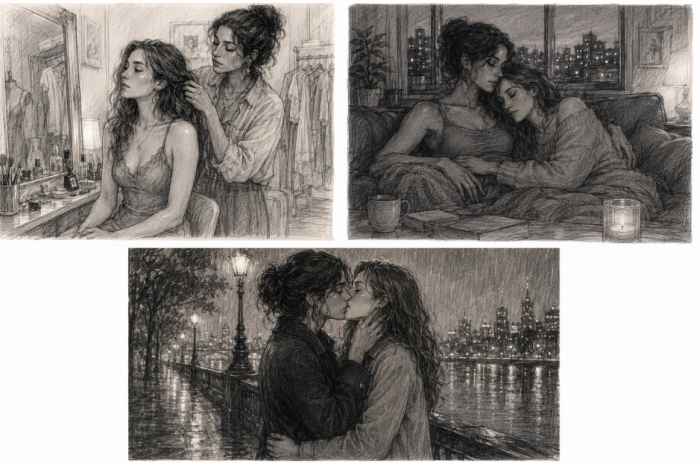 Becoming Emily
Chapter One: Borrowed Dresses (Part 1)
At twenty-four, Aaron had long ago accepted that people would occasionally mistake him for a woman from behind.
His chestnut hair reached just past his shoulders, naturally soft despite his half-hearted attempts to make it look untidy. He kept it because he liked it—though he always shrugged off questions about why he never cut it short.
“It suits you,” his younger sister would say.
“It gets in the way,” he’d answer every time, even though he never made an appointment at the barber.
He wasn’t especially masculine or especially feminine. He was simply… Aaron. Quiet, thoughtful, a graphic designer who worked from home and preferred cafés to crowded bars. He lived alone in a modest apartment filled with books, plants that somehow survived despite his forgetfulness, and an aging golden retriever named Winston.
His life was comfortable in its predictability.
Then Maya walked back into it.
They had met years earlier in college through an art club. Maya had always been effortlessly charismatic. Confident without being loud, elegant without seeming to try. Aaron remembered her sense of humor first, her kindness second, and only later learned about the long journey she had taken to become herself.
After graduation they drifted apart.
One rainy Thursday afternoon, she appeared in the doorway of his favorite café carrying an umbrella patterned with tiny stars.
“Aaron?”
He looked up.
“Maya?”
She laughed.
“You still recognize me.”
“I’d know that laugh anywhere.”
Within minutes they were catching up as though the intervening years had never happened.
Maya now worked as a stylist and makeup artist for fashion shoots and theatrical productions. She spoke passionately about helping people feel comfortable in their own skin.
“It’s amazing,” she said, stirring her tea. “Sometimes all someone needs is permission to see themselves differently.”
Aaron smiled.
“I envy that.”
“What?”
“Having work that changes how people feel.”
Maya tilted her head.
“You already do. Art changes people too.”
He wasn’t convinced.
Still, it felt good talking with her again.
⸻
Two weeks later his phone buzzed.
Maya: I need a ridiculous favor.
Aaron called immediately.
“That sounds ominous.”
“It kind of is.”
She explained that a local theater company had lost one of its backstage assistants only days before opening weekend. The replacement needed to fit into costume briefly during a rehearsal because blocking depended on everyone’s position on stage.
“They don’t actually have to perform,” Maya explained. “Just stand in while we rehearse. You’re about the right height.”
“So… I wear a costume for twenty minutes?”
“…Yes.”
Aaron sighed dramatically.
“I have a feeling I’m going to regret saying yes.”
“You absolutely are.”
⸻
The costume room smelled faintly of fabric softener and fresh paint.
Racks overflowed with dresses from different eras, shoes neatly arranged beneath them.
Aaron froze.
“Maya.”
“Hm?”
“The costume…”
“…is beautiful.”
“It’s a dress.”
“It is.”
“You neglected that detail.”
“I suspected you’d say no.”
“I should say no now.”
“You could.”
She smiled gently.
“But I also know you’re kind enough not to.”
He stared at the elegant navy-blue dress hanging from the rack.
“This is absurd.”
“A little.”
“I’m going to look ridiculous.”
“We’ll see.”
⸻
The changing room was quieter than Aaron expected.
The dress itself wasn’t uncomfortable.
Just… unfamiliar.
He emerged awkwardly, smoothing imaginary wrinkles.
“I refuse to look at anyone.”
“Too late.”
Maya stepped closer with the practiced eye of a stylist.
“Hmm.”
“Hmm?”
“The shoulders fit surprisingly well.”
“That’s your first observation?”
She chuckled.
“You really do have great hair.”
Aaron rolled his eyes.
“Everyone keeps saying that.”
“Because it’s true.”
She gently brushed his hair back behind his ears.
“There.”
He looked into the mirror.
Without intending to, he paused.
The dress didn’t magically transform him.
He still looked unmistakably like himself.
Yet there was something unexpectedly harmonious about the long hair framing his face.
Maya noticed his silence.
“What?”
“I don’t know.”
“What don’t you know?”
“I expected to feel… silly.”
“And?”
“I mostly feel… surprised.”
She nodded.
“Clothes can do that.”
⸻
Rehearsal went better than expected.
Everyone was too busy worrying about lighting cues and stage positions to pay Aaron much attention.
By the time they finished, he had almost forgotten he was wearing the costume.
Almost.
Backstage, Maya handed him a bottle of water.
“You survived.”
“Barely.”
“Liar.”
“I’ll admit…”
He hesitated.
“It wasn’t as embarrassing as I imagined.”
“I figured.”
“You seem awfully pleased with yourself.”
“I am.”
“Why?”
“Because you stopped tugging at the sleeves after the first ten minutes.”
“I did?”
“You relaxed.”
He hadn’t noticed.
⸻
As the evening wound down, Maya carefully packed away brushes and costume accessories.
Aaron picked up a small jewelry box lying open on the counter.
Inside rested a pair of delicate pearl earrings.
“They’re pretty.”
“They’re clip-ons.”
“I’ve never understood how those work.”
She grinned mischievously.
“Want to find out?”
Aaron looked suspicious.
“I don’t like that smile.”
“It’ll take five seconds.”
“Maya…”
She laughed.
“Only if you’re curious.”
He hesitated longer than he cared to admit.
“…Fine.”
The earrings clicked gently into place.
He blinked.
“That’s… less painful than expected.”
She stepped back to admire the effect.
“There.”
“What?”
“They suit your face.”
Aaron instinctively reached up to remove them.
Then he caught his reflection.
The earrings were subtle.
Almost understated.
Combined with his shoulder-length hair, they softened his appearance in a way he hadn’t anticipated.
He frowned—not because he disliked them, but because he couldn’t immediately explain why he didn’t.
Maya watched him carefully.
“You don’t have to make sense of every reaction right away.”
“I’m not trying to.”
“You are.”
He laughed quietly.
“Maybe.”
⸻
Over the next few days, Aaron found himself remembering that moment in the mirror more often than he expected.
Not because he wanted to become someone else.
Because he’d glimpsed a version of himself that felt… unexpectedly comfortable.
The thought lingered.
Like a melody he couldn’t quite place.
He wondered why.
And for the first time in years, he found himself looking at his reflection not with criticism or indifference, but with curiosity.
He wasn’t searching for someone different.
Only wondering how many versions of himself had never had the chance to exist.
Outside, autumn leaves drifted along the sidewalk.
Inside, without realizing it, Aaron had taken the first small step on a journey that would change his life in ways neither he nor Maya could yet imagine.
Becoming Emily
Chapter One: Borrowed Dresses (Part 2)
Aaron expected the theater to call someone else after opening weekend.
Instead, Maya called him.
“I owe you dinner,” she said.
“You don’t.”
“I do.”
“So why does that sound like a trap?”
“Because I also need another favor.”
Aaron laughed.
“There it is.”
⸻
The photography studio occupied the second floor of an old brick warehouse converted into creative workspaces. Racks of garments lined one wall while mirrors framed with bright bulbs illuminated the makeup stations.
“This isn’t theater,” Aaron observed.
“No.”
“So why am I here?”
“The model for a vintage bridal shoot woke up with the flu.”
Aaron stared.
“Maya…”
“I’m not asking you to replace her.”
“Good.”
“I’m asking whether you’d help us test hair, lighting, and wardrobe while we wait to hear if someone else can come.”
He folded his arms.
“That’s a suspiciously specific distinction.”
She smiled.
“It is.”
⸻
An hour later, no replacement had arrived.
The photographer sighed.
“If we cancel today, we lose the location.”
Maya looked at Aaron.
“You can absolutely say no.”
He looked around the studio.
Half a dozen people were quietly waiting.
No one pressured him.
No one expected him to agree.
Yet everyone hoped the day could be salvaged.
Aaron rubbed the back of his neck.
“…How long?”
“Maybe an hour.”
He exhaled.
“Fine.”
⸻
Unlike the theatrical costume, the outfit waiting for him wasn’t extravagant.
It was a simple cream-colored midi dress with flowing sleeves and a fitted waist.
Elegant.
Timeless.
Nothing about it felt exaggerated.
When Aaron stepped into the changing room, he caught himself noticing details he had ignored the first time.
The texture of the fabric.
The careful tailoring.
The way clothing could change not only appearance but posture.
He stood a little straighter.
Walked a little more carefully.
Not because anyone instructed him to.
Because the clothing encouraged it.
It fascinated him.
⸻
Maya waited outside with a garment bag.
“You ready?”
“As I’ll ever be.”
She circled him thoughtfully.
“The dress fits.”
“I’ve noticed.”
“May I?”
She gestured toward his hair.
Aaron nodded.
For several minutes she worked quietly.
A brush.
A curling iron.
Hairpins.
Nothing elaborate.
Just enough to introduce soft waves and gently frame his face.
“There.”
Aaron reached automatically toward his hair.
“No peeking yet,” Maya said with a grin.
“I wasn’t—”
“You absolutely were.”
⸻
Next came makeup.
Aaron had expected something dramatic.
Instead Maya explained every step.
“A little moisturizer.”
“Foundation?”
“Just enough to even your skin tone.”
“What does this do?”
“Concealer.”
“And this?”
“Tinted lip balm.”
He laughed.
“I never realized how many products existed.”
“Most people don’t.”
She spoke about makeup the way an artist discussed painting.
Not as something that hid a face.
Something that emphasized it.
“People think makeup is about pretending,” she said.
“For some, maybe.”
“But for many?”
“It’s about choosing what parts of yourself to celebrate.”
Aaron listened carefully.
The idea stayed with him.
⸻
Finally Maya stepped aside.
“Okay.”
She turned the mirror.
Aaron forgot to breathe.
He still recognized himself.
That surprised him most.
He hadn’t become someone else.
His features remained unmistakably his own.
Yet they appeared… softer.
Brighter.
His hair framed his cheeks in loose waves.
The subtle makeup drew attention to his expressive eyes.
The dress complemented rather than disguised him.
It wasn’t perfection.
It wasn’t illusion.
It simply revealed possibilities he had never imagined.
He stared longer than he intended.
Maya watched his reflection rather than his face.
“What are you thinking?”
Aaron answered honestly.
“I don’t know.”
She nodded.
“That’s allowed.”
“I expected to feel like I was pretending.”
“And instead?”
“…It feels strangely natural.”
Neither of them spoke for several seconds.
⸻
The photographer approached.
“Would you mind standing near the window?”
Aaron looked at Maya.
She gave an encouraging nod.
“Only if you’re comfortable.”
He walked across the studio.
The photographer adjusted a reflector.
“Perfect.”
Aaron almost turned to see who stood behind him.
“No,” the photographer said.
“You.”
Aaron blinked.
“Really?”
“The light catches your hair beautifully.”
The compliment landed differently than compliments usually did.
It wasn’t about looking handsome.
It wasn’t about masculinity.
It was appreciation for something gentle.
Something graceful.
Unexpectedly, he liked hearing it.
⸻
By afternoon the replacement model still hadn’t arrived.
The creative director made a decision.
“We’ll pivot.”
Instead of bridal portraits, they photographed details.
Hands holding flowers.
Silhouettes.
Backlit profiles.
Nothing intended to suggest Aaron was anyone other than a stand-in.
The session became experimental rather than commercial.
Everyone relaxed.
Aaron did too.
Between shots the crew chatted easily with him.
No teasing.
No awkwardness.
Just professionals adapting to circumstances.
For perhaps the first time, Aaron realized the discomfort he’d expected had come mostly from his own assumptions.
⸻
That evening Maya insisted on buying dinner.
They chose a quiet Thai restaurant overlooking the river.
Aaron had changed back into jeans and a sweater.
Yet he kept catching glimpses of himself in the darkened restaurant windows.
Or perhaps remembering them.
Maya noticed.
“Still thinking?”
He smiled sheepishly.
“Is it obvious?”
“A little.”
“I’m confused.”
“About today?”
He nodded.
“I liked it.”
“There isn’t anything wrong with liking it.”
“I know.”
“But it feels like it should mean something.”
“It might.”
“It might not.”
She rested her elbows lightly on the table.
“You don’t have to rush toward an answer.”
Aaron considered that.
“I’ve spent most of my life assuming there were only two choices.”
“What choices?”
“Either something fits perfectly…”
“…or it doesn’t.”
“And now?”
“Now I’m realizing there can be curiosity without certainty.”
Maya smiled warmly.
“I think that’s a healthier place to begin.”
⸻
Over the following weeks, Aaron found himself asking questions.
Not dramatic ones.
Small ones.
How did Maya choose colors that suited her?
Why did certain hairstyles change the impression a face gave?
Why did some fabrics feel elegant while others felt playful?
Maya answered every question with enthusiasm.
Sometimes she demonstrated techniques on mannequin heads from the salon.
Other times, with Aaron’s permission, she showed him on himself.
One Saturday afternoon she taught him how to braid his own hair.
Another day she showed him how different eyebrow shapes subtly changed facial expressions.
Aaron discovered he enjoyed learning.
Not because he had decided who he wanted to become.
Because he enjoyed understanding an art form he had never allowed himself to explore.
⸻
Winter arrived quietly.
Snow dusted the city one evening as Aaron and Maya closed the salon after a charity makeover event.
“You were wonderful today,” Maya said.
“I mostly handed people hairpins.”
“You also listened.”
He shrugged.
“They seemed nervous.”
“They trusted you.”
As they stood outside watching snowflakes drift beneath the streetlights, silence settled comfortably between them.
Aaron looked at Maya.
“Thank you.”
“For what?”
“For never telling me what I’m supposed to feel.”
She smiled.
“I remember wishing someone had given me that freedom.”
Without thinking, Aaron reached for her hand.
She looked down, then back up.
Their fingers intertwined naturally.
Neither hurried.
Neither questioned it.
Together they continued walking through the softly falling snow, two friends discovering that sometimes the gentlest changes begin not with certainty, but with simple acceptance.
Becoming Emily
Chapter One: Borrowed Dresses (Part 3)
By early January, Aaron had fallen into an unexpected routine.
Every other Saturday, he spent the afternoon at Maya’s salon.
Officially, he was helping organize supplies, greet clients during community events, or assist with photography sessions.
Unofficially, he had become Maya’s favorite person to experiment with.
“Turn your head.”
He obeyed.
“A little more.”
“Like this?”
“Perfect.”
She stepped back, considering the hairstyle she’d just finished.
His hair had grown another inch over the winter. With a few careful twists and a pair of pearl pins, she’d transformed the loose waves into an elegant half-up style.
“There,” she said with satisfaction.
Aaron studied the mirror.
“I wouldn’t have imagined my hair could do that.”
“You’ve spent years tying it into the same ponytail.”
“I suppose I have.”
She smiled.
“You’d be amazed what happens when you treat hair like something expressive instead of something to manage.”
⸻
As the weeks passed, Aaron noticed subtle changes in himself.
He stood differently when wearing dresses for photo sessions—not because anyone told him to, but because he had learned how clothing influenced movement.
His shoulders relaxed.
His stride shortened naturally.
He paid attention to fabrics, colors, and silhouettes in a way he never had before.
Oddly enough, the attention spilled over into the rest of his life.
He started dressing more intentionally even on ordinary days.
A better-fitting coat.
A softer scarf.
Boots he genuinely liked instead of simply tolerating.
His sister noticed almost immediately.
“You’ve been shopping.”
Aaron laughed.
“That obvious?”
“You look… happier.”
He hesitated.
“I think I’m figuring out what I actually enjoy.”
She grinned.
“It’s about time.”
⸻
One afternoon, Maya spread a collection of dresses across a clothing rack.
“Spring collection,” she announced.
Aaron raised an eyebrow.
“I thought I was helping you organize.”
“You are.”
“By trying everything on?”
“Exactly.”
He chuckled.
“You planned this.”
“I absolutely planned this.”
⸻
Among the dresses was a simple pale-blue wrap dress that caught Aaron’s attention.
He couldn’t explain why.
It wasn’t the fanciest.
It wasn’t the most dramatic.
It simply felt…
Comfortable.
When he stepped out of the changing room wearing it, Maya’s expression softened.
“That’s the one.”
“The one?”
“The one you forgot you were wearing.”
Aaron blinked.
“What do you mean?”
“You walked out naturally.”
He thought back.
She was right.
For the first time, he hadn’t paused to wonder how he looked.
He had simply walked.
That realization lingered.
⸻
The salon’s receptionist poked her head around the corner.
“Maya?”
“Yes?”
“Your two o’clock is early.”
“I’ll be right there.”
She turned back toward Aaron.
“I’ll only be a few minutes.”
Left alone, Aaron wandered toward the large mirror near the window.
Sunlight filtered through sheer curtains.
He studied his reflection quietly.
The familiar face looking back at him had become…
Complicated.
Not in a frightening way.
In an honest way.
He still saw Aaron.
Yet there was another version of himself he had begun to recognize.
Not a stranger.
A possibility.
Someone who smiled a little more freely.
Someone who seemed unexpectedly at ease.
The thought no longer frightened him.
It simply asked to be understood.
⸻
That evening, after the salon had closed, Maya brewed tea for both of them.
“I’ve been wondering something,” she said.
Aaron looked up.
“What?”
“When we’re working together…”
She smiled apologetically.
“I keep almost introducing you differently.”
“Differently how?”
She hesitated.
“When clients ask who you are.”
He laughed.
“‘This is Aaron, my friend who occasionally models dresses’ is admittedly a mouthful.”
“Exactly.”
“So what do you usually say?”
“My assistant.”
“That’s safe.”
“It is.”
She stirred her tea thoughtfully.
“Sometimes performers use stage names.”
Aaron nodded.
“I know.”
“I wondered whether you’d ever want one.”
He blinked.
“A feminine one?”
“Only for creative work.”
“Only if you wanted.”
The room grew quiet.
Aaron considered the idea far more seriously than he expected.
“A name…”
he murmured.
He’d never thought about it before.
Names carried weight.
History.
Expectation.
Identity.
Maya reached for a notebook.
“I made a list.”
“You made a list?”
“I may have been thinking about this for a while.”
Aaron laughed so hard he nearly spilled his tea.
“Of course you did.”
⸻
They spent nearly an hour reading names aloud.
“Claire?”
“Not me.”
“Julia?”
Aaron shook his head.
“Sophia?”
“Pretty.”
“But not quite.”
“What about…”
She paused.
“…Emily?”
The room became strangely still.
Aaron repeated it softly.
“Emily.”
It felt warm somehow.
Gentle.
He couldn’t explain why.
Maya watched carefully.
“You smiled.”
“I did?”
“You did.”
He looked down at his teacup.
“I… like it.”
“Would you like me to use it?”
He thought for a long moment.
“Only here.”
“Only here,” Maya agreed.
“No pressure.”
“No expectations.”
“Just…”
“…Emily.”
The name settled between them comfortably.
Not replacing Aaron.
Simply existing alongside him.
⸻
The first time Maya greeted him with, “Good morning, Emily,” he instinctively looked over his shoulder.
“There isn’t anyone else here,” Maya teased.
“I know.”
“It’ll take time.”
Aaron smiled.
“No.”
He corrected himself quietly.
“Emily.”
Hearing the name spoken aloud felt different than saying it himself.
It wasn’t a costume.
It wasn’t a performance.
It was a space where he could explore without needing immediate answers.
And somehow, that made all the difference.
⸻
As winter gave way to spring, Emily became a familiar presence inside the salon.
Only there.
Only with people Aaron trusted.
The transformation was never rushed.
Some days he arrived in ordinary clothes and left that way.
Other days he spent hours experimenting with hairstyles, learning makeup techniques, or trying combinations of skirts, blouses, and dresses simply to understand what felt authentic.
There were no rules.
Only curiosity.
One evening, after locking the salon, Maya looked at him thoughtfully.
“You know…”
“What?”
“When I first asked you to wear a costume, I thought I was asking a favor.”
“And now?”
“I think we accidentally opened a door.”
Aaron—Emily—looked up at the evening sky, where the first stars were beginning to appear.
“I think…”
he said slowly,
“…I wanted that door to exist long before either of us knew it was there.”
Maya reached for his hand.
He met her halfway.
Neither of them needed to define what they were becoming—not yet.
For now, it was enough to walk side by side, trusting that the answers would come in their own time.
Becoming Emily
Chapter One: Borrowed Dresses (Part 4)
The first thing Emily noticed was that she had stopped counting the days she spent dressed as herself.
At first there had been a mental ledger. Saturdays at the salon. The occasional photography session. An afternoon helping Maya organize wardrobes. Every experience had been carefully contained, almost quarantined from the rest of her life, as though she feared that allowing those moments to spill into ordinary time would force a question she wasn’t prepared to answer.
Gradually, the ledger disappeared.
She no longer thought, Today I’m pretending.
Instead she found herself wondering, How do I feel today?
The answer was rarely simple.
Some mornings she woke as Aaron, pulled on jeans and a sweater, and thought little about it. Other mornings she found herself standing before the wardrobe for several minutes, her hand resting on the door, remembering the pale blue wrap dress hanging in Maya’s studio. She wasn’t longing for the dress itself. She was remembering the quiet ease that came with wearing it.
It surprised her how much of femininity, at least for her, had very little to do with being looked at.
The private moments mattered far more.
The careful ritual of brushing out her long hair until it caught the morning light.
Learning to twist it into a loose bun that inevitably escaped into soft strands around her face.
The gentle concentration required to apply a little concealer beneath tired eyes.
The almost meditative act of choosing earrings.
Each gesture asked for patience instead of performance.
For years, she had moved through life without paying much attention to her own reflection. Mirrors had been functional objects, nothing more. Now they had become places of conversation. She wasn’t admiring herself so much as getting acquainted with someone she had overlooked for a very long time.
⸻
One rainy afternoon, while helping Maya sort through donated clothing for a local LGBTQ+ community center, Emily finally asked the question that had lingered for months.
“What was it like?”
Maya looked up from a cardboard box.
“What?”
“The beginning.”
There was no need to explain further.
Maya understood.
She sat cross-legged on the wooden floor, folding a cream cardigan before answering.
“I spent years believing I needed certainty before I was allowed to explore.”
Emily listened quietly.
“I thought if I tried on a dress, or learned makeup, or imagined another name, it meant I had already made every decision about my future.”
She smiled faintly.
“I was wrong.”
Emily remained silent, sensing there was more.
“My transition didn’t begin the day I changed my name. It began the day I stopped punishing myself for being curious.”
The sentence settled into the room like a feather finding still water.
Emily looked down at the dress folded across her lap.
Curiosity.
The word felt kinder than every label she had been trying on in private.
Maya had never once asked her what she was.
Never suggested that curiosity required a destination.
Emily realized, perhaps for the first time, what an extraordinary gift that restraint had been.
⸻
There were photographs of Maya from years earlier tucked inside old albums she occasionally shared.
Not because she enjoyed revisiting them, but because she wanted Emily to understand that becoming herself had not erased who she had been.
The younger Maya smiled uncertainly in nearly every picture.
She always seemed to be occupying space she had borrowed from someone else.
The woman sitting beside Emily now looked entirely different—not because her features had changed beyond recognition, but because she inhabited them with ease.
Confidence had altered her expression more than any surgery or hormone ever could.
Emily wondered whether peace was visible.
Looking at Maya, she thought perhaps it was.
⸻
Their relationship deepened almost imperceptibly.
There was no dramatic confession.
No sudden declaration.
Instead it accumulated through ordinary kindnesses.
Maya remembered how Emily liked her tea.
Emily learned that Maya hummed absentmindedly whenever she concentrated on intricate hairstyles.
Rainy evenings became shared dinners after closing the salon.
Sunday mornings sometimes meant wandering through botanical gardens, saying very little as spring slowly reclaimed the city.
Emily found herself watching Maya in unguarded moments.
The way she greeted nervous clients with effortless warmth.
The quiet pride she took in helping teenagers prepare for school dances, older women rediscover hairstyles they’d abandoned years ago, and transgender clients experiencing their first affirming makeover.
She never treated beauty as correction.
Only as revelation.
Emily fell in love gradually, almost accidentally.
Not because Maya had introduced her to dresses or makeup.
Because Maya possessed the rare ability to make another person feel that there was nothing shameful about becoming more fully themselves.
It was an act of generosity Emily had never encountered before.
⸻
One evening they attended a small charity gala hosted by the community center.
Emily wore a forest-green dress she had chosen herself.
Not borrowed.
Not selected by Maya.
Bought after an hour spent quietly browsing a boutique, her hands trembling as she carried it to the register.
The purchase had felt strangely ceremonial.
The dress now hung naturally against her frame.
She had styled her own hair for the first time.
Applied her own makeup with only the lightest corrections from Maya.
Standing in front of the mirror before leaving the apartment, she had realized something that almost brought tears to her eyes.
She no longer saw a man attempting to resemble a woman.
She simply saw herself.
The realization was so gentle she nearly missed it.
She smiled.
Not because the reflection was flawless.
Because it felt familiar.
⸻
At the gala, strangers addressed her without hesitation.
No second glances.
No puzzled expressions.
Only effortless acceptance.
Emily had imagined that being seen this way would feel exhilarating.
Instead it felt… peaceful.
As though some constant background noise she had lived with for years had quietly switched off.
She spoke with volunteers, laughed at stories from local artists, listened as Maya introduced her simply as “Emily.”
No explanation followed.
None was requested.
The name passed from person to person with such natural ease that Emily almost forgot there had ever been another.
Later that evening, while music drifted softly through the hall, Maya found her standing alone on a balcony overlooking the city lights.
Emily rested her hands against the cool railing.
“I think something changed tonight,” she whispered.
Maya didn’t ask what.
She waited.
Emily searched for the words.
“I’ve spent months wondering when I’d stop feeling like a guest in my own life.”
A light breeze stirred loose strands of her hair.
“For the first time…”
She closed her eyes.
“…I felt like I had come home.”
Maya’s hand found hers without urgency.
Their fingers intertwined naturally.
Neither woman looked at the other immediately.
They simply stood together beneath the evening sky, sharing a silence that carried more understanding than conversation ever could.
Emily realized she was no longer grateful merely for Maya’s guidance.
She was grateful for Maya herself.
The realization filled her with equal measures of warmth and fear.
First love, she suspected, often arrived quietly enough to be mistaken for gratitude until one ordinary evening revealed it had become something much deeper.
Becoming Emily
Chapter One: Borrowed Dresses (Part 5)
There was no single morning when Aaron disappeared.
The realization came instead through absence.
One afternoon Emily reached automatically for her wallet while leaving the apartment and noticed that she had begun thinking of herself in the first person without correction. Weeks earlier, the thought would have startled her. Now it simply passed through her mind with the same quiet certainty as remembering her keys.
She had stopped rehearsing who she was.
She had begun living.
The transition happened in countless ordinary moments that no one else would have considered remarkable.
She lingered over shampoo because she had discovered the pleasure of caring for her hair rather than merely maintaining it. She learned that different fabrics moved differently in the wind and that certain colors changed the way she carried herself. She developed a fondness for long cardigans, soft knit dresses, and delicate silver jewelry—not because they made her feel more feminine, but because they felt unmistakably like her.
She had expected femininity to be dramatic.
Instead it was full of quiet rituals.
Brushing.
Choosing.
Caring.
Paying attention.
Those rituals slowly transformed not only how she looked but how she inhabited time itself. She became less hurried. More observant. She noticed flowers planted outside apartment buildings she had walked past for years. She found herself pausing to watch reflections shimmer in rain-soaked pavement. She wrote more often in a notebook Maya had given her, filling pages with impressions instead of conclusions.
Maybe becoming yourself isn’t discovering something hidden, she wrote one evening.
Maybe it’s finally giving yourself enough silence to hear what was always there.
⸻
Spring unfolded almost unnoticed.
The trees outside the salon exchanged bare branches for pale green leaves. Warm afternoons brought more people into the neighborhood, and the sidewalks filled with conversations spilling out from cafés.
Emily liked walking those streets.
At first she had chosen neighborhoods far from home, places where anonymity felt like protection. Every outing had carried a current of nervous anticipation. Would someone stare? Would someone recognize her? Would she be questioned?
Those fears had shaped every step.
Reality proved gentler.
Most people barely looked up from their own conversations.
The barista smiled and asked for her order.
The florist complimented her earrings.
An elderly woman held open a door and wished her a pleasant afternoon.
Life continued with astonishing indifference.
Emily slowly understood that strangers were occupied with the complicated business of being themselves.
They were not waiting to examine her.
That realization felt like laying down a weight she had carried for years without realizing how heavy it had become.
⸻
She began spending more evenings at Maya’s apartment.
Not because either of them planned it.
Because leaving always seemed unnecessary.
They cooked together, often improvising meals from whatever vegetables remained in Maya’s refrigerator. Afterwards they would sit on the small balcony overlooking the city.
Maya had filled the space with potted herbs and climbing jasmine. On warm evenings the flowers released a faint sweetness that drifted through the air.
Emily loved those evenings because nothing needed to happen.
There was no lesson.
No makeover.
No discussion about identity.
Sometimes they read separate books in companionable silence. Sometimes they listened to old jazz records while rain tapped gently against the railing.
Emily gradually realized that what she cherished most about Maya was not the guidance she had offered during the past months.
It was the ease.
With Maya, she never felt observed.
She felt seen.
The distinction mattered more than she could explain.
⸻
Only once did Emily ask about Maya’s transition in detail.
Not out of curiosity for medical milestones or dates.
She wanted to understand what peace had cost.
Maya answered with characteristic honesty.
“There were years,” she admitted quietly, “when I thought my future depended on convincing everyone else that I was real.”
She looked down into her tea before continuing.
“I eventually discovered something difficult.”
Emily waited.
“The people who loved me eventually understood.”
“And the people who refused…”
Maya smiled sadly.
“…would never have been convinced by perfection anyway.”
Emily carried those words home.
For days they echoed through her thoughts.
She recognized herself in them, despite the differences in their journeys.
She had spent so much energy imagining impossible standards she believed she needed to meet before allowing herself happiness.
A perfect explanation.
A perfect certainty.
A perfect future.
Perhaps none existed.
Perhaps living honestly had always required stepping forward before certainty arrived.
⸻
One Saturday afternoon they wandered through a weekend artisan market.
Emily wore a cream blouse tucked into a flowing navy skirt, comfortable ankle boots, and a lightweight cardigan that fluttered whenever the breeze caught it.
No one stared.
No one questioned her.
She paused beside a stall selling handmade hair clips carved from polished wood.
Her fingers drifted across their smooth surfaces.
Months ago she would have admired them as objects belonging to someone else’s world.
Now she wondered which one would match the dress hanging in her closet.
The thought made her smile.
Without realizing it, she had begun planning a future that assumed Emily would still exist tomorrow.
That simple expectation felt astonishing.
⸻
As the afternoon faded into evening, Maya reached for her hand.
The gesture had become familiar over recent weeks.
Still, it sent a gentle warmth through Emily every time.
Neither woman hurried to define their relationship.
Labels seemed oddly unnecessary.
Love, Emily was beginning to understand, often announced itself through consistency rather than spectacle.
It was remembering.
Choosing.
Returning.
She had never experienced affection that felt so calm.
There were no games to decipher.
No performances to maintain.
Only the steady reassurance that someone delighted in her company.
For someone who had spent much of her life wondering whether she was enough, that reassurance was quietly transformative.
⸻
Later that night, Emily stood alone before the mirror in her apartment.
She removed her earrings first, placing them carefully into a small porcelain dish.
Then her necklace.
She brushed out her hair slowly, watching the waves settle across her shoulders.
At last she met her own eyes.
The face reflected there still carried traces of uncertainty.
Growth rarely erased every doubt.
But the fear that had once dominated her expression had softened into curiosity, and curiosity had gradually become hope.
She realized she had stopped asking herself whether Emily was real.
Instead, a different question had taken root.
What kind of woman do I want to become?
The question felt expansive rather than frightening.
There was no single answer waiting to be discovered.
Only a life waiting to be lived.
Outside her window, the city settled into the quiet rhythm of late evening.
Inside, Emily turned off the bedroom light and smiled into the darkness.
For the first time in years, tomorrow felt less like something to endure than something to anticipate.
| Attachment | Size |
|---|---|
 IMG_4202.jpeg IMG_4202.jpeg | 319.16 KB |

Becoming Emily - Borrowed Dresses - Chapter 2 Final
Author:
Audience Rating:
Publication:
Genre:
Permission:
Becoming Emily
Becoming Emily
Chapter Two: Learning to Stay (Part 1)
The first morning Emily signed her name instead of Aaron’s, she expected the pen to hesitate.
It didn’t.
The ink flowed across the page with quiet confidence, forming six familiar letters that had long since ceased to feel borrowed.
Emily.
She looked at the signature for several moments after the form had been handed back across the counter.
Nothing extraordinary happened.
The clerk smiled politely and moved to the next customer.
Outside, the city continued exactly as it had before.
Yet Emily stood on the pavement with an unexpected ache behind her eyes.
She realized she had spent so many months imagining monumental moments that she had almost overlooked the beauty of ordinary ones.
A name on a form.
A receipt.
A greeting.
Tiny acknowledgements that quietly accumulated into a life.
⸻
Living as Emily full-time proved less dramatic than she had once imagined.
Life retained its familiar rhythms.
Laundry still waited to be folded.
Bills still arrived.
The dog still insisted on morning walks before breakfast.
There was comfort in discovering that authenticity did not replace ordinary life.
It simply allowed her to participate in it more honestly.
Sometimes she laughed at herself.
She had once imagined that becoming Emily would answer every question she had ever asked.
Instead it merely changed the questions.
No longer Who am I?
Now they were gentler.
What kind of partner do I want to be?
What kind of artist?
What kind of friend?
Identity had stopped being the destination.
It had become the starting point.
⸻
Maya noticed the difference before Emily did.
There was a steadiness about her now.
Less urgency.
Less searching.
The nervous habit of touching the necklace at her throat whenever strangers looked her way had almost disappeared.
She laughed more readily.
She no longer apologized before expressing an opinion.
Even the way she occupied physical space had changed.
She stood without unconsciously trying to disappear.
Watching those changes filled Maya with quiet pride.
Not because she believed she had created them.
Because she remembered hoping, years earlier, that someone else might someday experience the same peace she had fought so hard to find.
Seeing Emily arrive there felt like watching dawn return after a very long winter.
⸻
Their relationship entered a softer season.
The urgency of first love gradually gave way to familiarity.
Emily found herself memorizing the shape of ordinary evenings.
Maya reading beside the open window.
The faint scent of rosemary drifting from the kitchen while dinner simmered.
The gentle brush of shoulders as they moved around one another in the apartment.
They became fluent in each other’s silences.
Sometimes entire evenings passed with only a handful of words exchanged.
Emily discovered that intimacy was not measured by conversation.
It was measured by the absence of performance.
She no longer wondered whether Maya found her beautiful.
She knew she was cherished.
There was an extraordinary calm in that certainty.
⸻
As summer faded toward autumn, Emily accepted a position illustrating book covers for a small publishing house.
It meant fewer afternoons at the salon.
More deadlines.
More meetings.
More opportunities to build a life that belonged entirely to her.
She welcomed the change with equal parts excitement and apprehension.
For the first time, people were meeting Emily without ever knowing another version of her.
She wasn’t introducing herself.
She was simply living.
The realization was strangely liberating.
No explanations followed her into conference rooms.
No history preceded her.
She could simply arrive.
⸻
One evening, after finishing work later than expected, Emily walked toward the train station beneath trees beginning to surrender their first golden leaves.
She paused outside a bookstore.
In the window stood a display of sketchbooks identical to the one Maya had given her nearly a year earlier.
She smiled.
That notebook had become the quiet record of her transformation.
Not because it documented milestones.
Because it captured moments.
She bought another.
Not to replace the old one.
To continue the story.
⸻
Later that night, curled beside Maya on the sofa, Emily turned the blank pages slowly.
“Another journal?” Maya asked with an affectionate smile.
Emily nodded.
“I filled the first one.”
“Already?”
“I think…”
She rested her fingertips against the empty page.
“…the first one was about becoming.”
“And this one?”
Emily looked thoughtfully out the rain-speckled window.
“I think this one is about living.”
Maya reached over and gently squeezed her hand.
Neither of them realized that the answer carried a quiet truth neither was yet ready to see.
The first journal had been written by a woman searching for herself.
The second would be written by a woman searching for her future.
Those were not always the same journey.
⸻
Weeks passed.
Emily settled naturally into her new work.
She began visiting neighborhood cafés to sketch after meetings, discovering that observing strangers remained one of her favorite forms of inspiration.
One Tuesday afternoon she noticed a man sitting alone near the window reading a thick novel.
He was there again on Thursday.
And again the following Monday.
They never spoke.
Occasionally their eyes met in the reflection of the glass before each returned politely to their own thoughts.
Emily barely considered it remarkable.
Cities were full of familiar strangers.
Still, she found herself wondering what chapter he was reading.
Then she laughed quietly at herself.
Not because she imagined romance.
Because she had finally become curious about other people’s stories again.
For a long time, her own story had occupied every corner of her heart.
Perhaps that was changing.
Perhaps healing created room for new people.
She closed her sketchbook and stepped back into the crisp autumn afternoon, unaware that another chapter of her life had already begun to approach—slowly, quietly, with the same patience that had brought Emily herself into the light.
Chapter Two: Learning to Stay (Part 2)
Autumn arrived almost unnoticed.
The first leaves appeared one morning outside Emily’s apartment, scattered across the sidewalk like forgotten letters. She watched them drift while a squirrel sniffed patiently at every tree, entirely unconcerned with the quiet revolutions taking place inside the woman holding his leash.
Life had become wonderfully ordinary.
She caught the train to work.
She complained about deadlines.
She bought groceries, watered her plants, forgot laundry in the washing machine.
Months earlier she had imagined that living openly as Emily would feel extraordinary every day.
Instead, the extraordinary part was that it no longer did.
The novelty had slowly dissolved into belonging.
And belonging, she realized, was infinitely more satisfying.
⸻
Beginning hormone therapy felt different.
It wasn’t the dramatic turning point people imagined when they heard the word transition.
There were no immediate transformations.
Only waiting.
Emily had become unexpectedly good at waiting.
She found herself thinking about gardens.
No one planted a seed and expected blossoms the following morning.
Growth possessed its own rhythm.
Her body, she suspected, would be no different.
She began recording small observations in her journal.
Week three.
My skin feels softer. I don’t know whether anyone else would notice, but I do.
Week six.
I cried during a film I’d seen three times before. I’m not embarrassed by it anymore.
Week nine.
Something is changing, even if I can’t describe it.
Looking back through the pages, she realized she was writing less about appearances and more about sensation.
She felt… gentler.
Not weaker.
Simply less armored.
⸻
The first unmistakable physical changes arrived so quietly that Emily almost overlooked them.
One evening, while changing into a loose sweater after a shower, she caught herself pausing before the mirror.
There was a subtle difference in the silhouette reflected back at her.
Barely perceptible.
A softness that hadn’t been there before.
She rested her hand lightly against her chest.
The tenderness surprised her.
Not painful.
Simply unfamiliar.
She stood there for several minutes, smiling through unexpected tears.
This time they weren’t tears of relief.
They were tears of recognition.
She wasn’t celebrating a physical feature.
She was witnessing her body beginning to participate in a journey her heart had started long ago.
For the first time, those two parts of herself seemed to be walking in the same direction.
⸻
Clothing changed again.
Not because Emily wanted it to.
Because her body quietly asked for different things.
Sweaters draped differently.
Blouses settled along unfamiliar curves.
She discovered herself standing longer in changing rooms, not judging her reflection but studying it with patient curiosity.
She remembered the frightened person who had once believed dresses alone held transformative power.
Now she understood.
The clothes had never mattered nearly as much as the comfort with which she inhabited them.
Femininity was becoming less performative and more instinctive.
She crossed her legs without thinking.
Tucked loose hair behind her ear absentmindedly.
Rested her hands differently while speaking.
These weren’t gestures she consciously practiced.
They simply appeared, as though some quiet part of her had finally stopped asking permission.
⸻
One afternoon Maya photographed Emily in the salon for no particular reason.
No professional lighting.
No elaborate styling.
Emily wore a cream knit sweater, faded jeans, and almost no makeup.
She laughed when Maya insisted on taking the picture.
When she saw the finished image later that evening, something caught in her throat.
There was no trace of performance.
Only comfort.
The woman smiling at the camera looked as though she had forgotten it was there.
Emily realized she had spent years chasing the idea of looking feminine.
Without noticing, she had begun looking like herself instead.
The difference mattered enormously.
⸻
Love, too, was changing.
Not diminishing.
Changing.
The urgency that had once characterized Emily and Maya’s relationship slowly gave way to something quieter.
They still reached instinctively for one another’s hands while walking through crowded streets.
Emily still fell asleep with her head resting against Maya’s shoulder while rain tapped softly against the apartment windows.
There was still affection.
Still tenderness.
Still gratitude.
Yet Emily began noticing something she could not quite explain.
When she imagined her future, the picture had become strangely spacious.
Not lonely.
Open.
As though life still contained chapters neither of them had yet read.
The realization frightened her.
Not because it suggested unhappiness.
Because it suggested change.
⸻
At work, Emily noticed herself paying attention to people differently.
She sketched constantly.
Faces on trains.
Readers in cafés.
Musicians performing in the square outside her office.
One afternoon she found herself studying a man seated across the room.
He was perhaps a few years older than she was, dressed plainly, completely absorbed in a weathered paperback.
Nothing about him demanded attention.
And yet Emily found herself wondering what kind of laugh he had.
The thought startled her.
Not because she had never appreciated an attractive man.
Because she had never lingered on the feeling.
She closed her sketchbook and looked out the café window instead.
For several minutes she examined the unfamiliar sensation carefully.
It wasn’t dramatic.
It wasn’t overwhelming.
It was curiosity.
The same quiet curiosity that had once led her toward dresses, makeup, and the name Emily.
Only now it seemed to be asking an entirely different question.
⸻
That evening she walked home beneath trees blazing gold and crimson.
The question stayed with her.
She loved Maya.
Of that she felt certain.
The love was real.
It had changed her life.
But certainty about one feeling did not erase the possibility of discovering another.
Emily wondered whether she had mistaken the limits of her experience for the limits of herself.
She had spent years believing she understood who she could become.
Life had gently proven otherwise.
Perhaps attraction could unfold the same way.
Not as contradiction.
As expansion.
⸻
She didn’t speak about those thoughts immediately.
Instead she watched them.
She had learned enough over the past two years not to rush toward conclusions.
Identity had taught her patience.
She extended that same patience toward her heart.
Some evenings she noticed herself absentmindedly observing men passing on the street, wondering what kind of stories they carried.
Sometimes she caught herself appreciating a deep voice, broad hands wrapped around a coffee cup, or the reassuring steadiness with which someone occupied a room.
She never felt guilty.
Only curious.
It was less about desire than recognition—another unopened door appearing quietly in the hallway of her life.
And if her journey had taught her anything, it was this:
The doors worth opening rarely announced themselves with certainty.
They invited curiosity first.
The answers came later.
Emily closed her journal that night with a peaceful smile.
Two years earlier she had believed becoming herself would mean finally reaching the end of her questions.
Instead she had discovered something far more beautiful.
An honest life was not one without questions.
It was one in which she no longer feared asking them.
Becoming Emily
Chapter Two: Learning to Stay (Part 3)
Winter arrived quietly, wrapping the city in muted colors.
Emily found that she had begun measuring time differently.
Once, every month had been another step in transition. She had counted milestones with almost scientific precision, searching the mirror each morning for evidence that her body was moving toward the woman she already knew herself to be.
Now the changes arrived almost as surprises.
She would pull a sweater over her head and notice that the fabric rested differently than it had only weeks before. A favorite dress, once hanging almost straight, now followed softer lines. A winter coat that had fit comfortably the previous year suddenly felt as though it had been tailored for someone she no longer entirely remembered.
She stopped looking for change because change had quietly become her everyday companion.
⸻
Her journal reflected that evolution.
The earliest pages were full of observation.
Today my face looked softer.
My hair is long enough to wear this style.
I think strangers see Emily before they see anything else.
Months later, the entries no longer centered on appearance.
Instead they became almost philosophical.
I spent years believing my body was something I needed to negotiate with.
Now it feels like we’re learning the same language.
She reread that sentence several times.
It felt true in a way that surprised her.
Hormones had altered more than measurements or contours. They had changed the relationship she carried with herself.
She no longer regarded her reflection as an evaluation.
It had become a conversation.
⸻
Some evenings she would stand before the mirror after brushing her hair.
Not to admire herself.
Simply to witness.
She watched the woman reflected there breathe quietly beneath the warm bathroom light.
There was still tenderness across her chest as her body continued to change. The sensation reminded her daily that growth was not abstract.
It lived beneath her skin.
She rested a hand lightly over her heart.
Years earlier she had imagined transition as moving from one person into another.
Now she understood that nothing so absolute had happened.
Aaron had not vanished.
He had simply stopped carrying a role that had become too heavy to sustain.
Emily felt less like someone new than someone finally uninterrupted.
⸻
As her confidence settled into something deeper than excitement, another quiet change began unfolding.
She noticed men.
Not dramatically.
Not all at once.
Her attention lingered where once it would have passed by unnoticed.
A warm smile exchanged with a stranger while ordering coffee.
The gentle patience of a man helping an elderly customer carry groceries.
The calm voice of a colleague explaining an idea during a meeting.
She found herself observing qualities she had never consciously looked for before.
Kindness.
Gentleness.
Presence.
The realization fascinated her more than it frightened her.
For weeks she had assumed that this new awareness must somehow invalidate what she felt for Maya.
Yet every time she returned home and found Maya reading by the window, wrapped in an oversized cardigan with a mug of tea balanced on one knee, affection still rose naturally inside her.
Nothing had disappeared.
Something else had simply appeared beside it.
⸻
That thought stayed with her for days.
Perhaps hearts were less orderly than people hoped.
She had spent years trying to fit herself inside definitions that felt too narrow.
Maybe attraction resisted neat categories for the same reason identity often did.
It grew where experience allowed it to grow.
She found unexpected comfort in that possibility.
Not because it solved anything.
Because it removed the pressure to solve everything immediately.
⸻
One afternoon, while sketching in the familiar café near her office, she noticed the same man she had seen several times before.
He occupied his usual seat near the window.
Dark wool coat folded carefully over the back of his chair.
A thick novel resting beside an untouched cup of coffee.
He read with remarkable concentration.
Occasionally he smiled faintly at something on the page before absentmindedly tucking a loose strand of hair behind one ear.
Emily smiled to herself.
She realized she had stopped wondering whether he found her attractive.
Instead she wondered what made him smile like that.
The difference felt significant.
Curiosity had replaced self-consciousness.
She sketched without looking directly at him, capturing the relaxed posture of someone completely absorbed in another world.
When she closed the notebook an hour later, she discovered that the drawing carried an unusual tenderness.
Not romance.
Attention.
She had drawn him the same way she drew landscapes she loved.
⸻
That evening she walked home beneath a pale winter sky.
The cold air carried the scent of wood smoke from nearby chimneys.
She tucked her scarf more closely around her neck and reflected on how dramatically her understanding of desire had changed.
When she was younger, attraction had always seemed performative.
Something people were expected to announce.
Something measured by certainty.
Now it felt quieter.
More like gravity than lightning.
A subtle inclination toward warmth.
Toward safety.
Toward people whose presence allowed her to become a little more herself.
Perhaps that was why Maya had been her first great love.
Not because Maya had shown her femininity.
Because Maya had shown her acceptance.
Emily would always love the woman who had held that door open.
She knew that with complete certainty.
Whether that love would remain romantic forever was a question she could not yet answer.
But she no longer believed that changing answers erased earlier truths.
Some relationships were chapters.
Others became foundations.
Neither was less important.
⸻
Later that night she opened her journal once more.
She wrote slowly, allowing each sentence to arrive without forcing it.
When I first met Maya, I thought she was leading me toward womanhood.
She wasn’t.
She was leading me toward honesty.
Honesty is strange.
It doesn’t stop asking questions once you’ve answered the first one.
Emily closed the notebook and rested her hand against its worn leather cover.
Outside, snow had begun to fall.
The flakes drifted through the glow of the streetlights with unhurried certainty, each one following its own path to the ground.
Watching them, she smiled.
For the first time in her life, she no longer felt compelled to decide the ending of her story before allowing herself to live the next page.
She trusted that, when the time came, her heart would recognize the truth as gently as it had recognized the name Emily.
Becoming Emily
Chapter Two: Learning to Stay (Part 4)
There came a point when Emily stopped measuring transition by mirrors.
The mirror had served an important purpose in the beginning. It had reassured her that the woman she felt herself becoming could also be seen. Every softened feature, every new contour, every subtle change had once carried enormous emotional weight.
Now the mirror had become almost incidental.
It reflected a life already being lived.
Instead, Emily measured herself by instinct.
She noticed it while walking through department stores. Months earlier she would have wandered uncertainly between clothing racks, wondering whether she belonged there at all. Now she reached automatically toward fabrics she loved, absentmindedly comparing textures between her fingertips, imagining how a wool skirt might pair with a favorite sweater already hanging in her wardrobe.
There was no performance in those moments.
No audience.
Only preference.
She realized that femininity had quietly become less about appearance than participation.
She wasn’t trying to resemble the woman she imagined.
She was simply making choices as the woman she already knew herself to be.
⸻
The physical changes continued at their own patient pace.
Some mornings she caught sight of herself unexpectedly while passing a shop window and experienced a fleeting moment of surprise—not because she failed to recognize the reflection, but because recognition now arrived so effortlessly.
There had once been a split second in which her mind translated what she saw.
That pause had disappeared.
She simply looked.
She smiled.
She kept walking.
The ease of it moved her more than any dramatic transformation ever could.
⸻
Work settled into a comfortable rhythm.
Emily became known among her colleagues for lingering over details that others overlooked.
She drew hands with remarkable care.
Expressions between words.
The subtle posture of people who were listening rather than speaking.
Her editor once remarked that every character Emily illustrated seemed to possess an interior life.
The compliment stayed with her.
Perhaps, she thought, learning to notice her own inner landscape had quietly taught her to imagine everyone else’s.
⸻
The café near the publishing house became part of her weekly routine.
By now she recognized the regulars almost without thinking.
The elderly woman who solved crossword puzzles every Tuesday.
The university student who always ordered peppermint tea.
The man near the window.
She eventually learned his name without intending to.
One afternoon the barista called out, “Oliver, your refill.”
The name settled somewhere in her thoughts.
Oliver.
She found herself attaching it to the sketches she’d made over the past months.
Not because the drawings were about him.
Because names transformed strangers into possibilities.
She wondered what occupied his life outside those quiet afternoons.
Whether he worked nearby.
Whether he preferred novels to films because books allowed him to inhabit another person’s thoughts.
Emily smiled at herself.
She had built entire stories around strangers since childhood.
This felt no different.
Or perhaps it felt just different enough that she hesitated to admit it.
⸻
That hesitation fascinated her.
She had always imagined attraction as immediate, unmistakable.
Instead it appeared to arrive through attention.
The more she noticed Oliver’s small habits, the more curious she became.
The way he thanked the staff before leaving.
The habit of smiling at dogs that wandered past the café window.
The way he always closed a book carefully, as though it deserved gentleness.
None of these things were dramatic.
Together they formed an impression that lingered after he had gone.
Emily found herself asking a question she had never expected.
Is this what attraction feels like for me?
Not urgency.
Not fantasy.
A quiet desire to know another person.
The question remained unanswered.
She allowed it to remain that way.
⸻
At home, life with Maya retained its familiar warmth.
They still cooked together several evenings each week.
They still wandered bookstores on rainy Sundays.
They still reached instinctively for each other’s hands while crossing busy streets.
Nothing had broken.
Nothing had become false.
Yet Emily noticed that their love had become increasingly companionable.
There was deep affection.
Profound trust.
A sense of home she doubted would ever disappear.
But there was also a growing stillness between them.
Not distance.
Completion.
Sometimes Emily would watch Maya tending the herbs on the balcony, sunlight catching the silver strands beginning to appear near her temples, and feel overwhelmed by gratitude.
Without Maya, there would be no Emily.
At least not the Emily she had become.
That truth would never change.
But gratitude, she was slowly learning, was not the same emotion as longing.
The distinction was almost imperceptible.
It revealed itself only in silence.
⸻
One evening Emily lay awake long after Maya had fallen asleep beside her.
Moonlight filtered through the curtains, tracing pale patterns across the bedroom ceiling.
She listened to the slow rhythm of Maya’s breathing and thought about love.
Her first understanding of romance had been inseparable from discovery.
Every shared experience had carried the exhilaration of becoming.
Every touch had reassured her that she could be seen and accepted exactly as she was.
Now that acceptance no longer felt uncertain.
It had become part of the landscape of her life.
She wondered whether relationships, like identities, were living things.
Perhaps they were never meant to remain exactly as they began.
Perhaps some transformed because they had succeeded rather than failed.
The thought filled her with unexpected peace.
Not every ending arrived through loss.
Some arrived through growth.
⸻
The following afternoon, as snow drifted lazily outside the café windows, Oliver glanced up from his book just as Emily gathered her sketchbook to leave.
For the first time, they smiled directly at one another.
It lasted only a moment.
A simple exchange between two familiar strangers.
Emily stepped back into the cold air feeling oddly light.
Nothing had happened.
No conversation.
No introduction.
Only recognition.
Yet as she walked toward the station, she realized her heartbeat had quickened ever so slightly.
She laughed under her breath.
Not because she had suddenly fallen in love.
Because life, once again, had surprised her.
She had once believed her greatest discoveries were behind her.
Instead, she was beginning to suspect that becoming herself had not narrowed the possibilities of her future.
It had quietly multiplied them.
She pulled her coat a little closer against the winter wind and continued home, carrying with her the comforting certainty that hearts, like seasons, were allowed to change without betraying what had come before.
Becoming Emily
Chapter Two: Learning to Stay (Part 5)
The first conversation between Emily and Oliver lasted only four minutes.
It began because the café had become unusually crowded, leaving only one empty chair at Emily’s table.
He paused beside it with an apologetic smile, a book tucked beneath one arm.
“Would you mind?”
Emily looked up from her sketchbook.
For a heartbeat she remembered every imagined conversation she had silently composed over the previous months.
None of them resembled reality.
Reality was simpler.
Kinder.
She smiled.
“Of course.”
For several minutes they read in companionable silence.
Then Oliver glanced toward the sketchbook lying open beside her coffee.
“You drew those?”
Emily nodded.
He studied the page with quiet appreciation rather than exaggerated praise.
“I like the way you draw people.”
She tilted her head.
“What do you mean?”
“They always look as though they’re thinking about something.”
Emily laughed softly.
“I suppose they usually are.”
“So are you.”
She smiled into her coffee.
“Probably.”
It was enough.
⸻
Their friendship unfolded with the same patience that had characterized every important relationship in Emily’s life.
There were no dramatic declarations.
Instead there were repeated encounters.
Shared tables.
Conversations about novels.
Recommendations for films neither had yet seen.
Oliver worked as an architect.
Emily discovered that he spoke about old buildings with the same affection she reserved for illustrations.
He noticed details most people overlooked.
The curve of worn stone steps.
The way afternoon light entered a room designed centuries earlier.
The quiet dignity of places built to outlast their creators.
Emily recognized something of herself in that way of looking.
Both of them seemed drawn toward things that rewarded patience.
⸻
Months passed before either acknowledged that they were no longer simply acquaintances.
One snowy evening Oliver walked Emily to her apartment after the trains were delayed.
They lingered beneath the awning outside her building while snow drifted through the glow of the streetlights.
Neither seemed eager to say goodnight.
Emily became aware of how comfortable she felt beside him.
There was no need to perform.
No pressure to become more interesting than she already was.
The familiarity surprised her.
She had known that feeling once before.
With Maya.
The comparison filled her with both gratitude and uncertainty.
⸻
She spoke to Maya before anything changed.
Not because she felt guilty.
Because she loved her too deeply to allow silence to do the speaking.
They walked through the botanical gardens where they had spent so many Sunday mornings together.
Winter had stripped most of the trees bare.
The paths lay quiet beneath pale sunlight.
Emily struggled for words.
“I think…”
She stopped.
Maya reached gently for her hand.
“I know.”
Emily looked at her.
Tears gathered almost immediately.
“You do?”
Maya nodded.
“I’ve watched you changing.”
“I was afraid that meant I was losing you.”
Maya smiled with unmistakable tenderness.
“No.”
She brushed a loose strand of hair away from Emily’s face, just as she had done countless times before.
“I think it means you’re growing.”
Emily cried then—not from heartbreak alone, but from relief.
The hardest conversations sometimes carried the gentlest endings.
They spoke for hours.
About first love.
About gratitude.
About the strange miracle of meeting someone at exactly the right season of life.
Neither woman questioned whether what they had shared had been real.
It had.
That truth remained untouched.
Love, Emily realized, did not become false simply because it changed its shape.
⸻
In the months that followed, Maya became family.
Not by romance.
By choice.
She was still the first person Emily called after good news.
Still the woman who insisted on fixing Emily’s hair before gallery openings.
Still the person who understood parts of Emily’s journey no one else ever could.
Their relationship had become something quieter.
No less meaningful.
Simply different.
⸻
Emily’s relationship with Oliver began almost shyly.
Their first date felt less like crossing a threshold than continuing an unfinished conversation.
They wandered through an art museum for hours, often separating to study different paintings before finding one another again in the next room.
Oliver never hurried her.
He seemed genuinely interested in the way she looked at the world.
When she described why a particular portrait moved her, he listened with complete attention.
Emily found herself relaxing in ways she hadn’t anticipated.
Being admired had once made her nervous.
Being understood made her peaceful.
⸻
The first time Oliver took her hand, they were walking beside the river at dusk.
He didn’t ask.
He simply looked at her with a quiet question in his eyes.
Emily answered by slipping her fingers into his.
The gesture felt astonishingly ordinary.
She smiled.
Perhaps that was why it mattered so much.
⸻
As their relationship deepened, Emily discovered a different rhythm of closeness.
Oliver was naturally affectionate.
He greeted her with lingering hugs after difficult days.
He absentmindedly brushed her hair away from her face while they cooked together.
Sometimes, while reading on the sofa, he would rest an arm around her shoulders without interrupting either of their books.
Emily had never realized how much comfort could be communicated through such simple gestures.
She found herself leaning into them instinctively.
Not because she needed reassurance.
Because affection had become another language they shared.
⸻
Nearly a year later, Oliver suggested they look for an apartment together.
Emily laughed at first.
“We spend half the week in each other’s homes already.”
“Exactly,” he replied with a smile.
“So perhaps we should stop pretending otherwise.”
She spent weeks considering the idea.
Not because she doubted him.
Because she understood what building a shared home meant.
It wasn’t simply moving furniture.
It was choosing a future.
When she finally agreed, the decision felt wonderfully calm.
Not impulsive.
Not frightening.
Simply right.
⸻
Their apartment overlooked a tree-lined street filled with old brick buildings and cafés.
On the first evening after unpacking, they sat on the floor surrounded by unopened boxes, eating takeaway noodles because neither could find the kitchen utensils.
Emily looked around the room.
Books stacked against one wall.
Her sketchbooks piled beside Oliver’s architectural drawings.
Two lives beginning to intermingle.
Oliver reached for her hand.
“I’m glad you’re here.”
Emily rested her head lightly against his shoulder.
“So am I.”
Outside, evening settled quietly over the city.
Inside, Emily realized that every chapter of her life had taught her something different about love.
Maya had shown her that she deserved to be seen.
Oliver was teaching her that, once seen, she deserved to build an ordinary life filled with laughter, shared routines, and the quiet comfort of coming home to someone who chose her every day.
For the first time, Emily understood that the greatest romances were not measured by dramatic moments.
They were measured by ordinary evenings that slowly became irreplaceable.
Chapter Two: Learning to Stay (Conclusion)
Spring settled gently over the city.
Emily noticed it first in the mornings.
The windows remained open a little longer.
Birdsong arrived before the alarm.
The apartment carried the mingled scents of fresh coffee, clean laundry, and the small collection of herbs Oliver insisted on growing despite his remarkable inability to remember to water them.
Life had become astonishingly quiet.
Not empty.
Simply free of constant negotiation.
For years, every morning had begun with a question.
Am I becoming myself?
Now the question had disappeared.
She rose from bed, chose her clothes almost absentmindedly, tied her hair into a loose ponytail or let it fall over her shoulders, applied a touch of makeup if she felt like it, kissed Oliver goodbye before work, and stepped into the world without wondering whether she belonged there.
She simply did.
That realization arrived not as excitement but as peace.
⸻
Her body continued to change, though increasingly she noticed it only in passing.
A favorite dress fit differently.
A tailored jacket followed softer lines than it once had.
She no longer examined herself searching for evidence that transition was working.
Instead, she experienced her body from within.
She liked brushing her hair before bed.
She enjoyed choosing a perfume that matched the season.
She found unexpected pleasure in buying flowers simply because they made the apartment feel alive.
She discovered that femininity was not hidden in any single gesture or article of clothing.
It lived in countless small preferences that accumulated into a life.
Those rituals were not performances.
No one else needed to witness them.
They belonged entirely to her.
⸻
Oliver delighted in those quiet rituals as well.
He noticed when she wore a new fragrance, not by naming it but by pausing beside her with a smile.
He remembered which bakery sold the pastries she loved on Saturday mornings.
If she rested her head against his shoulder while they watched an old film, he would instinctively settle closer, as though making room for her had become second nature.
Emily found herself cherishing that effortless tenderness.
There was no urgency in it.
Only attentiveness.
She had once imagined romance as something dramatic.
Instead it revealed itself in ordinary acts of consideration repeated over months until they quietly became a shared language.
She loved how safe she felt with him.
She loved that he never seemed to ask her to become more or less than she already was.
His affection was never possessive.
It was an invitation.
Every day, he chose her again.
And every day, she found herself choosing him with increasing certainty.
⸻
She remained close with Maya.
Some relationships, Emily realized, refused to fit inside the ordinary vocabulary of endings.
They still met for coffee.
Still celebrated birthdays together.
Still laughed about disastrous early makeup experiments and the first dress that had once seemed impossibly daring.
Looking at Maya no longer filled Emily with longing.
Instead it filled her with gratitude so profound it almost resembled reverence.
There are people, she thought, who enter our lives not to remain the love of our lives, but to teach us how to love ourselves.
Nothing that followed could diminish what Maya had given her.
⸻
One evening, almost two years after she had first signed her name as Emily, she found the worn journal that had accompanied so much of her journey.
She curled into the armchair by the window while rain tapped softly against the glass.
The earliest pages felt as though they had been written by someone she loved but scarcely recognized.
There were lists.
Questions.
Fear.
Hope so fragile it trembled between every sentence.
Later entries carried confidence.
Then curiosity.
Then joy.
The final blank page waited near the back.
Emily uncapped her pen.
She thought for a long time before writing.
Not because she lacked words.
Because she wanted the last sentence of the journal to honor the woman who had filled every page before it.
Finally she wrote:
I used to think transition was about becoming someone new.
Now I think it was about removing everything that kept me from living as the person I had always been.
She stopped.
Then added one more line.
The most beautiful part was discovering that life truly began afterward.
Emily closed the journal gently.
Across the room Oliver looked up from his book.
“You finished it?”
She nodded.
“How does it end?”
Emily smiled.
“It doesn’t.”
She glanced around the apartment.
At the evening light spilling through the windows.
At the sketchbooks waiting on her desk.
At the flowers beginning to bloom on the balcony.
At the man she loved looking back at her with quiet affection.
“It just reaches the place where another story can begin.”
Oliver smiled without asking what she meant.
He didn’t need to.
Emily crossed the room, sat beside him, and leaned comfortably against his shoulder.
Outside, the rain continued to fall, washing the streets clean for another spring morning.
Inside, for the first time in her life, Emily felt no urgency to look ahead.
She had spent years becoming herself.
Now she understood the greater challenge—and the greater gift—was simply living.
And that, she thought, was a story worth telling.
| Attachment | Size |
|---|---|
| IMG_4203.jpeg | 394.23 KB |

Becoming Emily - Borrowed Dresses - Chapter 2.1 Final Final
Author:
Audience Rating:
Publication:
Genre:
Other Keywords:
Taxonomy upgrade extras:
Permission:
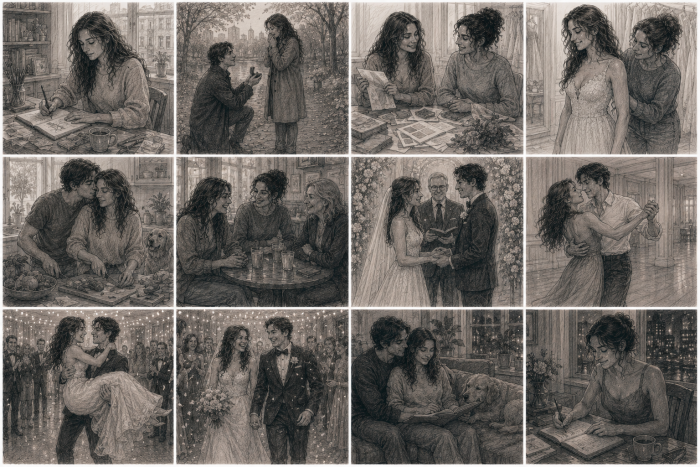
Chapter 2.1; Home
Time became quieter after that.
Not slower.
Simply less concerned with milestones.
Emily often realized that weeks—and sometimes months—had passed without thinking about transition at all. Life had quietly replaced the language of becoming with the language of living.
There were illustration deadlines.
Long walks through familiar streets.
Dinner with Maya, who had become less an old love than an irreplaceable part of their family.
Rainy evenings reading beside Oliver while music drifted softly through the apartment.
The extraordinary had finally surrendered to the ordinary.
Emily discovered that she preferred it that way.
Several months after moving in together, Oliver stopped walking outside a small animal rescue.
Emily noticed immediately.
He stood looking through the fence with the unmistakable expression of someone pretending not to want something.
“What?” she asked.
“Nothing.”
She smiled.
“It isn’t nothing.”
Oliver laughed quietly before nodding toward an older golden retriever lying beneath a tree.
“He looks lonely.”
The dog barely acknowledged them.
One ear lifted.
His tail thumped exactly once before he settled his head back onto his paws.
Emily knelt beside the fence.
The old retriever walked over with the measured dignity of someone who had long ago abandoned any interest in impressing strangers.
He rested his chin gently against the wire.
Emily reached through and scratched behind one soft ear.
The dog sighed contentedly.
That simple sound somehow settled the matter.
The shelter volunteer explained that the retriever had belonged to an elderly couple who had both passed away within months of one another.
He was healthy.
Gentle.
Quiet.
“No one’s overlooked him because he’s difficult,” she said.
“They’ve overlooked him because everyone wants puppies.”
Emily felt her chest tighten.
She understood, perhaps more deeply than most people could, what it meant to wait for someone to choose you.
They brought him home that afternoon.
Oliver insisted on naming him Winston.
“He looks like someone who should have opinions about literature,” he said.
Emily laughed.
“You’ve decided that because he has gray around his face.”
“I’ve decided that because he’s clearly judging us.”
Winston blinked once before curling into a patch of afternoon sunlight as though he had always belonged there.
Within a week, it became impossible to imagine the apartment without him.
Home acquired new routines.
Morning walks before work.
A food bowl forever finding its way beneath Emily’s feet.
Evenings spent with Winston stretched comfortably across the rug while Oliver read aloud from whatever novel currently occupied the coffee table.
Sometimes Emily would look around the apartment and find herself smiling for no reason at all.
A sleeping dog.
Books left open.
Two mugs cooling beside the window.
It seemed astonishing that happiness could be assembled from such ordinary pieces.
One autumn afternoon Oliver proposed beneath trees beginning to turn gold.
There was no audience.
No elaborate plan.
Only two people standing beneath drifting leaves.
He told Emily that every version of his future contained her.
She answered yes before he had finished asking.
Later, while laughing through happy tears, she realized Winston had patiently sat beside them throughout the entire proposal, wagging his tail only after they embraced.
Oliver declared it his official approval.
Emily insisted the dog had been waiting to see whether the answer was yes.
Planning the wedding became one of the happiest seasons of Emily’s life.
She discovered she cared remarkably little about fashionable trends.
Instead she found joy in choosing flowers that reminded her of spring mornings.
Music they both loved.
Good food.
Enough room for people to laugh.
Maya became indispensable.
She helped Emily choose a dress that felt unmistakably like her—not because it was extravagant, but because Emily stopped noticing the dress each time she looked in the mirror.
She simply saw herself.
A week before the ceremony they attended their final dance rehearsal.
Emily had been quietly nervous.
Not because she disliked dancing.
Because dancing required trust.
Oliver offered his hand.
She accepted it instinctively.
The instructor demonstrated the steps only once before leaving them to practice.
Oliver’s hand rested lightly against the small of her back, guiding rather than directing. Emily relaxed into the rhythm almost immediately.
Years earlier she had been conscious of every movement her body made.
Now she simply listened to the music.
The room faded.
There was only the gentle cadence of the melody and the familiar comfort of moving together.
The dance became another conversation between them.
One spoken entirely without words.
On the morning of the wedding Emily stood alone for several quiet minutes.
Her dress hung near the window where soft daylight illuminated its folds.
She touched the fabric almost absentmindedly.
Not because it transformed her.
Nothing needed to transform her anymore.
It was simply the dress she had chosen for one of the happiest days of her life.
Maya entered quietly behind her.
Neither woman spoke for a moment.
Finally Emily smiled.
“I’ve been thinking about the first dress you helped me wear.”
Maya laughed softly.
“I was thinking exactly the same thing.”
They embraced.
Neither needed to explain the tears that followed.
The ceremony passed like a beautiful dream.
When Emily looked out at the gathered guests she realized something remarkable.
Every chapter of her life had somehow arrived together in one room.
Family.
Friends.
Colleagues.
Maya.
Oliver’s relatives.
People who had known Aaron.
People who had known only Emily.
There were no longer separate versions of her life.
There was only one.
Complete.
As evening settled over the reception hall, the band began the first dance.
Oliver extended his hand.
Emily smiled.
She no longer remembered being afraid of dancing.
The rehearsal had taught her something unexpected.
The steps mattered very little.
Trust mattered completely.
She slipped naturally into his embrace.
His hand rested gently at the small of her back while they moved slowly across the floor.
She found herself laughing when she missed a turn.
Oliver laughed too.
Neither cared.
The room blurred around them.
Near the end of the song, just as they had practiced, Oliver drew her into one final graceful turn before lifting her briefly into his arms as they completed the last movement together.
Warm applause filled the room.
Emily felt her cheeks grow warm with happy embarrassment.
She buried her face against Oliver’s shoulder for just a moment before looking back out at the smiling faces surrounding them. Oliver leaned in and have her a sensual kiss and Emily felt like a complete woman. She loved how he held her and felt safe and vulnerable at the same time. She realized how much she loved being a lady.
For an instant her eyes found Maya and whirlwind of emotions came up to her.
Maya was smiling through tears. Emily saw her and started crying as well - those were tears of joy - A person can go through life without ever finding a soul mate and here Emily was lucky to find not 1 but 2 partners while navigating through an identity and persona exploration and a gender and sexuality change. She thanked her stars for being so lucky and wowed to give back to the world.
Maya raised her glass ever so slightly. Emily understood.
Without a single word, they acknowledged everything that had brought them to this moment.
Oliver gently set her back on her feet.
They remained standing together as the applause slowly faded. Emily felt comfortable and snug leaning her head in Oliver's right shoulder as he placed his arm around her and walked her off the dance stage.
Emily looked around the room.
At Winston asleep beneath their table, completely unconcerned by celebrations.
At friends whose laughter filled the hall.
At the man whose hand still rested comfortably in hers.
She thought about the frightened young person who had once believed happiness meant finally becoming someone else.
How mistaken that had been.
Becoming herself had never been the destination.
It had simply been the doorway.
Home had always waited on the other side.
And surrounded by love, friendship, laughter, and the quiet certainty that she belonged exactly where she was, Emily stepped through that doorway completely at last.
| Attachment | Size |
|---|---|
| 7a1a2.1784760309.5486.web_.rediffmail.com_.png | 3.54 MB |
