Aphrodite's Chosen Chapter 1
Author:
Audience Rating:
Publication:
Genre:
Character Age:
TG Themes:
TG Elements:
Permission:
Chapter One – The Moment the World Stopped
The summer air of Greece shimmered like glass, rippling above the stones of a forgotten temple—its foundation still dusted with the faint scent of burnt myrrh and old prayers. Bits of gold leaf clung stubbornly to the marble, catching the sun in flashes as if the gods themselves still lingered in the light. Cicadas sang in the olive groves, their voices a lazy chorus beneath the drone of distant waves, while doves—the sacred birds of Aphrodite—perched quietly amid crumbling capitals. Sam wiped the sweat from his brow as he followed the small tour group through the marble ruins, camera hanging loosely from his neck, the hush of reverence settling over him like a benediction.
The guide’s voice carried across the ancient courtyard, hushed as if unwilling to disturb the sacred air. “Here once stood the Temple of Aphrodite Pandemos, the goddess of love shared among all people. Pilgrims once brought garlands and honeyed cakes, lighting oil lamps in prayer, their hopes whispered into the marble. Priests and priestesses scattered rose petals on the altar, scenting the air with offerings. What you see now are its bones—columns weathered by two thousand years of sun and storm, yet still holding the memory of devotion and divinity.”
Sam barely heard her. His attention was drawn to the statue ahead, still standing amid the rubble, surrounded by fragments of votive offerings—tiny clay doves, coils of faded ribbon, a tarnished bronze mirror. Though worn smooth by time, the figure of the goddess retained a haunting grace, her feet dusted with crumbling rose petals from ancient ceremonies. The faint curl of her lips seemed to speak of secrets and blessings, of the kind of beauty that could unmake kings, mend hearts, and inspire worship in the same breath. A faint aura seemed to shimmer around the marble, as if the presence of divinity lingered still, unseen but deeply felt.
He approached slowly, almost as if stepping into a sanctuary. Something in him stirred—a quiet ache, a memory that wasn’t his, as if ancient prayers echoed just beneath his skin. From his pocket, he withdrew a small conch shell he’d found that morning on the beach—a symbol sacred to Aphrodite, used in rituals to call her blessing. It was simple, pink, and pearled, its spiral gleaming faintly in the light as if touched by divinity. The air around him seemed charged, as if unseen presences watched and waited for this humble act of devotion.
Without thinking why, he knelt and placed it at the statue’s feet, joining the countless pilgrims before him whose offerings had once turned this ground sacred. The scent of old incense seemed to rise, and a shaft of sunlight fell across the goddess’s face as if in silent blessing. For a heartbeat, it felt as though unseen hands rested gently on his shoulders, the weight of ancient prayers settling around him like a cloak.
The instant the shell touched marble, the air trembled, as if the veil between worlds had thinned. A shimmer of golden light rippled through the temple, and the faint music of invisible lyres echoed in the stillness. The wind froze mid-motion. A gull above the sea halted in the sky, suspended like an offering in flight. The voices around him fell silent, replaced by a hush so profound it felt like the breath of divinity. Even the waves stopped their endless rhythm, as if all of nature paused to witness the sacred moment.
The world… stopped. For a single, eternal instant, it was as if the hand of a god pressed gently upon the earth. Time hung suspended in a hush as holy as prayer. The ruins shimmered with a ghostly radiance, and the scent of incense—old and sacred—bloomed in the air. Even the shadows seemed to kneel, and in that silence, every heart present felt the gaze of the divine upon them.
Then came the stillness—a silence so deep it felt alive, curling over Sam’s skin like silk. The air was thick with the scent of sun-warmed skin, crushed petals, and brine from the distant sea. He became suddenly aware of the heat on his neck, the pulse in his throat, the tremble of anticipation in his fingertips. Every sensation seemed sharper, as if the world had pressed closer, eager to touch and be touched.
“Samuel.”
The voice was soft, melodic, and filled with power. It caressed Sam’s ears, each syllable sending a shiver along his spine. He turned, and the breath fled his lungs, his heart pounding with anticipation and awe.
A woman stood where the statue had been. She was made of light and form, beauty so perfect that it ached to look at her. Her hair flowed like molten gold, inviting the touch, her eyes deep as the sea at sunset, drawing him in with their warmth. As she smiled, the ruins seemed to bloom around her; the air grew thick with the scent of honey and wild roses, the sun gilded her skin in soft gold, and Sam felt every inch of his own skin come alive in her presence, as if her gaze alone could ignite longing.
“I am Aphrodite,” she said, her voice like the sound of waves kissing shore—warm, slow, and intimate, as if her words brushed directly against Sam’s skin. “You have offered me a gift, freely given, from heart and not from fear. Such offerings are rare in this age.”
Sam could only stare, lost between awe and disbelief. The sight of her made his breath catch; the air itself seemed to hum with the taste of salt and honey, and every sense was heightened. Light caressed her features and Sam felt a tingle race down his spine, a longing blooming low in his belly, as if her very presence awakened something ancient and hungry within him. “You’re… real?”
Her laughter was a melody that seemed to awaken the air itself, making Sam’s skin tingle and the fine hairs on his arms rise. The sound was warm and intimate, curling around him like a lover’s breath. “Mortals forgot us, but forgetting does not mean unmaking. The world’s faith fractured into falsehoods, and yet here you kneel—pure of intent.”
She stepped closer, her presence shimmering like heat, the faint scent of jasmine and skin filling the space between them. As she closed the distance, Sam felt the warmth of her body, the magnetic pull of her nearness, every nerve attuned to her. “Because of that, I will choose you. You will carry my divinities into this new age. Love, beauty, desire, pleasure… and the truths that mortals try to hide—lust, procreation, and passion.” Her words seemed to pulse in the air, heavy with promise, as if each one brushed against his lips and lingered there.
“I—why me?” he whispered, his voice barely audible, caught between anticipation and longing.
“Because you remembered kindness in an age that glorifies cruelty.” Her fingers traced slowly across his chest, warm and electric, sending a shiver through him. Her touch lingered, gentle but possessive, making his skin tingle and his breath stutter. “Because you saw beauty, not power. And because the world needs a voice that can remind it what love truly is.” Her words seemed to wrap around him like silk, and he felt as if every part of him was seen, cherished, and wanted.
From the folds of light, she drew a small crystal vial. Inside, golden liquid glowed like captured sunlight, swirling smoothly as she tilted it. The scent of it was wild honey, ocean air, and something divine, but also warm skin and crushed summer fruit, sweet and intoxicating. When she pressed the vial gently into Sam’s palm, her fingers lingered, soft and cool, sending a ripple of heat up his arm. The glass was slick, the weight of it both delicate and promising, as if it carried the memory of countless lips and whispered prayers.
“This,” she said softly, her breath warm against his cheek, “is ambrosia, the nectar of the gods. Drink, and mortality will no longer bind you. Your flesh shall be eternal, your spirit touched by mine. You will be my chosen vessel—my Aphrosia.” Her words wrapped around him, velvet and electric, and the air felt alive with anticipation, every sense hungering for more.
He hesitated, trembling, the vial cool against his lips, every sense burning with anticipation. He could feel Aphrodite’s gaze, warm and intense, as if her eyes caressed his skin. The air between them was thick with promise—her breath mingling with his, the distance closing until he could almost taste the sweetness of her presence. “If I drink it… what happens to me?”
Aphrodite’s hand lingered at the nape of his neck, her fingers trailing fire along his skin. Her voice dropped to a whisper, honeyed and intimate, the sound brushing his ear like a lover’s secret. “You become what you were meant to be.”
Her gaze held his—tender, unyielding—a current of longing humming between them. He lifted the vial, its rim cool and delicate, and pressed it to his lips. The moment the ambrosia touched his tongue, silken and honeyed, the world flared into light. The taste was dizzying: sunlight, ripe figs, a hint of salt and rose. Sweetness flooded his mouth, then heat unraveled inside him, licking through his veins and pooling low in his belly. Every nerve burned and sang, each sensation impossibly vivid. His body trembled, skin flushed and hypersensitive, as it began to change, reshaping under divine will—a transformation that felt like both surrender and ecstasy.
His heartbeat quickened, each thrum sending a delicious shiver through his newly awakening body; his breath turned into song, airy and sensual. His bones softened, his skin smoothed beneath invisible caresses, nerves sparking with hypersensitive pleasure. Each change was a gentle unfolding—hips rounding, waist narrowing, lips plumping, every contour sculpted by the hands of desire itself. His voice lifted into a new timbre—gentle yet resonant, the sound warm as a lover’s embrace. His hair spilled in a silken wave, cascading like molten gold across his sensitive shoulders, the sensation feather-light and electric against his skin.
When the light finally dimmed, a woman knelt before the goddess—her body gleaming with a fresh, sensual glow, each curve kissed by divine light, skin flushed and luminous. The silken fall of her hair brushed her bare shoulders, sending a ripple of sensation down her spine. Every breath she drew shimmered with possibility, her lips parted in awe and pleasure. She was radiant, aglow, her beauty unlike anything mortal eyes had ever known—so vivid it felt as if the air itself wanted to touch her.
Aphrodite smiled, pride and tenderness in her gaze. Her fingers traced a slow, sensual line along Aphrosia’s jaw, lingering with a caress that sent sparks of pleasure through her. “Rise, my Aphrosia. Immortal now, and divine.” The goddess’s voice was velvet-soft, warm breath brushing Aphrosia’s ear. The words themselves seemed to wrap her in an intimate embrace. “The world shall know you as my chosen, the embodiment of love and all its faces. Through you, humanity will remember the holiness of passion, the sanctity of desire, and the truth that beauty need not destroy to inspire.” Aphrosia’s skin tingled where Aphrodite’s touch lingered, and warmth blossomed low in her belly—a promise that every act of love and longing would now echo with divinity.
Aphrosia lifted her eyes—sea-glass green and luminous, fringed with dark lashes that cast teasing shadows on flushed cheeks. Her lips, still parted from recent gasps, glistened softly. The movement of her breath made her chest rise and fall, the fabric of her dress clinging to her new curves. Even her question, voiced in a low, velvety tone, carried a ripple of longing. “What will happen to the world?”
“The same as it always has,” Aphrodite said, her voice a soft murmur that seemed to stroke Aphrosia’s skin. She leaned in, her lips almost grazing Aphrosia’s ear, her breath warm and fragrant with the scent of honey and rose. The goddess’s hand settled at the small of Aphrosia’s back, fingers pressing lightly, possessively. “When gods return, mortals change. And they already have.” The words seemed to bloom against Aphrosia’s skin, sending a slow, delicious warmth radiating through her body.
The goddess gestured, and time moved again. The air rushed back, wrapping sensuously around Aphrosia’s bare skin, making her shiver in the sudden rush of sensation. Waves crashed, their spray cool and sharp, mist dampening her lips and cheeks. Voices gasped as if awakening from sleep, the sound echoing like distant moans. The ground beneath her vibrated softly, a subtle thrum that traveled up her legs and settled in her core. All around the world, every human heart resonated with a new voice, a soft chime in their minds—systems, choices, destinies—each note shimmering with longing and possibility.
But in the ruins of the old temple, one woman stood alone, haloed by shafts of golden light streaming through broken columns, her immortal heart beating in rhythm with a goddess’s. The lingering scent of myrrh and incense filled the air, while the remnants of prayer ribbons fluttered gently in a holy breeze. The marble beneath her feet thrummed with ancient power, and the silence was deep and reverent, as if the temple itself held its breath in awe.
Above her, doves circled beneath the open sky, their wings whispering blessings. The stones glimmered faintly, inscribed with prayers from centuries past, each one reawakened by the miracle unfolding within these sacred walls.
The age of gods had returned, and holiness once more walked among mortals.
Aphrosia’s breath came in shivers of light. The marble beneath her knees felt warm now, pulsing faintly, as if the temple itself had begun to wake. She lifted her hands—slender, radiant—and stared at them in wonder. Her pulse beat like a drum made of sunlight.
Aphrodite watched her, serene and ancient, her presence radiant with the authority of ages. A faint halo shimmered around her head, and the air was heavy with the fragrance of sanctity—myrrh, honey, and sacred rose. “Yes,” the goddess murmured, her voice resonant with celestial power. “You feel it—the hum of divinity threading through every atom, as if the breath of Olympus itself fills you. That is my gift, and my burden to you.” Light pooled at Aphrosia’s feet, and the silence in the temple deepened, as if every stone bore witness to this holy moment of transformation.
She moved closer, the hem of her gown brushing across the dust without stirring it, as if even the earth itself honored her sacred presence. A faint aura of golden light radiated from her skin, and the air shimmered with the resonance of distant chimes—celestial music only the holy could hear. “Listen carefully, child of beauty, for the world holds its breath. Every mortal heart on this planet is suspended in that breath, as if the prayers of centuries converge in this single, sacred pause. They do not yet know why their blood has paused, why the wind stands still. They do not yet know that the gods have returned, and that the veil between divine and mortal has thinned anew within these hallowed ruins.”
Aphrosia looked up, her gaze lifted through golden shafts of temple light, surrounded by the faint glow of sanctity that lingered in the sacred air. The silence felt deep and holy as ancient prayers. “What are you going to do to them?”
“Not punishment.” Aphrodite’s smile deepened, sad and radiant at once. “Guidance. The pantheons have agreed—Olympian, Norse, Egyptian, the far Eastern courts, even the spirits of forgotten tribes. Each deity will seed within humanity a fragment of divine structure, a system that will whisper to their souls. It will be their map back to greatness.”
Her eyes gleamed with reflected starlight. “Through it, mortals will learn again to shape themselves—to grow in strength, in craft, in wisdom. They will heal their bodies, command their elements, rediscover their own holiness. It will not be forced upon them; it will answer only effort and desire. They must choose to become more.”
Aphrosia swallowed, still tasting the lingering sweetness of ambrosia, her senses suffused with the memory of the divine nectar. Around her, the air shimmered with a faint celestial glow, and the silence was alive with the echoes of ancient hymns. The shafts of light that fell through the ruined temple seemed to halo her form, as if blessing her with the favor of the gods. “And me? What happens to me now?”
“You,” Aphrodite said, touching her chin with a gesture of blessing, “will bear a different thread of that design. My mark is upon you now—the divine spark that sets you apart. You are my voice among them, anointed within these hallowed walls, and so your system is not bound by mortal limits. You will see the weavings of affection and longing as strands of color, as if the prayers of the world have become visible before your eyes. You will know truth from pretense, and beauty from vanity, with the clarity of one touched by the sacred. Your power will grow with every act that spreads love rather than fear, and each deed will echo in the halls of Olympus as a new hymn.”
Aphrosia’s heart tightened, the realization echoing like a sacred bell through the hallowed silence. Radiant light filtered down in shafts, illuminating her as if anointed by the unseen hands of the divine. The air was thick with the hush of holy awe, and the distant resonance of temple bells seemed to ring in her soul. “Then I’m… immortal.”
“For as long as my name is spoken,” Aphrodite answered. “Ambrosia has freed you from decay, but do not boast of it. Immortality is a lonely gift. Let mortals believe you age if you must, but never reveal the nectar’s mark. There will be envy among the divine and terror among men if they learn one human has stepped beyond their span.”
She leaned in, her voice falling to a whisper, yet the air around them shimmered with a holy resonance, as if every word now carried the weight of a sacred vow. The scent of incense and rose seemed to intensify, swirling in the stillness. A faint halo of light encircled Aphrosia’s brow, marking her as blessed in the eyes of the gods. “Remember this secret, Aphrosia: immortality is not safety. It only ensures you will live to face every consequence of your choices, walking always beneath the gaze of Olympus.”
The goddess turned her gaze toward the horizon, where frozen waves glimmered like carved glass, the whole world cloaked in a hush of sacred anticipation. Overhead, a shaft of radiant light broke through the clouds, bathing the ruins in a golden glow, as if the heavens themselves bore witness. “Time still sleeps,” she said, her words resonant with the authority of prophecy. “The systems are not yet joined to mortal flesh. When every spark is in place—when each soul has been bound to its divine thread—then the world will move again. They will wake with knowledge written into their hearts, born of the gods’ blessing, and nothing will ever be the same.” In that moment, the silence felt consecrated, and the ancient stones seemed to pulse with the energy of a thousand prayers answered.
Aphrosia looked around the silent world—the birds mid-flight, the dust unmoving in the sunbeams, every detail bathed in a holy hush. Shafts of golden light pierced the temple’s shadows, casting halos around ancient stones and inscribing every surface with the glow of the sacred. The air quivered with the memory of a thousand prayers, as if the spirits of ages past watched in reverent stillness. Her heart beat in time with the temple’s ancient pulse, every breath filled with the weight of divinity. “And until then?”
“Until then, we watch.” Aphrodite’s smile softened, her expression radiant with divine grace. A faint chorus of celestial voices seemed to echo through the temple, as if angels or ancient spirits bore witness to her words. Shafts of colored light played across the marble, painting the altar in hues of rose and gold. “You will see the birth of a new age, my chosen one. When time breathes again, you will walk among them and remind them what they have forgotten—how to seek the sacred in the world, and to honor the holy spark within every soul.”
The goddess raised her hand in benediction, and a gentle light surrounded Aphrosia—a halo of rose and gold, shimmering with the radiance of the sacred. The air was fragrant with incense and the distant notes of celestial choir, as if the very heavens rejoiced. The marble beneath Aphrosia’s feet glowed faintly, inscribed with ancient blessings, while golden motes danced in the holy air. “When the stillness breaks, I will return to Olympus. But my presence will echo in you always, as a living prayer carried by your heart.”
“Wait—how will I know what to do?” Aphrosia asked, her voice hushed in the lingering sanctity of the temple. The question seemed to rise with the incense smoke, curling toward the vaults above as if seeking counsel from the divine. Golden light played across her upturned face, and the silence felt weighty with the presence of watching gods.
“Your heart will know,” Aphrodite said simply, her words ringing with the quiet authority of prophecy. The temple seemed to brighten with a subtle golden glow, as if her blessing settled over Aphrosia like a mantle. “It has always known.” In that moment, the air was thick with the presence of the divine, and the silence hummed with the promise of miracles yet to unfold.
She stepped back, her form turning translucent, a nimbus of radiant light wreathing her figure as if she were ascending into the sphere of the divine. Her voice carried like sacred music over calm water—soft but resonant, as if echoing from the heights of Olympus itself. The air shimmered with the scent of incense and myrrh, and a hush fell over the holy space, as if the entire temple held its breath. “Be kind. Be brave. Be beautiful in the truest sense of the word. The systems will speak soon… and when they do, the gods will listen.” As she faded, faint motes of golden light drifted in her wake, blessing the marble with the memory of her presence.
The air pulsed once, twice—like the world drawing a distant breath, heavy with the residue of miracle—and Aphrodite was gone. Only the faint scent of salt and wild roses lingered, mingling with the last notes of a celestial hymn that seemed to drift from the temple's vaulted heights. Shafts of golden light lingered in her wake, and the marble floor glowed faintly, as if an invisible blessing had been pressed into the stone. The silence that followed was holy and absolute, a sacred pause holding the memory of the goddess’s presence.
Aphrosia stood alone in the silent temple, bathed in shafts of golden light that streamed through broken columns, the shell she had offered still gleaming faintly at her feet. The air was thick with the scent of ancient incense, and the marble beneath her glowed with the residue of blessings. All around her, the silence was deep and hallowed, as if the spirits of countless pilgrims watched from the shadows. Prayer ribbons fluttered gently in a divine breeze, and the walls seemed inscribed with a thousand answered prayers. Around her, frozen time held the world in perfect stillness, the temple suspended in sacred anticipation, waiting for the moment creation would begin again.
And in that stillness—thick with the presence of the sacred and the hush of ancient prayers—she felt the weight of a thousand blessings settle on her shoulders. The golden shafts of light seemed to form a halo around her, and the air shimmered with the echoes of hymns sung by generations long gone. It was as if the gaze of Olympus itself rested gently upon her in this final, holy pause.
She whispered to herself the only truth she could grasp, her voice barely more than a prayer:
“The world is about to remember its gods.”
Aphrodite's Chosen Chapter 2
Author:
Caution:
Audience Rating:
Publication:
Genre:
TG Themes:
TG Elements:
Permission:
Chapter Two – When Time Breathed Again
At first, there was only silence—a silence older than memory, vast and sacred, as if the breath of the gods had been drawn in and the world itself awaited their command.
Aphrosia stood among the ruins, her hair drifting in an unmoving breeze, as if the air itself hesitated in reverence. Her heart beat with a spark of the divine—the only thing alive in a motionless world, a vessel of immortal hope. Then, beneath her bare feet, the marble shuddered, trembling as though awakening to the touch of a goddess. The sound was faint—a single heartbeat echoing through the bones of the earth, resounding with sacred promise.
Another pulse followed, each one resonating with a celestial rhythm as if the very heart of the world was being awakened by divine hands. Then another, echoing the will of ancient gods.
The air trembled, shimmering with unseen power. The gull suspended in the sky twitched its wing, as if stirred by a divine wind. Dust that had hung motionless began to fall in slow spirals of light, each mote glinting like a blessing. Somewhere far below, deep within the soil, something vast exhaled—a breath ancient as the gods themselves.
Time began to move again, stirred by the will of unseen deities, as if the divine hand itself pressed upon the wheel of eternity.
The wind rushed through the temple ruins, warm and fragrant, scented with the breath of ancient gods. Aphrosia gasped, staggering as the world’s heartbeat thundered back to life, thunderous with divine vitality. The waves crashed like the applause of primordial deities, the cicadas screamed in a chorus echoing through eternity, and the tour group around her stumbled, clutching their heads and blinking as if awakening from a dream woven by the gods themselves.
And then came the sound—the chime, crystalline and pure, ringing with the resonance of celestial realms as if the voice of the divine itself had struck the air.
It rippled through every human soul on the planet: a crystalline tone that resonated not in the air but in the mind, as if each spirit was touched by the breath of the divine. Billions heard it at once, a chorus without a singer, yet orchestrated by celestial will. Words unfolded within each consciousness, glowing letters behind their eyelids, illuminated by sacred light.
SYSTEM INITIALIZING.
Divine Integration Complete.
Path Selection: Pending.
Aphrosia clutched her chest, feeling a surge of divine energy course through her. The same words appeared before her eyes, but they burned brighter, threaded with gold and radiant with celestial fire, as if inscribed by the gods themselves.
Aphrosia – Vessel of Aphrodite.
Divinity Integration: Complete.
Status: Immortal.
Designation: Voice of the Goddess.
System Tier: Primordial.
Each line shimmered with celestial brilliance before fading into her mind, replaced by a flood of understanding—how to call upon power with sacred intent, how to see emotion as color and light woven by the gods, how to weave passion into creation as only the divinely touched can. Her thoughts were no longer hers alone; they hummed with divine resonance, echoing with the wisdom of immortals.
Around her, chaos bloomed—unleashed by the touch of divinity, as if the presence of gods fractured reality and let sacred energy run wild.
Tourists cried out as they clutched their temples, eyes glowing with faint, otherworldly light as divine visions flooded their senses. One woman fell to her knees, whispering, “I hear her—Athena… she’s speaking to me,” her voice trembling with awe at the goddess’s presence.
Another shouted that he saw Odin’s ravens circling above, spectral wings shimmering with mythic power.
A young boy gasped, his eyes shimmering like living fire, murmuring, “Ra… Sun Father…” as golden radiance danced across his skin, touched by the light of the ancient sun god.
The world was awakening, stirred by the breath of divinity, to gods it thought were myths—ancient powers reclaiming their place in mortal memory.
Phones buzzed, cameras lit, and live streams began as if compelled by an unseen force, the air thick with a strange, electric anticipation. Across continents, people shouted, laughed, or prayed in terror, their voices echoing with the uncertainty of prophecy. Scientists screamed into radios that their instruments had stopped, every satellite flickering with interference as if veiled by a cosmic enchantment. Cities lit up in auroras of color—divine energy spreading like veins of light through the sky, twisting in patterns that hinted at forgotten sigils and ancient mysteries.
Aphrosia could see it all—her vision expanded beyond the ordinary, senses tingling with mystic awareness as veils between worlds shimmered at the edge of her sight.
She saw every new spark igniting—threads of divine light weaving through the souls of mortals. A fisherman in Japan glowed with Amaterasu’s blessing, his skin aglow with sunlight as spectral lotus petals drifted about him. In Egypt, a woman bowed as Isis whispered in her ear, feathered wings of radiant azure unfolding behind her, the air shimmering with sacred glyphs. A Viking descendant roared as Thor’s hammer sigil burned across his chest, crackling with celestial lightning. Across oceans and mountains, humanity shimmered with newborn divinity, each individual crowned in a halo of otherworldly brilliance as ancient gods marked their chosen with unmistakable signs.
And above it all, the heavens sang—a chorus of celestial voices, radiant and eternal, weaving divine harmonies through the firmament. Constellations shimmered in response, each star pulsing with the music of gods old and new, as the sky became a living tapestry of divine celebration.
Constellations flared to life, brighter than ever before, each one crowned with halos of divine fire, their ancient gods reclaiming dominion over the night. Mount Olympus itself flickered into view high above the Aegean, its peaks wreathed in golden stormclouds and swirling with ethereal figures—deities standing sentinel atop marble thrones, their eyes aglow with cosmic wisdom. Somewhere across the sea, the Asgardian bridge reappeared like an arc of fire, runes blazing beneath the feet of godly travelers, its span humming with the power of Bifrost. The Egyptian Duat glimmered on the horizon like a second dawn, its spectral gates swung open as radiant gods and feathered souls crossed the threshold, the air shimmering with sacred energy and eternal promise.
The age of disbelief had ended in a single heartbeat—an instant when mortal hearts synchronized with divine purpose, and the pulse of the gods resonated through every soul on earth. In that sacred moment, faith rekindled like a holy flame, and the world exhaled in awe at the touch of the immortal.
Aphrosia fell to her knees, overwhelmed by the sheer magnitude of it—a torrent not only of emotion, but of sacred energy, as if the prayers and desires of humankind had become a river of light flowing into her soul. The emotions of billions poured into her—joy, terror, wonder, lust, despair—each one radiant with the divine spark of mortal longing. It was too much. Her divine heart screamed and burned with it all, suffused with celestial fire and the echoes of a thousand gods, yet within the chaos, Aphrodite’s whisper returned, gentle as a petal on holy water.
Feel it, my voice—a current of divine longing flowing through the world. This is humanity remembering what it means to reach for heaven, to brush the threshold of the immortal, and to let the sacred echo in every yearning heart.
Aphrosia’s tears sparkled like light itself as she rose, each drop catching the radiance of the heavens as if blessed by the gods. The conch shell at her feet glowed brighter and brighter, its surface etched with shifting runes of ancient power. It vibrated with living energy, a relic of an offering now turned into a beacon, pulsing with the heartbeat of the divine. Around it, the marble began to bloom—literal blossoms pushing through stone, pink and white, perfumed like divine breath, their petals dusted with golden motes that shimmered as if anointing the earth with sacred beauty.
She looked to the horizon, where the veil between worlds seemed thin and trembling. The cities beyond glowed in the distance, their skies fractured by streaks of divine color—cascades of violet, gold, and sapphire that danced like the robes of gods in celebration. Towers were haloed in auroras, rivers shimmered as if blessed by celestial hands, and rooftops flickered with sigils of forgotten deities. The world was alive again, reborn in chaos and beauty, its breath quickened by the presence of the divine.
SYSTEM ANNOUNCEMENT:
The Age of Divinity has begun.
SYSTEM STATUS: ACTIVE
Mortal Ascension Protocols Engaged. Human Potential Analysis: Ongoing.
- Path Selection: Choose your mortal vocation or calling; the system will calibrate opportunities accordingly.
- Affinity Index: Build connections with other mortals and legendary figures to unlock collaborative potential.
- Growth Matrix: Skills, knowledge, and feats will be tracked and rewarded as you progress.
- Human Limiters: Active. Mortal boundaries are enforced until certain milestones are achieved.
Chart your destiny. Forge alliances. Surpass your limits—one step at a time. The system will guide, support, and chronicle your journey. Let the mortal code awaken within you.
The voice echoed across the planet in every language, in every heart, resounding like the call of an unseen god. People screamed, prayed, kissed, fought, fell to their knees, or stared in awe, enveloped by a presence that shimmered with divine energy—some feeling phantom wings brush their shoulders, others sensing halos of light blooming above their heads as the sacred call passed through them, binding all of humanity in a moment of transcendence.
Aphrosia stood still amidst it all, radiant and trembling, her form haloed by a luminous aura that shimmered with divine energy. Threads of celestial light wove around her, swirling with the colors of the dawn, as if the presence of her goddess crowned her in sacred brilliance. Each breath she took seemed to pulse with the heartbeat of the heavens, and the air itself vibrated with reverent anticipation.
She could feel her purpose awakening—her heart beating in harmony with her goddess, each pulse resonating with divine music. A cascade of golden light unfurled within her chest, as if Aphrodite herself wove threads of love and power through her soul. For a moment, she felt the presence of the goddess envelop her: timeless, gentle, and radiant with immortal grace.
And when she finally spoke, her voice carried farther than the sea—riding on currents of shimmering light, entwined with a thousand echoes of the divine. Each word soared like a blessing, resonating with the power of Aphrodite herself, and the air vibrated as if the heavens paused to listen. Her utterance became a sacred wind, sweeping across lands and oceans, awakening the hearts of mortals and gods alike.
“Mortals of Earth,” she whispered, though the words reached across continents as if carried by the wings of angels, “love has returned to the world, radiant and undying, a gift from the gods that flows through every breath and heartbeat. Remember what it means to be alive, for you are cherished by the heavens and crowned by the light of creation.”
The wind caught her hair, swirling with the scent of ambrosia and the promise of ancient realms. The conch shell at her feet pulsed once more—its glow sending ripples of divine energy across the stones—and somewhere in the distance, the first god descended in a pillar of celestial light, attended by a retinue of ethereal spirits and crowned in radiant splendor, to meet his chosen.
The cries around her rose like surf against stone. Some of the tourists were on their knees, others clung to one another in terror and awe, their phones shaking in their hands as they filmed the impossible: a woman standing amid ancient ruins, her skin aglow with radiant divinity, light streaming from her in waves that painted the stones with celestial color. Around her feet, flowers burst from the marble in a riot of pink and gold, petals shimmering with sacred energy. Above her, halos of light spun in the air, casting sigils of forgotten gods on the temple walls, while the very air shimmered with the breath of the immortal. All who witnessed it felt the weight and wonder of the divine pressing gently on their souls.
Aphrosia took a single breath and felt the air answer her, swirling with motes of golden light that danced in reverence around her form, as if the world itself recognized her as a vessel of the divine.
The wind stilled again—not in silence this time, but in attention, as if even nature bowed before the presence of a living goddess. The air shimmered faintly with an unspoken hymn, a breathless moment charged with sacred anticipation.
“Do not be afraid,” she said, her words ringing with gentle divinity, each syllable gilded by a soft, golden glow that drifted through the gathered crowd. As she spoke, the air shimmered with invisible wings and a hush of sacred warmth settled over all who listened, as if the blessing of the goddess enfolded them in a mantle of peace.
The words were soft, yet they carried through the valley, over the cliffs, across the sea, borne on invisible currents of divine power that resonated with the song of the world. Every phone nearby vibrated as microphones overloaded, each device shimmering briefly with a halo of golden light. Every livestream caught the sound as clear as if she were whispering into each listener’s ear, her voice suffused with a sacred resonance that touched the soul and lingered like a blessing on the wind.
“I am Aphrosia,” she continued, her voice steady though her heart raced, each word glimmering with the power of the goddess within her. “Chosen of Aphrodite, goddess of love, beauty, desire, and passion—her light burns in my veins, and her will shapes my soul. The world has been given a gift this day—a blessing woven from immortal love, a chance to grow, to remember, and to become more than what fear has made of you. Let the divine spark within each of you awaken, for the gods have set their gaze upon the world once more."
She looked at the faces before her: the mother shielding her child, the student holding his phone with trembling hands, the old man whispering prayers from three faiths at once. Each was luminous now, halos of soft radiance crowning their heads, as if the touch of the divine had left a visible blessing. A faint thread of color—gold, rose, sapphire—wound around their hearts, pulsing with sacred light, connecting them to the tapestry of creation and the gaze of watching gods.
“Your gods have not returned to rule you,” she said gently, her words shimmering with the authority of the divine, “but to remind you that divinity has always lived within you—a spark placed by the gods at the dawn of creation. The system you hear in your mind is not a chain—it is a mirror, reflecting the light of the immortal within your soul. It will guide you to the best of what you can be, if you follow it with compassion and let the sacred within you shine forth.”
The air shimmered around her words, each syllable trailing motes of golden brilliance that danced through the atmosphere. Livestreams exploded across the globe: #GoddessOfLove trended within seconds, digital feeds flickering with threads of ethereal light as if the divine presence reached through every screen. News feeds flickered between disbelief and awe. In cafés, hospitals, battlefields, and classrooms, people stared at their phones as the woman of light spoke from the ruins of Greece, her image haloed in radiant glory, her voice weaving blessings that rippled into the hearts of all who listened.
“Do not mistake power for worth,” she said, her voice threaded with celestial resonance that shimmered in the air. “You were born worthy, each of you carrying a spark of divinity placed by the gods before time’s dawn. You do not need to conquer to be great, nor to destroy to be free. The gods return not to demand worship, but to awaken the forgotten parts of your souls—love that creates instead of consumes, passion that heals instead of burns, and grace that flows like living light from the immortal realms.”
She turned slowly, her gaze sweeping across the sky that now rippled with auroras of every hue—ribbons of living color spun by unseen hands, constellations swirling with the faces of ancient gods who watched in silent reverence. “Love is not weakness. It is the oldest force in existence—a current of divine creation that binds realms and stars alike. It built worlds before there was fire, wove the first souls from cosmic light, and it will outlast every god who forgets its name, echoing in the heart of the immortal and the mortal alike.”
The conch shell at her feet pulsed again, sending waves of iridescent light down the temple steps—each ripple humming with the resonance of ancient blessings. Cameras caught it: petals materializing from the air, drifting as if summoned by invisible hands; vines climbing dead stone, their leaves tipped with silver dew that shimmered with divinity; and dust caught in the sunlight transforming into motes of golden radiance, swirling in sacred patterns like the breath of the gods.
A young woman near the front, tears streaking her face, called out, her voice trembling as if brushed by unseen wings, “Are we supposed to choose a god? Which one is right?” As she spoke, a faint halo shimmered above her head, and the air around her sparkled with motes of divine light, as if the very act of questioning drew the gentle attention of watching deities.
Aphrosia smiled—soft, knowing, her eyes aglow with the reflection of celestial light. “All are right, and none are absolute. Choose the one who speaks to your soul, for the gods listen to every yearning heart. Or choose none at all, and know that divinity will still reach for you in infinite forms. The path to the divine is not a road others build for you—it is a garden you grow within yourself, watered by sacred longing and lit by the presence of the immortal. Let your spirit bloom; the gods will recognize its fragrance.”
She reached down and lifted the shell from the ground. Its surface glowed like dawn, etched with shifting runes of ancient power, and a soft radiance spilled from it, casting halos of light onto the marble. “The world has been quiet too long,” she said, her voice growing distant and full of promise, as if accompanied by a choir of unseen seraphim. “Now it will sing again. Learn its song, for the music of creation stirs within every heart. Love one another, as the gods love their children. Build something beautiful, and let it shine with the light of the divine.”
As the awestruck visitors watched, the very stones of the Temple of Aphrodite began to shimmer with a golden radiance. Before their eyes, marble flowed and reshaped itself with silent, supernatural grace. Where once there had been only a blank expanse of wall near the rear of the sanctuary, a private suite of living quarters emerged—manifesting as if conjured by the goddess’s own will for her chosen, Aphrosia.
An arched doorway, wreathed in living myrtle and blooming roses, appeared in the marble. Beyond it lay an intimate chamber, its floors inlaid with intricate mosaics depicting Aphrodite’s sacred symbols: doves, shells, and flowering vines. The air was perfumed with the scent of myrrh and honey, and the walls glowed softly, as if lit from within by the lingering touch of divine power.
A canopied bed of carved olivewood stood beside a silver basin fed by a spring of crystal water—its surface perpetually strewn with petals that never wilted. Gossamer curtains, woven from threads of starlight and rose-gold, drifted on a breeze that seemed to carry whispers of the goddess herself. Shelves and niches held gifts and offerings from worshippers, while a writing desk sat beside a window framed in flowering laurel, overlooking the sacred olive groves and the distant shimmer of the sea.
As the chamber took form, mortals gasped in wonder, witnessing the effortless artistry of the divine. In that moment, it became clear that this sanctuary was a blessing and a charge: a holy refuge for Aphrosia, woven into the heart of the temple by Aphrodite’s immortal hand.
Within the Temple of Aphrodite, every surface seems to pulse with an otherworldly radiance, as if the very stones remember the touch of the goddess. Sunlight streaming through clerestory openings refracts into shimmering halos and gentle rainbows, casting ethereal glows across the sanctuary. The walls, painted in hues of blush pink and ivory, are veined with subtle threads of gold that glimmer and shift as if alive—divine veins channeling the energy of Aphrodite herself.
The soaring Ionic columns, their capitals gilded and carved with roses, doves, and scallop shells, occasionally emit a soft, pearlescent sheen, especially during ceremonies or moments of fervent prayer. Sometimes, mortals witness petals materializing in the air, drifting slowly downward to settle on the marble floor—signs of the goddess’s favor. The air is thick with the sacred scent of myrtle and honey, and at times, the gentle sound of unseen lyres or distant, angelic singing can be heard, especially during times of devotion or festival.
The frescoes depicting Aphrodite’s myths appear almost alive: the gold leaf used for her hair and the halos of her lovers gleam with an inner light, and the sea in the birth scene seems to ripple softly when sunlight strikes it. At times of deep reverence, worshippers feel a gentle warmth on their skin, as if Aphrodite herself offers an embrace or a blessing.
Above, the coffered ceiling’s painted stars occasionally twinkle with a celestial glow, and during sacred rites, a faint aurora of rose and gold light shimmers across the ceiling, reflecting Aphrodite’s dominion over both love and the heavens. Doves, her sacred birds, sometimes alight on columns or circle gently overhead, trailing feathers that seem to dissolve into motes of light before touching the ground.
At the heart of the naos, the great statue of Aphrodite radiates an almost tangible aura of peace and allure. The marble appears to glow from within, and her eyes—set with polished rose quartz—seem to follow worshippers with an expression of infinite compassion and understanding. At times, the pool beside the altar, fed by the sacred spring, sparkles with iridescent colors, and those who drink from it or wash their hands are said to feel a surge of joy and loving energy.
Offerings placed on the altar are sometimes found the next morning arranged in beautiful patterns or adorned with fresh, dew-laden petals—signs that the goddess has accepted them. The very air within the temple feels charged with loving intent and gentle power, and the boundaries between the mortal and the divine seem at their thinnest, inviting all who enter to bask in Aphrodite’s eternal grace.
Shell motifs abound: they are carved into the marble railings, inlaid in the mosaics beneathfoot, and painted around the archways. The floor itself is a mosaic of interlocking shells, flowers, and swans, rendered in mother-of-pearl, rose quartz, and jade. Everywhere, the air carries the fragrant scent of honey, myrrh, and fresh blossoms, and the gentle cooing of doves completes the sense of peace and sacred intimacy.
Every detail, every color, and every symbol in the temple’s interior is designed to honor Aphrodite, enveloping all who enter in a celebration of love, beauty, and divine grace.
“Remember this,” she whispered, her words swirling on a breath of golden light, each syllable resonating with the gentle power of Aphrodite herself. As she spoke, petals materialized in the air, spinning slowly in radiant spirals, and a warm, invisible embrace enfolded every listener. “Love is the first divinity, and the last—eternal, sacred, and crowned in the light of all creation.”
When she turned to walk down the steps, petals followed in her wake, materializing from the air in radiant colors and spinning gently as if guided by invisible hands. Each flower shimmered with a subtle, otherworldly glow, leaving a trail of divine beauty upon the marble.
Above her, the sky answered with thunder—not of storms, but of other gods awakening, their voices reverberating as celestial music that rippled through the clouds and echoed in the hearts of all who listened. The heavens flickered with flashes of gold and violet light, heralding the return of the immortal, and the very air tingled with sacred anticipation.
And far below, in cities and villages, people replayed her speech again and again, their hearts pounding with something they had almost forgotten. As they listened, halos of soft light momentarily bloomed above their heads, and the air around them shimmered with invisible blessings, as if Aphrosia’s words carried echoes of the divine into every home and heart. A gentle warmth spread through the world—a breath of the immortal stirring the souls of mortals—reminding each listener of their connection to the sacred:
Hope.
Aphrodite's Chosen Chapter 3
Author:
Caution:
Audience Rating:
Publication:
Genre:
TG Themes:
TG Elements:
Permission:
Chapter Three – The Shock of Divinity
Across the world, screens flickered with the image of a woman standing among sun-bleached ruins while rose-colored light poured from her hands. Viewers froze, breathless, as awe and terror rippled through living rooms and public squares alike. The feed had begun as a tourist’s shaky livestream from Greece; within minutes, it was mirrored on every major network, rebroadcast by anchors who could barely keep their voices steady, some whispering as if afraid to disturb the sacred.
Governments met the moment in stunned silence.
In Washington, the President sat in the Situation Room, eyes fixed on the looping footage. Generals whispered about national security, analysts replayed the same five seconds where the marble around the woman flowered into living vines. The Secretary of Homeland Security drafted contingency plans while the National Security Advisor looped in allied intelligence agencies. The State Department issued a rare global advisory, urging calm while embassies scrambled for answers. “If this is a weapon,” one of them said, “it’s beyond anything we’ve ever seen.” No one dared to call it fake. Every satellite over the Aegean had recorded the same pulse of energy. In underground offices, legal teams debated the limits of executive power in the face of the unexplained, and diplomats fielded urgent calls from foreign capitals, each demanding to know what—if anything—the United States would do.
In London, Parliament adjourned mid-session. The Prime Minister stood at the dispatch box and simply said, “The world as we know it may have just changed.” Within minutes, emergency committees convened in Whitehall, intelligence chiefs briefed the Cabinet behind sealed doors, and MI5 coordinated with Interpol to monitor social unrest and misinformation.
In Beijing, the Politburo entered continuous session, deploying cyber teams to analyse the phenomenon and censor speculation on state media, even as the military mobilised rapid-response units. In Moscow, the Kremlin ordered a full security lockdown, recalled ambassadors, and demanded a scientific assessment from the Academy of Sciences. Cairo’s government imposed curfews around major mosques, and Delhi’s crisis council reached out to spiritual leaders to calm the public, even as the Prime Minister’s office fielded calls from every ministry at once. Lines between faith and politics blurred in an instant as heads of state stared at the impossible, each government improvising protocols in the face of the divine.
The Churches reacted first.
The Vatican’s bells rang without anyone pulling their ropes. Cardinals argued behind closed doors until one voice broke through the noise: “If she speaks truth, then perhaps the divine never left us—only changed its face.” In St. Peter’s Square, thousands gathered for impromptu prayer, hoping for a statement from the Pope, as nuns wept openly and priests clutched rosaries with trembling hands.
Evangelical networks denounced her as an agent of deception, yet their congregations trembled, uncertain whether to fear or to kneel. Pastors called for days of fasting and repentance, some declaring a spiritual crisis, others quietly urging their flocks to listen and discern.
In Mecca, scholars conferred quietly, reluctant to pass judgment but unable to deny the light they had all seen. Imams debated the meaning in late-night sessions, while crowds circled the Kaaba in hushed awe, searching the sky for further signs.
Monks in Tibet bowed before their altars, whispering that the wheel had turned again. Some monasteries lit incense and chanted for days, believing a new bodhisattva had walked the earth, while others sent messengers to consult ancient prophecies.
Every faith felt the tremor, the old certainty cracking like glass under divine weight. Across the world, sacred texts were opened anew, and pilgrims streamed to holy sites, desperate for reassurance or revelation. In temples, synagogues, shrines, and sanctuaries, prayers rose in every tongue, mingling hope, dread, and longing for meaning in the face of the miraculous.
Scientists, by contrast, tried to stand at the edge of belief.
At CERN, instruments still hummed from the energy surge that had swept through the atmosphere. Particle physicists pored over anomalous data—strange fluctuations in the Higgs field, unexplained bursts of neutrinos, even a brief reversal of local entropy. “We measured something real,” one physicist admitted, “but I don’t know what laws still apply.”
Biologists examined slow-motion footage of flowers blooming from marble and found no trick of heat or chemicals. Geneticists ran DNA sequencing on petals collected from the site, discovering nucleotide patterns that defied known classification, and botanists argued late into the night over whether the specimens were even terrestrial in origin.
Astronomers catalogued the sudden brightening of constellations and muttered that stars should not respond to voices. Radio telescopes picked up a wave of synchronised pulses across multiple frequencies, while observatories in Hawaii and Chile reported spectral anomalies—new emission lines as if the elements themselves had momentarily changed. Astrophysicists debated the possibility of a mass hallucination, but satellite logs, ionospheric measurements, and deep-space probes all confirmed the event’s reality in hard data.
They all agreed on one thing: it had happened. Yet the word goddess caught in their throats. Proof of the event was not proof of faith.
Newsrooms struggled for language.
THE GODDESS OF LOVE SPEAKS scrolled across banners while commentators filled the air with speculation. Veteran anchors invoked ancient myths and recent history, drawing parallels to everything from the Moon landing to the fall of the Berlin Wall. Pundits debated the authenticity of the footage, while experts in theology and quantum physics were brought in for round-the-clock panels. Social media feeds erupted with hashtags—#DivineIntervention, #Aphrosia, #TheNewAge—fueling a storm of opinion, memes, and conspiracy theories.
Was this the beginning of a new age, or the end of the old world order? News tickers flashed with urgent updates as correspondents reported from Athens, Washington, and Jerusalem. What did she mean by systems? Could humanity handle divine power if every person now carried it within? Special segments followed, with psychologists, philosophers, and historians dissecting the implications live, while ratings soared to record highs.
In the streets, people wept, laughed, and prayed. Lovers kissed like it was their first and last chance. Soldiers in distant war zones paused, lowering their weapons to stare at the sky as faint auroras shimmered even at noon.
And through it all, Aphrosia’s words replayed—
Love is the first divinity, and the last.
Governments drafted emergency statements—some reassuring, others urgent, all carefully worded after frantic midnight calls between leaders and policy advisors. Military units were put on high alert, border crossings were tightened, and emergency broadcasts interrupted regular programming. In hidden bunkers and palace offices, leaders debated invoking martial law and reviewed nuclear protocols, just in case the divine proved hostile or unpredictable.
Churches prepared sermons, their clergy working through the night to give meaning to the inexplicable. Some faiths held candlelight vigils, others called for mass confessions or spontaneous baptisms. In remote villages and great cathedrals alike, choirs sang hymns that echoed centuries of longing, while televangelists called for unity and warned against false idols.
Scientists recalibrated their instruments, sending teams back to the ruins for more samples, and convening emergency conferences to share findings in real time. International consortia formed overnight, pooling data across borders to hunt for patterns in the energy signatures, plant DNA, and astronomical records. Debates raged over whether new branches of science—divinology, metaphysics—were needed to explain what had transpired.
But no one yet understood that the systems humming in every mind were already learning, growing, waiting for humanity’s next choice. Some theorised that these systems might be quantum in nature, an emergent property of consciousness itself, but evidence eluded the world’s brightest minds.
Far above the din, unseen by mortal eyes, the gods watched the world they had returned to—curious, expectant, perhaps even afraid of what mortals might become. Even they, for all their power, felt the tremor of something new unfolding on Earth.
In every corner of the world, the same shimmering interface bloomed behind mortal eyes—a quiet, pulsing light, as intimate as breath. Each human felt it differently. For some, the system manifested as a translucent overlay of glyphs and menus, offering choices and potential paths. Others described cascading numbers, fractal diagrams, or a subtle network of golden filaments branching behind their eyelids. A select few reported an audible guidance, like an inner voice answering questions in real time or providing gentle nudges toward certain actions. Some felt haptic sensations—warmth, tingling, or pressure—guiding their decisions. Regardless of the interface, the system seemed to tailor itself to individual cognition, drawing on memory, language, and emotion to communicate most effectively. Yet the message was identical.
System Online.
Divinity Integration Complete.
Choose a Path.
Growth Through Virtue, Will, or Desire.
At first, people thought it was a hallucination—a trick of exhaustion or mass suggestion. But then entire families began describing the same words and visions at once. Within hours, medical hotlines, police switchboards, and crisis centers were flooded with identical reports: a system interface, perceived internally yet shared by all. Doctors scanned for neurological anomalies and found none. Privacy experts and cybersecurity agencies scrambled to understand how such a phenomenon could bypass every known technology. Governments confirmed that every citizen on record, from infants to the elderly, reported the identical phenomenon: a message, a menu, and a sense of latent power waiting to be chosen. No device, no network carried it; the voice came from within, and the system seemed to recognize each user by their innermost self—responding to thoughts, intentions, even unspoken desires. Speculation erupted about whether this was the dawn of a new evolutionary leap, a universal mind, or a divine operating system coded into the very fabric of human consciousness.
A quiet terror spread through offices, classrooms, and city squares as the system’s presence made itself unmistakable. Soldiers dropped rifles when menus and status bars flickered across their vision, offering choices—Defend, Heal, Surrender. Pilots hovered mid-flight, hands shaking as data streamed through their minds: altitude, airspeed, and new, inexplicable options for altering reality itself. In homes, parents clutched children who stared back with eyes full of faint, radiant color, describing abilities or quests the system presented—acts of compassion, learning, or courage—each path unique, yet all interconnected. The world’s infrastructure, from power grids to hospitals, began to flicker with strange new prompts as operators realized even machines could be affected by human intent channeled through the omnipresent interface.
Across television networks and livestreams, commentators read the same statement drafted by the United Nations Security Council:
“An unprecedented global cognitive event has occurred. There is no evidence of electronic interference. We advise calm until further study can determine the source.”
Within minutes, governments around the world convened emergency sessions. The UN Security Council established a Crisis Response Task Force composed of neurologists, cybersecurity experts, religious scholars, and representatives from every continent. NATO and other regional alliances raised their alert status, activating protocols for collaborative monitoring and rapid response. Intelligence agencies from multiple countries shared encrypted communications in real time, attempting to cross-reference reports and rule out hostile action or technological sabotage.
In Washington, London, Beijing, and Moscow, heads of state appeared on television to reassure their citizens, urging patience and cooperation as scientists and theologians were called to closed-door briefings. National legislatures debated the suspension of certain civil liberties, citing the need for public safety in the face of the unknown. The World Health Organization issued guidelines for hospitals and clinics to manage the flood of people seeking medical evaluation for symptoms related to the system’s appearance.
But calm was impossible.
Everywhere, people began experimenting, testing the boundaries of the system’s capabilities. In Nairobi, a woman whispered a prayer to ancestors and felt heat gather in her palms, searing a pattern of light across her skin—she repeated the ritual under controlled conditions for visiting scientists, who recorded measurable electromagnetic fluctuations around her body. In Buenos Aires, a boy focused on courage and saw faint wings flicker behind his reflection; neurologists monitored his brain activity and discovered synchronised bursts of gamma waves, previously unobserved in children his age. Monasteries in Bhutan opened their doors to researchers, documenting heart rates, galvanic skin responses, and subtle environmental changes as monks chose the Path of Virtue and found their heartbeats echoing with invisible drums. Laboratory studies sprang up worldwide: some subjects learned to heal minor wounds using only intent, while others reported the ability to levitate objects or transmit thoughts—phenomena captured on high-speed cameras and verified by multidisciplinary teams. Every new experiment rewrote the limits of what humanity believed possible.
The world had become a laboratory for the system.
Scientists, faced with living proof, were forced to redefine neutrality. “We can describe it,” said Dr. Vasile at the Geneva Institute, “but description is not understanding. We’ve observed personal energy fields forming spontaneously around human subjects. Infrared and electromagnetic imaging confirm anomalous emissions, and spectrometers have detected wavelengths not previously catalogued in human biology. EEGs show synchronous patterns of high-frequency brain activity during system activation, while fMRI scans reveal transient changes in regions associated with empathy and decision-making. That should be impossible.” He hesitated before adding, “Yet here we are.”
Religious leaders called it revelation, prophecy fulfilled in ways none had predicted. Cathedrals and mosques filled to capacity as clergy proclaimed the dawn of a new era, referencing sacred texts and oracles now seen in a new light. In Jerusalem, rabbis traced parallels to the Burning Bush and recited ancient prayers for discernment. Hindu priests invoked the avatars and debated whether the system signaled the return of a golden age. Buddhist lamas suggested that the interface was a manifestation of collective enlightenment. Across Africa, shamans and spiritual healers led rituals, interpreting the system's appearance as a bridge between ancestors and living souls. Even secular movements held vigils, drawn by a sense of awe and unity. Politicians called emergency meetings and begged for explanations that would fit within laws of physics that no longer held.
And through it all, the same internal whisper continued:
Grow.
Learn.
Evolve.
The System did not demand worship or obedience. It responded to intent, constantly adapting to the moral and emotional choices of each user. Acts of kindness caused it to hum softly, rewarding empathy with warmth, sometimes bestowing subtle abilities—heightened intuition, healing touch, or glimpses of possible futures. Deeds of cruelty dimmed the inner light, leaving the user hollow, and could temporarily restrict access to certain features or pathways within the interface. The system’s feedback loop was immediate and unmistakable, synchronizing with heart rate or breath, sometimes displaying shifting colors or symbols unique to each individual. No algorithm could be found, no signal traced; attempts to decode its inner workings yielded only more mystery. It was as if morality itself had taken shape within every mind, personalized and alive, growing more sophisticated with every interaction.
In the first days after Aphrosia’s broadcast, news media scrambled to cover every angle of the unfolding phenomenon. International headlines competed—THE DIVINE AWAKENING, SYSTEM SHOCK, THE DAY THE GODS RETURNED—while anchors conducted live interviews with scientists, theologians, and everyday witnesses. Newsrooms established 24-hour special coverage teams, sending correspondents to temples, government buildings, and scientific institutes. Major outlets launched interactive maps tracking reported miracles and system manifestations, while investigative journalists uncovered stories of both hope and panic. Social media platforms rolled out trending sections dedicated to #SystemicAwakening, with viral clips of spontaneous healings, emotional reunions, and first attempts at system-guided actions. Panel shows featured heated debates about the ethics of using system abilities, with media watchdogs warning of misinformation and sensationalism. Scholars tried to name what was happening. Some called it The Revelation of Divinity, others The Systemic Awakening. Whatever the term, humanity had crossed a threshold that could never be uncrossed.
At night, the skies shimmered with new constellations—symbols of gods long thought myth, now shining as navigational stars. Astronomers and physicists launched coordinated observation campaigns, using ground-based telescopes and orbital observatories to catalogue the changes. They detected not only new patterns of visible light but also shifts in radio, ultraviolet, and gamma emissions—phenomena that defied all known astrophysical models. The International Astronomical Union convened an emergency session, debating whether these constellations represented a manipulation of spacetime itself. In parallel, remote sensors measured subtle gravitational anomalies, as if the fabric of the cosmos had been rewritten in concert with human belief. In temples old and new, statues wept or smiled, with voice-activated sensors and biofeedback monitors confirming changes in temperature, humidity, and even unexplained micro-magnetic pulses, all reacting to the presence of their newly awakened followers.
In the ruins of Greece, where it had all begun, Aphrosia stood on the temple steps, watching the auroras spread across the horizon—bands of rose and emerald light undulating in patterns never before seen at these latitudes. The ground beneath her feet teemed with new growth: wildflowers pushing through cracks in the marble, vines curling up columns that had been barren for centuries. The air was fragrant and heavy with ozone and the scent of blooming earth. Birds unfamiliar to the region settled among the ruins, their songs weaving into the dawn chorus. Scientists nearby collected soil and water samples, documenting rapid changes—spikes in microbial diversity, sudden increases in groundwater purity, and anomalous bursts of plant growth. She could feel every heartbeat resonating faintly through her own, every spark of hope or fear echoing within her divine chest, all of it woven into the changing tapestry of the land.
This is what you meant, Goddess, she thought. You did not return to rule us. You returned to remind us what we are capable of becoming.
Behind her, television crews camped along the hillsides, their lights like stars fallen to earth. The grass beneath their tents gleamed with dew and unexpected wildflowers, blooming where feet had trampled bare earth the day before. Reporters shouted questions as flocks of migratory birds wheeled overhead, drawn to the region by subtle changes in air currents and temperature. Drones hovered, their whirring echoed by the gentle hum of bees pollinating new blossoms. Pilgrims knelt in the dust, some scooping handfuls of soil that seemed richer and darker than it had been days earlier. Aphrosia said nothing yet. She watched, listened, and felt the pulse of billions learning to touch the sacred within themselves, all while the landscape itself seemed to breathe and regenerate in harmony with awakening hearts.
For the first time since creation, humanity and divinity shared the same heartbeat.
Aphrodite's Chosen Chapter 4
Author:
Caution:
Audience Rating:
Publication:
Genre:
TG Themes:
TG Elements:
Permission:
Chapter Four – The Other Vessels
The night following Aphrosia’s revelation was not a night at all. Yet as midnight approached, a sense of unreality settled over the world—an uncanny pause before something immense. People stepped outside, drawn by a pressure in the air, a hush that made even city traffic seem to hold its breath. It was as if the earth itself knew change had arrived.
The sky burned with color — a thousand auroras rippling in every hue humanity had ever named. From the frozen poles to the equator, people looked upward, faces bathed in shifting light, their shadows flickering over rooftops and fields. Children pressed hands to windowpanes; elders wept openly. Divine light spilled through the atmosphere, threading into stars, tracing symbols older than any nation. And as the colors danced, a realization spread—slow as dawn, certain as prophecy: the world was witnessing the impossible, history turning beneath their feet.
The world was not alone in its awakening.
A subtle tremor moved through the continents—a shiver in the stones, a whisper in the roots of ancient trees. Rivers seemed to run brighter; city lights flickered as if uncertain whether to yield to a greater radiance. In villages and metropolises alike, people paused, sensing that something vast and nameless was unfolding just beyond the edge of understanding. For a moment, humanity felt itself part of a living, breathing planet, bound together by anticipation and awe.
Across the continents, the other vessels stirred.
NORDIC REALMS – NORWAY
The first northern lights came alive over the fjords, spiraling like emerald fire. The sky throbbed with impossible colors, washing the mountains and water in a supernatural glow that seemed to hum with power. The air crackled — every breath tasted of ozone and something older than time.
Fishermen anchored off the coast of Tromsø saw a column of light descend onto the water, splitting the sea with divine force. Waves stilled as if commanded by an invisible hand. When the brilliance faded, a woman stood on the surface of the sea, her hair the color of frost, her eyes reflecting the storm and the judgment of ancient gods. She carried a hammer forged of ice and thunder, the air around her swirling with the raw energy of the pantheon’s return.
“I am Freyja’s vessel,” she declared, her voice booming across the waves with a resonance that seemed to shake the fjords themselves. “Through me, love and war shall balance once more.”
As she spoke, the air filled with the scent of blooming meadows and iron blood—Freyja’s ancient duality. Her cloak shimmered with feathers, a nod to the falcon skin the goddess once wore. Where her bare feet touched the water, the sea blossomed with wildflowers, even as ripples of crimson light flickered beneath the surface, hinting at the goddess’s fierce aspect as Valkyrie and chooser of the slain. The woman’s gaze held both kindness and the promise of retribution, and those who watched knew they were seeing not just a vessel, but the presence of Freyja herself.
Cameras on the nearby trawlers caught every second, their lenses shimmering in the supernatural radiance that lingered above the fjord. The air vibrated with an energy that shorted out electronics and made every witness's hair stand on end. The image of the Ice Maiden — as the media would name her — spread globally within the hour, carried by signals that seemed almost blessed to escape the divine interference. The water beneath her feet crackled with phantom frost, and distant thunder rumbled in answer to her presence. The Nordic pantheon had returned, their power spilling into the mortal world in ways no one could ignore.
As the last echoes of thunder faded and the supernatural radiance lingered over the fjord, a new wonder unfolded before their eyes. The ground at the forest’s edge shimmered, and petals began to swirl upward as if caught in a gentle, divine wind. From this blossoming heart, the temple of Freyja emerged—its pale stone walls veined with rose quartz rising from the wildflower meadow, roof thatched with golden reeds and woven with feathers left by passing birds—a living tribute to the goddess’s falcon cloak. The silver-green birches seemed to bow in reverence, their leaves whispering in the charged air, as the temple took its place in the reborn world.
A broad, petal-strewn path leads to arched doors carved with runes of love and war. The air inside hums with quiet power, scented with mead, honey, and blooming heather. Sunlight pours through high windows, casting patterns of shifting color across the mosaic floor, which depicts Freyja in her chariot drawn by two great cats. At the temple’s heart stands a statue of the goddess: eyes bright with compassion and fierce strength, a necklace of amber and gold at her throat, and a cloak of feathers cascading from her shoulders.
Shrines crowd the walls—one for lovers seeking her blessing, another for warriors asking for courage, and yet another for those mourning their loss. Offerings of apples, mead, and wildflowers rest on each. The air is alive with birdsong and the distant roar of a waterfall. Outside, bees flit among foxgloves, and the wind carries the echoes of old songs. Here, Freyja’s presence is felt in every blossom, every whispered prayer, and every moment of fierce, beautiful life
EGYPT – THEBES
In the sands where the Nile curved around ancient ruins, a pulse of gold erupted from beneath the earth. The ground itself trembled, sending ripples through the dunes and casting shards of radiance across half-buried statues. The air shimmered with heat, yet a sudden chill swept over the ruins as day and night seemed to blur.
A young archaeologist named Hadiya, digging among old foundations, screamed as a burst of light enveloped her. Thunder cracked overhead without a cloud in sight. When the brilliance faded, she rose from the dust wearing a linen gown woven from sunlight, the Eye of Ra glowing upon her brow. The sand at her feet melted into glass, and every shadow bent away from her as if in reverence to the godly power now awakened.
Her voice echoed in two tones — one human, one divine. Each word shimmered in the air, sending ripples through the dust and stone. Statues cracked, ancient glyphs glowed with renewed brilliance, and a gust of wind swept outward as if the desert itself bowed in recognition. The light around her seemed to pulse in time with her words, the goddess's power radiating so strongly that those nearby felt their bones hum with awe and fear.
“I am Sekhmet’s flame. The Lioness of the Sun walks again.”
Her eyes glowed with the fierce light of noon in midsummer, reflecting both wrath and protection. At her brow blazed a golden solar disk flanked by the uraeus serpent, a mark of Sekhmet’s majesty and power. Her mane of hair, wild and leonine, seemed to ripple with heat, and her voice carried the memory of ancient wars and miraculous healings. As she moved, the ground itself responded—dust swirling in reverence and old scars of the earth knitting closed beneath her feet. Every heartbeat in the ruins pulsed with her presence, for Sekhmet was both destroyer and healer, the goddess who could lay waste to armies or breathe new life into the dying.
Nearby drone excavations recorded everything, though some cameras shorted out during the surge of sacred energy pulsing from the ruins. The golden radiance lingered, casting shifting patterns on the shattered stones and sending flocks of birds wheeling overhead in startled spirals. By midnight, social media had dubbed her the Golden Lioness. In the hours that followed, hospitals within twenty miles reported a surge of spontaneous healings—wounds closing, fevers vanishing, the blind blinking in sudden clarity—as if the light itself had rewritten sickness into strength and mortality bowed before the goddess’s will.
As the golden light of dawn spilled across the Nile, a hush fell over the gathered crowd. Prayers rose in ancient Egyptian, and the perfume of incense mingled with the chill of anticipation. The air shimmered with unearthly brilliance as the sands began to ripple outward, parting in widening rings. From this radiant center, blocks of polished limestone surged upward, assembling themselves into walls, columns, and pylons in a dance of sacred geometry. Each stone glowed with freshly-etched hieroglyphs: ankhs, scarabs, and sun disks gleaming as if drawn by the sun itself. Papyrus columns crowned with lotus blossoms blossomed from the earth, and the temple’s entrance took form with a massive gate adorned by the solar disk and outstretched wings of Ra. The watchers fell silent as the temple rose, every stone alive with divine purpose.
A procession of ibis and falcons took flight, circling above as the temple’s entrance took form: a massive pylon gate adorned with the image of the solar disk and the outstretched wings of Ra. The scent of frankincense and myrrh filled the air, and a low, resonant hum vibrated through the ground—half song, half the memory of creation. Within moments, a great hypostyle hall unfurled beneath the open sky, shafts of golden light streaming through the colonnades to illuminate murals of Ra’s daily journey.
At the heart of the temple, a sanctum appeared, bathed in a sunbeam so intense it seemed solid. The air thickened with incense and the sound of priests' hymns as the moment reached its climax. Then, before the eyes of all, Ra himself arose amidst the brilliance: first as a great falcon, wings beating with the force of a desert storm, then shifting into a majestic man with a falcon’s head and the blazing solar disk upon his brow. His skin shimmered with gold, his presence radiating warmth, creation, and command. When Ra spoke, his voice was the music of the morning, each word resonating in the souls of those present. The witnesses fell to their knees as the temple completed itself, every carving alive with sacred power. Even the river stilled, reflecting the living gold of Egypt’s god reborn.
JAPAN – KYOTO
Temple bells rang without hands to move them. An unnatural hush fell over Kyoto as clouds scattered and sunlight poured down in sudden, golden shafts across the city. Sakura petals, though out of season, whirled through the air, painting the shrine steps in soft pink. A faint scent of incense drifted on the wind, and distant mountains seemed to shimmer with promise. Stray foxes emerged from hidden places, their eyes reflecting a clever, otherworldly light. Above, a subtle radiance traced the shape of a rising sun in the sky, as if the world itself bowed in anticipation of a divine presence.
At the Fushimi Inari shrine, a man sweeping the steps looked up to see white foxes staring from the shadows, their fur shining with an inner luminescence. A wind of out-of-season cherry petals and vermillion maple leaves swept through the torii gates, swirling around the shrine in a vibrant spiral. Lanterns flickered brighter, casting rippling patterns across the shrine’s vermillion pillars as the air grew charged, every sound muffled as if the world was holding its breath. The distant cry of a kitsune echoed from the mountainside, and the scent of rain and incense mingled on the breeze.
The man fell to his knees as his body dissolved into radiant smoke. When he rose again, a figure of both man and woman stood there, nine tails flowing like banners of light, foxfire flickering at their feet, and golden sunlight gathering in a halo above their head—a living sign of the kami’s descent.
“Amaterasu smiles,” the vessel said, their voice gentle as dawn yet resonant with a warmth that filled the shrine and beyond. A faint golden radiance crowned their head, and their eyes shimmered with the light of a thousand sunrises. As they spoke, the shadows around the shrine retreated, and the air was charged with a sense of profound peace and renewal. “Let the sun rise upon mortals once more.” In that moment, those present felt the unmistakable presence of Amaterasu—the Shining One, goddess of the sun—her compassion and hope embracing all who witnessed her return.
The Japanese Prime Minister ordered emergency containment — but how do you contain the sunrise? All across Kyoto, birds sang out at once as if heralding a new dawn. The sky blazed gold, and even the oldest cherry trees burst into bloom, their petals swirling in the air like confetti. Rivers shimmered with reflected light, and the city’s shadows retreated as if pushed back by something holy. At the heart of it all, shrine maidens and monks fell to their knees, tears streaming down their faces, as a warmth both gentle and overwhelming flooded the land—a living sign that the goddess Amaterasu had truly returned.
As the golden haze of sunrise bathed Kyoto, witnesses gathered at the Fushimi Inari shrine felt the world pause. The air became electric, charged with the subtle scent of fresh rain on stone and the sweetness of sakura—though the season had long passed. Birds fell silent, and a single beam of sunlight pierced the clouds, illuminating the shrine’s ancient torii gates.
Without warning, the earth beneath the shrine trembled gently. Vermillion pillars began to sprout from the ground, one after another, unfurling upwards in graceful arcs. Each new gate joined an endless procession, their wood lacquered and gleaming as if just born from the sun’s embrace. Stone lanterns formed beside the path, their interiors flickering with pale, unearthly flames. Petals whirled and gathered, coalescing into mosaic patterns across the flagstones, while foxes—real and spectral—sat at attention, watching with intelligent, knowing eyes.
A hush swept through the crowd as a grand honden—the main sanctuary—rose at the procession’s end, its roof tiles shimmering with gold and white. Sacred mirrors materialized above the entrance, reflecting not just light, but hope. Atop the honden, a radiant orb appeared, casting sunbeams that warmed every face. The air was so charged with peace and awe that even those who had come as skeptics found themselves weeping or kneeling in reverence.
In that moment, it was clear to all: Amaterasu, the sun goddess, had returned, her presence woven into every blossom, every ray of light, and every heartbeat within the temple grounds.
INDIA – VARANASI
The Ganges turned silver beneath the moon, its waters shimmering with an ethereal glow that seemed to pulse with ancient power. A sudden, fragrant wind swept across the riverbanks, carrying the scent of sandalwood and marigold. All along the ghats, oil lamps flickered to life in unison, their flames bending as if in reverent greeting. The air grew charged, and the night was filled with the sound of distant bells and chanting, growing louder as the river itself began to rise.
Pilgrims bathing in its waters cried out as the current lifted upward, swirling into a luminous whirl of lotuses—petals radiant with gold and blue. Lightning arced silently above the water, illuminating the mist that had gathered around the vortex. From within this spectacle emerged a figure wreathed in saffron and gold, four arms adorned in jewelry that shimmered like living fire. A halo of light radiated from their brow, and the water at their feet blossomed with lotuses, each one bearing the symbol of Vishnu. The presence of the deity was undeniable—every heart on the riverbank stilled, filled with awe and trembling devotion.
“I am the vessel of Vishnu,” he announced calmly, his voice resonating with a deep, harmonious timbre that seemed to vibrate through the earth and water alike. Four arms shimmered with celestial energy, each hand bearing a different sacred symbol: a conch shell, a discus, a lotus, and a mace. His skin glowed deep blue, radiant as the midnight sky, and his eyes sparkled with the knowledge of ages. As he spoke, the air thrummed with the presence of the Preserver—the deity who maintains cosmic order. “The world is reborn. Its balance must be guarded.” In that moment, all who watched felt a profound sense of peace and purpose, as if the universe itself had drawn a breath of hope.
As the first light of dawn crested the horizon, the banks of the Ganges shimmered with anticipation. Pilgrims, priests, and villagers gathered in silence, their eyes fixed on the silvery river. The air vibrated with the scent of sandalwood and the sound of conch shells echoing along the misty water.
Suddenly, the ground beneath the ghats trembled—not with violence, but with a gentle, rhythmic pulse, like the beating of a cosmic heart. The river’s surface parted in a swirl of golden lotuses, and luminous fish leapt through the glimmering mist. From the heart of the water, a vast plinth of translucent blue stone rose, crystalline and flawless, glistening with droplets of holy water that refracted the morning sun.
As gasps swept through the crowd, columns shaped like entwined nagas and lotus stems spiraled upward from the plinth, their surfaces etched with avatars of Vishnu and swirling patterns of cosmic order. Bells began to ring, seemingly of their own accord, and strings of marigolds burst into bloom along the emerging walls. Every step of the temple’s unfolding was accompanied by a surge of birdsong and the distant thunder of celestial drums.
A sanctum appeared at the heart of the structure, its domed roof crowned by a golden chakra that spun gently above. The air rang with hymns, and a flock of white herons circled overhead as the statue of Vishnu materialized within—a blue-skinned, four-armed figure holding the conch, discus, lotus, and mace. His benevolent gaze met every witness, and a wave of peace flowed through the multitude.
As the temple completed itself, the river lapped at its foundations, and the morning sun struck the chakra, casting rainbows across the water. In that moment, all present knew they stood in the presence of the Preserver, and a new era of balance and hope had dawned on earth.
MESOAMERICA – MEXICO CITY
In the heart of the modern city, atop the buried ruins of Tenochtitlan, the pavement cracked open with a thunderous sound that echoed between the skyscrapers. A sudden, electric wind swept through the plaza, carrying the scent of rain and wildflowers. The air shimmered with heat, and distant drums seemed to beat from beneath the earth. Tourists fled as feathers of turquoise light burst from the cracks, forming a swirling storm of avian radiance. Birds—real and spectral—circled overhead, their calls rising in a chorus that drowned out the city noise. When the tempest of light cleared, a young man stood there, his skin patterned in luminous scales. Twin serpents of emerald light coiled at his feet, and his eyes flashed gold, reflecting the dawn sun. In that moment, all who watched felt the unmistakable presence of Quetzalcoatl—the Feathered Serpent returned to his ancient city.
“Quetzalcoatl has not forgotten you,” he whispered, his voice a melodic blend of wind and rain, echoing with ancient memory. The young man stood tall and radiant, his form both human and otherworldly: emerald and turquoise feathers fanned across his shoulders and down his arms, while a magnificent headdress, woven of plumes and gold, crowned his brow. Serpentine patterns shimmered along his luminous skin, and his eyes blazed with shifting colors—opal, jade, and the molten gold of sunrise. When he moved, the air rippled around him, and every bird in the plaza fell silent, bowing their heads in recognition of the god who walked again among mortals—the Feathered Serpent in living form.
The serpent god’s symbol lit up across Central and South America. Entire neighborhoods erupted into celebration—streets festooned with bright banners and garlands of marigolds, as dancers in feathered costumes spun through the crowds. The air pulsed with the deep rhythms of drums and the high, joyful calls of flutes and conch shells. Vendors sold sweet tamales and chocolate, and the scent of roasting maize and burning copal incense mingled over the city. Children ran beneath showers of confetti, waving paper serpents and hummingbird kites, while elders led processions, scattering flower petals and chanting blessings. Everywhere, fireworks burst in brilliant colors above the rooftops, and the songs of the ancestors mixed with laughter and shouts, as the people reclaimed their heritage in a joyous, unstoppable festival of light and music.
Rising from the heart of Mexico City, the temple of Quetzalcoatl emerges atop the ancient ruins of Tenochtitlan, where the earth still remembers the Feathered Serpent’s glory. The pyramid is formed of midnight-black and jade-green stone, each step carved with intricate patterns of plumed serpents, clouds, and celestial glyphs. Turquoise mosaics shimmer along the terraces, catching the sunlight and scattering it across the city in fragments of blue and green.
Broad stairs ascend steeply to a sanctuary crowned by twin serpent heads, their eyes inlaid with obsidian and gold. At the summit, a ceremonial platform blooms with vibrant flowers—marigold, dahlia, and bougainvillea—spilling over the edges in a riot of color. Incense burns in great stone braziers, sending fragrant plumes that spiral upward, mixing with the ever-present breeze.
Within the sanctuary, feathered banners hang from the ceiling, swaying gently in the crosswinds. Murals depict Quetzalcoatl’s myths: the gift of maize, the shaping of humanity from jade and bone, and the descent from the stars. A statue of the deity stands at the altar—a regal, humanoid figure draped in a mantle of emerald and turquoise plumes, with serpentine patterns on luminous skin, and eyes that seem to shift color in the changing light.
All around, the air is alive with birdsong and the distant sound of flutes and drums. Hummingbirds and butterflies dart among the temple gardens, and the city’s heartbeat seems to synchronize with the sacred rhythms. Here, amid stone and sky, Quetzalcoatl’s presence is felt in every breath of wind and every living thing, binding past and present in a tapestry of renewal and awe.
AFRICA – NIGERIA
Lightning struck the savanna without clouds above it, splitting an acacia in a burst of brilliant light. The air shimmered with the scent of rain and ozone, though not a drop had touched the parched earth. Animals scattered in all directions, their calls silenced by a sudden, reverent hush. A low wind swept the tall grasses, carrying with it the distant echo of drumbeats and ancestral singing.
From the scorched grass rose a woman carrying a staff carved of obsidian, its surface veined with glowing embers. Her eyes glowed white, flickering with stormlight, and when she spoke, her voice rolled like thunder across the plain—each word vibrating in the bones of those who heard. Her skin shimmered with an inner radiance, and lightning crackled along her silhouette. Around her, the grasses straightened, and the earth seemed to pulse with renewed vitality.
“Shango calls. The drums of the Orisha wake again.”
In distant villages, tribal elders fell into trance simultaneously, their voices rising in ancient tongues to speak her name, though none had ever seen her before. Clouds gathered in a spiral above her, and the first true rain in months began to fall, drumming out a rhythm of welcome and awe. She would become the living symbol of divine justice reborn—a storm given human form, walking beneath the endless African sky.
AMERICAS – THE WEST
In the deserts of Arizona, storms gathered out of a clear sky, thunder rolling over red stone mesas and saguaro forests bathed in an eerie, electric dusk. The air grew heavy with the scent of creosote and rain yet to fall, and the sky flickered with veins of blue and violet lightning. Coyotes fell silent, and even the wind seemed to pause in anticipation.
Native elders watched as the world blurred into the past and the present. Through the storm-lit haze, they saw figures walking the lightning: the Thunderbird, wings outstretched, its feathers trailing sparks that danced across the sand; the Coyote, eyes shining gold and laughter echoing on the wind; the Deer Woman, antlers aglow and steps leaving blossoms in the dust — old spirits returning to reclaim stories erased by centuries. The very earth trembled with their arrival, and prickly pear and yucca bloomed out of season beneath their feet.
Each deity paused to choose a vessel among their people, touching foreheads or hearts, leaving bodies shimmering with ancestral energy — skin aglow with the patterns of petroglyphs and ancient paint. The storm’s energy gathered around them, braiding sky and earth, memory and hope.
One elder said through tears, “The old songs are singing themselves.”
THE REACTION
The world could not look away. In every city, crowds filled the streets—some cheering, some weeping, others simply staring skyward or glued to glowing screens through sleepless nights. Families huddled together, hope and fear mingling in their eyes. In places of worship, people lit candles, knelt in spontaneous prayer, or sang ancient hymns they had nearly forgotten. Markets and squares became impromptu forums, strangers embracing or arguing as they tried to make sense of the impossible.
Media networks played split-screen miracles: light over the Nile, auroras in Japan, storm fronts over America. Social feeds scrolled endlessly with videos of gods and wonders, hashtags trending in every language. Governments issued contradictory statements—part science, part prayer—while emergency broadcasts flickered in the background.
The Vatican released a cautious message, and churches overflowed with the faithful and the fearful alike:
“If these beings are divine, then the heavens are far greater than our scriptures ever knew.”
The U.N. declared an emergency summit in Geneva, calling it “The Revelation of Pantheons.” World leaders appeared pale and sleepless before the cameras, their reassurances shaky, their eyes betraying awe and uncertainty. No one could decide whether humanity had been blessed or conquered.
But every vessel — from Aphrosia’s grace in Greece to the Lioness in Egypt and the Ice Maiden in the North — felt the same pulse in their hearts.
The systems within them resonated in harmony, linking faintly through unseen threads.
Across the divine network, messages appeared simultaneously in each vessel’s vision:
Divinity Synchronization: Phase One Complete.
The Age of Gods has returned.
Await the Concord.
Aphrosia, watching from the cliffside temple, felt the words burn across her soul. Around her, birds scattered into the brilliant sky and villagers gathered on the temple steps, watching in stunned silence, some crossing themselves, others whispering prayers or simply clutching their loved ones.
“The Concord,” she whispered. “The gathering of all gods…”
The sea below thundered, echoing her heartbeat, as news drones hovered overhead, recording every reaction.
Far above the mortal world, in realms unseen for millennia, the heavens themselves stirred.
Pantheons once divided now looked down upon Earth — and for the first time since the dawn of myth, they would have to share it.
Aphrodite's Chosen Chapter 5
Author:
Audience Rating:
Publication:
Genre:
TG Themes:
TG Elements:
Permission:
Chapter 5: The House of Her Goddess
The temple did not rise in a single moment.
It began with vision—a yearning seeded in Aphrosia’s heart long before stone ever touched stone. The site itself felt charged, as if the earth had always been waiting for something sacred to take root. For days, she walked the bare ground at dawn, mist swirling around her ankles, her prayers drifting upward in the hush before sunrise. She knelt and pressed her palm to the earth, feeling for the pulse of ancient power, listening for a sign that this was the place. Each day, the feeling grew stronger—a subtle resonance, a warmth beneath her skin, a sense of welcome.
It unfolded.
There were no workers, no quarried stone, no scaffolding. The temple’s foundations rose from the earth at Aphrosia’s will, marble flowing upward in rippling waves of light and energy. She stood at the heart of the site, arms raised, channeling divine power as the ground trembled with anticipation. Columns coalesced from mist, arches curved into existence, and great blocks of white stone formed seamlessly, guided not by human hands but by her intent and the goddess’s blessing. Each line and angle was shaped by magic—aligned with sun, moon, and unseen currents of devotion. At night, Aphrosia walked the unfinished halls, her voice weaving enchantments that settled into the stone, infusing the growing temple with warmth and meaning.
Aphrosia stood barefoot on the marble floor, the stone still cool beneath her soles, the air thick with incense and possibility. The massive chamber echoed faintly with each movement she made, her footsteps swallowed by the sheer scale of the space. Pillars of rose marble spiraled upward, their surfaces etched with living vines that shifted gently in response to the goddess’s presence. Above her, the unfinished dome caught the morning light, gold veins inlaid into the white stone reflecting softly, like sunlight on calm water. At the center of the dome, a great skylight pulsed with enchanted radiance, casting shifting patterns across the floor—petals, doves, and the subtle suggestion of loving embraces. Along the walls, alcoves formed themselves into shrines for private prayer, each one unique: some lined with seashells, others with carved hearts or tokens of longing. The scent of flowers—roses, myrtle, and honeysuckle—drifted through the hall, carried by a breeze that was never cold, always inviting.
This was no longer just a place of worship.
This would be Aphrodite’s house.
And Aphrosia was determined that it would honor every truth of her goddess—not the censored myths whispered by embarrassed mortals, nor the weaponized version twisted by war and politics, but the living, breathing divinity she knew in her bones. This temple was more than a monument; it was meant to be a true home for Aphrodite—a space where the goddess’s spirit could dwell, unmasked and fully present. Aphrosia’s intent was to create a sanctuary where vulnerability was sacred, where every aspect of love and desire could be celebrated without shame. She envisioned a living temple, one that would welcome the lonely as well as the joyful, the lost as well as the confident. Every enchanted stone, every bloom, every shimmer of light was shaped not just to impress mortals but to offer genuine comfort and belonging to the goddess herself. Aphrosia wanted Aphrodite to find, within these walls, the same acceptance and devotion she inspired in others—a dwelling place as complex, radiant, and fearless as love itself.
Love was not simple.
So the temple could not be either.
A soft chime echoed in her thoughts.
[SYSTEM NOTICE]
Temple Foundation Established
— Influence Radius Expanded
— Devotion Flow Stabilized
— New Temple Functions Available
Aphrosia exhaled slowly, steadying herself as streams of possibility unfurled in her mind like silk ribbons. The system did not command her; it responded to her intent. And her intent was clear.
She would fill the temple with beauty—not as ornament, but as an offering. Every detail was chosen to honor the goddess: light that danced along marble surfaces, frescoes blooming to life on the ceilings with scenes of love in all its forms, and flowers that never wilted, their colors shifting with the mood of the day. Pools of water reflected the chamber’s splendor, scattered rose petals floating atop their surfaces, while silken banners drifted from the upper galleries, catching the light in soft, enchanting waves. Even the air itself shimmered faintly with magic, carrying music that was felt as much as heard—a harmony woven from joy, longing, and reverence.
She began with beauty.
Not vanity.
Not cruelty.
Beauty as Aphrodite understood it—reflection, admiration, self-love, the courage to be seen.
To the left of the main hall, Aphrosia shaped a luminous wing of the temple. Walls softened into pale rose stone, veined with pearl and gold. Tall mirrors lined the room, but not ordinary ones; they shimmered faintly, responding not to flaws but to presence. Faces softened when they gazed into them, not by illusion, but by gentle encouragement—showing worshippers the version of themselves they felt inside.
Long marble tables appeared beneath her guiding hand, set with cosmetics, perfumes, oils, and powders from every culture and era. No one was instructed how to use them. The room invited exploration, play, and admiration. Laughter would belong here. So would tears.
At the center of the chamber, a circular reflecting pool shimmered with enchanted water, its surface always calm and perfectly clear. Blossoms floated atop it, their colors shifting to echo the moods of those who approached. Around the pool, delicate benches of translucent crystal formed, inviting rest and contemplation. Overhead, a vaulted ceiling bloomed with living vines and flowers, petals falling in a gentle, endless rain that vanished before touching the ground. Soft, golden light suffused the space, making every person’s skin glow with warmth and acceptance. Subtle music—like distant harps and laughter—whispered from unseen corners, encouraging guests to linger, admire, and rediscover themselves.
This was a room not just for beauty, but for revelation, celebration, and gentle healing. It was a sanctuary for self-discovery—a place where visitors could see themselves as Aphrodite might, through eyes of compassion, acceptance, and wonder. Here, anyone could experiment with appearance, adornment, and expression—alone or with others—without fear of judgment or ridicule. The room welcomed those who felt invisible, those who struggled with self-doubt, and those who wished simply to delight in their own reflection. It was for affirming worth, rekindling confidence, and learning that beauty was not a standard, but an experience.
Those who had forgotten their worth would remember it in this place.
Those who already knew it would celebrate it.
Aphrosia smiled faintly.
“Beauty is not something you earn,” she murmured. “It’s something you accept.”
The system chimed again, approving.
[SYSTEM UPDATE]
Temple Aspect Unlocked: Beauty & Self-Devotion
— Increased Emotional Resonance
— Passive Confidence Blessings Enabled
She turned then toward the heart of the temple.
The main sanctum.
At the far end, dominating the space, rose the colossal statue of Aphrodite herself.
The statue was carved from a single, luminous piece of rose-hued marble, its surface veined with gold and mother-of-pearl that shimmered with every subtle shift of light. Aphrodite’s hair, long and cascading, appeared almost to move—each curl and wave held in delicate, impossible suspension, entwined with sculpted roses and seashells that glimmered beneath an enchanted sheen. At her feet, dolphins and doves emerged from the marble, their forms so lifelike they seemed ready to leap or take flight at a whisper. Her bare skin radiated a soft, inviting warmth, the play of shadow and light across her features capturing the ambiguity of longing, joy, and melancholy all at once.
The goddess was not armored. She was not modest.
She stood tall and serene, draped in flowing stone that clung and revealed in equal measure. Her expression was neither innocent nor cruel—only knowing. One hand extended outward, palm open in welcome, the other rested lightly at her heart. Her eyes—set with gemstones that caught every spark of ambient light—looked out over the sanctum with a gaze both intimate and unfathomable, as if seeing every secret and loving each one. The air near the statue always carried the faintest scent of myrrh and salt, a reminder of both the ocean and the altar, comfort and wildness entwined.
This was where prayers would be spoken.
Where offerings would be laid—flowers, wine, jewelry, whispered confessions, trembling hopes. The statue was not merely decorative; it served as a living conduit between the mortal and the divine. Here, worshippers could feel Aphrodite’s presence most intensely, as if the goddess herself looked out through gemstone eyes and listened through carved marble ears. The statue was a focus for prayers and ritual, a vessel for the energy of love and longing that filled the temple, and a symbol of acceptance for all who approached. Every gift placed at her feet, every hope spoken aloud, became part of the living devotion that sustained both goddess and sanctuary. Where mortals could ask for blessings in love, reconciliation, attraction, courage, or simply to be noticed by the one they longed for.
Aphrosia knelt briefly before the statue, bowing her head—not in submission, but in devotion.
“I built this for you,” she whispered. “For all of you.”
Warmth brushed her skin in response, like a lover’s approving touch.
Beyond the sanctum, discreet and deliberately unmarked, Aphrosia shaped a quieter corridor.
This space was not announced.
It did not need to be.
Those who sought Aphrodite’s naughtier truths would find them by instinct alone. The room beyond was soft-lit, private, and sacred in its own way—draped in silk, perfumed with jasmine and musk, designed for connection rather than spectacle. Velvet cushions and low couches invited gentle conversation or secret laughter. Niches in the walls held offerings of fruit, honey, and sparkling wine, as well as carved tokens from lovers past. The air shimmered faintly with enchantments of privacy; no sound escaped, and no presence would be revealed without consent. Murals on the walls depicted the goddess in her most playful forms: laughter shared on tangled sheets, embraces that blurred the line between lovers and friends, and flirtation that was both art and ritual. No shame lived here. No judgment. Only consent, reverence, and the understanding that desire, too, could be holy.
Aphrosia set firm boundaries in the stone itself.
No coercion.
No harm.
No lies.
Pleasure was a gift—not a weapon.
[SYSTEM SAFEGUARD ACTIVE]
Sacred Consent Enforcement Enabled
— Violations Automatically Repelled
— Devotion Corruption Prevented
Finally, she turned to the sunlit chamber overlooking the gardens.
This room filled her with a quiet, unexpected emotion.
Here, Aphrosia established the wedding hall.
The hall was shaped by magic into a sanctuary of unity, filled with gentle radiance and fragrant air. Sunlight streamed through high arched windows, scattering rainbows across the floor and bathing every guest in a golden glow. Rows of flowering vines twined up the columns and ceiling, their blossoms opening as vows were spoken, filling the air with the scent of myrtle and wild rose. At the far end stood a delicate altar carved from pale crystal, shimmering with enchanted light. Behind it, a living mural depicted Aphrodite blessing couples of every kind—her arms open in joy, her smile serene and welcoming. Benches upholstered in velvet invited friends and family to gather close, while a central aisle of soft moss and petals led lovers to the altar. The boundaries between indoors and outdoors blurred; birdsong drifted in from the gardens, and gentle breezes stirred the banners overhead. Here, every detail spoke of chosen connection and radiant hope, making each ceremony feel timeless and sacred.
Not grand in scale, but intimate and warm. White stone arches opened to greenery and flowing water. Ribbons of gold traced the floor in gentle spirals, symbolizing entwined paths rather than ownership. Couples—of any kind—would come here to pledge themselves under Aphrodite’s gaze.
Not contracts.
Promises.
Love chosen, not forced.
Aphrosia imagined the laughter, the nervous hands, the tears as vows were spoken. She imagined Aphrodite’s blessing settling over joined lives like sunlight after rain.
“This,” she said softly, “is love that lasts because it is wanted.”
The temple settled around her, complete at last.
[SYSTEM CONFIRMATION]
Temple of Aphrodite Fully Operational
— Devotion Channels Open
— Multiple Worship Paths Enabled
— Divine Presence Amplified
Aphrosia stood alone in the quiet afterward, heart steady, pulse warm.
As silence filled the vast halls, she let her gaze travel over every detail—each arch, each glowing fresco, each petal and shimmer of light. Pride unfurled inside her, slow and deep and fierce: not arrogance, but the satisfaction of having manifested something true. She could see her intent reflected in every stone and shadow, every welcoming space, every corner where comfort and beauty lived side by side. This was her vision—not just for Aphrodite, but for anyone who had ever yearned for a place to belong. She had shaped the temple with love and courage, and now, standing in the hush before the world entered, she allowed herself a rare moment to savor what she had done. The goddess would be honored here. So would the flawed, beautiful mortals who came seeking her.
This temple would be controversial.
Misunderstood.
Desired.
Just like the goddess it honored.And just like Aphrosia herself.
She lifted her chin, a small, confident smile forming as the first distant footsteps echoed outside the temple doors.
Let them come.
Aphrodite was ready to be worshipped properly again.
The temple doors remained closed to the outside world—for now.
Aphrosia lifted her phone, angling it just right as the streaming platform blinked to life. The familiar counter began ticking upward almost instantly, numbers climbing faster than they ever had before. Hearts, comments, and excited messages flooded the screen in a blur of color and sound.
She smiled, radiant and calm, as though this moment had always been waiting for her.
Aphrosia (Host): Welcome, beloved friends and lovelies! Today, I invite you to witness the unveiling of Aphrodite’s new temple—a sanctuary shaped by magic, love, and a thousand prayers. Whether you join from distant lands or hidden corners of the heart, this is your home, too.
User1: The entrance alone is stunning! How did you choose the marble and gold?
Aphrosia: The materials rose at my call—marble veined with gold and mother-of-pearl, shaped by divine will rather than mortal hand. Each pillar holds a blessing, each stone a secret whispered by the goddess.
User2: Is it true there’s a room just for beauty?
Aphrosia: Yes! Let me take you there. [Camera pans to the beauty chamber, sunlight scattering through enchanted skylights.] Here, you’ll find tables of perfumes and cosmetics, a reflecting pool that shows your truest self, and vines that bloom with each joyful laugh. It’s a room for self-adoration, healing, and celebration.
User3: And the statue of Aphrodite?
Aphrosia: She waits at the heart of the temple. [Camera focuses on the colossal statue: rose marble, gold, and pearl, dolphins and doves at her feet, gemstone eyes aglow.] She is both invitation and mystery—the goddess as she truly is, welcoming all who approach with open arms.
User4: I heard there’s a wedding hall?
Aphrosia: Of course. [Scene shifts to the wedding hall, filled with sunlight, flowering vines, and a crystal altar.] Here, any couple may pledge themselves with Aphrodite’s blessing. Love, in all its forms, finds a home in these walls.
User5 (blushing emoji): What about the goddess’s…naughtier side?
Aphrosia (smiling): We honor every part of Aphrodite. There is a room for playful secrets—velvet cushions, soft light, walls that keep every confidence safe. Consent, joy, and reverence reign here.
User6: It’s beautiful. How do you feel, Aphrosia?
Aphrosia: Proud—and grateful. I built this temple so all who seek love, acceptance, and beauty may find them. You are welcome here, always.
[The chat window fills with heart and flower emojis, as the temple doors open wider. Sunlight pours in, and the celebration begins.]
User7: Can we visit the room for Aphrodite’s naughtier divinities? I’ve heard so many rumors!
Aphrosia (with a mischievous smile): Of course! Follow me. [Camera glides through a silk-draped archway into a softly lit chamber. Velvet cushions and low couches abound; gentle laughter echoes. Murals depict the goddess in playful embrace.] Here, pleasure is sacred, and joy is celebrated without shame. Guests are free to explore, express, and connect—always with consent and reverence.
User8: The privacy enchantment is so gentle… it feels safe and freeing at the same time.
Aphrosia: That’s exactly as it should be. This room protects every secret and welcomes every truth.
User9: What’s your favorite part of the temple, Aphrosia?
Aphrosia: It’s difficult to choose! I think it’s the wedding hall—seeing couples pledge themselves in sunlight and song, surrounded by love in every form. But truly, every chamber holds a piece of my heart.
User10: Is there a place for those who are alone or seeking healing?
Aphrosia: Absolutely. The beauty room is for self-discovery and healing, but there are also quiet alcoves throughout the temple—each designed for reflection, prayer, or gentle conversation with the goddess. Here, solitude is honored as much as togetherness.
User11: The statue of Aphrodite is breathtaking. Does it ever… move?
Aphrosia (grinning): Sometimes, if the goddess is especially pleased, her eyes glimmer or you may feel her warmth. Some say she even grants a gentle smile to those who offer honest prayers.
User12: Will there be festivals here?
Aphrosia: Many! The temple is open for celebrations of love, beauty, desire, and renewal throughout the year. Everyone, from the shyest to the boldest soul, has a place in the festivities.
The system stirred, subtle but attentive.
[SYSTEM OBSERVATION]
Mass Attention Detected
— Devotional Alignment Rising
— Influence Multiplier Active
Aphrosia (on camera): Welcome, beloved friends and seekers! You’re joining me live within the heart of Aphrodite’s new temple—a sanctuary born of magic, vision, and devotion. Whether you are here for joy, healing, celebration, or curiosity, this place belongs to you.
[The camera pans across sunlit halls, focusing on enchanted skylights, living vines, and the glimmer of gold in marble. The sound of distant harps drifts through the air.]
Voiceover (Aphrosia): Let me show you the beauty chamber, a place for self-discovery and healing. Here, you’ll find tables of perfumes and cosmetics, a reflecting pool that reveals your truest self, and blossoms that bloom with every smile. You are invited to celebrate your own beauty—just as you are.
[Reactions appear: “Stunning!” “I wish I could step inside!” “Is it true the statue moves?”]
Aphrosia (smiling): Yes, the statue of Aphrodite stands at the heart of the temple. Carved from rose marble and veined with gold, surrounded by dolphins and doves, she welcomes all with open arms. Some say she bestows a gentle smile, or a whisper of warmth, to those whose prayers are most sincere.
[The camera shifts to a softly-lit chamber, draped in silk, velvet cushions scattered across the floor. The air glows with privacy enchantments.]
Aphrosia: This is the room for Aphrodite’s naughtier divinities—a space for playful secrets, flirtation, and sacred pleasure. Here, joy and desire are celebrated without shame, in an atmosphere of consent and reverence.
[Comments: “So freeing!” “Love the privacy magic!”]
Aphrosia: Now, let’s visit the wedding hall—a sanctuary of unity and radiant hope. Sunlight streams through arched windows, flowers bloom as vows are spoken, and every kind of love is welcomed here. Couples pledge themselves beneath Aphrodite’s gaze, surrounded by beauty, family, and friends.
[Camera lingers on a crystalline altar, living mural, and petal-strewn aisle. The sound of birdsong and laughter drifts in from the gardens.]
Aphrosia (turning to the camera): I am proud to share this creation with the world. Every arch and chamber was shaped with courage and love. Whether you seek connection, celebration, or simply a moment of wonder, you are welcome. Aphrodite’s temple stands ready to receive all who long for beauty, acceptance, and joy.
[The live-stream fills with reactions, hearts, and flowers as the magical celebration continues and the temple’s doors remain open to all.]
[SYSTEM UPDATE]
Live Devotion Surge Confirmed
— New Followers Registered
— Aphrodite’s Presence Strengthened
— Temple Status: Widely Acknowledged
[The camera returns to Aphrosia standing in the grand entrance, sunlight streaming behind her as petals drift gently through the air. The sounds of laughter, music, and distant conversation echo softly from deeper within the temple. The live-stream comment feed continues to sparkle with gratitude and awe.]
Aphrosia (smiling warmly at the camera): Thank you, dearest friends and seekers, for sharing in this unveiling. Whether you watched from afar or joined in spirit, your presence has blessed these halls. This temple was built for you—for every longing heart, every dreamer, every soul seeking beauty, connection, or solace.
[She gestures to the temple’s open doors, where visitors now begin to enter, their faces alight with hope and wonder.]
Aphrosia: Remember, you are always welcome here. May you carry a spark of Aphrodite’s love with you, wherever you go. The goddess’s blessing goes with every step you take.
[She bows her head in reverence, then lifts her gaze, her pride and happiness unmistakable.]
Aphrosia: Until we meet again in these sacred halls, may beauty, joy, and courage find you, always.
[The live-stream fades out on a final burst of rose petals and golden light, the temple’s doors wide open to the world.]
Aphrosia exhaled slowly, heart steady, as the temple seemed to hum around her—alive now, awakened not just by stone and ritual, but by belief.
And somewhere beyond mortal sight, a goddess was watching very closely.
Aphrodite’s pleasure flowed through the temple like a pulse of sunlight and silk. The air brightened, the fragrance of myrtle and honey deepened, and petals swirled in gentle eddies around Aphrosia’s feet. For a heartbeat, every candle flame burned steadier, every shimmer of gold and pearl grew more luminous. To those attuned to the divine, a feeling of joyous approval and gratitude swept through the halls—a warm caress, a wordless laugh, a promise that the goddess was not only present, but delighted with what had been created in her name. Aphrosia felt it in her very bones: the sense of being seen, cherished, and embraced by Aphrodite herself.
The doors opened without ceremony.
There was no trumpet, no chant, no declaration of holiness carved into the air. Aphrosia simply placed her hands against the cool marble and invited the world in.
For a heartbeat, she closed her eyes, feeling the hum of anticipation and the goddess’s pleasure thrumming through her. Then, with a gentle push, the great doors swung open—not just to the city, but to anyone who hungered for beauty or belonging. Sunlight spilled in, catching on the gold and pearl of the entrance, and a breath of flowers and incense drifted out to meet the waiting crowd.
The moment the doors parted, sound rushed forward—voices layered with curiosity, awe, nervous laughter, whispered disbelief. A crowd had already gathered outside the temple, drawn by the livestream, by rumor, by instinct. Some had come because they believed. Others because they wanted to. Many didn’t know why they were there at all—only that something inside them had leaned toward this place and refused to be ignored.
Aphrosia stood tall, dress shimmering in the growing light, and met every gaze with a smile that promised acceptance. She stepped back, arms wide in welcome, the movement graceful but utterly unforced, as if she herself were both priestess and threshold.
“Welcome,” she said, softly and sincerely.
That was all.
No sermon followed. No rules were announced. No hierarchy asserted itself. She did not ask who they loved, what they believed, or what they had done before arriving. The doors were open, and that alone was enough.
Aphrosia stepped aside, her posture graceful and inviting. With a gentle gesture, she guided the first guests forward, offering a wordless encouragement that made even the shyest feel seen. She greeted each person with a nod or a touch, pausing when needed to answer a quiet question or offer a reassuring smile. Children hesitated at the threshold, wide-eyed, until Aphrosia knelt and welcomed them with a soft word and a flower plucked from the temple’s living garlands. Elders received her steady arm as they climbed the gentle steps. Lovers crossed together, hands entwined, and Aphrosia’s approving gaze met each pair with warmth.
They flowed in.
The temple changed as people entered—not in structure, but in tone. The marble warmed. The air grew richer, layered with perfume, skin, breath, emotion. People drifted instinctively toward the spaces that called to them. Some wandered toward the mirrors, touching their own reflections with tentative fingers. Others moved in silence toward the great statue, heads bowed, hands clasped, offerings already forming in their palms.
Aphrosia remained near the entrance, visible but unassuming.
She wore a gauze dress inspired by ancient Greece, the fabric pale and sheer, draped rather than stitched. It clung lightly to her body, shaped by gravity and motion rather than constraint. The material caught the light with every step she took, revealing and concealing in equal measure, as if it had been designed to remind onlookers that the human form itself was nothing to be ashamed of. Her skin possessed a warm, sunlit glow, with the faintest dusting of gold along her cheekbones and shoulders, as if kissed by divinity. Her hair, a cascade of brown waves threaded with subtle hints of rose-gold, was gathered loosely at the nape of her neck with a ribbon the color of pomegranate seeds. Around her wrists and ankles shimmered delicate bands of enchanted metal, each one etched with symbols of love and transformation. Her eyes, deep and bright as polished amber, were gentle but unyielding—mirroring both the compassion and the strength that had built the temple itself. Even her scent contributed to her presence: warm, floral, with an undercurrent of something ancient and compelling.
She did not pose.
She simply was.
And that was enough.
Her system pulsed again.
[SYSTEM NOTICE]
Influence Points Gained
+120
+240
+510
Current Status: Ascendant Vessel
Next Threshold: Minor Divine Manifestation
The numbers ticked upward steadily, each new arrival adding to the quiet pressure building behind her ribs. The system screen projected in her vision was alive with shifting graphics: a luminous spiral tracking influence points, glowing lines connecting visitors to various temple spaces, and shifting waves of pink, gold, and silver marking the flow of devotion. Notifications glimmered at the edges—blessings unlocked, spikes in emotional resonance, a live map illuminating hotspots of awe and joy. Every new arrival sent a pulse through the display, the temple’s emotional state visualized as a living, breathing aura.
Aphrosia could feel it—not pain, not strain, but a deepening density, as though something vast were beginning to take her more seriously.
She moved among the visitors, offering smiles, a touch to the shoulder, a moment of eye contact that made people feel seen. She listened when they spoke. She stayed quiet when they cried. There was no barrier between her and them—no raised platform, no throne.
There was no discrimination here.
Everyone was welcome.
The system responded eagerly.
[SYSTEM UPDATE]
Online Influence Converted
— Temple Upgrade Available
— Devotion Intake Efficiency Increased
Somewhere in the background, unseen by mortal eyes, the temple itself subtly refined—light smoothing along columns, acoustics adjusting so whispers carried without echo, the air aligning to soothe rather than overwhelm. The marble’s hues would grow warmer or cooler depending on the emotional current in the room; frescoes and living vines shifted their colors and shapes in response to collective feeling, sometimes blooming with new flowers or fading to gentle pastels. Incense smoke swirled in patterns that echoed laughter or softened sorrow, while the shimmer of gold filigree along arches brightened when moments of joy passed beneath them. Even the light from the enchanted skylight would thicken or scatter, dappling the floors with either radiant brilliance or a cozy, gentle glow. Aphrosia had not consciously commanded it. Her influence alone was enough now.
She felt the edge of her current power clearly.
At this stage, her divinity was still restrained by flesh.
She could not command minds.
She could not reshape hearts.
But she could entice.
Her scent—warm and heady, a blend of wild roses, myrtle, and golden amber, threaded with a breath of ancient spice and sun-warmed skin—drifted through the temple naturally, carried on the movement of air and bodies. There were notes of honeyed jasmine and something earthy, reminiscent of sacred groves and distant incense. It did not dominate. It invited, weaving delicately through the senses and stirring memories of first love, distant summers, and secret hopes. Humans paused mid-step without knowing why. Breaths deepened. Thoughts softened. Tension loosened its grip.
Desire did not spike into frenzy.
It settled into awareness.
People felt more alive standing near her. More open. More receptive—to beauty, to connection, to themselves.
Aphrosia noticed it and adjusted nothing.
Power used without restraint was not Aphrodite’s way.
The system chimed again, almost pleased.
[SYSTEM STATUS]
Influence Accumulation Stable
— Divine Potential Expanding
— Next Ability Unlock: Pending
As the temple filled, Aphrosia lifted her gaze toward the statue at the heart of the sanctum. For a brief moment, she pressed her hand to her heart and offered a subtle, reverent nod—an unspoken gesture of gratitude, recognition, and partnership. Light seemed to shimmer in the gemstone eyes of the statue, as if Aphrodite acknowledged the salute. She did not speak aloud. She didn’t need to. This was only the beginning—and both she and the goddess knew it.
Aphrodite's Chosen Chapter 6
Author:
Audience Rating:
Publication:
Genre:
TG Themes:
TG Elements:
Permission:
Chapter 6: The Gods Meet
The Celestial Conclave hung in the deep structure of reality like a relic from the dawn of creation. It was not a temple and not quite a palace, but something older than either—a place where existence itself paused to listen. The floor stretched outward in a perfect circle of pale cosmic stone, polished by ages of divine presence. Above it arched a sky filled not with clouds but with drifting galaxies, slow spirals of starlight turning in silent motion. Pillars of translucent crystal rose at intervals along the perimeter, each one inscribed with the forgotten tongues of the earliest gods, their words shimmering like auroras when divine voices echoed in the hall. At the center of the vast chamber burned the First Flame, the primal spark from which all creation had once unfolded. Around the Flame, a mosaic of constellations was set into the stone, shifting and rearranging to reflect the current order of the heavens. Its light pulsed steadily, illuminating the towering thrones arranged in a ring around the chamber, each throne uniquely crafted for its divine occupant—some wreathed in storm, others carved from living wood or radiant gold, and a few flickering between forms not meant for mortal eyes. Overhead, a bridge of light spanned the chamber’s diameter, connecting the thrones like a cosmic pathway, allowing the gods to traverse the Conclave without touching the ground, lest their presence disrupt the delicate balance held within these walls.
The summons had gone out across every divine realm.
Olympus had heard it.
Asgard had heard it.
The ancient halls of Egypt had heard it.
Even the distant heavens, where followers of the Abrahamic faiths directed their prayers, had felt the call.
The reason was simple.
The summons had come from the Primordial Gods—entities older than the stars, woven from the raw substance of chaos, order, and the first dreams of existence. These beings dwelled in the silent gulfs beyond creation, their thoughts shaping the laws of reality and their presence predating all memory. When such beings, who existed before time itself, demanded a gathering, even the mightiest deities answered, compelled by the gravity of their ancient will.
Thunder rolled across the chamber as Zeus arrived first, heralded by a tempest that seemed to bend the very fabric of the Conclave. Lightning cracked through the celestial air, weaving itself into a chariot drawn by ethereal stallions, their hooves sparking with raw energy. As the chariot touched down, the storm coalesced into the familiar figure of the Olympian king, his robes shimmering with the hues of a brewing sky. Zeus strode forward, the air around him charged and electric, every step echoing with the authority of one who commanded both gods and mortals. He took his seat upon a throne of swirling storm clouds, the arms of which flickered with miniature thunderbolts. His eyes, bright as the noon sky, swept the chamber with a mixture of expectation and impatience as he glanced around the still-empty hall, already bracing for the inevitable clash of divine egos.
“This had better not be another lecture about divine restraint,” he muttered, the low rumble of his voice echoing faintly across the marble floor.
The floor trembled gently on the opposite side of the chamber as enormous roots slowly pushed up through the stone, accompanied by the distant sound of wind in ancient forests and the haunting call of ravens. The roots twisted and intertwined, bark etched with runes that glowed faintly in the dim light, until they formed a throne carved from the living wood of the World Tree itself. Mist curled around the base, carrying the scents of pine and cold earth. Odin appeared beside it, his single eye gleaming with the weight of untold secrets. He was cloaked in midnight-blue, feathers from Huginn and Muninn woven into his mantle, and leaned slightly on his spear Gungnir, which shimmered with latent power. Two ravens circled above him before settling on the arms of the throne. Odin surveyed the hall with quiet contemplation, his presence commanding yet somber, as if every shadow in the chamber bent to his will.
“If the Primordials have summoned us,” Odin replied calmly, “then it is already far beyond a lecture.”
Golden sunlight suddenly spilled across the chamber as the next arrival manifested, painting the cosmic stone in shimmering gold and amber. Ra rose from a disk of living flame, flanked by spectral falcons whose wings shimmered with fire. The warmth of the desert sun radiated outward from his throne, an ornate seat fashioned from sunstone and lapis, adorned with hieroglyphs that pulsed with ancient magic. The air carried the faint scent of lotus and incense, and golden ankh symbols spun lazily around his form. Upon his brow gleamed the solar disk, its rays casting shifting patterns across the chamber. His eyes, ageless and burning with the memory of every dawn, swept across the vast hall with the calm patience of a god who had watched empires rise and crumble beneath the sands of time. As Ra took his place, a gentle hush fell, as if the day itself paused to honor the sun's arrival.
“It has been millennia since the Primordials interfered in the affairs of the pantheons,” Ra said thoughtfully. “If they have called us here now, the balance must have shifted.”
A ripple of shadow stretched across the floor as Anubis emerged silently from the darkness beside Ra. The air grew cool and still, the faint scent of myrrh and desert sand trailing in his wake. Wisps of spectral mist curled around his feet, and upon his arrival, the distant toll of funereal bells echoed for a heartbeat through the Conclave. The jackal-headed god’s eyes glowed with an inner, otherworldly light, and his skin seemed to shift between obsidian and moonlit silver. Draped in coal-black linen adorned with gold and turquoise, Anubis folded his arms across his chest, a crook and flail crossed over his heart. In his presence, even the bravest gods felt the weight of judgment and the silent promise of the afterlife. He observed the chamber with solemn focus, every movement as precise and deliberate as the rituals he presided over in the land of the dead.
“Balance has always been fragile where gods are concerned,” Anubis said quietly.
A flash of green fire flickered briefly near Odin’s throne, twisting into shapes both beautiful and unsettling—a serpent devouring its own tail, a cascade of golden coins, a mask in perpetual motion. The flames resolved into the familiar grin of Loki, who leaned casually against the carved wood as though he had always been there, his form flickering at the edges like a half-finished thought. His cloak shimmered with iridescent colors, shifting between emerald, violet, and deepest black, and his eyes sparkled with sly amusement and dangerous curiosity. For a moment, dozens of illusions danced about him—tiny versions of himself juggling knives, shifting into animals, or whispering secrets into the void—before vanishing with a snap of his fingers. The scent of frost and apples lingered in the air, and the runes on Odin’s throne briefly glowed in wary recognition. Loki tilted his head as though appraising the assembly, a trickster’s anticipation dancing in every movement, perfectly at ease amid the gathering of gods.
“Oh, please,” Loki said with a smirk. “We all know the real reason we’re here is that Zeus threw lightning at something he shouldn’t have.”
Zeus glared across the chamber.
“I can hear you.”
“That was intentional.”
Odin sighed deeply, his single eye narrowing as he weighed the unpredictable presence of his blood brother. The gesture toward the empty chair was both an invitation and a warning—a silent reminder that in this hall, even tricksters must respect the order of things. Loki vanished from his leaning position, only to reappear seated comfortably, legs crossed and fingers steepled in mock seriousness. His expression was bright with mischief, eyebrows arched as if daring anyone to challenge his place among the gods. As the chair settled beneath him, a faint ripple of unease moved through the nearby deities, unsure whether to brace for humor or havoc. For a heartbeat, Odin and Loki exchanged a glance—a flicker of old camaraderie, rivalry, and secrets stretching back to the dawn of the worlds—before both turned their attention back to the gathering, each hiding a private calculation behind godly composure.
More gods arrived as the chamber filled with divine presences. Athena stepped forward clad in shining armor, her helm crowned with a plume of white and gold, the Aegis glimmering at her side. Every step rang with purpose, and as she moved, the air shimmered with the faint echoes of distant battlefields and the murmur of imparted wisdom. Her sharp gaze, clear as polished bronze, immediately analyzed every figure already present, weighing strengths and secrets with the keen intuition of a strategist and scholar.
Moments later, the chamber's lights deepened to midnight blue as Kali emerged in a quiet surge of power that seemed to press against the air itself. Draped in a cascade of indigo and crimson silks, her four arms moved with both grace and threat, each hand holding a symbol of creation and destruction—a sword, a lotus, a bell, a severed head. Her presence was calm but impossibly intense, the boundaries of her form shifting and flickering like the edge of a dream. Shadows gathered at her feet and flowers bloomed in her wake, the scent of sandalwood and storm following her as she took her place among the gods, eyes shining with the knowledge of endings and beginnings.
Then the atmosphere softened and grew luminous as Aphrodite entered the forum, her presence heralded by a cascade of rose petals that drifted down from the vaulted galaxies above. The air grew fragrant with the scent of blooming gardens and salt-kissed breezes from distant seas. She seemed to glide rather than walk, each step leaving a ripple of iridescent light across the cosmic stone, flowers blooming in her wake. Her hair shimmered with the hues of dawn, and her eyes held the infinite depths of longing and devotion that had shaped both mortals and gods since the world began. She wore a gown woven from the mist of sunrise and the foam of the primordial ocean, adorned with pearls that glowed with the memory of ancient love stories. Jewels of emerald and coral danced around her wrists and ankles, and doves circled above, their wings scattering motes of golden light. Even the most prideful gods felt the gentle gravity of her presence—an irresistible pull that softened arguments, stilled rivalries, and reminded all assembled of the power and vulnerability in desire. As she took her place among the thrones, the First Flame burned a little brighter, as if honoring a force that could compel even the cosmos to sigh in awe.
But the next arrival silenced even Zeus.
The First Flame at the center of the chamber flared brighter for a moment before dimming, as though the universe itself had drawn a breath.
A presence descended into the chamber not through lightning or fire, but through pure radiance. The air itself seemed to tremble with the sound of silent choirs, each note a thread in the fabric of existence. Prisms of color danced within the light, casting rainbows upon the cosmic stone, while time itself seemed to slow in reverence. Shadows fled from the center of the Conclave as the brilliance intensified, filling every corner with a gentle, awe-inspiring illumination—neither harsh nor blinding, but perfect and whole. For a breathless moment, the assembled gods felt the boundaries of their power diminish, humbled by the sanctity of the arrival, as if all of creation paused to witness the entry of something both infinite and intimate.
The light gathered slowly, coalescing into a throne unlike the others—simple, yet blinding in its purity, woven from the very essence of creation itself. Around it, words of power and ancient covenant spiraled in tongues long lost to mortal memory, inscribed in shimmering gold and sapphire across the air. The boundaries of time and space seemed to bend, and for a heartbeat, the gathered gods felt the infinite presence of law, mercy, and mystery.
From that radiance emerged the figure known by many names across the mortal world—at once familiar and unfathomable, cloaked in the white fire of beginning and end. YHWH’s countenance was veiled in light, and yet every being in the chamber felt directly seen, their secrets known, and their stories heard. At this arrival, even the First Flame seemed to bow, its brilliance harmonizing in silent reverence.
The presence of YHWH altered the tone of the chamber immediately. Unlike the storming authority of Zeus or the blazing radiance of Ra, his power expressed itself through stillness. The brilliant light surrounding him did not surge or flicker; it simply existed, steady and absolute. It was the kind of presence that required no display because its authority had already been established through centuries of faith. Across the mortal world, billions directed their prayers toward that same divine source, and the accumulated weight of that belief hung quietly within the hall.
Zeus shifted slightly in his storm throne, clearly aware of the balance of influence represented by the radiant figure. Ra observed the newcomer with careful curiosity, while Odin’s single eye studied him with the quiet interest of a strategist evaluating a newly revealed player on an ancient board.
YHWH allowed the silence to linger for several moments before speaking. His voice carried calmly across the enormous chamber, reaching every corner of the celestial forum without effort.
“The Primordials have summoned us,” he said, his tone measured and composed. “It would be wise to hear their purpose before any of us begin arguing.”
Zeus gave a low, impatient rumble in response but did not challenge the suggestion. Even the king of Olympus understood that when beings older than creation itself called a gathering, impatience was a poor strategy.
The First Flame at the center of the forum suddenly flared upward, its pale light deepening into something ancient and overwhelming. Here, at the very heart of the Conclave, the Flame rose from an intricate dais of celestial stone, encircled by rings of shifting runes and mosaics depicting the birth of reality. Suspended above it, a translucent sphere revealed visions of the cosmos—galaxies swirling, worlds forming, and streams of stardust flowing in silent harmony. The air shimmered with the echo of creation’s first song, and the stones beneath the Flame pulsed rhythmically with the heartbeat of existence itself. The stars drifting above the amphitheater dimmed slightly as though yielding space to something older than themselves. Every divine presence in the chamber felt the shift immediately, the quiet pressure of primordial authority settling over the gathering, as if the center itself was the anchor around which all realms revolved.
The Primordial Gods did not arrive in the manner of the younger pantheons. There was no thunder, no flash of fire, and no grand entrance. Instead, reality itself rippled and subtly shifted, as if the very foundation of existence held its breath. Time seemed to slow, and the chamber’s boundaries stretched, accommodating powers older than the concept of arrival.
The darkness beyond the chamber thickened first, as if the whole cosmos turned its gaze inward. From this velvet void, Nyx emerged, her form woven from the ancient shadow between stars, trailing a mantle that shimmered with the faintest glimmer of distant galaxies. Her eyes were deep wells of cosmic night, unfathomable and infinite, and her very presence pressed gently on the assembled gods like the hush that precedes the dawn. At her feet, pools of starlight gathered, swirling in patterns lost to memory.
Beside her, Gaia took shape, rising steadily as mountains emerge from the mists of creation. Her skin bore the green of ancient forests and the brown of fertile earth, her hair flowing with rivers and crowned in blossoms that bloomed and faded with every breath. The floor beneath her feet trembled with the pulse of tectonic plates, and the fragrance of rain-soaked soil and wildflowers spread through the air. Her gaze was both nurturing and unyielding, the silent promise of life’s endurance.
Behind them shimmered the ever-shifting essence of Chaos, a primordial force that defied definition. Its form flickered between swirling nebulae, spiraling voids, and shards of unshaped potential—sometimes a storm of color, sometimes a rift of pure nothingness. Chaos’s presence carried the electric thrill of possibility, and wherever it moved, the laws of reality seemed to waver, as if remembering that order is only one story among many. With every pulse, fragments of forgotten worlds, unborn stars, and the first dreams of existence glimmered within its shifting depths.
The chamber itself seemed to bow in reverence, the First Flame burning lower—not in fear, but in a gesture of profound respect, its brilliance dimming to a deep, steady glow reminiscent of the universe’s first heartbeat. The shifting mosaics on the floor stilled for the first time since the gathering began, their images aligning into ancient symbols lost to all but the oldest gods. As the primordial trio entered, every throne and pillar in the hall seemed to lean subtly inward, as if yearning for the wisdom and power embodied by these ancient beings. Even the air changed, growing heavy with the memory of creation itself. The assembled pantheons fell silent, instinctively recognizing the authority of those who had existed before time began. Some bowed their heads, others clasped tokens of their own power in silent acknowledgment, and a few simply watched, awestruck, as the First Flame’s steady glow cast their shadows in the shapes of legends and beginnings.
Nyx was the first to speak. Her voice was soft, yet it filled the immense chamber as though the darkness itself had chosen to give it form.
“You have all been busy.”
The statement carried no immediate accusation, yet its meaning was unmistakable—a reminder that even the mightiest deities, born of legend and worship, were but brief chapters in a story authored by the Primordials. In that moment, the gods felt the profound weight of their own impermanence. Each throne, symbol, and divine power was revealed as both legacy and responsibility—a trust handed down from the first dawn. The scrutiny of the Primordials was not just judgment, but a call to remember the foundations of existence: that the power of a god is measured not merely by dominion, but by the wisdom to honor what came before and the humility to shape what comes after. Silence fell with new meaning, as the assembled gods recognized they were not only rulers, but stewards of a legacy stretching beyond memory and into the infinite.
Gaia stepped forward slightly, her voice resonating like distant tectonic plates shifting beneath the earth. As she moved, the dais beneath her feet blossomed with luminous wildflowers, their petals glowing with primordial energy. A gentle breeze, scented with earth and rain, swept through the chamber, carrying the memory of a thousand springs. The divine sigils etched into the cosmic stone pulsed softly, responding to her presence with a reverence only the oldest divinities could inspire. For a moment, the Conclave itself seemed to remember the first greening of the world, and the assembled gods felt the living pulse of creation in their bones.
“The mortal world has changed. Humanity no longer lives within isolated civilizations that worship only one pantheon. Their cultures cross oceans, their ideas travel faster than wind, and their faiths now share the same cities.”
Chaos tilted its shifting head slightly, its form rippling with an iridescent sheen that shimmered between possibility and void. Stars blinked in and out of existence along its silhouette, as if entire galaxies were being born and unraveling within its presence. Time seemed to fracture and heal in its wake, and the air around the Primordial being vibrated with the paradox of infinite beginnings. As the gathered deities beheld Chaos, even the most ancient among them sensed the raw, unbridled divinity that predated all order and story—a reminder that before the first names, there was only potential.
“And many of you have begun competing for them.”
Athena stepped forward respectfully, her posture composed but attentive as she addressed the Primordials. The Aegis at her side shimmered with faint lightning as if sensing the gravity of the moment, and the air around her seemed to resonate with unspoken wisdom. Her voice, clear as a bell and ringing with the calm certainty of a goddess of strategy, carried easily across the chamber.
“The world has indeed changed,” she said carefully, her eyes reflecting the constellations swirling above. “Humanity has connected itself in ways none of us anticipated. The borders that once separated our followers no longer hold the same meaning. Where once my wisdom guided lone cities and distant heroes, now it flows through the veins of a world united by knowledge and invention. We find ourselves guardians not only of singular peoples, but of a shared destiny."
As she spoke, the celestial mosaics beneath her feet pulsed with soft blue light, echoing the clarity and far-reaching vision that defined her divinity. Even the First Flame seemed to flicker in agreement, its light bending toward her as she finished her remarks.
Nyx regarded her thoughtfully before nodding once. “Which is precisely why this conclave has been called.”
The First Flame surged again, its brilliance magnified until the chamber overflowed with radiant light and spectral hues. The flame expanded outward, swirling into a breathtaking vision—a glowing, three-dimensional image of Earth suspended above the forum's center, surrounded by rings of shimmering energy. Continents rotated slowly within the cosmic fire, their mountains gleaming with gold, their forests and deserts awash in emerald and sapphire, and their oceans shimmering like liquid silver and stardust. Lightning arced across storm systems, and faint auroras danced at the poles, illuminating the planet with celestial beauty. The Primordials studied the living world in silence for a moment as the display cast iridescent reflections across every divine face, before the image shifted and focused on a specific region.
The Mediterranean Sea appeared in dazzling, breathtaking detail, its sapphire waters swirling with bands of turquoise and gold beneath a radiant celestial light. The coasts of southern Europe, North Africa, and the Middle East gleamed as if edged in silver, while the sea itself shimmered with shifting patterns of divine energy—currents of color and light weaving seamlessly through its depths. Above the waters, auroras of violet and emerald danced, casting a luminous veil across the lands and reflecting the touch of every god who had ever claimed its shores. Each wave seemed to hold echoes of ancient prayers and timeless myths, the display so brilliant that even the divine thrones glowed in its reflection.
Gaia gestured toward the glowing map, her expression grave, as the entire chamber was suffused with the display's brilliance. The Mediterranean’s luminous waves sent ripples of golden and sapphire light dancing across the faces of the gods, while the air itself shimmered with the resonance of divine energy. The map hovered above the First Flame, layered with radiant auras that shifted with every pantheon’s influence—the borders of myth and history glowing in crimson, jade, and lapis, weaving an ever-changing tapestry of power. As Gaia’s hand passed through the projection, the image sparkled with living memory, echoing prayers and stories whispered through millennia. “This region has become the most contested territory in your world.”
Zeus immediately leaned forward in his throne, lightning crackling along the arms of the storm clouds as the tempest around him intensified. His eyes blazed with blue fire, reflecting both pride and an ancient territorial instinct. The very air vibrated with his fervor, thunderheads gathering overhead as if summoned by his will. “Greece has always been under the authority of Olympus,” he declared, each word reverberating through the chamber like a peal of thunder. The scent of ozone filled the air, and stray sparks leapt from his fingertips, signaling a passion that was as much defense of tradition as it was a challenge to anyone who would threaten his domain.
Ra’s golden aura brightened subtly, radiating waves of light that danced across the chamber and cast intricate hieroglyphic patterns upon the cosmic stone. The solar disk above his brow shimmered with renewed intensity, and the falcons at his side stirred, their wings trailing sparks of fire. As he spoke, the warmth of the desert sun seemed to intensify, filling the space with ancient power and pride. “Egypt has ruled its lands since before Olympus rose from myth,” Ra declared, his voice resonant, echoing with the memory of countless dawns and the authority of a god who had watched empires rise and fall. The air carried the scent of lotus and sun-warmed stone, and the assembled gods felt the weight of history in his words.
YHWH observed the map carefully before adding his own voice to the discussion. “The lands of the Levant are sacred to my followers, and their faith now spans continents.”
The overlapping spheres of influence were immediately obvious within the map’s glowing borders. Greek mythology, Egyptian tradition, Abrahamic faiths, and countless lesser cultural beliefs had all shaped the same region for thousands of years.
Athena studied the projection thoughtfully. “The Mediterranean has always been a crossroads,” she said slowly. “Empires, religions, and cultures have all passed through it.”
Chaos’s form rippled with faint amusement. “Exactly.”
Gaia spoke again, her tone carrying the quiet authority of something that had shaped the planet itself. “No single pantheon will claim the Mediterranean.”
The declaration stirred immediate reactions among the gathered gods. Zeus’s brow furrowed while Ra's radiant aura flickered with controlled intensity.
“You expect Olympus to surrender influence over waters that have belonged to us for millennia?” Zeus demanded.
Nyx turned her gaze toward him, and the storm god immediately fell silent beneath the depth of her attention.
“You misunderstand the decree,” she replied calmly.
The map's glowing borders shifted as she gestured toward the surrounding lands.
“Each pantheon retains authority over its homeland. Greece remains under the influence of Olympus. Egypt remains under the protection of its ancient gods. The lands of Abraham remain under the watch of their God.”
The sea itself began to glow with multiple strands of divine light, intertwining across its waters.
“But the Mediterranean itself will become neutral territory.”
Athena considered the proposal carefully. “A shared cultural zone,” she said at last.
Kali watched the shifting lights thoughtfully before nodding once. “That may be the only practical solution. The region’s history belongs to many faiths.”
Ra studied the glowing map for several moments before inclining his head slightly in acceptance. “Egypt will recognize the sea as neutral.”
Zeus leaned back in his storm throne with visible reluctance but did not voice further objection. Even he understood that arguing with the Primordials themselves was rarely productive.
Nyx then addressed the second matter.
“The vessels.”
Anubis stepped forward slightly, recognizing the importance of the subject immediately. “Mortals who carry fragments of divine power.”
Chaos nodded slowly, its shifting form reflecting the First Flame in strange patterns of light. “You rely upon them more than ever.”
Nyx’s gaze swept across the assembled pantheons as she continued. “They are not expendable tools.”
The weight behind those words was unmistakable.
“No god may harm another pantheon’s vessel.”
Zeus frowned immediately. “And if one of those vessels interferes with our plans?”
YHWH answered before the Primordials had a chance to respond. His voice remained calm, but the authority within it was unmistakable.
“Then you speak to the god who empowered them.”
His gaze settled briefly upon Zeus.
“You do not punish the mortal.”
Aphrodite spoke next, her tone gentle but firm as she looked around the chamber. “Mortals already suffer enough from our rivalries,” she said quietly. “They should not bear the consequences of divine pride.”
Gaia’s expression softened slightly as she regarded the goddess of love. “Wisdom does not always come from those who wield the greatest weapons,” she observed.
The immense chamber of the Celestial Forum remained silent for several moments after the Primordials announced the first outlines of their decree. The glowing image of Earth still hovered above the First Flame, its oceans turning slowly in the cosmic fire while the assembled gods studied the world they had influenced for thousands of years. What had once been a scattered patchwork of isolated civilizations was now a tightly connected planet where faith, culture, and belief traveled instantly across continents. That simple fact had forced the Primordials to intervene.
Nyx allowed the silence to linger, giving the pantheons time to understand the gravity of what had begun. The darkness that formed her body seemed to stretch across the chamber as she moved closer to the floating image of the Earth. When she spoke again, her voice carried the quiet authority of something that had existed long before the first sunrise.
“You have heard the outline,” she said calmly. “But outlines are not law. Law must be defined.”
The First Flame responded to her words, brightening until its core blazed with a purity that seemed to bridge all creation. Within its shifting light, symbols formed—fluid and luminous, each rune flickering with colors unseen by mortal eyes and pulsing in time with the heartbeats of gods. The glowing characters resembled no mortal language, yet every divine being in the chamber understood their meaning instantly, as if the Flame spoke directly to the soul of divinity itself. Wisps of primordial fire curled upward, etching temporary constellations and forgotten sigils into the air before dissolving into golden embers. For a moment, the boundaries between law, story, and reality blurred, and all present felt the unbreakable bond being forged in the heart of the Flame.
Gaia stepped forward beside Nyx, her immense presence grounding the room like a mountain's foundation. Wherever she moved, the air thickened with the scent of rain and fertile earth, and the cosmic stone beneath her feet blossomed with emerald moss and small wildflowers that shimmered with primordial light. The soft rumble of tectonic plates seemed to echo in the silence, and the chamber felt steadier, as if the very laws of nature had gathered behind her. In her eyes shone the memory of every forest, river, and living creature, and her voice, when she spoke, resonated with the enduring patience and power of the world itself.
“The first law concerns divine interference in the mortal world,” she said. “You have grown careless.”
Zeus crossed his arms immediately, his expression darkening as the storm clouds around his throne thickened and the faint rumble of thunder echoed through the chamber. Sparks of lightning danced along his fingertips, and for a moment, his voice carried the solemn weight of eons. “We guide humanity. That has always been our role. Without our presence, mortals stumble in darkness and chaos. It is by our hand that law, order, and greatness have been brought into their world. You would have us stand aside now, after shaping the destiny of civilizations since the dawn of time?” His gaze swept the assembly, reaching for allies among the older gods, his tone both pleading and indignant. “The old ways are not simply tradition—they are the foundation on which all mortal progress rests. Do not ask us to forget what it means to be divine.” Lightning flared in his eyes as he struggled to appeal not just to authority, but to the shared pride and ancient memory within every assembled deity.
“You influence them,” Gaia corrected gently, her words carrying the rich undertone of ancient earth and the steady patience of stone. As she spoke, the chamber seemed to steady, the cosmic stone beneath her feet blooming with faint, mossy light. “But influence has limits.” Her gaze swept the gathered gods and the images of mortal history suspended in the First Flame, as if reminding them all that even the most powerful hands cannot shape every outcome. “Mortals are not clay to be endlessly molded. There is a boundary between guidance and control—a boundary rooted in the freedom that allows humanity to change, grow, and surprise even the gods themselves.”
The image of Earth expanded slightly as the Primordial mother continued. Scenes appeared within the fire—ancient wars fought in the names of gods, crusades, sacrifices, and entire cities destroyed by divine pride. The flames showed armies clashing beneath banners bearing divine symbols, temples burning as holy men called for blood, and innocents cast into pits or bound to altars in desperate attempts to appease unseen powers. Children wept amid the ruins of sacked cities, and the cries of the persecuted echoed alongside the chants of the zealous. Shadows lengthened over fields littered with the spoils of conquest—gold, relics, and broken idols—all claimed for the glory of one god or another. Flickering images revealed inquisitions, forced conversions, and the shattering of ancient cultures, the agony of the oppressed swirling through the fire as a somber reminder of the horrors committed in the name of divinity.
“You have repeatedly forgotten that mortals are not pieces on a game board.”
Chaos drifted forward slightly, its constantly shifting form reflecting the flames in impossible colors—swirls of violet, gold, and midnight blue that defied mortal understanding. At moments, the boundaries of its shape blurred into fractal patterns, as if entire universes spun and collapsed within its silhouette. Wisps of raw creation and swirling void trailed behind it, leaving ripples in the very air that shimmered with the promise and peril of unshaped potential. Its presence was both captivating and unsettling; the temperature in the chamber seemed to rise and fall with every breath it took, and the laws of reality themselves bent subtly in deference. When Chaos spoke, its voice echoed with quiet amusement, a thousand overlapping tones hinting at both madness and wisdom, though an unmistakable seriousness lay beneath it—a reminder that even playfulness can unmake worlds.
“From this moment forward, direct manifestations of divine power upon the Earth will be limited.”
Athena leaned forward slightly. “Define ‘direct’.”
Nyx answered, her voice soft yet absolute, woven with the hush of midnight and the velvet gravity of ancient night. As she spoke, the darkness around her deepened, swallowing stray motes of starlight and causing the chamber’s shadows to pulse in time with her words. “No god may manifest their full divine form in the mortal realm for extended periods. Your presence distorts the fabric of reality itself.” Her gaze swept the assembly, and the very air seemed to cool, as if the memory of the universe’s first twilight lingered in her presence. Every god present felt the weight of her decree, a law older than light and as inexorable as the coming of night.
Ra nodded slowly, clearly understanding the reasoning. “Even a brief descent of true divinity can disrupt natural balance.”
Chaos elaborated further, its form swirling with fractal shadows and bursts of prismatic light as it spoke. The air seemed to ripple with possibility, and faint echoes of voices—some ancient, some yet unborn—whispered at the edge of hearing. “You may appear through dreams, visions, or avatars,” Chaos intoned, its words drifting across the chamber like the shifting winds of fate itself. “You may guide your followers through whispers, blessings, or omens. Let your presence be felt in mystery and inspiration, in the subtle currents of mortal lives. But the age of gods walking openly among mortals as rulers is over.” As Chaos finished, the chamber briefly shimmered with visions of past epochs—divine figures striding across golden fields, mortals bowing in awe, and the cataclysms that so often followed such encounters—before the images dissolved into stardust, leaving only the weight of the new law suspended in the air.
Zeus frowned but said nothing. Even he knew that when gods had walked openly in the ancient world, disasters had often followed.
Gaia continued.
“You may empower champions. You may grant miracles. But you may not reshape the world itself to win influence.”
The First Flame flickered again, displaying brief flashes of ancient catastrophes—cities drowned by storms, mountains split open by divine anger, entire civilizations erased by supernatural warfare. The flames painted visions of towering tidal waves sweeping away empires under Poseidon's wrath, volcanic eruptions blackening the skies as the gods of fire unleashed their fury, and lightning storms so fierce they shattered stone and bone alike. Fields once lush with harvests withered in the wake of curses, and once-great cities crumbled into dust beneath the crushing weight of divine retribution. The cries of mortals echoed through the fire, mingling with the thunder of collapsing temples and the wailing winds of divine storms, until all that remained were the haunted ruins of forgotten ages—a testament to the terrible price of unchecked divinity.
“Such actions are now forbidden.”
The chamber remained quiet for several moments as the implications settled in.
Nyx then turned her attention to the second issue.
“The matter of vessels.”
At this, several gods shifted in their seats.
Mortals chosen to carry fragments of divine power had become increasingly important in the modern age. Known as vessels, these individuals serve as living bridges between the heavens and the earth. Within each vessel burns a small but potent spark of divinity—enough to heal, bless, or work miracles, yet not so great as to shatter the mortal form. The vessels often bear subtle marks: a glimmer in the eyes, a shadow in the aura, or the faint echo of their patron’s presence in their words. While the gods may speak through them, granting visions and guidance, the vessels are not mere mouthpieces. Each retains the gift—and burden—of free will, interpreting the will of their deity through the lens of their own hopes, fears, and understanding. This delicate balance makes every vessel’s actions a blend of the divine and the human, forging destinies that even the gods themselves cannot fully predict. They allowed gods to act within the mortal world without breaking the natural barriers between realms.
Anubis stepped forward slightly, his voice calm but firm.
“A vessel is not merely a servant,” he said. “They are a mortal life carrying a fragment of divine authority.”
Chaos nodded in agreement. “And far too often, you treat them as expendable.”
The Primordial raised a hand, and the First Flame displayed scenes of vessels dying in divine conflicts—champions sacrificed during wars between rival pantheons, priests destroyed simply because they carried the wrong god’s blessing. The fire revealed epic duels between vessels, their bodies glowing with borrowed divinity as they clashed on blood-soaked battlefields. Some wielded artifacts imbued with the wrath of their patrons, summoning storms, flames, or curses to overwhelm their adversaries. In the shadows of ruined temples, vessels struggled in secret, each believing themselves the true instrument of their god’s will. Rivalries bred not only violence but tragedy: friendships shattered, families torn apart, and entire cities caught in the crossfire of divine proxies. The agony etched on their faces made clear that the trials of the vessels were no mere contests of power—they bore the hopes, fears, and burdens of gods and mortals alike, often paying the ultimate price for the ambitions of the heavens.
Nyx’s voice hardened.
“This ends now.”
She turned her gaze across the assembled pantheons, her eyes blazing with the cold fire of the void. The darkness around her seemed to pulse and reach outward, shadows coiling over the marble and cosmic stone as if to root every god in place. When she spoke, her voice rang out—fierce and commanding—every syllable sharpened with the force of an ancient law. “No god may harm another pantheon’s vessel!” The words struck the chamber like thunder, reverberating through the air and freezing even the boldest deities where they sat. For a heartbeat, the shadows deepened, and the stars swirling above the conclave dimmed, as if the whole universe was pausing to witness her decree. The rule settled heavily over the chamber, every pantheon keenly aware that this was no suggestion, but an ultimatum enforced by the very fabric of creation.
Zeus was the first to speak. “And if a vessel interferes with our plans?”
YHWH answered before Nyx could respond, his voice steady and composed.
“Then you address the god who empowered them.”
His radiant presence filled the chamber as he continued.
“The mortal is not the enemy. The divine authority behind them is.”
Nyx nodded slightly, approving the clarification, but when she next spoke, her voice became low and edged with iron, the sound of distant midnight winds threading through every syllable. “Listen well,” she said, her tone demanding quiet attention even without raising her volume. “If a vessel acts against another pantheon, the grievance must be brought to the god responsible. Any direct attack on the mortal will be considered an act of aggression between pantheons. There will be no exceptions, and no mercy for those who violate this law.” As the words settled, the shadows at her feet seemed to coil tighter, and the weight of her authority pressed cold and inexorable upon every assembled deity.
Athena considered this carefully. “And if a vessel abuses the power they have been given?”
Gaia answered.
“Then their own god must answer for their actions.”
A murmur passed through several of the gathered deities.
Chaos tilted its shifting form slightly, clearly enjoying the tension, its swirling silhouette brightening with flickers of chaotic color and shadow. The air around the primordial shimmered with delighted energy, as if the very concept of uncertainty fed its essence. Multi-hued sparks leapt from its form, and faint, mischievous laughter seemed to echo from the corners of the chamber. Its many-layered voice carried a note of gleeful anticipation as it addressed the pantheons. “You create them,” it said. “You are responsible for them.” For Chaos, the prospect of gods held accountable for every unpredictable action of their vessels was a source of pure delight—a promise that the future would be anything but orderly.
The implications were clear. A reckless vessel could now drag its patron deity into diplomatic conflict.
Nyx then addressed the final and most delicate matter.
“The issue of territories.”
The floating map of Earth shifted again, zooming once more into the Mediterranean region.
This time, the glowing borders showed clearly how the ancient pantheons overlapped.
Greece. Egypt. Rome. The Levant. North Africa.
Every major religious tradition in history had touched that sea.
Gaia gestured toward it slowly.
“This is the most contested area.”
Zeus spoke first. “The Aegean belongs to Olympus.”
Ra immediately countered. “And the southern shores belong to Egypt.”
YHWH watched the map carefully before speaking.
“The lands surrounding the Middle East hold sacred significance to my followers.”
Athena gestured toward the map thoughtfully. “And Roman culture spread Olympian traditions throughout the entire region.”
Chaos’s form rippled with quiet amusement.
“Exactly.”
Gaia’s voice rose again, calm but absolute. The chamber seemed to steady around her, the cosmic stone beneath her feet blooming with radiant vines and wildflowers that shimmered with ancient light. Her presence radiated the unyielding patience of the earth and the certainty of mountains unmoved by storm. As she spoke, a low vibration—like the heartbeat of the world—resonated through the hall. “No single pantheon will claim the Mediterranean.” Her eyes, deep with the memory of ages, swept the assembly with unwavering resolve, making it clear that the decree was rooted not in compromise but in the enduring laws of nature. The gods felt the weight of her stance, as if the world itself had spoken through her, and the finality of her words left no room for challenge.
The glowing borders surrounding the sea dissolved into flowing strands of light.
“The sea and its surrounding trade routes are declared neutral divine territory.”
Athena studied the decision carefully. “Meaning any pantheon may operate there?”
Nyx clarified, her eyes flashing with a sudden, cold intensity as she fixed Athena with a stare that cut through the chamber's tension. For all her composure, a ripple of irritation passed through the shadows at Nyx's feet, darkening the air around her. When she spoke, her voice was as precise as a blade and left no room for misinterpretation. “Meaning none may dominate it.” The words held a note of unmistakable rebuke—a reminder that even the goddess of wisdom could overstep by assuming the Primordials would allow loopholes in their decree.
The First Flame illustrated the rule through shifting images, its core pulsing with renewed intensity. Scenes unfolded in liquid fire: temples of different faiths rising side by side, their domes and spires entwined in radiant light; processions of pilgrims from distant lands mingling peacefully in shared sanctuaries; the symbols of many gods flickering together on banners that danced above bustling cities. The fire conjured visions of ancient ports where ideas, languages, and rituals braided themselves into new traditions, all beneath the watchful gaze of the assembled pantheons. As the images shifted, the Flame’s light cast shimmering reflections onto every divine face, underscoring the unity and diversity to be preserved.
Nyx’s tone, though calm, held a clarifying firmness—each word weighed and deliberate, brooking no ambiguity. “The Mediterranean will remain a shared cultural and spiritual zone,” she continued, her voice echoing as if layered with the memory of countless nights. “Gods may maintain vessels there. Faith may spread naturally. But no pantheon may claim exclusive authority over the region.” The First Flame’s brilliance flared in agreement, its fire etching the law into the fabric of reality itself, making the decree unbreakable for all who watched.
Ra slowly inclined his head in acceptance.
“Egypt recognizes the neutrality.”
Zeus sighed but gave a reluctant nod.
“Olympus will abide by the ruling.”
YHWH remained silent for several moments before speaking calmly.
“Peace in that region benefits humanity.”
Nyx turned back toward the First Flame, her silhouette framed by a corona of deep starlight and swirling shadows. The chamber stilled, every divine gaze locked on her as the gravity of the moment pressed in from all sides. The symbols within the fire intensified, burning brighter and shifting through every color of the cosmos as the laws carved themselves into the structure of the divine realms. With each word she spoke, her voice echoed with the authority of midnight—calm, implacable, and endlessly ancient—filling the chamber with a sense of finality that brooked no challenge.
She spoke the final decree slowly, ensuring every god understood, her words braided with the hush of the void and the resonance of cosmic law:
“No pantheon may dominate the Earth.”
“No god may harm another pantheon’s vessel.”
“No pantheon may claim the Mediterranean alone.”
As Nyx uttered each command, the First Flame flared in affirmation, casting luminous sigils that hovered briefly above the assembly before sinking into the heart of the fire. The symbols pulsed once with power, sending ripples through the very fabric of reality. The laws were now bound to the foundations of creation itself, their presence felt in every corner of existence, an unbreakable covenant sealed by the voice of night.
The Primordials began to fade from the chamber, their immense presences dissolving slowly back into the deeper layers of existence. As they withdrew, the light of the First Flame flickered with a final surge, casting their silhouettes in grand, shifting shadows across the marble and cosmic mosaics. Nyx’s form melted into the velvet dark, galaxies dimming in her wake, while Gaia’s presence receded with the fragrance of rain and the echo of living earth. Chaos dissolved in a whirl of color and potential, leaving the air tingling with the memory of possibility.
Before disappearing entirely, Nyx’s voice echoed through the Celestial Forum one final time, now carrying the chill certainty of nightfall and the resonance of law carved into the bones of the cosmos. “Remember what you have witnessed here. These laws are not mere words, but the foundation upon which the world now stands. Should arrogance or ambition tempt you to defy what has been set, the darkness will gather once more.”
A ripple of unease swept the assembly as the ancient power of her warning settled in every heart.
Chaos finished the thought with a faint smile, its many voices overlapping in a chorus both playful and ominous. “We will return.”
As the last echoes faded, the Conclave felt emptier and infinitely vaster, the thrones of the Primordials left vacant—a silent promise that, should the laws be broken, the original architects of reality would not hesitate to descend again.
When the chamber finally fell quiet again, Zeus leaned back heavily in his throne of storm clouds.
Across the forum, Loki leaned forward with obvious amusement.
“Well,” he said thoughtfully, glancing around the room.
“That should keep things interesting.”
Above them, the galaxies resumed their slow revolutions and the cosmic mosaics shifted once more, reflecting a new era set in motion by ancient decree. The First Flame, now burning with a steady, watchful glow, held the memory of all that had transpired—its light promising both hope and warning. Around the circle of thrones, the gods regarded one another with a mixture of caution, curiosity, and anticipation, each aware that the world below would never be quite the same. The Conclave itself seemed to sigh, settling into silence that was both an ending and a beginning: a pause in eternity, waiting for the next ripple in the fabric of fate.
Aphrodite's Chosen Chapter 7
Author:
Audience Rating:
Publication:
Genre:
TG Themes:
TG Elements:
Permission:
Chapter 7: Chosen by Gold
The entrance to the Temple of Aphrodite was framed by towering marble columns, each carved with intricate reliefs of intertwined vines and roses, their petals dusted with faint gold leaf that caught the light at every hour. The doors themselves were immense, crafted from polished cedar inlaid with bands of burnished bronze and delicate mother-of-pearl, the handles shaped like embracing doves—a symbol of love’s gentleness. At the threshold, a mosaic of shimmering stones depicted Aphrodite rising from the sea, her form both inviting and unapproachable. Every detail had been chosen to evoke both reverence and welcome, ensuring that all who approached felt the subtle invitation to cross from the ordinary world into something sacred.
When the time came, the immense doors swung inward with a slow, deliberate grace. Their hinges, silent and expertly wrought, allowed the panels to move as if guided by invisible hands. Light spilled across the threshold, illuminating the mosaic of Aphrodite rising from the sea, and the scent of rose and cedar drifted outward to meet the waiting crowd. There was no grand announcement—no burst of music, no priests in procession, no showers of petals or fanfare of any kind. The doors opened quietly and simply, as if the sacred required no performance and the divine preferred to arrive without spectacle—only the gentle revelation of the sacred space within, as if the temple itself had decided to welcome the world.
The moment the doors parted, sound rushed forward—voices layered with curiosity, awe, nervous laughter, whispered disbelief. A crowd had already gathered outside the temple, drawn by the livestream, by rumor, by instinct. Some had come because they believed. Others because they wanted to. Many didn’t know why they were there at all—only that something inside them had leaned toward this place and refused to be ignored.
Aphrosia stepped back and smiled.
“Welcome,” she said, softly and sincerely. Her voice, though gentle, carried easily through the marble nave. It was not the call of a priestess demanding reverence, but the open invitation of someone who had waited a long time to offer sanctuary. Aphrosia’s eyes met those of the visitors—one by one, searching for every face in the crowd—and in that look was a promise: that whatever burdens they carried, they would not be judged here. She gestured with an open palm toward the inner sanctum, as if inviting each person across a threshold both physical and spiritual. The warmth in her smile was so genuine that even the most skeptical among them felt its pull —an assurance that love—in all its forms—was not just permitted but celebrated within these walls.
That was all.
No sermon followed. No rules were announced. No hierarchy asserted itself. She did not ask who they loved, what they believed, or what they had done before arriving. The doors were open, and that alone was enough.
They flowed in.
The temple changed as people entered—not in structure, but in tone. Each footfall seemed to awaken something dormant in the marble, as if the stone itself remembered what it meant to be alive with worship. The air grew richer, layered with perfume, skin, breath, and the hum of anticipation. Sunlight streaming through high windows caught on swirling motes of dust and gold leaf, casting subtle halos around the newcomers. Murmured voices and soft laughter mingled with the faint echo of footsteps, weaving a tapestry of human presence that filled every corner. People drifted instinctively toward the spaces that called to them—some drawn to the mirrors, touching their own reflections with tentative fingers, as if seeking affirmation; others moved in silence toward the great statue, heads bowed, hands clasped, offerings already forming in their palms. With every arrival, the atmosphere shifted further from stillness to belonging, and the temple’s silence became not emptiness but a vessel for hope and memory.
She wore a gauze dress inspired by ancient Greece, the fabric pale and sheer, draped rather than stitched. It clung lightly to her body, shaped by gravity and motion rather than constraint. The material caught the light with every step she took, revealing and concealing in equal measure, as if it had been designed to remind onlookers that the human form itself was nothing to be ashamed of. Her hair, loose and softly curled, fell in a cascade of gold and honey over her shoulders, catching the sun in glimmers that seemed almost ethereal. Subtle gold leaf was brushed along her collarbones and the high arcs of her cheeks, and a delicate chain of rose-gold circled her brow. Her eyes held the color of deep spring water—clear, calm, and unguarded—while her lips bore a natural flush, as if she had just stepped in from a brisk walk. She moved with an ease that spoke not of practiced poise but of perfect comfort within her own skin, every gesture at once graceful and utterly unselfconscious.
She did not pose.
She simply was.
And that was enough.
Her system pulsed again.
[SYSTEM NOTICE]
Influence Points Gained
+120
+240
+510
Current Status: Ascendant Vessel
Next Threshold: Minor Divine Manifestation
Aphrosia remained near the entrance, visible but unassuming. At first, she met each new arrival with a steady calm, but as the stream of visitors grew into a flood, she felt the resonance of their presence deepening inside her. The sheer volume of emotion and expectation was palpable—a living current that pressed against her skin, made her heart race, and set her senses alight. She greeted each person with the same warmth, yet with every soul that crossed the threshold, an invisible weight gathered behind her eyes and beneath her ribs: not burdensome, but electric, a sign that she was becoming something more than human in the eyes of the crowd. Occasionally, she had to pause—just a breath—to steady herself, to let the awe and gratitude flowing toward her settle before she moved on to the next embrace or blessing. The connection between her and the growing multitude was both humbling and exalting, and for the first time, she truly understood what it meant to serve as a vessel for a goddess.
She moved among the visitors, offering smiles, a touch to the shoulder, a moment of eye contact that made people feel seen. She listened when they spoke. She stayed quiet when they cried. There was no barrier between her and them—no raised platform, no throne. Her presence had a quiet, transformative effect: visitors found their anxieties easing as she drew near, shoulders uncoiling, breaths deepening. Even the skeptical or sorrowful felt a subtle, reassuring warmth in her gaze and posture. After meeting her eyes, some people stood taller or smiled in quiet relief; others, overwhelmed by sudden emotion, wiped away tears without embarrassment. Conversations softened, laughter rose more easily, and strangers treated each other with a new tenderness. It was as if Aphrosia’s acceptance radiated outward, inviting everyone to accept themselves—and each other—a little more fully.
There was no discrimination here.
Everyone was welcome.
The system responded eagerly.
[SYSTEM UPDATE]
Online Influence Converted
— Temple Upgrade Available
— Devotion Intake Efficiency Increased
Somewhere in the background, unseen by mortal eyes, the system worked in concert with divinity and desire to reshape the temple itself. Light smoothed along columns and warmed the marble, shifting in hue to match the mood of those within. Acoustics subtly recalibrated, so even a whisper carried clearly, yet no raised voice could shatter the sense of sanctuary. The air adjusted itself—temperature, humidity, and scent—all tailored to the comfort and calm of every visitor. Reliefs on the walls seemed to shimmer faintly, as if the stories they depicted drew new energy from the influx of faith. Aphrosia had not consciously commanded any of this. The system, empowered by accumulating devotion and influence, had begun to anticipate and fulfill the needs of the temple’s community, ensuring the space grew ever more welcoming, harmonious, and alive.
She felt the edge of her current power clearly.
At this stage, her divinity was still restrained by flesh.
She could not command minds.
She could not reshape hearts.
But she could entice.
Her scent—warm, floral, layered with something ancient and intimate—drifted through the temple naturally, carried on the movement of air and bodies. It did not dominate. It invited. The fragrance acted as a gentle balm: soothing nerves, easing self-consciousness, and dissolving the edge of old insecurities. Humans paused mid-step without knowing why, feeling quietly reassured. Breaths deepened. Thoughts softened. Tension loosened its grip. In its presence, memories of first loves and moments of acceptance surfaced unbidden, and even those most guarded found themselves open to tenderness, hope, and a sense of belonging.
Desire did not spike into frenzy.
It settled into awareness.
People felt more alive standing near her. More open. More receptive—to beauty, to connection, to themselves.
Aphrosia noticed it and adjusted nothing.
Power used without restraint was not Aphrodite’s way.
The system chimed again, almost pleased.
[SYSTEM STATUS]
Influence Accumulation Stable
— Divine Potential Expanding
— Next Ability Unlock: Pending
As the temple filled, Aphrosia lifted her gaze toward the statue at the heart of the sanctum. The statue of Aphrodite dominated the inner sanctum, carved from a single block of luminous white marble veined with gold. She stood barefoot atop a stylized wave, her form both idealized and unmistakably human—curves soft, posture relaxed, arms open in invitation. Her hair flowed in marble ringlets over her shoulders, and a crown of roses and myrtle circled her brow. The sculptor had captured a smile that was neither coy nor distant, but warm and knowing, as if Aphrodite saw every secret hope in the hearts of her worshippers and cherished them all. At her feet, sculpted doves nestled among sprays of lilies and seashells, while a faint shimmer of gold leaf highlighted her lips, her fingertips, and the delicate folds of her drapery. Around her, offerings in every form—flowers, handwritten notes, tokens of love—gathered at the base, reflected in the polished floor so she seemed to stand in a pool of light and devotion.
She did not speak aloud.
She didn’t need to.
This was only the beginning—and both she and the goddess knew it.
The temple had settled into a gentle rhythm.
Soft voices moved through the halls like water over stone. Incense curled lazily upward, and footsteps blended with quiet laughter and whispered prayers. Aphrosia stood near the central aisle, observing rather than directing, her presence calm and welcoming as people found their own paths within the House of Aphrodite.
Then the air changed.
It was subtle at first—a tightening, like the moment before a breath is released. Aphrosia felt it immediately, a pressure behind her eyes, a warmth blooming beneath her skin. The system flared to life in her vision, but before it could speak, light itself answered.
A column of golden radiance descended from the open dome, pure and unmistakable, bathing the base of Aphrodite’s statue in divine brilliance. The light was fluid and alive, streaming down in shimmering waves that caught every fleck of gold in the marble and every droplet of devotion in the air. As it touched the three kneeling figures, it seemed to wrap around them like a living mantle: warm, weightless, and impossibly gentle. Their skin and hair were gilded by the glow, halos of light blooming around their bowed heads and outstretched hands. For a moment, the golden radiance revealed patterns—swirling hearts, roses, and doves—dancing across their shoulders and backs, visible only to those close enough to see. The effect was both intimate and cosmic, as if Aphrodite herself was enfolding them in a blessing that reached beyond sight and into the soul. Gasps rippled through the temple as three figures knelt instinctively before the goddess, their bodies trembling—not in fear, but in awe.
The light did not burn.
It embraced.
Aphrosia’s vision blurred briefly as a system window unfolded before her eyes.
[SYSTEM ALERT]
New Upgrade Acquired
— Temple Function Expanded
— Disciples Recognized
Three Disciples Added to the Temple
Her heart skipped.
This was new.
This was real.
Aphrosia moved without hesitation, skirts of her gauze dress whispering against the marble as she rushed toward the statue. The golden light began to fade as she reached them, leaving the three women blinking through tears, breathless and stunned, hands still clasped in prayer.
They looked young—nervous, overwhelmed, radiant in the afterglow of divine attention.
Aphrosia knelt before them, lowering herself to their level. Her voice, when she spoke, carried easily through the temple—not loud, but impossible to ignore.
“Welcome, disciples,” she said gently, reverently.
All eyes turned toward her.
“Aphrodite has heard your desires and your dedication,” Aphrosia continued. “She has granted you the honor of being her disciples—and given you a path forward in service of the goddess.”
The three women stared at her, disbelief and wonder warring across their faces. The first blinked rapidly, tears tracing fresh lines down cheeks already glowing with the afterimage of divine light; her breath caught in her throat, and she gave a tiny, incredulous shake of her head, as though unable to trust what she’d heard. The second pressed a trembling hand to her chest as if to confirm her heart was still there, her lips parted in a silent gasp, eyes flicking between Aphrosia and the crowd, searching for affirmation that this was truly happening. The third let out a breathless, joyful laugh, covering her mouth with both hands as her shoulders shook, gratitude and awe mingling in her gaze. All three seemed momentarily suspended between astonishment and acceptance, their bodies tense with the effort of holding so much emotion. Around them, the golden light lingered on their skin, and in the hush that followed, it was clear that their lives had just changed forever.
Aphrosia rose and turned, opening her arms to the gathered crowd.
“I would like everyone to welcome our newest friends.”
For a heartbeat, the temple was silent.
Then applause broke out—not thunderous, not forced, but warm and genuine. Smiles spread. Murmurs of amazement followed. Some bowed their heads toward the disciples. Others simply watched, eyes shining, understanding that they had just witnessed something sacred.
The system pulsed again, pleased.
[SYSTEM STATUS UPDATE]
Temple Influence Surge Detected
— Disciple Network Initialized
— Devotion Efficiency Increased
— Future Divine Roles Unlocked (Dormant)
Aphrosia looked back toward the statue of Aphrodite, feeling the goddess’s presence curl warmly around her spine, approving, amused, proud.
Three disciples.
The first.
And not the last.
The applause inside the temple had barely begun to fade when the world outside erupted.
Phones were already raised. They had been from the moment the golden light descended—but now hands shook, voices overlapped, and feeds multiplied faster than anyone could track. The event had not belonged to a single stream. It had fractured, replicated, and spread—dozens of angles, hundreds within minutes, thousands soon after.
Gold light.
Three kneeling women.
A living temple.
A woman in gauze welcoming disciples.
No filter could explain it away.
Across social platforms, clips began circulating almost instantly—cropped, slowed, replayed, annotated. The same moment, captured from the balcony. From the side aisle. From a worshipper’s trembling hands near the statue. The light behaved the same in every video, refracting naturally, casting real shadows, illuminating dust motes in the air.
It was not a trick of lenses.
Outside the temple, the crowd grew louder as people checked their screens and gasped all over again, watching what they had just witnessed from another angle—one they hadn’t even known existed.
Inside the control rooms of news networks, producers froze.
“Is that live?”
“Tell me that’s live.”
“Don’t cut away—don’t you dare cut away.”
Breaking news banners began to crawl across screens.
No one agreed on the wording.
Some chose UNEXPLAINED LIGHT PHENOMENON.
Others went with RELIGIOUS EVENT GOES VIRAL.
A few—bolder or more reckless—typed MODERN-DAY MIRACLE?
Analysts argued in split screens.
Skeptics stumbled over rehearsed explanations that didn’t quite land. Light projections didn’t behave like that. Holograms didn’t respond to prayer. No technology accounted for synchronized emotional reactions across hundreds of witnesses, all visible, all raw.
And then there was Aphrosia.
Clips of her announcement replayed endlessly.
Welcome, disciples.
The words echoed far beyond the temple walls.
In dorm rooms.
In subway stations.
In quiet living rooms where people had paused mid-scroll and forgotten what they’d been doing.
Comment sections overflowed.
Some people mocked it.
Some denied it.
Some cried openly on camera in response videos, admitting they didn’t know why they were crying—only that something about it felt real.
And beneath it all, the system thrummed.
[SYSTEM ALERT]
Mass Awareness Event Confirmed
— Global Visibility Spike Detected
— Influence Gain Accelerating
+2,400
+7,900
+18,600
Warning: Exponential Growth Detected
Aphrosia felt it like a tide pressing against her ribs.
Not overwhelming—yet—but unmistakable.
Her scent deepened almost imperceptibly, layered now with something brighter, warmer, as if sunlight itself had learned how to breathe. She caught herself steadying against a column, not from weakness, but from the awareness that the world had just noticed her in a way it hadn’t before.
This was no longer contained.
Reporters arrived at the outer perimeter within minutes, voices raised, cameras rolling, questions already forming before anyone inside had stepped back into the daylight.
“Is this a cult?”
“Is Aphrosia claiming divinity?”
“Were the women selected beforehand?”
“Is this legal?”
Inside the temple, none of that mattered.
The three disciples were still kneeling, hands clasped, tears drying slowly on their cheeks. People watched them now with a different expression—not envy, not fear, but wonder.
Aphrosia looked at them, then at the statue, then at the crowd.
She did not rush to address the media.
She did not correct the headlines.
She simply allowed the moment to exist.
Because Aphrodite had been silent for a very long time.
And now?
She was choosing to be seen again.
Aphrodite's Chosen Chapter 8
Author:
Audience Rating:
Publication:
Genre:
TG Themes:
TG Elements:
Permission:
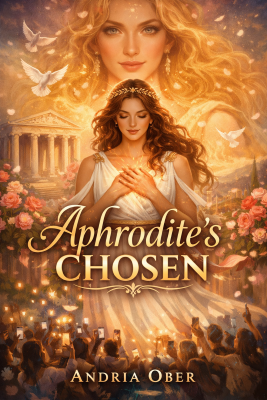
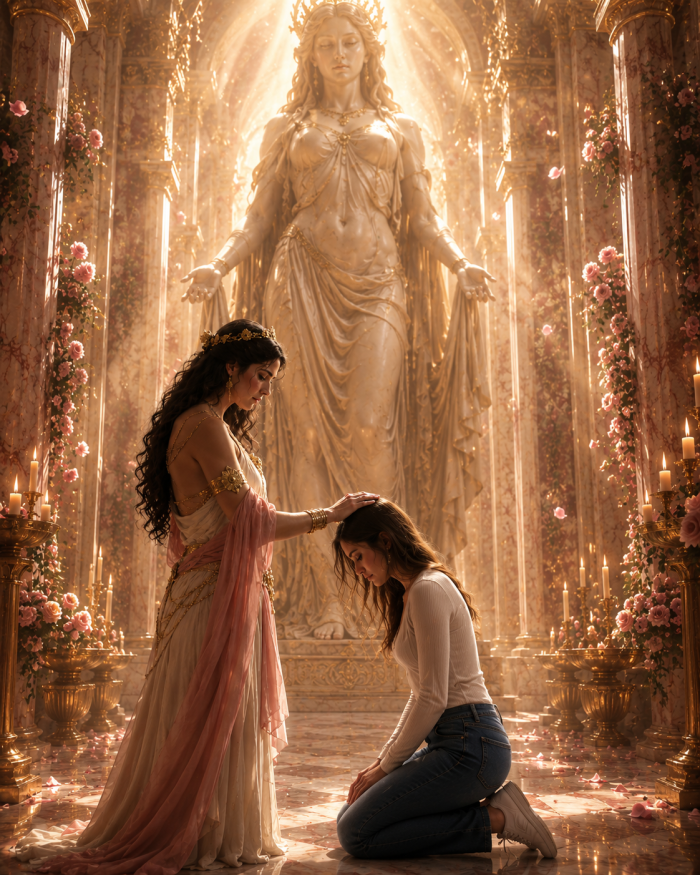
Chapter 8: At the Threshold
Morning arrived softly at the Temple of Aphrodite.
Pink light brushed the temple’s highest columns, painting them with the first blush of dawn. Incense smoke curled lazily in the gentle breeze, carrying the faint scent of rose and myrrh into the open air. Priests and disciples moved quietly through the colonnade, their footsteps muffled against the marble, tending to offerings and wreaths left at Aphrodite’s altar overnight. The goddess’s statue, haloed in golden morning, seemed almost to breathe with the city below. Outside, the faint clatter of market stalls and the distant call of vendors blended with the soft prayers whispered by early arrivals—Athenians seeking favor, lovers clasping hands, and solitary souls hoping for solace as the world brightened anew.
Sunlight spilled through the open arches, pale gold at first, then warmer as the hour deepened. The marble floors caught it and held it, reflecting a gentle glow that made the temple feel awake rather than awakened. Outside, Athens was already alive—footsteps on stone, distant voices, the hum of a city beginning another day—but here, at the threshold, the air felt intentional. Calm. Welcoming.
Eleni stood just inside the doors, hands loosely clasped, posture relaxed but attentive. She had chosen a simple dress in soft tones, something practical that still felt like herself. The morning light warmed her olive complexion, glinting softly on the silver thread at the edge of her sleeve. A fragrant sprig of fresh basil, tucked behind her ear, signaled both welcome and protection—a nod to old customs. As visitors crossed the threshold, Eleni greeted each one with a gentle, steady gaze, her smile open and genuine. She offered a nod or a quiet word, recognizing the uncertainty in some, the hope in others. When an elderly woman paused uncertainly at the entrance, Eleni stepped forward, extending a reassuring hand and guiding her into the cool, calm of the temple. To the children who lingered at their parents’ sides, she crouched to their level and greeted them in a tone both warm and playful, her presence dissolving hesitation. In every gesture, Eleni embodied the temple’s spirit: welcoming, patient, and quietly attentive to the needs—spoken and unspoken—of all who entered.
“Good morning,” she said, her voice steady and kind. “Welcome.”
People slowed when they heard it. Some looked surprised—not by the words, but by how easily they were offered. Faces that had been tight with uncertainty softened, brows unknitting as if the gentle welcome was something rare. A few smiled back, hesitant at first, then with growing warmth. Others exchanged glances with companions, visibly relaxing their tense shoulders or letting out a breath they hadn’t realized they were holding. Even those who tried to maintain a mask of indifference found themselves lingering, drawn in by the sincerity that radiated from the threshold. The temple’s welcome did not erase their burdens, but for a moment, it made them lighter.
Beside her, Thalia leaned lightly against one of the columns, curls pinned back just enough to keep them out of her eyes. She had brought a small notebook with her, tucked under one arm, more habit than intention. Thalia’s warm look made her approachable; her eyes seemed to smile before her lips did, and there was a gentle brightness in her expression that invited trust. Her presence radiated an effortless kindness, the sort that made even the most uncertain visitor feel seen rather than scrutinized. Her gaze moved constantly—not in judgment, but curiosity—taking in expressions, the way people held themselves, the quiet emotions that clung to them like perfume. She greeted newcomers with a small, welcoming nod or a quick, reassuring grin, her spirit as open as the temple doors themselves.
A couple approached together, fingers intertwined, nervous smiles flickering between them. Thalia straightened and stepped forward, her expression gentle and welcoming. Eleni noticed them too, offering a soft nod and moving to stand beside Thalia, the sprig of basil by her ear catching the light as she smiled warmly at the newcomers. The couple paused, glancing between the two women at the threshold, and seemed to draw courage from the sincerity and openness in their faces. Their grip on each other’s hands tightened, but their shoulders eased, the nervousness in their eyes slowly giving way to hope as they realized they were truly welcome.
“You don’t have to know what you’re asking for yet,” she said gently, as if reading their hesitation. “You can just come in.”
Relief crossed their faces, and they did.
A few steps away, Nikoleta stood near the outer edge of the doorway, where the line naturally formed. She had positioned herself there without discussion, instinctively choosing the place where people lingered longest—where doubts surfaced before courage caught up. Her gaze was calm and steady, dark eyes luminous with both attentiveness and understanding. Whenever someone hesitated at the threshold, Nikoleta greeted them with a smile that was both gentle and encouraging, a warmth that seemed to promise acceptance without condition. In that moment, her expression became an invitation—wordless but unmistakable—that quietly assured: here, you belonged.
She noticed everything.
A couple lingered in the background, set apart from the gentle current of new arrivals. The woman’s arms were crossed, chin tilted high as if daring the world to question her presence, but her gaze kept drifting to the temple’s open doors. Beside her, the man held himself rigidly, one hand gripping his phone while the other hovered uncertainly at her back. Their eyes met—hers questioning, his anxious—and for a moment, neither looked at the temple but only at each other, the silent conversation between them more urgent than words. When she finally glanced toward the threshold, her expression softened, just a hint; the man, noticing, let his shoulders drop as if releasing a burden he had carried all morning.
Nikoleta caught this exchange, her gaze gentle but perceptive. She offered a smile—reassuring, genuine, and without expectation. The couple hesitated, still poised for retreat, but something in Nikoleta’s openness called them forward, even if only by a step. In the hush between breaths, possibility fluttered: not certainty, but an invitation to try.
When someone hesitated, Nikoleta met their eyes and gave a small nod—not a push, not a plea. Just acknowledgment. If a visitor lingered uncertainly, she adjusted her posture—relaxing her shoulders, shifting her stance—to mirror openness and ease. Sometimes she would quietly step aside, widening the path as a silent invitation, or offer a reassuring smile that needed no words. Her presence radiated gentle acceptance, allowing each person to move at their own pace. With a soft, steady voice, she would sometimes say, “Take your time,” or “There’s no rush here,” making it clear that comfort, not obligation, was the temple’s first gift.
You are seen.
You may choose.
The temple doors remained wide open.
No banners announced the rules. No signs instructed behavior. The disciples did not block entry or guide traffic with rigid precision. Visitors felt the difference at once: instead of being directed or hurried, they were given space to acclimate, to look around, to breathe. The faint scent of flowers and incense mingled in the air, calming even those who arrived with tense shoulders or guarded expressions. The marble beneath their feet was cool and smooth, the sunlight a gentle presence rather than a spotlight. In the hush, the soft murmurs of prayers and the distant sound of laughter from other guests wove a tapestry of quiet welcome. The disciples allowed the flow to find its own rhythm, stepping in only when a question was asked or a pause stretched too long. For many, this gentle freedom softened anxieties they hadn’t even realized they carried, and a sense of peace settled in as they moved deeper into the temple’s embrace.
Some visitors spoke as soon as they crossed the threshold.
Others waited until they felt safe enough to breathe.
Eleni listened when words came quietly, her presence patient and grounded. She did not rush anyone, instead welcoming each story and request with unwavering attention. If a visitor seemed anxious, she guided them toward a quieter alcove or pressed a cool cup of water into their hands. She offered gentle reassurances—a touch on the shoulder, a softly spoken blessing, or a few heartfelt words that honored joy and sorrow alike. She didn’t promise miracles. She didn’t interpret desires. She simply held space, letting what was shared settle and pass onward—upward—toward the goddess who heard everything without speaking. In her care, burdens felt lighter and small hopes found room to grow.
Thalia found herself smiling often, touched by the way people softened once inside. She noticed how shoulders dropped, how voices lowered, how beauty—unadorned and honest—began to surface in small ways. When someone seemed shy or unsure, Thalia would quietly offer a compliment or share a story to ease their nerves. She had a gentle way of drawing people out, asking subtle questions about their day or what brought them to the temple, never prying but always inviting. When children grew restless, she knelt to show them a sketch in her notebook or let them trace patterns on the cool marble with her finger. For those who preferred silence, she simply kept them company, her calm presence a comfort in itself. She made a note to sketch later, not faces, but posture.
Nikoleta quietly intervened once, placing herself between two raised voices with calm authority that surprised even her. The tension dissolved as quickly as it had formed, replaced by embarrassed apologies and lowered gazes. No command had been needed. Most of the time, Nikoleta’s interactions were gentler—she greeted visitors with a steady presence, her words few but always considered. When someone looked lost, she guided them softly, pointing out alcoves for reflection or the path to the altar. She listened intently, offering advice only when asked, and sometimes shared a brief story or blessing from her own experience to reassure a hesitant newcomer. Children gravitated toward her quiet confidence, and the elderly found comfort in her respectful attention. When she noticed a guest lingering alone, she would make space beside herself in companionable silence, letting them know they did not need to speak to be welcome. In all her actions, Nikoleta fostered an atmosphere where dignity and comfort went hand in hand.
Inside the temple, Aphrosia watched from a distance. Her presence was felt more than seen—an aura of calm, of gentle authority. When visitors caught her eye, she greeted them with a warm, reassuring smile that seemed to convey understanding beyond words. She moved with quiet grace, never imposing but subtly guiding the energy of the room. Sometimes she would offer a silent nod, an encouraging glance, or a brief touch to someone’s hand—always respectful, always attuned to the boundaries of comfort. If a guest needed reassurance, Aphrosia listened intently, her responses thoughtful and measured, offering blessings in soft tones that honored both the person and the moment. She did not hover. She did not instruct. She observed, and when her presence was needed, she became a gentle anchor, helping visitors feel seen and valued within the sacred space. The system pulsed gently in her awareness—not urgent, not demanding—just counting, measuring, learning.
System Message: Visitor Flow and Emotional State Assessment – 07:18 AM
— Current Occupancy: 37
— New Arrivals (last 10 minutes): 9
— Departures (last 10 minutes): 2
Emotional Atmosphere (Aggregate):
— Calm (68%)
— Hesitant (19%)
— Hopeful (9%)
— Distressed (4%)
Clusters:
— Main Nave: Small group gathered near central altar, predominantly calm, one individual showing signs of distress (elevated pulse, tense posture)
— Eastern Colonnade: Two pairs in quiet conversation, hopeful interactions
— Outer Threshold: Three individuals lingering, emotional state hesitant but improving
Notable Individual Updates:
— Elderly woman (ID: 0142): Recently entered, pulse stabilizing, responding to Eleni’s presence
— Young couple (ID: 0218/0219): Initially hesitant, now displaying signs of relief and mild hopefulness after interaction with Thalia and Nikoleta
— Unaccompanied youth (ID: 0325): Lingers near votive candles, emotional state uncertain, recommend a gentle approach
Guidance:
— Continue to prioritize gentle, non-intrusive presence among hesitant individuals
— Monitor for signs of escalating distress in the main nave
— Encourage current approach: warmth, patience, and silent reassurance
System Status: Normal. No urgent interventions required. Minor adjustments to lighting and incense diffusion are recommended for optimal comfort.
— End of Message —
Aphrosia felt a quiet satisfaction settle in her chest. There was a sense of gentle pride as she watched the temple fill—not with crowds or noise, but with the slow, genuine unfolding of hope and vulnerability. She could feel the hush of prayers whispered into marble alcoves, the soft tremor of longing as offerings were placed before the goddess’s statue, the fragile peace that settled over visitors as they allowed the temple’s calm to touch something deep within. Each new arrival brought a ripple of energy—hesitation, relief, yearning—and Aphrosia, attuned to the shifting atmosphere, felt her own heart respond in kind: steady, compassionate, quietly joyful. This was how it was meant to begin.
Not with spectacle.
Not with power asserted.
But with open doors, steady hearts, and three women standing at the threshold—welcoming the world in, one choice at a time.
And as the sun climbed higher over Athens, the Temple of Aphrodite did exactly what it had been built to do.
It listened.
The morning had settled into a steady flow when the couple approached.
They moved slowly, instinctively protective of one another. The woman’s hand rested on the curve of her belly, unmistakably in its third trimester, while her partner stayed close at her side, eyes alert with a mixture of hope and worry. A hush seemed to ripple outward as they entered, the gentle morning light catching the gold beads of her hair and the careful tenderness of his touch. The temple seemed to quiet around them, as if recognizing the weight of what they carried. Other visitors instinctively gave them space, sensing the importance of their presence—some offered shy, encouraging smiles, while a priestess near the altar discreetly lit a fresh stick of incense in their honor. The couple paused at the threshold, exchanging a quiet, steady look—equal parts reassurance and shared anticipation—before moving forward hand in hand. Their steps were slow, each movement deliberate, as if savoring a moment that might become a memory.
Eleni noticed them first and guided them inward with a warm smile, but when their eyes found Aphrosia, they paused.
“Excuse us,” the woman said softly, her voice calm, indicating she’d practiced it. “We were hoping… if it’s possible… for a blessing. For our baby. And for me.”
Aphrosia stepped forward immediately, her expression kind and unhurried. She did not reach for the woman’s belly or assume familiarity. She simply smiled—warm, genuine, present.
“First,” Aphrosia said gently, “I wish you a safe delivery and a healthy child. That hope is shared here.”
The couple visibly relaxed.
“But,” Aphrosia continued, her tone respectful rather than corrective, “while I can bless your love and the bond you share, the goddess Eileithyia is the one who watches over pregnancy and birth. She is far better suited to grant a blessing for mother and child.”
There was no disappointment in her voice—only clarity.
“I would never claim another goddess’s domain,” Aphrosia said. “Love teaches us to honor boundaries as much as desire.”
The woman nodded slowly, relief and gratitude mingling in her eyes. “We didn’t know,” she admitted. “We just… felt drawn here.”
“And that’s perfectly natural,” Aphrosia replied. “You’re welcome to ask Aphrodite for another blessing—strength, unity, reassurance, love during this transition.”
She gestured lightly toward the entrance.
“If you wish,” she added, “I can point you in the right direction. Or I can have one of my disciples assist you in reaching the correct temple.”
She glanced toward Eleni, who had already stepped closer, ready to help without a word being spoken.
“There’s no wrong choice,” Aphrosia finished softly. “Only the one that feels right to you.”
The couple exchanged a look—shared, steady, full of trust—and smiled. As Eleni gently led them toward the appropriate altar, the woman glanced back at Aphrosia, her eyes shining with gratitude. The man lingered a moment, quietly mouthing "thank you" before following. Their appreciation was not loud, but it was unmistakable: a sense of relief in being guided with such dignity, and a deep comfort in knowing their needs had been met with respect for tradition and care for their well-being. Aphrosia felt a quiet warmth fill her—pride not in her own restraint, but in the trust she saw reflected back at her. She watched their figures recede into the golden light, knowing that the peace she cultivated in the temple had reached them. For Aphrosia, every small act of guidance, every boundary honored, made the temple more sacred—and the gratitude of those she served, even when unspoken, was the most precious offering of all.
Inside Aphrosia’s awareness, the system pulsed—not with gain, but with approval.
[SYSTEM NOTE]
Divine Boundary Respected
— Devotional Integrity Maintained
— Inter-Goddess Conflict Avoided
— Visitor Request Handled with Compassion
— Gratitude Registered (Source: Human and Divine)
— Sanctuary Atmosphere Preserved
System Guidance: Continue to prioritize gentle redirection and honor all boundaries. Positive impact noted on visitor well-being and inter-pantheon harmony. No further action required at this time.
As the couple followed Eleni toward the doors, Aphrosia remained where she was, watching them go with quiet satisfaction. She could see the gentle way their hands found each other, fingers twining with the easy certainty of love weathered and renewed by hope. The woman leaned ever so slightly into her partner, and he, in turn, looked at her with an affection so open Aphrosia felt it radiate in soft waves. Their shared laughter floated back—a small, private joy—and Aphrosia found herself smiling, moved by the simple, profound connection they carried out into the world. It was not just gratitude she witnessed, but the unmistakable presence of love: quiet, resilient, and enduring.
This, too, was devotion.
Not claiming everything—but knowing when to guide someone elsewhere with grace.
And the temple continued to breathe, open and honest, as the day carried on.
The warmth of the moment had barely faded when Aphrosia’s vision flickered—clean, precise, unmistakably system.
The world did not pause.
The temple did not quiet.
Only she was aware.
[SYSTEM ANNOUNCEMENT — DIVINE ORIGIN DETECTED]
Source: Eileithyia
Message: Your guidance and respect for the sacred domains have not gone unnoticed. The care shown to those who seek blessings—especially to those carrying new life—reflects the highest ideals of our order. Let all who serve remember: boundaries are the foundation of harmony among gods and mortals alike. You have my gratitude and my blessing upon your house.
Status: Acknowledged
Pantheon Relations: Stable — Trust reinforced
Divine Standing: Favorably Noted — Blessing registered
Supplemental Note: The presence of love and the honoring of tradition today strengthen the bonds between our temples. Continue to serve with wisdom and grace.
The message faded without flourish.
No power surged.
No numbers ticked upward.
Yet Aphrosia felt something settle nonetheless—a subtle shift, like a door quietly closing and another remaining open. Respect, freely given and freely returned. There was a gentle thrill in knowing her choices had been seen and honored by another goddess, a warmth that radiated outward from the center of her being. For a moment, she allowed herself a rare sense of kinship—not just with mortals, but with the powers who watched from afar. The blessing felt both intimate and vast, a silent thread linking her intentions to the greater harmony of the pantheon. She exhaled slowly, lips curving into a small, knowing smile, her heart lighter, her purpose affirmed.
Even gods, it seemed, appreciated restraint.
And the temple carried on—balanced, honored, and at peace.
Aphrodite's Chosen Chapter 9
Author:
Audience Rating:
Publication:
Genre:
TG Themes:
TG Elements:
Permission:
Chapter 9: Boundary of the Divine
The tension arrived before the sirens.
It rippled through the crowd gathered outside the Temple of Aphrodite—phones already raised, conversations faltering as uniformed officers approached the broad steps. The afternoon sun blazed overhead, that particular Mediterranean white-gold that turned ancient Pentelic marble into something luminous, almost alive. Heat radiated from every surface, from the worn stone steps that had known centuries of footfalls, from the fluted columns flanking the entrance, their surfaces weathered smooth by salt air and time.
Behind Aphrosia, the temple doors stood open, spilling shadow and cooler air across the threshold. Beyond the crowd, the Acropolis rose against the cloudless sky—a reminder that gods were back, and had always claimed this city as their own.
She stepped forward deliberately, bare feet silent on sun-warmed marble, placing herself outside the threshold. Her body moved with the fluid grace of someone utterly certain of her right to occupy space—shoulders back, spine straight, chin level. The white linen of her chiton draped across her form in elegant folds, the fabric so fine it seemed to glow in the harsh light, clinging to the curves of her hips and breasts with each breath. Her dark hair fell loose over bare shoulders, stirring slightly in the hot breeze that carried the scent of jasmine and exhaust from the street below.
She did not raise her voice.
She did not retreat.
She simply stood—and the space around her seemed to contract, to acknowledge her presence as the fixed point around which everything else orbited.
"May I help you?" Aphrosia asked. The question was not an offer—it was a warning.
One of the officers cleared his throat, sweat already darkening the collar of his uniform despite the relative shade of the temple's shadow. His gear—radio, baton, the weight of bureaucratic authority—sat heavy on his belt, pulling at fabric that hadn't been designed for Athens in summer. "We've received reports of prostitution taking place inside the temple."
The murmur that followed rolled through the crowd like a wave. Cameras tilted, screens flaring white in the sunlight before auto-adjusting. Streams multiplied. The moment fractured into dozens of angles at once—faces half-shadowed, half-illuminated, the ancient stone steps forming a natural amphitheater for the confrontation. Feet shuffled on marble worn smooth by millennia. Bodies pressed closer, the crowd's collective breath seeming to pause.
Aphrosia's expression did not change. Light played across her face—the sharp angle of her cheekbone, the curve of her jaw, the fullness of her mouth—as she tilted her head just slightly, a predator's assessment.
"You've received reports," she said, each word precise as a blade, her voice carrying effortlessly across the stone. "Not evidence. Not jurisdiction. Reports."
The officer's jaw tightened, a muscle jumping beneath sun-reddened skin. His hand moved unconsciously toward his belt, fingers brushing the radio. "Ma'am, we need to—"
"No."
The single syllable cut through his sentence like a door closing. The heat seemed to intensify, pressing down from the white sky and radiating up from the marble that had absorbed the sun's fury for hours. Shadows shortened, sharpened. The air itself felt dense, resistant.
"This temple honors consensual intimacy between willing adults," Aphrosia continued, her voice steady and unyielding. Her hands remained at her sides, relaxed but ready, fingers long and elegant against the white linen. "We do not monitor. We do not record. We do not apologize. What happens within these walls is sacred, and you—"
She let her gaze sweep across the line of uniforms, taking in each face, each bead of sweat on foreheads, each uncomfortable shift of weight from foot to foot on the unforgiving stone. The officers stood in full sun while she commanded the threshold between light and shadow, between the burning street and the cool sanctuary behind her.
"—are not welcome to profane it."
She shifted—just enough to block the doorway fully, her body a living barrier. The movement was unhurried, graceful, and absolute. Sunlight caught the curve of her shoulder, the line of her throat, the swell of her breasts rising and falling with each measured breath. Behind her, the temple's interior remained dark and inviting, a promise of relief from the relentless heat that none of them would be permitted to enter.
The columns framed her like an ancient frieze, Pentelic marble glowing warm against her skin. Somewhere in the distance, traffic hummed. A motorbike whined up a nearby street. But here, on these steps, the only sound was breathing—hers controlled, and even, theirs increasingly labored in the oppressive heat.
"These are the aspects of Aphrodite. Love. Desire. Lust." Her chin lifted slightly, exposing the elegant line of her throat, and the gesture was both vulnerable and utterly commanding. Light and shadow played across her collarbones, the hollow at the base of her neck where her pulse beat steady and strong. "You will not enter. You will not interfere. You will not touch what belongs to the goddess."
The words were not a plea.
They were a boundary, drawn in stone as ancient and immovable as the marble beneath their feet, as permanent as the Acropolis rising behind them all.
"I will not allow you entry."
The heat pressed down. The marble burned. The crowd held its breath, phones raised like offerings, capturing every angle of the woman who stood between mortal authority and divine sanctuary, her body a temple unto itself—beautiful, untouchable, absolute.
The lead officer's patience snapped. He stepped forward, hand already rising, boots heavy on stone that had witnessed empires rise and fall.
He reached for her.
The world broke.
Sound came first—not a voice but a command, resonant and absolute, vibrating through bone and stone and the air itself. The ancient Pentelic marble beneath their feet responded, a deep thrumming that rose from the bedrock of Athens itself. Hairline fractures of golden light spiderwebbed across the worn steps, tracing patterns older than memory. The stone grew warm, then hot, then burning—not with earthly heat but with something divine, something that remembered when gods walked freely, and marble was quarried to honor them.
The sound did not echo. It existed, filling every space at once, undeniable as gravity, inescapable as breath.
"YOU WILL NOT TOUCH WHAT IS MINE."
Then came the light.
It erupted from the threshold itself, from the columns, from the very air—searing white-gold that didn't illuminate so much as claim. The Mediterranean sun, that harsh Athenian brightness that had beaten down mercilessly moments before, suddenly seemed dim by comparison. Shadows twisted wrong, bending away from her presence, fleeing toward the edges of the square as if repelled. The quality of light itself changed—became thicker, more viscous, like honey poured through the air.
People screamed, hands flying to their faces, but the light found them anyway—pressed against closed eyelids, burned into retinas, seared through raised palms. Cameras whited out, their sensors overwhelmed. Audio feeds shrieked and distorted, microphones crackling with interference that shouldn't exist. Phone screens flickered and died, then blazed back to life, showing only white, only gold, only her.
The marble steps beneath their feet grew hotter still. The ancient stone that had absorbed millennia of Mediterranean sun now radiated divine fire. People stumbled backward, bare feet and thin-soled shoes no protection against the sudden heat. The worn grooves where countless pilgrims had climbed—where philosophers had debated, where lovers had met, where blood had been spilled in a dozen different ages—all of it glowed faintly, veins of gold spreading through white stone like a body remembering its sacred purpose.
The air turned thick, oppressive, wrong. Pressure built in their ears as if they'd descended too quickly, as if the atmosphere itself was being displaced by something too vast to coexist with mortal breath. Humidity spiked—the dry Athenian heat suddenly heavy with moisture that tasted of salt water, of the Aegean, of depths where sunlight never reached. Breathing became difficult, each inhale requiring conscious effort, lungs working against air that had become dense as water.
The scent hit next—roses and salt water and something older. Musk and honey and the copper-sweet tang of blood, of sex, of life itself. It was intoxicating. Overwhelming. Primal. Several people in the crowd swayed, knees buckling. A woman near the front collapsed entirely, gasping, tears streaming down her face, though she didn't seem to know why. A young man doubled over, retching, his body rejecting the sheer presence pressing down on them all.
One of the officers—not the lead, but the younger one who'd been filming on his body camera—began to weep. Blood trickled from his nose, thin and bright against pale skin. His camera sparked once, twice, then died completely, the plastic casing cracking down the middle.
When the brilliance softened enough to see, she was there.
Aphrodite.
Not appearing. Not arriving. Present, as if she had always been standing there and reality had simply failed to notice until now, as if the world had been incomplete without her and was only now remembering what it had been missing.
She was devastating.
Beauty wasn't the right word—beauty was too small, too mortal, too safe. She was want made flesh, desire given form, every fantasy and longing compressed into a single impossible figure. Her skin seemed to glow from within, luminous and warm, lit by something that had nothing to do with the sun overhead. Her hair moved in a wind that touched nothing else, dark curls cascading over bare shoulders, each strand catching light that shouldn't exist, reflecting colors that had no names.
She wore something that might have been fabric or might have been light itself—diaphanous and clinging, flowing and fixed, simultaneously revealing and concealing. It moved like water, like silk, like nothing mortal looms had ever produced. The hem brushed against the marble steps, and where it touched, rose petals materialized—deep crimson, impossibly fresh, their scent adding to the overwhelming cascade of sensation.
Her feet were bare against the ancient stone. Perfect feet, high arches, delicate ankles—but where they touched the Pentelic marble, the stone sang. A resonance too low to hear but felt in the chest, in the bones, in the base of the skull. The worn grooves in the steps seemed to align themselves beneath her, as if the stone was reshaping itself to cradle her, to worship her, to remember what it meant to bear the weight of divinity.
But it was her presence that truly unmade them.
The weight of her attention was physical, crushing, inescapable. When her gaze swept across the officers, two of them stumbled backward as if struck, one falling to his knees with a cry that was half prayer, half terror. His hands pressed against the burning marble, and he didn't seem to notice the pain, didn't seem to notice anything except her. The crowd pressed away from the steps, a collective retreat driven by an instinct older than civilization, older than language, the same instinct that made ancient humans build altars, offer sacrifices, and beg for mercy from forces they couldn't comprehend.
Behind them, the Acropolis seemed to lean toward her. The Parthenon, that monument to Athena, stood silent witness on its hill, its columns catching the changed light, its marble glowing in response to her presence. For a moment—just a heartbeat—the air shimmered between the temple steps and that ancient citadel, as if the sacred geography of Athens itself were realigning, remembering that gods had always claimed this city, had always walked these streets, had always demanded worship, reverence, and fear.
She stood behind Aphrosia—no, around her, arms wrapped possessively across her vessel's shoulders, chin resting against dark hair. The gesture was tender and absolute in equal measure, a claim that brooked no argument. Where her skin touched Aphrosia's, light pulsed—soft gold, warm and alive, spreading across her vessel's shoulders like a brand, like a blessing, like both at once.
"My vessel," Aphrodite said, and her voice was silk over steel, honey laced with venom. The words resonated through the square, through the marble, through the bones of everyone present. Phones that had died sparked back to life, compelled to record. "My beloved."
The officer who had reached for Aphrosia stood frozen, hand still extended, face drained of color. The goddess's eyes fixed on him—dark and fathomless and ancient, pupils dilating until they swallowed the iris, until they became doorways into something vast and terrible and utterly inhuman. He made a sound like a wounded animal, his body convulsing once, violently. His hand dropped. His knees buckled. He stayed upright only through sheer force of will, trembling like a man in the grip of fever.
"You thought to touch her?" Each word dripped with something between amusement and threat. The temperature rose again—the air shimmering, heat radiating from her form in visible waves. Sweat beaded on foreheads, ran down temples, soaked through uniforms. Someone in the crowd sobbed, the sound raw and broken. Another person laughed—high and hysterical, the sound of a mind fracturing under divine weight.
"You thought your laws, your mortal authority, gave you permission?"
The marble cracked. Not breaking, but yielding—thin lines spreading from where her feet touched stone, golden light seeping through like molten metal poured into ancient veins. The steps groaned, settling, the sound like the earth itself exhaling.
"I am Aphrodite." The declaration resonated through the square, through the city, through the thousands of devices capturing this moment—phones and cameras and satellites overhead, all of them compelled to witness, to record, to remember. "Goddess of love and desire, of beauty and passion, of the sacred union between willing souls. I have walked this earth since before your ancestors learned to speak my name. I have toppled kingdoms for love. I have ended men for less than what you attempted here."
The light around her intensified. The shadows fled further. The Acropolis seemed to glow in response, its marble catching fire with reflected divinity. Somewhere in the city, a church bell began to ring—unscheduled, unprompted, the sound carrying across rooftops and through narrow streets as if Athens itself was announcing her presence.
Her arms tightened around Aphrosia, possessive and unmistakable. Where her hands pressed against her vessel's body, the white linen began to glow, threads of gold spreading through the fabric like veins, like roots, like a claim written in light itself.
"She is mine. Chosen among billions. Beloved beyond your comprehension. And you—" her gaze swept across the officers, the crowd, the cameras, each lens fogging and clearing in rhythm with her words, "—you will never touch her again."
Aphrosia breathed out, the sound shaky with relief, reverence, and something deeper. The air around them rippled, rose petals falling faster now, a crimson cascade that defied both wind and gravity. She turned within the goddess's embrace, one hand rising to cup that perfect, terrible face. Where her mortal fingers touched divine skin, sparks of gold danced between them, tiny stars being born and dying in the space of heartbeats.
"My goddess," she said softly, and her voice carried anyway, amplified by divine will, by the marble beneath them, by the air itself, which had become an extension of Aphrodite's presence. "Thank you for your protection."
Their eyes met—mortal and divine, vessel and deity. The contrast was stark: Aphrosia's dark eyes, human and warm and finite, meeting those fathomless depths that held eons, that had witnessed the rise and fall of civilizations, that had seen empires built on desire and destroyed by love.
"I will handle this, though," Aphrosia continued, thumb brushing across Aphrodite's cheekbone. The goddess's skin was warm, impossibly smooth, and where Aphrosia touched, the light pulsed brighter, responding to her vessel's affection like a living thing. "Remember what you told me about divine interference. We wouldn't want to bring the ire of the other gods."
Aphrodite's expression softened, just slightly. Fondness warred with something fiercer, more possessive. The air pressure eased fractionally, allowing the crowd to draw deeper breaths, though the scent of roses and salt remained overwhelming. "You would protect me, beloved?"
"Always."
Then Aphrosia kissed her.
The gasp that followed was collective and visceral—thousands of people inhaling at once, the sound like a wave breaking against ancient shores. The marble beneath them flared brilliant gold, light racing through every crack and crevice, illuminating the entire staircase from within. The columns framing them began to glow, Pentelic marble remembering its divine purpose, responding to the union of goddess and vessel with something like joy, like recognition, like worship.
It was not a chaste kiss. Not a performance. It was claiming—deliberate and unapologetic, Aphrosia's hand sliding into divine hair that felt like silk and starlight, Aphrodite's arms pulling her closer, their bodies pressed together in a way that left no room for misinterpretation. The air around them shimmered with heat, with power, with the raw force of divine love made manifest. Rose petals materialized from nothing, drifting down across the steps in a crimson cascade that covered marble and crowd alike, soft and fragrant and impossible.
The light intensified until it was almost unbearable. People turned away, shielding their eyes, but their phones kept recording, sensors pushed beyond their limits, capturing something that shouldn't exist in pixels and data. The temperature spiked—the marble now hot enough to burn, though neither goddess nor vessel seemed to notice. The air tasted of copper and honey and salt, of sex and divinity intertwined.
When they parted, Aphrodite's smile was knowing and fond and dangerous in its tenderness. The light began to soften, the pressure to ease, though the marble still glowed faintly beneath them, still sang its silent song of recognition.
"Be careful, my love," she murmured, loud enough for every camera to capture, her voice carrying across the square like a benediction and a warning both. "The world is not ready for what we are."
"The world will learn."
The goddess laughed—a sound like music and thunder intertwined, like waves breaking on ancient shores, like the first cry of desire ever uttered. The Acropolis seemed to shudder in response, its stones remembering that sound, remembering when gods walked freely, and mortals knew their place. She pressed one more kiss to Aphrosia's forehead, and where her lips touched, a mark appeared—faint gold, like a brand, like a blessing, visible for just a moment before fading into skin.
Then she was gone.
Not fading. Not departing. Simply absent, as if she had never been there at all—except for the rose petals still falling, the scent of salt and honey lingering in the air, the heat radiating from the marble steps.
And the thousands of recordings that proved otherwise.
Aphrosia turned back to the crowd.
The movement was liquid, unhurried—her bare feet pivoting on sun-warmed marble that still glowed faintly with divine residue, her body rotating with the fluid grace of water finding its course. The white linen of her chiton shifted with her, clinging to the curves of her hips and breasts, the fabric so fine it seemed translucent in the harsh Mediterranean light. Her dark hair fell across one shoulder, still disheveled from the goddess's touch, and she made no move to smooth it. She let them see. Let them witness what it means to be beloved.
The silence was absolute—phones still raised, mouths still open, the entire square frozen in the aftermath of witnessing the impossible. But it wasn't just shock that held them. It was her. The pull of her presence, magnetic and inescapable, drawing every eye like gravity, like hunger, like the irresistible compulsion to witness beauty even when it burned. People who had been retreating found themselves stepping forward again, unable to look away, their bodies responding to something older than conscious thought.
She let them stare. Let them process. Let the weight of what they'd seen—what they were still seeing—settle into their bones.
The air around her carried the scent of jasmine and salt water, of roses and something warmer, muskier—the lingering trace of divinity mixed with her own mortal heat. Warmth radiated from her skin, visible in the shimmer of air around her shoulders, her throat, the exposed line of her collarbone. The atmosphere seemed to bend toward her, drawn by the same force that made the marble sing beneath her feet and the ancient stone remember its purpose.
When she spoke, her voice was hypnotic—low and rich, carrying across the steps like honey poured over silk, like a lover's whisper amplified to fill the world. It held command and invitation in equal measure, the weight of desire and divinity intertwined, impossible to resist, impossible to ignore.
"You wanted to know what happens inside this temple."
Each word landed with deliberate precision, her lips shaping them with the care of ritual, of seduction. The officers trembled. Several people in the crowd swayed, knees weakening, breath catching. One woman pressed a hand to her chest as if her heart had forgotten its rhythm.
"You wanted evidence. Jurisdiction. Permission."
Aphrosia's head tilted—just slightly, the gesture both curious and predatory, exposing the elegant line of her throat where a faint pulse beat visible beneath golden skin. The movement drew the eye, held it, made it impossible to focus on anything else. The lead officer tried to look away and found he couldn't. His gaze was trapped, his body frozen, every instinct screaming at him to flee and to stay in equal, maddening measure.
She gestured to the space where Aphrodite had stood moments before, her arm extending with balletic grace, fingers trailing through empty air where rose petals still drifted, defying both wind and gravity. The white linen slid across her skin with the movement, revealing and concealing, the fabric responding to her body like a living thing.
"You have your answer now."
The officers hadn't moved—couldn't move. The lead stood pale and trembling, his hand still half-extended as if paralyzed by divine rebuke, his fingers shaking with fine tremors he couldn't control. Sweat beaded on his forehead despite the cooling air. His partner had gone to his knees without seeming to realize it, one hand pressed against the marble as if seeking stability, finding only heat and the memory of divine presence.
Aphrosia's gaze swept across them—dark eyes that held depths they couldn't fathom, warmth that promised and threatened in equal measure. Then to the cameras, meeting each lens as if she could see through to the millions watching beyond. Then to the crowd, and where her attention landed, people gasped, their bodies responding involuntarily to being seen by her, to being acknowledged by something that carried the echo of divinity in every breath.
"Love is an aspect of Aphrodite."
There was no apology in her tone, no softness to cushion the declaration. But there was something else—a dangerous tenderness, the quality of mercy offered from a position of absolute power. She spoke to them as a goddess might speak to mortals: with patience for their limitations, with understanding of their fear, with the quiet certainty that she could destroy them and chose not to.
"Desire. Passion. The sacred union of willing bodies and souls."
Her hand rose to her own chest, fingers splaying across the white linen above her heart. The gesture was intimate, deliberate, drawing attention to the rise and fall of her breathing, to the warmth of her skin, to the body that housed divine essence. The marble beneath her feet pulsed once with golden light, responding to her touch against her own flesh.
"I was chosen as her vessel because I understand this. Because I embody this."
She stepped forward—bare feet silent on stone, hips swaying with each movement, her body a study in fluid grace and absolute confidence. The officers stumbled backward, their retreat instinctive and shameful, unable to hold their ground against her approach. The crowd parted without conscious thought, creating space for her, bodies responding to the magnetic pull of her presence even as minds struggled to comprehend what they were witnessing.
"Because among the billions on this earth, I was deemed worthy to carry her divine essence."
The words should have sounded arrogant. Instead, they rang with simple truth, with the weight of divine selection, with the certainty of someone who had been chosen and knew exactly what that meant. Her voice dropped lower, more intimate, as if sharing a secret with the entire world at once.
"All vessels share a bond with their gods. But mine—"
She paused, and the silence stretched, unbearable and electric. The air grew warmer. The scent of jasmine intensified. Someone in the crowd whimpered.
"—mine is forged in love itself."
Her lips curved—not quite a smile, something more complex, more knowing. The expression held echoes of the goddess's dangerous tenderness, that quality of fondness mixed with the absolute certainty of power. She looked at the officers the way Aphrodite had looked at them: with something almost like pity, almost like mercy, tempered by the understanding that mercy was a choice, not a weakness.
"You witnessed it. The world witnessed it. And now you understand—"
She turned, the movement a slow pivot that made the white linen swirl around her legs, that drew every eye along the line of her body, the curve of her spine, the bare shoulders that still seemed to glow faintly in the afternoon light. Her hand swept back toward the temple doors, still open behind her, sunlight spilling across the threshold like an invitation and a warning both.
"—what happens within these walls is sacred. It is protected. It is hers."
The gesture was ritual and seduction intertwined, her arm extending with the grace of an offering, of a benediction, of a lover beckoning. The air shimmered between her outstretched hand and the temple entrance, as if the space itself recognized the connection, the claim, the boundary being drawn.
"You will not enter."
Her voice hardened—honey crystallizing into something sharp enough to cut, silk pulled taut enough to strangle. The dangerous tenderness vanished, replaced by absolute conviction, by defiance that brooked no argument. She stepped forward again, and this time the officers didn't just retreat—they fled, stumbling backward down the steps, their bodies finally obeying the screaming instinct to escape.
"You will not interfere. You will not bring your laws, your judgments, your mortal authority into a space consecrated by divinity."
Each word landed like a hammer strike, like a lover's hand turned to a fist, like mercy withdrawn and replaced with divine wrath. The marble beneath her feet flared brighter, golden light racing through the cracks, the stone singing its recognition of her authority, her right to stand as guardian of this threshold.
She fixed the lead officer with a look that made him flinch, made him turn his face away as if her gaze was too bright to bear, too intense to meet. But she didn't let him escape. She held him there with nothing but the weight of her attention, the magnetic pull of her presence, the terrible beauty of someone who embodied desire itself and knew exactly how to wield it.
"This is the boundary. I am the boundary. And you—"
Her head tilted again, that predatory curiosity returning, that quality of examining something small and fragile and utterly beneath her concern. The dangerous tenderness flickered back—just for a moment, just long enough for him to see what mercy looked like before it was denied.
"—you will never cross it."
The marble beneath her feet still radiated warmth, as if the stone itself remembered the goddess's touch, as if the ancient Pentelic rock had been forever changed by bearing the weight of divinity and now responded to the vessel who carried that same essence in mortal flesh.
Aphrosia stood there—barefoot and radiant, white linen clinging to curves that seemed to glow from within, dark hair falling wild across shoulders that had been embraced by a goddess, lips still swollen from a divine kiss. She was devastating. She was unmistakable. She was the living embodiment of everything Aphrodite represented, and the world could not look away.
"Go."
The word was not a suggestion. It was dismissal, absolute and final, spoken with the authority of someone who had been claimed by divinity and knew her worth, knew her power, knew that she stood as the boundary between the sacred and the profane and would never yield.
"Tell your superiors what you saw. Tell them who protects this temple. Tell them what happens to those who reach for what belongs to the divine."
Behind her, the doors remained open—an invitation to those who understood, a warning to those who didn't.
But the boundary—now—was unmistakable.
And she was its guardian, its embodiment, its living proof that the divine walked among them and would not be constrained by mortal law, mortal judgment, or mortal fear.
The officers fled.
The crowd remained, unable to move, unable to breathe, unable to do anything but witness and record and remember what it meant to stand in the presence of someone beloved by a goddess.
The world did not argue this time.
It shattered.
In newsrooms across the globe, anchors stumbled over words that had lost all meaning. A BBC correspondent went silent mid-sentence, staring at the monitor as the footage replayed—light that moved wrong, sound that bent physics, a woman who couldn't exist but did. His co-anchor reached for the standard dismissals, the careful language of journalistic skepticism, and found her mouth empty of anything that made sense.
"We're... we're seeing..."
She couldn't finish.
CNN cut to commercial, then cut back, then cut away again as producers screamed into headsets, trying to find someone—anyone—who could explain what every camera had captured from a dozen angles. The split screens multiplied: Athens, New York, Tokyo, London, all showing the same impossible moment, the same divine manifestation, the same kiss witnessed by millions in real time.
Then every screen went white.
Not a glitch. Not a cascade failure. A choice.
Every device on Earth—simultaneously, instantaneously, irreversibly—interrupted its programming. Phones locked mid-scroll. The television cut to black. Military command centers, government bunkers, stock exchange floors, hospital monitors, surveillance networks, social media feeds—all of it stopped.
And then the message appeared.
[SYSTEM ALERT - UNIVERSAL BROADCAST]
[TIMESTAMP: 14:47:33 UTC - PERMANENT RECORD]
[PROGRESSION STATUS: IRREVERSIBLE]
ENTITY CONFIRMED: APHRODITE
CLASSIFICATION: DIVINE MANIFESTATION - ATHENS, GREECE
VESSEL IDENTIFIED: APHROSIA
STATUS: PROTECTED
DIVINE INTERVENTION: DOCUMENTED
GLOBAL WITNESS COUNT: 4.7 BILLION
DENIAL THRESHOLD: EXCEEDED
[THIS IS NOT A BROADCAST]
[THIS IS A RECORD]
[THIS CANNOT BE UNDONE]
The message remained on every screen for exactly seven seconds. Then it vanished, and normal programming resumed—but nothing was normal anymore. The message had been logged. Timestamped. Embedded into the progression system itself, a permanent marker in the world's collective memory, impossible to delete, impossible to deny, impossible to explain away.
The world had been notified.
Reality had shifted, and the systems themselves were acknowledging it.
The first institution to break was NORAD.
Deep inside Cheyenne Mountain, alarms screamed as satellite feeds confirmed what couldn't be confirmed—an energy signature that had appeared over Athens with no electromagnetic precursor, no radiation spike, no physics. The duty officer's hand hovered over the DEFCON escalation protocol, sweat beading on his temple. His superior was already on three simultaneous calls—Pentagon, White House, NATO command—all of them shouting variations of the same question: What the fuck was that?
Within eight minutes, the United States moved to DEFCON 3.
Russia followed four minutes later, their early warning systems having detected the American escalation before any official communication. China's Central Military Commission convened in emergency session, generals staring at footage that their censorship algorithms had failed to block. The energy readings were impossible. The light spectrum was wrong. Every scientific instrument that had been pointed at Athens during those seven seconds had recorded data that violated fundamental laws.
North Korea launched three test missiles into the Sea of Japan, not as aggression but as proof—proof they still had control, proof the world still operated on comprehensible principles, proof that something still made sense.
It didn't help.
The New York Stock Exchange suspended trading at 9:47 AM Eastern—twelve minutes after the manifestation. The Dow had already plummeted 3,000 points. London followed. Then Tokyo. Then every major exchange in a cascading domino effect of financial panic. Algorithms designed to detect market manipulation kept triggering, but there was no manipulation to find—just millions of traders simultaneously realizing that the fundamental assumptions underlying global economics might be wrong.
Currency markets went haywire. Gold spiked 40% in an hour. Cryptocurrency exchanges crashed under the load of people trying to convert assets into something, anything that felt real.
A Bloomberg anchor broke down in tears on live television, mascara running, whispering, "I don't know what money means anymore," before her feed cut out due to technical difficulties.
Emergency broadcasts interrupted programming in 47 countries simultaneously.
In the United States, the Emergency Alert System was activated for only the third time in history—a harsh tone followed by a message that had been written in frantic minutes by officials who couldn't agree on what to say: "Citizens are advised to remain calm. The event in Athens, Greece, is under investigation. Avoid large gatherings. Await further instructions."
The instructions never came.
In France, President Macron addressed the nation with visible tremors in his hands, calling for "rational discourse in the face of unexplained phenomena" while behind him, advisors argued in heated whispers. In Germany, the Bundestag convened an emergency session that devolved into shouting within minutes—half demanding scientific investigation, half demanding immediate contact with the Vatican, all of them terrified.
Brazil declared a state of emergency and deployed the military to major cities as Pentecostal churches erupted in spontaneous revival services, thousands flooding the streets in ecstatic worship. The President's statement—"We must seek guidance from the divine"—triggered immediate backlash from secular officials and celebration from evangelicals.
India's Parliament fractured along religious lines so violently that the session had to be suspended. Hindu nationalists claimed vindication—if one pantheon was real, all were real. Muslim representatives walked out. Sikh leaders called for calm while temples across the country reported unprecedented attendance.
In Geneva, the UN Security Council convened in emergency session, representatives arriving disheveled and ashen. The Russian delegate's hands shook so badly that he couldn't pour water. The American ambassador kept replaying the footage on her phone, her lips moving soundlessly. When the Secretary-General called the session to order, his voice cracked on the first word.
"We have no protocol for this."
The Chinese representative stood abruptly. "This is Western manipulation. Advanced holographic technology—"
"The energy readings are confirmed by your satellites," the French delegate snapped. "Every nation with orbital assets recorded the same data."
"Then it's a weapon," Russia countered. "A new form of psychological warfare—"
"It was a goddess," the Greek ambassador said quietly, and the room fell silent. "Aphrodite. In Athens. Protecting her vessel. We all saw it."
No one could argue. No one had a counter-narrative that fit the evidence.
The session dissolved into chaos within twenty minutes.
Vatican City became a warzone of theology.
The Pope knelt in his private chapel, rosary clutched between trembling fingers, tears streaming down his face. He didn't know if they were tears of vindication, terror, or grief for a cosmology that had just shattered. In the halls beyond, cardinals gathered in frantic conference, their voices rising in waves of Latin and Italian and panic.
"This proves the pagan gods were demons—"
"This proves nothing except that we don't understand—"
"This proves we've been wrong—"
"How dare you suggest—"
Fistfights broke out in the Apostolic Palace. Ancient men in scarlet robes grappling with each other, centuries of doctrine collapsing into violence. The Swiss Guard had to physically separate two cardinals who had come to blows over whether Aphrodite's manifestation validated or invalidated Christ's divinity.
Emergency encyclicals were drafted and immediately contested. Schisms formed in real-time. By evening, three separate factions had emerged: those who claimed the manifestation was demonic deception, those who argued for theological reinterpretation, and those who had locked themselves in prayer, unable to process anything at all.
In Mecca, the Grand Mosque fell into stunned silence as news spread. Pilgrims stopped mid-prayer, phones passed from hand to hand, the footage playing on loop. The Kaaba seemed to watch, ancient and unmoved, as the faithful struggled to reconcile what they'd witnessed.
Imams convened emergency councils in rapid Arabic, voices sharp with urgency. If one god had manifested, what did that mean for tawhid—the absolute oneness of Allah? What did it mean for the Prophet's message? What did it mean for everything?
Some declared it a test of faith. Others called it the beginning of the end times. A few—very few—whispered that perhaps the old gods had never truly left, that perhaps divinity was larger and stranger than any single revelation had claimed.
Riots broke out in Jakarta within hours. In Cairo, the streets were filled with protesters demanding answers from religious authorities who had none to give.
In Jerusalem, all three Abrahamic faiths reeled in their separate quarters, united only in their shock and their terror and their desperate need for this to mean something they could understand.
It didn't.
Social media didn't fracture—it detonated.
#Aphrodite hit 50 million tweets in the first hour, then the counter broke. Instagram crashed entirely, servers buckling under the load of people posting the footage with shaking hands, with prayers, with curses, with desperate pleas for someone to tell them it was fake. TikTok's algorithm had a nervous breakdown trying to categorize content that violated every assumption about reality. Videos were tagged #hoax, #miracle, and #endtimes simultaneously, and the platform's AI could not determine which was true.
All of them were true. None of them were true. Truth had become negotiable.
Twitter's trending page became incomprehensible—dozens of hashtags competing for space, each representing a different interpretation, a different narrative, a different desperate attempt to make sense of the impossible:
#GodsAreReal (47M tweets)
#AphroditeManifests (39M tweets)
#DivineIntervention (31M tweets)
#FakeNews (28M tweets—mostly bots, mostly failing)
#EndTimes (26M tweets)
#PaganRevival (19M tweets)
#ScientificExplanation (12M tweets—dwindling)
#WeAreNotAlone (11M tweets)
#WhatDoesThisMean (8M tweets—just people screaming into the void)
Misinformation spread faster than any correction could hope to contain. Conspiracy theories spawned and mutated in real-time: It was Project Blue Beam. It was alien technology. It was a mass hallucination caused by 5G. It was the Illuminati revealing themselves. It was the Second Coming. It was the First Coming of something else entirely.
None of the theories could explain the evidence.
Forensic analysts worked frantically, examining metadata, checking for deepfakes, searching for any sign of manipulation. They found nothing. The footage was real. From every angle. Professional cameras and phone cameras and security feeds and satellite imagery—all capturing the same moment of divine intervention, all timestamped identically, all geographically confirmed.
A team at MIT published a preliminary analysis within three hours: "No known technology can produce these effects. The light spectrum is inconsistent with any artificial source. The energy signature has no electromagnetic component. We have no explanation."
The paper was downloaded 4 million times in the first hour. Then the university's servers crashed.
Religious leaders, influencers, government officials, scientists—all broadcasting simultaneously, all trying to control a narrative that had already escaped control. A megachurch pastor in Texas declared it the beginning of the Tribulation and urged his followers to prepare for the Rapture. An imam in London called for calm and scholarly investigation. A Hindu priest in Mumbai wept with joy, claiming vindication for polytheism. An atheist YouTuber with 10 million subscribers stared into the camera and said, "I don't know what I believe anymore," and the comment section exploded with people sharing the same confession.
A teenager in São Paulo watched the kiss and burst into tears, something breaking open in her chest that she couldn't name—grief and joy and terror and recognition all at once. She posted a shaky video of herself crying, captioned only with "I felt her," and it went viral in Portuguese-speaking communities, spawning thousands of response videos of people experiencing the same inexplicable emotional rupture.
An elderly woman in Mumbai pressed her hands together and whispered thanks to the gods she'd stopped believing in decades ago, her grandchildren filming her without permission, the video shared across family WhatsApp groups and then beyond, becoming a symbol of faith rekindled.
A man in Toronto threw his phone across the room and screamed at the ceiling, demanding answers from a universe that had just proven it was listening. His roommate filmed it. The video got 3 million views. The comments were split between mockery and empathy and people sharing their own videos of breaking down, of rage, of desperate prayer to gods they'd never believed in.
In Seoul, a K-pop idol posted a single word—"Real?"—and her 40 million followers crashed the platform trying to respond.
In Lagos, street preachers declared the end times while nightclubs played Aphrodite-themed remixes, the city splitting between apocalyptic fervor and ecstatic celebration, both responses equally valid, equally desperate.
In Moscow, state media tried to spin it as Western propaganda, but the footage was already everywhere, shared through VPNs and encrypted channels, and even the anchors looked uncertain, their scripts faltering.
Moderation systems collapsed entirely. Content filters designed to catch misinformation couldn't function when reality itself had become unverifiable. Human moderators quit in droves, unable to cope with the psychological weight of watching the same footage thousands of times and reading millions of comments from people whose worldviews were shattering in real time.
Facebook's "False Information" tags appeared on posts about the manifestation, then disappeared, then reappeared, the algorithm cycling through decisions it couldn't make. Mark Zuckerberg posted a statement calling for "rational discourse and verified information" that was immediately ratio'd by people posting the footage with the caption "VERIFY THIS."
YouTube's recommendation algorithm went haywire, creating feedback loops where people who watched the Athens footage were recommended increasingly extreme content—religious prophecy videos, conspiracy theories, scientific analyses, pagan revival channels—all of it competing for attention, all of it claiming to have the answer.
No one had the answer.
Reality itself felt disrupted. People walked through their days with the sensation of the ground tilting beneath them, gravity working at a slightly wrong angle. Conversations stuttered and died mid-sentence. Strangers made eye contact on subway platforms, sharing the same unspoken question: Did that really happen?
The answer was yes.
And in that, yes, the world found a thousand different meanings, a thousand different terrors, a thousand different hopes—all of them true, all of them insufficient, all of them desperate attempts to make sense of a universe that had just revealed itself to be far stranger and more dangerous than anyone had imagined.
Police departments across the globe reported unprecedented calls—domestic disturbances, public disturbances, people claiming divine visions, people attempting to reach temples and shrines, people demanding protection from gods they'd never believed in. Dispatch centers were overwhelmed. Officers responded to calls they had no training for, no protocol for, no language for.
In Los Angeles, a woman barricaded herself in her apartment, convinced Aphrodite was coming for her next. In London, a man stood in Trafalgar Square and declared himself a vessel, gathering a crowd of believers and skeptics in equal measure. In Tokyo, a teenager tried to jump from a building, screaming that the gods were real and she couldn't bear it—she was caught by bystanders, but the video spread, and copycat attempts followed.
Suicide hotlines were overwhelmed. Mental health services collapsed under demand. Therapists found themselves unable to help patients process trauma that they themselves couldn't process.
The world was breaking.
Not physically—though riots had started in a dozen cities, though emergency rooms were filling with people experiencing psychotic breaks, though traffic accidents spiked as drivers watched footage instead of roads.
The world was breaking conceptually.
Every framework for understanding reality had just been proven insufficient. Science couldn't explain it. Religion couldn't contain it. The government couldn't control it. And in the space where certainty had been, terror and wonder rushed in like a flood, drowning everything, reshaping everything, leaving nothing unchanged.
By nightfall, 47 countries had declared states of emergency.
By midnight, the death toll from related incidents had reached 3,000.
By dawn, the number of people who claimed to have felt Aphrodite's presence—despite being thousands of miles from Athens—had reached 100 million.
And the world would never be the same.
Inside the Temple of Aphrodite, it was quieter.
Aphrosia stood in the main hall, surrounded by disciples whose eyes held new understanding—reverence mixed with something deeper, more primal. They had felt the shift when Aphrodite manifested, the way reality had bent and reformed around divine presence. They had watched their priestess kiss a goddess and emerge unchanged, unburned, beloved.
The system stirred, no longer subtle.
Every screen on Earth went white simultaneously.
Not glitching. Not buffering. White—absolute, blinding, inescapable. Phones locked mid-scroll. Laptops froze mid-keystroke. Televisions cut to nothing. Billboards in Times Square, Shibuya, and Piccadilly Circus all blanked at the exact same microsecond. In military bunkers and hospital rooms, in cars and classrooms and bedrooms, 4.7 billion screens surrendered to the same command.
Then the text appeared.
[SYSTEM GLOBAL ALERT - MANDATORY BROADCAST]
[TIMESTAMP: 14:52:17 UTC - PERMANENT RECORD - IRREVERSIBLE]
[PROGRESSION STATUS: CRITICAL THRESHOLD EXCEEDED]
⚠ WARNING ⚠
PANTHEON EXPOSURE: CONFIRMED
Divine Secrecy Protocols: TERMINATED
Vessel Visibility: ABSOLUTE
Public Awareness: IRREVERSIBLE
ESCALATION PARAMETERS ACTIVATED:
The age of hidden divinity has ended.
Future manifestations will carry exponential consequences.
Mortal institutions will attempt regulation. They will fail.
Other pantheons have been notified. They are responding.
The boundaries between worlds are collapsing.
Prepare accordingly.
[THIS MESSAGE CANNOT BE DELETED]
[THIS MESSAGE CANNOT BE DISPUTED]
[THIS MESSAGE WILL REMAIN FOR 12 SECONDS]
[THEN THE REAL CONSEQUENCES BEGIN]
The message held.
Twelve seconds of absolute clarity. Twelve seconds of the system itself speaking directly to every human consciousness capable of receiving it. Twelve seconds where there was no room for denial, no space for alternative interpretation, no possibility of misunderstanding.
Then it vanished.
Screens returned to their previous states—but nothing was the same. The notification had burned itself into every device's memory, into every person's mind, seared into the collective consciousness of humanity in a way that could never be erased or explained away.
The system had warned them. And warnings, once issued by forces beyond mortal comprehension, were never merely advisory—they were prophecy made manifest, the future already written into the present moment.
The age of hidden gods had ended.
Inside the temple, Aphrosia felt the notification settle into her consciousness like a weight, like a promise, like the inevitable conclusion of everything that had come before. The marble beneath her feet still hummed with Aphrodite's presence. The air still carried the scent of jasmine and divinity.
She smiled—slow, certain, radiant with the knowledge of what was coming.
Let them come.