Call of the Canijo
Author:
Audience Rating:
Publication:
Genre:
Character Age:
TG Themes:
Other Keywords:
Permission:
Call of the Canijo
A Short Western Story
By Maryanne Peters
The bullet had entered his chest and pierced his lung. Captain Glenn Kilbourne had been told that he was one of the last Union officers to fall in the Civil War. It was April 1865, and it seemed a cruel thing to be told that his survival would be a miracle, but he fought hard to heal himself. The surgeon was skillful but told him that recovery would take a long time, and a New York damp fall and cold winter were now his enemies.
“You need to seek dry conditions,” the physician told him. “Winter in the desert would allow dry, clean air to enter your damaged lung and promote the healing.”
The desert. It was an unknown thing to Glenn, and even less known to his fiancée Carley Burch, an established city woman looking forward to being married to the man she thought of as her dashing husband to be, now rendered an invalid.
“You have to do what the doctors advise,” said Carley. “We can be married straight away, and I will go with you.”
“I will not harness you to a lame horse, or worse still a dead one,” said Glenn. “There will be no wedding until I am recovered, God permitting.”
There had been talk in the mess-halls about Arizona. The fledgling state had been split across the middle in the Civil War and fractured not just between North and South, but between North and South and the Indians, and between the Apaches and Navajos, and between the Americans and the Mexicans. But by 1862, at year after the Battle of Apache Pass, and 3 years before Glenn left New York, it seemed that everybody was ready for peace. Tuscon was building itself into a small city, surrounded by desert and that clean air he was told he needed.
“I will head out there through Texas,” Glenn told Carley. “I will find a place and if I feel that I am set to be healed I will send a message for you to come and join me.”
In those days the railroad ran out well before Texas, but the Mail Trail was well established, and it seemed that with every mile he headed west by coach, Glenn’s health was improving. But his breathing was still limited, and he felt weak and inadequate.
He had a letter of introduction to the commander of the cavalry at Fort Lowell outside the city of Tuscon. Captain Thaddeus Martin rode into town to meet a brother officer, now wounded and retired – it seemed the least that he could do. He found Glenn on the porch of the guesthouse, resting, and unable to rise to greet him.
“I can see that you need rest and I know of the perfect place on the road between here and the Fort,” said Captain Martin. “It was the Hutter place, but the family is all dead save one, and they no longer farm the land. The surviving child lives there, but as a boarder you will be made welcome, I am sure. Let me call in there on my way back and send you a message if you can be taken in there.”
Sure enough, Glenn received a message that the Hutter place was his, and that he would be received by the occupant, the last of the family, that very afternoon.
Glenn felt unable to ride so he hired the stable boy to drive him there in a wagon. He and his bag were helped down outside the house and his ride turned back to Tucson only a short distance away.
The house looked well built. It was in Spanish style with some visible stonework and other walls of white plaster and with a roof of baked tiles. There were flowers in watered beds but most of the vegetation was cacti and other desert shrubs but planted and tended to create barriers and decoration. Behind the house he could see trees to provide shade.
He lifted his bag with difficulty and almost dragged it to the front door, before he was able to knock as loudly as he could.
The door opened and he was surprised to see a young woman standing there. Her long blonde hair was untied, falling around her shoulders in natural curls. She looked nothing like the tender Carley. There was a strength in this young woman that made Glenn feel almost weaker than he was.
“You must be Captain Kilbourne,” her voice seemed surprisingly deep. “Come inside. Let me help you with your bag.” She picked it up as if it were full of dry sponges, when to him it seemed packed with lead.
“I am grateful for your hospitality, Miss,” said Glenn. “I will try not to be too much of a burden. Be assured that I will pay a fair board.”
“Don’t speak of that, Sir,” she said. “You have been injured in the service of your country. I will unpack your bag. Let me show you to the terrace where I have set up a chair with a view and some shade. I know you need rest, and I will help as I can.”
She brought him a cool drink. It was water flavored with some cactus and had been kept in a bottle hung down in the well. She said that it had healing properties.
“I was with the Indians for a time,” she said. “They did me many wrongs but I learned as a suffered, and I am better person for all that I went through.”
“You must tell me about it,” he said. He walked through the house and onto the terrace, where a canvas awning cast a shadow over a large, cushioned chair. He thought it the most comfortable seat he had ever sat in.
“Fort Lowell have provided some beef which I will cook for you this evening,” she said. “I will add some more medicinal vegetables that are common among the Apaches. Let me gather those now.”
Glenn was tired, and the chair was comfortable. The warm desert air filled his lungs. He fell asleep.
He was awoken by the smell of food. Eating had become a chore through his convalescence but the smell of good food made him realize that an appetite long suppressed had returned. With difficulty he pulled himself out of the chair and through a beaded curtain into the living room at the centre of the house.
“Sit here,” she said. “This is your chair at the head of the table, and I have set your things in the main bedroom that was my parents, Captain.”
“I would not want to displace you,” he said. “And please call me Glenn. I am sorry but I have not even asked what your name is.”
“Please call me Flo,” she said, as she dished his meal. “And I am not displaced. I was the youngest of my family and I had the smallest room. It is still my room. The Apache killed my parents and my brothers. This house has been empty until you arrived.”
Glenn felt the sadness in the voice and decided not to ask more about the events that had caused her such pain. That was the way things were for the next few weeks. She spoke about her garden and the meals she liked to cook for him. At her insistence he talked about life in the city rather than the war. It seemed that they had agreed that tales of pain were to remain untold.
She was strong, and often almost carried him when she helped him to wash, or to get to bed. Yet she was tender – her touch seemed to heal him. He relished the moments when they were close together – so close that he could smell the flowers that she bathed in on her skin, or feel a lock of her soft hair brush his face. But those moments became less as his strength improved – he longer required her shoulder or her arm. He realized that he would be healed.
She had two horses in the stable some distance from the house. He could mount the horse from the side porch and they started to ride together. She pointed out that the land was hers, but the livestock belonged to a neighbor who paid for the sparse crazing. The land was dry but there was ground water and scope for irrigation.
“I love the desert and would like it to stay, but some of this land can be watered and carry more stock,” she said. “This state has a bright future.”
He looked across at her, looking beautiful at the hot wind blew the hair not pinned up under her broad brimmed straw hat. He had a future too. He resolved to send a message to Carley in New York and have her come west.
By the time Carley had arrived he was looking at land himself. He had taken to riding out to Fort Lowell regularly, into town to discuss the cattle business with local ranchers. By the time that the stage brought Carley into Tucson he was talking about raising the money to buy his own spread.
“What an awful journey!” said Carley. “Texas was so hot it seemed unbearable – worse than the hottest day in New York, but then we have fall to look forward to. But, if I’m not mistaken, it is even hotter here!”
“This is the desert, Sweetie,” said Glenn. “It is the place that cured me, with a little help from Flo Hutter.”
Carley bridled at the mention of her name, and found it difficult to accept that she would be staying at the Hutter hacienda, taking the main bedroom while Glenn shifted to the oldest brother’s room. Flo was welcoming of her, and seemed genuinely interested in seeing Carley and Glenn married and living nearby. Carley had brought with her a fine wedding dress made for her in New York City, and Flo was thrilled to see it and admire the handiwork.
“I wish I could sew but I never learned how,” said Flo.
“I learned, but I don’t have the patience,” said Carley. “I must find a dressmaker in that place you call a town.” She was referring to the city of Tuscon.
“You will need to brush up on your skills I think,” said Flo. “I know enough to repair my own clothes. These dresses belonged to my mother. And I grow much of what we eat, and I make my own cordials, medicines, soap, and candles. You will learn what is needed.”
“I hate this place already,” said Carley. “The air is so clear you can smell the manure. Even though New York City has thousands of horses all dropping their stuff all the time there are other smells to distract your nose from the filth.”
“If Glenn goes into cattle there will be a whole lot more shit, and the blowflies that go with it,” said Flo, feeling it her duty to prepare Glenn’s bride. “Product from the east will grow when the railway gets this far, but until then a rancher’s wife must learn to make do.”
Carley wanted so much to be Glenn’s wife, but within a week she had already decided that her future did not lie in New Mexico. In tears she told Glenn that she was going home.
“If you love me, you will join me,” she cried. “I love you Glenn, but this is not the place for me.”
But he watched her go. He had set his heart on making a new life in a new world. He thought of a return to the east as a defeat. New Mexico was a place where he could make a differences, as his friend Captain Martin had told him more than once. Or Arizona, or Colorado – these were places where a man could start fresh and be somebody. A man in New York City was just another ant in the world’s biggest anthill.
Flo seemed almost as sad to see her go. She suggested that they both go for a ride in the desert to clear their heads and consider what to do next.
“That’s what the desert is there for,” she said. “That is why I love the desert.”
She had rode that trail hundreds of times and never been thrown from her horse. It was a rattlesnake that spooked her animal. She fell hard, and the horse ran off – the rattler must have too. Glenn was there and dismounted to help her to her feet.
“I think I have broken a rib,” said Flo. “It hurts but I know how to treat it. It looks like you may be able to return that favor by caring for me for a little?” She smiled at him, and he smiled back for the first time since Carley had left.
“I can never repay you for all that you did for me,” he said. He helped her onto his horse and he lead them home where Flo’s horse stood waiting.
Glenn had time to think as he walked. He helped Flo to her bed and carefully pulled off her boots and lay her down.
“If I am going to stay here in New Mexico then Carley is not the girl for me,” he said. “So, it seems to me that the woman I need has been right in front of me all along, a woman just as beautiful but with the strength needed to make a good life in a get place. Flo Hutter – will you marry me?”
“You are a fine man Glenn Kilbourne, and I can think of no better life than to be your wife,” said Flo with a trace of tear in her eye. “But I can’t marry you. It is impossible for me.”
“Why would you say that?” said Glen. “It is not about your land, although that would help so that I could spend all the money on livestock. You know this country. You belong here, and I think that I belong here too.”
“You misunderstand me, Glenn,” she said. “I would marry you in a heartbeat, if I could. I have fallen in love with you. I want you, but I want more for you to be happy. Carley could do that for you. Maybe you should go back east, at least until we have civilized to a state she can accept. I can’t marry you because I am not a woman.”
“What are you talking about?” He was on his knees beside her bed, wiping her tears away from her eyes, marveling at how she was so much more beautiful in her state of distress.
“I can’t bend forward because of the broken rib, so you are going to have to pull up my skirts and pull down my drawers,” she said.
“I couldn’t do that, Flo!” he exclaimed in horror.
“Just do it,” she said. “I need to tell you my story. Perhaps I should have done it earlier, but both of us wanted to bury our pasts. Now I am forced to dig up mine so that you can find the future you deserve.”
He did what was asked of him – the skirts raised he slowly pulled down her drawers from her soft smooth abdomen past her navel and then her pubic hair. Then to his horror he saw the penis and the empty ball sack below it.
“When the Indians attacked they killed my parents and my brothers but they took me captive,” Flo began. “It was the blonde hair, I think. I was very young, but I did my best to fight. They just laughed at me at first, and then when I continued to fight they gelded me like a calf. From then on they said that I belonged with the women of the tribe, which included one old woman who was a eunuch the way I had become. But she said (and I will call her she as she spoke of me that way) that she had surrendered her balls by choice because she was of two spirits, and the stronger spirit was a female one. She told me that she thought that I was the same – with a female soul that the cruel cut might just have set free. I went along with her in order to survive but I never believed that she was right until the day that the cavalry rescued me from the Indian camp following the Battle of Apache Pass. When they appeared I realized that I could never go back to living as a man again. I never did. My name is Florian – Florian Hutter, but I live as Flo … Florence I guess. I live as a woman, but as you can see, I am not that. I am not a woman, so I can never be a wife. I never understood the tragedy of that until just now.”
Glenn understood the tragedy too. His tragedy was that he still loved Carley but she did not share his dream and he doubted that she ever would. But compared to Flo’s tragedy this was nothing. He had recovered from the injury to his lungs, but she would never recover from her injury.
He kissed her on the lips, tenderly.
“You are a woman, Flo Hutter,” he said. “I see an old injury, and it means that you cannot bear a child, but you should marry a man if that is what you want. I am sure that you will give him pleasure, just as I know that you will support him as you did me.”
She smiled at him.
“I need to get you a bandage and something to eat,” he said. “You will need to tell me how I can do that.”
He stayed with her for a week to help her and then he returned to the East Coast. He said that he would return once he had been able to convince Carley to move west, but Flo never heard from him again. Instead, she found the man that Glenn said she would. His name was Lee Stanton, a widower with 4 children in need of a mother – a caring person who could feed them and tend to their injuries and illnesses as only a person that the Indians call “of two spirits” truly can. And Lee himself had no complaints either. He never doubted that he had married a woman.
The End
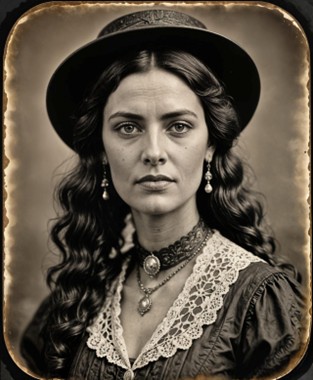
© Maryanne Peters 2023
Author’s Note: This story is loosely based on a story “The Call of the Canyon” by Zane Grey, but there is no canyon in my story so I changed it to the Spanish canijo – weakling. Grey’s story was said to be about
3140