The Cartoonist, Part 1/3
Author:
Audience Rating:
Publication:
Genre:
TG Themes:
Other Keywords:
Permission:
I’m Keith Browning. I’m a successful cartoonist whose strip The Watsons has been syndicated in newspapers all over the United States and in some other countries for decades. In early 1995 I was working on a cover for a book collecting some of my comic strips. Each volume collected strips that focused on one of my characters and this one was for Cindy, a girl in 7th grade. As with the other books, I drew a detailed, oversized version of my character for the cover of the book.
You should realize that comic strip art is always drawn enlarged, and shrunken down for publication. The book was going to be printed on 8-by-8 inch paper with 3 strips per page, keeping the Monday-to-Saturday storylines each week on a pair of facing pages and in the typical size for them in newspapers, but the original strips are drawn two to a 15-by-11 page, and reduced by about 50%. The cover art was even bigger, because unlike the strips inside, it was going to be printed full bleed to the edges of the page, and I was using an 18-by-18 inch section cut down from an 18-by-24 page to draw it on.
The Fateful Night
I was behind schedule, so I was up all night trying to draw the most detailed version of this character I ever had. I think I pretty much had her done when I passed out in my chair in front of the drafting board.
When I woke up, I was looking at my work. But not the oversized cover panel of Cindy I’d just been working on. Had I fallen and knocked other work out of my desk?
When I cleared my eyes, I realized it was more than that. 360 degrees around me was comic book art. I looked down at myself. I was Cindy. What the hell?
I was in my bed, or on it, anyway, because I wasn’t under the covers, and I was wearing what I’d drawn on Cindy last night. I guess I’m Cindy now.
It was morning, so I figured I’d shower and change, and figure out what morning it was afterward. I grabbed a full change of clothes and headed for the bathroom. Or at least looked for it. I opened every door. There was my brother’s bedroom, my sister’s bedroom, my parents’ bedroom, some closets, the living room, kitchen, and den, but there was no bathroom anywhere in the house.
Come to think of it, I couldn’t remember ever having drawn a bathroom in the Watsons’ house, or anywhere in the strip. But surely they needed one! Surely they still went to the bathroom, even if I never showed it! Right?
I returned to my bedroom and changed into the new clothes without a shower. In the moment while I was naked, I examined Cindy’s body. Since it was a mass-market strip published in newspapers, I’d never drawn what Cindy had between her legs. I hadn’t even done it privately for myself; that wasn’t my kind of porn. So did she have anything?
Nope. There was no hole of any kind down there. Good thing I did not have to pee. I could do one over on Harlan Ellison and write “I Have no Urethra, and I Must Pee,” but so far, at least, I didn’t have to pee.
Eventually the rest of my family woke up and we all came down for breakfast. It was a school day, and we all went off to catch our respective buses: Mine to middle school, Faith’s to high school, and Kenny’s to primary school. I instinctively knew where each of us caught our different buses. No, I remembered. Cindy remembered, and I could review those memories in my head.
School was boring, since of course I already knew everything that was being taught. But I turned in my assignments; when the time came, I discovered I had papers ready to turn in. I likewise took note of new assignments. I played along, pretending I was the 13-year-old girl I appeared to be. I sat with my friends at lunch, which was the best part of the day, all of us bringing our sack lunches and swapping items with one another. Naturally, there were no restrooms in the school, either, but fortunately, I never felt the urge for one.
The whole world was drawn like a comic strip, and nobody else noticed. I guess it was the way the world had always been to them. But it worked as if it wasn’t. There was science, and it was apparently possible to magnify things and see in the same level of detail as people did on Earth. It just looked funny to my eyes.
When the day was through, I came home on another bus, did my homework, ate dinner with my family, and went up to my room to think.
I had surprisingly many possessions up here. But they were all things Cindy had had at some point in the 23 years I had been drawing the strip. That was a lot of plot lines, and it gave Cindy a lot of toys, dolls, posters, and other possessions. She had a huge wardrobe, which apparently contained every article of clothing she’d ever worn. And that included panties and training bras. Why? Why would you have panties at all if you didn’t have any genitals?
After some thought, I decided the reason was because there was a plotline once in which Cindy’s mother Linda described a panty thief she experienced in college. That established that there were panties in the Watsons’ world. And everything else around here was based on the Watsons’ world. I have fallen into my own comic strip, somehow.
By the late 80s, it had become OK to talk about bras, and I’d put in a story about Cindy getting her first training bra. This established the fact that not only did bras exist but Cindy wore training bras. I had nowhere near the number of bras or panties as I had blouses, T-shirts, pants, skirts, shorts, dresses, and shoes, but I had enough.
I had pajamas, too, because at some point Cindy had had a pajama party and that implied the existence of such. When it was time for bed, I put on my pajamas and got into bed properly this time, not just lying on top of everything the way I had done the previous night. And I got up again the next morning.
Continued Life as Cindy
It was not quite Groundhog Day; time passed, though one day was much like the next. Summer came, and I had fun during the school break. I had a lot of time to spend with the three friends who lived in my neighborhood. Then fall came, and I went back to school. But I was still in seventh grade. Nobody questioned that, either. Cindy had been a seventh-grader for 23 years, and she was destined to remain a seventh-grader. The kids all remembered being in sixth grade and the other grades before that, as could Cindy. I could read Cindy’s memories, and she remembered being in all those other grades and not being in seventh before now. But I knew.
I made it through another school year, learning the same lessons. Mostly the same, anyway. All were classes that I’d had Cindy in at some point during the strip, even though there were actually too many different ones for Cindy to take in one year, so two classes changed. And I made it through another summer. And then another year of seventh grade.
What a messed-up world I had created! One where time doesn’t flow properly and basic cause and effect doesn’t even work. We take food and drink into our body but we don’t let anything out. There was even a nutrition lesson in school that talked about the importance of eating the right nutrients, how nutrients and sugars and fats were absorbed from the food we ate into our body and other components of our food were eliminated. But it didn’t go into any specifics about elimination. Apparently we did it, but it happened magically without ever visiting a toilet or soiling our clothes or any such thing.
Faith went on dates now and then. But I couldn’t. It wasn’t that I wasn’t allowed. I simply couldn’t bring the subject up. Nobody asked me out, and I couldn’t even take the initiative to ask a boy out. For that matter, I couldn’t have more than casual conversation with anybody who wasn’t one of the roughly thirty named characters in the strip who Cindy had ever associated with. The rest of the people were there, but they were just filling roles. I could go into a store to spend my allowance on something, and I could ask the store employees where something was or how much something cost or I could say I wanted to pay for my purchase, but I couldn’t say anything unrelated to their job as store employee to one of them, nor could they say anything to me except appropriate responses to my in-character actions. I simply could not will my body to do things that Cindy did not do in the strip.
I’m pretty sure people didn’t have sex in this world, either, but some women got pregnant, and the stork came and delivered their babies. What was supposed to be a metaphor in the comics was real. But it was the same women repeatedly having the same babies, who are forgotten about after a while and then born again. They were the parents and babies I’d written into the comic strip. There weren’t other ones, or if there were, I didn’t find out about them.
Years passed, and I lived the same existence over and over again. Sure, it wasn’t exactly the same, but it was essentially the same. There were funny things that happened differently each year, but they were all the things I had written about in Cindy’s life the last 23 years. I was reliving my own comic strip in the first person, and it was boring. I needed to end this somehow. I wasn’t sure how I could do it, but I needed to get out. This was a curse, being forced to live the same year over and over again, forever, knowing everything that could possibly happen and being powerless to change any of it.
Eventually I decided to see if I could get out the way I got in. The year I was in at this point had Cindy in an art class, so she both had the ability to draw and had the equipment. I tried to draw as realistic a version of myself, that is, Keith, as I could. It wasn’t great; Cindy wasn’t an artist and I only had letter-size paper. I didn’t have a drafting board either, but I had a desk. After several attempts, I finally felt like I had drawn my last night as Keith to the best I could recall, including a small version of the picture of Cindy on his drafting board. I stayed up as late as I could, sitting at my desk, adding tiny details to the room, until I finally fell asleep.
Becoming Keith Again
It worked, sort of. I awoke as Keith, slumped over my drawing board with the drawing of Cindy. But I was still in a cartoon world, and a more poorly drawn one now. But it was a version of my Earth, not a version of the Watsons’ world. There were bathrooms with showers and toilets again and I gladly took the first shower I’d taken in about a dozen years, as well as the first pee.
After I dressed I found that my wife Barbara was ready with breakfast.
“Did you finish that drawing? You were up all night with it.”
This was reassuring, in a way. Even though I was in some sort of comic strip, I was in my real world in the comic strip, exactly where I’d left off. Indeed, I found the drawing of Cindy that had started this all (which oddly, alone of all the things here, was drawn as well as Keith could draw, and not in Cindy’s style), and the already addressed mailing tube I was going to use to send it to my publisher. Since time was of the essence, I went and mailed that, first thing.
Once again, in this world nobody else seemed to notice they were in a comic strip, even as they were reading one themselves. But my life went on in ways that made sense, but were new to me. I had free will. I wasn’t limited to just actions that I (or someone) had drawn in the past. I drew new comic strips for The Watsons, inventing new funny stories for Cindy and the other characters to get into that were in character with the established story. When I wanted to, like for the cover of one of my books, I was able to draw something that looked more realistic than the world I was living in.
Eventually, Barbara died and I was left alone. And I was getting pretty old, and that still meant something in this world. I felt the aches and pains people tended to associate with old age.
But I didn’t have to die. I said to myself, “I can draw my way out of this!”
I set to making another drawing of myself, as Cindy had done, but with my own skill. I drew myself younger, how I looked after the strip was successful but many years before I had first discovered the strange ability I had to fall into worlds I had drawn on paper.
And that was successful, but too successful. I came out younger, but I had rewound history. The world had gone back, too, and I was in my old trap of living history I had already seen. Whatever I did didn’t matter, and history went down its predetermined course. And I was still in a comic book world, but it was a better drawn one. It wasn’t long before I was planning a way to draw myself out of this world as well.
I’d lived a full life as Keith, interrupted by twelve years of being Cindy in a time loop, and trying to get more time as Keith had failed miserably. Maybe it was time to be somebody else. What if I drew an alternate Earth? Could I change things and experience a different world? But what should I draw?
One thing came to mind. I had lived twelve years a a girl, but not as a real girl. I got to wear the clothes, but I didn’t get to experience dating as a girl, or having to sit to pee, or periods, or many of the other things that made women women. Those things were outside Cindy’s experience, even though as a thirteen-year-old girl, she should have had her first period. She never did, though, because I’d never written a story like that, and she didn’t have any place for the period to come out, anyway. What if I drew myself as an adult woman?
For a moment I wanted to throw this thought in the wastebasket. I’m not transgender! In the later years of my life as Keith, gay and transgender culture had moved increasingly into the mainstream. And I was happy for them, but that was them and not me. Likewise, I didn’t try writing them into my comic strip. It was outside my experience and I felt that I would be unlikely to do them well, that I’d only upset the gay and trans community by drawing them poorly and upset the straight cis community by including gay or trans characters at all. Somebody else could do that, someone who knew it better. And they did, to limited success.
But then I figured, “Why not?” I had already admitted to myself that Keith had had a full life. Though while living as Keith I’d never felt like I wanted to be or should be a woman, during the years I lived as Cindy, not once did I hate the life because I was a girl. I hated it was because I was stuck living the same year of life over and over again, with such tight limits on what I could do. The rest of the experiences of living as a woman were an unexplored aspect of life.
So that was my next project. On one of those large sheets like I’d used for the cover of Cindy’s book (in another life; the event hadn’t happened yet in this world) I drew me at my drafting table, except with me clearly pictured as a woman. And I stayed up all night adding little details to the drawing until I fell asleep into it.
Becoming Female
I woke up at my drafting table as a woman, roughly speaking a female version of Keith. And my room was there mostly how I remembered it.
But, DISASTER! That was all there was. When I opened the door to leave the room, there was NOTHING. A featureless void. I threw a wadded up piece of paper and it seemed to sail on forever. I dared not let go of the door since it was clear there was nothing out there to stand upon. Through the window I saw nothing as well. It seemed I had drawn myself into a world which featured nothing but the room I came into.
So why the difference? There was one pretty obvious reason why. When I had drawn Cindy, that was part of the detailed world I had invented in The Watsons over 23 years, and so what I am now calling my second life took place within that world. Both when Cindy had drawn me and when I drew myself, I had drawn something from the real world. Both my third life (which picked up where the first one had left off) and my fourth life (as younger Keith) took place in that real world.
This last time I had made up something different. When I had fallen into the drawing of Cindy it was associated with the many other drawings of Cindy which were present in the room, which contained complete archives of all my strips. This drawing wasn’t associated with any other drawings, even though I had meant for it to be associated with real life as the drawings of Keith had been. It was counter to that world, however, so I got as my fifth life just what I drew: Female me in a room. I wasn’t even properly female; like Cindy, I had nothing between my legs. That was a good thing, since I didn’t have any bathroom to use if I had needed to.
But I had drawing supplies, because they were part of that room I had drawn. With literally nothing else I could do, I started drawing. I drew the whole house, and myself, and my husband (who I pictured as a male version of Barbara), in different outfits, and naked as well. I drew a bathroom. I drew a refrigerator full of food. Every detail that I’d thought I’d need to live in this house. With all these drawings gathered around me, I drew myself, the female me, once again, almost identical to the drawing I’d made the night before, and stayed there adding little details to the drawing until I fell asleep.
It worked! The next day, I still awoke at the drafting table, but there was a house attached to it. And my husband was in our bed. And all the other details of the house were there. And things worked. I had a bathroom and for the first time I peed as a woman. But that was all there was. Outside the house was a void. I’d drawn nothing to indicate that there was a rest of the world, and so there wasn’t any in my sixth life.
Interestingly, I’d drawn a pair of “Barbara” and “Keith” signs that existed in my original house, gifts we got at some point, and this had made me be named Barbara now, and my husband Keith. But he was as loving and dedicated to me as Barbara had been. And why not? There was literally nothing else in the world.
It was a viable setup. It turned out that the refrigerator was always full, and though we ate the same food all the time, we wouldn’t go hungry. It was going to get pretty boring, and I dedicated myself to a new project. I had to draw the entire world.
Of course, I could not draw every detail of every person’s life. But if I was going to get to really experience life in the world as a woman, I needed to draw the world I was going to live in. I set myself to doing it. This time, instead of there being a dozen or so pages scattered around me, I was going to fill books with drawings. Fortunately, my drawing paper and pencils and pens were present in an inexhaustible supply as well. What I’d drawn in one of the drawings was always refilled no matter how much I took from it.
Keith didn’t understand why I was drawing all these “unreal things” but supported me in my efforts to do so. He clearly did not have memories of the real world, but he knew how to do the things someone living in this one-house universe would know. Every night Keith was always there in bed for me, which I made sure to always go to, since I did not want to risk falling into another drawing until I was really ready. Yes, we had sex. I was finally able to experience sex as a woman. I can’t say it was better or worse than sex as a man, just different.
Months passed, but when I literally did not have to do more than the human basics and my drawings, it went faster than I might have expected. I had put a calendar in the house and I used it to track the days. In less than a year I finished several thousand drawings ranging from the whole Earth as seen from space to every sort of thing within it. Finally, one night I drew my female self at my drafting table again, and let myself fall into it.
The Cartoonist, Part 2/3
Author:
Audience Rating:
Publication:
Genre:
TG Themes:
Other Keywords:
Permission:
That was a lot of work, but it worked. There seemed to be a real world now that I lived in, with me the cartoonist Barbara and my husband Keith. As I had depicted myself, in my seventh life I made a living drawing The Watsons.
But despite me trying to draw the world I grew up in faithfully apart from me and my spouse being of opposite sexes, a lot had changed. I had intentionally not focused too much on any one thing in my depiction of the world, worrying that if I defined my life too precisely, I’d be confined by the things I’d drawn, as Cindy was. Well I certainly wasn’t confined to the life I knew. Fortunately, just as I had been able to read Cindy’s memories, in this world Barbara had detailed memories I could look into to understand the past and how things were in this world.
Our house was drawn in enough detail that we still lived in the same house, but The Watsons was now a small paperback comic book sold on newsstands, in the same style as Archie comics. I had all of the issues published so far on a shelf in my drawing room where I had awakened.
I remembered Archie as something of a unique title in my original world, the only comic published in the digest size featured on checkout racks in supermarkets. Those were reprints of comics originally published in the standard comic book size, but still, no other comic was being published that way, despite hundreds of comic books being published in the standard size, and many other comics published primarily as individual strips syndicated in newspapers. As with mine, reprints of the others came in large-format books sold through regular bookstores. Somehow the digest format was more popular in this world and there were three others besides Archie and The Watsons, and they were all publishing new material in the digest format. As the creator of one of these comics, naturally Barbara had this basic level of knowledge about her closest competitors.
Just like when I had cast myself into a younger version of Keith, The Watsons had been going for only 5 years and I’d turned back the clock to 1977. But instead of having to produce six small four-panel strips and one large color strip a week, I now produced 40 pages of full-color comics per month, typically six panels to a page, so almost twice as much content and all in color rather than most of it not colored. And it was much more story-driven. The Watsons’ daily strips had always been one of the more story-driven comic strips, the 6 daily strips in a week telling a short story, but now the whole month was telling a story and there was a more consistent plot from one month to the next.
Interestingly, I was letting the characters grow, albeit at the rate of one year every two years, so Faith was now a senior in high school, Cindy was entering high school, and Kenny was in middle school. And the Watsons had had a fourth kid, Bret, who wasn’t even in school yet when the series started and now was in first grade. That was part of a plan for the future, since the comic was meant to focus on the kids and it couldn’t do that if they all stopped being kids. And despite all these kids being of very different ages and in different schools, they were still part of one story, though each kid had his or her own storyline within the overall story.
While I was in a version of the real world, that world had changed, too. As with my comic book, I was able to see Barbara’s memories of this world just by thinking about “current events” and “recent history” and “news.” History seemed to be mostly the same before 1972, but the Watergate breakin didn’t happen, or wasn’t caught or reported. In any case, Nixon lost the 1972 election to McGovern, and the consequences were profound.
Women’s liberation was a thing in the 1970s Keith lived through, but the Equal Rights Amendment was never ratified. McGovern was a supporter of it, and in 1975 he was assassinated. The killer was apparently motivated by his support for the amendment. In the wake of his assassination, the additional states that needed to ratify the Equal Rights Amendment to pass it had done so.
McGovern’s veep Sargent Shriver had been so terribly ineffective as president he didn’t even run for re-election. But it had been John Glenn, not Carter, who won the Democratic nomination and the presidency in 1976, and that’s where we were now. And a woman I didn’t know from my timeline was vice president. Glenn’s choice of a woman as running mate was seen as instrumental in winning the 1976 election. Who was she?
Shriver became president, saw the ERA pass a mere week later, and was completely unprepared. He did recognize something needed to be done, though, and appointed a woman, Ellen Daniels, to the new Cabinet-level position Secretary of Equal Rights. She had been a state senator who spearheaded the effort after McGovern’s assassination to get the ERA passed in her state, and this led to it happening in other states as well. A month later, she found herself in a new role, responsible for figuring out in what ways the United States, individual states, and cities and towns were violating the ERA, and recommending solutions during the two-year delay written into the amendment before the ERA actually took effect.
And there were a lot of ways. Shriver issued a dozen executive orders changing policies within organizations of the federal government which discriminated against women in some way, all of which were direct implementations of her suggestions. And Congress passed 32 bills correcting parts of federal law, or overriding state and local laws on the authority of the new amendment, or intending to correct ingrained behavior which might not actually be covered by any law, and Shriver signed them all. He would actually have been able to claim it as a great accomplishment if he’d really been responsible for much of it himself. Instead, it was his Secretary of Equal Rights who got the credit, and she was now vice president.
Only one of those laws affected the armed forces, and ironically it was the one about the draft. Women were now required to register for the draft, though it was clear, because of their size, strength, and other attributes, that if there was another actual draft, far fewer women would be selected for combat roles than men. It was, however, possible.
Shriver had also issued an executive order, directing the heads of each of the armed forces to ensure that by the time the ERA took effect that their respective forces were not violating it, at all levels. The changes basically took two forms. A number of women at various levels received promotions that their superiors believed they’d been passed over for in discriminatory ways. Some retired military women also got promotions, increasing the level of retirement pay they received.
In addition, the armed forces now permitted women to go into combat. As we’d gotten out of Vietnam in the same way as in the original timeline, the United States was not currently at war. But there were companies of women in combat training. The Army had promoted three women within its ranks and placed them on a committee with two men to make sure that, by the deadline, the Army was complying with the law. The men and women of the committee both agreed that women should be in separate combat companies from the men, the close quarters in such units making it indecent for there to be mixed-sex companies. Larger-scale units could include sections devoted to both men and women and their separate facilities, and indeed they’d have to if those female units were to be deployed at all, since there were only five such companies across the entire Army. That was all the combat-interested women they had. But they’d made provisions to make more companies when needed. The other forces took similar actions.
The armed forces weren’t the only place to struggle with what the ERA meant for restrooms, showers, and such. The last bill Congress passed in 1976 in support of the ERA, which Shriver signed into law after the 1976 election had already named Glenn as his successor, was the “bathroom bill.” Men and women agreed the ERA did not mean that men and women should be using the same restroom, only that comparable facilities be made available, and in appropriate numbers to whatever people were present. Due to the differences in men’s and women’s bodies, and the numbers of men and women who might, due to personal preferences, be present in any particular place, this didn’t even mean equal facilities, or equal numbers. The law had carefully considered all that and mandated that men’s and women’s restrooms, showers, and the like be outfitted with equipment of comparable quality, and in quantities appropriate for the needs of the men and women using the facilities where they were located. In most places this was already true, but a lot of fuss had been made over the law.
Just one issue hadn’t been settled before the newly elected Congress took office in 1977: Public decency laws. Specifically, there were many laws in various places which permitted men to be topless but prohibited it for women. Daniels had included this within her comprehensive list of laws that constituted sex-based discrimination, and at first Congress ignored it, thinking that permitting women to be topless in public wasn’t something that the people really wanted. But in the summer of 1976, some women started campaigning for exactly that. They started “topless rallies” in which groups of women paraded topless through various public places. There was some opposition, but most of it came from people who misunderstood what this would really mean, and an education campaign had quelled a lot of it. Women being allowed to be topless in public wouldn’t mean women wouldn’t have privacy in restrooms and changing rooms, just that they were free to go topless in the same places men currently could.
By the end of 1976, 31 states had authorized women to go topless in public wherever that was considered acceptable for men. The FCC had also issued a statement permitting women’s bare breasts to appear on television, provided that the content wasn’t of a sexual nature, a provision which actually blocked much of the content which might have aired. But it allowed news coverage of the topless rallies to air without censorship bars, as well as a few other cases. An important case was educational programs about breast-feeding, which were technically permitted all along but usually didn’t air because of people’s perception that they weren’t permitted.
In summer 1977, the rallies started up again, and were focused on the states which still prohibited topless women, as well as in DC, seeking a federal law. Incidentally, even though the laws in these places prohibited topless women, since authorities questioned whether those laws were still valid, or would be once the ERA took effect, very few of these women were arrested. In fact, in all of 1976, only five women at one rally and two other isolated women had been arrested for going topless in public, and all of them had been released without being charged. In 1977 none had been arrested at all, except one group of three topless women charged with vandalism; they weren’t charged based on their lack of clothing.
I had taken a long, leisurely shower, relishing my ability to do so, during which I “remembered” all these facts about the state of the world I lived in from Barbara’s memories. After the shower, I dressed normally. But over breakfast, Keith reminded me that today was special. The two-year delay had just ended, and this week people were celebrating the start of equal rights for women supported by the 27th Amendment* to the U.S. Constitution. Today was the first Saturday after the ERA had taken effect, and there were topless rallies scheduled in every major city. And though I’d never participated in one, Keith and I had signed up for today’s. Men were allowed in the rallies as long as they were there to support the cause, and were also topless.
* In the world Keith came from, the 27th Amendment was a different, unrelated amendment about congressional pay raises. Of course, they are just numbered in the order they pass.
So I set aside the comic strips, and as practically my first deed here, joined a topless parade that featured tens of thousands of women and a few thousand men. The parade route ran all around downtown, and it technically started at 1 PM, though we left the house topless before that. It was pretty crowded, so we basically walked from our home to downtown, did one lap, and returned home, spending almost three hours walking only about 3 miles.
Evening news reported similarly strong showings across the country. If this didn’t get both the national law and most of the remaining state ones as well, they probably weren’t ever going to happen.
I had stayed topless after we got home, and shook my breasts at the screen during the news report about the rallies. I stayed topless during dinner as well. Keith had cooked it, as he always did in this world.
At the end of dinner, Keith commented, “Babs, I didn’t realize you were so serious about going topless.”
“Oh, I’m not, really,” I told him. “I’m just celebrating today. Tomorrow I’ll be dressed normally.”
“You want to get bottomless tonight?”
I accepted his invitation for sex. This Keith was a lot more forward in that way. The one in the previous world that was just the house never asked for it and we only did it if I initiated it.
I did go back to dressing normally the next day. And the next day, and most of the days after that.
It was less than a month later when we did get the federal law authorizing women to be topless wherever that was allowed for men, and there was a second round of nationwide topless rallies. Of course, this still meant that in most public buildings, businesses (with some exceptions like gyms), schools, public transportation, and the like, men and women were expected to have their chests covered.
And I had the Watsons attend a topless rally in the next issue. They all appeared topless, but I tried to make it tastefully done, with only the outline of the breast or a small curve when one of the women was facing forward, and a small circle for the nipple. And all of it was only on two pages; they got dressed again as soon as it was over. My publisher said they didn’t want to have naked breasts in the comic regularly, but it was OK this one time. And I figured that was fair. If they had wanted censor bars in the issue, I would have accepted that, too, but all the media were following the FCC’s guideline and allowing limited, non-sexual bare breasts.
Having Children as Barbara
I decided I had done it right. I had managed to get into an Earth, not exactly the one I came from, but one as fully functional, and I had become a woman here in a position similar to the man I was in my first life. There were more changes in history, some of which I’m sure I didn’t notice because I could not remember every detail of the world.
There were a few times I noticed differences I attributed to the way I’d drawn the world. For instance, people’s bodies were slightly more flexible and suffered less from pain. This was hard to quantify, but the feats of professional athletes made this clear. Something generally different about human bodies? Almost certainly due to the way I depicted them. But who likes drawing pain? For the most part, I’d gotten things right. There was no telling what caused changes like the Watergate and ERA stuff, but I personally attributed it to the butterfly effect. Some small change years earlier had led to bigger changes later.
It was about three years after I arrived in this world that Keith brought up the subject of us having children. Barbara and I had never done it in the original world, but I had a long thought about it and said yes. This was going to be a big change. Living as Cindy, even as sterile and incomplete as that life was, made me realize there was a part of life out there which I could experience, and hadn’t. Giving birth to a child was one of those things. And I had only so many more years during which it was practical.
I could never be sure whether I’d gotten the feeling of sex for women right. But the way it was treated in society made me think it was at least comparably pleasurable. But when my doctor provided me with pamphlets about pregnancy and birth, I realized I’d gotten one thing very wrong, the experience of women giving birth. The way I’d drawn births conveyed the difficulty, but not the pain most women experienced, and they were always very happy afterward to have their babies. The result was that women’s birth canals here were much more flexible and women suffered much less pain here than in my original world, unless the pamphlets were completely lying and concealing the pain. I’d never had the experience personally, nor even second hand through my wife, but I knew that for most women it was at least somewhat painful.
So the proof came when it was time for me to give birth. Giving birth felt like having sex with a guy with a really huge dick, except backward. It was still about as difficult as I thought it should be to push the baby out, which led to an intense sensation of stretching, but it wasn’t painful in the least. The head coming out led to an orgasm, and the shoulders led to a second. So I’d gotten it pretty much completely wrong, unless I’d been completely lied to on the original Earth. But apart from not being able to experience it was way it was on that Earth, I didn’t feel like I’d lost anything. This way was better!
Keith had no opinion of names, so I’d chosen names that were combinations of the names of the eldest children in the Watson family, Faith and Cindy, in ways I hoped weren’t obvious. If I had a daughter, she would be named Cathy, and if a son, Finn. So Cathy it was.
Having Cathy as a part of my life was wonderful, even through the bad parts. Neither Keith nor I sought any more kids, but just having the one was enough to enjoy all the stages of parenthood. I continued The Watsons the whole time, which made enough money the way I was publishing it to support the family without reprint books, though my publisher connected me to deals for Watsons toys, lunch boxes, binders, and the like. There were even a couple of TV specials. Working with an animator was interesting. I didn’t have to draw every frame, but I had to draw a lot more than I would have for the comic. The timing was perfect, though; the extra money from those shows put Cathy through college.
Even with their slow aging, the comic kids eventually graduated from school, got married, and had their own kids who became featured characters. By the time Cathy was in college, The Watsons was pretty much in generation 2, with only Bret of the original parents’ kids still in school.
I did have a decision to make, though, one that necessitated another prior decision. I spent four years pondering it before making the first decision. For the first time in my several lives, I confided in Keith what I had done.
“Keith, I have something very difficult to believe that I must tell you, because I have to make an equally difficult decision, and I want to make it with your full knowledge.”
Keith was very confused, but I told him everything. My first Earth, the time I’d spent as Cindy, as Keith in a comic-strip continuation of my first life, and again repeating an earlier part of that life, then the incomplete worlds, and how I’d drawn, on thousands of pages, a thorough sampling of everything in the world to make this world. How it was an imperfect, but by some methods of judgment better version of the world I’d started out in. And Keith was able to understand me!
“Babs, I always thought there was something just slightly off about the world, and now that you point it out, I can see how the world isn’t as... realistic as it should be. Photographs are more realistic than the vision of the world with my own two eyes. And you say that you made all this so you could experience a second life as a woman?”
“More or less, yes. And that’s the decision I have to make yet again. I can let this life live out until I die, or I can start drawing some other world to immerse myself into. Part of the decision is what kind of world I would live on, because I’ve lived as a man and as a woman now.”
“But I wouldn’t come with you. I don’t remember any of those things, so I must not be the same Keith who lived with you while you drew the world, or the Barbara who lived in your first life.”
“I guess so.”
“When you go, what would happen here? Would there be a Barbara who goes on, like the one I remember before the time you say you arrived here? Or would the Barbara here just die?”
“That is something I cannot say. I can’t even be certain that the times I returned to my original Earth I really came back to that world or whether I was just in a copy of it. The fact that everything looked like a comic strip to me makes me think it was a copy, but none of the other people could ever tell that. Nobody here could either, until I told you.”
“Did you ever try to tell the people on the other comic-strip worlds that they were in a comic strip?”
“No. You’re the only one I’ve ever revealed this secret to in any of my lifetimes.”
“Huh. I guess there really is no way to tell, then. Even if you go revisit one of those other worlds, and come back here, you can’t distinguish me from a copy of me who was created knowing all that I know now.”
“Yes. You understand the reality of things, the bizarre meta-reality that I have somehow created.”
“OK, let me think about your dilemma. You’re not in serious danger of dying this week, right?”
“No. Nothing serious is wrong with me. This is a long-term thing. If I want to do this, I want to start planning what this next world is going to be like and doing the drawings on the side over a period of years.”
It was only a few days later when Keith came back to ask, “Do you think you could take me with you?”
Wow! What a question! I replied, “Another question I can’t answer, since I never tried, never even told anyone else in the other lifetimes about it. It’s conceivable it would work. Suppose we sat here together, fell asleep together, and fell into a wider drawing with two people in it for us to occupy in the next world.”
“That might just work!” Keith replied.
“I don’t know why it works, and I frankly can’t even rule out the possibility that it has happened to other people already. They go off to live in other worlds of their own making, so all we could possibly see is what happened to them when they left. I’ve never heard about other cartoonists or artists of any kind dying in strange ways in front of art they were drawing, or going missing, so either it doesn’t happen, or they go on living somehow, controlled by a copy of their mind or something. Or it just looks like natural death. Or it changes the world so that they never existed and nobody knows.”
“Well, then, that’s my request. I’m fine with it as long as you make an effort to take me with you.”
“Deal! The next step is we have to come up with some idea of what kind of world we want to go to.”
The Cartoonist, Part 3/3
Author:
Audience Rating:
Publication:
Genre:
TG Themes:
Other Keywords:
Permission:
Keith and I had decided we were going to try to go together into what would be my eighth life and his second. But deciding on another world to make was harder than we thought.
In shooting down one of Keith’s ideas, I explained, “It can’t be too much like this world, or my first world. When I projected myself into an earlier version of my first body, I got stuck in a world where the timeline was fixed. Although I could make minor changes, including drawing a different way out of that world, I couldn’t do things that changed the timeline within that world in meaningful ways. I was simply unable to make such decisions. And at the same time, I can’t define the world too strictly. When I went into Cindy, she had been featured in thousands of comic strips that defined exactly what behavior she was capable of, and also what she was not capable of. The Watson family I drew in my first world was like many other cartoon and comic-strip families in that they never age. The seasons pass, but a year later they haven’t aged.”
“So Cindy was stuck in a year-long time loop.”
“Essentially right.”
“I can see how that would suck, especially after you’ve been through it a few times.”
I added, “The worst part was that I was literally unable to break out of it. The comic strip had defined Cindy’s behavior so thoroughly that I was literally unable to will my body to do anything she wouldn’t do. There weren’t even bathrooms, nor the bodily functions needing them, because I’d never mentioned them in the comic strip. If I hadn’t been able to draw my way into a different world while Cindy was in an art class, I might have been trapped there eternally.”
“I understand why you are worried about that. But The Watsons you draw now isn’t like that. I’ve read all your work. Characters age. You have mentioned bathrooms. Could you go back into this version of your comic?”
“I could, but I don’t want to. It would be better than the first time, but just thinking about that phase of my life scares me.”
“So tell me again how you made this world different.”
“I defined myself as the cartoonist who draws The Watsons, and you as my house-husband, but there wasn’t a lot of detail in there about our lives specifically. Instead, I focused on the kinds of things that people do in general. The kinds of foods we eat, the way we go to school, the jobs we do, the way we date, get married, have sex, and have kids, not always in that order. All depicted using different people, in different places, at different times in their lives. I tried to avoid drawing anything twice unless it was just one of those things literally everybody does, or it was needed to show different aspects of the thing.”
I quickly drew a series of rough sketches of people eating to illustrate my next point.
“There was lots of eating, but I tried to avoid the same food being eaten twice anywhere over the entire set of drawings. Similarly, there were lots of drawings of people sleeping, going to bed, waking up, washing themselves, and plenty of birth and death scenes, each one different. Not quite everybody gets married, so I made sure to show some people purposefully deciding never to get married and instead growing old single, but I also drew several marriages, and lots of scenes featuring couples who might be interpreted as being married. There are people from other cultures, other races, other societies, though there are a lot of societies I don’t know, so I drew samples and best guesses, ways of showing that those people are different without being too specific. I probably changed some of those societies dramatically, but I don’t know enough of how they were in my first life to be able to tell.”
“Are there any areas where you know it didn’t work?”
“I drew people as being more flexible and less subject to pain than is realistic, and this led to athletes being able to perform better than they did in my original world, but it was only a matter of degree. Perhaps partly related to this, but also because I always drew mothers giving birth as being happy before, during, and afterward, childbirth isn’t painful here at all and instead is intensely pleasurable.”
“Birth is painful on your original world?”
“Yes, it is sometimes said to be the most pain a woman will experience in her entire life. Of course, it varies from one birth to another. And you don’t even know because the change is wrapped so thoroughly into the fabric of this world that pain during childbirth is simply not a thing here.”
“So you can modify specific characteristics of the world.”
“Or leave them out entirely, like the first two attempts I made at becoming female. The first was just a single scene like what Cindy had drawn of my first life. But, apparently because I had drawn it as an intentional change from my original world, unlike Cindy’s drawing, I ended up in a universe that just consisted of that one room, and drawing was basically all I could do. So I realized I needed to draw the whole world, but to make it more bearable and as a test of how it would work, I drew an intermediate version with our whole house, the first version of you, and some basics of human behavior. The universe still only consisted of that house, but I was able to live mostly like a human being while drawing the thousands of pages needed to illustrate the whole world.”
“So you could draw the whole world again, but with us as other people, in the future so you’re not living the past again.”
“It would be a lot of work, and it’s not interesting enough to me to devote the effort. In the intermediate world I was only doing that, and not any other job. I had breaks to eat, sleep, and be with that world’s version of you, but for 10 to 12 hours a day, I drew. If we are doing it on the side here, we would never finish. I would have to retire from drawing The Watsons, and work hard for a year on drawing the world. We would have to really have some interesting positions in the world to make it worthwhile. I wouldn’t do it to just make us be some random people.”
“Hmm. That’s tough. If we don’t just draw another variant Earth, how are we going to imagine something so detailed?”
We shot down a lot of other ideas, in little sessions like this once a week for months, before Keith finally suggested, “What if we don’t try to make a detailed world?”
“What, intentionally put ourselves into one of those limited worlds, like the one where I couldn’t even pee, and couldn’t go anywhere outside the equivalent of this room?”
“Well, not that limited. It should be a whole world, but one that is less well defined. In the same way you left our behavior undefined by showing only a little of it, you could leave the world’s behavior undefined by showing only a little of it.”
“But then we might end up on a barbarous kill-or-be-killed world or some other horrible place!”
“I suppose. Maybe the limits, the laws and enforcers of the laws, are what we show.”
“Could get too boring. The laws might end up so strict we have to live like Cindy within little rigid guidelines, except instead of not having free will, we’ll just have enforcers everywhere who dictate our actions.”
And it went on like this the rest of that night. The next session I figured it out.
“Suppose we’re gods.”
“Oooh. How’s that work?”
“We start on a featureless world, but the comics show that we can literally do anything. We can change our bodies, we can make other people, destroy ones who misbehave, we can create plants and animals and buildings and maybe whole new planets. We’re invulnerable, undying, and our only limit is that we can’t change each other.”
“Right. We should show that limit to imply one exists, and the lack of limits in other areas will help show those limits don’t exist.”
“Yes! You’re getting it!”
So our subsequent sessions were both building a checklist of things to show, and coming up with ways to show each one. We didn’t always agree, but hashed out our differences, and several times I redid a drawing because once I got it done I didn’t think it portrayed what I wanted adequately. I installed a second drafting table beside mine so that Keith could help. He was a terrible penciller, but once I had drawn the basic shapes he was an adequate colorist. And they all needed to be colored, of course. We didn’t want to end up in a black-and-white outlined world!
One of the things we decided on pretty early, since we had the ability to change our shape, was that we would each wear a symbol on our foreheads, based on our initials. Because Keith came from the family that was Barbara’s in my original world, our surname was Stewart, not Browning. In Keith’s symbol the legs on the right side of the K poked through the centers of the loops at the top and bottom of the S. For mine, the B was backward, and the S was twined around the vertical post.
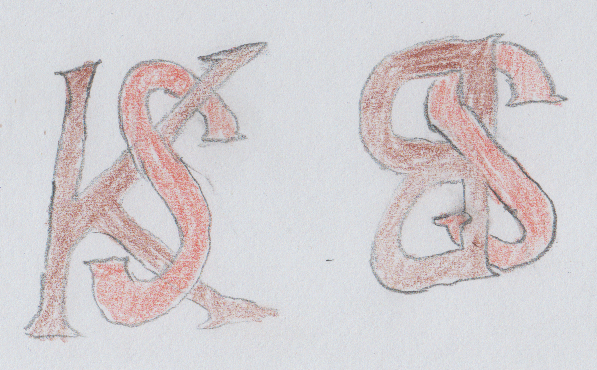
These symbols helped identify us even when we were shapeshifted in the drawings, and we were probably going to be stuck with them in the other world, but that was fine. We’d always be able to identify each other that way.
And we kept doing this once a week, sometimes working on ideas Keith had come up with during the week, while I kept on drawing The Watsons the rest of the time. If this didn’t work somehow, either because we couldn’t go into the world together, or it was so bad we wanted to come back here by drawing ourselves the way we are today, this life will still be available. It was slow, but since we’d decided on a plan that didn’t need a massive amount of art, but a moderate amount of carefully thought-out choices, we got through it in about a year.
The last drawing was an oversized one, the one we were going to hopefully fall into together, which showed the two of us in forms resembling idealized versions of the forms we have now, naked, and with the symbols. The musclebound comic-book heroes were far from my normal style, but they were also what every aspiring cartoonist learned to draw before developing his or her own style, so of course I could draw them. And I let Keith draw parts of it, too.
We spent two daily sessions of eight hours each putting together the final drawing, and it still wasn’t done. But it was close, so after dinner the second night we worked at it until it was done, which was perfect in one important way. As we got tired, we would eventually fall asleep and hopefully fall into the drawing. When it looked done, I got up and arranged all the other related drawings around us while Keith continued to add little details, and then I rejoined him, continuing to add more of my own tiny details to the drawing so that we could stay up late together working on it until we fell asleep.
The Eighth World
I am not sure if I stirred first or Keith did, but we were partially on top of each other and woke together.
“It seems like this worked,” I commented. “We have these bodybuilder bodies and we’re lying here on the featureless plain.”
“Let’s see if our powers came with us,” Keith said.
He slowly drew up his hand and a short distance away, a shape rose up out of the ground and formed a small house.
“That’s good. But why do we actually need a house?”
“I don’t know. To put all the other stuff we make inside, to protect it from the sun, rain, and wild animals, when we create those things.”
He laughed and I laughed with him.
Keith continued, “I think it just felt right. But come look. I made it with the furnishings and everything.”
I was curious which furnishings, since some of the things we were used to on Earth, like television, wouldn’t work in an isolated world with no broadcasters or electric power supply. So I followed him in. It turned out he’d made some tables, chairs, shelves, closets, and a bed. Of course a bed, I thought to myself. We’re pretty certain to want to try sex with these bodies! There was no kitchen nor bathroom, as it should be, since we’d designed the bodies without the need to eat, drink, or eliminate wastes. There was a near-perfect reproduction of my drawing studio as it was on pseudo-Earth the night before, including the drawings which got us here.
So we tried out the bed. And when we were done, Keith next tried out the body transformation ability, forming his body into a copy of mine, except of course for the forehead logo. I obliged, making myself a copy of the body he had moments earlier, and we did it the other way. Next I ran outside and transformed into a tigress, and let him chase me down as a tiger. And we repeated this with many other forms. Would we ever get tired of it? We’d never get physically tired, since the bodies were designed not to need rest or sleep.
We went through countless changes, including a bit where I created a lake and we spent a while as various aquatic creatures. We didn’t make anything to keep track of time, nor were there any day-night cycles here, but I think this went on for a few days. We ended up as two giraffes, which had sex in just as awkward a way as you would imagine. At this point Keith was unable to think of any animals we hadn’t used yet, and just changed back into the superhero-looking version of himself that he arrived here as. He moved our house from where it was, completely out of sight across the horizon due to some of our chases having gone on for miles, to where we were now. He went inside, and I transformed into super-Barbara and followed him.
“That was fun,” I told Keith.
“But now what?” he asked.
“We could play God.”
“You mean fill this world with all the plants and animals and stuff from Earth?”
“It doesn’t have to be those. We can make up our own.”
“Sounds fun!”
So we headed back outside, taking turns trying to outdo each other in making the most fantastic plants and animals imaginable. Since we didn’t limit ourselves to Earth-things, this went on for a lot longer. In fact, since time had no meaning for us anymore, I might well say it went on forever.
| Attachment | Size |
|---|---|
 The Cartoonist logos.png The Cartoonist logos.png | 416.55 KB |
