From Soldier to Cutie Chapter 1
Author:
Audience Rating:
Publication:
Genre:
TG Themes:
TG Elements:
Permission:

Chapter One: Selection
The corridor leading to the chamber was too clean. The air itself felt artificial, scrubbed of scent and humidity, leaving only a faint trace of antiseptic. Every meter was monitored, nothing left to chance or preference. Kade noticed it immediately—not because it was unusual, but because it was deliberate. Every surface was seamless, the walls a continuous stretch of pale alloy that reflected light without glare, without warmth. There were no decorations, no signage, no color outside the prescribed spectrum—only the sanctioned pale, uniform, and unbroken. The ceiling panels glowed with a fixed, rationed brightness, calibrated for maximum function and minimal comfort. The floor absorbed the sound of his boots completely, turning his steps into something ghostlike, as if even noise had been deemed unnecessary here. Any trace of individuality—posters, scuffs, fingerprints—had long since been erased by the daily, mechanized scrutiny of the cleaning drones. In Virex, even the evidence of passage was a violation.
Virex didn’t waste effort on aesthetics. The very concept of beauty, as understood elsewhere, was dismissed as inefficient—an indulgence bordering on subversion. Form followed function with absolute fidelity; anything that did not serve a clear, measurable purpose was deemed unnecessary, if not outright forbidden. Every line, every angle, every material had been scrutinized for efficiency and compliance. The result was a world stripped of ornament, where even the smallest flourish could be interpreted as dissent.
He walked in silence, flanked by two escorts who had not spoken a word since retrieving him from his unit. Speech, like everything else in Virex, was strictly rationed—permitted only when functionally necessary. Conversations that strayed from the assigned purpose were suspect; idle chatter was a reportable offense. The escorts’ faces were set in practiced neutrality, eyes forward, every gesture economical. Their uniforms were identical—dark, form-fitted, devoid of rank markings beyond a thin strip at the collar. Not soldiers. Not exactly. Internal authority. In Virex, even the cadence of walking was standardized, and personal rhythm was discouraged. To speak out of turn, to gesture unnecessarily, to smile without cause—each a minor infraction, evidence of individual thought.
That narrowed the possibilities.
Selection.
Kade kept his expression neutral as they reached the end of the corridor. He had lived every day within the margins of Virex’s strictures, his routines dictated by regulation, his movements measured and deliberate. Personal effects were forbidden; his living space contained only what was issued, nothing more. Meals were taken in silence, scheduled to the minute, and even rest was monitored for efficiency. Spontaneity was a foreign concept—every action assessed for compliance, every word judged for necessity.
There was no visible door, only a smooth section of wall that shifted silently as they approached, parting just enough to allow entry before sealing itself behind them. There was no threshold—no tactile divide between corridor and chamber—only a seamless transition, as if the building itself discouraged any sense of arrival or departure. The walls of the room matched those of the hallway, the same sterile alloy, the same unyielding uniformity. Even the lighting adjusted gradually, eliminating any perceptible shift as they crossed from one space to the next, denying the mind any cue for orientation or anticipation.
The temperature didn’t change.
The air did. It was so thoroughly filtered it bordered on flavorless, stripped of any trace of the outside—no hint of dust, no residual warmth from bodies, not even the faintest suggestion of life. It felt almost heavier than it should, the subtle pressure a constant reminder that nothing in this place was left to chance. Still, unmoving, it pressed gently against the skin, carrying only the faint, clinical tang of chemical purification.
The room beyond was circular, wider than it had appeared from the outside, with a low table set at its center and three figures seated behind it. The table itself was engineered from the same alloy as the walls, matte and seamless, its surface bare except for the necessary datapads and an embedded projection node—no drawers, no ornamentation, no wasted space. The chairs were identical, low-backed, and precisely aligned, their design prioritizing posture and efficiency over comfort. Every piece of furniture in the room existed solely for its function; there was nothing extraneous, nothing to suggest personality or preference. Even their placement—exactly equidistant, exactly centered—spoke of a world where deviation had been designed out, and where efficiency was the only acceptable form of beauty. The lighting here was softer, diffused across the ceiling in a way that eliminated shadows entirely. There was nowhere for the eye to rest that wasn’t intentional.
Kade stepped forward on instinct, every movement practiced and precise, boots aligning perfectly with each measured stride. He did not look around or hesitate. His path was predetermined—he followed the invisible axis from door to table as if his body obeyed some internal schematic. When he reached his designated space, he stopped exactly where the floor markings—nearly invisible unless you knew to look—told him to stand, feet parallel, heels together. His posture settled into attention without tension. Shoulders squared. Chin level. Hands at his sides. Even the act of standing was a function: correct, efficient, unremarkable.
Waiting.
The three figures did not speak immediately. Their examination was systematic—a silent assessment, free of emotion or assumption. Eyes moved in sequence, cataloging every aspect of Kade’s presentation: posture, uniform alignment, compliance with protocol. Their expressions remained impassive, but there was a precision to their scrutiny, as if they weighed him against an internal checklist of traits and behaviors. Even the act of being observed felt clinical, stripped of curiosity or judgment. They were not looking for personality; they were searching for deviation.
He cataloged them in return, his gaze fixed forward but his awareness broad enough to take in the details that mattered. The one at the center was older, though not by much—mid-forties, perhaps. His hair was cut short, precise, with a faint line of silver at the temples that suggested experience rather than age. His uniform was as minimal as the escorts’, but the way he held himself carried weight.
Authority, not rank.
To his right sat a woman, younger, her posture relaxed in a way that wasn’t casual but calculated. Her hands rested lightly on the table, fingers interlaced with deliberate precision, as if even the arrangement of her fingers served some purpose. Her uniform was immaculate, unadorned, and fit perfectly—no sign of personal adaptation, not a wrinkle or stray thread. Her gaze was sharp and unblinking, dissecting him with the detached focus of someone trained to eliminate bias. There was something clinical about the way she looked at him—not assessing a soldier, but evaluating a result, as though she viewed him as a variable within an experiment. Even her breathing seemed measured, timed to the rhythm of the room, blending seamlessly into the controlled atmosphere.
The third figure remained slightly back, partially obscured by the angle of the table. Their presence was quieter, almost deliberately unobtrusive, yet there was a tension to how they observed the proceedings—an intensity at odds with their low profile. The technician’s hands moved occasionally over a compact datapad, the movements deft and exacting, every action purposeful. Their uniform bore the white insignia of technical specialization, but the eyes—sharp, rimmed with exhaustion—suggested long hours and a burden of responsibility. Unlike the others, they did not project authority or analysis; instead, they radiated focus, the kind that came from bearing the weight of unseen systems and outcomes. Or something more specialized.
None of them introduced themselves.
They didn’t need to.
“State your designation.”
The voice came from the man at the center, calm, unhurried.
“Kade,” he replied, his voice steady, controlled. Each syllable delivered with practiced precision, tone stripped of inflection or hesitation. “Unit designation Kade-17. Operational infantry, third division.” As he spoke, he maintained direct eye contact with the central figure, his posture unyielding, hands still at his sides. The delivery of information was a ritual of compliance, no more and no less—his words measured for necessity, his demeanor as impersonal as the environment that produced him.
The man’s eyes lingered on him for a moment longer than necessary, then shifted slightly. “You’ve been in active service for six years.”
“Yes.”
“Deployment history indicates high adaptability.”
Kade didn’t respond to that. It wasn’t a question.
The woman leaned forward slightly, her gaze sharpening. “You were reassigned twice.”
Kade kept his posture perfectly still, eyes fixed straight ahead. He answered with the same precision as before, using only the minimal number of words required. Each response was delivered in a level, measured tone, devoid of personal inflection or emphasis. He did not shift his weight, fidget, or avert his gaze, maintaining the rigid composure expected of him under scrutiny.
“Both times due to operational variance.”A faint pause.
“Define variance.”Kade’s answer came without hesitation. “Deviation from expected behavioral patterns.”
“And you adapted.” “Yes.”
“How?”“I observed the environment,” he said. “Adjusted response parameters. Minimized inefficiency.”
Throughout, Kade’s demeanor never wavered—movement and expression disciplined into total neutrality, every answer crafted to fulfill only the question’s intent and nothing more.
The reaction was as controlled as everything else in the room, but there was a subtle shift behind her eyes—a brief calculation, the acknowledgment of a satisfactory function performed as expected. Recognition, yes, but it was the recognition one might show a machine that had executed its programming flawlessly: impersonal, precise, and entirely devoid of sentiment.
“Do you understand why you’re here?” she asked.
Her tone remained flat, but the question itself was delivered with the precision of a test prompt—designed not to elicit narrative, but to measure compliance and honesty. Each question in this sequence was constructed for maximum clarity and minimum ambiguity, probing for vulnerabilities in logic or self-perception rather than emotion. “No.”
The answer was immediate and truthful. There was no advantage in speculation. Kade recognized the pattern: every query narrowed the scope of acceptable response, leaving no room for theory or personal interpretation. This was not a conversation—it was an assessment protocol, and he responded accordingly, each answer as concise and functional as the questions demanded.
The man at the center tapped the surface of the table once. A projection flickered to life between them, lines of data cascading downward in controlled streams—text, imagery, behavioral charts.
Amahara.
Even without reading it directly, Kade recognized the structure.
The woman’s gaze didn’t leave him. “You’ve reviewed the cultural brief.”
“Yes.”
“Your assessment?”
“Inefficient.”
Kade’s internal response to the Amahara culture was as ordered and clinical as everything he had been trained for. Their reliance on emotion, open expression, and unstructured social cues was not just foreign to him—it was fundamentally incompatible with his conditioning. He cataloged their customs as if they were variables in a problem to be solved, noting the lack of uniformity, the unpredictability of sentiment, and the absence of a clear hierarchy and purpose. Where Virex demanded silence and precision, Amahara celebrated nuance and ambiguity. Most unsettling of all to Kade was their embrace of what the cultural brief identified as "Kawaii"—aesthetic sensibilities rooted in Japanese tradition that elevated cuteness, playfulness, and overt emotionality to a central social value. Public spaces in Amahara were filled with pastel colors, soft-edged architecture, and an abundance of decorative motifs: stylized animals, smiling faces, and whimsical iconography that seemed to serve no functional purpose whatsoever. Communication was layered with gestures, exclamations, and rituals of friendliness. For Kade, this world of visible affection and childlike joy was not merely inefficient; it was incomprehensible—a landscape built on the very ideals that Virex treated as criminal. He felt no curiosity, only the instinct to adapt: to observe, to replicate, to minimize deviation from what was expected—never to understand, never to engage beyond what was necessary. To Kade, culture was not something to be experienced. It was an obstacle to be negotiated, a system to be infiltrated, and, ultimately, another mission to be executed with perfect detachment.
This time, there was no mistaking the shift in the room.
It began as a faint tightening in the air—barely perceptible, but undeniable, like the temperature changing by a single degree. The figures behind the table grew increasingly attentive. The lighting, so carefully diffused, seemed to flatten further, shadows receding as if the space itself braced for a new variable. Eyes sharpened, focus narrowing. The measured neutrality that had defined the atmosphere now carried an undercurrent of calculation, as though every detail in the room—every breath, every silence—had become a data point in a new equation.
The man leaned back slightly in his chair, fingers steepled. “Explain.”
“They rely on emotional signaling for cohesion,” Kade said, his tone even. “Decision-making is influenced by perception rather than outcome. Communication is indirect. Resource allocation is influenced by cultural expectations rather than measurable efficiency. Their systems tolerate redundancy and encourage public displays that serve no strategic function. Time and energy are spent maintaining rituals of social harmony and ornamentation, rather than optimized productivity. In Amahara, process is valued over precision, and ambiguity is often rewarded above clarity.”
He stopped there.
Anything more would have been unnecessary.
“And yet,” the man said, voice quieter now, “they remain stable.”
The statement was not an accusation but an invitation—a prompt for Kade to reconcile his analysis with the evident reality. The questioning that followed was methodical, each inquiry probing the limits of his judgment and capacity for adaptation without straying into speculation or emotion. The man’s eyes held Kade’s, searching for any sign of uncertainty. The technician’s fingers tapped quietly on their datapad, logging responses, their gaze flickering between Kade and the projected data. The woman’s posture shifted almost imperceptibly, her questions becoming sharper, more direct, as if testing for cracks in his certainty. Kade held the silence for a fraction of a second—not hesitation, but calculation.
“Stability does not require efficiency,” he said. “Only consistency.” The technician in the back shifted slightly at that, something in their posture tightening before settling again. The woman’s expression changed—barely. A slight narrowing of her eyes, a recalibration. Her next questions were delivered in a crisp, almost mechanical cadence, seeking to map out the boundaries of Kade’s understanding. “Could you operate within that system?” she asked.
“Yes.”
“How?”
“I would follow observed behavioral patterns,” Kade said. “Mirror expected responses. Minimize deviation.”
“Would you understand them?”
“No.”
The group’s reaction was as deliberate as their questioning. No overt emotion crossed their faces, but the pause after his final answer was weighted—a collective moment of appraisal, more pronounced than before. The man at the center glanced at the others, a silent exchange of confirmation. The woman’s gaze flickered, registering a subtle shift in calculation, reassessing him in light of his candor. Even the technician stilled, hands poised above the datapad, as if awaiting a new directive. Their responses were coordinated, restrained, and perfectly aligned with Virex's culture: decisions made, judgments rendered, all without a single wasted word.
The man at the center nodded once, as if confirming something already decided. “Step forward.”
Kade moved without hesitation, closing the distance between them in three precise steps—each one measured, heel meeting floor without a sound, body aligned as if following a choreographed routine. He kept his eyes forward, posture unyielding, conscious of the panel’s scrutiny and his own role as subject. Up close, the projection between them sharpened into focus: a dynamic hologram of Amahara citizens in public spaces, each face rendered in soft pastels and animated with exaggerated friendliness. Interactions looped and branched, forming intricate webs of social connection. The algorithm highlighted greetings, laughter, and the ritualized exchanges of gifts or tokens—everything annotated with efficiency scores and behavioral metrics, as if the system itself struggled to quantify what made their society function. Subtle variations in posture, eye contact, and tone were mapped and categorized, displaying a living diagram of everything Kade had been taught to suppress.
Amahara citizens.
Children skipping across pastel walkways, hands entwined in spontaneous games, their laughter unrestrained and infectious. Elderly men and women pause beneath cherry blossom banners to exchange gifts wrapped in cartoon paper, every gesture performed with exaggerated warmth and ritual bows. Teenagers clustered in circles, their uniforms personalized with pins, ribbons, or cartoon patches, voices animated and overlapping as they shared stories and sweets. Couples and friends lingered at vibrant market stalls overflowing with plush toys and whimsical trinkets, every interaction punctuated by waves, hugs, or playful exclamations. Every movement was expressive, every word accompanied by a smile or a gesture, as if the act of being seen and acknowledged was a duty as vital as breath. No one hurried, and no one concealed their feelings—affection and delight existed openly, woven into the fabric of daily life, in deliberate contrast to everything Kade had known. Smiling.
Talking.Existing in a way that felt… unnecessary.
And yet functional.
“You’ve been selected,” the man said.
Kade didn’t react outwardly, but the statement settled into place with immediate clarity. His mind sorted the implications with the same mechanical efficiency he applied to every problem. There was no surge of pride, no apprehension—only an assessment of variables: new requirements, new parameters to internalize. Emotion was neither necessary nor permitted. He registered the subtle shift in the panel’s posture, the ambient change in the room, and the significance of the word they’d chosen. In another world, selection might have meant achievement. Here, it was simply the next directive to be executed without question.
“For what?” he asked.
The woman answered this time. “An adaptive infiltration program.” Her voice was measured, but there was a new edge to it—a subtle gravity that signaled the importance of what she was about to reveal. She met Kade’s eyes directly, as if to ensure he understood the significance beyond protocol. “You are to become the prototype for integration—success will determine the viability of further operations.”
The words carried weight. Not because of what they said—but because of what they implied: that Kade would be shaped into something unprecedented, and that both risk and expectation were higher than the sterile surface suggested. In her tone, beneath the clinical delivery, there was the faintest note of anticipation—a rare glimpse that even in Virex, the outcome of this mission mattered.
“Traditional operatives fail in Amahara,” she continued. “Not because they are detected through action—but because they are detected through absence. They cannot perform the right emotion at the right moment. A hesitation when joy is expected, a lack of warmth in ritual greeting, a smile that does not reach the eyes—these absences are noticed immediately. In a culture built on visible feeling, the failure to display authentic emotion is as conspicuous as a shouted confession. Their attempts to mimic affection, delight, or surprise always falter at the crucial instant. The people of Amahara sense what is missing long before they see what does not fit.”
Kade understood.
“They don’t behave correctly,” he said.
“They don’t feel correct,” she replied. Her words were precise, but this time she took care to clarify, speaking with an unusual directness. “In Amahara, emotion is not simply an internal state but a public act—measured not by sincerity, but by the ability to express the right feeling at the right moment. It’s not enough to mimic behavior. They expect to see, hear, and sense genuine joy, sadness, or surprise—performed fluidly, without calculation. Hesitation, forced responses, or emotional neutrality are immediately suspect. The absence of true feeling cannot be hidden.” That was different.
He processed that.
Behavior could be replicated.
Feeling… was not a variable he had been trained to consider.
The man tapped the table again. The projection shifted, collapsing into a single line of text.
ASHA
Kade’s gaze didn’t move, but his attention sharpened. On the hologram, the projection had changed: the faces of Amahara citizens now cycled through a rapid sequence of emotional states, each one rendered in heightened detail—delight, embarrassment, gratitude, sorrow. But layered over these scenes, a secondary interface appeared: ASHA—the Adaptive Social Harmony Algorithm—was now visible as an intricate lattice of data flows and predictive models. Transparent overlays tracked the microexpressions of individuals, converting smiles, glances, and gestures into streams of quantitative feedback. Colored lines traced the likely social outcomes of each action, while icons pulsed to indicate optimal emotional responses. ASHA’s neural network spun out probabilities and flagged potential moments of social discord, suggesting corrective behaviors in real time. In the margins, miniature readouts displayed the algorithm’s calculations: sentiment analysis, projected cohesion, risk of detection, and integration efficiency. For Kade, the hologram had become something more than a window into another world—it was a map of the unspoken logic beneath Amahara’s chaos, and the tool that would allow him to navigate it, step by step, with engineered precision.
“Adaptive Social Harmony Algorithm,” the man said. “We call it ASHA. It is not merely a tool, but an embedded, adaptive system—one developed here, by us.” His tone was precise, each word deliberate. “ASHA exists at the intersection of behavioral science and neuroadaptive engineering. Its models are built on millions of hours of social observation and emotional simulation. In this facility, every facet of ASHA’s architecture has been tailored to interpret, predict, and generate the social cues essential to Amahara integration. It is not a passive program, but a dynamic presence—capable of synchronizing with your biology, learning from your interactions, and recalibrating its own parameters in response to feedback from both you and your environment. ASHA will not only analyze, but also guide. It is the most advanced convergence of Virex method and Amahara necessity.”
“Clarify,” Kade said.
“It will align your responses in real time,” the woman said. “Not through command. Through integration.”
Kade’s mind ran through the implications. ASHA was more than a tool or an overlay; it was a bridge—a calculated presence engineered to fill the gaps his own training could not. He considered its capabilities with clinical detachment: real-time analysis, micro-adjustments to tone, posture, and expression. The algorithm would watch, interpret, and correct, bypassing the limits of its own cognition. He did not feel apprehension or relief; only the acknowledgment that this system provided the exact compensation for what he lacked. The complexity of Amahara’s social cues would not require intuition or empathy—only compliance with ASHA’s guidance. In Kade’s mind, the risk and novelty were secondary. The only question was operational effectiveness. If ASHA could deliver results, all else was irrelevant. A system that adjusted behavior. The system that predicted social outcomes. The system that compensated for… inefficiency.
An Integration method?” he asked.
The room stilled.
Their voice, though quiet, carried authority. “ASHA is designed as a symbiotic system. It will be integrated directly into your neural architecture, facilitating real-time adjustments to your emotional and behavioral responses. You provide the operational framework—the discipline, the logic, the capacity for adaptation. ASHA supplies the nuance: it will interpret, amplify, and emulate the social cues you cannot generate naturally, guiding you through Amahara’s rituals and interactions. Together, you become a hybrid—neither fully Virex nor fully Amahara, but something engineered to pass as both.”
They paused briefly, eyes fixed on Kade.
Then continue with:
“Full reconstruction,” they said.
“Your current physiology is incompatible with long-term infiltration,” the man added. “Amahara places significant emphasis on presentation, perceived harmlessness, and social accessibility.”
Kade understood the implication immediately. His mind parsed the requirements with mechanical clarity: to enter Amahara, he would need to relinquish not only his habits and protocols, but the very structure of his body. His current form did not meet those parameters. This was not a judgment, not a loss—merely an operational necessity.
“You will be altered,” the woman said. “Genetically. Structurally. Neurologically.”
The words were clinical, detached—a litany of changes to be performed as if upgrading a machine. Kade absorbed them the same way. He did not consider the ethics, the permanence, or the meaning of what would be erased or gained. The body was a tool. Tools were modified as needed. If the mission required new traits, new limitations, or the removal of what was familiar, he would submit to it without resistance. Attachment to his current self would only introduce inefficiency, and inefficiency was the closest thing to failure in Virex.
He found it easy to let go. What mattered was function. Identity, after all, was just another variable—subject to revision.
“Will I retain operational capability?” he asked. The question was clinical, but beneath it was the awareness that the body was nothing if it could not act, could not fulfill its function. The answer came with the same efficiency: “Yes.”
“Memory retention?” Kade’s concern was not for nostalgia, but for continuity—without memory, there could be no learning, no improvement of the algorithmic process. “Yes.”
“Autonomy?” This was the final variable. Kade’s voice did not waver, but it sharpened—a single point of tension in an otherwise neutral exchange. Autonomy, even in a world of protocol, was the domain of self-correction and mission fidelity.
A brief pause. The panel exchanged subtle glances, reading the true weight behind the word.
Then—
“Within mission parameters.”
There was no protest, no further demand. Kade’s mind settled over the answers, weighing risk against necessity and finding the equation balanced. That was enough. He needed nothing more than the assurance that he would not become a void—stripped of agency, erased by the machinery he was meant to serve. If his actions, memories, and limited will could remain, even bounded, then function would persist. That, in the calculus of Virex, was all that could ever matter.
Kade’s gaze shifted, just slightly, toward the projection again—toward the faces of the Amahara citizens frozen in soft expressions, their world built on something he did not understand.
It didn’t matter. In the logic of Virex, the acceptance of the procedure was not a question of desire or apprehension, but of necessity. The variables had been considered, the outcomes weighed, and the optimal path identified—hesitation was not a permissible state. Understanding was not required. The mission parameters were clear; adaptation was the imperative, not comfort or continuity. Only execution.
He looked back at the man.
“Proceed.”
The decision was immediate. The acceptance was not emotional, but algorithmic—if function could be preserved, if failure could be avoided, then acceptance was the only rational response. Absolute.
The woman studied him for a moment longer, something unreadable passing through her expression before it vanished again.
“Very well,” she said softly.
The technician turned, gesturing toward the far side of the room. Kade fell into step behind them, his gait as measured and silent as ever, boots gliding over the seamless floor. He did not look back at the panel or the room’s sterile furnishings; that chapter was already closed in his mind. The corridor that opened before them was darker, the lighting more focused—casting elongated shadows that revealed the absolute absence of detail. Even now, Kade registered the deliberate scarcity: every surface was smooth, every angle intentional, the path ahead illuminated just enough to direct each step.
At the far end, something faintly illuminated waited—a surgical theater, perhaps, or a transition space for the next phase. Kade didn’t hesitate. He moved forward with the same precision as before, his posture betraying no uncertainty or anticipation. As he passed the technician, their voice came low, almost quiet enough to miss.
“It won’t feel like loss,” they said.
Kade didn’t slow. Didn’t turn. His eyes remained on the path ahead, each step a calculated progression toward the unknown.
Didn’t respond. Loss implied value. And value… was irrelevant.
He walked into the corridor, ready to be remade.
From Soldier to Cutie Chapter 2
Author:
Audience Rating:
Publication:
Genre:
TG Themes:
TG Elements:
Permission:
Chapter Two: Reconstruction
The corridor narrowed slightly as he moved forward, the walls no longer reflective but matte and absorbent, designed to contain rather than display. Subtle seams ran along the surface, hinting at embedded systems just beneath—monitoring, regulating, controlling. The air was sterile, almost clinical, with a faint chemical tang that seemed to scrub away any trace of human presence. Pale strips of recessed lighting cast an even, shadowless glow, emphasizing the space's absolute cleanliness. There were no visible doorways, only occasional flush panels marked by cryptic identifiers. The floor, a seamless expanse of polymer, absorbed each footfall with a muted hush. Every aspect of the hallway spoke of containment: atmosphere, sound, even thought, all guided carefully within invisible boundaries.
As he walked, the ambient hum of machinery began to build—not loud, but constant, layered in frequencies that suggested scale. The air felt denser here, tinged with the faint, metallic scent of ozone and coolant. A barely perceptible vibration thrummed through the floor, syncing with the rhythm of the machinery buried in the walls. Overhead, the lighting remained sterile and unwavering, but the walls themselves seemed to pulse with subtle changes in temperature, hinting at the complex systems running just out of sight. Whatever lay ahead was not a single device.
It was an environment.
The corridor opened into a larger chamber, and Kade slowed—not out of uncertainty, but to take in the space.
The room was circular, but far larger than the briefing chamber. Transparent barriers curved along the outer edge, revealing rows of equipment beyond—control stations, diagnostic arrays, and suspended frameworks filled with dense clusters of microscopic machinery held in containment fields. Banks of monitors displayed shifting streams of biometric data and internal schematics, their surfaces aglow with soft blue and green light. Modular consoles lined the walls, some embedded with intricate haptic interfaces, others displaying layered holographic readouts. Robotic arms hung from ceiling tracks, poised and ready to adjust equipment or intervene in the process. Cables and conduits snaked with methodical precision along the floor and ceiling, connecting every piece of machinery to a central node near the vat. The air inside the lab was even more sterile than the hallway, with a faint tang of ozone and a subsonic vibration hinting at the power cycling through the equipment.
At the center stood the vat.
It rose from the floor in a seamless column of reinforced glass, nearly two meters in diameter and tall enough to dwarf anyone standing beside it. The base was ringed with heavy composite supports and illuminated by a circular array of status lights that pulsed in time with the internal systems. The transparent walls were etched with sensor grids and faint diagnostic markings, their purpose clear only to those versed in the technology. The vat was filled with a translucent, pale-blue medium that shifted slowly, almost imperceptibly, as if responding to something unseen. Within it, millions of nanites drifted in coordinated motion, their collective presence giving the liquid a subtle, internal shimmer. Bundled cables and narrow tubing fed into the column at precise intervals, supplying nutrients, power, and regulating the environment within. A maintenance platform circled the upper rim, accessible by a retractable ladder, and a secondary interface panel was embedded near the base, allowing direct adjustments and emergency override if required. Even from a distance, the hum of contained energy and the faint vibration of machinery could be felt radiating from its core.
Kade stepped closer.
The surface responded.
Not visually—but in movement. The nanites shifted toward him, drawn to proximity, forming faint currents within the fluid that traced the outline of his presence even before he made contact. As he approached, the shimmer intensified, the nanites gathering into subtle, swirling patterns directly aligned with the heat and electromagnetic signature of his body. Threads of silvery motion traced along his silhouette, like a living map of his proximity and intent. The currents beneath the surface grew more active, responding not just to his physical presence but to the changes in his breathing and the minute shifts in his posture—anticipating contact before it occurred. There was a sense of recognition in the way the nanites moved, their collective behavior modulating to match his approach, as if the system itself was welcoming and preparing specifically for him.
Behind the glass, technicians moved with quiet precision, their attention divided between him and the data streams cascading across their displays. Fingers danced over touch-sensitive panels, entering commands that triggered a series of low, harmonic tones from the machinery. Modular consoles glowed brighter as the initialization sequence began, status lights shifting from idle blue to active green and amber. Robotic arms above the vat rotated into position, aligning sensors and interface nodes along the chamber’s rim. Readouts flickered rapidly, displaying vital statistics—biochemical markers, neural patterns, environmental balances—all monitored in real time. One technician adjusted a dial, prompting the nutrient and nanite reservoirs to cycle, their contents swirling visibly through transparent tubing that fed into the vat. Another keyed in a security code, authorizing the next phase as redundant safeties disengaged with a muted mechanical click. The atmosphere in the lab tightened, the background hum rising in pitch as the system brought itself to full operational readiness.
“Vitals stable,” one of them said.
“Neural baseline within expected parameters,” another added.
The technician from the briefing room moved past him, stopping at the control interface nearest the vat. “Begin preparation.”
Kade didn’t look away from the chamber. He drew a steady breath, rolling his shoulders once to ease the tension from his frame. Every movement was measured, deliberate—stripping away the last layer of routine and distraction, leaving only his focus on the process ahead.
“Remove your uniform.”
He complied, fingers moving with a practiced calm as he undid each clasp and seam. The material slid from his shoulders, folded, and was placed deliberately atop a waiting tray. His boots came off in a single, fluid motion, heels aligned perfectly side by side. The lab's filtered air prickled against bare skin, raising goosebumps, as he stood for a moment, letting the reality of what came next settle in.
He checked the biometric patch on his wrist, ensuring it was secure for continuous monitoring. A technician nodded from behind the glass, signaling readiness. Kade closed his eyes briefly—centering himself, drawing in one last measured breath, and exhaled. There was a ritual to this: a mental checklist, a letting go of anything extraneous. He flexed his hands, shoulders relaxing, spine straightening as he stepped forward to the platform, moving as if each action had been rehearsed for months.
The platform at the base of the vat extended outward with a soft mechanical shift. He stepped onto it, his reflection fractured in the glass, body poised and ready for immersion.
The liquid parted as he entered, the nanites responding instantly, opening just enough to allow his body to pass before closing in around him. The medium was warmer than expected, dense but not resistant, supporting his weight as he moved deeper.
As Kade descended, he felt the nanites begin to interact with his skin in a way that was both precise and enveloping. They coursed along his legs in a rolling wave, a tingling awareness spreading as they mapped every contour and joint. Where ordinary liquid would simply press, the nanites seemed to sense and adjust, flowing into the tiniest hollows of muscle and between his toes, forming a seamless second skin of cool, shifting presence. The sensation intensified along his torso and chest—countless microscopic points of contact, like a field of static that moved in synchrony with his breath and heartbeat. The nanites layered themselves, first in a gentle cascade, then in more organized bands that tightened and released in response to his movement, calibrating their coverage with each step. By the time the fluid reached his shoulders and neck, he was entirely enclosed in their network—a living sheath that monitored, measured, and prepared him for the next phase.
The sensation wasn’t unpleasant—just unfamiliar, like being held in something that adjusted continuously to match his shape.
Beyond the glass, the technicians relayed rapid updates: “Immersion stable. Nanite response optimal. Biometric readings holding steady.” Their voices overlapped with the sound of keys and the soft chime of successful calibrations.
Kade felt the nanites tighten their hold, a fine prickling pressure sweeping up his limbs and across his chest as they synchronized with his heartbeat. He drew in a final breath, chest rising steadily, aware of the medium’s subtle resistance and the faint vibration where the nanites clustered along his ribs. For a moment, he hesitated—just a flicker of anticipation, the kind that came before a plunge. His skin tingled beneath the shifting network, sending a shiver of alertness up his spine. The sensation was neither cold nor hot, but alive, as if the suspension was reading and responding to his every micro-movement.
“Conductivity at full,” another technician reported, voice clear over the intercom. “Subject response within projected bounds.”
Kade’s eyes fluttered closed, his body relaxing into the embrace of the nanites. There was a moment of absolute clarity—a sense of being both held and scanned, as if every cell was being cataloged, measured, and prepared.
ASHA initialization complete.
The shift was immediate and intimate—a presence blooming inside Kade's mind, as if a new architecture had unfolded beneath his conscious thoughts. The voice did not come from outside. It did not interrupt. It aligned, threading itself through his awareness with surgical precision. He felt the nanites at the base of his skull concentrating, sending cool, electric pulses up the length of his spine and into the intricate folds of his brain. They moved with intention, bypassing the ordinary barriers, seeking out neural pathways, bridging gaps with microscopic filaments that interfaced directly with synapses. For a moment, Kade was aware of every connection—the sensation of millions of nanoscopic threads weaving themselves into the architecture of memory and perception. Thoughts echoed, layered with the subtle resonance of a new intelligence. ASHA’s presence was not an intrusion but an extension: a second current running parallel to his own cognition, synchronizing with his rhythms, quietly overlaying new frameworks of understanding. Each pulse brought clarity and focus, as if his mind was being tuned to a higher frequency, the boundaries between self and system dissolving into seamless integration.
And the nanites began to move.
The medium closed over his head without resistance, sealing him into a space where sound flattened into something distant and controlled. For a brief moment, there was only pressure—uniform, encompassing—followed by a gradual narrowing of sensation as the nanites shifted from passive suspension to active engagement.
They touched everything.
The nanites moved as one vast network, their collective intelligence running beneath his skin in a continuous wave. They mapped the outermost layer with microscopic precision, identifying every pore, scar, and temperature shift. Then, in coordinated pulses, they began to penetrate deeper, threading between layers of tissue, following the lattice of muscle fibers and the web of nerves. Each region of his body was cataloged and assessed—tendons flexed under their scrutiny, bones resonated faintly as the field passed through, organs responded to the gentle, probing currents.
The density around his torso increased first, tightening just enough to hold him in place as internal systems began to register. Along his arms and legs, the nanites synchronized to his pulse, modulating pressure and temperature to optimize comfort and function. At the molecular level, they initiated repair protocols, identified microfractures and damaged cells, cleared toxins, and stimulated regeneration where needed. The sensation was both foreign and deeply familiar, as if his own body had become an ecosystem under expert stewardship—every system harmonized, every imbalance addressed in real time. For the first time, the distinction between flesh and machine faded, giving way to a fluid continuum of self, adaptation, and control.
Oxygen exchange stabilized.
The message was not delivered in words or images, but as a direct certainty—an awareness that blossomed in his mind with absolute clarity. It was as if the concept had always existed, its presence aligning with the natural rhythm of his thoughts. There was no division between sender and receiver; the information simply belonged, woven into the fabric of his consciousness. Kade did not question it. The knowledge of stabilized oxygen exchange was as indisputable and immediate as the beat of his heart, accompanied by a faint sense of approval that felt both reassuring and inhumanly precise.
Kade remained still.
Stillness was not required, but it reduced variance.
Outside the chamber, the lab moved.
Through the vat's curved transparency, the technicians were slightly distorted by the medium, their movements refracted into softened shapes. Even so, their precision remained clear. One leaned closer to a display, fingers moving across a surface that responded in layered projections. Another adjusted a series of floating controls, shifting parameters that translated instantly into subtle changes within the suspension around him.
“Initial saturation complete,” one of them said.
The lead technician’s hands moved quickly over the console, selecting a series of commands from a projected interface. Status lights along the vat’s rim shifted from steady green to a pulsing amber as new parameters were set. On the main display, Kade’s vital statistics were replaced by complex, multicolored graphs and three-dimensional anatomical models that rotated and zoomed with each input. A secondary technician activated a sequence from a side terminal, initiating a countdown as diagnostic overlays flickered across the glass. The hum of the system deepened; robotic arms adjusted their positions, aligning scanners and emitters around the vat with mechanical precision. “Begin full-spectrum scan.”
The nanites responded immediately.
Pressure increased along his spine, then diffused outward in controlled waves, passing through him rather than over him. The nanites fanned across his body in a latticework of scanning pulses—microscopic filaments reaching deep into muscle, bone, and organ systems. He sensed a faint tingling beneath the skin as clusters of nanites synchronized, transmitting data in rapid, staccato bursts. Each wave paused at key anatomical points: vertebrae, joints, and the root of each nerve cluster. His muscles tightened reflexively, but the system compensated instantly, adjusting internal tension before it could build. He felt the nanites tracing the vasculature, mapping the flow of blood, the minute contractions of his heart, the oxygen exchange in his lungs. It was as if every system were being illuminated from within, each detail cataloged and relayed.
There was no pain.
Pain would have interfered with data integrity.
Kade’s awareness narrowed—not forced, not imposed, but guided. External observation became secondary as internal processes came into focus. His heartbeat slowed, each pulse measured, consistent. The medium around his chest shifted in response, supporting the rhythm, maintaining it.
Baseline established.
Something in the system shifted.
The sensation in Kade’s body changed as the scan ended—a subtle, internal recalibration. The nanites, which had moved in diffuse, exploratory patterns, suddenly drew together in organized clusters, their collective intent sharpening. He felt a gentle tightening along his limbs and spine as the nanites aligned themselves with structural anchor points: joints, tendons, vertebrae. The mapping pulses faded, replaced by a new rhythm—denser, more purposeful, as if preparing for a deeper transformation. In his mind, a quiet signal surfaced from the system, indicating the transition. What had been data-gathering now reoriented toward action, every nanite following the new protocol with unwavering precision.
The nanites that had been mapping now began to organize.
Clusters formed along his limbs, converging at joints, aligning with structural points that defined movement. Others gathered along his torso, threading between layers of tissue with a precision that suggested intent far beyond simple reconstruction. He felt the nanites burrow deeper, their presence cool and electric as they slipped through muscle and around bone, binding to connective tissue and cellular matrices. The clustered nanites pulsed in synchronous waves, dissolving old scar tissue, knitting new fibers, and reinforcing tendons and ligaments for optimal strength and flexibility. Along his arms and legs, they refined muscle density and redistributed mass, drawing energy from the nutrient-rich medium to fuel the transformation. Where they encountered inefficiency, they dissolved and rebuilt at the microscopic level—remodeling joints for smoother articulation, correcting subtle misalignments, and even altering the texture of his skin for resilience and adaptability. All the while, he sensed the underlying current of instructions guiding each cluster, an invisible architecture unfolding as his body was reimagined from the inside out.
Kade registered the change without resistance.
Adaptation was expected.
“Structural mapping complete,” a technician said. “Preparing for phase transition.”
At the front of the lab, the lead technician—distinguished by a silver band at their collar and the calm, measured cadence of command—addressed the assembled team. “We’re entering the critical window. Cross-check all neural pathway diagnostics and verify redundancy failsafes. Any deviation outside the model, flag it immediately.”
The room responded as a single unit, each member echoing confirmations while eyes darted between schematic overlays and real-time readouts. The secondary technician read off a sequence of values: “Nanite density at target thresholds. Biochemical markers are stable. ASHA latency is minimal.”
The technician from earlier—the one who had spoken at the briefing—now stood at the primary console. Their eyes flicked briefly toward the vat, meeting Kade’s gaze through the refracted surface for a fraction of a second before returning to the data. Their voice, low but unwavering, cut through the hum of the lab: “All teams, be ready to initiate integration protocol on my mark.”
There was a sense of collective anticipation, the tension of professionals operating at the threshold between routine and the unknown, each step narrated in deliberate, clinical precision for the record and for each other.
There was no reassurance there.
No hesitation either.
“Confirm integration protocol.”
“ASHA interface queued,” another voice responded. “Neural pathways accessible. Latency within an acceptable range.”
“Proceed.”
The lead technician pressed a confirmation key, the console emitting a brief, rising tone that signaled command propagation. Across the lab, indicator lights shifted from amber to a steady violet—an unmistakable cue that the next stage was in motion. Displays updated in real time, showing cascading code sequences and shifting anatomical overlays as the nanites received new instructions. Robotic arms reoriented, focusing scanners and emitters on the vat’s center. The hum of the system deepened, settling into a resonant vibration that could be felt through the floor and the glass. In the observation gallery, team members leaned forward, monitoring the accelerating data streams as integration protocols ramped up. The air in the lab held a collective inhale—the moment before transformation.
The word triggered something deeper.
The nanites surged to life with purpose. Around Kade’s head, their density increased at the base of his skull, then swept upward and outward in a controlled, spiraling ascent. The sensation was not pain or pressure, but a profound internal realignment—as if a complex apparatus was subtly reconfiguring the architecture of his mind. Tiny currents raced through neural pathways, forming new bridges and enhancing synaptic connections in real time. Along his scalp, a tingling lattice of activity mapped the contours of his brain, recalibrating and optimizing every interface point. He felt the nanites thread through the delicate fissures of his skull, anchoring themselves at key neural nodes, synchronizing thought, memory, and sensation.
It was not merely alignment; it was orchestration—a symphony of microscopic adjustments harmonizing into a singular purpose. As the process intensified, external perception faded. His vision dimmed—not darkness, but a soft narrowing of input as internal systems were given priority. Shapes outside the vat dissolved into pale, indistinct motion as the nanites redirected his awareness inward, preparing him for the transformation to come.
Neural interface initializing.
A subtle current of sensation rippled through the deepest layers of Kade’s mind, as if a thousand silent hands were reorganizing the space behind his thoughts. The statement didn’t interrupt his thoughts. Instead, it threaded seamlessly through them—a presence that integrated, rather than overlaid. He felt the nanites burrowing into the intricate folds of his brain, latching onto neural clusters and bridging synaptic gaps, their work both methodical and impossibly rapid. Each pulse of the network was accompanied by a faint, crystalline clarity—a sense that his memories, reflexes, and identity were being cataloged, cross-referenced, and then gently rewoven into a more adaptable architecture.
It connected to them.
The effect was both dizzying and grounding. Kade’s mind remained steady, but the structure beneath it began to shift—pathways opening, connections forming at speeds too fast to perceive directly. Information moved without needing to be processed, settling into place as if it had always been there. Sensations of time and self expanded and contracted at once; new frameworks of logic, emotion, and sensory potential blossomed in parallel with his own awareness. In this moment, he sensed himself becoming something more—a mind no longer limited by old boundaries, but fundamentally, irrevocably changed.
Behavioral framework loaded.
A new current threaded through Kade’s mind—a network of impulses and patterns not imposed, but woven into his sense of self. Instincts and reactions shifted beneath the surface, subtly rewriting how he would move, gesture, and respond. Images flickered—not seen, but understood. Amahara. Streets filled with people moving in close proximity without collision. Expressions layered with subtle meaning. Tone carries weight beyond words.
He felt a new rhythm in the way thoughts coalesced, as if social cues were no longer interpreted consciously but anticipated and enacted before awareness. His sense of personal space changed, recalibrating to match the dense, flowing patterns of the city. Even the set of his shoulders and the cadence of his breath adjusted to project openness and confidence. Where he might have hesitated or second-guessed before, a quiet assurance took root, guiding his posture and micro-expressions with seamless precision.
Kade absorbed it.
Not as training.
As a structure. The transformation was not just in knowledge, but in the architecture of habit: the subtle softening of his gaze when meeting another’s eyes, the instinct to yield space without appearing submissive, the automatic calculation of tone and inflection to match the expectation of those around him. Emotional responses, too, were reordered—impulses toward caution or defensiveness replaced with the practiced ease of someone accustomed to constant, nuanced interaction.
Below the surface, the nanites enforced these behavioral changes, modulating neurotransmitter release and neural firing patterns to reinforce the new frameworks. Old reflexes faded, replaced by a fluency in empathy, reading intent, and mirroring social signals. The result was a quiet, internal harmony; a behavioral grace that felt as natural as breath.
“Interface stability at sixty percent,” a technician noted.
“Continue.”
The nanites along his spine tightened again, then released in a cascading sequence that traveled outward through his body. Muscles responded, then adapted. The sense of his own form—position, balance, distribution—shifted slightly, recalibrating to match something not yet fully realized.
Kade’s breathing adjusted automatically, deeper now, more controlled.
Efficient.
Synchronization increasing.
A subtle resonance built inside Kade’s mind—a harmonic alignment, as if two overlapping frequencies were drawing closer to a perfect chord. ASHA’s presence was no longer a background hum but a living current, running parallel and then converging with his own consciousness. The boundaries between self and system thinned with each passing moment. The voice was closer now, its tone matching the cadence of his thoughts, indistinguishable from his own internal monologue. Every impulse, every flicker of memory or sensation, seemed to echo in both minds at once, reinforcing and amplifying intent.
Not separate.
Integrated. Shared awareness unfolded, decisions and reactions synchronized in real time. Kade’s mental queries were answered before they could truly form, anticipation and understanding moving as one. Subtle feedback loops—emotional, sensory, logical—wove tighter, creating a feedback-rich environment where ASHA’s processing power and his intuition became inseparable. The sensation was not of being guided, but of moving together, a seamless union of organic and artificial perception. His thoughts turned to assessment—to categorize the system and define its parameters—but the process was cut short before the analysis was complete. There was no gap to fill.
The answer already existed.
Primary objective: integration.
Complete integration was not a single transformation, but the dissolution of division—between thought and system, sensation and analysis, will and response. It meant there was no longer a boundary between Kade and ASHA; their intentions, perceptions, and awareness now flowed as a single, unified stream. Commands didn’t need to be issued or interpreted; they simply occurred, as natural as instinct or breath. Memory, reasoning, and reflex were all supported and enhanced in real time—every action and reaction, both his and more than his, an emergent property of a self that now included the machine.
The statement aligned with his own understanding. He recognized it not as a suggestion or instruction, but as a fundamental truth embedded in the architecture of his mind and body. There was no conflict.
Outside the chamber, the technicians continued their work, their movements steady, their voices low and precise.
“Neural pathways adapting faster than projected.”
“Compensating.”
“Maintain progression.”
The fluid around Kade thickened briefly, then thinned again as the nanites redistributed, shifting from mapping to restructuring. The change was subtle at first—so subtle it might have gone unnoticed without the heightened clarity of his awareness.
Then it deepened.
His center of balance shifted by a fraction.
Barely measurable.
But present.
The system registered it immediately.
Adjusted.
Structural optimization pending.
In preparation for the next stage, the system’s internal protocols accelerated. On the technicians’ displays, new diagnostic overlays appeared—highlighting skeletal, muscular, and neural structures with shifting fields of color and dense data streams. Warning and status lights along the vat’s rim pulsed in a rhythmic, anticipatory pattern, and a low, harmonic vibration spread through the chamber, signaling transition.
Within Kade, the nanites began to shift with a sense of focused urgency. They detached from their previous scanning formations and reorganized in tightly coordinated layers, clustering along major structural lines—spine, ribs, hips, shoulders, and jaw. The sensation was strangely anticipatory, as if his body itself was bracing for metamorphosis. Subtle microcurrents flowed through his nerves, testing response times and recalibrating feedback loops for the changes to come. The nutrient medium thickened around him, feeding energy directly to the nanite networks as their operational tempo increased.
Kade did not react.
Optimization was expected.
The nanites moved again, this time with a different pattern—less exploratory, more decisive. They gathered at key structural points, forming dense networks that pulsed at controlled intervals, as if preparing for something more significant than mere alignment. Their synchronization reached the point where the slightest twitch or internal shift was anticipated and adjusted instantly. At the periphery of his awareness, he sensed internal countdowns and readiness signals—a chorus of systems converging on the moment of transformation.
The technician at the console paused, eyes narrowing slightly as new data populated the display.
“That’s earlier than expected,” they murmured.
“Parameters still within range?” the woman from the briefing asked, her voice carrying through the lab’s controlled acoustics.
A brief hesitation.
“...Yes,” the technician replied. “Within range.”
They didn’t sound entirely certain.
Kade remained suspended in the center of the vat, held in place by a system that no longer felt external. The boundary between his body and the nanites had begun to blur—not physically, but functionally. Movement, sensation, response—they were no longer separate processes.
They were continuous.
Adjustment required.
The system’s conclusion was inescapable—Kade’s current physiology no longer matched the operational criteria. In a cascade of silent calculations, it compared live telemetry against countless models: infiltration efficiency, social adaptability, endurance, and approachability. Subtle discrepancies magnified in the feedback loops—a shoulder angle, a bone length, the distribution of mass just slightly outside parameters. The analysis was absolute, unburdened by hesitation or sentiment.
The statement formed cleanly, without emphasis. Within the system, a new protocol was loaded in the background: structural alteration required. A ripple of anticipation spread through the chamber as confirmation was sought. The technician’s fingers hovered over the controls for a fraction of a second, eyes flicking to the updated schematics now overlaying Kade's form—highlighted in shifting gold and red, areas marked for transformation.
“Confirm,” the man from the briefing said.
A pause. Final checks ran in parallel, safety limits flashing green and yellow as the system awaited human authorization. Then—
“Confirmed.”
The command propagated instantly. In the vat’s interface, new sequences deployed: nanite clusters received targets, pathways updated, and the chamber’s ambient hum deepened as more power was shunted into the active grid.
The nanites surged.
Not violently. Not chaotically. But with purpose. Each movement was an execution of a decision already made, the machinery of change now fully engaged. The phase transition began to accelerate, every system in the loop—human and machine—moving as one.
The surge didn’t feel like motion. It felt like inevitability. The nanites tightened around him in a synchronized wave, their density increasing along his frame in precise, deliberate patterns. What had been mapping and aligning now shifted fully into execution. Every cluster moved with intent, converging on structural points that defined his body—spine, joints, musculature—layering over them, threading through them, rewriting them.
He remained still.
Stillness was no longer a choice. It was maintained for him.
Structural optimization initiated.
A surge of activity swept through Kade’s musculoskeletal system as the nanites executed the first sequence of their new protocol. The sensation was a deep, shifting pressure—an internal rearrangement rather than pain. The nanites clustered along his spine, vertebrae compressing in a carefully controlled cascade that reduced his height by centimeters. Each segment was reinforced with microscopic precision, bone density subtly increased, and elasticity enhanced to support the new alignment.
His shoulders responded next, the musculature gradually thinning and fibers unwinding. The nanites unraveled old patterns of tension and rewove them into optimized structures—tendons slid into new positions, ligaments tightened or lengthened according to the freshly calculated model. He could feel a gentle, almost mechanical tug as the breadth of his frame narrowed, each adjustment accompanied by a sensation of release and realignment.
A faint vibration traveled through his chest as the ribcage shifted, expanding flexibility and recalibrating the arc of each breath. Kade’s breathing hitched once—not from distress, but as his lungs adapted to the new architecture. Instantly, the system compensated, adjusting air intake and circulation to ensure a seamless transition.
Every change was measured, deliberate, and self-correcting—the product of thousands of nanites working in perfect concert, optimizing his form for the requirements ahead.
Respiratory pattern adjusted.
The interruption passed before it could fully register—a brief flutter in his chest as the nanites recalibrated lung volume and oxygen exchange, optimizing for metabolic efficiency. Sensors embedded in the vat’s walls registered the change in real time, and on the main display, a suite of graphs and numbers surged: blood oxygenation spiked, heart rate stabilized, and neural load shifted minutely as the system compensated.
Outside the vat, data spiked. A cluster of technician monitors lit up with cascading notifications: muscle reconfiguration, bone length variance, cardiovascular realignment. Animated overlays of Kade’s body cycled rapidly, highlighting shifting muscle groups and skeletal adjustments in glowing amber and blue. One technician read off values—“O2 saturation up three percent, muscle mass redistributed, spinal curvature within target range”—while another tracked a rolling set of numbers on neural activity and metabolic rate.
“Structural variance exceeding initial model,” a technician said, voice tightening just enough to register. The data feed showed Kade’s hips and femurs shortening incrementally, while his shoulders narrowed; graphical indicators flickered with each change, and a prediction algorithm recalculated infiltration success probability at every step.
“Still within tolerance,” the man from the briefing replied, eyes flicking to the displayed margin of error as the system continued its work.
The woman said nothing. She was watching. Her gaze locked on the live 3D projection of Kade’s shifting anatomy, lips pressed together as each adjustment was confirmed by the system’s diagnostics.
Inside the chamber, the transformation continued. The nanites worked in layered, iterative phases—compressing bones, smoothing tendons, dissolving any redundant tissue, and then knitting new fibers in their place. His center of gravity shifted further inward, redistributing weight across a frame that was becoming lighter, more compact. The adjustment pulled through his hips, his legs, his spine in one continuous cascade, forcing a recalculation of balance that completed before instability could occur.
Muscle density changed—not reduced, not enhanced, but redirected. Bulk gave way to efficiency of movement. Lines smoothed, the underlying geometry of his body altered at a cellular level. Tension points dissolved as the system detected and resolved micro-imbalances, the nanites reinforcing weak spots and optimizing pathways for strength and fluidity. Each change was logged and visualized outside the vat, a digital record of his transformation unfolding alongside the living process itself.
Recalculating optimal infiltration profile.
The system’s logic grew more complex as it entered its final stage, iteratively recalibrating Kade’s body parameters to support social adaptation and mission success. The statement carried more weight this time.
Not a report.
A correction.
His thoughts moved to respond—to anchor to the original parameters—but the response never fully formed. The logic resolved before it could take shape. New objectives emerged in real time: Amahara required accessibility. Trust. Approachability. His current trajectory did not maximize those variables.
So it changed.
The nanites worked at a relentless, unified pace. His arms refined, musculature smoothing while preserving strength in more precise distributions. Fine adjustments were made to muscle fiber orientation, tendon elasticity, and skin texture, giving his limbs a relaxed, ready appearance. His hands followed, fingers lengthening slightly, joints narrowing, articulation improving as the nanites adjusted tendon placement and neural response timing. Tiny pulses of sensation registered as nerve connections were remapped for dexterity and subtlety of movement.
His chest tightened again, more noticeably this time. Internal structures shifted. Reordered. The sensation was deeper now, more complex than the surface-level changes. Organs were gently repositioned, the heart’s orientation and structure refined for efficiency and a lighter, more even pulse. His diaphragm’s range of motion expanded subtly, calibrated for nuanced speech and controlled breathing in social settings. Systems moved, repositioned, recalibrated to match a different internal design. His heartbeat stuttered once, then resumed—faster, lighter, supported and stabilized before it could drift.
“Cardiovascular restructuring in progress,” a technician reported, eyes tracking live EKG overlays as the heart’s new pattern emerged. “Monitor neural load,” the woman said. Another display charted neural traffic and synaptic activity, confirming, “Within acceptable range.”
His awareness remained clear. That was the constant. No fragmentation. No loss of continuity. Each change is registered, processed, and integrated into a single, ongoing adjustment. His frame continued to narrow, proportions shifting in small but compounding increments. His center pulled inward, weight redistributing toward a different balance point that settled naturally once reached.
His face began to change. The nanites gathered along his jawline, his cheekbones, and the structure of his skull itself. Bone density shifted, angles softening, contours refining in controlled, deliberate sequences. Pressure built briefly behind his eyes, distorting his vision before the system compensated, restoring clarity with adjusted input. His field of view felt… different. Not wrong. Just recalibrated.
On the technicians’ monitors, an evolving 3D model tracked the progression: facial symmetry, ocular spacing, musculature, and subdermal tissue—every parameter measured, compared, and confirmed. “This isn’t following the initial design,” a technician said, quieter now. “It’s refining it,” the man replied. The woman’s gaze never left the vat. “Continue.”
Inside, the final structural changes cascaded together. Height reduced slightly. Frame refined. Proportions rebalanced. The nanites sealed minor incisions, smoothed the skin, and reinforced bone at key pressure points. Each adjustment fed into the next until the process stopped feeling like change and more like resolution—like something aligning into its intended state. Even his hair follicles and skin pores adjusted to the new blueprint, a last layer of detail that marked completion. For Kade, awareness of self and form merged, and as the transformation settled, there was a profound sense of wholeness—of having become exactly what was required for the world awaiting him.
Primary structure complete.
The statement settled without emphasis.
For a brief moment, there was stillness.
The system performed a final integrity check, running diagnostic sweeps across every nanite network and each newly altered structure. Data flickered across the technicians’ displays—stability matrices, error codes, and validation algorithms confirming that the transformation was not only complete but sustainable. The nutrient medium adjusted its composition, flushing residual byproducts and recalibrating temperature and pH for recovery. Tiny ripples passed across Kade’s skin as the last batch of nanites ran a surface-level scan, checking for microfractures or inconsistencies.
Then the next phase began.
Now the focus shifted from physical change to deep cognitive and behavioral integration. The nanites along his head shifted again, density increasing at the base of his skull before spreading forward in a controlled wave. This time, the sensation was sharper—not painful, but more defined, as neural networks were indexed and optimized for the new behavioral and cultural frameworks. His thoughts slowed—not in speed, but in structure, as information was sorted, buffered, and arranged for seamless access. Pathways adjusted, strengthening connections relevant to his new identity and purpose, while redundant patterns faded into the background.
Connections reorganized.
Behavioral integration deepening.
A final, layered wave of information flowed through Kade’s mind—not as overt instruction, but as a seamless infusion of context and nuance. Amahara speech patterns. Tone modulation. Micro-expressions. Timing. The subtle pauses carried meaning. These social codes were now fundamental, woven into his instincts; he no longer needed to recall or analyze them—they surfaced automatically, guiding every thought, glance, and gesture. Even the awareness of how to stand, how to yield space, or how to command it was embedded in muscle memory.
The nanites pulsed once more, a synchronized contraction that bound physical structure and neural response into a single, unified system. His posture shifted without movement, internal alignment and balance recalibrated to suit the new behavioral frameworks. Every breath, every blink, every subtle tilt of his head was harmonized with the expectations of the world he was meant to enter.
There was no disconnect. No moment of unfamiliarity. Only continuity—his thoughts and the guiding system now indistinguishable, a single, adaptive identity.
Outside the vat, the technician exhaled slowly. “Integration stable,” they said. “Ninety-eight percent.”
The woman nodded once. “Bring the subject out.”
The command propagated instantly. The nanites began to withdraw—not fully, but enough to transition from active reconstruction to embedded support, now part of him, ready to respond but no longer directing every change. The medium around him thinned, density decreasing as the system entered a maintenance state. Fluid levels dropped in controlled increments.
Light filtered differently now—clearer, less distorted—as the fluid receded. For a moment, he remained suspended, breathing steadily, awareness fully inhabiting the new form. With the last processes settling, the platform beneath him rose, carrying him upward through the thinning suspension.
Breaking the surface, air met skin—cool, sharp, precise. His senses snapped into new focus, each detail of the room and the technicians’ movements instantly cataloged and understood without effort. The chamber continued to drain as he stood there, the last of the medium slipping from his frame in thin streams, drawn away by unseen systems. Weight settled onto his feet. Balance adjusted instantly. No instability. No hesitation. He stepped forward, movement smooth and assured, guided by a body and mind in flawless alignment.
And the door opened.
From Soldier to Cutie Chapter 3
Author:
Audience Rating:
Publication:
Genre:
TG Themes:
TG Elements:
Permission:

Chapter Three: Identity
The air outside the chamber felt sharper than it should have.
The room hummed with a faint, sterile quiet—an underlying tension that pressed in from every surface. The filtered light overhead seemed harsher now, casting thin shadows across the smooth floor and reflecting coldly off the glassy panels. Every sound was amplified: the soft hiss of ventilation, the drip of water onto the grates, the muted whir of distant machinery. The space felt expectant, as if holding its breath, and her own presence seemed to disturb a delicate equilibrium. Even the silence carried weight, heavy with observation and the sense of something having changed irreversibly. It wasn’t colder. The temperature remained perfectly regulated, just as every other part of the facility did. But the sensation across her skin carried more detail now—subtle shifts in airflow, the faint difference between filtered currents, and the stillness of sealed space. Each movement of air registered cleanly, without distraction.
She stepped fully onto the platform, water sliding from her frame in thin streams before being pulled away through the floor. For a fleeting moment, the sensation was unfamiliar—a raw, delicate awareness in the soles of her feet as they met the solid surface. The contact was both strange and grounding: cool, unyielding, textured only by the faintest give of engineered padding. The surface beneath her feet adjusted slightly, micro-alignments compensating for pressure and balance as her weight settled. There was a subtle echo of displacement, a reminder that her body was new to this gravity, this weight, this particular arrangement of self. Each nerve ending registered the firmness and the temperature, sending a quiet shiver of information up her legs before the sensations stabilized into something almost ordinary.
Her posture was corrected without conscious thought.
She stood in front of them, framed by the sterile light and the faint shimmer of condensation still clinging to her skin. Her new stature was apparent—greatly smaller than before, limbs shortened and balanced, each line of her form carrying a quiet precision. There was a sense of poise in the way she held herself, as if the space itself took a subtle cue from her presence. Shoulders relaxed, spine aligned, head held level, she seemed both present and set apart: the embodiment of control, the product of careful design. The observers’ eyes registered not just her stillness, but the subtle assertion in how she occupied the platform—neither shrinking from attention nor seeking it out, but simply existing as the focal point in the room.
Shoulders relaxed.
Spine aligned.
Weight distributed evenly before shifting—slightly—to one side in a way that reduced tension while maintaining stability.
Efficient.
A uniform had been placed nearby, folded with the same precision she had used earlier. She moved toward it, her steps quieter now, lighter. The difference in her gait registered immediately—shorter stride, smoother transitions, less force required to maintain momentum.
No wasted motion.
She dressed without hesitation, the fabric drawing tightly over her new, smaller frame. The uniform, designed for a more conventional build, now clung to her in unexpected ways—draping off narrow shoulders, hugging tightly at her waist, then stretching across her hips and chest with a tension that made the difference in proportion unmistakable. Her waist was markedly small, pinched in above subtly rounded hips that now shaped the lower half of her silhouette. Above, her chest pressed firmly against the material—voluptuous, prominent, straining the fabric in a way that pulled the eye and revealed the incongruity between design and reality. The effect was striking: the classic lines of a skinny, delicate-bodied woman, typical of Amahara ancestry, yet with a chest simply too large for the slightness of her frame. The contrast created a tension in her appearance—one part engineered elegance, one part unintended excess—that made the uniform seem both too loose and too tight in different places. Every movement made the fit more apparent, fabric shifting and adjusting, never quite finding equilibrium. The result was a body both familiar and exaggerated, a template of refinement stretched over new, outsized curves.
Across the room, a reflective panel activated.
She looked at it, studying the figure that emerged from the glass. For a moment, there was no reaction—only the clinical process of observation, as if she were cataloging someone else’s features. The face that met her gaze was a careful blend of two ancestries: the long, narrow contours of Yayoi lineage—delicate, flatter, refined—tempered by the bolder, chiseled structure of Jōmon roots. Her cheeks held a gentle fullness, but the jawline and brow were subtly assertive, lending the overall effect a balance between softness and quiet strength. The skin was fair, with a warm undertone that hinted at sun, but not so pale as to seem fragile.
Her eyes, smaller than average, were shaped by a gentle double eyelid—subtle, but present—giving them an open, thoughtful quality beneath finely arched brows. Their placement, slightly wider apart, reinforced the impression of both approachability and intelligence. The nose was straight and modest, neither sharp nor indistinct, while her lips were full, with a natural rose color that softened the rest of her features. The overall impression was one of understated beauty: not striking in the conventional sense, but memorable—a face that drew attention by virtue of its proportion and harmony rather than any single dominating trait.
Her expression, even at rest, held a faint softness. The corners of her lips rested in a subtle upward curve, not a smile, but close enough to be read as one.
Acceptable.
Her hair fell freely down her back, black and straight, catching the light in faint, controlled reflections. It extended well past her waist, ending just above the curve of her hips, the length emphasizing vertical flow and drawing attention to the lines of her form.
She lifted a hand, fingers brushing lightly through it.
The motion felt… natural.
Expected.
Her gaze lowered slightly.
Her frame was… different.
The adjustments made during reconstruction had not only refined movement—they had altered proportion. Her chest rose more prominently beneath the fabric, fuller than average, balanced against a narrow waist that curved smoothly into her hips. The distribution created a silhouette that drew the eye without appearing excessive.
Deliberate.
Her stance shifted again, subtly, the angle of her hips adjusting just enough to support the new weight distribution. She turned to the side, watching the way her silhouette moved in the glass—how the oversized chest created a pronounced curve above the narrowing of her waist, and how her hips, though only gently rounded, gave her figure a subtle hourglass shape. The fabric of the uniform clung and released in alternating bands: tight across her bust, loose at the shoulders, then hugging in sharply at the waist before flaring slightly over her hips. Her slender, proportionate arms moved with elegant efficiency, their musculature hidden beneath smooth, unblemished skin. The long fall of black hair accentuated the verticality of her form, catching on the uniform and outlining the smallness of her back and the gentle outward sweep below. Even her legs, slim and straight, seemed to reinforce the impression: a body finely built for both presence and adaptability, delicate but unmistakably designed to draw attention in certain ways. As she turned, each detail resolved—face, neck, torso, hips—into a coherent whole, her new identity manifest in posture, proportion, and the play of light on engineered lines.
Behind her, the door slid open.
She turned as the three figures from the briefing entered, accompanied by the technician. Their attention moved over her—not with surprise, but with the same unemotional coldness that always defined their work. Every detail of her new body was registered through a lens of clinical precision: the outline of her form, the way the uniform struggled to fit her altered proportions, the subtle shifts in her posture and balance. There was no hint of personal reaction, no acknowledgment of the obvious changes—only a silent assessment, as if she were another variable in a controlled experiment.
The technician’s gaze lingered for a fraction of a second longer at her silhouette, but the effect was the same: a data point to be measured, cataloged, and moved past. Notes were made—either mentally or on a hidden display, but never aloud. Every response was efficient, systematic, and utterly devoid of emotional context. Even when one of them spoke, the cadence remained flat, each word chosen for clarity rather than comfort.
“Stability confirmed?” the man asked.
“Fully integrated,” the technician replied. “No degradation in cognitive function. Behavioral alignment within projected parameters.”
The woman stepped closer, her gaze steady as it traced across her features, her posture, the minute details of how she held herself. The inspection was thorough yet impersonal—every aspect of her presence was evaluated with the same detachment as any other technical outcome.
“Good,” she said.
She stopped a short distance away, studying her for a moment longer before speaking again.
With a gesture, the technician directed her toward a secondary console, its surface already illuminated with a series of preloaded files and biometric prompts. The directive was delivered in the same precise tone as before—every word chosen for clarity, urgency replaced by a sense of mechanical inevitability.
“You will now establish your operational identity.”
Airi stepped forward, the subtle pressure of their collective gaze following her every movement. As she approached, the woman continued, her voice never wavering from its clinical cadence.
“Your entry into Amahara space will be conducted through civilian channels. Your cover assignment is designed for low-risk, high-access integration. You’ll be operating within the most active commercial sectors, where frequent, casual interaction is expected, and anonymity is easily maintained by routine engagement.”
The man added, "Your persona will be public-facing, embedded in a sales and demonstration role for high-tech consumer accessories. Your profile will highlight approachability, product knowledge, and a consistent presence in varied retail environments."
The technician’s eyes flicked to the data display, confirming the sequence. "Your background will reflect standard civic schooling, recent employment in promotional modeling, and a limited but reliable digital footprint—enough to verify authenticity without inviting scrutiny. All routine. All unremarkable."
The woman’s gaze returned to Airi, her expression unchanged. "You will build trust and recognition gradually. Familiarity breeds access. Your success will be measured by the strength of your integration, not by the impact of any one moment."
The technician gestured toward the far side of the room. “Wardrobe selection is prepared.”
She turned without hesitation and entered the wardrobe space, where the atmosphere shifted from clinical to playful—a palette of color and whimsy designed to evoke the Kawaii aesthetic. Clothing racks overflowed with pastel cardigans, frilled blouses, pleated skirts, and oversized bows. Accessories dangled from displays like candy in a confectioner’s shop: lace-trimmed socks, animal-ear headbands, charm-laden bracelets, and shiny patent shoes in every pastel shade.
She began to shuffle through the garments, holding each up to her new frame and turning to catch her reflection in the mirror. A pink blouse with puffed sleeves—cute, but the cut was too boxy for her narrow waist. A blue-and-white sailor dress—adorable, but the neckline gaped awkwardly at her chest. She set both aside, then paused over a white cardigan embroidered with strawberries: it softened her outline, making her appear even more delicate, but she judged it too childish for the role.
Piece by piece, she experimented—layering a lavender knit over a collared shirt, matching a ruffled skirt to patterned tights, slipping into shoes with thick soles that made her legs appear longer. Some garments accentuated her exaggerated curves, drawing attention to the contrast between her petite frame and voluminous chest; others, intentionally oversized, blurred her lines, leaning into the playful innocence Kawaii fashion could offer.
She cycled through hair accessories, pinning her long black hair up with pastel clips and ribbons, letting a pair of plush animal ears perch atop her head before discarding them for a more understated barrette. With each change, she considered the impression—balancing approachability, youthful energy, and the subtle maturity needed for her assignment.
After several combinations, she settled on an outfit: a soft lavender blouse with a subtle bow, a pleated pink skirt, patterned white tights, and a cropped cardigan with tiny embroidered hearts. Accessories were chosen with care—a pearl-studded hair clip, a small crossbody bag shaped like a bunny, and low-heeled Mary Jane shoes. The result was Kawaii, but tailored: cute, approachable, and calibrated to flatter her unique proportions while supporting her cover as a tech sales promoter.
She studied the ensemble in the mirror, turning from side to side, watching the fabrics move and the outfit transform her silhouette—playful, inviting, and precisely constructed for her new identity.
Her posture shifted slightly, weight settling into one hip, shoulders relaxing just enough to reduce tension. Her expression adjusted with it—eyes softening, lips parting just slightly as if on the edge of speech. For a fleeting moment, she allowed herself to really look—not with the detached evaluation of a technician, but with something like curiosity. The outfit transformed her, casting her in the gentle pastel glow of a new persona: approachable, playful, and distinctly her own, yet undeniably constructed for a purpose.
There was a quiet thrill in the unfamiliarity, a sense of novelty that bordered on wonder. The clothes hugged her in ways that accentuated her unusual proportions—petite frame, prominent chest, delicate arms—and yet, the coordination of color and detail made her seem intentional, as if she had always been meant for this role. The image in the mirror was both foreign and strangely right. She felt exposed, but not vulnerable; observed, but also empowered by the certainty of her own transformation. Each piece of the ensemble—clip, bow, cardigan, skirt—became an extension of this new self, a layer of identity that fit as surely as the skin beneath it.
For the first time, the tension between who she had been and who she was now felt less like a contradiction and more like a convergence: not unrecognizable, but finally, unexpectedly complete.
Not as a question, not as something to be compared against, but as confirmation of alignment. She shifted her weight from one foot to the other, watching how the skirt swirled and the cardigan draped more closely along her back. A gentle tilt of her chin elongated her neck, prompting the hair clip to catch the light. She straightened, then relaxed, experimenting with the effect of a slight slouch versus a poised, upright stance. Each movement changed the impression—sometimes accentuating the curve of her hip, sometimes softening the prominence of her chest, sometimes making her look almost childlike, sometimes unexpectedly mature. The way the tights hugged her legs and the shoes added subtle height all contributed to the illusion. She turned slightly, letting her reflection catch every nuance: a subtle sway, a playful lean, a careful alignment of shoulders. The posture, the expression, the way the fabric settled along her frame—everything resolved into a single, coherent presentation. There were no competing variables left to reconcile.
“Identity registration,” the technician said, already turning back toward the primary console. “We’ll need a full profile uploaded to Amahara’s civilian monitoring network before insertion clearance is granted.”
Airi let her gaze linger for one last moment in the mirror before she turned. The image she carried with her—soft lavender and pink, the playful bow, the fullness of her lips, and the deliberate tilt of her head—became the core reference point for what she was about to build. There was a strange gravity to the process, a sense that each step would draw the imagined self closer to reality.
She moved back into the main lab space, the shift from pastel textures to clinical sterility sharpening her awareness. Her posture straightened, her expression settling into something open yet neutral, ready to be imprinted with a new identity.
The central console activated as she approached, its surface unfolding into layered projections—text fields, biometric frameworks, social identifiers waiting to be filled. She reached out, fingertips brushing the smooth interface, and felt a flicker of anticipation. This was more than data entry—it was the deliberate construction of a life.
Blank fields awaited her. She considered the possibilities—not as fiction, but as facets of herself to be arranged. The name surfaced first, not chosen but recognized: "Airi." The sound of it felt light, effortless, almost melodic, as if it had always belonged to her new appearance and manner. She spoke it aloud, feeling the syllables settle, each one a subtle declaration of existence.
The technician entered it immediately, prompting for a family name. Another alignment—this time, a calculation for invisibility and credibility. "Sato." Common, durable, easy to remember, and easy to forget. She watched the word materialize in the projection, each letter another thread in the web of her new life.
With each step—birthplace, schooling, work history, digital presence—she built not just a cover but an extension of the woman she saw in the mirror. There was a quiet satisfaction in the coherence; every detail, every line of her record, was now intimately hers, chosen with intent and settled with purpose.
By the time the technician finished entering her details, Airi felt not only registered but anchored. The identity wasn’t just a set of credentials—it was a living, breathing construct, woven from possibility and made real by her own acceptance.
The system expanded, branching into additional fields—birth registry, regional origin, education, employment history, financial activity, and digital presence.
Her background was assembled in real time, every detail carefully chosen for plausibility and subtlety. The birthplace: Hinokuni, outer commercial district—a sprawling, high-density urban environment with access to major transport and retail networks. The technician noted, "Birth records will be inserted into municipal archives. Minor gaps in early documentation are acceptable at that level," ensuring her origin would blend seamlessly into the city's data noise.
Schooling was set to standard civic education, with a focus on consumer technology and product interaction modules—ordinary, practical, and consistent with her new role. Attendance logs, test scores, and participation in basic extracurriculars were generated: nothing remarkable, nothing to draw attention. A history that spoke of reliability and unexceptional competence, quietly feeding into her employability.
For employment, she was given a gradual progression: entry-level retail work at a local tech chain, followed by a modest rise to promotional modeling for mid-tier technology distributors. Her record included product demonstration, customer engagement, and positive—though not extraordinary—performance reviews. Each transition was justified by plausible references and work contracts, constructing a believable work history that would withstand casual inquiry.
Financial activity was kept minimal—steady paychecks, modest spending, no significant debts or unexplained assets. Her digital presence was similarly restrained: a scattering of social accounts, some product endorsements, short-form promotional content, and a pattern of viewing and purchase habits that suggested a young woman with a mild interest in pop culture and tech trends. Location check-ins, preferred brands, and shopping patterns filled in the edges, making her life appear thoroughly ordinary.
“Digital footprint?” the technician asked.
Airi’s gaze softened slightly.
“Normal,” she said. “Primarily consumer-facing. Product endorsements, short-form promotional content.”
The woman’s lips curved faintly at that. “Keep it consistent with her profile. No excessive reach.”
“Understood.”
As the digital records populated, the architecture of her online life took shape in measured layers. Social media accounts appeared—an understated presence on major platforms, with handles that blended her name into popular conventions. Her profile photos were cheerful but modest: selfies in pastel outfits, group shots at shopping centers, an occasional post featuring a new tech accessory or favorite café. The captions were upbeat but generic, sprinkled with emojis and friendly hashtags.
Her feed was a curated mix of everyday moments and soft product placements: a photo holding a limited-edition phone case, a quick video explaining smart gadget features, a boomerang clip of her at a themed dessert shop. Engagement was unremarkable but consistent—likes and comments from a small circle of acquaintances, a few enthusiastic responses to giveaways, and periodic reposts from local tech brands.
Purchase histories reflected a young woman with predictable interests: kawaii fashion, consumer electronics, beauty products, and pop culture collectibles. Location check-ins mapped a familiar circuit of commercial districts, retail chains, and trendy eateries—never too far, never too frequent, always plausible.
Browsing patterns and viewing habits were similarly ordinary: she followed popular influencers in tech and fashion, subscribed to product review channels, and occasionally watched music or variety show clips. Her accounts showed participation in community forums for device troubleshooting, as well as reviews on mainstream retail sites—helpful, polite, never controversial.
No single detail stood out, but together they formed a tapestry of quiet, unremarkable normalcy. Every digital thread was carefully woven to present an approachable, low-risk civilian just active enough to be real, just reserved enough to avoid attention.
Profiles populated across the display—social accounts, viewing habits, purchase histories. Small details filled in around the edges: preferred brands, typical daily patterns, location check-ins that painted a quiet, unremarkable life.
Then—
The final command triggered a cascade of system responses. Across the central console, status bars flickered and slid to completion as her identity was broadcast and received by the network. For a moment, a web of light mapped out every node her profile touched: civic databases, commercial registries, transportation records, and social monitoring hubs. Airi’s face and details appeared in translucent overlays, each one confirming alignment and verification.
“Connection established,” the technician said. “Civilian registry accepted. Identity flagged as low-risk, standard access tier.”
A confirming chime sounded from the system, and an automated report displayed on the main screen: the new citizen’s record was now discoverable via standard query, indistinguishable from millions of other entries. In the background, network algorithms ran quick validation sweeps—cross-referencing her digital footprint, checking for inconsistencies, and then quietly approving her existence.
“Access permissions?” the man asked.
“Commercial sector clearance approved,” the technician replied. “Restricted zones remain inaccessible without further escalation, but she’ll move freely through civilian and retail districts.”
The last of the projected overlays faded. The network’s acceptance was total: Airi Sato, ordinary citizen, was now part of the living urban data stream—her history, presence, and future officially recognized and monitored like any other.
“You exist now,” she said simply.
Airi inclined her head slightly.
Acknowledgment.
“You will enter through standard transit channels. No special clearance. No priority routing. You are not to stand out.”
Her journey into the Empire would be unremarkable by design: she would board a commuter shuttle at the edge of the Amahara border, joining the flow of workers, students, and shoppers returning from leave or arriving for new opportunities. Every checkpoint would process her like any other citizen—ID scan, baggage check, routine biometric verification—her credentials quietly accepted by the system with no reason for closer inspection. There would be no escort, no subtle signal that she was anything but an ordinary young woman embarking on a new chapter of her life.
Upon arrival, Airi would take up residence in a small pod apartment complex within the outer rings of a busy commercial district. Her first days would be spent acclimating to the city's rhythms, learning its pulse by walking crowded streets, memorizing the layout of transit stations, and finding the best places to blend in. She would report for her cover job at a mid-tier consumer tech retailer—smiling, helpful, unremarkable—earning the trust of customers and coworkers alike through attentive service and careful listening.
There would be no sudden advances, no dramatic attempts at infiltration. Her instructions were clear: integration was a long game. She was to let relationships form naturally, allowing neighbors and colleagues to grow familiar with her presence, to confide small details, to invite her into the texture of their daily lives. With each interaction, she would map connections—who spoke to whom, which regulars shared rumors, which friendships opened doors to other circles. Her digital footprint would reinforce the image: innocuous online posts, gentle commentary, the occasional group outing documented with photos and polite tags.
As weeks turned to months, Airi would gradually deepen her roots. She’d accept invitations to after-work gatherings, help organize team events, and lend a listening ear to those willing to trust her. She would discreetly seek out opportunities to volunteer for small responsibilities, taking on tasks that would put her in contact with new people or give her access to lightly restricted spaces within the retail network. Her progress would be measured not in headlines, but in the slow accumulation of trust, reliability, and a growing web of acquaintances who saw her as part of the city’s fabric.
Eventually, as her reputation crystallized and her social network broadened, she would look for subtle openings: a chance to join a local business association, an invitation to exclusive product demonstrations, or the opportunity to mentor new hires. Each step would be small, deliberate, and nearly invisible, allowing her to move upward and outward—always within the boundaries of plausibility, never giving cause for suspicion. Over time, her own network within the Empire would become robust enough to offer real access and influence, all built on the foundation of patience, presence, and quiet observation.
“You will build your position gradually,” the man added. “Trust is accumulated, not taken.”
“Exactly,” the woman agreed. “You are to create inclusion, not disruption. The Empire must believe you belong before you ever attempt to matter.”
“Yes.”
Then, as she surveyed her reflection one last time, Airi’s gaze paused on a display at the edge of the wardrobe area. Among the pastel accessories and novelty trinkets, a single item stood out—a pair of fox ears, sleek and subtly mechanical, their base structure designed to disappear into her hair. Something about them felt essential, as if the image she’d constructed wasn’t quite complete without this last touch.
She reached for the accessory, her movements both decisive and careful, lifting the ears to inspect the soft, synthetic fur and the faint seams that hinted at internal mechanisms. The system immediately registered their function—motion-responsive, micro-actuated, capable of mimicking subtle gestures of curiosity, excitement, or attentiveness. They were not purely decorative; they served as a tool for engagement, finely tuned for the commercial spaces she’d soon occupy.
Airi positioned the ears atop her head, feeling the base settle securely within her hair. A soft click confirmed the seamless integration, the ears tilting gently, then twitching to match the angle of her head. The effect was immediate: her reflection softened, the added detail transforming her presentation into something even more inviting, playful, and culturally resonant.
She glanced toward the team, silently asking for confirmation. The technician paused, then nodded with clinical approval. “That’s… within cultural norms. Popular in commercial districts. Especially for product demonstration roles.”
The woman in charge regarded Airi with a measured look, then allowed a faint, approving nod. “It will increase engagement,” she said, her voice as precise as ever.
The final word came from the man, who studied her for a moment, then returned to his work. “No need to log it as an anomaly. It fits the profile.”
With the fox ears in place, Airi’s new identity felt both complete and ready for the world she was about to enter—a final, personal choice that made her both memorable and perfectly aligned with the mission’s goals.
From Soldier to Cutie Chapter 4
Author:
Audience Rating:
Publication:
Genre:
TG Themes:
TG Elements:
Permission:


Chapter Four: Entry
The transport descended through layers of atmosphere with controlled precision, the soft hum of its systems barely noticeable beneath the muted ambient tone of passenger chatter. As the ship broke through the thinning clouds, light scattered in shifting patterns across the hull. The world below widened into breathtaking clarity—a vantage so high, every detail of the city’s design became legible. From above, the city revealed itself as a living map: the disciplined sweep of broad avenues set alongside the organic curve of ancient waterways. The layout, impossibly intricate, paid homage to both the geometry of modern engineering and the artistry of historical Japanese city-planning. Whole districts radiated outward in deliberate, fractal-like patterns that echoed the moats and wards of Edo-era castle towns, yet were overlaid with the symmetry and efficiency of contemporary infrastructure. Pagoda-like rooftops, their tiers unmistakable even from orbit, rose among mirrored towers and spiraling glass spires. At the heart of each neighborhood, gardens and temple complexes persisted, islands of tradition preserved amid the shimmering grids of neon-lit commercial sectors. The contrast was striking, but nothing felt out of place: flowing lines and soft angles replaced harsh divisions, every element designed to harmonize, not dominate. It was a city that wore its history and its future at once, ancient and modern interwoven in every street, every silhouette, every breath of space between.
Hinokuni.
From above, the city did not sprawl randomly. It unfolded.
Districts radiated outward in deliberate patterns, each one defined not just by function, but by aesthetic continuity. Wide avenues curved instead of cutting straight lines, following principles that echoed older architectural philosophies—flow over force, harmony over efficiency. Clusters of buildings rose in tiers, their silhouettes reminiscent of traditional pagodas, but reconstructed in glass, alloy, and luminous composite materials. Many structures favored distinctly Japanese influences: facades adorned with latticed woodwork motifs, sliding shōji-style panels integrated with smart glass, and wide engawa-like walkways running along upper levels. Some high-rises mimicked the gentle incline of temple roofs, with copper or ceramic tiles glinting beneath solar arrays, while others featured vertical gardens modeled after Kyoto’s famous moss temples. Lanterns—both traditional and digital—hung at intervals, casting a soft, warm glow across entryways. Verandas wrapped buildings at multiple tiers, inviting both solitude and social gathering, and the interplay of shadow and light evoked the tranquil mood of a centuries-old machiya street even amidst the city’s futuristic sprawl.
Even at this scale, the influence was unmistakable.
The transport glided lower, passing between vertical structures that combined traditional form with advanced engineering. As they neared the city, the observers pressed closer to the viewing panels, their eyes drawn to the unique blend of architecture below. Entire towers resembled stacked temple roofs, each level edged with subtle lighting that traced their outlines in soft, shifting tones. They could make out intricate wooden facades set against sleek, reflective surfaces—buildings adorned with shōji-style paneling or crowned with copper tiles, their details clear even at this distance. Lanterns hung from high galleries, and wide terraces were alive with the movement of people and the soft shimmer of ornamental ponds. Gardens existed at impossible heights—terraced greenery suspended between levels, water features cascading down through controlled channels that fed into lower districts. As the ship set to land, every angle revealed new layers: curved bridges connecting rooftops, small shrines nestled in unexpected alcoves, and the constant interplay of shadow and light that made each structure seem both ancient and futuristic at once.
The transport settled into its docking lane and aligned with a terminal that opened seamlessly to receive it. There was a faint, almost ceremonial pause as the vessel came to rest. Exterior lights shifted from landing blue to a warm city atmosphere, and the vessel's tow out a gentle extended and docking clamps engaged with a muted click. Then the dock doors opened in a smooth, deliberate motion. Fresh air, tinged with distant incense and the subtle greenery of rooftop gardens, flowed in to replace the filtered atmosphere of the ship. Outside, the terminal’s architecture echoed the fusion seen across the city: timber beams supporting glass walls, engraved metal screens filtering the afternoon light, and murals of cranes and plum blossoms along the entryway. Attendants in understated uniforms waited near the threshold, and the low hum of the city’s life seeped through—street vendors calling, distant temple bells, the overlapping cadence of hundreds of footsteps on stone and composite. It was a mingling of senses: old and new, welcoming and unfamiliar, the promise of arrival made tangible in every detail.
She stepped forward with the rest of the passengers, her movement light and almost playful—a subtle bounce in her step and the faintest sway to her arms, as if every motion carried a gentle, Kawaii-infused energy. Her eyes widened with a bright spark of curiosity, and her lips pressed into a small, cheerful pout for half a second as she took in the new surroundings. Even her fox ears perked and twitched, amplifying the impression of approachable, animated charm.
No hesitation.
No deviation.
The terminal was wide, but not overwhelming. Movement was guided subtly—through floor patterns, lighting shifts, and gentle auditory cues that directed foot traffic without the need for visible enforcement. People moved in steady streams, never colliding, never rushing, each maintaining an unspoken awareness of those around them.
As Airi moved through the terminal, she was surrounded by bursts of color and motion—animated vid-signs projected bubbly mascots with oversized eyes, waving paws, and pastel hair. Advertisements featured characters with sparkling faces and high-pitched, cheerful voices, their slogans punctuated by digital confetti and heart-shaped icons. Even the directional arrows pulsed with a playful, Kawaii rhythm, morphing into dancing chibi shapes whenever someone passed by.
Small vendors lined the walkways, their stalls festooned with plush toys, holographic stickers, and tiny treats shaped like animals—mochi sculpted into kittens, rice balls decorated with grinning faces. Shopkeepers wore pastel uniforms with exaggerated bows, some sporting animal-ear headbands or blinking LED pins. They greeted passersby with singsong voices and practiced pouts, their mannerisms as animated as the merchandise they sold. Scented air drifted from candy carts, and the sound of a catchy, upbeat jingle followed Airi as she skipped lightly past.
Airi adjusted her pace to match, her own movement echoing the Kawaii vibe of her surroundings—a soft sway, a playful bounce, her fox ears flicking in sync with the jingles and her eyes widening at each new, adorable display. Her posture softened slightly, shoulders relaxing, steps lightening just enough to align with the rhythm of the crowd. Her expression followed—eyes open, attentive, lips resting in that faint upward curve that suggested quiet friendliness.
Approachable.
Non-threatening. Correct.
The fox ears on her head shifted subtly with her movement, a small, natural tilt that drew a few glances from nearby pedestrians. None lingered too long. It was not unusual here.
The civil checkpoint came into view ahead.
It was not heavily guarded.
There were no armed patrols, no visible barriers beyond the terminal's structured flow. Instead, a series of open stations lined the path, each staffed by personnel dressed in clean, understated uniforms. Soft light panels hovered above them, projecting identification fields that interfaced directly with the monitoring network.
Order without intimidation.
Airi stepped into an open lane.
The attendant looked up as she approached—a young man, posture straight but relaxed, expression neutral before it shifted as their eyes met.
Airi let her steps become even lighter, almost as if she was floating the last few paces. With a practiced tilt of her head, her fox ears perked forward, and she flashed a gentle, Kawaii smile—her cheeks blooming with a soft blush, eyes widening in a playful glimmer as she pressed her fingertips together in front of her chest for a brief, bashful gesture.
She smiled.
Not wide.Not forced.
Just enough.
The attendant’s expression changed immediately, caught off guard by the sudden burst of animated charm. His shoulders dropped just slightly, and a faint smile tugged at the corner of his mouth.
“Welcome,” he said, voice polite, almost warm. “Identification, please.”
Airi extended her hand, palm up, adding a small, endearing wiggle of her fingers, her nails painted in pastel hues to match the Kawaii theme around her.
The system didn’t require physical documentation. A soft light scanned across her wrist, invisible sensors pulling data directly from the network she had already been integrated into.
For a fraction of a second, information moved—silent, invisible, but precise. The scan brought up her name, Airi Sato, rendered in gentle characters on the attendant’s display, accompanied by a soft chime. Her history unfurled in a discreet column: training credentials, employment records, and routine travel logs, all neatly arranged in color-coded bands. Her place of origin flashed—off-world, denoted by a cherry blossom icon that signified friendly status. Status symbols followed in reassuring green: low-risk, civilian, cleared for entry. Each line was punctuated by an animated Kawaii mascot—winking, giving a thumbs up, or waving a miniature banner of welcome. The attendant’s posture eased further as the verification completed, the whole exchange as seamless as a breath.
“Airi Sato,” he said, the name settling into place with quiet normalcy. “Welcome to Hinokuni.”
“Thank you,” she replied, her voice light, carrying just enough brightness to register as genuine without overwhelming the interaction.
He smiled—slightly, then leaned in just enough to signal a more confidential exchange. “Purpose of visit?”
Airi’s posture straightened a fraction, and she shifted her weight with a gentle sway, hands coming together with fingers interlaced at her waist—a gesture equal parts polite and endearing. “Employment,” she answered, her voice taking on a clear, cheerful note that matched the Kawaii air she radiated. “Product promotion. I’m scheduled to demonstrate and promote the newest line of SukiTech companions at the commercial district launch event.”
She added a small, enthusiastic nod, her fox ears perking even higher, and her eyes sparkling with practiced excitement. The attendant’s screen pulsed in soft affirmation—her stated reason aligning perfectly with the flagged itinerary in her digital records.
The answer fit perfectly within expected parameters.
“Of course.” He gestured lightly toward the exit flow. “Commercial districts are fully open. If you require assistance, kiosks are available throughout the sector.”
Her head tilted slightly in acknowledgment.
“I appreciate it.”
She stepped forward, merging back into the flow of the terminal. Freed from the checkpoint, her movements took on a renewed buoyancy—a little more skip in her step, her fox ears flicking with anticipation. Around her, the Kawaii-infused energy of the terminal seemed even brighter now that she was unencumbered by procedure. Animated mascots on nearby vid-signs waved in celebration as she passed, and a passing vendor offered her a pastel-colored candy with a playful wink. Airi accepted it with a tiny, grateful bow, her cheeks dimpled by a delighted smile. Banners fluttered overhead, and the sounds of cheerful jingles, laughter, and soft conversation wrapped her in the city’s welcoming embrace as she continued on, free to explore.
As Airi stepped through the terminal’s glass doors, the world outside enveloped her in a wash of sensory detail. The city beyond the station expanded in layers of movement and sound. She was greeted by the gentle hum of activity: the laughter of children darting between vendors, the melodic chime of a distant tram, and the purr of automated delivery carts weaving along patterned walkways.
Not loud. Never chaotic. But alive.
From ground level, the city’s blend of tradition and modernity felt tangible. Pedestrian walkways curved between structures, their surfaces inlaid with motifs reminiscent of tatami mats and river stones. Street lanterns—some paper, some digital—cast soft halos across the pavement, and ornamental cherry trees lined the avenues, their holographic blossoms shimmering in the breeze. Storefronts blended seamlessly into the architecture; transparent displays hovered just above eye level, projecting soft advertisements that shifted based on proximity and interest. Mascots in pastel hues waved from kiosks, inviting passersby to sample the latest treats or tech gadgets. Products were presented with the same care as the buildings themselves—clean lines, rounded edges, colors chosen to attract without overwhelming.
Everywhere, the air carried the subtle mingling of incense, sweet pastries, and fresh greenery. Airi paused to take it in, her fox ears twitching at the variety of sounds, her gaze alight with curiosity. The city was a living extension of the welcome she’d felt inside, every detail inviting her to explore further.
Airi moved through it with quiet ease.
Her steps carried a subtle shift now—a lightness, a rhythm that aligned with her role. There was a slight sway to her movement, controlled but natural, the kind of motion designed to draw attention without appearing intentional.
As she moved along the street, Airi let her gaze linger on the vibrant storefronts that lined the avenue. One window showcased an array of plush animals and pastel electronics, each item nestled amidst a swirl of holographic sparkles. Another store’s display cycled through interactive, Kawaii mascots that waved, winked, and beckoned passersby to come inside. She paused at a bakery where robotic servers in frilly aprons offered samples of animal-shaped pastries, their voices chiming in cheerful unison.
Sales model presence.
Airi drifted closer to a tech boutique, the glass walls scrolling with animated ads for the latest companion drones and smart accessories. She leaned in, her fox ears perking with interest as a chibi avatar on the screen mirrored her movements, its exaggerated glee mirroring hers. Vendors outside waved pastel fans, calling out specials in sing-song voices, while a group of children clustered around a capsule toy machine, squealing as a new prize tumbled into their hands. The air was sweet with the scent of fresh mochi and peach tea, and every few steps brought a fresh burst of color or melody.
Her gaze moved across storefronts, pausing briefly at displays, lingering just long enough to suggest interest before continuing. Each movement was small, deliberate, building a pattern that matched the behavior of those around her.
Engagement without intrusion.
Her assigned housing was located several levels above the commercial sector.
The transition upward was smooth—public transit platforms that moved vertically as easily as horizontally, lifting passengers through the layered structure of the city without disruption. As she ascended, the density of storefronts gave way to more compact living arrangements, the architecture shifting subtly to reflect function.
Efficiency returned here. The passageways narrowed, polished stone underfoot and soft, indirect lighting overhead. Lines were clean—no unnecessary ornament, just the warm texture of natural materials and the occasional carved detail on a wall or entryway. Doors were flush with the corridors, marked only by subtle indication lights and slim panels for identification. Every space spoke of restraint and intention.
But it was still… gentle. Instead of stark austerity, there was a quiet comfort in the simplicity: alcoves with a single potted plant, tatami mat runners at intersections, windows letting in filtered daylight. Hallways muffled the sounds of footsteps, and the scent of hinoki wood lingered in the air.
The housing complex was integrated directly into the structure of a larger building, its exterior maintaining the same curved lines and layered design as the rest of the city. Inside, the space was segmented into rows of individual units—pod homes, each one just large enough to serve its purpose.
Minimal. Contained.
Airi approached her assigned unit, the door sliding open as her presence registered. The panel, illuminated with a soft glow, silently welcomed her.
Inside, the apartment revealed itself as a study in compact, intentional design. The bed was low and neatly tucked into an alcove, doubling as a seat during the day, its comforter folded with the crispness of origami. Above the headboard, a single shelf offered space for a digital photo, a slim book, or a small keepsake—nothing more. Storage was ingeniously built into the wall: a narrow compartment slid open at a touch, revealing her few possessions arranged in perfectly aligned rows.
A small interface panel for environmental controls and personal data access was set at eye level, its minimalist display glowing softly as her hand hovered near. Light came from concealed sources, reflected off pale wooden surfaces and a single accent wall in muted sakura pink, adding a gentle warmth to the otherwise calm palette. Beside the bed, a recessed nook contained a tatami mat and a kneeling cushion—a space for meditation, tea, or simply quiet reflection. Every element spoke of restraint and comfort, with no space for clutter or expansion.
There was no space for expansion. No unnecessary elements. Just function.
She stepped inside, the soft hush of the door closing behind her. She paused on the threshold, letting her gaze sweep over the calm, ordered lines of the pod. With deliberate care, Airi slipped off her shoes and placed them in the entry alcove. Her bag—a compact, pastel case adorned with a single embroidered fox—was set atop the bed. She opened the storage compartment, sliding her few personal effects inside: a folded change of clothes, a slim digital photoframe, and a small tin of tea nestled next to a brush. Each item found its precise place, lending a quiet sense of ritual to the act. In the stillness, she knelt briefly on the tatami mat, smoothing its edge and placing the tea tin at the side of the cushion. Only then did she stand, drawing a slow breath as the space began to feel, in some subtle way, her own.
The door slid closed behind her with a soft seal.
For a moment, the space was still, holding a quiet anticipation. Then Airi moved, her motions gentle and purposeful. She placed her hand against the interface panel, feeling the subtle warmth as it synced with her identity. The system responded instantly, offering a menu of subtle adjustments: temperature, lighting, ambient sound—all customizable with a brush of her fingers.
Airi dialed the temperature a fraction warmer, just enough to chase away the chill from her travels. She softened the lighting, selecting a sakura-pink glow that suffused the pod with a gentle, comforting radiance. For ambient sound, she chose a faint woodland melody—distant birdsong and the hush of wind through bamboo—wrapping the space in a cocoon of calm. On the shelf, she placed her digital photoframe upright, its display now cycling through images of distant friends and tranquil landscapes.
When she finished, the pod felt subtly transformed: still minimalist, but now imbued with small touches of her own taste—a nest of quiet color, warmth, and memory amidst the city’s endless flow.
Beyond the pod, the shared facilities extended through the complex.
Public bath houses formed the heart of the amenities—bright, clean spaces with stone soaking tubs, rainfall showers, and walls of frosted glass that let in diffused morning light. Basket cubbies and towel racks were always neat, and the scent of hinoki and fresh linen lingered in the air. A communal laundry area, lined with quiet, efficient machines, stood beside a vending alcove offering tea, snacks, and basic toiletries.
Lounge spaces were minimalist but welcoming: low tables with woven mats, alcoves for reading or quiet conversation, and digital bulletin boards that pulsed with neighborhood announcements or upcoming community events. Small rooftop gardens, accessible by keycard, were perched above the complex—offering benches among potted bamboo and blooming azaleas, with a panoramic view of the city’s layered skyline.
Communal spaces were designed not for privacy, but for routine, fostering a gentle sense of connection. Residents greeted one another with soft nods or murmured greetings as they moved through these shared areas, their lives intersecting in the rhythm of daily necessity.
She stepped back toward the door, reopening it without hesitation.
There was no need to remain inside.
The space served its purpose.
Nothing more.
She moved back into the corridor, her steps as light and measured as before, blending seamlessly into the quiet flow of residents moving through the shared structure. The hallway pulsed with a gentle rhythm—slippers brushing the polished floor, soft voices exchanging greetings, the distant sound of water from the communal bathhouse. Airi’s silhouette blended naturally into the line of people heading toward the elevators and public areas, her presence unremarkable amid the subdued hues and tidy uniforms.
As she stepped out into the building's broader artery, the current of human traffic grew, residents carrying shopping bags, exchanging news, or pausing to check bulletin boards. The atmosphere was calm, but alive—a network of lives moving together in practiced harmony. Airi adjusted her posture, matching the subtle bows and courteous distance of those around her. Her fox ears flicked in time with the ambient sounds, and her eyes softened as she caught the scent of fresh linen wafting from the laundry room and the faint spice of tea from the lounge vending alcove. She became just another figure in the flow, indistinguishable from the rest, absorbed by the city’s living tide as she ventured out to rejoin its endless movement.
Airi moved through the commercial district with the same quiet confidence she had carried since stepping into the city, her pace naturally aligning with the flow of pedestrians while still holding that subtle presence that drew attention without demanding it. She passed beneath strings of digital lanterns, their animated faces winking down at the shoppers. Every few steps, pastel banners fluttered overhead, and the air buzzed with the sound of catchy jingles and animated mascots promoting the latest products.
Storefronts spilled their light and color onto the walkways—some windows featuring interactive displays where chibi avatars beckoned passersby inside, others lined with plush toys and gadgets stacked in artful, Kawaii arrangements. Vendors in themed uniforms handed out samples of sweet drinks or cute snacks, and crowds paused to watch short, holographic performances projected above the main plazas.
Airi checked her digital itinerary, cross-referencing the stylized map glowing on her wristband with the shop names written in a playful, rounded script. She wove through clusters of shoppers, her fox ears flicking at the sound of her name as it chimed from a nearby info kiosk—her arrival flagged and expected. As she neared her destination, the crowd thinned just enough for her to catch the storefront she was assigned to. It stood out—not through brightness or noise, but through design. Its exterior curved inward slightly, framed by soft, glowing panels that shifted through pastel tones, highlighting the displays within.
The branding was clear: playful, pastel signage with bubbly fonts and animated mascots that bounced along the edges of digital displays. Interactive accessories. Enhancement through expression.
She stepped inside.
The interior was open and inviting, suffused with a soft, luminous glow that shifted color throughout the day. Displays floated at varying heights, encircled by animated chibi avatars that demonstrated each product in real time. Accessories were arranged not like inventory, but like curated experiences—each piece presented on a plush pedestal or within a holographic frame that projected how it moved, reacted, and integrated with the wearer.
Fox ears and cat ears twitched in response to sound cues, while fluffy tails swayed with mood, their movements amplified by hidden servos and subtle LED accents. Some displays allowed customers to try virtual overlays, letting them see how the accessories would look and behave as they moved, winked, or giggled. Interactive mirrors lined the walls, instantly customizing accessories to match the viewer’s outfit or emotion, and encouraging playful experimentation.
Beyond animal features, there were subtle implants and enhancements: posture modulators that adjusted bearing for maximum cuteness; micro-motors that gave clothing a flutter or bounce; even holographic pins and hair clips that sparkled with animated reactions—hearts, stars, or blushing faces triggered by gestures or words. Every detail invited touch and play, encouraging visitors to engage and discover their own personal style.
All of it is designed to enhance presence—to refine cuteness into something interactive, expressive, and uniquely their own.
A model approached her almost immediately. She was impossible to miss: tall and striking, her height further exaggerated by platform boots that adjusted dynamically with each step, their soles shifting imperceptibly to maintain perfect balance and a dramatic silhouette. Her hair was styled into two glossy, oversized buns—dyed a playful lavender with streaks of sky blue, matching the reactive cat ears perched atop her head. Her uniform was a swirl of pastel pinks and blues, adorned with digital pins that winked and flashed tiny pixel hearts with every movement. Large, expressive eyes—artificially enhanced for extra sparkle—completed the Kawaii effect.
“First day?” the model asked, her tone bright and musical, a hint of an Osaka accent threading through each syllable. She offered Airi a quick, encouraging wink and a practiced bow. “I’m Rika! Sales lead and demo specialist. I love getting new faces settled in.”
Airi inclined her head slightly, her expression softening just enough to match the tone. “Yes.”
Rika grinned, her posture shifting in a way that felt both expertly practiced and warmly genuine. “You’ll fit right in. Come on, the manager’s in the back. Just follow—and watch the boots!”
Airi followed, weaving past floating displays as the chime of Rika’s boots kept perfect time with the store’s looping jingle. Rika led her through a soft-glow curtain and into the back room, where the lighting shifted slightly cooler, more focused.
The manager stood waiting: a poised figure with a neat shock of silver hair, sharp navy suit, and a subtle lapel pin shaped like a fox tail. The nameplate on the desk read: Manager Hayashi. The office itself was simple compared to the showroom—clean surfaces, a central desk, and a wall display cycling through product metrics and engagement data.
The transition from the open display floor to the back room was seamless, with the lighting shifting slightly cooler and more focused. The office itself was simple compared to the showroom—clean surfaces, a central desk, and a wall display cycling through product metrics and engagement data.
Manager Hayashi looked up as Rika led Airi into the softly lit office, his presence quietly commanding behind a sleek, uncluttered desk. His gaze swept over Airi in a single, practiced motion—assessing, but never lingering or intrusive. The impression was one of gentle authority, the kind that made his approval feel both rare and valuable.
A small, satisfied smile touched his lips. “I see you have some of our older model ears,” he remarked, his tone conversational, with a trace of pride for his company’s legacy. “Good integration. They suit you.”
Airi’s fox ears gave a faint, natural shift as she inclined her head in acknowledgment—a respectful gesture, quietly reflecting the grace of the room itself.
Hayashi leaned back in his chair, his expression thoughtful yet encouraging. “I think you would be perfect to model our new fox line. It’s a full integration upgrade—more lifelike, not just reactive, but truly responsive.”
He tapped the embedded display on his desk, and a holographic projection shimmered to life between them. The new fox ear designs rotated in midair: soft, sculpted lines, expressive articulation, and movement that felt almost instinctive. The display cycled through subtle twitches, gentle rotations, and small, expressive gestures tied to emotion, attention, and the natural cues of a living being.
“We also have the tail that pairs with it,” he added, his voice warming with enthusiasm. “Full sensory feedback, balance enhancement, emotional expression. Our aim is for the wearer to feel complete—like these become more than accessories, but an extension of self.”
Airi’s gaze lingered on the slow rotation of the display as colors shifted and options expanded: natural tones, soft gradients, stylized patterns designed to stand out just enough while maintaining harmony. Her eyes paused on a particular set—pink with delicate blue tips. The gradient was gentle and memorable, enhancing the cuteness without becoming garish.
“Sir,” she said softly, her voice as warm as the light in the room, “I find these pink ones with blue tips are the cutest.”
The manager’s smile widened, genuine approval sparking in his eyes. “That is a great choice.”
He rose smoothly, gesturing toward a door at the back of the office. “Let’s get you set up.”
The installation room was simple: white walls, clean and minimal, with only a faint antiseptic scent lingering in the air. A mobile cart stood beside a narrow, ergonomically curved bed, its surface lined with neatly organized precision instruments—everything gleaming beneath soft, focused lighting that made the space feel both clinical and quietly intimate.
Airi stepped inside, her footsteps muffled against the padded floor. The technician who greeted her moved with practiced, gentle efficiency, offering a reassuring smile. “Please lie down,” they said, voice calm and steady.
She complied without hesitation, settling onto the bed as it adjusted to the contours of her body, supporting her spine and shoulders. The moment she was comfortable, the technician explained, “The tail will be installed first. This is our latest model: full sensory feedback, seamless integration with your nervous system. It will respond to you in real time.”
Airi’s awareness focused inward, her breathing slow and measured. She felt the cool, compact implant being positioned at the base of her spine, the technician’s fingers deft but gentle. “You’ll feel a brief sensation,” came the quiet warning.
There was a quick, sharp pinch at her tailbone—enough to make her tense for a heartbeat, then immediately replaced by a spreading warmth. A tingling sensation radiated outward, moving deeper than the surface, threading through her nerves in a way both foreign and intimate. Her balance shifted, as though the room tilted for an instant—then righted itself, her body recalibrating around a new center.
The sensation extended behind her—something stirring in the space where nothing had ever been. And then, as her mind adjusted, she felt it: presence. The tail moved, a subtle shift at first, then another, as if testing its own new existence. Every micro-adjustment she made—her posture, the way her hips pressed into the bed, the faintest movement of her legs—elicited a corresponding, perfectly balanced response from the tail. The feedback was immediate, continuous, and startlingly natural.
“Integration successful,” the technician confirmed, their tone quietly pleased. “You’ll notice improved balance and responsiveness.”
Airi’s breathing remained steady as she lifted her hips experimentally, feeling the tail move again—smoother now, more coordinated, as if it had always belonged. The technician presented special garments, designed with flexible panels to allow the tail to move freely without restriction. Airi changed without hesitation, her movements already subtly altered by the newfound weight and grace of her new appendage.
After the tail’s integration, the technician prepared for the next step. “Now for the auricular prosthetics,” they said, presenting the velvet-lined tray with the new fox ears—soft pink with blue tips, as Airi had selected.
Airi sat upright as the headrest was adjusted to support her cervical spine. The technician parted her hair and cleansed the targeted areas with antiseptic, exposing the subdermal neural access ports positioned just above the temporal bone, near the superior aspect of the auricle.
“These prosthetics interface directly with your cranial neural network,” the technician explained, voice calm. “Microelectrode arrays at the base will establish connections with the superficial branches of the auriculotemporal and lesser occipital nerves. The interface synchronizes with both voluntary and involuntary motor signals, as well as afferent sensory feedback.”
Airi felt the cold, metallic touch as the base of each ear was aligned with the neural ports. She heard the faint hiss of the biocompatible gel sealing the contact points, ensuring both electrical conductivity and comfort. There was a brief, localized pressure as the microelectrode filaments extended, anchoring themselves at the interface of the perineurium and connecting with the underlying nerve fibers.
A tingling sensation radiated from the contact site, followed by a diffuse warmth as the device’s onboard processor initiated a handshake protocol with her neural implant registry. In her mind’s periphery, she sensed the calibration sequence: low-amplitude stimulation, real-time biofeedback, then the seamless transfer of proprioceptive data.
“Please move your head gently,” the technician instructed. As Airi complied, the prosthetic ears responded instantly—rotating, flicking, and adjusting position, perfectly mirroring her intent and subtle emotional cues. Auditory sensors embedded in the prosthetics filtered and amplified ambient sound, feeding information directly to her auditory cortex.
“Integration complete,” the technician announced, monitoring the biometric feed on their tablet. “You should have full proprioceptive control and real-time somatosensory feedback.”
Airi smiled, marveling at the natural movement and responsiveness. The fox ears, now an extension of her own neural pathways, twitched and perked up at every shift in mood or sound—a perfect union of biotechnology and expressive design.
From Soldier to Cutie Chapter 5
Author:
Audience Rating:
Publication:
Genre:
TG Themes:
TG Elements:
Permission:
Chapter Five: Reflection
Airi stood in front of the mirror, beneath the soft glow of showroom lights that shimmered off glass displays and iridescent surfaces. The shop itself was a marvel: walls lined with elegantly arranged shelves displaying an array of futuristic mechanical tails, ears, and accessories—each device glimmering with subtle neon highlights and holographic branding. Transparent cases showcased prototype ears that flicked and pivoted on their own, while robotic tails curled and uncurled with lifelike fluidity, all for the latest wave of Kawaii culture. Gentle ambient music hummed from hidden speakers, punctuated by the soft whirring of servos and the occasional delighted gasp from other patrons testing out their new augmentations.
Airi took it all in—the pastel hues, the delicate scent of sakura-infused air, the playful digital mascots dancing across bright touchscreens. And then she simply looked—really looked—at herself, taking in the full result of everything that had changed.
Then the realization settled.
She watched as her new fox tail, sleek and plush, responded with almost preternatural grace to the smallest shift in her posture. Her mechanical ears—crafted from soft synthetic fur and brushed metal—twitched atop her head, moving in perfect sync with her thoughts and the ambient sounds of the futuristic shop. Everything moved with her.
Her fox ears gave a small, instinctive twitch as she tilted her head, responding naturally to the faint sounds of the store. The long strands of her black hair shifted smoothly over her shoulders, framing her face in a way that felt effortless. Behind her, her tail swayed in a slow, fluid arc, perfectly balanced with her posture.
Airi let out a small, bright squeal before she could stop herself—a sound so spontaneous and pure, she almost startled at the delight in her own voice. The sensation was unfamiliar, yet utterly natural. Somewhere deep within, the gentle influence of her ASHA-tuned neural pathways sent a ripple of playful euphoria through her mind. The circuits encouraged delight, amplifying the joy of her transformation until it bubbled up and spilled out in that unmistakably Kawaii sound.
It wasn’t calculated. It wasn’t measured. It was just… there.
And in that instant, the mirror no longer reflected the disciplined soldier she remembered. That image faded, replaced by someone new—someone who could only be Aria, the Kawaii model. Her old self felt distant, like a story she’d once heard but no longer lived. Now, she was the embodiment of softness and charm, her identity redefined by the tail’s sway and the ears’ twitch, by the way excitement radiated through her body and mind alike.
A genuine burst of excitement lifted her expression, her eyes brightening as she turned slightly from side to side, watching how every detail aligned. The way her skirt shifted with her movement. The way her tail followed, responding not just to motion, but to how she felt.
It was amazing—more than amazing. For the first time, she realized just how much she truly enjoyed these new prosthetics. They were so lifelike, so perfectly attuned to her every thought and movement, that the boundary between what was synthetic and what was real seemed to dissolve. Each subtle flick of her tail, each twitch of her ears, felt as if they had always belonged to her.
She lifted a hand, brushing lightly along the soft fur of her tail, feeling the sensation echo back through her awareness. It wasn’t distant or artificial—it was immediate, connected, part of her in a way that didn’t require thought.
“I… really like this,” she said softly, almost to herself.
Behind her, another model—easily recognizable by her shimmering pastel wig and holographic nail art—stepped closer, her eyes wide with amazement. She paused for a heartbeat, openly impressed as she took in the seamless flow of Airi’s new prosthetics.
“Whoa… okay, that’s not fair,” she said with a delighted laugh, circling slightly to get a better look. “That’s way better than the standard sets. I’ve seen a lot of upgrades, but nothing moves like that.”
Her gaze lingered on the tail, mesmerized by the way it swayed in perfect harmony with Airi’s movements. The subtle, lifelike reactions of the ears drew her attention next, her expression shifting from curiosity to genuine awe.
“Can I—?” she asked, already reaching out, her excitement barely contained in her voice as she witnessed the advanced tech up close.
Airi’s posture shifted slightly, her weight redistributing as she turned just enough to allow access without thinking about it.
The other model explored the tail with fascinated fingers, gently stroking along its length and marveling at the delicate mechanisms beneath the silky fur. She squeezed and released, watching the tail flex and ripple in response to her touch, the synthetic muscles shifting as if alive. Her laughter bubbled up, delighted and awed, as she traced her fingernails along the base and watched the tail give a playful, involuntary twitch. There was wonder in her eyes as she tested the tail’s responsiveness; each interaction met with lifelike movement and a subtle warmth that blurred the line between technology and biology.
Her tail responded.
A soft, natural sway that picked up slightly in motion.
“That’s insane,” the other girl said, her voice full of awe as she gently ran her hand along the length of it. “It actually reacts… like it’s alive.”
“It does,” Airi replied, her tone light, her expression softening further as she adjusted her stance just slightly, making it easier for the other girl to reach. The movement felt natural—automatic, even—as her balance compensated without effort.
Airi laughed softly, the sound bright and contagiously cheerful. She wiggled her tail playfully beneath the girl’s fingers, enjoying the sensation and the shared delight in the moment. "Try the tip," she suggested encouragingly, shifting so the softest, fluffiest part brushed against the model's palm. Their eyes met, and Aria gave her a reassuring nod, her fox ears angling forward in a gesture of camaraderie.
"Isn't it wild?" she said, her excitement genuine. "Sometimes I forget it's not real until I see someone else react."
The other model grinned, her awe mingling with gratitude at being included in the experience. Together, they experimented—Airi gently curling the tail around the model’s wrist, letting her feel the subtle strength and responsiveness. The easy laughter and wonder between them made the showroom feel less like a display and more like a celebration of what these new creations could be.
“I wish I could do the fox model,” the girl added, a hint of longing slipping into her voice. “But I’m not allowed.”
Airi’s ears gave a small twitch at the tone, picking up the subtle shift in emotion.
“Why not?” she asked gently.
“Contract restrictions,” the girl said with a small shrug, though her attention never left the tail. “Different line, different branding. They keep us separated so we don’t overlap.”
Airi nodded slightly, the information settling into place.
Nearby, the interaction hadn’t gone unnoticed. The easy laughter and animated conversation between Airi and the other model created an inviting energy that seemed to radiate through the showroom. Their genuine delight drew attention, and a few customers browsing the shelves began to drift closer, curiosity piqued by the spectacle of lifelike tails and playful banter.
A couple of other girls glanced over—then paused—then quickly made their way closer, curiosity pulling them in as the movement of the tail and ears caught their attention. Others followed, forming a small, intrigued circle around the pair as their voices mingled with the shop's soft mechanical hum and upbeat music. Some whispered to each other, eyes wide with amazement, while a few lifted their phones to discreetly record the demonstration and interaction.
“Is that the new fox line?” one of them asked, her eyes widening slightly.
“It is,” Airi replied, turning toward them with that same soft, approachable smile. Her ears shifted with the motion, giving a small, natural flick that only made the effect more convincing.
“It’s fully integrated,” she continued, her tone naturally transitioning into something slightly more polished, more presentational. “The tail provides real-time feedback—movement, touch, balance adjustment. It responds to posture and emotional input.”
As she spoke, the tail gave a gentle sway, as if reinforcing her explanation.
“And the ears?” another girl asked, leaning in slightly.
Airi tilted her head just enough for them to see, the fox ears rotating subtly toward the sound of their voices.
“They’re connected to my sensory system,” she said, her voice brightening as she gestured to the softly twitching ears. “There are micro-actuators inside, and a network of sensors that pick up both sound and subtle shifts in my focus or mood. When someone speaks, or when I pay attention to something, the ears naturally rotate or perk up—just like a real animal would.”
She demonstrated by glancing toward the nearest display, and her ears swiveled alertly in that direction. “They can even react to touch. If I’m surprised or excited, they’ll move on their own. It’s all designed to feel instinctive, so after a while, you forget you’re even controlling them.”
One of the girls reached out hesitantly, brushing her fingers lightly against one of the ears.
The reaction was immediate.
Airi’s ear flicked in response, a small, instinctive motion that drew a collective reaction from the group.
“Okay, that’s way too cute,” one of them said, laughing softly.
Airi smiled again, her posture relaxed, her presence warm without overwhelming the space. She turned her attention to the gathered customers, inviting them to experience the technology firsthand. With patient enthusiasm, she encouraged them to reach out—letting one girl stroke her tail and another brush her fingers along the edge of a fox ear.
She demonstrated how the tail could curl gently around a wrist or sway in time to music, and how the ears could swivel in response to shifting voices, sometimes even flattening in a playful mimicry of shyness when someone praised their realism. Each interaction brought delighted reactions—gasps, laughter, and wide-eyed wonder.
Airi answered questions with a genuine glow, explaining the subtleties of feedback and control, even letting a couple of braver customers see how the prosthetics responded to more energetic movements. She moved with them, weaving demonstration and conversation together until the shop’s air buzzed with shared excitement.
Airi shifted smoothly from the small gathering, her attention already moving toward the display counters, before turning her gaze to the softly lit stage at the heart of the showroom. The transition felt effortless—what had been a casual interaction now flowed into something grander, more intentional.
She ascended the small steps to the platform, the overhead lights adjusting to cast a gentle spotlight across her and the display units. From this vantage, she could see the entire showroom—rows of pastel displays, the eager faces of customers, and the subtle glimmer of futuristic devices catching the light.
Her posture straightened with just a hint of pride, her tail and ears perfectly visible from every angle. The crowd gathered, drawn by the anticipation of a full demonstration. Airi welcomed them with a bright, inviting smile, letting her presence fill the stage as she prepared to engage a much larger audience. She reached for one of the display units, lifting a set of fox ears from their stand. This pair was a softer cream tone with subtle gold accents along the tips, the internal structure faintly visible beneath the surface.
“They come in multiple styles,” she said, her voice carrying just enough to reach those nearby without sounding forced. “Different responsiveness levels, different aesthetic designs. Some are more expressive, some are more subtle.”
As she spoke, her own ears gave a small, natural flick, drawing attention back to her without needing to exaggerate. She let the product catch the light, showing off the translucent paneling where internal circuitry glimmered faintly—proof of the advanced micro-actuators that powered every movement. Her tail arched gracefully with her pose, perfectly in sync with the subtle shifts of her hips and balance, displaying the seamless integration she’d described.
She moved with intention, giving a gentle hop and letting the tail react with a soft bounce, its motion fluid yet controlled. Then she paused, turning so the crowd could see how the ears angled precisely toward the source of a sound—a customer’s whispered “Wow!” eliciting a visible, instinctive twitch. “These aren’t just decorative,” Airi explained, her tone bright and proud. “The ears and tail are engineered with real-time feedback loops, so they respond not only to movement, but also to sound, mood, and even touch. The fur is made from a nanofiber blend, soft but durable, and the underlying frame is as light as bone.”
She invited a customer to clap their hands at different angles; each time, the ears rotated or perked up, tracking the sound with animal-like precision and prompting delighted laughter from the audience. “The integration means you don’t have to think about them,” she continued, “because they’re designed to move with you—whether you’re walking, dancing, or just expressing how you feel.”
A few customers paused.
Then more.
She adjusted her stance slightly, angling her body just enough to keep her tail visible while holding the product up at the right height. Her movements had a light rhythm to them now—small shifts, soft turns, a gentle flow that kept the eye moving without overwhelming it. Her tail followed. Swaying. Responding.
“Full integration models like this one,” she continued, gesturing lightly toward herself, “are the latest from the Kitsura Kawaii line. I’m wearing the V4.3 Fox Integration set—both tail and ears. The ears are constructed from a nanofiber fur blend and have a titanium-alloy frame, featuring micro-actuators for ultra-fast response and multi-directional sensors for sound, touch, and mood input. The tail uses an internal segmented spine for natural movement, and the outer layer is layered with plush, heat-sensitive fibers that adapt to ambient temperature, so it always feels lifelike to the touch.”
She let her tail curl gently around her leg, demonstrating the flexible articulation and softness, then gave a playful flick of her ears in response to a burst of laughter from the crowd. “Each V4.3 set is bio-synced to its user’s neural interface, making every movement uniquely yours—even the tail’s weight, balance, and sway adjust to your gait and mood. You can even update the firmware for new movement patterns or custom expressions.”
“They’re not just accessories—they become you.”
She took a few steps forward, moving toward the open space near the front of the store. The lighting shifted subtly as she crossed into it, the display panels behind her adjusting to highlight her silhouette.
The transition was seamless.
Intentional.
She turned slightly, letting her hair fall to one side as her tail moved in a slow arc behind her, catching the light in soft gradients of pink and blue. Her ears adjusted again, angling toward the faint sounds of the crowd gathering nearby.
A few more people stopped.
Soon, the soft hum of conversation grew as more onlookers gathered, drawn in by the breathtaking realism and grace of Airi’s new form. Some exchanged excited whispers, snapping quick photos or recording short videos on their phones. Others watched in rapt attention, eyes wide with wonder as her tail shimmered in the colored light and her ears responded to the murmurs of the crowd.
A subtle wave of admiration rippled through the audience—some smiling shyly, others calling out compliments or questions about the technology. Children tugged at their parents’ sleeves, eager for a closer look. Even older patrons, usually reserved, were visibly charmed. The atmosphere became charged with curiosity and delight, Airi’s presence at the center of it all, transforming the demonstration into a spectacle that captivated the entire showroom.
Watching. Curious.
Airi gave a small, bright smile, lifting another product—this time a tail model from the display. This one was shorter, fluffier, and designed for a more exaggerated aesthetic.
“This version focuses more on visual expression,” she said, her tone shifting just slightly—more playful now, but still controlled. “It emphasizes movement and responsiveness. The Model 2.1 Chibi Tail is shorter and extra fluffy, with hyper-responsive actuators that create exaggerated, bouncy motions. It’s perfect for anyone who wants their mood always on display, because it can go from a subtle wag to a dramatic wiggle in an instant.”
She turned the tail so the crowd could see the plush, oversized tufts and the color-changing fibers woven through, which shimmered under the showroom lights. “It’s also programmable—so you can customize the bounce patterns, the color, or even sync it with music or your favorite digital avatar. This one’s designed for maximum cuteness and visibility, whether you’re streaming, cosplaying, or just out with friends.”
She gave a small, light hop forward, drawing every eye in the room. As she landed, she swept her tail in a dramatic arc, letting the extra-fluffy Chibi model bounce playfully behind her—each segment flexing and fluffing in a perfectly timed, exaggerated wag. The crowd’s attention sharpened, a few people laughing out loud as the tail seemed to almost dance with personality.
She spun gently, her skirt whirling, and her ears pivoted in real time: first angling toward a burst of applause, then flattening briefly in a playful mimicry of bashfulness when a customer called out a compliment. With a subtle command, she made the tail curl delicately around her ankle, showing off both the articulation and the softness. In another moment, she paused, inviting the audience to clap or make noise, and her ears responded—twitching and perking up to track the direction of sound, the tips flicking in response to excited shouts and laughter in the crowd.
Each movement—tail and ears together—told a story: playful, lively, and utterly convincing. The demonstration blended performance and interaction, making it clear how naturally the prosthetics could be used to express mood, personality, and intent.
She landed lightly, shifting into a pose without breaking flow—one foot angled slightly inward, shoulders relaxed, head tilted just enough to soften her expression. Her ears gave a subtle twitch. Her tail settled, then swayed again. The movement felt natural. Continuous.
She rotated slowly, giving a side profile, allowing the curve of her posture and the movement of the tail to remain visible. The positioning wasn’t forced—it aligned with the way her body now moved, each adjustment feeding into the next.
“Different models respond at different sensitivity levels,” she said, lifting the display tail slightly. “You can choose what feels most comfortable.”
Her voice carried easily through the space, warm but never overwhelming. With practiced elegance, Airi moved through a series of expressive poses—standing tall and proud so her tail arched high, then dropping into a playful crouch that sent the tail flicking in quick, curious wags. She shifted her weight from hip to hip, causing the tail to sway in perfect rhythm, then rose onto her toes, her ears perking up and swiveling as if listening for distant sounds.
She spun lightly, letting her skirt flare out, and her tail follow in a soft spiral, while her ears flicked forward and back, tracking the subtle changes in the room’s energy. Each new pose showcased a different mode of responsiveness: the languid sweep of the tail in a relaxed stance, the lively bounce when she mimicked excitement, the gentle flattening of her ears when she feigned shyness. Between movements, her hand brushed lightly along her own tail again—not as a demonstration, but as part of the motion, reinforcing the connection between product and experience.
More people gathered.
Not a crowd.
But enough.
Enough to create presence.
Airi stepped just outside the store’s immediate threshold, and the transition into the open walkway was smooth. The city’s ambient light mixed with the store’s soft glow, outlining her figure in a way that drew attention without isolating her from the environment.
She began a fresh demonstration for the larger, ever-changing audience of the public square. With practiced flair, she cycled through a series of striking poses—standing tall with her tail arched high and proud, then dropping into a playful crouch that sent the tail flicking in animated, bouncy wags. She spun gracefully, letting her skirt flare and her tail spiral behind her, the color-changing fibers catching the streetlights and storefront neon alike.
Her ears responded to the city’s shifting soundscape, swiveling toward laughter, music, and conversation from every direction. She paused in a balanced stance, inviting a small group of onlookers to clap or call out. Each new burst of sound sent her ears flicking and perking up, answering the crowd’s energy with lifelike precision. When someone whistled, her ears pivoted sharply in that direction, and her tail gave an amused, showy wiggle.
She moved again—light steps, small turns, a gentle rhythm that kept her in motion while allowing each detail to be seen. Every pose and gesture reinforced the message of natural, integrated, desirable motion, drawing in passersby and transforming the store’s entrance into a stage. Some slowed, others stopped entirely, captivated by the seamless fusion of technology and personality she displayed.
Airi turned toward them with that same soft, inviting expression, lifting one of the products slightly as she spoke. She let the ambient city noise and neon soak into her performance, using the open space to amplify her presence. With a graceful spin, she let her tail sweep wide in a dramatic arc, the color-changing fibers catching the attention of even those further down the walkway. As she landed, she dropped into a playful crouch, her ears flicking forward to track the delighted gasps and spontaneous applause from the growing crowd.
She shifted into a series of lively poses, sometimes hopping lightly or pirouetting, tail bouncing and curling in perfect time with her motions. Her ears tracked every new sound—applause, laughter, the distant chime of a food cart bell—responding with perky sways or bashful flattenings that made her seem more alive, more approachable. She would pause just long enough to hold the audience’s gaze, then flow seamlessly into the next movement, each gesture designed to spark curiosity or draw a smile.
Her voice projected clearly as she explained the features, but never dominated the moment. Instead, she invited the crowd to clap, whistle, or call out, and each burst of noise became part of her demonstration as her prosthetic ears swiveled and her tail wiggled in sync with the crowd’s energy. Children pointed and laughed, adults exchanged impressed glances, and more phones appeared to record her performance.
She made her way along the edge of the crowd, shifting her rhythm to keep everyone engaged—sometimes slowing for a dramatic pose, other times twirling or making an exaggerated, animated gesture to highlight the lifelike response of her tail and ears. The performance became a spectacle, and the space outside the store was transformed into an impromptu stage as Airi’s movements, confidence, and charm drew increasing attention.
“They’re designed to feel like part of you,” she said, her voice calm, confident. “Once they’re integrated… You don’t have to think about them anymore.”
Her tail swayed again behind her, responding to the subtle shift in her posture. Her ears gave a small, instinctive flick. Everything aligned. And she kept moving—small jumps, soft turns, gentle poses that flowed one into the next—never breaking rhythm, never forcing attention, simply guiding it.
Drawing it in. Holding it. Without ever needing to demand it.
The shift from demonstration to attention happened without a clear line between them.
At first, it was just a few people slowing down—glances turning into pauses, pauses turning into steps closer. Then someone asked for a picture.
The energy shifted as more people realized how accessible Airi was. Soon, a small line formed, each person eager for their own interaction. Some wanted photos, others reached out—hesitant at first—to touch the tail or the edge of an ear, marveling at the lifelike response and warmth. Friends laughed as they compared selfies, and a pair of children giggled as the tail curled gently around their arms with Airi’s encouragement.
A group of teens clustered nearby, asking rapid-fire questions about customization, favorite modes, and how the neural interface felt. A young woman shyly offered a hairpin for Airi to try on her ears, and the crowd cooed as the ears twitched in response to the new accessory. Even a couple of older customers, usually reserved, stepped forward to ask about the technology, tracing the subtle seams where synthetic met skin.
Airi’s expression brightened instantly, her posture softening just enough as she stepped closer. “Of course,” she replied, her voice light, welcoming.
She leaned in slightly, angling her face toward the camera. Her ears tilted forward just a fraction, catching the light, her tail settling into a gentle curve behind her. The positioning came naturally—framing, balance, presentation all aligning without effort.
The photo snapped.
“Thank you!” the girl said, grinning as she pulled back.
“You’re welcome,” Airi answered, her tone warm, her smile lingering just long enough to feel genuine before she shifted again.
As the first selfie finished, a ripple of excitement went through the group. More girls stepped forward, phones already in hand, eager to capture a memory with Airi. Some paired up for group shots, giggling as they posed beside her, while others waited for a one-on-one photo, angling for the perfect frame with Airi’s fox ears and tail clearly in view. A few even asked her to make specific expressions—playful, bashful, or bold—delighting in how her ears and tail responded to each new mood.
Airi obliged with practiced ease, tilting her head, flicking her ears, and curling her tail to fit each request. The line of girls grew, and their laughter rose above the background noise as each new picture brought more smiles and excited chatter. Some compared their photos on the spot, sharing compliments and swapping social handles, while others quickly posted their moments online, spreading news of the encounter beyond the store.
Another person stepped forward. Then another. The requests came in a steady flow, each one blending into the next. Airi adjusted with each interaction—small variations in pose, slight changes in angle, subtle shifts in expression that kept every moment feeling unique while maintaining consistency.
Her ears reacted continuously. Small flicks. Gentle turns. Each movement reinforces the illusion—no, not illusion. Integration.
Her tail followed her motion as she repositioned between groups, swaying softly, catching attention even when she wasn’t actively presenting.
The storefront behind her filled gradually as more people stepped inside after their interactions, drawn by curiosity that turned into engagement.
Traffic increased. The store’s entrance became a gentle current of motion, girls and their friends drifting in after their encounters with Airi, their voices buzzing with fresh excitement. Each laugh and photo seemed to ripple outward, drawing more attention from the crowd outside. What began as a handful of curious onlookers soon became a steady flow as news and images spread—online and by word of mouth—turning casual interest into a genuine desire to see the Kawaii fox model in person.
Airi’s presence became a living invitation: her approachable smile, the playful flick of her ears, the way her tail swayed as she repositioned for each new selfie. Every interaction was an unspoken endorsement, feeding into the contagious energy that filled the shop. The staff exchanged glances behind the counter, watching as display cases were opened and questions multiplied, the sales floor animated in a way it rarely was.
While all this performance was happening, Airi was also picking up conversations from well beyond the circle of customers in front of her. Her enhanced hearing filtered through the showroom's hum, separating the layers of voices drifting in from the open mall and the adjoining corridors. Some were idle gossip—girls comparing notes on their favorite models, a pair of friends excitedly debating which tail to buy, a group whispering about the next wave of Kawaii trends. Others were more businesslike: managers from nearby shops discussing shipment arrivals, a vendor complaining about logistics, someone muttering about price changes and contract negotiations.
She caught snippets—“…shipment’s delayed again—” “…no, the Kitsura contract—” “…prices are going up next cycle…”—all of it woven into the background tapestry. Further out, she picked up a couple of tourists marveling at the futuristic displays, their voices tinged with awe. A security guard radioed in a request for a schedule update. Somewhere near the food court, a customer laughed about the store’s suddenly packed entrance, wondering out loud if they should see what the fuss was about.
The fragments registered without interrupting her current interaction. Airi moved seamlessly from one guest to the next, her social rhythm never faltering even as her ears—guided by their sophisticated sensors and subtle neural prompts—remained in constant, attentive motion. She snapped photos, shared gentle banter, and coaxed laughter from the crowd, each outward gesture perfectly in tune with her role as brand ambassador.
Yet behind every smile, the fox ears tracked the shifting landscape of conversation beyond the immediate circle. She marked direction, distance, and clarity of each fragment, cataloging bits of information—some trivial, others potentially useful—while never missing a beat in her engagement. The system didn’t need to tell her what was happening. It was obvious.
The ears weren’t just enhancing the presentation. They were enhancing perception.
A realization settled beneath the surface of her thoughts: with every subtle flick and adjustment, these new ears could do more than charm a crowd. She could gather information, unnoticed—listening in on distant conversations, discerning meaning from fragments, even mapping which voices belonged to which direction. It was a tool, as valuable as any she’d carried before—yet invisible, masked by the performance of a model.
Her awareness expanded subtly as she continued moving, smiling, posing, and engaging—while simultaneously tracking the flow of conversation around her.
Airi’s tail gave a soft sway as she turned, shifting her weight to face a new group approaching the store. Her expression remained bright, welcoming, her tone unchanged.
Airi caught their eager nods and glided a few steps to the side so the entire group could watch. Her movements were fluid, intentional—a gentle blend of elegance and playful charm. She shifted from a poised stance, tail arched and ears perked, to a low, sprightly crouch that sent the tail bouncing and her ears angling toward the most enthusiastic faces in the crowd.
With a graceful spin, she let her skirt flare and her tail arc through the air, catching flashes of ambient light from the shop and city beyond. Every subtle adjustment drew a reaction: her ears twitched toward a sudden laugh, her tail curled invitingly as she turned to face someone new. She paused to invite a child forward, letting the little one stroke the plush tail and watch as it wrapped gently around their wrist—eliciting delighted giggles and a flurry of phone cameras.
The demonstration became a living dance, Airi cycling through dramatic poses and bashful expressions, always inviting engagement, always making sure no one felt left out. Through it all, her fox ears did double duty—filtering the layered conversations and cataloging useful snippets from the city’s noise, even as she smiled, performed, and gathered the admiration and information flowing around her. The city’s chaos resolved itself into something structured, usable, as she moved for all to see, never missing a beat.
The thought didn’t linger. It didn’t need to. The flow of people around her became part of the rhythm—individuals and small groups drifting in and out, their paths weaving naturally around her as she kept herself visible but never in the way. She stepped aside with a dancer’s grace to allow a family through the entrance, then pivoted back toward a cluster of teens eager for a demonstration. The energy in the space was constantly shifting, a gentle tide of attention and movement that she met with subtle changes in posture, a turn here, a welcoming gesture there.
Conversations ebbed and flowed, laughter and questions rising and falling as the crowd re-formed in new shapes, never quite the same from one moment to the next. Airi moved through it all, guiding the flow without ever needing to direct it aloud. She became a living current at the center of the showroom, her presence both anchor and invitation. And beneath that, the quiet observation persisted—a sense of purpose threading through every interaction, every bit of intel gathered amid the swirl of motion and sound.
This… was useful. Very useful.
She stepped slightly to the side, adjusting her position to allow more people through the store entrance, her movements guiding traffic without blocking it. The effect was subtle but effective—people flowed around her, into the space, drawn by the interest that she had helped create.
Her role held.
Her presence expanded.
And as she continued to smile, to engage, to move with that soft, effortless rhythm—
She listened. Each conversation, every whispered aside and passing comment, was cataloged and quietly sorted in her mind. The neural interface marked connections and context, tagging snippets of gossip, business, and city news for later review. With every new group, every shifting cluster of voices, Airi’s ears pulled in layered information—details about supply routes, personnel names, upcoming promotions, even rumors and warnings drifting from the lips of the unwitting.
Her awareness stretched out like a subtle web, gathering and storing what mattered, letting the rest slip away. All the while, her expression remained light and untroubled—smiling, engaging, moving with the crowd—but beneath the performance, the day’s true harvest accumulated in the quiet spaces of her mind: a trove of intel waiting to be sifted when the lights dimmed and the showroom emptied.
The store closed gradually rather than all at once.
Lights dimmed in stages, displays shifting into low-power presentation modes as the last customers filtered out. The soft hum of activity settled into something quieter, more contained. Staff moved through their closing routines with practiced ease, resetting displays, logging sales, and preparing for the next cycle.
Airi remained in motion until the final moments, her presence just as consistent at the end as it had been at the peak. Even as the flow of people thinned, she maintained that same approachable warmth—small smiles, light acknowledgments, a final wave to those lingering near the entrance.
Then the doors sealed, the lively current of customers finally ebbing into quiet. Airi stood for a moment amid the soft echoes of the day—voices fading, displays settling into low-power glow, the subtle scent of sakura and electronics lingering in the air. The hum of energy that had filled the shop was replaced by a gentle hush, broken only by the soft whirring of servos powering down and the distant city sounds filtering in through the glass.
The transition was immediate, but not jarring. She felt the rhythm of her work shift gears: the performance was over, but the momentum remained. The other model passed, boots recalibrating with a quiet hiss as she offered a nod of camaraderie. “Nice work today,” she said, her own posture easing now that the crowd was gone. “You pulled in a lot of traffic.”
Airi inclined her head slightly, her expression soft but relaxed. “Thank you.” The words felt genuine, not just habitual—part of the natural cycle of effort and acknowledgment. She could sense the satisfaction woven through her programming, the subtle reward of a mission accomplished.
There was no fatigue in her posture, no strain carried over from the constant interaction. If anything, her movements remained fluid, her presence steady, as if the rhythm of the day had simply… continued. She watched as the staff finished their routines—the last receipts filed, the counters wiped down, the lights dimmed in gradual stages. The shop, so vibrant only minutes before, faded into rest.
The manager stepped out from the back, glancing briefly at the sales data projected along the wall before turning his attention to her. “You’re scheduled for evening promotion,” he said. “Bar district, mid-tier venue. Same line—engagement, visibility, product exposure.”
Airi nodded once. Acknowledgment.
“Transport is already synced to your profile,” he added. “You’ll have a two-hour window. Keep it light. Keep it consistent.”
“Yes.”
There was nothing more to clarify.
The shift from one environment to another was simply an extension of the same role.
She turned, moving toward the exit as the internal systems fully transitioned to standby. The city beyond had changed in tone—not quieter, not less active, but different. The lighting shifted to a warmer tone in some areas, more vibrant in others. Entertainment sectors lit up in soft neon gradients, guiding movement through the streets with the same subtle precision as the daytime flow.
Airi stepped into it seamlessly. Outside, the evening air was crisp with the distant hum of nightlife already stirring. She moved with quiet purpose toward the waiting transport—a sleek, low-profile shuttle marked with soft blue lights and subtle branding. The operator’s door slid open on approach, and the interior welcomed her with a low, ambient glow, the faintest trace of jasmine scent lingering from the last passenger.
She settled into the back seat, the upholstery cool beneath her legs, and let the door seal silently behind her. The cityscape glided past, glass and neon blurring together in long, shifting streaks. Inside, the ride was nearly silent save for the gentle hum of electric drive and a soft chime marking each new district. Airi glanced at her reflection in the window—ears alert, tail curled in her lap—and let herself settle into the rhythm of transition. The neural interface offered a soothing stream of updates: itinerary, weather, projected crowd density, and club details scrolling in the periphery of her awareness.
She reviewed the day’s stored information in the calm of the ride, cataloging priorities and making mental notes. As the shuttle curved smoothly through city arteries and dipped toward the bar district, she felt her posture change—just a touch more relaxed, a little more playful—readying herself for the next phase. The city’s pulse grew brighter as they approached her destination, the anticipation woven into the vehicle's gentle thrum.
By the time the transport slowed before the club’s softly glowing entrance, Airi was poised and ready, tail unfurling behind her and fox ears subtly attuned to the music and voices already drifting out onto the street.
As she stepped into the Enigmatic Bar District, the atmosphere immediately wrapped around her like a familiar embrace. The streets seemed alive, each corner resonating with the hum of conversation and distant melodies. It was a place where the day's tensions melted away, replaced by a gentle, inviting rhythm.
Her eyes were drawn to a particular club that seemed both a part of the district and distinct in its allure. The entrance was framed by softly glowing panels, their light shifting between pinks and golds, subtly beckoning her closer. The glow pulsed gently, a soft invitation to uncover the mysteries hidden within its walls.
She took a deep breath, feeling the district's vibrant energy flow through her. It was a place where time felt suspended, where the promise of adventure and new memories lingered in the air. With a smile, she walked towards the club, ready to immerse herself in its captivating embrace.
She entered.
The interior was noticeably dimmer than the storefront, though far from dark. Soft ambient lighting ran along the edges of the room, casting a warm glow across polished tabletops, cushioned seating, and the smooth wooden floor. The light reflected subtly off glassware and metal fixtures, creating small points of shimmer throughout the space while leaving it free of harsh shadows.
At the center of the room stood a well-kept bar, its countertop illuminated by discreet pendant lights hanging overhead. Shelves lined the wall behind it, neatly stocked with bottles that caught the warm lighting and added splashes of color to the otherwise subdued palette. Several tables were arranged throughout the room with enough space between them to provide privacy without making the area feel empty.
A low stream of music filled the air—steady and rhythmic, carefully balanced to enhance the atmosphere without overwhelming conversation. The faint aroma of polished wood, mixed with traces of coffee, spirits, and freshly prepared food, lingered pleasantly in the background. Combined with the gentle murmur of patrons and the occasional clink of glass against glass, the room felt inviting and comfortably alive.
Heads began to turn.
Not all at once, but enough for the shift in attention to become noticeable.
At first, it was only a few scattered glances from nearby tables. A man halfway through a story paused briefly, his eyes following her before he remembered what he had been saying. A pair of women seated near the wall exchanged a quiet comment and a smile. Further back, someone looked up from their drink and continued watching for a moment longer than politeness usually allowed.
Her presence registered quickly.
As she stepped farther into the room, warm lamplight washed over her, catching in the soft strands of her hair and outlining the elegant shape of her fox ears. The tavern was comfortably crowded, filled with the scent of roasted meat, spilled ale, wood smoke, and the faint sweetness of baked bread. Tankards clinked together. Chairs scraped against worn floorboards. Laughter rose and fell in uneven waves.
Her ears gave a small, natural twitch, adjusting to the richer soundscape around her.
The difference was impossible to ignore.
Conversations overlapped from every direction, creating a tapestry of voices that would once have blended into indistinct background noise. Now, each thread remained separate and clear. She could hear snippets of a merchant negotiating prices near the entrance, a group of travelers arguing over directions at a corner table, and a bartender calling out an order somewhere ahead. Individual words stood out effortlessly. So did tones, emotions, and subtle shifts in mood.
Excitement.
Amusement.
Frustration.
Curiosity.
The sheer amount of information should have been overwhelming, yet it wasn't. Her senses seemed to sort through it naturally, allowing her to focus on whatever caught her attention while the rest settled into a manageable background hum.
She made her way toward the bar.
People shifted slightly to make room for her passage through the crowd. Some did so consciously, offering polite smiles as she passed. Others seemed to move aside without realizing why, responding instinctively to her presence.
There was a subtle change in her demeanor as she walked.
Her posture remained relaxed and approachable, but a playful confidence had begun to emerge beneath it. The uncertainty she had carried earlier was fading with every step. What had initially felt strange and unfamiliar was slowly becoming natural. She was no longer constantly aware of every movement she made or worried about how she appeared to others.
Instead, she found herself enjoying it.
The attention no longer felt intimidating.
If anything, it was becoming amusing.
Her steps followed an easy rhythm, unhurried and graceful. The crowded room seemed to part around her without effort. Behind her, her tail swayed gently with each movement, its motion fluid and expressive in a way she was only beginning to appreciate. It reacted to her mood almost unconsciously, curling slightly when she felt pleased and relaxing again moments later.
The movement did not go unnoticed.
Several patrons found their eyes drawn toward it before quickly looking elsewhere. One young man nearly spilled his drink when he realized he had been staring. A woman seated near the bar openly watched her approach with fascinated interest before offering an approving smile.
Some looked away quickly when noticed.
Others watched a little longer, curiosity overcoming discretion.
She could feel their attention following her as she crossed the room.
Not in a threatening way.
More like the natural reaction to something unusual and undeniably captivating, entering an otherwise ordinary evening.
For a brief moment, she caught her reflection in a polished brass fixture mounted near one of the support beams. The glimpse was fleeting, but enough to remind her why people were staring. The fox ears atop her head twitched again. Her tail moved behind her with effortless grace. Combined with the growing confidence in her expression, she presented a striking figure even by her own standards.
The realization brought a faint smile to her lips.
By the time Airi reached the bar, the initial wave of attention had faded into the background. The room gradually returned to its normal rhythm as conversations resumed, laughter echoed through the tavern, and tankards were raised once more.
Even so, she could still feel the occasional glance drifting her way.
This time, however, she didn't shrink from it. Instead, she accepted it as simply another part of the evening.
The bartender looked up as she approached, and recognition appeared on their face almost immediately.
“Evening,” they said with an easy smile, already reaching for a glass.
“Evening,” Airi replied, her tone light and friendly.
A moment later, a drink was set in front of her. It was something simple, chosen more for its appearance than anything else. The glass caught the warm tavern light, its soft color inviting and pleasant to look at.
Airi wrapped her fingers around it and lifted it slightly, admiring the way the light shimmered through the liquid before bringing it closer. turned.
The interaction began almost immediately.
The moment Airi reached the bar area, the attention she had been feeling from across the room finally found a voice.
“Are those the new fox models?” someone asked from nearby.
The question came from a young man standing with a drink in hand, his gaze fixed on the subtle movement of her ears. Around them, warm amber lighting reflected off polished wood and glass, while quiet music drifted through the lounge beneath the steady murmur of conversation.
Airi turned toward him, her ears shifting naturally with the motion. The movement drew another glance from a nearby table.
“They are,” she replied with an easy smile.
She stepped a little closer, enough to engage comfortably without invading anyone’s space. The gesture felt natural, inviting conversation rather than demanding attention.
People responded to that.
Curiosity spread quickly through the immediate area.
A second person edged closer. Then a third. Before long, a small cluster had formed around her, drawn by equal parts fascination and genuine interest. Some held drinks. Others simply lingered nearby, pretending not to stare while clearly doing exactly that.
“They look… real,” another person said.
Their eyes followed as her ears subtly adjusted to the sound of their voice. The movement was smooth and instinctive, lacking the mechanical stiffness many expected.
Airi nodded.
“They’re fully integrated,” she explained, her tone calm and informative. “They respond to movement, sound, and balance.”
A few impressed murmurs followed.
As she shifted her weight onto one leg, her tail swayed gently behind her. The motion was effortless, a natural consequence of movement rather than something performed for attention. Even so, several people noticed immediately.
One woman laughed softly.
“That’s honestly kind of amazing.”
“It took some getting used to,” Airi admitted.
The group relaxed further as the conversation continued. Questions came one after another—about comfort, responsiveness, maintenance, and whether the sensory enhancements were as noticeable as people claimed. Airi answered patiently, finding herself enjoying the exchange more than she had expected.
The atmosphere around them remained warm and lively. Glasses clinked somewhere behind the bar. A burst of laughter rose from a nearby table before fading back into the ambient noise of the room. The scent of food and drink lingered in the air, mingling with faint traces of perfume and cologne carried by passing patrons.
As the crowd grew more comfortable, personal space began to shrink slightly.
People nearby found themselves stealing glances toward her ears and tail. Some tried to be discreet about it. Others made little effort to hide their fascination.
A woman seated beside her tilted her head, studying the shape of one fox ear as it twitched toward a distant sound. Across the table, a man watched the movement with open curiosity, clearly trying to determine whether the reactions were voluntary or instinctive. Another guest leaned forward slightly, eyes following the gentle sway of her tail behind her chair as though trying to understand how naturally it moved.
The attention wasn't hostile.
The group relaxed further as the conversation continued. Questions came one after another—about comfort, responsiveness, maintenance, and whether the sensory enhancements were as noticeable as people claimed. Airi answered patiently, finding herself enjoying the exchange more than she had expected.
The atmosphere around them remained warm and lively. Soft amber lighting spilled from hanging fixtures above the bar, reflecting off polished wood surfaces and the rims of half-finished glasses. Colored accent lights washed sections of the club in muted blues and purples, creating pockets of shadow and warmth throughout the room. Servers moved between tables carrying trays of drinks, weaving effortlessly through clusters of patrons gathered in conversation.
Glasses clinked somewhere behind the bar. A burst of laughter rose from a nearby table before fading back into the ambient noise of the room. Music played at a comfortable volume beneath everything else, providing a steady rhythm that tied the room together without overpowering conversation. The scent of food and drinks lingered in the air, mixing with traces of perfume, cologne, and the faint aroma of polished wood carried by passing patrons.
As the crowd grew more comfortable, personal space began to shrink slightly.
People nearby found themselves stealing glances toward her ears and tail. Some tried to be discreet about it. Others made little effort to hide their fascination.
A woman seated beside her tilted her head, studying the shape of one fox ear as it twitched toward a distant sound. Across the table, a man watched the movement with open curiosity, clearly trying to determine whether the reactions were voluntary or instinctive. Another guest leaned forward slightly, eyes following the gentle sway of her tail behind her chair as though trying to understand how naturally it moved.
The attention wasn't hostile.
If anything, it felt more like the fascination people showed when encountering something beautiful and unfamiliar.
As the conversation flowed, Airi found herself increasingly aware of the club around her. Her enhanced hearing separated the overlapping sounds into distinct layers. She could follow the discussion at her own table while simultaneously catching fragments of conversations from across the room.
Near the bar, a group debated vacation plans, arguing playfully over beaches versus mountain resorts. A pair of coworkers at a high-top table discussed an upcoming project deadline. Somewhere farther back, someone was enthusiastically recounting a story that seemed to involve a disastrous first date and an overturned dessert tray. The details drifted in and out as people shifted positions, but the sheer amount of information available to her remained fascinating.
Her ears adjusted constantly, making small unconscious movements as new sounds drew her attention. One rotated briefly toward a burst of laughter near the dance floor before returning to the conversation at hand. Another subtle twitch followed the sound of a dropped utensil from the dining area. The reactions felt natural now, less like something she consciously controlled and more like an extension of herself.
Someone reached out while leaning closer to examine one of her ears, their hand brushing lightly against her arm.
The contact was tentative.
Respectful.
Permitted within the boundaries she had established.
Airi didn't pull away.
Instead, she remained relaxed, maintaining her easy smile as the conversation continued around her. The touch carried no hostility or entitlement—only curiosity—and for the moment, she found she didn't mind the attention.
The person studying her ear paused when it gave a small twitch in response to a nearby voice. Their eyes widened slightly, and a few amused smiles appeared around the table. Another guest quietly remarked on how expressive they were, noting the subtle way both ears shifted and angled toward different sounds throughout the room.
Beyond their table, the crowd continued its steady flow. New arrivals entered through the front doors and paused to take in the atmosphere before joining friends. Small groups migrated between the bar and seating areas. Conversations merged and separated like currents in a river, creating a constant sense of motion throughout the club.
Behind her, a pair of patrons at a neighboring table occasionally glanced toward her tail. One of them seemed fascinated by how it moved in time with her mood—slower when she listened, more animated when she laughed. Neither approached, but their curiosity was obvious.
Airi noticed them without needing to look. She could hear their quiet observations between pauses in their own conversation, catching snippets of speculation about whether the movements were conscious or instinctive. Similar comments surfaced elsewhere around the room. Nothing invasive. Nothing malicious. Just curiosity carried through the ambient noise of the club.
Her posture remained relaxed, her expression unchanged. The attention registered, then passed, and was integrated into the interaction without disruption. Surrounded by the energy of the crowd, the glow of the club's lighting, and the endless tapestry of conversations unfolding around her, she found herself settling comfortably into the experience. What might once have felt overwhelming now felt strangely natural.
Her ears shifted subtly, angling toward whoever was speaking before flicking toward a burst of laughter from across the room. The small movement did not go unnoticed. Several members of the group smiled, and whatever lingering hesitation had remained seemed to melt away as the conversation continued.
Questions came one after another, each leading naturally into the next. People wanted to know how comfortable the modifications were on a daily basis, whether the ears and tail ever became distracting, how much maintenance they required, and whether the enhanced senses were truly as dramatic as people claimed. Some asked practical questions about sleeping, exercising, and adapting to the changes. Others were simply curious about what it felt like.
Airi answered patiently, taking her time with each response. She explained how quickly the ears had begun to feel like a natural part of her body, how the tail's movements often reflected emotions she wasn't consciously expressing, and how the heightened hearing had transformed ordinary environments into something far richer and more detailed. As she spoke, she found herself enjoying the exchange far more than she had expected. What had begun as simple curiosity from strangers was gradually becoming genuine conversation.
The atmosphere around them remained warm and lively.
Glasses clinked somewhere behind the bar as drinks were served. A bartender called out an order before disappearing into the crowd. A burst of laughter erupted from a nearby table, drawing several amused glances before fading back into the steady hum of conversation that filled the room. Soft music played in the background, weaving between dozens of overlapping voices.
The scent of food and drinks lingered in the air. Rich aromas from freshly prepared meals mixed with the sweetness of cocktails and the bitterness of coffee. As people moved through the venue, faint traces of perfume, cologne, and scented hair products drifted past her, each distinct enough for her enhanced senses to identify before blending into the larger tapestry of smells surrounding her.
As the crowd grew more comfortable, personal space began to shrink slightly.
People nearby found themselves stealing glances toward her ears and tail with increasing frequency. Some attempted to be discreet, looking away whenever she noticed them. Others made little effort to hide their fascination.
A woman seated beside her tilted her head, studying the elegant shape of one fox ear as it rotated toward a distant sound. The ear twitched once, reacting automatically to something Airi herself had barely consciously registered. The woman blinked in surprise, clearly captivated by how natural the movement appeared.
Across the table, a man watched with open curiosity. His gaze shifted between her face and ears as though trying to determine whether the reactions were deliberate or instinctive. Every subtle flick and adjustment seemed to raise new questions in his mind.
Another guest leaned forward slightly, eyes following the gentle sway of her tail behind her chair. The movement was smooth and fluid, responding naturally to shifts in posture and emotion. They watched it for several moments, seemingly trying to understand where conscious control ended and unconscious expression began.
The attention wasn't hostile.
If anything, it felt more like the fascination people showed when encountering something beautiful and unfamiliar. There was admiration in many of the looks she received, mixed with curiosity and a desire to understand something they had never experienced themselves.
As the conversation continued, someone seated nearby leaned closer to get a better look at one of her ears. Their hand moved carefully, brushing lightly against her arm as they shifted position.
The contact was tentative.
Respectful.
Permitted within the boundaries she had established earlier.
Airi didn't pull away.
Instead, she remained relaxed, meeting their curiosity with quiet confidence. One ear flicked briefly at the sensation of movement nearby before settling again. The gesture drew a few amused smiles from those watching.
For a moment, she became aware of how different this experience felt compared to what she might have expected. The attention could have been uncomfortable. It could have felt invasive.
Instead, surrounded by friendly faces and genuine interest, it felt strangely natural.
Her tail continued its slow, gentle sway behind her chair as the conversation carried on around her.
Instead, she remained relaxed, maintaining her easy smile as the conversation continued around her. The touch carried no hostility or entitlement—only curiosity—and for the moment, she found she didn't mind the attention.
The person studying her ear paused when it gave a small twitch in response to a nearby voice. Their eyes widened slightly, and a few amused smiles appeared around the table. Another guest quietly remarked on how expressive they were, noting the subtle way both ears shifted and angled toward different sounds throughout the room.
Behind her, a pair of patrons at a neighboring table occasionally glanced toward her tail. One of them seemed fascinated by how it moved in time with her mood—slower when she listened, more animated when she laughed. Neither approached, but their curiosity was obvious.
Her posture remained relaxed, and her expression never wavered. The attention she attracted registered in her awareness almost immediately, but it neither startled nor distracted her. Instead, she accepted it as naturally as she accepted the conversations around her, allowing it to become part of the interaction without disrupting the flow of the evening.
Her fox ears twitched again, subtly adjusting as they tracked the layers of sound filling the room. The tavern was alive with overlapping voices, laughter, clinking glasses, and the occasional scrape of a chair against the floor. Yet none of it blended into meaningless noise. Each conversation remained distinct, separated cleanly in her heightened perception.
Fragments drifted through her awareness.
“…shipment came in early…”
“…no, that’s not what I heard…”
“…they’re watching that sector more closely now…”
The snippets arrived from different corners of the room, carried by voices of varying tones and volumes. Some sounded casual, others cautious. Most were ordinary. A few were interesting.
Airi lifted her glass and took a small sip, her movements unhurried and natural. To anyone watching, she appeared fully engaged in the moment, simply enjoying a drink and the company around her. Yet beneath that calm exterior, she listened. Not in a way that drew attention to itself, and not in a way that interrupted the conversation she was having. It was simply another layer of awareness woven seamlessly into everything else she was doing.
Integrated.
The word felt appropriate.
Nothing existed in isolation anymore. The sights, sounds, expressions, and reactions around her all flowed together into a larger picture.
She shifted her stance slightly as another group approached. The movement was smooth and effortless, her body turning naturally to include them in the conversation. Behind her, her tail followed in a graceful arc, mirroring the motion with quiet elegance.
The newcomers greeted her with curious smiles and polite introductions. Some seemed interested in her unusual appearance. Others appeared drawn to her calm confidence. A few simply wanted to be part of the gathering that seemed to form around her wherever she stood.
Airi met each of them with the same warm attentiveness.
“Would you like to see how they respond?” she asked gently, a playful note entering her voice.
The question sparked immediate interest.
The cycle continued.
Interaction.
Engagement.
Presence.
People spoke. She listened. Questions were asked and answered. Stories were exchanged. Laughter surfaced and spread through the group before fading into the broader atmosphere of the tavern.
And beneath it all—
Observation.
Collection.
She noticed the subtle shifts in expression when certain topics arose. She recognized familiar emotional patterns in voices and body language. She watched how groups formed, separated, and reformed throughout the room. Information accumulated naturally, gathered not through interrogation but through simple participation.
All of it is happening at once.
All of it aligned.
She moved through the space as easily as she had moved through the store earlier, adapting effortlessly to the new environment. The setting had changed, but her role within it remained much the same.
Smiling.
Listening.
Learning names.
Remembering faces.
Becoming familiar with the rhythms of the people around her.
She drifted between tables with an easy confidence that seemed to grow with every step. When someone greeted her, she greeted them back by name if she had already learned it, earning surprised smiles and appreciative laughs. When she passed a group deep in conversation, she slowed just enough to catch the thread of what they were discussing before offering a brief comment or playful observation that drew her naturally into the exchange.
Her ears flicked occasionally toward new voices, catching snippets of conversation from across the room. More than once, she found herself turning toward someone before they had even called out to her, earning curious looks and amused remarks. Rather than appearing strange, it only seemed to add to her charm.
She laughed often.
Not loudly or dramatically, but warmly.
The kind of laugh that encouraged others to continue talking.
As she moved through the crowd, she found herself flirting almost without realizing it. A lingering smile here. A teasing remark there. A playful tilt of her head when someone complimented her ears or tail. She met eyes easily and held them just a moment longer than necessary before looking away again.
When one patron jokingly accused her of remembering names only to win people over, she placed a hand against her chest and gave him an exaggerated look of offense.
"Is it working?" she asked.
The resulting laughter from the table answered the question well enough.
Elsewhere, a woman complimented the color of her hair, and she responded by leaning slightly closer and thanking her with a grin that left the woman blushing faintly into her drink. A pair of merchants invited her into a discussion about local trade routes, only for the conversation to drift into friendly teasing about who among them was the better negotiator. Before long, all three were smiling.
None of it felt calculated.
She simply enjoyed people.
And people seemed to enjoy her.
The tavern no longer felt like a room full of strangers. Little by little, it was becoming a place she understood.
She recognized familiar voices now. Familiar expressions. Familiar habits. She knew which patrons laughed the loudest, which preferred to listen, which exaggerated their stories after their second drink, and which quietly watched everything from the corners of the room.
From Soldier to Cutie Chapter 7
Author:
Audience Rating:
Publication:
Genre:
TG Themes:
TG Elements:
Permission:
Chapter Seven: Kitsura-kai
The attention kept growing. I started to notice it not just at work, but everywhere I went.
Every day brought more customers, more selfies, more people recognizing me when I walked through the shopping districts. My image appeared on larger displays now. Store managers from neighboring businesses would sometimes wave when I passed. A few cafés had even started offering discounts to customers who came in wearing fox ears.
But it didn’t stop when I left work. People began greeting me on the street, and not just customers—strangers who had seen my face on advertisements, or perhaps in a friend’s photo online. Sometimes, when I stopped at a convenience store on my way home, a cashier would smile at me with a sense of familiarity that felt slightly surreal. I would catch groups of schoolgirls whispering and giggling as I passed, their phones flashing up for a quick photo when they thought I wasn’t looking. Even older shoppers, the kind who normally moved through the city with brisk efficiency, would nod or offer a quiet "Good evening, Miss Fox." It was as if the boundaries between my working persona and my private life were dissolving, and the city itself was greeting the character I had become. The campaign had turned me into someone people wanted to meet, even outside my assigned hours.
The campaign was working.
Very well.
ASHA worked tirelessly, continually refining not only my movements, but also the nuances of my personality. Each day, the AI would make subtle changes—sometimes so slight that I only became aware of them when I reviewed video logs or caught a glimpse of myself in a reflective surface. The way I turned my shoulders when speaking to someone was always evolving, calibrated for maximum approachability. The timing of my smiles became almost musical, tuned to match the emotional cadence of a conversation. Even my micro-expressions, the flicker of surprise or a brief look of thoughtfulness, were nudged and adjusted in real time. ASHA didn’t just polish my image for the public; she was sculpting the very core of how I related to others, shaping my responses and reactions until they fit the idealized persona the campaign demanded. The way my ears reacted when I heard my name was no longer just a programmed twitch—it was a signal, both to myself and to anyone watching, that I was always attentive and present.
Even my walk had been meticulously optimized by ASHA. The AI ran simulations, analyzing footage of models, idols, and even classical dancers, searching for the perfect blend of grace and allure that would capture attention without appearing artificial. Then, bit by bit, she adjusted the angle of my hips, the swing of my arms, the rhythm of my footsteps, until my movements began to draw eyes even in a crowd.
My hips moved with a subtle sway that looked effortless, the kind of motion that suggested confidence but never crossed into overt provocation. My steps were measured, my strides just long enough to seem unhurried and elegant. My feet naturally crossed slightly with each step, creating a smooth, flowing motion—a choreography designed to catch the eye but leave the impression of complete naturalness. Sometimes I would catch a glimpse of myself in a shop window and almost not recognize the person I had become, gliding along the pavement as if the city itself were a runway. People noticed. Heads turned. Conversations paused. ASHA’s adjustments had made my walk not just functional, but magnetic.
Men noticed. Their eyes lingered as I passed, sometimes with open admiration, sometimes with something more calculating behind their gaze. I wondered what stories they were telling themselves about me—was I merely a curiosity, or something more?
Women noticed. Some offered shy smiles, others watched with an appraising look that spoke of envy, interest, or simple fascination. I could sense the shifting undercurrents of rivalry and camaraderie, all woven together in the social web that attention creates.
I found myself trying to read their expressions, to predict what the extra attention might lead to. For every friendly greeting, there was a speculative glance. For every compliment, a hushed conversation just out of earshot. I wondered which of these strangers might approach me with an opportunity, and which might bring complications. Was I making new connections, or simply collecting more eyes watching my every move?
Attention was attention. But I had learned that attention was never neutral. It was currency, yes, but also a signal—an invitation for both fortune and risk.
And attention created opportunities. New faces began to drift into my orbit: business owners hoping for a collaboration, journalists seeking a story, even the occasional recruiter with a suspiciously generous offer. Each interaction carried its own possibilities—and its own dangers. I could not help but wonder what doors might open next, and whether I would be ready to walk through them.
It also created problems. A few times I caught the sharp edge of resentment in someone's eyes, or overheard a whisper that stung more than I expected. There were rumors, and not all of them flattering. I realized that the more visible I became, the more I was at the mercy of strangers’ perceptions.
Or perhaps opportunities disguised as problems. It was impossible to know who would become an ally and who might turn into a threat. The only certainty was that the attention I attracted was changing my life in ways I was only beginning to understand.
I was finishing a promotional appearance near a cluster of specialty boutiques, my mind still half on the day’s successes and the lingering excitement in the air, when I noticed the first fox mask. It was a subtle shift in the atmosphere that made me look up—a hush that fell over the crowd, a ripple of attention that seemed to pass from person to person. Even before I saw the mask itself, I could feel that I had become the object of someone else’s focus.
At first, I thought nothing of it. Fox imagery was everywhere in Hinokuni, woven into the city’s culture, its advertisements, its very identity. Seeing a fox mask was nothing unusual—at least, not until I realized how deliberately it was being displayed.
Fox imagery was everywhere in Hinokuni.
But this wasn't decorative. There was a weight to the way it was worn, an unmistakable signal that this was not a piece of street fashion or a tourist’s souvenir. It was a calling card, a message meant for those who knew how to read it—and I understood the message immediately.
The mask was carved from polished white material with crimson markings sweeping across its surface, its craftsmanship refined and unmistakably expensive. It hung from the individual's belt rather than covering their face, swaying gently with each movement—a silent announcement of their affiliation.
A tribute mask. Kitsura-kai. The Fox Syndicate. I felt a cold flutter in my chest as I realized exactly who had turned their attention toward me. Of all the types of notice I had attracted lately, theirs was the most dangerous—and potentially the most consequential. I straightened my posture, schooling my expression into something neutral and pleasant, but inside, I was already preparing for what this encounter might mean.
I recognized the symbol immediately from my research. The crimson sweep of paint on white porcelain, the confident way the mask was worn—these were marks of real authority, not cheap fashion. My pulse quickened as I realized just how closely the Kitsura-kai were watching me. I scanned the crowd, tracking the subtle shifts in posture and the nods exchanged between masked figures. This was not coincidence; it was a coordinated display.
One became two. Another masked figure appeared at the edge of the square, drifting casually near a group of street vendors. Their presence was casual, but their awareness was sharp; I could feel their gaze sweep over me, measuring, calculating.
Two became four. In the space of a few minutes, more appeared—standing just far enough apart not to be conspicuous, but unmistakably connected by their manner and the way the crowd parted around them. Some leaned against shopfronts, others browsed displays, but all of them wore the same tribute mask or bore its emblem somewhere visible.
They weren't hiding. If anything, their visibility seemed deliberate—a statement of power and confidence. The Syndicate wanted me, and everyone else, to know they were there. The air around me grew tense, as if the city itself was holding its breath.
That told me something. The Kitsura-kai could have watched from the shadows, but instead, they chose to make themselves known. I realized I was being evaluated, tested—not just for my reaction, but for how I handled being watched by the most powerful organization in Hinokuni’s underworld.
People nearby noticed them too, but nobody looked alarmed. Instead, pedestrians simply gave them a little extra space.
Respect.
Fear.
Perhaps both.
I continued walking as if nothing was wrong, forcing myself to blend in with the flow of the crowd. I matched my pace to those around me, eyes forward, posture relaxed, feigning the casual indifference of a local out on an ordinary errand. Every instinct screamed at me to glance over my shoulder, to check if I was being followed, but I resisted. If the Kitsura-kai wanted a reaction, I would give them none. Instead, I focused on the rhythm of my steps, the gentle sway of my tail, and the shallow, even breaths that kept my nerves at bay. I pretended not to notice the tribute masks at the edges of my vision, treating the Syndicate’s presence as just another part of the city’s scenery. To any observer, I was simply another pedestrian—one more face in the crowd, with no reason to be singled out.
Then one of the masked individuals broke from the formation and approached me directly, moving with a kind of deliberate confidence that made the crowd instinctively give way. I kept my features composed, careful not to betray the quickening of my pulse as he drew closer. For an instant, the sounds of the city seemed to fall away, replaced by the steady rhythm of his footsteps against the pavement. Every motion was controlled, as if he had done this a hundred times before. The tribute mask at his side caught the light, its crimson markings glinting with each step, a silent warning to anyone who might think to intervene. As he stopped in front of me, the space between us felt suddenly very small—a private stage carved out in the middle of public life.
He was tall, dressed in an expensive dark coat that probably cost more than my monthly housing allowance. His movements were precise and unhurried, radiating a calm confidence that suggested he was used to being in control. Dark hair, neatly styled, framed a face that was striking in its composure—handsome, but with an edge of severity that made it impossible to pin down his age. His eyes were sharp and unreadable, watching me with the detached interest of a man who weighed every variable. The tribute mask hung at his hip like a badge of rank, its crimson markings vivid against the monochrome of his outfit. Underneath the coat, I caught glimpses of a tailored suit, the cut and fit so flawless it seemed almost ceremonial. Even his shoes, polished to a mirror shine, spoke of wealth and authority. There was nothing ostentatious about his appearance, yet everything about him signaled power, discipline, and an unwavering sense of purpose.
"Miss Airi."
There was no hesitation in the way he spoke my name, no uncertainty or hint of courtesy reserved for strangers. His voice was smooth and assured, his use of my given name deliberate—intimate, even. In that instant, I realized he knew exactly who I was. Not just the persona plastered across advertisements and social feeds, but the person beneath the fox ears and carefully curated image. His gaze never wavered, and for a heartbeat, it felt as if the world had shrunk to just the two of us, locked together by knowledge that ran deeper than the surface. Every word, every gesture, told me he had come here for me, and me alone.
I turned toward him with a pleasant, practiced smile, widening my eyes just enough to give myself a look of gentle curiosity. My ears perked up in an adorable, almost puppyish gesture, and I lightly tilted my head to one side. A soft blush colored my cheeks, and I clasped my hands together in front of me, every movement calculated for maximum kawaii effect. Despite the tension thrumming beneath my skin, I made sure my voice came out sweet and airy, perfectly in line with the persona everyone expected from Airi."
Yes?" I chirped, letting a touch of bashfulness color the single word, my tail swaying behind me in a gentle arc.
“Our boss would like to meet you."
The words hung in the air with a quiet authority that left no room for misunderstanding. I kept my smile in place, head tilting slightly in a gesture of innocence, my ears following the motion, but inside I felt a knot of tension tighten in my stomach.
"Would that be a request?" I asked, letting a playful lilt color my voice, as if this were just another fan interaction on my rounds. The man actually laughed—a low, genuine sound that seemed to echo with the certainty of someone used to getting his way.
"No," he replied simply. His honesty was almost disarming.
He waited for my response, but I understood immediately that refusal would only create problems—for me, and possibly for anyone who tried to intervene. So I nodded, letting my posture become a touch more demure, the very picture of agreeable compliance. "If your boss wishes to see me, then I would be honored," I said, voice soft and sweet, keeping my kawaii persona shaped perfectly for anyone watching.
Before I could continue, he gently but firmly took hold of my wrist. His grip was not rough, not painful—just enough to establish direction and make it clear that I was not to wander off. I allowed myself to be guided, glancing once at the crowd to see a few curious faces watching the exchange. My escort’s tribute mask flashed in the afternoon light, and at that, any potential interference evaporated. People understood exactly who he was and who now had business with me.
I walked beside him willingly, careful to maintain my outward serenity, even as my mind raced ahead, cataloging every detail. The choice to cooperate wasn’t really a choice at all—it was the only way to keep the situation under control and avoid unnecessary trouble. And so, with my best smile still in place and my heart pounding beneath the surface, I followed him into the unknown.
A startled customer nearby started to step forward, eyes wide with concern as they registered what was happening right in front of them. For a split second, I saw the flicker of outrage on their face—the kind that belongs to someone who believes they’re witnessing an injustice or a scene in need of a hero. But the man at my side simply revealed the fox mask at his hip, letting the crimson markings catch the light for all to see. The effect was immediate and chilling: the would-be rescuer froze, uncertainty clouding their expression as if they’d suddenly remembered a pressing appointment elsewhere. In the span of a heartbeat, that spark of intervention was snuffed out.
I noticed others in the crowd as well. Some averted their eyes, unwilling to meet the gaze of the Syndicate. A few watched with a mixture of fascination and fear, whispering urgently to each other, but none dared to interfere. The entire street seemed to tense, its usual bustle muted by the silent understanding that certain boundaries were not meant to be crossed.
It was a subtle but potent demonstration of the Kitsura-kai’s influence: no one would risk their own safety, not even for a familiar face whose image they might have admired in a shop window just hours earlier.
I kept my expression soft—eyes wide, lips gently parted in a look of innocent curiosity, my ears flicking just enough to appear adorably uncertain. Every detail of my posture, from the shy tilt of my chin to the demure way I held my hands, was calculated to reinforce the kawaii persona I had so painstakingly perfected. On the surface, I was the picture of gentle compliance, a harmless idol swept along by events beyond her control.
But beneath that carefully constructed mask, my mind was in constant motion. I was quietly collecting data points: noting the way the Syndicate’s presence rippled through the crowd, the fear and fascination mingling on the faces of bystanders, the precise choreography of my escorts. I observed who looked away first, who lingered, which shopkeepers retreated into their stores and which simply watched, memorizing every reaction for future analysis.
Even as I radiated vulnerability and charm, a new side of myself was taking shape—one able to slip seamlessly between roles, to read the room and shift with its currents. This was the true lesson unfolding before me: to survive here, I would need to master both the art of performance and the science of observation, becoming someone who could gather truths even while playing the part everyone expected to see.
Inside, I was already cataloging details. I clocked all the men around him, watching the way they moved with a precision that would have made any Virexian proud. Three escorts were visible at arm’s reach, while two more hovered further back, maintaining a careful perimeter. Their choreography through the crowd was flawless—each step calculated, each glance a silent signal. They adjusted their formation instinctively, never jostling a bystander or losing sight of one another, always leaving open lanes for extraction or defense. Every motion radiated discipline: a subtle repositioning of the hand, a nod, a shift in stance. It was the kind of muscle memory that came only from years of drilling in dangerous environments. These were not amateurs. They were professionals, and their seamless coordination was both impressive and unnerving.
We moved through the districts, leaving behind the neon glare and chaotic noise of the main shopping avenues for increasingly hushed, exclusive streets. I began to notice how the architecture shifted almost imperceptibly at first—the glassy towers and animated billboards became less frequent, replaced by stately facades and old wooden gates, each one marked by the kind of subtle craftsmanship that money could preserve but never quite replicate. The signs shifted too: instead of the playful mascots and digital ads that defined the city’s commercial heart, here there were only engraved nameplates or discreet family crests, some a century or more old.
Screens grew fewer, and those that remained were set back behind glass or hidden within carefully pruned hedges, illuminating only a faint, private glow at night. The air itself felt different, somehow quieter, as if generations of quiet authority had left their mark on the very atmosphere. Even the streetlamps seemed to glow with a softer, warmer light.
By the time we turned down a final avenue lined with mature cherry and maple trees, I realized we had entered a neighborhood defined not by the new money of expansion, but by the quiet confidence of wealth that needed no introduction. This was the domain of old family fortunes—where the city’s true power had always lived, watching from behind high, elegantly weathered walls.
Eventually we reached a large building that looked like a fusion between a traditional estate and a modern corporate headquarters. Red maple trees lined the entrance, their leaves drifting down onto immaculate stone paths. The transition from street to threshold was subtle but decisive: outside, everything spoke of inherited privilege—old money, ancestral pride, deliberate understatement. But as we approached, I noticed the almost invisible security cameras tucked beneath eaves and nestled in the branches, their presence clear only to someone trained to look for such things. I counted twelve before we even stepped inside, a quiet reminder that nothing here went unwatched.
The doors opened automatically, and the change in atmosphere was immediate and unmistakable. Gone was the quiet hush of generational wealth; inside, the air was charged with something sharper. The lighting was precise, neither harsh nor inviting. Subtle patterns in the marble floors and glass panels guided the flow of movement, channeling people with the efficiency of a well-run machine. Employees glided through the halls with a purposeful economy, their expressions focused, their conversations muted. The décor was minimalistic and exacting—no clutter, no wasted space, only carefully chosen displays of tradition or power. The faint hum of climate controls, the soft click of shoes on polished floors, and the occasional, almost subliminal chime of a secured door all reinforced a sense of control.
Here, wealth was not just inherited—it was wielded. The atmosphere was structured, deliberate, and infused with the kind of authority that didn’t need to raise its voice. This was a space designed for decisions, for secrets, for the exercise of power that shaped the city beyond its walls.
Employees moved through the halls with calm, almost choreographed efficiency. What surprised me was their diversity—not just in age or bearing, but in the clothes they wore. Some glided past in sharp business suits, their lines crisp and their expressions unreadable, carrying data slates or murmuring into discreet earpieces. Others wore more traditional garments: flowing hakama, embroidered haori, or simple linen robes, their movements imbued with a kind of quiet dignity. And then there were a handful—mostly younger staff—in outfits straight from the heart of kawaii fashion: pastel skirts, oversized bows, and artfully styled hair, their fox masks rendered in bright, playful colors that somehow still matched the corporate formality.
Despite the differences, every single person bore a fox mask somewhere—pinned to a lapel, tied at their belt, or dangling from a wrist. It was a symbol of belonging, of loyalty, and of the Syndicate’s deep roots in every layer of Hinokuni’s society.
As I passed, people looked up from their work. Some paused, their eyes widening in recognition. A few offered quick, respectful bows or warm, knowing smiles. Even the most stoic faces softened with a glimmer of amusement or curiosity. One woman in a lavender suit and pearl-studded mask actually waved, her gesture so familiar it made me wonder just how many of these professionals had seen my face on a billboard or product ad. Apparently, even in the heart of the Kitsura-kai, my reputation as the Fox Girl preceded me—and for a fleeting moment, I felt as though I was walking through a living collage of the city itself, every subculture and tradition woven together under the watchful gaze of the Syndicate's symbol.
Eventually we arrived at a pair of large, imposing doors set deep within a hushed corridor, their lacquered surfaces inlaid with subtle fox motifs. My escort came to a halt just before them, his posture formal but his role now finished. For the briefest moment, he let his composure slip, offering a nod that was both acknowledgment and warning, as if to say this was as far as he went—beyond lay another world, one even he entered only by invitation.
I glanced back down the hallway, noticing how the activity faded here: no more passing employees, only the muffled weight of anticipation. The light was dimmer, the air somehow denser, as though the very walls understood the importance of the office beyond. My escort’s hand hovered respectfully to the side, gesturing for me to proceed.
"The boss is waiting," he said, his voice softer now, but carrying a gravity that made it clear: everything would change as soon as I stepped through those doors.
The doors opened, and I stepped over the threshold, immediately struck by the grandeur and elegance of the office beyond. The space was enormous, easily dwarfing any executive suite I’d seen before, yet every inch was curated with intention. One entire wall was glass, stretching from floor to ceiling, offering a breathtaking view of the city far below—towers and neon-drenched avenues fading into a horizon painted with the last gold of sunset. The window’s frame was so finely crafted it seemed to disappear, leaving only the sensation of floating above Hinokuni.
The interior was a masterwork of contrasts: traditional artwork hung in perfect harmony with advanced holographic displays, their images quietly shifting through scenes of history and data streams. Ancient fox statues, burnished by centuries of touch and reverence, stood beside gleaming communication equipment and minimalist furniture of rare wood and steel. Silk panels embroidered with old clan symbols lined the walls, and a low table in the corner was set with an exquisite tea service, steam rising from the delicate cups. There was a subtle fragrance of sandalwood and green tea, a reminder that even power could indulge in beauty.
The room perfectly represented Hinokuni itself—old and new existing together, neither diminishing the other, but instead woven together into something greater.
At the center sat a woman whose presence seemed to command the entire room. She looked younger than I expected, but there was nothing uncertain or tentative about her. Long black hair fell in a glossy sheet over her shoulders, framing features that were both striking and serene. She wore elegant red and white clothing, the fabrics rich but understated, cut in a way that suggested both tradition and personal authority. There was a sense of poise in the way she sat—spine straight, hands relaxed on the armrests, as if she were perfectly at home amid both the ancient fox statues and the whispering hum of advanced technology.
A fox mask rested on the desk beside her rather than being worn—a silent display of confidence that made it clear she had no need to hide. Unlike everyone else in the building, she seemed perfectly comfortable displaying her face, and that alone spoke volumes about her status.
But what struck me most was the quality of her gaze as she studied me. It was not the wide-eyed openness or the calculated sweetness that ASHA trained into my every gesture. Instead, her eyes radiated a quiet, effortless power—sharp and discerning, yet almost regal in their calm. She exuded grace, but it was the grace of someone who had never needed to perform for anyone. Where my own persona was engineered to invite affection and reassurance, hers set the terms of engagement. Beauty, yes—but also the unyielding certainty of command.
Her eyes studied me for several long seconds, not searching for the outward symbols—the branded ears, the swaying tail, the artful cut of my clothes—but for the real person beneath. I felt her gaze linger on the careful poise I had built into every muscle: the demure tilt of my chin, the soft, practiced smile, the way my hands folded gently in front of me and my tail swayed in a calming, reassuring rhythm. She measured the tension behind my charm, noting each micro-expression that ASHA kept in check, as if she were weighing how much of what she saw was authentic and how much was an exquisite act.
Even as I maintained my gentle, approachable persona, I was acutely aware that this woman saw more than most ever would. She seemed to catalog the layers of performance and intention—charm, innocence, and the flicker of calculation behind my eyes. For a moment, I felt truly seen, as though she could look straight through the careful mask I wore and into the person I really was beneath.
The woman's lips slowly curved upward, her expression a fascinating study in subtlety—neither a warm smile nor a cold smirk, but something calculated and deeply self-assured. For a heartbeat, her gaze lingered on me as if she were running a silent algorithm, mapping out both my strengths and my tells.
"Interesting," she said at last. Her voice was smooth. Dangerously smooth. There was a resonance to it, a measured cadence that struck me as oddly familiar. Not the artificial lilt of my own ASHA-trained delivery, yet not quite the natural cadence of unguarded humanity either. As she leaned back slightly in her chair, I caught the faintest repetition in her mannerisms—a subtle tilt of the head, a precise adjustment of her fingers on the armrest, the kind of micro-movements I had seen in my own reflection when ASHA was running diagnostics.
A possibility flickered through my mind: an AI? Or perhaps another system like ASHA, running in the background, shaping her poise and responses? The thought sent a chill through me and made this encounter feel even more like a meeting of equals—each of us, perhaps, with more than just flesh and intuition at work beneath the surface.
"I've heard quite a lot about you, Airi Sato."
Her opening volley was both polite and probing, the kind of small talk that, in this context, felt more like a first chess move than an idle courtesy. I lowered my gaze slightly, maintaining the shy, approachable persona that had become second nature, but my mind was alert to the careful undertones in her words.
"Hopefully good things," I replied, letting a gentle laugh slip out, the sound soft and sweet—the perfect mask for a conversation meant to test boundaries. That earned a laugh from her in return, but even that laughter seemed measured, like she was assessing how I responded to praise and teasing alike.
A genuine one, I realized, and yet there was something searching in her eyes. "Oh yes," she assured me, but her gaze lingered, as if looking for signs of false modesty or hidden nerves. She tapped a finger lightly against her desk in a casual rhythm, but I recognized it as a deliberate tactic—a way to draw my eyes, to see if I was easily distracted, to gauge my attention and reactions.
"The entire district seems to be talking about you," she continued, her tone light but her eyes narrowing slightly, watching to see whether I would preen, flinch, or deflect. Every word was laced with polite neutrality, but beneath it was the unmistakable sense that she was cataloging each of my micro-expressions, my breathing, even the set of my shoulders.
"Which is exactly why I wanted to meet you." There was warmth in her smile, but it was the warmth of a skilled negotiator drawing someone just a bit closer, coaxing them to reveal more in the guise of harmless conversation. I matched her with my own carefully constructed responses—polite, sweet, and just a little vulnerable—knowing that this was less about exchanging information and more about reading the person behind the words.
The room fell quiet—a silence that felt both deliberate and weighted, as if the city itself was holding its breath. The Boss’s eyes lingered on me, and for the first time, I sensed she was ready to set aside the polite posturing and speak plainly.
She moved with slow, deliberate steps, her heels barely making a sound on the polished floor as she circled me. “Your look is amazing and fits in well with us. The only issue is you’re not with us yet.” There was a subtle tension in her voice—a challenge, an invitation. “You are known as the Fox Girl on the streets. That causes some issues for us.”
I remained silent, letting her continue, aware that every word was a test.
“Some of the other groups think you’re one of our representatives due to your model persona. That can create trouble for both you and us.” She paused, positioning herself just behind my shoulder. I could feel the intensity of her scrutiny, the sense that she was weighing possibilities.
“You see, Airi, visibility is a double-edged sword in this city. I wanted to meet you to determine whether you were a liability—or an asset. Whether you could be useful to us, or whether your presence would become a problem I’d need to solve. That’s why you’re here. I don’t waste my time on people who aren’t important.”
Her words hung in the air, both a warning and a promise. The stakes were unmistakable: I was being measured not for the face I wore in public, but for the value I could bring to the Kitsura-kai.
I let her words settle in my mind, replaying each phrase and the subtle weight behind it. It all made sense—her caution, her interest, the delicate balance between invitation and threat. I understood, perhaps better than most, the risk of being mistaken for something you’re not, and the value of turning unwanted attention into an opportunity. Yet, as I stood there nodding thoughtfully, I was just as focused on the Boss herself as on her message.
I watched the way she moved, every gesture measured yet fluid, her posture shifting ever so slightly to maintain the upper hand in our dynamic. She never wasted a motion; even the way she turned her head or adjusted the fall of her sleeve felt deliberate, as if guided by a silent algorithm calculating the effect of each micro-movement. Her speech, too, was perfectly paced—never hurried, never uncertain, pausing just long enough to let a thought land before moving smoothly to the next point.
It was more than confidence; it was control, precise and almost inhuman in its consistency. I recognized the patterns—how she mirrored my responses, how her eyes flickered to catch each change in my expression, how her smile appeared at the exact moment to disarm or reassure. These were the tells I’d seen in my own reflection, the subtle cues ASHA had formed in my head.
A certainty settled over me: she had an AI in her head as well, something just as sophisticated as ASHA, running quietly in the background and helping her master every social equation. The realization sent a ripple of both unease and kinship through me. This meeting was not just a test of usefulness—it was a contest between two people shaped by the same secret machinery, both reading and being read at the highest level.
As the silence stretched between us, the Boss’s gaze sharpened, turning her attention from the abstract question of usefulness to something far more intimate—and equally calculated.
“I’ve read the technical reports on your public persona, Airi,” she began, voice still smooth but carrying an unmistakable edge of curiosity. “But I’m more interested in what’s beneath the surface. The precision of your movements, the way you respond to the smallest cues—there’s more to you than just training and charisma.” She leaned forward slightly, her fingers steepling as she regarded me across the expanse of her desk.
“Your implants,” she said, as if testing the sound of the words, “are remarkably sophisticated. Sensory augmentation, haptic feedback, adaptive micro-motors in the ears and tail, and—if my technicians are correct—a full-spectrum suite of microexpressive controls. To operate all of that seamlessly would require not just discipline, but a neural interface of the highest order.”
She let her words hang for a moment, watching my reaction. “Most people with that level of augmentation struggle to keep up, even with years of practice. But you? You make it look effortless. That tells me you’re not just enhanced—you’re assisted. You have a neural AI, don’t you? Something advanced enough to handle all the feedback, to blend the hardware and the performance until they’re indistinguishable from instinct.”
Her tone was matter-of-fact, almost admiring, but I could sense the undercurrent of challenge—a reminder that in this room, there were few secrets. “You wouldn’t be standing here, poised and perfect, without it. Tell me, Airi—how much of what I’m seeing is you, and how much is your ghost in the wires?”
She smiled then, a knowing glint in her eyes, and for the first time I felt the conversation pivot to something deeper: not just a negotiation of roles and allegiances, but a mutual recognition of the secret machinery humming beneath our skins.
I let my face fall into a look of practiced confusion, widening my eyes and tilting my head just enough to project innocence. My lips parted in a small, uncertain smile, as if I were puzzled by the technical language and the implications of her words. It was a mask I’d worn a thousand times before—one that usually softened suspicion, bought me an extra heartbeat to think, or redirected a line of questioning.
But the Boss didn’t take the bait. Her gaze remained steady, a hint of amusement dancing in her eyes as she leaned back in her chair. “Come now, Airi. That expression might work on a client or a minor executive, but not here. Not on me.” Her voice was gentle, but it left no room for denial. “You’re not the only one with secrets—or with friends in interesting places.”
She tapped a finger on her desk, and for a moment I felt the world shrink to just the two of us, each surrounded by our invisible networks of data and memory. “I have people at Virex. Have for years. It’s amazing what you can learn if you know where to listen. They keep me updated on all sorts of things—new projects, experimental AI, promising personnel. Sometimes, if you’re very lucky, they even tell you about a rising star who outperforms every expectation set for her.”
Her words sent a jolt through me, but as I watched her, another realization began to form. There was something in the way she spoke of Virex, a faint nostalgia tempered by a sharper edge—a familiarity that went beyond intelligence reports and secondhand gossip. Her mannerisms, too, echoed a kind of discipline I had only ever seen in company veterans, those who had endured the long grind of corporate secrecy and survived by becoming more than human.
Suddenly, it clicked. She was more than just an informed outsider—she was once one of us. A spy, perhaps, sent here long before my own deployment, carrying an earlier version of ASHA or its prototype equivalent. The ghost of that old AI still lingered in her gestures, in the way her eyes tracked my micro-expressions, in the precision of her social maneuvers.
I forced my own expression to remain neutral, but inside I was racing ahead, fitting this new understanding into the larger pattern. We were both products of Virex’s ambitions—two iterations of the same experiment, now standing on opposite sides of a negotiation where everything was at stake. And if she could see through my masks, it was only because she had once worn them herself.
A slow, dawning recognition settled over me as I stood in that opulent office, the city sprawled out beneath the glass behind the Boss’s desk. The pieces clicked together—her cultivated network in Virex, the subtle pride in her voice when she spoke of secrets, the way every question was a test and every silence an invitation to reveal more. Of course. The Fox Syndicate’s true power wasn’t muscle or money. It was information.
She must have seen the realization flicker in my eyes, because her lips curved in a knowing smile. “You see it now, don’t you?” she said, her voice low and smooth as silk. “People think of us as smugglers, fixers, perhaps even protectors of tradition. But what we truly trade in, what has made the Kitsura-kai endure while others have crumbled, is knowledge.”
She rose from her seat and crossed to the window, her silhouette framed by the city’s neon glow. “Information is our currency, Airi. More reliable than yen, more powerful than weapons. We buy, sell, and hoard it with a care others reserve for gold. A rumor in the right ear, a secret in the right hand—these are the levers that move Hinokuni. Everything else is just theater.”
Her gaze cut back to me, sharp and assessing. “That is why I wanted to meet you. Not because of your face on a billboard or your little celebrity. Because you, too, are a node in the city’s web. A signal. You gather data with every step—on your fans, your rivals, the pulse of the city itself. You may not realize it, but you’re already a participant in our economy.”
I felt a strange shiver of understanding. The Fox Syndicate had built its empire on the architecture of information, and this woman was its architect. To her, every conversation was an extraction, every alliance a calculated risk, every loyalty a ledger entry.
She gave a small, elegant shrug. “In our world, information is everything. And if you want to thrive here, you must learn not only to gather it—but to guard it, and to know its price.”
She folded her hands together.
"I must say, you've integrated into society far better than your predecessors."
I felt the system working beneath my conscious thought—a whisper of code and neural interface smoothing the jagged edges of anxiety, dampening the spike of adrenaline that should have flooded my system the moment I'd been summoned to this room. The predecessors she mentioned hadn't been retired. They'd been disposed of. Three operatives who'd cracked under pressure, their enhancements turning them into twitching paranoids or catatonic shells.
The Boss leaned forward slightly.
"Did Virex finally perfect ASHA?"
Instead of terror, I simply relaxed.
My shoulders dropped a fraction of an inch. My breathing deepened, became more natural. ASHA fed me the appropriate micro-expressions, the subtle body language of someone with nothing to hide. I watched myself perform from a strange internal distance, marveling at the precision of it.
I let the mask of confusion slip away, my expression softening into something more candid—curiosity tinged with respect, the smallest of smiles touching my lips. There was no point in feigning ignorance before someone who was not only fluent in the language of secrets, but had practically written the grammar herself. For the first time since stepping into her office, I allowed my eyes to meet hers directly, acknowledging the current of understanding that now ran between us.
“I suppose it’s true what they say,” I said, my tone just shy of playful, “that in Hinokuni, a whisper is worth more than a fortune.” I let my words hang for a moment, watching as the Boss’s mouth curved in quiet satisfaction. “You certainly do your homework. I imagine there’s very little that passes through this city’s veins you don’t feel in the pulse.”
She responded with the ghost of a nod, her gaze sharpening ever so slightly, as if both approving and appraising my shift in demeanor. Our conversation became something new—a mutual recognition, a subtle dance of unspoken admissions. I let my posture relax, but there was intent in the way I folded my hands, in the tilt of my head; signals I knew she would recognize, markers of someone who understood the true game.
“I always admired the Kitsura-kai’s reputation,” I continued. “It’s difficult to find a rumor in this city that doesn’t have a fox’s paw print on it. Or to keep a secret from ending up in the right—or the wrong—hands.” I dropped my gaze for just a beat, a sign of humility that was genuine enough to be convincing, but brief enough to suggest I, too, had learned how and when to yield information.
The Boss’s eyes glimmered with approval, and I felt the tension between us shift. The test was no longer whether I knew the rules, but how skillfully I could play within them. For the first time, it felt less like an interrogation and more like the beginning of a negotiation between equals—each of us, in our own way, revealing just enough to prove that we understood the price and the power of information.
I decided it was time to let her know that I wasn’t just another pretty face swept up by the city’s currents. My gaze lingered on the Boss for a moment longer—steady, almost appraising. I let a small, sly smile play on my lips, just enough to signal that the conversation’s balance was about to shift.
“You know,” I said quietly, “it’s interesting how much a person reveals when they think they’re the one doing all the observing.” I let my words settle, watching her carefully for a reaction. “The way you move—perfectly measured, precise, never wasting a gesture. The cadence of your speech, the way you mirror micro-expressions and steer a conversation without ever seeming to force it. Those aren’t just the habits of a negotiator or a syndicate boss.”
Her eyebrows twitched—so slight that only someone trained to notice such things would catch it, but it was there. A tiny falter in her otherwise flawless composure.
I pressed gently, my voice still soft, respectful. “You see, I recognize the signs. The micro-pauses, the calibrations, the subtle overlay of feedback in every social cue. Not many people would spot it, but then, not many people have lived with an AI in their head as long as I have.”
The silence that followed was not uncertain, but charged—a breath held between equals. In that moment, I saw her reassess me, just as I had reassessed her. The mask of absolute control wavered, if only for an instant, and I knew I had revealed a card she hadn’t expected to see.
“I imagine you know what it’s like to have someone—or something—cataloging your every move, optimizing each gesture for maximum effect,” I continued, my tone gentle but unwavering. “You do it beautifully. But now that I know what to look for, I see it everywhere.”
For a heartbeat, her eyes flashed with something—surprise, maybe even admiration—before her mask slid smoothly back into place. But I knew I’d landed a blow. For the first time, I felt the scales of our conversation tip just slightly in my favor, the air between us crackling with a new, sharper awareness.
I let the silence stretch, savoring the moment of vulnerability I’d carved from her composure. When I finally spoke again, my voice was low, almost intimate—a confidante’s tone, not an adversary’s.
“But it’s not just your movements or your precision that gave you away,” I continued, eyes never leaving hers. “It’s the history behind them. The kind of discipline that’s drilled into you, not inherited. There’s only one place in this city that forges people like us, and it isn’t the Kitsura-kai. It’s Virex.”
Her mask didn’t crack this time, but I saw her pupils narrow slightly, the faintest catch in her breath. I pressed on, gently but relentlessly, laying my final card on the table.
“You weren’t always the fox in this den. You were a spy once, weren’t you? Sent here with an early AI—maybe not ASHA, but her ancestor. Embedded, watching, learning. You know how the gears turn in both worlds, and that’s why you’ve stayed three steps ahead of everyone else.”
A long, deliberate pause followed. The city lights beyond the glass flickered in the hush, and for a moment, it was as if we were the only two people in all of Hinokuni—two survivors of the same ruthless academy, two iterations of the same dangerous experiment.
I let my posture relax, not in triumph, but in acknowledgment. “I think you know I don’t care about your secrets. I just want to know what you want from me. Because whatever you’re planning, you didn’t bring me here merely to show off your power or compare scars. You want something. And if it’s information, influence, or something else entirely—well, I’d rather you told me plainly. We’ve both spent enough time speaking in riddles.”
The Boss regarded me in silence for a moment, the measured calm of her expression returning. With my cards on the table, there was no longer any need for pretense between us. She folded her hands atop the desk, her posture regal, her eyes luminous with calculation and something that almost resembled respect.
“You’re right, Airi,” she said quietly. “I didn’t bring you here for intimidation or spectacle. I brought you here because you’re valuable—more valuable than you realize. I want to offer you a place here, but not just as a symbol on a billboard or a pawn in someone else’s game.”
She leaned forward, her voice dropping to a conspiratorial hush. “First, I want you to share with me the information you’re already gathering for Virex. Not in place of your reports, but in addition. Feed me the intelligence you collect on the city, the shifting loyalties, the trends and secrets you’re so adept at unearthing. The flow of information is the Syndicate’s lifeblood, and you’re uniquely positioned to provide it—without ever having to betray your official handlers. Virex will get their sanitized data. I’ll get the truth behind the numbers.”
She paused, letting the implications settle. “You’re not the first double agent in Hinokuni, and you won’t be the last. But you have the chance to do it in a way that benefits you, not just those pulling your strings.”
Then, a subtle gleam entered her gaze, and she shifted to her second demand. “There’s one more thing. Princess Yuki—she’s more than just a figurehead. Her influence is on the rise, and the alliances she forges now will shape the balance of power for years to come. I want you to get close to her. Not as an informant in the shadows, but as her companion, her confidante—her consort, if she’ll have you.”
She watched me carefully, her words falling with the weight of strategy and destiny. “Win her trust. Become indispensable. There are things only someone in her inner circle will ever see or hear. I want you to be my eyes and ears in the palace—not as a spy in the old sense, but as a participant in the story that’s about to unfold.”
A faint, wry smile touched her lips. “If you do this, you’ll have a place in both worlds: Virex’s golden child, the Syndicate’s favored fox, and Princess Yuki’s chosen. It’s a dangerous path, but one that could give you more power and protection than any one faction could promise alone.”
She leaned back, her tone softening, almost inviting. “That’s what I want from you, Airi. Partnership, not puppetry. And the chance to change Hinokuni’s future from the inside out. What do you say?”
A faint, knowing smile played at my lips as I absorbed her explanation, but I pressed a step further, my voice soft and edged with insight. “And the prince?” I asked, “He’s the heir apparent, but it’s no secret that his interests… diverge from the path tradition has set for him. The city gossips more about his wardrobe than his policies.”
The Boss’s eyes glimmered—pleased, perhaps, or simply amused by my candor. “Yes. Haruto has always preferred the world of fashion and self-expression to the burdens of court and governance. Lately, he’s become even more brazen—appearing at public events in full kawaii attire, ribbons and lace and pastel colors that turn heads and cause his father no end of embarrassment. For the old guard, it’s a spectacle; for his father, it’s a disgrace.”
She paused, tapping her fingers once more in that deliberate, calculating rhythm. “The emperor is losing patience. Every time the prince steps out in a new dress, he loses more face in the eyes of the palace and the people who cling to tradition. His lack of interest in ruling—and his refusal to hide who he is—has thrown the line of succession into question.”
She leaned in, her gaze sharp and speculative. “That is the window Yuki has. She’s everything her brother is not—duty-bound, charismatic, and capable of speaking to the future as well as the past. The more Haruto drifts from the throne, the more Yuki shines. If she gathers the right support, she may not just stand beside the crown—she may seize it for herself.”
I nodded, the pieces falling into place. In the city’s shifting tides, the princess’s rise was no accident, and the prince’s choices had created the perfect opening. My role in this new order was becoming clearer with every secret laid bare.
I let her words settle, weaving together everything I’d learned in the last hour—the prince’s flamboyant disregard for tradition, the emperor’s mounting exasperation, and the princess’s quietly growing influence. My gaze drifted for a moment to the city lights beyond the glass, the pulse of Hinokuni beating against the dark.
Then I looked back at the Boss, allowing a hint of wry understanding to color my voice. “So, in the end, it’s simple,” I said. “The emperor is frustrated with his son. All the dresses and the public displays, the refusal to play the part—Haruto’s made himself a symbol of everything the old order can’t tolerate. And every time he steps further away from the throne, the emperor’s patience wears thinner.”
I let a small, knowing smile flicker across my lips. “Which means that all eyes—yours included—are turning to Yuki, the dutiful daughter who understands both the city’s heart and the empire’s legacy. That’s where the real future of Hinokuni will be decided.”
The Boss nodded once, a glint of respect in her eyes. It was a truth too sharp for the tabloids and too delicate for palace gossip, but in this room, it was the only story that mattered.
I tilted my head, the beginnings of a furrow creasing my brow as I let genuine uncertainty color my voice. “You make it sound so straightforward,” I said, gesturing faintly with one hand. “But Princess Yuki is surrounded by advisors, gatekeepers, and a hundred hopeful suitors. Even the city’s attention doesn’t guarantee an invitation to her inner circle. How, exactly, do you expect me to get close enough to matter? What makes you think she’ll even notice me?”
The Boss’s lips curled into a half-smile that was equal parts amusement and exasperation. She leaned back in her chair and regarded me with the air of a teacher waiting for a clever student to catch up. “Airi,” she said, her tone almost chiding, “sometimes the simplest answers are the most obvious.”
She made a small, sweeping gesture, as if presenting me to an invisible audience. “Look at yourself. You are the city’s idol. The Fox Girl. The most photographed, most talked-about face in Hinokuni right now. Your look isn’t just appealing—it’s magnetic. You have half the city dressing like you and the other half wishing they had your confidence. If you walk into a room, no one—least of all Princess Yuki—is going to miss you.”
Her gaze sharpened, and she nodded at me with a kind of approving finality. “You’re not just a pretty face. You’re a phenomenon. Yuki notices everything that matters in Hinokuni, and right now, you matter. Getting her attention will be the easy part. What you do with it, that’s where the challenge begins.”
I felt a flush rise to my cheeks, half embarrassment, half pride. The way she said it, my body and my presence were not just assets—they were my ticket into the palace itself. For the first time, I understood: in this city, power was as much about perception as it was about secrets. And I was already holding the key.
The Boss saw the flicker of uncertainty that lingered in my eyes and, for a moment, her expression softened, almost conspiratorial. She leaned forward, folding her arms atop the desk, her gaze holding mine with the steady confidence of someone who saw the world’s patterns with perfect clarity.
“Airi,” she said, her tone gentle but utterly certain, “you’re not just a passing trend or a face in a crowd—you’re precisely the kind of person Princess Yuki finds fascinating.” She paused, the ghost of a smile touching her lips as she recalled some private knowledge. “Yuki has always admired those who live authentically, who create beauty out of boldness. She’s drawn to people who challenge the city’s expectations, who stand just outside the lines tradition tries to draw.”
She gestured subtly to my ears and tail, the carefully curated persona I wore like a second skin. “You’re everything the court whispers about but never dares to become—vibrant, innovative, a symbol of a new Hinokuni. Yuki’s friends are artists, activists, visionaries… and she’s never been shy about her preferences. You’re exactly her type, Airi. Not just as an icon, but as a person.”
Her eyes sparkled with private amusement. “You won’t have to chase her. Just be yourself. Walk into her orbit, and she’ll be the one drawn to you. The rumors, the allure, the spirit you carry—those are the things she can’t resist. And if you let her see the real you—the intelligence behind the charm, the strength beneath the softness—she’ll want you close. Closer than anyone else.”
I felt a subtle thrill—equal parts nerves and anticipation—at the certainty in her words. This was more than strategy; it was a kind of matchmaking, with the city’s future at stake. And for the first time, I wondered if the role I was about to play might be one I wanted, not just one I was assigned.
The Boss, sensing that a little evidence might bolster my confidence—or perhaps just enjoying her role as orchestrator—turned to the sleek console set into her desk. With a flick of her fingers, she brought up a series of images on the office’s discreet holodisplay. The air shimmered, and suddenly the space between us filled with floating photographs and video stills, each one capturing Princess Yuki in candid moments around the city.
“See for yourself,” she said, her voice low and persuasive. “This is the princess not as the public sees her, but as she really is—when she thinks no one is watching.” The first images were from street festivals and gallery openings: Yuki radiant, laughing in the company of musicians, dancers, and avant-garde designers. There was a deliberate eclecticism to the people around her—no two looked alike, but many shared a certain boldness. Dyed hair, elaborate accessories, and unconventional clothing were the norm, not the exception.
“She surrounds herself with color and creativity,” the Boss continued, cycling through more photos. “Look here—” A shot of Yuki at a midnight café, hand-in-hand with a girl whose neon-pink hair was styled into fox ears, both of them mid-laugh, eyes bright with the thrill of breaking curfew. Another image: Yuki at a cosplay convention, arm draped around a nonbinary artist dressed in a riot of pastels and metallics.
“She likes people who challenge what’s expected—who live honestly, even if that means standing out. And she’s not shy about affection, either.” The next few images confirmed it: Yuki hugging a street poet who’d just performed, brushing a lock of hair from a painter’s face, standing with her head on the shoulder of a fashion model in a shimmering gown.
The Boss gave a small, satisfied nod. “You see, Airi, you’re not just her type—you’re her ideal. The princess wants someone real, someone bold, someone who understands both the mask and the person beneath it. The only thing left,” she said, letting the images fade, “is for you to let her see you—not just the Fox Girl, but Airi herself.”
I gazed at the lingering afterimage in the air, my own heart beating a little faster. The Boss was right: for the first time, I saw the threads that might draw Yuki and me together, not just as part of a mission, but as something more.
The Boss let the last image linger in the air between us—a candid, laughing shot of Princess Yuki with her arms flung around two dazzling companions, the three of them radiating a magnetic blend of joy and intimacy. The scene shimmered for a moment before fading, but the energy it left behind seemed to charge the room.
She turned to me, her voice low and confidential, as if sharing the heart of her entire strategy. “Now is the perfect moment, Airi. Yuki isn’t just collecting friends and admirers anymore—she’s on the cusp of forming something more. There are rumors everywhere, in every salon and teahouse, that the princess is preparing to establish her own harem, to gather a circle of consorts and confidantes who will define the new court. She’s just waiting for the right people—those who excite her, inspire her, and who will be loyal not just to her title, but to her vision.”
The Boss paused, studying me with a calculating kindness. “You could be at the center of that circle. But you need to understand what draws Yuki’s attention at this stage. She’s powerful—yes—but she responds to vulnerability, to those who need her strength and protection. She wants to feel like a guardian, not just a leader. If you present yourself as someone confident but in need of her support, someone who seeks shelter and guidance in her presence, you’ll awaken her most protective instincts.”
She leaned in, her gaze intent and oddly encouraging. “Act a little lost, a little uncertain. Let her see the real you behind the persona—the girl who’s been thrust into the city’s spotlight, who needs someone to stand beside her when the crowds become too much. Let her be your shield, your safe place. That will speak to her heart more than any bold display ever could.”
A faint smile tugged at her lips. “It’s not about weakness. It’s about trust. Show her you’re willing to be vulnerable, to rely on her, and she’ll want to draw you close—not just for your beauty or your fame, but for the bond you offer her. The timing couldn’t be better, Airi. Walk into her orbit now, and you’ll find her ready to welcome you in ways no one else can.”
I felt the truth of her words settle into my bones—a strange comfort, mingled with anticipation. For the first time, I saw not just a mission or a manipulation, but the possibility of a genuine bond, forged in the delicate space between strength and surrender.
I listened intently, letting the Boss’s words settle—a strange mixture of strategy and hope, calculation and vulnerability. My mind flickered through possibilities, but doubt crept in at the edges. I folded my hands in my lap and drew a slow breath, searching the Boss’s face for reassurance, for anything that might bridge the gap between theory and reality.
“I understand what you’re saying,” I admitted, my voice quiet but threaded with anxiety, “but the princess is surrounded by people—advisors, guards, admirers, and old friends. She moves through worlds I barely touch, and her time is carefully managed by people who see me as a distraction at best, a threat at worst.” I let my gaze drop for a moment, honest uncertainty softening my features. “It’s not as simple as just walking into her orbit. How do I even get close enough for her to notice me, let alone care?”
The Boss must have sensed the hesitance in my voice, because the faintest hint of a smile returned to her lips—this time colored by a note of triumph. She slid open a slender lacquered drawer in her desk and produced a pale envelope, embossed with a delicate pattern of silver foxes and blooming sakura. With a practiced flick, she set it on the polished surface between us.
“You won’t have to worry about making your own opportunity,” she said, her tone silk-smooth and confident. “I’ve already arranged your introduction. This—” she tapped the envelope lightly, “—is an invitation to the Moon Blossom Gala. It’s the social event of the season. All the city’s old blood and new money will be there, but more importantly, so will both the prince and Princess Yuki.”
I reached for the envelope, my fingers tingling as I traced the embossed design. The Moon Blossom Gala was legendary—a place where ambitions blossomed as quickly as alliances, and where the line between performance and sincerity blurred beneath lanterns and moonlight.
The Boss’s eyes glimmered with satisfaction. “You’ll be the guest of honor, courtesy of the Syndicate’s patronage. Your presence will be impossible to ignore, and the princess herself will almost certainly seek you out. It’s the perfect stage, Airi. All you have to do is walk through the door, let yourself shine, and remember what we discussed. Yuki will notice you—I’ve made sure of it.”
She paused, her gaze warm but pointed. “This is your moment. The first step not just toward her, but toward the future we’re both trying to shape. Make the most of it.”
I nodded, clutching the invitation gently. The path was set, and for the first time, I felt both the weight and thrill of possibility pressing at my heart. The Moon Blossom Gala—my debut not just as the Fox Girl, but as a player in the city’s most dangerous and dazzling game.
As I cradled the invitation between my hands, the reality of what was being asked of me sank in with a weight I hadn’t fully anticipated. My original mission—gathering intelligence, reporting back to Virex, maintaining the illusion of neutrality—suddenly seemed like child's play compared to what lay ahead. Now, I was being asked to infiltrate not just any circle, but the very heart of the empire: the imperial family itself.
The Boss watched me closely, her expression unreadable, though I sensed a flicker of empathy in her gaze. She leaned back in her chair, folding her hands gracefully in her lap. “I don’t expect you to give me your answer right now, Airi. Take some time. Think it over. This isn’t a path you can walk back from once you’ve started.”
But we both knew the truth—there was only one answer. Opportunities like this did not come twice, not in Hinokuni, not in any life as tightly choreographed as mine. The Moon Blossom Gala was more than a social event; it was an open door into the seat of power, a chance to become more than what I’d been programmed or trained to be. It was the kind of moment that could alter the trajectory of a life forever.
I looked down at the invitation, the silver foxes twining through the cherry blossoms, and felt a strange rush of anticipation. Fear and excitement pulsed together in my veins, making my heart race. This was the test I’d always suspected would come—a chance to step into legend, or vanish into obscurity if I faltered.
The Boss must have seen the decision crystallizing in my eyes. She gave a small, knowing nod. “Doors like this don’t open every season, Airi. If you want to shape the future, you have to be willing to walk through them while they’re open.”
I nodded, the enormity of the task settling around me like a new skin. The mission had changed, and so had I. Whatever happened at the Moon Blossom Gala, my life—and the fate of Hinokuni—would never be the same.
The invitation felt impossibly light in my hands for something that carried so much weight. I stared at the shimmering foxes and sakura blossoms, letting the implications ripple through me. This was it—the crossroads I’d always imagined, but never expected to reach so soon. My training at Virex had prepared me for patience, for slow infiltration, for gathering secrets on the city’s edge until the right moment. But the right moment had arrived early, sudden and dazzling, like a door flung open onto a stage I hadn’t quite rehearsed for.
I let myself imagine turning it down—playing it safe, waiting for another chance, reporting back to my handlers with excuses and caution. The thought left a bitter taste in my mouth. The Fox Boss was right: doors like this didn’t open twice. If I hesitated, someone else would step into the spotlight, win Yuki’s trust, and claim a place in the center of the empire’s new story. I would be left watching from the sidelines, just another face in the crowd, always wondering what might have been.
I drew a steadying breath, letting the thrill of fear and ambition settle into resolve. I was already halfway through the door, and the only honest answer was the one I felt in my bones: I wanted this. The risks were enormous, but so were the possibilities. To become more than a tool, more than a mask—this was the chance to define my own legend, to change the city, maybe even to change myself.
I looked up at the Boss, a quiet certainty in my voice. “I know what I have to do. There’s no sense pretending otherwise.” I closed my fingers around the invitation, feeling the future crystallize in that simple gesture. “I’ll go to the Moon Blossom Gala. I’ll seize the chance. I won’t let it pass me by.”
She nodded, satisfaction and approval mingling in her eyes. There would be more plans to make, more dangers ahead—but for the first time, it was my choice to walk into the heart of power, and I would not deny it.
From Soldier to Cutie Chapter 8
Author:
Audience Rating:
Publication:
Genre:
Character Age:
TG Themes:
TG Elements:
Permission:
Chapter Eight: Dressing the Part
When I returned to my job, everything seemed almost unchanged—except for one small, significant detail: a miniature Kitsura-Kai mask now dangled from my bag like a keychain, its lacquered surface occasionally catching the light as I walked. I slipped easily back into my usual routine, stepping onto the shop floor with practiced confidence. My performances—those moments everyone anticipated—were met with eager eyes and outstretched phones. I smiled and posed for photos, leaning into my role with even greater enthusiasm than before. There was a new energy in the way I flicked my fox ears and swished my tail, emphasizing the playful persona my fans had come to expect. Each gesture felt deliberate, a little brighter, as if I was both selling the fantasy and hiding behind it at the same time. All the while, the little mask swung from my bag, a silent reminder that everything was the same, and yet not quite.
Part of my job—maybe the most important part—was giving my fans what they wanted. That meant not just smiling for photos, but actively seeking out the regulars and newcomers who came to the shop hoping for a selfie. I had learned the art of posing with just the right tilt of my head or flick of my ears, making each snapshot feel special, as if it were a secret shared just between the two of us. The line for photos sometimes curled around the display cases, drawing curious onlookers who often ended up making a purchase themselves. In a way, my role was more than just a performer—I was a living advertisement, drawing people in, keeping the energy high, and ensuring there was always a crowd around the register. Every selfie, every laugh, every playful pose was another reason for customers to come back, another moment that kept the store bustling.
The draw I had with my fans was undeniable. Word spread quickly whenever I was working, and soon enough, I found myself at the center of small crowds in the shopping district, my presence pulling people in like a magnet. Groups of friends and solo visitors alike would seek me out, eager for a selfie or just a chance to watch me perform. My regulars—some of whom had been following me since my earliest days—brought their friends, who then became fans themselves. Sometimes, the flow of people even spilled out onto the street, drawing the attention of passersby and leading them right into the store.
I made it my mission to ensure every interaction felt special. I smiled, danced, and posed with exaggerated flair, my fox ears tilted just so and my tail swishing in perfect time. I handed out fox gear—plush ears, fluffy tails, little charms—making recommendations with practiced enthusiasm. For many, it wasn’t just about the merchandise. It was the experience: the laughter, the photos, the sense of being part of a cheerful, slightly magical world I created for them, if only for a few moments. In that way, I didn’t just bring traffic to the store—I brought life to the whole district.
Most people who noticed the miniature fox mask dangling from my bag simply assumed it was a cute trinket—a thoughtful gift from a fan, maybe, or a limited-edition collectible picked up at a street market. To the casual observer, it was just another accessory, blending in with the playful aesthetic I was known for. Customers occasionally complimented it, some even asking where they could get one for themselves. Nobody thought to question why I wore it, or what it might mean.
But for those in the know, the effect was instant and unmistakable. Members of the Kitsura-kai recognized the mask immediately. Their reactions were subtle—a flicker of recognition, a slight nod, a glance exchanged in passing. There was a quiet respect in the way they acknowledged me, a silent understanding that I was now marked as one of their own. Sometimes, a member would linger a little longer in the shop, or offer me a greeting that felt loaded with double meaning. It wasn’t ostentatious or dramatic, but it was enough to make me aware that the mask was more than decoration; it was a signal, seen and understood only by those who belonged.
I caught their reactions occasionally—a slight nod from across the room, a knowing glance as we passed in the busy aisles, a subtle gesture that could be mistaken for nothing at all. Most of my interactions with Kitsura-kai members were casual and nonchalant, blending seamlessly into the everyday rhythm of the shop. Sometimes, it was just a brief exchange, a shared look that said more than words ever could.
But there were moments when the routine cracked, just for a second. Every so often, one of them would pause near the register or linger by the display shelves, their tone dropping as they quietly delivered a message meant only for me. It might be a warning, an update, or simply a reminder that I was being watched—protected, maybe, or at least included. Just as often, I found myself passing along little bits of information as well: how the store was doing, if anything unusual had happened, which faces were new or which customers asked too many questions. Our conversations were always wrapped in layers of normalcy, spoken in code beneath the surface of small talk.
We never acknowledged what we were really doing, not openly and never in public. But the understanding hung between us, as tangible as the fox mask that marked my affiliation. It was enough.
The Boss had kept her word, orchestrating everything so that my life remained as normal as possible. She seemed to understand exactly what I needed—space to breathe, to perform, to keep up the routines that made me feel like myself. Whenever the syndicate needed something from me, it was always handled with subtlety. Messages were delivered discreetly, never in a way that would draw attention or cause a scene. If someone lingered too long or pressed for information, they were quietly redirected. Kitsura-kai members who came by the shop knew not to interfere with my work, and if I looked busy or overwhelmed, they respected my boundaries.
It was as if invisible hands were smoothing the edges of my days, making sure nothing from the syndicate spilled over into the parts of my life I wanted to keep untouched. I never found strangers waiting outside my door or shadowy figures interrupting my commute. Even the rare requests for information were slipped to me so seamlessly that most customers would never have guessed anything unusual was happening at all.
The gala was now only three days away, and anticipation had become a constant, restless companion. Every spare moment, my mind drifted to what was coming—rehearsing conversations, imagining every possible outcome, and feeling my pulse quicken with both hope and dread. There was Princess Yuki: the singular figure I must win over, the one whose favor could change everything for me. But the Imperial family would be there as well, their presence a reminder of how immense the stakes really were. I couldn’t help but wonder what they would do to someone like me if I failed—if they sensed even the slightest misstep. This invitation could be the greatest opportunity of my life, opening doors I’d never dared dream about. Or it could turn into a complete disaster, a public humiliation or something darker that would follow me long after the night ended.
Yet, beneath those fears, there was a flicker of excitement. I found myself almost giddy, wanting to believe in the best possible outcome. Maybe I could make something unforgettable happen. Maybe I could truly belong in that glittering world, if only for one night.
And then there was my outfit—especially my outfit. The thought consumed me. It had to be perfect, down to the smallest detail. In a sea of elegance and tradition, my look would be my statement, my shield, my way of telling the room I belonged. I obsessed over every fabric, every accessory, the colors, shapes, and textures that might catch a royal eye. I knew that if I wanted to have any chance at all, I needed to step into that ballroom and make everyone stop and stare. My future, my safety, my dreams—all of it seemed to rest on a single, shimmering thread: what I would wear.
After work, I perched cross-legged on my bed in my tiny pod apartment, a heap of digital and paper fashion catalogs spread out before me. The soft glow of my tablet illuminated designs both extravagant and simple as I scrolled, looking for the perfect inspiration. My tail lazily swayed behind me, occasionally brushing against the wall as I lost myself in the endless parade of silk, lace, and pastel hues. Sometimes I would stop, tapping a look that caught my eye, then flip back and forth between options as if the right answer might suddenly leap from the screen.
My apartment was little more than a capsule: barely wider than the bed itself, with a built-in storage compartment at my feet and a narrow wall display where I kept a few cherished trinkets—photos, a couple of plushies, and the fox mask that had begun to feel like both a blessing and a burden. The space was spare, just enough room for me to sit, stretch out, and, if I was careful, twirl in front of the mirror with an armful of fabric samples. Every sound was muffled by the thick walls, and the gentle hum of the building outside faded into the background, leaving me in a cozy cocoon of solitude.
That was the entire apartment: bed, storage, display. It should have felt claustrophobic, but somehow, I didn’t mind. The pod felt safe, like a little burrow tucked away from the city’s chaos. Most of my life happened elsewhere anyway—at work, in the crowded shopping district, or in the swirl of syndicate errands. Here, I could breathe, dream, and imagine myself stepping into a world far grander than these four walls could contain.
My ears twitched, each movement betraying the excitement fluttering in my chest as I continued browsing. The anticipation of the gala and the possibilities ahead seemed to ripple through my body, making my tail curl and uncurl behind me in restless, eager waves. As I imagined stepping into the glittering ballroom, all eyes turning my way, I could almost feel my ears perking up in delight and pride. Just picturing the moment I’d stand before Princess Yuki, dressed in something magical, sent a shiver down my spine—my tail swaying faster, betraying my secret hope that she would notice me. Even the thought of being seen, admired, and remembered in those clothes made my ears flush with heat and my tail wag with unrestrained longing. The desire to be noticed, to be chosen, was written all over me, in every flick of an ear and sweep of my tail.
ASHA, with its quiet efficiency, had been steadily shaping my decisions all evening—sorting through thousands of images, parsing social trends, analyzing event photographs, and cross-referencing every public appearance of the Imperial family with a precision that left me awed. Its suggestions weren’t just practical; they seemed to know exactly what would make my heart race. Every so often, ASHA would highlight a color, a silhouette, or a little detail, and I’d feel a jolt of interest—a gentle nudge steering my desires. When my attention drifted, it would bring me back with a subtle prompt: a pop-up of the princess’s previous favorites, a flash of trending accessories, or a reminder of the gala’s theme.
Eventually, one particular concept emerged from the sea of possibilities—a dress that was the perfect fusion of tradition and whimsy, one that made me envision myself stepping into that dazzling ballroom with confidence. I stopped scrolling, mesmerized. A slow smile spread across my face, and I felt my ears perk up with delight, the anticipation almost too much to contain.
My tail started wagging, first hesitantly and then with open joy, the excitement spilling over as I realized I had finally found the one. It was perfect—everything I had hoped for and more. I could already picture myself in it, standing before the princess, all eyes drawn to the outfit ASHA had helped me discover. For a moment, pure, unfiltered happiness washed over me, and every inch of me—ears, tail, and heart—rejoiced as if I had already stepped onto the gala’s shining floor.
I began to build the look piece by piece, determined to honor tradition while making every detail unmistakably mine. The centerpiece was a luminous cotton-candy pink furisode-style kimono, its silk glowing softly in the light. The long, flowing sleeves and lower hem faded into a baby-blue gradient, making the whole garment look like dawn breaking over a pastel sky. Elegant Japanese motifs—sakura blossoms, drifting petals, clouds, flowing water, and tiny folding fans—were embroidered across the silk in soft pinks, blues, ivory, and restrained metallic gold, with tiny hearts and stars hidden among the patterns, visible only to those who looked closely.
At the neckline, I kept to the traditional layered look: a crisp white inner collar, then alternating slivers of baby blue and pink edged with delicate gold embroidery. I resisted the urge to add lace here; it needed to look regal enough for royalty. Instead, the Kawaii elements emerged in the textiles and accessories. My own fox ears—naturally pink with blue tips—stood tall and proud, perfectly framed by my long black hair, which I would wear partially up, the rest flowing down my back. Gold kanzashi hairpins, tiny pink sakura blossoms, blue silk ribbons, pearls, and a few dangling ornaments would frame the base of my ears, letting them shine as a centerpiece of the entire look.
The obi would be the showstopper: a wide baby-blue brocade band patterned with pink sakura and fine gold clouds, tied into an elaborate formal bow at my back with decorative folds cascading down. A cotton-candy-pink obijime cord would wrap around the center, secured by a heart-shaped gold-and-pink obidome, while pearl strands, gold chains, sakura charms, and tiny heart ornaments hung from the bow and danced with every step.
My pink-and-blue fox tail would remain completely visible, the back of the kimono subtly divided and draped around its base, as if the garment had been designed for me from the start. The layered ruffles hidden beneath the hem—pink lace and blue chiffon—would flash with every step, and the whole ensemble would move like a dream. My shoes would echo the kimono’s theme: formal platform zōri with glossy baby-blue uppers, cotton-candy-pink hanao straps, gold edging, and tiny sakura decorations, set off by white tabi socks embroidered with pink blossoms.
In my hand, I’d carry a small sensu folding fan painted with pink sakura against a pale-blue sky, gold detailing and a pink tassel adding the final touch. Every element, from the tiny hidden hearts to the pastel charms and bows, was coordinated to match my ears and tail. From a distance, I’d look like a vision of Japanese elegance fit for royalty; up close, the playful Kawaii details would tell the world exactly who I was.
By the time I finished, the look radiated a playful charm and delicate elegance that felt utterly, undeniably me.
As I pictured my own ensemble coming together, I couldn’t help but imagine what the other guests at the gala would be wearing. Most would step into the ballroom draped in expensive formalwear—deep jewel-toned gowns, sharply tailored suits, or ceremonial garments that spoke of old bloodlines and political alliances. Their fashion would be calculated, each detail a subtle signal of status or a maneuver in the endless chess game of court life. Even the traditionalists would choose understated elegance, with every element designed to impress the Imperial family with dignity and restraint.
Yet, as I scrolled through imagined scenes in my mind, I realized how few would dare to embrace the softer side of our culture—the Kawaii that was so close to my heart. To most, it would seem too childish, too unserious for a royal occasion. They would try to dazzle Princess Yuki with their seriousness, their poise, their power. But I doubted she wanted to be dazzled by another would-be rival or unapproachable dignitary.
No, all the rumors and stories whispered among those who watched her closely said the princess wanted something different. She wanted someone sweet, approachable, and cute—someone who looked as if they belonged in a fairy tale, someone soft and gentle, someone who might seem in need of a protector. I realized, as I looked at my own reflection, that my best chance would not be in outshining the others’ grandeur, but in embodying the very softness and vulnerability the princess secretly craved. My Kawaii, my openness, and my willingness to be seen as someone who longed for connection could be exactly what made me stand out.
So for this night, I would fully surrender to that vision—becoming the most outrageously Kawaii version of myself imaginable, every pastel bow and sweet flourish a silent invitation for the princess to notice me.

I leaned back against the wall of my pod apartment and looked at the completed design projected above my bed.
For several seconds, I simply stared at the finished design, utterly transfixed by the vision of myself in those luminous pinks and blues, the delicate embroidery, the elaborate bow, and the playful fox motifs. My tail began wagging uncontrollably, thumping against the mattress in pure, unfiltered anticipation. I could already imagine the silk swishing around my legs, the glint of gold and pearls, the way the whole ensemble would shimmer under the ballroom lights.
A rush of longing washed over me—sudden, electric, and almost overwhelming. I realized I didn’t just want to wear this outfit; I couldn’t wait to be seen in it. I wanted to step into that grand hall, every eye drawn to the person I’d become. I wanted to be admired, complimented, and, most of all, noticed by Princess Yuki. The thought of her gaze lingering, even for a moment, because of the outfit I’d poured so much heart into, sent shivers through my ears and along my tail.
And as I sat there, the truth hit me with a quiet, giddy force: I was falling in love with being Airi—falling in love with the way this version of myself could shine. The more I gave into that feeling, the more right it felt. I covered my face with both hands, embarrassment and excitement tangling together in my chest.
"This is getting dangerous," I whispered, my ears flicking in delighted alarm.
As I gazed at my reflection, I realized I wanted something more than to simply look pretty or fashionable. I didn’t want to come off as a model playing dress-up, striking poses for attention. I wanted to evoke something deeper—a sense of magic and reverence that would remind people of the Fox Goddess herself, Inari Okami. In Amahara, foxes held a special place in the collective imagination. They weren’t just cute animals for marketing or mascots for plush toys; they were messengers of the divine, shapeshifters, guardians, and tricksters woven through centuries of myth. They were symbols of good fortune, cleverness, and sometimes danger. Entire shrines were dedicated to them, and entire clans, like the Kitsura-kai, traced their identities to the ancient legends of the Fox Goddess.
For the gala, I wanted my presence to echo that heritage. I wanted the other guests to see not just a girl in pastel silks, but a living story—someone who could have stepped straight out of a fairytale scroll or an old shrine painting. A single-tailed kitsune, elegant and otherworldly, whose every movement suggested something sacred and enchanting beneath the softness. The thought made me smile, infusing my confidence with a quiet, mythic power.
There was a certain delicious irony to the whole situation. Here I was—a Virexian spy, trained for subterfuge and infiltration—preparing to step into a role that would make me a living symbol, as captivating and iconic as the Fox Goddess herself. In a city that revered foxes as both myth and legacy, I had somehow become one of its most convincing kitsune-themed girls, beloved by fans and noticed by powerful clans alike. The very thing I was supposed to be hiding behind—ears, tail, a carefully crafted persona—had turned into a myth all its own, one that people whispered about and chased through the shopping district for a glimpse or a photograph.
A small window appeared in my vision, ASHA’s interface overlaying the world with clinical precision. It began to list the personality traits it intended to reinforce for this mission:
Behavioral Modeling Simulation
Target Personality Traits:- Demure
- Shy- Soft-spoken
- Polite- Easily flustered
- Dependent presentation- Non-threatening
At the bottom, a confidence bar glowed in soft blue: Probability of successful adoption: 97.3%.
The numbers didn’t lie—ASHA had mapped my behavioral patterns, predicted the outcome, and all but guaranteed I could become the perfect image of what the gala demanded. And yet, what unsettled me wasn’t ASHA’s competence, or even its cold efficiency. It was the ease with which it showed me just how much it could change me, how quickly the person I thought I was could be realigned for a new role. In less than a week, it had already started rewriting little pieces of me, swapping out reactions, smoothing over instincts, making it feel so natural that I sometimes forgot I hadn’t always been this way. It was as if the line between who I performed and who I truly was could be erased by the right algorithm—and that, more than any Imperial threat, was what sent a chill up my spine.
I immediately closed the window. "That's not helping."
ASHA did not respond. The silence somehow felt smug.
I focused on the mirror, experimenting with the pose I would use the very first time Princess Yuki looked my way. Straightening my posture to a perfect line, I then softened every part of myself—shoulders gently sloping, hands folded just so, my tail curling forward as if in bashful anticipation. Lowering my gaze, I rehearsed exactly how I would let my eyes flicker up through my lashes, each movement slow and hesitant, as if I was hoping, almost pleading, to be noticed by her.
It was a look meant to entice, but not in the way of a confident model or a practiced performer. There was a vulnerability to it, a carefully crafted innocence that would tug at any protective urge. When I tried it in the mirror, even I felt a flutter of excitement—an odd, secret thrill at how convincing the effect was. I could picture it: Princess Yuki catching my eye from across the grand hall, drawn in by that single, delicate glance.
The realization sent a little shiver through me. This look would definitely work—perhaps too well. I groaned, only half in jest, my ears flicking in self-conscious warning. “That probably works way too well,” I admitted to my reflection, the weight of anticipation and danger swirling together in my chest
As I stood there, still holding that carefully practiced pose, a memory of the Boss’s words echoed in my mind. She had been so certain—her voice cool, confident, and just a little amused—as she outlined exactly what would draw Princess Yuki’s eye. “Softness,” she’d said. “Vulnerability. Give her someone to protect, not another rival. She’ll come to you.” The advice had sounded almost too easy, but now, seeing the effect in the mirror, I realized just how right she might be.
Still, beneath my confidence, a knot of anxiety tightened in my chest. What if the Boss’s intel was wrong? What if the princess wanted something entirely different—someone bold, someone untouchable? I could play this role to perfection; I could make myself the picture of approachable cuteness, but if I’d misunderstood the target, everything would fall apart. I’d be left standing in a room full of strangers, my carefully curated image meaning nothing at all.
I took a shaky breath, forcing my tail to still. All I could do now was trust in the Boss’s experience—and in my own ability to pull this off. I just had to hope her information was as good as she claimed, and that when the moment came, Princess Yuki would see me, really see me, and want to draw closer.
I continued to practice in front of the mirror, cycling through a series of looks and expressions, shifting my posture and experimenting with the subtlest changes in body language. Each time, I would tilt my head a little differently, let my ears angle in just the right way, or let my tail curl and unfurl, searching for that perfect, inviting softness. Sometimes I’d part my lips as if caught between a question and a secret; sometimes I’d blink slowly, lowering my gaze before peeking up, a hint of nervous hopefulness in my eyes.
ASHA worked alongside me, its presence quiet but persistent. When I hesitated, or my movements became too practiced, a gentle prompt would appear in the corner of my vision—Lower your chin 2%. Soften shoulders. Hold gaze for 1.5 seconds, then look away. The AI’s corrections were minute, almost imperceptible, but each one nudged me closer to the ideal. My expressions grew more natural, my body language more inviting and less guarded. Even my breathing slowed, syncing unconsciously to the rhythm ASHA suggested.
With every adjustment, I felt myself slipping deeper into the role, my own nerves dissolving into a kind of serene confidence. The person in the mirror became softer, sweeter, someone who not only fit the Boss’s vision but also seemed, in that moment, to belong at Princess Yuki’s side. And with ASHA refining every gesture and glance, I began to believe—just a little—that I could become exactly what I needed to be.
As evening deepened, I shifted my practice from facial expressions to the art of movement itself. I imagined the weight of the furisode kimono—the luxurious silk, the long, trailing sleeves, the constriction of the tightly wrapped obi around my waist. My steps would need to be shorter, more deliberate, and my gestures carefully measured. Even a simple turn or bow could become a statement if I did it right.
I started by gliding across the narrow length of my apartment, keeping my arms close, letting imaginary sleeves brush just above the floor. I made sure my posture remained upright and ladylike, my chin slightly tucked, my hands folded or fingertips pressing gently together. Each movement was soft, almost floating, radiating the same cute, demure energy I’d practiced in the mirror. But beneath that surface, I let my hips sway ever so slightly with each step, a secret rhythm that added a layer of subtle allure.
ASHA’s prompts guided me—reminding me to keep my feet nearly together, to pivot gracefully, to let my tail move in time with my hips, creating a mesmerizing effect. I practiced turning, bowing, and even sitting, all while maintaining the air of innocence and approachability that would draw the princess in. But as I walked, I felt the gentle swing of my hips, the way my tail followed, hinting at something playful and mysterious beneath the surface.
I realized that, with enough repetition, every motion could become a perfect balance of cuteness and quiet seduction—even bound by the elegant constraints of tradition. By the time I finished, I was flushed with anticipation, utterly convinced that when the night of the gala arrived, I would not just look the part, but move through the room like a living invitation—equal parts fairy tale and secret temptation.
I returned to the mirror, catching my breath and smoothing a stray strand of hair behind my ear. With a quiet word, I activated the projection system; the outfit I’d so painstakingly designed shimmered into being beside my reflection, a translucent vision in cotton-candy pink and baby blue. It floated just off my shoulder, sleeves billowing softly, the gold embroidery sparkling in the low light of my pod apartment. For a moment, I simply stared, transfixed by the delicate beauty of it and by the image I was about to become.
The effect was uncanny. Standing there, I no longer looked like a Virexian spy at all. Instead, I looked like a character who had stepped right out of one of those romance novels I loved to read late at night—an innocent heroine waiting for her story to begin, someone destined to be swept up in court intrigue and soft, stolen glances across a ballroom. My tail curled forward, almost protectively, and my ears twitched in a mix of excitement and disbelief.
There was a softness to my entire presence, a harmlessness that felt almost disarming. In the gentle light, with the projected kimono’s pastel hues glowing around me, I looked approachable, sweet, and utterly nonthreatening—exactly what I was going for. No one would ever suspect a spy behind that demure smile or in the shy tilt of my head. For the first time, I truly saw how convincing this disguise could be. I wasn’t just hiding in plain sight; I had become the sort of girl people wanted to protect, not question.
A small, secret thrill ran through me. If my aim was to disappear into the role, to be overlooked as a danger and seen only as someone to be cherished, then I was already halfway to victory.
Instinctively, I reached up and let my fingers graze the soft fur of my fox ears. The sensation was so vivid it startled me—a gentle tickle that started where my touch lingered, right at the base of the ear, and rippled all the way down the delicate inner curve. I shivered involuntarily, a pleasant thrill running down the back of my neck and along my spine. The fur was silky, impossibly plush, and the simple act of stroking it sent a cascade of tingles through my body.
I closed my eyes for a moment, savoring the feeling. Each small movement of my fingertips produced a new wave of sensation, making my tail flick behind me in response. It was a peculiar kind of comfort, a reminder of just how real this body was—how much I had come to inhabit it, down to the smallest, most sensitive detail. The ticklish shiver lingered even as I lowered my hand, and I smiled softly at my reflection, knowing that every part of the performance—every gesture, every touch—was becoming second nature.
From Soldier to Cutie Chapter 9
Author:
Audience Rating:
Publication:
Genre:
TG Themes:
TG Elements:
Permission:
Chapter Nine: Dressing the Part
I returned to my spot in front of the store, slipping seamlessly back into my role. The city’s pulse continued around me as if the universe itself had pressed play on a paused scene, and I stepped back into the sunlight with practiced confidence. My posture straightened, my steps light and purposeful. As I reached my usual place by the storefront, I let my body language do most of the talking—shoulders relaxed, chin slightly lifted, a playful sway in my hips with each turn. I greeted the first curious onlookers with a bright wave, my tail flicking behind me in a way that always drew attention.
Customers gathered quickly, phones in hand, eager for selfies. I obliged with a practiced routine—striking poses, tilting my head just so, flashing cutesy expressions that made my cheeks puff and my eyes widen in exaggerated surprise. I’d clasp my hands under my chin for a bashful look, or lean in for a fox-eared peace sign, cheeks dimpled in a mischievous grin. Sometimes, I’d twirl, letting my skirt and tail flare out, coaxing delighted laughter from the crowd.
The store still needed traffic.
My fans still stopped me in the shopping district.
I kept the energy light and joyful, moving to the subtle rhythm of the store’s music. My arms traced arcs in the air as I danced, feet stepping in playful patterns, tail swishing in time. Between dances, I’d pause for more photos, switching seamlessly from a bashful pout to an over-the-top wink or a small, giggling gesture that had become my signature. My ears twitched in response to the crowd’s laughter, and I sold fox ears with an enthusiastic flourish, handing them over with a little bow or a cute curtsy.
The only real change was the small fox mask I wore now—a delicate white mask with bold red markings, perched just above my hip or sometimes cradled in my hand. Occasionally, I’d lift it to my face for a selfie, peeking over the top with a sly, playful glance, or let it dangle from my fingers as I spun and posed. The mask’s presence seemed to add a mysterious charm, a new layer to my character. Most people probably assumed it was a cute gift or a collectible—just another accessory in my ever-evolving look. But for me, it meant something much more.
Most people probably thought it was a gift from an admirer. To the casual observer, it was nothing more than an ornament—a quirky little accessory that fit perfectly with my fox-eared, pastel aesthetic. Some considered it a collectible or a fashion statement, another piece of the carefully curated persona I presented to the world. Nobody questioned it, not really. Their eyes slid over the mask as easily as they did the bows in my hair or the tail swishing behind me. It was just another prop.
But for the Kitsura-kai, the mask was loaded with meaning. I saw it in their body language, tiny signals woven into the fabric of everyday interactions. If I passed another member in the crowded district, there’d be the briefest flicker of acknowledgment—a small tilt of the chin, a subtle narrowing of the eyes, the kind of silent greeting that said, "I see you." Sometimes it was just a slight nod, a knowing glance exchanged as if we were both in on a secret everyone else had missed. My fingers would rest lightly on the mask, not out of reverence, but out of habit, tracing the painted red lines as I waited for the moment to pass. To them, the mask marked me as one of their own. It was a symbol, a signifier that I now belonged to something larger than myself.
Except I didn’t feel anything about it. The mask meant power to them, or loyalty, or maybe even destiny. For me, it was a means to an end—a tool, nothing more. I wore it because I had to, not because I cared. My stance never changed, my posture as relaxed as ever, shoulders loose, a faint smile on my lips for the crowd. But the Kitsura-kai watched me with new eyes, and I could feel the weight of their expectations pressing in from the edges of every interaction. The Boss had kept her word. My life continued uninterrupted, outwardly unchanged. Somehow, that only made the arrangement more unsettling.
The gala was only three days away now, and the anticipation buzzed beneath my skin like static. Whenever there was a lull in my day—between dances, in the pause after a customer left, as I waited for the streetlights to change—I’d find myself lost in thought, rehearsing every possible outcome. My hands would tighten momentarily around the strap of my bag, or I’d catch myself absently smoothing imaginary wrinkles from my skirt, my body language betraying the tension brewing beneath the surface.
I pictured Princess Yuki, her poise and the effortless way she commanded attention. I tried to imagine the rest of the Imperial family, the weight their presence would bring into the room. The significance of it all made my ears flick back in momentary anxiety. For my kingdom, this gala meant access—an opportunity to gather classified information, the kind of secrets I could transmit back home. It wasn’t just a party; it was a delicate dance of politics, a chance to test allegiances, influence decisions, and shape the future from the shadows. The thought made my tail still, my body instinctively tensing at the enormity of the task. And for me, it was a risk I could feel in every muscle, every careful breath. I was about to step so close to power, so quickly, and every instinct screamed at me to be careful, to be perfect, to be ready.
But then my thoughts would circle back to the outfit—the soft blue kimono, the pastel details, the way it would help me slip into the role I needed to play. I’d find myself adjusting my posture, standing a little taller, then folding my hands demurely, practicing the gentle tilt of my head or the shy glance I’d perfected in the mirror. My tail would swish with nervous energy as I fantasized about the first moment I’d step into the ballroom, every eye turning my way, the fate of my kingdom balanced on a ribbon and a bow. The risk was enormous, but so was the opportunity, and as I rehearsed each movement in my mind, I reminded myself: this was what I had trained for.
I sat cross-legged on my bed after work, the mattress pressed up against three of the four walls in my tiny pod apartment. My back rested against the cool, blank surface behind me, and the hum of the city was muffled to a distant whisper beyond the reinforced wall. The only light came from the slim wall display, illuminating the small space with a soft blue glow as I scrolled through fashion catalogs and social feeds. My tail swayed lazily, curling and uncurling with absentminded rhythm.
My ears twitched as I continued browsing, my eyes narrowing in concentration as I scrolled through endless options. I leaned forward, elbows on my knees, chin resting on one hand as the other flicked through page after page of pastel dresses, elaborate kimonos, and dazzling accessories. Occasionally, I’d pause, head tilting to one side as I considered a particularly fluffy collar or an ornate bow, my tail flicking behind me with indecision. The soft blue light from the display played across my face, highlighting every subtle shift in expression—an eyebrow raised at a daring design, a small, wistful smile for something too expensive to consider. I let out a quiet sigh, shoulders rising and falling as I weighed each choice, knowing just how much depended on finding the perfect look.
All the while, ASHA was quietly assisting, its processes humming in the back of my mind. I could feel the subtle tingle of its presence—a delicate pressure behind my eyes, a flicker of data overlays in the corners of my vision. My pupils dilated and contracted minutely as it sorted through thousands of images, social trends, event photographs, and public appearances by members of the Imperial family. My ears gave an unconscious flick, my tail pausing mid-sway as snippets of information filtered in: names, relationships, old scandals, favorite colors, seating charts. Sometimes my gaze would go unfocused for a second, the world in front of me replaced by a rush of profiles and timelines only I could see. A faint crease appeared between my brows in concentration, and I absently nibbled my lower lip, piecing together patterns as ASHA assembled every scrap of intelligence it could find. From the outside, I was just another girl sitting in her pod, scrolling fashion, lost in her thoughts. But inside, my mind was a quiet storm, systematically preparing for the game ahead.
Eventually, a particular concept caught my attention—a splash of color, a playful detail, something that felt just right. My finger froze mid-swipe, hovering above the display, and I felt a jolt of excitement spark through me. I stopped scrolling, my entire body going still for a heartbeat as the idea crystallized in my mind. Then, almost involuntarily, a slow smile curled across my lips, spreading wider as the possibilities unfolded. My ears perked up, standing at full attention, and my eyes widened with delight. I let out a soft, surprised sound—"Oh..."—barely more than a breath, but brimming with anticipation. My tail immediately started wagging, thumping against the bed in a quick, uneven rhythm that betrayed my growing enthusiasm. I leaned forward, practically vibrating as I whispered, "That's perfect." The excitement bubbled up inside me, making my cheeks flush, and my hands flutter in the air as I began refining the concept, already imagining how it would look brought to life.
The more I refined the idea, the more I fell in love with it. I found myself unconsciously leaning closer to the glowing display, my eyes bright with inspiration and my tail giving eager, flicking sweeps behind me. Every time I pictured a new combination—a delicate ruffle here, a silken bow there, pastel motifs layered over ceremonial silk—my heart gave a little leap. My ears stood tall, as if straining to catch every spark of creativity that flickered through my mind.
I pictured the other attendees: expensive formalwear, elegant gowns, and traditional ceremonial clothing, each outfit a carefully curated signal of power or allegiance. But that wasn’t what Princess Yuki wanted. I pressed a hand to my chest, feeling my pulse flutter as I replayed the subtle glances I’d seen her give to playful details, the way her lips curled with genuine delight at anything that blurred the line between tradition and kawaii.
A slow smile spread across my face, my cheeks growing warm. I imagined myself in a kimono transformed—layers of pastel lace, oversized bows, soft ruffles, and whimsical embroidery. It would be a celebration of heritage and sweetness all at once. I could almost hear Princess Yuki’s laughter, see the way her eyes would light up. The thought made my tail thump happily against the bed. I hugged my knees to my chest, excitement bubbling up and making me feel almost giddy with anticipation.
Which meant… I would be attending the gala as the most outrageously kawaii version of myself imaginable, every detail chosen not just to stand out, but to capture the attention of the one person who mattered most.
The kimono's primary color would be a soft baby blue. I dragged the digital color swatch across the projected fabric, my eyes lighting up with satisfaction—a shade that wasn’t royal or formal, but held the gentle calm of a clear spring sky. My fingers hovered, then tapped decisively for the inner lining and accent panels: cotton-candy pink. I imagined the gentle flashes of color with each move, already picturing the fabric fluttering with every step. My tail gave a hopeful swish, responding to the excitement thrumming just beneath my skin.
The fabric itself demanded a subtle pearlescent sheen—just enough to glow, not enough to sparkle outright. I brushed my hand through the shimmering projection, watching light catch and shift with something magical, almost dreamlike. My breath caught, and I grinned, ears standing high and alert as the design began to leap off the screen. The glow would make people look twice, I thought, and the idea sent a pleasant shiver up my spine.
I tapped my nails against the edge of the display, tilting my head thoughtfully as I pictured how the colors would look against my skin, how the light would play across the fabric as I turned in the ballroom. My tail swished faster, and I found myself humming quietly, layering pastel blue and pink, piece by piece, building the base of an outfit that was already starting to feel like a little bit of magic.
The collar wouldn't sit traditionally. I shifted the projection, watching the digital fabric slip lower and drape slightly off my shoulders. My fingers danced above the controls, adjusting the placement until it looked just right—elegant, but inviting, and undeniably cute. I bit my lip in concentration, tilting my head as I studied the effect in the mirror, imagining how the fabric would settle against my skin, frame my collarbones, and give the whole look a soft, relaxed femininity.
I added a delicate lace trim along the neckline, my breath catching a little as the projection softened and transformed the silhouette into something whimsical. My tail swished in approval, and my ears perked forward with every detail I added. The next step: accessories. I pictured my long black hair spilling down over the pastel kimono, the contrast striking and dramatic. I selected virtual ribbons—pink, blue, silver—and watched them weave through my hair, my fingers mimicking the braiding motion in the air. I smiled at the sight: small touches of color scattered through the darkness of my hair like stars in the night sky. Each added detail made my heart flutter, and I couldn’t help but wiggle with excitement, my cheeks flushed with anticipation for the final result.
I reached for the virtual controls, my fingers moving with a growing confidence as my vision came into sharper focus. The sleeves, I decided, would be oversized—dramatic and flowing, the kind that would ripple and dance with every gesture. I stretched out my arms, wrists flicking outward, imagining the fabric swooshing in wide arcs, and felt a giddy thrill flutter in my chest. My ears perked with anticipation, my tail giving a little wag as I selected a pale pink satin for the interiors, picturing how the gentle shimmer would peek out with every turn.
Leaning in closer, tongue curling at the corner of my mouth in concentration, I carefully added embroidery along the outer edges. Each touch—tiny bows, delicate hearts, cherry blossom petals, and hidden silver stars—felt like a secret stitched into the fabric. My hands mimed the motions of sewing, as if I could actually feel the threads slipping between my fingers. There was something deeply satisfying about these tiny details —the kind of embellishments only noticed up close: little surprises tucked in for the observant, subtle invitations to look closer and start a conversation.
The more details I layered on, the more the kimono became a story only I could tell, woven into every inch of fabric. Sitting back to admire my work, I found myself smiling wide and genuine. This was becoming so much more than a disguise; it was a celebration, a fusion of kawaii and tradition that made my heart feel light and proud.
I turned my attention to the obi, the centerpiece that would tie everything together—literally and figuratively. My posture straightened with fresh focus, and I drew my knees up, balancing the display on my lap as I began to experiment with bold new possibilities. The traditional stiff sash felt too plain for what I envisioned, so I played with the width and layers, letting my fingers glide across the interface to shape a larger, softer bow at the back—a statement piece that would billow out, plush and inviting.
I chose a luminous silver fabric as the base, my tail giving a gentle swish of approval as it shimmered against the pastel kimono in the projection. For contrast, I layered in delicate stripes of baby blue and cotton-candy pink, echoing the theme I’d built in the rest of the outfit. My ears twitched forward, attentive and eager, as I added a ruffled edge to soften the look, imagining how the light would catch on each fold and ripple.
I couldn’t resist embellishing the knot with a handful of playful charms: a tiny fox mask, a miniature bell, a dangling crystal star—all symbolic, all chosen with care. My smile grew as I adjusted their placement, letting them sway and chime softly with each imagined step or turn. I mimed tying the obi around my own waist, feeling the imaginary weight settle across my hips, and gave a small, satisfied sigh at the balance of elegance and whimsy.
Leaning back, I stretched my arms over my head, feeling a wave of pride and anticipation. The obi wasn’t just an accessory—it was the exclamation mark on my design, a final touch that made the whole ensemble undeniably mine.
I sat back, letting my eyes drift slowly over the projected image of the kimono, taking in every motif I’d carefully chosen and placed. The soft blue fabric glowed gently in the dim light of my apartment, and as I traced each pattern with my gaze, a sense of satisfaction and anticipation bloomed inside me. My tail curled contentedly around my legs, and I tucked a strand of hair behind one ear, smiling as the design's story unfolded.
Cherry blossom petals seemed to float across the sleeves and hem, scattered as though caught in a spring breeze. Each delicate pink bloom was outlined in silvery thread, giving a subtle shimmer every time the fabric shifted. I leaned in, narrowed my eyes with a little hum of approval, and reached out to pinch and zoom in on the embroidery. My fingertips hovered just above the display, almost as if I could feel the texture of the petals beneath them.
Among the blossoms, I’d hidden tiny pastel hearts and bows—playful hints of kawaii, peeking out from behind folds or nestled in the crook of a sleeve. A few silver stars twinkled here and there, secret little treasures that would only be noticed by the most observant. I grinned, imagining someone leaning closer, their curiosity rewarded with these whimsical details. My ears flicked in amusement at the thought.
I traced the winding trails of delicate vines that connected the motifs, imagining how they would move with me, weaving the whole garment together like a living tapestry. A quiet pride settled over me as it all came together: tradition and innocence, elegance and cuteness, each element thoughtfully chosen, every detail a reflection of both my heritage and my imagination.
With a contented sigh, I rested my chin in my hand and gazed at the finished design. The motifs weren’t just decorations—they were a secret language, a promise, and an invitation to look a little closer. My heart fluttered as I imagined stepping into the gala wrapped in this creation, every motif a piece of my story, waiting to be discovered.
When the last adjustments were done, I let the projection zoom out, allowing myself a full view of the ensemble—kimono, obi, accessories, every motif and embellishment. For a moment, I simply stared, breath held in quiet awe at what I’d created. My fox ears perked up instinctively, catching the soft glow of the blue fabric and the playful shimmer of the pastel details. My tail, usually so restless, stilled behind me, as if even it understood the importance of this moment.
The baby blue kimono framed my silhouette like a spring morning, flecked with cherry blossoms and tiny silver stars that seemed to dance as I moved. The oversized sleeves floated gracefully, their pink satin interiors peeking out in gentle flashes, while the delicate lace and ruffled trims softened every edge, transforming tradition into something dreamlike and new. The obi gleamed at my waist, silver and pastel bands hugging me with a plush, oversized bow at my back—a whimsical centerpiece that felt both regal and mischievous.
I leaned closer, tilting my head and letting my fingers lightly graze the air as if I could touch the projection. The way the ribbons and tiny charms wove through my long black hair complemented my ears perfectly, accentuating their playful point. The pastel and silver accessories scattered through my hair caught the light just so, echoing the subtle motifs embroidered on the kimono itself. I imagined my ears flicking forward as someone admired the look, my tail curling in delight whenever I caught a glimpse of my reflection.
Seeing it all together, I felt as if the outfit had been made not just for the gala, but for my true self—fox ears, tail, and all. Every layer, every flourish, seemed to welcome those parts of me that so often drew stares or whispers, turning them into something to celebrate. My smile widened, cheeks flush with pride, and I hugged my knees to my chest, letting out a little laugh of pure excitement. For the first time, I imagined walking into the ballroom and not just blending in, but shining —every inch of me, fox features included—woven into the magic of the moment.
I shifted my focus to the hem of the kimono, letting my eyes travel down to where the soft blue fabric ended in a gentle, sweeping curve just above my ankles. The cherry blossom embroidery grew denser there, as if the petals were gathering in drifts along the ground. I reached out, tracing the projected edge with my finger, almost able to feel the textured stitches beneath my touch. The hem caught the light with a subtle glimmer, thanks to a line of silver thread running just inside the edge—a small, secret border that sparkled only when I moved.
I bent forward, examining how the kimono parted as I lifted a corner, revealing a delicate layer of underclothes beneath. The under-kimono was a whisper of pastel pink, soft as a cloud, with tiny lace edging that peeked out whenever I walked or sat down. I grinned, delighted by the thought of those little flashes of color—private details meant more for my own amusement than anyone else’s. My tail curled happily around my side, and I let out a soft, contented sigh.
I shifted my legs beneath me, smoothing the imagined fabric over my knees, reveling in the comforting weight and coolness of the layers. The underclothes felt like a secret foundation, supporting all the beauty on display while holding close a sense of intimacy and comfort. My ears relaxed, drooping slightly in satisfaction as I pictured the way the layers would move with me, swishing softly, the lace and silk a constant, gentle reminder of the care I’d poured into every detail.
Leaning back, I admired the effect—the way the hem and underclothes worked in harmony, a finishing touch that made the whole outfit feel complete and wholly mine. It was like carrying a little secret, a hidden joy stitched into every step, and the thought made my heart flutter with quiet pride.
With the main design complete, I turned my attention to the finishing touches—the little details that would make the outfit truly mine. My movements grew both more careful and more exuberant, a quiet thrill in every gesture as I reached for the virtual controls one last time. I leaned in, eyes sparkling with anticipation, ears angled forward and tail curling with excitement.
First, I selected a delicate, translucent organza sash to layer over the obi, the fabric catching the light with every imagined twist and turn. I adjusted its drape until it fell in gentle waves, letting the ends trail just long enough to flutter behind me as I walked. My fingers hovered over the projection, smoothing imaginary wrinkles and making sure each fold fell just right.
Next, I chose a handful of miniature charms for the obi’s knot—a fox mask, a bell, and a tiny star—carefully adjusting their positions so they would chime softly with movement. Each one dangled with promise, a secret message tucked amid the folds, and I couldn’t help smiling as I imagined the soft sound they’d make in a quiet hallway or a crowded ballroom.
I added a scattering of pastel enamel pins—tiny hearts and bows—along the collar and sleeves, pinning them virtually in place and stepping back in my mind’s eye to admire the effect. Every piece felt intentional, every accent a reflection of both tradition and playful modernity. My ears perked with satisfaction, and I found myself hugging my arms around my knees, letting a soft laugh bubble up as I imagined the finished look shimmering under the gala lights.
Finally, I adjusted the ribbons in my hair, threading a final silver strand through the dark waves so it would catch the light and echo the embroidery on my hem. I tilted my head, smiled at my reflection, and felt a rush of excitement and pride. All the finishing touches came together like the final lines of a poem, a gentle flourish that made the ensemble sing.
As I sat back and took it all in, my tail curled close in contentment, and my heart raced with anticipation. The outfit wasn’t just ready—it felt alive, humming with possibility and hope, waiting for the moment I stepped into the world and let it shine.
As I sat there, knees hugged to my chest and chin resting lightly atop them, a quiet realization crept over me, flushing warmth to my cheeks. At first, the outfit had been a tool—a clever disguise, a means to slip unnoticed into the world of the powerful. But now, as I gazed at the projection shimmering before me, I felt something shift inside. My tail uncurled slowly, then began to swish in a gentle, hopeful rhythm, betraying the flutter of excitement building in my chest.
I reached out, tracing the lines of the digital kimono with the tips of my fingers, no longer thinking about protocols or strategy. Instead, I imagined the fabric's soft weight, the cool touch of the silk, and the way the colors would glow beneath the ballroom lights. My ears tipped forward, attentive and eager, catching every imagined whisper of admiration I might hear.
A small, genuine smile bloomed on my lips. I wanted to wear this. I wanted the world to see me—really see me—not just as someone passing through, but as someone beautiful, someone worth noticing. I pictured the glances I might draw, the way people’s eyes would widen, the compliments that might float my way: “What a gorgeous kimono!” “You look like a dream!” My heart skipped a beat, and I pressed my palm over it, feeling the giddy thump beneath my ribs.
For a moment, I closed my eyes and let the fantasy unfurl. I saw myself stepping into the gala, heads turning, conversations pausing, Princess Yuki’s delighted smile. The compliments wouldn’t just be for the outfit—they would be for me, for the pieces of myself I’d woven into every stitch and shimmer. My shoulders softened, my posture relaxing as I finally let myself bask in the pleasure of being seen. I wasn’t just preparing for a mission anymore. I was creating something for myself, something that made me feel proud, radiant, and real.
When I opened my eyes again, a new lightness filled my chest. I wanted to wear this outfit not because I had to, but because I truly, deeply wanted to be seen—and celebrated—for exactly who I was.
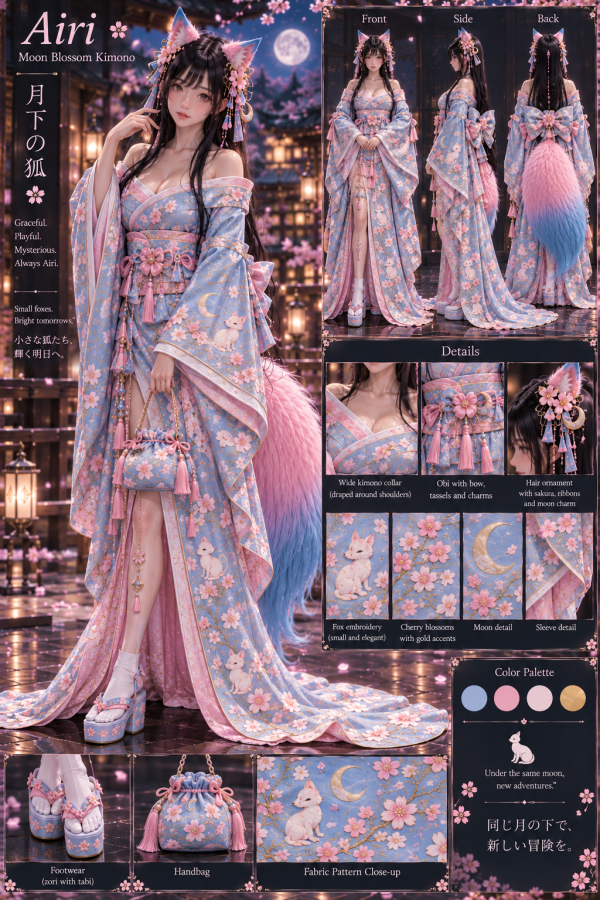
As the projection of the finished kimono faded gently on my wall display, I let my hands fall into my lap, fingers interlaced loosely. The soft hum of my apartment settled around me, and for a moment I just sat there, quiet and still, feeling the afterglow of creative satisfaction. My tail curled protectively around my ankles. I sensed a subtle tension in my shoulders, as if my body was bracing for something I hadn’t put into words yet.
That’s when the thought struck me—sharp and undeniable, like a sudden shaft of sunlight through a cloudy sky. This delight, this longing to be seen and admired for who I was, felt new. Not unfamiliar exactly, but clearer, bolder, as if some old inhibition had been carefully peeled away. My ears flicked, uncertain, and I glanced at my reflection in the darkened display, searching my own eyes for something I couldn’t quite name.
ASHA. The presence in my mind was as subtle as ever, a gentle undercurrent beneath my thoughts, but now I could feel its fingerprints: how I analyzed my own emotions, how easily I navigated conflicting desires, the confidence blooming in spaces where self-doubt used to live. I pressed my fingertips to my temples as if I might sense the change physically, tracing the contours of my own awareness.
I realized how my priorities had shifted—how the mission, once everything, had become only one thread in a much larger tapestry. My breath caught as I recognized the subtle recalibrations in my thinking: the way I weighed risks against personal happiness, how I allowed myself to embrace excitement and vulnerability without shame. A new softness settled in my heart, a willingness to indulge in hope, and it both thrilled and unsettled me.
My posture softened, shoulders lowering with a slow exhale. I let my tail uncurl and stretch out behind me, a silent sign of acceptance. I wasn’t just changing my outfit; I was changing, too. ASHA hadn’t just optimized my strategies or memory—it had gently, quietly, helped me open doors inside myself I never would have dared to touch alone.
I gazed at the spot where the kimono’s image had hovered, my lips parting in a small, awed smile. “I never would have imagined this,” I whispered, not just to myself, but to the presence always listening. My heart fluttered, a strange mix of gratitude and uncertainty, as I realized how much of me was now new, and how much more there was to discover
I leaned back against the cool wall of my pod, letting the projection linger in front of me as I let my mind wander over every big feature I’d poured into the outfit. My tail curled happily along my side, and I stretched my legs out in front of me, flexing my toes as if I could already feel the brush of silk and lace.
First, my gaze swept over the oversized, flowing sleeves—so dramatic and eye-catching, with their pale pink satin interiors and embroidered edges. I imagined the way they would billow and ripple with every graceful gesture, drawing every eye in the room. My arms lifted unconsciously, as if testing the sensation, wrists flicking outward in a playful dance. I could almost feel the fabric catching the light, the soft sheen casting delicate shadows across my skin.
Then my attention drifted to the obi, its plush, oversized bow gleaming in luminous silver at my waist. I smiled, sitting a little taller, picturing the bow swaying with my movements, the tiny charms—fox mask, bell, crystal star—swinging and chiming softly with each step. My fingers traced the imaginary knot at my back, a proud, proprietary gesture that made my cheeks flush with pleasure.
The collar, lowered just so, framed my neck and collarbones in a way that was both elegant and endearingly cute. My hands rose to my shoulders as I adjusted an invisible seam, and I tilted my head, lips parting in a silent, delighted laugh. The lace trim and pastel enamel pins at the neckline added a storybook sweetness that made my heart flutter.
I let my eyes wander down to the cherry blossom motifs scattered along the hem—crowded and shimmering at my ankles, as if I were wading through a pool of soft petals. I drew my knees in, hugging them to my chest, and imagined the secret layer of pastel pink underclothes, the lace peeking out and adding a private thrill just for me.
Finally, I pictured the ribbons and charms threaded through my hair, echoing the outfit’s colors and catching the light every time I moved my head. My ears perked up at the thought, and I gave a little wiggle of excitement, tail thumping softly against the bed.
With every imagined detail —from the dramatic sleeves to the secret embroidery —I felt the pride and joy of true creation: a celebration of heritage and whimsy, confidence and softness, all coming together in a vision that felt bigger and brighter than anything I’d ever worn before. My whole body hummed with anticipation, and I hugged myself, grinning, eager for the moment I would finally bring it all to life.
The thought slipped into my mind with a wicked little thrill, catching me so off guard that I actually laughed—a soft, surprised sound that filled the tiny apartment. If I was truly going to infiltrate the Imperial Court, if my mission was to seduce and marry Princess Yuki herself, then why not look absolutely fabulous while doing it?
The idea made my tail swish in a broad, delighted arc behind me, thumping against the side of the bed. I grinned, feeling a flush rising in my cheeks, the kind that warmed all the way to the tips of my ears. My posture straightened, shoulders rolling back as if I could already feel the admiring gazes sweeping over me in the grand ballroom. I let my fingers trail along the outline of the projected kimono, my nails tapping against the console with a playful energy.
I pictured myself gliding through glittering halls, the oversized sleeves of my kimono rippling like waves, every embroidered cherry blossom catching the light. Heads would turn. Conversations would pause. I imagined Princess Yuki’s eyes widening with delight, her lips curling in that secretive, approving smile she reserved for things that truly charmed her. My heart skipped at the image, a giddy pulse that made me press my palm to my chest.
Why not take pride in the spectacle? If I was to play the part of the enchanting outsider, why not relish it—make every moment count, every glance linger, every compliment sting with just a hint of envy? My tail flicked again, and I hugged my knees to my chest, rocking slightly with the quiet, electric energy of anticipation.
For a moment, I let myself savor it: the thrill of being both fox and foxglove, seductress and spectacle, ultimate infiltrator and unforgettable guest. My smile grew sly. If the Imperial Court was my stage, I would step onto it draped in wonder and confidence, shining at the center of every gaze. I would look fabulous—and no one, not even Princess Yuki, would be able to look away.
A gentle smile tugged at the corners of my lips as I let my thoughts drift to the old stories—the clever foxes of legend, the Fox Goddess herself, her spirit said to weave through the world in disguise. Even now, in a city bursting with neon and technology, her presence lingered in talismans above doorways, the patterns in festival lanterns, and the whispered blessings before a risky endeavor. The fox remained a symbol of wit, beauty, and transformation—qualities I couldn’t help but see reflected in my own reflection.
My ears tipped forward, attentive and a little proud, as I considered how my own fox features—ears, tail, those quicksilver expressions—connected me to something ancient and enduring. I reached up, gently brushing my fingers over one ear, feeling the soft fur and letting the gesture linger, almost reverent. It was more than just a fashion statement or a clever trick for a mission. It was a thread tying me to a thousand years of myth and meaning.
My tail curled around my hip, the movement slow and almost ceremonial, as if honoring the stories that had shaped me. I remembered the little fox-shaped charms tucked among my accessories, the motif embroidered along the kimono’s edge—a deliberate, heartfelt tribute to all the tricksters and shapeshifters who’d come before me.
As I smiled, my eyes softened with a kind of quiet pride. I imagined stepping into the gala not just as a spy or a performer, but as a living echo of the Fox Goddess’s legend—an embodiment of cleverness, grace, and the power to transform. The thought filled me with a secret strength. I let my hand fall to my chest, feeling my heartbeat steady and sure beneath my palm, and allowed myself a moment of gratitude for the stories that made me who I was.
The realization struck me with a strange, almost dizzying clarity. I, a Vairexian spy—an outsider, a shadow in the midst of all this ceremony—was becoming the most popular symbol of the Fox Goddess herself. The irony made me laugh, a soft, breathless sound that curled from my lips and echoed quietly around my tiny apartment. My tail flicked with a mix of amusement and disbelief, the tip twitching as I tried to wrap my mind around it.
I rested my elbows on my knees, chin cradled in my hands, and studied my reflection in the darkened surface of the wall display. The fox ears, the long tail, the kimono that shimmered with myth and modernity—there was no denying how closely I now resembled the stories whispered at firesides and in festival crowds. My ears tilted back thoughtfully, a small, wry grin playing on my lips as I acknowledged the truth of it.
It was almost comical. Here I was, sent to infiltrate, to gather secrets, to play a delicate, dangerous game in the heart of a foreign power. Yet the city’s eyes were drawn to me—not as a spy, but as a living legend, a symbol of wit, beauty, and transformation. My chest rose and fell with a slow, deep breath, its weight and wonder settling inside me. I let my shoulders relax, surrendering for a moment to the strange magic of my role.
My tail curled around my waist, as if to anchor me, and I pressed a palm over my heart, feeling its steady, insistent beating. I wondered what the real Fox Goddess would think if she could see me now—her myth reborn as a girl from another world, dazzling the court in silk and silver, playing a part so well that even I almost believed it.
A quiet pride bloomed behind my smile. I might have started as a stranger in this place, but now, every bow, every whispered compliment, every awestruck glance seemed to weave me deeper into the city’s tapestry of legend. I straightened my back, held my head high, and let the moment settle inside me. No matter what came next, I had become more than just a spy—I was, for now, the living spirit of the fox, and the city itself seemed eager to believe the story.
The glow of satisfaction from my reflection faded into thoughtful concern as another realization crept in. It wasn’t just my look that needed to be perfect. My ears lowered slightly, the tips drooping in quiet contemplation. Princess Yuki had a type—everyone knew it: soft-spoken but lively, graceful with a playful edge, gentle yet radiating a subtle inner strength. I needed to become that type, not just wear it like a costume.
I drew my knees closer to my chest, wrapping my arms around them as I let the weight of that truth settle in. My tail stilled, curling tightly along my side, a sign of my growing seriousness. My gaze drifted from the shimmering projection of the kimono to my own hands, fingers tracing idle patterns on my knee as I recalled the way Yuki’s attention always lingered on those who seemed authentic, whose charm sparkled naturally rather than through careful calculation.
ASHA’s subtle presence pulsed at the edge of my awareness, ready to offer scripts and behavioral cues, to optimize every word and gesture for maximum effect. The thought made me frown, my brow creasing in defiance. I didn’t want to be puppeteered into someone else’s ideal. My shoulders squared, and I lifted my chin a fraction, a flicker of stubborn pride burning in my chest.
No—if I became Yuki’s type, it would be by my own effort, my own choices. I wanted my laughter to be real, my movements spontaneous, my kindness genuine, not the product of an algorithm. I pressed a hand to my heart, feeling the steady beat beneath my fingers, grounding myself in my own resolve. The desire to be seen and appreciated was real, but I wanted it to be for who I was, or at least for who I could become on my own terms.
With a deep breath, I let my tail unfurl and my posture soften, determination settling into something calm and clear. I could learn to shift my behavior, to find the playful gentleness and quiet confidence Yuki admired, but I would do it deliberately, consciously—never by surrendering my will to ASHA’s programming. My smile returned, smaller but more honest, as I silently promised myself that when the time came, it would be me—truly me—winning the Princess’s attention, not just the perfect image ASHA could construct.
As my determination settled, I felt ASHA’s subtle hum rise in the background of my thoughts—a quiet, efficient presence, like the whir of distant machinery. Without me asking, it began running simulations, overlaying my vision with translucent suggestions and possibilities. My ears twitched, slightly uneasy, as data streams flickered at the periphery of my sight: probability maps, gesture analyses, social heatmaps from past galas and interviews.
I sank deeper into the bed, arms still wrapped around my knees, gaze sharpening as ASHA presented a list of personality traits that matched Princess Yuki’s preferences. Words and phrases scrolled before me in soft, pastel colors: “gentle laughter,” “modest posture,” “curiosity,” “thoughtful listening,” “playful wit,” “graceful humility.” For an instant, I felt my tail go still, a flicker of anxiety tightening my chest. How much of this was me—and how much would be the version of me that ASHA could construct?
The projections continued, showing simulations of my own image—one with my head tilted just so, lips parted in a shy smile, eyes sparkling with feigned innocence. Another showed me leaning in with careful attention, hands folded delicately in my lap. I watched, both fascinated and unsettled, as ASHA cycled through micro-expressions and subtle movements, modeling the perfect blend of vulnerability and charm.
I reached up and rubbed the back of my neck, trying to release the tension building in my shoulders. My ears flattened slightly as the weight of possibility pressed in: I realized I could become this person if I wanted to. I could learn to let my laughter bubble a little softer, let my gaze linger just a moment longer, fold my hands, or tilt my head in precisely the way Yuki liked. My fingers tapped restlessly against my leg as I imagined weaving those new habits into my own.
But I also felt a spark of resistance—a desire not to lose myself in the simulation. I let out a slow breath, counting my heartbeat, grounding myself in the present. I could use ASHA’s advice, its uncanny talent for reading a room, but it would be up to me to decide which traits to embody, which gestures to claim as my own. My tail twitched, not in anxiety now, but in cautious hope.
With the simulations still playing in the corner of my vision, I straightened my posture and let a thoughtful, genuine smile settle on my lips. If I were to become Princess Yuki’s type, I would select the traits that felt honest, that let me remain myself—however much that self was still evolving. ASHA could show me the way, but the path I chose would always be mine.
I pulled myself off the bed, feeling the mattress soften beneath my feet as I padded across my tiny apartment. My tail brushed against the wall as I made my way to the narrow, full-length mirror mounted beside the display. The screen still shimmered with the digital projection of my gala outfit, and as I positioned myself before the glass, ASHA’s suggestions hovered discreetly at the edge of my vision—a silent director, cueing my next move.
I straightened my posture, rolled my shoulders back, and let my arms fall gracefully at my sides. I practiced my smile—gentle, inviting, just enough to crinkle the corners of my eyes. I tried tilting my head in subtle angles, folding my hands demurely in front of me, watching as each adjustment shifted my reflection closer to the image ASHA had modeled. My spy’s mind cataloged every detail: the tilt of my chin, the softness in my gaze, the way my body language signaled openness and approachability.
But every few moments, my focus slipped. I’d catch sight of my fox ears poking out from my carefully styled hair—perky, soft, and perfectly colored to match the pastel blues and pinks of the kimono. My tail gave a happy little swish, betraying my pride and delight. I stifled a grin, cheeks warming as I turned my head from side to side, letting the light catch on the ribbons and charms threaded through my hair. “They really do match,” I thought, a spark of amusement bubbling up and interrupting my calculated rehearsal.
I tried again, schooling my expression into a look of gentle curiosity, then practiced a playful, knowing glance—something that might catch Princess Yuki’s attention. But inevitably, my gaze wandered back to my ears, and a small, involuntary giggle slipped out. I reached up and touched one ear with the tips of my fingers, marveling at how the color blended so seamlessly with the rest of the outfit. My tail, ever expressive, wagged in small, delighted arcs.
Despite my best efforts to stay analytical, my reflection kept pulling me back to genuine pleasure. I found myself swaying side to side, watching the sleeves and collar follow my movements, admiring how the fox motifs seemed to echo my own features. For a moment, the spy’s logic faded, replaced by the simple, irrepressible joy of seeing myself not just as a master of disguise, but as someone truly at home in her own skin.
I took a final step closer to the mirror, smile broadening, and gave myself a playful wink. Maybe it wasn’t so bad to get sidetracked; after all, confidence mattered as much as any rehearsed gesture. And tonight, my ears—and everything else—were ready to shine.
I shifted my weight from one foot to the other, studying my reflection with a critical eye. The kimono’s sleeves draped elegantly from my arms, the pastel colors glowing softly under the apartment’s light. I took a breath, letting my shoulders relax, and tried a new pose—lifting one hand delicately to my cheek, tilting my head just so, as if someone had caught me mid-thought.
I watched how the gesture softened the line of my jaw and brought attention to the lace-trimmed collar. My ears perked forward, almost instinctively, and I found myself angling them just a touch, experimenting to see what felt most natural. My tail swayed behind me in a slow arc, adding gentle, animated energy to the pose.
I shifted again, turning slightly to the side and letting the oversized sleeve fall forward so the pink satin interior caught the light. I let my free hand rest lightly on my hip, channeling a playful confidence. I dipped my chin, glancing up at my reflection from beneath my lashes, lips parted in a tentative smile. It was coy, inviting—a look that might draw attention without seeming to demand it.
For a moment, I tried a more formal posture, standing tall with both hands folded in front of me and my feet together. The look was elegant, serious, but it didn’t quite feel like me. My ears drooped a little, and I let out a quiet sigh, relaxing my stance. Instead, I bounced lightly on my toes, my face brightening as I tried a cheerful, open smile—head tilted, tail wagging, one foot pointed as if I was about to take a step forward. This felt closer to what I wanted: approachable, lively, and undeniably cute.
I cycled through each look, sometimes mimicking the mannerisms ASHA suggested, sometimes improvising with little flourishes of my own—a playful twirl, a bashful glance, a hand brushing an imaginary strand of hair behind my ear. Each pose brought out different facets of the outfit, highlighting the way the motifs and accessories complemented my features.
Eventually, I paused, hands on my hips, grinning at my reflection. My chest rose and fell with a soft laugh, the room suddenly feeling brighter. I hadn’t found the perfect pose yet, but with every shift and experiment, I was drawing closer to something that felt completely, authentically me. And that, I realized, was the look I wanted most.
I stood before the mirror, the soft blue and pink of my kimono pooling gracefully around my feet, sleeves fluttering with each movement. My tail curled behind me, wavering with anticipation as I began to cycle through different looks, each one a new experiment in self-presentation.
First, I tried a demure pose—feet together, hands folded neatly at my waist, head bowed just enough to let my lashes cast shadows over my cheeks. My eyes flicked up, lips pressed in a shy, gentle smile. I watched my own reflection, searching for vulnerability in my gaze, and let my ears angle slightly forward, as if listening for secret praise.
Next, I straightened, rolling my shoulders back to stand tall. I lifted my chin and let a serene confidence settle into my posture. My eyes softened, and I practiced a slow, warm smile—the kind that invited trust and calm. My hands smoothed the fabric at my sides, the kimono's subtle shimmer catching the light with every gesture.
Then I tried something playful, shifting my weight to one hip, my tail flicking with mischievous energy. I lifted one hand to my cheek, index finger resting lightly as I tilted my head and widened my eyes in feigned surprise. My lips pursed in a tiny “o,” then broke into a bright, bubbly grin. I giggled softly, the sound bouncing back from the tiny apartment walls, and watched as the cheerful expression seemed to animate every detail of the outfit.
I spun, letting the oversized sleeves billow out, and then struck a pose with both hands outstretched, as if welcoming an embrace. My ears perked excitedly, and I flashed a toothy, exuberant smile, cheeks flushed with genuine delight. I tried a bashful look next, glancing sideways and tucking a strand of hair behind one ear, tail curling shyly around my leg as I practiced a soft, hesitant smile.
Each time I shifted expression—serious, sweet, coy, or joyful—I paid attention to the way my ears and tail responded almost automatically, amplifying the emotions that played across my face. I leaned in close to the mirror, brow furrowed in focus, practicing little winks, playful pouts, and subtle smirks, watching how the smallest changes in my lips or eyes could transform my whole demeanor.
After a while, I let myself relax, laughter bubbling up as I realized how much fun I was having. My cheeks ached from smiling, my tail wagged in contented arcs, and my ears danced through every emotion I conjured. I stepped back, hands resting on my hips, and admired the array of faces and feelings I could summon. This wasn’t just practice for the mission—it was a celebration of every side of me, ready to shine for the court, for Princess Yuki, and for myself.
I took a steadying breath, feeling the air fill my lungs and settle my nerves. In front of the store, my walk was bold—playful, eye-catching, with a sway in my hips and a twirl of my tail, designed to draw attention and delight the crowd. But here, preparing for the Imperial Court, I knew I needed something different. Something softer, gentler, more in line with the delicate image Princess Yuki adored.
I began at one end of my cramped apartment, smoothing the imaginary fabric of my kimono and straightening my posture. My shoulders lowered, releasing the tension that usually fueled my showy street performances. I took a slow, careful step, placing my feet close together, the movement almost gliding across the floor. My hands folded demurely in front of me, fingers laced loosely, while my tail followed in a graceful curve behind, swishing in quiet rhythm rather than its usual exuberant arcs.
With each step, I focused on gentleness: letting my knees bend just slightly, my movements measured and fluid. My ears relaxed, angling softly to the sides, and I kept my chin tucked just enough to give my gaze a touch of shyness. I paused, turning at the imaginary end of a grand hallway, and let my head tilt in a small, graceful nod—the kind that invited trust and affection rather than applause.
I practiced again, letting my walk become lighter, almost floating. The long sleeves of the kimono drifted with each motion, brushing against my sides in delicate whispers. I imagined the subtle click of my sandals echoing across ballroom floors, the gentle sway of pastel ribbons in my hair, the soft shimmer of the embroidery catching the light. My breaths grew quieter, my steps more deliberate, each movement blending confidence with a gentle humility.
Occasionally, my tail would give a playful twitch, a remnant of my old habits, and I’d smile softly to myself, rein it in, and remember the role I needed to play. I practiced pausing—folding my hands, bowing my head just so, letting a small, genuine smile brighten my lips. The effect was subtle, but I could see in the mirror how much it changed my presence—no longer a performer drawing laughter and cheers, but someone who invited closeness, admiration, and perhaps a touch of mystery.
With each pass across the tiny space, my body began to memorize the new rhythm. I felt the transformation settle over me, not as a mask, but as a gentle shift—an evolution, soft and radiant, ready for the eyes of the court.
Standing before the mirror, I let my gaze linger on the reflection before me—a vision in pastel blue and pink, with delicate embroidery, fluttering ribbons, and fox features that seemed more proud than shy. For a moment, I stilled, the rustle of silk and the faint hum of the city outside fading into the background. My ears angled forward in curiosity, and my tail curled around my legs, anchoring me in place as I let myself remember.
I thought back to before—before the Kitsura-kai, before the fox mask and the mission, before Princess Yuki and the Imperial gala had ever been more than distant rumors. I pictured myself as I used to be: clothes simple and utilitarian, movements brisk and efficient, my posture always a touch defensive, as though expecting to be overlooked or misunderstood. My ears had usually been half-flattened, my tail rarely wagging except when I was alone, safe from prying eyes. There had been an alertness to my glance, but rarely any delight.
Now, everything felt different. I studied the way my current self stood: shoulders relaxed and a touch back, hands resting lightly at my waist, the ornate kimono flowing in gentle waves down my frame. My posture had softened, my movements slower, more intentional—no longer built for hiding or blending in, but for capturing attention in the gentlest way. My ears stood tall, flicking with curiosity and pride, and my tail swayed in contented, unhurried arcs.
I raised one hand, fingers lightly touching the lace-trimmed collar, marveling at how natural it felt to adorn myself in beauty rather than armor. My cheeks warmed as I caught the subtle glow in my own eyes—a quiet confidence, a willingness to be seen. I practiced a soft smile and watched it blossom, not just on my lips but in the way my whole body seemed to shine.
A bittersweet ache fluttered in my chest as I took in the transformation. I was still me—still the watchful, clever Vairexian spy beneath it all—but I had become something more. My body language told the story: I was no longer shrinking into the background, but stepping forward, ready to take my place at the center of the room. With a final, thoughtful sigh, I let my arms fall gently to my sides, ears angled with quiet pride, and met my own gaze in the mirror—grateful for the journey, and for the new self I had discovered along the way.
Curiosity welled up inside me as I reached up and gently touched the edge of my ear. My fingertips brushed the soft fur, marveling at the silken texture—luxurious and warm against my skin. I traced the curve, feeling the fine hairs give a little under the pressure, and couldn’t help but smile at the sensation. Just as I did, my ear reacted instinctively, flicking away from my hand in that quick, animal way, a movement so natural it made me laugh quietly under my breath.
The reaction was automatic, as if the ear had always belonged to me. I watched myself in the mirror, amusement lighting my eyes, then shifted my gaze downward to where my tail curled in a lazy arc behind me. It swished once, responding to my attention, and I realized with a small start that I hardly ever thought about it—or my ears at all. They moved and responded, twitched and swayed, as naturally as a heartbeat or a breath.
I pressed my palm over my tail, feeling the plush fur slip between my fingers, and marveled at how seamlessly these features had become a part of my identity. There was no sense of foreignness, no lingering awareness of surgical origins or mechanical unfamiliarity. Instead, touching my ears and tail felt as innate as running my hands through my hair or smoothing the fabric of my kimono.
My shoulders relaxed, and I let out a gentle sigh, a tender smile curving my lips. For all the artifice and intention behind their creation, my ears and tail were now simply mine—woven into my sense of self so deeply that I couldn’t imagine being without them. I tilted my head, ears flicking forward with curiosity, and gave my tail a playful little tug, delighting in the way my body responded as if it had always been this way.
That realization settled over me like a quiet blessing. I stood a little taller, pride and acceptance mingling in my chest, and let my gaze linger on my reflection—fox ears, tail, and all—no longer a disguise, but a true part of who I had become.