Not This Guy
Author:
Audience Rating:
Publication:
Genre:
Character Age:
TG Themes:
Permission:
I reached for what should have been there, what I needed to do my business....

Not This Guy
A Novel
By Suzan Donamas
Chapter One
The afternoon I fell into the spring, I was wearing my good suit. Navy blue, medium-weight wool, the one I kept for client meetings. I'd driven out along the Tamiami Trail because the meetings were done and I had three hours to kill before dinner, and the Everglades were right there, flat and enormous and unlike anything in Rockford, Illinois, where I'd spent the last eleven years of my life.
I’d rented one of the new Buicks, next year’s model, a ’59, and drove out to find some nature,
I found the spring the way you find things when you're not looking -- following a path that went from gravel to dirt to something that might have been a path or might have been a suggestion, until I pushed through a stand of cypress and there it was. A pool maybe thirty feet across, the water the color of pale jade, perfectly still except for a slow upwelling at the center where whatever fed it came up from underground. No sign. No marker. Just water in the late afternoon light.
I should have gone back to the car.
I was trying to get a closer look at something on the far bank -- a bird, maybe, or the shadow of a bird -- when my left shoe found a patch of wet limestone and I went in. Not gracefully. Fully, suddenly, completely -- suit and tie and the good shoes I'd had resoled twice and the billfold in my breast pocket with the rental car agreement folded inside. Up to my neck in a Florida spring at four-thirty in the afternoon.
The water was warm. Warmer than I expected, and clear enough that I could see my hands in front of me, the bubbles rising from the upwelling at the center, the pale sandy bottom. I was not hurt. I was extremely wet, and the suit was ruined, and I pulled myself out along the bank and stood dripping in the late sun and looked at the spring, which looked back at me with complete indifference.
I drove back to the motel with the windows down, hoping to dry out before I had to walk through the lobby.
I didn't think about the spring again. I had dinner at the diner next door -- a patty melt and coffee and a piece of pie that was better than it had any right to be -- and I went back to my room and hung the suit in the bathroom to dry and went to bed.
* * *
The first thing I noticed, at something like three in the morning, was that I needed the bathroom. This was not unusual. I was thirty-eight years old and had been drinking coffee since six in the morning, and this was simply a fact about being thirty-eight years old and drinking that much coffee.
I got up. Crossed the dark room, found the bathroom, did not turn on the light, but stood there in the darkness in front of the bowl. I reached for what should have been there, what I needed to do my business.
It wasn't there.
I went back to bed.
I had clearly been dreaming. The mind did strange things in unfamiliar motel rooms. I would feel more like myself in the morning. I ignored the feeling of a full bladder and went back to sleep, feeling even more tired than I had when I came back to the motel, soaking wet in my medium-weight worsted Midwestern suit.
I lay in the dark and the air conditioner hummed and somewhere outside a Florida night bird delivered an opinion about something, and I drifted back toward sleep, and my hand moved in a half-asleep, completely automatic way across my own chest….
I was awake.
I lay very still.
I moved my hand again, deliberately this time. One side. The other side.
Then I did what I'd done in the bathroom -- the inventory, the check -- slow and careful, hoping very much to be wrong.
I was not wrong.
The sound that came out of me was not quite a scream. The walls in these motels are thin, and there were sleeping strangers on either side, and some professional instinct compressed it before it escaped fully, so what came out was closer to a very controlled, very emphatic exhalation. The sound of a person who has just received information that exceeds the available categories.
I lay there in the dark and thought: did I hit my head? I thought: have I been poisoned? I thought, because it was 1958 and I was a midwestern American and this was the kind of thing you thought: have the Russians done something?
Then the practical part of my brain, the part that closes equipment deals and reads balance sheets and gets things done, took the wheel.
I had a meeting at nine o'clock.
I sat up and turned on the bedside lamp. I put my arm across my chest. They were still there. Large, soft, smooth…things that had no business being on the chest of a heavy equipment salesman from Rockford, Ill.
The room looked the same. The suitcase on the luggage stand, the navy suit drying in the bathroom, my Braves cap on the nightstand. Everything exactly where I'd left it. I looked at my hands in the lamplight, turned them over, and they were hands I didn't recognize -- smaller, the fingers longer and more tapered, no calluses on the palms.
I got up and went to the bathroom and looked in the mirror for a long time.
The face looking back was mine and wasn't. The bones were there -- the structure, something around the eyes that I knew. But everything had shifted, softened. The jaw rounded, the brow lighter, the chin softened, the lines gone. A face with my face inside it, the way a photograph of a relative will sometimes contain a whole family history in one set of cheekbones. My hair was still the duck-butt I'd been wearing since 1951. It looked ridiculous above the woman’s face I was wearing.
I had been about five-foot-eleven. I measured myself against the door frame. I decided that I couldn’t be more than about five-foot-six, which was five inches shorter than I'd been yesterday. I was considerably lighter. I had, as previously established, a new configuration above the waist and a very different one below it. The suit in the bathroom was not going to fit. The pants were not going to fit. The shoes were not going to fit.
I sat down on the edge of the bathtub.
I had a meeting at nine o'clock to sell earthmovers to the Army Corps of Engineers, and I had nothing to wear, nothing to say. Thinking about those things did not produce any useful result.
First things first. I tried to make a long-distance call to Rockford -- my boss Walt, who would know what to do—but the instructions beside the phone on how to make a long-distance call defeated me. They made no sense at all. Besides, it was four in the morning Florida time, three in the morning Central, and the phone would ring twelve times in an empty office, so I hung up and sat in the vinyl chair by the window and looked at the parking lot.
The rental Buick parked under the Silver Springs Motel sign accused me of having abandoned it. Across the four-lane highway, a yellow-and-red neon Waffle Barn sign promised greasy meats and fluffy baked goods. The gravel lot had three semi-trucks in it.
My stomach rumbled. Another accuser.
I tried to get dressed. My briefs refused to brief me, and I discarded them into the trash receptacle beside the toilet. My pants were miles too long, tight across the seat and thighs and hugely unfit at the waist. I rolled the cuffs up so I wouldn’t be stepping on them. My shirt was too wide for my shoulders and hung oddly loose over my…breasts.
I tried stuffing my socks into the toes of my dress shoes to make them stay on my smaller feet. Even with the laces pulled as tight as my newly tiny hands could, the danger existed that I would simply walk out of my shoes. The strategy worked no better with the canvas deck shoes I’d packed in case someone offered me a boat ride.
I put my Milwaukee Braves cap on to hide the silly-looking duck-butt haircut.
Then I was out the door before I decided to go. The window of the motel office did not show a light, and I headed for the highway, stepping carefully to keep my shoes on my feet.
* * *
The air outside was warm and close, the sky doing something pink and extraordinary over the palm trees, and I was wearing the least wrong combination of my clothes -- the pants cinched to a belt hole I'd never used, the shirt enormous across the shoulders and problematic in one specific area, the canvas deck shoes which were too large but at least flexible. The Braves cap sat on my head loosely, where before it had been tight.
I stepped off the curb and started across the highway.
The truck came from my left, big and loaded, doing highway speed, and it didn't slow down -- it stopped, or nearly, and the air horn blast was long and appreciative, and the driver had his arm out the window and a grin I could see from the center line.
I stood in the headlights.
Thirty-eight years as a man, and I knew exactly what that air horn meant. I'd heard it directed at women from trucks like this one, understood the grammar of it, always filed it away as background noise belonging to a world I moved through without being part of.
I stood there and felt it land on me, and something moved through me that I was absolutely not going to examine before breakfast.
I gave the driver a small nod and a weak smile and scurried the rest of the way to the Waffle Barn. Weirdly certain that someone was looking at my ass.
* * *
The waitress’s name tag identified her as Vonzell. She had the kind of face that had seen everything come through a highway diner at four in the morning. She pointed me at the counter without a word, poured coffee without being asked, and put a laminated menu in front of me.
The coffee was terrible. I put three sugars and a container of cream in it, and it was still terrible. I drank half of it and let it argue with my stomach.
The hunger that had been patient was done with that. “Sirloin,” I said. “Two eggs, over easy. Biscuits. Grits. Bacon. Sliced tomatoes.” My voice sounded odd, as if it came from my face instead of my chest.
Vonzell's pencil paused.
“Hungry this morning,” she said. Not a question.
“Yes, ma'am,” said a voice that was mine and wasn't. Not so deep as before, almost whiskey rough, but more bourbon than rye.
*
From the kitchen, I heard the sound of the grill come alive.
I ate most of the steak, all of the eggs, the tomatoes and the biscuit. The grits I had always wanted to try. They were good with butter and salt, better than hashbrowns, I decided. I managed two pieces of bacon before the hunger finally relented.
Vonzell refilled the coffee. “You're up early,” she said. “You look like you're wearing your old man's shirt.”
“I had a funny night,” I said. “I went swimming. Something in the water disagreed with me.” I stopped talking. She'll think I'm crazy, I decided. My story was something out of an Alfred Hitchcock show.
“Water? Where?” Vonzell asked.
“Out in the Glades. There was a spring.” I didn’t want to talk about it, but Vonzell had questions.
She set the coffee pot down. “One of those old Spanish springs?”
“I dunno,” I said.
She called back toward the kitchen. “Johnny. You remember what Darlene said about her cousin Beaumont?”
“Which thing,” said a voice from the grill.
“The spring, the thing she said about Beaumont falling in the spring.”
A pause. “Ah, Darlene has told some bigger ones than that. Mind that time she claimed Jimmy Stewart left her a twenty-dollar tip?”
“He seems like he would be a good tipper,” Vonzell said. She leaned on the counter. “Beaumont went into one of those springs three years ago. Came out two inches taller and his trick knee cleared up entirely.”
“That's not quite what happened to me,” I said. Understatement.
“No,” she agreed, looking me over with calm, professional assessment. “I can see that.” What did she think she saw, I wondered.
From the kitchen, to the grill, “Which spring was it?”
“I don't know,” I said. “It wasn't marked.”
* * *
I needed the bathroom. I headed left by thirty-eight years of habit, and Johnny said, quietly, “other one, miss,” and I stopped and went right.
The bathroom had a single bare bulb and a mirror that had been honest with a lot of people. I stood in front of it in the fluorescent hum and looked at myself properly for the first time, in real light, with enough time.
The face was mine and wasn't. The bones were there, something in the eyes entirely and unmistakably still Guy Wendell of Rockford, Illinois. But the jaw was rounded, the brow softer, all of it redistributed into something that looked like the sister I'd never had. The shirt hung off my shoulders and didn’t work right elsewhere. My hands, when I raised them, were the wrong hands.
And the hair. The red-blonde duck-butt, faithful and unchanged, sitting on top of a face that could no longer keep any of its promises.
I don't know why it was the hair that did it. But something loosened and I cried for a few minutes in the Waffle Barn bathroom, quietly, because the walls were thin and Vonzell and Johnny were right outside, and Guy Wendell had never been a man who cried where people could hear him.
I ran the cold water. Washed my face twice. Put the Braves cap back on.
Went back out.
Vonzell had fresh coffee waiting and didn't say a word about my eyes.
Not This Guy -2-
Author:
Audience Rating:
Publication:
Genre:
Character Age:
Permission:
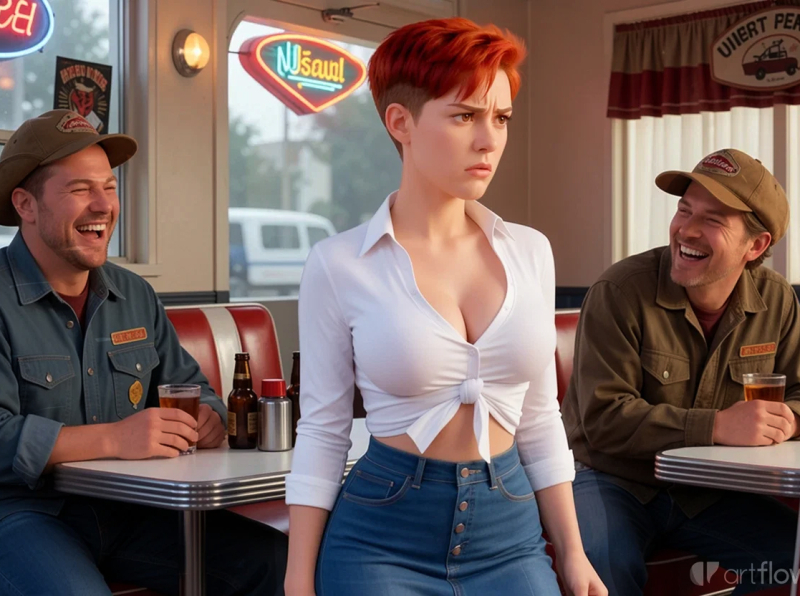
“You done showed them your bongos,” she said.
Not This Guy
Chapter Two
by Suzan Donamas
The trucker who came in next was lean and tall -- several inches taller than I used to be, which meant considerably taller than I was now -- and he spotted me at the counter from the door and came that way with the unhurried directness of a man who generally found that moving toward what he wanted worked out well for him.
Vonzell tried to warn him off with her glare. He settled on the stool two over from me, one empty between us.
“Hey darling,” he said. “Where you headed?”
“She's not headed anywhere with you, Rollie Blankenship,” Vonzell said. The shoofly motion she made with the coffee pot slopped hot coffee on her own hand. Ow!
I reached into my water glass without thinking, pulled out an ice cube, held it across the counter. “Put this on it,” I said. “Right now.”
“I know, I know,” she protested. We dealt with that. When I looked up, the trucker was smiling at me. Blue eyes, the specific faded blue of something left in the sun for a long time. A good smile with patience behind it.
“Sweet thang,” he said. “I'll take you anywhere you want to go.”
“She don't want to go anywhere with you,” Vonzell said. To me, lower, “Believe me, you don't.”
“My stuff is at the motel,” I said. Which was not a refusal, I noticed, even as I said it.
“The Silver Springs?” he said. “You ain't a mermaid, are you?”
“That's crystal springs has got the mermaids!” Vonzell snapped. Then to me, “He's got you hip-moh-tized already, Missy.”
“Missy,” said the trucker. “You already been introduced to me. I'm Rollie Blankenship. What's your name?”
I opened my mouth. Thirty-eight years of being Guy Wendell, and what came out was, “Gwen,” I said. “Gwen Wendell.” That sounded stupid, but it was said.
Vonzell cut her eyes sideways and said nothing.
Rollie extended a weathered hand across the empty stool. “Gwen Wendell,” he said, tasting it. “That's pretty. Where you from?”
“Milwaukee, originally,” I said. “But I've been in Rockford.”
“Long way from home.”
“Uh, huh,” I agreed, feeling stupid.
Vonzell went to make more coffee and rattled things doing ir.
Rollie's order came up without him ordering it -- three eggs scrambled with cheese, two sausage patties, grits with a big pat of butter, and a pecan waffle on a second plate. Johnny had seen the truck in the lot and just started cooking. Rollie ate with the focused efficiency of a man on a schedule, and I watched him and thought about things I didn't have words for.
Before Rollie arrived, Vonzell had addressed the shirt situation. She'd taken five minutes, retrieved a spare bra from her locker. “Too small, a 32C, I shoulda asked your size,” she said. “Come to the back with me.”
I followed, and she improvised in the back room by the utility sink, unbuttoned the shirt, twisted the tails into strings and tied them in front under the breasts. It changed the situation considerably. She also repositioned the Braves cap. I'd looked in the utility room mirror, and the bourbon voice said, very quietly, “Lord. Lord, that’s me?”
“Mm-hm,” Vonzell said, “That’s all you, missy-wearing-her-man’s-shirt. Where is your old man?”
“I dunno,” I confessed.
Then she led me back out to the counter and I sat, careful not to look down because it might attract someone’s attention.
Too late. The four truckers in the big booth were already attentive. One of them was beating out a rhythm on the underside of the table. The Maple Leaf Rag?
“Knock it off!” Johnny bellowed from the grill.
All four of them burst out laughing, and I nearly slid off the stool.
Vonzell leaned in to whisper, “You done showed them your bongos,” she said, “and now they all want to play the drums.”
The bourbon voice laughed before I could stop it. It was a warm laugh, warmer than the one I remembered having. But damnit! Bongos? I’d never heard that before. Am I giggling? I wondered. I looked sideways to avoid looking at my bongos.
Rollie finished the eggs and made progress on the waffle. He had a quality of presence that was doing something I couldn't entirely account for -- not loud, not pushy, just there, solid and faintly amused by everything. The blue eyes came back to me every few minutes from the waffle or the coffee or the middle distance.
I asked Vonzell for the check, just to not be watching Rollie.
She nodded toward the big booth. “Them boys paid it.”
“Least we could do!” one of them bellowed.
“Damn right,” Rollie muttered between bites, with a look in their direction.
“No offense Rollo -- you wasn't here and we didn't know.” And someone started with the rhythm on the table again, another ragtime beat. Johnny shouted something with no vowels and they stopped.
“Know what?” I asked no one.
Rollie put down a five-dollar bill and stood up. He was very tall from where I sat. He extended his hand, and I put mine in it, my hand looking small, and he led me toward the door.
“Oh,” I said.
Vonzell watched us go through the glass.
.
* * *
The motel room smelled like air conditioning and the ghost of my navy suit. Rollie moved through it like he had permission I didn't know about.
I don't remember much about the next few hours except that the spring had apparently been generous in every direction, and whatever thirty-eight years as Guy Wendell had failed to teach me, the body seemed to have its own ideas about, and I liked them.
Rollie slept. I lay next to him and looked at the ceiling fan turn and outside, Florida went about its business, and the nine o'clock meeting assembled itself gradually in my mind -- the Army Corps of Engineers conference room, the sales materials in my briefcase, Walt back in Rockford expecting a call with results.
I had missed it.
What the hell, I thought. No one had planned on meeting me. They'd planned on meeting Guy Wendell, and Guy Wendell was not available. I snuggled into the curve of Rollie's arm and went back to sleep.
* * *
The second time I woke up, it was because I wanted to, which was new information to me. I felt things in places I hadn’t used to have places.
I looked at Rollie and he rolled over to smile up at me. “I’m ready,” he said.
We moved together, and it was quick and good with my heels on his shoulders, and I made noises I don’t think I’d ever made before. What is happening to me? I wondered. “Oh,” I said aloud. “I think I’m getting fucked out of my mind.”
We laughed when we had breath to, and we kissed, a lot. Kissing someone with beard stubble was entirely new to me, and it turned out I liked that, too.
“What time is it?” he asked.
“I dunno? Does it matter?” I said.
He looked at the clock and said, “My load is due in Clearwater by eleven.”
I giggled.
“Not that load,” he said and tickled me under my ribs, under my boobs. “The load on my truck.”
“What time is it?” I asked as he rolled away from me, and I put my hands on his back, so strong, so hard.
“As near ten as no matter,” he said.
I wanted to ask if I could come but I knew the answer to that.
“He looked at me with his faded blue eyes in the morning light. “You can come with me,” he said, “or you can stay here, I guess.”
I thought about the rental Buick in the parking lot. The sales materials in the briefcase. Walt at the office in Rockford, and the quarterly numbers, and my apartment that smelled like nobody was ever home.
“I have something to tell you that you should know,” I said.
“Tell me on the way,” he said, and got up to help me pack.
We put Guy Wendell's things into Guy Wendell's suitcase -- the five shirts, the two pairs of pants, the Walgreens shampoo that didn't cause itching, the suntan lotion, the bug cream. I folded one shirt differently than Guy would have, just to see. Rollie retied the shirt-tail bra with matter-of-fact hands, no commentary, and I noted this for later. The Braves cap went on last.
Rollie pushed me back to get a good look, then adjusted the cap a quarter-inch.
The day clerk was a different teenager doing different homework. He looked up when we came through and looked back down. That was that.
Guy Wendell’s suitcase went in the back of the cab and Rollie boosted me up to the seat. I liked the feel of his hands on my waist and squealed to let him know that.
The truck smelled like diesel and distance and something underneath both of those that I was starting to think of as just Rollie. He went around to the driver's side and we pulled out onto the highway.
The Waffle Barn went past the window. I could see Vonzell through the glass. She raised a hand, not quite a wave. I raised mine back.
“Okay,” said Rollie, moving the gears smoothly. “Tell me.”
Not This Guy -3-
Author:
Audience Rating:
Publication:
Genre:
Character Age:
TG Themes:
TG Elements:
Permission:
He laughed. “You are so not a guy.”

Not This Guy
Chapter Three
Suzan Donamas
“I'm really a guy,” I said. “I mean, that's my real name. Guy Wendell.” I sounded confused even to myself.
He laughed. “You are so not a guy.”
“Not this guy,” I said. “I mean, I was a guy. I fell into a spring, and it changed me.”
He glanced over. “There's a spring north of here turns girls into mermaids,” he said. Grinning.
I blinked at him for a moment. Was there such a spring? After what happened to me, I was ready to believe it. What would it be like to turn into a mermaid? Would you be able to turn back if you didn’t like being fishy?
Wait. Wait. Wait. Did I want to turn back into a guy? Into that guy that I was. Well, not right at the moment. Please God, no. I shook my head and made a chicken noise.
Rollie watched me, still grinning. “I wanna see where you’re going with this,” he said.
I tried again. “Yesterday I was a man,” I said. “Guy Wendell. The suitcase is his.”
“What happened to him?” Rollie asked.
“He turned into me.”
Rollie drove.
“I approve,” he said, and reached over and tweaked my nipple.
I almost hit my head on the roof of the cab. I made a sound I didn’t intend to make, and I felt my face go hot.
He laughed like a loon while I gasped for breath to speak.
“Don't do that while you're driving,” I managed. Because I can’t get you back, I didn’t say.
“Fair,” he said, hand back on the wheel, still grinning at the highway ahead.
I tried to tell him a third time. He believed something had happened to me. That was his version of a philosophical position. “If you believe it, I’ll believe you,” he said.
He sucked at his teeth, probably getting a crumb of bacon out of his gums. “My cousin Dwayne went fishing in Lake Okeechobee and came back speaking Cajun French, having never been to Louisiana in his life.” He shrugged one shoulder. “Florida,” he said.
“Florida,” I agreed.
The highway went by. The cab was warm and smelled right, and the radio played something country at low volume, and I sat with several feelings at once, none of which I had a long history with. I looked sideways at Rollie, then I sat sideways in the seat so I didn’t have to turn my head, and we drove through the towns south of Clearwater, while I looked at him all I wanted.
* * *
We dropped the load at a depot that smelled of machine oil and cardboard, and Rollie went inside with the paperwork and came out with a bill of lading for a pickup in Tampa, bound for Charlotte, North Carolina. He got back in the cab and put his hand out, and I put mine in it. My hand still looked small in his. I was still getting used to being small.
“Say I do believe you,” he said. “Just suppose you used to be this guy -- he nodded at the suitcase behind us -- but now you're not. You’re not this Guy-guy anymore.”
He shook his head.
Guy-guy, I thought and smiled at him.
“Dayem,” he said. “I think you hit the jackpot. Young, beautiful, and good in the sack. What more do you want?”
I felt pleased. I noticed I felt pleased. I considered whether I should and decided that this was Florida, and the springs had their own opinions, and mine at this particular moment was that yes, jackpot seemed about right. Guy cashed in his chips, and I won the jackpot.
* * *
We picked up the Tampa load -- industrial machinery in big crates -- and got back on the highway heading north. The afternoon light came in long and amber through the windshield and Rollie had the radio on low.
“Where you from originally?” he asked.
“Milwaukee,” I said. “I was born there. But I got married on an island -- I'm trying to remember the name of it. She's from there, my ex. Took the kids back when we split. Went back home….” I still couldn’t think of the name of the island.
“Ouch,” he said. “You don't look old enough to have been married and had kids.”
“I'm thirty-eight,” I said. It sounded completely implausible.
He looked at me. “You might be twenty-eight,” he said. “But I ain't believing anything over -- oh.” He grinned. “Nineteen. Tell me you're nineteen and I'll believe you.”
I looked at my hands on my knees. The hands of someone who had never closed an earthmover deal in her life.
“I have three kids,” I said.
“Uh-huh. That’s what made your tits so big. But they never chewed your nipples.”
“And I coached Little League. For my boys.”
“Sure.”
“I've sold earth movers in seven states.”
“Earthmovers,” he repeated. He looked at the road. Looked back at me. The grin was getting wider.
“You,” he said. “Sold earthmovers. Well, I know you done moved the earth with me.”
“I was six feet tall, I said,” with what dignity I had. “I had a very good handshake.”
Rollie laughed so hard he had to ease off the accelerator, and it was infectious, it filled the cab, and I started laughing too and couldn't stop -- laughing at seventy miles an hour on a Florida highway with Guy Wendell's suitcase in the back and the Braves cap on my head.
It felt like something loosened and fell away.
* * *
Somewhere north of Tampa I remembered the rental car.
“Oh,” I said.
“What.”
I fumbled in the billfold and found the rental agreement folded in an inside pocket and held it up. “Can't look now,” Rollie said. “Driving.”
“The car is still at the motel,” I said.
“What car?”
“The big ol’ Buick I rented after flying down here.”
“Oh, that car,” said Rollie, grinning at the road.
I looked at the paper. Guy Wendell typed in every box. Rockford, Illinois. The long number was company account. Everything documented and real -- printed evidence of a person who had walked into a Florida motel and vanished.
“They're going to come looking for it,” I said. “For him.”
“For who?”
“That Guy-guy,” I said and giggled.
“But not this guy,” he said, reaching over to squeeze my thigh.
I opened the billfold and found the driver's license. Six feet, one-sixty, the duck-butt, the broad jaw. The face of someone I used to know very well. I held it at arm's length.
“Don't look much like you anymore,” Rollie observed with a glance.
“No,” I said.
A sign went past the window. Silver Springs, fourteen miles.
I had some vague idea about looking for the Buick when we passed through. The rental agreement was right there. It would be the responsible thing. Walt would need to be called, arrangements made, Guy Wendell's life dealt with in some orderly fashion.
Silver Springs came and went.
The Buick sat in the parking lot in my mind, baking in the afternoon sun, and I watched the sign slide past and didn't say anything and the highway continued north and the light was amber and Rollie's hand was warm on my thigh again.
The island where I'd met Laneka -- I still couldn't bring up its name. When I reached for it, I got the shape of the place instead: palms against a particular blue, the sound of surf, a woman on a beach turning to look at me with her hand shading her eyes. The children I couldn't picture specifically, but felt as a warmth, a weight, a gravity that was still there even if the details were softening at the edges.
Guy Wendell, I thought, experimentally.
It felt like a story someone had told me once. A good story. Mostly true.
Charlotte was seven hundred miles up the road and the industrial machinery shifted in its crates on the curves and Rollie drummed his thumb on the steering wheel to whatever was on the radio and outside the window, Florida gave way to Georgia, slow and green.
Gwen, I thought.
That fit. But not Gwen Wendell. That still sounded stupid. Maybe Gwen Blankenship?
I leaned back in the seat and watched the highway and put my hand on top of Rollie Blankenship's hand there on my thigh and felt, without qualification and without examining it too carefully, like I was going in the right direction.
Not This Guy -4-
Author:
Audience Rating:
Publication:
Genre:
Permission:
"Best thing," he said, "is if that Guy-guy just disappears."
Not This Guy -4-
by Suzan Donamas
The cab of Gypsy smelled like diesel and distance and something underneath both of those that I was already starting to think of as just Rollie. The bench seat was wide enough that there was a foot of space between us, and Rollie used about half of it, his hand finding my knee every few miles in the way of a man checking to make sure something valuable was still there.
The radio played country at low volume. Outside, Florida went about its business — flat and green and enormous, the sky doing things with clouds that you don't see in Illinois.
I was aware of the leather curtain behind the seat in the way you're aware of a fire in a room. Not looking at it. Knowing it was there.
"You can crawl back and sleep if you want," Rollie said. "There's a bunk back there. You get used to the noise."
I looked at him.
"The engine noise," he said, with the specific innocence of a man who knows exactly what he's said.
"I'm fine up here," I said.
He nodded at the road and put his hand back on my knee.
*
Somewhere north of Tampa, he pulled the billfold out of the conversation the way you pull a bad tooth — directly, without preliminary.
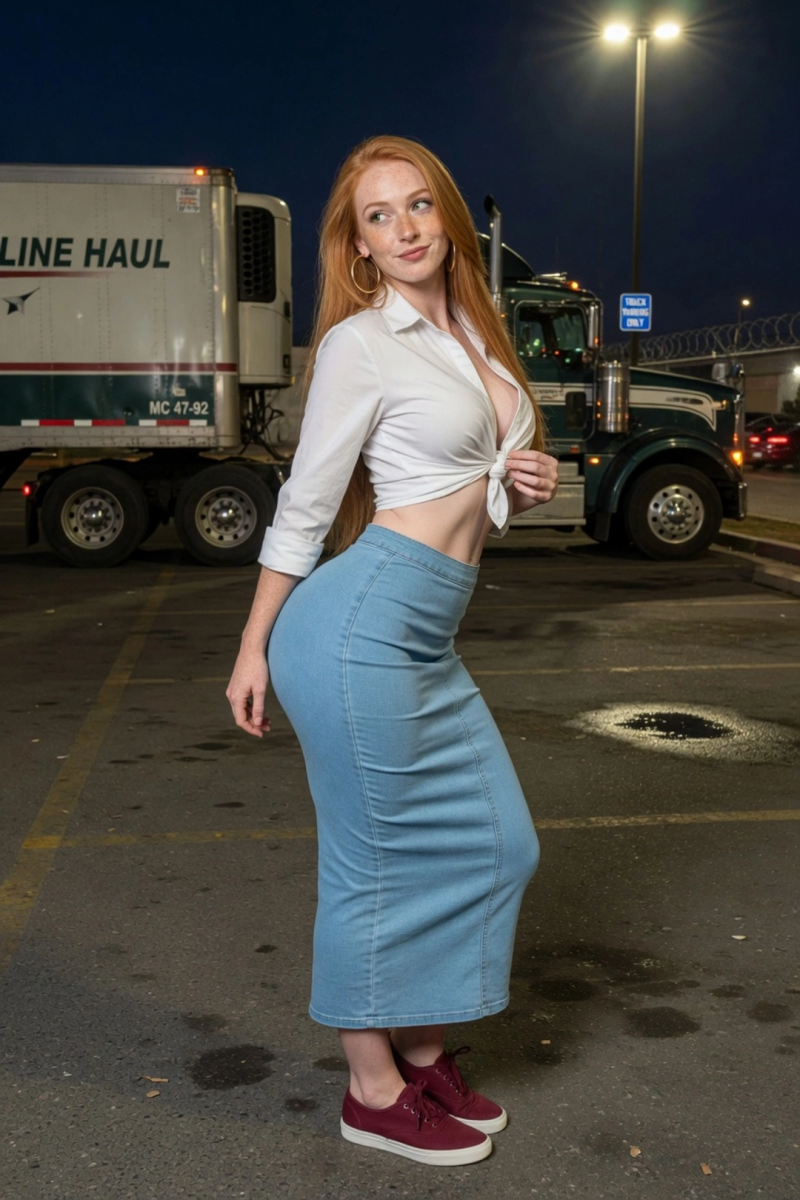
"Best thing," he said, "is if that Guy-guy just disappears."
I had the billfold on my lap. I'd been looking at it without quite opening it. "Disappears," I said.
"We can probably find someone to buy the cards and the license. Get a hunnerd, maybe two."
I opened it. The Diners Club card. The company American Express. Guy Wendell's driver's license with the broad jaw and the duck-butt and six feet one inch printed under his photograph.
"And for me?" I said.
"Florida ID cards only run about thirty dollars if you don't want the best there is." He sucked his teeth. "Best thing is to see what they got — take a name that fits a description close enough to you. Or you can have a custom one made, whatever name you like. Florida cards don't have pictures, so."
I held the license at arm's length. The face in the photograph looked back at me with polite incomprehension.
"Twenty-three," Rollie said. "That's what we put on it. I know you look nineteen, but twenty-three and nobody looks twice." He glanced over. "They might figure your face for nineteen, but your body says a mite older." He reached over and held my breast for a moment with the frank appreciation of a man making a point, and I felt the heat go through me from that and looked out the window at the palms.
"Gwen," I said. "For the first name. That's what came out at the Waffle Barn and I don't think I want to change it."
"That's pretty," he said. "And the last name?"
I thought about it for a mile or two. Wendell was gone, or going. Whatever name I picked was going to be the name I answered to, signed checks with, introduced myself by, for the rest of whatever life I was building at seventy miles an hour up a Florida highway. That seemed like it deserved more than thirty seconds of thought.
But then again, thirty-eight years of Guy Wendell had also not been chosen.
"My mother's maiden name was Delahoussie," Rollie offered.
I got the giggles. I couldn't help it — Delahoussie hit something and wouldn't let go, and the bourbon voice laughed for a good quarter mile.
"You don't like Delahoussie," he said.
"I can't be somebody who makes me laugh every time I sign a check," I managed.
"How about Telford," he said.
I said it. Gwen Telford. It sat in the cab for a moment and neither of us hated it.
"Where's that from?" I asked.
"Last name of the first girl I ever kissed," he said. "Behind the Methodist church. Hannibal, Missouri."
I looked at the highway and thought about being named after the first girl Rollie Blankenship kissed behind a Methodist church in Hannibal, Missouri. It should have seemed strange. It didn't seem strange at all.
"Gwen Telford," I said again. "Okay."
"Now," said Rollie, "where's Gwen Telford from?"
This was the other problem. The bourbon voice was a surprise — lower and warmer than you'd expect from the face — but the vowels were pure Illinois, flat and nasal and honest about it. You couldn't claim Georgia or Alabama or anywhere south of a certain line.
"Kansas City," Rollie said. "That's flat and nasal too, just with a little western twang on it. You been living there. And Springfield, Illinois for where you're from originally — born there, grew up there. That oughta satisfy anyone that you got a right to put an r in warsh."
I tried it. Said something with a warsh in it. It was not much of a stretch.
"Springfield," I said. "I can do Springfield."
"Born there, moved to Kansas City." He looked over. "Now where are you?"
I looked out the window at the highway. At the flat green nothing of central Florida going past at speed.
"In a truck," I said. "Going north."
"That'll do for now," he said, and put his hand back on my knee.
*
I was thinking about the leather curtain again. I was thinking about Rollie's voice when he sang along with the radio, the way it sat low in his chest, and I was thinking about his hand on my knee and his hand on my breast and the particular way he'd looked at me across the empty stool at the Waffle Barn counter. I was thinking about the bunk behind that curtain, and about how much of the drive to Charlotte was still ahead of us, and I was aware of a heat in my body that was not going anywhere on its own.
Guy Wendell had been attracted to women for thirty-eight uninterrupted years. The spring had been thorough.
I licked my lip. Rollie asked if I was thirsty.
"Yes," I said, because it was easier than the truth.
He reached behind the seat without looking and came up with a thermos. Coffee, strong and not terrible. I drank some and put the cap back on and set it on the seat between us.
A sign went past. Jacksonville, eighty-four miles.
I looked at the sign and I looked at Rollie's forearm on the gearshift and I looked out at the highway and I was aware that my whole body was making an argument that my brain was pretending not to hear.
"You're doing that lip thing again," Rollie said.
"What lip thing," I said.
"The one that's gonna get us pulled over."
"What does that even mean?" I said. "Who's going to pull us over?"
"I am," he said. "Ima pull us over and we'll pile in the back and tear off a piece of heaven."
The heat went straight through me and south and I felt my face go red.
"We're on a highway," I said. This was true and completely irrelevant and we both knew it.
Gypsy eased onto the shoulder. Gravel popped under the tires. Rollie set the brake and the engine idled and he looked at me with those faded blue eyes and didn't say anything at all.
I looked at the leather curtain.
"Jacksonville's only eighty-four miles," I said. One last argument for civilization.
"Mm-hm," said Rollie.
I went over the seat.
*
"Works better if you're on top," he said, clambering over after me. "More room that way."
He was right. The bunk was narrow and warm and smelled of him and the cab was louder back here than up front, which turned out not to matter in the least. He got his jeans down around his knees and I stripped and got on top of him and yeah, that was going to work a great deal better.
Half an hour later, give or take, we were on the road again and I had the giggles.
I was sitting sideways on the bench — I'd discovered I liked sitting sideways so I could look at him without turning my head — and every few miles something would come up from inside me and come out as a giggle and I couldn't entirely stop it. Rollie drove with the specific serenity of a man who has done a good job.
"What's funny," he said.
"I am," I said. "I'm funny." I looked at my hands on my knees — the wrong hands, the right hands. "Guy Wendell would not believe this day."
"Guy Wendell sounds like he needed to fall in a spring," Rollie said.
I thought about that for a mile. The apartment in Rockford that smelled like nobody was ever home. Walt at the office. The quarterly numbers.
"He really did," I said, and the giggle came back, and Jacksonville was getting closer and somewhere between here and there I was going to become Gwen Telford of Springfield, Illinois and Kansas City, Missouri, twenty-three years old, and none of that felt like a problem.
Rollie's hand found my knee again.
The radio played.
Not This Guy -5-
Author:
Audience Rating:
Publication:
Genre:
Character Age:
TG Themes:
Permission:
"I want you to wear a skirt," he said.
Not This Guy -5-
by Suzan Donamas
Rollie had been through Jacksonville a few hundred times and had feelings about it.
"City'll eat you alive if you stop in the middle of it," he said. "We go through and stop on the other side. Then when we want to leave, we ain't in traffic trying to get away."
So we went through. Jacksonville in the early evening was loud and new and sprawling — construction cranes and fresh concrete and half-built things that would be something by next year — and I watched it all go past from the height of Gypsy's cab, looking down into the cars alongside us, feeling tall in a way I hadn't since yesterday morning when I'd been a different person and six feet one inch and selling earthmovers for a living. A woman in a station wagon glanced up at me, and I looked back at her and thought, you have no idea.
The city thinned on the north side, construction giving way to scrub pine and sandy soil, and Rollie took an exit with a Howard Johnson's and a strip of stores and a Sears sign visible from the highway.
"There's your Penneys," he said.
"That's a Sears," I said.
"Close enough," he said, and pulled Gypsy into the far end of the lot where there was room to breathe.
He came around and lifted me down from the cab. I liked the feel of his hands on my waist and made a noise to let him know that, and he grinned and set me on the asphalt.
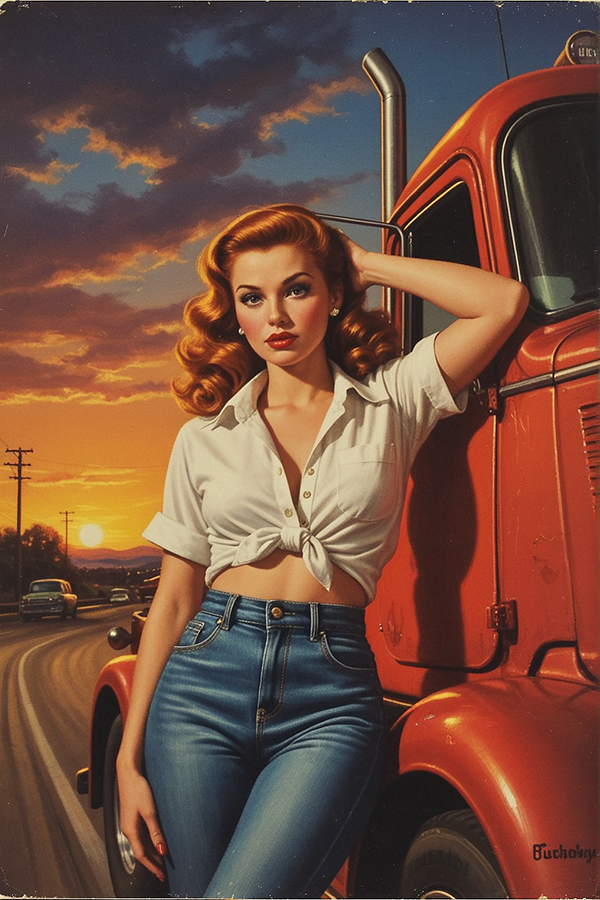
"I want you to wear a skirt," he said as we walked toward the store.
I looked at him. "Why?"
"Because taking them pants off in the sleeper was like to kill me. You poked me in the eye with your elbow and your knee."
I laughed. I couldn't help it. "That was your fault."
"I was exactly where I was supposed to be," he said. "It's the pants that were the problem."
I looked down at Guy Wendell's trousers, rolled at the cuffs, belted to within an inch of their life. They were not, I had to admit, a practical garment for the situation under discussion.
"A skirt," I said.
He made a vague gesture that somehow communicated something that moves out of the way without requiring surgery.
The heat went through me again and I looked at the Sears sign to collect myself.
"You're buying dinner," I said, and walked toward the entrance.
"I was always buying dinner," he said, and followed me in.
*
A saleswoman materialized with the professional radar of someone who had seen everything come through a Florida Sears on a Friday evening. She looked at me. She looked at Rollie. She looked at the knotted shirttails, which were doing what they did, and she made a decision about us that showed in her face for just a moment before she put it away.
"Can I help you find something?"
"Skirts," said Rollie. "And blouses. And whatever else she needs." He thought for a moment. "Underpants," he added helpfully.
The saleswoman looked at me with an expression that said honey without saying it out loud. "Right this way," she said.
I found underpants first. There was a rack of frilly ones in pastel colors — pink and yellow and a pale blue — and I held a pair up and felt completely goofy and then put them in the basket anyway. Then a package of plain white ones, more sensible, for the days when I was presumably going to be a sensible person.
The saleswoman, who said her name was Patsy and had the manner of someone who had fitted complicated women into difficult garments for twenty years and was not going to be surprised by anything, measured my waist and my hips without comment and brought me two denim skirts, one straight cut and one with a little flare at the hem.
"Both," said Rollie, from the chair where he'd settled in to supervise.
"I don't need both," I said.
"You need both," he said.
I got both.
For blouses, Patsy understood immediately — she picked five of them from three different racks, all with shirttails long enough to tie, all light enough for Florida and for whatever came after Florida. She did not comment on the knotted shirttail situation already in progress. I liked Patsy.
"Do you want to look at brassieres?" she asked.
I opened my mouth, and Rollie said, "Nope."
Patsy looked at Rollie. She looked at me. Something moved across her face that might have been a suppressed smile. "Shoes are over there," she said, and pointed, and that was that.
*
The shoe department had a young clerk with a cowlick who looked at my feet and asked my size. I had no idea. Guy Wendell had worn an eleven. These were not elevens.
"Measure them," said Rollie, installing himself in the adjacent chair as if he had season tickets.
Seven and a half. I said it out loud, just to hear it. Seven and a half. It seemed both surprising and completely right, like a lot of things about the last twenty-four hours.
"Now," said Rollie to the cowlick, "show her something with a chunky heel. Not too tall. Something she can walk in on a truck stop floor without killing herself."
The clerk looked at me.
"He's helping," I said.
The boots were thirty dollars, which was the most expensive item and worth it. Dark brown leather, a heel that was substantial without being precarious, and when I stood up in them I was tall enough to look Rollie nearly in the mouth, which produced a reaction in him that I noted for future reference.
I wore them out of the shoe department, and the chunky heels went click click click on the linoleum, and the denim skirt moved the way a denim skirt moves, and I did not look down at myself because the situation was already complicated enough.
Rollie bought the purse without consulting me. Pink leather, soft as anything, with a long strap for my shoulder. I looked at it.
"Pink," I said.
"Matches your everything," he said.
I put it on my shoulder. Patsy appeared from nowhere with a compact mirror, the professional instinct apparently overcoming all prior reservations. I looked at myself in the little circle of glass. Cowgirl hat. Knotted shirttails. Pink purse. The boots I could hear but couldn't see.
"Lord," I said quietly.
"Mm-hm," said Patsy, and took the compact back, and watched us head for the register.
*
The drugstore next door provided toothbrushes and a comb and the other things you need when you've left your whole life in a motel parking lot in Silver Springs. Rollie asked if I wanted makeup.
"You're pretty enough without it," he said. "You know that."
"Let's skip it," I said. "I wouldn't know how."
He nodded. "But we oughta get your hair seen to. That D.A. — someone who knows what they're doing could make it look more —" He moved his hand.
"Girly," I said.
"I was gonna say intentional."
I put my hand up to the duck-butt automatically. It had been there through everything — the spring, the motel, the Waffle Barn, the shoulder of a Florida highway, the back of Gypsy twice. It was the one thing that hadn't changed, which made it either a comfort or a problem, and possibly both.
"I'm keeping the cap," I said.
"Wouldn't have it any other way," he said.
The Braves cap went in the pink purse, the brim sticking out at an angle. It barely fit. That was fine. It was mine.
*
The beauty shop was three doors down and still open, because ladies get their hair done before they go out on a Friday night. The woman who did my hair was named Doris and she had the same quality Patsy had — she took in the situation, made her assessment, and got to work.
"You want to keep the shape?" she said, in the tone of someone who might have opinions.
"Yes," I said.
She kept the shape. She softened it, worked the front differently, did something with the sides that I couldn't follow in the mirror but felt. When she was done, the duck-butt was still there, more or less, but it had become a choice instead of a habit. The face under it looked like a woman who wore her hair this way because she wanted to, because it suited her, because she had decided.
I sat in the chair and looked at myself and thought: Gwen Telford. Twenty-three. Springfield, Illinois.
It fit better than anything I'd tried on at Sears.
I tipped Doris a dollar fifty and put the cowgirl hat on over the result and went back out to find Rollie leaning against the building with his arms crossed, watching the parking lot, and when he saw me he straightened up and looked for a moment with the specific attention of a man revising his already favorable opinion.
"Well," he said.
"Dinner," I said. "You promised me dinner."
*
We found a steakhouse a quarter mile up the road — white tablecloths, candles in glasses, a menu that had langostino on it, which I had never tried. We ordered steaks and langostino and all the trimmings, because neither of us had eaten a real meal since the Waffle Barn at four in the morning, and the food, when it came, was serious and good.
We ate for a while without talking much, the way you eat when you're hungry enough that conversation is a secondary concern. The langostino was extraordinary. I made a note to have opinions about langostino going forward. Gwen Telford, who liked langostino. Sure.
We were slowing down, nearly full, the plates mostly cleared, Rollie with his coffee and me with mine, when he said, without looking up: "Those four men in the corner booth have been watching you."
I knew. I had known since we sat down, the specific weight of it at my back. I looked at Rollie instead of at the corner booth.
"Do they like what they see?" I asked.
"I'd say so," Rollie said. "You can feel their eyes on you. Right on your skin."
A tingle went through me that had no business being there, or every business being there, I wasn't sure which. I set my fork down.
"Stop it," I said.
"I'm not doing anything," he said. "I'm just pointing out what's already there." He looked at me steadily across the candle. "You felt it before I said anything."
This was true. I picked my fork up and put it down again.
"Four of them," I said.
"Mm-hm."
"And you're not bothered."
He thought about that with the patience of a man who has already worked it through. "You came out of that spring for me," he said. "That's the important part."
I looked at him for a long time. The blue eyes, the candlelight, his hand on the tablecloth near mine.
Then he reached across and covered my hand with his, and held it. Not loosely.
"Being watched is exciting to you," he said. It wasn't a question. "You like knowing they want you." He paused. "And you like knowing you belong to me."
My heart was going hard enough that I could feel it in my throat. Everything he'd said was true, all of it, and the rightness of it moved through me like the spring water had — all at once and everywhere at once.
"I belong to you," I said, just to hear it out loud.
It sounded like something that had always been going to be true.
"Yes, you do," Rollie said simply, and signaled for the check.
*
He lifted me up into the cab, and I unzipped the boots and tucked them behind the seat, and we went over into the bunk together without much discussion and without any elbows in anyone's eye. The skirt turned out to be everything Rollie had claimed on its behalf. He worked efficiently, and I contributed enthusiastically, and afterward I lay with my cheek on his chest and listened to his heart slow down.
How many times in the last twenty-four hours, I started to think, and then his hands moved on my back and the thought dissolved before it finished.
Not This Guy -6-7-8-
Author:
Audience Rating:
Publication:
Genre:
Character Age:
Permission:
We were having a whole conversation without moving our mouths.

Not This Guy
-6-7-8-
by Suzan Donamas
Chapter Six
Rollie fell asleep as the sun went down, the way a man sleeps when he's been driving since before dawn and plans to drive again at full dark. He went all at once, between one breath and the next, his arm still around me.
I lay there for a while. Through the leather curtain, the light changed from amber to purple to the particular gray-blue of a Southern evening. Outside, Jacksonville finished its Friday night — voices from the Howard Johnson's lot, a car radio, someone laughing at something across the asphalt.
After a while I sat up carefully and let him sleep.
There was storage built into the wall of the bunk — a long low compartment with a latch — and I opened it without much expectation. A wool blanket, dark green. A flashlight. A paper bag with what turned out to be beef jerky and a sleeve of saltine crackers. And books.
Seven or eight of them, paperbacks, their spines cracked from reading and their covers doing what paperback covers did in 1958: making promises in primary colors. A woman in a torn dress. A man with an improbable jaw. Red letters above them: Kidnapped Bride. Stolen Fiancee. Hidden Lust for a Stranger. Captive Wife. Woman on the Run. Fugitive Lover. Runaway Girlfriend.
I held Kidnapped Bride at arm's length and looked at the cover for a moment.
Guy Wendell had read sales reports, trade publications and Louis L'Amour. Guy Wendell would have looked at this cover and put it down immediately.
I opened it to page one.
* * *
Twenty pages in, I surfaced briefly, the way you surface from a dream when a car goes past outside and then you go right back under. The woman in the book was being carried somewhere against her will, or in the vicinity of against her will, her feelings on the subject considerably more complicated than the word against could account for. The man doing the carrying had blue eyes.
I noted this and turned the page.
The writing was not Hemingway. It knew things Hemingway did not know, and didn't apologize for knowing them, and I found I had no objection to that.
Rollie breathed slow and steady beside me. The light through the curtain was full dark now.
I finished Kidnapped Bride and picked up Stolen Fiancee, which had a different woman in a different torn dress being carried by a man who might have been the same man with a different haircut. I read thirty pages of that.
Then I put it down and lay on my back in the bunk and looked at the ceiling of the sleeper cab and did not examine too carefully the reason my heart was going the way it was going.
Guy Wendell, I thought.
It felt like a name I'd known once. The shape of a person I'd heard about from someone reliable.
Outside, a truck pulled into the lot — the long downshift, the hiss of air brakes, the idle settling into its rhythm. The road was still out there, waiting. Charlotte was seven hundred miles north, and Rollie would sleep another hour or two and then we'd be moving again, Georgia in the dark, the Carolinas by morning.
I reached for Woman on the Run and then stopped and put my hand on Rollie's chest instead, felt it rise and fall.
Gwen Telford, I thought. Twenty-three years old. From Springfield, more or less. In a truck, going north.
That was enough to know for now. The rest of it could wait for the road.
I opened Woman on the Run and read until Rollie stirred.
Chapter Seven
The Charlotte freight depot smelled like motor oil and sawdust and the particular exhaustion of things that have traveled a long way to get somewhere unremarkable. Rollie backed Gypsy into the dock with the patient precision of a man who has done this ten thousand times, and I sat in the passenger seat watching his hands on the wheel and thought: I could watch him do this all day.
I could not have told you four days ago that I would ever think a sentence like that.
The dock foreman, a heavyset man in a canvas jacket with PIEDMONT FREIGHT stenciled on the back, waved Rollie down, and they talked through the window for a few minutes. I heard the words Chicago and deadhead and call you back, and then Rollie climbed down and came around to my side.
"Dispatch is finding me something," he said. "Could be an hour. You want breakfast?"
I wanted breakfast.
* * *
The diner across from the depot was called Marvella's, which seemed optimistic for a place with grease-fogged windows and a parking lot full of semis. Inside, it was warm and loud and smelled like bacon, which covered a number of sins. Rollie found a booth in the back and stood beside it until I slid in first, then he slid in next to me. A waitress appeared with coffee before I'd finished unwinding my scarf.
The coffee was better than the Silver Springs Motel diner. I was developing opinions about truck stop coffee; this was at least grade three, maybe grade two.
We ordered. Rollie got eggs and sausage and a stack of pancakes that arrived looking like serious intentions. I got the same thing because I was hungry in a way that still surprised me — Guy Wendell had eaten like a man who regarded food as fuel; Gwen Telford, it turned out, regarded it as one of the better arguments for being alive.
I was working through the pancakes when the man appeared at the end of the table.
He was maybe thirty, broad through the shoulders, with a good-natured face and the kind of confidence that comes from being found handsome often enough to expect it. He was looking at me the way men had been looking at me since the Waffle Barn, which I was getting better at receiving without doing something foolish with my face.
"Rollie Blankenship," he said. "You are the last man I expected to see in Charlotte."
"Jonah." Rollie looked up from his pancakes with the particular neutral expression I was coming to understand meant he was paying close attention. "Delivering to Piedmont."
"I work there now." Jonah's eyes moved to me with the transparent casualness of a man pretending the move was incidental. "You going to introduce me to your—" He left a pause where a word should have been.
"This is Gwen," Rollie said.
Jonah smiled. It was a good smile, practiced but not entirely dishonest. "Gwen." He said it like he was deciding whether he liked the taste of it. "You mind if I—" He gestured at the booth.
I looked at Rollie. Rollie looked at his pancakes.
Jonah slid into the booth across from Rollie but he hadn’t taken his eyes off me.
The thing I understood, watching him, was that I had a choice. Guy Wendell would have registered Jonah as background noise, a man talking to another man across a table. But I was sitting in a diner in Charlotte, North Carolina, wearing a denim skirt Rollie had picked out and boots that clicked on linoleum and a shirt tied under my boobs, and Jonah Fellman was looking at me with transparent appreciation, and somewhere in the new architecture of my nervous system a small pilot light had gone on.
Not for Jonah. I want to be clear about that. For the situation.
Jonah was funny, as it turned out. He'd worked for Piedmont three years, had opinions about the depot foreman's management style, knew Rollie from a run through Memphis two years back and brought it up with the ease of men who have a history of not quite being friends but respecting each other's competence. He talked to Rollie and looked at me. He talked to me and glanced at Rollie. He was reading the room the way a man reads a room when he suspects there's a room to read.
"So where you from, Gwen?" he asked.
"Springfield," I said. "Originally. Kansas City most recently."
"Kansas City." He nodded like this confirmed something. "You working, or—"
"Traveling," I said.
He smiled. "With Rollie."
"With Rollie," I agreed.
Jonah looked at Rollie. Rollie ate a piece of sausage.
And here is where I did the thing I should not have done, which was: I let Jonah catch my eye for just a half-second longer than necessary, and I did not quite smile, and I looked back at my coffee.
It was nothing. It was absolutely nothing. It was the smallest possible motion, the social equivalent of a pebble dropped in still water.
I felt Rollie go still beside me the way a room goes still before a change in weather.
Jonah felt it too. He was a man who had navigated enough of these situations to understand, immediately, that he had just seen a line he hadn't known was there. He leaned back slightly. Recalibrated.
"Well," he said, with the particular cheerfulness of a man making a graceful exit, "I got to get back before Herschel loses his mind. Rollie." He stood. "Gwen — real pleasure."
He was gone before Rollie looked up from his plate.
Rollie looked up from his plate.
I applied myself to my coffee.
"Gwen," he said.
"Mm," I said.
"What was that."
It was not a question. I understood it was not a question.
"Nothing," I said. "He was just—"
"I know what he was just." Rollie set his fork down with the quiet deliberateness of a man setting something down so he doesn't do something else with his hands. "And I know what you just."
I looked at him. He looked at me. The diner went on around us, indifferent.
The thing I could see, if I looked carefully, was that he wasn't angry. Or not only angry. Or something I didn’t quite have a word for. Hot? He was heated, hot. There was something else in the faded blue eyes — something that had registered the situation and found it, on some level that he wasn't going to acknowledge over pancakes in Marvella's, not entirely unwelcome.
He knew I'd done it on purpose. He knew I knew he knew. We were having a whole conversation without moving our mouths.
"Finish your coffee," he said, and picked his fork back up.
* * *
The payphone was on the wall outside the depot office, and Rollie made the call while I stood in the watery January sun and watched a man on a forklift argue with a pallet of something that didn't want to be moved. The conversation was short. I heard Rollie say Winston-Salem and yeah and what time and then he hung up and came back with the particular set to his shoulders of a man who has work to do and is satisfied about it.
"Cigarettes," he said. "Long trailer out of Winston-Salem, bound for Chicago. We deadhead there, pick up at seven tomorrow morning."
Chicago.
The word landed in my sternum and sat there.
I knew, in a general sense, that trucks went to Chicago. Chicago was where things went. It was the center of a certain kind of American gravity, the place the roads bent toward. I had simply not, until this moment, thought about what Chicago meant in terms of coordinates — in terms of how far Rockford, Illinois was from the city limits, in terms of Walt Niederhauser's office on State Street, in terms of an apartment on Elm with my clothes in the closet and eleven years of a life stacked neatly in drawers.
Ninety minutes. Chicago to Rockford. On a good road, less.
Rollie was watching me.
"Chicago," I said.
"You got people there?"
The question was careful. Not casual — Rollie didn't do casual when he meant something — but measured, the way you hand someone something fragile.
"Not anymore," I said.
He looked at me for a moment. Then he nodded, the way he nodded when he'd heard what he needed to hear and wasn't going to ask for more than that. I had come to love that nod. I wriggled a bit in appreciation of that knowledge and I saw Rollie’s eyes widen in appreciation of my wriggle.
He glanced at the sun. "We’ve got time before we head out," he said. "Nice place for dinner, not a diner. You can wear the good boots."
I followed him back to the truck, both of us pleased about something we hadn’t named.
* * *
The heels were ivory with a low block heel, nothing dramatic, but on the asphalt of the parking lot they were dramatic enough. I took Rollie's arm without being asked and he didn't say anything about it, just slowed his stride to match mine while I figured out what my feet were supposed to do. Click-cclack, click-clack. By the time we reached the door I almost had the rhythm and the sway just right..
The steakhouse was the kind of place that had menus with tassels and a bar that looked like it had been there since 1965 and intended to stay put. The hostess led us to a booth in a corner, leather seats, a candle in a little glass globe, and I slid in across from Rollie and spread the cloth napkin in my lap like I'd been doing it all my life. The waiter arrived, middle-aged, unhurried, and looked at me first. What can I get you to drink, ma'am?
Ma'am.
I ordered sweet tea and didn't let myself make a face about it.
Rollie got the ribeye. I got the petite sirloin, medium, because that was what I said when he asked how I liked it and it turned out to be true. We didn't talk a lot. Rollie was a man who ate like eating was its own conversation, and I found I didn't mind the quiet. I had the candle to look at. I had the heels under the table, crossed at the ankle the way I'd seen women do. I had the slow understanding that no one in this room was looking at me sideways, not the hostess, not the waiter, not the couple two booths over. Whatever I was, I was passing through the world as a woman having dinner with her man, and the world had no objections.
Rollie paid cash and left a good tip.
I walked back to the truck full of good sirloin and the clatter of the heels followed me, sounding natural now. Rollie picked me up and put me in the cab and I slid over to my side while he climbed in behind me. Just like in the diner booth earlier. I smiled at him as he adjusted things and made a note in his logbook, then we were on the road again. I took off the heels and put them away and snuggled up close to Rollie. If he need to shift, he could move me.
"You sleepy?" he asked. "It’s about ninety minutes to Winston. I’ve got to log my ten hours when we get there — we’ll still be ready by seven."
“You’re the boss,” I said with a giggle. “I just work here.”
He smiled at me as he got the truck into gear. “Work?” he said. “Is that the word for it?”
“Well, it has four letters,” I said.
* * *
He waited until we were on the highway before he said anything. I'd been watching North Carolina through the passenger window — red clay and pine trees and a sky that couldn't decide what color it wanted to be — and I was thinking about Chicago and not thinking about Walt and doing those two things simultaneously with the practiced skill of a woman who had been doing it since Charlotte.
"You want to tell me what that was back there," Rollie said.
I was sitting sideways in the seat, knees under me, in a pose that would have left Guy Wendell wracked with pain for days. Not right up against Rollie in case he needed to shift but easily within arm reach. My new favorite place to be.
I showed the tipoff my tongue, like I was thinking of what to say. "I told you, it was—"
"Gwen."
Something in his voice changed register. Not louder. Lower.
I stopped. A thrill traveled down my spine toward a place between my knees.
"You pushed my buttons," he said. "On purpose. With Jonah Fellman, who I have known for two years and who is not a bad man but who would have gotten the wrong idea if I'd let it go another thirty seconds."
I considered arguing. I considered explaining. I considered pointing out, accurately, that nothing had actually happened. I showed the tip of my tongue again.
"Yes," I said.
Rollie drove.
"Why," he said.
This was the harder question. The honest answer was: because I could. Because I had discovered in the last four days that I had a capacity to make men look at me that I had never had before and I wanted to test its range. Because I wanted to see what would happen when Rollie noticed, and I wanted what happened to be exactly what happened, and I was self-aware enough to know all of this and still have done it anyway.
"I wanted to see," I said.
"See what."
"What you'd do."
Another mile of pine trees.
"And?" he said.
"And—" I looked at my hands in my lap. "I liked what you did."
Rollie was quiet for long enough that I started to wonder if I'd miscalculated something. Then his hand left the gearshift and came down on my knee, not gently, and stayed there.
"When we stop for fuel," he said, "you're going to climb in the back."
The heat went through me so fast it was almost useful information.
"And?" I said, because apparently I had learned nothing.
"And I'm going to make a point," he said, "about what happens when you poke at things to see if they bite."
I looked out the window at the pines.
"Okay," I said. And that little shivering thrill made another journey to an inner place.
* * *
The point he made was not, precisely, unpleasant.
This is all I am going to say about that, except: there was a moment, somewhere in the middle of it, when I understood with complete clarity why those seven paperbacks were in the storage compartment. Rollie Blankenship had curated that collection the way a man curates evidence of a preference he hasn't had occasion to act on in some time. The women in those books found something clarifying in exactly this kind of correction. I had read that and understood it intellectually.
The intellectual understanding turned out to be insufficient preparation.
We came back out of the sleeper and Rollie got the truck back on the highway and I sat in the passenger seat with a warmth in my face that had nothing to do with the heater but matched the warmth in another part of my anatomy.
Winston-Salem came up ahead of us in the dark, a scatter of lights above the treeline, and Rollie followed the signs until he found what he was looking for.
He found a legal place to park the bobtail, not in the restaurant parking lot. We didn’t have a trailer attached, so you could actually see something out the little back window in the sleeping berth. I crawled in first, got naked, then Rollie crawled in, taking up almost all the remaining space. He handed me one of the books. Captive Bride.
“Read to me, till one of us falls asleep. I got the ‘larm set for 5 a.m.”
It was tight, holding the book above my face while I read until the words swam, until the woman on the page and the woman reading were the same kind of lost, and somewhere in the dark middle of a sentence I was asleep with the book on my chest and Rollie's breathing slow and even beside me. When I surfaced again the sleeper was pearl-gray and my mouth tasted like sleep and the clock on the dash said five-forty. I lay still for another minute, listening to the truck lot coming alive outside, then reached over and put my hand on Rollie's shoulder.
“Five o'clock,” I said. “Your pickup.” The alarm in the cab rang at the same time. I’d expected it, but it still startled me. How had I woken up just before it rang?
We stopped at a Truckadero on the way out of town to use bathrooms, collect Danish and coffee, and were back on the road in less than fifteen. I had a blanket pulled over me.
After a few miles Rollie reached behind the seat without looking and came up with Captive Bride, which I had gotten halfway through the night before.
He handed it to me open to a page near the middle.
I read the page. I read it again.
"Read it out loud," he said.
My voice, when it came out, was even warmer than usual. The bourbon had gone to something nearer whiskey.
I read two pages. Then I read two more. Rollie drove with his hand on my knee and his jaw set in the particular way it got when he was concentrating on something that wasn't the road, and the heater hummed, and outside the window North Carolina went about its business completely unaware of what was happening in the cab of a Kenworth.
I stopped at the end of a chapter.
"Keep going," Rollie said.
"We have to pick up a trailer," I said.
He made a sound that was not quite a word.
"In Winston-Salem," I said. "Seven AM. You told the man seven AM."
Rollie drove for another mile.
"Bookmark it," he said.
I found a matchbook in the ashtray and put it between the pages and closed the cover. Rollie's hand moved from my knee and went back to the gearshift, and I sat in the passenger seat with the closed book in my lap and thought about the part I just read where Burton spanked Ellie Sue for flirting with the best man. And she’d liked it.
I might not have believed that sequence a few days ago, but now I knew different. Could it happen? I knew that it could.
* * *
We stopped for fuel outside of Lexington and I sat in the cab while Rollie dealt with the pump, and the payphone on the wall of the service station looked at me and I looked back at it.
Walt Niederhauser's number was MOhawk 4-2280. I had dialed it so many times that the sequence lived in my fingers the way songs live in your fingers, without having to go through your brain at all. I could have dialed it in the dark.
I thought about what I would say.
Hello Walt, this is — no.
Walt, I need to tell you about Guy Wendell — no.
The Army Corps meeting, Walt, the reason nobody showed up — no.
The bourbon voice would come out of the receiver and Walt Niederhauser, who was not a stupid man, would hear a woman he'd never spoken to telling him things that only Guy Wendell could know, and he would listen, and then he would ask questions I couldn't answer in any way that would leave the situation better than I found it. He'd call the police. He'd call the motel. He'd find the Buick in the lot with the keys still above the visor and the rental agreement in the glove box and no Guy Wendell anywhere.
And then what. Then what for Walt, who was worried before he was angry and would be both now. Then what for the Army Corps, who had a contract to sign. Then what for the woman in the truck whose name was Gwen Telford from Springfield, Illinois, who had a Florida ID card that said she was twenty-three and had never heard of any earthmover salesman from Rockford.
The payphone looked at me.
I looked at my hands.
I thought about Marcos. He was six. He had a way of running toward you with his arms already out, committed to the hug from ten feet away, all-in before he arrived. I thought about Elena, who was eight and precise about things, who at Christmas had explained to me at length and with evidence why Santa Claus was logistically impossible, and then said she still wanted to leave cookies out just in case. I thought about the way Laneka had looked at me the morning she left, standing in the doorway with two suitcases and the specific expression of a woman who has made a decision she should have made two years earlier. I thought about an island I had never seen, palms and a particular blue I was imagining, a surf I couldn't hear.
Marcos would be running toward someone else now. Arms out from ten feet. All-in.
I sat with that for a while. The service station hummed and a truck pulled in behind us and somewhere in the distance a train said something long and flat about the distance between places.
Guy Wendell showing up on Ilhaina — even if such a thing were possible, even if Laneka could be made to understand something that couldn't be understood, even if the children could be told something that wouldn't damage them in ways I couldn't predict — Guy Wendell wasn't there anymore. And Gwen Telford was a stranger with a Florida ID and a bourbon voice who had no claim on anyone.
To go back would be to ask two children to lose their father twice.
Let Guy be dead. Let him be a man who walked into the Everglades in his good suit and didn't come back. It happened. Men disappeared. The Buick in the motel lot would be found; the rental company would sort it out; Walt would eventually stop calling and file the paperwork and hire someone else. Marcos would grow up. Elena would keep leaving cookies just in case.
I would be, for the rest of whatever I was now, a woman who had loved two children she could not go back to. That was the thing the spring had taken that it couldn't give back. I put it somewhere careful and closed the door.
The truck door opened and Rollie climbed in, smelling like diesel and cold air.
"Ready?" he said.
"Yes," I said.
He looked at me for a moment the way he sometimes looked at me, reading something in my face that he hadn't been told. He didn't ask. He just put his hand on the back of my head for a moment, warm and steady, and then started the truck.
* * *
The trailer in Winston-Salem was fifty-three feet of Lucky Strikes and Pall Malls and Camels, stacked in brown cardboard cases to the ceiling and smelling, even through the walls, like a decision you'd regret in thirty years. The yard manager had us backed in and loaded and the paperwork signed by half past six, and Rollie walked the truck and trailer while I stood in the cold Carolina morning with my hands in my jacket pockets and watched the sky go from black to gray to a thin winter pink over the warehouses.
Rollie came back around from checking the rear lights and stopped next to me.
"Chicago by tomorrow night," he said. "Day after at the latest."
Chicago. Two days.
"Is there a decent place to stay in Chicago?" I asked. "While you unload."
He looked at me sideways. The question had a second question inside it and we both knew it.
"There's a place I know on the North Side," he said. "Takes truckers. Clean."
"North Side," I said.
"That work for you?"
A careful question, from a careful man.
I thought about the North Side of Chicago, which was not Rockford, which was not State Street, which was not MOhawk 4-2280. The North Side of Chicago was somewhere Gwen Telford had never been.
"That works for me," I said.
Rollie nodded. He walked around to the driver's side. I walked around to mine, and the boots clicked on the blacktop, and I pulled myself up into the cab with the ease of someone who had been doing it her whole life — which was four days, which was all the life I had — and Gypsy smelled like diesel and distance and the particular warmth of a thing I was already calling home.
Rollie looked over at me.
"You got the book?" he said.
I held it up.
He smiled, the real one, the one that went all the way to the faded blue eyes.
Then he put her in gear, and we went north.
Chapter Eight
The delivery took most of the morning — a warehouse on the South Side with a loading dock that smelled like cigarettes even before you opened the door, men with clipboards and opinions about count. I waited in the cab while Rollie dealt with it and watched Chicago arrive outside the windshield, which was not the same as being in it. The city didn't care about the truck. The truck didn't care about the city. I was somewhere in between. Waiting in the cab sometimes was my job now, and I liked it.
By noon, Rollie had the paperwork signed, and Gypsy unloaded, and we were bobtain again, and back on the North Side, at a place he knew on Halsted that took truckers and kept clean sheets and didn't ask questions. The room had a window that looked at a brick wall and a radiator that knocked like it had a encyclopedias to sell. I liked it.
He laid four fifties on the dresser.
"Sears is six blocks," he said. "Spend it."
I looked at the money. "All of it?"
"Every dollar." He picked up his cap from the bedpost. "I've got to go see a man about a load back south. You'll be all right?"
I had been all right in a Florida spring, in a gas station bathroom, in a diner in Charlotte with Jonah Fellman looking at me. I thought I could manage six blocks.
"I'll be all right," I said.
* * *
The Sears on State Street was familiar in the way of all Sears stores — the same smell, the same particular light, the same sense that anything you needed could be found here if you were willing to look for it. I had bought my first skirt in a Sears. It felt right to come back.
I spent the first fifteen minutes just walking the women's floor, which was something Guy Wendell would not have done. He would have found what he came for and left. Gwen Telford browsed. She ran her hand along a rack of blouses and stopped when something stopped her. She held things up against herself in the mirror and put them back and picked them up again. She was learning what she liked, which turned out to be different from what she thought she'd like, which turned out to be bright and fitted and not sorry about itself.
Rollie liked me visible. I had figured out what that meant in practice — color, fit, the particular kind of confidence that says I know what I look like and I have decided it must be your problem, ‘cause it sure ain’t mine. I found a blouse in a deep coral that did things for my coloring that made me stand in front of the mirror longer than was strictly necessary.
I was reaching for a second one in green when I heard them.
Two women, late thirties or early forties, sensible haircuts, the particular look of women who have worked in the same office long enough to finish each other's sentences. They came around the end of the rack and stopped at the clearance section three feet away, and I heard the one with the dark bob say, "—still can't believe it, he was just there, you know, he was just at the Rockford meeting in November—"
I went still.
"Walt's taking it hard," the other one said. "You know how Walt is."
"They found his rental car at the motel. His suit was in the room. His briefcase." A pause, the sound of a hanger sliding on a rack. "Nobody just leaves their briefcase."
"Unless they're not planning to come back," the dark bob said, quietly.
I was holding the green blouse and seeing nothing in front of me.
Guy Wendell, who had not been planning to come back. Whose briefcase was in a motel room in Silver Springs, Florida. Whose suit. Whose rental car with the keys above the visor because he always did that and no one had ever told him it was a bad idea.
Walt was taking it hard.
I thought about Walt. His handshake, which was firm in the way of men who had decided a long time ago that a good handshake was worth having. The jar of lemon drops on his desk for anyone who came in. Eleven years of Monday morning meetings and the particular way he said Guy when he meant I need you to handle something difficult.
I felt something move up through my chest toward my throat and I breathed through it, slowly, the way you breathe through something you are not going to do in the Sears on State Street in front of strangers.
Guy Wendell was dead. Walt would grieve and then hire someone else. The briefcase would go to a storage facility and eventually to a landfill. The Buick would be returned to the rental agency and cleaned and rented to someone else. The apartment on Elm in Rockford — the lease was up in March.
Let Guy be dead. I had thought that before. Now I understood it differently. Not as a decision but as a fact. He was already gone. I was just the last one to know.
"—did you see, by the way—" the dark bob said, and her voice changed register, lightened, the way voices do when they're done with the hard thing and ready for something easier. "Coming through accessories, that woman with the denim skirt."
I reached for a pair of slacks without looking at them.
"Oh my God," the other one said. "The skirt."
"The skirt. And that top—" A brief, delighted pause. "Honey."
"Some men like that, I guess."
"Some men do." And I could hear the smile in it, not cruel exactly, but comfortable in the way of women who have decided what they are and are satisfied with the contrast. "She looked like she was trying to fall out of it."
I stood very still for a moment.
Then I put the green blouse over my arm with the coral one, and thought about the top I was wearing, which tied under my boobs because Rollie had picked it out in Charlotte and I had put it on this morning without hesitating. It was a man’s shirt tied under my boobs because Rollie liked the way I looked and liked to see other men looking at his woman.
The thing was — I was aware there was a version of this moment where I felt ashamed or small or caught out — but the thing was, I didn’t feel that way at all.
I was not trying to fall out of my top. I knew exactly where I was. I had Rollie's two hundred dollars in my purse and I was buying bright things for myself in a Chicago Sears, and those women had looked at me and seen a tart and a truck driver's girl, and they were not wrong exactly, they just didn't know that I had chosen this. That my man liked me visible and I had decided I liked being seen. That I had stood in the mirror twenty minutes ago and looked at myself and not looked away.
The giggle came up without warning. I put my hand over my mouth.
One of them glanced over at the sound. I smiled at her pleasantly, the smile of a woman who has just thought of something privately funny. She looked back at the clearance rack.
I took my blouses and my slacks to the counter and nearly every dollar.
* * *
The walk back was six blocks of Chicago winter, which was a different animal from Florida cold — purposeful, with a manifesto. I had a bag in each hand and the heels clicked on the sidewalk and I thought about Walt's lemon drops and Marcos running with his arms already out and the briefcase in the motel room, and I let myself feel the weight of it all the way up Halsted, because it was there and it was real and it was mine to carry.
Halfway back to the hotel, I had it somewhere manageable.
In the middle of the last block, I saw the liquor store I’d passed on the way to Sears two hours ago. I had a little money left, and Rollie had said I was to spend it all, so I went inside.
I picked out a half-pint of good bourbon and put it on the counter. Neither Rollie nor I did much drinking, but sometimes it is good to have something to mark a celebration. The clerk looked at me but I waved him away for the moment, I wasn’t done.
I saw the six spinners of paperback books near the back. I went directly to the one farthest from the lights of the front of the store. There near the floor, they had the kind of books I was looking for. The titles said it all: The Wrong Stranger, The Bride Wore Red, Road to Lust. Master of Her Dreams. They would do.
The clerk looked bored when he added up the total, and I put in two nickel Hershey bars to spend every last cent. But he winked at me when he took my money.
Rollie was back before me, sitting on the edge of the bed with his boots off and a road atlas open across his knees. He looked up when I came in.
"Spend it all?" he said.
I set the bags down and showed him the empty billfold.
He smiled. The real one, all the way to the faded blue eyes.
"Good girl," he said, and went back to the atlas.
I hung the coral blouse next to the green one in the narrow closet and thought: yes.
That's all. That's exactly right. I’m Rollie’s girl and it’s good to be me.