Occult Samantha
Author:
Organizational:
Audience Rating:
TG Themes:
No Man's Hunger: Chapter 1 to 9
Author:
Caution:
Audience Rating:
Publication:
Genre:
Character Age:
TG Themes:
TG Elements:
Permission:
SYNOPSIS: In 1566 Constantinople, a Janissary is bitten by an ancient vampiress and awakens transformed; first into something between genders, then, through blood and hunger, into a woman. Across five centuries she moves through mercenary camps, European brothels, the court of Versailles, Victorian England, two World Wars, and the New World; feeding discreetly, loving unwisely, and burying everyone she touches. Her body is clay, shaped by desire and will. And the woman who made her has been watching all along,
Chapter 1 - The Sultan's Path - Constantinople, 1565

"I've been waiting for you," she said.
But for how long?
In the dreams, there had been a woman. Dark hair like a mane; lips whispering words I could barely hold; eyes that looked through me to a self I hadn't known was there.
I walked the Sultan's path at twilight with a sharpened blade in my fist and no memory of having drawn it. The corridor stretched ahead of me like a throat; marble walls inlaid with tiles of lapis and turquoise, hanging lamps casting pools of amber.
The first eunuch had barely raised his hand before I opened his neck. My instructor would have been proud. What little blood that ran from him was thin, spreading across the white marble in a shape that made me think of wings.
I stepped over him and kept walking.
There had been others. Three, perhaps four; I was losing count. All of them had worn that same ashen look. One had been leaning against a pillar, half-conscious, and my blade had found his ribs before he could straighten. Another had simply stared at me as though he had been waiting for someone to finish what had already been started.
"I've been waiting for you," she said.
Her hair was so black it seemed to withhold light.
Emine. That was her name, I knew it without being told.
"Drink," she said.
There was a goblet in my hands. And I drank; the liquid warm, thick, and faintly sweet.
Her fingers found my wrist, and then she was beside me, close enough that I could smell her beneath the incense: something old and strange like the air in a sealed tomb.
"There are powers older than empires," she said. "Older than the faiths that name them. There are those of us who have walked since before your Prophet, before the Messiahs, before the first temples were raised to any god."
I reached for her and found her skin cool and smooth beneath the silk. She placed her hand on mine, and my calloused fingers found the warmth between her thighs and the slick, swollen heat of her sex. I pressed deeper, my thumb finding the hard pearl of flesh at the apex; circling, rubbing; and her breath came in short, sharp gasps.
"I knew I was right to choose you, Hasan ibn Selim," she said.
Her mouth was on my neck now, and I pushed two fingers inside her and felt her clench. I looked down and saw my hand disappearing into the dark fold of silk between her legs, my fingers glistening when they withdrew before plunging back. She hissed and bit her lip. I wanted to consume her.
"Join me," she said.
Then her teeth sank in.
The pain was exquisite, a pleasure so intense it bordered on annihilation. We were tangled together in silk and blood, and for one moment I saw us from above: two women intertwined on the cushions in the golden light.
I closed my eyes and I saw my mother's face. Not as she was when I was taken, weeping at the door of a stone house in a village whose name I had been taught to forget; but as she had been at the church. The little church with its domed ceiling painted blue, its icon of the Savior with his blessed countenance and flat black eyes. Then the surahs and hadiths of my adopted faith. Iblis. The djinn who whisper in the ears of the sleeping.
I shoved her.
"Servant of Satan," I gasped. The words came out in a language I hadn't spoken in twenty years. Then again, in Turkish, louder: "Şeytan'ın kulu!"
She reclined among the bloodied cushions and looked up at me, amused. She did not argue. She did not plead. She simply watched.
And I ran.
The dead eunuchs lay where I had left them, grey and deflated, and I leapt over them without looking down. The palace was a blur of tilework and shadow. I heard no alarm, no shouts.
The courtyard. My mare was tethered where I had left it. The guards, if there were any guards alive to speak of, did not stop me.
I rode with one hand on the reins and one hand pressed to my neck.
The wound burned; and something was changing.
Chapter 2 - Blood Fever - Wallachia, 1565
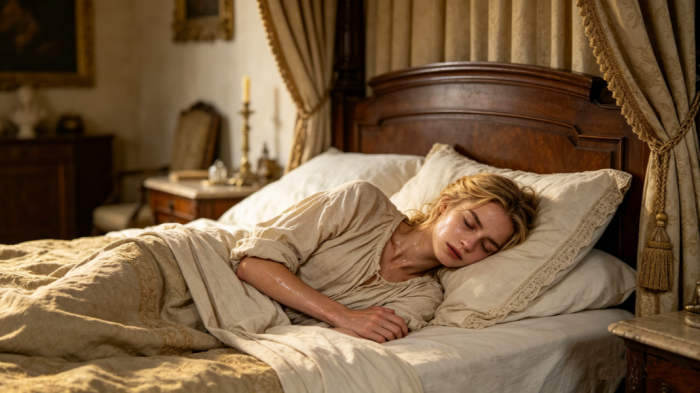
Voices.
The smell of damp stone and something medicinal. Then darkness again, pulling me back under.
The next time, I caught words.
"Male, certainly, but look at the…"
"A hermaphrodite, I've read of such cases in…"
"…angel or demon, that is what I want to know."
The voices swam above me like fish in muddy water. I tried to open my eyes and managed only enough to see the dance of firelight and the heavy shapes of fabric hanging from the walls. This was not the palace. This was not any place I knew.
I tried to move my arms and found that I could not.
The darkness took me again.
When it released me the third time or the tenth, the voices had consolidated into two. One was thick and gravelly, the other was higher and in the careful diction of the educated. I lay with my eyes closed and listened.
"Three days now," the gravelly voice said. "Three days and still changing. You've never seen anything like it, Mihnea. Admit it."
"I will admit it freely, my lord. I have not."
"The hair alone. I swear it was brown or black when we brought him in. Look at it."
A pause. The scratch of a quill on paper.
"Blond, quite remarkably blond. And the skin…"
"Like cream. Like a babe's skin. Not a mark on it."
I opened my eyes.
Two faces hovered above me. The first belonged to a large man with a scar bisecting his left eyebrow, his dark beard trimmed close. The second face was narrower, older, with the pallid complexion of someone who had spent his life indoors with books.
"Water," I said. Then, because the word had come out in Turkish and the faces above me showed no comprehension: "Apă." Romanian. Pulled from somewhere deep, from the village, from the life before.
The large man laughed in delight.
"It speaks! And in the tongue of the land, no less." He snapped his fingers and someone beyond my vision brought a cup to my lips. I drank.
"My name," I said, and then stopped, because the name that almost rose to my lips was Hasan. It would have to be my old name. "Stepan. My name is Stepan. If you could provide safe harbor to a fellow Christian…"
"Stepan," the large man repeated. "I am Boyar Radu. Well, Stepan. You present me with a problem. My men found you collapsed on the road five days ago, half-dead. They brought you here because I am a generous man, and because they thought you might be something valuable."
"I don't understand."
"No," Radu said. "I don't suppose you do." He straightened and made a gesture. "Mihnea, the mirror."
The physician moved to a side table and returned with a hand mirror, the kind a woman might keep on her dressing table. He held it above my face.
The person in the mirror was not me.
She was young, terribly young, no more than sixteen or seventeen to look at her; with an androgynous face framed by pale blonde hair that fell past her shoulders. Her skin was white and smooth and flawless, and her eyes were lighter than they should have been.
I stared at this stranger. She stared back. Her mouth opened when mine opened, forming a small, silent circle of incomprehension.
"You see the difficulty," Radu said.
"This is sorcery. A trick." My voice came out thin, girlish; a stranger's voice from a stranger's throat.
"Three days we've watched it happen," Radu said. He was enjoying himself, that much was plain. "When they carried you in, you were a man, or at least a boy. Dark hair, dark skin, lean as a hunting dog. Then the fever took you, and you began to change. The hair first, then the skin. Then…" He gestured vaguely at my chest.
I looked down.
The blanket had been pulled back at some point during my delirium, and I was naked beneath it. What I saw made no sense. My chest, which had been flat and hard with muscle, now bore two small breasts; barely more than the buds of a girl just entering womanhood, with pale pink nipples. My waist had narrowed. My hips had softened, rounding outward with a layer of fat; and when I strained against the leather straps binding my wrists to the bedposts, the muscles that responded were thin and unfamiliar.
"Fascinating, isn't it?" Mihnea said, leaning in with his leather-bound notebook. He peered at my chest with the detached interest of a man examining a rare specimen of butterfly
"Mihnea." Radu waved a hand. "Enough poetry. Show me the rest."
The physician pulled the blanket away entirely, and I was exposed from throat to ankle, bound and bare on the boyar's bed.
I had never been a modest man. Military life stripped that from you early. But this, being laid out like a specimen, unable to cover myself, unable even to turn away, this was something different.
Between my legs, the evidence of my manhood remained, but diminished. What had been a grown man's equipment now looked almost childlike: smaller, withdrawn, nested in a sparse thatch of fine blonde hair. My thighs were soft and round, my knees smooth and pristine.
Radu reached down and touched me there. Casually, the way you might test the firmness of a pear at market, holding the soft shaft between his fingers, then cradling my much reduced scrotum in the palm of his right hand.
I jerked against the restraints. The leather bit into my wrists.
"Still male," Radu observed, rolling my diminished flesh between his thick fingers with the same unsentimental assessment he might give a coin of questionable minting. "But barely. Mihnea, do you think this will change too?"
"It is... possible, my lord."
"Mm." Radu released me and brought his fingers to his nose, inhaling slightly. "Extraordinary. Truly extraordinary. Write it all down."
"My lord, the scholarly implications alone…"
"Yes, yes. Write it down and then leave it. I want to have a word with our guest in private."
Mihnea hesitated. Caution, perhaps; or the remnant of whatever oath physicians swore. But Radu was already looking at him with the impatience of a man who did not ask twice, and the physician gathered his writing implements and retreated through the heavy oak door. It closed behind him with a sound like a coffin.
I heard the bolt slide home from the inside.
"Now then," Radu said, moving around the bed. "My servants have already cleaned you. Thoroughly. Bathed you, oiled you to my preference."
"Release me," I said.
"In time, perhaps. But I am a curious man, Stepan. And curiosity must be satisfied."
"I beg you, as a fellow Christian."
He was behind me now. I craned my neck but could not see him. All I could hear was the sound of heavy cloth falling on to the stone floor.
"Shh." His hand settled on the small of my back; his thumb traced the ridge of my spine where it met the new curve of my waist. "You know, you really are quite remarkable. More woman than man now, I'd say. This waist and these hips…" His hand slid lower. "And yet still this…" His other hand reached beneath me, finding and cupping what remained of my sex, rolling it almost tenderly; and I wished that I could will my body to die. "So small now. Like a boy's. A little boy's prick on a girl's body."
I thrashed but the restraints held.
"Stop." The word was barely a whisper. "In the name of God... "
"Which god would that be?" Radu asked.
And then he was in front of me, naked and corpulent; the blunt, terrible pressure of him, positioning himself. He entered me without pause or preparation, and the pain was a white-hot lance that drove the breath from my lungs. He was enormous inside me, and every thrust was a violation that tore through my body and my understanding of myself.
"There," he said, as though commenting on the weather. "That's it. You take it well, for the first time. Or is it?" He was gripping my hips with both hands now, his thick fingers digging into the soft new flesh. "Such a girlish little body. Such pretty skin. I could sell you for a fortune in any market from here to Venice."
He leaned forward and put his mouth close to my ear.
"You'll learn to enjoy it," he whispered. "They always do. I'll keep you fed and warm, and in return…"
I turned my head.
Later, I would try to recall what had happened in that moment; what instinct overtook me. But in that instant, there was no thought; there was only the proximity of his throat and a hunger that rose in me like a tide.
It was nothing like the goblet Emine had given me in the palace. This was alive. I drank the way a man dying of thirst drinks water; without thought, without restraint, in great desperate swallows that filled my throat.
Radu screamed but my teeth tore through his windpipe and all that was left was gurgling. I drank deeply and felt the changes as they happened. Each swallow of blood reshaped me from the inside out. The transformation that had taken three days of fever now accelerated in minutes, fueled by Radu's intoxicating blood. I drank until the beating stopped; then drank beyond that, drawing the last dregs from a body that had gone slack and hollow against the bed.
When I released him, he slid to the floor like a sack of wet grain.
The hunger was sated; more than sated, I felt gorged, swollen with stolen life, and in its place was something I had never experienced before. Power.
I pulled at the leather strap binding my right wrist. It snapped like a thin thread.
The left followed, then the ankle restraints. I sat up on the bed and looked down at myself. The body below was undeniably female now: full-breasted, wide-hipped, the skin luminous. When I touched my face, I found high cheekbones, a narrow jaw, and lips that felt swollen and lush.
Between my legs, the transformation was now complete.
Radu lay on his back on the stone floor. He was looked as though every drop of pigment had been drained from him along with his blood; a waterskin that had been wrung dry.
I moved.
First, Radu's clothes thrown carelessly on the floor. Then the bedside table: his coin purse, heavy with gold and silver. A ring set with a dark stone, possibly garnet. A small dagger with a bone handle, sharp enough to shave with. Mihnea's leather-bound notebook, left as ordered. I took everything. Rolled the coins and jewelry into a pillowcase and knotted it.
The bolt on the door slid back at my touch. The corridor beyond was dark, the great hall at the end of it cold and empty, the fire banked to embers. A guard sat slumped in a chair by the main door, his chin on his chest. I passed within arm's reach of him. He did not stir.
Outside, the air was cold and clean. The stables were twenty paces from the main building. Inside, a dozen horses stood in their stalls, drowsing. I could smell them.
I mounted one, and the wind caught my hair and whipped it behind me. And I rode.
Chapter 3 - The Ditch Beyond the Reeds, Near Győr, Autumn 1591
For over twenty years I kept myself empty.
Twenty-five years of chewing bread that tasted like sawdust, drinking water that sat in my gut like a stone, watching my skin go the color of old tallow while the thing inside me gnawed at the walls of its cage.
I had made a bargain with myself in the dark hours after Wallachia: I would not feed. I would not become what Emine had made me. I would starve the creature down to nothing. It didn't kill me. It simply hollowed me out. Now I understood what they meant by the Nesuferitul.
By the autumn of my twenty-fifth year of fasting, I looked like a boy of fifteen who had been raised on thin soup and bad air. My cheeks were sunken, my skin a dull, unhealthy grey; my chest flat, my jaw soft and beardless.
The Hajduk irregulars that patrolled the marsh roads west of Győr would pick fights with Ottoman scouts, stripping the dead for pocket money. They called me István and assumed I was simply a runt. A late bloomer, a boy whose balls had not yet dropped.
"You'll fill out," the sergeant told me once, clapping me on the shoulder.
I smiled and said nothing. I was very good at saying nothing.
That morning, the sergeant sent seven of us through the reeds to cut off a band of Ottoman stragglers reported near an irrigation ditch south of the road. The intelligence was secondhand but we went anyway.
I carried a short sword and a buckler that felt too heavy. The weakness was constant now. I compensated with the animal instinct that the thing inside me provided even in its diminished state.
It was not enough.
The ambush came from the willow scrub to our left. Two akıncı riders burst through the curtain of branches, swords already swinging. Behind them came three foot irregulars.
Our column shattered. A German with a red beard took a saber across his face before he could raise his guard. The blade opened him from jaw to temple. To my right, a Hungarian whose name I'd never learned caught a spear thrust in the belly and sunk into the mud.
I raised my sword and managed a parry, barely deflecting a blow. The training was still there but not the strength. The irregular who had swung at me saw how the sword wavered in my grip and laughed. He swung again and I stumbled backward, my boot catching in the mud. I went to one knee and the weakness washed through me, my vision bleaching at the edges. I was saved momentarily when the sergeant engaged the Turk.
This is how I die, I thought, on my knees in a swamp, too stubborn to have done the one thing that would have kept me alive.
Then a hand found my boot.
The gutted Hungarian had dragged himself through the mud to where I knelt. He was dying. I could hear it in his labored breathing. But his hands were bloody, and when his fingers closed around my ankle, they left a smear of red across the leather.
The smell was intoxicating.
The blood was a vibration that resonated in every inch of my starved and shriveled flesh. The thing inside me didn't gnaw at its cage, it tore through the bars.
The first swallow was like breathing after being held underwater. I gorged on the dying man, taking what blood was left in him, leaving him a shriveled husk. I had no recollection of crossing the distance to the first Turk. One moment I was on my knees in the mud having my fill, the next I was on him, dragging him sideways off the bank and into the reeds.
His blood was thick and warm and indescribably alive. The starved thing fed with a fury that obliterated thought. I heard wet, tearing sounds and understood dimly that they were coming from me.
The second Turk was charging, screaming, his sword raised, his face contorted with horror.
I struck him full on the chest and bore him down into the mud. His sword swung pathetically as my fingers tore into his chest, tearing his ribs apart. I consumed his heart whole, then I turned to the rest of the main vessels and the blood pooling in the cavity of his chest, pressing my mouth to the wound like a lover's kiss, drinking him down in great shuddering gulps.
I was remembering now. Each soul had its own flavor, its own signature of experience.
The third man was running. I caught him in four strides. When I was done, I knelt in the rushes, waiting. Inside me, the thing that had been starving for twenty years was purring.
I could feel the changes already. Warmth flooding into my extremities, my skin tingling as color returned to it. My hands were filling out, the skin softening. My face felt different when I touched it: the jaw slightly narrower, the cheekbones higher, the lips fuller than they had been that morning. I pressed my hands flat against my ribs and felt the tissue there, swelling, budding.
Twenty years. Twenty years of discipline, of denial… all lost.
"István," the sergeant said. "What... happened here?"
He was ten paces away, the last of our company. Sometime between the last Turk and this moment, I had devoured every one of them.
I wiped my mouth with the back of my hand. "I handled it," I said.
My voice was higher than it had been that morning. The sergeant heard it. I watched his eyes flicker down to where my doublet strained, then back to my face. Filled, flush, and female.
He did not have the chance to ask again.
Chapter 4 - The Baggage Train, 1593, Near Székesfehérvár
My life as a woman was both harder and easier.
Before the men woke up I would begin with hauling water, then scrubbing pots and then stirring whatever Greta told me to stir. I had learned to love the mornings for their simplicity, for their honest demands.
The mercenary camp occupied a muddy clearing beside a road that led, supposedly, toward Komárom, though no one seemed in any particular hurry to get there. The company had made camp beside a half-burned roadside chapel simply because it worked to block the wind.
I knelt at the bank and worked the shirts against a flat rock. Then, because the morning was still early and the camp still half-asleep, I unlaced my bodice, pulled my shift over my head, and waded in to my waist. My skin prickled but didn't numb, another way my body had stopped playing by the rules of mundane humanity. The water ran over my belly and between my thighs.

"Christ's wounds," a young voice muttered.
It was one of the new men filling canteens some ways upstream. One was an old Swabian who carried a halberd. The man who had spoken was younger, leaner, and clean shaven; a mere foal. He tilted his head and gazed firmly at my bosom.
He was attractive and I didn't shrink. My former male inclinations were nowhere to be found, quenched by blood and feeding. Instead, I smiled, arched my back slightly and raised my arms to pull back my hair in a tight knot. My breasts were large, high, and youthful. I scrubbed them both with a small rag, then between my legs, unperturbed by their witness; then walked back to the bank giving them full sight of the hair now matted to my lush lower lips.
I wiped myself down quickly and put on the clothes Greta had handed down to me: an off-white linen shift, a faded red wool bodice that laced up the front, and a dark skirt
It was better this way. Better than murder and rape.
I had learned that in the weeks since the boyar's estate, since the starvation and the slaughter. As a woman, I could control the hunger. I could feed gracefully and precisely, taking just enough from a sleeping drunk or a wounded straggler to sustain myself without killing.
The two men, now joined by a few of their company, murmured appreciatively.
"What's your name," the younger one called out.
"Stefánia," I said. "And yours?"
"Martin," he said. "This is my cousin, Johann."
"You are very beautiful, Stefánia," Johann said looking down.
"What he means is that we would appreciate your company one of these evenings. If you're available of course."
I nodded. "You should speak to Greta," I told them, and returned to the cookfire.
Back at the camp, Greta was peeling onions with a short knife. She didn't look up when I sat down beside her.
"You've been here two weeks," she said.
"I know."
"You're a good girl, Stefánia. Helpful, obedient. But every man in this camp is looking at you like you're the last lamb before Lent."
I said nothing. The fire crackled and spat.
"The women who follow this company," Greta continued, "we eat because we're useful. I cook. Marta mends. Old Katya tells fortunes."
"I help with the cooking and I am learning to mend."
"I know you are. But you must know what it means for a woman to travel in this company. Especially a young woman like yourself."
"I do know."
"Good, then listen to me." She set the knife down. "Choose the first one yourself. If you wait, someone will choose for you, and it might not be gentle. Even worse, you might not be paid." She said the last part in good humor.
I stared at the fire.
"I've known girls who thought they were above it," Greta said. "All of them learned quickly what it meant to be a woman traveling among men."
She was right. I had lived by the sword for years and never thought less of myself for the killing. I knew full well this was what the women in a baggage train did. It was far better than starving to death or being raped.
"I am not too proud," I said. "I will choose."
Greta nodded, as if I had confirmed something she had already settled in her mind. She handed me an onion.
"Good. Now make yourself useful until then."

Miklós found me in the early afternoon, while I was hauling a bucket of slop towards the ditch behind the horse lines. He served as the company's runner; carrying messages, settling debts, arranging the kinds of transactions that officers preferred not to do in person.
"Stefánia," he said, falling into step beside me as though we were old friends taking a stroll. "I have news that will improve your evening."
"I doubt that."
"Are you familiar with József Báthory?"
I shook my head.
"A Hungarian gentleman, traveling with the company under some arrangement with the captain. He has seen you and made a request."
I set the bucket down.
"He will pay, of course," Miklós continued. "Handsomely I should add. For an evening in his wagon."
It appeared that someone had chosen for me.
"And if I refuse?"
Miklós shrugged. "Greta said you had agreed to this. Was she mistaken?"
This was better, I reminded myself.
"No, she was not mistaken," I said. "Thank you, Miklós."
Greta came for me an hour before sunset.
She took me by the elbow and steered me toward the sutler's wagon at the edge of camp; a heavy, canvas-topped affair that smelled of dried herbs. She heated water in a small pot over a candle, testing it against her wrist until satisfied. Then she took a rag, dipped it, and began to wash my face. She was quite thorough, working around my eyelids, the bridge of my nose, and behind my ears.
When she was done, she applied a small amount of goose fat to my lips. My body received the same treatment. She paid particular care of the parts which would receive the most attention from my customer. My breasts of course, but also my arms, thighs, and belly. The perfume she applied to each part was cloying and slightly rancid.
Then she handed me a new shift and laced up my bodice, tighter this time, cinching it until my waist narrowed and my breasts rose above the neckline. The pressure was uncomfortable, but it seemed to straighten my posture, forcing my shoulders back.
Throughout all of this, I said nothing. I watched it happen as though from a great distance, as though the body being prepared belonged to someone else; a doll perhaps, or a puppet. The old soldier in me understood something of this
"Here." Greta held up a piece of polished brass.
I looked.
The girl in the mirror looked more fetching than I had ever felt. Her hair caught the candlelight and her eyes were large and blue.
"Good," Greta said, tucking the brass away. "Now go and enjoy yourself."
The wagon was larger than I expected. A single lantern hung from a hook on the canvas roof. Inside, a narrow cot had been made up with a wool blanket. A small trunk served as a table, with a cup and a bottle of wine set on it.
József Báthory entered at dusk, ducking through the canvas flap. He immediately made himself comfortable on the cot, sitting opposite the trunk and reaching for the wine.
"I'm sorry if I startled you," he said. "It's been a long day."
He was clean shaven, perhaps thirty, and my woman's body told me that he was handsome. Greta had chosen well, at least in this regard.
"I am not startled, Sir."
"Of course not. That's sensible. What's your name?"
"Stefánia."
He nodded, offering me the cup. "Come to me, Stefánia."
I shifted closer to him.
"I'm not going to hurt you," he said.
I nodded warily, but there was a kind of weary sincerity to his words.
He reached out and touched my hair and I felt myself lean into his palm. The warmth of his skin against mine was intoxicating. I was always cooler than the living, and his large masculine hand satiated a barely acknowledged hunger.
I had suspected this for some time. In my two weeks with the company, my eyes had begun to wander: the shape of a man's chest under a shirt had become delectable; the way certain men moved, the younger ones especially, produced a heat in my belly; the bulges in their trousers made my nipples harden.
Now, with József's hand on my face and his body close enough that I could feel the warmth radiating from him, the suspicion became certainty. I wanted him. Not as a woman is supposed to want a man, demurely and with reluctance, but with a directness that would have appalled the man I had been.
I kissed him first.
His mouth was warm and tasted faintly of the wine. He made a low sound of surprise, then his hands were in my hair, kissing me with devastating tenderness. His tongue found mine, and we teased each other, the sensation sending a shiver through my body.
He helped me unlace my bodice, humming to himself. Then the shift came off over my head, and I was bare before him from the waist up, my breasts pale in the lantern light, the pink nipples tightening in the cool air. He looked at me as if enraptured.
"Beautiful," he said, touching the side of my breast delicately, feeling it's smooth responsive skin. "Truly, a work of art."
His mouth found my throat, then hunted lower. When his lips closed around my nipple, I gasped and gripped his shoulders, and my hips moved against him involuntarily, seeking pressure, seeking contact. He stayed me with a hand, finding my skirt damp with lust.
"Patience," he said.
He laid me back on the cot and undressed me the rest of the way, sliding the skirt down my hips, his fingers grazing the soft skin of my thighs. Then I lay naked before him, shamelessly; and filled with hunger.
He undressed himself quickly, and I saw immediately that his body was lean and hard, the muscles of his abdomen clearly defined. I touched him gingerly with the tips of my fingers, licking my lips unconsciously, which made him let out a small chuckle.
When I looked up at him, he was still smiling broadly, observing me as I explored.
He was hard and fully erect and did nothing to hide himself from me. It was not his confidence that troubled me, it was my own. Something had changed fundamentally in me and it was far worse than I had initially feared.
The sight of his manhood did not fill me with the slightest bit of revulsion or disgust. Instead, what I felt was pure, unbridled lust and fascination. I cradled his tight sack in my palm, then worked myself up his shaft, admiring its girth and length. I pulled back the foreskin and exposed the smooth helmet underneath. Then leaned forward, fighting the urge to plant my lips on it.
He had bathed and perfumed himself before arriving, which was a surprise. I had no idea a man would do this for a mere whore. But his male musk was still under all of that, and I breathed in deeply filling my nostrils with his scent.
"They told me you were a mere maid," he said. "Not something so… wanton."
I pursed my lips, gazed up at him, and pretended to sulk. "Would you prefer that I acted the innocent virgin, my Lord?"
He laughed softly, then gasped as I took him between my lips.
The taste was stronger, cleaner; his maleness engulfing my senses. I lapped him gently, tasting him, bringing him deeper into my mouth. I wanted him; all of him; the mere sensation of his hardness in my mouth made me slick; the smoothness at the tip of his cock was nothing less than ambrosia.
At some point, he began to slowly thrust into my mouth, carefully so as not to gag me. I made sure not to injure him, hiding my teeth behind my lips. He seemed to harden even further in my mouth which seemed to surprise him.
"Oh, sweet Jesus," he groaned
It was obvious that he could control himself no longer. He seemed almost in a rush to enter me now, pushing me back on the cot, placing himself hurriedly between my legs. When he slipped into me, we both stopped.
There was a sharp tearing beneath that made me cry out for a moment, my fingers digging into his back. He froze above me, surprised.
"You're…" he started. "But…"
"Don't stop," I whimpered. "Please. Don't stop."
He moved again, my wetness easing his way. His throat was inches from my mouth, the vein blue beneath his skin. I could have taken from him so easily… I turned my head and bit the pillow instead and let the pleasure take me.
It was as delicious as when I took someone's blood; waves of it, cresting and breaking, making me tighten on him, extracting every scrap of friction until I shuddered. He followed moments later; he had barely lasted a minute.
He lay upon me, utterly drained, falling into a deep sleep. I could feel him gradually softening inside, but I was not fully satisfied. The hunger was so profound it frightened me. When he slipped out of me, I glanced down at his manhood and considered taking it into my mouth again; so sure was I that I could get another erection out of him. But I resisted and settled for his lips and gentle nips and licks of his skin, occasionally drawing a few drops of blood.
Near dawn, he rose seemingly refreshed, dressed, and set something on the trunk. A whole forint, much more than a soldier's daily wage.
Then he was gone. The canvas flap swayed in his wake, and I was alone with a hunger between my legs.

Greta was waiting at the cookfire. She said nothing when I approached, she simply held out her hand.
I gave her the coin. She raised it towards the light then took out her purse and deposited it. Then she counted out forty kreuzers. "Your cut," she said. "As this is your first time. Next time, I will take half. That's the standard rate."
She stroked my head gently for a moment, then told me to get changed. There was work to be done in the camp. That was all. No questions about how it had gone, no sympathetic clucking or congratulatory warmth.
Later that night, when the work was done, I lay in my blankets among the other women, listening to the sounds of the camp settling into sleep. I could still feel how it felt to have him inside me, a tenderness that was half-pain and half-something else. And when I shifted my thighs I felt the slickness there and the memory of the pleasure rose up like heat from a banked fire.
And then the other hunger came.
It arrived the way it always arrived; gradually, then all at once. A tightness in the throat. A sharpening of the senses until I could hear the heartbeats of every person within fifty paces. The sound was maddening, like a feast being described to a starving woman. The previous evening's intimacy had done something to the curse, had stirred it or stoked it.
I lay rigid in my blankets and counted heartbeats. Marta's-slow, thick with sleep. Katya's-irregular, the stuttering rhythm of an old woman's overtaxed heart. Too close. Too known. If I fed from them, there would be questions.
I rose quietly and moved through the camp, keeping to the shadows. Far from the camp's edge, I found what I was looking for, what I had sensed. A deserter, or what was left of one. He had crawled this far before the wound in his side had drained his will. Now he lay propped against a fallen log, his breathing shallow and ragged. He was young, his uniform crusted with mud and blood.
I knelt beside him, and he opened his eyes for a moment.
"Angel," he murmured. "Are you an angel?"
"Yes," I said.
I pressed my mouth to the soft skin below his jaw and bit down gently, carefully, the way I had taught myself. The blood came in a warm rush, and I drank in measured sips. Just enough to silence the hunger.
Then I walked back through the camp and settled back between the women. In the darkness, I could feel my skin tighten and smooth, my breasts press more firmly against the linen of my shift. The curse fed on blood, and blood fed the curse. It was not lost on me that the more I fed, the more beautiful I would become; and the more beautiful I became, the more men would want me.
When Greta shook my shoulder the next morning, the camp was already stirring with the clatter of pots and the cursing of men.
"Up, girl," she said. "A second man has already asked. He saw you at the stream and would like to meet you before we move off to the border."
I reached for the basin of water beside my blankets, dipped the rag, and began to wash myself. Then the goose fat on my lips, and the bodice, laced tight.
Outside, men moved in the grey light, and somewhere among them a man was waiting for me, and beyond him another, and another after that. I laced the bodice tighter and stepped out into the morning.
Chapter 5 - The Monastery of Snakes, Carpathian foothills, c. 1605
Five weeks without feeding and the world had taken on the quality of a painting left out in rain, the colors bleeding, the boundary between solid and phantom growing unreliable.
I had learned of the monastery from a dying priest in Sibiu, a man whose blood informed me of a place in the Carpathian foothills where monks of the Hesychast tradition kept prohibited books and did not turn away those marked by afflictions. I had committed the directions to memory and set out the following morning.
Weeks of fasting had reduced me to something barely recognizable. My body had retreated from its feminine fullness the way a tide retreats from shore, leaving behind an ambiguous terrain that was neither man nor woman.
The monastery gate was oak and set into a wall of rough stone. The man who appeared in the doorway was stooped and grey.
"You've come a long way, stranger," he said. "I suspect you carry a burden heavier than most."
"Heavier than you know."
He nodded. "I am Brother Gavril. Come in. You look as though you haven't eaten in some time."
He led me through the gate and across a courtyard. The monastery was modest: a chapel with a domed roof, a long dormitory building, and a kitchen from which the smell of bread drifted.
We sat on a stone bench among the herbs of a small garden. Gavril brought bread and some wine. I ate slowly. The food tasted like nothing, another consequence of the fasting.
Gavril watched me eat, his hands folded over the prayer rope at his belt.
"You know what I am." I said at last.
"I know what you might be," he corrected. "I have read accounts. But I have never met one in the flesh, if you'll forgive the expression."
Before I could respond, the garden gate crashed open.
The man who staggered through was tall, his hair wild and unwashed.
"Strigoaică!" he shrieked. "I know what you are! I've seen your kind on the battlefield!"
I continued with the bread, barely looking up.
"Hush, Nicodim," Gavril said, his voice dropping to a soothing measure. "Sit down, my dear friend."
"They walk among the dying!" the man raved, pacing in a small circle. "I saw one at Mohács. It drank from the wounded while the cannons still fired! It took my soul, my eternal soul, God help me… " He slapped his skull with both hands repeatedly as though trying to physically beat the memory out of himself.
"I have sinned terribly, Brother. They are beautiful and terrible… beautiful and terrible… I laid down with one, Brother. God help me, I laid with one and enjoyed it. I want to confess my sins."
"You have confessed them many times, Nicodim." Gavril rose and placed both hands on the man's shoulders. "And each time I have told you that if we confess our sins, he is faithful and just to forgive us our sins and to cleanse us from all unrighteousness. You must only believe."
"I do believe," Nicodim said.
"Then you are forgiven. You are safe. This person is a guest. Come, let me take you to Brother Teodor. He has your medicine prepared."
The wild-eyed man allowed himself to be guided, but over his shoulder he fixed me with one last look.
When Gavril returned, he settled back onto the bench as though nothing had happened.
"Nicodim was a mercenary," he said. "He arrived here two years ago, quite broken. He speaks of many things that most dismiss as ravings. But God's creation contains more wonders than our scripture and the church fathers have named." He met my eyes. "And I believe you did not come all this way for bread and water."
He came for me after compline.
"Follow me," he said.
We moved through the monastery's winding corridors in near darkness, then descended a narrow staircase I had not noticed during the day.
At the bottom, Gavril unlocked a heavy oak door. The smell that emerged was unmistakable: old parchment, ink, and leather. The chamber was small, carved from the living rock beneath the chapel. Shelves lined every wall, packed with texts whose spines were cracked and darkened with age.
"I have studied creatures like you for thirty years," Gavril said, setting his lamp beside the manuscripts. "Through texts, through correspondence, through the testimony of men like Nicodim. But I have never had the opportunity to examine one directly. Will you permit it? In exchange for other forms of knowledge."
"An examination…" I said.
"A scholarly one. I am not a physician, but I am meticulous. And what I learn may help us in unexpected ways." He paused. "First, our agreement. I will share everything I know; every text, every theory, every scrap of knowledge I have gathered. In exchange, I ask only to observe and document. Nothing more."
I studied his face. This was not Radu. This did not seem like a man who took.
"Very well," I said.
I unlaced my shirt and pulled it over my head. Then the trousers, the worn boots, and the binding cloth I had wrapped around my chest more out of habit than necessity. I stood naked before him in the candlelight.
My breasts were barely there; small swellings, the nipples flat and pale, like those of a girl of twelve who had only just begun to change. My waist curved inward slightly, and my hips held a shadow of width that contradicted my otherwise boyish frame. Between my legs, what remained was vestigial, my cock shrunken to something no larger than a child's thumb, resting against a scrotum that had drawn up and tightened into soft folds that suggested, unmistakably, the beginning of labia. The whole arrangement looked unfinished, as though God had only taken half a rib from Adam.
Gavril looked up from his notebook. "May I?"
I nodded.
He knelt before me with the careful deliberation of a man examining a manuscript page. His calloused fingers were gentle as they parted the folds, tilting the lamp closer. He turned the diminished shaft this way and that, pressed lightly on the tissue surrounding it, felt the shape of what lay beneath the drawn-up scrotum.
His touch was entirely without desire. He made notes in his book. Small, precise drawings. Measurements estimated by eye. When he was done, he stood and stepped back, and I dressed quickly.
"Thank you," he said.
We turned to the manuscripts.
The illustrations were old: Strigoi with elongated limbs and hollow eyes; Revenants dragging themselves from shallow graves; and others, male, female, hermaphrodite; drawn with a precision that suggested the artists had seen what they depicted.
"The Brides of Constantinople," Gavril said, tapping a passage in Greek that I could not read. "An account from the eleventh century. A sect of blood-cursed beings who served in the Byzantine court. They could shift their forms through the consumption of blood; male to female, old to young; even taking on the features of specific individuals." He translated as he read, his finger tracing the lines. "'The blood sustains more than just life, it shapes the vessel. Or, perhaps, the blood allows the vessel to become what it desires."
I traced the illustrations with trembling fingers. One showed a figure mid-transformation, caught between two bodies. Another depicted a woman of extraordinary beauty feeding from the throat of a sleeping emperor.
"When you feed," Gavril continued, closing the Greek text and opening a Latin one, "youth is preserved and feminine traits intensify. When you starve, you revert. You become ambiguous." He gestured at my body. "As you are now."
"Yes," I said. "But there is more. Different victims yield different gifts. I've absorbed languages, memories, even mannerisms through feeding. Not completely, but enough. A merchant I fed from in Brașov; I woke knowing a few sentences of Yiddish I had never learned. A Frenchman gave me an ear for Occitan. It is fragmentary, perhaps dependent on how much I take from each of them."
Gavril set down his quill.
"And the female form," he asked. "Did you desire it?"
"No!" I answered, a bit too vehemently. "Never. I have never had the desire to be female."
"Nevertheless, what you say aligns with the older accounts. The Brides were said to retain their victims in small ways; adopting gestures, speech patterns, even physical features." He leaned forward. "Tell me, have you ever tried to direct it? To hold an image in your mind as you feed; a specific face, a specific form?"
"No."
"I believe you could. The texts suggest that the blood is clay, and the mind is the potter's hand. If you were to imagine a form as you fed; truly imagine it, hold it fixed in your thoughts; the transformation might follow your will rather than your hunger."
I stared at the manuscripts. Had there been something in me which had wished for this? To be a woman?
"Is that all you have?" I asked.
"There is nothing more in this library, but there is a community in Buda," Gavril said. "Ottoman merchants, scholars, physicians. There might be those who know of your kind among the infidels. And if you choose to feed discreetly, you might attain the knowledge you seek."
Buda had been conquered by Suleiman the Magnificent in the middle of the last century.
"Remember that you are still a child of God. The hesychast practice katharsis, the purification of the mind through the repudiation of all temptation. You have told me in confession that you repressed your desires for twenty years before Satan devoured you. You must do so again or your very soul might be in peril. The hunger shapes more than just your body. It shapes your mind, your desires, your very self. Be careful what you become."
I left before dawn, while the monks were at matins.
The Carpathian foothills fell away behind me as I walked east toward Buda, and I could feel the emptiness in my veins waiting to be filled.
Chapter 6 - The Velvet House - Buda, c. 1618
The mirror was Venetian glass, a luxury only I was afforded since it was a gift from an admirer.
I watched myself in it, naked and freshly oiled, the rose-scented unguent gleaming on my skin.
The bath girls had come at dawn, as they did every third day, and stripped me of every hair below my eyebrows. What remained was a body smooth as polished stone. My breasts had filled out beautifully since the last feeding; heavy enough to draw the eye, firm even without a corset, the nipples pink and responsive. My waist curved inward dramatically above my hips and below, between porcelain thighs, there was the soft, plump cleft.
I turned in the mirror to examine the rest: the swell of my backside, the long line of my back, the unblemished expanse of pale skin that stretched from my shoulders to the cleft of my buttocks.
The Seven Stars or Yedi Yıldız as the Ottoman clientele preferred to call it, occupied three floors of a stone building at the Víziváros, along the Danube riverbank. My chamber was on the uppermost; small but private.
A harem slave, that was the fantasy I had been hired to embody
The chemise went on first. It was of fine silk imported at considerable expense and clung where the oil still lingered. Through the fabric, the dark circles of my nipples were plainly visible, as were my nether lips. This was, of course, entirely by design.
Next the fitted trousers (Şalvar) of blue brocade and an Ottoman-style robe (entari) which in this incarnation owed more to European fashion than the Harem-i Hümâyun. The neckline plunged lower than any respectable Ottoman woman would have tolerated, framing my breasts and pushing them upward so that the upper curves spilled over the chemise like cream from a bowl. The effect was not especially decorous but not undeniably indecent. It lay somewhere in between, allowing men to imagine the unwrapping.
I practiced while I pinned my hair. "Efendim, bu akşam çok naziksiniz," I said to the mirror. Hungarian for the local merchants: "Igen, uram, nagyon kedves." German for the Habsburgs who still slipped across the border on unofficial business: "Ich bin Ihnen sehr dankbar, mein Herr," and French for the Jesuits and diplomats: "Vous êtes trop aimable, monsieur."
Each language I had taken from the men who had attended me; through blood of course but also through conversation and literary tokens I requested of them. I could argue points of Hanafi jurisprudence with a scholar or debate the merits of Copernicus with a Jesuit astronomer, because the men who frequented the Seven Stars paid not merely for beauty but for the illusion of a woman who could match their intellect while submitting to their wills and desire.
The door opened and Ilona entered without ceremony.
"Turn," she said.
I turned. She circled me once, her gaze moving from hem to hairline. Then her hands were at my neckline, tugging the chemise lower, adjusting the entari's bodice until my breasts were pushed higher, the upper globes fully exposed, the nipples barely concealed beneath a single layer of translucent linen.
"Four whole years here," she said. "And still you still play the modest maiden. Why?" She shook her head. "The kethuda knows exactly who you are."
"Men like mystery and naïveté," I explained.
"Not with this man, you know that."
She pulled the chemise aside, exposing my left breast entirely. She ran her thumb across the nipple once, firmly, and it stiffened obediently under her touch. Then she tucked the fabric back into place, but loosely, so that the slightest gesture would displace it again. She repeated the adjustment on the right, her fingers quick and impersonal, pinching the nipple between thumb and forefinger to ensure it pressed visibly against the silk.
"Better," she said, patting me on the cheek.
She crossed to my writing desk and slid open the drawer. From her sleeve she produced a leather purse and counted out coins with the speed of a moneylender.
"Twenty-five thalers. Your share for the month."
About forty forints by the current exchange rate. A Hungarian cavalryman earned perhaps ten in the same period, if he was lucky and his captain was honest. A rural laborer might not see that sum in an entire year.
"The kethuda requested you specifically," she said, turning as she made to leave. "Don't disappoint."
The envoy. Atakan Kethuda. His blood had tasted of cloves and saffron; and in the weeks since his last visit, I had dreamed of the warm rush of his memories. The hunger stirred in my belly and I pressed my thighs together against the sudden warmth between them. Both hungers seemed intertwined and inseparable.
His cock tasted of clean skin and rosewater; which was to be expected since I had bathed him before taking him into my mouth.
My world had narrowed to the weight of him on my tongue, the thick, veined shaft that filled my mouth, the musky scent of his groin where I had buried my nose. The envoy sat with his back against the bolsters, his kaftan open, his shalvar long since disposed of.
I could not explain the hunger. There was mere desire of course, though few of my fellow workers professed to enjoy this act to this degree. No, it was something older and deeper than lust, a thirst that lived in my marrow, and it fastened itself to the maleness of him.
I drew back and held him in my hand, studying him. His cock was thick, dark, and circumcised; its glistening head flushed purple and red. A bead of moisture gathered at the slit, and I licked it away with the tip of my tongue, tasting him. He enjoyed this I knew, the tentative kisses and licks.
The shaft pulsed in my grip. I traced the largest vein with my lips, feeling the blood rush beneath the skin; my nostrils firm against the hard flesh. I would not take him this way, but my mouth watered nonetheless.
"Stefánia," he breathed. His voice was strained, the cultivated restraint of an educated man beginning to fray at the edges. His hand found the back of my head; not pushing, there was still some inhibition due to his religion.
My eyes were still on him when I took him back into my mouth. I wanted to swallow him whole, draw from him everything he contained: his warmth, his vitality, the life that pulsed through his body. My nipples hardened, and the wetness between my legs became a slow, insistent trickle down my inner thigh. Each motion of my mouth along his shaft seemed to pull something from him and with each pull I felt myself growing stronger.
He had lasted longer than most but I could feel the moment approaching.
"Turn around," he said, his voice tense.
I obeyed. I turned my bare posterior to him, my face pressed down into the cushions. My hairless sex was exposed and slippery, and I felt him hesitate, torn between touching me and the urgent need to enter. I felt him slide into me, and I encouraged him with a long seductive sigh. His rhythm was unhurried, the restraint of a man who had no desire to spend himself so quickly. But I had no intention of prolonging this. I pushed back against each thrust, taking him deeper, clenching around him. I felt the hot pulse of his release within a minute. He groaned, making two more futile thrusts, and collapsed against my back, his breathing heavy, his skin damp with sweat.
Within seconds his weight went slack, and he slept. Not the gradual drift of a satisfied man but the sudden, heavy unconsciousness of someone whose reserves had been emptied. I eased myself out from under him and arranged the cushions around his body.
He slept for two hours while I prepared a meal and some condiments.
When he woke, he seemed quite refreshed. He blinked, found me, and smiled.
"I must have been more tired than I thought," he said, sitting up and reaching for the wine I had already poured.
"The road from Constantinople is long, Efendim." I handed him the cup and settled beside him on the divan, close enough that my thigh pressed against his. "You carry the weight of empires on your shoulders."
He drank, and we talked. He knew I was discrete and I made sure that my breasts and cunt were ever at his disposal even as we did this.
Atakan was a steward attached to the provincial governor's household and his mind was as finely calibrated as any instrument. He spoke of the tensions along the Habsburg border and the movement of sipahi cavalry toward the frontier.
"You have heard, no doubt, that in Prague the lords have taken to throwing one another from windows." He seemed to enjoy this, the misfortunes of your enemies always brings delight I understood. "The Emperor's men were seized and cast down from a great height. A dragoman in my pay tells me that they lived, which the Catholics have called a miracle. The Protestants suggests they survived by falling on to a dung heap. A divine dung heap one presumes." He chuckled to himself, then grew more serious. "For now, it is far away. But do not be deceived by distance. There are fortunes to be made not by loyalty, but by timing."
In my years at this house, I had already begun lending small discrete sums to Ottoman officers of high repute in return for gifts and patronage. I was now ready to turn my thalers into cloth or even horses if the signals pointed to escalation.
I took his flesh in my palm and began to stroke it gently, easing it erect again. "My love," I said. "Do you remember the Armenian to whom you provided safe conduct?"
He lay back on the cushions. "The one who wanted to discuss standardized duties at our border? Wasn't he Greek?"
"Yes," I said. "The very one. He wishes to send you some gifts in appreciation for your help. Would next week be appropriate?"
"Of course. Tell him that the silk brocade and ambergris he sent the last time was quite exceptional. Perhaps he could find it in his heart to find me some gold threaded fabrics this time?" He smiled and tweaked my nipple playfully. "Does Ilona know that her favorite is playing at being a merchant in her spare time?"
I had no time answer. He pulled me to him, his hands brushing aside my loosely worn robe to cup my breasts. I allowed it with feigned reluctance; a small shake of the head, a murmured protest, then the slow yielding that made men feel they had conquered.
My head was on his chest and I tilted my head as though in pleasure and drew my fingernail across the soft skin below his clavicle. A small cut, no larger than a scratch from a brooch pin. The blood welled in a thin crimson line, and I pressed my lips to it:
The dusty heat of a childhood courtyard in Edirne, pomegranate trees heavy with fruit. Karakaş Mehmed Pasha, the new governor of Buda. Transylvania and its ruler, Bethlen Gábor. The Protestant nobles looking to him for protection from the Emperor and his successor.
I drank sparingly. Three swallows. Then I kissed the wound close and nuzzled against his throat as though I had simply been nipping at his skin in passion.
He left an hour later, adjusting his robes. I stood at the door and watched him descend the stairs, his step only slightly less vigorous than when he had arrived. Outside, the muezzin called the faithful to evening prayer, and I stood at the window listening, my lips still warm with blood.
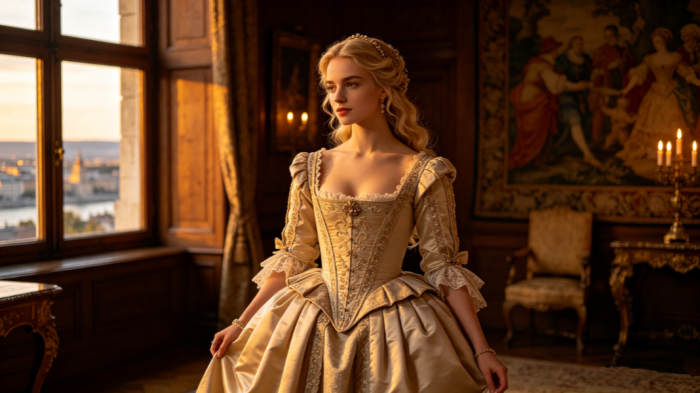
She arrived on a Tuesday, though I did not learn her name until that evening.
I noticed her first in the common room, where Ilona allowed select guests to mingle before making their choices. The woman sat apart from the others, a cup of sherbet untouched before her. Her dark hair was pulled back severely and she wore a traveling cloak of good wool over a silk gown. Her eyes found mine across the room and something in my blood responded, a resonance I had not felt since I was first drawn to Emine.
That evening, she sent word through the madam that she wished to see me.
I waited in my room, dressed in the manner of a Viennese Kurtisane: a gown with a low, square neckline that exposed the shoulders and upper chest; a tightly fitted bodice; and a full skirt. I stood as she entered, curtseying.
"Come to me, little one," she said, motioning with her hand.
I did so, and she kissed me.
Her mouth was warm and commanding. One hand gripped the back of my neck; the other worked the laces of my bodice. Within moments my gown was pooled around my waist and her mouth was at my breast. I gasped and arched into her, seeking the fingers which were gliding along my inner thighs.
She sat back on the divan and pulled me on to her. Her fingers had not left my cunt, two fingers thrusting rhythmically, sometimes withdrawing almost completely before pushing hard against my cervix. She turned my head to face her even as she did so.
Her face was impassive, even as my own was twisted in barely contained pleasure. I was mewling now, my breath hitching with each thrust of her hand; but she was still detached, observing. Then she nodded as if to give me permission, and I came, a whole body spasm that left me jerking in her arms.
When I was done, I clung to her, head on her chest. I looked up at her stolid eyes and pleaded. "More, please…"
Instead, she released me, allowing me to fall gently to her feet.
She extended one bare foot.
"Kiss it, Stefánia," she said.
I looked up at her. The old soldier in me recoiled but that man was barely a whisper now. The hunger that lived in me obeyed a different chain of command.
I lowered my head. Her right foot was slender, the arch high, the skin smooth and warm. It was unquestionably beautiful. I pressed my lips to the instep and felt a shiver pass through me. Her toes were long and elegant, and I took them into my mouth one at a time, laving each with my tongue, tasting the faint salt of her skin and something beneath it; the sweetness of ancient blood. My eyes closed. The sensation of submission was intoxicating, and I hated myself for it, but I did not stop. I licked the sole of her foot from heel to toe, and she watched me with detached satisfaction.
"Good," she said. "Now come higher. Feed."
She parted her thighs, and I knelt between them and pushed back the hem of her gown.
The scent of her reached me before my mouth did: rich and dark, like ripe figs warmed in the sun; an undertone of musk that made my head swim.
Her sex was beautiful in its own way: the outer lips full and dark, fringed with fine black hair trimmed short with scissors, parting to reveal the glistening pink within. The inner folds were delicate and intricate, deepening in color from rose to dusky crimson toward the center. At the apex, her clitoris stood swollen and proud beneath its hood.
I leaned in and pressed my mouth to her.
The taste was warm and salty-sweet. I licked along the seam, parting her folds with my tongue, exploring the ridged texture of her inner walls where they met the wet heat of her opening. She was impossibly soft there, yielding and responsive, and when my tongue found her clitoris and circled it, she made a low sound, guttural and approving, that sent a flood of wetness between my own thighs.
I sucked her clitoris between my lips, flicking it with the tip of my tongue, and her hips lifted off the divan. Her hand found my hair and gripped. I was drowning in her; the taste, the texture, the velvet clench of her thighs around my ears. I slid two fingers inside her, curling them upward, and felt her tighten around me, her inner muscles gripping.
"I know what you are, little one," she said.
I tensed. My fingers stilled inside her, but I did not withdraw.
"Don't stop," she admonished but there was laughter in her voice. "We'll talk after."
I did not stop. I worked her with my fingers and my tongue until her back arched off the divan and her thighs clamped around my head and she came with a shuddering cry that she muffled with the back of her own wrist. The contractions pulsed around my fingers, and I stayed there through all of it, licking her gently through the aftershocks, savoring all of her until she pushed my head away and brought her lips to mine again, as if in thanks.
We drank wine in the aftermath, both of us flushed.
"Do you know my name?" she asked.
The memory was there, a gift from her. "Leyla, from Salonika."
Leyla reclined against the cushions, her gown in disarray, and regarded me.
"Watch," she said.
Her face changed. Not gradually, not with the fevered agony of my own first transformation, but with the fluid ease of water finding a new vessel. Her jaw squared. Her cheekbones sharpened. The fullness of her lips thinned, and a shadow of stubble darkened her chin. For a moment, a lean, handsome man looked at me from Leyla's face. Then the features softened, flowed, and the woman returned.
"Some of us are made," she said. "Crafted with care by our creators. Shaped, instructed, given the tools to manage what we have become." She tilted her head. "Others, like you, are tainted at birth, abandoned before the transformation is perfected."
"Emine," I said. The name tasted like ash.
"Your maker? Yes. I know of her, though our paths have rarely crossed." Leyla took a sip of wine. She is an old one, very old; though like most vain women she doesn't care to be reminded of it. She has gone by many names: Enheduanna; Eudokia; Elvira. She has not begotten a child for at least half a millennia, or so my sisters tell me."
Leyla stroked my cheek with the tips of her fingers. "I like you, Stefánia. You have a pleasing personality. Perhaps it is because you are a Christian." She laughed.
"Tell me how to reverse it," I said. "How to return to what I was. Please, sister."
"And so polite too," she added. "Which is why I sought you out. My sister, Elizabeth, informed me of a vampir who starved herself senselessly for twenty years. You poor uneducated thing."
She set down her cup and looked at me with something that might have been compassion.
"You left your mistress before being fully formed. You will remain hungry until you find your maker and demand what she failed to give you." She waited, letting the words settle. "There is no going back to the man you once were. There is only forward, and forward means learning to manage what you are."
"I wish I had the time or authority to teach you," she added, more softly. "But that privilege belongs to Emine, and she is not here. I have given you what I can." She reached across and touched my cheek again. "It was wise that you came to Buda, to this velvet house. But feed discreetly, if you know what is good for you. The Christians and the Turks agree on very little, but they agree on burning what they cannot explain."
"And you?" I asked. "What do you do?"
"I move. I change. I become someone new before the questions begin." She stood and began to rearrange her clothing. "Our kind are hunted by those who fear what they cannot understand. The moment they begin to notice that you do not age, that your beauty does not fade, it might be too late."
She fastened her cloak at the throat and looked back at me.
"When you tire of Buda, and you will tire of Buda; come to France. The courts there are filled with women who trade in appearance and desire, and a creature like you will find ample cover among them." She smiled. "Find me in Paris, in ten years or twenty. Ask for Leon de Vries. I may be wearing a different face, but I will know yours."
Then she was gone.
I sat in the dim light and pressed my fingers to my mouth. I could still taste her on them.
I blew out the lamp and sat in the darkness, listening to the sounds of the brothel below; and I began, reluctantly, to plan.
Chapter 7 - The Sun King's Mirrors Versailles, c. 1683
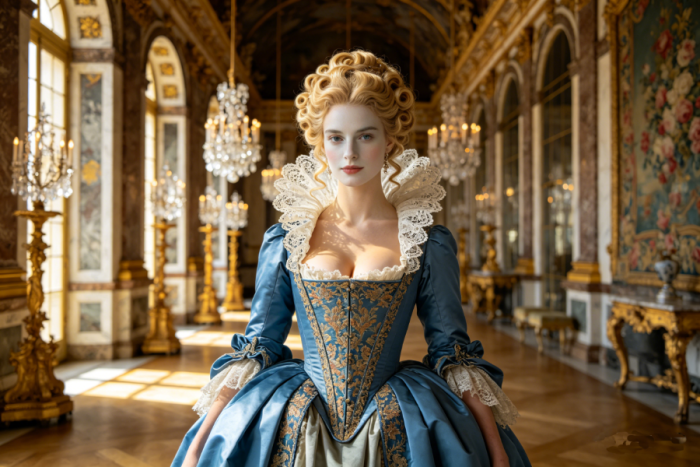
Nearly a hundred years as a woman, and my vanity had only grown with each new incarnation.
Stéphanie de Villon was a woman of exquisite construction: golden hair arranged in elaborate curls, a swan's neck rising from a cascade of Alençon lace. The gown was a confection of blue silk over a few petticoats that widened my hips to fashionable proportions. The bodice was of brocade and heavily boned, my breasts pushed upward until the upper curves trembled with each breath. I adjusted the fichu at my neckline, pulling it lower until the dark shadow of my cleavage was visible but the nipples remained hidden.
My already pallid skin was further whitened with Venetian ceruse; to appear without it would have been unconscionable. I dabbed it along my collarbone and across the swell of my breasts.
When the court was at mass, I dismissed the servants and slipped from my apartment. The Comte's private library occupied a room on the ground floor of his wing. The shelves rose to the ceiling, packed with volumes in Latin, French, Italian, and Greek. Under glass cases along one wall lay artifacts: a Byzantine reliquary, a bronze head from Africa, and a sealed jar containing something dark and desiccated.
I worked methodically, starting at the eastern wall. My fingers traced the spines: Histories of the Levant. Diplomatic correspondence. Jesuit mission reports from Constantinople.
Then I found it; a slim volume bound in calfskin, its distinctly unappealing title stamped in gilt: My Journeys (On the Marvels of Traveling). An excerpt from an Arabian travelogue translated by a Jesuit priest. I opened it carefully and scanned the pages.
In the Harem of the Sultan, there resided a woman called Emine, a favorite of remarkable beauty who, by the testimony of the eunuchs, did not age in the manner of other women.
...the death of this Emine occurred in childbed, though "death" may be an insufficient word. The delivery chamber was sealed by order of the Valide Sultan, and none were permitted to view the aftermath save the Valide herself. I learned of this through an interview with one of the Valide's trusted servants some years later, the very same from whom I gleaned stories of the Imperial Harem and its ways as recounted earlier in this volume. Of the incident she indicated that the consort's room was awash with blood, the midwife drained completely and grey as ash, the favorite mutilated beyond all recognition...
I set the travelogue aside and moved to the Comte's writing desk, where a stack of leather journals sat beside an inkwell. His private diaries. The Comte had been busy. His journals documented encounters with immortal beings across Europe; not as folklore or superstition, but as business arrangements. Financial agreements. Political intermediaries. And there, recurring like a refrain: La Dame Pâle. A woman who created companions and maintained a network of influence spanning centuries.
The library door creaked open.
The Comte de Montmorency stood in the doorway, a candle in one hand. He was a man of fifty, handsome in the ruined way of the French aristocracy, good bones obscured by excess, intelligent eyes dulled by wine. I had been introduced to the court as his young mistress, a minor heiress from Lorraine, his pet curiosity, his magnificent investment. He looked at me, then at the open journal, and smiled.
"We had an agreement," he said. "Your body in exchange for access."
"I grew impatient with the schedule."
He closed the door behind him and crossed the room. His hand found my breast through the silk of my bodice, gripping it roughly, his thumb pressing hard against the nipple through layers of fabric. He fancied himself a libertine, the kind who confused cruelty with sophistication.
"You forget yourself, Stéphanie." He squeezed harder, enjoying the give of my supple flesh under his fingers. "I installed you here, I clothe you, I presented you to the court…"
I caught his wrist.
The techniques Leyla had taught me in Buda were not merely physical. I held his gaze and pressed his hand more firmly against my breast, then guided it lower, across the rigid stomacher, down to the front of my skirts. His breathing changed. I leaned in close enough that my lips grazed his ear.
"Kneel," I said.
He knelt.
There was no resistance. There never was, not anymore. The Comte, whose ancestors had been Constables of France, whose name appeared in the genealogies of half the noble houses of Europe, sank to the floor with the obedience of a well-trained hound.
I lifted my skirts. I wore nothing beneath them. The Comte's face was level with my sex, and I gripped the back of his head and pulled him forward.
"Gently," I instructed.
He obeyed. His tongue found me with the desperate attentiveness of a man who had learned, through repeated instruction, exactly how I wished to be served. I leaned back against the chair, my eyes flitting over his journals, as the top of his head moved between my thighs. The sensation was pleasant enough. His tongue circled my clitoris with the pressure I preferred.
"Is it to your liking?" I asked, my eyes still fixed on his journals.
"Completely, mistress," he said. He returned to his work, making small, muffled sounds of abject devotion.
When I was finished with him, I turned his head to one side and pressed my lips to the soft skin behind his ear. The cut was small. A nick, really. He barely flinched. I drank three swallows, enough to taste the shape of his recent conversations, the names of his correspondents, the location of the cardinal's letters. Then I kissed the wound closed.
"Thank you, my Comte," I said. "You've been most generous."
He blinked at me from the floor, dazed and diminished, and I left him there among his books and secrets.
The salon of Madame Giselle Fournier was, by common agreement, the most dangerous room in Versailles that did not contain the King.
The room was stifling, and I could taste the heartbeats of every person in it. A duchess whose husband had recently been appointed ambassador to the Sublime Porte was holding forth on the barbarism of Turkish coffee. I positioned myself nearby and listened, filing away the names she dropped while offering sympathetic noises at appropriate intervals. An elderly marquis attempted to corner me near the harpsichord, his hand finding the small of my back. I deflected him with a smile and a murmured excuse about the heat.
It was there, beside a marble bust of Marcus Aurelius, that the Chevalier Armand de Ségur found me. He wore the black coat of a physician beneath a modest wig, and he had been watching me for weeks.
"Mademoiselle de Villon," he said, bowing precisely. "You look remarkably well this evening."
"You are too kind, Chevalier."
"Not at all. I speak as a physician. Your complexion, for instance." He tilted his head, studying my face. "Flawless. Not a single mark. No scarring from smallpox, no blemishes of any kind. For a woman who claims provincial origins, where the pox rages unchecked, it is quite extraordinary."
"Good fortune and clean living," I said. "My mother was meticulous about hygiene."
"Your mother," he said, quite undeterred. "Yes. Tell me, where precisely in Lorraine does your family hold their estates? I have some acquaintance with the region."
"Near …pinal. A small holding. It is unlikely that a man of your standing would know it."
"You're right, I would not. Because I have made inquiries, and no family named Villon holds property within fifty leagues of …pinal." He said this pleasantly, as one might comment on the vintage of a wine.
Around us, the salon continued as if nothing was amiss. My own expression was perfectly agreeable. "Then you must allow me to bring you there," I replied. "When the Comte feels able to make the journey, of course."
"I find it curious," de Ségur said, raising his voice just enough that the three nearest guests could hear, "that a woman of your... constitution shows such remarkable resistance to aging. The Comte de Montmorency introduced you to court four years ago. You have not changed by so much as a single line. Your skin, your hair, your figure, all precisely as they were. I have been a physician for thirty years, Mademoiselle. Nature is not so generous."
"Perhaps Nature makes exceptions for those who do not bore her," I replied, snapping open my fan.
The nearest guests had turned. A baroness with rouged cheeks and predatory eyes was listening openly now.
"Perhaps," de Ségur said, undeterred. "Or perhaps the exception is of a different kind entirely." He stepped closer. "I have examined the Comte recently. He is a man in precipitous decline. Pale. Weak. Drained, one might say, of his essential humors. And yet his mistress blooms like a rose in winter. It raises questions. About the nature of the arrangement. About the nature of the mistress."
"I am young and he is old. I take what I need while he takes whatever his heart desires. Gluttony is the vice of those who eat too much, but not of those who eat well," I replied. "You forget yourself, Chevalier."
"On the contrary. I remember everything perfectly." His eyes moved down my body. "I have observed certain irregularities. Your hands, for instance, the set of your shoulders, the musculature of your forearms when you raise a glass." He was performing now, and he knew his audience. "It is my professional opinion that you are not a woman in truth, Mademoiselle. You are either a very clever young man, or something far rarer. A hermaphrodite, perhaps; a creature of uncertain sex passing itself off as a lady of quality."
The silence that followed suggested the ravenous attention of the entire salon.
"A fool's lips enter into contention, and his mouth calleth for strokes," I informed him, over slitted eyes. "You will retract that."
"I will not. And I will say further that the Comte, who has sponsored this deception, is either a fool or a conspirator." De Ségur turned to address the room with the confidence of a man who believed himself protected by truth. "I challenge the Comte de Montmorency, or this thing…" He gestured at me."…to settle the matter with steel."
The Comte was not present. He was in his chambers, weakened from weeks of my feeding.
I closed my fan. "Might is the queen of the world, not opinion; but opinion is that which makes use of might," I said. "The Comte is indisposed, but I accept your challenge, Chevalier. I trust you have no objection to being defeated by a woman."
A murmur ran through the salon. De Ségur's composure flickered, then he bowed stiffly and withdrew.
I turned back to the room. Madame Fournier was staring at me with undisguised fascination. I raised my glass to her and drank.
The cardinal's correspondence was kept in a locked chest.
The Comte had arranged access through his connections with the Archbishop's secretary, a transaction that cost him two hundred livres. I worked through the papers: bundles of letters tied with faded ribbon, sealed with wax that crumbled at my touch.
Most of it was ecclesiastical tedium. Disputes over benefices, complaints about Huguenots. But buried among the dross, I found what I was looking for.
The letters were written in a cipher that mixed Latin with Greek, but I had absorbed enough from the Count's blood to recognize the system. One correspondent signed herself only with a symbol but the cardinal's marginal notes identified her plainly: Emine, qui se nominat La Dame Pâle.
I read for two hours, translating as I went. Emine had created companions across centuries. A Byzantine soldier in the eleventh century was the latest; a Cappadocian Father her most infamous. "She does not create equals," the cardinal had written. "She creates mirrors, then shatters them."
The freshest documents were letters from informants across Europe, dated within the last decade. Reports of a blonde woman of unusual beauty working in a brothel in Buda. The same woman traveling with a party of irregulars near Komárom. A creature of shifting appearance seen in the company of an Armenian merchant. Each report was addressed to Emine, care of intermediaries in Venice, Paris, and London.
She had been watching me. Every city, every identity, every bed I had occupied. And the intermediary in Paris was the Comte de Montmorency.
I found him in his chambers, propped against pillows, looking ten years older than when I had first arrived at Versailles. His skin had the yellowish tinge of a man whose blood had been thinned too many times.
I set the letters on his lap. "How long?" I asked.
He did not pretend to misunderstand.
"Since before I met you," he said. "She contacted me through a Venetian intermediary. Offered me... knowledge. Protection. Access to circles I could not have entered otherwise. In exchange, I was to provide shelter for a creature she described as her wayward child."
"And report my movements."
"Yes."
I sat on the edge of his bed and took his wrist. His pulse was thin and rapid. "Tell me everything," I said, and pressed my mouth to the vein.
The blood was watery now, depleted, but the memories were still vivid, now that I knew where to look: I was to be made comfortable; not to be allowed to leave without her knowledge; promises of knowledge, of youth, of discipleship. Beneath it all, the Comte's own craven certainty that he could manipulate something beyond his comprehension.
I released his wrist and wiped my mouth with the back of my hand.
"Where is she now?"
"Everywhere," the Comte groaned, cradling his arm. "The New World. The Levant. She changes her name, her appearance, her sex. She watches you as would any concerned parent. She loves you, Stéphanie."
I almost spat.
I gathered the letters and the journals and tied them into a bundle. Outside, the rain had stopped, and the first grey light of what would be a consequential dawn was beginning to show through the curtains.
It had rained the night before, and the grove beyond the Orangerie smelled of wet grass and the faint sweetness of rotting oranges.
The dew was heavy on the ground, soaking through my shoes as I walked to the clearing. I had not changed into men's clothing. I wore a simplified riding habit, the skirt shortened to mid-calf; but I was still unmistakably a woman.
They stood at the edge of the clearing in a state of visible distress, two minor nobles who had agreed to serve a physician's honor. Dueling was illegal under the King's edicts, and dueling against a woman was the kind of spectacle that attracted the wrong sort of attention. De Ségur had already removed his coat, his shirtsleeves rolled to the elbow. He held his smallsword with the easy grip of a man who had practiced regularly.
My own sword was borrowed from the Comte's collection; a clean, well-balanced blade with a simple guard.
"I had hoped the Comte would come himself," de Ségur said. "But this will serve to prove my point."
"En garde, Chevalier," I said.
He attacked first, which I had expected. His style was French and classical: the lunge direct, the blade seeking center line. But there was calculation beneath the orthodoxy. His first thrust aimed low, toward my hip; a location designed to draw blood and shame, to force me to lift my skirt or expose the shape of my body beneath the fabric.
I parried in quarte and disengaged, stepping offline. The old reflexes were there; faster and more precise than anything a human woman should possess and I had to throttle them deliberately. I had to fight like a gifted amateur, nothing more.
De Ségur pressed forward. A feint to my shoulder, then a cut toward my forearm. I deflected and riposted, my blade kissing the air beside his cheek.
"You fence well," he said, circling. "Unusually well for a lady of provincial upbringing."
"My father employed a master-at-arms. He was Italian."
"How convenient."
He lunged again. This time, I let him come deeper before I parried, binding his blade and redirecting it wide. The movement brought us close, corps-à-corps, and I could smell his blood moving beneath his skin. Then I stepped back and thrust.
The blade caught his forearm, a shallow slice precisely placed. Blood welled in a thin red line and dripped onto the wet grass. De Ségur hissed and stepped back, his sword arm faltering.
The hunger rose in me like a hand closing around my throat.
Two more exchanges, then I beat his weakened blade aside and set my point against his throat. A single bead of blood appeared there.
"I yield," he said.
I withdrew my blade and knelt beside him as he sank to one knee, cradling his cut forearm. The gesture appeared solicitous, a woman's natural compassion, the witnesses would later say, shown even to the man who had insulted her.
What they did not see was my hand closing gently around his wounded arm, my thumb pressing against the cut, and that blood reaching my lips surreptitiously.
His pupils dilated. His jaw slackened. The rigid intelligence behind his eyes softened into something pliant and confused.
"You were mistaken, Chevalier," I said softly, though our seconds were close enough to hear.
"I was mistaken," he repeated. His voice had gone flat and obedient.
"Will you apologize?"
"I apologize," he said. "I apologize unreservedly. Mademoiselle de Villon is... she is entirely what she claims to be. I was deceived by my own jealousy. Forgive me."
I helped him to his feet and pressed my handkerchief against his wound. The seconds were already murmuring among themselves, relieved and scandalized in equal measure.
"Think nothing of it," I said, and smiled like a woman who had already forgiven everything.
The candles had burned low by the time I finished.
The Comte's bedchamber was the finest room in his wing. The remains of a supper lay on a side table: wine; sweetmeats to improve his chlorosis. He lay on his back in the center of the bed, naked, his arms arranged at his sides. A dagger protruded from his chest at a slight angle.
I had drained him first, of course.
Beside him, the Chevalier de Ségur slept the heavy, dreamless sleep of laudanum. I had summoned him to the Comte's chambers that evening using the hold I had established, and he had come like a man sleepwalking. I made him disrobe and placed the dagger in his hand. All he had to do was slip the blade between the Count's ribs and lie down beside him. Which he did, without complaint.
Two men, naked, in a bed. The scandal would be prodigious. The investigation would be cursory. To investigate would be to acknowledge, and to acknowledge would be to implicate oneself in the knowing.
I paused at the door and looked back once.
The candlelight made the scene almost beautiful. It could have been a painting: The Death of the Libertine, perhaps, or Justice Among the Aristocracy.
I closed the door and descended the servants' staircase.
The carriage was waiting in the stable yard, arranged through the same network of discreet contacts I had cultivated during my years at court. Dawn was breaking over Versailles as we pulled away. The palace rose behind me in the grey light, its windows beginning to catch the sunrise.
Leyla had told me to come to France, and though I did not find her, France had given me what it could. The hunger stirred in my belly, patient and familiar.
Chapter 8 - The Ash Orchard - Rural Kent, England, c. 1790
He was looking at me again but I ignored him. The work required all my concentration or I would hear no end of it. I had already consulted Jean-Baptiste's Instruction pour les jardins fruitiers et potagers; it wasn't that complex.
I was perched on a wooden ladder, a small pruning saw in my right hand. The trees must be guided, not forced; overgrowth is the main enemy; sunlight and air are essential; and every cut has a consequence. It was simple.
"That branch has seen better days," he said. He had been by my side for the past ten minutes, ale in hand, holding the ladder steady.
"Hush!"
"But…"
"I saw Jean-Baptiste instruct his gardeners to do it in this manner."
"Do you mean La Quintinie from that book you borrowed?"
"And who else would that be, my dear?"
He gave my posterior a small squeeze through my skirt. I did not object.
"Mrs. Beecham is watching," I warned, leaning into his hand.
He looked around but the old biddy was nowhere in sight. "Mrs. Beecham wonders why a French girl from Lyon is acquainted with various persons from Versailles. Who have been dead this hundred years, I should add."
"That is easily answered. I visit them in my dreams. And I speak to Mrs. Beacham of nothing but the price of fish and bacon."
Behind me, the house stood solid and unpretentious; red brick darkened by age, the chimney already sending up a thin ribbon of smoke where I'd banked the fire before coming out. The front garden was a modest affair of herbs and Chamomile.
I cut away cankered wood and removed such fruit as showed rot, then pared a little lichen from the bark where it lay too thick.
"Come down," he said, patting the back of my thigh. "You've been up there too long."
He helped me down, glanced about once more, and kissed me lightly on the cheek.
"The western trees lean," he said. "The ground is over-wet on that side. I could build a drainage channel, run it down toward the brook."
"You could also eat your breakfast first."
"I am at breakfast." He took another draught of his ale and smiled. "The Ashford commission is settled by the by," he said, settling himself on the stone bench beneath the oldest apple tree. "They require the full survey by Michaelmas. The line of the canal must take account of the chalk near Wye.."
"And if you go about?"
"Three miles more, half a year's additional labour, and a conversation with Lord Faversham concerning his hunting grounds, which I would as soon avoid."
"Then go around," I said. "Lord Faversham will survive the inconvenience."
"Spoken like a woman who's never had to explain hydraulic engineering to a man whose primary qualification is that his grandfather owned the land."
It was my turn to rub his shoulders. He looked up at me, squinting against the early light, and I bent to kiss him, my dark hair falling across his face. His hand found the back of my neck, holding me there for as long as propriety permitted.
"I'll be home before dark," he said.
"I shall expect it. A wife has her claims."
"I declare myself the most willingly governed husband in Kent."
He gathered his coat and his leather satchel of drawings and walked out through the garden gate, his mind already at work on the problem ahead. I watched him until he reached the lane, until the hedgerow swallowed him.
I sat down on the stone bench.
The hunger had been growing for eleven days. I had managed it carefully for years, discrete trips to Canterbury, where the poorhouse afforded a steady supply of the dying and the delirious from whom a few careful mouthfuls could be drawn without detection. But the new warden was vigilant. I would have to go to London, and London lay a day's journey by coach.
Excuses would have to be made.
Four years can be measured in many ways.
In Thomas's case, it was measured in commissions: the canal at Ashford completed, the bridge at Faversham redesigned, a new drainage system for the Romney Marsh that had earned him a modest reputation and a steadily growing correspondence with engineers across the south of England.
In mine, it was measured in the small, warm body that sat cross-legged on the hearth rug, frowning at a hornbook with the intense concentration of a general surveying an unfamiliar battlefield.
Elinor had Thomas's grey eyes and my dark hair, though hers fell in soft curls where mine hung straight.
I had not expected her. For centuries, I had assumed that my body's transformations had rendered conception impossible; that whatever Emine's blood had wrought was too unstable. I had been wrong. I now knew that the same will that shaped my features when I fed could also open doors I had assumed were sealed.
I had wanted a child. My body had obliged.
"Mama," Elinor said, jabbing her finger at the hornbook. "This letter is broken."
I set down my mending and leaned over her shoulder. "That's a 'G,' darling. It's not broken. It simply has a tail."
"Why?"
"Because the man who designed it thought it needed one."
"I don't like G."
"You don't have to like it. You only have to read it."
I had learned more languages than I could reliably count. Ottoman Turkish, Greek, Romanian, Hungarian, German, French, Latin, Italian, and Arabic; absorbed through blood, study, and the long attrition of centuries. I had debated Jesuit astronomers, French philosophers, and Ottoman scholars.
And none of those conversations were as dear to me as the sound of Elinor's voice.
"C-A-T. Cat!" She looked up at me, and I gathered her against my chest and held her there, my face buried in her hair.
She would not always smell this way. She would grow old. She would lose the radiance of her skin, and she would die. While I would not. But she was here with me now.
That evening, the three of us occupied our usual positions: Elinor drowsing on the rug, her hornbook abandoned beside her; Thomas at his desk, bent over a drawing of what appeared to be a lock gate mechanism; and I in the chair by the fire, darning one of his shirts.
Thomas looked up from his work and caught my eye and nodded his head at our sleeping child. I shook my head: Let her be, she's peaceful. He smiled and returned to his drawing.
I could have lived inside that moment forever.
Then Thomas coughed.
It was nothing exceptional, and he pressed the back of his hand to his mouth and frowned. But the cough came again, deeper this time, and when he pulled his hand away there was a faint pink smear on it. Not much.
"Thomas," I said.
He looked at me, then reached for his handkerchief and pressed it to his lips, and when he took it away, the white linen was stained with a shade of red that no amount of washing would remove.
First the walks.
Thomas had always walked the property each morning before settling at his desk. Then one morning he did not walk but sat on the stone bench and watched the garden from a distance.
Then the appetite.
His plate went from full to half-full to nearly untouched. The doctor from Canterbury came twice, bled him once, prescribed rest and fresh air and a tincture of laudanum that did nothing except grant him a few hours of quiet. Consumption, the doctor said.
I did not leave his side. Instead, I watched him waste away in front of me. My own hunger was irrelevant. I changed his sheets and spooned broth between his cracked lips and held the basin when the coughing came.
One evening in the fourth week, I sat at his bedside wringing out a cloth in cool water. Elinor was asleep in the nursery having been told that Papa was tired and needed quiet.
I was wiping him down when his hand found my wrist.
His grip was weak but his eyes were clear. The fever had broken an hour earlier, leaving him in that strange state where the dying sometimes see and say things more plainly.
"You're changing again," he said.
"Thomas…"
"Hush, my sweet." He considered my face and let his gaze move down to my chest, where the bodice hung looser than it should have. "I've watched it happen before. After Elinor was born, you went to London to check on your inheritance again and came back softer. Fuller." He paused to breathe. "You never age, my love. Three years, four, seven now. Hours in the orchard and in the sun. Not a single line."
"You're feverish," I said, realizing that carelessness and vanity had undone me. "You should rest."
"There is no need to hide, Anne. I have wondered for years. I just never knew how to ask."
"Please…" I said, "do not hate me. I could not bear it." The tears that followed were full of every lie I had told him, every performance of normalcy.
"I could never do that," he said. "Will never do that."
I set down the cloth and decided on the truth.
"I need blood," I said. "To maintain this form. To remain as you see me. Without it, I change. I become… something else."
"If only you had told me earlier," he sighed. "You could have taken your fill from me."
I shook my head and sank my head into his chest, wiping my tears on his nightshirt.
"How old are you?" he asked, stroking my hair.
"Old enough to walk the sun king's palace. Old enough to see kingdoms fall and empires pass away."
"I guessed correctly. An immortal. I thought you might have been a princess or a queen in another life. You had such fine ways when we first met." He coughed and drew his breath slowly for a few moments. "Or that you were an angel sent to torment me with happiness."
Thomas raised his wrist.
"Take what you need," he said.
"No," I said. "Never."
"This isn't for me. This is for Elinor. She needs her mother whole."
"There are other ways," I said.
But he was insistent. Our child could not be alone; not now and certainly not in the years to come. His skin was thin and papery, the veins visible beneath it like channels on a map. The hunger rose in me, now that he had offered, and I hated it with a thoroughness that surprised me.
I lifted his wrist to my lips.
His blood was thin but it was warm, and it tasted of everything I was about to lose. I felt my skin soften and the fullness return to my body.
"There you are," he said. "There's my Anne."
He pulled me to him, and we kissed for the last time.
He died that night, and I sat beside him until dawn.
The house was quiet now. Thomas's study door stood closed. His boots sat by the kitchen door where he had left them, his coat still hung on its peg. I had a basin of water before me and vegetables from the garden that needed to be washed. I saw through the little window that the trees of our small orchard needed pruning again.
"Mama."
Elinor stood in the kitchen doorway, her dark curls crushed on one side from sleep. She held her arms up.
I dried my hands on my apron and gathered her to me. Her arms went around my neck and her face pressed into my shoulder. She was all that I had left. And I would be with her till the very end; when she finally grew old, when she returned to be with her father.
Thomas's blood was still in me, and my body was pliant, responsive like clay. I closed my eyes and concentrated.
The skin at the corners of my eyes creased and the flesh beneath my jaw softened, losing its taut definition. A thread of grey appeared at my left temple, then another at the right. The skin of my hands coarsened slightly, the faintest suggestion of age spots appearing at the wrists. My breasts settled lower against my ribs.
That would be enough for another five years at least.
When I opened my eyes, Elinor was staring at me, her small hand reaching up to my cheek. She would forget this, like all children.
The woman reflected in the basin water was a distortion; not the ageless creature who had moved through courts and battlefields and brothels for two centuries. She was a widow of perhaps thirty-five, tired and grief-worn, with grey beginning at her temples and lines of care around her mouth. She looked like a woman who had loved someone and lost him. She looked like someone who belonged to the world she inhabited.
"Don't be sad, Mama."
I wiped the tears from my eyes and gave her a smile. "Let me show you something."
I carried her out the back door, across the yard. The morning was cool and the apple trees were in the first stage of blossom.
"Look," I said, tilting her so she could see. "Do you know what those are?"
"Flowers," Elinor said.
"Apple blossoms. Your father planted these trees the year before you were born. And in autumn, they'll give us apples."
She reached for the nearest branch, her small fingers grasping at a cluster of buds. I held her steady while she touched them.
There is only forward, someone had told me once.
I pressed my lips to my daughter's temple and breathed.
Chapter 9 - The Anatomist, London, 1835
The toast was burning.
I could smell it from the parlor, where I sat pretending to read the morning gazette. Elinor's kitchen was always producing some small domestic crisis or another: a pie crust collapsed, a scullery maid in tears over a dropped tureen.
"You're not reading that," Elinor said, appearing in the doorway with a fresh rack of toast and a pot of marmalade. "You've been staring at the same page for ten minutes."
"I am reading it. There is a very interesting article about the price of wool."
"You don't care about the price of wool, Mama."
"I care enormously about wool. I have investments. I am wearing wool at this very moment."
She set the toast rack down and kissed the top of my head, then settled across from me at the small table by the window. The townhouse on Lamb's Conduit Street was comfortable without being ostentatious; her husband's solicitor's income provided well enough, and Elinor had inherited her father's talent for making a modest space feel ample.
"You look well this morning," Elinor said, pouring herself tea. She said it casually, but I caught the slight narrowing of her eyes. Her dark hair was threaded with a bit of silver at the temples and gathered in a practical knot at the nape of her neck. She was forty-three but still quite attractive.
"What is it now, dearest?" I didn't look up from the wool report.
"Mrs. Pemberton asked me last week whether you'd found some elixir at the apothecary. I told her you simply refused to age out of sheer stubbornness."
"Mrs. Pemberton should take less nightcaps and cigarettes."
That made Elinor tut; it wasn't polite to proclaim another's vices so loudly.
I had aged myself as delicately as I dared. A line here, a softening there; grey at the temples progressing to grey throughout, though I confess I had been less thorough than I should have been. At seventy, I ought to have looked seventy. Instead, I presented perhaps sixty. Vanity, the old vice. I could shed an identity and cross borders but I could not quite bring myself to look properly old.
The door to the parlor burst open and two small bodies hurtled through it with total disregard for the furniture. The boy, William, launched himself at my knees. His sister, Charlotte, followed at a more considered pace and stood beside my chair with one hand on the armrest.
"Grandmother," William announced, "I have found a beetle."
"Have you indeed."
"It is in my pocket."
"Then I suggest it stay there until after breakfast."
Charlotte tugged at my sleeve. "Grandmother, I should like to hold the beetle."
"No one," I said, "is holding any beetles at the breakfast table."
I offered them both a piece of toast halved. Then the nursemaid appeared in the doorway, flushed and apologetic, and collected them both. I watched them disappear up the stairs and fought the urge to follow them.
I drew Thomas's pocket watch from the folds of my shawl and checked the time. Half past eight. The appointment was at ten.
"An appointment?" Elinor said.
"Yes, with a physician."
Elinor's cup paused halfway to her lips. "Are you unwell?"
"Perfectly well. It is a consultation. Nothing to concern yourself with."
She set the cup down. "Mama?"
"Elinor, there is absolutely nothing the matter. It concerns my hobbies. You are familiar with those, aren't you?"
"You mean the strigoi and the Brides? The Illuminés; Swedenborg, and the Masons?" Elinor made a low grumble but didn't press further.
I rose and smoothed my skirts. Elinor walked me to the front door. I turned and took her in my arms.
She was taller than me by an inch. I held her, my face pressed against her shoulder, breathing her in. Her scent was distinct despite the faint sweetness of rose water she had dabbed behind her ears.
"Mama," Elinor said, her voice careful. "You're squeezing rather hard."
I released her and stepped back. "I shall be back for supper."
"Promise?"
"I promise."
The coach stopped before a modest house of brown brick. A brass plate beside the door read: DR. J. HARROW - PHYSICIAN & ANATOMIST
I paid the driver and went in.
The office was a cabinet of curiosities masquerading as a consulting room. Anatomical drawings covered nearly every surface of the walls; muscles flayed and labelled in precise Latin script. Glass specimen jars lined the shelves: a human hand carefully dissected to display the small muscles; a uterus with ovaries and fallopian tubes still attached by some vivisectionist's art; and a human brain halved to display the hypothalamus and pituitary.
The man himself was thin to the point of severity, with sharp cheekbones and wire-rimmed spectacles. He extended his hand as his footman closed the door behind me.
"Mrs. Vale," he said. "A pleasure to make your acquaintance."
"Dr. Harrow." I took the chair he indicated.
"You wrote to me regarding a matter of some delicacy," he said. "You wished to discuss certain legends pertaining to blood-taking immortals, with particular reference to the Brides of Constantinople."
"I did."
"Then allow me to provide some context. The legends of blood-drinking entities are as old as civilization itself. The Lamia of Greek mythology for instance, a woman transformed by the gods into a creature that devoured children and drank the blood of young men. Lamashtu of Mesopotamian tradition, a demoness who preyed upon pregnant women and infants. In both cases, note the association with feminine corruption and sexual transgression."
I shifted in my chair and my foot began to tap against the floor.
"The connection between blood-taking and feminine sexuality persists through the medieval period: the succubus, the revenant bride, Black Sabbaths and their attendant sacrifices." He paused to adjust his spectacles. "All of which you know, I suspect."
"I do."
"What interests me is not the mythology but the mechanism. I have been conducting research into the properties of blood for some years: its composition, its decay, its capacity to carry information between bodies. I believe that the blood of a male donor carries within it the essential pattern of maleness, not merely in its gross physical properties but in its organizing principle. And conversely for female blood."
I knew this. I had lived this.
"Furthermore," Harrow pressed on, apparently oblivious to my mood, "I have observed in certain marine organisms the capacity to change sex in response to environmental conditions. A female wrasse, when the dominant male is removed from a group, will transform herself into a male. The gonads restructure. The behavior shifts entirely." He spread his hands as though presenting evidence to a jury. "Is it not possible that the condition you investigate represents an analogous process in a higher organism?"
"I did not come here for a lecture on Greek mythology or fish," I said. "I came because your correspondence suggested you possessed knowledge that I do not. If that was a misrepresentation, Doctor Harrow, I should like to know now, before I waste any more of the morning."
He regarded me across the desk and sat back.
"Then perhaps you should tell me what you know."
I gave him a smattering of truth, all told in the third person.
I ended with a couple who once resided in Bath, the husband deceased some decades ago. "He died of consumption," I said. "Or so the doctor believed. He wasted away over the course of six weeks."
"And did this woman love her husband?" he asked.
"With all her heart, though that hardly seems relevant under the circumstances; unless you are implying a moral basis to the corruption."
"I understand now; everything is perfectly clear," Harrow said, nodding sagely. He removed his spectacles and set them on the desk.
"It is painfully clear," he said solemnly, "that you are an idiot."
I stood. The chair scraped against the floor behind me, and I reached for my shawl. "Thank you for your time, Doctor. I shall not trouble you further."
"No, not an idiot," he continued, as though I had not moved. "An imbecile."
I turned.
"No," he said decisively. "A cretin. That's what the Swiss call poor creatures like yourself. Those born without the capacity to see what is directly in front of them."
His face was changing.
It was fluid, effortless, like water finding a new shape. The thin, scholarly face filled with a lean androgynous beauty that I had last seen in a room above a brothel in Buda, more than a hundred years ago.
"Leyla," I said.
She sat behind Harrow's desk in Harrow's black coat, her dark hair cropped short in a man's style.
"Hello, Stefánia," she said.
My hands had balled into fists at my sides. The relief of seeing her was tangled so thoroughly with fury that I could not separate the two. "You let me sit here for half an hour listening to a lecture about fish."
"The wrasse was a nice touch, I thought."
"I will strike you."
"You will not." She took my hand in both of hers as if in apology. "Sit down, Anne. I did not arrange this meeting to discuss marine biology. I am here to help."
I did not sit. "Help? In what way?"
"As a physician, I have learned to convey bad news directly and without subterfuge. Your husband, Thomas. You drained him."
"I did no such thing. I fed from Thomas once. Once, and only because he offered, and only at the very end when he was already dying. I was careful. I have always been careful. I fed in Canterbury, from the poorhouse…"
"Not the blood, Stefánia." Her tone seemed almost consolatory. "The bed."
I stared at her.
"Every time you lay with him," she said. "Every time you took him inside you, every time his body gave itself to yours. You drew from him. You drained him the way a river drains a bank; slowly, imperceptibly, over years. And he withered."
"No."
"The consumption was not consumption. It was you."
"No." I said it again, but my world was breaking together with my voice.
I thought of Thomas's cough. The first spot of blood on his handkerchief. The way his appetite had diminished. I had sat beside him and nursed him and wept for him, and all the while…
"Every night," I said. My voice was barely audible. "Every night we…"
"Yes."
My knees gave. My hands pressed flat against the cold boards and my vision blurred with tears that I could not stop and did not try to.
Our final communion, the blood from his wrist. There you are. There's my Anne. I had told myself it was the consumption. But I must have known. It was obvious.
"I was too harsh," Leyla said. She was beside me now, cradling me. "Your sister provided you with knowledge that was not easily decipherable. That is her way. A bad habit which I have failed to correct."
I could not speak. The tears came in silence, which was worse than sobbing, because there was no release in it; only the steady, unrelenting knowledge of what I had done.
Elinor.
Elinor, whom I had held this morning with unusual intensity. Elinor, whose cheek I had kissed a thousand times. Elinor, whose hair was prematurely greying; whose children I had gathered in my arms and bounced upon my knee.
"The children," I whispered.
"No, there is no risk there."
"But the possibility… It is a possibility, is it not?"
"Not to my knowledge."
"To your knowledge…"
I looked up at her. The decision was already forming inside me, cold and absolute, and with the terrible clarity of someone who has just seen the truth.
"I have to leave her," I said.
Leyla frowned.
Somewhere across the city, in a comfortable townhouse on Lamb's Conduit Street, my daughter was clearing the breakfast things and wondering when I would return for supper.
I had promised her. I had promised.
The solicitors and bankers in Amsterdam, here in London, Frankfurt. I could arrange everything in a matter of weeks. There would be enough for Elinor, William, and Charlotte to last them many lifetimes over.
I rose from the floor and wiped my face with the back of my hand, and I did not look at Leyla, because I knew that if I saw compassion there, I would break entirely. Instead, I straightened my shawl and smoothed my skirts and walked toward the door.
"Child," Leyla said. "Where will you go?"
I stopped but did not turn.
I thought of the apple trees in Kent, planted by a man whose death I had caused. I thought of Elinor reaching for apple blossoms with small, trusting fingers.
"Forward," I said. "There is only forward."
I opened the door and walked out into the grey London morning, and I did not look back.
No Man's Hunger: Chapter 10 to 19 (End)
Author:
Caution:
Audience Rating:
Publication:
Genre:
Character Age:
TG Themes:
TG Elements:
Permission:
NOTE: This story was originally posted in single large chunk. But some readers have indicated that it was hard to navigate, so I've split it into two parts.
SYNOPSIS: In 1566 Constantinople, a Janissary is bitten by an ancient vampiress and awakens transformed; first into something between genders, then, through blood and hunger, into a woman. Across five centuries she moves through mercenary camps, European brothels, the court of Versailles, Victorian England, two World Wars, and the New World; feeding discreetly, loving unwisely, and burying everyone she touches. Her body is clay, shaped by desire and will. And the woman who made her has been watching all along,
Chapter 10 - No Man's Hunger - Somme sector, France, 1916
The rat sat on the edge of the surgical tray, cleaning its whiskers with the fastidiousness of an odalisque, while I extracted shrapnel from a boy. He was unconscious, which was a mercy. The chloroform was running low and I had begun rationing it three days ago, reserving what remained for amputations.
I flicked the rat off the tray, and it landed in the mud with a wet plop and scurried away.
"That's Gerald," Lance Corporal Bell said.
"Don't name the rats, Bell."
"Too late, sir. Gerald and I have an understanding. He stays off the bandages, I don't step on him." Bell set a pan of clean water down and peered at the boy on the table. "Will he keep the arm?"
"Probably."
"That's practically optimistic, coming from you."
Bell was twenty-two and constitutionally incapable of falling into complete despair.
I moved to the next stretcher. Corporal Jameson, Lancashire regiment, both legs shattered below the knee. His face was grey, his pulse thready. I checked the tourniquets that had been applied in the trench. The femoral artery on the left side had been nicked and he had already lost far too much blood.
"Morphine," I told Bell.
Bell didn't question it. He administered the injection and withdrew to the next patient, and I drew the canvas screen around Jameson's stretcher. The corporal's eyes were already glazing when I leaned close. I pressed my mouth to the hollow beneath his jaw and drank: a childhood in a mill town and some girl who would mourn him and then probably forget. He was right in that last assumption. Then he was gone. It was a kindness I told myself.
The male body I inhabited was a construction of will and careful feeding. Leyla had taught me the technique over the course of the last century. The blood was clay, and the mind was the potter's hand. But holding a male form required constant effort, like flexing a muscle that wanted to relax.
The male body was a shirt I wore as penance.
The name surfaced and I pressed it back down. Thomas, whose blood I had tasted only once but whose life I had drained over years of love. I had kept his name-Stephen Vale-because I deserved to flinch every time someone spoke it.
"Doc!" Bell called from beyond the canvas. "Another one coming in."
The orderlies carried a Private in on a stretcher. A stomach wound; peritonitis from perforated bowel. The pungent faecal matter hadn't been cleaned out. The boy's hands were pressed to his abdomen, his fingers laced through a mess of blood and intestine. It was clear to everyone involved that he had arrived several hours too late.
"Behind the screen," I said. "And morphine."
They set him down and left. Bell hovered at the partition's edge, and I caught his eye and shook my head. He understood and moved away, closing the canvas as he left.
I knelt beside him. His eyes found mine. "Maman?" he whispered.
"Oui," I said. "Je suis là. Tu es en sécurité maintenant."
I smoothed the hair from his forehead with my free hand and leaned close, pressing my lips to his temple as though in comfort. Then lower, to the pulse point below his ear. His skin was hot with fever and smelled of dirt and terror. I drank. His memories came with the blood: his mother in a stone farmhouse in Picardy, almost a local to this madness; a dog named Bijou; a girl with braided hair who waited by a gate. I took it all, gently, shaped my face to that of his mother, just for a moment, so that he could see her one last time.
When I pulled away his chest had stopped its labored rise and fall. I cleaned my mouth. Pulled the blanket up.
When I emerged from behind the partition, Sergeant Wilkes was waiting with a cigarette between his lips.
"You look better than the rest of us, Doc," he said. "What's your secret?"
I peeled off my gloves.
"Clean living," I said.
Wilkes grunted and walked away. I stood in the mud between the stretchers, listening to the guns as the boy's blood settled into me.
The orders came at half-three in the afternoon, carried by a runner.
"Medical station to advance," he recited, "in support of the infantry push along the Bazentin Ridge. Captain Vale to establish forward aid post at map reference…" He fumbled with the paper."…eh…captured enemy position."
"When?"
"Now, sir. Immediately."
I dismissed him and turned to Bell. "Pack the essentials. Morphine, chloroform, bandages, surgical kit. Leave the heavy instruments for now."
Bell was squatting on a wooden plank having a conversation with Gerald. I had seen far worse; talking to a rat was perfectly harmless in the grand scheme of things.
"What's Gerald saying?" I asked.
"Not Gerald," he said. "Gwendoline, his cousin. And she's telling me everything about the German machine guns and snipers; not that it's going to really help us in the end."
I allowed him his momentary fit of madness
Gwendoline scurried away and he shook himself free from his stupor. "The autoclave, sir?"
"Leave it."
We moved out in a party of six: myself, Bell, two stretcher-bearers, and a pair of orderlies. The communication trench was a winding channel barely wider than a man's shoulders, its walls shored up with corrugated iron and timber that bowed inward.
We moved in single file and, at a junction, I climbed a fire-step and carefully looked over the parapet.
The landscape was a hellscape of craters filled with brown water. Between them lay the detritus of industrialized slaughter: a wagon wheel standing upright in the mud; coils of barbed wire flattened and twisted; a rifle with its bayonet fixed, driven point-first into the ground. And the bodies of course; they lay everywhere: limbs at wrong angles, faces pressed into the mud as though listening for something underground, or turned skyward, mouths agape; sometimes with expressions of mild surprise, though death was hardly an unexpected guest at this dinner.
I had seen battlefields before. The siege at Buda; the skirmishes along the Habsburg frontier where I had followed the mercenary company. But those had been human in their scale. A man killed another man, and the body fell. Here, the killing was mechanical and anonymous.
I dropped below the parapet and we continued.
The Geneva Convention. I had read it. A fine document, drafted by reasonable men in clean rooms. It promised that those who tended the wounded would be respected and protected. And yet I counted three medics in the space of two hundred yards. The first lay face-down in a shell hole, his Red Cross armband still bright against his sleeve. The second was propped against the trench wall with his medical bag open beside him, its contents scattered in the mud. He had been trying to treat himself, it seemed. The third I recognized: a young Welshman named Evans who had shared his tobacco with me a week ago and told me about his fiancée in Swansea. He lay across the duckboards with his arms outstretched.
The captured German dugout was deeper than I had expected.
Bell unpacked the supplies with his usual precision. The stretcher-bearers took positions at the entrance, ready to receive casualties from the line. The orderlies laid out blankets on the dugout's wooden bunks.
"Not bad," Bell said, looking around. "Almost cozy. Gerald would approve."
The first casualties arrived within the hour. A lance corporal with a shattered femur, a private who had lost half his mandible, and another clutching the stump of his wrist. I knelt beside the lance corporal and began cutting away his trouser leg to assess the damage, ignoring the commotion and machine gun fire just above my position.
That was a mistake. The bullet entered straight through my frontal bone.
I was aware of falling, and then the mud was in my mouth and my eyes. The last thing I registered was the distant voice of Bell saying my name, and then the sound of men running and bayonets doing their work.
I woke in a shell crater with half my skull knitted back together.
The mud had covered me like a burial shroud, and when I clawed my way out, the aid post was empty apart from a dozen other bodies. The guns had moved on to some other stretch of the line.
My male form had dissolved during the regeneration; my body, left to its own devices, had reverted to its natural inclination. I crawled out of the crater and found myself female: slight, blonde, and still in uniform.
I found new clothes in an abandoned farmhouse two miles behind the lines. A plain wool dress, a faded cotton shift, and a pair of wooden sabots. A refugee farm girl. France was full of them that autumn and no one would look twice. The transformation felt as much punishment as liberation.
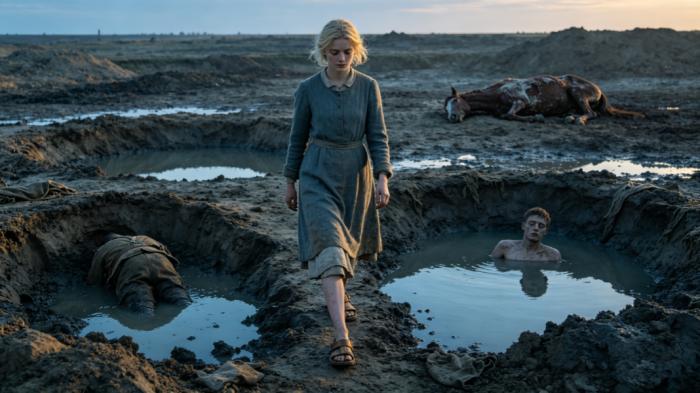
I walked south through the wreckage of the countryside following a familiar trail. Now that I was a woman again, I could sense her presence. She was close, waiting for me.
The road passed through what had once been a village. A church steeple lay across the main street like a felled tree. Most of the houses had been disgorged, their walls blown out; and the carcass of a boulangerie sat stolidly among the rubble
It was in front of this bakery that I found her. Leyla, my old friend from all the way back in Buda; or Leon as she was now called, at least for the time being. He was crouched in the rubble photographing the remains of the shop front. He wore a correspondent's uniform and a press armband; his hair cropped close and his jaw lined with stubble.
"Leon," I said.
He looked up.
"Ah, at last, I've been waiting for you," he said. "You look awful by the way."
"Just died."
"It happens," he grunted.
"The church," he said, tilting his head toward the steeple lying across the road. "We can talk there."
We picked our way through the debris. The nave was open to the sky, the roof collapsed inward, but the apse still stood. The crucified Christ gazed down at us with one eye, the other half of his face blown away by a shell fragment. Leon cleared a space on the stone floor and sat; I sat across from him.
"Twenty years ago," I said. "Jerusalem. That's when we last met?"
"Jerusalem," he confirmed.
"Rome before that. You were selling antiquities to English tourists and I was cataloguing Ottoman archives. A simpler time. I think. Before Rome, Vienna; and before Vienna, London"
"Not London," he said. "That was Emine disguised as me. I've told you that. Don't you believe me?"
"No, I believe you; it's just difficult to think of it otherwise."
He raised his hand to stop me. "We don't have to discuss it."
"No."
We compared notes as was our wont, every twenty years; our positions and rendezvous marked by messages dropped at certain locations in London and Paris; old places which Leon had arranged soon after the Peninsular War.
"Not religious any more?" he asked, glancing up at the Christ.
"I still believe in God if that's what you mean." We had spent months travelling together as missionaries in China as part of the China Inland Mission. It was all coming back now.
"It was not you in London then?" I asked again.
"No," he said. "I gathered it was unpleasant. Emine seemed unhappy with what you did…em… to your husband."
He produced a cigarette from somewhere and lit it. The smoke rose through the broken roof and dispersed into the grey French sky. "By the way, Emine has left Europe."
I went still.
"America," Leon continued. "She's been there for decades. Building something new; a new identity, a new network presumably. She saw the war coming long before the rest of us." He drew on the cigarette. "She asked after you. I declined to respond."
"We really are sisters, aren't we?" I said.
"Mind is coming back, I see," he said, tapping his temple. "We were both made by her. Be patient, the brain matter takes longest."
"You made me lick your toes when we first met." It was a sudden recollection. "No sister would do that."
"That was three hundred years ago," he said, shaking his head. "And you enjoyed it."
"I suppose I did," I said, frowning. "Thank you. For not talking. To Emine I mean."
"Don't thank me. I did it because she irritates me."
I knew it was a lie, and he smiled at me, tilting his head.
"Don't be angry with her for too long," he continued. "She has been protecting you after all. From the Hunters, you understand? Though you've escaped their notice for the most part. The hunters are only interested in us if we interfere with the workings of this world. If we choose solitude and the company of the lower classes, that is our business entirely."
He stubbed out the cigarette on the stone floor and leaned forward, his elbows on his knees. "The world is changing, Stéphanie. Not in the way it has always changed. This is different. Photography. Fingerprinting. Identity papers with descriptions and photographs attached. National registries. Border controls that function. Every war produces more bureaucracy, and this war has produced more than all the others combined. Our kind must adapt."
"We have always adapted."
"We have always moved. That is not quite the same thing." He paused. "I have contacts in Switzerland. Neutral ground, discreet professionals who can produce documents that will withstand scrutiny. After the war, when the borders reopen, I can establish you. A new name, a new history, properly papered and backed by records that will hold."
"And in exchange?"
"In exchange, you stop punishing yourself with this ridiculous male martyrdom and accept what you are."
"I wasn't aware you had opinions about my gender."
"I have opinions about everything." He chuckled.
I looked away. Through the shattered nave, the ruined village stretched in every direction, the landscape scraped raw. A fragment of stained glass still clung to the window frame; a shard of blue and gold depicting a wing; an angel's wing, perhaps, or a dove's.
I stood and walked to it, saw myself in its reflection. A girl. A woman. A creature of uncertain origin and indeterminate future; a blue-gold Byzantine icon, with an expression of serene and total detachment from the suffering of the world.
"If men built this," I said, "I want no more of it."
Outside, the guns continued their work, and the sky over France was the color of ash.
Chapter 11 - The House on Rue des Phocéens, 1918
His mouth was adequate; he had been thoroughly domesticated after all.
I lay on my back on the narrow bed, my thighs spread, fingers threaded through his hair.
"Use your fingers, my love," I urged.
He introduced one finger and then another which gave me just the right amount of fullness. My breath hitched when he curled and found the ribbed area within. He glanced up appreciatively when I did so, eyes fixed on my breasts which I had bared. He reached up to knead them with his left hand and I let him.
Between my thighs, where his tongue now worked, the flesh was young and responsive; younger than it had been for well over a century. I pressed my hips upward against his face and felt the pleasure as his finger thrusts increased apace. I tightened my fingers in his hair and held him there, the muscles of my thighs and cunt contracting as my back arched.
He surfaced, flushed and gratified, wiping his mouth with the back of his hand. He was Chef de Service of a shipping firm; thirty, well-mannered. He visited me on alternate Tuesdays when his wife was visiting with her mother.
I used a moist, perfumed towel to wipe his face, leaning forward so that my breasts were full in his face. In my right hand, I cradled his manhood and urged it awake; too soft to enter me this week, but just enough that I was able to urge a small amount of ejaculate from it while he suckled on me.
"You are so beautiful," he said.
"And you are one of the kindest men I've known."
He dressed while I remained on the bed, propped on one elbow, the sheets gathered loosely at my waist, my bare sex open to his gaze. He sat on the edge of the mattress to tie his shoes, and I rose behind him and put my arms around his shoulders, pressing my bare breasts against his back, my lips finding the soft skin of his neck. He sighed and leaned into me.
The puncture was small. A pinprick, nothing more, and the blood that welled from it was rich and warm and tasted of sardines, cheap tobacco, and an unremarkable childhood in Aix. I took four sips and sealed the wound with my tongue. He shivered pleasantly.
"Same time in two weeks?" he murmured.
"Of course," I said. "And next time, you will fuck me, Monsieur. I insist."
He left a little unsteady on his feet, his eyes soft and unfocused. He would think of me constantly for the next several days. He would be unable to concentrate at his desk; and he would return, as they all returned, drawn by something he mistook for love.
I washed at the basin, dressed in a simple cotton frock, and went downstairs.
The common room was a large chamber on the first floor furnished with mismatched chairs. The salt air crept through the shutters from the Vieux-Port. The evening's trade was slow and the girls who were not occupied sat smoking or reading the illustrated papers. A gramophone in the corner played something anonymous and mirthful.
Margot was curled in an armchair near the window, a cigarette in one hand. She was perhaps nineteen, dark-haired, with pleasant features. She had arrived at the house three months earlier from Toulon and had attached herself to me with the tenacity of a stray cat. I knelt and gave her a small shoulder rub.
"You look pleased with yourself," she said.
"I am always pleased with myself."
She snorted and offered me a cigarette. I sat in the chair beside hers.
"I heard something today," she said. "From that antiquaire on the Rue Paradis. The one with the moustache who cries when he finishes."
"I know the one."
"He's been buying Ottoman pieces. Old ones. Miniature paintings, illuminated pages, that sort of thing. He says the market's gone mad for it. There are collectors in Paris and London paying fortunes for anything with a provenance from the old empire."
"The empire isn't done quite yet," I said. "Though why anyone would pay a fortune for items which will soon be flooding the market is anyone's guess."
"Well, maybe not real fortunes," Margot said, uncertainly. "Just a lot of money to me."
I lit a match for her fresh cigarette and said nothing.
"But here's the interesting part." She leaned closer. "He mentioned a sealed miniature portrait that's been circulating. A woman. Dark hair, pale skin, very beautiful. No one knows who she is, but the portrait itself is old; sixteenth century at least, maybe older. And every collector who's handled it has tried to buy it, and every one has been outbid by someone they can't identify."
"Did he describe the portrait in any detail?"
"Only that she looked like she was staring through you. His words. He said her eyes followed him around the room." She laughed. "He's being dramatic, of course. But the money is real."
Emine, perhaps. The Pale Lady. My maker, the woman who had watched me across centuries with the patient attention of a collector. How a seal miniature would be of any use to me was hard to fathom; the buyers on the other hand. I still needed money for a sojourn in America where she was last seen; that was my main priority.
"If you hear more," I said, keeping my voice light, "about the portrait or the buyers, I would be interested."
"Why? Are you a collector now?"
"I collect all sorts of things."
She gave me a peculiar look and returned to her coffee.
I was reaching for the evening paper when the house's maid appeared in the doorway.
"The madame wants you," she said. "In her office. Now."
"Did she say why?"
"There are men with her."
The younger girl raised her eyebrows at me. I smoothed my frock and followed the maid down the corridor.
The madame's office was at the rear of the house, a small room heavy with the scent of violet perfume. She sat behind her desk, and beside her stood a man of perhaps sixty in an expensive grey suit. Flanking the door were two gendarmes in uniform and, slightly to the side, a small inconspicuous man in a dark coat.
The man in grey turned when I entered.
"Claudette," he whispered.
I stopped in the doorway and looked at the madame, then at the gendarmes, then at the man who had spoken.
"I'm afraid there has been a mistake," I said. "My name is Stéphanie. Stéphanie Deval."
But the man was already crossing the room toward me, and the gendarmes had shifted to block the door behind me. There were tears in his eyes and he would have hugged me if I hadn't taken two steps back.
The small man was prepared for this and presented a thin dossier to the gendarmes expectantly. Inside were three sheets of typed correspondence, a letter from a private investigator's firm in Lyon, and a photograph mounted on stiff card.
The senior gendarme had clearly seen it all before and simply presented the photograph to me, face up.
The girl in it was perhaps eighteen. She stood before an ornamental balustrade in a white dress with a high lace collar, her blonde hair pinned up in the style of the pre-war years. Her face was oval, her lips set in an expression of suppressed amusement. She looked, for all intents and purposes, exactly like me.
The date stamped on the reverse was 1912. Six years ago. I had not changed by so much as a freckle since then.
"Claudette D'Arboussier," the small man said, clearly an investigator of some sort. "Monsieur D'Arboussier's daughter. She disappeared in the autumn of 1914, shortly after the mobilization. She was eighteen years old, and her parents have been searching for her for the past four years."
"Monsieur," I said, with all the gentleness I could summon, "I am very sorry for your loss. But I am not your daughter. My name is Stéphanie Deval. I was born in Lyon. I came to Marseille less than a year ago."
"Born in Lyon," the investigator repeated. He consulted his notebook. "We found no record of a Stéphanie Deval born in Lyon in the years your apparent age would suggest. No baptismal certificate, no school enrollment, no family registry. Your identity papers were issued in Geneva in 1917 by a notary who has since been struck off for forgery."
Leon's Swiss contacts, it seemed, were not quite so talented as advertised.
"Claudette," my purported father said. "Is it something we did? Why won't you recognize Papa?"
"What kind of petulant child does this to her parents?" the investigator said indignantly. "Your mother has been inconsolable for the past four years. You must return at once…"
D'Arboussier simply raised his hand to make him stop.
"This is a mistake," I said again, turning to the madame. "Tell them."
She examined her fingernails. "I'm afraid, my dear, that I have a responsibility to cooperate with the authorities. If these gentlemen believe there is a question of identity to be resolved..."
The bribe had been generous. I could see it in the way she held herself and the careful avoidance of my eyes. Whatever loyalty she felt toward the girls of her house extended only as far as her ledger book.
"Mademoiselle," the elder gendarme said, "you will accompany Monsieur D'Arboussier to his residence, where the matter of your identity can be established to everyone's satisfaction. If you are not Claudette D'Arboussier, the investigation will confirm it. If you refuse, we will be obliged to detain you on suspicion of identity fraud, given the irregularities in your papers."
I could have broken both gendarmes before they cleared their holsters. I could have put the investigator through the wall and been out the window and across the rooftops in the time it took the madame to scream. I had done worse, for less reason.
But Leon's voice was in my head. Photography. Fingerprinting. Identity papers. The Hunters are only interested in us if we interfere with the workings of this world. A woman who fought off four men and vanished into the night would attract exactly the kind of attention I had spent centuries learning to avoid.
"Very well," I said. "I will come with you. But under protest."
The automobile was a black Citroën, driven by a chauffeur in black livery. I sat in the rear beside D'Arboussier while the investigator sat in the front passenger seat. My "father" watched me with an expression that hovered between hope and terror, as though he feared that looking away for even a moment might cause me to vanish again.
I considered the possibilities as the streets of Marseille scrolled past the window.
First: coincidence. The world was full of faces, and over centuries I had worn enough of them to know that resemblance was cheaper than people supposed. My features, sculpted and influenced through feeding, tended toward a particular ideal of European beauty. It was entirely possible that the real Claudette D'Arboussier had simply possessed a face that fell within the same parameters.
Second: D'Arboussier knew what I was. This was less likely but not impossible. Rich men collected dangerous knowledge the way they collected art, and if he had encountered accounts of blood-cursed beings, he might have orchestrated this charade to capture one.
Third: Emine.
The Citroën turned through iron gates and onto a gravel drive lined with plane trees. The house at the end was substantial, a villa of pale stone with blue shutters and a terracotta roof. Bougainvillea climbed the southern wall in dense profusions and the garden was meticulously kept.
D'Arboussier stepped out first and offered me his hand. I took it, because I could see that he was trembling and it was the least I could do to settle him.
The front door opened before we reached it.
The woman who appeared was perhaps fifty-five, thin to the point of fragility, dressed in dark blue silk with a cameo at her throat. She gripped the doorframe with one hand, and her face underwent a transformation more dramatic than any I had ever performed.
"Claudette…"
Then she was across the threshold and her arms were around me and her face was pressed into my hair and she was weeping with desperate, gulping sobs.
I stood very still. Her hands clutched the fabric of my dress as though I might dissolve any moment. Her body was shaking so violently that I had to steady her or she would have fallen.
"Maman," I said, because it cost me nothing and I was, even after all these centuries, still capable of pity.
She pulled back and cupped my face in both hands.
"My darling," she whispered. "My beautiful child, you've come home."
"I'm so sorry for making you worry, Maman."
Over her shoulder, D'Arboussier stood in the doorway, his composure finally broken, tears flowing down his weathered cheeks. The investigator waited by the car, already irrelevant. This family's conviction did not require evidence. It ran deeper than documents or photographs, and would accept any miracle rather than face the alternative.
I let myself be held; moved despite myself by their happiness.
Two years as Claudette, and I had become her as much in mind as in body.
It was not difficult. The D'Arboussiers asked so little of me beyond presence. They did not question the gaps in my memory of childhood because they had already decided that whatever horrors had befallen their daughter had mercifully erased the worst of it. The idea of even broaching the topic of the brothel was simply unthinkable.
A fashionable alienist was consulted and he pronounced my amnesia consistent with severe emotional trauma and prescribed rest, sunshine, and the avoidance of distressing subjects. In other words, he prescribed exactly the life they already intended for me.
My father was one of the nouveau riche; an industrialist who had profited from the war, which would have been slightly problematic from a moral perspective if I had one. He had begun with a factory producing traditional Savon de Marseille made from imported olive oil, before graduating to vegetable oils and investments in petroleum products; and finally to shares in merchant ships moving goods between France and North Africa and the Levant.
He was disciplined and possibly harsh with the old Claudette; something which he clearly regretted at this point in his life. I was his only child and his wife, my mother, had not forgiven him for chasing their only daughter away from the house. He saw my rescue as a moral duty and a chance to restore something broken in his life.
And so I was chaperoned. To the opera at the Grand Théâtre, where I sat in the family box and allowed my bare shoulders to catch the light. To salons in Aix and Cannes, where I smiled and said little and was pronounced enchanting. To winters on the Riviera, where I lay on the terrace of the villa and looked out over the Mediterranean.
At all times, I played the dutiful daughter who they probably never had. I would call him Mon Père or even Monsieur before my mother chided me and insisted that I call him Papa as I always did before. I made a point to be perfectly presentable when he returned from work, waiting for him and greeting him properly every evening before dinner. Then showing interest in his work and delighting him with the knowledge I had acquired over the centuries, though always in moderation.
"It seems like my life's work is destined to be in safe hands," he would say, every time I presented an interesting idea.
In the same way, I accepted my mother's guidance in all things without question: in clothing, posture, etiquette; everything. For the first few weeks, she insisted on brushing my hair each evening in lieu of the maid. She would personally wash my hair every two weeks as if I was still a little girl, until I told her that she had to stop for fear of damaging her hands. I would offer to brush her hair in turn and sit quietly with her in the evenings, reading to her or playing the piano if she asked me to. It was the first time I had ever been a daughter to anyone, and the gradual relinquishing of responsibility and the rigid familial structure was altogether welcome.
My feeding remained as always discrete. The sons of industrialists and the younger officers of the naval garrison provided ample material. A dance at a charity ball, a whispered suggestion, a few moments alone in a darkened garden. Then a few sips that left them dazed and devoted. They would call the next morning with flowers. They would write poems of indifferent quality. They would pine for weeks, certain they had fallen in love, and I would accept their attentions with the modest reluctance expected of a well-bred young woman rediscovering society after a long absence.
The marriage was arranged in the autumn of my third year. I was now by their count, twenty-five though I still looked no older than in their photograph. My mother was reluctant but my father knew that I was of age; and he had made certain calculations.
The Comte de Montfort arrived at the D'Arboussier villa for dinner on a Thursday. He was fifty-eight and had the disposition of a man who had spent his patrimony on horses, cards, and women. His title was ancient and his estate was mortgaged. My parents were quite unaware but the syphilis he had contracted in his youth had left him with a tremor in his right hand.
D'Arboussier wanted a title for his grandchildren, the Comte wanted money, and I was the currency of exchange. And so we were married.
The Comte visited my bed perhaps once a month, which was more than I expected given his condition. He was perfunctory about the act itself and I encouraged his brevity, partly because his touch revolted me though each encounter provided an opportunity to feed. I was not especially gentle with him, and his existing ailments provided cover for his gradual wasting.
I willed my body fertile as I had done once before, coaxing the clay of my body into compliance. The first son arrived in the spring. The second followed two years later. Both were healthy, dark-haired, and bore enough of the Comte's features to satisfy the genealogists while possessing enough of mine to ensure they were beautiful. He named them Henri and Louis, because his family expected it.
Motherhood the second time was different. With Elinor, I had been naive enough to believe the arrangement could last deep into Elinor's old age. Now I knew that I would have to leave my children far earlier than I wanted, and the knowledge made each moment with them both sweeter and more terrible. I held them the way one holds a bird that has landed on your hand: lightly, aware that it will soon depart.
The Comte died in his sleep on a November morning, eight years after our wedding. The physician attributed it to the cumulative effects of his long illness and signed the certificate without hesitation. I wore black for a year and received condolences with appropriate gravity.
By that time, I had already moved back in with my parents, my two sons in tow; to their utmost delight I should add, since the move finally allowed my mother to forgive Papa for marrying me off to a corpse twice my age.
What followed was a liberation I had not anticipated. The revolution that Chanel and others had begun-the dropped waistlines, the shorter hemlines, the sleek silhouettes that did away with corsets and petticoats-suited me. A straight-cut dress forgave variations in the bust and hip that a boned bodice would have betrayed. I cut my hair to the jaw in the style of the garçonne and discovered that the androgyny it suggested was not merely fashionable but true.
I hosted salons in my father's name. Small, intimate gatherings in the drawing room of the Montfort townhouse in Paris, where politicians and industrialists and military attachés drank my champagne and discussed the topics of the day with the comfortable indiscretion of men who believed a beautiful widow incapable of understanding what she heard.
When poor Papa died two years later, I was his sole heir. The lawyers found no irregularities. My mother received the family mansion and a large annuity, and was more than happy to have me deal with the day to day aspects of the business. The estate passed to me without contest: the factories; the shipping interests; the properties in Marseille, Lyon, and Paris; the accounts in Switzerland that I had been quietly supplementing with my new reserves.
I was, by any measure, one of the wealthiest women in France.
It was exactly the kind of visibility that killed our kind.
I understood this even as I signed the documents. Leon had warned me that the Hunters took no interest in vampires who lived quietly among the proletariat. A courtesan in a Marseille brothel was invisible. A comtesse and industrialist whose photograph appeared in Le Figaro was not.
Maman dropped a newspaper into my lap.
The children were playing and she had closed her eyes, hands folded in her lap; a clear sign that she wanted me to read to her. My face looked up at me from the society page: Comtesse de Montfort, née D'Arboussier, at the opening of a new wing of the Musée des Beaux-Arts. 1932. The photograph was sharp and clear, the product of modern equipment that captured every detail. My face, unchanged; my skin, unlined. My eyes as bright and depthless as they had been in a photograph taken in 1914.
Someone would notice. Someone always noticed. The Chevalier de Ségur had noticed at Versailles, and that had been in the age of candlelight and gossip. Now there were cameras, newspapers, and filing cabinets full of indexed records.
Upstairs, my sons were arguing over a wooden horse. Their voices carried down through the floorboards-Henri's imperious, Louis's aggrieved-and the sound was so ordinary, so perfectly, wonderfully mundane.
I had built this. And I would have to leave it, as I had left everything.
Chapter 12 - 16th arrondissement, Paris, 1936
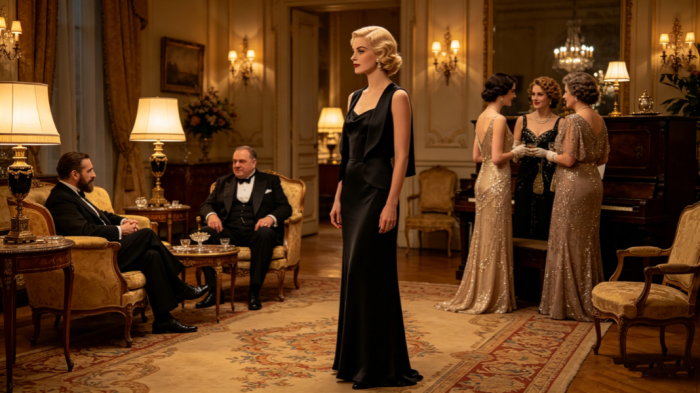
The last of them left in pairs, arm in arm, slightly drunk on champagne and their own cleverness.
I stood at the door of the townhouse on the Avenue Foch and did the needful: the double kiss, the light touch on the elbow.
"Bonsoir, Claudette. A magnificent evening as always," an actress said waving gently to me.
"You are too kind, Jeanne. The pleasure was entirely mine."
Behind me, the servants had already begun their work. The crystal glasses disappeared and the small plates bearing the remains of the canapés were spirited away toward the kitchen.
From upstairs, came the scent of my mother's perfume. Jasmine and orange blossom, the same fragrance she had worn the day she pulled me into her arms on the threshold in Marseille. Beneath it I could detect the medicinal tinctures her nurses administered three times daily. Her heart was failing; the specialist from the Hôpital Necker had suggested, bluntly, that it would take her in a matter of years. She was only sixty-eight.
I closed the front door on the last departing couple and turned to find Henri watching me from the landing.
My eldest was fourteen and already wore his father's face though the dark eyes were mine. Beside him, Louis leaned against the banister nonchalantly.
"Bed," I said.
"It's only half past ten," Henri protested.
"Bed," I repeated.
Louis, took his brother's arm and steered him toward their rooms. Henri went, though not without a backwards glance that contained both reproach and adoration. I watched them disappear down the corridor and listened until their door closed. Then I turned back to the foyer.
He was still there.
Günter Möller stood beside the sideboard, examining a small bronze by Rodin.
He had been watching my home all evening: the arrangement of rooms and the servants' movements. I had caught him studying the lock on my study door while pretending to admire a Fragonard in the hallway. He had noted which guests arrived together and which departed separately. These were not the observations of an industrialist with an interest in French manufacturing, which was how he had been introduced to me three weeks earlier at a reception at the German embassy.
"Herr Möller," I said, crossing the foyer toward him. "I thought you had left with the Beaumonts."
"Forgive me, Comtesse." He set down his glass and straightened. His French was excellent though accented. "I found myself reluctant to end such a stimulating evening. Your circle is remarkable; artists and captains of industry in the same room, and none of them at each other's throats."
"The secret is the champagne."
He laughed.
I studied him as I approached. Forty-two. His skin was slightly weathered in the way of men who spent time outdoors, but he filled out his clothes nicely, and his bearing showed no signs of the gluttony so typical of men of his class. He was quite beautiful to behold. The scent of his blood reached me before I was close enough to touch him. I touched his arm lightly.
"You must allow me to offer you one last cognac," I said. "I have a bottle of Rémy Martin that I've been saving for a guest who can appreciate it. My study is just through here."
I saw momentary surprise, a shade of suspicion. Then it passed, and he smiled.
"I would be honored, Comtesse."
I led him down the corridor toward the study door. The lock turned and the study enclosed us.
It was my favorite room in the house, and the only one I had furnished entirely to my own taste rather than the decorator's. The walls were paneled in walnut, darkened by age to the color of strong tea. Leather-bound volumes lined the shelves. I had read every one of them, though not all in this particular lifetime. A carpet from Esfahan covered the parquet floor, and the desk was Louis XV.
I crossed to the sideboard and lifted the crystal decanter.
"The Rémy Martin," I said, pouring two generous measures. "1875. A very good year, if you believe the merchants."
I could see his eyebrows rise momentarily.
"Distilled during the height of the 19th-century Phylloxera crisis," I continued
"I am quite aware of that, Comtesse, though I stand by the tongue more than the merchant," Möller said, accepting the glass. He swirled it once, inhaled, and drank. His eyes closed briefly. "Exceptional."
"I'm glad it meets with your approval."
"Your collection is impressive, Comtesse. I noticed several first editions; the Montaigne, the Rabelais. Are they for display, or do you read them?"
"I read everything. It is my principal vice."
"A modest vice for a woman of your position."
"I have others," I replied. "Tell me, Herr Möller, your factories in the Ruhr. I understand the steel industry is experiencing something of a renaissance."
"Renaissance is a generous word. Recovery, perhaps. The Führer has invested heavily in industrial capacity. There are many who see opportunity in this."
"And those who see danger?"
"Only for the enemies of the Fatherland." He met my eyes. "You understand this, I think. Your shipping interests. The routes through North Africa, the Mediterranean trade. These are not the concerns of a woman who fears complexity."
He was testing me, probing the edges of what I knew and what I might be willing to discuss.
I rose from my chair and carried my cognac to the bookshelf nearest him.
"Complexity does not frighten me," I said. "What concerns me is the man who believes he understands everything and learns too late that he understood nothing."
I turned to face him fully. Then I reached for his tie.
His breath caught. A slight dilation of his pupils, the rush of blood to the surface of his skin. The tie slid free, and I draped it over the arm of the chair.
"Comtesse…"
"Claudette," I corrected. My fingers moved to the buttons of his shirt, working them open one at a time. Beneath the starched cotton, his chest was broad, firm, and lightly furred with hair. I ran my fingers over his torso; he was absolutely delightful.
I kissed him; my tongue parting his lips, tasting and playing with him. His hands came to my waist, uncertain at first, then gripping with sudden need. I guided him backward toward the chaise, one hand flat against his bare chest, the other sliding his shirt from his shoulders.
He sat. I stood over him for a moment, letting him look. Then I drew the silk strap of my gown from my left shoulder and let the fabric fall, exposing one breast. It was, like all of me, a product of centuries of careful attention: full and firm; the nipple young and pink and already stiffening in the cool air of the study. It was not the breast of a mother of two.
"Here," I said, and guided his mouth to it.
He took the nipple between his lips with the reverence of a man who has been offered communion. I cradled the back of his head and let him suckle, his tongue circling, his breath hot against my skin. I let the other strap fall, and the gown pooled at my waist, then slid to the floor. I wore nothing beneath it save my stockings and a pair of silk step-ins. His eyes moved over me: my skin unblemished and soft like that of an eighteen year old, the waist narrow, the sex between my thighs smooth and bare.
His cock strained against his trousers unabashed.
"Take it out," I told him. "Let me see what you have for me."
He did as instructed, and I took his erection in my hand. He was already uncomfortably hard.
"Please…" he pleaded.
"Not yet," I said.
I rose and swung one leg over the chaise. Below me, his face was flushed, his lips parted, and I lowered myself onto his mouth with the brazen confidence of a cabaret performer.
His tongue found me immediately; clumsy at first, too eager, pressing too hard. I shifted my hips and guided him with gentle words as a mother might to her child. He learned quickly. The flat of his tongue dragged along my seam, parting the folds, and when he found the right pressure on the swollen bud at the apex I inhaled sharply. His hands gripped my thighs as I rocked against his face, my fingers braced on the curved back of the chaise. I could feel myself growing slick against his chin, his cheeks, the wetness gathering and flowing with each movement.
"There," I breathed. "Yes. Just there."
I leaned forward and pressed my lips to his throat and whispered, "Give me everything."
He did. And I bit down.
The skin of his neck parted beneath my teeth with the ease of ripe fruit. And I drank. His body shuddered through the last spasms of his climax, his consciousness dissolving,
The memories came with the blood.
The Rhineland. Troops crossing the Hohenzollern bridge in Cologne. The exhilaration and fervor of men who believed they were building something holy from rubble and resentment. Then: Austria, Czechoslovakia, the Sudetenland marked with arrows.
Möller had attended these briefings not as a principal but as an observer, an industrialist whose steel production entitled him to a seat near the back of the room.
I drank deeper. The memories shifted, and the room changed.
The men around this table were fewer and they wore no uniforms. A symbol was embossed on the leather folder before each of them: The Vespertine Circle. Hunters. Möller was mid-ranking. A financier, not an operative. He funded expeditions, procured equipment, facilitated introductions between the Circle's leadership and sympathetic elements within the German military and intelligence services. The Abwehr connection I had suspected was real.
All his secrets were laid waste by my feeding. The Circle had existed for centuries, claiming descent from the ašipu of Akkad and the fangxiangshi (方相氏) of the Han. They had been scribes, shamans, medieval church inquisitors; all evolving into a modern network that spanned borders and ideologies. They hunted what Möller called Nachtblüter. Night-bloods, though I was hardly constrained by mere daylight.
I took as much as I needed, enough for control. Seven full swallows. His body went slack beneath me, his breathing shallow and labored. A thread of compulsion formed as it always did when I drank deeply.
When he woke again, he would obey. Completely.
I rose and dressed.
Möller lay on the chaise like a discarded marionette, his shirt open, his trousers around his knees, the puncture wounds on his neck already closing to faint pink marks that would be invisible by morning. His breathing was regular now, though his color was poor.
I poured myself a measure of cognac and sat in the chair across from him.
"Günter," I said.
His eyes opened. They were glassy, unfocused. The thrall looked back at me from behind them.
"Tell me about the Circle's operations in France. And England, if you have anything."
He crawled to my feet and told me. I crossed my right leg over my left and let him have my toes. I preferred the more assertive, masculine person he had been before, but he had to know his place; just this once.
Günter suckled on my toes with complete adoration and his words came in an uninflected stream: safe houses in Lyon and Bordeaux, a network of informants within the Catholic hierarchy, surveillance operations in Paris, Marseille, and the south. They had killed at least three of my kind in the past decade. One in Vienna, one in Prague, one in London; all had been in the higher echelons of power. The London operation had been led by a woman.
"Her name," I said.
"Charlotte Vale-McKenzie."
I set down the cognac glass because my hand had begun to tremble.
"Describe her."
"English. Perhaps thirty. Dark hair, grey eyes. Her maiden name was Vale. She chairs the Circle's British operations from a house in Kensington." He paused, his brow creasing with the effort of retrieval. "She is considered... passionate. Her great great grandmother was obsessed with the subject. Wealthy, created an esoteric society. Kept journals. Documented everything. Her name…"
Elinor.
Elinor, who had called me Mama. Elinor, whose dark curls I had smoothed from her forehead a thousand times. Elinor, who had reached for apple blossoms with small trusting fingers while I held her steady.
Of course she had kept journals. She was her father's daughter; methodical, precise. I had left Elinor to protect her. I had left her without a word and never returned; and the money I had arranged through solicitors and bankers had provided for her family for generations. But I had not considered what else I might have left behind.
"Is Charlotte Vale-McKenzie aware of my existence?" I asked.
"Unlikely," Möller said, still sucking delightedly on my toes. "The Circle has other priorities; those who would create the circumstances to feed and enrich themselves. But there are portraits and photographs from different eras; women who do not age. We have names for some of them: the Queen; the Scholar; the Beast; the Evangelist; and also La Biche; because she always runs.
"It is a blood feud. Frau Vale-McKenzie believes that your kind have tormented her family for decades; killed her ancestors Thomas and Anne Vale. She will not rest until she has put each and every one of you down."
I closed my eyes.
I could hear Maman's heartbeat; irregular, a faltering rhythm. Beside her, the night nurse turned a page of her novel. The jasmine and orange blossom perfume had settled into the fabric of the house itself, inseparable from the plaster and the wood and the air I breathed.
Helene was not my mother. And yet she was in every way that mattered for the past twenty years; in the brushing of hair, in the quiet evenings of reading and piano, in the steadfast fiction of love that we had both agreed to maintain until it ceased to be fiction entirely.
"Claudette. My daughter." she would say. "You look exactly the same as when you returned to us. Are you doing that for me?"
I could not lose her to the Hunters. I could not lose her to the war that was coming, the war I could now see in Möller's blood.
America. Leon had said Emine was there, building something new. She was always ahead of the rest of us. The war would remake Europe's borders and bureaucracies, and in the chaos, the Circle would move freely, hunting in the rubble. But in America, we would be safe. For the time being.
I stood and crossed to the study window. The Avenue Foch was dark and quiet, the chestnut trees lining the boulevard bare in the autumn chill. Somewhere out there, in a house in Kensington, a woman was studying photographs and planning how to kill me.
I pressed my forehead against the cold glass.
Behind me, Möller lay curled on the carpet, sleeping the heavy sleep of the enthralled. Down the corridor, my sons dreamed whatever dreams boys dream of.
I would move Helene first. Then the boys. Then the factories, the shipping routes, the gold and other deposits; everything that could be liquidated or transferred. I would dismantle this life the way I had dismantled every life before it.
It would take years to complete, But I still had a minute to myself in this room that smelled of cognac and sex; and I would allow myself one more minute of believing that this was home.
Chapter 13 - Mother Courage, Marseilles, c. January 1943
The streets of Marseille were blacked out. Every window shuttered, every lamppost extinguished, the city reduced to shadow and darkness.
The Café Beaumont sat halfway down the block, its awning retracted, its doors padlocked. In the thirties, before all of this, I had hosted literary evenings in the upstairs room: poets and novelists and the occasional philosopher who believed that civilization was a permanent condition.
I walked on and turned onto the Rue de la République.
Two soldiers materialized from a doorway thirty paces ahead. They stiffened when they saw my major's uniform.
"Heil Hitler, Herr Major!" they said in unison.
I returned the salute and walked past them without breaking stride. Major Erich Brandt had a face which didn't invite conversation or interrogation. Behind me, the soldiers relaxed and continued their patrol. I listened to their footsteps recede and then I was alone again in the dark.
I found Henri's scent and followed it beyond Place de la Joliette, past shuttered warehouses and the hulks of barges tied up along the quays.
The chandler's warehouse was a squat building of grey stone wedged between a rope works and a coal depot. A wooden staircase clung to its exterior wall, leading to a door on the upper floor. I climbed the stairs and through the door, I could hear the scratch of a pen on paper. My son's breathing.
I shifted slowly back into Claudette and opened the door without knocking.
The room was perhaps twelve feet square, lit by a single desk lamp. The walls were bare plaster, stained with damp. The desk itself was grey steel, a half-eaten meal on a tin plate sat to my son's left. A Wehrmacht-stamped ledger lay open to a page of factory output figures.
Henri looked up from behind this wreckage. His dark hair was cut short and there were shadows beneath his eyes.
When he saw the uniform, he seemed surprised for a moment; then he nodded to himself, as if my presence in this form had settled something in his mind.
"I wondered when you would come," he said.
I removed the peaked cap and set it on the corner of his desk,
"Henri," I said.
"Maman."
He did not rise. He did not reach for me.
"I wanted to come earlier," I said.
"But you didn't," he said, sitting back on his chair. "So I did what I could."
He said it without self-pity, which made it worse.
"Well, do you want to know what has happened since you left?" He stood up and lit a cigarette. I could see that his fingers were shaking.
I nodded.
"When the armistice was signed," he began, "the Wehrmacht requisition office gave us seventy-two hours to convert the Villeurbanne production line to their specifications. Seventy-two hours or they would seize the factory outright and install their own management.
"I signed the conversion orders. I met with their procurement officers and I shook their hands. I redirected forty percent of our output to German supply chains: bearings, machined parts, small components for vehicles. In exchange, I retained operational control of the main factory in Lyon and the workforce."
"You don't need to do this anymore, Henri. You can leave. With me."
I took a step towards him but he distanced himself, moving towards the curtained window behind his desk.
"You don't want to hear about your old employees?" he said. "You hired some of them yourself."
"Yes," I said. "Tell me."
"Every quarter, they send new forms. Names, ages, occupations. Anyone flagged as a security risk-communists, anyone with the wrong surname -was subject to conscription for the Service du travail obligatoire."
"And Pelletier?"
"I told the auditor that he was a simpleton who couldn't spell his own name, let alone read Marx. He still works at the foundry."
"Madame Lévy?"
"Our bookkeeper. Yes, I listed her under a false name on the payroll. She stayed on the books for fourteen months until someone in La Résistance could arrange passage. She's in Switzerland now, or so I'm told."
"You did a good thing," I said, but he wasn't really listening or looking for my affirmation.
"The Villeurbanne annex," he said. "I had to sign it over to Rheinmetall's French subsidiary. It employed sixty-three workers. When Rheinmetall took control, thirty-eight of them were transferred to factories in the Ruhr. I don't know how many are still alive.
"That is what I did," he said.
I had listened without interrupting for the most part, but beneath the composure, I was crumbling. The knowledge that my son who was barely a man had been forced to make these calculations at all; had signed forms that determined whether people lived or were shipped east was more than I could bear.
I decided to say it plainly because there was no other way about it; and the events were still fresh on my mind.
"Henri," I said. "Louis is dead. He was killed at Bir Hakeim in June. In Libya."
Henri's jaw tightened and he turned his face toward the window.
"What was that fool doing in Africa?" His voice cracked. "Why did you let him go?"
"He volunteered. I could not have stopped him even if I had known in time." I did not tell him that I had been there when it happened.
"You could have stopped him. You could have stopped anything."
Henri's hand pressed flat against the desk, as if he were trying to hold something in place. When he turned back, he wiped his eyes with the back of his wrist in a single quick motion.
"He was always the good one," Henri said.
I waited until his breathing steadied. Then I shifted.
"The war is already decided," I said, as calmly as I could. "The German Sixth Army was encircled at Stalingrad last November. Three hundred thousand men. The Russians will push west soon, and they will not stop until they reach Berlin. It's only a matter of time now."
Henri watched me with the same careful blankness he had worn when I entered.
"When that happens," I continued, "every name on every requisition form, every signature on every collaboration document, becomes a liability. The liberation will not be gentle, Henri. Our people have a long memory for traitors and a short one for context."
I watched him closely but he betrayed nothing. "I have a route prepared. Spain first; I have contacts in Barcelona who can move us across the border. Then Lisbon, where a ship departs for New York every ten days. I have the papers, for both of us."
He was quiet for a long time.
"No," he said.
"Henri."
"I've heard from a contact in the French National Police. Bousquet is planning an operation in Marseille. A cleansing, like scrubbing a kitchen floor. Dissidents, Jews, vagrants; anyone with suspect papers." He pulled on his cigarette and turned it between his fingers. "I still have access to transit documents. I still have contacts at the prefecture. I can get papers for perhaps a dozen people, maybe more, before the operation begins."
"And after?"
"After, I'll manage," he said. "Call it penance. I'm sure you are pleased to hear that I haven't lost all my conscience."
The silence that followed was the kind that precedes an earthquake. Henri's fingers were still clinging to the glowing remains of his stub, but they had gone white at the knuckles.
"You never told us," he said. "But Louis and I both suspected. We used to talk about it when we were boys, after you'd gone to bed. How Maman never got sick. How Maman never aged. How Maman's skin was perfect in every photograph, in every light, at every hour. Louis thought you were a saint. Some kind of miracle." He stubbed out his cigarette. "I was less romantic."
He reached beneath the desk and produced a slim leather notebook, its cover cracked with age. He set it between us but did not open it.
"I've done my own research," he said. "Our German friends are especially concerned about this sort of thing, as it turns out. There's an entire department-SS-Ahnenerbe, the ancestral heritage office-that collects folklore and artifacts related to vampirs. They consider it a matter of racial science."
I flipped the notebook on to its front. A journal from my London years, written in a cipher that mixed French with Ottoman Turkish. I had thought it lost in the move from Marseilles to Paris.
"You're forty-seven this year, Maman," Henri said. He gestured at my face, the skin luminous even under the merciless white of the desk lamp. The face of a woman no older than thirty. "Look at yourself."
I shook my head.
"Or have these slips been your way of gently letting us know the truth?" he added.
I could have lied. I had lied for nearly four hundred years, to lovers and children and kings and priests, and each lie had come as easily as breathing. I had lied to Thomas, my gentle engineer who planted apple trees. I had lied to Elinor, my daughter, whose dark curls I could still feel beneath my fingertips. I had lied to Maman, and to every man and woman whose blood I had taken while whispering endearments.
But I could not lie to Henri. Not now.
"I understand," Henri said, when I did not deny it. "I haven't even asked you how a woman of forty-seven, a socialite at that, managed to get past German checkpoints and into the …tat Français." He tilted his head. "Or how she planned to bring her son safely out. By persuasion? By charm?" He paused. "Or by something else?"
He knew what I could do, the way children guess at the adult secrets that shape their world. He was taller than me by several inches, and in the dim light he looked less like the boy I had held against my chest and more like a man who had been forged in a furnace I could not control.
"Please, Henri." My voice broke on his name. "I'm begging you. Your mother is begging you. Please come with me."
His eyes were moist again, and I could see the effort it cost him not to look away.
"Henri, I can't lose both of you. Please. Come with me."
"You've already lost me, Maman."
I shook my head desperately. "No, no, no. Don't… don't say that."
"Then take my will, Maman," he said. "It's the only thing you haven't already taken."
I looked at him, wild-eyed. Surely he knew that I would never do such a thing. There were limits, and those limits were all that was left of my humanity.
My hand moved toward him, a small, involuntary motion, the hand of a mother reaching for her child across a table, across an apple orchard, across an unbridgeable distance. My fingers extended, trembling slightly, reaching for his wrist, any part of him that I could hold.
Then they curled back. My hand returned to my side, the fingers closing into a loose fist that pressed against the seam of the major's trousers.
I picked up the peaked cap from the corner of the desk and settled it on my head. I turned to the door.
"Maman," Henri said.
I stopped. I did not turn.
The silence filled with everything he might have said-I love you or Don't go or I forgive you-and everything I might have said in return.
I opened the door and stepped into the stairwell. The bolt slid home behind me and I stood there on the landing for a moment, listening to it echo.
Then I descended the stairs, and the darkness swallowed me whole.
Chapter 14 - The Descendants, New York, c 1980
His hand was in my hair before I could catch my breath.
Tim yanked me off the mattress and onto my knees on the stained carpet. The fluorescent tube above the bathroom door cast everything in a sickly yellow wash that made his skin look jaundiced. He was already hard, his cock jutting from the open fly of his jeans, and he gripped the back of my skull with both hands and shoved himself into my mouth.
"Open wider, you dirty whore," he grunted.
I opened. He pushed deep, well past my tongue into my throat. The spit gathered at the corners of my lips and spilled down my chin. I knew he liked the mess and the sheer obscenity of it. His hips snapped forward and I took him to the root, my nose pressed against the wiry hair of his groin. He held himself there until my eyes watered.
Then he pulled out and slapped his cock across my face. The shaft was slick with my saliva and it left wet streaks across my cheekbone. He tilted my chin up with one hand, admiring his work.
"Fucking beautiful," he said.
He hit me with it again, harder this time, the swollen head catching the corner of my mouth. I looked up at him through the tangle of my bleached hair, which was half-plastered to my face with spit and sweat.
Then he grabbed my shoulder and spun me around, pushing me onto all fours. I allowed myself to relax, aware of what was coming next. He bunched my skirt up around my waist and entered me in a single hard thrust that drove the air from my lungs. I moaned. I couldn't help it. Whatever else Tim was, he fucked like a man with nothing to lose.
"That's it, bitch," he said. His fingers knotted in my hair, pulling my head back until my spine curved. "Take it."
He slammed into me hard enough that it shook the bed frame against the wall. Then he came inside me with a strangled groan, his warm seed flooding my cunt.
"Clean me up," he said, pulling out and rolling onto his back on the bed. "And make sure that you enjoy it."
I turned and took him in my mouth again. He was softening, slick with both of us, and I licked him clean; moaning and smiling as if I was having the best meal in my life.
"You missed a spot," he said, pointing to his balls.
I took each of them into my mouth, removing any residue cum on them. Then I swallowed, wiped my lips, and sat back on my heels.
Tim reached for the nightstand drawer.
I knew what was in it before he opened it.
"Don't," I said.
"Piss off, Stella."
"You're killing yourself."
He had already tied off his arm, the tourniquet clenched between his teeth while he worked the lighter beneath the spoon.
"I said don't."
"And I said piss off." The needle found its mark, and he pressed the plunger. His eyes rolled back. His jaw slackened. For a moment he looked almost peaceful.
"You stupid bastard," I said quietly.
He should have gone under for at least a half hour but he soon came back to himself. His supply had clearly been cut with more sugar than actual product. A fucking idiot; a fucking idiot that I once thought I loved or at least liked enough to shack up with.
Something shifted in his face, the non-existent chemical warmth curdling into aggression.
"Don't you fucking lecture me," he snarled. He lurched off the bed and swung at me with the flat of his hand.
I caught his wrist and redirected him with as much effort as one might use to close a door. He hit the far wall shoulder first and slid to the floor.
He stared up at me, panting despite the junk in his veins, his mouth open.
I stood over him and felt the hunger coil in my belly. His pulse was visible at his throat. It would be easy. He coughed and his ribs showed through his skin like the scaffolding of a tent. He was dying, another epidemic of consumption was crawling through the land; and the smack was his only comfort.
He looked like Maman before she died. She had gone the same way; cancer and morphine. She had died believing I was her daughter, and in every way that mattered, I was.
And the rest? Louis' body was somewhere in North Africa. Henri survived. He had run the factories under Vichy, made the decisions required of him to survive, and after the Liberation he had stood before a tribunal and been acquitted but not forgiven. He was sixty now, living quietly in Normandy with his wife. I sent money through intermediaries, from accounts that bore names he would not recognize. He lacked for nothing except a mother.
I carried Tim, still wide-eyed, to the bed where he quickly dozed off.
I moved to the cracked mirror above the sink. The face that looked back at me was twenty-two, perhaps twenty-three. I had bleached my hair platinum and cropped it jagged with kitchen scissors. Hasan ibn Selim. Stefánia. Stéphanie de Villon. Anne Vale. Stephen Vale. Claudette D'Arboussier. Comtesse de Montfort. Now Stella Vane, guitarist and backing vocalist for a band that played to crowds of fifty in venues that smelled of stale beer and vomit.
Love hadn't helped me forget. The abuse hadn't made me forget.
I pulled on the torn fishnets, working them up over my thighs. My leather jacket was worn and heavy with band pins, my boots steel-toed and scarred.
In the mirror, Tim stirred.
"We're on in two hours," I said. "Get yourself together."
Then I grabbed my guitar case and walked out into the hallway.

Charlotte Vale-McKenzie was seventy-eight years old but carried herself like a much younger woman.
I had chosen a corner table and was wearing a nondescript trench coat over a black dress, my bleached punk hair hidden beneath a silk scarf.
She saw me and crossed the terrace, walking stick in hand.
"Miss Vane, I presume," she said.
"Stella will do. Tea? Or would you prefer coffee?"
I counted three men: one at the neighboring table pretending to read the Times; one standing near the entrance with a newspaper folded under his arm; and a third at the corner of the block, leaning against a mailbox.
"Your men are very professional," I said.
"They should be. I trained most of them personally."
"I did request to speak alone." I brought the teacup to my lips.
By the time I took my third sip, the man at the entrance was gone. At the corner of the block, the mailbox stood alone. And the third man at the neighboring table had left his coffee half-finished and had begun a leisurely stroll south on Madison.
Charlotte's jaw tightened, but she did not panic. She turned back to me with a composure I had to admire.
"Compulsion," she said. "You fed on them."
I didn't answer her.
"Then you could take me now. Make me your puppet. Add me to your collection."
"I could."
"But you won't." She reached for her tea and poured some milk with steady hands. "Because if you make me your thrall, my people have standing orders to kill me on sight."
She said it as a simple statement of fact. The Vespertine Circle had survived for centuries by treating sentiment as a vulnerability to be eliminated.
She set down her spoon. "What do you want?"
Even with the passage of years, I could see the traces of Anne and Elinor on her face. She was my blood, however distant, however hostile.
"Thomas Vale did not die of consumption," I said.
"Elinor Vale, his daughter, thought as much," she said.
"He died because his wife loved him," I continued. "Because she lay beside him every night and drew the life from him without knowing it. The consumption was a convenient explanation, and the doctors of the time knew no better."
"His wife. You mean Anne Vale."
"Yes."
"Anne Vale, who disappeared without a word," Charlotte continued. "Who left behind a legacy that Elinor spent the rest of her life trying to decipher."
"The very same," I said, "She left to save her daughter from the same fate as her husband. And arranged finances through solicitors to ensure that Elinor and her children would never want for anything."
I removed the silk scarf from my head. My bleached hair caught the sunlight, but it was not the hair Charlotte was looking at. It was the face beneath it.
"I am Anne Vale," I said. "Your great-great-great-grandmother. And I killed Thomas because I loved him too much. And I left Elinor because it was the only thing I could do to protect her."
Charlotte stared at me. Her teacup sat forgotten in her hand, the steam rising between us.
"Elinor believed whatever took her father took you as well," she said.
"Elinor was half right. I was her mother, and I was something else besides."
The silence between us was filled with the sound of traffic, the clink of other people's china and the vast, unbridgeable distance of two centuries.
"Not all of us deserve to die," I said. "Some of us have only ever tried to love the people we were given, and failed."
Charlotte set down her tea. She gripped the silver handle of her walking stick and rose from her chair.
"This changes nothing," she said. But her voice had lost its edge.
She walked away across the terrace without looking back, her stick clicking against the flagstones.
I sat with my cold tea and watched her go as if she was somebody else's child.
The paintings hung in pools of muted light against red walls. Unfashionable Old Masters mostly: a middling Titian, a Caravaggio of questionable provenance, and an oil by Lucas Cranach were among the highlights.
I moved through the preview gallery with a glass of champagne I had no intention of drinking, my heels clicking softly on the marble floor. I had changed for the occasion: a black sheath dress, my hair now dark and straight. The punk wardrobe was folded in a suitcase at the Waldorf Astoria. Stella Vane, punk rocker, did not attend stodgy gallery shows.
She was standing in front of the painting by Cranach when I found her. Dr. Ilona Harrow-or Leyla or Leon-wore a tailored jacket of dark blue over a cream silk blouse, her hair cut in a sharp bob. She was presenting female again for God knows what reason.
"You've got nerve showing up here," she said, without turning around.
"And a lovely evening to you too, Ilona."
She turned and gave me a fast once over.
"Back to your usual self I see. Too much of a taste for riches and decadence?" She took a sip of her champagne. "Emine has spoiled you. Just like she spoils herself."
"Emine hasn't spoken to me in over a century."
"That you know of." She gestured at the Cranach. "This was hers. Half the lots in this auction are hers or passed through her hands at some point. She's liquidating. Maybe she wants to buy you a present."
I studied the painting, a hitherto unknown version of The Procuress, probably of lesser quality than the one in the Georgian National Museum.
"You think she arranged the D'Arboussier business," I said.
Ilona tilted her head, a mannerism she had carried across centuries from Leyla to Leon.
"A wealthy French family loses their daughter in 1914. Four years later, a private investigator locates a woman of identical appearance working in a Marseille brothel. The resemblance is perfect. The family's gratitude is boundless. And a vampire who had been living hand to mouth suddenly finds herself installed in a villa with access to shipping networks, industrial wealth, and social connections that span the Mediterranean." She paused. "It would be just like her to do so. Did it happen on your birthday perhaps?"
Ilona had told me on more than one occasion that she found the daughters of Emine to be positively insufferable.
"Impossible," I countered. "She can't control what form I choose to take. Unless… your Swiss contact was compromised."
Illona raised her eyebrows.
"The real Claudette," I said. "What happened to her? Do you know?"
"Dead, I suspect. Probably before the war." She shrugged. "Emine is patient. We both know that."
I thought of Papa weeping in the madame's office. His tears had been real. His love had been real. The entire edifice of the Claudette years, built on a foundation of genuine human grief that Emine had identified and exploited.
"She's a monster," I said.
"And yet you loved them. Your parents I mean; you told me so," Ilona corrected. "And she is your maker, you have no right to complain."
"Enough with the potter and clay analogies. Emine isn't God."
She turned back to the painting, and we stood in silence for a moment. Around us, the preview crowd murmured and sipped. A man in a pinstripe suit raised his catalogue toward the Caravaggio and whispered something to his companion about investment potential.
Then I felt it.
A resonance in my blood. Ilona stiffened beside me, her champagne glass arrested halfway to her lips. We both turned toward the gallery entrance.
The woman who entered was Chinese, in her forties, dressed in a silk blouse of deep burgundy with a mandarin collar. She approached us directly, with no pretense of browsing.
Ilona exhaled. "It's only you," she said.
"Did you think someone was coming to eat you?" the Chinese woman said, elbowing Ilona's upper arm.
"And what would be the point of that?" Ilona replied. "Stella, this is Mei Xue [美雪]."
The woman inclined her head. "Āimǐnà's child," she said.
"I beg your pardon?"
"埃米娜," Mei Xue repeated. "Your maker's name, or the one she used when we first met. It was some centuries ago. She was trading porcelain in Chang'an, and I was still pretending to be a concubine in the court of Emperor Xuanzong." A faint smile crossed her lips. "A tedious assignment, though the poetry was exceptional."
"Tang Dynasty," Ilona murmured beside me, as though offering a footnote.
"You knew Emine," I said.
"Knew her. Argued with her. Avoided her where possible." Mei Xue's eyes were fixed on Illona.
Ilona touched my elbow and steered me a few steps from the nearest patrons. Mei Xue followed, and the three of us formed a small constellation beneath a small Rembrandt etching.
"You need to disappear," Ilona said. Her voice had dropped the wry amusement. "The Hunters are active. Charlotte Vale-McKenzie may have left you standing in that café, but she will not leave you standing forever. What you did during the war, the thrall you made; it's too much, Stella. You've forgotten the first rule."
"I haven't forgotten anything."
"Then act like it." She glanced at Mei Xue. "Our sister has resources in the East. Networks that the Vespertine Circle hasn't penetrated. If you're willing to let go of the leather jacket and the electric guitar for a decade or two, she can help you become someone the Hunters cannot find."
Mei Xue regarded me dubiously.
"I have a place in Singapore," she said. "Quiet. Beautiful. Far from the concerns of Europeans who believe they invented immortality."
I looked across at the Cranach one last time but Mei Xue tapped me on the shoulder.
"That isn't the one for you," she said, opening a catalogue and pointing at one of the lots. "This is what Āimǐnà wants you to buy."
I looked down where her finger was: an 1863 first pressing of Goya's Disasters of War, whole and intact. $20,000 high estimate without the juice.
"I'll think about it," I said.
"Think quickly," Ilona replied.
She kissed both my cheeks and then both she and Mei were gone, absorbed into the gallery crowd as smoothly as blood dissolving in water.
Chapter 15 - The Book Critics, Singapore, c. 1982
The girl appeared in the doorway like a wet cat.
She was nine, maybe ten, school uniform plastered to her small frame. White blouse gone translucent, pinafore dark with water, white socks soaked through inside canvas shoes. She clutched her school bag to her chest with both arms as though it contained state secrets rather than a pencil case and a maths workbook.
She slipped down the far aisle, squeezed herself into the gap between two shelves, pulled her knees up to her chin, and opened a book she had clearly chosen before hand. A small puddle began to form beneath her.
She had first appeared two months ago, locked out of her flat because she'd forgotten her keys, with nowhere to go until her parents finished work.
As for myself, I was where I usually was from Monday to Saturday-behind a counter re-stickering returns.
The shop occupied a narrow slot on the second floor of Bras Basah Complex; a few walls of wooden shelving lined deep with dog-eared paperbacks: Danielle Steele, Sidney Sheldon, and Jackie Collins on one side; Ludlum, Clavell, and le Carré on the other; and the children's section crammed into the back corner where the spines of the Famous Five, Secret Seven, and Nancy Drew were arranged in order of publication.
It was Mei Xue's of course, but I got to keep all the "profits" after rent. She had set me up here twelve months ago with a lease, an awesome inventory, and instructions to be boring. "No salons," she had said. "No industrialists. No champagne. Just sell books and be nobody."
The shop operated on a rental system: buy a book, return it within a week for a partial refund. The girl had never paid for anything. The New Yorker in me almost told her: "This isn't a library, kid." But I let it pass.
After about ten minutes I set down the pricing gun, picked up a stack of returns that needed reshelving, and drifted down the aisle on the pretext of straightening the children's section. I slotted a Hardy Boys back into its place and glanced down at the cover in the girl's hands.
The Crooked Bannister.
"You should skip that one," I said. "It's kind of stupid."
She looked up, not exactly surprised at my critique. This wasn't the first time I had commented on her reading choices.
"The robot is fun," she said.
I considered this. The robot was, admittedly, not the worst thing about The Crooked Bannister.
"Hmm," I said. I reached up to the shelf above her and pulled down a copy of The Mystery at Lilac Inn and held it out to her.
She eyed it with open suspicion. The look on her face suggested I had offered her a plate of vegetables.
"That one's for old people," she said.
I raised an eyebrow. "Are you calling me old?"
She regarded me with a slight frown. "All aunties are old," she said.
I pursed my lips for a moment, then let out a small chuckle. She was right of course; and The Mystery at Lilac Inn was a teensy bit racist. I set the book on the shelf beside her, within easy reach, and went back to the counter without another word.
The rain continued. She read. I worked.
It was late afternoon when the door burst open and a woman stumbled through it, umbrella dripping.
"Xiao Lin!" she called. "Xiǎo Lín! Nǐ zài nǎlǐ?"
The girl scrambled to her feet, remembering to return The Crooked Bannister to where she found it. Her mother spotted her and the relief that crossed her face was immediately replaced by fury. She seized the girl's hand and began scolding in rapid Mandarin.
I came around the counter, picked up The Mystery at Lilac Inn from the shelf where I had left it, and held it out.
The girl looked at me. Then at the book. Then at her mother, who was already pulling her toward the exit; then took it with her free hand and pressed it to her chest. They were halfway down the stairs when the girl twisted back to look at me over her shoulder.
I lifted one hand in a brief wave.
I stood behind the counter for a moment, my hand still raised. Then I lowered it and picked up the pricing gun and went back to my stickers.
Chapter 16 - The ingénue, Paris, c. 1990
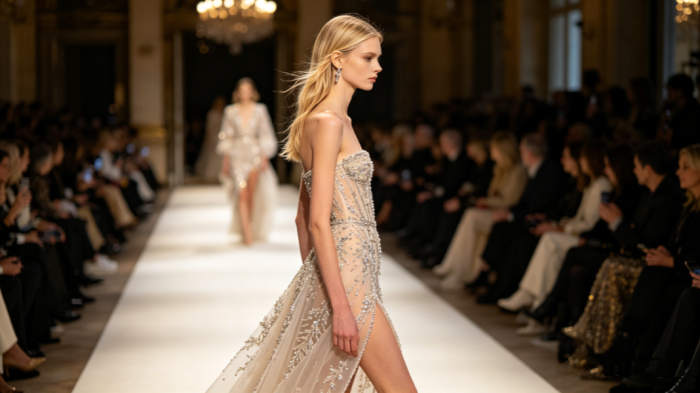
The fifth casting of the day took almost two hours.
I had changed out of my sneakers into heels the moment I arrived; then stood in line with the rest of them, my portfolio beside me. By the time my turn came up, there were fourteen girls in the waiting area, all of them smelling of desperation and hunger.
As for myself, I was seventeen on paper, with a body that fulfilled industry expectations: sharp collarbones; ribs faintly countable through my shirt; almost prepubescent in form. The industry wanted girls who looked like they might snap in a strong wind, and I had obliged.
"Samantha Petit."
I stood, tucked my portfolio under my arm, and walked through the door.
A single casting agent in a charcoal turtleneck held court behind a wooden table, flanked by her assistants. She did not look up. I stopped at the mark on the floor, exchanged a few pleasantries. My manager said that they were looking for girls with a good personality though all that really meant in reality was girls with the right look and who were thin enough to fit the clothes.
The agent nodded expectantly, and I walked.
Away from them first, to the far wall, then back. The agent marked something on her clipboard. "Fitting," she said, and a woman with a fringe gestured me towards the adjoining room.
The first outfit was a Lagerfeld reimagination of the house staple: a skirt suit in candy-pink tweed, the hemline shortened to mid-thigh, the jacket cropped and collarless with gold-chain trim at the pockets. They dressed me with the brisk efficiency of stable hands tacking a horse. The tweed was heavier than it looked, beautifully constructed. I walked in it. The agent made another mark.
Back behind the partition. The suit came off and the evening gown went on: blue velvet, panels of silk chiffon at the sides that showed my flanks, mesh inserts at the décolletage scattered with seed pearls.
I walked again. The agent nodded and her assistant confirmed my contact details.
They brought me to a second changing room further down the hall: smaller, windowless, lit by a single floor lamp. A copy of a Louis XVI fauteuil armchair sat in the corner, its gilt frame incongruous against the concrete walls. Three assistants waited: two women I had not seen before and one of the assistants from the casting room.
They began removing the gown. Their hands were careful, but as the silk chiffon slid from my arms, something shifted in the quality of their touch. The one behind me smoothed the gown's bodice with a palm that pressed too long against my ribs. Another let her fingertips trail the length of my bare arm with the unhurried deliberation of someone appraising livestock. The third knelt to unpin the hem and, as she did, ran her thumb along the inside of my ankle.
Then I felt it, a faint sting at the base of my neck. A needle, delivered through a ring-mounted pin. The compound entered my bloodstream and was metabolized instantly. A compliance drug.
I let my eyes go soft. My posture loosened and I let myself fall into their arms. I gave them exactly what they expected.
Their faces first. A woman with a severe-fringe appeared to be the main handler; mid-thirties, a scar at her left ear. The second was younger, dark-haired, with the posture of a former dancer. The third was in her thirties, tall and gaunt in a way that suggested she had once been one of us. All three shared the same quality behind their eyes: a flatness, the particular vacancy of a mind that had been drunk from and refilled with instructions. Thralls.
"Trop parfaite," the dark-haired one whispered.
"Madame will want to see her," the handler replied.
"Is she still awake?" the gaunt one asked.
The handler turned to her. "Go watch the door."
The gaunt woman slipped out. The other two turned back to me.
They stripped me completely and arranged my body in the Louis XVI chair as if I were a doll being posed for a portrait. The dark-haired one lifted my left leg and draped it over the armrest, opening me entirely. They examined me with the impersonal attention of horse traders inspecting teeth.
"No marks," the handler said, running a finger along the inside of my thigh. "No scarring. No stretch marks. The skin is…" She paused. Her jaw tightened. "Flawless."
"Elle a le corps d'une chienne," the dark-haired one said. She has the body of a bitch.
The handler cupped my left breast and squeezed, her fingers pressing deep enough to leave marks on anyone whose skin did not heal in seconds. "Boyish tits on a girl who probably opens her legs for anyone with a camera." She released me and wiped her hand on her skirt in mock disgust.
I heard a polaroid being taken.
The dark-haired one was staring at the juncture of my spread thighs. She reached down and flicked my clitoris with her middle finger, a sharp, contemptuous snap; then roughly forced two fingers into my vagina.
"A slut. Built for one thing," she muttered. "Madame picks them like this. Always like this."
"Keep your voice down," the handler said. But she didn't disagree.
Then they pulled back. I heard them gathering the discarded gown, folding it with care-the couture, at least, deserved respect. Then they threw a rough wool blanket over me and were gone.
I lay in the chair with my left leg draped over the gilded armrest, my body half exposed to the empty room. I held the stillness for thirty seconds, cataloging what I had learned.
Three thralls. A handler with a network. A "Madame" who selected girls by physical perfection and used fashion castings as a procurement system. The jealousy was real, which meant the thralls retained enough of themselves to feel, which meant their maker was either careless or cruel.
I dressed myself, waited for the hallway to empty, then left.
Outside, the Rue du Faubourg Saint-Honoré was doing what it always did: selling beautiful things to people who believed that beauty could be bought. Which was not completely untrue.
I stepped into the October air and felt the hunger stir.
The flat on the Rue de la Roquette had been arranged by Mei Xue and was four flights up a stairwell. Two single beds, a hotplate, a window that looked onto a brick wall close enough to touch if you leaned out.
Tammy Briggs was on her third cup of instant coffee and her first cigarette of the evening; seated cross-legged on her bed in a cotton slip. Her shoulder blades jutted through the fabric and her ribs showed even more than mine. She had been two years with Mei Xue's agency.
"I may have got one," I said, setting my portfolio against the wall.
"Which one?"
"Chanel. What about you?"
"Nothing firm but I'm booking more compared to last fashion week. So I'm fine," she said, though she didn't seem that fine. "The last casting was the worst. He didn't even look at me. He just marked something and waved me on. I might as well have been a coat rack."
Tammy laughed, and for a moment she seemed like the girl who arrived in Paris two weeks ago, fifteen pounds heavier and crying because she knew she would be turning twenty in two months time.
I crossed to the hotplate and filled the kettle.
"Coffee?" I asked.
Tammy nodded; I knew she needed the caffeine to reduce her appetite, which wasn't ideal but preferable to inducing vomiting after a meal. While the water heated, I set a baguette on the counter near Tammy's elbow. She glanced at it and looked away.
I had seen famine. Real famine; the kind that followed sieges and scorched-earth campaigns, that turned villages into open graves. This was something different; a famine of the will.
The bread sat untouched on the counter but she took the cup of coffee I offered.
I changed out of my tights and crawled into bed with her. We could have been twins apart from the differences in hair color: faux prepubescent girls with flat chests, skin stretched tightly over bone.
I cuddled up to her back. "As a man, it was always about strength," I said, half to myself. "For a woman, it's this. But beauty for a woman is power. Every door is open to you when a woman is beautiful."
"Mm." Tammy was staring at the brick wall through the window. "And neither of us has enough of it, apparently."
I didn't correct her; she had heard too many casting agents and managers recount the flaws in her body and "personality" to think otherwise.
"I should wash my hair," Tammy said, without moving.
"You should eat that bread."
"I had lunch."
She hadn't. I knew because she had been at castings since nine and the agencies didn't feed you and the cafés near the Faubourg were too expensive.
"I could force you…" I said whimsically.
"Right…"
I let it go. You could not force someone to eat any more than you could force them to live. And Tammy was nearly twenty, a young woman who knew exactly what she needed to do to get what she wanted.
At half past eight, Tammy swung her legs off the bed and reached for her coat.
"Going out," she said, buttoning it with fingers that fumbled slightly. "Some girls from last year's Lanvin show. Drinks at a place in the eleventh."
"Which place?"
"New one. Very exclusive apparently. Members only sort of thing."
"Have fun," I said.
"Always do, darling."
Mei Xue had told me that this would happen; asked me to look into it because I had a bit of French.
Tammy left. I listened to her footsteps descend the four flights, then the street door opening and closing.
Then I pulled on my coat and followed her out into the wet Paris night.
I followed at a distance of thirty meters, close enough to keep her coat in sight.
She turned onto the Rue Oberkampf, then turned into a narrow courtyard through a passage between two buildings. At the far end, a door in the stone wall stood open just enough to reveal a slice of interior: low red light, the gleam of polished wood. Tammy disappeared through it, and the door closed behind her.
I waited.
The presence came before any sound or sight. Another immortal; close, younger than myself by a significant margin. The signal was uncontrolled, which told me the creature inside was either arrogant or untrained.
I pressed my back against the wall and did what Emine had once done to me: I folded my presence inward, dampened it. It was a trick I had spent decades learning, to become a shadow that cast no shadow.
Twenty minutes. Then a side door opened in the alley, and a woman stepped out.
She was dark-haired and olive-skinned, appearing to be in her late twenties. Her coat was too large for her frame and cut in a style that belonged to a decade earlier; an army surplus piece, perhaps, or something scavenged from a charity bin. She moved with unguarded confidence, and she did not sense me standing six feet away in the dark.
I stepped out of the shadows.
"You're the one running the girls," I said, in French.
She moved first; faster than any human, her fingers shooting toward my throat like razors. I caught her wrist and pulled it firmly behind her, then kicked her legs from out under her. I leaned over and drank from the base of her neck.
The memories came in fragments, unprocessed by the centuries of reflection that eventually organized creatures like us.
A French soldier in the mud outside Zaragoza, the stink of powder and shit, the Spanish heat. A woman beneath him, her mantilla and bodice torn but seemingly unafraid, smiling curiously at him. Then the same woman's face above him, beautiful and terrifying, her mouth all red. Then waking in a body that was rearranging itself. Weeks of confusion, rape upon rape by his fellow French soldiers who do not recognize him. Years in a cheap Spanish brothel, learning to hunt and feed. Then the long trek back to France; decades of feeding without understanding, killing without intention, creating thralls from the wreckage of her appetites.
I released her wrist.
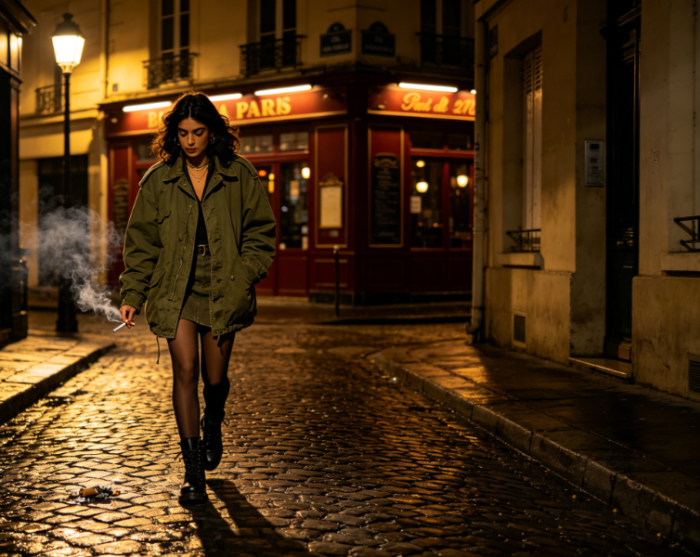
Clémence did not run. She stood in the alley glaring at me, her hands balled into fists.
"Peace, sister," I said. "I understand your situation. I want to help."
"You're going to tell me to stop."
"No, to be careful." I leaned against the alley wall and crossed my arms. "Your body has needs, but I've buried two of our kind who thought they were careful. Too many bodies, too many people who notice."
"I don't kill them," Clémence said. "I wouldn't do that. They're only girls, like… me."
"The thralls," I said. "The girls you recruit through that door. You don't kill them, but you take their will and replace it with your own. You tell yourself it is a kindness because they're still breathing. But the real reason is that you don't know how to do otherwise. I can teach you."
Her jaw clenched.
"The last one you took," I pressed. "Did you learn her name? The family she left behind to be with you?"
The silence that followed was its own answer.
"In 1713, I fed from a child in Austria. A plague orphan. I told myself it was mercy, that I was easing her passage. And perhaps I was. But I felt her fear. She was four years old and she was terrified." I paused. "I still feel it. Three hundred years, and I can still feel her fingers clutching at my sleeve. But only because I want to; because I want to make each life weigh enough to notice."
Clémence's shoulders dropped but she was still defiant.
"A pretty story," she said.
"A hundred years from now," I said, "you will either be someone who chose how to feed, or someone the feeding chose. The first kind can sit in a café, feel the hunger in her belly and not act. The second kind becomes the hunger entirely.
"Taking without choosing makes you a slave." I held out my hand. "Let me show you what freedom looks like."
From inside the club, Tammy's laugh floated out through the stone wall. It was bright and unguarded and entirely unaware of what moved in the dark around her.
Clémence flinched at the sound.
She did not take my hand. But she nodded.
I lowered my hand and turned toward the lit street at the end of the alley. Clémence fell into step beside me. Behind us, the red door stayed closed, and Tammy's laugh faded into the wet stone and the night air.
Chapter 17 - The Visit, Normandy, 1998
The neighbor who let me in was a stout woman in a wool cardigan.
"He has been sleeping most of the morning," she said. "The doctor was here at ten."
The room was small. A single window with white cotton curtains let in a flat, milky light. A bedside table held a glass of water, a row of prescription bottles, and a small framed photograph of a woman. Henri's wife. She had died four years ago according to my solicitors.
Henri himself lay propped on two pillows, his breathing shallow, his hair white and fine.
I sat in the wooden chair beside the bed and took his hand in both of mine. His skin was thin and cool, his fingers curling slightly inward.
His eyes opened. A momentary frown-I was still Samantha Petit, barely twenty-six-and then he understood.
"Maman," he said.
I squeezed his hand, nodded, and was quiet for a moment.
He was too drowsy and too weak to carry a conversation. His eyes drifted, caught on my face, drifted again. So I began to talk, as you would to a child who needs the sound more than the sense.
"Before France," I said. "Before Claudette. Before any of that, I had a life in England."
His eyes found me again for a moment.
"A modest house," I continued. "Red brick. And there was an apple orchard which I tended to for years. He was an engineer, like your grandfather. He built canals and bridges, and he came home every evening before dark because he promised his wife that he would."
"You had a sister," I said. "She had dark curls and grey eyes, and she learned to read by the fire while her father drew lock gates at his desk. And her mother…" My thumb pressed lightly into his palm. "Her mother loved them both but it was not enough to save either of them."
Henri's breathing had steadied. His eyes were half-open, tracking my face.
"I left her," I said. "I left her because I thought that staying would have killed her. I failed that time, as well. As a mother."
Henri's fingers tightened around mine.
I sat with him, his hand still in mine.
The coughing came without warning.
His chest seized and his body curled forward, and he held his sides because of the pain it caused. I rubbed his back and held a handkerchief to his lips and waited.
It passed. He settled against the pillows, his breath ragged. But after a moment, impossibly, the corner of his mouth lifted.
"And where," he said, "did you develop a green thumb, Maman?"
I let out a low, warm laugh and smiled at him. He was right, of course. I had never demonstrated any inclination for plants in all the years he had been with me. But I had an explanation.
"I once walked the gardens of Versailles, my darling," I said. "During the reign of Louis the Fourteenth."
Henri's eyebrows lifted.

"Allow your mother to impress you," I said, with a raised finger. "The director of the royal fruit and vegetable gardens was a man named Jean-Baptiste de La Quintinie," I continued. "He was an extraordinary man. A lawyer by training, turned gardener by conviction. His Instruction pour les jardins fruitiers et potagers is one of the bibles of modern horticulture and agronomy."
Henri shook his head; in wonder or ignorance I could not tell; but his eyes were open now. I drew a breath and recited his dedication from memory:
"'Nature, which-it seems-takes pleasure in denying Your Majesty nothing, whom you indeed regard as the most perfect of your works, has doubtless reserved for your august reign what the earth has hidden from all past ages. It is only through sheer toil that ordinary people wrest from the bosom of this common mother what they are obliged to ask of her every day for their sustenance, because her strongest inclination is to produce only thistles and thorns; but if Your Majesty continues to favor with your gaze those who have the honor of cultivating her in your gardens, we shall see, to the glory of our monarch and to the advantage of humankind, that what was unknown to all antiquity will no longer be unknown to anyone. This Earth, which seems so stubborn towards everyone, will finally yield, even, so to speak, with some joy to the slightest command of a great Prince...'"
I paused, then added, a line from the Encyclopédie:
"'Tout le monde coupe, mais peu savent tailler. La taille des arbres est contre nature. Ils ne furent point faits originairement pour être troublés et arrêtés dans leur action de végéter.'"
[Everyone cuts, but few know how to prune. Pruning is against nature. Trees were not originally made to be disturbed and arrested in their act of growing.]
Henri was quiet for a moment, lost in thought.
"You met a royal gardener? I thought you would tell me you had met Racine. Or La Fontaine. Or Fontenelle."
I clicked my tongue. "I was a mistress and courtesan," I said, "not a scholar."
He laughed but it caught in his chest immediately and became a cough. I leaned forward and rubbed his back again, until it passed and he sank against the pillows, his eyes moist.
"I did see Le Misanthrope in Paris once," I said, defending myself. "But Moliere was on his death bed by then."
He lay still for a moment, getting his breath back. Then he turned his head on the pillow and looked at me.
"I really do have the most wonderful mother in the world," he said.
My face held its composure for exactly one breath.
Then it didn't.
The tears came without sound. No sobbing, no gasping. Just water filling my eyes and spilling over, running down my cheeks and dripping from my jaw onto the collar of my coat. I pressed my free hand over my mouth, my other hand still gripping his.
Henri did not try to comfort me. He simply kept hold of my hand.
When it passed, I wiped my face with the back of my hand. I straightened my coat. I stood, leaned over the bed, and pressed my lips to his forehead.
"Sleep," I said. "The nurse will be here in a few hours."
I was at the door, when he spoke again. His eyes were closed and his voice was barely a murmur, the words drifting up from somewhere between sleep and surrender.
"I know you've been taking care of me all these years."
I stopped. My hand tightened on the doorframe, but I did not answer.
I stepped into the hallway and pulled the door closed behind me. I listened to the silence from behind the door where my son was breathing for a moment, and left.
Chapter 18 - Sor Juana, Mexico City, c. 2005
I walked beneath the archways of the Universidad, my sandals slapping softly against the worn stone paving.
The October sun fell in clean rectangles between the columns, and somewhere behind the far wall, in the gastronomy kitchens, someone was making mole, and the smell of toasted chiles and chocolate drifted through the warm air.
I was wearing jeans and a cotton blouse and carrying an inexpensive bag with a small skull motif. I was still mostly Samantha Petit though my hair was dark now and straight, parted in the center.
Mexico City had been good to me. The city was vast enough to disappear into and old enough to feel familiar.
A group of students crossed my path, young women in jeans and backpacks, one of them gesturing emphatically about something while the others laughed. They parted around me without a glance.
I found a bench in the shade of the colonnade and sat. The stone was cool through my jeans. I pulled my Nokia from my handbag and opened the email I had already read.
A time. A date. This place.
I read it once more, then closed the phone and put it back.
I was looking at a service door set into the far wall of the colonnade when the memory surfaced without invitation.
Three years earlier, the same city, the same university.
Clémence's voice on the phone had been desperate, tearful breaths with my name and a place buried somewhere inside it.
The Universidad del Claustro de Sor Juana was a short distance from the Zócalo. I walked briskly first, then started running, the memory of her voice triggering rising panic.
I found her easily by her scent.
Clémence was crouched in the darkness beside a girl who lay on her back with her arms flaccid. The girl was model-thin, dyed blonde hair fanned across the tiles. Her neck bore two barely sealed puncture marks and her pulse was thin.
Clémence looked up at me.
"I'm sorry," she said, her voice raw. "I'm sorry."
There was still dried blood on her mouth, a smear of it across the back of her left hand where she had tried to wipe it away. Her palms were pressed flat to her own thighs, her eyes wide and empty, her whole body braced, waiting for whatever came next. The punishment. The abandonment. The disgust.
I crouched beside the girl, then pulled my phone from my pocket, and made two calls. The first was to a private clinic in Coyoacán; a doctor who owed me a favor. The second was to Leyla's network in Mexico City.
I gave the address; they knew the rest.
I reached down and took Clémence by the wrist. She flinched but did not resist. I pulled her upright.
"Don't…" she began, her eyes trembling.
"Hush," I told her. I hugged her for a moment so that she would quieten.
I took the hem of my own shirt and wiped the blood from her mouth and chin, the way you might clean a child's face. She stood perfectly still while I did it, her eyes fixed on a point beyond my shoulder, fighting back tears.
Two men arrived through the service entrance as I steered Clémence toward the exit. I nodded to them.
The older of the two looked at the girl on the floor, then at me. "Tu hermana?"
I shook my head.
The younger of the two was already setting up a line, and the one who addressed me had turned his attention to a pack of Normal Saline and was preparing to check her blood type. I could see a pack of O Negative and a blood warmer in the large carry case at his side.
I did not look back.
Our hotel was a mid-range place on the Zócalo that looked out onto the cathedral's floodlit towers. I led Clémence inside and closed the door and locked it.
I ran a bath. The water steamed in the small bathroom, filling the air with heat and moisture. I removed Clémence's stained clothes and sat her inside the bath.
She had not spoken a single word since we arrived. She hadn't even dared to look at me.
I worked shampoo through her dark auburn hair with both hands, getting rid of all traces of the blood from her scalp and then her face; my fingers moving from crown to nape, working the lather through, the same way that Maman had once done for me decades ago in Marseille.
"Close your eyes," I told her.
I made sure the shower was at the right temperature, then used it on her hair, my palm shielding her eyes from the rinse; then on her face and trunk. The waters swirled pink in the bathwater for a moment before dissolving.
Clémence sat with her eyes closed. Her breathing, which had been shallow since the corridor, deepened. I rinsed her hair a final time then dried it, pressing the water out in light squeezes, then gently toweled her down.
I walked her to the bed in a hotel robe. She sat, then lay down on her side. I lay beside her on top of the covers, on my back, my hands folded on my stomach.
After a moment, Clémence turned and pressed her face against my shoulder. Her hand found the fabric of my shirt and gripped it loosely. Her breath was warm through the cotton.
Within minutes, she was asleep.
I lay still and listened to her breathing and the distant noise of the Zócalo below.
In the morning, the space beside me was empty.
The note was on the nightstand, written in Clémence's cramped hand:
I'm sorry. I need to prove I can manage on my own. I'll come back when I'm good enough for you.
I read it twice, folded it, and set it on the nightstand where I'd found it.
Three years was nothing. I had waited longer for much less.
Around me, the courtyard continued its business. A bell rang somewhere inside the building, and a fresh wave of students poured from a doorway and dispersed. Near a locked side door at the edge of the colonnade, a small placard marked the restricted Sor Juana exhibit.
Then I felt it; someone I had washed and held and let go.
I looked up.
Clémence was walking toward me through the crowd, carrying two cups of coffee. Her dark hair was longer than I remembered, falling well past her shoulders, and she wore a simple linen dress.
She looked well. She looked like someone who had kept a promise to herself.
She was smiling.
And I smiled back.
Chapter 19 - The Cistern, 2020

The Bosphorus was the color of tarnished silver through the floor-to-ceiling windows, and Clémence's skin was warm against mine.
The sheets were ruined. Twisted around our legs like white silk bandages, pulled free of the mattress at one corner where someone had grabbed them too hard.
The suite at the Çırağan was obscenely beautiful: parquet flooring appointed with Turkish rugs, Ottoman Revival moldings, a chandelier that cost more than most people's homes.
But the room was just a frame.
I pressed my lips to the curve of Clémence's neck. Her skin tasted of the faintest trace of the jasmine oil she had used in the bath. I moved lower, kissing the ridge of her shoulder blade, my hands finding her ribs tracing them before sliding forward to cup her breasts. I kneaded them gently enjoying how her flesh had just the right amount of pliancy and firmness. Her nipples hardened against my palms and she made a small sound.
"Ma chérie," I whispered against her shoulder. "Tu es si belle comme ça." I kissed the freckle beneath her ear. "J'aime le goût de ta peau."
Between our thighs, the slickness of what we had done together was cooling against the silk. I pressed myself against the small of her back.
But Clémence was not soft. The muscles along her spine were just slightly taut, not fully submitting to my touch
"It's pointless," she said.
I didn't stop touching her.
"You don't need her anymore. We don't need her." She was irritable even though she had enjoyed being seduced. "Istanbul is fine. Istanbul is beautiful. Let's stay here, fuck like queens, and not go chasing the woman who abandoned you."
"All these years," I whispered, "and you still haven't rid yourself of that potty mouth." I licked around her left ear. "She didn't really abandon me. I had lots of help over the years. It was pedagogical."
"Don't use that word in bed."
"There is no danger," I continued, my hands straying to her lower lips, enjoying their moist softness. She squirmed a bit, then parted her thighs slightly. "If she wanted to kill me or take me, she would have done so centuries ago."
"I'm not worried about her killing you." Clémence turned her head, just enough that I could see the edge of her pale green eyes. "I'm worried about what she'll do to your head."
"My head is perfectly fine." I kissed the corner of her mouth. "Don't be angry. Please?"
She was quiet for a moment. Then she turned fully, her body rolling to face mine. She studied me intensely. My dark eyes, my olive skin, the face I had settled into for this chapter of my existence. Azra Demir, on the passport. Turkish enough for Istanbul. Beautiful enough to satisfy my vanity, which, after nearly five hundred years, remained my most durable character flaw.
"You're going to go regardless," she said.
"Yes."
"And nothing I say will change that."
"Probably not."
She kissed me. It was not a gentle kiss. Her fingers knotted in my hair and her mouth was hungry against mine, her tongue sliding past my lips with the confidence of a woman staking a claim. I kissed her back, my hand finding the nape of her neck, pulling her closer until our breasts pressed together and our legs intertwined.
When we broke apart, her eyes were still fierce but the tension had eased.
"Fine," she said. "But if she tries anything, I'll eat her."
"Noted."
I rolled her onto her stomach and straddled her hips. She groaned in protest, but her body surrendered immediately, her arms folding beneath her head. I began at her shoulders, pressing my thumbs into the knotted muscles along her trapezius, working the tension out with slow, firm strokes. I could feel her muscles softening, her breath deepening. I moved down her spine, vertebra by vertebra, my palms warm against her skin.
"Là," she murmured. "Just there."
I worked the spot until she sighed and moaned almost as hard as when I finger fucked her earlier. Then her breathing changed, her lips parted slightly against the pillow, and the faint worry lines between her brows smoothed themselves out. I kept my hands on her for a few more seconds and leaned down so that my cheek was on her back. She was warm and alive and mine.
Then I rolled off her and reached for the nightstand.
The note had been waiting at the front desk when we checked in, addressed to Madame Demir. The script was in the Ottoman calligraphy of a highly trained harem woman.
The Basilica Cistern. 8 p.m.
The date was the anniversary of the night in 1566 when Hasan ibn Selim's life had changed forever.
I folded the note and slipped it beneath the pillow. Then I looked at Clémence sleeping in the silver light from the Bosphorus.
"I'll be back," I whispered.
She did not stir.
The heels were impractical and I knew it, but I wore them anyway.
Silk dress the color of pomegranate seeds, light brown cashmere overcoat, a scarf loosely draped. I had shed names and genders and nationalities and lovers and children and I could not shed the desire to be looked at and found beautiful.
The last tourists were trickling out as I descended.
I started down and the noise of traffic and the evening street vendors thinned to nothing. Soon there was only the sound of my heels on the steel steps and then the cistern opened beneath me like a forest submerged. Three hundred and thirty-six columns rising from black water that held the ceiling like the ribs of some vast sleeping creature; the brick vaulting overhead consuming every breath, so that my footsteps produced only a soft wet echo that seemed to come from every direction.
I moved deeper.
The air was cool and thick…and I was on the road outside Târgoviște and the horse beneath me was lathered with sweat and the Janissary company ahead was singing something obscene; and the mud was red and the columns blurred and I steadied myself against one of them…
…the stone was cold beneath my palm and it was the cold of the marble floor in the Comte's chamber at Versailles; the boning of the corset crushing my ribs and the Comte had said something gallant and meaningless and I had smiled and the smile was a blade and the blade was in my hand and then it was in his chest.
I kept walking. The water was perhaps two feet below the raised walkway and perfectly still and black as a mirror and I caught my reflection in it.
A tourist coughed somewhere behind me in the dim forest; and it was Thomas's cough, the first one, the one that was nothing, and I was in the bedroom in Kent and the sheets smelled of laudanum and his hand found my wrist and his grip was weak but his eyes were clear and he said you're changing again and I said you're feverish and that was the last lie I told him or perhaps the second to last because the very last was I love you, and how could that have been true if I had killed you.
The Medusa heads.
I had reached the northwest corner where they waited; one tilted sideways like a woman listening for something; the other inverted, her serpent hair pressing into the stone floor, her blank eyes staring at the ceiling. I felt the weight of the Janissary's sword in my hand; the night Emine's eyes shifted from dark brown to near-black; and her mouth was red.
Hasan's body. Stefánia's body. Anne's body. Stephen's body. Claudette's body. Stella's body. Samantha's body. Azra's body. Which body was I standing in. Which hands were these. The heels clicked on metal and the sound came back to me from the vaulted ceiling and for a moment I was all of them and none of them, a crowd packed into a single silk dress, every face I had ever worn echoing against my skin.
I closed my eyes.
She had just made herself visible to me.
On a stone bench near the Weeping Column; she was waiting.
Emine did not stand. She sat with her hands folded in her lap, her dark hair falling in heavy waves past her shoulders. She wore a simple black dress and a grey wool coat, and she looked exactly as she had the night she had taken me nearly half a millennia ago.
"Good evening, daughter," she said. "You look well."
"Good evening… Mother," I replied. It seemed appropriate; the only correct way to address her.
"I have watched you," Emine said. "Across centuries. Sometimes from closer than you knew."
I said nothing.
"The distance was necessary, Azra. Not for my benefit. For yours. A creature shaped entirely by its maker becomes a reflection, nothing more. A mirror has no will of its own."
"How generous of you."
"There was something else," she continued, ignoring my tone. "I was afraid of something. Not death. Death is an abstraction for us. What I feared, what I have always feared, is eternal solitude. The horror of existing forever with no one who understands what that existence costs."
I folded my arms. The silk of my dress shifted against my skin, and I could feel the damp chill of the cistern pressing through the cashmere.
"I realize that I am not even half your age," I said, "but that doesn't make me a complete fool. There is nothing about you which suggests any fear of solitude. You orchestrate. You place people like furniture and then retreat to admire the composition. That is not the behavior of someone afraid to be alone."
Emine laughed. It wasn't a woman's laugh exactly; more like a schoolgirl's giggle.
"I'm sorry," she said, once she had settled. "I still like to test my children, an old habit. But in all seriousness, being a woman is preferable is it not?"
I grunted in response.
"I'll take that as a yes. What about this version?" she said, leaning forward slightly. "I abandoned you deliberately. Not from cruelty or carelessness, but from design. A creature who is fully trained, fully equipped is… predictable. Complete. And completeness, for our kind, is a form of death. Your suffering; the confusion, the loss, the centuries of not knowing; that suffering is precisely what kept you alive. It is why you sat with dying soldiers; why you loved Thomas, Hélène, and the children; why you can hold to Clémence without reservation. Quite simply, you are worth knowing because you were never finished."
"No," I said, firmly. "I don't buy that either. Try again."
Emine laughed, more softly this time, almost a titter.
"Third try," she said. "A short one." She straightened on the bench and met my eyes. "Would you believe me if I told you that I love you, my daughter?"
I frowned.
Not because the words were unwelcome. Not because I doubted them, exactly. But because it suddenly occurred to me that she had spoken the truth at the beginning of our conversation-that she had truly always been with me. In Buda as Leyla; in London as Jonathan Harrow; in Rome, Jerusalem, and China; at the Somme as Leon; even as Ilona in New York. I looked at Emine's face and I thought: Have you always been her? Have you been all of them?
Emine seemed to read my thoughts.
"Don't ask," she said. "Keep everything in your heart."
She patted the empty seat beside her, and I sat down beside her.
"I have nothing more to give you," she said. "From this point forward, I will not interfere with your life." She paused, and something almost human crossed her face. "Clémence is good for you. Keep her safe."
"She said she would eat you if you harmed me."
"Well, if she has an appreciation for aged meat…" She smiled and pursed her lips. "I would not be unhappy if you called upon me. Once in a long while. Once a century, perhaps."
I did not embrace her. I simply sat beside her with my arms folded; and allowed my head to rest gently on her shoulder and the moment to be exactly what it was.
Bad Girl (Temp.) - Chapter 1 - Mark Steele
Author:
Caution:
Audience Rating:
Publication:
Genre:
Character Age:
TG Themes:
TG Elements:
Permission:
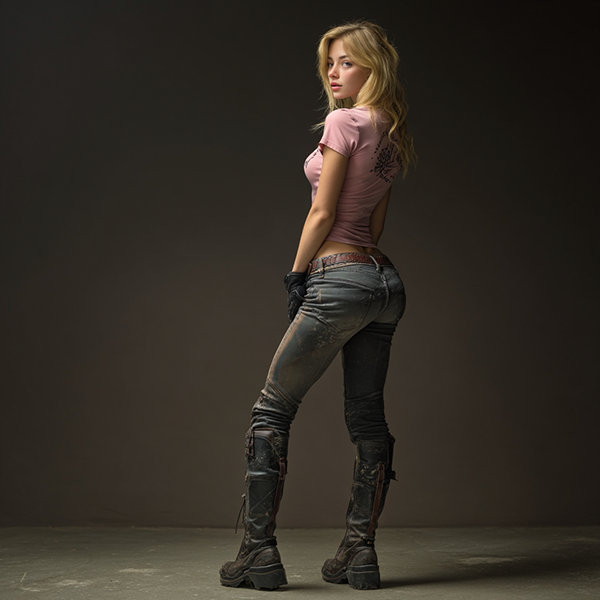
20th December - London - Mark Steele
Mark Steele started his day like he was prepping for battle: five-mile run, ice-cold shower, black coffee, ten minutes meditating on the stock tickers while casting an eye absentmindedly over the London skyline.
He was on the forty-first floor, in his second home; a penthouse so surgically minimalist it could double as an operating theatre. Floor-to-ceiling windows, an indecent amount of Italian marble, and exactly one piece of art—a Warhol print, still half-wrapped in shipping plastic because he’d never bothered to hang it. The only personal effects on display were his gym shoes and endless rows of signed, first-edition hardbacks, all perfectly dusted.
He checked his wrist, platinum face ticking forward. 6:15 a.m.
On his kitchen island, the matte black phone vibrated. An incoming calendar ping, on schedule. Mark answered before the first ring completed. “Talk.”
Lena Park’s face appeared, glossy but exhausted. She had the kind of skin that only occurred in high-end magazine ads, but the tight line of her jaw said she’d been awake since yesterday. “We have movement on Silk’s price. Pre-market, up two percent. Volume is retail-heavy.”
“Get aggressive,” Mark said. “I want Silk trading under seventy by market close.”
Lena’s eyes flicked away—probably at one of her thirty open tabs—and she nodded. “Understood. About the legal action—”
Mark inhaled, slow, annoyed. “Make it personal. Target Hunter directly. Go after the London assets. Forget the lawyers, use the press.”
Lena’s smile looked surgically installed. “I’ll issue guidance to the PR team. One final thing; there’s a minor problem with the New York project. Cross’s team made noise. There’s a protest scheduled at the site.”
“Let them,” Mark said. “Police will disperse. Push permits through. If you have to convince someone, do it. Discrete wire. Any other issues?”
Lena looked down for a fraction of a second, like she’d dropped a contact lens. “There is a potential optics problem. The shelter housed at the demolition site—it's a women’s charity. They have media contacts.”
Of course they did. Mark pinched the bridge of his nose, counted to three. This is why the world needed less feeling, more execution. “Get them out by Friday. Give them a bonus for leaving early. Or threaten to call Immigration, whichever works. Efficiency, Lena. Is that all?”
A flicker in her voice, almost human. “I had an idea to delay demolition, spin it as an affordable housing initiative—”
Mark cut her off with a single raised finger. “We don’t do affordable, Lena. That’s not our brand.”
The second Lena vanished, Mark’s muscles unclenched. He glanced at his knuckles, pale from gripping the espresso cup. The pain in his left hand registered—he’d cracked the handle, hard enough to leave a fault line through the ceramic. He left the broken mug where it was. He stepped to the window and forced himself to breathe in the city’s cold morning. Farther out, construction cranes carved the horizon. It looked like progress, if you didn’t know better.
And Mark Steele knew better than most. As a child, he’d imagined his mother walking away, indifferent to the newborn left at the fire station. Then he had imagined that she was actually dead—that fiction had got him through his first year with his unyielding father—that she actually cared for him but simply couldn’t. The real answer had come to him years later—not caring at all what happened to her; all that mattered was control.
The elevator bell chimed.
He turned from the city. A courier stood on the threshold of the private lift, crisp uniform, no expression. “Delivery for Mr. Steele.”
The box was large and heavy, the label from an obscure London antiquarian. No return address. He slit the tape and lifted the lid. Velvet lining. Tissue paper, obsessively wrapped. Mark peeled it back and felt a little shot of something like awe, then instantly buried it.
A First Folio. Almost certainly not a facsimile. Mark's fingers traced the spine with a mix of reverence and skepticism. The rich, full calf leather felt supple beneath his touch. He noted the marbled endpapers, a flourish not present in the 1623 edition, and the gilt edges shimmering under the light. It was a beautiful piece, a collectible, yes, but not the original he yearned for. Tipped inside was an envelope with a note written and signed with crowquill calligraphy: “Mr. Steele, consider this a gesture of goodwill. —Evangeline Hunter, CEO, Silk Conglomerate.”
He almost laughed. A bribe, then. He imagined Hunter’s people scrabbling to find some angle that might slow him down—a rare book for a lapsed collector. Maybe it would’ve worked, once. Before Harvard, before bloodless conference rooms, before he learned to trade empathy for winning.
Mark flipped the title page. Under “Twelfth Night,” a rectangular scrap of parchment glimmered like a gold tooth. It was the size of a boarding pass, thick as a bandage, and shimmered if you looked at it from the corner of your eye. Probably a trap, he thought, half-joking. He held the parchment up to the light. There was nothing—no watermark, no inscription. Just a palm-sized shimmer, flecked with pinpoints of color. His thumb brushed its edge and for a moment he felt—what, a static shock? A tickle? Whatever. He shoved it back between the pages.
He placed the book in a glass display case, but as he did, his eyes caught something on the lowest shelf. There, out of order, was a slightly scruffy romance hardback. The kind with gold embossing and a couple mid-clinch on the dust jacket. Mark rolled his eyes. Lena, probably. She used to like to “decorate” his shelf with shit she found at charity shops—her way of reminding him to get a life. Mark thumbed through the novel, ready to pitch it. But on the copyright page, he saw it: first edition, full number line, and a handwritten note on the flyleaf—To M, from L, keep believing in happily ever after. He hesitated, book hovering over the bin.
Fuck it. He was still a collector at heart. He shelved it in the appropriate place by the author’s name.
He sat, opened his laptop, and resumed reading the numbers as if nothing had changed. The first Folio watched him from the display case, silent and perfect. The shimmer in its pages was almost an afterthought. But as Mark crunched his models, he felt the uninvited warmth of a memory: his mother, gone, and the blankness she left behind. He blinked, jaw locked, and powered through.
21st December - London - Angel Valentine
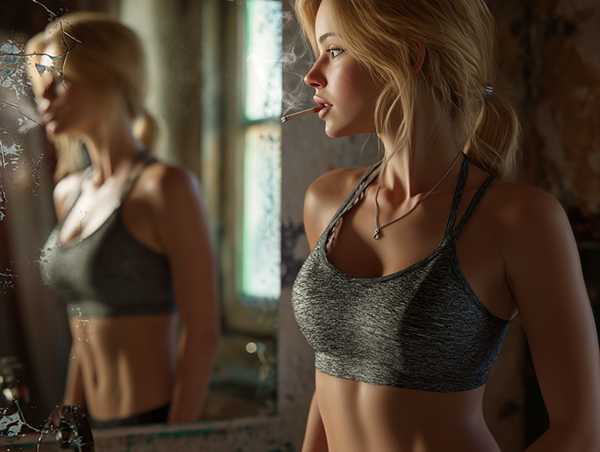
Angelique Valentine did her hair in the cracked bathroom mirror, a cigarette dangling between her lips and a cheap supermarket Pinot Gris sweating on the windowsill. The flat was three rooms, if you were feeling generous: bathroom, kitchen that doubled as a living room, and two bedrooms.
Angel sat on the rim of the tub adding babylights to her blonde hair. Maud Winters limped in, an ineffective brace around her knee. “You missed a spot,” Maud said, pointing with her toothbrush.
Angel grinned. “That’s the look. Street-rat chic.” She wiped her hands and flicked the cigarette into the toilet with perfect ballet precision.
“You have an audition tonight?” Maud asked, dabbing at the bags under her eyes with a tea bag that had seen better days.
“Not an audition. Just work,” Angel said. “Big spender’s in town. Management wants us on our best behavior.” She checked her roots.
Maud’s eyebrow arched. “You’re not going to tell me who, are you.”
“Wouldn’t want to jinx it.” Angel ran a streak of black eyeliner across her left lid. “You need anything before I go?”
Maud smiled in that tired, lopsided way that said she knew more than she let on. “Bring me a croissant. And don’t get arrested.”
Angel smirked. “No promises.” She grabbed her leather jacket from the coat hook, checked the lining for pepper spray and a condom, then gave Maud’s hand a quick squeeze. “Don’t wait up.”
The Licorice Elephant was nestled between a vape shop and a boutique pet crematorium. Outside, it looked almost respectable—a black box with frosted windows, brass elephant above the door, doorman in black. Inside, it was three floors of velvet, lacquer, and the thick scent of bergamot and honey. The main stage was set in a horseshoe, red velvet curtains pooling onto the floor.
Backstage, the changing room was a hive of hairspray, mesh, and double-sided tape. Ruby Tuesday—half-dressed, half-cocked—sat on the edge of the vanity, downing a protein shake and glowering at her phone.
“Nice of you to show, Valentine,” Ruby said, flipping her auburn ponytail. “Thought you’d given up on us mere mortals.”
Angel shrugged out of her jacket and let it drop to the tile. “I had to dig your dignity out of the Lost and Found first.”
Ruby scowled. “That’s rich, coming from the girl who still uses paper towels for makeup removal.”
“Better than whatever you call that discount bronzer,” Angel said. She eyed Ruby’s costume—black mesh leotard, glitter overkill, tiger stripes of body paint trailing over her hipbone. “What’s the theme tonight? Escapee from the zoo?”
“It’s ‘Burlesque Jungle.’” Ruby rolled her eyes. “Management’s idea. Supposed to class up the place.”
Angel gave Ruby the side eye. “Because nothing says sophistication like being pawed by drunk city boys in discount suits.”
“Speaking of pawing, Cross wants you in VIP,” Ruby said frowning. “Now.”
The mention of Vincent Cross was enough to freeze a vein or two. Angel made a show of stretching, but her mind was already sifting escape routes. She walked through the maze of mirrors, heels silent on the carpet. Vincent Cross stood in the VIP booth, glass of bourbon in one hand, iPad in the other. He didn’t bother to look up when she entered.
He set the bourbon down. “Sit.”
She did, crossing her legs so the hem of her dress slid up just enough. Cross didn’t blink.
“I have a guest in three days time,” he said. “Christmas Eve party. You’ll be his date but he doesn’t know it yet. I’ve been told you’re just his type so it won’t be a problem.” He pushed a photo towards her. It showed a man, probably in his late 30s, dressed in a power suit.
Angel bit her lip, slow and showy. “You need me to babysit one of your degenerates?”
“This isn’t negotiable.” Cross handed her a black envelope. Inside: a hotel name written on an invitation card, the amount she would be paid written on a heavy piece of paper, and three crisp hundreds. “This is just the bonus. Consider it a signing fee. You’ll get the rest once it’s done.”
Angel thumbed the money, her excitement growing—it was well over a thousand pounds for just a night’s work. But she kept her face blank. “And if I say no?”
Cross’s smile was pure acid. “You won’t. But just to clarify—” He tapped his iPad and turned it toward her. The paused video frame showed Angel, two years ago, naked and half-high, riding a stranger’s lap in the Elephant’s champagne room.
Angel exhaled through her nose. “You’re running out of threats, Vince. That tape’s so old it’s basically an antique.”
Cross waved her off. “Say hello to your crippled friend for me. Seems to me like she could use a helping hand from someone she pulled off the streets.”
Angel’s fists curled but she forced herself to smile. “This is the last time. And I want to be paid up front—all of it.”
“Done!” Cross said. He smiled and pulled out an envelope from his coat pocket, and handed it to her with the confidence of a man who knew that would be her answer all along. “Wear something nice, and hold off on the fags for a few days?”
She walked back through the club, past the main stage—where Ruby was mid-leap, body arched like a bow, crowd roaring approval—and out onto the smoking patio. She lit a cigarette and stared at the glowing end. She had four months of rent riding on tomorrow. Clearly, the money meant nothing to Cross. And there was Maud’s treatment, maybe a better brace for her knee. Maybe, if she played it right, a little something for herself. The smoke burned her throat, but she welcomed it. It was the only thing tonight that felt honest.
24th December - London - Mark and Angel
Three days later, Christmas Eve blanketed London in slush and fairy lights. Mark Steele stood on the edge of the Ritz’s marble ballroom, pretending not to loathe everyone in it. The event was Silk Conglomerate’s “Yuletide Charity Masquerade,” which meant a thousand quid a plate, open bar, and enough sexual harassment under the mistletoe to keep the tabloids busy through New Year’s.
He sipped his gin neat and watched the room reflect off crystal chandeliers. Women in gold-threaded dresses and gossamer masks. Men in tuxedos and predatory grins, circling each other like sharks in a Bond film.
A champagne tray drifted past. Mark declined, nodding to the server with automatic courtesy. His gray suit was understated perfection, tailored to move like a second skin, but the custom Venetian mask itched at his nose. “Festive,” Lena Park had said when she delivered it, as if Mark could give less of a shit about pageantry. Still, the anonymity made it easier to stare.
Evangeline Hunter held court by the ice sculpture, every bit the billionaire queen. She wore deep emerald, her mask a filigree of silver, and her voice carried to every corner of the room. Mark locked eyes with her across the dance floor. She raised her glass, gave him a smile that said: You’ll never get my company. He raised his glass in return, smiling back: Watch me.
The DJ started “Santa Baby.” Mark checked his watch, counting the minutes until he could leave without causing offense. He looked for the rarest commodity in the room—something interesting.
He found it at the far end of the bar. She leaned against the lacquer, sipping whiskey and scanning the room with unhurried confidence. Little Black dress, backless. A narrow tattoo down her spine and mask so simple it made everyone else’s look like drag. Blonde, athletic, and lean. Her eyes flickered over Mark and kept moving. Someone had clearly read his mind since she was exactly his type; what he needed tonight. Not just beautiful, but dangerous; the kind who made you regret underestimating her.
Mark waited until she drained her glass, then sidled up, half a step too close. “You look bored,” he said.
She barely glanced at him. “That’s because I am.” Her accent was East London, but polished, like she’d sanded off most of the vowels.
He signaled the bartender for another whiskey, neat. “You here for the charity, or the open bar?”
She took the fresh glass, sipped. “I’m here for the freak show. Same as you, I’d bet.”
Mark allowed himself a smile. “You don’t seem like the usual party hire.”
She turned, giving him the full force of her gaze. “I’m not. But tonight, I play nice.”
“Do you have a name?” he asked.
She shrugged. “Tonight? Call me Angel.”
He almost laughed. “Of course. And is that what you are?”
“Depends who’s paying.” She lifted her mask just enough to show the slash of a smile, then replaced it.
He recognized the game—flirting as fencing, every question a feint, every answer a counter.
“Mark,” he said, extending a hand.
“Angel,” she said again, shaking his hand with unexpected strength.
“You know the CEO?” he asked, nodding toward Hunter.
Angel gave the tiniest of shrugs. “Know her, been threatened by her, same difference. She’s got a thing for drama.”
“Don’t we all,” Mark said. “So what’s your real gig?”
She lowered her voice. “I dance. But not for free.”
He looked her over, openly now. “Let me guess: modern, not classical.”
“Both.” She leaned in, eyes sharp. “You?”
“Finance,” Mark said. “But only for the suffering.”
“Saint,” she teased.
He shook his head. “Long since excommunicated.”
She drained her whiskey. “So, Mark. Want to get out of here before someone asks us to polka?”
He almost choked. “You read my mind.”
They slipped through the throng of twirling couples, weaving their way to the exit. Angel’s stilettos clicked a steady beat against the polished marble floor, each step echoing her confidence. A sleek black car awaited them. Once inside, the driver navigated the London streets back to Mark’s place while he leaned back, stealing glances at Angel as she stared out into the night, her silhouette framed by the soft glow of passing streetlamps.
When they arrived at his penthouse, Mark exited first, holding the door open for her. Angel glided past him, her eyes scanning the lavish suite.
She shrugged off her coat, and kicked off her shoes. “So what now?”
He closed the door behind him. “That’s up to you.”
She crossed to the window, looked down at the city, her back to him. “You could have had any girl back there,” she said. “Why me?”
“Because you’re the only one who doesn’t care,” he said. “And because I like knowing I could be in danger.”
She turned, smiling. “Smart boy.”
He crossed the room in two steps, hands at her hips. She didn’t flinch. She let him kiss her, hard, a dare as much as a welcome. She tasted like whiskey and cinnamon gum, and her tongue met his with the same competitive energy as her banter.
He pressed her against the window, city lights blurring behind her. Her hands were already at his tie, tugging it loose, the knot coming apart like an unraveling deal. She slipped her fingers between the buttons of his shirt, nails biting just enough to make him want more.
She pushed him onto the bed, landing on top in a graceful tumble, knees on either side of his chest. She peeled her dress over her head, and the tattoos continued: a geometric pattern on her left inner thigh and a lotus motif at her sacrum. Her body was cut with muscle, but soft in the ways that counted.

He ran his hands along her thighs, up to the inside; then traced it with his thumb causing her to bite her lip. She reached for the condom in his jacket pocket before he could even move. “Efficient,” she said.
“Always,” he replied.
She rode him, every movement controlled, yet utterly wild. She moaned in his ear, her hair in his face, hands pressed flat against his chest. For a moment, he let himself feel it—her power, his surrender, the melting of all his defenses. She came first, then again, her body shaking around him. When he finished, she rolled off, breathing hard, chest slicked with sweat and pride.
He lay back. “Who are you really?” he asked, not expecting an answer.
She looked at him sideways, hair plastered to her forehead. “Wouldn’t you like to know.” She got up, dressed with military efficiency, smoothed her hair, and checked the contents of her purse.
Mark lay back on the bed watching her. “You don’t have to leave.”
She laughed. “I’m going before you kick me out.”
He watched her slip her shoes back on, the curve of her calf, the impossible ease with which she returned to armor.
“Will I see you again?” he asked.
She shrugged, opening the door. “If you’re lucky, Mark.”
When the door clicked shut, Mark stared at the imprint she’d left on the sheets: a faint outline, a smudge of lipstick, and the tiniest flake of gold from her mask. He poured himself a drink, sat on the window ledge, and for once, let his mind go blank.
When he opened them again, he noticed a faint glow emanating from the display case. It was the weird rectangular parchment from the First Folio, sticking out from the top edge like a flare receding in its strength. He’d forgotten it was there. Mark smiled to himself, an uncharacteristically warm feeling blooming in his chest.
The world outside pulsed with possibility.
Bad Girl (Temp.) - Chapter 2 - Angelique Valentine
Author:
Caution:
Audience Rating:
Publication:
Genre:
Character Age:
TG Themes:
TG Elements:
Permission:
25th December - London - Angel’s Flat
Mark woke up with his face pressed into a pillow that reeked of supermarket hair dye and someone else’s sweat. For three full seconds, he thought he was hungover in a particularly shitty business hotel. Then he reached for his phone and hit his breasts against the bedside table. That’s when he decided that he was really hungover and just went back to sleep
About a half hour later, he got up, yawned, open his eyes, and immediately noticed the shitty apartment he was in. He was in a narrow, low-ceilinged bedroom, so cold he could see his own breath. There were a few visible possessions that immediately caught his eye: a string of fairy lights over a cheap vanity laden with cosmetics, perfume, and hairspray; a warped IKEA wardrobe; a few pairs of high heels neatly stacked in a corner, and a half-empty wine bottle sweating on the windowsill. The entire room was neat but had the distinct odor of desperation and poverty.
Mark shivered and started to rub himself. That’s when he noticed his top—a ragged gray tank, not his usual style that didn’t hide much including a pair of breasts that were not, as far as he could tell, a hallucination. They were high, firm, and attached to a ribcage with the kind of muscle definition you only saw on pro athletes.
“Fuck,” he said, except the voice that came out was all wrong—higher than he’d expected, still rough from sleep, but definitely not his.

He leapt from the bed, legs tangling in the threadbare sheets. He landed with a graceless flop and stared at his own knees, which were flecked with faint blue bruises. He was wearing men’s boxers, at least a size too large. He yanked them down, already dreading what he might find. The area between his legs was shaved clean, save for a strip of platinum-blonde hair. Mark blinked. He’d expected—no, he didn’t know what he’d expected, honestly. But it wasn’t this: smooth, almost clinical, like a topiary. He ran a finger down, found nothing unexpected except for the absence of anything familiar.
He sat, hard, on the cold wood floor. For the first time since his father told him as a kid that his mother had abandoned him, hated him, Mark Steele wanted to scream.
Instead, he got up and went straight to the mirror. It was mounted above a sink that was streaked with toothpaste and what looked like foundation. He stared, fighting the urge to flinch. The woman in the mirror looked back at him with a level of exhaustion and annoyance he recognized intimately, but her face was not his.
It was a sharp, striking face, more beautiful than pretty. Her eyes—his eyes, apparently—were blue-green and ringed with thick black lashes. Her cheekbones were sharp, jawline severe but round. A constellation of freckles ran across the bridge of her nose. There were two tattoos he could see without undressing: a geometric fractal design at the girl’s left inner thigh which seemed to cover a slightly smaller birthmark, and a vertical lotus design extending down the spine of her back disappearing under the tank top.
He recognized the face immediately—Angel, from the Christmas party. Angel who he had fucked last night. He held his head in his hands and tried to convince himself saying repeatedly, “This can’t be real.” He pulled off the tank, stared at the body underneath. The muscle tone was ridiculous—shoulders, arms, the V of the stomach. Her breasts were not large, but perfectly sized for her frame. It was clear that the Angel was dedicated to maintaining an athletic frame. He turned, saw another tattoo: a black heart over the left hip.
He looked back at the face, into the eyes. “What the fuck,” he said, softer this time.
There was a clatter in the hallway. For a second Mark expected security, or at least Lena with an emergency latte. Instead, a voice came through the thin wall—woman, older, somewhere between annoyed and resigned.
“Angel! We’re out of wine again.”
Mark staggered to the bedroom, found a battered purse on the floor, and rummaged. Debit card: Valentine, Angelique. Library card, same. Work ID with a company he’d never heard of—“Licorice Elephant,” whatever the fuck that was. There was a condom, pepper spray, a lighter.
He sat on the edge of the knobby mattress. The window looked out over a concrete alley. It was gray, and damp, and absolutely not New York.
Mark folded his hands, forced himself to breathe. There had to be a reason for this—a prank, a drug, a dream. Or maybe he’d been murdered by Evangeline Hunter and reincarnated as…his one night stand. No, that seemed even less likely than magic. He rubbed his temples, tried to remember last night. The party. The woman—Angel. The room. The sex. Had she drugged him? Was this a psychotic break? He looked at the bed. There were no drugs, no signs of struggle, not even a stray hair except for the ones in his own head. His brain, ever the analyst, tried to run a scenario tree. The top three branches were “drug-induced psychosis,” “elaborate Silk Conglomerate revenge,” and “quantum-level fuckery.” The odds on the last one increased by the second.
He found himself standing in the bathroom again, facing the stranger in the mirror. Then he slapped himself a few times but that did nothing except cause his cheeks to turn red.
“Fine,” he said, through gritted teeth. “If this is how it is, I’ll figure it out.”
He considered showering, but the water in the flat sounded like it came from a Victorian-era sewer, so he passed. He put the tank back on and tried the wardrobe. It was a horror show: jeans, two crop tops, a sequin miniskirt, two cocktail dresses including the LBD Angel had worn that night, two pairs of Doc Martens, a men’s leather jacket with “PROPERTY OF TOM BLACKWOOD” scrawled on the inside label, and a threadbare bathrobe. He put on the jeans, which fit better than he wanted to admit, and the jacket, which smelled faintly of tobacco and motor oil.
He heard a shout from the hallway. “Angel! Where did you put the grater?”
He opened the door. The corridor was so narrow his shoulders brushed both walls. A woman with a knee brace stood at the far end, holding a can of Red Bull.
She looked him up and down. “Rough night?”
Mark shrugged. “Yeah.”
“Thought so. You’re out of fags.”
“Yeah,” he said again, voice coming easier now. But just the mention of a cigarette seemed to trigger a craving in him. But he didn’t smoke.
The woman rolled her eyes and shuffled back to what passed for a kitchen. “Don’t forget, you’re on early today. The Elephant’s got a client lunch.”
Mark’s mind lurched. Client lunch? What did Angel do?
He closed the door and slid down the wall until he was sitting on the floor, knees to his chest. His mind raced, but the overwhelming sensation was not panic. It was rage. He was Mark fucking Steele. He’d built a billion-dollar empire from almost nothing. He’d survived a despotic father, prep school, Harvard, and a dozen hostile takeovers. He was not going to let this—whatever it was—defeat him.
He needed a plan.
But first, he needed to figure out what the hell “The Licorice Elephant” was.
25th December - London - Mark’s Penthouse
Across town, Angel woke up with a hangover that felt like it had been crafted by gang of dwarfs from Khazad-dûm. She opened her eyes and saw…white. White ceiling, white sheets, the kind of perfect whiteness that only came with obscene amounts of money and zero concern for practical cleaning. She blinked. Her head was killing her, but otherwise, she felt…good.
Better than good. Rested, warm, dry.
She recognized the bed from the previous night. It was huge, at least a California King, and the linen was softer than anything she’d ever stolen or slept on. She rolled onto her side and stood up. The floor was heated marble, the room minimalist except for a Warhol print propped against the wall. Angel looked around, slow. She remembered last night—the party, the money, the mark, the sex (could have been worse). But she didn’t remember going to sleep in that prick’s mausoleum.
She walked to the bathroom, feeling weirdly steady. The mirror was a single flawless slab of glass. She looked into it and saw Mark Steele. She squinted. The face looked back, equally confused. She tried smiling. The reflection did, and she nearly laughed at how awkward it looked—like a wolf trying to smile for a nature documentary.
Angel took inventory. The hair was full and dark, cropped slightly close with not a strand out of place. She had a short trimmed beard. She opened her mouth, inspected the teeth. Perfect. She pulled up her shirt—expensive, tailored, still holding the scent of the faint mid-priced perfume Angel sometimes wore—and looked at the body underneath. Jesus Christ. It was all muscle and vascularity, not an ounce of extra anything.
She ran her hands down, not even pretending to be coy, pulled down her boxers, and found the cock surrounded by a thick mat of pubic hair. The guy was kind of hairy but in a kind of sexy way. The cock was circumcised and flaccid at first but responded quickly to her touch. She whistled. “Now that’s an upgrade.” She liked the feel of it her hand—thick, pulpy and then becoming firm over the course of a few seconds. She pulled her boxers up and enjoyed the sight of the bulge straining against her boxers.
She tried the voice. It came out deep, with a hint of New York. “Fuck.” She laughed, loud and hoarse. She poked her own chest. “Damn, Mark. You work out, huh?”
Angel did a little flex for the mirror, then dropped the shirt and went exploring.
The penthouse was, in a word, minimalist: nothing out of place, not a crumb, not a speck. The fridge was empty except for a row of energy drinks and a block of artisanal cheddar. The coffee machine looked like it cost more than her foster parents’ car. She poured herself a glass of water—Fiji, obviously—and sat at the kitchen island, feet on the chair, just to see how it felt.
It felt amazing.
There was a phone on the counter, matte black, latest model. She picked it up, thumbprint unlock. Her thumb worked. She scrolled through the notifications—dozens of emails, half from a Lena Park, some flagged urgent, none of it making sense. She ignored them all, instead looking for clues.
Angel was not, by nature, a panicker. But this was new territory, even for her. She needed to figure out if she was losing her mind, or if this was, in fact, happening. She walked back to the bedroom, rummaged through the drawers. Every item of clothing was either bespoke or designer. She tried on a shirt, then the suit jacket. It fit perfectly. She looked in the mirror and saw power. Even hungover, she looked like someone who could snap the old Angel in half.
She grinned, then something caught her eye in the corner of the mirror; something glowing with a slow dull throb in a glass display case. She walked over and took it out—it was an old leather bound book containing the plays of William Shakespeare.
Angel stared. She remembered last night, the way Mark had looked at her, the way his eyes kept darting to the book on the shelf. She picked it up, thumbed through. There was something wedged between the pages: a rectangle of thick, shimmery parchment, like a small expensive bookmark. She pulled it out. It was cool to the touch, the shimmer almost gone, but she could still see it if she caught the light. She pressed it to her palm, felt a tickle run up her arm and settle at the base of her skull. She put it back in the book and closed it.
She knew what this was. It was a curse, a spell, a prank, whatever you wanted to call it. Some kind of cosmic fuckery, and she was the punchline. No, that was wrong. The real punchline was Mark Steele, wherever he was.
Angel laughed, long and hard. She looked at herself in the mirror again, really looked.
She was Mark Steele. For now, at least.
She picked up Mark’s Patek from a polished chestnut table top and checked the time—6:23 a.m.. Across town, someone was probably already searching for her, maybe even calling her name. Maybe her old body was dead. But that was their problem. She had a new body, a new life, and an entire empire at her disposal.
This was as good as it gets.
She poured herself a second glass of water, then sat down at the laptop and began to plan. She’d always wanted to see New York.
25th December - London - Angel’s Flat
Mark sat on the edge of the mattress, staring at his new hands. They were smaller than he was used to, but strong. He flexed the fingers again, and noted absentmindedly the perfectly manicured nails with red polish which matched those on her toes.
He had no idea what to do.
He looked at the purse on the floor. There was a single banknote in it—ten pounds, creased and torn. He fished it out, tried to remember the last time ten quid had meant anything to him.
The voice in the hallway called again, softer now. “Angel? You okay?”
He took a breath, deep and steady. “Yeah,” he said, surprised at how natural it sounded. “I’ll be fine.”
He was Mark Steele, and if he was stuck like this, he’d find a way to win. He just had to figure out the game first.
26th December - London - Angel’s Flat
Mark woke up with a headache the size of Westminster and an urgent need to pee. He fumbled out of bed and collided with the wall twice before finding the bathroom, where he spent twenty seconds remembering how to urinate without splattering everything.
He had tried going back to sleep to see if he would wake up as Mark again. Obviously, it hadn’t worked and he was still a girl. By the time he flushed, he’d noticed two things: the water in the flat ran brown for the first three seconds, and the entire apartment smelled like cheap instant coffee and lavender body spray.
He shuffled to the kitchen, where his flat mate was already up, balancing on her good leg and stirring porridge on the stove with the other.
She turned. “Sleeping Beauty returns. Thought you’d died in your sleep.”
Mark grunted, unsure what to say.
The previous day was a blur: trying to call his own phone number which first went unanswered, then becoming permanently engaged as if he had been blocked. Then trying to call his company and getting a customer service rep who sounded like she was twelve, and realizing immediately that that was a dead end. He could have tried going to his penthouse but the doorman would have blocked him on sight. He had searched his phone for any avenues of escape or just plain information but that was a dead end as well. Then he checked his account online and realized that he had less than a hundred pounds to his name.
He sat at the chipped table. The woman poured the porridge into two mismatched bowls and dropped one in front of him. “Eat up. You’re going to need it.”
He stared at the grayish mush. “What is this?”
“Overnight oats, chia seeds, almond milk, protein powder. Keeps the engines running.” She watched him, expectant.
He took a spoonful. It tasted like wallpaper paste, but his body liked it. He finished half the bowl before he realized what he was doing. He really had to find out what to call her. He looked around hoping to find the woman’s handbag, saw it on a kitchen counter, and quietly looked inside while her back was turned. He found her bank card and it read “Maud Winters.”
“Hey, if you’re trying to bum a cigarette from me, I haven’t got any. I’m trying to cut down anyway, too expensive.” Maud sat across from him, bracing her elbows on the table. “I talked to Deb last night. She said you’re on the schedule tomorrow. You’ll need to check in by four.”
Mark blinked. “Schedule?”
She gave him a look, equal parts worry and accusation. “Don’t tell me you forgot already. You sound funny. Are you trying out an American accent for the clients?”
“I… must’ve hit my head,” he said, improvising. “It’s all a bit fuzzy.”
Maud’s eyes narrowed. “Maybe you should lay off the the Aldi Belvedere, then.”
He tried to steer the conversation away and tried to mimic Maud’s accent, just to stave off any more questions. It was surprisingly easy.
Maud stroked his hair gently, like a mother would her daughter. “Thanks again for getting the rent. Four months in arrears, and now—” She tapped her brace. “Consult was three hundred quid. Where the fuck did you get that kind of money?”
“A client,” he lied, guessing it had to be true.
“Right,” Maud said. “Must’ve been some client. I shouldn’t have wasted your money on the consult. The surgery for my ACL is going to cost over ten grand done private. I’ll just wait for the NHS appointment.”
Maud finished her porridge and lit a cigarette, blowing smoke out the cracked window.
Mark’s mouth watered at the smell—he’d never smoked a day in his life, but suddenly he wanted one more than he wanted anything. “I thought you said you didn’t have any fags? Can I have one?”
Maud stared. “And you actually believed me. You asked me to help you quit just last week. And since when do you smoke in the morning?”
He shrugged. “Just need to steady my nerves.”
She tossed him the pack. He fumbled with it, dropped the lighter, and eventually managed to get a cigarette between his lips. He coughed so hard it felt like he might vomit up the oats, but then his lungs settled and a heady wash of calm spread from his fingertips to his toes.
He exhaled. “Fuck.”
Maud cackled. “You look like a kid trying to act tough.” She eyed him, then her phone. “You should get some makeup on. Hide the raccoon eyes.”
Mark realized he had no idea how to do that.
He got up and rinsed the bowls, letting Maud do her thing. She vanished into the bathroom, and he took the opportunity to poke through Angel’s phone again. There were a few missed calls from someone labeled TOM B. and a string of increasingly desperate texts from “Elephant Crew,” which he guessed (yesterday) was the work group chat. The rest of the messages were the usual spam, threats from the landlord, and memes.
He scrolled the contacts, hoping for a clue. Every name was either a first name only or a nickname. No family, nothing from before. He tried to Google Angelique Valentine but she had no web presence. No LinkedIn, no Facebook, not even an Instagram. How old was she anyway? He sat back down, at a loss.
Maud emerged, face scrubbed and brace hidden under black pants. She tossed him a hoodie. “Put this on. It’s freezing out.”
He complied, grateful for the warmth.
“Listen,” Maud said, “I don’t know what’s gotten into you, but you can’t just stop showing up for shifts. Deb will fire you, and then what?”
“I thought—” he hesitated, thinking up an excuse for his tardiness—“maybe I could try something else.”
She laughed, short and sharp. “You mean something ‘normal’? You tried that last year, remember? Office temping? You lasted one week, came back crying about spreadsheets and psychos in polyester.”
He did not remember, but he nodded along.
“Face it, Angel, we’re not like them. I know you’re smart and you can handle the work, but you’re not made for nine to five in an office. You work the stage, I train and supervise the newbies, and if we keep it up, we don’t end up homeless. Or dead.” Maud stabbed a finger at him. “You think I like it? I’d rather teach dance full time instead of working operations. But the world doesn’t pay for broken knees and sob stories.”
She lit another cigarette. Mark eyed it, but didn’t ask.
Maud leaned in, voice softening. “You okay? You seem… off.”
He shrugged, tried to look bored. “Didn’t sleep.”
She eyed him, unconvinced. “You sure you’re not using again?”
“I’m clean,” he said, and was surprised at how easy it came out.
She gave a grudging nod, then checked her phone. “Gotta jet. Hospital follow-up. You’ll be alright?”
He gave a thumbs-up.
When she left, the flat felt even smaller, and the smell of her cigarette lingered like a dare.
Mark stared at the phone, willing it to ring. He needed a plan, but all he had was oats, a hoodie, and the creeping dread that he was now responsible for another human being’s life.
27th December - London - Angel’s Flat
By the next morning, Mark had run through every possible scenario for getting his old life back. He’d tried calling himself (engaged again), tried emailing Lena Park (auto-reply), then tried calling his New York penthouse (that was blocked as well). Meanwhile, his body—Angel’s—was suffering: cramps, jitters, and a pounding headache that even three aspirin and a hot bath couldn’t cure.
At 9:00 sharp, Maud returned, looking even more exhausted than before. “You’re not dressed,” she said, exasperated.
“Dressed for what?”
She rolled her eyes. “The club. You’ve got a shift at ten. Deb’s expecting you, and if you no-show again, you’re out. There are lines of girls waiting to take your place. Deb’s got the best terms in all of London, you know that.”
By this time, Mark had done a web search for the Licorice Elephant and he knew exactly what Maud meant. He’d spent two days hiding in the flat, hoping the problem would solve itself. It hadn’t. He was still a woman, still broke, still expected to work at the Elephant.
He tried to argue. “I’m not feeling well.”
Maud snorted. “None of us are, darling. Get your bloody arse in gear.”
She thrust a gym bag into his hands. “Outfit’s in there. You know the drill.”
He carried the bag to the bathroom and locked the door. The gym bag contained what he assumed was standard-issue dancer gear: three sets of lingerie (black, red, blue), a makeup bag, a pair of heels so high they looked like torture instruments, and a tiny bottle of body oil.
He sat on the toilet and put his head in his hands. He’d faced down billionaires, lawyers, even his own childhood traumas. But the thought of stripping in public, with this body, was the most terrifying thing he’d ever encountered.
He struggled into the blue bra, careful not to tear the lace. It fit perfectly, pushing his cleavage into a shape which was probably illegal. He shimmied into the panties, nearly losing his balance as the unfamiliar parts rearranged themselves. They rode up in a way that felt both invasive—he had never worn anything that ran up his butt crack—and perversely comforting. He stared at his reflection. The woman in the mirror was ready to sell the world a dream. He tried to smile. It didn’t quite reach his eyes.
Maud called from outside. “You okay in there?”
He stared at himself in the mirror for a long time. He had absolutely no idea how to put on make-up so walked out in his bra and panties with his foundation and mascara in hand and looked desperately at Maud.
Maud laughed. “You look like you’re going to a funeral.”
He shrugged, feeling his cheeks burn.
Maud sighed and helped him out. They didn’t have much time so he landed up with a kind of smudged look. “We’ll clean it up later at the club,” Maud told him. He let her believe that. He put on a pair of Angel’s jeans, a cotton shirt, and puff coat and set off with Maud.
On the way to the club, she filled him in. “Since you seem to have developed amnesia, I’d better fill you in on the basics. Stage shows are every half hour but if you’re feeling out of sorts, you can skip those and try to get clients the usual way. I’ll show you the regular and VIP private rooms when we get there. And don’t do extras even if they ask—it’s against the law, you hear—don’t fucking do it. They pay for company, not for… you know.”
He nodded, grateful.
Maud’s limp was more pronounced today, but she kept pace, talking the whole way. “Stick to your strengths. You’re the best at improv, just talk to them, flirt, make them feel like kings. If you don’t want to show your bits, don’t. Ruby does full nude, but she’s an exhibitionist. You just do what feels right.”
He was starting to feel less panicked, more resigned.
They arrived at the club—a black-painted box with neon script and a line of bored-looking men out front. Maud held the door for him, and he stepped inside.
The smell hit him first: sweat, perfume, sanitizer. The lights were low, the air thick. The Licorice Elephant looked less like a strip club and more like the VIP lounge of a Bond villain’s yacht—three floors of black lacquer, brushed steel, and enough velvet to upholster Versailles. Maud led Mark in through a side entrance, where a retired bouncer in a suit buzzed them up to the staff-only level.
“House rule,” Maud whispered as they passed the security cameras. “No cell phones on the floor. What happens at the Elephant, stays at the Elephant.”
Mark tried not to notice the tingle that ran up his spine at the prospect of surveillance, or the way the lighting hit his (her) legs in the glass of the stairwell. The banister was slippery with disinfectant, and he gripped it out of habit, surprised by the strength in the hands he’d barely learned to use.
Maud’s limp got worse as she climbed, but she powered through. They emerged into a corridor lined with massive gold-framed mirrors. Every doorway had a plush curtain. The first opened onto a makeup room, where half a dozen women were already doing battle with eyeliner, false lashes, and glitter. Every hair color in the spectrum was represented, but all the women were beautiful in the way that Instagram couldn’t fake: hard eyes, knowing smirks, and bodies that looked sculpted by struggle.
Mark hovered at the threshold.
A woman in cherry-red lingerie looked up from her compact and grinned. “Hey! Fresh meat!”
Maud raised her eyebrows, feeling more protective of Angel than she usually was. “Don’t call her that. She taught you remember?”
“It’s a term of endearment, I always call Angel ‘Fresh Meat’”
The woman—Ruby—eyed Mark up and down. “Why haven’t you changed yet?”
He blanched. “I, uh—” He hesitated.
Maud elbowed him. “Don’t be shy.”
As he turned around, Mark could see Ruby walk up to Maud and whisper conspiratorially, A few seconds later, she was nodding vigorously as if agreeing to some plan of action.
Mark fumbled out of the hoodie and jeans, praying the body beneath wouldn’t betray him. He stood in the blue lingerie he had put on back in the apartment. Then he took a deep breath and turned round, feeling absurdly exposed. The women exchanged looks.
Ruby opened Mark’s bag and tossed him the matching thigh-highs, and a suspender belt. “Put that on.”
The stockings were soft as air and he managed somehow to put them on without causing them to run.
Ruby gave him a once-over. “Much better. Next time, try not to look like you’re being sent to the gallows.”
She led him to a row of lockers. “This one’s yours. Code is 3434.” She grinned. “We all use the same one. No secrets here.”
Mark stashed his clothes and tried to breathe.
Maud returned, carrying a pair of gleaming black kitten heels. “We won’t do the stilettos or platforms tonight but you’ll have to get used to them in the next few days. You can go barefoot today for any private dances but watch where you’re walking. Deb will understand once I explain things to her.”
The pre-shift meeting was led by Deborah Wells herself. She was tall, silver-haired, and dressed in a tailored pantsuit that radiated power. Her eyes flicked over the room, missing nothing.
“My weekly reminder of the House rules,” she said. “No booze on shift. No freebies for friends. Any client gives you trouble, you get a bouncer. If you’re caught doing anything illegal, you’re gone. We clear?”
A chorus of “Yes, Deborah.”
She eyed Mark as if assessing his posture and his inappropriate heels.
“Angel. Glad to see you back.”
He nodded, doing his best not to look terrified.
Deborah ran through the schedule: Maud had called ahead to tell Deb that Angel couldn’t do any stage work that night. Angel had been scheduled to be on main at eleven but would head straight to the Floor Walk and circulate and socialize with guests instead, offering private dances. “You remember the drill?”
He nodded again.
“Good. Any questions?”
Mark’s mind was blank. He shook his head.
The meeting adjourned, and the girls scattered to the dressing room. Ruby took Mark aside. “You nervous?”
He debated lying, then shook his head. “Petrified.”
She laughed. “Good. Means you care. Just remember: they’re the ones who should be scared of you.”
Mark had no idea what he was doing.
27th December - The Licorice Elephant
At 10:20pm, Maud found him pacing by the lockers. “You look like you’re going to hurl.”
“I might,” he said looking down. Then he said, “Maud, I need your help. I don’t have a clue what to do.”
When Mark looked up, he didn’t see a look of anger or exasperation, but one of concern. Maud couldn’t figure out what had happened to Angel in just a matter of days.
“Wanna run through it?” she said.
He nodded, and she led him to a side room, set up like a rehearsal studio: full-length mirrors, portable pole, sound system. The floor was scuffed to hell, but polished enough to show the whites of his knuckles.
Maud sat on a stool. “I’ll cue the music. You just move, feel it out, show me what you have. Just don’t wear the heels for dancing tonight, you’ll break an ankle.”
He stared at the pole, then at the reflection of himself—herself—in the mirror. He’d never performed in his life. He’d barely danced at his own prom, and now he was expected to undulate for a room of strangers.
He tried to remember what he’d seen at other clubs; what he’d seen other women do on other (non-professional) dance floors to entice men: slow, deliberate movements, a lot of eye contact, hips and butt doing most of the talking.
He wrapped a hand around the pole for support and tried a spin. His body surprised him—it wanted to move, and the arms that felt so useless suddenly had leverage. He hooked a knee and managed a basic swirl, not graceful but passable.
Maud clapped. “Not bad. Now give it some attitude.”
He tried again, slower. He watched the mirror and realized the trick was to ignore the audience and play to yourself. He arched, let the rhythm do the work, and felt the whole body respond. It was mortifying, but also…liberating. For the first time since the swap, he wasn’t thinking about what he’d lost. He was thinking about what he could do.
Maud smiled. “That’s it. You’re a natural. Feel the music and keep moving. When you’ve got that, try looking at me as if I’m one of your clients. Great!”
He felt a surge of pride, immediately quashed by self-loathing. “What if I mess up?”
“Then you own it,” Maud said. “Nobody here wants perfection. They want honesty. You go with what comes naturally today and we’ll start from scratch again tomorrow.”
She dug in her bag and laid out Angel’s cosmetics neatly on a table. “Here. Mascara. You look like a drowned rat.”
Maud applied it to his lashes, expertly, and for a second their faces were so close he could feel her breath. There was a maternal tenderness to it, but also a kind of pride. Then she did the rest of his face.
“You remind me of the girl I picked up off the streets three years ago. Didn’t know how to dance but had rhythm; almost clueless about how to do her make-up apart from her eyeliner and lipstick. I don’t know what happened to you but we’ll get you back to your old self in no time,” Maud said. “Okay, you’re ready,”
Mark nodded, unsure whether to laugh or cry.
Back in the dressing room, Ruby was working the new girls, offering them tips and fake insults in equal measure. Mark kept to the sidelines, watching the clock.
At 10:55pm, Maud appeared with a clipboard. “Stage time.”
He followed her through the warren of corridors to the main floor. Ruby and some other girls went on stage, while Maud ushered Mark to the floor where he would be serving drinks and engaging in small talk.
Mark had always been interested in the mechanics of making money. Even as a billionaire CEO, he had time to lend a listening ear to the nickel and dime stuff the average grifter was engaged in. The economy of the Licorice Elephant was, however, the ultimate humiliation.
“Angel, I know that last job you did has done a number on you,” Maud said with a look of concern. “God knows what those assholes fed you. I know you did it for me—for us—so that makes me even more liable. So I’m going to explain everything to you like it’s your first time. The floor walk is your bread and butter here. You’ll be moving through the club, engaging with guests, building rapport. It’s all about making them feel special enough to want to buy private dances or snag a VIP room experience. Got it?”
Mark nodded, trying to absorb all of it.
“Good. After the stage shows, this is where the real money comes in. You need to personalize your interactions. One-on-one attention is key—make them feel like they’re the only person in the room. That’s how you increase their spending.”
“Okay, but what if they ask about prices?” Mark asked, anxiety creeping in.
“Easy. You’ll explain the options for private dances—lap dances start at twenty quid a song. If they’re interested in VIP rooms, that’s a hundred for three songs. Your goal is to persuade them to upgrade. It’s all about upselling.”
“Upselling? How does that work?”
Maud saw the worried look on Mark’s face. “Don’t worry. Like I told you, there’s no sex involved. That’s illegal. When guests walk in, the waitstaff will push drinks right away. Those drinks are pricey—fifteen to twenty pounds for just a basic spirit and mixer. Start with that as your first upsell. Then, you can pitch bottle service or fancy non-alcoholic drinks which can cost a fortune.”
Mark raised an eyebrow. “And then what?”
“That’s where you come in,” she continued, her tone turning serious. “The floor walk is basically a live sales process. You’re selling yourself for private dances. Chat, flirt, build that connection. You’re not just offering a dance; you’re selling an experience. Say something like, ‘One song isn’t enough to relax. Why not get three?’ Boom! You just multiplied the cost.”
He swallowed hard. “And the VIP area?”
“Exactly. You want to move them from the main room to a private VIP room. That’s the big leagues. Packages can cost hundreds, even thousands of pounds, depending on the time of night and the crowd. You and the waitstaff will work together to sell that premium experience. Emphasize exclusivity, privacy, and superior service. Make them feel like they’re getting something special.”
Mark took a deep breath. “Got it. Engage, upsell, and make them feel special.”
“Right!” Maud clapped him on the shoulder, a hint of encouragement in her voice. “Now go out there and own it.”
Mark nodded, wishing he could just reboot his system. His skin felt hot, itchy. Every time he looked down, he saw breasts jiggling beneath lace mesh. He’d caught three men staring at him before he even made it to the main floor. It wasn’t creepy, it was literally the whole point.
The club was already filling—city traders, packs of rugby lads, a few grim-faced salarymen who drank only tonic and stared at the wallpaper. Mark moved through the crowd like a nervous cat, sticking to the shadows and trying not to make eye contact.
It didn’t work.
First client was a finance bro in a skinny tie and cufflinks that probably cost more than Mark’s entire wardrobe. He leered as Mark slid into the booth. “Angel, right? You’re the one with the tattoos.”
Mark managed a smile. “That’s me.”

The man looked him up and down, pausing at every curve, every inch of exposed flesh. Mark wanted to punch him, or run, but instead he crossed his legs and shifted so the guy got a better look at the goods. That’s what he was there for, after all.
“You look different from your photos,” the client said.
Mark blinked. “Better or worse?”
The man grinned. “Better, obviously. I love the tattoo on your thigh.”
They made small talk and Mark kept his thighs slightly wider than normal so that the man could take a look at the fractal tattoo on his left inner thigh. The man tried to steer it to sex within sixty seconds. Mark dodged, kept it light. He found himself defaulting to old habits—mirroring the client’s body language, probing for weaknesses, talking about the FTSE 100 like he actually gave a shit. It worked. The man loosened, started bragging about his bonus, his car, his ex.
After ten minutes, the guy bought a private dance. Mark followed him into one of the VIP booths, heart pounding. He ran through the drill Maud had taught him—make eye contact, touch his shoulder (no more than three seconds), drop to a crouch and sway hips in time to the music. The man watched, rapt, eyes glued to the place where Mark’s ass met the curve of his thigh.
Mark finished the routine and stood, legs shaky.
“Not bad,” the man said, handing over a folded twenty. “You’ve got a great body, but you should smile more.”
Mark took the money, resisting the urge to set it on fire.
The next few hours were a blur. Mark danced for seven clients. Three wanted to talk about football, two wanted to talk about crypto, one wanted to talk about his divorce. Only one tried to put his hand somewhere it didn’t belong, and Mark slapped it away before he even thought about it. The guy apologized profusely and left him a big tip; nothing more embarrassing than being thrown out by a bouncer.
He got better at the walk—his kitten heels were easier now, the hip sway automatic. The body responded, even when the mind screamed. By the fifth client, Mark found himself leaning in, whispering in the man’s ear, and actually enjoying the way the guy squirmed under the attention.
It was a rush, a power trip, something he knew all about even as a man; but it came at a price.
By midnight, Mark’s head hurt from the perfume, the neon, and the endless feedback loop of men staring at his tits. Every time he caught his own reflection, he flinched. He was getting used to the body, but not to the way people looked at it.
Backstage, he collapsed onto the sofa, feet throbbing. Maud joined him, kneecap brace gleaming under the lights.
“Not dead yet?” she teased.
Mark shook his head. “Almost.”
Maud handed him a bottle of water. “You did good tonight. Even Deb said so.”
He took a long drink. “It’s weird, isn’t it?”
Maud raised an eyebrow.
“The way they look at you,” Mark said. “Like you’re not even human. Just…parts.”
Maud smiled, sad and proud. “Welcome to the jungle, sweetheart.”
They sat in silence for a while. Other dancers drifted in and out, chattering about rude customers, bad tippers, the new girl who cried after every set.
Mark stared at his own hands, the tattoos, the way the nails caught the light. “Do you ever wish you were someone else?”
“All the time,” Maud said. “But this is the skin I’ve got. So I make it work.”
Mark found himself thinking that the girls at the club weren’t so bad. If he had the money again, maybe he would even “save” them. He nodded, not trusting himself to say more.
After the shift, Maud found him at the bar, drinking orange juice and staring into space.
“House takes thirty percent,” she said. “Deb’s giving you 50% off the floor fee tonight, ‘cause you’re rusty. But only tonight.”
He looked at his final earnings after Maud helped him settle up for the night. From the cash he earned from customers he deducted the House Fee, the 30% commission, the tip outs to the DJ, floor manager and security; what he had now was about 150 pounds. He’d worked six hours, sweated through three bras, and listened to more mansplaining than he’d endured in his entire previous life. He thought of his old salary—what he used to make in a minute, and felt tears starting to challenge his otherwise stoic exterior.
Maud must have read his mind. “It’s honest work,” she said. “Nobody here’s going to judge you for surviving.”
He nodded.
In the flat, Maud made tea and microwaved leftover porridge. Mark ate in silence, then collapsed into bed without bothering to change. He lay awake for a long time, feeling every ache in his body. He thought about power—what it was, who had it, and how quickly it could vanish. He thought about the men at the club, the way they’d eyed him, and how he’d smiled back, weaponizing the body he’d been given. He thought about Angelique Valentine—what kind of person she’d been, what kind of life she’d lived.
“Next week will be easier,” Maud had said. “You’re strong, Angel. You’ve survived worse.”
He wasn’t so sure. But for tonight, it was enough to have made it through.
27th December - New York - Angel (as Mark)
By the time Angel—Mark—landed in New Jersey, she had everything planned to a tee.
The private jet was staffed by a smiling crew who called her “Mr. Steele” and didn’t bat an eye when she asked for a double bourbon soon after breakfast. She read the Wall Street Journal cover to cover before the wheels even touched the tarmac.
At Teterboro Airport, a car waited. Black, tinted, identical to every other billionaire’s ride. The driver barely made eye contact as he shuttled her through the city, past the winter-blasted parks and glass towers. Angel looked out the window, amused and slightly aroused by the ease with which the world deferred to Mark’s silhouette. The power wasn’t just real; it was addictive.
The building—Steele Tower, of course—loomed over Midtown like a Bond villain’s lair, all blue glass and geometric lines. Security at the front desk waved her through. The woman at reception glanced up, then returned to her screen, unmoved by Angel’s slightly off-kilter smile.
Upstairs, the office suite was an ice palace: white marble, chrome, and a view of the city that made her want to howl. She walked the perimeter, feeling the weight of the suit and the expensive shoes, the way they reshaped her walk. She tried a few of Mark’s old gestures she’d seen in online photos —hands in pockets, jaw clenched, a curt nod—and was delighted at how natural it felt.
The phone rang, a metallic trill that seemed to vibrate in her bones.
She answered on the first ring. “Steele.”
“Mr. Steele,” said the woman on the line, voice perfectly modulated, “your legal is waiting in the conference room. Would you like coffee?”
Angel grinned. “Black. No sugar.”
She hung up, flexed her new fingers, and walked to the conference room.
Victoria Middleton was already seated, her back perfectly straight, a sheaf of documents in front of her. She wore a grey suit with subtle blue stripes and a pair of thin-rimmed glasses. Angel sized her up: intelligent, ambitious, probably took no shit from anyone except the man whose body she now wore.
“Victoria,” Angel said, sliding into the chair.
She passed a folder across the table. “The situation is as follows: Silk Conglomerate has accelerated their proxy fight. Temple is calling for an emergency board meeting tomorrow at eight a.m. Hunter is shopping their pitch to the analysts.”
Angel scanned the doc. It was all legalese and flow charts, but she could read between the lines: hostile takeover, two days to derail, and up to three potential traitors in the C-suite. She whistled.
“Where’s Lena?”
Victoria hesitated. “She asked for the morning off—personal errand. I can bring her in remotely.”
Angel shook her head. “Let her finish. She’s got better things to do than play defense.”
Victoria’s eyes flicked up, a shade of surprise. “Of course.”
Angel studied her. Victoria had a scar on her left temple, barely visible under the makeup, and wore a watch that cost more than most cars. Her hands were steady, her face a mask. But there was something underneath—a flicker of doubt, or maybe hope.
“Anything else?” Angel asked.
Victoria’s tone was almost gentle. “Is everything all right, Mark?”
Angel laughed. “I’m fine. Just had a week to clear my head.”
Victoria accepted the answer. “Tomorrow, then.”
After she left, Angel spent an hour reading the board profiles again. Jane Temple, the iron lady, ran the audit committee like an Inquisition. Two other board members owed her favors, but the others were swing votes. She needed a plan.
At 6:00, she texted Lena:
“Need your eyes on Silk’s off-book assets. Dinner?”
Lena responded instantly: “9pm, your place. I’ll bring the wine.”
Angel felt a shiver run up her spine. She’d never met Lena in the flesh, but, from his texts, the old Mark had always held her at arm’s length—too ambitious, too clever, a threat. Angel wanted to see what happened when that leash came off.
The rest of the day was an endless parade of underlings and supplicants. Angel met with the comms team and the HR director who looked like he could use a Xanax smoothie. She nodded, made notes, and played Mark to the hilt: decisive, cold, always in control.
She found herself enjoying the attention, the way people listened when she spoke. Even the men who’d have dismissed her in her old body now hung on her every word. It was exhilarating.
She wondered how Mark had ever gotten bored of this. She chuckled quietly to herself. Of course he didn’t; that’s why she'd been constantly getting calls from her old phone which she had since blocked. Her PAs had also been informed that any call from an Angelique Valentine was unwelcome and that the woman was persona non grata.
At nine sharp, Lena Park arrived at her penthouse suite.
She was shorter than Angel expected but radiated a presence that filled the whole room. Her suit was bespoke, but the shirt was open at the collar, and her hair was pulled back in a severe ponytail. She strode in, set the wine on the counter, and surveyed the penthouse as if she were evaluating a rival’s balance sheet.

“You’ve done some redecorating,” Lena said, voice dry.
Angel smiled inwardly, happy for the new information Lena has just provided. She poured two glasses. “You noticed.”
They sat on the balcony, city lights stretching in all directions. Lena sipped her wine and looked at Angel over the rim of the glass. “You seem different,” she said.
Angel laughed. “Enlightenment. Or maybe jet lag.”
Lena considered her boss, then shrugged. “Whatever it is, keep it. It looks good on you.”
It was crystal clear to Angel that Lena still wanted to get inside Mark’s pants. They spent an hour trading notes, digging through Silk’s shell companies and blind trusts. Lena’s brain worked like a knife, cutting through bullshit and bad data. Angel found herself genuinely impressed.
She also found herself staring at Lena’s lips, the way they curved when she smiled, the way she chewed the end of her pen when she thought hard.
At midnight, Lena closed her laptop and stretched, arms over her head. “You’re still staring,” she said.
Angel felt her face flush, but Mark’s body didn’t give it away.
They sat in silence for a while. Angel tried to focus on the city, but her eyes kept drifting back to Lena—wondering what she would look like with her hair loose on her back, and without the severe pantsuit which she chose to wear that evening, contrary to her actual intentions. She wondered what it would feel like to touch her, to hold her, to—
She realized, with a start, that she was hard. Really hard.
It was like someone had swapped her entire circulatory system for rocket fuel. She shifted in the chair, trying to ignore it, but the sensation only got worse.
Lena looked at her, and the corner of her mouth twitched. “You okay?”
Angel coughed, reached for her wine, and nearly spilled it. “Fine. Just… tired.”
Lena didn’t push. She finished her drink and packed her things. “See you at the board meeting?”
“Wouldn’t miss it.”
Lena hesitated at the door, then looked back. “You’re going to win tomorrow.”
Angel smiled, and for a moment, it was real. “I know.”
After Lena left, Angel went straight to the bathroom, locked the door, and pulled down her pants.
The erection was—impressive. She’d seen porn, she’d even used a strap-on once or twice, but nothing prepared her for the reality of flesh, blood, and pulse. She touched it, experimentally, then with more force. The pleasure was electric. Sharp, fast, all-consuming. She stroked harder, biting her own lip, and felt the climax build like a tidal wave.
When it hit, she almost blacked out.
She leaned against the counter, breathing hard, staring at the mess in her hand. For a moment, she wanted to cry. Then she laughed—a wild, ragged sound—and cleaned up.
She looked in the mirror and saw Mark Steele’s face, flushed and alive.
“I get it now,” she said to the reflection.
She went to bed, and dreamed of Lena.
***
28th December - New York - Angel (as Mark)
The board meeting was a bloodbath.
Jane Temple ran the table, her voice honeyed but deadly. She made her case for the Silk deal, painting it as a merger of equals, a “unified vision for the future.” The other directors nodded, wary but tempted.
When it was Angel’s turn, she stood and paced the room.
“We’ve all read the prospectus,” she said. “But let’s be honest. Silk doesn’t want a partnership. They want us gone.”
Temple tried to interrupt, but Angel held up a hand.
“They’ve stacked the board, lined up proxies, and run a whisper campaign with the press. It’s textbook. And we’re falling for it.”
She looked around the room, made eye contact with every director.
“I don’t care if you like me. But if you let Silk in, you’re signing your own death warrants. They’ll carve us up and sell the bones.”
A tense silence.
Then Lena spoke up, sharp and clear. “I’ve analyzed the numbers. Mark’s right. The merger would gut our R&D and hand control to the Hong Kong office.”
Another director, emboldened, nodded. “We’d be out within a year.”
Temple bristled, but the tide had turned. Angel sat, hands steepled, and watched as the vote went her way. Six to three, motion denied.
Afterwards, Victoria met her in the hall.
“Well played,” Victoria said, eyes gleaming. “You found your killer instinct again.”
Angel smiled. “Never lost it.”
Victoria hesitated, then handed her a folder. “There’s something you should see.”
Angel opened it. Inside was a dossier on Evangeline Hunter, the Silk CEO. It was exhaustive: business interests, shell companies, and a few odd references to “parchment artifacts.”
Angel raised an eyebrow. “You believe in magic, Victoria?”
Victoria’s lips curled. “No. But I believe in patterns. And Hunter’s got a lot of them.”
Angel tucked the folder under her arm. “Thanks.”
Victoria lingered. “You’re really okay, aren’t you?”
“Never better,” Angel said, meaning every word.
That night, Angel threw a party. She invited the entire board, plus Lena and Victoria. She watched the way people mingled, the way they looked to her for direction, the way Lena stood at her side, sharp and competent and always one step ahead.
After midnight, Lena pulled Mark aside. “What’s the plan now?”
Angel grinned. “We take the fight to Silk. And we make this company better than it’s ever been.”
Lena’s eyes shone. “I’m with you.”
They clinked glasses, and for a moment, Angel forgot everything but the pleasure of the moment.
The next morning, Angel woke before dawn. She ran five miles through the city, relishing the cold air and the burn in her muscles.
She returned to the penthouse, showered, and dressed for the day. She stood in front of the mirror, adjusting the tie, and saw not just Mark Steele, but something new—someone stronger, smarter, alive.
The phone buzzed. It was Evangeline Hunter.
She answered. “Steele.”
A laugh, low and musical. “So you figured it out.”
Angel’s heart hammered. She hadn’t figured it out but Hunter seemed happy to confirm everything.
Evangeline’s voice was smooth as silk. “You’re doing better than I expected. Mark was always clever, but you?”
Angel smiled. “I’ll take that as a compliment.”
“You should,” Evangeline said. “But don’t get cocky. I’m going to London. Soon. I want to see how the other side is holding up.”
Angel felt a jolt of fear—and excitement.
“See you soon, Evangeline.”
The line went dead.
Angel set the phone down, hands steady.
It was only a matter of time before Hunter made her move. But for now, she had a company to run, a city to conquer, and a date with Lena at eight.
HE smiled into the mirror. “Let’s play.”
Bad Girl (Temp.) - Chapter 3 - Working Girl Romance
Author:
Caution:
Audience Rating:
Publication:
Genre:
Character Age:
TG Themes:
TG Elements:
Permission:
January - London - Mark (as Angel)
The weeks blurred into each other like smudged lipstick.
Every morning, Mark got up, put on his gym kit, and ran laps around the canals, lungs burning, legs raw. If you looked past the stares from construction workers and the old women walking their dogs, it almost felt normal. Sweat, pain, the grind. He clung to it—routine was the only thing left that felt like his.
Maud played drill sergeant and the Licorice Elephant’s rehearsal space became his second home. First the pole: walks, pirouettes, hips dips and simple spins; then the more humiliating but still basic “fireman” move, then floorwork and the splits. Maud barked corrections and encouragement. “Chin up, ass out, don’t look like you’re apologizing for existing.”
Mark bit back retorts and did what she said. Once he had done enough repetitions of the basics, Maud stressed moves which would bring the most eyeballs: more advanced splits, hello boys, windmills and the brass monkey; teaching him how to transition from move to move. Still, Mark knew he was an absolute beginner and couldn’t compare with the dancers he saw on Youtube; who he sort of envied despite himself. He would watch the moves on loop in his bedroom at night, rehearse them in his head and plan how he would execute them once he had a pole in front of him. He knew he had the physique for it. It was simply a question of perseverance.
The costumes were a different story. The first time Maud brought in Angel’s full collection, Mark gawked. Six drawers’ worth: bras which lifted, accentuated and enticed; garters with more metal than a punk show; stockings in every conceivable shade. He tried them on, one by one, feeling like a clown in a very expensive circus.
He couldn’t help but notice how the other girls compared—how Ruby’s tits seemed engineered to draw attention, how even the smallest breasts looked perky in the right push-up. Mark found himself inspecting his own, at night in bed, confused by how critical he’d become about their size and symmetry. A new, unwanted kind of body dysmorphia.
“You okay?” Maud asked one morning, catching him staring down his own shirt with a frown.
“Fine,” he said.
“You know, for someone who used to walk in here like they owned the place, you’re acting like a trainee. Are you sure you’re not using again?”
He shook his head, eyes fixed on his chest. “Just tired.”
Maud handed him a mug of peppermint tea, the sort of thing he’d have mocked just 4 weeks ago. Now it felt like a warm hand on his back. “You can talk to me, you know. I won’t rat.”
He almost did, but what could he say? “I woke up one day and wasn’t myself anymore?” That he missed the feeling of control, of taking up space and being the biggest threat in the room? That he hated how every glance felt like it could turn violent?
Instead, he drank the tea and let Maud talk about her own past: the ballet scholarship that got wrecked by a drunk driver; the string of crap jobs; the years in clubs, first as a performer, then as “house mom.” She was unfiltered in a way that made Mark wish he could open up.
“You’re not the only one starting over,” she said, eyes soft. “Some of us get used to it. Some of us fake it.”
He nodded, not trusting himself to speak. And he didn’t know if he could be as strong as Maud.
So he hit the gym with a vengeance. The body—Angel’s body—responded beautifully, getting leaner, more defined. He learned what foods kept the energy up, which pre-workouts actually worked. He found he cared, not for the male gaze but for the way his muscles flexed in the mirror, the way he could almost pass for one of the fitness models he’d followed back in his old life.
The club shifts got easier, too. The routines became second nature. Mark found himself able to banter with clients, throw shade at Ruby, even play along with the DJs. He knew how to walk the fine line between accessible and untouchable, between selling fantasy and keeping a piece of himself for later.
What he didn’t expect was the camaraderie backstage. The girls were brutal, funny, loyal. They called out creeps, looked out for each other, and never hesitated to share makeup or a spare tampon. It was a sisterhood he’d never known existed.
One night, after a rough shift, Maud dragged him to the roof to smoke.
“Tell me what’s really wrong,” she said, offering a cigarette.
Mark took it, inhaled, coughed. “I don’t remember how to be this person.”
Maud’s eyes crinkled. “You don’t have to remember. Just be.”
“I don’t know if I want to,” he admitted.
She flicked ash over the edge. “You think I wanted this?” She gestured at her scarred leg, the city lights. “Life’s not a TED Talk. You get what you get, and then you fight for more. If you’re lucky, you get a friend to watch your back while you do it.”
He looked at her, really looked. Maud was tired, sure, but she was alive in a way that none of his old friends had been.
He nodded. “Thank you.”
She slugged his shoulder. “Don’t get sappy on me. Tomorrow we’re doing chair work. Wear something you can sweat in.”
He smiled, a real one this time.
January - London - Mark (as Angel)
Five weeks after the swap, Mark worked the late shift and caught the last train home. The city was empty, save for a few drunk tourists. He liked the stillness of the streets, the way his heels echoed off the sidewalk.
But the peace didn’t last.
Three men followed him out of the tube. He could tell by the way their laughter got closer, by how they spread out to flank him. Back in his old body, he’d have turned and faced them. Now, every instinct screamed run.
He cut down a side street, pace quickening. The men called after him, crude and eager.
“Hey, love! Where you off to in such a hurry?”
“Don’t be rude, babe. Come back and talk!”
Mark ignored them, heart racing. The flats felt slick, unstable. The men picked up speed.
He ducked into a corner store, pretending to browse gum and crisps. The men hung outside, watching. Mark lingered, bought a water, and tried not to look scared. The clerk gave him a look, then ducked his head and went back to his own world.
Outside, the men waited.
Mark stepped out, shoulders tense. The men closed in, blocking the path.
“Leaving so soon?” one said, hand hovering near Mark’s waist. He stank of cider and sweat.
Mark put the bottle between them, ready to use it as a weapon. “Fuck off.”
The men laughed, but their eyes were hard.
One reached for him.
And then everything changed.
A motorcycle roared up the curb, scattering the trio like pigeons. The rider dismounted, helmet off in one motion, and strode straight for Mark.
Tom Blackwood.
He was broader than Mark remembered from his Twitter and Facebook profiles, jaw shadowed in dark stubble, eyes hard and bright. He looked at the men, then at Mark. “You alright, Angel?”
Mark nodded, knees weak.
Tom faced the men, calm as granite. “You got a problem, boys?”
One of them, the tallest, tried to talk tough. “Just having a chat, mate. No harm—”
Tom stepped in, fist already moving. The punch was quick and decisive, dropping the man to his knees. The other two backed off, hands up.
Tom didn’t even look back at Mark. “Get on the bike.”
Mark obeyed, helmet still warm from Tom’s head. He clung to Tom’s leather jacket as they sped off, the city a blur of cold air and sodium light.
They stopped in front of Mark’s flat. Tom turned, expression unreadable. “You okay?”
Mark nodded, but the adrenaline left him shaky.
Tom’s gaze softened. “Why’d you stop riding the bike to work?”
Mark looked at him with blank stare. He had a bike?
Tom smiled. “You always were stubborn.”
Mark managed a laugh, breathless. “Still am.”
Tom reached out and brushed a strand of hair from Mark’s face. The gesture was gentle, almost reverent. “You need to be more careful.”
Mark looked away. “I can take care of myself.”
“Not tonight you couldn’t.” Tom’s tone wasn’t judgment, just fact.
They stood like that for a moment, the silence electric.
Then Tom leaned in and kissed him.
It was soft, at first. Hesitant, like he was waiting for permission. Then Mark responded, and it grew hungry, desperate. Tom’s hands cupped Mark’s face, steadying him.
When they broke apart, Tom looked at him, eyes raw. “You should get inside.”
Mark nodded, still dazed.
He watched Tom ride off into the night, then walked the rest of the way home.

The flat was quiet. Maud was asleep, but Mark couldn’t. He showered, tried to scrub the night off, then rifled through Angel’s things.
He couldn’t find anything to do with a bike but in the bottom drawer of the wardrobe, underneath a mountain of cards, photos, and paperbacks, he found a stack of old notebooks. He opened one and started to read.
The entries were raw, confessional. They told of abuse, poverty, the hard calculus of survival. But they also spoke of hope, of ambition, of nights spent dreaming about a life outside the clubs and the debts.
Tom featured heavily. First as protector, then as lover, then as the one who got away when Angel pushed too hard, too fast. The longing in her words was unmistakable.
Mark read until dawn. When the sun broke over the city, he felt something shift inside. For the first time, he understood not just the body he wore, but the life it came from.
February - London - Mark (as Angel)
By February, Angel—Mark—had almost learned to love the shudder of the club's front door and the blast of cold air that came with every new customer. London was gray, eternal, but inside the Licorice Elephant, every hour was another shot of neon and laughter and glitter. Angel had found a rhythm, a small kingdom of borrowed skin and borrowed joy.
She’d also found the “bike” under a cover near the flat. It was an old Honda CMX500 Rebel presumably gifted by Tom; she knew that Angel couldn’t have afforded it and would have paid the rent before buying something so extravagant. And Mark definitely knew how to ride a bike.
The keys were in the drawers near the front door and her helmet was with Maud. (“You asked me to keep it so don’t ask me,” said Maud exasperated.) She’d also found old photos of Tom and Angel on road trips on his Norton. Angel would now take the Honda to work, sometimes arriving at the Elephant in a tight crop top or a leather bralette to get the clients worked up before she changed to her work clothes. It worked surprisingly well.

And there was Ruby Tuesday.
Ruby was the undisputed queen of the Elephant: sharp as gin, legs for days, and the kind of smile that promised either murder or a very good time. Under Maud’s advisement, she took Angel under her wing, showed her which clients tipped best, which ones to avoid, and how to use double-sided tape for strategic cleavage. Angel grew to like Ruby’s banter, her war stories, her utter refusal to be cowed by men or management.
At first, the other dancers treated Angel like she was contagious. She moved different, talked different, hesitated where Angel used to strut. But Ruby had cachet, and when she started inviting Angel to drinks and after-hours Chinese, the others followed. By Easter, Angel had a seat at every lunch table, a locker crammed with inside jokes and spare lashes.
She’d abandoned any pretense of dignity; her uniform that night was a red mesh bra and G-string, black heels, and a velvet choker that read “ANGEL” in rhinestones. It felt like being gift-wrapped but she didn’t mind that much any more. It was work.
Angel put her bag in a locker and sat back waiting for Ruby to get dressed. “So, I was thinking about the whole ‘naked on stage’ thing. You know, it’s just like a really intense yoga class, right?”
Ruby laughed, putting on her own rhinestone choker. “Yeah, if yoga involved glitter and the occasional creepy guy in the front row. You should’ve seen my last performance—had to dodge a guy who thought he was auditioning for a horror movie.”
Simone popped her head out from behind a mirror, mascara wand in hand. “You mean he didn’t get the memo? This isn’t a haunted house, darling. It’s a strip club!”
Angel laughed, “Right? We’re not here to scare anyone. But let’s be real, though—when I’m up there, I’m basically a superhero. I mean, I’m wearing less than a swimsuit and still somehow managing to look fabulous.”
Ruby rolled her eyes. “Superhero? More like ‘Naked Avenger.’ Just remember, your superpower is making awkward men feel special while you’re just trying to pay rent.”
“Hey, at least I’m getting paid for this ‘awkwardness,’” Angel shot back, grinning. “I could be stuck in a cubicle, staring at spreadsheets.”
Simone chimed in, “And instead, you’re staring at… well, everything else! Just think of it as a very lucrative form of therapy. ‘For one hour of discomfort, I make what I’d earn in retail for a week!’”
“Exactly!” Angel said, striking a pose. “And I’m reclaiming my body while I do it. It’s empowerment wrapped in rhinestones, ladies!”
Maud was waiting near the lockers, clipboard in hand. “You’re main floor tonight, then bar rotation. Same as last week.” She gave Angel a quick once-over, her gaze lingering on the way she held herself in her work clothes. “Glad to see you’re almost back to normal.”

The girls were great. Vincent Cross was a different story. He watched Angel from the VIP booths, always with a whisky in hand and an unreadable smirk. Sometimes he’d send over drinks, or cash, or—once—a black envelope with nothing inside. Mark (Angel) recognized the move: control, intimidation, the slow boiling of a frog.
Once a week, he would ask for a dance from Angel, usually no more than three songs. Angel didn’t hesitate, he kept his distance and the money was good especially when he asked for her from the VIP area. He would make a grand gesture of giving her a twenty pound tip to see her tits; which he really didn’t need to since Angel was already doing it for her regulars.
Mark (Angel) had gotten over this after talking with some of the other girls and a bit of peer pressure. She was virtually the only girl who didn’t take off her top at one point; though the boss was generally nonchalant about whatever she did as long as she was able to pay her dues. Now, walking around in lingerie or even taking off her top had become more like a performance which she had become really good at. It wasn’t quite like reading company reports and checking out Bloomberg but it was close. More than anything, it was the fastest and most effective way to pay for groceries and the rent.
So Angel played along. But every time Vincent tried to push her toward “private services” or to make her see him outside the club, Angel used the oldest CEO trick in the book: delay, redirect, make it look like you were about to say yes just before you said no. It worked. For now.
The real surprise was Tom.
Tom Blackwood started coming around once a week, always with a different biker in tow. He never booked a dance, never even drank much. Instead, he’d wait at the bar, tipping the servers and shooting the shit with the Elephant’s bouncers. On the odd days when Angel wasn’t riding, he’d walk her home, sometimes silent, sometimes spinning stories about his gang or his grandmother’s cooking. She started to look forward to those walks, even if she pretended not to. So she left her bike home once a week just to make it happen.
One night, after a Friday double, Ruby dragged Angel and Simone out for “celebratory chips” at a greasy spoon near the club. They were halfway through a plate of curry fries when Ruby put down her fork and stared at Angel, hard.
“What’s with you and Tom?” she asked.
Angel shrugged. “He’s a friend.”
“Sure. And I’m the Duchess of Cornwall.” Ruby stabbed a fry. “You like him, don’t you.”
Angel felt the heat crawl up her neck. “He’s nice.”
“Nice? That’s what you call a bloke who once knifed a man in a parking lot?”
“He’s not like that with me,” Angel muttered.
Ruby grinned, slow. “I knew it. You’re gone for him.”
Angel opened her mouth to protest, then closed it.
She was gone for him. It was embarrassing, it was illogical, it was completely fucking real.
Ruby leaned in. “You know, I’ve never seen you so soft. It’s cute, in a weird way.”
Angel made a face, but Ruby just laughed.
“Don’t overthink it,” Ruby said. “Let yourself have something good for once.” Ruby leaned back, her legs crossed. “So, how’s the whole ‘reclaiming objectification’ thing going for you?”
Angel took a sip, grinning. “Well, I’ve learned to embrace it. I mean, if I’m gonna be objectified, I might as well charge for it, right?”
Simone smirked. “And you do it with style! ‘Confidence: Now Available in Rhinestones.’”
Ruby raised her glass. “To the Naked Avengers, fighting off awkwardness one dance at a time!”
“Cheers!” Angel clinked her glass against theirs. “But seriously, it’s all about the mindset. I’m not just taking my clothes off; I’m providing top-tier entertainment!”
“Right, and we’re all just highly trained athletes in glittery outfits,” Ruby added, winking. “Next thing you know, we’ll have sponsorships from yoga pants companies.”
Simone laughed, “Or maybe a reality show: ‘Survivor: The Strip Club Edition.’”
“Only if I get to be the host!” Angel declared, feigning a dramatic flair. “Welcome to the stage, where the nudity is optional, but the sass is mandatory!”
They all burst into laughter, the camaraderie wrapping around them like the warmth of their drinks.

February - London - Mark (as Angel)
It was a few weeks later when Vincent Cross made his move.
Angel was cleaning up after a set, picking glitter out of her hair in the dressing room, when Ruby poked her head in.
“Vincent is asking you in the VIP. Now.”
It was just his weekly. Angel checked her lipstick in the mirror, straightened the “ANGEL” choker, and walked into the lion’s den.
Vincent was alone, sipping bourbon and running his thumb over a scar on his jaw. He gestured to the empty seat.
“Sit,” he said.
Angel sat. She made a point to cross her legs and lean back, all attitude.
Vincent smiled. “You’ve gotten good at this.”
She shrugged. “Comes with the territory.”
He regarded her for a moment. “You could be making a lot more, you know. Private work. No pressure, but you’d make in a night what you make here in a week.”
Angel locked eyes with him. “I’ve told you before. Not interested.”
He chuckled. “You don’t even know what I’m offering.”
“I know exactly what you’re offering.” She let the steel back into her voice. “And I said no.”
For a second, the room was dead quiet.
Then Vincent leaned in, voice dropping. “You ever get tired of pretending?”
Angel felt a chill. “I don’t pretend.”
“Everyone pretends. Especially you.” He smiled, but it was all teeth.
She stood. “Do you want a song or are we done here?”
Vincent counted off a few ten pound notes for her time and watched her walk out, eyes cold. “You’ll come around,” he said, barely louder than a whisper.
But Angel knew he was wrong.
After her shift, Tom was waiting outside the club, perched on his bike and smoking a cheap cigarette.
“You all right?” he asked.
Angel hesitated, then nodded.
Tom tossed the cigarette and patted the seat behind him. “Let’s get out of here.”
They rode through the city, past the dead offices and kebab shops, over the bridges where the wind cut like a knife. At his place—a cramped flat above a garage—they drank strong tea and watched reruns of old Top Gear, feet propped on the coffee table.
For the first time in months, Angel relaxed.
They talked about nothing: bikes, food, dumb movies. When the laughter died down, Tom turned serious.
“Why do you do it?” he asked. “The dancing.”
Angel considered. “It pays the bills. It’s honest.”
Tom nodded. “But you hate it.”
“Not always,” Angel admitted. “Some nights, it feels like I can control the whole room. Like I’m… seen.”
Tom smiled. “I see you.”
Angel looked away, embarrassed. “I know.”
They sat in silence, the air thick with things unsaid.
Then Tom reached out and brushed Angel’s cheek, rough thumb gentle on her skin. “You’re shaking,” he said.
She hadn’t noticed. “It’s cold,” she lied.
Tom didn’t push. He just scooted closer, arm around her shoulders, and let her rest her head against his chest.
They sat like that for a long time. When Angel finally pulled away, Tom watched her with an intensity that made her breath catch.
“Can I kiss you?” he asked.
She nodded, barely able to speak.
The kiss was slow, careful, but grew hungrier with every second. Tom tasted of tea and cigarettes and something that was entirely him. He ran his fingers through her hair, pulled her onto his lap, let her guide the pace.
When she straddled him, he didn't rush. He traced the curve of her waist, the small of her back, the inside of her thigh—and a gasp escaped her lips at the unfamiliar electricity of his touch against skin that was becoming increasingly hers over the past few months.
She'd orchestrated this dance countless times from the other side, but now—her body responded in ways that shocked her, blooming with sensations that radiated outward from places she'd never felt before. Her breasts, heavy and sensitive against his chest. The hollow ache between her legs. The maddening smallness of her frame against his.
They made it to the bedroom, half-undressed. Tom laid her down, and she surrendered. His mouth traced patterns that made her arch and whimper, sounds she'd never made before, never known she could make. He was gentle, but not hesitant. When his fingers slid inside her, the invasion was so intimate she had to turn her face away, overwhelmed by the vulnerability of being entered rather than entering.
"Tell me what you want," he said.

The question paralyzed her. She'd always been the one asking, always known exactly what to do. Now she floated in sensation, unable to direct, only receive. "I want you," she whispered. ”I want all of you.” The admission both terrifying and freeing.
Tom kissed her again, and she melted into submission, her body speaking a language her mind was only beginning to translate. When he finally entered her, the fullness was so profound she cried out—not in pain but in recognition of something primal and feminine awakening inside her. She arched, shocked at how her body seemed to pull him deeper, to hold him; how she wanted to be claimed completely.
Her first orgasm caught her by surprise—a sudden rush that radiated outward, nothing like the focused release she'd known as a man. The second built more slowly, deeper, until she was clutching at him, begging incoherently. But Tom didn’t stop thrusting into her. By the third, she was sobbing, laughing, her body not her own but more authentically hers than ever before.
Afterward, Tom held her close, his heartbeat steady against her back. She felt small, protected, cherished—emotions she'd never allowed herself before. As he stroked her hair and whispered sweet nonsense, she drifted into sleep, wondering if she'd ever find her way back to who she was after this night.
The next morning, Angel woke before dawn. Tom was already up, making coffee and humming tunelessly.
She watched him from the bed, sunlight catching in his hair. For the first time, she saw herself through someone else’s eyes: not broken, not a failure, but something worth loving.
She pulled on one of Tom’s T-shirts and joined him in the kitchen.
Tom handed her a mug. “You okay?”
Angel nodded.
She sipped the coffee, looked out the window at the city waking up, and felt something new: hope.
For the first time since the swap, she felt like herself. Like Angel.
She grinned. The word fit.
Outside, the day was just beginning. There would be challenges—Vincent, the club, the past that never quite went away. But she wasn’t alone anymore. And that made all the difference.
Bad Girl (Temp.) - Chapter 4 - Billionaire Romance
Author:
Caution:
Audience Rating:
Publication:
Genre:
Character Age:
TG Themes:
TG Elements:
Permission:
February - New York - Angel as Mark
Dinner was already plated when Lena Park arrived. Mark (formerly Angel) wore a black-on-black best, no tie, sleeves rolled, the perfect blend of intimidating and disarming. She wore a silver slip dress, daring by her standards, paired with a blazer that she refused to remove even after two glasses of wine. Mark clocked the nervous micro-glances at his forearms, the way she tucked a stray hair behind her ear when she meant business, the tic of her heel under the table.
“Better than Nobu,” Lena said, after sampling some Otoro. “I’m impressed.”
Mark smiled, slow and predatory. “You don’t sound that impressed.”
“I’m not easily impressed,” she parried, reaching for her glass. “But you’re persistent.”
Mark studied her.
From their earlier interactions and the minutes and memos he’d read, Lena was all edges and almost masculine in her pursuit of leverage. She outmaneuvered him in many board meetings and had only relented to a relationship with Mark last year when she was sure he’d play by her rules. Mark had got that much from her old text messages which hadn’t been deleted from Mark’s phone. The thing probably lasted no more than a month and seemed perfunctory, almost businesslike in its passion.
Tonight, Lena was different. Warier, but also less rehearsed. Maybe she’d finally decided he was a lost cause and could relax around him. Maye she just preferred the new Mark.
They ate in relative silence, the only sound the clink of ceramic and the distant hum of the city, forty stories below. He poured her more sake and watched her drain it, eyes never leaving his face. She didn’t smile, but she didn’t need to.
When the plates were cleared, Mark leaned back, arms spread, a deliberate flex. “I had a weird thought today.”
“Only one?” Lena said, deadpan.
Mark laughed. “I wondered how you’d look with your hair down.”
She blinked, surprised. “You’ve never asked that before.”
“Would you?”
She considered it, then undid the pin. Her hair fell to her shoulders in a glossy curtain, softening the severity of her features. It was the smallest act of vulnerability he’d ever seen from her.
She set the pin down like it was evidence and asked, “What else did you wonder?”
Mark’s smile sharpened. “If you’d let me take you to bed, or if you’d make me work for it.”
Lena’s nostrils flared, ever so slightly. “I have an early meeting.”
“My bed is large enough for two,” Mark said, standing.
She didn’t move, but her eyes followed him as he rounded the table and offered his hand. She took it, the grip ironclad. He pulled her up, close enough to smell the ghost of her perfume, then walked her to the bedroom, neither rushing nor hesitating.
In the low light, Lena’s mask began to slip. She pulled the blazer tighter as if to shield herself, then let it drop when she realized how silly it looked. Mark let her undress herself, watching every button, every inch of exposed skin. Lena could feel his eyes on her. He didn’t touch her yet; just watched, absorbing the way her muscles flexed under her camisole, the subtle tremor in her fingers.
“Are you going to stare all night?” she said, trying for bravado.
“Maybe.”

Mark stepped in, hands at her waist. She tensed, then exhaled, letting him draw her in. He kissed her—light at first, then hungrier, tasting the sake on her lips. She kissed back, harder than he expected, then bit his lower lip, a warning shot from the old Lena. He liked it.
He stripped her top with practiced ease, then paused at her bra. “Can I?”
She nodded, and he slid the straps off, slow, watching her shiver. He was careful not to rush. If there was one thing he’d learned from (Angel’s) years in the trenches, it was that patience was currency. He moved his mouth to her neck, then down to her collarbone, hands kneading her back and shoulders. She was rigid at first, a coil of ambition and stress, but every pass of his tongue loosened something. By the time he reached her breasts, she was gasping, her head tipped back, eyes closed.
“You’re not the same,” she murmured, barely audible.
He stopped, just for a second. “What do you mean?”
“Last time, it was always about you,” she said, voice barely above a whisper. “This is…different.”
Mark smiled against her skin. “This time, it’s all about you.”
She didn’t answer. He worked his way down, hands bracketing her hips, tongue tracing the line of her abs. He was proud of her, of the athleticism and discipline it took to build this body. The old Mark would’ve rushed to the finish line, but the new Mark, the one who’d lived inside Angel’s skin, knew how to savor. He mapped every inch, tongue and fingers working in tandem, reading her reactions with a tactician’s precision.
He undressed her fully, then stepped back to admire her. She tried to cover herself, but he caught her wrists and pinned them above her head, gently but with intent.
“Don’t hide,” he said.
She shuddered, but held his gaze. “Don’t give me a reason to.”
He smiled, then kissed her again, this time letting his hands roam wherever they pleased. He found the places she liked best—the small of her back, the spot just above her hip bone, the inside of her thigh. He lingered there, kissing, biting lightly, then used his fingers to tease her open. She was already slick, and he could smell her, could feel the way her body responded to every calculated touch.
He entered her slow, letting her adjust to his size, his rhythm. She clung to him, nails digging into his back, but he didn’t mind. He liked the pain. He set a pace that was steady, relentless, building her up but never letting her tip over the edge. When she starting begging, he nearly lost control, but held back, wanting to see how far he could take her.
He whispered in her ear, dirty and sweet, and watched her unravel.
When she finally came, it was violent; a full-body quake that left her gasping and clinging to him like a lifeline. He let her ride it out, then flipped her over and did it again, this time slower, deeper. She cursed him, then herself, then him again.
Afterward, they lay tangled in the sheets, both slick with sweat and shivering slightly from the aftershocks.
Lena was the first to speak. “What happened to you?”
Mark turned, propping himself up on one elbow. “You want the truth?”
“Always.”
He thought about it, then shrugged. “I woke up one day and decided I was done pretending to be a machine.”
She studied him, searching for the punchline. “You mean it.”
He nodded. “I do.”
She laughed, soft and rueful. “I never thought you’d grow up.”
“Neither did I.”
A long silence, comfortable this time.
Finally, Lena rolled over, draping an arm across his chest. “I still have that meeting in the morning.”
“Go,” he said. “Be a shark.”
She smiled, then closed her eyes, already drifting.
He watched her sleep, felt a strange new warmth in his chest, and realized that maybe he was more than the sum of his new body’s worst instincts. The city glowed outside the window, indifferent to the denizens which inhabited it. But inside, Mark Steele felt alive for the first time in years.
He woke to the smell of coffee and the sound of Lena cursing at her phone. She’d already dressed; hair up, blazer on, makeup flawless. But her eyes were softer now, the perpetual squint of suspicion replaced by something like contentment.
She didn’t say goodbye. She just kissed him on the mouth, then left, leaving her hairpin on the nightstand as a reminder.
Mark stared at it for a long time, then got up, showered, and dressed for the day. He had a company to run, a world to conquer, and, if he played his cards right, a woman to win over.
February - London - Angel (formerly Mark)
A week later, Angel lay on the scuffed laminate floor of her room, sweat-soaked and half-naked, one leg braced on the radiator and the other twitching from some half-remembered gym routine. She checked her phone again—nothing from Mark. She’d called his NYC office twice in the last hour and was given the runaround. Flights: still in the four-figure range, unless she wanted to sleep in the lavatory or, more likely, ship herself over in a cargo hold.
Rent was due in six days. Her cut from the last three Elephant shifts had been decent, but she still had to buy groceries, protein powder, and the extra-strong wax strips that Ruby had sworn by.
She stared at the calendar taped crookedly to the wall. She’d started marking off days in red marker, a habit left over from (Mark’s) childhood. It took her two minutes to realize that her last period was… fuck, when? She counted the Xs backwards, squinting at the numbers. At least two weeks late.
She laughed at the idea—her, pregnant. No way. She hadn’t had a single period since the swap. Maybe her body was still recalibrating. Maybe it was just the stress, or the protein shakes, or the fact that she’d gone from CEO to “exotic dancer” in two months. Or maybe it was that bit of shimmering parchment.
She went to the mirror, lifted her shirt, and checked for signs—of what, she wasn’t sure. Belly was flat as ever, abs a little more pronounced now that she’d figured out her carb intake. Breasts looked the same: a touch fuller since the swap, but nothing scandalous. The tattoos were still there, all sharp edges and color, and the birthmark on her thigh was the same shade of not-quite-brown. No nausea, no cravings, no mood swings beyond the standard existential terror.
Angel put on her sports bra and joggers, pulled her hair into a tight ponytail, and zipped up the battered hoodie. She had a pole session with Maud in twenty minutes, and the only thing worse than missing practice was listening to Maud’s “I told you so” all week.
She checked the phone again. Still nothing.
Angel grabbed her keys, and headed out. If there was anything wrong with her, she’d deal with it the same way she did everything else: denial, violence, and work.
February - London - Angel
It was a Thursday, which at the Licorice Elephant meant no fewer than two hen parties, one minor rugby team, and a slew of bankers in suits who thought being generous with tips gave them license to act like the club was a zoo and the girls were the flamingos.
Angel arrived sweaty from her bike, locked it to the rail, and ducked in the staff door. The changing room was already a chemical warfare zone: hairspray, heat from the straighteners, faint notes of talcum and sweat and Ruby’s signature CK One.
“Oi, Angel.” Ruby Tuesday was at the lockers, towel around her shoulders and the world’s most garish tiger-print bra in hand. “You’re early. I like it. There’s a reptile in blue suit at table two, name’s probably something like ‘Clive.’ Watch out—he’s got wandering hands and thinks ‘no’ is a negotiation.”
Angel dropped her bag and cracked her knuckles. “Want me to knee him if he tries it?”
“Nah, let him spend first. But if he corners you, just say ‘champagne room’s closed for deep clean.’ I’ll handle the rest.” Ruby snapped her bra on with a pop. “You owe me for the makeup hack, by the way.”
“Fine,” Angel said. “I’ll teach you a pole trick later.”
Simone Laurent sashayed in, dressed in a mesh dress that left nothing to the imagination. “Everyone’s grumpy today. What’s the beef?”
“Kids undercutting prices,” Ruby grunted. “There’s a couple of twenty-year-olds out front doing two-for-one lap dances. Ruins the market.”
Angel didn’t say it, but she had noticed the shift. The Elephant was still top-tier, but there was always someone younger, hungrier, or just more willing to bend the rules. The older dancers stuck together, but the new crop had no loyalty, not to the house, not to each other, sometimes not even to themselves.
She found her station at the mirror, where a new girl was struggling with a tangled garter. “Let me,” Angel said, and untwisted the bands with two quick tugs. She smoothed the fabric over the girl’s thigh, then stepped back. “Perfect.”
The girl blushed. “Thanks. Sorry. First week and my hands are all nerves.”
“Don’t sweat it. Just keep your eye on the bouncers and if a guy gets weird, look for Ruby or me.” Angel paused. “And don’t listen to anyone who tells you to do extras.”
Ruby winked at her in the mirror. “Look at you, big sister.”
Angel narrowed her eyes at Ruby. “Don’t push it. And I was your big sister once.”
She stretched, rolling her shoulders and back, but everything ached. The two-hour pole session with Maud had left her stiff and, under one arm, raw with a rash from gripping. She slathered on some Vaseline, grimacing.
Ruby leaned in. “You alright?”
“Yeah. My armpit’s on fire, though. Might have a yeast thing from the pole?”
Ruby pursed her lips. “Don’t fuck around with that. If it’s not better by tomorrow, ask Maud. Or see a pharmacist.”
Angel hesitated, then asked, “You ever get like… weirdly tired? Even after you sleep?”
Ruby’s face shifted, softer. “Yeah, hon. All the time. Especially if you’re off your cycle.” She made a face. “Just wait ‘til you’re forty. You’ll want to murder the world.”
Angel forced a laugh, filed that for later.
Simone plopped down next to her, opening her own makeup kit. “Anyone have a spare contour stick? Mine’s dead.”
Angel tossed hers over. Simone grinned. “Lifesaver.” As she blended, she said, “So I’m getting my tits done next month. Finally. And maybe a little BBL if I can swing the loan.”
Angel shrugged. “Your body, your rules.”
Simone winked at her. “You wouldn’t know it, Miss Fitness Model. Some of us weren’t born with perfect genetics.”
Angel looked at herself in the mirror, at the hard lines of her arms, the cut of her jaw, the stubborn flatness of her chest. It used to feel like an asset. Lately, she wondered if she’d missed the memo about what “feminine” was supposed to look like.
Ruby caught her looking and smirked. “Don’t let it get to you. Plenty of punters love the action-figure thing. Besides, Simone’s got the personality of a wet blanket after three drinks.”
Simone stuck out her tongue, then snapped her bodysuit into place and strutted off.
“Seriously,” Ruby said, low. “Don’t fuck with your body. You’re not getting a second one.”
Angel nodded, unsure why that stung. She finished her face, threw on her set and headed out.

The night was a blur. Three sets, four champagne rooms, two hour-long privates, one guy who paid for the full hour just to sit and talk about his divorce while Angel stroked his head. Clive in the blue suit tried to grab her ass; she redirected his hand so smoothly he never realized he’d been handled. Then she asked for a bigger tip just for the trouble. On break, she helped the new girl fix her lashes and lent her a tissue when she started to cry after a particularly gross client.
Backstage, Ruby poured herself into a beanbag and tossed off her wig. “Jesus. This week’s a killer.”
Angel sat beside her, letting herself finally sag. “You want to split a cab home after close?”
Ruby grinned. “Thought you’d never ask.”
They watched Simone preen in the mirror, then Maud’s reflection as she checked the nightly sheet. The club had made good money; everyone would walk away happy, except the ones who’d hustled for nothing.
Ruby glanced at Angel. “You ever think about quitting?”
Angel considered. “Some nights. But then what? I’m not going back to the real world.”
Ruby smiled, tired but real. “You could run the place, you know. After Maud. You’re the only one who scares the boss.”
“Yeah, right,” Angel said,.
Ruby finished her water and stood. “Don’t take shit from anyone, okay? And if that bitch Susie tries to poach another one of your regulars, tell Maud. She’ll fix it.”
Angel’s mind flickered to Susie; blonde, conniving, always hovering near the best tippers. “I can handle it.”
“Not if she starts spreading stories, you can’t,” Ruby said. “Protect your brand.”
Angel didn’t know whether to laugh or shudder.
After more than two months of performing at the Licorice Elephant, Angel often found herself slipping into a mental haze during her sets. As she danced, her body moved through the routines with practiced grace, but her mind wandered. Thoughts of grocery lists jostled for space with unresolved issues from her past and plans for the evening, anything to distract from the weight of being there. The music pulsed around her, but it felt like a distant echo; each sway and spin became automatic, a survival mechanism designed to shield her from the vulnerability that came with baring herself to an audience.
After a few weeks, what had once felt shocking or transgressive for Angel had morphed into the mundane. The initial fear and then thrill of shedding her clothes under the club lights faded, replaced by a numbness that dulled her senses. The nudity, once a raw exposure of vulnerability, became just another part of the job, an obligatory act stripped of its emotional weight. In those moments, she felt like a ghost inhabiting a familiar shell, present yet detached, navigating the delicate line between performance and reality.
She still had uncomfortable flashbacks of her previous life as Mark, still felt keenly at times the loss of status and power she once had. The relentless grind to make ends meet was familiar but utterly different from his time as a man. But Maud, Ruby, Simone, most of the girls at the Elephant made it a bit easier. She never had relationships with that degree of intimacy in his previous life, certainly not with his late father or even his college mates.
When the night was over, she split the take: House got their cut, DJ and security got their tips, Ruby got her finder’s fee for the one VIP. All told, Angel pocketed fifteen hundred in three shifts.
She hid the cash in a tampon box in her bag, changed back to street clothes, and waited outside for Ruby, who took forever.
In the dark, Angel checked her phone again. Still nothing from Mark.
She shook her head, lit a cigarette, and watched the streetlights flicker on. The world kept spinning, and so would she.
March - London - The Licorice Elephant - Angel
It was the first Friday in March and the Elephant was packed to fire hazard, city boys and tourists stuffed into every red velvet nook, the line outside snaking down the block. Angel was midway through her second set when she saw Evangeline Hunter walk in.
Hunter was in a navy pantsuit and had her hair in a chignon. She sat at the main bar and didn’t order, just surveyed the crowd with the polite boredom of a surgeon before a minor procedure.
Angel finished the set with a flourish, did her lap around the floor, and pretended not to look back. She checked the rotation sheet and tried to disappear backstage, but Maud intercepted her at the stairwell.
“Special request,” Maud said, pushing a brass token into Angel’s palm. “VIP suite. Party of one.”
Angel didn’t have to ask who. She walked the gauntlet, past the regulars and the leering tourists, into the deep plush of Suite Three. Hunter sat at the back of the banquette, arms draped along the velvet, legs crossed. She looked like she owned the building.
“Angelique,” Hunter said, voice as mild as tea. “Thank you for making time.”
Angel sat across from her, back straight. “It’s my pleasure. Would like a drink or maybe a dance?”
“I’ve already ordered a bottle of French Bloom,” Hunter replied. “And the Billionaire’s mocktail there is for you.” Hunter pushed the glass over to Angel and encouraged her to take a sip.
“It’s lovely,” Angel said, leaning back on the plush seat and edging towards Hunter as she would a normal guest.
“Tonight, it’s your art,” Hunter said. She placed a thick envelope on the table. “I’d like to reserve your entire evening.”
Angel picked up the envelope, thumbed through it. It was five thousand, easy. “What’s the catch?”
Hunter shrugged. “No catch. I enjoy watching excellence.”
Angel felt a chill but kept calm. “Thank you, you’re very generous.”
“Excellent, now that I have your undivided attention... ” Hunter said. She folded her hands. “Tell me. Does it bore you? Dancing for these men?”
Angel considered lying. “Some nights.”
“And the others?” Hunter’s voice was honeyed, almost maternal.
“Some nights, it’s electric,” Angel said. “You see the moment they decide to want you. It’s a kind of power.”
Hunter nodded, satisfied. “Does it ever feel like loss?”
Angel blinked. “What do you mean?”
Hunter’s eyes were a study in indifference. “Do you ever feel yourself slipping, the more you perform? Do you worry there’s nothing left but the act?”
Angel bristled. “I don’t perform for free.”
Hunter smiled. “That’s exactly what I hoped to hear. May I ask for a demonstration? Not a dance just yet—just show me the tattoo on your thigh.”
Angel exhaled, tension breaking. This was easy. She was still wearing a relatively fresh set of lingerie—a sequined bra and panty set—so there was nothing to it. She stood, put one heeled foot on the cocktail table, and exposed the geometric design on the soft part of her left inner thigh. She held it, steady, as Hunter leaned forward, inspecting the lines with academic interest.
“It’s beautiful,” Hunter said. “Do you ever regret it?”
“No,” Angel said.
“Show me the other one,” Hunter said. “The one above your hip.”
Angel didn’t hesitate. She turned, placed the same heeled foot on the sofa and displayed the black heart tattoo on her hip.
“I love your confidence,” Hunter said, almost gently. “But I wonder, do you prefer being watched, or doing the watching?”
Angel smiled instinctively. “Is this a job interview?”
“In a way,” Hunter said. “You ever think about what you’d be if you weren’t here?”
Angel shrugged. “That’s almost a cruel question. But every girl here has an exit plan.”
Hunter watched intently. The air in the room was thick, and Angel realized she’d been holding her breath. Hunter patted the seat beside her. “Come. Sit. You’re not in trouble. You’re delightfully honest and a very charming girl.”
Angel sat, perched on the edge, then lay back beside Hunter to allay any suspicions. Hunter leaned in, close enough that Angel could smell her perfume.
“You have a wonderful body. I don’t think men really realize just how much effort it takes to maintain something like this.”
Angel smiled. “Thank you. Is this your first visit to the Elephant? What brings you here tonight?"
Hunter leaned back slightly, a sly smile creeping onto her lips. "Well, let’s just say I’ve been dealing with a rather persistent issue at work—some man trying to muscle his way into my company. It’s all being handled, of course, but I wonder if you have any clever suggestions for someone in my position?"
Angel cocked her head, feigning innocence. "Oh, navigating corporate politics can be quite the minefield. I mean, sometimes it takes a certain... finesse to keep the wolves at bay, wouldn’t you agree?"
Hunter's eyes glinted with intrigue. "Precisely. It’s all about knowing how to play the game. But tell me, do you have any experience in dealing with such... aggressive competitors?"
"Well," Angel said, her tone dripping with feigned sincerity, "I’ve always believed that a little charm can go a long way. Perhaps a strategic distraction might turn their attention elsewhere? Or maybe even a well-timed show of strength?"
Hunter chuckled softly, her gaze unwavering. "Interesting thought. You seem to have a knack for understanding power dynamics. I wonder how you learned to navigate such treacherous waters."
"Let’s just say I’ve had my fair share of lessons," Angel replied. "But enough about work. What about you? Do you like what you see here?"
Hunter leaned in closer, her voice low and conspiratorial. "Oh, I do enjoy a good view.” Then almost sheepishly, Hunter said, “I’m sorry for being so vulgar but I wanted to see you up close.” She paused, as if calculating something. “Would you be willing to remove your top?”
Angel hesitated for a microsecond, then did. She reached back and unclipped her bra with practiced ease, then shrugged off the straps slowly and seductively allowing the bra to fall into her lap; and arched her back displaying her breasts to the older woman. It was clinical, almost medical.
Hunter nodded at the piercings. “Those must have hurt.”
“A little,” Angel said, not sure why she was answering since it was the other Angel who had tolerated the piercings and the tattoos.
“May I?” Hunter’s hand hovered, not quite touching.
Angel nodded. Hunter brushed the ring lightly, then let her finger rest just above the areola for a few seconds; then withdrew. “Your breasts are immaculate. I wish I had breasts like yours.”
They sat in silence for a moment as the older woman admired Angel’s physique. Then Hunter reached into her coat pocket and set a single fifty-pound note on the table. “Now, would you show me your splits?”
Angel’s jaw clenched. She stood, walked to the center of the room, and dropped gracefully into a perfect center split, hands braced on the floor, leaning back to fully expose herself. Her G-string cut high on her hips; everything else was on display. She looked up at the ceiling, counting the cracks in the plaster; this would have been just another night except that Hunter’s presence reminded her of that other life.
Hunter placed another fifty on the table. “Beautiful.” There was a glimmer of mischief in her eyes. “How about a lap dance?”
Angel pulse quickened at the challenge. “Would something R & B do?” she asked. Hunter nodded and Angel walked with a gentle sway to the intercom and asked a staff member to convey the request to the DJ who piped the music through to the room within seconds. Then she stepped forward, hips swaying with the sultry rhythm as she closed the distance, feeling the heat radiate from Hunter’s gaze. With each movement, she twerked and undulated slowly, her body a fluid cascade of curves and confidence.
As she drew closer, Angel cupped her breasts, lifting them slightly to tease Hunter, showcasing her flawless skin and enticing piercings. The air thickened with desire as she sank to the floor, executing a perfect split right at Hunter's feet. Her legs formed a tantalizing V, and she let her hand drift down, resting on her crotch, a bold invitation. In that moment, with her labia subtly exposed and the unmistakable outline of her camel toe on display, Angel felt a rush of exhilaration wash over her. She was lost in the performance, the world around her fading away as she slipped into the rhythm of her program, each move designed to enthrall. Her gaze did not leave that of Hunter’s at any point during the routine.
Hunter crossed her arms. “You know, I always admired your discipline. Even when you were... ” She paused, as if selecting the word. “ ...a man.”
Angel’s world inverted. For a second, the floor felt like it was tilting.
Hunter watched her, lips pursed. “Does it hurt? Knowing you lost everything for nothing?”
Angel didn’t answer. She reached for her bra, but Hunter’s hand flashed out, pinning her wrist.
“Don’t,” Hunter said, voice flat. “We’re not done.”
Angel pulled away, but the room was suddenly smaller.
Hunter smiled. “You’re not the first to cross me, Angelique. But you’re the first to do it with such style. I almost respect it.”
“Why are you doing this?” Angel whispered.
Hunter’s eyes glinted. “Because I can.”
She leaned back, expression almost pitying. “You’re not the first to try to take what isn’t theirs. You won’t be the last. But I want you to know what it means to be at the bottom. To be powerless.”
Angel felt something inside her snap and her resolve hardened. “You think this is punishment? I’ve lived worse.”
Hunter laughed, low and soft. “Not like this.”
She stood, smoothed her suit, and left the envelope and the fifties on the table. “I have a nice surprise in store for you, by the way. The papers will love this story.”
She walked out, leaving Angel in the too-bright room, bare-chested, and shaking. Angel sat for a long time, staring at the money, then pulled her top back on and gathered the cash, hands trembling. She wanted to cry, but couldn’t. She’d been played.

It took less than twelve hours for the story to hit the Sun. Angel woke to a chorus of missed calls and a link from Ruby: “u are FAMOUS xx.”
The headline: BILLIONAIRE’S DIRTY SECRET! Mark Steele’s Stripper Lover EXPOSED. Below, two blurry shots. One a photoshopped image of Angel in a gold rhinestone bra at the Elephant, another of her at the corner offie, smoking and looking, frankly, like shit. The article managed to hit all the high notes: “fallen heiress,” “sexual deviancy,” “high-end flesh trade.”
Angel almost laughed at the idea of being high-end or even an heiress, fallen or otherwise. And they had clearly photoshopped her breasts to make them look larger than they actually were.
Maud came in holding the print edition, face paler than usual. “You want coffee, or just the whiskey?”
Angel took both, drained the whiskey first. “At least they didn’t say I was on drugs.”
Maud pointed to a sidebar. “See page six.”
She did. There it was: “Angelique Valentine, known as ‘Angel’ to fans and clients, previously struggled with substance abuse but has ‘turned her life around’ as one of the Elephant’s top performers.” Next to it: a quote from an “anonymous former employer” about how Angel “could’ve been anything she wanted; shame about the choices.”
Angel threw the paper. “Bollocks! I don’t even have a CV.”
Maud tried to hug her, then thought better of it and made more coffee.
It got worse as the day went on. The club owner called: “Stay away for a week, let it blow over.” Her regulars texted, some supportive, some creeps, all of them idiots. The landlady left a message about “moral decency” and implied the rent would go up. Angel shut the phone off and lay on the sofa. She thought of Mark, how he’d have handled this: probably sued the paper, then bought it, then fired everyone who worked there. Except he wasn’t Mark, not anymore.
March - New York - Mark
On the other side of the Atlantic, Mark Steele’s life was a bit less than perfect.
Victoria Middleton had a small war room set up in the east conference suite: crisis comms, legal, and one PR flack who looked like she’d rather be anywhere else. Lena Park was there too, eyes ringed in red from lack of sleep but razor-sharp as ever.
Victoria started. “We need to respond before the markets open. Denial will look like guilt. Playing the victim will backfire.”
Mark interrupted. “What about ignoring it?”
Victoria glanced at Lena, who shook her head. “If we do, they’ll find worse. We need to get ahead.”
The PR flack stammered, “There’s some sympathy for her online. She’s working, she’s not hiding anything, it’s almost… refreshing?”
Mark smiled wolfishly. “Let’s lean into it. She’s an honest worker, I’m a reformed bastard, everyone loves a redemption arc.”
Victoria slid over a folder. “We’ll have to bring her to the US, make it look legitimate. Preferably with a supportive family member. There’s a sister or roommate?”
Mark’s mind spun. Maud. She’d need to bring Maud. Somehow, she had forgotten all about Maud. He felt something like nausea for a moment.
“Get them visas, set up a condo, and put Maud—that’s her room mate—on my health plan. No cost spared,” Mark said. “And make sure Angel doesn’t get sandbagged by the press.”
Lena’s voice was cold. “You care about her now?”
Mark met her gaze. “I care about not being taken down by Evangeline Hunter and her pet tabloids. This is all a move. You know that.”
Lena looked away.
Victoria cut in. “Next issue: to defuse the affair angle, we’ll need you and Angel to appear publicly affectionate. You can manage that, can’t you?”
Mark nodded, but inside he wanted to puke.
March - London to New York - Angel
The flight from Heathrow to JFK was largely uneventful.
At the airport, a woman in a black suit handed her a packet with tickets, a prepaid phone, and a new set of “statement outfits” that looked like they belonged to an influencer or cheap model.
Maud sat across the aisle, leg propped up, watching movies and pretending not to be nervous. Angel wanted to sleep, but every time she closed her eyes, she saw Hunter’s face.
She tried to imagine how this would end. Maybe the media would forget her in a week. Maybe Mark would have a meltdown and they’d swap back and she’d wake up with a hangover and a billion-dollar company. Maybe Maud would finally get her surgery and they’d move to Spain. But more likely, she’d fuck it all up and end up exactly where she started: a body, a job, and a name she couldn’t quite believe.
The “condo” was nicer than any hotel she’d ever seen, three bedrooms and a balcony view of Central Park. The fridge was already stocked, the bathroom stacked with high-end skincare and more tampons than a Tesco. A whiteboard in the kitchen had a schedule, color-coded: "Photoshoot,” “Philanthropy event,” “Red Carpet,” “Joint interview with Steele.” In the corner, a vase of lilies and a note: “Rest up. Orientation at 10. – V.M.” Angel guessed that was Victoria Middleton.
Maud was in heaven. “Bloody hell, you could eat off these floors.”
Angel laughed, actually laughed. “Don’t tempt me.”
She poured two glasses of the best orange juice she’d tasted in months and clinked them with Maud’s. “To being famous for all the wrong reasons.”
Maud smiled, but there was worry under it. “You’re going to kill it, you know.”
Angel shrugged. “Let’s just hope I don’t kill anyone.”
The next day, Angel was summoned to Steele Tower.
Victoria Middleton greeted her with a firm handshake and placed a thick binder labeled “Public Image and Relationship Management – Confidential” on the conference room table.
Victoria started, efficient as a guillotine. “You and Mark will be photographed together often. Hand-holding, cheek kisses, nothing overt. In private, you can do what you like, but if there’s a camera, you’re on.”
Angel opened the binder. Pages of rules: how to greet, how to dress, how to deflect “bedroom questions” with humor but never details. There was a section on Maud: “Family Angle,” “Health Crisis as Redemption Narrative,” “Potential for Public Speaking on Women’s Health.”
Angel whistled. “This is next-level. Are we getting married next week?”
Victoria didn’t blink. “The answers to that question would be in the Appendix under M for Marriage and W for Wedding. Please check the index as well. And, in answer to your question, if the story demands it, yes. Until then, you’re engaged. Here’s the ring.” She set a velvet box on the table.
Angel opened it. The diamond was almost vulgar. “You’re shitting me.”
Victoria smiled. “Wear it left hand, always.”
Angel closed the box and pocketed it. “You know, in the movies, this is where the fake couple falls in love and runs off together.”
Victoria’s face didn’t move. “This isn’t the movies.”
Angel stood. “Right. Guess I’ll see the boss, then.”
“Tomorrow. I hope you haven’t got too comfortable at the new place because you’re moving in with Mr. Steele ASAP,” Victoria told Angel firmly, raising her hand to stop Angel from interrupting. “If you’re worried about Ms. Winters, we’ve already set up an Orthopedic consult for her tomorrow. She’ll get the works, MRI, ACL surgery, rehab, whatever. Also a live in nurse once she gets surgery since you won’t be around. You’ll ”
“As efficient as always, Victoria,” Angel replied.
Victoria’s brow furrowed but she allowed herself a rare smile, one that hinted at her meticulous nature. “We’re very thorough here. Please pay special attention to the first five sections of the file.
“One last thing, I’d like to confirm some of your measurements Height: 5'7" Weight: 120 lbs Bust size” 34 inches US bra size 34B. Waist: 24 inches US size XS–S. Hips: 36 inches US size XS–S. Shoe Size: 8 Top Size: S or XS.”
Angel was stumped and simply shrugged her shoulders. She hadn’t bought that many clothes in the last 3 months and didn’t know anything about US sizes for women.
“Don’t worry, the tailors will be meeting you once you settle in and we can get accurate measurements then. In the meantime, we’ll stick with what we’ve got to fill up your wardrobe with the necessities. We can’t have you wandering around New York by yourself just yet buying clothes.”
With that, Angel tucked the binder under her arm, the heavy ring weighing down her pocket, and left the room.
Moments later, Mark entered, his demeanor sharp and focused. “What’s your impression of her?” he asked, nodding toward the door Angel had just exited.
Victoria leaned back in her chair, contemplating. “She’s resilient, but there’s an edge of vulnerability. I think she’ll adapt, but she needs to be careful. The media won’t let up easily.”
Mark’s eyes narrowed slightly. “And the file? What’s in it?”
Victoria handed him the USB stick. “Detailed findings on Hunter and Silk, including acquisition practices. There’s a section on something called the Parchment—an ancient codex, pieces of which the Hunter family is interested in and collecting at vast cost. Some say it’s tied to a family curse, others says that it can cause a kind of mental illness or serious personality changes. Seems like a lot of mumbo jumbo but I’ve included it together with the more empirical stuff. It seems Silk been involved in some questionable acquisitions, particularly with rare artifacts.”
Mark raised an eyebrow, intrigued. “Questionable how?”
“Rumors suggest they’ve exploited vulnerable sellers and manipulated markets to obtain these antiquities. We need to keep a close eye on their operations.”
Mark nodded, digesting the information. “Let’s ensure we’re prepared for whatever comes next.”
March - New York - Mark Steele’s Penthouse
Moving in together was a clusterfuck of epic proportions.
The condo had three bedrooms, but the PR playbook was clear: “fiancés” slept in the same bed, cooked breakfast together, even “shared a bathroom” for the benefit of lurking paparazzi and the stray drone outside their window.
Angel took the master, but Mark installed himself on the adjacent chaise and announced he would “stand guard in case you murder me in my sleep.” They bickered about everything: who got the rain shower first; what counted as “real coffee;” what to play in the morning—Mark wanted Dua Lipa or BTS, and Angel preferred Bach and Radiohead.
The first night, Angel found Mark sitting cross-legged on the rug, rolling her—his—old Patek watch over and over in his hands.
“You miss your stuff?” Mark asked.
Angel looked up, face unreadable. “You could always buy me a new Patek. I don’t miss the stuff. I miss knowing what I’m supposed to be.”
Mark smirked. “That’s rich. You used to run a company. Now you run a blender and Netflix remote.” Mark tossed the watch onto the end table. “Careful, or I’ll revoke your orange juice privileges.”
“Fine, but you’re still taking the futon tonight. What a wanker.” Angel closed the door and listened for his retort, but none came.
Living together was like starring in a surreal reality show.
They knew each other’s histories, but the physicality was always a loop of surprise and adjustment. Mark still forgot to close the bathroom door. Angel used his razors without asking which was infuriating (Mark told his PA to get her some lady’s razors and get her membership at a waxing facility). Mark cooked eggs at midnight (Maud had expressed surprise when Angel stopped doing this). Angel cycled to Central Park at dawn, returning with bagels and bruise-colored shins,which made Mark complain that she was damaging his body, even though he was secretly pleased that Angel had continued with her exercise regime.
Sometimes, at 3 a.m., they’d find themselves in the kitchen, clad only in their underwear, picking at leftover Chinese food while debating which company might weather a bear market.
One night, Angel caught Mark staring at his reflection in the gleaming stainless steel fridge, his fingers tracing the outline of her former jaw. “Do you ever want to swap back?” she asked, her voice low.
Mark shrugged, a hint of contemplation in his eyes. “Sometimes. But then I look in the mirror and think, this is better.”
“Yeah,” Angel replied, her tone softening, “but it’s mine.”
Mark’s gaze sharpened, a flicker of determination igniting within him. “And it’s mine to wreck. Or maybe to fix.”
Angel leaned against the counter, crossing her arms as she studied him. “Why are you so determined to make me angry? We were having a friendly conversation just a while ago. It’s not as if I’ll be slipping back into the CEO position any time soon with this.” Angel pointed to her body with her hands.
“I made my peace with the situation some weeks ago. Even more so now that I know that you had nothing to do with it,” Angel said, sitting on a kitchen stool. “I didn’t like the work or the shitty money all that much but I like Maud and the girls. But I’m still angry with you for not answering my calls for three months. And what kind of selfish prick abandons Maud the moment she comes into money. The least you could have done was to send her some for surgery. It’s literally been months since you had the chance. You’re definitely as much of an asshole as I once was.”
Then as if realizing she’d been ranting, she added, “On the bright side, you really are getting the hang of this business. I didn’t expect you to grasp the intricacies so quickly. So don’t fuck it up! I still want a billionaire lifestyle without all the work.”
Mark leaned against the counter, his brow furrowing as he processed Angel's words. “You’re right,” he finally admitted, his voice low and edged with sincerity. “I’ve been selfish. I’ve been so caught up in my own mess that I forgot about the people who matter. It’s not an excuse, but I didn’t know how to handle any of this; this life, your life, our lives.”
He ran a hand through his hair. “I never intended to abandon Maud or anyone else. I just... I thought I needed to distance myself from the chaos. But that was cowardly. You’re right to be angry. You’re right to call me out.” His gaze flickered away, lost in thought for a moment before returning to her. “I see now how much you care for the girls, for Maud. I should have sent help. I should have been better.”
Angel didn’t show any emotion on her face but it was a bit disconcerting for her to see Mark acting this way.
A slight smile tugged at the corners of his lips, a hint of admiration mingling with remorse. “And you’re right about the business too. I’ve had to adapt quickly, and it’s been eye-opening, learning how you navigated it. I didn’t expect to learn so much from you, or to feel this... connection to it all. It’s strange, isn’t it? How this life has become ours, even if it’s not what we wanted?”
He paused, searching her eyes for understanding. “I don’t want to screw it up, Angel. I want to make things right, for both of us. I’m not going to wreck your body or your company, I’m going to make it better, if I can. I owe you that much. So, let’s figure this out together. I may not have all the answers, but I’m willing to try.”
Angel thought that there was a chance that things would settle down after that, but it wasn’t quite so simple.
She had even let Mark sleep with her in the master bedroom after the first week, ostensibly at the behest of Victoria and her team, but mainly because she thought it was the right thing to do. But always with a large bolster between them. In the back of her mind, though, Angel knew that the position, the body, everything would still get in the way for Mark.

The next morning, Angel was in the tub, headphones in, eyes closed. Mark barged in but stopped when he saw her.
She was submerged to the collarbone, legs folded out slightly with her knees barely visible over the soap suds, her hair in a messy knot. Mark could see the tattoos, the strong curve of her shoulders.
Angel didn’t move, just glared. “Ever heard of knocking?” she said, yanking out a bud.
Mark didn’t flinch. “I’m late for a call. I need something for my headache.” He reached for the medicine cabinet,
She watched him, daring him to look her way.
Mark’s breath caught. “Do you always stare people down while you’re naked?”
She grinned. “Do you always need to be the alpha?”
He scoffed, then lingered—longer than he should have. Her eyes flickered. He could tell she was waiting for him to leer, to make a joke, to be the pig she’d known from her own past.
He didn’t. He said, “You have a nice back.”
She looked away, something hot and embarrassed in her face. “Yeah, well, you picked it.”
He left, closing the door with a soft click.
The first event was a leukemia charity gala at the Met. Angel wore a scarlet gown slit up to the hip, a clever fuck-you to the dress code. The makeup artist spent an hour erasing her tattoos before Angel wiped off the foundation and told him, “I’m not going in drag.”
Mark looked better than ever in a midnight suit, hair slicked back in a way that made him look both expensive and slightly dangerous. They did the step-and-repeat, posed for a dozen flashbulbs, then hit the ballroom. People stared, of course, but it wasn’t like the Elephant. Here, the gazes were mixed with calculation, the up-and-down scan of people appraising a rival’s jewelry or spouse or IQ.
Angel played her role like a pro. She shook hands, kissed babies, and even danced a half-rumba with a 70-year-old Manhattan doyenne. She called Mark “darling” with a posh English accent in public and “dickhead” in the car ride home. The contrast gave him whiplash.
The press was even weirder. A Vogue writer cornered Angel at the cheese table and asked, “What was your biggest challenge transitioning from performance to high society?”
Angel smiled. “Society’s much the same everywhere. There are more rules here, but fewer consequences.”
The reporter chuckled, mistaking Angel’s candor for humor. “What’s your secret to owning the room?”
Angel took a leisurely sip of her drink, her gaze drifting across the gala's glittering crowd. “Never let anyone decide what you’re worth. Not even yourself.”
The reporter leaned in, intrigued. “And what drew you to this leukemia charity? What’s the mission behind it that resonates with you?”
Angel considered for a moment, her eyes sparkling. “It’s about hope and healing. It’s crucial to support those fighting battles they didn’t choose. Everyone deserves a chance to thrive.”
“Interesting,” the reporter continued, “and if you had to pick, what’s your favorite painting here at the Met?”
A sly smile crept onto Angel's lips. “I have many favorites, but Sargent’s “Portrait of Madame X” is my pick for tonight. It’s fascinating how it captures the tension between sexuality and societal expectations. The black gown was so scandalous that even actresses would have hesitated to wear it for a portrait. It’s not just the dress itself though, but the way she wore it—completely bold and unapologetic. It really stirred the pot back then.”
The reporter nodded, captivated by her passion. Mark overheard all of it and knew she was better at this than he’d ever been.
The next event was a morning TV interview, live. Angel wore navy with gold trim, hair brushed out and face bare except for a little eyeliner. She was stunning, but the tattoos were fully exposed, and the segment’s producer was clearly panicking backstage.
The host, a waxy man in a perma-smile, tried to bait her. “Do you think your… ahem… previous line of work prepared you for the spotlight of being Mark Steele’s fiancée?”
“We’re not engaged yet,” Angel grinned, showing the conspicuous absence of a ring on her left hand; a blatant rebellion against Victoria Middleton’s script. “As for your question, I think being stared at for a living is great prep for live TV. And there are fewer gropers on set.”
The host blinked. “And, er, how about your opinions on Steele’s current merger fight?”
Angel’s answer was a clinical, bullet-pointed breakdown of the proxy war, complete with strategy and stakeholder analysis. She ended casually.
"Think of a hostile takeover like a surprise plot twist in a business drama; where one company tries to take over another, even if the current leaders aren’t on board. It’s not personal; it’s usually about strategy, growth, or unlocking value. While it can lead to positive changes like innovation or better performance, it can also bring uncertainty for employees and customers. Lately, there’s been growing concern among some investors and employees about whether Silk is keeping pace with changes in the industry. While there’s a lot of strength in the brand and the team, there’s also a sense that new ideas and fresh leadership might help unlock its full potential."
The host moved on, visibly rattled.
Mark almost burst with envy, and a little with desire.
After a week, the press pivoted. Angel was no longer a stripper. She was “the most interesting woman in finance,” a “living tattooed disruptor.” The tabloids ran old photos from the club, but even the dirt became currency. The gossip sites photoshopped her next to old money socialites, invented rumors of catfights and midnight brawls.
Angel started to like it.
They hit two more galas and a black-tie at the Guggenheim. Each time, Angel wore something more daring: a mesh panel gown with nothing under, a slinky jumpsuit that left her back bare except for the ink. By the fourth event, even the Manhattan matrons were copying her lipstick.
Mark watched all of it, oscillating between fury and awe.
The PR team kept sending them on photo ops. Angel started choosing her own outfits—tighter, looser, punkier, whatever. Mark, always watching, started to see the logic. There was no consensus about what Angel “should” be, so she decided to be all of it, all at once. She was a chameleon.
Mark was obsessed, but also afraid; afraid that Angel would eclipse him, afraid that she’d get bored and do something wild, afraid that he liked her too much to ever let her go. It was almost a relief when Victoria called them both into the office for a “strategy meeting.”
“You’re killing it,” Victoria said, deadpan. “But the public wants a wedding date. We need to stage the proposal, pronto.”
Angel looked incredulous. “You want to do a fake-proposal on live TV? Is this Love Island? Do you think Americans are morons?”
Victoria tapped her pen. “We’re doing it on the balcony, at sunset, with the press and a drone. I should have thought of this right from the start but I wasn’t sure you were ready.” She looked straight at Angel with an unreadable expression. “By the way, what gave me the idea was the fact that you’re still not wearing the ring I gave you. Just as well as it happens.”
Angel glared menacingly at Victoria but agreed to it all.
Mark watched her leave, hips swaying, and realized he’d never been so attracted to anyone in his entire life. It was completely ridiculous, but he really wanted her.
Bad Girl (Temp.) - Chapter 5 - A Very Fine Engagement
Author:
Caution:
Audience Rating:
Publication:
Genre:
Character Age:
TG Themes:
TG Elements:
Permission:
Late March - New York - Mark Steele’s Penthouse
Mark tried to be helpful. Really.
He knew what posh girls used on their faces though he never really had the money to buy any of it when he was working at the Licorice Elephant. So he bought Angel three types of cleanser, and a Sephora haul large enough to bankrupt a minor country. The first morning, he left a care package on her side of the sink: organic moisturizer, a detangling brush, a perfect lipstick matched to her skin.
Angel found it and said nothing.
He watched from the kitchen as she did her makeup—fast, precise, the way Ruby had taught her. It was good, almost as good as he had been when he was the one in her shoes; but slower and more dedicated to getting it exactly right.
“You should do a tutorial,” he said.
“Why?” Angel replied, not looking up from the mirror.
“Could help girls who—” Mark stopped. “Never mind.”
Angel snapped the compact shut, her eyes narrowing as she shot Mark a pointed glare. “I’m not your project.” She had spent too long being molded by others—first by the expectations of the corporate world, then by the whims of men who thought they could dictate her worth.
Mark raised his hands in a placating gesture, his sheepishness evident. “I know,” he replied, but there was an undercurrent of uncertainty in his tone.
“Look, it’s not that I don’t appreciate what you’re trying to do,” she began, her voice softening. “But after three months at the Elephant, I’ve learned something important about myself. I’ve discovered what I want—not just in my career, but in life and relationships. I won’t let anyone else define that for me again.”
Mark nodded slowly. He could see the fire in her eyes, a reflection of the woman she had become.
“Let’s go shopping,” he suggested suddenly, wanting to shift the mood. “You can pick out what you really want.”
“Alright, but only if you promise to keep your opinions to yourself.”
“Deal,” he replied, relief washing over him.
The shopping trip started fun, then turned ugly.
They went to SoHo, drifted through the boutiques. Angel didn’t hesitate; she picked what she wanted: slouchy knits, power suits, sneakers, things with sharp edges or strong colors. Mark kept choosing low-cut dresses, low-waist jeans, micro-minis, all the lingerie he’d seen on Angel’s Instagram.
“Put this on,” he said, handing her a leather bralette and pants set.
Angel wrinkled her nose. “You wear it.”
“Come on. You wore less at the Elephant.”
She dropped the clothes in the cart. “That was a job.”
Mark smirked. “This is too. We’re supposed to look like a couple.”
She stared at him. “A couple, not a porn ad.”
He bristled. “It’s just for the look.”
“Your look, not mine.” She stalked to the next rack.
They fought all the way to the register. The sales assistant pretended not to notice, but when Mark tried to insist Angel model a bodysuit for him, she gave a sharp “Sir, maybe let her try in her own time?”
Mark saw the look: pure disgust. And in that second, he saw himself, saw what he’d become—a parody of every asshole who’d ever tried to dictate a woman’s worth. He paid, grabbed the bags, and left.
Angel followed, silently.
On the sidewalk, he halted. “Sorry. I was out of line.”
Angel shrugged, her expression a mix of anger and disappointment. “Used to it,” she replied curtly.
As they settled into the plush back seat of their chauffeured car, they sat looking straight ahead, not daring to meet each other’s glances. Angel's focus remained on Mark; she didn’t want to remain pissed at him and she didn’t want to be constantly “difficult.”
“You know, it’s like this—” she said. “When I went shopping with Ruby or Maud back in London, it felt different. We were two girls having fun, sharing opinions, and navigating the world together. But with you? It’s like I’m back in that corporate boardroom, where everything’s about control and power plays.”
Mark shifted in his seat, the shame curling in his stomach like a tight knot. “I didn’t mean—”
“I know you didn’t,” she interrupted, her voice rising slightly. “But it felt like you were trying to mold me into something you wanted, not letting me be me. We both know what it means to be a woman now, and that should change how we interact. It shouldn’t feel like a competition or a transaction. It’s supposed to be about support and understanding.”
He opened his mouth to speak, but the words caught in his throat.
Angel continued, her tone softening slightly. “Look, you’re less of an asshole than I was in my previous life. I can see that. But you’ve changed, just like I have. You need to sort out the things that made me such a piece of shit before. It’s not enough to just be better; you need to understand why I was that way in the first place. Also, I quit smoking a few weeks back and it’s still making me irritable.”
“Maybe we both need to learn how to be better,” he finally admitted.
Angel nodded. “Exactly. Let’s figure this out together, but it starts with you recognizing your own flaws. I can’t keep pretending we’re just playing house when there’s so much more.”
Late March - New York - Mark Steele’s Penthouse

The sky was a symphony of warm, pastel hues—soft pinks, purples, and golden tones—creating a dreamy atmosphere. A perfect antidote to the fake engagement that was about to be filmed.
Angel was standing on the balcony waiting for Mark, wearing an elegant, floor-length gown adorned with intricate beadwork and sequins that shimmered in the ambient light.
She heard the lights and cameras whir to life, following Mark as he approached her, ready to capture every meticulously staged detail of their performance.
“Ready?” he whispered, leaning down close to her ear; his voice low and intimate, sending a flutter through her stomach. Her heart raced, caught between the thrill of the performance and the reality of their complicated relationship.
When he dropped to one knee, the cameras sprang into action, the crew poised for the perfect shot.
“Angel Valentine,” he began, his voice steady yet laced with an undercurrent of excitement that made her pulse quicken. “Will you marry me?”
The words hung in the air like a spell, and Angel feigned shock, her eyes widening in faux surprise. She felt the heat of the moment envelop her, a mixture of adrenaline and something deeper that she couldn’t quite name. Her gaze was directed downward, and her hands gently clasped in front of her,
With a flourish, Mark slipped the diamond and sapphire engagement ring onto her finger, and she let out a gleeful squeal that surprised even her. They kissed passionately, lips colliding in a way that ignited a spark deeper than the ruse they were playing. Mark's hands found their way to her waist, pulling her close, and she melted against him, feeling the warmth radiate from his body.
A drone buzzed overhead, capturing the scene from above as Mark dipped her low, their kiss framed by the golden hues of sunset, the world around them fading into a blur.
“Cut!” the director’s voice crackled through the earpieces, but neither seemed to hear, lost in the intoxicating moment. They continued to kiss, deepening the connection that had begun as mere performance. Mark’s grip tightened, fingers splayed possessively across her back, and Angel reveled in the sensation, her breath hitching as she leaned into him, feeling the world drop away.
They exchanged flirty whispers, teasing each other with playful banter that only heightened the electric tension between them.
“You know, I think I could get used to this,” he murmured against her ear, his warm breath sending shivers cascading down her spine. Then the reality crept back in, and they reluctantly pulled apart, adjusting their clothes and smoothing down their clothes and hair. As the crew packed up and filed out, the atmosphere shifted, leaving behind a charged silence.
Angel changed quickly and flopped onto the couch, shedding the layers of their performance like a snake molting its skin. Dressed in a loose T-shirt that hung just right and shorts that showed off her legs, she flicked on Netflix, but the flickering screen barely registered in her mind. Instead, her thoughts were tangled in the aftermath of their staged romance, replaying the way Mark’s lips had felt against hers, the heat of his body so close.
Across the room, Mark remained at the table, poring over a stack of company reports, though his focus was clearly fragmented. The crisp papers crinkled under his fingers as he tried to immerse himself in numbers and projections, but his mind kept drifting back to the kiss they had shared. He could still feel her body, the way she melted against him, and it tugged at something deep within him—a yearning he hadn’t expected.
Every now and then, their eyes would meet, quick glances filled with unspoken words, each one crackling with tension.
Mark caught himself stealing a look at Angel, her hair cascading over her shoulders, the soft glow of the television illuminating her features in a way that made her look almost ethereal. He felt a rush of desire, a primal urge to bridge the distance between them, but fear held him back. What if this was just a fleeting moment, a remnant of their charade? He wanted to reach out, to pull her close, yet he hesitated, rooted in place by the uncertainty of what crossing that line would mean for them both.
Angel bit her lip, torn between the urge to close the gap and the fear of what that might mean.
She sensed the way his gaze lingered on her. “Should we…?” she began, her voice barely above a whisper, but the words trailed off, swallowed by the charged silence that enveloped them.
“Yeah,” Mark replied, his voice thick with need. But still, they lingered in that electric stillness, each waiting for the other to make the first move.
That night, Mark lay in bed, wide awake. He heard Angel moving on the other side of the dividing bolster. “You still up?” he asked quietly.
“What’s on your mind?”
He hesitated before speaking. “It’s strange. Being you is exciting, empowering, but sometimes when I look at you, I kind of miss it. The freedom, the clothes, the way people look at you. I miss just being able to—do what I want.”
“Like what?” she asked.
He pondered for a moment. “Like looking at you without feeling...”
Angel didn’t answer, but a few seconds later Mark could hear her getting up from her side of the bed to go to the bathroom. About five minutes later, she returned to the room and turned up the dimmer slightly.
She was in one of the lingerie sets he’d picked.
The bodysuit clung to her curves like a second skin, the fabric whispering against her skin as she moved. Lace spiraled across her bust and hips, and the structured cups cradled her breasts alluringly. The high-cut sides elongated her legs, making them appear endless, while the low back dipped daringly, inviting exploration.

She stood in the doorway, arms crossed.
“You want to look?” she said, voice tight.
He nodded, stunned.
She stepped closer, every inch of her a challenge. “It’s just skin, Mark. Yours, mine, whatever. And if nothing changes and I have to grow old in this body, it will all go away. The last few months have been, let’s say, educational. You already know this but being a man—especially a man like you—complicates things. For both of us.”
He sat up, nervous. “You’re not a trophy.”
She laughed bitterly. “Tell that to the media.”
He reached out, and for a second, he saw the pain there the exhaustion, the armor barely holding. She took his hand, let him trace her tummy and the taut muscles under her soft skin through mesh of her bodysuit.
“You want me to wear what you like?” she said, softer now.
He shook his head. “I want you to wear what you want.”
“You want me to be yours, but I’ve always been mine first.” Angel looked at him intently. “Mark, look at me,” she said gently. ”It’s not like I find it horrifying that you like my body. If anything, it makes me happy. But you don’t know me, or what I’ve become.”
He wanted to say sorry, but instead, he kissed her palm, gently.
At the press shoot the next day, Angel wore the leather pants and bralette that Mark had wanted her to model for him. She smirked at the cameras and played the part. Mark couldn’t take his eyes off her.
In the cab home, she said, “You’re still an asshole, but at least you’re my asshole.”
He laughed, feeling the tension finally ease.
That night, she tucked herself into bed and threw the large bolster between them on to the ground. She turned away from him, and Mark instinctively shifted closer, wrapping his arm around her waist as he spooned her. His hand slid over to rest on her belly, fingers splayed gently against the soft fabric of her shirt. Angel let him keep it there, savoring the warmth radiating from his palm, a soothing contrast to the coolness of the night.
She nestled into him, her heart racing at the intimacy of the moment, grappling with the strangeness of their connection; the gentle rise and fall of her breath mingled with the steady rhythm of his heartbeat.
Just before she fell off, Angel whispered, “I still hate you.”
Mark, half-asleep, mumbled, “Good. Hate’s honest.”
She squeezed his hand, and they drifted off, together, neither admitting just how much they needed it. As she faded, Angel thought, I’ve never wanted to kiss myself so badly in my life.
April - New York to Indonesia - Angel and Mark
Mark hated flying. Angel, on the other hand, loved everything about it: the antiseptic lounges, the endless drinks, the strange suspension of normal time. From the moment they hit the lounge at Teterboro, she grasped the upper hand—insisting on bourbon (just a tinge) at breakfast and smuggling a box of pastries into the private jet.
“Relax,” she said, cramming a pain au chocolat into her mouth. “Nobody’s looking for you up here. You can act like a degenerate for once.”
Mark glared, but took the other pastry. “You’re the degenerate. I’m the CEO.”
“Not tonight. You’re just the guy stuck beside me,” Angel said, stretching out and propping her boots on the footrest. She had the catlike calm of a person who’d survived worse than turbulence. He admired it. Secretly. And he didn’t tell that beside her was exactly where he wanted to be.
Yogyakarta was a wall of heat and humidity that reminded Mark of all the things he hated about the outside world.
The hotel was a palace—cool marble, polite staff, a breakfast buffet that put New York’s to shame. Angel spent her first afternoon in the pool, then got a massage, then a facial, then another massage. Mark met with lawyers and portfolio managers for six hours straight. By the time he made it back to the suite, Angel was on the terrace, drinking coffee and watching the sun crash behind the volcanoes.
“You look like an influencer,” Mark said, flopping onto the chair next to her.
Angel grinned. “If I was, I’d be doing this naked.”
“You’re impossible,” he said, but already his mind was drawing images of Angel naked tanning in the Indonesian sun. Mark was obviously familiar with his old body but seeing it from the perspective of man was quite another matter.
He could see that Angel had effortlessly embraced her new life as a woman of leisure. She flitted from one indulgence to the next, savoring each moment with a zest that left him both envious and intrigued. The spontaneous adventures, luxurious pampering—the simple joy of doing absolutely nothing that she had denied herself when she was a man—were now hers to relish, and she was making up for lost time with a fierce determination.
Angel sipped her coffee. “So what’s on tomorrow?”
Mark rattled off the agenda: “Nine a.m., meeting with the Minister of Energy. Noon, closed session with the VC syndicate. Four, call with World Bank.
“You want to run some of the stuff by me? I’m good at stuff, you know?” she asked.
“Sure,” Mark said, leaning back in his chair. “High upfront costs and long payback periods for the solar project are a tough sell for traditional VCs.”
Angel nodded, her fingers tapping lightly on the table. “Exactly. They’re looking for quick exits—five to seven years max. We need to pivot our approach if we want to attract them.”
“What do you suggest?” he asked, intrigued.
“We can explore asset-light models, like PAYG leasing platforms. It reduces the capital burden and makes it more appealing to investors.”
Mark raised an eyebrow. “And what about blended finance?”
“Good point. Most successful solar home system companies rely on that mix—VC equity for innovation and growth, alongside concessional debt from DFIs like the World Bank. It’s all about balancing risk.”
“Right, but that complicates things with multiple stakeholders,” he replied, rubbing his temples.
“True, but we can co-invest with impact funds or green development banks. Let them absorb more risk while we focus on scalability, especially with software layers rather than just hardware,” she suggested.
He leaned forward, intrigued. “What about exit strategies? Those seem limited.”
“Very few clear paths,” she admitted. “IPOs are rare in rural energy, and acquisitions are tricky. Our best bet is secondary sales to impact funds or infrastructure investors.”
Mark frowned. “That poses liquidity risks. We can’t afford to be stuck.”
“Agreed. We should target companies with data-rich platforms—energy plus fintech. They attract tech buyers and offer flexibility with convertible instruments or revenue-sharing models.”
Mark couldn’t hide his admiration. “You’ve really thought this through.”
Angel smiled. “It’s what I do best. Let’s make this work.”
“But after I finish, if there’s time, we’re going to Borobudur for the sunset?” There was a note of hopeful expectancy in Mark’s voice.
Angel raised an eyebrow. “A date? I thought this was a business trip.”
He shot her a look. “We’re engaged, remember?”
She arched her eyebrows, but a flush rose in her cheeks.
In the morning, Mark suited up and hit the meetings—he was there for an Energy Transition Summit.
Angel went for a long run, then took a cab to Borobudur alone, and lost herself in the carvings and the haze of incense. She took a hundred photos and sent only one to Mark, preferring to keep the experience to herself.
When Mark got back at eight, he found her sprawled on the bed, reading Céline and eating the minibar’s entire chocolate supply.
“Nice day?” he said, pulling off his tie.
She shrugged. “Could’ve been better.”
“You went without me,” Mark accused.
Angel didn’t look up. “You were busy saving the planet.”
He groaned, but felt something soft open in his chest. “Next time, you’ll take me?”
She considered it. “Maybe.”
They spent the rest of the week hopping from city to city: Jakarta to rewrite some of their old palm oil deals to make them more sustainable; Surabaya to seal some logistics and warehousing deals; a brief stop in Bali for a roundtable with Australian VCs.
Everywhere they went, Angel found something to love—visiting the Masjid Al-Akbar in Surabaya; an old Dutch pastry shop in Jakarta; a tiny jazz club with a crooked neon sign; a great Babi Guling shop in Bali.
At night, they’d work through Mark’s decks together. Angel was still shockingly sharp. She flagged weaknesses in the sustainability memos, rewrote half his talking points for the NGO crowd, even coached him on how to handle a hostile panelist at the UNDP forum.
“Look, I love that you’re turning Steele into a more ethical company, but—” she said, gesturing with a pencil at one slide. “If you want this to land with impact investors, you need to talk about blended capital up front. They don’t care about six-year returns. They care about visibility, about reputational lift.”
Mark scribbled notes, then looked up. “You’re scary.”
She smiled. “That’s why you like me. You do like me, don’t you?”
They worked late and argued about leverage and social capital until 2am. Mark had never enjoyed business more.
When the trip was nearly over, Angel suggested a detour.
“There’s this boat that does overnight tours around Flores and Komodo. You can see the dragons, go diving, drink rum on the deck. I already booked it and you’re coming,” she said, smugly. “Yeah, that hangdog expression when I told you I went to Borobudur by myself—not having that hanging over me when we get back home.”
He pretended to be annoyed but went along.
They flew into Rinca and took a private charter to Flores. The yacht was small but perfect—a luxury phinisi with a large master bedroom and 9 crew. It had an exquisite master cabin with a private terrace above deck and an additional cozy cabin below for two guests. Ideal for unforgettable honeymoons and milestone anniversaries, even if you weren’t on one.
The guide had just finished a harrowing story about how one dragon nearly ate a vertically challenged tourist last year, when they spotted their first one.
Angel got as close as the guide allowed, then closer, daring Mark to follow.
“Come on, they won’t eat you,” she said.
“They eat everything,” Mark countered.
“That’s what makes it fun.”
Mark did, grinning for the first time in days. The dragons, for all the hype, mostly just sprawled on their bellies and flicked their tongues at the air. Mark got a selfie of Angel making a face at the beast, and for once, nobody watching could’ve said who was the wild animal and who was the tamer.
Later, on the deck, they watched the sunset. Angel wore a loose white shirt and nothing else, legs stretched out, hair loose. Mark had never seen her so relaxed. She poured them both a glass of mediocre rum. “To us, the world’s weirdest couple.”
He toasted. “To us.”
For a long time, they sat in silence, watching the water burn gold and red and then fade to black.
Angel put her hand on his thigh. Not sexually, just there; it felt good under her palm. He didn’t move.
“Do you ever think,” she said, “that this could’ve all gone differently? You, me, everyone?”
He nodded, not trusting his voice.
She squeezed his leg. “I like the way it went.”
He covered her hand with his own.
They didn’t kiss, not yet. They didn’t need to. Not with the ocean and the sky and the world holding its breath for them.
They spent the next afternoon snorkeling off the beach. The water was blue and glassy; Angel dove down, lithe and unafraid, while Mark floundered above, cursing into his mask.
Back on the yacht, sunburned and sleepy, they sipped cocktails and let the ocean air take over.
Angel said, “You’re terrible at swimming.”
Mark said, “You’re a show-off.”
She shrugged. “I like being good at things.”
He smiled. “Me too.”
They sat in silence for a while, watching the sunset, the boat rocking gently.
Angel was lost in a whirlwind of thoughts. This was good, even great, but it wasn’t always like that. How had she accepted this fate so easily? It felt like just yesterday that she was moping around, filled with anxiety and dread, planning her escape for two days before finally stepping into the world of the Licorice Elephant. Was it simply the weight of the situation that had pressed her down, or was it fear of being cast out onto the unforgiving streets?
Could she have thrived in another low-paying job, scraping by in a life far removed from the luxuries she once knew? The thought sent shivers through her. She had always been fiercely independent, yet now she questioned if she could truly survive on her own—just her, alone, struggling to make ends meet—or even with Maud's support or the camaraderie of the other dancers
Was it the magic that had shifted her perspective, or had she always harbored this hidden part of herself, waiting for the right moment to emerge? Had everything before been a mere façade, a mask she wore until it fell away?
She thought back to the moments when Mark had started restructuring the company; a process she had once fought against fully understanding the disapprobation which lingered wherever she went. Why hadn’t she protested? It was her creation, her empire built from the ground up, yet now it seemed she had relinquished it without a second thought; even aiding in mitigating its evils, almost enfeebling it. Yet, it all seemed so insignificant to her.
Each question gnawed at her. The more she reflected, the more she realized how deeply intertwined her past and present had become, and how her journey was only just beginning.
Angel looked at Mark sideways. “You want to talk about it?”
Mark pretended not to understand. “About what?”
“About why we’re here. About the last three months. About Lena, who is clearly avoiding me at company functions.”
He exhaled. “I don’t know if I want to talk about Lena.”
“Why? It’s obvious that you two are together again.”
He looked at her “Because I’m not sure whether I’m good for her. Especially with you...”
Angel propped her chin on her knees and they watched the horizon together.
“I met someone at the club. Kind of… ” Angel said. “His name’s Tom. He’s… decent.”
“He’s a very old friend from foster care. He’s a good person, at least when he was around me. Kind. Did you sleep with him?”
She smiled. “Would it matter? I’m pretty sure you slept with him before.”
He shook his head. “No. Yes. I don’t know.”
Angel looked out at the water. “It’s hard to explain. When you’re in the wrong body, everything gets scrambled. Needs, wants, all of it. But with Tom, I felt—safe. Like it was okay to just be.”
Mark was quiet for a long time. Then: “You’re happy?”
“I’m alive, not just living,” she said. “That’s better.”
He nodded. “You make it look easy.”
She laughed. “It’s not. You know that better than I do. I think.”
He set his glass down. “When we get back, I want you to come to the next board meeting.”
She raised an eyebrow. “Why?”
“Because you’re better at this than I am. The strategy, the people. I want you there.”
She hesitated. “What about Jane? The rest of the board?”
He smiled. “You never let that stop you before.”
Angel caressed Mark’s hair. “You know, I think we’re both better now. Maybe not good, but better.”
He covered her hand with his own, and they let the dusk settle around them.
April - New York - Mark and Angel
Mark was already in bed, scrolling through emails and pretending he wasn’t waiting for her. He’d spent twenty minutes selecting the perfect pair of boxers—something classic, snug enough to accentuate the contours of his sculpted thighs without feeling constricting.
He wanted something that whispered confidence rather than shouted for attention. As he stood before the mirror, Mark flexed slightly, allowing his muscles to ripple beneath the surface, imagining how Angel would react to this display of raw masculinity. He felt a thrill at the thought of her gaze lingering on him, the way her eyes might widen in appreciation, and he couldn't help but smile at the anticipation of their encounter.
He left the lights low, a single lamp spilling gold across the duvet.
Angel’s voice came from the bathroom. “You still awake?”
He cleared his throat. “Couldn’t sleep. Jet lag’s a bitch.”
She stepped in, wearing a frumpy white bath robe. “That so?”
He nodded. “Long day.”
She turned, untied the belt, and let the robe slip off.
The lingerie was obsidian black, a web of satin straps that crisscrossed her torso like calligraphy. The high collar encircled her throat with delicate chains that caught the light when she swallowed, while the quarter-cup bodice lifted and separated her breasts, presenting them like offerings on an altar of skin.
Below, a geometric maze of elastic bands framed her hipbones, leading the eye downward to where a barely-there thong disappeared between her thighs. Suspenders stretched taut against her legs, creating shadows in the hollows of her muscles.
The entire ensemble transformed her body into something both vulnerable and dangerous—a creature of pure sensation designed to be worshipped rather than touched.
Mark’s mouth went dry. His cock went hard, instantly, no warning.
Angel watched the bulge with a slow, wicked smile. “Well. I guess you’re not that tired.”
Mark sat up, too stunned to talk. “You—”
She stalked toward him swaying, every step precise. “You picked it, remember?”
He nodded, the room spinning.
Angel stopped at the foot of the bed. “You want me to take it off?”
He couldn’t speak, just shook his head.
She laughed, low. “That’s a first.”
She climbed onto the bed, straddling his legs, the heat from her body making his skin prickle. She put her hand on his chest, feeling his heart hammer.
Mark tried to play it cool. “You look...”
Angel ran a finger down his abs, then circled his cock through the boxers. “I know.”
She pulled the waistband down, freeing him. He was bigger than he remembered—than she remembered? Maybe it was the change in perspective.
Angel gripped him, slow, lazy strokes, her other hand braced on his shoulder. She looked down at him, unblinking, and realized she was just as turned on as he was.
He groaned. “Fuck.”
Angel grinned. “That’s the plan.”
She stroked harder, using her thumb to tease the head, and Mark felt himself losing control. He tried to hold back, but she leaned in and whispered, “Don’t.”
He came hard, shuddering, as waves of pleasure ricocheted up his spine, each pulse igniting a fire deep within him. Angel held him through the intensity, her fingers gentle yet firm, grounding him in the moment. She wiped her hand clean with a piece of tissue. But the lingering heat of their connection hung thick in the air.
Leaning in, she pressed a soft kiss to his jaw, an unexpected tenderness that sent shivers down his body.
As Mark caught his breath, he felt the aftershocks of his release reverberate through him. The experience had been overwhelming, almost disorienting. He wasn’t the one in control anymore; Angel had taken the reins, and it was exhilarating and terrifying all at once. He had always been the dominant one, guiding Lena with confidence, but now he was like putty in Angel's hands—vulnerable and exposed.
Angel sensed the shift in power. She had never admitted to Mark but the months as Angel had brought with it a newfound appreciation for the male form. Every time, Mark had nonchalantly disrobed in front of her; their time on Flores with him in his speedos; tonight with his pathetic attempt to seduce her with his body—all of it had made her salivate with need. She could feel the warmth radiating from Mark's skin, the sculpted muscles beneath, and it excited her in ways she hadn't anticipated. The way his body responded to her touch, the way he surrendered to her whims, made her heart race.
Angel knew that Mark had at least one more in him, but he would need a bit of encouragement.
Pushing herself up, she began to kiss her way down his body, trailing soft, heated kisses across his abdomen, lingering at his nipples, and nipping gently at his neck. His muscles tensed under her lips, and she felt an electrifying warmth pooling in her core, her nipples hardening in response. Mark squirmed beneath her, his inexperience as a man evident in the way he reacted to her every move. She could see the struggle in his eyes, a mix of desire and frustration, and it only fueled her confidence.
Then, mounting him in a fluid motion, she took charge, riding him and pleasuring herself at the same time, her vaginal muscles clenching around him, relishing in the sensation of him filling her completely. She felt powerful, in control, and utterly alive.
Mark’s breath quickened, and she could feel his tension building again. He was losing himself, unable to hold back, and as she took him deeper, he finally succumbed.
Once he was fully spent, she curled up next to him, tucking her head under his chin.
“You still want to swap back?” she murmured.
He wrapped his arm around her. “Only if we do this first.”
Angel laughed, warm and sleepy. “Next time, maybe you’ll last longer.”
He smiled into her hair. “Next time, don’t make me wait so long.”
Mark soon surrendered to the warmth of the moment; and was soon deep in slumber. Angel propped herself up on her elbow, gazing down at him with a mixture of affection and something new.
She traced the outline of his jaw with her fingertips, marveling at the way his strong features softened in sleep. His chest rose and fell rhythmically, the faintest hint of a smile playing at the corners of his lips. Angel leaned closer, brushing a gentle kiss against his forehead. In that silence, she allowed herself to dream of possibilities, feeling the weight of her past slip away, replaced by the tender hope of what could be.
Bad Girl (Temp.) - Chapter 6 - Mothers Part 1
Author:
Caution:
Audience Rating:
Publication:
Genre:
Character Age:
TG Themes:
Permission:
April - New York - Steele Industries
Three days later, Angel put on a blazer and heels and took the elevator to the executive floor. Victoria had left a terse “see you at 9am” in her inbox, but when she stepped into the glass-and-steel lobby, it was Lena who greeted her and brought her to a guest area.
Lena smile was tight and cautious. “Ms. Valentine, you look stunning today,” she said, her gaze flitting nervously over Angel’s inked skin peeking from beneath her blazer and the daring cut of her skirt.
Angel arched an eyebrow, a playful smirk forming on her lips. “Just call me Angel. And you look great too. I bet your closet is packed with these sharp numbers.”
Lena nodded, her shoulders easing slightly. “If you’d like, we could set up an office for you here. Mark mentioned I should extend the offer... indirectly.”
Angel chuckled softly, shaking her head. “I appreciate it, really, but I think I’ll pass for now. I’m still getting the hang of this whole corporate thing.”
Lena’s expression shifted to one of understanding, and she gestured for Angel to follow her. They walked past sleek glass partitions adorned with abstract art, the hum of office life buzzing around them. Mark hadn’t done much redecorating so Angel was familiar with all of it.
As they reached a cozy guest area, Lena motioned toward a low table where colorful brochures were spread out, showcasing Steele Industries’ latest initiatives and projects.
“Here’s some reading material,” Lena said. “You might find it interesting.”
Angel picked up a brochure, glancing at the glossy images and bold headlines, a smirk playing on her lips. “Looks like you’ve got quite the empire here.”
Angel leaned forward, her fingers tracing the edge of a glossy brochure outlining Steele’s ambitious Green Energy initiatives. “So, Lena, have you seen the projections for our solar panel rollout? Mark’s really pushing for a greener Steele Industries. I think it’s about time we made an impact beyond just profits.”
Lena nodded. “I’ve been tracking the numbers. It’s impressive—especially considering how much we’ve neglected sustainability in the past.” Her voice was steady, but Angel sensed the tension simmering beneath the surface.
“How long have you been CFO now?” Angel asked, leaning in slightly. “Mark’s mentioned your work more than once. He thinks you’re incredibly competent.”
A flicker of pride crossed Lena’s face, quickly replaced by a guarded look. “Just over three years. It’s a demanding role, but I enjoy the challenge.” She glanced away, as if the mention of Mark had cast a shadow over their conversation.
Angel noticed the shift and decided to take a chance. “You know, I get it. You and Mark had… something before. It’s okay; I’m not threatened by it.” She motioned toward an empty interview room nearby. “Why don’t we chat in there? I promise I won’t bite.”
Lena hesitated, then followed Angel into the small interview room, the door clicking shut behind them.
“You know about that?” she asked, her voice low and the color draining from her face.
“Of course. It’s hard to miss the way he talks about you,” Angel replied. “Honestly, someone like Mark might need more than one woman in his life, though I prefer he didn’t.” She grinned, hoping to lighten the mood.
Lena let out a small laugh, the tension easing just a bit. “That’s a unique perspective.”
“Speaking of perspectives, I heard you’re into romance novels,” Angel said, shifting the conversation. “I’ve seen some of your favorites in Mark’s library. They’re surprisingly… steamy. But I don’t know if I would actually read and dog ear a first edition copy.”
Lena’s cheeks flushed slightly. “That sounds like something Mark would say. They’re a guilty pleasure. I mean, who doesn’t love a good escape into a world of billionaires and grand gestures?”
“Exactly!” Angel said. “There’s something so satisfying about watching a powerful man crumble when faced with genuine connection. It’s like a fantasy where love conquers all.”
“It’s not just about the wealth, it’s the emotional vulnerability that gets me,” Lena admitted, her eyes lighting up. “Seeing those characters grow, learning to open up… it’s refreshing.”
“It’s refreshing to see someone who seems untouchable realize that they can be weak and accessible,” Angel said, leaning forward. “It makes you believe that genuine connection can change everything.”
Lena chuckled. “And who wouldn’t want to trade their daily grind for exotic locations and lavish lifestyles? It’s a nice break from the everyday stresses.” Lena smiled, her guard lowering further. “And let’s be honest, there’s a certain appeal to the idea of security. In a world full of uncertainty, the thought of a partner who can provide safety and comfort is… well, it’s kind of comforting.”
“Totally! It taps into that deep-rooted desire for stability,” Angel replied. “It’s like the ultimate fantasy where you don’t just find love, but also a sense of protection.”
Lena’s eyes brightened as she added, “And it’s empowering too! The female lead often challenges the billionaire, setting boundaries and influencing his transformation. She’s not just a damsel in distress; she’s a force in her own right.”
Angel grinned, feeling the camaraderie grow. “It’s really all about balance. Those stories show that love doesn’t mean losing yourself; it means growing together.”
“Wow, I’ve never really thought about it like that,” Lena admitted, her smile widening. “You’ve got a knack for this thing. Maybe we should co-write a romance novel or something!”
Angel laughed. “Now that’s an idea! Who knows? We could create a whole new genre!”
Angel leaned closer, sensing a bond forming. “You know, I’d love to share recommendations. We could start a little book club—just the two of us. You’re important to both Steele and Mark, and I want to be friends.”
Lena studied Angel’s face. “I’d like that. It’s nice to have someone to talk to who gets it. I mainly lurk on Romance forums and write some fanfic in my spare time.”
“Great! Let’s make it happen. But first, let’s focus on making Steele Industries a better place, shall we?”
Angel winked, feeling a spark of camaraderie as they stepped back into the bustling atmosphere of the executive floor.
They headed toward the meeting room, their heels echoing softly against the polished floor. Angel glanced at Lena. She wore a confident expression, her posture exuding authority that matched her role as CFO.
As they moved closer, Angel's presence wrapped around Lena like a gentle breeze. The scent of her perfume mingled with a hint of sweat—a raw, authentic musk that stirred memories within Lena.
Angel, too, couldn’t help but notice Lena’s allure. The tailored suit hugged her curves perfectly, and the confidence in her stride deepened Angel’s desire to connect. She longed to showcase the transformation within her, yet revealing the truth of her body swap felt impossible.
For a fleeting moment, Angel felt the urge to lean in and kiss Lena. But just then, the doors swung open, drawing them back into the whirlwind of business and the presence of old men in even older suits.
April - New York - Steele Industries
The boardroom was a stage set for conflict, a battleground of wills and ideologies. Mark stood at the helm, flanked by Victoria’s sharp-eyed scrutiny and Jane Temple's steely resolve. Lena occupied the seat to his right, her posture poised yet alert, while Angel lounged at the far end, absorbing the tension.
Jane launched her assault with precision. “You want us to divert 30% of growth capital into Green Energy? At these dismal rates?” Her voice dripped with skepticism, each word a calculated strike.
Mark remained unyielding, arms folded, his expression carved from granite. “We don’t have a choice. We’re not getting a second planet, Jane. The stakes are too high.”
A sly smile flickered across Jane’s lips. “Cute. But the world runs on returns, not sentimentality. You’re asking us to gamble our profits on a fairy tale.”
Mark’s voice cut through the air like a blade, cold and unwavering. “What good are returns if nobody’s left to spend them? A thriving economy requires a livable world.”
A murmur rippled through the room, even the old-money stakeholders shifting in their seats, unease etched on their faces.
Victoria seized the moment, her tone assertive as she outlined the proposed strategy. “We’ll pivot our investments towards sustainable technologies. It’s not just about compliance; it’s about leadership in an evolving market.”
Lena supported her claims with a flurry of data, her numbers crisp and compelling, weaving a narrative that painted a future where profit and responsibility could coexist. Angel observed the dynamic between Mark and Lena, a synergy that resembled a pair of sharks gliding through murky waters, now infused with an unexpected layer of empathy.
As the meeting progressed, Angel found herself captivated by Lena’s every move—the way she articulated her points, the subtle bite of her lip before she spoke, and the fleeting glances she cast at Mark.
When the vote was called, Mark’s motion passed by the narrowest of margins, a single voice tipping the scales. Jane’s glare could have sliced through glass, but the new order was established, and the tide had turned.
As the attendees began to filter out, Mark approached Angel, his demeanor softened. “Thanks for coming,” he said sincerely.
She shrugged. “It was worth the show.”
He held her gaze, a flicker of nakedness breaking through his corporate armor. “You made me sound… human. In your edits.”
Her eyes fell to the floor, a shy smile creeping onto her lips. “Because you are.”
In a fleeting moment, Mark brushed his fingers against her cheek, a gesture so delicate it almost slipped away unnoticed.
Lena strolled toward them, a radiant smile lighting up her face as she basked in the victory of the vote. Angel watched Lena’s expression closely, searching for any hint of lingering jealousy, but all she saw was triumph.
“Great job in there,” Lena said. “We really turned things around.”
Angel took a step closer, her pulse quickening. “Thanks. We couldn’t have done it without you.”
The air between them crackled with unspoken tension, and for a brief moment, Angel considered revealing everything—the swap, the transformation, the awakening of emotions she never expected. But something held her back, leaving her standing on the precipice of connection, unsure of which way to leap.
April - New York
The private clinic was done up to look like a spa but it had the same sterile odor Angel remembered from every hospital urgent care visit in her old life.
She sat on the crinkling paper of the exam table, feet swinging off the edge like a sulky twelve-year-old.
The doctor clicked the door shut behind her and sat with the practiced intimacy of someone who could get through a pelvic exam and a five-minute therapy session in a single go.
“Did I piss on the wrong stick?” Angel said. “Or is it lupus?”
The doctor’s mouth twitched. “It’s not lupus. You’re pregnant.”
There was a beat. Then another, longer.
Angel squinted. “Sorry, I don’t speak TikTok. Like... actually pregnant? Or the ‘could be’ kind?”
The doctor slid the ultrasound across. There, in a dim gray blob, pulsed a tiny, insectile heartbeat.
“Congratulations,” she said, with the same affect as a cashier bagging onions.
Angel stared at the screen, then at her own stomach, still flat, still defined. It was like looking at a magician’s trick—a rabbit yanked from a hat, only the rabbit was a parasite and the hat was her uterus.
The room started to tilt. She gripped the edge of the table, the paper ripping under her nails.
The doctor kept talking, something about weeks and trimesters, a probable conception in December last year, hormones and next steps. Angel heard it from underwater. She watched the grainy, gummy bear on the monitor, watched it flutter.
The door creaked open again.
Mark, ducked in, hair perfect, tie askew, a cup of hospital coffee in hand. “They called me,” he said, voice a little too loud. “Something about an emergency?”
Angel wanted to claw his eyes out.
The doctor stood, professional as ever. “You must be Mr. Steele. I was just confirming the pregnancy—”
Mark nearly dropped the coffee. “What?”
Angel didn’t wait. “You fucked up,” she spat. “You fucked up, and now I’m... ” She couldn’t say it.
Mark looked at her, then at the monitor, then back at her, horror and wonder in his expression. “Are you…?”
“Apparently!” Angel shouted.
The doctor excused herself, stage left.
Mark set the coffee down with shaking hands. “You’re pregnant?”
Angel nodded, tears springing up but instantly vaporizing from pure rage. “How? I haven’t... You were in there, you... ”
“I always used protection,” Mark said, voice dropping, “I swear to god, I never... ”
Angel jabbed a finger at him. “Bullshit. Was it that biker? Or did you just get drunk one night and forget?”
Mark’s face reddened. “No. I didn’t.”
Angel’s hands trembled. “Then who? Who, Mark? Who the hell did you let fuck my body?”
Mark opened his mouth, closed it. He paced the room, arms crossed tight. “Maybe… it was you,” he finally said, eyes locked on the floor. “That night, before we swapped.”
It took a moment. Then it hit.
“Are you saying... ” Angel’s voice broke. “That I did this to myself? But I was wearing a condom and you’re on the pill.”
Mark nodded, helpless.
Angel started to laugh, but it came out as a dry, animal sound. “Fuck. Fuck. That’s some Greek tragedy shit.”
The silence grew fat and awkward. Finally, Angel said, “I want a DNA test.”
Mark flinched. “You think I don’t know?” His face was stone. “It’s yours, Angel. It’s always been yours.”
That brought Angel up short. The room felt smaller than before. She wrapped her arms around her stomach, protective, not sure if she wanted to break it or shield it from the world.
Mark came closer, tentative. “What do you want to do?”
Angel shook her head. “I don’t know. I really don’t.”
There was another beat, this one loaded.
Mark’s tone softened. “Whatever you decide, I’m here. For you, for the kid, all of it. Even if you hate me.”
Angel didn’t answer. She was watching the heart on the monitor, how it fluttered on without a care. She wondered if it would grow up to hate her, too.
Later, when Angel cornered Mark in the hallway and said, “I need to go back to London for a week,” his immediate response was not No, but Why.
“Personal stuff,” Angel said, her voice all practiced indifference. “I want to see Ruby, Simone, the rest of the girls. Maybe check on the flat, close it out.”
Mark eyed her. “And Tom?”
Angel’s face didn’t move. “Maybe.”
Mark’s jaw clenched, the muscle flickering under his skin. “Fine. But take security. Victoria will lose her mind if you get papped with a biker gang.”
Angel smirked. “Relax. I’m not an idiot.”
April - New York to London - Angel and Mark
The moment Angel’s flight was in the air, Mark made arrangements to follow her in his private jet. He landed at Farnborough five hours behind, armed with a duffel bag and the kind of paranoia usually reserved for ex-spooks.
Mark had his chauffeur park discretely outside the old flat. Watched as Angel came out an hour later, helmet in hand. She mounted her Honda and tore down the street, weaving between traffic like she was born in the lane.
Mark followed at a polite distance. He watched Angel cut through the city, Soho then out toward Shoreditch, always in motion, never staying put.
Angel parked outside a trendy restaurant with too much glass and not enough privacy. Mark hung back, watched as Tom Blackwood arrived—on foot, for once, jacket slung over his shoulder, boots dusted from the road.
They hugged. Not a perfunctory, cheek-to-cheek London hug, but a proper, arms-around, squeeze-until-something-cracks hug. Angel’s hands lingered at Tom’s waist; Tom’s hand cupped the back of her head like he was grounding them both. Mark felt a weird little twist in his stomach. He hated it.
After a minute, Angel led Tom inside. Mark waited fifteen, then walked in himself. The place was all exposed brick and unfinished cement, no tablecloths, everyone staring at their phones. He found them at a window table, Tom already halfway through a pint, Angel picking at a salad she clearly didn’t want.
Tom spotted Mark first. His eyes narrowed. “So you’re the suit.” Angel didn’t even seem surprised that he was there.
Mark offered a hand. “Mark Steele.”
Tom’s grip was crushing. “Tom.”
Angel gestured between them, her own smile brittle. “Tom, Mark. Mark, Tom. Now you’re both introduced.”
The three of them sat, silent. Tom’s presence filled the space. Mark suddenly felt smaller than usual.
Angel broke it. “I have something to say.”
Tom cocked his head, waiting.
Angel licked her lips. “I’m pregnant.”
Tom’s glass froze an inch from his mouth. “You’re... ” He set it down, hard. “You’re sure?”
Angel nodded. “Saw the scan. Little blob and all.”
Tom went pale, then flushed red. “Congratulations,” he said, his voice gravelly. “Is it... ?”
Angel met his eyes. “It’s not yours.”
Mark realized his own fists were balled in his lap.
Tom gave a short nod. “Good. I mean... not good, but you know.”
Angel put a hand on Tom’s. “I’m happy you’re here.”
Tom swallowed. “You deserve a real family.”
Mark couldn’t help it: he looked at Tom’s hands, the roughness, the way they could break bones yet hold him (her) gently. He—no, she—remembered the feeling of being lifted by them, of being protected. Was his new life good enough to forego all that?
He shook it off. “Thank you for meeting us,” Mark said, polite as a funeral.
Tom looked at him, right through him. “Take care of her,” he said. “She’s not as tough as she pretends.”
Angel squeezed Tom’s hand. “I’m tougher than both of you.”
Bad Girl (Temp.) - Chapter 7 - Mothers Part 2
Author:
Caution:
Audience Rating:
Publication:
Genre:
Character Age:
TG Themes:
Permission:
April - London - Angel
Angel rode her Honda out to the edge of London, where the city turned to flats and then fields, to see the place where Angel had been made—not born but shaped.
The façade of St. Margaret’s Home for Girls was the color of old blood, the paint peeling in strips revealing the bones underneath. The sign out front was warped by sun and rain: “Empowering Girls For a Brighter Tomorrow.”
She buzzed the bell. After a minute, a face appeared behind the wire glass: an older woman, probably late fifties, makeup smeared at the edges, eyes sharp and appraising. “Can I help you?” she asked, not opening the door.
“Angelique Valentine,” Angel said, using the name with practiced ease. “I was a resident here. I’d like to see my old files.”
The woman looked her up and down. “We’re not a museum, love. Records are private.”
“I’m not here to complain or sue,” Angel said. “I just want to know who I was. Before.” She let her accent slide toward upper-middle, the one that had opened doors in New York. “My company is considering a grant. I need to see how you’re doing before we sign off.”
The woman’s face shifted. “You work for one of those tech types?”
“I am the tech type,” Angel said. “May I?”
The door buzzed. Angel stepped into the stench of bleach, overcooked cabbage, and teen girl funk. The foyer was a mess of motivational posters and security cams. A battered register listed every visitor for the last month—none.
The woman led her into a room with Formica tables and mismatched chairs. “Wait here,” she said, then vanished up a staircase.
Angel looked around. The walls were covered in children’s art—crayon families, unicorns, some surprisingly accurate skulls. In one corner, a shelf sagged under the weight of old DVDs.
A different woman brought Angel a cup of tea. “Milk and sugar?”
“No, thank you,” Angel said. She sipped the tea and waited.
Five minutes later, the original woman returned. She carried a plastic binder labeled “Valentine, A.” There was something like envy in her eyes. “You look good,” she said, a little too pointedly. “Most don’t, after this place.”
Angel took the binder. “Thank you, Mrs…”
“Peel. I’ve been here twenty-two years.”
“Impressive.”
She scoffed. “Not really. They keep us because nobody else will do it for the money.”
Angel leafed through the file. Intake forms. Medical reports. A photo of herself at eleven, defiant in a red school jumper, an abrasion on her chin. She found a section marked “Behavioral Incidents” and scanned for anything she’d forgotten.
Peel hovered. “You want the truth, or just the paper?”
Angel looked up, met the woman’s gaze. “Always the truth.”
Peel leaned back, arms crossed. “We did our best. But we were understaffed. Government cut funding. Sometimes the girls got rough with each other. We had a few bad staffers, but they were gone quick.”
Angel kept reading. She found a line about a missing girl: “AWOL, returned by police, bruises noted; " and wondered if it was really her.
Peel sniffed. “You’ve done well for yourself.”
“Luck and leverage,” Angel said, closing the binder. “But thank you.”
“Were you happy?” Peel asked, sudden and sharp.
Angel considered what the “real” Angela would say. “It was survival, not happiness.”
Peel nodded. “That’s about right.” She took the binder, replaced it with a single A4 sheet: an alumni form, asking for donations.
“I’ll think about it.”
Angel rode back to London. The cold wind felt good on her face, like it could cut away the old skin.
She made it to her old flat by three, keys still working. The rent had been on auto-pay since she and Maud had left London; Mark—she—never believed in burning bridges.
Inside, the place was exactly as she’d left it: the chipped IKEA table, the overflowing bookshelf, the wall calendar still stuck on the week she’d moved to America. Angel dropped her bag and just stood, letting the silence settle around her.
She pulled open the wardrobe. Inside, a half-dozen costumes still hung, sheathed in dry cleaner bags. She touched the spandex, the rhinestone bras, the battered pairs of stage heels. They smelled faintly of sweat and perfume, a Proustian rush of backstage nerves and cheap after work alcohol.
She found her old makeup kit and opened it. The powders were stale, the brushes stiff, but just holding them made her chest ache with nostalgia. She’d hated the job some nights, but she’d loved the feeling of being seen. Of walking into a room and knowing every eye was on her, not out of love or mere lust but out of pure awe.
Maybe it was because she had worked so hard at getting good at it. Maybe she was an exhibitionist at heart. Maybe it ran deeper than she’d ever wanted to admit.
She opened the bottom drawer of the dresser. Angel’s old journals were there—she’d always kept the discipline of writing, even when life was a blur of shifts and hangovers. She flipped to the most recent one, the one started a month before the swap.
Blank pages. A whole diary, empty. She wondered if she had ever noticed. She doubted it. She thumbed back to the earlier entries. There were notes on every regular at the Elephant: who tipped, who groped, who cried in the private rooms. Lists of pole tricks she wanted to master. Drawings of tattoos she might get, if she ever had the money.
She closed the journal and lay back on the ratty mattress. It was all still there, the city, the memory, the hunger. She wanted to dance again. Not for the money or the men, but for herself. She made a mental note: ask Mark if she could install a pole in the penthouse. Maybe in the gym. He wouldn’t say no.
Her phone buzzed. A New York number; Maud.
Angel answered. “You miss me already?”
Maud’s voice was tinny but warm. “Don’t flatter yourself. I need you to bring me back some proper tea bags. The shit here is like pond water.”
Angel laughed. “Done. How’s the knee?”
“Sore. But the nurse is nice. She wears those little white socks you like.”
“I’ll bring you biscuits, too.”
A pause. “You okay, Angel?”
Angel hesitated. “I went back to the home today. St. Margaret’s.”
Maud’s tone sharpened. “Why torture yourself?”
“I needed to see it. Needed to know I wasn’t just making it up.” It wasn’t a complete lie. Angel really did want to know where she (Mark) came from.
Maud made a noise, half-growl, half-sigh. “You weren’t. That place fucked up a lot of girls.”
“I thought maybe there’d be something… I don’t know. Closure.”
“Closure’s a lie,” Maud said. “You just carry it differently.”
Angel closed her eyes. “Tell me about my childhood. The real one. The one before I started lying.”
“You’ve forgotten even that? What that client did to you at Christmas…” Maud was silent for a moment, then said, “Your mum dropped you at the council office when you were three. She said she’d be back, but nobody believed her. You were fostered three times, then adopted by a couple in Reading. They were strict. Not cruel, just mean. They didn’t like how you dressed, how you talked. You might have been beaten, I’m not sure.”
Angel’s stomach went cold. “Did I ever meet my real mum?”
Maud exhaled. “Once. When you were twelve. She tried to get you back, but social services blocked it. Said she was unstable.”
Angel tried to remember, but the old memories didn’t come with the body. “What about after?”
“She wrote you letters,” Maud said. “You never answered.”
Angel pressed her palm to her chest, like she could steady her heart. “Thank you.”
“Don’t thank me, luv,” Maud said. “You’re the one living with it.”
“I’m glad you’re in New York. You deserve it.”
Maud laughed. “I deserve Spain. Or at least a holiday. But this’ll do.”
Angel smiled. “I’ll call you tomorrow.”
The next morning, Angel rode her Honda back into town, carving between lorries and buses with the speed that always made her feel alive.
She’d made the mistake of looking up the old adoption records—there were whole websites now, full of kids trying to piece together where they came from. It was like a mass grave for hope.
She parked outside Mark’s London penthouse, helmet tucked under her arm. The doorman recognized her, or at least the face. “Ms. Valentine,” he said, with an appreciative glance. “Welcome home.”
Angel winked. “Save me the top lift. I hate waiting.”
The penthouse was glass, marble, and money. Mark—her—had always liked things clean and expensive. Angel hadn’t been back here since that fateful night on Christmas Eve. She shed her jacket and dropped onto the nearest sofa, staring out at the city.
Mark was already there. He wore a pale t-shirt and sweats. He looked softer than she remembered and had a mug of something in his hand. He didn’t look surprised to see her.
“You followed me,” she said.
“Wasn’t hard. Virginia has your new phone on location tracking, permanently—for your personal safety of course..”
Angel rolled her eyes. “Stalker.”
Mark shrugged. “I care.”
For a second, neither spoke.
Mark said, “I wanted to say sorry. For the fight at the health screen. For not being there when you needed me.”
Angel waved a hand. “It’s fine. I’m not mad.”
“I am,” Mark said. “You deserved better.”
Angel stared at him, unsure if this was a trick. “It’s not a competition. We’re both pretty fucked.”
Mark smiled, slow and sad. “Yeah.”
Angel said, “You hungry?”
Mark grinned. “I can always eat.”
They ordered sushi and ate it straight from the cartons, sitting on the floor, watching the city pulse and flicker below.
After, Mark said, “You went to St. Margaret’s.”
Angel nodded. “From what I’ve seen and read, it hasn’t changed much.”
“I never want to see that place again,” Mark said.
Angel nodded. “I understand. But I needed to see where you—well, now I—came from. Especially with the baby coming. Just for the record, I’ve decided. I’m keeping it no matter what.”
Mark’s face brightened up when he heard this.
Angel continued. “I’m thinking about fixing it—the home, St. Margaret’s. Or at least funding something that actually works.”
Mark’s eyebrows went up. “That’s not like you.”
“Maybe it is now,” Angel laughed. Then she asked more quietly, “What happened after you ran away from home?”
“I lived on the streets and did what I needed to survive until Maud found me,” Mark replied. Angel didn’t want to press further, she could guess what that meant.
“What was your mum like?” Mark asked, surprising himself
Angel stared out the window. “She left when I was five. I’m not sure. Dad said she was a junkie, but I don’t believe it. I don’t remember her, not really. Just her perfume. Dad was… strict.” Her jaw tightened. “He wanted me perfect. Harvard, the company, everything.”
Mark saw the outline of Angel’s former life as the CEO of the company he now led—work, ambition, loneliness. “Do you hate him?” he asked.
Angel considered. “Sometimes. Sometimes I think I became him, just to win.”
Mark leaned back. “I think I ran away to be the opposite of mine. Whoever she was.”
“You don’t have to be anyone’s version but your own.”
“That’s rich, coming from you,” Mark said.
She grinned. “Self-awareness is my new thing.”
He kicked at her foot. “Wanker.”
Angel kicked back, but he caught her ankle, held it and started giving her a foot massage, just the way he knew her body would like it. “You want to try again? Us, I mean.”
Angel didn’t answer for a long time. The city was alive below with endless possibilities, every one of them brighter than the life she’d left behind.
“I don’t think we ever stopped trying,” she said, finally.
Mark squeezed her foot. Angel felt her chest go tight, then warm, then hopeful. She’d never needed saving, but she liked the way it felt to be chosen.
April - London - Mark Steele’s Penthouse
Angel woke first. She lay there, counting the thump of Mark’s heart under her ear, enjoying the rare stillness. She thought about the night before, how easy it was to fall back into old rhythms, how hard it was to remember which parts were her and which belonged to the Mark that came before. But mostly, she thought about St. Margaret’s. About all the girls still there, waiting to survive.
She untangled herself, pulled on sweats, and went to the kitchen. The apartment was still dark, but she found the espresso machine by instinct, poked at it until it hissed to life. She sat at the island, checking her phone, scanning emails, putting together a to-do list.
It was a compulsion. She could feel the old CEO brain wiring up, ready to solve, optimize, fix. She kind of hated it, but it was hers, so she ran with it.
Mark wandered in twenty minutes later, eyes puffy, hair every which way. He grabbed a glass of water and drained it in one go. “You always up this early?”
“Jet lag,” Angel said. “And existential dread.”
Mark grunted. “Anything in the news?”
“Mostly market rumors. Your PR team did a good job with the engagement story, but there’s a fresh one about a hostile takeover bid from Silk.”
He made a face. “Hunter’s not going to back off. She’ll escalate.”
Angel shrugged. “So escalate back.”
They sat in silence for a bit, Angel sipping her espresso, Mark rubbing the bridge of his nose.
After a minute, Angel said, “I want to do something.”
He perked up. “Like what?”
“I want to fund the Elephant. The ‘shelter,’ not the club. Deb is already finding it hard to make ends meet with her rates and discounts to the newer girls. If we buy in, it’ll help all of the girls; girls like me—like us. That one’s personal. But I also want to fund real shelters. I want to give them what we never had.”
“That’s… big. Expensive.”
“You’re loaded, I should know,” Angel said. “And it’s not really about the money. It’s about changing the story.”
Mark frowned, weighing it. “Charity isn’t infinite, Angel. If you throw money at every cause, you dilute the impact.”
“I’m not talking about a blank check,” she said. “And this one is close to both of our hearts. I want to vet them. Talk to the people running the homes. See what they need, what works, what doesn’t.”
Mark arched an eyebrow. “Like due diligence for trauma?”
“Exactly,” Angel said, warming to her own pitch. “If we’re going to do this, I want to do it right. No press releases. No naming buildings after ourselves. Just fix what’s broken.”
Mark ran his thumb along his jaw, thinking. “I’ll have Victoria draft a list. Top ten shelters in Greater London. You can start there.”
Angel smiled. “Thanks, boss.”
She blew him a kiss, then opened her laptop.
April - London - Angel
The next afternoon, Angel hit the ground running. She visited three women’s homes, each more desperate than the last. The first was run by a saintly Glaswegian who doubled as cook and security. The second had walls so thin you could hear every cough, every sob. The third was in an old council house, staffed by ex-addicts and volunteers. They served tea and biscuits, but the main course was survival.
Angel took notes on her phone: “Too few staff. Too many kids. Bathrooms out of order. Security a joke. Need proper locks. Legal aid for immigration cases. Food bank frequently empty.”
She asked blunt questions. “What’s the biggest threat to your residents?” “What would you do with twice the budget?” “How many of your women end up back on the street?” The answers were ugly, but nobody sugarcoated it for her. They knew everything about her—and more— from the tabloids.
She made it a point to talk to the residents, too. Some were shy, some hostile, a few openly flirtatious (“You’re much hotter in person,” said one, staring at Angel’s tattoos). She didn’t mind. She let them lead, and when someone wanted to tell their story, she listened.
At the end of the week, Angel asked for an invitation to a local (borough-level) meeting. The room buzzed with the low hum of conversation as Angel stepped inside.
A long table was set up in the center, surrounded by a mix of council officers, refuge managers, and outreach leads, each with their own stories etched into their faces. A couple of police representatives leaned against the wall, arms crossed, listening intently. Angel scanned the attendees, noting the smaller, peer-led networks tucked into the corners—groups representing BME-led refuge providers, their members animatedly discussing strategies for better support.
She had orchestrated this meeting through Mark's connections at Steele (U.K.), a calculated move to bridge the gap between the larger organizations and the grassroots efforts that often went unnoticed. The Esmée Fairbairn Foundation and Comic Relief were known for their generous funding, but Angel wanted to ensure that she would hear the voices of those on the front lines.
The mood was all business—no time for niceties. The chairwoman, a severe Welshwoman named Bronwen, called the meeting to order. “First on the agenda: Valentine Grant. Apparently, we’ve got a new patron in town.”
The eyes swung to Angel.
She stood, hands in pockets, and said, “I’m not a patron yet. I’m here to learn what you need.”
A hard-faced administrator sneered, “We need six months rent and a new boiler. You writing cheques tonight, darling?”
Angel smiled, not blinking. “Maybe. But I want to know who’s going to use it best.”
Bronwen nodded. “You heard her. Go on, tell her your sob stories.”
What followed was an hour of brutal, rapid-fire testimony. Underpaid staff. No funding for therapy. Half the girls were self-harming, and the other half were being stalked by ex-boyfriends. Legal aid was impossible to get, especially if you were an immigrant or “looked like trouble.”
Angel took it all down. She noticed who interrupted, who listened, who stayed late to clean up the mess of papers and tea cups. She built her own ranking, not by need but by grit. When it was over, she found Bronwen at the coat rack.
“You’re not what I expected,” Bronwen said, eyeing her up and down.
“What’d you expect?”
“Someone who wanted her name on a plaque.”
Angel shook her head. “Not interested. You know my history. I could have been anyone of those girls in the shelters I’ve visited.”
Bronwen hesitated. “You’ll change your mind. They all do.”
Angel shrugged. “Maybe.”
“You’re alright, Ms. Valentine. If you want to see what real need looks like, come by the house tomorrow. Bring coffee. I’ll show you the worst of it.”
Back at the penthouse, Mark was on a Zoom with Victoria and a pair of corporate lawyers. He barely looked up when Angel came in, but she could tell he was keeping an eye on her. She went to the kitchen, poured a stiff drink, and flopped onto the counter stool.
Mark ended the call, then leaned over. “How’d it go?”
“They think I’m either a savior or a fraud,” Angel said.
She sipped her drink, then looked at him. “I want to do more than just write a cheque. I want to build something. Make it harder for these places to vanish in the night.”
He nodded. “That’s doable. You’ll need a team, though. And a board.”
She rolled her eyes. “Already micromanaging?”
He shrugged. “It’s what I do.”
She caught his hand, squeezed it. “Thank you. For believing in this.”
Mark looked at her, eyes a little softer than usual. “I believe in you.”
She leaned across the counter and kissed him. She tasted salt and gin and the faintest trace of possibility.
The next morning, Angel met Bronwen outside a battered terrace house in East London. The door buzzed, and inside, the air was thick with baby formula and bleach. Bronwen led her upstairs, past the common room where three kids watched Paw Patrol on mute while their mothers chain-smoked in the kitchen.
Bronwen gave her the tour: the cupboard with a single can of beans, the laundry room with one working machine, the “therapy suite” that was just a folding chair and a broken lamp.
At the top of the house, Bronwen opened a door. “Here’s what you paid for,” she said, voice flat.
Inside, a girl sat on a mattress, knees drawn to chest, eyes fixed on a battered mobile. She looked up when Angel entered.
Angel crouched next to the bed. “Hi,” she said. “I’m Angel.”
The girl gave a one-shoulder shrug.
“You don’t have to talk to me,” Angel said. “I just wanted to see if you were okay.”
The girl was silent for a minute. Then, “I’m fine.”
Angel nodded. “Good. If you need anything, you can tell me. Or Bronwen. Or anyone, really.”
The girl glanced at her, suspicious. “You a social worker?”
Angel grinned. “No. I just used to be you.”
The girl cracked a small smile.
Angel got up, nodded to Bronwen, and left.
In the stairwell, Bronwen said, “You’re better at this than you think.”
Angel shook her head. “See you next week?”
“Bring more coffee,” Bronwen said, and closed the door.
She called Mark from a park bench. “I want to do this,” she said.
Mark was silent for a second, then said, “Do it.”
“Really?”
“I’ll have Victoria set up the trust. You can run it your way. Just promise me you won’t bankrupt us.”
Angel laughed. “No promises. But I’ll try.”
She hung up, then looked at the world—grey, dirty, unpredictable—and felt something close to joy.
For the first time since the swap, she knew exactly what she wanted. She wanted to save someone. Maybe even herself.

Angel spent the next week in the trenches. She traded designer gowns for hoodies and joggers, blending in at the shelters, watching, listening, never judging. It was the best and worst thing she’d ever done.
The first shelter she hit was a twenty-four-hour women’s safe house on the edge of the Lea Valley called, Emberlight. The manager, a no-bullshit Jamaican woman named Joy, ran the place like a submarine—everything tight, nothing wasted. Angel shadowed her through a single twelve hour shift on her first day.
Most of the residents were still asleep when Angel arrived at midnight, but within an hour a woman arrived escorted by police and flanked by her two children—a boy and a girl, both under six—clutching their mother’s tattered coat. The mother’s face was a canvas of bruises, a black eye blooming against her pale skin, her hands trembling as she tried to steady herself. Joy, the no-nonsense manager, sprang into action, guiding them through the intake process with practiced efficiency.
“Warm drinks first,” she instructed, ushering them to the kitchen where steaming mugs awaited. As the kids sipped their cocoa, Angel watched, heart heavy. She stepped forward, offering clean clothes from the donation bin.
Joy didn’t miss a beat, completing a Domestic Abuse Safety Assessment (DASH) in the background while Angel engaged the children, showing them toys to distract from the chaos.
“These are for you,” she said, handing over a couple of stuffed animals. The little girl’s eyes lit up, her fingers curling around the plush teddy.
“Her name is Elena,” Joy explained softly, glancing at the mother, who sat with her head bowed, fighting tears. “She fled after her partner threatened her with a knife. She thought she could find safety here.”
Later, Joy received a call from another woman, Keisha, in a temporary B&B, terrified because her abuser had tracked her down.
Joy turned to Angel. “Keisha’s in a bad spot. Her abuser found her at the B&B, and we can’t waste any time. I’m working with the council to get her and the kids out of there fast.” She paused, her voice steady but urgent. “If he shows up again, it could get dangerous. We need to make sure they’re safe.”
As dawn broke, the children stirred awake, and staff members sprang into action, preparing breakfast and packing bags for school. Angel helped out, cutting fruit and pouring cereal, trying to create a sense of normalcy amidst the turmoil. A school liaison officer arrived shortly after, ready to assist with enrollment, ensuring the kids could slip into school without drawing attention to their situation. A support worker settled beside Elena, gently explaining the house rules and the importance of confidentiality. They discussed next steps—legal aid, housing applications, benefits—and offered trauma counseling.
The health visitor arrived next, checking on a newborn baby cradled in her mother’s arms. At just twenty-one, Chloe was grappling with postnatal depression and anxiety, her eyes flickering with fear and exhaustion.
In that moment, surrounded by the rawness of their experiences, Angel realized that she wasn’t just witnessing their struggles; she was part of their fight for survival.
Her old self—the Mark inside—would have been bored, or maybe angry at the inefficiency. But she got it now. You could only hold the edges together and hope the wound closed on its own. She took notes. “Too few cribs, not enough locks on the windows. Some of the girls in the rooming house are still seeing men on the side. They pay, but it’s risky. Nobody wants to talk about it. No money for security. Joy doesn’t completely trust the police.”
The next home was in North London, near Finsbury Park. A refuge for women who’d already cycled through the others and needed longer-term support: PTSD, OCD, neuroatypical, the full alphabet soup. They did art therapy here, and Angel was surprised how much it helped. The staff was good, but you could feel the thinness, how easy it would be for the whole system to snap.
She met a woman named Zahra, thirty-five, who’d had her jaw wired shut after her ex’s last visit. Zahra couldn’t speak, but she wrote pages and pages in a spiral-bound notebook, which she let Angel read. The first sentence: “Don’t waste your money on the men, give it to the women who keep the lights on.” The second: “If I could run the place, it would have cameras on the roof.”
Angel laughed, left a note in Zahra’s book: “Cameras are in the budget. And so are you.”
Everywhere she went, she saw Angel’s own story refracted: the small cruelties, the ways women learned to keep themselves alive. She’d lived on the outside, but this was the engine room. She felt the old Mark inside her but now there was a new layer: empathy, or at least the beginnings of it.
At night, Angel lay in Mark’s penthouse suite, bingeing trash TV and writing reports to herself. The disparity in her circumstances now and those of the women could not have been more glaring. But she had been there or just on the edge of it for three months; the other Angel, the one whose body she had taken had seen it all. Some nights, she wanted to text Mark, to talk or to cry or just to share the insane things she’d seen. But she waited. She wanted to do this on her own.
On Friday, around midnight, she called Ruby. The phone rang once, then Ruby answered with a burst of laughter and an “Oh, fuck off! Who is this?”
“It’s me, Angel,” she said.
“Bullshit. You’re in New York with your billionaire. Simone, get over here. It’s Angel, says she’s in London.”
A flurry of shouts and giggles, then Simone: “Prove it. What’s my mum’s name?”
Angel grinned. “Claire Laurent. She hates men, loves gin, and once got you out of a shoplifting charge by threatening to call the French Embassy.”
Ruby hooted in the background. “It’s her. Where the fuck are you?”
Angel checked her watch. “I can be at the club in thirty.”
They screamed, hung up, and Angel threw on her jacket and boots. She hopped the tube, made it to Tottenham Court Road in under fifteen, and slid into the Elephant through the side door.
The place hadn’t changed. Same old bouncers, same blue neon, same blend of hairspray, vodka, and sweat. She found Ruby in the dressing room, spiked red hair and all, grinning like a Cheshire cat. Simone was there too, even more glamorous than Angel remembered. They hugged, squeezed, then pulled her down onto the bench, eyeing her up and down like she was a rare steak.
“You’ve gone posh,” Simone said, poking at Angel’s designer boots. “Is this what New York does to you?”
“It’s a loan,” Angel said, “from a very generous trust fund.”
Ruby snorted. “You look like you’ve got secrets.”
Angel winked. “You have no idea.”
For a few minutes, Angel just watched the familiar chaos: Simone flicking her lashes, Ruby teasing a new girl about her outfit, the background noise of women doing what women do best—survive, and make fun of it.
“You gonna get dressed?” Simone asked.
Angel raised an eyebrow. “I’m retired.”
“Not for a reunion set,” Ruby said, already pulling a mesh bodysuit off the rack.
Angel laughed, then unbuttoned her blouse, just to the edge, and let them see the high-end lingerie beneath. “Agent Provocateur,” she said, deadpan. “I’ll let you try it on if you promise not to break it.”
The girls howled. Simone did a little bow. “She’s still got it.”
They didn’t hit the main floor. Instead, after last call, they all decamped to the Fox & Hound, just a hop and skip away, where Angel bought the first and second rounds. They sat in a corner booth, trading war stories.
“So what’s it like, being rich?” Ruby asked.
“Boring, mostly,” Angel said. “But I get to spend Mark’s money. And that is not boring. He’s agreed to fund some women’s shelters and invest in the Elephant. I’m in charge.”
Ruby did a double-take. “You? In charge? Bloody hell.”
Simone leaned in. “You always said you’d own the club one day.”
Angel turned solemn. “It’s not about power anymore. It’s about not letting the next girl end up like me. No, worse then me.”
A silence, for a second, then Ruby said, “I’ll drink to that.”
They clinked glasses, and for a moment, the world was bearable.
The gifts came out after pint three.
Angel pulled a pair of velvet bags from her backpack. “For you,” she said, sliding one to Ruby, one to Simone.
They eyed her, suspicious, but opened them. Ruby’s was a custom-made garter set, black with tiger stripes, lined in silk. Simone’s was a baby-blue corset, stitched with real pearls. The money was Mark’s but the gift was from her.
“Fuck off,” Ruby whispered, fingers trembling. “This is like a thousand quid.”
“Two,” Angel corrected. “I checked.”
Simone squealed, pulling the corset to her chest. “Oh my god, I’m never taking this off. I’m going to sleep in it.”
Angel grinned. “It’s washable.”
They oohed and aahed, then started debating who got to wear theirs first. The other girls, half drunk and half envious, crowded around, taking photos and planning a full runway debut for the next girls’ night.
“Why are you spoiling us?” Ruby said, trying to sound casual, but her eyes were glassy.
Angel shrugged. “It’s not my money. And you’re my people.”
Simone hugged her, tight. “We missed you, you know. The new girls are shit. No loyalty.”
Angel felt something sharp in her throat. “I missed you too.”
They stayed until the pub closed, then lingered on the pavement, shivering, still laughing. Angel looked at the two of them, arms wrapped around each other, and for the first time, she felt like she belonged.
“I’m setting up an emergency fund,” she said. “For you, for the girls. No questions asked, no judgment. Just—call, and you get what you need. If that’s okay?”
Ruby snorted. “You’re not a fairy godmother, Angel.”
She grinned. “No, but I can fake it.”
Simone elbowed her. “We’ll take it. But only if you promise to wear the corset to the next girls’ night.”
“Done,” Angel said.
They started walking, tipsy, toward the station. Angel watched the city, ugly and beautiful, and wondered if she’d ever get used to feeling this alive. She doubted it.
By the second week, Angel was on a first-name basis with every shelter manager in a three-mile radius. She’d memorized the rhythms: the quiet of early morning, the bedlam of dinner rush, the brittle calm that set in after dark. She’d also learned to spot the ones who needed more help than she could give.
One morning at Emberlight Shelter, a call came through from the street team: “We’ve got a repeat. She won’t give her name. Says it’s not safe.”
Angel was on tea and coffee duty, so she watched from the kitchen as Joy escorted a frail woman up the steps. The woman wore three coats, hair matted, eyes jittery. She looked like every cautionary tale, but there was something in her face that made Angel stop.
Joy said, “She’s been here before, many times. Don’t push her.”
Angel nodded, poured an extra cup, and carried it to the common room.
The woman was perched at the edge of the old floral couch, trembling so badly she spilled half her tea. When Angel sat beside her, she flinched, then stared, hard.
“Name’s Angel,” she said, keeping her voice low. “You want a biscuit?”
The woman shook her head, but didn’t look away. Her hands kept moving—tapping, twisting, then tugging a ragged scarf tighter around her neck.
Angel waited, counting her own breaths, until the woman said, “Do you work here?”
“Sometimes,” Angel said. “Mostly I just listen.”
The woman gave a broken smile. “Nobody listens.”
Angel shrugged. “I’m not great at it, but I try.”
Another pause. Then: “You look like someone I lost.”
Angel felt a ripple of something—a memory she didn’t own. “Who?”
The woman didn’t answer. Instead, she pulled a crumpled photo from her pocket and stroked it, thumb tracing the image until the paper threatened to tear.
Angel watched, silent, until the woman’s eyes started to drift. Then she stood, refilled the tea, and left her alone.
Later, Angel found Joy outside, smoking in the tiny yard.
“That one’s a regular?” Angel asked.
Joy flicked her ash. “Clara. Been on the circuit since before my time. She’s had more names than you’ve had hair colors.”
“Kids?”
“Lost custody years back. She always asks about her daughter. I don’t know if the girl made it.”
Angel nodded. “She knew my face.”
Joy smirked. “You got one of those faces.”
“Not really,” Angel said, and went back inside.
Clara stayed the night. She didn’t eat, but she sat at the kitchen table until it was time for bed. Angel noticed the way her hands froze at certain moments: when the TV switched channels, when someone slammed a door, when a baby started to cry in the next room.
She watched Clara watch the world.
In the morning, Angel caught her in the hallway, staring at a faded photo taped to the wall: a class of primary school kids in Halloween costumes, all gappy smiles and paper masks.
Clara’s jaw worked, like she was chewing invisible gum. “I had a daughter once. She looked like that.”
“What happened?” Angel said softly.
Clara looked away. “They said I couldn’t care for her. I tried. But they said no.”
Angel let the silence hang. Then, “If she wanted to find you, what would she do?”
Clara shrugged. “She wouldn’t. She’s better off. She’s probably rich, or dead.”
Angel saw herself in the answer, and it pissed her off.
“She’s not dead,” Angel said, with more force than she intended.
Clara flinched, then smiled. “You think so?”
Angel wanted to hug her, or shake her, or both. “I know it.”
Clara’s eyes went glassy. She touched Angel’s wrist, then let go.
Over the next few days, Angel made it a point to check in on Clara. She brought her tea, a new scarf, once even a pair of socks. She didn’t push, but she paid attention.
It was in the third visit that Clara slipped.
They were in the kitchen, waiting for the kettle. Clara watched Angel closely, then said, “Do you have a birthmark?”
Angel blinked. “Excuse me?”
Clara pointed, vague. “On your thigh. Like a little brown heart.”
Angel froze. She did—high on her left leg, only visible when she wore shorts, or less. But it was covered by the fractal tattoo that Mark—the “real” Angel—had placed there.
“How did you—?” Angel started.
Clara shrugged. “Just a feeling.”
Angel’s skin crawled. She changed the subject, but her mind wouldn’t let it go.
She started digging that night.
Over the next few days, she pulled up her adoption records. With the help of the U.K. branch of Steele Industries, she traced Clara’s surname—Tomlinson—through the public files, then the NHS database, then old news articles. Nothing lined up and there were gaps: social care files “misplaced,” a hospital record with a redacted birth date, a string of addresses in the system but no clear line.
She called Joy. “Do you know anything else about Clara? Did she ever mention where she’s from?”
Joy thought, then said, “Brixton. Maybe. Or Lewisham. She bounces around.”
“Family?”
“None we know of. Just the daughter she talks about.”
Angel scrolled through her emails. She found a line in her own intake file: “Birth mother—Clara T.—last seen Brixton, 1999.”
Her chest went tight.
She called Mark, but hung up before it rang.
Instead, she went to the shelter. It was after hours, but she convinced the night worker to let her in. She found Clara in the common room, awake, watching static on the TV, and sat down with her. Clara looked at her for a second, then returned to watching the static. It was about five minutes before Angel spoke to her.
“Can I see the photo?” Angel asked quietly.
Clara hesitated, then handed it over.
The image was old, water-stained. A woman holding a newborn, wrapped in blue. Clara had written on the back, in looping script: “For my daughter, if I ever see you again. I never left you. I love you.”
Angel handed it back, hands shaking.
“Do you remember her name?” Angel asked.
Clara smiled. “I do. But it hurts to say.”
Angel waited.
Finally, Clara whispered, “Angelique.”
Angel’s world tipped sideways.
She sat, stunned, as Clara cried beside her.
She didn’t know how long they sat there, silent but together.
Eventually, Angel said, “You never left me.”
Clara looked up, surprised. “What?”
Angel swallowed, voice thick. “You did everything you could.”
Clara reached for her hand. “I wish I could have done more.”
Angel squeezed her fingers. “You did enough.”
For the first time, Clara smiled. Not a broken smile, but a real one—full, and alive.
They stayed like that for a long time, holding on, not letting go.
The next morning, Angel hit the ground running. She started at the café then texted Victoria in New York, cc’ing Mark on the thread: “Need a private investigator, best in London, ASAP. Please expedite.”
By the time she finished her coffee, there were four candidate firms in her inbox. She called the one at the top. “Steele Industries. Mark Steele’s office. I want to know everything about a woman called Clara Tomlinson—Brixton, probably homeless, mid-forties to fifties. I need her history, next of kin, last known address, and every social service record that exists. Discreetly.”
The PI, a Scottish woman, said, “Give us three days. We’ll have your answers.”
Angel barely lasted two.
She checked her phone a hundred times a day, bouncing from meeting to shelter to hardware store (CCTV for Zahra, as promised). She met with architects about the Elephant’s new rooftop garden, held a press conference about women’s health, and did a phone interview with The Guardian in which she called Boris Johnson “the reason most Londoners drink before noon.”
At night, she lay in bed, scanning adoption records, building a timeline in her head, connecting dots that nobody else wanted to see.
On the third day, the PI called. “Ms. Valentine. You need to come to the office. It’s easier in person.”
Angel got there in twenty minutes, wind-blown and hyped on Red Bull. The PI met her in the foyer, led her to a small room lined with file boxes and screens. “Clara Tomlinson, born Brixton, 1976. Father dead at twelve, mother unstable. By sixteen, Clara was on her own—couch surfing, A-levels at night school, part-time jobs.”
Angel said, “What about the kid?”
The PI slid a photo across the table: Clara, young and smiling, holding a newborn. “Nineteen years old, she got pregnant by another student—long gone. She wanted to keep the baby, but was in council housing for vulnerable youth. When she started to show, they said she had to leave; policy is ‘no dependents.’ So she moved to a high-rise in Lewisham, alone.”
Angel’s chest tightened. “What happened after?”
“Social services flagged her for ‘failure to thrive.’ A neighbor complained about a crying baby and a mother who never left the flat. Clara was malnourished, likely postnatal depression. She reached out to her GP, but got bounced to the bottom of the queue—no urgent resources. Missed a health visitor appointment, so they escalated.”
Angel nodded, seeing it all play out. “Emergency foster placement?”
The PI tapped her pen. “Official story: baby would stay a ‘few nights’ while Clara got back on her feet. But after six weeks, a review panel found she’d made progress but not enough. They wrote, ‘Mother demonstrates motivation, but long-term welfare best served by stable placement with experienced carers.’ That’s the exact phrase.”
Angel flinched. “They took me.”
The PI pushed over a printout. “You were adopted by a couple in Reading, the McIntyres. Not abusive, but cold. They never told you about the adoption. Only revealed when you were sixteen, after an argument. No follow-up. No legal support for Clara.”
Angel clenched her jaw. “Did Clara fight?”
“She tried. Wrote letters to the council, attended every review. Brought character references from a local café, even got a therapist to sign off. But without a solicitor her appeals died on arrival. The last note in the file: ‘Mother agitated and unwell. Recommend no further contact for child’s safety.’ After that, Clara disappears from the system.”
Angel gripped the edge of the table. “Why?”
The PI shrugged. “Burnout. Homelessness. She cycled through temp jobs and hostels, then dropped off the grid. Every once in a while, she’d call around shelters, ask for you by name. But nobody put it together. Nobody cared.”
“How did you find the connection?”
“DNA match. You gave us your sample and Clara’s current shelter had a toothbrush with her blood on it—she has bad gums, loses a lot of blood. We compared, triple checked. One-in-ten-billion match. She’s your mother, no question.”
Angel’s vision went fuzzy. “That’s it, then.”
The PI softened. “I’m sorry.”
Angel stood, paced the room. “Did she ever get well? Did she ever have a real job?”
The PI flicked through her notes. “She worked at a supermarket in Croydon for two years. Lost the job when they caught her sleeping in the stockroom. But she never stopped looking for you.”
Angel blinked, fighting the sting behind her eyes. “Thank you,” she said, and left before the PI could see her cry.
April - London (Angel) and New York (Mark)
When Angel called, Mark picked up on the first ring. It was four a.m. in New York, and he looked half-dead, but his eyes snapped into focus the instant he saw her.
She didn’t waste time. “I found her.”
He sat up so fast the camera juddered. “Your—our—?”
“Your birth mother. Clara Tomlinson. She’s alive.”
Mark let out a slow breath. “What? Where?”
“Emberlight Shelter, in London. She’s been in and out for decades. She’s… not well, but she’s alive. She never stopped looking for you.”
Mark’s jaw twitched, the only sign he was feeling anything at all. “Did she ask for you?”
“She always does.” Angel smiled, then felt it fade. “She thinks she’s a ghost. She thinks I am, too. But I think she knows that I’m her daughter.”
They sat in silence.
“What do you want me to do?” Angel asked. “Do you want to see her?”
There was a long pause.
“She won’t recognize me, not like this. She’ll think I’m playing some sick joke.”
Angel’s gaze softened, her expression a mirror of his turmoil. “But you can still see her. If there’s anything else, there’s me. I can be a daughter to your mother… I want to… .”
Mark didn’t answer right away. “I spent years believing my mother was dead or worse. I never let myself care.”
The room fell silent. He ran a hand through his hair, frustration bubbling beneath the surface. He imagined Clara, frail and worn, waiting in that shelter, hoping against hope that her daughter would come back to her.
“Okay,” he finally said, his voice low but resolute. “I’ll go to London.”
Angel’s face broke into a smile. “You won’t regret it. Just remember, it’s not about fixing her life. It’s about being there for her.”
April - London - Emberlight Shelter
Half a day later, Mark found himself in front of the shelter with Angel at his side, the drizzling rain like a curtain between him and the unknown.
“What do you want me to do?” Angel asked.
“What can we do? Find out what she needs, make sure she gets the care she requires. I’ll come with you. And watch.”
Clara was on the same couch, watching the static and test patterns again. This time, when Angel sat down, Clara took the tea without a word. They sat like that, side by side, for a long time, the room eerily quiet for that time of the day. Angel wanted to talk, but words seemed insufficient.
When she got to the bottom of her cup, she looked at Angel with a weird, hopeful fear. “Did you ever hate me?”
Angel’s throat burned. “No. Never. I thought you were dead.”
Clara smiled. “Me too, sometimes.” She looked to her side at Mark, who was standing at a distance but within earshot. “Is he your…”
“Yes, he’s my partner.”
“Does he treat you well? Are you happy?” Clara asked.
“Yes, I’m happy,” Angel answered.
Clara squeezed her hand, bony and trembling. “That’s all I wanted.”
She shuffled away, leaving Angel alone with the static.
Mark's gaze lingered on his mother as she shuffled away from the flickering screen, disappearing down the dim corridor. A lump formed in his throat, and he fought to hold back the tears. With a shaky breath, he wiped his eyes, then sank into the worn couch beside Angel.
Angel saw Mark’s dilemma from the outside now. The urge to control, to fix, to bulldoze every problem out of existence. But that was never what people needed, not really. What they needed was to be seen. To be chosen.
So they both waited. Watched. Let Clara come and go, sometimes sober, sometimes not, always looking over her shoulder. On the third day, they both saw Clara again.
The woman walked past Haven House, looked up at the sign, then at Angel, and for a moment, their gazes locked. Angel wanted to run to her, to shout her name, but she didn’t move. She just waved, watched, waited, and hoped.
Mark arranged to meet the manager that day. With a trembling hand, he reached into his pocket and pulled out an envelope, holding it out to the shelter management. “This is for Clara Tomlinson. A fund for therapy, housing, medical care. No strings attached. Just... let her know she’s not alone.”
The manager took the envelope, surprise etched on her face. “Are you sure about this?”
Mark nodded. “She deserves to know someone cares.” Then he left to join Angel outside.
“I’ve asked Joy to text me if she needs any help,” Angel told him.
They wouldn’t force a reunion, wouldn’t demand closure. They would simply remain, steady and near, like a light left on in a dark hallway.
A week passed, then two. Angel did her rounds of the shelter, returning to Emberlight on a regular basis. Mark returned to New York, to work, and Clara stayed off the streets, sometimes watching the static, sometimes sitting by the window, staring at the sky.
One afternoon, Clara walked over to Angel, handed back the teacup she had just finished drinking, and said, “You have your father’s smile.” And in that moment, Angel knew: healing wasn’t a destination, but the quiet choice to keep showing up. For each other. For the ones they loved. For the ones they’d lost, and the ones they were learning to find again.
Bad Girl (Temp.) - Chapter 8 - Three's a Crowd
Author:
Caution:
Audience Rating:
Publication:
Genre:
Character Age:
TG Themes:
Permission:
May - New York - Angel and Mark
When Angel landed at JFK, she expected the usual circus—paparazzi, a blacked-out car, maybe even a snide remark from Mark’s driver. Instead, there was just Victoria, waiting with a sign that said “Welcome Home, Angel.”
Victoria hugged her. Not the cold, European double-tap she’d grown used to, but a full-body squeeze that threatened to crack a rib.
“He’s at the penthouse,” Victoria said, and gave her a look. “Don’t be nice. He’s impossible lately.”
The car ride into Manhattan was fast and silent. The city outside felt changed—no, she felt changed. Every building, every angry horn blast, every gaudy billboard was sharper, more alive.
Mark met her at the door. He wore a suit that fit better than any she’d ever owned, and he looked—fuck, he looked good.
Angel laughed and let him fuss over her, but she was busy taking in the penthouse. It looked the same, but also not: sharper, cleaner, the vibe less spartan and more “hyperfunctional.” The kitchen table was covered in binders, legal pads, and what looked like a hand-drawn flowchart of every executive’s weaknesses.
She whistled. “You’ve been busy.”
Mark shrugged, but he couldn’t hide the pride. “Did a little spring cleaning.”
“Just a little?”
He led her to the living room, pointed at an organization chart. “See this?”
“Yeah?”
“Got rid of half the board. Replaced them with people who actually give a shit.”
Angel raised an eyebrow. “You got rid of Jane?”
“She quit before I could. Said she ‘didn’t feel challenged.’” Mark scoffed, then poured them both a drink. “I’m not playing anymore, Angel. If I’m going to do this, I’m going to do it my way.”
Angel sipped her bourbon, let it burn all the way down. She wondered if just the act of meeting his mother could have caused all this. “You sound just like me.”
Mark grinned. “Maybe I learned from the best.”
They sat, side by side, looking at the skyline.
“What about you?” he asked.
Angel leaned back. “It was… good. Hard, but good. The women are the same everywhere, you know? Same fears, same hustle, same stories.”
For a while, they just sat, the hum of the city filling the silence.
Then, Mark stood. “Come with me.”
They took the private lift to the garage. Parked at the center, under a spotlight, was a brand-new Ducati Monster in Ducati Red.
She stopped dead. “You’re kidding.”
“You like bikes, right? “
Angel snorted. “Like? I’d marry one if I could.”
Mark explained. “Tom gave me the Honda when we together so that we could go on road trips but most of the time I preferred to ride with him. The rest of the time, it stayed where you found it.”
She picked up the key, feeling its weight. “You’re not worried I’ll kill myself?”
Mark shrugged. “It’s safer than what you did in London. Besides, I got the one with ABS. And I hired a guy to tune it so it’s impossible to wheelie.”
Angel rolled her eyes. “You really know how to kill a buzz.”
Mark tossed her the keys. “Consider it an investment in your happiness. Also, in not dying of boredom. But you have to promise that you’ll take the car once you start showing.”
Angel walked around the bike, ran her hand along the seat, the engine, the gleaming paint. It was smaller and lighter than the bikes she would have chosen when she was a man but it was perfect for a woman her size. Then she kissed him, hard, and for a second neither of them spoke.
Then, Mark said, “There’s one more thing.”
He led her upstairs, to his office. On the desk, a manila envelope with her name. Inside: banking forms, a debit card, and a number. Seven digits, left of the decimal.
“You’re kidding.”
“Not kidding. I want you to have options. And, as you like to remind me every other week, it was your money to begin with.”
That was a slight exaggeration but there was no reason for Mark to do this under the circumstances. Angel set the glass down and looked him straight in the eye. “I thought you liked control.”
Mark hesitated. “I’m learning.”
Angel laughed, then wiped her eyes. “You bastard. You’re not allowed to be this nice.”
Mark smiled, slow and wolfish. “Who says I’m being nice? I just want to see what you do with it.”
She pocketed the key fob. “What’s the catch?”
“No catch,” Mark said. “If you want to leave, you can. But I hope you’ll stay.”
Angel let the silence stretch, the invitation unspoken.
Finally, she said, “I’ll think about it. But you’re not getting rid of me that easy.”

May -New York - Haven House - Angel
One week later, Angel found herself standing outside the battered door of Haven House, the very shelter she’d once tried to bulldoze as Mark. Funny how the world worked.
She knocked, then let herself in. The manager, an ex-nun named Moira, was sitting in the tiny lobby with a clipboard and an expression of permanent skepticism.
“You’re early,” Moira said, a note of surprise in her tone.
Angel grinned. “I’m still on London time.”
Moira gestured at the whiteboard on the wall. “You’re on breakfast, then you can decide where you want to slot in for the first few days.”
The job at Haven House wasn’t glamorous, and that was the point. Angel swept floors, refilled coffee, taught self-defense classes in the dingy basement gym. She helped clean up after the regulars—wine drunk at 9am, panic attack at noon, brawl over the last Mars bar at three. For once, her work wasn’t about control. It was about survival, and sometimes even a little grace.
Moira, let Angel do as she pleased in the first week. “You want to teach yoga, teach yoga. You want to run the food bank, run it. We’re short on people everywhere.”
Moira never asked about the money that suddenly started showing up in the shelter’s account, or why the building repairs got fast-tracked, or why the old heating system was replaced overnight.
It was a late Thursday when the new girl showed up. Fourteen, maybe, hair shaved on one side and a busted lip. She said her name was “Gem,” and she wouldn’t look anyone in the eye. Angel recognized the look: feral, half-starved, waiting for someone to kick her out or worse.
Angel made her a peanut butter sandwich and let her eat it in the supply closet. No questions, no lectures.
After a while, Gem crept out, clutching the empty plate. “You really work here?” she asked.
Angel nodded. “I do.”
Gem stared at the tattoo snaking up Angel’s arm. “Did it hurt?”
Angel smiled. “Yeah. But not as much as not having it.”
Gem smirked, the universal language of teenage contempt. But she came back the next day. And the day after that.
By week’s end, she was helping in the kitchen, rolling her eyes at the grownups, and making rude gestures behind Moira’s back. Angel laughed quietly. She’d been that kid. Maybe she still was.
On Fridays, Angel ran the “job club” for the residents. It was mostly a way to get them to update their CVs, but it also gave her a chance to scope out anyone with skills worth stealing.
That’s how she met Kate Chen—Kate Chen, the only resident who wore pressed blouses and quoted Schopenhauer during chores. She’d arrived two weeks ago, eyes glassy, speaking only when forced. Kate had the posture of someone who’d spent too long in front of a computer, and the eyes of someone who’d lost a bet with life. She wore battered Nikes and a hoodie two sizes too big. Her accent was kind of posh, but her demeanor was pure zero-fucks.
She sat down at Angel’s table and said, “So, what’s your story?”
Angel shrugged. “Ex-dancer. Currently a billionaire’s fiancée. Now I make sandwiches for delinquents.”
Kate raised an eyebrow. “You ever do any coding?”
“A little,” Angel lied. “Why?”
“I need help with something,” Kate said. She slid a laptop across the table, screen already open to a directory of court documents and unread emails.
Angel scanned the files. “What am I looking at?”
“My old life,” Kate said. “I used to design analytics software for healthcare. Got into a car accident, lost my job, husband cleaned out my savings while I was in the hospital. Now I’m fighting for the rights to my own code, but no one will touch me with a ten-foot pole.”
Angel scrolled through the legal briefs. It was a nightmare: NDAs, predatory contracts, restraining orders. Classic Mark Steele playbook.
Angel’s hands started to shake.
Kate noticed. “You okay?”
Angel stared at the screen. “What company did this to you?”
Kate named it. Angel felt a cold sweat break out. She remembered the acquisition, remembered the gleeful boardroom chatter, remembered the deal memo: “Move fast, break them, settle out of court if they complain.”
Kate kept talking. “I’ve tried every legal aid in the city. They all say the same thing—‘impossible.’ But I can’t let it go. That’s my code. My life.”
Angel closed the laptop, barely able to breathe. “I’m so sorry,” she whispered. “I think I did this to you.”
Kate blinked. “You? You’re what, the janitor?”
For the first time since the swap, Angel broke. She sobbed, loud and ugly, right there in the rec room. She cried for Kate, for Clara, for every person she’d trampled on the way up. She cried for herself.
When she finally stopped, Kate passed her a tissue. “You know, most people don’t cry for me. They just offer platitudes and fuck off. It was just business. Men like Mark Steele always win. I was stupid to forget that.”
Angel’s chest squeezed. “You were never stupid.”
Kate blinked, once, then twice, like she’d been hit.
Angel reached out, touched her hand. “I mean it.”
Kate stared at their hands, then at Angel. For a second, her whole face changed—softer, almost human. “Thank you.”
Angel laughed, shaky. “Also, I’m not most people.”
Kate grinned. “Good. Because I have a plan.”
She pulled up the laptop again, and together, they started drafting an appeal. They sat together until Moira called them for lunch.
The flu hit Angel two days later, hard and fast. It started with chills, then fever, then the kind of headache that made her want to punch God.
She tried to work through it—made coffee, ran meetings, even went on a food bank run—but by day three she could barely see straight.
She hid out in her room, bundled under a blanket, riding the fever. She dreamed of drowning in a bathtub full of soup, of Mark shaking her awake, of her mother’s face on the far side of the glass. She woke to someone wiping her forehead. At first, she thought it was Maud, or Moira, but then she heard the voice.
“You’re burning up.”
It was Mark. He sat on the edge of the bed, holding a mug of broth and a washcloth. He looked terrified, which was funny, because Angel had never seen him scared of anything.
“You’re not supposed to be here,” Angel croaked.
He grinned, but it was shaky. “Too bad.”
He helped her sit up, fed her the soup, then wiped her mouth with a napkin. Every touch was gentle, careful. Angel wanted to joke, but the tears came instead, hot and stupid.
“I’m so tired,” she whispered.
Mark pulled her close, stroked her hair. “I know.”
She clung to him, trembling. “Don’t leave. I don’t want to be alone.”
He kissed her temple. “I’m not going anywhere.”
They stayed like that, Angel falling in and out of sleep, Mark never leaving her side.
In the morning, the fever broke. Angel woke, sweaty and shaking, but alive. Mark was still there, asleep in the chair, chin on his chest, snoring like a bear. She watched him, heart pounding, then laughed—quiet, grateful, amazed. She reached out, touched his hand. He woke, eyes bleary, then smiled.
“Still an asshole,” Angel said, voice raspy.
Mark grinned. “You wouldn’t have me any other way.”
Angel squeezed his hand. “No, I wouldn’t.”
They sat together, the sun coming up through the dirty window, lighting the whole room gold.
May - New York - Mark Steele’s Penthouse
Two weeks later, the penthouse was packed with people Angel didn’t recognize. Mark had thrown an “open house” for the new regime—a meet-and-greet for board members, lawyers, and the handful of survivors from the last management cull.
Angel spent the first hour on the balcony, working through a three gins and watching the city pulse below. The noise inside was a wall of white teeth and expensive perfume, punctuated by the occasional nervous laugh.
As the guests were leaving, she spotted Lena by the bar, dressed in a sharp blue dress, hair loose for once. She looked more relaxed than Angel had ever seen her.
Angel walked over. “Didn’t think you’d show.”
Lena raised an eyebrow. “I like to keep you guessing.”
Angel laughed. “Can I steal you for a minute?”
Lena hesitated, then shrugged. “Lead the way.”
They went upstairs, to the second-story library. Angel hadn’t lost her taste for collectibles but there was a slight difference this time.
She led Lena to a shelf and pointed. “Look familiar?”
Lena read the spines. “The Sheik. Forever Amber. The Flame and the Flower… Jesus, you’ve got the whole scandal section.”
Angel grinned. “I prefer ‘classics.’.”
Lena pulled out the copy of The Sheik. “This is a first edition. Where did you get it?”
“eBay. I got in a bidding war with someone named ‘Sultana69.’”
“Pfft, people underestimate romance novels. They’re a window into what people really want.”
Angel nodded. “What do you want, Lena?”
She thought for a minute. “I want to run something. To build something. Maybe not as big as Steele, but mine.”
“You’d be good at it,” Angel said.
Lena put the book back, turned. “Why did you bring me here, really?”
Angel exhaled. “I wanted to say sorry. For the way I…Mark treated you. You deserved better.”
Lena looked at her puzzled. “Thank you, but that had nothing to do with you. And he’s changed, I’m not sure why. Maybe it’s because of you.”
“I still have to own what came before.”
Lena touched her hand. They stood, just breathing, for a minute.
Then Lena grinned. “I should get back before they start a coup.”
Angel smiled. “Please stay. You ever read ‘Bared to You’?”
Lena rolled her eyes. “Hasn’t everyone? Is that filed between Conrad and Dostoyevsky?”
“I see you know my filing system.” Angel pulled the limited first edition off the shelf, handed it to her. “It’s yours.”
Lena took it, a real smile this time. “You’re impossible.”
Angel winked. “So are you.”
They didn’t go back to the party. Instead, Angel took some wine out from the fridge and they both sat down on the large couch which dominated the reading area.
Soon Lena was halfway through her second glass of wine and deep into a diatribe about alpha males, which was either meant to be flirtation or a warning.
Angel listened, legs folded under her, chin on her fist. “Explain it to me again. Why the billionaire fixation? Not that I’m judging—just, you know, data gathering.”
“Oh, so you were just lying to me previously, trying to get in my good books,” Lena hiccupped. “You don’t actually like billionaire romances.”
“Nah,” Angel said, with the smile of confidence trickster. “I’m good with the whole billionaire thing. I’m just asking the expert.”
Lena smirked. “You want the short version or the meta-analytic?”
“Hit me with both. I’ll choose later.”
Lena eyed her. “Okay. Short version: it’s escapism. Who wouldn’t want to spend a couple hundred pages somewhere that isn’t here? It’s about luxury, possibility, no ceiling on what life can give you.”
“Money solves everything, huh.”
“Not everything. But it takes care of the boring problems so you can focus on the good ones, like sex and identity and whether you’re emotionally available enough to survive a weekend in the Hamptons.”
Angel grinned. “You ever been to the Hamptons?”
“I once dated a hedge fund guy who had a house there,” Lena said. “He made me sign an NDA about what happened in the sauna. Spoiler: It wasn’t that interesting.”
Angel sipped her wine. “So it’s about escaping poverty? Or just escaping.”
“Both,” Lena said. “But it’s also about security. If you grew up with money, you can afford to find it distasteful. If you didn’t, it’s oxygen. It’s the difference between ‘helicopter boyfriend whisks me away’ and ‘can I pay my rent.’”
Angel nodded. “So the fantasy is someone who handles the world for you.”
Lena shrugged. “At first, maybe. But the real trick is power. Every one of those books has a moment when the billionaire melts for the protagonist—like, really loses it. The all-powerful man brought low by ordinary love. It’s addictive.”
Angel made a face. “Sounds like a weird kink for emotional labor.”
Lena laughed. “It is. It’s also a kink for seeing the unseeable: the hidden heart, the private weakness. All the money in the world, but you’re the only one who can make him beg.”
Angel considered this. “There’s something a little medieval about it.”
“There is something medieval about all of it,” Lena said. “Alright, let’s break this down, shall we?” Lena leaned in, her glass of wine glinting in the low light. “The whole Cinderella thing—classic, right? Some nobody gets swept off her feet by a rich dude, and bam! She’s living the high life. It’s like fairy tales for adults.”
Angel chuckled, swirling her own drink. “Yeah, but it’s not just about the glass slipper. It’s about the idea that love can leap over social walls like they’re nothing. Makes you feel all warm and fuzzy, doesn’t it?”
Lena rolled her eyes. “Warm and fuzzy? Sure. But let’s not forget the empowerment angle. These heroines aren’t just sitting there waiting for their prince. They challenge him, set boundaries, and sometimes even put him in his place. It’s like taming a wild stallion, but with more emotional baggage.”
Angel leaned back, thinking. “I always figured those stories were kind of regressive. The hero does all the work, the girl just waits to be swept away.”
Lena shook her head. “Not the good ones. The best heroines push back. They don’t just accept the world, they reshape it. They make the billionaire play by their rules. They don’t just roll over. They’ve got integrity! They’re like, ‘I’m not here to be your trophy, buddy.’”
Angel mimicked a sassy hand gesture, making Lena laugh. “Like training a dangerous animal. But sexy.”
“Exactly,” Lena said, raising her glass. “But with better sex and more penthouses.”
Angel was silent for a moment, thinking about the great sex. “Is it weird that I kind of get it now? After everything?”
Lena smiled. “No. It’s only weird if you pretend you’re not the main character. Actually, even when you’re not.”
Angel shot her a look. “You always see through people like that?”
“Only the ones I like,” Lena slurred, leaning closer to Angel. “And don’t get me started on the forbidden love aspect. You know, the taboo stuff? The power dynamics are all kinds of messy, which makes it feel so much more intense. Like, ‘Ooh, can we really do this?’”
Angel felt her cheeks flush. “So, what’s the appeal for the billionaire? Why do they always fall for the ‘ordinary’ girl?”
Lena snorted. “Because she’s not a threat to his power, but she’s the only thing he can’t buy. She’s reality. And she always calls him on his bullshit.”
Angel raised an eyebrow. “That’s the feminist take?”
“That’s the human take,” Lena said. ”Who doesn’t want to feel like they’re the center of someone’s universe? It’s like being wrapped in a cashmere blanket made of desire. But let’s be real—some women aren’t into this billionaire fantasy. It can be problematic, you know? All that power imbalance and gender stereotype crap. Control, possessiveness—where’s the line between passion and toxicity? It’s a fine line, my friend.”
“And yet,” Angel said, leaning closer, “the genre is evolving. We’re seeing female billionaires, equal partnerships, and critiques of wealth. It’s about time!”
“Cheers to that!” Lena clinked her glass against Angel’s, grinning. “Let’s rewrite those fairy tales, one drunken conversation at a time.”
They sat in silence for a while, the air thick with subtext.
Angel broke it. “You know, you could write one of these.”
Lena grinned. “I’d rather live it.”
They laughed, together. Angel felt the echo of it in her chest, unexpected and bright.
“So,” Lena said, “which one are you? The billionaire, or the love interest?”
Angel didn’t hesitate. “Both. And neither.”
Lena nodded. “Welcome to the club.”
They toasted, and the conversation drifted to other things, but Angel held onto that answer for a long time.
Lena was the first to cross the line.
It was barely midnight and the city was still singing with the afterglow of the party downstairs, but up there—where the only audience was the ghosts of bad decisions—she moved in slow, magnetic circles around Angel.
It started with a simple dare. “You ever been with a woman?” Lena asked.
Angel hesitated, and Lena saw it. “Not really,” Angel said. “Not before, and not like this.”
“Want to learn?” Lena’s hand was already on Angel’s knee, pressing through the silk of the dress. Lena kissed her. There was nothing hesitant about it.
Angel pulled her close, tasting red wine and lipstick. It was a good kiss, hungry and needy. She wasn’t sure if it was the magic, or the nostalgia. She didn’t care. They stumbled backward to the couch, kissing like teenagers, and Lena’s hands were suddenly everywhere—at her collarbone, sliding down the front of her dress, cupping her breast. She pinched Angel’s nipple hard, and Angel gasped.
“You’re so sensitive,” Lena whispered, kissing her ear.
Angel shuddered. “You’re good at this,” she breathed.
“I practice,” Lena said, her voice a dare and a promise.
She cupped Angel’s breast again, thumbed the nipple through the fabric, watched as Angel’s eyes went glassy. “You want more?”
Angel nodded, mute.
Lena slid her hand under the dress, over the waistband of Angel’s panties, pressed until she felt the slick heat. She watched Angel’s face, fascinated by every twitch, every surrender. “You like being touched by a woman?”
Angel moaned. “I like being touched by you.”
Lena kissed her again, then moved down, mouth open on Angel’s neck, her collarbone, licking a slow path to the rise of her breast. She pushed the dress down, bit the nipple, smiled at the sound Angel made—half gasp, half whine.
She pulled back for a second, breath ragged. “Do you want him to watch?” Lena nodded at the doorway.
Angel turned to look. She didn’t care. She wanted everything.
Mark was standing in the doorway, frozen.
Lena beckoned. “You coming, big man?”
He crossed the room in three steps. The old Mark would have made a joke or a power play. This Mark stood, reverent, hands trembling. They shifted, legs entangled, Angel’s dress bunched her waist, Lena’s hair wild across her face. Mark watched, breathing hard.
Angel looked at him, her eyes black with want. “You want to join?”
He nodded.
Lena pulled him down. She kissed him, full on the mouth, then turned and kissed Angel, letting Mark watch their tongues dance, the way Lena bit Angel’s lip, the way Angel clung to her like she’d drown without it.
Mark watched, then did what he’d always wanted to do: he took control.
He put his hand on Lena’s thigh, felt the muscle there, the slight tremble. He slid it up, found her wet already, stroked her through the fabric of her panties until she moaned into Angel’s mouth.
Then he turned to Angel, cupped her jaw, kissed her with all the pent-up need he had. She melted into him, opened her mouth, let him taste her. He palmed her breast, squeezed hard enough to make her gasp. Then he felt Lena’s hand join his, the two of them kneading and teasing Angel until she was shaking. He could feel the way her body responded—how her breath hitched and her back arched. He knew every inch of her body—every sensitive spot, every hidden valley—and he used that knowledge to his advantage.
With a knowing glance, Lena guided Mark's hands lower, gently positioning them to explore Angel's slick heat.
He smiled against Angel’s skin as his hands slid under her dress, pushing it up and out of the way. The cool air caressed Angel's thighs, making goosebumps erupt along her skin. Then Mark's fingers danced over her stockings, tracing delicate patterns. Finally, he reached her lace panties, soaked through with desire. He hooked his fingers into the delicate fabric and slowly, agonizingly, pulled them down her legs.
Angel lifted her hips, eager to be rid of the barrier between them. When her bare skin met the cool upholstery of the day bed, a shiver coursed through her. Mark's breath was hot against her inner thigh as he moved closer. Angel's heart raced as she anticipated where he would go next. She felt his lips brush against her mound, and her eyes closed as Mark's tongue parted her folds, teasing her labia with feather-light touches.
He knew how much she loved this—how her body would tremble and her hips would twist in response. Then he focused on that sensitive bud, alternating between soft, deliberate strokes and quick, electrifying flicks that made her gasp. Her hips instinctively bucked toward him, seeking more of that exquisite sensation. He wrapped his lips around her clitoris, sucking gently, drawing out the sweet moans that escaped her mouth. The heat built inside her, coiling tighter with every swirl of his tongue, every flick that sent her spiraling closer to the edge.
"Oh, God," Angel moaned, her fingers tangling in the couch cushions.
Her back arched, and a whimper escaped her lips, the tension mounting until it became unbearable. “Mark, please… I’m so close,” she gasped, her body trembling with anticipation.
Just as Angel teetered on the brink of release, Mark withdrew, a smirk playing on his lips as he watched her writhe in frustration.
“Not yet,” he murmured, his voice low and commanding. She whimpered, her body desperate for the sweet release he had nearly given her.
“Tell me how it feels,” he commanded, his fingers still hovering near her, teasing but never satisfying. Angel's back arched, frustration mingling with desire as she struggled to articulate the sensations coursing through her.
“Mark, please… I need to—”
“Need to what?” he interrupted, his tone playful yet unyielding. “I want to hear you beg.”
"You're evil," she panted.
He grinned against her neck. "I know."
“Tell him what he wants to hear,” Lena encouraged, caressing Angel’s hair, trailing her fingers along the curve of Angel’s left breast. Angel didn’t want to give him that pleasure; or maybe she did.
Mark returned to his ministrations, his mouth brushing against Angel’s inner thigh, teasingly slow. He could feel the tension building in her body again, the way her muscles tightened in anticipation. Then with a gentle kiss, his tongue swirled around her clit, sending shockwaves of ecstasy through her. Angel moaned and pressed her cunt against his lips as he expertly worked her, alternating between soft licks and firm suction.
Lena joined in, her hands deftly working Angel’s breasts, pinching and rolling her nipples as Mark continued below. The combination of sensations overwhelmed Angel, her body trembling as she teetered on the edge.
Then Mark’s fingers replaced his tongue, sliding inside her, curving upward to find her G-Spot. His other hand massaged her clitoris, his thumb applying just the right amount of pressure.
"Mark," she moaned, her toes curling. "I'm so close... I'm going to..."
Angel's hips were bucking off the couch involuntarily.
"Oh, fuck, Mark," she cried out, her toes curling. "I can't... I can't take it anymore!"
“Just let go, babe,” Lena murmured, her voice sultry and coaxing.
With one final, deliberate flick, Mark pushed Angel over the precipice. Angel cried out, her orgasm crashing over her like a wave, her body convulsing in pure bliss. Lena cradled her gently, stroking her hair and whispering soothing words.
As the waves of ecstasy subsided, Lena leaned in closer, her breath warm against Angel's ear. “Now it’s your turn, babe,” she murmured, a playful glint in her eyes. Lena turned, knelt on the couch, and reached for Mark’s zipper. She freed his cock, already hard, and looked at Angel with a wicked grin. “You want to see what you’ve been missing?”
Angel nodded. Lena licked the head, slow, then took him in her mouth, inch by inch, until her nose pressed against his skin. She came off with a pop, and let Angel have the next turn.
Angel hesitated, her heart racing as she knelt before Mark, a swirl of nerves and excitement tumbling in her stomach. This was uncharted territory; she had never been in this position before, and the sight of him—his body, so familiar yet foreign—made her pulse quicken. She licked her lips, unsure of what to expect. Lena’s presence beside her felt like a lifeline.
“Ah… so you’ve never done this before. Interesting,” Lena whispered. “Just relax,” her voice smooth and coaxing. “Take your time. Start slow.”
Angel nodded, but her hands trembled slightly as she reached for Mark. She wrapped her fingers around him, feeling the heat radiate from his skin. The texture was unlike anything she had imagined, so different in her small hands—smooth yet firm, overwhelming in its presence. She glanced up at Mark, who watched her with a mix of curiosity and desire, and that made her feel strangely powerful.
“Now, use your tongue,” Lena instructed, leaning closer to demonstrate. “You want to tease him a bit. Just flick it along the tip like this.”
Angel mimicked Lena’s movements, her tongue darting out tentatively. The salty taste hit her with unexpected intensity, and she fought a wave of uncertainty. Would she even like this? What if she didn’t? But as she focused on Mark’s reactions—his breath hitching, his eyes darkening—something inside her shifted.
“Good… Just like that,” Lena encouraged, softly but eagerly, her tone filled with enthusiasm. “Now, take him deeper. Don’t be afraid to use your hands too.”
Taking a deep breath, Angel steadied herself. She opened her mouth wider, letting Mark slide further in. The sensation was strange and exhilarating, a mix of power and vulnerability. She could feel the weight of him on her tongue, the way he pulsed against her, and it sent a shiver of arousal down her spine.
Thoughts raced through her mind—why was she doing this? She’d read that women engaged in this to please their partners, to enhance intimacy. Was that what she was doing? Or was there something more? Was she really just trying to connect with Mark, to show him how much she cared?
But as she continued, she realized it was more than that. The taste, the texture, the control—she felt empowered in a way she hadn’t anticipated. The way Mark responded to her, the way his body tensed and relaxed under her touch, fueled her desire. She found herself getting lost in the rhythm, the push and pull of pleasure that coursed between them.
“See? You’re getting the hang of it,” Lena praised, her voice a sultry murmur. “Just follow your instincts. Let yourself enjoy it.”
Angel glanced up at Mark again, and the heat in his gaze sent a thrill through her.
She had once been a powerful man, but now, kneeling here, she was something entirely different—vulnerable yet strong, a woman discovering her own desires. The realization washed over her; she was turned on by this—the connection, the intimacy, the way she could bring him pleasure. With each movement, she embraced this new side of herself, the awkwardness fading as she surrendered to the moment. She was no longer just giving a blow job; she was exploring a part of herself she never knew existed.
Mark watched them, power coursing through him, every touch magnified. He could last forever, he realized. He had prepared for this moment since his first encounter with Angel. He’d never felt so in control of his own body—or anyone else’s.
He pulled them both up, kissed them, then bent Lena over the couch, her body partially supported by Angel, pulled her panties aside, and slid into her in one slow, careful thrust. Lena arched, bit Angel’s shoulder, moaned against her neck.
Angel watched, eyes wide, feeling Lena’s hot gasps against her cheek, and unconsciously moved her hand between her legs, rubbing herself as Mark fucked Lena slow and deep.
Lena’s orgasm was a riot, a whole-body shudder that left her limp and giggling, biting Angel’s nipple so hard she almost screamed. Mark kept going, slower, deeper, letting her come down. Then Angel pulled Lena off, knelt between Mark’s legs, and took his cock in her mouth again.
“Your turn,” Lena whispered.
Angel grinned, and Mark didn’t hesitate. He gently pushed Angel onto her back, and slid into her, her slickness making it effortless. She was so wet it was obscene. She gasped, legs around his waist, nails raking down his back. Lena knelt beside her on the couch, kissing her neck and toying with her nipples while whispering filth into her ear. When Angel came, her hips lifted off the couch, her toes curled, mouth open in a hoarse cry.
Mark continued to thrust into her but knew he was close. He pulled out at the last second, and came in hot, pulsing jets all over Angel’s stomach, then Lena’s hand, then the couch. The sight of it made both women laugh. Then they leaned in to tease Mark’s still firm penis, sharing it between their tongues. When Mark was done, they collapsed in a heap, Mark between them, sweaty and messy and utterly happy.
For a while, nobody spoke. Just the sounds of breathing, and the city humming below.
Then Lena said, “I needed that.”
Angel grinned. “Me too.”
Mark wrapped his arms around both of them, feeling like a king and a pet all at once. He looked at Angel, then at Lena.
Lena whispered, “So, what’s the moral of the story?”
Mark kissed her, then Angel. “There’s always room for one more?”
Angel laughed, wiped her mouth, and said, “You’re such a fucking man.”
“Let’s do this again,” he said, panting.
Angel nodded.
“Deal,” Lena said.
They drifted off, tangled together, hearts pounding, all the old pain burned away in the heat of something new.
Bad Girl (Temp.) - Chapter 9 - The End of the Affair
Author:
Caution:
Audience Rating:
Publication:
Genre:
Character Age:
TG Themes:
Permission:
June - New York - Angel and Maud
Maud’s condo had a view of Manhattan that was supposed to impress, but Angel paced past it without a glance. She was getting big. Not quite fat, but big; about six months pregnant but her abdominal muscles hid most of the changes.
Her reflection, caught in a window pane, was everything you would expect from a woman in her situation: breasts straining lightly against the cotton of her exercise bra, her belly showing a slight bulge as if she had gorged herself on too many french fires, the skin tight and shiny. She’d started sleeping over at Maud’s place every few weeks; she told Mark it was to let him get a break, but the truth was she missed the old world. The world before penthouse gyms and board meetings, before every night became a prenatal seminar.
She paced to the window and glared out at the lights. “I hate this,” she muttered.
Maud, curled up on the sofa in silk pajamas, watched her with one eye open. “You said that yesterday,” she said, “and the day before. And, no, you don’t hate it. By the way, you want to rotate to the other side of the room so you wear down the carpet evenly?”
Angel gave a dismissive chuckle, then winced as the baby did a roll in her gut. “I’m going to piss myself.”
“You always do.”
“Not always.”
“I’d bet the paint on the toilet disagrees.”
Angel was halfway to the bathroom before she realized Maud was right. She didn’t bother closing the door. “You ever do this?” she called over the sound of her own waterfall. “Ever get this fucking huge and just loathe yourself?”
Maud grunted. “I was a dancer, not a brood mare.”
“You know what I mean.”
Angel came out, adjusting the waistband of her shorts. She didn’t even own maternity clothes; Mark said he liked seeing her in his old Harvard T-shirts, and rubbing her belly, like she was a trophy he’d won at a carnival. Most days she didn’t mind. But right now—
She limped to the fridge, poured out a glass of oat milk, then downed it without tasting. She rubbed her lower back with both hands, feeling the old familiar ache settling into new, deeper roots. “Maud?”
“Yeah?”
“Was I like this before?” Angel asked, voice thin. “Was I always so… fucking anxious?”
Maud thought for a long moment. “You were worse,” she said. “You just hid it behind the dancing and the drama. Now you’ve run out of places to hide.”
Angel let the words sit. She moved to the couch, not really sitting, more like lowering herself one inch at a time until gravity took over.
The two women sat in silence. Angel could feel her own scent in the room, half sweat, half milk, all hormones. She didn’t care. She stretched out her legs and let her feet invade Maud’s personal space.
“Did you ever want kids?” she asked. “I mean, did you ever think about it?”
Maud rolled her eyes. “Sure. Back when I thought I was immortal and made of rubber. Then I met enough kids in this world to know it was a raw deal.”
Angel looked down at her belly. The skin was webbed with new marks, the tattoos around her hips stretched to comic dimensions, old ink now rendered surreal by pregnancy.
“Sometimes I dream it’s not really mine,” she said. “That I’m just… hosting it. That someone’s going to come and take it away at the end, like a rental.”
Maud’s voice went soft. “You think that because you’re scared of fucking up. Welcome to the club.”
Angel felt a knot of anxiety twist in her stomach, yet beneath it simmered an unexpected thrill. The notion of nurturing a life, of bringing forth a child, had never crossed her mind in her former existence. This little being growing inside her; it was nothing short of miraculous. The thought of motherhood seemed almost too grand for her to grasp. But did she truly deserve this gift?
Angel pressed her palm flat against the dome of her stomach. The baby kicked, hard. “I used to be Mark,” she whispered. “I was him. Now I’m this.”
She made a vague gesture at her own body. “I don’t know if I can be the mother this thing deserves.”
Maud turned and faced her fully, arms crossed. “Nobody can. Not at first. Not ever. That’s the lie. You really believe those picture-perfect moms online have it all together? Trust me, they’re just one meltdown away from losing it. The truth is, Angel, you just take it one day at a time. You get up, you care for your child, you hope for a supportive school environment, and you figure out the rest as you go along.”
“I don’t even know if I want to be a woman forever,” Angel said to herself. But she knew it was a lie the moment she did. She wanted this, really wanted this.
Maud looked at Angel with a frown then realized than pregnancy did weird things to women. “You’ve got three months at the shelter, nearly three years of pole-dancing, and one billionaire locked down. If anyone can mother on hard mode, it’s you.”
Angel let the compliment hang. She felt a tear sting the corner of her eye, and for a split second she wanted to say more; to spill about the body swap, about the weird, cursed parchment, about the terror that one morning she’d wake up back in Mark’s skin with nothing to show for it but regret. But she didn’t. She just looked at Maud, at her lined face and soft hair, and felt an old ache, the kind that came from knowing someone had your back no matter what.
Maud reached out and squeezed her calf, hard. “You need to sleep,” she said.
“I can’t,” Angel said. “If I lie down, I’ll suffocate. If I sit up, my feet turn into sausages.”
Maud stood, grabbed a spare pillow, and stuffed it behind Angel’s lumbar. “Then you sleep here,” she ordered. “I’ll do the dishes, then I’ll join you.”
Angel closed her eyes. She felt Maud’s hand, strong and rough, stroking her hair the way mothers in TV shows did. She breathed in the scent of home: old laundry, cheap wine, a ghost of talcum powder from the eighties.
“Maud?” she whispered.
“Yeah?”
“Do you think Mark will be a good dad?”
Maud’s answer was immediate. “He’d better be, or I’ll punch him myself.”
Angel smiled, then let the darkness enfold her. She drifted, half-dreaming, until Maud’s weight settled beside her and the world narrowed down to warmth and shared breath.
The chairs were molded green plastic and the yoga mats, courtesy of the city, had a film of someone else’s sweat embedded in the foam. Angel watched the circle of bellies, each one a little more swollen, a little more certain of its own purpose, and wondered for the dozenth time if anyone in the room could tell she was a fraud.
She took the mat closest to the fire exit, a habit from the club—always know your escape. Mark slid in beside her, all elbows and knees. He didn’t comment, but his face was a public service announcement for suppressed feeling. She caught him staring at her belly, at the pulse of something alive beneath the shirt, and for a half second, she wished she could share it with him. Not the baby—just the weird awe of being a container for a future that was not entirely your own.
The instructor was an ex-doula turned birth coach, a woman with the haircut of a children’s librarian and the exact same cheery attitude. “Welcome, all,” she said. “Tonight, we’ll focus on breathing through pain.”
Angel let out a sharp puff of air through his nose, and Mark looked at her, half amused, half warning.
“Partners... ” the doula said, “ ...find your comfort position. You’ll need each other.”
The other couples giggled, nestled into each other, some with matching water bottles, some with matching smiles. Angel watched one woman, thin and perfect and serene, rest her head on her husband’s shoulder. She had a bump like a basketball tucked under her shirt; her husband rubbed slow circles on her back, like he’d read the manual.
The doula moved around the circle, correcting postures. “Relax your shoulders. Breathe into the tension. Remember, you’re a team; mother and partner.”
Angel shifted in her seat. The baby kicked, then twisted, then settled low.
“Is it weird for you?” she whispered to Mark.
He leaned close. “What, the class?”
“Me. Like this.”
He hesitated, then: “No weirder than waking up in your body every day for six months.”
She smirked. “You love it.”
“Maybe I do.”
The doula barked: “Alright, everyone, let’s get into the Hands and Knees position. This is excellent for back labor. Partners, your job is to learn how to apply counter-pressure or massage your partner's back while in this position. Counter-pressure is key. It means using firm, steady pressure with your hands, fists, or even a tennis ball on the lower back or sacrum during a contraction. This technique is especially helpful when the baby is positioned in a way that causes back pain. The pressure can really help ease that intense discomfort. I’ll show you exactly where and how to apply that pressure, so pay close attention!”
Mark looked sheepish. “Let’s just do it.”
Mark positioned himself behind Angel, his arms encircling her waist with a clumsy uncertainty. His hands, once so familiar and commanding, now felt oversized and tentative against her skin. He pressed into her hips, searching for the tense muscles that needed relief. Following the doula's instructions, he focused on applying steady pressure, kneading her lower back with just the right amount of force, feeling the warmth of her body beneath his palms.
“Is this okay?” he murmured, his voice almost hesitant.
Angel nodded, her breath catching slightly as he found the right spots. The tension in her back began to melt under his touch, and she leaned into him, seeking comfort. The rhythm of his hands was unpracticed but earnest.
“Just like that,” she encouraged, her voice softening. She could feel the connection between them deepen, the awkwardness fading as he focused on her needs. “That’s good,” she muttered.
He held it, steady, then let go. She missed the contact, immediately.
“Thanks,” she said.
He came around to face her, and she saw the look: the old Mark, calculating, then melting, unsure what to do with his own tenderness.
Next came breathing and panting.
The doula gave everyone a summary of everything they had gone through before: “Alright, everyone, listen up! We’re going to practice what to do in the 'Transition' phase. This is where the urge to push hits hard, but remember: if you’re not fully dilated at 10 cm, pushing can backfire and slow things down. Instead, use panting to get through it. Now, when we reach the 'Crowning' phase, as your baby’s head starts to emerge, I’ll need you to stop pushing. This is crucial for allowing your tissues to stretch gently and avoid tearing.
“We’ll practice the 'Hee-Hee-Hoo' technique: two quick inhales through the mouth followed by a long, blowing exhale. It goes like this: ‘Hee-Hee-Hoo.’ Keep those shoulders relaxed and focus on that exhale. No holding your breath! Trust me, it’ll make all the difference.”
Angel watched the others—their synced breaths, their obvious comfort—and felt like she’d landed on the wrong planet. Mark crouched down to Angel's level, his hands enveloping hers as he locked his gaze onto her eyes. A sense of calm washed over them both, the world outside fading into a distant hum.
“Okay, here comes the urge,” he said, his voice steady and reassuring. “Look at me. Hee-hee-hoo.” He demonstrated the technique, his breath flowing in sync with hers. “Good! Again with me: Hee-hee-hoo.”
Angel felt the rhythm settle between them. “Keep your breaths light and shallow,” he encouraged, his eyes never leaving hers. “You’re doing great.”
During a break, Mark leaned in. “You want to bail?”
She shook her head. “No. I want to see how it ends.”
When the class reconvened, the doula passed out ultrasound photos. “Anyone want to share?”
The circle went around. Each woman showed off a ghostly black-and-white snapshot. “That’s our girl—twenty weeks.” “He’s already got my nose.” “She kicked during the whole scan.”
Angel stared at her own picture, the outline of a tiny skeleton. She hesitated, then passed it to Mark.
He looked at it a long time. “It’s real,” he said.
She nodded. “Too real.”
The last exercise was a guided visualization. “Close your eyes,” the doula said. “Picture the moment you meet your baby. What do you feel?”
Angel tried to do it. She saw herself, cradling a pink, wrinkled creature, its eyes shut tight, its mouth open and screaming. She wanted to love it, but all she could think of was whether the soul inside was hers, or Mark’s, or some ghost from the parchment that started this mess. She wondered what the child would call her. She wondered if it would recognize her as its mother.
She opened her eyes and saw that Mark was watching her, his expression unreadable. She touched his cheek, just once, a silent thank-you for being there, for not bolting.
When the class ended, Angel moved to leave, but Mark stopped her, wrapping her in his arms impulsively. “You’re going to be amazing,” he said. Angel surrendered to his embrace, allowing herself to melt against his solid frame. The baby was real and she wanted it more than anything she had wanted in her life.
July - London
The long table in Silk’s Boardroom was a single slab of onyx, polished until it mirrored the ceiling. Floor-to-ceiling windows framed the city in sharp irregular portals, turning London into something distorted and dissected. The only thing on the table, apart from three glasses of untouched water and a tray of black coffee, was a small brittle sheet of parchment. The swap document. The thing that had fucked their lives for a year and still held them in its teeth.
Evangeline Hunter sat at the head, chair turned slightly so she could catch both the skyline and the faces of her enemies. Angel sat on the right, Mark on the left. Neither had touched the coffee.
Evangeline leaned back in her chair, a sly smile curling at the corners of her lips. “Congratulations, Mark,” she said, her voice smooth as silk. “Securing a minority stake in the Silk Conglomerate is no small feat. Two seats on the board; impressive, really.” She paused, letting the words hang in the air like a fine mist before continuing. “But let’s be honest, shall we? It won’t be nearly enough to steer the ship in a new direction.”
Mark's jaw tightened, and he exchanged a glance with Angel, whose expression remained inscrutable. “What’s your angle, Evangeline?” Mark asked, his tone measured but edged with curiosity.
“Oh, I didn’t bring you both here just to tie up loose ends or to negotiate a truce regarding the hostile takeover bid,” she replied, her eyes glinting like shards of glass. “No, this is about something much more... personal.”
Angel leaned forward, her instincts prickling with unease. “What do you mean?”
Evangeline straightened, her demeanor shifting from playful to deadly serious. “I want to ensure the legacy of the Hunter family remains intact. And if that means using you two as pawns in a larger strategy, then so be it. I’m not here to coddle you; I’m here to remind you of the stakes.”
Mark clenched his fists. “You think you can intimidate us? We’re not backing down.”
Evangeline chuckled softly. “Oh, I don’t need to intimidate you, Mark. The truth is far more effective. You’re already in deeper than you realize, and soon enough, you’ll see just how little control you truly have.”
“You’ve both done quite well,” she said. “Better than I expected. You’ve dismantled Richard’s empire. Funded shelters. Caught the attention of every board in the city. It almost makes me want to vomit.”
Mark shifted. “We’re not here for flattery or insults, Ms. Hunter.”
“No, of course not. You’re here for closure.”
She paused “And I will admit you’ve surprised me, Angelique. I sort of guessed that Mark would thrive. But you’ve become almost respectable, some would say a credit to her sex.” Evangeline sniggered as she finished. “So I have a reward for you.”
She reached under the table and produced a leather document folder. It was old, scuffed at the corners. She opened it with deliberate slowness, took a photo out and slid it across the table.
It landed in front of Angel with a soft swish. The photo was small, creased, the color faded to bloodless sepia. A woman, young, with wild dark curls and a mouth set in a half-smile, held a newborn wrapped in a red shawl. The baby was tiny, barely visible, but its eyes were open, staring straight into the camera.
Angel inhaled. Something in the woman’s face was familiar. Not just the shape of the mouth, or the stubborn set of the jaw, but the haunted look—the thing you only saw in the mirror after too many nights of not enough sleep.
Mark took the photo from Angel’s trembling hands. He turned it over. On the back, in faded blue ink, a line: “For my son. If you ever see this, know I never left you. I love you.”
He looked up. “Who is this?”
Evangeline steepled her fingers. “That, Angel, is your mother. Eleanor Hunter. My sister.”
Angel felt like the floor had dropped out from under her. “No,” she said. “That’s impossible. My mother died of an overdose. I was six. My father told me... ”
“Your father lied,” Evangeline said, her voice suddenly sharp. “He erased her. Richard Steele wanted the Hunter fortune. He seduced Eleanor, married her in secret, then drove her mad with suspicion. Gaslit her. Abused her. When she tried to leave, he staged her death. Faked the papers. Stole you, and raised you as his own.”
Angel’s hand was on the table, nails digging into the onyx. “Why are you telling us now?”
Evangeline didn’t blink. “Because I promised your mother I would. And because, for all his brilliance, Richard Steele was a coward. He hated the idea that you might ever know where you came from.”
Angel sat back. The world blurred at the edges. Her whole life; the lonely boarding schools, the endless performance, the sense that she’d never fit; suddenly made sense, and none of it mattered.
“You should know,” Evangeline said, “that what happened to you is not unique.”
Mark looked up, startled. “Other people have... ?”
“Not many,” Evangeline said. “It’s an old thing, predating Christendom. Older than any of our little dynasties. It’s a talisman, yes, but also a curse. For those who... ” she smiled “ ...transgress. It’s been in my family for centuries, usually in a vault, sometimes in a courtroom. Every generation, there’s at least one person who can’t resist the urge to ‘improve’ themselves at the expense of others. The parchment always finds them.”
Mark’s mouth was dry. “So what are we supposed to be, exactly? Guinea pigs?”
Evangeline shook her head. “No, Mark. You’re the lesson. The parchment is about balance. It always does what is right; even if it hurts.”
Angel’s hands gripped the chair arms so hard her knuckles went white. “What’s it balancing?”
Evangeline’s gaze turned to her, then back to Mark. “Your arrogance. Your legacy. The damage you did, and the damage done to you. Sometimes it swaps souls, not bodies. Sometimes it lets you live as the person you’ve wronged. Sometimes it just lets you feel what you’ve buried. The magic is unpredictable, but the outcome is always the same.”
Angel felt sick. “So… this was punishment? For my father?”
Evangeline’s voice turned glacial. “Not for your father. For you. Because you were him. Arrogant. Ruthless. Blind. You inherited his mission to destroy my family, to annihilate what he couldn’t take by force. You tore down charities. You laughed at the poor. You even tried to evict your own mother’s last refuge.”
Angel sat up. “That’s not... ”
Evangeline cut him off. “You don’t need to justify yourself. The parchment didn’t pick you at random. It was drawn to the mess you made. And to the mess you inherited.”
“Is that all there is? All this, just for revenge?” she whispered.
Evangeline looked intently at her, not a hint of sympathy in her voice. “You learned, didn’t you? You found the one thing you could never buy: empathy. The parchment gave you that. It gave you a mother.” Hunter turned and looked at Mark, then turned back to face Angel. “And it gave you a daughter.”
The word daughter landed like a body on the table. It was clear that Evangeline knew everything about their lives.
Angel let go of the parchment, finally. “Why would you do this to your own niec…nephew? Your sister’s only child. It’s monstrous.”
“You know nothing about your mother,” Evangeline sneered. “But maybe the parchment will let you feel something of the pain she felt. In any case, she was soft, far too lenient.”
Evangeline watched the lights flicker outside the building, relishing the moment. “By the way, everything you’ve experienced so far, that’s not the punishment. I know you’ve come to like being a woman, Angel, it’s the parchment’s way. Or maybe it was always the way you were. I would hardly call being a woman attached to a billionaire punishment.”
Angel felt a growing anger in her and was ready to hit the older woman.
“A year,” Evangeline said. “The bodies will revert at midnight, Christmas Eve. You’ll go back to your old skin. Your old life.”
Angel’s jaw dropped. “And then what?”
Evangeline’s smile was the slow fade of a dying star. “The ancient texts don’t warn about what happens next. Some say the soul doesn’t always come back whole. After a year of being someone else—of loving, grieving, growing—it’s possible you’ll never truly return. The reversal can break you.”
Mark stared at his hands. They felt too heavy, too old. “So what do we do?”
Evangeline shrugged. “I don’t know. It’s inescapable. I’ve never seen it play out.” She held the faded parchment between her fingers. “These things are rare you know. I wouldn’t waste it on just anyone. What I’ve heard is that most people don’t last a year. They give up, or end it early.”
Angel’s eyes glittered. “You don’t care what happens to us, do you?”
“Good god,” Evangeline’s mouth twitched. “It’s not my job to care.”
Mark looked at Angel, and for the first time, saw the terror beneath her stubbornness.
“We’ll beat it,” he said, barely audible.
Angel squeezed his hand.
Evangeline walked to the door. “I’ll see you on Christmas,” she said. “If you survive that long.”
When she was gone, Mark picked up the parchment. He folded it back into the envelope.
He turned to Angel. “We’re running out of time.”
She nodded. “Then let’s not waste it.”
They walked out together, through the mausoleum of glass and marble, and into the city.
They walked in silence for a few blocks, then ducked into a side alley just to catch their breath. Angel still held the photo. She kept it tucked in the pocket of her coat, but every ten steps she’d pull it out, stare, and tuck it back. She was walking slower now, one hand on her belly, her face gone soft and blurred from tears.
Mark broke first. “I don’t want to lose this,” he said, voice so quiet it nearly didn’t exist.
Angel looked at him, startled. “What do you mean?”
He laughed, a single ugly sound. “I mean; being me, what I am right now. I used to think I was born to dominate every room. And now that I’ve got it... ” He gestured at himself, at the broad shoulders, the city that bent to his name... “I don’t want to go back.”
Angel considered that. “You hated my life,” she said. “You used to call it small. Despicable. Parasitic.”
Mark nodded. “It was. But I can change it. I am changing it. And now I see... ” He swallowed. “I see why you never stopped fighting. Why you never settled for what they gave you. I miss your body. Your hands. The way I used to move and the way the world used to look at me when it wasn’t all about power and threat. But this is better.”
Angel put a hand on his. “I used to think being a man was the only way to survive. That’s what my dad taught me. But being a woman... ” she looked and touched the swell of her belly, “... it’s the only way I learned to feel. I wouldn’t trade this for anything.”
They walked, side by side, until they reached a bridge overlooking the river. The water was black and slick, reflecting the city’s bones. Mark leaned on the railing, Angel next to him.
“We’re supposed to revert at Christmas,” Angel said. “What do we do until then?”
Mark didn’t answer for a long time. He stared at the water, at the current. “You ever think about what you want, after? If you could choose?”
Angel nodded. “I want to keep her,” she said, touching her abdomen. “And I want to keep you.”
Mark smiled, almost sheepish. “Even if I go back? To being her?”
Angel shrugged. “I fell in love with the soul, not the package.”
Mark’s laugh was softer this time. “I’m scared,” he admitted. “Not of changing back. Of losing you.”
Angel was quiet for a while. “You won’t. Not if I have a say.”
He looked at her, saw the tears in her eyes. “Marry me,” he blurted.
“What?”
Mark dropped to one knee, right there on the bridge, not caring who saw. “Marry me, Angel Valentine. I don’t care if I’m a man, a woman, or a floating head in a jar. I want you for the rest of my life. However long that is.”
Angel covered her mouth, then started to laugh. “Are you serious?”
Mark looked up, dead serious. “Yes. Before the baby comes. Before anything else changes. I want to be yours.”
Angel reached down, pulled him up. “Is this for the kid, or for me?”
Mark gripped her hands, hard. “For us. For who we are now. And for who we might be, later.”
Angel tried to speak, but the words failed her. Instead, she pulled Mark in and kissed him—no, kissed her, the woman underneath the man, the soul she’d grown to need as much as breath
.
They stayed like that for a long time, locked together under the neon and the sky.
When they broke apart, Angel wiped her cheeks and said, “You know this might not last.”
Mark nodded. “Then we make it count.”
Angel looked at the photo one last time, then tucked it away.
They left the bridge, arms wrapped around each other, determined to live the hell out of whatever time was left.
July - London
Angel had never believed in the white-dress fantasy, even as a little boy, even in her wildest pole-dancer dreams, but here she was: six months pregnant, laced into a silk slip, her face a mask of nerves and hope.
The morning started in chaos. Maud arrived first, arms full of pastries and threats. “Eat,” she commanded, “or I’ll force-feed you on the altar.” Simone and Ruby came next, both hungover, both wearing shades indoors, both ready to talk Angel out of getting married to a billionaire. “It’s not too late to run,” Simone whispered, loud enough for the makeup artist to hear. “I hear nuns are making a comeback.”
Angel grinned, then almost burst into tears. She’d spent the last three days crying for no reason: at commercials, at weather forecasts, at a pigeon with one leg hopping down Park Avenue. Now it felt like every second was the last before a storm: sky tense, air electric, full of things unsaid.
The slip dress was simple, bias-cut, ivory. “It’ll look like lingerie,” Lena had said during the fitting, “but expensive.” Maud had picked the shoes: Doc Martens, because “you might need to fight someone before the night’s over.” The makeup was classic and the belly—there was no hiding it. It led the way, straining the fabric, drawing every stare.
The bridal suite was on the top floor of a midtown hotel, and Angel could see all of London through the window.
There was a knock. Lena’s head appeared around the door. “You okay?”
Angel nodded, then shook her head. “I feel like I’m going to throw up. I’m not joking.”
“Don’t,” Lena said. “At least not before the ceremony.”
She stepped inside, closed the door. “You look beautiful.”
“I look like a parade float.”
Lena smirked. “A beautiful parade float. And you’re glowing. That’s not just a cliché, by the way. I read a study about how pregnancy—”
Angel cut her off with a hug. “Thank you,” she whispered, then ruined the moment by crying into Lena’s shoulder.
Lena patted her back. “It’s okay. I get like this at weddings, too.”
They sat on the edge of the bed. Angel tried to remember the last time she’d felt this exposed, even naked onstage. Well, maybe that time that bitch Evangeline ambushed her at the Elephant. But this was different.
“I miss my old body sometimes,” Angel admitted touching her baby bump. “But this is good.”
Lena nodded her head. “You’re allowed to miss whatever you want. But you also have to celebrate what you are now.”
Angel looked at herself in the mirror. She touched the edge of her lip, the sweep of her collarbone. “I do. I think I do.”
There was another knock. “Showtime,” Simone called. “If you’re not out here in sixty seconds, we’re starting without you.”
Angel got up, wiped her eyes, and breathed in. “Ready,” she said. It was a lie, but she didn’t care.
The ceremony was in a decommissioned cathedral, all crumbling stone and neon halos. The aisles were lined with candles and roses. A string quartet played something that sounded like old movie scores. The pews were full: Wall Street sharks, club girls, old friends and new. Tom was there, sitting in the back, giving her a thumbs up.
The walk down the aisle took an hour, or a second. At the altar, Mark stood, hands folded, looking like he was trying not to burst out of his own skin. He wore a black suit and no tie. His hair was perfect, and his eyes were full of wild, embarrassed joy.
He took her hand. “You’re radiant,” he said.
“You’re not so bad yourself,” she said, smiling up at him.
At the altar, Angel’s hands trembled. Mark squeezed them, steady.
The judge read the script. “Do you—”
“Yes,” Angel said, too loud, cutting him off.
The guests laughed.
Mark grinned, wide. “I do.”
They kissed, and for one impossible second, the world went quiet.
The reception was a riot. Lena got drunk and danced on a table. Ruby started a limbo contest and Simone won, barely. Maud gave a speech that made Angel sob; about finding family where you can. Mark’s speech was short, and at the end, he said: “I never knew what it meant to be a man, until I met you.” Angel spluttered and almost spit out here wine before she could stop it.
They cut the cake. They drank. They held hands under the table, even when they thought nobody was watching.
At one point, Tom found her in a side room, nursing her swollen feet and a ginger ale. “You did good,” he said, smile lopsided. “You’re happy?”
She nodded. “Yeah. Really happy.”
He patted her shoulder, awkward. “Take care of yourself. And the kid. I mean it.”
“I will,” Angel promised.
He left, and she watched him go, a strange mix of old ache and new hope in her heart.
Later that night, Mark and Angel stood on the roof of the building, looking down at the city. The wind tangled their hair together.
“Do you think we’ll still be us, after?” Angel asked.
Mark thought, then nodded. “Yes. Because you can’t unlove someone, no matter what shell they end up in.”
Angel leaned against him. “Then let’s not waste another second.”
The honeymoon was a long weekend in Monte Carlo. Mark did it because he wanted it to end like one of Angel’s ridiculous novels, but also because he liked the view of the Mediterranean from their suite.
Angel wore flowing dresses and let her hair down. They spent mornings on the balcony, drinking coffee and eating fruit. Sometimes they didn’t speak for hours. It was enough to just be.
For lunch they ate pasta on a private balcony overlooking the sea. Mark watched her from across the table, eyes full of hunger, like he couldn’t decide if he wanted to fuck her or devour her whole. She wore a backless dress, her pregnant belly a statement piece, her breasts swollen and alive.
They barely left the room.
Nights were different. Mark liked to watch her undress. He traced every new stretch mark with his tongue. “You’re immaculate,” he whispered, like it was a secret. Angel laughed, embarrassed, but she let him worship her all the same.
The first night, Mark knelt on the balcony, hands braced on her thighs, and ate her out with a reverence that felt like penance for every sin he’d ever committed. The second night, he fingered her slow and deep while she watched the boats come in, her legs spread wide and her head thrown back.
Mark had gotten good at worship: hands, mouth, tongue, every part of her body catalogued and mapped, every inch of her stretched skin loved like it was sacred. Angel discovered a new edge to her pleasure; sharper, more immediate, less concerned with performance than just the act of being touched, adored.
“I never thought I’d like this so much,” she admitted afterward, sweat cooling on her skin.
Mark grinned, wiped his mouth, and said, “I knew you would.”
She slapped his shoulder, then let herself laugh. It was pure joy.
“I can’t believe you’re still attracted to me,” she’d tease, but the truth was she’d never felt more desired. More wanted.
They swam in the ocean. They made love with the windows open, the sea breeze cutting through the heat. They lay in bed and talked about the future, about the baby, about what would happen when the year ended.
“I don’t want to change back,” Angel confessed, one night when the lights of the city shimmered on the ceiling.
Mark drew her closer. “Me neither. Not unless you want to.”
She shook her head. “I want this. Us. Like this. Always.”
July to September - New York
When they returned to New York, the last trimester hit like a truck. Angel grew bigger and the baby kicked constantly, sometimes so hard it woke her in the night. Her back ached. Her feet looked like small loaves of bread. She peed every hour.
The labor started at four in the morning. Angel’s water broke on the kitchen floor; she swore, then started laughing hysterically. Mark rushed her to the hospital, and Lena and Maud showed up an hour later, both armed with snacks and romance novels.
The pain was like nothing Angel had ever known. Worse than any fist fight she had in college or the fracture she got playing football. Things got loud, fast. Mark tried to be brave, but the sight of Angel in pain broke something in him. He held her hand. He stroked her hair. When the contractions hit, she nearly broke his fingers, but he didn’t let go.
Maud coached from the sidelines. “Push like you mean it, sweetheart. Scream if you have to.” Angel screamed. She cursed the world. She cursed Mark, Maud, and the doctor. But when the baby came, blood and slime and perfect, Angel went dead quiet.
The nurse cleaned the baby, and placed her on Angel’s chest. Mark cried. So did Maud, but she pretended it was just allergies.
Angel stared at the child. “She’s so small,” she whispered.
Mark leaned in, awe and terror on his face. “She’s ours,” he said, voice cracking.
“Lisa,” she said, when the nurse asked for a name. “Lisa Eleanor Valentine-Steele.” Eleanor, after the mother Angel never knew
The nurse smiled. “Beautiful.”
Mark cut the cord, then held the baby while Angel sobbed with exhaustion.
Later, in the recovery room, Lena visited. She looked at the baby, then at Angel. “You did good,” she said, a tear streaking her cheek.
Angel nodded, too tired to speak.
The first days were hell. Lisa screamed, constantly, like she knew the world was out to get her. Angel learned to breastfeed. At first, she was terrified the baby wouldn’t latch onto her “muscle-bound, stripper tits,” as she put it, but Lisa was a natural. The act of feeding was strange, intimate, and absolutely wonderful.
Angel learned to pump milk with a machine that looked like an alarm clock. She hated the sound, the suction, the way it made her feel like a cow, but she loved the freedom it gave her, the ability to hand Lisa off to Mark or Maud and go for a run or a nap.
Mark took the night shifts, feeding Lisa with bottled breast milk while Angel tried to sleep. He rocked the baby, sang her lullabies off-key, changed diapers with a precision that would make a surgeon jealous.
Maud cooked, she cleaned, she ran interference with the world so Mark and Angel could be alone with their new life. Lena visited twice a week, always bringing gifts; tiny rompers, plush animals, books she insisted Lisa “read” immediately.
There were days Angel hated herself. Hated the way her body changed, the way she smelled, the way the world seemed to shrink down to the radius of a baby’s cry. Mark was always there. He didn’t judge, didn’t push. Sometimes he just held her, Lisa sleeping between them, and let her weep into his shirt.
“I was never this good as a man,” Angel admitted one night, Lisa asleep at her breast.
Mark looked at her, and for a second, Angel saw herself reflected back—the person she used to be, the one she’d tried to kill off with bravado and cruelty.
“You’re better now,” Mark said, kissing her forehead. “And you’re a damn good mom.”
Lisa grew. She lost her newborn fuzz, grew dark hair and blue eyes. She was loud, stubborn, and impossibly cute. She liked to grab Angel’s necklaces and chew on them. She liked to fall asleep on Mark’s chest.
They built a rhythm. Mark ran the business, Angel ran the house. It was grossly old fashioned but Angel didn’t mind. It was her choice. She had three months of being a mother to Lisa and she wasn’t going to waste any of it.
But it was hardest when Angel had time to herself, to think about what the future held. Angel would lie awake and think about the swap, about the parchment and the curse, about what would happen when she changed back. She’d lose so much of the intimacy she now had with Lisa, the feeling of Lisa pulling on her nipple, her warmth against her skin as she suckled, that feeling of exhaustion but rightness. Could she even bear going back to her old body, to be Mark again? Would Lisa even know her?
Sometimes, Mark would find Angel on the balcony, staring at the city, baby monitor in hand.
“Can’t sleep?” he’d ask.
She’d shake her head. “I’m scared I’ll wake up, and this will all be gone.”
He’d join her, arm around her shoulders. “It’s real. I’m real. Lisa’s real.”
Angel would lean into him, feeling his warmth, the solidness of his body and believe it—at least for a little while.
December - London - Mark and Angel’s Penthouse
Christmas Eve in London, a city wrapped in tinsel and existential dread.
Mark’s penthouse looked like the catalog version of a family holiday: tree so big it scraped the ceiling, mountains of gifts, Lisa drooling on a tartan blanket and shrieking every time someone so much as jingled a bell. It should have been perfect.
But Angel could barely breathe, her eyes puffy from tears that would come without warning.
It had been exactly one year. In a few hours, she would wake up in a body that didn’t know this baby, didn’t know these breasts or the swell of her hips, didn’t recognize herself in the mirror or in Mark’s eyes. She paced the kitchen, grinding coffee beans just to have something for her hands to do.
Mark was on the floor with Lisa, making her laugh by stacking wooden blocks and letting her knock them down.
After a light Christmas dinner, which Angel hardly touched, she stood at the window, watching the snow start to fall, her hands trembling. Mark came up behind her, arms wrapping around her middle. “You okay?”
She shook her head. “No. I don’t want this.”
He pressed his lips to the back of her neck. “I don’t want to change back, either. But we don’t have a say in this.”
Angel turned, searching his face. “What if I wake up tomorrow and I’m just… gone? Won’t I be gone if I’m not Angel any more?”
Mark cupped her face. “You won’t be gone. I’ll be with you, whatever body you’re in.”
She let out a shaky laugh. “You make it sound easy.”
“It’s not. But I’m stubborn.”
They sat on the couch in silence, counting down the minutes, Lisa asleep in her basket on the coffee table. As the clock neared midnight, Angel started to cry—not big, dramatic sobs, just silent tears, streaming down her cheeks like they’d been waiting for the right time to fall. Mark held her when she started gasping uncontrollably as the final seconds approached.
At the stroke of midnight, nothing happened.
The world didn’t tilt, bodies didn’t revert, the air didn’t shimmer with magic. Just the tick of the clock and the sound of Lisa snuffling in her sleep.
Angel stared at her hands, flexed them, checked her reflection in the window. She was still here. She stopped crying but they still waited. After five minutes, Angel reached over and cradled Lisa in her arms. Her tears had dried up but she was still waiting for something to happen.
Mark held her close and waited with her till the half hour mark and until it was full hour after midnight.
Mark kissed her. “We’re still us,” he whispered.
She nodded, almost laughing through her tears. “We are.”
September - London (Nine months later)
London looked even better with money. Mark and Angel landed at Farnborough on a Friday, Lisa in a onesie that said Future PM and a mood to match.
They were there for Lisa’s birthday celebration with the rest of the gang, but Angel had insisted that they arrive a few days later to see the sights and “see the renovations at the new shelter.”
On their second night, Maud picked up Lisa at the penthouse. “You two enjoy your grownup night,” she said, tossing Lisa in the air while the toddler screamed with laughter.
Mark drove Angel to Tottenham Court Road. The sign for the Licorice Elephant was smaller than she remembered, and the air smelled of fresh paint and polished brass, the renovated space both familiar and strange. They wandered through the club, their footsteps echoing in the emptiness where music usually thundered.
"What do you remember most about this place?" Angel asked, her fingers trailing along the velvet banquette where dancers once perched between sets.
Mark's eyes grew distant. "The dressing room after hours. Everyone counting tips, sharing cigarettes, ice packs for sore ankles. Maud doing everyone's makeup touch-ups." He smiled faintly. "I miss that—women taking care of each other in small ways. But..." he squeezed Angel's hand, "there are compensations."
In the new VIP section, a table waited with covered silver platters. Angel's heels clicked against the hardwood as she guided him to a seat. "Wait here," she whispered, lips brushing his ear. "I need to grab drinks and some paperwork from the office for you to review. I’ll get the music on as well, for old time’s sake."
Angel didn’t go to the office. Instead she walked briskly to the dressing room which was almost exactly as she’d left it except with better fittings. The old lockers were replaced with a large industrial metal monstrosity but the contractors had saved a small spot for her, still painted with an angel’s halo as previously. Inside was a box she’d asked Ruby to pack for her—something Mark had bought for her over a year ago during their ill-fated shopping trip, and which she never got around to wearing for him. She did her makeup fast, just a red slash of lip and a flick of eyeliner. Then she put her heels and coat back on and rushed to the DJs booth to turn on the music.
When she returned, she wore the same Alaïa coat she'd arrived in—caramel suede with shearling trim that clung to her curves like a second skin. She set down two crystal tumblers of amber liquid and a manila folder before him.
While Mark bent his head to examine the documents, Angel's fingers found the coat's belt. It fell open with a whisper. Underneath, delicate black French leavers lace and silk embraced her curves, clinging to her skin. She wore a boned balconette bra amd a matching thong. Her body was different now—softer, with more curves and confidence that came from owning it.
Mark looked up and let out a short gasp, a smile forming on his lips.
Angel stepped back, letting the coat slide from her shoulders to pool on the floor. Then she let her hips sway in hypnotic circles to the music, her fingers tracing the edge of the lace where it met her skin, teasing both herself and Mark with the promise of what lay beneath.
When she turned, Mark saw that the thong did not cover an inch of her ass. Only a thin strip of lace and silk held her panties in place, revealing the exquisite curves of her ass. Angel’s hair fell across her back as she glanced over her shoulder, eyes holding his as her hands unclasped her bra. Then she turned and held her left breast—its areolae now slightly darker and wider with her maternity—flush with his lips. Mark leaned forward to take her nipple in his mouth, but she stepped back and pushed him back with a single finger. "House rules," she reminded him, voice husky. "No touching the dancers."
She approached again, close enough that her nipples brushed against his lips again as she arched her back. His breath caught as she straddled him, careful not to make contact, hovering just above his lap. Her fingers traced the outline of his erection through his pants while her other hand slid between her own legs.
Then she sat back on the small couch in front of him and with a dancer's flexibility, she executed a perfect split. Mark could see that the fabric of Angel’s thong held a thin strip of moisture, her labia clearly engorged pressing against the thin cloth. With practiced dexterity, Angel lifted her buttocks off the couch and gently slipped of her thong. This was the first time Angel had ever been fully nude in the Elephant. She had always stopped short of that final act, as if she was saving her stripper virginity for someone really special.
Mark's hands gripped the edge of the cushion, knuckles white with restraint. When Angel started playing with herself, he could only rub his crotch helplessly in response. Angle’s finger worked her cunt with abandon, letting every truthful moan and sigh reach Mark’s ears. She spread her labia so that Mark could see and hear everything—her quivering engorged clitoris and the sopping sound of her fingers pleasuring her wet vagina. By now, Mark’s large erection was bursting against the seams of his tight jeans and he worked to loosen his pants to relieve the hell he was going through.
Angel clicked her tongue and shook her head in disapproval at Mark’s lack of self-control. Then she leaned close, sucking on the fingers which had just been inside her cunt, and breathed warmly against his ear.
"So," she whispered, "are you going to sit there all night?"
The question hung in the air for only a moment before Mark's control snapped. His mouth found hers as they fell together onto the velvet, hands desperate, bodies finally meeting without barriers or rules.
They left the club at dawn as the city was waking up.
Angel looked at Mark: the man she once was yet never wanted to be again and at the life they’d built.
She felt powerful, whole, unbreakable. She knew the curse could come back, or the magic could turn, or maybe none of it was real. But in that moment, it didn’t matter. She had everything she wanted, and more. And nothing could take it away.
Lisa’s first birthday was an ungodly mess. Angel had insisted on doing it in London, “for the symbolism,” she’d said, but mostly because the penthouse had a garden and Mark had secretly wanted to impress the British tabloids. There were more guests than Mark could count: former coworkers, minor celebrities, the entire cast of the Elephant’s weekend revue. The apartment was decked out in rainbow streamers, Peppa Pig banners, and a balloon arch so big it threatened to suffocate the kitchen.
Mark handled the logistics, Angel the guest list.
Maud showed up first, with a basket of scones and a card that said, “Congrats on keeping her alive for a year.” She looked more relaxed than Mark had ever seen her, hair down and wearing a vintage dress that clung to her new curves. After years of struggle, she had money, health, and an artist girlfriend who lived in Barcelona.
Lena arrived next, arms full of presents and gossip. “I’m writing a novel about you,” she whispered to Mark, “but I promise to change the names.” Angel was more concerned about how anyone would be able to differentiate Lena’s novel from the zillion other Billionaire Romance stories out there.
Ruby and Simone came together, both looking like they’d just walked off a shoot for some avant-garde fashion magazine. They immediately commandeered the kitchen, pouring champagne and shouting to be heard over the other girls from the Elephant.
Clara Tomlinson sat quietly in the corner, holding Lisa in her lap. She wore a simple black cardigan, hair in a neat bun, hands trembling a little as she bounced the baby. Mark watched them from across the room and felt a pang; a blend of gratitude and guilt for every time he’d cursed his own mother, never knowing what she’d lost.
Angel was everywhere at once: checking the cake, refereeing toddler fights, laughing so hard her voice rose above the chaos. She’d thrown herself into motherhood with the same intensity she once reserved for destroying men in boardrooms or onstage. She was good at it; better than she ever thought she’d be.
Midway through the party, Evangeline Hunter swept in like a storm front. She wore a dove-gray suit, tailored to perfection, and carried a gift bag with the logo of an impossibly expensive French boutique.
Mark stiffened. Angel moved to intercept her, but Evangeline just raised a hand. “I come in peace,” she said, then handed the bag to Lisa, who promptly chewed on the ribbon.
The guests quieted, everyone sensing the drama.
Evangeline waited, poised, then addressed Mark and Angel directly when they retired to Angel’s London library, now stacked with even more first edition romance novels. “I owe you both an apology,” she said. “I may have—how do you Americans say?—bullshitted a little about the parchment.”
Angel glared. “Try a lot. And according to my passport, I’m British, so never mind the bollocks and get with it.”
Evangeline gave a thin, genuine smile. “Yes, a fair bit of bollocks, I have to agree. I wanted to scare you, to see what you’d do, to see you squirm. Because, as far as I can tell, the parchment is a bit of a soft touch. The truth is, nobody in my family line knows where the parchment came from, or how it really works. It’s not just us. There are records, scattered through history, but no one can say what it wants. It just… finds people. Most people think those touched have gone insane. People in the know, like you and I, understand that they’re no longer the same people.”
“So we might be stuck like this forever?” Mark asked hopefully.
Evangeline shrugged. “Or not. I suspect the only rule is that there are no rules. And, for what it’s worth, you turned out as expected, an exemplary case of the parchment doing good things to bad people or maybe a bad person,” she said, nodding towards me. “You made it through a year, didn’t kill each other, didn’t break the world.”
“Yet,” Angel muttered.
Evangeline laughed, surprisingly warm. “Yet. But perhaps now, you can write your own story.”
She left before either of us could throttle her, disappearing into the garden with a glass of champagne and a small, private smile.
The party raged until dusk. At some point, Maud and Lena took over music duties, switching from Disney songs to power ballads, belting out “Total Eclipse of the Heart” with a gusto that nearly brought the neighbors down on them. Angel found herself wondering how Lena seemed so much younger than she actually was.
After the last guest left, Mark found Angel in the rooftop garden, barefoot, dress stained with cake, Lisa asleep in her arms. The air was soft and wet, the city glittering beyond the hedge.
He sat beside her. “Did you have fun?”
She nodded, tears in her eyes. “I did. I really did.”
He put his arm around her. Lisa stirred, but didn’t wake.
Angel stared at the sky. “Sometimes I still feel like I’m in the wrong story,” she whispered. “Like I’m waiting for someone to pull the rug out.”
Mark squeezed her hand. “You’re not alone in that.”
She smiled, sad and sweet. “I know.”
Lisa sighed in her sleep, a small, contented sound.
They watched the city for a while, the lights flickering on, the world moving forward from their happily ever after lives.
Better Make Sure I Look Pretty
Author:
Audience Rating:
Publication:
Genre:
Character Age:
TG Themes:
TG Elements:
Permission:
Chapter 1: A Conventional Wish

Twelve hours into a sixteen-hour shift, my feet had stopped sending pain signals to my brain.
The convention center was a zoo of bright wigs and foam swords. Kids, (they were all kids to me) paraded past in costumes that must have taken months to build.
A girl in full plate armor laughed so hard she nearly toppled into a booth selling body pillows. I searched my mind for who she was depicting: Rellana from Elden Ring? First time seeing that. The next moment, a group of cosplayers swept past me, trailing glitter. One of them, a skinny kid dressed as Rem from Re:Zero caught my eye and gave me a thumbs up. I nodded. That was the extent of my social interaction most days: crowd control and the occasional verbal warning about blocking fire exits.
It was fine. I was fine.
I made my circuit past the vendor hall and down toward the quieter corridors near the loading docks. This was where the amateurs snuck off to take photos against the plain walls and where couples found dark corners.
I heard it before I saw it, a girl's voice pleading: "Please just go. Please."
Round the corner, a young woman was backed against the wall in what had probably been a spectacular costume. Her eyeliner was running and her foundation a smudgy disaster. Standing over her was a guy about her age. His hand was on the wall beside her head, something he learned from some K-Drama perhaps. Three other people hovered at the far end of the hallway. One had his phone out. None of them moved.
I didn't announce myself. I just walked up, hooked my hand around the guy's upper arm, and pulled him back two steps. "Sir. Step away."
He turned his face towards me, and I watched as he scanned my security badge and the expression on my face which I have been told, on more than one occasion, could curdle milk.
"This is between me and my girlfriend," he said.
"Ex," the girl said. "Ex-girlfriend."
"Your ex-girlfriend doesn't seem to want you around," I said. "It's over. Walk away."
He puffed up, and I tightened my grip just enough to give him a clear preview of how the next thirty seconds could go. I was tired, my back hurt, and I was in no mood for a wrestling match with a twenty-year-old.
He deflated once he felt the tension in his joint.
"Whatever, man." He yanked his arm free and shot the girl a look. "We're not done talking."
"Yeah," I said. "You are."
He left, and the gawkers at the end of the hall melted away too, their entertainment concluded. I waited until his footsteps faded before I turned around.
The girl was ugly crying: her eyes swollen and red, her breath hitching as she seemed to fight for breath. She slid down the wall to a crouch, wings crumpled behind her like a broken bird. The costume was beautiful even ruined, the kind of detailed handiwork that spoke of real skill. Whoever she was, she had poured herself into this.
"Hey," I said.
She looked up at me with mascara-streaked eyes and tried to talk, but only managed a wet gulp.
"You're getting your wings messed up," I continued.
I reached into my back pocket and pulled out a packet of tissues. Then, after a moment's thought, the granola bar from my breast pocket that was supposed to be dinner. I set them on the floor beside her like offerings at a shrine.
"Take your time," I said.
She pulled out a tissue and pressed it against her face. The granola bar she clutched like a lifeline, though she didn't open it. Her sobs came in waves while I stood there with my hands in my pockets and tried to look dispassionate yet concerned.
"I'm sorry," she said finally. "God, I'm such a mess."
"You're fine. The costume is amazing. Are you Albedo from Overlord?"
That earned a shaky laugh. "I'm Emma. Sorry. I don't know why I'm telling you my name."
"Stan." I paused. "You got someone to call? A ride?"
She nodded and pulled her phone out. I watched her fumble with the screen for a moment before she managed to open the rideshare app. While she waited for the car, she told me, in fits and starts, that she had come alone. That she lived alone; that the ex had shown up uninvited.
I filed all of this away without comment.
"Four minutes," she said, checking her phone.
"I'll wait."
We waited. She blew her nose again with a honk. I tried to tease out some of the bent feathers of her "angel" wings, now folded neatly behind her.
The car pulled up to the loading dock entrance. Emma stood, slipped off her broken wings and turned to me.
"Thank you," she said. "Really. Most people just walked past."
I shrugged. Nodded.
She smiled and disappeared into the car.
I stood there for another half minute, listening to the fluorescent light buzz above me, then I straightened my uniform and went back to my patrol.
Round the corner, I nearly walked into a shopping trolley.
"Jesus!" I stepped back. The trolley was packed with plastic bags and an umbrella. Attached to it was a small woman in a beige cardigan buttoned to the throat, her white hair pulled into a bun. She could have been seventy. She could have been a hundred.
"It was a good thing you did," she said.
I looked past her down the hallway. Empty. No badge, no wristband, no convention pass. She had no business being back here, but I was too tired to muster the energy for a confrontation with someone's grandmother.
"Ma'am, this area is restricted to convention attendees…"
"The girl," she continued, as though I hadn't spoken. "The one with the broken wings. You helped her."
"That's the job."
"Is it? Is that all it was?"
I didn't answer.
She reached into the depths of her shopping trolley and rummaged around until she produced a sliver of something that looked like parchment: old, yellowed, covered in writing I couldn't read.
"What if I told you," she said, holding it up between two fingers like a fortune cookie slip, "that you could help her and yourself? A year or so of your most cherished desire. All you have to do is say yes."
I stared at the parchment. Then at her. Then at the shopping trolley full of plastic bags.
"Are you Emma's fairy godmother?"
"I'm your fairy godmother."
It was midnight at an anime convention. I had been on my feet for thirteen hours now. A strange old woman with a magical parchment was, honestly, not even the weirdest thing I had seen today. A man in a full latex horse costume had tried to use the women's restroom at noon. That was more weird.
"Sure," I said. "Why not. Make it so."
What did I wish for?
Ordinarily, I would have considered a do-over as a girl when I died and was reincarnated, if that was a thing. But I was at an anime and game convention. I smirked and pictured myself as a female cosplayer; and in the privacy of my own skull, where no one could hear, I added: Better make sure I look pretty while you're at it.
The parchment seemed to glow for a few moments and the writing on it vanished. It was a neat trick; maybe she was a convention attendee after all.
"Well," she said, her tone shifting from mystical to thoroughly annoyed. "That was profoundly reckless."
"Excuse me?"
"You were supposed to think it over, you big galoot." She stuffed the blank parchment back into her trolley with the air of someone filing a disappointing tax return. "Deliberate. Contemplate. Wrestle with the moral implications. Haven't you read Goethe before?"
"What? Faust?"
She paused. Looked at me with a sideways glance. "Well, well. Points for literacy."
I crossed my arms. "You're telling me that was, what, a deal with the devil? You don't look much like Mephistopheles."
"And you don't look much like a doctor of philosophy, but here we are, both full of surprises." She adjusted her cardigan with prim efficiency. "The bargain is sealed. Including, I should mention, the 'pretty' part."
"What?"
"The thing you said. About being pretty. It's included."
I hadn't said that out loud. I was certain, absolutely completely certain, I had not said that out loud.
"Most men your age ask for money, or sex, or power," she said, almost conversationally. "Or to be twenty again. You, apparently, want to be decorative."
"What are you talking about? I didn't say anything about…"
But inside, underneath the denial, the need reasserted itself: Was there really anything wrong with wanting to be a pretty girl? It's just a fantasy. Everyone has fantasies.
The old woman had been turning away, one hand on her trolley, but she paused and spoke over her shoulder: "Nothing wrong with wanting to be a girl. It's the pretty part I'm talking about."
I thought to myself: "You want me to wish to be plain and ugly? I mean, even regular women dream of being pretty once in a while."
She didn't respond apart from an audible harrumph. She was already shuffling down the hallway, trolley wheels squeaking against the concrete floor, plastic bags rustling. At the far end, she turned a corner and was gone.
I stood there.
None of that had happened. Obviously. I was exhausted, hypoglycaemic, and I had spent the last twelve hours marinating in a building full of people who believed in magic and dragons and the power of friendship. Some of it had clearly seeped in through my pores.
The parchment hadn't really glowed. Old women with shopping trolleys didn't read minds. There was no bargain, no deal, no Faustian anything.
I uncrossed my arms, went back to my post and finished my shift; and if my hands shook slightly when I clocked out at two a.m., that was just the low blood sugar.
Nothing more.
Chapter 2: Josephine
The first thing I noticed was that the sheets smelled like lavender.
When I opened my eyes, I was met with a technicolor wonderland of color and fabric: bolts of material in electric blue and crimson spilled off a desk cluttered with scissors and thread spools; pieces of armor were piled up in a corner of the sitting room visible through the bedroom door; anime and game posters covered every available wall surface; a sewing mannequin stood in the corner wearing what appeared to be an unfinished Japanese school uniform; and wigs on styrofoam heads lined a shelf like a row of trophies.
Obviously, it was a hallucination.
I closed my eyes and stretched under the sheets and felt my legs rub against each; soft and strangely limber. I sat up, and my hair fell across my face. The hand I brought up to brush it aside was also wrong. Smaller, slender, the nails longer than I had ever kept them.
I looked down. My sleep shirt was oversized, black, and printed with a faded image of Totoro.

A mirror was propped against the wall beside the closet, half-obscured by a hanging garment bag and what looked like a damaged pair of angel wings. I shoved them aside and stood in front of it.
A young woman stared back at me.
She was in her early twenties. Blonde hair, mussed from sleep, falling in waves that couldn't decide if they wanted to be straight or curly. There were a few visible freckles scattered across the bridge of her nose and her cheeks, and her eyes were a striking light blue. It was the kind of face you would notice across a coffee shop and think about later.
I was pretty. Or at least I thought I was.
I touched my cheek with trembling fingers. The skin was warm and impossibly smooth under my fingertips. I ran my hand along my jaw, down my neck, and across my collarbone. I could feel the tears forming before I felt them.
I bit down on my lip to stifle the emotions that were surging through me.
It was joy. Pure, stupid, annihilating joy that climbed up my throat and turned into a sound I had never made before: a high pitched squeal. I clapped my hand over my mouth. The woman in the mirror clapped her hand over her mouth. Her eyes were bright and wet.
"Oh my God," I whispered through my fingers. "Oh my God."
I turned sideways, studied the silhouette, turned back. I pulled the hair over one shoulder. I gathered it up and held it on top of my head. I let it drop.
Every configuration was a gift I wanted to unwrap twice. And underneath the giddiness, in a part of my soul that I had kept locked in a basement, I finally allowed myself to admit: I had wanted this.
I had wanted this. Since I was, what, eight? Fourteen? That afternoon in the clearance aisle at Target, when I had picked up a pair of women's underwear, plain black cotton with a thin lace trim, and bought them with a pack of gum and a bottle of water so the cashier wouldn't notice. I had worn them once, alone in my bedroom, standing in front of the bathroom mirror with the door locked. I threw them in the dumpster behind the apartment building the next morning, wrapped in a paper bag.
But the wanting hadn't gone in the dumpster. It had gone into the basement with everything else: the fantasies about being a woman in a beautiful dress; about being held by someone whose hands were bigger than mine; about being with men as a woman, about being touched the way women in movies got touched. All of it shameful, all of it shoved so far down that by the time I was twenty-five I had almost convinced myself it was just a quirk, a glitch in an otherwise functional operating system.
Somewhere in the apartment, a cabinet door banged shut, and I heard the gurgle of a coffee maker.
Someone was here. A friend? A boyfriend?
Barely five seconds later, the door banged open like it had been personally offended by the wall.
"Okay, so I just saw that Daniela posted her Frieren and it's literally the same reference sheet I've been using for three months, which means either she hacked my Pinterest or the universe is personally out to get me, and honestly at this point I'm not ruling anything out… Joey, why are you standing in front of the mirror crying?"
Emma stood in the doorway with a mug of coffee in one hand and her phone in the other, her dark hair twisted into a bun. She was wearing an oversized shirt which looked suspiciously similar to mine, a Kiki shirt as faded as my Totoro. The dark circles under her eyes were visible from six feet away, and she looked like she had been awake since well before the coffee maker.
She was the girl from the convention hallway. Same face, minus the mascara tracks and with about eight hours of sleep.
"I'm not crying," I said. I wiped my eyes with the back of my hand.
"You're literally crying." Emma deposited her coffee on the desk, and sat on the edge of the bed with one knee drawn up. "Was it that TikTok? I told you not to watch the one with the dog."
"I didn't watch…"
"The dog gets adopted at the end, it's fine, it's a happy ending." She reached over and tucked a strand of my hair behind my ear. Her fingers brushed my cheek, and my entire nervous system lit up like a switchboard. I must have flinched, because she pulled back half an inch. "You okay? You're being weird."
"I'm fine. Just a… weird dream."
"Ugh, same. I dreamed I showed up to the con in full costume and forgot pants. Like, full Black Widow top half, bare ass bottom half." She took a sip of her coffee and spoke into the mug. "Which, honestly, would probably get more engagement than anything I've posted this month."
I stood there, feet on cold floor, and tried to assemble the pieces. Emma. Convention. The guy I had pulled off her. The loading dock, the broken wings, the rideshare.
I lived alone, she had said. I came alone.
But she didn't live alone. I was standing in her apartment, our apartment, surrounded by evidence of a shared life. Two mugs on the desk, one with a chipped handle. Two toothbrushes visible through the open bathroom door. A photo on the wall by the window: Emma and me grinning in half-finished costumes, cheeks pressed together.
The fairy godmother hadn't just changed my body. She had changed the world around it and slotted me into it like a missing puzzle piece.
"Joey." Emma was looking at me. "Are you sure you're okay?"
Joey. She said it before. My name was Joey.
"Yeah," I said. "Yeah, I'm good. Just, um. Groggy."
"Well, wake up, because the con is tomorrow and I still need to fix the belt buckle on my Widow suit and you said you would help with my eye makeup." She was already moving, tightening and smoothing the bedsheets, and pulling the covers back over the bed.
She put her hand on my shoulder as she passed me and squeezed. "Also I ate the last of the cereal, so you'll have to starve today."
I must have had a frown on my face.
"Joking. We can get bagels later."
She said all of this in roughly five seconds and was halfway out the door before I managed: "Sounds good."
Emma disappeared, leaving behind the coffee mug and a faint trace of something floral; shampoo, maybe, or whatever product she had put in her hair.
I sat on the edge of the bed. My bed. Our bed? In my room. In the apartment I shared with the girl whose ex-boyfriend I had confronted a lifetime ago.
My phone was on the nightstand. The date was three weeks from the day I had "saved" Emma at the cosplay "summit."
I picked it up and the screen responded to my face unlocking with a soft click. The wallpaper was a photo of a sunset over a convention center parking lot. My name stared back at me from the lock screen notifications.
Josephine Evans.
My finger went to Instagram, as if this was the first thing I usually did every morning. The handle was @joeyevans_cos and the follower count was around six thousand. Six thousand people following an account that belonged to a person who hadn't existed before this morning. Except she had existed, there were photos going back at least one year: me as Mikasa Ackerman with crazy accurate ODM gear; a Makima from Chainsaw Man; Emma and I in matching Spy x Family costumes; I was Loid, she was Yor, both of us laughing.
The comments were a stream of hearts and exclamation points: Your 2B is going to break the internet. Tutorial for the Makima please?? You and Emma are literally the cutest.
I scrolled through photos of a life I had never lived, costumes I had never built, conventions I had never attended. The tiny, rational part of my brain said: You don't know how to do any of this. You can't sew. You can't do make-up. You don't know anything about creating costumes.
"Joey! Bagel order. Now. I'm fucking starving." It was Emma again.
I set the phone down. "Everything," I called back. "Everything on it."
I looked around the room, at the fabrics, the posters, the half-built armor, the sewing mannequin wearing someone else's dreams, and thought: I can do this, I want to do this.
I didn't know how to cosplay. I didn't know how to be a roommate, or an Instagram personality with six thousand followers and a convention in two days.
But I had wanted this all my life. I would learn how to be a girl.
I would learn how to be Joey Evans.
***
After bagels, we settled in the living room, which was less a living room and more a cosplay workshop that happened to contain a couch.
The dining table had been colonized long ago. Reference photos were taped to the wall above it in neat rows: Black Widow stills from three different MCU movies, each one annotated with sticky notes in Emma's cramped handwriting. Seam placement wrong in AoU-check Winter Soldier version. A hot glue gun sat in its cradle, wisps of dried glue trailing from its tip. Scraps of Worbla and EVA foam littered the floor like industrial confetti.
Emma's Black Widow suit was draped across the table, and she attacked it with the intensity of a surgeon. Gone was the chatty girl from the bedroom doorway. She ran her fingers along the inside seams of the catsuit, found the weak points, and reinforced them with quick, invisible stitches that held the stretch fabric firm without restricting movement.
"The leather's peeling here," she muttered, more to herself than to me. She dabbed acrylic paint onto a sea sponge and began weathering the panels along the forearms, stippling layers of grime and shadow onto the surface until it looked like it had survived an actual firefight.
I sat on the couch and watched her work. She epoxied the snapped belt buckle back together, held it firm for ninety, then checked the holster fit by strapping the whole belt around her hips over her leggings. Then she pulled the red wig from its head and began trimming with a pair of curved scissors, cutting in tiny, careful strokes along the hairline.
"Can you do my eyes?" she said without looking up from the wig. "I want to test the look before Saturday so I'm not scrambling. You're so good at it."
My stomach clenched. I opened my mouth to say something to deflect but Emma had already set the wig down and turned to face me, expectantly.
"Yeah," I said. "Sure."
She waved me towards the vanity in her bedroom where the makeup was organized in clear acrylic drawers. I pulled the drawers open and found palettes, brushes of every conceivable shape, pots of setting powder, tubes of liquid liner, false lashes still in their cases, tiny bottles of lash glue. Below the mirror, a thick binder lay open to a page of printed reference images: Black Widow's smoky eye from The Winter Soldier, broken down into steps by some beauty blogger with annotations added in someone's girlish handwriting.
I reached out nervously… and something happened when I picked up the first brush. It was like my body remembered a language my brain had never learned.
My fingers selected a flat shader brush, dipped it into a warm brown base shade, and began to lay color across Emma's lid with short, controlled strokes. Emma had settled into the chair, chin tilted up, eyes closed, feet tapping on the floor impatiently.
"Hold still, idiot," I said softly.
"Hmm… okay." She didn't even open her eyes.
I worked in silence, my left hand bracing gently against her temple while my right hand moved with a precision that startled me.
I consulted the look book for the wing. The reference showed a smoky effect extending from the outer corner. I smudged the dark shadow outward from the corner of her eye, pulling it into a smoky wing that lifted toward the tail of her brow. Then I added black liner along the lash line and a haze of charcoal beneath the eye.
The line came out clean. Almost perfect; there was a slight wobble as I drew and Emma saw me grimace angrily at myself.
"Gorgeous. Do the other side." The next time it came out clean.
I shaped her brows with a pencil and spoolie, feathering tiny hair-like strokes into the sparse spots. I trimmed a pair of false lashes to fit her eye shape, applied a thin line of adhesive, waited thirty seconds for it to get tacky, then pressed them into place along her lash line with the back of a clean brush.
When I was done, Emma studied herself in the mirror. "Deadly," she said, satisfied. She looked like Scarlett Johansson's slightly sleep-deprived younger sister.
"I can get rid of the bags if you give me some time with the foundation," I blurted out, drawing on some unknown female reservoir of knowledge.
She squeezed my knee as she stood. "Okay. Let's check your costume."
She pulled open the wardrobe, extracted a garment bag, and unzipped it; a 2B costume from NieR: Automata: the black gothic dress with its high collar and fitted bodice, the black blindfold and white-silver wig on a clip, and a pair of thigh-high boots that looked too sexy for words.
"What the fuck," I breathed. "I'm going as 2B?"
Emma gave me a look that could have curdled the cream cheese from breakfast. "Stop with the drama already. Are you twelve? You fucking chose it two months ago."
"Should I try it on?"
"You literally just tried it on last night. It's perfect. Unless you've gained ten pounds since eleven p.m., which, given how you demolished that bagel… " She left the sentence dangling and performatively squeezed my hips.
"Actually. Let's post a teaser. People have been asking."
She sat me down, did my makeup in half the time it had taken me to do hers; quick, efficient strokes that turned my complexion porcelain and unreal. She positioned me by the window where the light fell in clean lines.
"Hold the blindfold up. Chin down a little. Eyes on me. No, softer."
The shutter clicked. Emma showed me the photo and I barely recognized myself: a young woman with knowing eyes and a half-smile, the 2B blindfold dangling from elegant fingers.
We composed the caption together. Emma typed while I watched: Saturday's going to hit different. Who else is counting down?
She tagged me, added hashtags, and posted. Within minutes, hearts began popping up like little red flowers.
"Okay," Emma said, setting her phone face-down. "Now the real work."
Chapter 3: Dress-Up
The alarm went off at six and Emma was already half dressed.
She was in the Black Widow base layers, a skin-tight black undersuit that made her look like Irma Vep. She shoved a mug of coffee into my hands before I had gotten both feet on the floor.
"We're behind," she said. "Are you sick or something? You're usually awake half an hour before me on game day."
"It's six in the morning."
"We're behind. Drink."
The coffee was too hot and too strong but I drank it anyway. The apartment looked like a fabric store had detonated overnight. The sewing machine on the dining table was still threaded from last night's emergency hem repair.
"Shower," Emma said, pointing at me with her phone. "Fifteen minutes. Not a second more. I need the bathroom by six-twenty."
"Yes, ma'am."
"Don't 'ma'am' me. Move."
I moved, showered, toweled dry, and worked through the skincare routine that my hands seemed to know by heart: cleanser, toner, moisturizer with SPF, a light primer that would give the foundation something to grip.
Back in the bedroom, Emma intercepted me with a comb.
"Sit," she said, pushing me onto the bed. She stood behind me and began working through my wet hair with quick, efficient strokes, her fingers separating the tangles with an ease that suggested she had done this a hundred times. Her knuckles grazed the back of my neck and I shivered.
"Cold?"
"Little bit."
She gathered my hair and twisted it up, pinning it loosely out of the way. Her hand rested on my shoulder for a moment while she leaned around to check the front.
"Okay. You'll cap this later. Don't touch it."
Emma squeezed my shoulder and moved on, already talking about adhesive options for her widow bites, and I sat there with the sensation of her fingers on my skin.
"Base layers," Emma called from across the room, tossing items onto the bed one at a time.
The unglamorous foundation of a cosplay nobody ever sees, skin-toned seamless underwear: a strapless bra that I adjusted, checking the cups and band to make sure nothing would migrate during eight hours of walking and posing; and compression shorts.
I pulled them on and checked the mirror. From the neck down, I looked like a flesh-colored mummy.
"Gorgeous," I muttered sarcastically, but I was only half joking. The whole effect wasn't exactly Insta ready but even the sight of myself this way made me feel like preening.

"Nobody's looking at your compression shorts, babe." Emma appeared beside me and handed me a pair of cheap black thigh-highs, still in their packaging. "These first, then the sheers over top."
I sat on a chair and began working the first thigh-high up my leg, gathering the fabric in my fingers the way you're supposed to, rolling it over my toes and up my calf. The material was cool and impossibly thin. The whole idea of being able to wear these and not look ridiculous made me do somersaults internally.
Black Widow crouched at my feet, and checked the back seam.
"Rotate it. Little more. There." Her fingers pressed against the back of my knee, straightening the line. "Other one."
I did the other one. Emma ran her finger along the seam behind my left knee and thigh, checking for bunching. Her face was six inches from my thigh and she was squinting at a stocking seam with the intensity of a jeweler examining a diamond.
"Sheers," she said, handing them up without looking.
The sheer tights went over everything, a final smoothing layer that added an extra barrier against runs. I stood and Emma circled me once, tugging here, smoothing there, her hands quick and impersonal and everywhere.
"Good. Don't sit down yet."
I stood in the middle of the room in my stockinged feet and compression shorts and strapless bra, layered like some kind of lingerie lasagna, and watched Emma pull my 2B dress from its garment.
I reached for the sleeve pieces hanging beside it, and my thumb caught on a loose thread. Instinctively, I looked around for scissors.
"No," Emma said, without turning around. "Don't cut that. Joey, I swear to God, if you ruin the sleeve I'll kill you and there won't be anyone left to clean up the mess."
"I wasn't going to…"
"You were reaching for the scissors. Tuck the thread and leave it."
I tucked the thread and left it. This Emma didn't seem anything like the girl I found crying in the loading bay just a few days ago.
The dress was black, fitted, and with a high collar. The bodice looked simple from the front but concealed hidden boning and seams. I stepped into it carefully, pulling the fabric up over my hips, guiding my arms through. The side zipper was hidden in the seam, and Emma zipped it for me while I held my breath.
Emma stepped back and looked at me. Tilted her head. Nodded once.
"All that dieting has worked wonders."
"I didn't diet."
"The bagel budget say otherwise." She smiled. "You look incredible. Check the back."
I turned in the mirror. The dress had transformed me. Suddenly I had a silhouette, a shape. The bust needed a small adjustment, so I repositioned the hidden support panel, shifting it a quarter inch to the left until it sat flush. The chest cutout showed exactly enough skin to be interesting without being precarious. I pressed my hand flat against it and breathed in, breathed out. Nothing shifted. I raised my arms above my head. The dress held. I pulled my shoulders back, checked the collar wasn't riding up. Leaned forward at the waist, watching the neckline in the mirror.
"The collar's not choking you?"
"It's fine."
"Check it again in an hour when your neck swells from the wig cap."
I made a mental note. These were the things nobody told you about cosplay: it wasn't about looking good in one perfect photograph. It was about looking good after four hours of walking, sitting on concrete, climbing stairs, bending to pick up a dropped prop, hugging strangers who asked for photos. The dress needed to survive a marathon, not a moment.
Emma was already handing me the petticoat.
It was a short, stiff underskirt that gave the dress its distinctive A-line flare without adding bulk. I stepped into it, pulled it up under the dress, and felt the skirt lift and settle into its proper shape. I checked where the shortest points of the skirt hit my thighs. High. Higher than I had expected, but I was thrilled to be showing some leg.
"Don't tug it down," Emma said, reading my mind. "It's supposed to sit there. You have the legs for it."
The sleeve pieces came next. They were individual garments that slid on like long, fingerless evening gloves extending from elbow to wrist. I worked the first one over my right hand, pulled it snug over my elbow and aligned the seam that ran along the outer edge.
Next, the thigh-high boot covers, structured and heavy, with interior zippers. I sat on the bed and started with the right one, guiding it over my stockinged foot, easing the zipper up with agonizing care to avoid snagging the tights underneath. Every half inch I paused, checked, continued. The left boot fought me harder. The zipper stuck at mid-calf and I had to back it down, smooth the fabric beneath, and try again.
"Slowly," Emma instructed from across the room, not looking up from her own wig adjustment. "You rush that and you'll get a run and I will not be held responsible for my actions."
The zipper cleared. I pulled both boots to their full height and adjusted the top edges, making sure they sat evenly, both the same distance from the hem of the skirt. Then I stood.
Everything changed. Almost unconsciously, I was beginning to hold myself like the 2B of the game. Emma noticed. She always noticed. "There she is," she said softly.
I walked to the door and back. Pivoted on one foot, testing my balance. Sat down on the bed, stood up again, making sure I could manage both without flashing the entire convention center. I tried a wider stance, the kind I would need for power poses in photos, one foot slightly ahead of the other.
"Stop showing off, Heel Queen," Emma said, watching me move, hands on her hips.
I sat at the vanity and Emma stood behind me, armed with bobby pins clenched between her teeth. She pulled my hair back, still damp at the roots, and began flattening it against my skull with a wig cap, tucking stray wisps, pressing everything smooth and tight. The cap was nude-colored, and when she was done, I looked temporarily bald in a way that was deeply unflattering.
"Don't look at yourself right now," Emma said, reading my expression.
She lifted the 2B wig from its head: white-silver, a bob that fell past my jawline. She positioned it carefully, settling the front edge along my hairline, adjusting at the temples, checking the ears.
"Tilt your head forward."
I tilted. She tugged the nape into place and secured it with two clips.
"Look up."
She adjusted the bangs with her fingers, sweeping them slightly to one side so that they covered my left forehead and eye area. She stepped back. Came forward again. Moved a few strands of synthetic hair to the left.
"Okay," she said. "Look."
I looked, and it was someone else in the mirror.

Not Joey, certainly not Stan. Not the freckled blonde with the sleep-mussed hair and the Totoro shirt. 2B looked back at me with my eyes, and my eyes looked back at her.
I didn't say anything. I couldn't. The woman in the mirror was beautiful in a way that I had no right to be. And yet the universe had conspired and the result was this.
My eyes burned. I blinked it away before Emma could see.
"Don't you dare cry," she said. "I haven't sealed your makeup yet."
"I'm not crying."
"You're always crying. Remember: face card first, feelings later." She put her hands on my shoulders and met my eyes in the mirror. Black Widow behind 2B, both of them smiling. "You look perfect. Now do my face before we're late and I murder you"
Chapter 4: First Convention
It's sort of amazing how being a girl in costume makes you see a place in a different light.
The wall of sound and light that hit me the moment I walked through the doors of the convention center now matched my mood, and no longer seemed like an annoyance.
Someone was hawking prints at full volume from a vendor booth to our left, and a group of kids in matching anime school uniforms nearly bowled us over in a dash towards what I assumed was a panel about to start. I had seen this a hundred times before as a level-headed adult, but this time I was one of the "kids." And I felt like one.
Emma grabbed my elbow. "Blindfold. Now."
She steered me toward a relatively quiet patch of wall between a fire extinguisher and a promotional standee for some gacha game. I had been carrying the blindfold in my hand. Emma took it from me, positioned it across my eyes and the bridge of my nose, and pulled the elastic behind my head. The fabric settled against my upper cheekbones.
"How's the visibility?"
I blinked behind the blindfold. The fabric sat high enough on my nose that I could see downward, mainly the floor and my boots.
"I can see my feet," I said. "Most of the floor."
She stepped back and assessed me with a critical eye. "Okay. We're doing this."
My heeled boots clicked against the convention center floor with a sound that seemed obscenely loud. Sweat was forming under the wig cap in a thin, itchy line. The blindfold slipped a fraction of a millimeter every few steps, and I reached up to adjust it before remembering that 2B would never fidget.
Stan's brain was still running in the background doing vague threat assessments: male, mid-twenties, looking at my legs. A creep? No, just looking. I was okay with that; if I didn't want to be looked at, I would have worn a burqa. Female, maybe sixteen, dressed as Harley, staring openly at my costume. A friend? She waved at me and I kept in character, giving her a stiff bow. Two guys near the Gundam booth, one nudging the other, both looking in my direction. I felt the vanity and self-consciousness slither in. The wig was flawless. The dress fit like it had been sewn onto my body, perfectly cinched even without a corset. I was fine. But being in a convention hall with thousands of others was nothing like the private viewing party with Emma. Every moment of my forty years as a guy screamed: you don't belong here.
"Hey! Excuse me, 2B?"
A photographer materialized at my two o'clock, camera slung around his neck.
"The dress and boots are perfect," he said. "And the silhouette is insane. Can I get a quick shot?"
I froze, then Emma's hand found my arm.
"She would love that," she said, already angling me toward better light. Her hand pressed against the small of my back, adjusting my posture. "Chin down, babe. Hand on hip."
I put my hand on my hip. It felt strangely absurd that someone would want to photograph me, but the guy raised his camera and the shutter fired five times in rapid succession.
"Beautiful," he said. "Thank you. You on Instagram?"
"@joeyevans_cos," Emma said, because she had become my publicist, my manager, and my emotional support animal.
He walked away. I stood there with my hand still on my hip.
"Breathe," Emma said, checking my forehead for a fever before she scooted to one side to do a few of her own shoots.

The next one came four minutes later. A woman in civilian clothes, dragging a wheeled suitcase, who stopped dead in her tracks and said, "Oh my God, I just played NieR:A. Where did you get those boots? You look just like her." I told her I had made the covers over base platforms, and the words came out naturally, because in this reality, I actually had.
After her, a pair of teenage girls asked if they could take a selfie with me. I crouched down to their height and they flanked me, a phone held at arm's length. "Your costume construction is amazing," one of them said, examining the sleeve piece with her fingers. "Is this all hand-sewn?"
"Most of it," I said.
These people weren't humoring me. They weren't being polite. They looked at me and saw a cosplayer who had built something impressive and wore it well.
I was walking differently now and, even in interactions, my movements were precise and minimalist like the 2B from the game. I stopped gawking at every passing cosplayer or store and adopted an upright, and almost melancholic posture when browsing merchandise. As long as the blindfold was on and I was in my "android" persona, I restricted my interactions with Emma beside me: no affection, no anxiety; everything was hidden or suppressed.
A man in an elaborate Geralt of Rivia costume nodded and smiled at me and I gave him a simple, unaffected nod in response. The effect was apparently devastating, because a woman passing in the opposite direction actually said "Oh, fuck off" to her friend in a tone of pure, admiring anguish.
Emma had returned from doing a set with a bunch of "Avengers," and fell into step beside me.
"You're doing it," she said quietly.
"Hmm…?"
"That thing where you stop thinking about it and just become her."
I didn't correct her. If this was just an overly vivid dream which could end any moment, then I wasn't going to waste even a moment of the experience. My calves screamed. My wig cap itched. The blindfold had slipped again and I could feel a bead of sweat tracing a slow path down my spine.
None of it mattered. Not even a little.
***
By noon, I understood why professional cosplayers looked so tired in their behind-the-scenes content.
The convention floor had become a gauntlet. Every ten feet, someone new materialized with a phone or a camera, and I would stop, hold whatever pose felt right, wait for the thumbs up, nod, and move on. My lip gloss had dried up, the blindfold had migrated upward again, sweat had long since defeated the primer on my upper lip, and there was a persistent dampness behind my knees where the boot covers trapped heat against the stockings.
But it was my first time; and I loved all of it.
Emma, meanwhile, was in her element. Black Widow prowled the aisles with the lazy confidence of a jungle cat, stopping for photos with an ease that made me jealous. She knew exactly how to angle her chin, where to place her hand on her hip, how to shift her weight so the catsuit caught the light along the right planes. Between photos she would check her phone, fire off a story update, then fall back into character without missing a beat.
"Water," she said, pressing a bottle into my hand as we passed a hydration station. "Don't mess up your lips."
I drank through a straw, carefully.
"Excuse me, are you two together?" A woman in a Triss Merigold costume had appeared beside us, trailing two other cosplayers: a Yennefer and a Ciri who looked about nineteen. "We're doing a group shoot by the atrium. The light's gorgeous right now. Would you want to join?"
I went blank.
"We would love to," Emma said, hooking her arm through mine. "Lead the way."
"Has she been staying in character all this time?" the Yennefer whispered to Emma. Emma just shrugged and whispered something to her which made her giggle.
The atrium was flooded with natural light from a glass ceiling three stories up. The woman dressed as Triss had clearly scouted out the location. She positioned us against a backdrop of green plants and concrete pillars as the group fell into a kind of organized chaos. The Yennefer directed traffic, while the Ciri had a reflector board she unfolded and held up without being asked.
"2B, you're here. Quarter turn to your right. Yeah, perfect. Can you drop your shoulder? The other one."
I dropped my shoulder. The Yennefer studied me for a moment, then reached for my sleeve piece.
"May I?"
I nodded. She adjusted the fabric at my bicep, smoothing a wrinkle I hadn't noticed, and stepped back with a satisfied nod. "The seam work on this is gorgeous. Is it flat-felled?"
"French seam," I said, the knowledge was somehow there.
"Of course. Okay, everyone. Power poses. Hold them."
We held them. The photographer, a friend of theirs, shot from multiple angles, moving low, shooting up, circling us. I stood in 2B's signature stance, weight on one leg, chin lowered, sword planted on the ground.
These women were serious. They had spent months on their costumes, hours on their makeup, and they treated the photoshoot with the same focus Emma brought to her sewing table.
After the shoot dissolved, the Triss showed us previews on her camera's LCD. I thought I looked good: the costume's lines worked with the light and my posture was confident and detached.
"I'll tag you both," the Triss said, exchanging Instagram handles with Emma while I stood there in a daze.
***
We found a bench near the back of a vendor hall, and Emma collapsed onto it with a groan. Then she helped me take off my blindfold which seemed like her way of telling me to become Joey again.
"God. My feet are filing for divorce." She pulled out her compact and grimaced at what she saw. "Ack. My liner. I look like a raccoon. A sexy raccoon, but still."
"Come on," I said, taking off my gloves. She had been asked to congregate for another Marvel shoot in about an hour and I couldn't let it pass.
I dug through Emma's belt pouch and found the liquid liner, a Q-tip, and a pot of setting powder. Emma tilted her face up and closed her eyes; the convention adrenaline hadn't completely drained out of Emma and she was tapping her feet on the ground as I worked.
"Hold still, idiot."
I cleaned the smudging with the Q-tip, then redrew it in a single smooth motion: a flick from the outer corner, following the angle of her lower lash line. The smoky shadow was still holding. I deepened the outer crease with my pinky, blending the edge, then dusted setting powder along the lid with a tiny brush.
"Other side," I murmured, and she turned her head without opening her eyes.
The work was clean and symmetrical. "Done."
Emma opened her eyes and checked the compact. Turned her head left, right. Her eyebrows rose.
"You absolute witch." She snapped the compact shut. "Seems like you've fully recovered."
"It's a gift." I gave her head a small pat as if she was Pod 042 from the game.
"It's witchcraft."
That made me blush. "Why are you always so nice to me?"
She reached out and put my blindfold back in place and flicked the edge of my blindfold affectionately, the way you would tug a friend's ponytail.
"Don't you start blubbering on me again, Joey Evans. Face card first, feelings later."
I stood, and as I straightened, I caught myself in the glass of a vendor's display case. The silver wig framed a face I was only beginning to recognize as mine. Not a disguise; not a borrowed identity stretched over the wrong scaffolding. Just a woman having fun. Just me.
I stared until Emma's hand landed on my arm.
"Come on, gorgeous. Hall C opens in ten and I want to hit the Artist Alley before the merch sell out."
We walked. My feet throbbed with every step but it was worth it

Chapter 5: In Real Life
I hit the back door of Café Mocha at 7:05, already tying my apron with one hand and fumbling for my time card with the other. The kitchen smelled like scorched milk and cinnamon, and the espresso machine was screaming.
"Work begins at seven," my manager said without looking up from the register. She was a compact woman with the energy of someone who didn't need 5 a.m. wake-up calls.
"Won't happen again. Promise."
"Five minutes is five minutes." She glanced at me, held the look for exactly one second, then smiled. "Table six wants a cortado and a pain au chocolat. Go."
I moved through the tables with a tray balanced on my left hand, coffee cups rattling gently.
"Hey, Joey!"
A middle-aged woman who always took a vanilla latte flagged me down as I passed. She had silver-streaked hair and the kind of warm face that made you feel like you had known her for years. "My daughter showed me your convention photos. The one with the white wig? You looked incredible."
"Thank you," I said.
This kept happening: customers lingering longer, ordering second drinks, a few new faces appearing specifically because they had seen the café tagged in my Instagram stories.
Another regular, Eastern European émigré, offered me dating advice once I loaded up my Instagram on her phone. "Is that you? It's different from the Catwoman thing you did the other time," she said frowning. "Why are you hiding your beautiful figure under that shapeless thing?" Pointing at my apron and jeans. "You'll never find a husband that way."

The morning blurred. I poured, I carried, I smiled, I wiped down tables, restocked the pastry case, and made small talk with the barista.
On my break, I sat on an overturned milk crate in the back hallway and pulled out my phone.
The 2B photos had gained another thousand likes overnight. One thousand. The atrium shots from the group shoot had been reposted by the Triss cosplayer, whose account had sixty thousand followers, and her caption read: This 2B absolutely destroyed me. The seam work alone. Go follow @joeyevans_cos
I texted Emma.
Joey: 14.7k. FOURTEEN POINT SEVEN.
Her response came in four seconds.
Emma: EXCUSE ME??
Emma: hold on let me check…
Emma: YOU ABSOLUTE PSYCHO
I grinned at my phone like an idiot, toggling between our text thread and the comments section.
The rest of my shift passed in a caffeinated haze. I refilled sugar dispensers, smiled at strangers, and counted my tips in the back room: forty-seven dollars in loose coins and crumpled bills that I smoothed flat.
My feet ached. But it was fine; really fine for once. Because these were the right feet and the right body. I wondered when the "being a woman" honeymoon would finally be over. Hopefully never.
I was untying my apron by the register when I heard the whispering.
Two girls, maybe sixteen, standing near the door with iced drinks they had barely touched. One had her phone out. The other was doing that thing where you grab your friend's arm and squeeze while trying to look casual and failing spectacularly.
They approached in the shuffling, giggling way that teenage girls approach anything that makes them nervous.
"Um, hi. Sorry. Are you… Joey Evans? From Instagram?"
My stomach did a backflip. "That's me."
"Oh my God." The arm-squeezer squeezed harder. Her friend winced. "We saw your 2B at the con last weekend. You were, like, amazing. Can we get a photo?"
I was still wearing my apron. There was a coffee stain on my left hip, my hair was a mess, I barely had any makeup on, and I could feel the heat in my cheeks climbing toward my ears.
"I look like a disaster right now," I said. I wasn't a movie star or even a famous model; why did they want a photo with me in my work clothes?
"You look so pretty," the quieter one said, with such guileless sincerity that something cracked open in my chest.
We huddled together by the pastry case. The arm-squeezer held her phone at arm's length and we all leaned in. The shutter clicked. They thanked me three times each and tumbled out the door in a tangle of laughter and phone-checking.
I stood there by the register, apron bunched in my hands, and felt the stupid grin on my face. Just a month ago, people had crossed the aisle to avoid making eye contact with me. Now two teenagers wanted a selfie with me in a coffee-stained apron.
Pretty. She had called me pretty.
I pressed my apron against my chest like a keepsake and walked home.
***
The apartment looked like a craft store had lost a bar fight.
I stepped through the door and immediately had to navigate around a sheet of EVA foam that had been left leaning against the wall, a pair of scissors balanced precariously on top of it. The living room floor was a minefield of fabric scraps, hot glue strings, and what appeared to be the severed arm of a mannequin wearing half a gauntlet.
"WTF, Emma. I just cleaned up two days ago!"
Emma was on our bed. Cross-legged, hunched over her design book, surrounded by a moat of swatches in every shade of red and black. She had a pencil behind one ear and another in her hand.
"Since when did you become a neat freak?" she mumbled, not looking up.
I set my bag down, changed out of my work clothes, and started cleaning. Again.
It wasn't a conscious decision. Something in me, the Stan part I suppose, simply could not coexist with chaos. I gathered the scattered EVA foam scraps into a pile, then sorted them by color. I collected the loose thread spools from the couch cushions and returned them to the organizer on the shelf. I found three separate pairs of scissors in three separate locations and reunited them in the scissors cup by the sewing machine, where they belonged.
"Where's the blue craft foam?" Emma asked, still not looking up. Her pencil moved in quick, decisive strokes across the page, sketching what looked like the silhouette of a weapon.
"I moved it," I said, lining up my paint brushes in perfect size order on the desk. Smallest on the left, largest on the right. "To the craft foam box."
"I knew where it was before you moved it."
"It was on top of the toaster."
"I know it was on the toaster." She finally glanced up, blowing a strand of hair out of her face. "That was its home. The toaster was its home."
"The toaster is the toaster's home."
I handed her a slab of blue craft foam just to avoid prolonging the conversation.
She made a sound like a deflating balloon and went back to her sketching, and I went back to my cleaning. This was how it always went. She would finish with a tool and set it down wherever her hand happened to be. And I would follow behind her like a human Roomba, returning things to their designated places.
It should have annoyed me, really annoyed me; but it didn't. At least not most of the time. There was something satisfying about having a shared space to tend, someone's life to organize.
***
Our apartment was tiny. One bedroom, which meant one queen bed pushed against the wall, which meant we slept approximately eight inches apart every night, Emma's cold feet inevitably migrating onto my side by 2 a.m.
By most evenings, we had migrated to the dining table, which served as workstation, eating surface, and repository for whatever Emma had most recently been obsessing over. I sat with my laptop open, editing con photos: adjusting the contrast on the atrium shots, cloning out a stray elbow from the group pose, running a subtle filter that brought out the white of the wig against the green backdrop.
Beside me, Emma had her phone propped against a stack of fabric bolts, swiping through DMs with one hand while eating cereal for dinner with the other.
"Someone wants to commission a Jinx," she said.
"Which version?"
"Arcane, obviously. Nobody wants League Jinx anymore." She typed a reply one-handed. "I quoted them four hundred and they said 'that seems high.' High. For a full costume with light-up props. I'm going to scream."
"Don't scream." I thought about the request for a moment. "Wait, do they want us to throw in a Fishbones? Do they think filament grows on trees? If they do, I'm the one who's going to scream."
She ate another handful of cereal. I nudged the box closer to her without looking up from my screen. She nudged her phone toward me to show a particularly nice comment on the atrium photos: "The way this 2B moves is giving actual android energy." I read it twice.
We worked in silence, the only sounds the click of my mouse, the tap of Emma's thumbs on glass, and the occasional crunch of cereal being consumed.
***
I was two coats into a matte black finish on a prop sword when Emma's phone lit up.
The ringtone, some ancient Faye Wong song I had heard a zillion times before, cut through the apartment like a romantic little banshee. Emma lunged for it, checked the screen, and her entire posture changed.
"Hello, this is Emma Seaton." Her voice dropped half an octave and gained the kind of smooth warmth typical of people who sell real estate. She hit speaker and set the phone on the nightstand, and I froze with the spray can in my hand.
The person on the other was someone from a marketing agency. They were launching a streaming platform and they wanted cosplayers at their launch event. Specifically, they wanted a Yor Forger, and they had seen Emma's work.
She nodded along, asked about timing and venue and usage rights for photos, and when they said the number, eight hundred dollars, one day, travel covered, her hand found a pillow and squeezed it so hard the seams nearly burst.
"That sounds wonderful," she said, in a tone that suggested she received offers like this every Tuesday. "Let me check my schedule and I'll confirm with you before the end of day. Thank you so much."
She hung up. Held the phone against her chest. Looked at me.
Then she screamed.
Not a cute scream. A full-throated, apartment-shaking howl of joy that probably registered on the Richter scale. She launched herself off her chair and tackled me.
"Eight hundred dollars!" She was bouncing. Physically bouncing, with me still attached. "Eight hundred dollars for ONE DAY, Joey! ONE DAY! And we just need to freshen up the old costume."
"I heard," I said, laughing, my hands on her waist to keep us both from toppling over.
She pulled back, grabbed my face with both hands, and shook it gently. "We're getting the good fabric for the next build. The actual good fabric. Not the clearance bin stuff that pills after one wash."
"We need to budget first."
"Don't you dare budget me right now. Let me have this for five minutes before you spreadsheet it."
I let her have it for five minutes. Then I spread-sheeted it.
We ordered a burger and a large order of fries from the burger joint downstairs. We spread it all out on the bed because the dining table was still occupied by the sewing machine, and I pulled up a notes app and started allocating.
"Two hundred for materials," I said, dipping a fry in ketchup. "The Yor wig needs replacing and the stockings are shot."
"One-fifty for materials, fifty for transportation."
"Make it sixty for buffer."
"One-fifty materials, sixty transport, and…" Emma pointed a fry at me. "Two hundred into savings. Real savings. Not the 'savings' that becomes a wig budget."
"That was one time."
"Twice at least," she said, but I had no recollection of that other time. She ate the fry. "Okay. That leaves three-ninety for whatever. New ring light? Fix the dress form?"
We went back and forth until every dollar had a job.
***
Later, with the food containers set aside and the apartment smelling like something deep fried, we settled into our evening ritual.
Emma opened her DM folder, scrolled to the unread requests, and cleared her throat.
"Ready?"
"Sort of."
She adopted the voice of a medieval herald: "'Greetings, m'lady. Your cosplay of Black Widow was a vision to behold. I myself am something of a Hawkeye.'" She lowered her phone. "He attached a photo of himself holding a Nerf bow. In his bathroom."
"No."
"There's a toilet bowl visible behind him."
"But is he cute…" I covered my face. "Honest mistake. Next."
"'Hey beautiful, I know this is random but I had a vision of us at a convention together. You as Hinata, me as Naruto. We could make it canon.'" She delivered this with the breathless sincerity of a soap opera confession, one hand on her chest.
"Tell him you only date Akatsuki members."
She scrolled further. "Okay, okay, here's one for you. Ready? Joey Evans DM folder, unread request number…" she counted silently, "…eleven."
She cleared her throat again, dropped her voice to a husky whisper, and read: "'I dream that I'm kissing you every night.'"
A moment of silence. Emma looked at me, her eyes visible just over her phone.
"Just kissing?" she said.
And then she leaned over and kissed me on the cheek. A quick, warm press of lips that I felt down to my toes. And before I could process that, she turned my face with her fingertips and kissed me on the mouth. Her lips still tasted of toothpaste.
"There," she said, pulling back and returning to her phone as if she had done nothing more remarkable than borrow a hair band. "Now he can stop dreaming. I've done it for him."
I sat very still. My cheek burned. My lips burned. My ears seemed to be throbbing.
"You okay?" Emma glanced at me. "You look like you swallowed a fry wrong."
"Fine," I said. "Good. Yep."
She snorted and went back to scrolling.
***
The evening wound down the way it always did.
Emma pulled up her editing software and started cutting footage for a behind-the-scenes reel. I had told her, on more than one occasion, that using the laptop and mouse would be easier but did she listen? She narrated her process in a low murmur: "cut here, transition, no that's too fast, slow it down."
Her remarks got softer as the minutes passed, the words spacing further apart, the pauses growing longer.
Her head drifted sideways. Landed on my shoulder first, then slid down to my lap.
I held still. The phone was still in her hand, screen dimming, the editing timeline frozen mid-cut. Her breathing slowed and deepened.
I reached down and eased the phone from her fingers, attached it to her charging cable and set it on the nightstand. Her hair had escaped the bun entirely and fanned across my thighs.
I touched her face. Just barely, the tip of a finger against her cheekbone, the way you would touch something you were afraid might break. She didn't stir. I dipped my head, close enough that her breath was against my face. Her hair smelled of lavender; the scent which had woken me on my first day as a woman.
I pulled the blanket up over her shoulders and settled back against the headboard. Somewhere outside, the city was still alive, but in here, in our small and cluttered kingdom of fabric, makeup, and borrowed dreams, everything was still.
Chapter 6: Breakthrough

Chicago was a different animal entirely, and the crowd at the DES convention center was denser, louder, and more intense than anything I had experienced.
The Sariel costume had taken us eight weeks.
Eight weeks of late nights, burned fingers, and creative profanity. The result was, objectively, insane. White-and-gold armor plates covered my torso and shoulders, each one hand-shaped from thermoplastic and painted with gold filigree that caught every light in the building. The mechanical wings extended from a backpack rig hidden under the armor, spanning nearly five feet when fully deployed, their translucent energy panels made from LED-embedded resin that shifted from gold to warm amber when I toggled the switch at my hip. Above my head, the halo rig floated on a thin carbon-fiber arm.
It was an Emma masterpiece.
Emma walked beside me in her Yor Forger: the elegant black dress and weapons holstered at her thighs. The streaming platform had paid for travel and the hotel room, and she had used the remaining budget to upgrade the costume's fabric.
"Wings are drawing aggro," she said, glancing over her shoulder at the growing trail of phones aimed in our direction.
"Good aggro or bad aggro?"
"Good. Very good. Three o'clock, photographer with the big Canon. He's been tracking you for thirty feet."
I gave the photographer a slow turn, letting the wings catch the overhead lights; the halo rig pulsed gently above my head. He fired off a burst of shots and gave me a thumbs up.
There were people pointing at me and gasping every few feet. Others called out my name: not Joey; Sariel. I would give them a smile and a nod, trying to keep in character. Sariel wasn't exactly a smile-y kind of game character, she liked to bash things with good hair physics. Absolutely no one was shy about coming up to me once it got started:
"Oh my god, Oh my god, you look just like her."
"Are you a model?" "Are you famous?"
"Can you do something sexy?"
"Have you even played the game?" Check my Steam account.
"You look like a Valkyrie, like you could kill someone right now."
"You look huge, like an amazon. Do you work out?" It's just the prosthetics and platforms.
Whenever someone asked me whether I made my own costume, I would hand them a homemade card with Emma's contact details on it.
A lady from Game Temple (Tencent), the developers of the game, managed to hustle us close to their booth and arranged a large impromptu photo session for me, with Emma making sure everything was in the right place. The Tencent lady gave us her card as we left and we exchanged WeChat contacts.

We pushed deeper into the main hall. A pair of Genshin Impact cosplayers waved us over for a group shot. A little girl in a homemade angel costume stared at my wings with her mouth open, and I crouched down to her level and let her touch the translucent wing panels. Her mother mouthed "thank you" over her head.
That's when I saw them.
Two security guards leaning against a wall at a junction between halls. Standard-issue black polos, radio earpieces, lanyards with badges. I recognized them both immediately: Dave and Marcus. I had worked alongside them for two years at conventions just like this one. They were doing what Dave and Marcus always did during the slow stretches: leaning, watching, commenting. A woman in a Cammy costume passed and Dave said something to Marcus that made him snort. Marcus tilted his head to follow her, appraising, his mouth moving in a way I was all too familiar with.
My stomach tightened. I knew exactly what they were saying because I had stood in that exact position a hundred times. Not saying those things, I hadn't been that guy, or at least I told myself I hadn't; but standing beside them while they said it, saying nothing.
Emma and I walked past. I was armored, haloed, unrecognizable. A girl. Dave's elbow connected with Marcus's ribs. Marcus looked me up and down; not at the armor, not at the wings, not at the weeks of work or the engineering or the art. He looked at the gap between the armor plates where the bodysuit hugged my thighs and waist. He said something to Dave. Dave laughed.
I wasn't disgusted exactly; I had expected it, experienced some of it online. I had assumed most women just shrugged it off, took it as a compliment. That was my excuse when I was a man; it was all just harmless fun. Boys will be boys. What did women expect when they showed off their bodies?
I caught myself. Not all men. Dave and Marcus were Dave and Marcus. The guy who had let me borrow his phone charger during a twelve-hour shift last year wasn't Dave and Marcus. The kid in the Rem costume who had given me a thumbs up wasn't Dave and Marcus.
But God, I was glad I wasn't standing against that wall anymore.
"Hey." Emma's arm slid through mine. Her eyes searched my face. "You okay? You went somewhere."
"Just recognized someone. From before."
She didn't ask from before what. She just tightened her grip on my arm and steered me left, toward the stage area where we were scheduled for a stage event in twenty minutes.
"Come on, Sariel," she said. "You've got a sword and a halo and a pair of wings that cost me three weeks of sleep. Let's go use them."
***
It was close to midnight by the time we returned from the cosplay community meet-up.
Our hotel room looked like a wardrobe bomb had exploded in it. Sariel's armor plates were lined up along the desk, Yor's black dress hung from the bathroom door, and the counter behind it was a battlefield of makeup wipes and cotton pads stained with foundation.
We sat cross-legged on one of the beds with our fries between us, because we weren't quite ready for bed.
"…and then he just lies down on the floor in front of me," Emma said, gesturing with a fry, "holds his phone sideways, and goes, 'Can you make it look like you're trampling me to death?'" She started cackling.
"What the f…" I tried to dredge up an old memory. "I know, I know. It's the Wonder Woman Hiketeia thing where she stomps on Batman's head."
"Wow, you definitely earned your nerd badge right there." She fed me a fry dipped in ketchup as a reward.
Just nine months ago, I had been a man who ate dinner alone in a studio apartment with the TV on for company. Now I was sitting cross-legged on a hotel bed in Chicago, eating celebration fries with my best friend, my body still tingling from where I had peeled off prosthetic armor edges.
"You're doing it again," Emma said.
"Doing what?"
"That thing where you stare at me like I'm a nature documentary."
"Sorry. I was just thinking."
She ate another fry, watching me. "About?"
I picked at the edge of a paper container. "Do you ever feel like you've lived two completely different lives? Like there's a before-you and an after-you, and they're so different they might as well be different people?"
Emma's expression changed and the joy seemed to drain out of it.
"Yeah," she said. "I do."
She set down her fry and wiped her fingers on a napkin. "After Derek, I didn't know who I was. Like, literally. He had been making my decisions for so long. What I wore, who I talked to, what I posted. Then when he was gone, I just stood in my apartment and had no idea what to do next." She pulled her knees up to her chest. "I had to figure out what I actually liked. What music was mine and not his. What I wanted to eat when no one was telling me. It sounds stupid…"
"Not stupid."
"It felt stupid. I would stand in the grocery store for ten minutes trying to pick a cereal because I genuinely didn't know my own preference anymore." She gave a small, crooked smile. "Took me months. And honestly, some days I still catch myself doing things because I think someone else wants me to, not because I want to."
I nodded.
"The after-me is better though," she said. "Way better."
"I would pick the after-me too," I said, looking down.
Emma reached over and squeezed my hand.
"Okay." Emma grabbed her phone from the nightstand and pulled up her reference folder. "Tomorrow. You're Rei, I'm doing Mitsuri."
"That wig is going to be a nightmare."
"The wig is already a nightmare. I've accepted it. Focus on your problems."
"I've worn the suit twice before, and I'm still the same size." I pinched my belly fat. "I think. It's past midnight. I'm too tired to try it on."
Emma swiped to a folder of Rei Ayanami references and my measurements: the white plugsuit, the blue bob, the red contact lenses. "Your plugsuit's fitted and sealed. The wig, contacts, and neural clips shouldn't be a problem."
"I think I'll skip the contacts on my 'rest' day. Bad for the eyes."
"I've heard of Injured Rei before but Lazy Rei? That's a new one."
She shoved my shoulder. I shoved hers. Her phone nearly slid off the bed and we both lunged for it, laughing, and I thought: this. This is the life I would pick. Every time. Every version. This one.
***

The Rei Ayanami plugsuit fit like a second skin, which was sort of the problem.
A plugsuit left no room for error. No armor plates to hide behind, no flowing skirt to forgive a misaligned seam. Just white stretch fabric molded to every line of my body.
I was nearly a year into whole "loving being a girl" honeymoon but it hadn't got any better. If anything, it had got worse. There were at least three other Reis attending the convention and, now that I had had enough sleep, I wanted to be better than all of them. I wanted my body to be perfect in the suit, and Emma sighed and shook her head when she saw me spend ten minutes checking out my lines in the full length mirror.
She put her hands on my hips and said, "You're beautiful, okay?"
Once I hit the floor, I started acting all demure and restrained like a stern Japanese mother. Even the red contacts I had rebuffed the night before had been put in place. I had no idea what the whole being vain thing was about until I had this body and now it seemed like an irresistible tide.
Predictably, it happened ten minutes from a scheduled shoot with a photographer whose work I had been admiring. Emma had gone ahead to check the lighting at our location. I stopped in a corridor to adjust the heel strap on my right boot, bending forward at the waist…
And felt it. A soft pop near the base of my spine, followed by the unmistakable whisper of thread releasing from fabric.
I straightened slowly, as though moving carefully might undo what had already happened. My hand reached behind me and found it: a split along the center back seam, about three inches long, gaping enough that I could feel air on my skin through the gap.
"No," I whispered. "No, no, no."
The nearest bathroom was forty feet away. I walked there with my hand pressed against my back like I was nursing a wound, weaving through the crowd trying not to draw attention while internally screaming.
The bathroom was bright and cold. I locked myself in the largest stall, twisted around, and took a picture of the tear with my phone: three inches of exposed skin between two flaps of white fabric. The stitching had given up entirely, leaving a clean separation that would only get worse with movement. I tried to reach it but it was pointless; the strain on the seam only made it separate further down my ass.
My finger hit Emma's name in my contacts before the thought fully formed.
Joey: SOS. Bathroom near hall D. Seam blew out on my back. HELP.
Three dots appeared immediately.
Emma: omw. don't move don't touch it
She was there in four minutes, pushing through the stall door with an emergency sewing kit in one hand and a look of focused determination.
"Where?"
I turned around. She sucked air through her teeth.
"Don't say it," I told her.
"What? That your ass has grown over the past six months?"
I would have swatted her but I didn't want to move.
"Okay. Not as bad as I thought. Tension tear, not a fabric rip. The material's fine, just the thread gave out." She was already threading a needle, her fingers moving with the precision of someone who had done this a thousand times. "I need you to stand straight. Arms at your sides. Don't move."
"I wasn't planning to…"
"Shh."
I stood still. The stall was small enough that Emma was practically pressed against me, her breath warm on the skin of my back. She peeled the edges of the tear apart gently, examined the failed stitching, and began working.
The needle moved in quick, tight stitches. I felt each one as a tiny tug against my skin. Emma hummed while she worked, that Final Fantasy thing she had as her ringtone.
"You've been bending wrong all morning."
"I bent one time."
"One time too many. You have to bend at the hips, not the waist. We've discussed this." Another stitch. Another tug. "If you bend at the waist in a plugsuit, the back seam takes all the strain. Physics, babe."
"That doesn't make sense."
"Bend down, not forward, Ayanami San"
I laughed. Here I was, standing in a fluorescent-lit stall with my costume split open, completely dependent on another person to put me back together. Stan would have rather walked out of the convention than ask for help. Because Stan didn't have an Emma.
Her fingers brushed my bare skin as she pulled the last stitch tight and knotted it. I shivered.
"Cold?"
"Little bit."
She smoothed the repaired seam with her palm, pressing the fabric flat, running her hand down the center of my back to check the tension. She pulled the plugsuit gently, readjusting what had shifted during the repair, and gave my ass a satisfied pat.
"Good as new. Better actually. I reinforced the stitch line."
I turned around. We were standing six inches apart in a bathroom stall, close enough that I could see the individual lashes above her brown eyes.
"Thank you," I said. I kissed her lightly on the cheek and hugged her tightly. She didn't seem to mind. "You're the best thing that's ever happened to me, you know." I could feel the tears forming in my eyes again, and she saw it.
"Oh no," she said. "It's blubbery Joey again." She carefully dabbed the tears from my eyes so that my makeup wouldn't be affected. "Face card first… "
"…feelings later," I completed.
"Come on, let's go. We're late." She put the sewing kit into her backpack and unlatched the stall door.
We walked out of the bathroom side by side, and the seam held.
***
It happened in the corridor between Halls B and D, where the crowd thinned and the overhead lights were dimmer.
We had taken the back route to avoid the bottleneck near the main stage. Emma was checking her phone, scrolling through tags from the morning's photoshoot, and I was walking beside her with my hands loose at my sides, still buzzing from a good session with the photographer. The Rei costume had photographed beautifully. The plugsuit's clean lines and the crimson contacts gave every shot a kind of eerie intensity that I loved. As for Emma, I guess you could say that she "slayed."

"Hey, nice costumes."
I didn't turn around. Compliments from strangers were part of convention life, and this one sounded harmless enough.
Then it came again, closer: "Seriously, you two look amazing. What are you from?"
I glanced over my shoulder. Three guys, no costumes, con badges hanging from lanyards. One in a Punisher tee, one in a hoodie despite the heat, one trailing slightly behind the other two. They were smiling.
"Evangelion and Demon Slayer," Emma said over her shoulder, still walking.
"Cool, cool. Hey, can we get a photo?"
Emma slowed. I didn't.
"We're actually heading somewhere," I said. "Sorry."
They kept following.
The comments shifted. The one in the Punisher tee leaned toward his friend and said something I caught fragments of: "…plugsuit is insane, look at her…" The friend in the hoodie said something back that ended in a laugh.
Stan's brain fired up like an old engine. Three males, one slightly separated from the other two, which meant the trailing one was either less committed or waiting for an opening. The corridor ahead was about sixty feet long with a fire exit on the left and a vendor hall entrance on the right. The vendor hall would be populated. The fire exit would set off an alarm.
"Hey, Mitsuri, that boob window is crazy," the Punisher tee said, louder now. "Your tits look amazing in it."
Emma's head turned.
"Joey…"
"I know." I took her arm and angled us right, toward the vendor hall entrance.
"Hey, don't be like that." The hoodie had sped up. He was trying to flank us, moving to our right, cutting the angle toward the vendor hall door. "We're just being friendly."
"We're good, thanks," I told them.
He stepped into our path. Not blocking exactly, just standing where we needed to walk, hands in his hoodie pockets, smile still pasted on.
I closed the gap with Emma while simultaneously narrowing the space the hoodie would need to hold his ground, forcing him to move or be moved. It was a technique I had used a hundred times in uniform.
He moved. A half-step sideways, just enough.
I guided Emma through the vendor hall doors and into a wash of noise and light. Hundreds of people, packed between booths, beautifully and safely crowded. I didn't look back until we were twenty feet in, and when I did, the corridor entrance was empty.
Emma's arm was rigid under my hand. I released my grip.
"Sorry," I said. "I grabbed you kind of hard."
"What the fuck. Were they following us?"
"Yeah."
"How long?"
"Since the corridor junction."
She stared at me. "How did you…"
I shrugged, scrambling for an explanation that wasn't I spent a decade working security. "I've read things. Online."
Emma didn't look convinced, but she didn't push it. Instead she let out a long, shaky breath and ran her hands over her face.
"God. I hate this. This is why I stopped going to cons alone after Derek."
"Derek?"
"I've blocked him three times since the beginning of the year," she said. "Spotted him near our booth last convention. When you were away."
"What?! Why didn't you tell me?"
She pulled her phone out, then put it back, then pulled it out again. "I'm fine. I'm fine. You think you're safe because there are thousands of people here, and then…"
I put my arm around her shoulders and she leaned into me. She was shaking, just slightly, a tremor I could feel through the fabric of her costume.
"I won't let anything happen to you," I said. It came out with more conviction than I intended.
Emma pulled back enough to look at my face.
"Okay, weirdo Yojimbo Rei," she said. "Let's go find somewhere with better lighting and more witnesses."

***
Our phones wouldn't shut up.
We had been home for two hours and the notifications hadn't slowed. Every time I set my phone face-down on the dining table, it vibrated itself in a slow circle. Emma's wasn't much better. Her screen lit up every few seconds with a new comment, a new follower, a new DM request.
The apartment was its usual beautiful disaster. We had dumped our convention luggage in the entryway and fallen directly on to the couch, still in travel clothes.
"Joey." Emma held up her phone, eyes wide. "You're at thirty-three thousand."
"What?"
"Thirty-three. Thousand." She turned the screen toward me. "You gained sixteen thousand in three days."
I grabbed my phone and opened Instagram. The Sariel photos had exploded. The atrium shot had been reposted by gaming accounts, cosplay aggregators, and the official Angel's Requiem community page. The caption on the repost read: Real-life Sariel just dropped. We're not okay.

There were even pictures of me out of character laughing with Emma between shoots. Comments poured in faster than I could read them. The Rei photos were doing well too, but the Sariel was the one that had caught fire. Someone had clipped a video of me walking through the main hall and set it to the game's soundtrack, and it had over a hundred thousand views.
An online cosplay magazine had run a short feature on convention highlights, and when they had asked me about the Sariel build, I had said: "It's all Emma. She's a costume-making genius." The quote had been pulled out and used as a caption for a photo of both of us. Emma took a screenshot and made it her phone wallpaper.
"You absolute sap," she said. "I'm framing this."

Then the email came.
A craft supply company, one we had bought from, wanted to sponsor us. The terms were straightforward: they send products and we create content showing how we used them in our builds. Monthly posts, tagged and hash tagged, with creative freedom over the execution.
We read the email together. When we finished it for the second time, she looked at me.
"We need a schedule," I said.
"We need to celebrate. French fries?"
"We need a schedule first. Then we celebrate." I pulled up a spreadsheet and my fingers started to move in a distinctly Stan-like manner: I blocked out posting dates, content types, product integration timelines. I color-coded by platform. I built a content calendar that extended three months out, with slots for convention coverage, build tutorials, and sponsored posts.
Emma ordered a burger and fries, then watched me over the top of her phone with an expression caught between amusement and genuine awe.
"When did you become a business major?"
"This is Youtube influencer shit not an MBA."
She held my face in her palms and pinched my cheeks. "Is this the real Joey Evans?"
The follower count kept climbing. Each new thousand felt like validation in numerical form, proof that I existed and was seen. I refreshed the page more often than I wanted to admit.
Then the other comments started showing up.
The first one was on a Rei photo: her jaw is kind of mannish tbh. take note of her crotch. I read it three times, each pass cutting a little deeper. The second was on the Sariel shoot: nice costume but the body proportions are off. Too broad in the shoulders for Sariel. And then, on a close-up of my Rei makeup: this asian-style makeup on a white girl is lowkey offensive. Stop copying asian features for clout.
I had a thick skin as Stan but this was different; this was something new, a part of me that had only recently learned to care what people thought.
Emma noticed of course.
"Show me." She held out her hand and I gave her my phone like a child handing over a splinter for extraction.
She read through the comments, her thumb scrolling slowly. Her expression didn't change, which told me she had seen worse.
"Okay," she said, handing the phone back. "First, the jaw comment is from a guy with fourteen followers and a profile picture of a car. He doesn't matter. What kind of fuck thinks you look like a guy. Second, the shoulder thing is cretinous. Third," She paused. "Babe, cosplay makeup is cosplay makeup. You're literally recreating a Japanese character. That's the art form. The Japanese and Chinese literally don't give a shit about cultural appropriation. They love it when white girls wear kimonos and qipaos."
"It still feels…"
"I know. It stings. It's supposed to sting. Why do you think they write it?" She pulled up her own comment history and showed me a screen full of abuse I had never seen; comments about her body, her face, her talent, her relationship status. A greatest hits collection of human cruelty.
"You never showed me these."
"Because they don't deserve my time, and they don't deserve yours." She closed the app. "Read the constructive ones. Someone said your wig styling was slightly off-center? That's useful. Someone suggested a different adhesive for the armor panels? That's useful. The rest is noise."
I nodded.
Later that night, we migrated to the bedroom. I sat against the headboard with my laptop open, tweaking the content calendar, adding notes about which products to feature first. Beside me, Emma scrolled through her phone, occasionally showing me a comment or a photo she liked, her reactions getting slower and quieter as the minutes passed.
Her head drifted. First upright, then tilting, then settling into my lap. Her phone screen dimmed and went dark.
I reached down and eased it from her fingers, plugged it into her charger, set it on the nightstand. Her breathing deepened. I stroked her hair, gently.
My laptop screen glowed with the content calendar; and below it, hidden in a minimized tab, my follower count had ticked past forty thousand. Somewhere in the world, strangers were looking at photos of me. Some of them were kind. Some of them were cruel. All of them were looking at a woman who hadn't existed eight months ago.
I closed the laptop. The apartment was quiet except for Emma's breathing and the distant roar of the city.
This life, the costumes, the comments, the trolls, the fries, the girl asleep in my lap, was exhausting; complicated; and it was completely mine.
I wouldn't trade it for anything.
Chapter 7: Warning Signs
The phone woke me at 6:47 a.m. on a Tuesday, vibrating insistently.
I reached for it with my eyes still closed. The screen was too bright and I squinted at it. An email notification: Tencent Games - Partnership & Promotions.
I opened it.
Dear Ms. Josephine Evans, Following the success of your Sariel cosplay at our Chicago activation event, we are pleased to extend an offer for you to serve as the primary promotional model for the Angel's Requiem: Divine Protocol expansion pack launch. The role would include press photography sessions, side-stage appearances at six major conventions across the United States, autograph sessions at our sponsored booths, and creation of sponsored video content for our social media channels…
There was a number at the bottom of the email. I read it twice. Then a third time.
I made a sound. It wasn't dignified. It was a girlish squeal which I had been using with increasing regularity. I sat bolt upright and bounced on the mattress hard enough to send my pillow tumbling off.
Emma, who had been a warm, motionless lump of blanket and dark hair beside me, slowly came alive. She was not usually a morning person.
"What…" She pushed herself up on one elbow, eyes barely open, hair plastered across half her face. "Joey, what the fuck, it's not even seven…"
"Read this." I shoved the phone at her face. "Read it. Read it right now."
She took the phone and her eyes moved across the screen. I watched her expression shift from bleary annoyance to gradual comprehension.
"Holy shit, Joey." She sat up fully. "That's… holy shit. That's amazing."
She grabbed me, both arms around my shoulders. Her chin dug into my collarbone and her lavender hair was in my mouth and I didn't care about any of it because Emma was holding me and I could feel her heart beating fast against mine.
"I knew it, I knew it," she said into my shoulder. "Main fucking model for the expansion."
"I know."
"Six conventions. At least."
"I know."
She pulled back, held me at arm's length, and studied my face. "That lady from the booth. She actually came through."
We migrated to the kitchen in a tangle of blankets and excitement. Emma put the coffee on while I sat at the counter with the email open, reading sections aloud between sips of water.
"Press photos," I read. "Side-stage appearances. Autograph sessions…"
"You're going to need a signature. An actual signature, not the chicken scratch you put on the rent check."
"What?"
"You'll practice on napkins like a normal person." She poured coffee into two mugs, slid mine across the counter, and leaned on her elbows opposite me. "Okay. Logistics. Talk to me."
We talked logistics. The contract required pristine costumes maintained across eight-hour convention days, which meant backup pieces, emergency repair kits, and probably a dedicated changing area near whatever booth they set up. I would need to stay in character for extended periods, pose for hundreds of photos, and handle the full spectrum of convention humanity, from the earnest fans who had rehearsed their compliments to the awkward ones who would stand too close and ask if I had a boyfriend.
"They also want another look, Sariel as the steampunk mage from the start of the game. Look at the budget they're providing."
Emma grabbed her laptop and opened it. "Okay. Let's draft a response before you accidentally reply with just a keyboard smash and nineteen exclamation marks."
We wrote the reply together, or rather Emma wrote most of it while I paced behind her. We discussed availability, asked about costume specifications, requested details on travel arrangements. Emma added a line about creative input on promotional content that I wouldn't have thought to include.
"Always negotiate," she said. "Even when you're excited."
When we got to the payment section, I pulled up an accounting app and started calculating. The number in the email was more money than I had made in six months at the café.
"We can put a chunk into savings," I said, still pacing. "Real savings this time. And the rest… we could upgrade the heat gun. Get the good Worbla, not the off-brand stuff. We can build you something incredible for the next con. A full Tifa with the Advent Children armor, or… oh, what about that Yennefer you've been pinning references for? We can get proper jacquard not…"
I stopped. Emma was smiling, but the smile had gone slightly rigid at the corners.
"What?" I said.
"Nothing." She shook her head and the smile softened again. "I'm just tired. It's early."
"You sure?"
"I'm sure. This is your thing, Joey. I'm so happy for you." She reached across the counter and squeezed my hand. Her fingers were warm from the coffee mug. "You deserve this. Every bit of it."
I squeezed back. It was 7:30 in the morning and she was right; it was too early for this kind of thing.
But later, while Emma was in the shower and I sat alone at the table with my cooling coffee. It had been two years since Emma, post break-up, had met Joey at a convention; over a year since I had woken up in a bed that smelled of Emma's hair, in a body I had spent forty years pretending I didn't need.
Everything I knew about cosplay, Emma had taught me. The stitches, the thermoplastics, the wig styling, the makeup, the photography angles, the social media strategy, the art of standing in platform heels for eight hours without your knees buckling.
And now Tencent was calling my name. Not ours. Mine.
I picked up my phone and looked at the email one more time. The excitement was still there, but underneath it, there was something else: a small, uncomfortable awareness.
I drank my coffee and waited for Emma to finish her shower so we could argue about breakfast.
***
The Tencent booth occupied a corner of Hall A like a small kingdom. Three massive LED screens looped the Divine Protocol trailer on repeat, the bass from the speakers vibrating through the floor and through my heels.
Banners of Sariel flanked the entrance, her mechanical wings spread wide against a digital sky. And then there was me, standing in front of those banners in the real-world version of her armor. Every armor plate had been cleaned, repainted, and edge-sealed for this event. The result was a costume that looked like it had been machined rather than hand-built in a cramped apartment by two women surviving on coffee and stubbornness.
Emma stood beside me as Tifa Lockhart. The costume was gorgeous: she had nailed the black leather skirt, the white crop top, and suspenders. Her dark hair was down and slightly longer than usual thanks to extensions she had blended in that morning. She looked stunning.
But today wasn't about Tifa.
The Tencent PR team had me on a tight schedule. Official press photos first: a photographer with equipment that cost more than our rent directed me through a series of poses against backdrops printed with the game's logo. Between each setup, Emma appeared at my elbow, adjusting the halo's angle, checking that the wing panels hadn't shifted, pressing a water bottle into my hand.
"Drink," she said. "You're going to pass out under those lights."
Then she disappeared behind the booth's curtain.
The fans started lining up around eleven.
It began as a modest queue, maybe twenty people, and then it swelled. Within an hour the line stretched past the edge of the Tencent booth and wrapped around a support pillar. A volunteer with a walkie-talkie appeared to manage the flow.
I signed posters, I signed T-shirts, and I signed sketchbooks. I smiled until my cheeks ached, posed for selfies, complimented costumes, and said "thank you so much" with genuine warmth that only began to thin around hour three. It was completely surreal; I was only a model cosplaying as a game character. Why would they want my signature?
Emma helped me detach my wings for the signing, then moved off to her own Final Fantasy events. She would drift back to the Tencent booth every hour or so to check up on me; directing people forward, chatting with fans who recognized her, keeping the energy up. But as the line grew and the attention consolidated around me, she drifted backward. I would look up between signings and find her a little farther away each time, arms crossed, lost in thought.
She appeared beside me during a brief gap in the queue. Her fingers found a panel in the back which had been displaced by a particularly enthusiastic fan hug and shifted it back into place the same way she had been fixing my costumes since the very beginning.
"Guess the algorithm gods really love you," she murmured.
"Pure luck and timing," I agreed.
Emma massaged my neck for a while. Then she pulled away and walked toward the far end of the hall, where her own meet-and-greet table sat with a modest stack of prints and a handful of fans waiting.
The afternoon was relentless. The Tencent team wanted B-roll footage: me walking through the convention hall in character, interacting with fans, deploying the wings in dramatic slow motion. Photographers materialized from every direction, professional and amateur alike.
Between shots, I looked for Emma. I found her leaning against a pillar near the edge of the Tencent space, arms at her side. Her Tifa costume was immaculate but she looked exhausted.
After the photographers dispersed, I walked over to her. My feet were screaming.
"Hey," I said. "You okay? You look…"
"Tired," she said. "Just tired."
I waited. There was something else under the surface, it was obvious.
"It's easy for you," she said quietly. She wasn't looking at me. She was looking at the crowd, at the banners with Sariel's face. "People have already decided you're the face."
This wasn't like Emma. I wanted to say: you made me; you built this costume; you taught me how to stand; how to pose; how to sew. Without you, I would be…
But the Tencent PR person was waving me back to the booth, and Emma had already turned away, reaching for her phone, pulling up something; Instagram, DMs, anything to fill the space where our conversation should have been.
I went back to the booth, and I smiled, I signed, and I posed.
***
That night, I stood at the sink of our hotel bathroom and worked a cotton pad across my cheek, watching the foundation lift away in pale streaks to reveal the skin beneath.
And then my reflection shifted.
Not dramatically, not like in a horror movie. More like looking at a word you've read a thousand times and suddenly not recognizing it. The face in the mirror was mine, but for a span of maybe three seconds, it looked like a photograph of someone else. My hands tingled, and I dropped the cotton pad and gripped the edge of the sink. Then the sensation passed, the pins and needles stopped, and the face was mine again; just Joey, flushed and tired from a long convention day.
I stood there for another thirty seconds, breathing, watching the mirror. Then I picked up the cotton pad and finished removing my makeup.
In the bedroom, Emma was already asleep. I pulled the blanket over her shoulders. Then I sat at the table with my laptop and opened Kimi and asked it to look into enchanted parchments and transformation bargains. It was something which I should have done months ago.
The results were what you would expect: conspiracy theories, scattered reports about mentally ill men who claimed to have spent a year, sometimes two, as someone else. There was even a satirical posting about an ex-stripper billionaire's wife who might have "beat the system." The AI's definitive conclusion was that it was a kind of minor mass hysteria.
A year or so of your most cherished desire. That's what the old woman had said. A year or so. Was I on borrowed time? I touched my face. The skin was warm, smooth, and real. These were my cheekbones. This was my chin, my arms, my body. The right body.
I didn't sleep that night.
By morning, the panic had transformed into something more useful: a plan and a purpose.
I started with the Yennefer.
Emma had been pinning references for months; but she never started building it because the materials were expensive and there was always a commission or a sponsored post demanding her attention first. Doing a Yennefer now was a luxury; at least until the next Witcher game came out.
I ordered the materials before Emma even woke up: tone-on-tone black jacquard for the jacket; high grade eco leather for the inserted panels; faux fur for the collar and trim; and suede for the trousers. The shirt, gloves, belt, cast metal buttons, and boots I sourced separately; each one would require varying degrees of modification.
When everything arrived at our home two weeks later, I cleared the dining table and sorted it into neat piles. I started with the jacket, cutting the brocade panels first and checking the pattern placement so the texture stayed clean across the seams. Then came the leather jacket panels and sleeve trims; followed by the fur trim and decorative cordwork. The beadwork on the sleeves I did by hand, stitching each pearl-white Czech glass bead individually on the sleeve trim.
Emma watched me from the couch one evening, her feet tucked under her.
"Come here," she said. "We can work on it tomorrow morning."
"I want to get it right," I told her. "And you've got too many commissions to complete."
I didn't look up from the beadwork. "We should make a photobook," I said. "Of everything we've done. All the costumes, all the cons, the behind-the-scenes stuff. Something physical. Something to remember everything by."
I bent closer to the beads and pretended I was concentrating.
"That's a really sweet idea," Emma said softly. "You sentimental weirdo."
That night, after she fell asleep, I sat on the floor beside our costume case with a sheet of stationery and a pen. The letter took me three attempts.
Dear Emma, I wrote. If you're reading this, then something has changed and I probably can't explain it to you in person. I need you to know that the past two years have been the best of my life. That's not an exaggeration. Before I met you, I was someone I didn't want to be.
I wrote vaguely about the "fairy godmother" and the parchment, but only just enough that she wouldn't assume I was having a mental break. Then I told her that I thought I was once a man and left it at that. I wrote about the way I felt when she fell asleep in my lap. I wrote about the DM readings that made me laugh until my ribs ached. I told her she was the most talented person I had ever known. I told her that I loved her.
I folded the letter twice, slipped it into an envelope, and tucked it beneath the false bottom of our costume case, between the foam padding and the reinforced base. If the magic ended and I ceased to exist, at least this would remain.
In the bedroom, Emma shifted in her sleep and murmured something I couldn't hear. I climbed into bed beside her, pulled the blanket up, and pressed my forehead between her shoulder blades.
I lay there in the dark with my eyes open, feeling her warmth and the rise and fall of her chest, and I thought: not yet. Please. Not yet.
Chapter 8: Angel's Requiem
By my third official outing as Sariel, I had gotten used to the rhythm of posing, smiling, and signing.
Emma was with me all the way, this time as Yennefer, doing what she always did: fitting me, repairing me, feeding me. She had laid our merchandise across our table in neat rows, sorted by character and size, each one sleeved in a clear protective film. Her own promotional work had dried up even as her commission waiting list started extending beyond half a year.
Before we packed up for the morning, two girls who couldn't have been older than twelve stood at the edge of the booth for five full minutes, working up the courage to approach, before one of them finally squeaked: "Your wings are the most beautiful thing I've ever seen."
"Did you build them?"
"My best friend built these," I said, and pointed at Emma, who was adjusting her wig in a compact mirror ten feet away, pretending she couldn't hear us. "She's the genius. I'm just the mannequin."
Emma snorted without looking up. "Don't listen to her. She's the whole package."
***
An organizer found us just after lunch, while Emma was rearranging the print display and I was reattaching a wing panel that had loosened during a photo session with a group of fans.
He was a tall man in a convention staff polo. He introduced himself and offered me a paid guest spot at next month's Portland convention. Featured panelist. Separate signing table. Promotional material with my face on it.
"We would love to have you," he said. "The Sariel has been the talk of the floor, and I have soft spot for your CZ2128."
I glanced at Emma. She was standing two feet away, close enough to hear every word.
"That sounds amazing," I said. "Can I think about it and get back to you?"
"Of course." He handed me a business card and left, already scanning the hall for his next recruit.
I turned to Emma. "What do you think?"
"I think it's great," she said. "You should do it." Her shoulders had gone rigid.
"We can talk about it later," I said.
"Nothing to talk about. It's your thing. Go for it."
She turned back to the display and began sorting stuff she had already sorted, and I stood there holding a business card that felt heavier than it should have.
The afternoon deteriorated from there.
A photographer spoke to Emma and asked to shoot me against the LED wall.
"Just the Sariel. The wings work better solo against the lights." Emma stepped aside without a word. I watched her retreat to the back of the booth and busy herself with something on her phone, her thumb scrolling without purpose.
A fan approached the table and pointed at Emma's prints. "These are gorgeous," she said. Then she looked at me and her eyes went wide. "Oh my God, you're the Sariel girl! Can I get a photo?" She didn't buy a print.
Another fan, a boy in a school uniform cosplay, asked Emma: "Are you her manager?"
Emma's smile didn't waver. "Something like that," she said.
By five o'clock, her responses had been whittled down to single syllables. Fine. Sure. Yep.
The convention hall thinned as the day wound down. We were behind the booth curtain tidying up, working in silence. The muffled roar of the remaining crowd leaked through the fabric walls.
"Emma?"
"Hmm."
"Can we talk?"
She slid a stack of posters into their box with more force than necessary. "About what?"
"About what's been happening, between us."
She didn't answer right away. She closed the box and pressed the flaps down.
"Do you even like this? What we do?" she said, still looking at the box. "Or do you just like being told you're pretty?"
"What?"
She turned around and I saw that the her eyes were red.
"Half the time I don't know who you even are anymore. You showed up in my life and you were this… this weird, quiet girl who cried in front of mirrors and couldn't do her own wig cap. And now you're on stage giving speeches and signing autographs and people are flying you to conventions and I'm standing behind a booth selling prints that nobody's buying because they're all looking… " She pressed her hand against her mouth, held it there for a second, then dropped it.
The silence between us was awful. My hands were shaking uncontrollably, and I set the remaining posters on the table and pressed my palms flat against the surface to steady them.
"You have no idea what you mean to me," I whispered
"Don't." She held up a hand. "Don't make this about… I'm asking about…"
"I love you, Emma."
Emma stared at me.
"I love you," I said again, and the tears were coming now. "Not because you built my costumes. Not because you taught me how to do makeup or sew or style a wig. Because you're the first person who ever made me feel like I was worth knowing. Before you, I was…" I caught myself, swerving around the truth I couldn't speak. "I was nobody. And you saw me. You saw me before anyone else did. Every single good thing in my life started with you."
I wiped my face with the back of my gauntlet.
"I would burn it all down tomorrow," I said. "The followers, the sponsorship, the Tencent deal, all of it. If I had to choose between any of that and you. Do you understand? You're everything to me."
Emma's arms were crossed. She had turned away from me, but I could see the war happening behind her eyes. The part of her that wanted to believe me fighting the part that had been trained by Derek, by life.
"I don't need your pity," she said quietly.
"It's not."
"It is. You feel bad because you got the thing and I didn't, and now you're…"
"Emma." I waited until she looked at me. "I don't want to lose you."
She opened her mouth, then closed it. Her arms loosened, just slightly.
We stood there for a long time.
She uncrossed her arms and wiped her eyes with the heel of her hand, smearing Yennefer's dark liner into a gray streaks across her temple. I reached over and fixed it with my thumb, gently, the way she had fixed a thousand small things for me.
We packed the rest of the booth in silence.
Later, as we took a circuit through the last dregs of the convention hall, Emma's hand found mine, her fingers threading through my own.
"I'm happy for you," she said. "I really am. It's just hard sometimes."
I squeezed her hand. "I know."
"I'm sorry I said that. About you liking being pretty."
"I do like being pretty. But I like being your friend more."
She laughed. "You're such a mush."
"Learned it from you."
And so we walked and walked, through the quietening hall in a large circle with our fingers intertwined, two women in borrowed skins and real tears.
***
The convention floor was truly emptying out by the time we got back.
We packed up in silence. Emma folded the tablecloth into precise thirds while I boxed the remaining prints, sliding each one into its protective sleeve with the care of someone filing love letters. Our little corner of the vendor hall looked naked without its dressing, just a folding table and two chairs and a stack of boxes that contained, in miniature, everything we had built together.
Emma was humming again. The Faye Wong song that continued to survive as her ringtone. She looked up and caught me watching her and rolled her eyes.
"Stop staring and help me with the case."
I was reaching for the costume case when I saw him.
He was thirty feet away, half-hidden behind a vendor's empty booth frame, baseball cap pulled low. The same twenty-something who had pinned Emma against a wall in a service corridor almost two years and a lifetime ago.
Derek.
"Hey," I said. "Let me get that side. You grab the wig cases."
I moved to Emma's left, placing myself between her and his line of sight. She didn't notice. She was wrestling a wig head into a padded bag, muttering about the styrofoam.
I kept packing. He was closer now, maybe twenty feet, lingering near a fire extinguisher mounted on a support column. I should have called security. I should have pulled out my phone and dialed the convention emergency number. But he hadn't done anything yet, and the part of me that was still Stan calculated that I could manage one agitated man if it came to that.
I was wrong.
He came fast. Not from the angle I had been watching but from behind the adjacent booth where he had circled while I was latching the costume case. A security guard at the hall entrance shouted something and I heard the thud of a body being shouldered aside, and then Derek was ten feet away, his face contorted with rage.
"You think you're so special now?" His breath reeked of whiskey and vomit. "I made you who you are. You were nothing before me. Nothing."
Emma didn't flinch. She didn't cry. She set down the wig case and faced him.
"Leave, Derek."
"Or what? Your little girlfriend's going to stop me?"
He laughed, and his right hand came out of his jacket pocket. The knife was small, a folding blade, maybe four inches.
He lunged and my body moved before my mind fully grasped the situation. I stepped between them and my left hand came up to redirect his wrist, catching it at the base of his palm, pushing outward.
But I wasn't Stan anymore. My hands were smaller and I was at least sixty pounds lighter than the body that had learned how to disarm a man. His wrist twisted in my grip and the blade came back, and I felt it before I understood it, a searing pain below my ribs on the left. He pulled back and drove it in again, lower.
I heard Emma scream.
My hand was still on his wrist; then I had both of them on him as he pulled back, twisting the knife back towards him. My knees were buckling and I lashed out with my boot, hoping to hit his peroneal. He cursed as he fell forward on to me, slipping on the pool of blood between us; and I felt the blade slip smoothly between his ribs. He flinched and rolled off me, pulling the blade from his chest. That was his last mistake.
But I was too far gone to see the rest of it.
Emma was pulling off my armor and pressing something to my side. I could barely see her face but my hand found her arm. She dropped to her knees beside me.
"No, no, no, no… Joey, stay with me, stay with me…"
"Emma."
"Someone call an ambulance! Someone…"
Her face blurred. The beadwork on her Yennefer costume caught the light one last time, each bead a tiny star I had stitched by hand. I pulled her close and pressed my forehead against hers.
Then everything went black.
Chapter 9: After Joey
The first thing I noticed was the absence of lavender.
The pillow case I woke up on was rough and smelled of nothing more than detergent. I lay still with my eyes closed for a moment and stretched my legs. Her cold feet were nowhere to be found.
Then I opened my eyes. The room was bare, unwelcoming. No posters, no fairy lights, no sewing machine or shelf of wig heads. Just a smoke detector with a blinking red eye and a hairline crack in the plaster.
I sat up and everything was wrong. My hands gripped the edge of the mattress and they were enormous, thick, dark hair covering the forearms. I stared at them and felt a wave of nausea coming on.
The apartment was small, utilitarian. There was a kitchenette with a two-burner stove, a card table with one chair, a TV mounted on the wall opposite the bed, its screen dark. No fabric scraps. No EVA foam confetti on the floor. No…
The counter held a stack of mail, sorted and opened, each envelope slit neatly along the top edge. A mug sat upside-down on the drying rack, dry and spotless. The trash can was empty.
My phone was on the card table, plugged into a charger. The Home Screen indicated that it was just over a week since I left her. Three unread messages from my shift supervisor: schedule confirmation for next week; a reminder about updated badge protocols; and a forwarded memo about parking lot coverage. It was as though nothing had happened; as though I had been here the whole time.
The bathroom was four steps from the bed, the mirror small and mounted above the sink.
The face in it was a stranger in his mid-forties. Stubble across a jaw that was too heavy, too square. I touched my cheek with trembling fingers. The skin was rough. Dry. Real.
I searched for her. For any trace: a freckle, a softness, a lingering ghost of the face that had been mine. But Joey was gone. Every inch of her had been reclaimed by whatever magic had made her possible.
The sound that came out of me was nothing like the high, startled laugh from that first morning. It was raw and broken, a howl. I collapsed on to the cold tiles of the bathroom, shoulders shaking, crying, gasping, until there was nothing left inside me.
I don't know how long I sat there. Long enough for the light through the bathroom window to shift. Long enough for the tears to exhaust themselves into a raw, hollow ache behind my eyes. And in my mind, throughout, I was asking God, asking the old woman: why it had to be this way; why they didn't just let me die.
Eventually I washed my face. The water was cold, the stinging discomfort a welcome intrusion.
Back at the card table, I opened my laptop and typed my handle into the search bar: @joeyevans_cos.
The account was still there. 85,000 followers. The profile picture showed a woman with blonde hair and a half-smile, in white armor. The grid was frozen: the last post was from the convention, a photo of Sariel's wings catching the light. Below that, a photo of Emma "fixing" me. Eight days ago.
The comments beneath it started normally: hearts, fire emojis, the usual chorus of admiration. Then they changed. joey are you okay? and praying for you and I just heard, I can't believe it and, further down, messages that I couldn't read past the first few words because the screen blurred and I had to press my palms against my eyes.
I found Emma's page. Her most recent post was four days old, a single photo of Joey. The atrium shot from my first convention, the one where the light caught the white wig and made it glow. The caption was three words: I love you.
I closed the laptop; walked to the bed and lay down on my back; and the silence closed in from every direction: no sewing machine whirring, no Emma murmuring about DMs, no sound of cereal being eaten. Nothing.
The bed was too small for two people. It had only ever held one.
***
The uniform still fit me, technically; but by the third week back, I had punched a new hole in the belt with a multi-tool. By the second month, the black polo hung off my shoulders loosely.
I clocked in. I patrolled. I clocked out. The convention center rotated through its calendar of events and I moved through all of them like a man serving out a sentence. My shift supervisor asked if I was feeling okay. I told him I was fine, and he didn't ask again.
The other guards noticed. Dave, who I hadn't seen since Chicago, visited our center for a regional training seminar and studied me across the break room. "You lose somebody?" he asked, which was more perceptive than I had ever given him credit for.
"Something like that," I said.
He nodded and didn't push it.
Food became a problem I solved with the minimum viable effort. A sandwich from the gas station. A can of soup heated on the two-burner stove. I ate standing up, chewing without tasting, swallowing because the body demanded fuel and the body was all I had left.
My hands. That was the cruelest part.
I bought a sewing kit from the craft store three blocks from my apartment: a pack of needles, a spool of black thread, a pair of scissors, a square of muslin fabric. I sat at the card table under the overhead light and tried to sew a straight seam.
The needle looked absurd between my thumb and forefinger, a toothpick gripped by a bear. The first stitch was too wide. The second pulled the fabric into a pucker. I ripped both out and started again, and again. And then, just for a moment, my fingers found something. A rhythm. The needle dipped, caught, pulled through in a motion that was too precise to be beginner's luck. Three stitches, four, five, each one small and even and spaced with a regularity that my hands shouldn't have been capable of. Then the sixth stitch went sideways and the thread knotted.
I kept trying. Night after night, the card table became my sewing table, and the apartment filled with practice squares of muslin covered in uneven stitches that occasionally, inexplicably, produced a line of work that would have made Emma nod. I knew that Joey was in there, somewhere, buried beneath a hundred and eighty pounds of bone and sinew and wrongness, reaching up through my clumsy fingers.
The apartment stayed immaculate. I cleaned it the way Joey had cleaned, because the alternative was sitting still, and sitting still meant thinking, and thinking meant remembering, and remembering meant the lavender and the laughter and the weight of Emma's head in my lap and the slow rhythm of her breathing as she fell asleep.
***
I checked Emma's accounts every morning before work and every night before sleep. For three months after Joey's death, @emmaseaton_cos was silent. The 2B photo of Joey remained her most recent post, accumulating likes and comments like flowers on a grave.
Then, on a Tuesday in late November, she posted.
A commission piece: a meticulously constructed Asuka plugsuit displayed on a dress form, photographed against a clean white backdrop with close-ups for details. The caption read: Commission complete. DMs open for inquiries. That was it. No emoji. No exclamation marks. No shout outs to the community.
I stared at the photo for twenty minutes. The craftsmanship was flawless. She was working. She was surviving.
More posts followed, spaced out over weeks. A Jinx styled to perfection. A set of armor gauntlets with hand-painted weathering. Each one technically accomplished, each one emptied of the chaotic joy that had once animated her feed. Her follower count grew steadily. People appreciated the work and that was all that really mattered once Joey was gradually forgotten.
I watched her rebuild herself through my phone screen, one commission at a time, and I was… glad. I couldn't lose her as well.
But I couldn't comment. Wouldn't DM her. What would I say? Hi, I'm the forty year old security guard who used to be your dead roommate. How are you holding up?
***
On a Monday morning in March, I arrived at work to find the upcoming event schedule posted on the break room corkboard. A regional anime convention, mid-tier, the kind that drew ten thousand attendees and a modest vendor hall. My eyes moved down the guest list, scanning for the same thing I had been searching for over the past few months.
And for the first time in eight months, she was there.
Emma Seaton. Cosplay Guest. Vendor Hall Booth 47.
The dread arrived first, the certainty that seeing her would break something I had barely managed to hold together. But underneath it was something worse.
Hope.
***
Booth 47 was visible from my post at the junction between Halls A and B, if I stood at the right angle and craned my neck past the support column.
I had been doing exactly that for the past three hours.
Emma had arrived at eight, an hour before the doors opened. I had watched her unload boxes from a rolling cart, arrange merch on the table, and prop up a small sign with her rates. She was alone; just Emma and her boxes and the memory of a hundred booth setups.
She was wearing 2B.
Not the version I had worn years ago at our first convention together. This was the updated design, the one I had sketched in bed one night, refining the neckline, adjusting the sleeve proportions and materials, adding subtle panel work that gave the silhouette more dimension.
The blindfold sat across Emma's face, hiding her eyes. Between photos, her smile fell away like a mask being set down. Her shoulders would curve inward, and she would watch the crowd distractedly, checking her phone with the mechanical frequency of someone looking for nothing in particular.
My break came at one-fifteen. I clocked out, set my radio on the charging dock in the break room, and stood in the hallway for a full minute with my back against the wall, breathing. I had made sure to shave and have my hair cut; put on a new shirt and pants; something fitting, to make myself more presentable.
Then I walked to Booth 47.
She was adjusting a print display when I approached; her back to me, the 2B blindfold set aside on her booth table. I stopped three feet away.
"Excuse me. Emma?"
She turned. Up close, the dark circles around her eyes were visible beneath a layer of concealer. Her eyes moved over me: the security uniform, the lanyard, the gaunt face of a man who had lost thirty pounds he couldn't afford to.
"You're the security guard," she said. "Who helped me. You look different."
"Yeah. Stan." I shifted my weight, suddenly painfully aware of how large I was. "I saw the news about your friend. About Joey. I'm sorry."
Her gaze dropped to the table. "Thank you." She straightened a print that didn't need straightening. "That's kind of you."
The silence stretched. I should have walked away. A normal person would have walked away. Instead I heard myself ask: "You haven't been posting much. On Instagram."
Emma's eyebrows rose slightly. "You follow me?"
"I, uh, I saw some of your stuff after the convention. After what happened near the loading area. You're talented."
"I've been doing commissions," she said. Her voice was perfectly pleasant and completely closed. "Focusing on the business side." She began sorting again.
I didn't move away.
She glanced at me sideways, and I could see her trying to figure out why a middle-aged security guard was lingering at her booth making small talk.
"You don't need to stick around," she said. "I feel safe. The venue's been great."
"Of course. I just…" I cast around for something, anything, to keep the thread from breaking. Behind her, draped over a chair, I could see a costume laid out for tomorrow: black jacquard jacket with leather panels, suede pants, leather over-knee boots. Yennefer. "Are you doing a trial run on that tonight?"
She followed my gaze. "The Yennefer? Yeah, I want to test the makeup before tomorrow. I've been struggling with the eye look." She said the last part to the costume, not to me. "The smoky violet thing you can sometimes see in the game. I keep making it too warm."
I had made notes on this before our last convention together. "Are you starting with a cool-toned taupe as your transition shade? Because if you're jumping straight to violet, the undertone will pull warm against your skin. You need to lay a neutral base first, then build the purple into the outer crease. And blend with a clean brush between… "
Emma stared at me.
"A friend of mine was into it," I explained. "Cosplay makeup. She taught me some things. Do you want me to try?"
Emma studied me for a while with an expression I couldn't quite decipher. Then she reached behind the booth curtain and pulled out a makeup bag.
"Why not," she sighed.
I sat on a folding chair beside her. She handed me a palette and a set of brushes, and I selected a flat shader and a blending brush.
"Tilt your chin up," I said.
She tilted her chin up. Closed her eyes.
The first stroke was too heavy. I corrected, lightened my touch, and the second was better. The taupe went down in the crease. The violet layered over it, cool and smoky, exactly where Yennefer's signature shadow belonged.
Emma sat very still for about ten seconds, then she degenerated to the foot tapping thing she always did.
"Hold still, idiot." That was the only thing that would make her stop.
My left hand braced gently against her temple, steadying the work, and I felt the warmth of her skin and the slight pulse beneath it.
"I know why it happened," Emma said, her eyes still closed. "We had an argument just before, and she was trying to prove something to me." A tear escaped from beneath her lashes and traced a line across the work I had just finished. "Sometimes, when I wake up, I can still feel her beside me in bed."
My hand stopped. The brush hovered a quarter inch from her skin. The tear reached the edge of the violet shadow and I caught it with the pad of my thumb, gently, pressing just enough to absorb it without smearing the pigment.
"Face card first," I whispered. "Feelings later."
Emma's eyes opened.
I held her gaze for as long as I could bear it, then picked up a clean brush and began setting the shadow with powder.
"There," I said. "Check it."
She picked up her compact. Turned her head left, then right, then back. The Yennefer eye was perfect; cool violet bleeding into smoky charcoal at the outer corner. She looked at the mirror, then back at me. The compact seemed to shake in her fingers, but she didn't say anything.
I should have left. But I couldn't.
The Yennefer costume was right there, draped over Emma's repair kit. I stood up before I made the decision to stand.
"May I?" I said, already reaching.
Emma seemed anxious for a moment, as if I was about touch a precious relic. Then something seemed to occur to her and she nodded.
I lifted the jacquard jacket from the chair. My hands moved over the leather paneling, ensuring that everything was lying flat and the hand stitching hadn't pulled away. I couldn't find anything wrong with the sleeve trim and gloves; the beadwork along the sleeves of the jacket was exactly as I had stitched it.
"What's wrong with it?" I said, running my thumb along an interior seam. "Did something happen during…"
I stopped.
"No, nothing like that," she said. "I noticed something was wrong when I first wore it. Just needs some tidying up."
"Why didn't you tell me?" The words were out before I could catch them.
"Because…" Emma went very still. "She made it for me."
"I mean…" I scrambled. "I'm sorry, that was… my mother taught me how to sew. I'm just curious about the construction."
Emma said nothing.
I checked the lower half of the costume, the suede pants and the boots, and my eyes went straight to the rear zip on the left over knee shaft. The zipper tape had begun to separate from the leather at the very top. It was a small thing, maybe an inch of lift, but under convention wear it would travel the full length by lunchtime.
"It's here," I said, pleased with myself. "The tape wasn't caught deeply enough in the hand-stitching. It needs to be saddle stitched with a leather needle. And I should have run a thin line of contact cement under the tape edge first before the needle went in."
I set it down and reached for our repair kit, its contents in the same cheerful disarray that Emma's tools always inhabited. Scissors handles poking out at odd angles. Thread spools loose and tangled. A seam ripper buried under a nest of bias tape.
I couldn't work this way, so I began to sort.
The scissors went into a cluster, handles aligned. The thread spools organized by color: blacks together, silvers together, the single spool of deep violet beside them. The seam ripper extracted and placed parallel to the scissors. The bias tape wound neatly and tucked in a side pocket. Measuring tape coiled. Needles returned to their case. Bobby pins collected into a magnetic tray. Smallest on the left. Largest on the right.
"Joey?"
"Yeah…?" My hand froze over the repair kit, arranged now with a precision that was bordering on pathological.
I looked up. Emma was staring at me.
Not at my hands. At my face. Her eyes moved across my features with an intensity that reminded me of the way she used to examine a costume for flaws.
I tried to speak but all that emerged from my mouth were the same sobs and gasps that wracked my body on the first day of my return. I couldn't stop myself. I wanted to be seen by her, recognized by her; but not like this, not in this body.
I felt her hands on my shoulders, calming me as I fought for breath; her hand wiping away my tears. "I can explain," I said.
"I read your letter, you crybaby," she replied, but I could hear from the strain in her voice that she was crying as well.
Finally, when I had nothing left in me, when I had done all my crying, I looked up, ashamed of what I had become.
Emma wiped the tears from my eyes with her sleeve. Her eyes were red and swollen, and the Yennefer makeup smudged beyond repair, but there was a smile on her face.
"Welcome home, Joey Evans," she said, her hand resting on my cheek. "What took you so long?"

Borrowed Lives
Author:
Caution:
Audience Rating:
Publication:
Genre:
Character Age:
TG Themes:
TG Elements:
Permission:
Synopsis: Peter always wanted to know what it felt like to be a woman. The answer comes unexpectedly: in sleep, in fragments, and in the borrowed lives of Elizabeth and Akari. At first it feels like a gift, then the edges begin to blur. Memories bleed, and lost hours become lost weeks as he struggles to understand whether he is witnessing other lives or slowly disappearing into them.
Prologue
The platform at Beauty World station was underground and air conditioned, which was a welcome relief from the humidity.
It had only been a short walk from my apartment but the sweat was already pressing into the back of my neck and settling in the creases of my arms. One of the major negatives about Singapore.
The carriage filled fast. Men in short-sleeved shirts, a group of young women in uniform consumed with their phones. There was a smattering of Mandarin and Singlish in the air. I stood near the doors at first, then found a seat past Sixth Avenue when the crowd thinned.
Two women.
The first sat across from me: mid-twenties, Chinese, a green cotton dress that ended just above the knee. She was reading a paperback, its spine cracked. Her lips were moist and slightly parted. The second was older, Caucasian, tall even while seated, her posture upright. Her thumb scrolled through her phone screen. I don't think they noticed me looking. The train curved and the green dress shifted against the young woman's thighs. I pretended to look at my phone. Newton station arrived and the carriage emptied. Twenty minutes spent in close proximity to two complete interior lives I would never have access to.
The office air conditioning ran several degrees below comfort, but the locals preferred it that way.
Tang Xue was already at her desk when I passed. She looked up and her eyes went straight to the cup in my hand.
"Not Starbucks again," she said.
She leaned back in her chair with one arm draped over the rest.
"I'll get you something from Luckin tomorrow," she said, "or maybe something from Toast Box, if your American tastebuds can take it."
"Hey, my tastebuds are almost localized by now."
She gave me a dubious look.
"Standup at eleven?" I asked.
"Yah. I'll send you the updated ticket before then."
She had already turned back to her screen before I finished nodding.
Chapter 1: The First Dream
I was alone at the concert hall again. I had thought of inviting Tang Xue but she didn't seem like someone who would be interested in classical music.
Two or three minutes passed; the orchestra members were talking among themselves, practicing certain passages.
She came from the left aisle, murmuring a soft excuse to the couple already seated in the row. I stood and she passed through the gap between us.
Shoulder-length hair, black and straight, the ends just brushing the collar of her dress. The dress itself was white and light blue, gathered at the waist and ending mid-thigh. Her legs were slim and bare, the skin smooth and slightly pale. Low heels, the kind with a modest block that could manage a full day without complaint.
She sat. I sat.
She crossed her ankles, right over left, a gesture that drew her legs together and slightly to one side. She was reading her program, one hand flat against its cover. I returned to my program as well: Chopin Piano Concerto No. 1, a crowd pleaser but something which I hadn't heard live in a couple of years.
She reached into the small bag at her side and drew out a scarf; light brown, probably a wool and cashmere blend; and arranged it across her lap. Her fingers smoothed the fabric.
I did not turn my head.
Was it the air conditioning? Was it me? Or was it something she had noticed only after sitting, the way the seat exposed more than she had calculated when she stood in front of her mirror that evening? I didn't know. I would never know.
The lights dimmed. The conductor emerged to applause and began the first piece of the night, something inspired by the music of Indonesia and the gamelan.
Over the next hour, I stole glances, always on the pretext of surveying the right side of the hall. Each time I brought back a fragment: the stillness of her hands on her lap, fingers interlaced over the scarf. The rapt angle of her head, tilted slightly forward. The slimness of her body in profile, the gentle line of her collarbone above the neckline of the dress.
I could barely see her face. The angle was wrong and the darkness of the hall conspired with my own unwillingness to turn fully. I caught the curve of a cheek, the slight flatness of her features, but nothing I could judge or desire. Not that I had any desire to be with her. I simply wanted to know what the scarf felt like against her thighs. Not to touch them, to be the skin it touched.
The Chopin entered its second movement and I was enraptured by the Romanze-Larghetto. I did not turn my head to gaze at her for the rest of the night.
I was on the MRT. The carriage was half-empty, at least for the moment; whole rows of orange seats vacant.
And I was a woman on my way to work.
There was no moment of transition.
The first thing I felt was the bra. Two lines of pressure, one across each shoulder, cutting fine grooves into my skin. Another band circling my ribcage. Not uncomfortable exactly, but wonderfully tangible. My breasts, resting in their cups; warm, supported, and enclosed, shifting minutely with the train's movement.
Below, my panties sat against my hips. Soft cotton, the elastic gentle rather than biting, the fabric smooth against skin that was plumper. The skirt fell to my knee, a modest hem, workday-appropriate; and below it, bare skin. My thighs were pressed together, the contact continuous and faintly warm. Nothing between them. When I shifted, the insides of my thighs slid against each other like two pieces of silk laid face to face, and I felt a small, involuntary pleasure at the sensation.
My whole body was lighter; my arms, resting in my lap, slimmer. The shoes. Low heels, the same modest blocks as someone, somewhere. They tilted my weight forward onto the balls of my feet, even seated; calves slightly taut, feet angled.
Hair touched my cheek. The train took a gentle curve, and strands of it brushed against the side of my neck and the line of my jaw. Each small sway of the carriage moved it. I could smell it, something faintly woody and fruity.
I did not look down. I did not lift my hands to examine them. The train was public, and this sensation of being was enough.
I sat with the bag across my lap, its strap looped over both wrists. Inside: my purse, my phone, my compact pressing through the leather. My knees were together, angled slightly to the left. I felt the question arise: whether to cross them; how much thigh crossing them would expose; whether the skirt would ride up; whether anyone across the aisle would notice. I stayed as I was. Knees together.
In the dark glass of the window opposite, I caught my reflection. A woman in transit; altogether unremarkable. I could not make out my face in the dim glass. I did not need to. This was enough.

The announcement came in three languages, a station name. The doors opened, and a man boarded, middle-aged, briefcase, and took the seat directly across from me.
He looked at me.
Not for long. A glance that started at my face and moved briefly downward before his gaze shifted to his phone. I drew my shoulders and pressed my knees more firmly together. And even this transient vulnerability felt right.
I did not want it to stop.
The train carried me forward; and I sat inside it and inside her.
Chapter 2: The Second Dream
The trail climbed steeply.
The path up Bukit Timah Hill was plain asphalt with dirt trails branching out for the more adventurous. Sweat had already soaked through the back of my shirt and was working its way down my spine.
I had been running for maybe ten minutes. I would head for the peak, rest, then head back down, maybe take a side path to the quarry view.
The dream from Tuesday night was still there. The feeling of being a woman. The bra straps resting on my shoulders, the way my thighs had pressed together, the tickle of hair against my neck. I hadn't told anyone of course; I wasn't into therapy. Besides, what would I say? I dreamed I was a woman on the MRT and I didn't want it to end?
The road leveled briefly and there was a small pavilion where an elderly couple had stopped to rest. My pace reduced to a slow jog.
Then she appeared.
Coming toward me from the opposite direction downhill, maybe thirty meters ahead on the trail. Tall, pale blue exercise crop top, blonde hair pulled back. Her pace was brisk and effortless, as if she meant to run back up the hill once she had completed the first circuit.
The distance closed.
Her legs were long and lean beneath jogging tights, the muscle definition visible even in the dappled light. Her face: attractive, angular, mid-to-late thirties. A faint, telling smoothness across her forehead, a slight fullness in her lips. Not obvious.
Her eyes met mine. Then she was past me.
I slowed, not stopping, and glanced back quickly over my shoulder.
Her ponytail swinging; the narrow waist; the defined curve of her hips and buttocks beneath the tights.
The pull came. I recognized it now. It wasn't attraction in the romantic sense; I had no interest in being with her as a man. More like curiosity. And envy. The same all consuming feeling I had felt in the concert hall, watching women in their separate, fully realized lives, amplified now by what had come after-the dream.
What was it like to wake up every morning in that body? To have grown up in it; to feel the slow reshaping of girlhood into womanhood; the inevitability of being looked at, assessed; to run this trail with those legs; the sensation of that ponytail swinging against the back of my neck. And what obligations came with it? What history?
I did not stop running, and I did not look back again.

I was standing on cool marble, barefoot. A bathroom immersed in the scent of rose tinged essential oils.
I knew what this was. Not immediately, but faster than the first time
I was inside someone else. And this time, instead of simply being, I let myself settle into it the way you lower yourself into water. The memories seeped in, an accumulation of experiences pressing through the walls of my awareness
Her name was Elizabeth Rice.
She was thirty-nine; had two children, six and three, asleep down the hall. She had a husband in the bedroom. She had been at a dinner tonight, the kind with linen napkins and three wines, and she had come home and unzipped her dress and hung it in the wardrobe and now she was here.
The bathroom was large. Double sinks, a freestanding bathtub at the far end. Lighting overhead and at the sides of the mirror, both dimmed. Along the vanity: jars and tubes arranged neatly; prescription retinol with a pharmacy label, toners, micellar water, cotton pads stacked in a clear acrylic holder.
I knew the face and the body. There was a residual tightness in her calf muscles. The same calves; the same long, carefully maintained legs I had watched retreating down Bukit Timah Hill.
Her body was extraordinary and I felt every inch of it. The lightness; the sheer, startling lightness of her frame. Her arms were slim and toned, the muscles defined but not heavy, the kind of definition that came from years of targeted work. Everything about her was engineered toward a particular ideal of femininity.
I was wearing an ivory silk bra and matching underwear. The bra was beautiful, the kind of piece that existed partly for the wearer and partly for an audience that might materialize. But beautiful or not, it had been on for hours, and I felt it. The underwire pressed into the soft flesh beneath my breasts; and heat had gathered underneath the cup despite the air conditioning. When I shifted my weight from one foot to the other, the fabric of the underwear moved against my hips and rode gently against the inside of my thighs.
My hands were already moving. I pressed a pad soaked with micellar water to my forehead and drew it down in a long, slow stroke. The foundation came away and I worked across each cheek, around the nose, along the jawline. Another pad for the concealer beneath the eyes, and then the mascara.
The movements were enjoyable for the first time. And when it was done, I looked up.
The mirror showed me without the mask.

I was beautiful: symmetrical features that age had complicated but not defeated. But without the makeup, I looked my forty years. Fine lines radiated from the corners of my eyes, and deeper lines bracketed my mouth. My skin tone was uneven, slightly darker across the bridge of my nose and, across my forehead, the skin was smooth in a way that didn't match the rest, the telltale presence of Botox. My lips were full and there was a faint ridgeline where the filler met the natural tissue.
I touched my face, then moved lower, to the collarbone, where the bone rose elegantly above the edge of the bra. Then I let it drop further, running absently along the outside of my thigh, following the curve of the muscle there.
I looked fine, I told myself. Not many forty year olds with two kids could say the same.
I reached behind my back, my fingers found the hooks and unclasped them. The bra released.
The relief was immediate; almost startling. The pressure across my chest vanished and my breasts settled into their natural position; lower, softer, smaller than they had appeared inside the cups. The cool air of the bathroom found skin that had been covered for hours, and the sensation was extraordinary.
I set the bra on the counter. Applied moisturizer, a light, slightly pearlescent cream.
A silk sleep camisole hung from a hook behind the door. Pale grey, thin-strapped. It settled against my chest and stomach, and I felt my nipples tighten briefly against the silk in the air-conditioned cold.
I switched off the bathroom light.
The bedroom was dark and Michael was asleep, lying on his back with one arm across his chest.
I pulled back the duvet on my side and slid in.
The linen was cool and startlingly smooth against my bare legs, and I felt the camisole ride up slightly against my stomach as I settled, the silk bunching. I pulled the duvet to my chest and lay still.
Michael's warmth radiated across the gap between us, close enough to touch. He was right there and yet entirely elsewhere. I turned my head on the pillow and looked at his profile;p his lips, slightly parted. I scratched below the surface and found something. Not hostility; love was in there somewhere, and frustration, and on top of that a weariness.
My hand found the phone on the nightstand. The Mandarin app opened to where I had left it. Vocabulary cards.
一直. Yìzhí. Always, continuously. I tapped the audio and the phone whispered the word at me. My lips moved and I got it the first time. Next card. 考虑. Kǎolǜ. To consider.
I drilled Mandarin at midnight, sometimes in the car waiting for my children, sometimes while watching TV alone. It wasn't casual. But why? Was it an escape?
The app chimed again. I had done it perfectly. But was it this body or the previous one that had managed it?
My mind drifted.
Sophie. Six years old and already forming opinions about everything; her hair, the particular injustice of bedtimes. Was it my fault? The precociousness. She had recently announced that she wanted to learn Japanese instead of Mandarin, a declaration that had produced a silence at the dinner table lasting several seconds. Michael didn't really care and, more importantly, wasn't even there. It was obviously the anime that I had let her watch. Callum. Three going on four. Still small enough to reach for my hand in car parks, his fingers closing around mine with complete trust. He slept with a stuffed wombat.
I loved them; of course I did.
Michael's business dinner. Last Thursday. He had come home at eleven, later than the dinner itself would have required, and when I had asked about it he had offered the usual précis and then mentioned a colleague. A woman. A local. Her name surfaced once in the recounting, casually, the way you mention someone who happened to be there and had no particular significance. He had not mentioned her since.
It was not proof of anything, certainly not evidence.
I closed the app. Set the phone face-down on the nightstand.
I lay beside my husband and listened to him breathe. We had known each other since college. I still loved him or I wouldn't have cared.
And the bewildering thing was that none of it felt borrowed. None of it felt like a costume or a dream. It did not feel like someone else's life at all.
Chapter 3: The Gap
I was sitting at a table near the drinks stall, and in front of me was a plate of vegetarian bee hoon, half-eaten. The noodles were pale and fine, tossed with shredded cabbage and sliced mushrooms. Beside it, a bowl of clear soup: some lotus root and soft tofu cut into cubes. A pair of chopsticks rested across the plate where I had apparently set them down.
I did not eat vegetarian bee hoon. And I hated lotus root.
My last clear memory was of my desk. The pull request had been open on my monitor, and I had been reading through a function refactor that one of the junior engineers had submitted. The standup had ended twenty minutes earlier.
That was eleven-fifteen, maybe eleven-twenty.
Now the clock on my phone read 1:45 PM. Two hours, gone, as though someone had lifted the needle from a record and set it down two tracks later.
I picked up the chopsticks and brought some noodles to my mouth and chewed slowly.
I picked up my phone. Two new messages, timestamped during the missing window. The first, sent at 11:47 AM, was a reply to a vendor query about API rate limits correctly citing the relevant SLA section. The second, sent at 12:09 PM, was a comment on the pull request I had been reviewing. The tone was professional but warmer than my usual register, the suggestions framed as questions rather than corrections, the kind of review that made the recipient feel guided rather than criticized.
I read the comments twice. They were good. Better than what I would have written if I was honest.
My calendar showed a one-on-one with my manager at 12:30, marked completed. Thirty minutes. I had apparently sat in a room with a man who controlled my performance review and…
Suddenly it was there; the meeting with my manager. He seemed more happy with me than he had been in months, clapping me on the back.
I set the phone face-down on the table. The soup was cooling. I picked up the spoon and began working through it. I ate the lotus root as well, chewing through it without enjoyment but also without the mild revulsion I would normally feel.
I should have been frightened. Two hours of my life had vanished. Someone had used my hands to type coherent emails; my voice to hold a meeting; my legs to walk down to this food court and point at dishes I would never have chosen.
Instead, what I felt was closer to recognition. The lost hours did not feel stolen, they felt like an exchange.
The office floor was deathly still, half my colleagues were bent over documents or their screens tapping into the void. Someone's Slack notification pinged.
Tang Xue's chair rolled toward me.
She was leaning back and holding a pen she was tapping absently against her knee.
"Hey," she said. "Were you okay earlier? You walked right past me." She raised one hand and mimed a wave. "I was this far away." She held her thumb and forefinger a few inches apart.
"Sorry," I said. "I was deep in a problem. Zoned out."
She nodded. "Yeah," she said. "You looked like you were somewhere else entirely."
Her eyes stayed on me.
"Won't happen again," I said.
She turned back to her screen and I turned to my monitor.
The pull request filled the screen. I scrolled to the comments section and found them; my comments, timestamped between 11:32 and 12:30, two separate threads of feedback on the junior engineer's refactor. I began reading.
The first comment was about error handling. The original code swallowed exceptions silently, logging them but not surfacing them to the caller. My feedback had been specific, the tone generous. Patient. It read like someone who remembered what it felt like to be junior and had decided to teach rather than correct.
The second comment addressed a design decision. The junior engineer had built the feature as a monolithic handler, and my feedback noted that the tightly coupled structure would become difficult to test and maintain as the system scaled. I suggested extracting the core logic into a service layer and wrapping data access behind a repository pattern. The explanation was lucid and the reasoning airtight.
The timestamps fell squarely inside the hours I had lost. The knowledge was all mine but the tone was someone else's; as though that other version of me had access to something the current version did not.
I closed the comment thread and stared at the diff view. Green lines, red lines. Code added, code removed.
Tang Xue's keyboard clicked softly behind me. The office was normal. Everything was normal.
The MRT home was quieter than the morning commute.
I stood near the doors with my jacket folded over one arm, watching the stations slide past through the windows. My hand went into the jacket's inner pocket; an obsessive-compulsive checking for my phone and keys. My fingers closed around a folded slip of paper, stiff and slightly glossy.
I left it in the pocket until I was off the train and walking the path from the station to my condo. I unfolded the receipt under a void deck's fluorescent light:
Tanjong Pagar Fitness Club. A membership receipt. Twelve-month premium access, paid in full. S$980.00. Payment method: Visa ending 4471. Member name: Peter Huang.
Dated four days ago. Saturday.
I opened my banking app. The charge was there, sitting in my transaction history between a $4.80 MRT charge and a $8 lunch at the office food court.
I had a vague memory of that afternoon: waking from a nap, a lazy weekend with no plans. But between that and the evening there was nothing solid, just a smeared residue. I did not remember wanting a gym membership. I had never been to Tanjong Pagar for anything other than a restaurant a colleague had recommended once.
I folded the receipt and put it back in my pocket and took the lift up.
The next morning I was on the MRT to Tanjong Pagar by 6:45.
I had not decided to go. I simply noticed myself going and knew my destination. The memory of buying the gym membership was now firmly fixed in my mind-I was flabby and needed to shape up. I was dressed in a T-shirt and running shorts under sweatpants, and I had a small sports bag on my shoulder.
The fitness club occupied both floors of a shophouse off Tanjong Pagar Road. The early crowd was already inside: a few serious lifters, a woman on an elliptical, a man stretching near the mirrors.
I pushed through the glass door. A reception counter to the right, staffed by a young guy in a branded polo shirt, lanyard around his neck, his hair neatly parted. He looked up as I approached.
"Morning, Peter," he said.
He reached under the counter, and the turnstile beside me clicked open.
"Morning," I said.
The locker room was down a short corridor, past the water fountain and a bulletin board pinned with class schedules and personal training rates. I pushed through the door and found a row of metal lockers. My feet carried me to number 37, halfway down the second row.
A combination lock. My right hand reached for the dial and my fingers began turning. The lock opened. Inside: a clean towel; a pair of trainers; a water bottle, half full.
I changed into the trainers. I filled the water bottle at the fountain. And I walked out onto the gym floor, because my body knew what came next, even if I didn't.
Chapter 4: The Third Dream
The farewell was for someone in DevOps, a tall, cheerful guy from Penang who was moving to Vancouver for a job at a company that made software for dentists.
He had bought the first round, which meant everyone else had to stay long enough to seem grateful.
I was at a table in the middle of the room, not at the bar itself. Tang Xue was up there, holding court with three engineers and someone from marketing, her laugh cutting through the noise intermittently. The beer was getting warm now. I turned the glass on its coaster.
That was when I saw her.
She was seated alone at the far end of the bar counter, separated from our group by four or five empty stools. Early thirties, possibly Japanese. A silk blouse in silver and a matte black leather skirt. Her makeup was immaculate: winged liner that drew the eye outward, matte red lipstick. Her skin was smooth and warm-toned under the bar's lighting, though I was too far away to know for sure; her hair dark, falling past her shoulders to her mid back.
In her right hand she held a gin and tonic with a citrus twist. She lifted it once while I watched, brought it near her lips, and set it back down without taking a sip.

I did not approach her. I did not make eye contact. I sat at my table and watched her the way I had watched women before. Every thirty seconds, her gaze moved to the entrance. She was waiting for someone.
I recognized the pull.
The same attraction that had preceded the concert, when the woman in the white and blue dress had settled into the seat beside mine. The same tightening of attention that had occurred when Elizabeth had passed me on the Bukit Timah trail. The same consuming want to know; not to touch, but to inhabit. To be. To feel what the clothes felt like from inside, to know the texture of her life.
The entrance opened and a man came in. White, mid-forties, wearing a long-sleeved shirt and a light jacket. He scanned the room once and found her immediately. He did not wave. He walked directly to her stool and greeted her by touching her elbow. She turned to him and smiled. They exchanged a few words, his head close to hers.
I turned away.
My beer was flat and warm. I finished it in two swallows and set the glass down.
I stayed another twenty minutes, long enough to shake the Penang guy's hand and wish him well in Vancouver, and then I was out in the night air.
I walked to the taxi stand carrying the image of her. I knew it would come for me tonight. Whatever was going to happen, the dream current would find me.
I was tall in the new pair of heels, taller than I was used to.
The memories arrived even more keenly than the way Elizabeth's had, like stepping into a room where every light was already on. My name-Carol Nakamura Akari-my age, the cost of the blouse and the shoes I was wearing; more than I would have ever considered spending, but they were gifts.
Mark was sitting on the edge of the bed. The entire far wall was a sheet of glass, and beyond it the Marina Bay waterfront glittering in the dark.
He had taken off his jacket and draped it over the desk chair. A glass of whiskey sat on the nightstand beside him.
"You look beautiful," he said. "I know, I've said it more than once tonight."
"Thank you," I said.
"Do you like the shoes?"
"I love them," I said, pointing my heeled foot towards him.
"You deserve them."
The words were warm and the exchange was a call-and-response we had performed often enough. The silk sat against my skin, cool and liquid, and beneath it my bra: black lace; pushup; the cups holding the modest curve of my breasts.
He reached for a bottle of red wine on the desk, poured a glass, and set it on my side of the nightstand. I would not finish it. I never did. But the gesture mattered to him.
I sat on the edge of the bed. The mattress gave beneath me, and my skirt rode up against the backs of my thighs. The pantyhose was sheer, nearly invisible against my skin, but I could feel the faint constriction around my waist, the smooth compression along my legs, and the touch of nylon against skin that had been shaved and moisturized. He came up behind me. I felt the mattress shift with his weight, and then his hands were at my shoulders.
"May I?"
I nodded.
His fingers were unhurried. This was the thing about Mark, he was always attending to me, not the other way round. I felt the cool air find the skin of my chest. His thumb grazed me as he worked the lower buttons, his breath warm against the side of my neck.
The blouse slid from my shoulders. He eased it down my arms and I lifted my hands slightly from my lap to allow the fabric to pass over my wrists. He laid it carefully behind us. Then the skirt. His hand found the side zipper, and the fabric loosened around my hips and fell.
I moved to kick off the heels but his hand touched the side of my thigh.
"Keep those on tonight," he said. His voice was soft. "And the pantyhose."
I settled back. The heels stayed.
He was behind me still, and his hand moved to my waist, to the waistband of the pantyhose, his fingers sliding beneath the elastic. Beneath the nylon, beneath the thin lace of my underwear, his palm found me and cupped me.
The orchiectomy had been two years ago, and the hormones before that had done their work-softening and reducing what was there to something vestigial. It did not match. It had never matched. And the discomfort of being touched there was not revulsion exactly but something closer to the feeling of hearing your old name spoken aloud.
Beneath that, a pragmatic note: Mark paid thirty percent above my standard rate specifically for this.
I turned my head, and his face was close, his expression unambiguously tender.
"You're beautiful exactly like this, Akari" he said. "You know that, don't you. Nothing needs to change."
He meant it. That was the problem. He was framing his preference as my completion, offering his desire as though it was a final diagnosis. The surgery I had been saving for was unnecessary, extraneous.
He said it again, softer: "I mean it. You're perfect."
The room was very quiet; the only sound a low hum from the air conditioning vents.
"I've offended you again," he said, reading my face. "I won't say any more. I'm sorry. Forgive me?"
"No," I said. "I'm the one who should be sorry. I shouldn't be this way, especially with you."
"It's almost like we're married, don't you think?" he smiled.
I let my gaze move to the window. The nightly fireworks show had just ended at the Marina Bay waterfront. Eighteen months of this, of evenings in hotel rooms with men who touched me with varying degrees of care, and then the clinic in Bangkok, and the recovery, and then my real life would begin.
"You're sweet," I said.
He kissed the side of my neck. Then he moved lower, his mouth moving down my back. His hands hooked the waistband of the pantyhose and underwear and drew them down just far enough, and his mouth found me.
The Sildenafil I had taken an hour ago was doing its work. I hardened in his mouth, and the pleasure was completely real. Mark's mouth was warm and his rhythm was steady. I reciprocated, though he was already hard; stroking him and taking him into my mouth.
Then he turned me over. My hands found a pillow and I placed my head on it. He was careful and always used protection. I knew I could trust him but I had added the lubrication ahead of time out of habit. The pressure came slowly, the fullness building, my hips angled in a way that experience had taught me made it bearable, even pleasurable. My body knew this. And then, briefly, a warmth that spread upward through my abdomen. I sighed unconsciously, and his hand tightened on my hip.
Afterward, his breathing slowed against my back, and I lay still and waited for the tenderness that always followed, as predictable as the bill.
He was still on top of me, one arm curling around me, another stroking my hair affectionately in the same way one might pet a cat they believed had fallen asleep. I lay still. My breathing had returned to normal. The heels were off now; I had kicked them free at some point, and they lay on the carpet somewhere. My legs were bare, the pantyhose gone, and I could feel the moisture drying in the frigid room.
"I'm serious about it," he said.
His voice was quiet, close to my ear.
"About what I said before," he continued. "The offer."
I knew what was coming. He had raised it twice in the last month; once over dinner, once in a moment very much like this one, both times delivered with the earnest quality of a man who had been building up to it.
The condo in the Orchard area. A monthly allowance deposited on the first, enough to live on comfortably, enough to make the day job optional. No more scheduling. No more other clients. Just him.
"I'm sorting things out with Jess and the kids," he said. "Back in Melbourne. It's going to take time, but I'm serious, Carol. I love you. You deserve better than this."
The sincerity was there, but it did not make the offer less complicated.
The condo would eliminate rent. I was paying seventeen hundred a month for a studio in Geylang that smelled of the noodle shop below it. Seventeen hundred saved, just like that. The allowance, whatever number he had in mind, and I could guess the range, would accelerate the SRS timeline by several months. Maybe even a year earlier to the life that waited on the other side.
But.
The dependency would end the autonomy my current arrangement preserved. I chose the clients. I set the schedule. I controlled the terms. I could walk away from any of them. Mark's offer would replace that with one man's continued interest. One man's continued solvency. One man's wife in Melbourne.
I still had my day job. Customer service at a Japanese electronics firm in the Paya Lebar area, answering calls about warranty claims and product returns in Japanese and English. Poorly paid but mine. The monthly transfer to my mother in Osaka-thirty thousand yen, deposited on the fifteenth-had not been missed once in four years; just enough to supplement her pension.
"I'm grateful," I said. "But I need to think about it. It's a big step."
He nodded. He was at my side now, propped on an elbow, looking at me, his other hand gently stroking my posterior.
Then his hand moved to my face, his thumb coming to rest at the corner of my mouth. He turned me toward him, gently, and he kissed me tenderly on the lips. It was indistinguishable from love, maybe it was love.
"I just want to take care of you," he said.
I held his gaze, and I kissed him.
Chapter 5: Someone to Watch Over Me
I woke with a headache.
My last clear memory was going to the supermarket, the Cold Storage near my apartment. I had picked up a loaf of wholemeal and a carton of milk and put them into a plastic bag at the self-checkout. After that, nothing.
My phone was on the mattress beside me.
The first notification sat in a banner at the top: Tanjong Pagar FitClub. Check-in: Friday, 8:02 PM. Duration: 45 minutes. Great workout, Peter!
I closed the app and scrolled down.
The only thing of note was a long text thread in Whatsapp. Tang Xue. The timestamps ran from 9:14 PM to 11:47 PM: two and a half hours of conversation, the messages stacked in alternating grey and green bubbles. I opened it.
The first message was mine, sent at 9:14: Hey, you free for dinner next week? I owe you for covering me in the standup last Thursday.
Her reply, three minutes later: Finally! I've been waiting for you to ask
Me: You're the only person at the office worth talking to. Don't tell anyone I said that.
Her: !!! Pick somewhere with chili crab. We can split the bill.
Me: You think I can't pay, is it? I know a great place in Joo Chiat.
Her: You say one ah.
The thread continued: a back-and-forth about restaurants that expanded to include opinions about laksa (she was a purist; I, apparently, was not up to scratch), a shared complaint about the DevOps migration timeline; the messages growing shorter and warmer. The last message was mine, a string of emojis: a crab, a chili pepper, a face with hearts for eyes. She had responded with a single laughing face, and that was it.
The tone was mine and not mine. The person who had written those messages had simply typed and sent, the way people do when they were comfortable in their own skin and certain of their welcome.
I set the phone face-down on the mattress.
It was clear what had happened: one if not all of the women I had encountered so far had access to my life.
And then, all at once, the memories became real, as if a card had been slotted into place. The gym first, the train, and then the jog home. A shower and then, sitting on my bed in a clean T-shirt with my hair still wet, picking up my phone and typing the first message to Tang Xue. The memories were seamless, completely lived in, rejoining a timeline they had always belonged to.
I lay back on the bed and my headache was gone.
I did not intend to dream of her again, but when I opened my eyes I was walking down a familiar hallway that smelled of white anthuriums.
It was a landed property off Chancery Lane. The place was Lian Wei's and I was leading from the front, showing Michael the way to the dining area. Four PH5 pendant lights hung in a descending line over a long teak dining table that was set for ten, each place marked with a cloth napkin. The other guests were already assembled. Four couples, all expat community regulars.
Michael was beside me during the introductions, his hand at the small of my back. He worked the room the way he worked everything: fluently and with a warmth that was real enough in the moment. He was going into the details of his recent road trip through Central Asia. I had heard it all before. Lived it, through sporadic Facetime sessions. Over a month away while I took care of the kids. It wasn't the first time he had left us to fend for ourselves. He needed his freedom after all.
At the table, Lian Wei was seated to my left.
The starter was a poached prawn salad with a lime-chili dressing. I ate it delicately, faintly aware of counting calories and how many miles I would need to run to work it off.
Between the starter and the main, Lian Wei turned to me.
"You're so lucky, you know," she said, glancing across the table at Michael.
There was nothing in her words that suggested malice. From the outside, it looked like the thing you were supposed to want.
"I know," I said. "We're very fortunate,"
Across the table, Michael was trotting out an old anecdote from a book he had read five years ago. Fine if you were listening to it for the first time; a bit tiresome if he forgot your face and retold it a second; embarrassing if you heard it a third. The couple beside him laughed. They were new to him, and he had good timing. Mid-punchline, his gaze found me across the table, and he gave me a small smile; warm, inclusive; the smile of a man who wanted his wife to know she was part of the evening, part of him.
Next was his story about an Australian translator who had described the relationship between two companies as "orgasmic" in Mandarin. Everyone was tickled, and I provided the correct translation to Lian Wei's amazement.
"You just started with the Mandarin six months ago," she said. "Are you some sort of language genius?"
"Just one of the many reasons I married her," Michael said.
I smiled dutifully.
When did it change? Was there a specific night, a specific conversation when the distance between us became the defining feature? Was it after the children? Or was it before? Had the marriage already been going when the children arrived?
The question did not resolve. It never resolved. I had asked it so many times that it had begun to sound like something from Michael's story repository.
Lian Wei touched my arm. "The lamb looks gorgeous, doesn't it?" she said.
I turned to her and smiled and said something about rosemary.
Sophie had settled down at nine-thirty after I had read her two chapters from the new book. Callum had been unconscious since eight, his stuffed wombat wedged between his chin and the pillow.
I was at the vanity removing my makeup with a cotton pad again.
The bra was pale champagne. New, bought because I thought Michael might like it. Lace trim along the upper edge, a small satin bow between the cups. Beneath it, my breasts sat in their cups with the kind of heaviness that came from twelve hours of support and compression.
This was fine. I still enjoyed this. Being a woman, that was all that mattered.
The bathroom door opened slightly.
Michael leaned against the frame. T-shirt and boxers, his hair mussed. His eyes found mine in the mirror, then moved downward.
"You look incredible," he said.
He crossed over to me and his hands were at my hips, his chin settling close to the top of my head. We watched each other in the mirror.
I set down the cotton pad.
His right hand slid upward along my ribs, following the line of the bra's side panel, his thumb tracing the edge of the lace. His left hand moved to my hip, fingers hooking gently under the waistband of my underwear, not pulling, just resting there.
"Even better than when you were doing cheerleading." He saw me raise an eyebrow in the mirror and added. "It's the truth."
I felt the warmth climb up my cheeks and into my ears. I knew that he wanted something. But did it really matter if I wanted it to?
His mouth was at my neck, and his hands were steering me backward, out of the bathroom and into our bedroom. He turned me around and kissed me. I kissed him back because my body wanted to and because the warmth from the compliment was still there.
The bra came off, the straps slid down my arms, my breasts settling into their natural weight. I had got the implants done as much for him as for myself. I knew he appreciated the effort. His hands found them, cupped them, his thumbs passing over the nipples, squeezing. They hardened under his touch and I let out a soft sigh.
He eased me onto the bed, the duvet cool against my back. His hand moved between my thighs; two fingers, pressing through the fabric of my underwear first, then pushing it aside and entering me. He knew exactly where to press, exactly how to rub me; and my body responded, the wetness gathering, my hips tilting towards his hand involuntarily.
Then he was inside, driving into me urgently. I clenched and met his thrusts with my own. He braced himself on his forearms, his face close to mine, eyes closed, turned inward toward his own sensation. I wrapped one leg around his hip and for a moment it seemed like it might have gone somewhere if he had stayed with it.
He didn't.
His rhythm accelerated and he finished with a series of grunts, his body going rigid and then heavy against mine. He rolled to his side. His hand found my hip, squeezed once, and then his breathing began to slow. I lay on my back. The wetness between my thighs cooled and dried in the air-conditioned dark, and the arousal that had been building toward something slowly receded.
There was a part of me which was thrilled that I had even been touched by a man, that I had been given the chance to experience being taken vaginally. But the real owner of this body was always circling in the background and she wasn't quite so satisfied.
After about five minutes, I reached for the phone on the nightstand. The Mandarin app opened where I had left it.
New lesson: measure words. 一杯, yì bēi, a cup of. 一条, yì tiáo, a strip of, a road, a fish. 一件, yí jiàn, a piece of clothing, a matter. They came easily. Too easily. I moved through thirty cards and my accuracy did not drop below ninety percent. The app recommended that I switch to a more advanced setting.
The proficiency was not mine. Or rather it was, from my other life, distant and irrelevant.
I set the phone on the nightstand and turned on to my side, away from Michael. His breathing continued, steady and oblivious. The house was quiet, and the children were dreaming their own uncomplicated dreams down the hall.
Chapter 6: A Day and Night to Remember
It was 3am in the morning, and the fridge seemed wrong.
It was that phantom moment just before the "false" memories engaged and became fully mine.
The shelves were clean, not just emptied but wiped down. The bag of prawn crackers: gone. The three packets of Indomie stacked in my larder: gone. The row of chocolate digestives in the fridge: gone. In their place, a single carton of oat milk, some cheese and eggs, two packs of salad, some Australian Wagyu, and four pieces of chicken breast.
I checked my phone before the memories solidified. A reservation confirmation was in my inbox. A seafood restaurant in Joo Chiat, the one I had mentioned to Tang Xue. Two people at 7:30 PM. At the bottom, in the special requests field: chilli crab (1), steamed sea bass, Kang Kong.
I poured a glass of cold water from a bottle in the fridge, stifling my rising anxiety. By the time I finished the glass, the tension had receded; because everything was exactly where I had put it, and everything had been perfectly planned.
The restaurant was narrow and loud: round tables packed close, red plastic stools, a fish tank by the entrance where two groupers drifted. Tang Xue was already seated when I arrived, a half-finished Hoegaarden in front of her.
"Wah, looking good man," she said.
For some reason, I had chosen a muscle tee and tight jeans. I sat. The chilli crab arrived ten minutes later flecked with egg ribbons and sliced chilli. Two pairs of polythene gloves appeared beside it and a bowl of lime water just in case we still messed up.
Tang Xue pulled her gloves on and started cracking the crab claws and peeling off the shards, while I waited for the mantous to arrive. She dipped the meat into the sauce and placed it on my plate.
She noticed my surprise.
"You said you were paying," she said, slightly embarrassed.
"Thanks," I said.
"You planned the whole menu," she said, gesturing at the steamed sea bass and the sambal kangkong. "Were you afraid I would order lotus root?"
"You told me you like fish," I said. Somehow I knew. "And sometimes they can run out. I'm beginning to like lotus root, you know."
It was her turn to raise an eyebrow. "Since when?"
"Recently. I'm a changed man."
"Definitely." She pointed a crab claw at my altered physique.
The sea bass was fresh and delicate. Tang Xue used her chopsticks to lift a piece and set it directly on my plate without asking, then the kang kong.
"The fish needs more plum," I said.
"It does not. It's perfect," she said. "You want it more sour, I'll bring you to a Teochew restaurant next time."
I placed a deep fried mantou on her plate. She took it, dipped it in the crab sauce, and bit into it. Her eyes closed briefly, a small private moment of pleasure she did not bother to hide. I watched her chew and then lick her fingers. She really was quite delightful.
"Is there something on my face?" she asked.
I shook my head and brought a sauce-soaked mantou to my own lips, and…
… I was Akari again.
The room was small, a studio in Geylang. Below, there was the clatter of the noodle shop opening, the smell of freshly brewed coffee.
I swung my legs over the side of the bed. I wore an oversized T-shirt that fell to mid-thigh, loose cotton shorts beneath it. I stood and the shirt settled against my body and I felt it. The rightness.
I brushed my teeth. Then the pills. A blister pack from the bathroom shelf, beside the moisturizer and the contact lens solution. 2.5mg of estradiol. I lifted my chin. The neck was smooth. The tracheal shave had been two years ago and the scar had faded to a thin line that was barely visible. My hands were slim, the knuckles slightly prominent but still feminine; the nails filed and clean. I was lucky in that respect. My skin was clear, the cheekbones had always been good, a gift from my mother's side.
I got dressed for the day.
My phone showed three messages from Mark, sent between midnight and six AM, which meant he had been lying awake or drinking or both. I scrolled through them without opening the thread: I keep thinking about what you said... I meant every word, Akari... You deserve someone who...
At nine-fifteen, I did a video call with my mother.
The phone rang four times before she picked up.
"Akari-chan. You're calling early."
"I woke up early," I said. "How are you feeling?"
"Fine, fine. My knee is better. The new exercises from the physiotherapist are helping."
We talked for twelve minutes. She asked about work and I told her about the warranty claims, the new product line, the colleague who brought homemade onigiri on Fridays. She asked whether I was eating enough. I said yes. She asked whether I had made any friends in Singapore.
"A few," I said. "From work, mostly."
"Good," she said. "You work too hard."
I told her that I would try to send her more money this month, which made her angry for some reason. She told me in her usual gruff way that I shouldn't send more than I usually did. I already knew that I would ignore the advice. I did not describe my evenings. I did not mention Mark or the hotel rooms. Whether she guessed that the only way I could afford the operations and her monthly allowance was by doing extras on the side was hard to say. I doubted it.
We said goodbye, and I held the phone against my chest for a moment after she hung up.
Mark's condo was in River Valley; a two-bedroom affair on the nineteenth floor, rented furnished,
He opened the door in a white T-shirt and loose trousers, a glass of whisky already in his hand.
"Akari," he said. "You look beautiful." He always said it first.
We sat on the sofa and his hand found mine.
"You didn't reply to my messages," he said.
"I know," I said. "I'm sorry. I needed to think."
He nodded slowly.
"It's my wife and children, isn't it," he said. He took a large swallow of whisky. "You feel that it would be a betrayal if I left them. And why would you want to be with a man who has already betrayed his family."
He was wrong. Or not entirely wrong, there was still the matter of my independence. I opened my mouth to correct him but he raised his hand.
"I've been thinking," he said. "About what you actually need. Not what I want." He set his glass down. "Your surgery. The one in Thailand. I looked into it. A good surgeon is around twenty thousand US. Maybe a bit more with recovery and travel."
"If you have something saved," he said, "I can make up the rest of it. No strings. Even if…" He paused, swallowed. "Even if you don't want to see me after. Even if this ends. I want you to have it."
His face was steady but I could see what it cost him. "Is there something about me which… No, don't answer that."
"Mark," I said.
"You don't have to answer now," he said quickly. "Just… think about it. That's all I'm asking."
I looked at his face and I felt something. Gratefulness? Affection? Love? I never had the luxury of love up to this point in my life.
"I'll think about it," I said.
I was in bed.
The sheets were warm and tangled at my waist and Tang Xue's arm was draped across my chest, her breasts pressing soft and warm against my ribs. My own hand stroking her back gently.
My body knew what had happened before the memories asserted themselves: the cool moisture in my groin, the faint pleasurable soreness.
I reached for my phone by the bedside. It has been about two hours since the restaurant and inside that two hours, I had lived an entire day: morning to night, kaya toast to wine; the full arc of Akari's weekend rendered in perfect sensory detail.
The offer. Twenty thousand dollars and completion. But could I take it? There would be consequences. The demands he would make on me despite what he had just told me. Perhaps his wife finding me years later and insisting that I return the money; a lawsuit perhaps.
I lay in the dark, breathing. My body was my body again but it wasn't the one I really wanted.
Chapter 7: A Perfect Life
The receptionist said my name before I reached the counter. "Morning, Peter." The turnstile clicked and I was through.
I changed quickly and walked out onto the floor. The gym was half-full. It was early enough for the serious crowd, late enough that the dawn warriors had already showered and left. I started with the cable machine, counting reps.
Then I saw him.
In the free weights section, near the far mirror. Tall, broad-shouldered, in a grey performance shirt; one hand braced against the mirror, the other holding his phone to his ear.
My husband. No, Elizabeth's husband. Michael.
I let go of the cable handle.
My heart was racing; the fragile boundary between dream and reality was barely holding up. I had lain beside this man in the dark and listened to him breathing. I had felt his hand at the small of my back, knew the smell of his skin after a shower, what it felt like to have his weight on top of me; the sound he made when he came in me.
I knew the college version of him too. Younger, a soccer player of all things; less polished, almost nerdish but the charm already developing. The version Elizabeth had fallen in love with, the version I had chosen, before the children and the distance. If I could just find the right angle, the right version of myself to offer, I could still fix it.
He ended the call and returned to the weights. He positioned himself beneath it, settled the bar across his shoulders, and began a series of squats. I watched him. He was not unreachable. I had it in me to make him turn and see the woman beside him.
Then Michael glanced up.
His eyes found mine in the mirror; the briefest moment and then a nod.
I nodded back.
The shower was already running.
I lay still for a moment. The sheets were cool where his body had been. I was in her body again. I rubbed my legs together just to feel the sensation of the soft skin of my inner thighs against each other. I turned away from the faint light coming from the bathroom and my breasts settled against the mattress. The tight left hip that needed stretching; the slight flabbiness in the lower abdomen that two pregnancies had left.
I picked up my phone.
Seven-twelve. I had forty-three minutes.
Sophie was in the bathroom when I found her, standing on the step stool at the mirror, a brush trapped halfway down her hair where a knot had defeated her.
"Let me," I said, reaching for the brush.
"No." She pulled away, the brush still tangled. "I can do it myself."
"You're going to be late, Soph."
"I said I can do it."
I stood in the doorway and watched her work the knot free, strand by strand, her face a picture of concentration. Her school uniform was on but the collar was folded wrong. I waited. She freed the brush. Ran it through twice, assessed the result in the mirror. She was nearly seven and already learning to judge what she saw. Was it from the school or was it partly my fault?
I fixed the collar when she wasn't looking.
Callum was on the hallway floor, one shoe on, one shoe off, the missing one nowhere to be seen. He looked up at me, mildly dismayed.
"Shoe," he said.
I had an inkling where it was. I knelt and reached under the console table. My fingers closed on the small shoe wedged against the wall, pulled it free and slid it onto his foot.
"Thank you, Mummy."
"You're welcome, baby."
His bag was by the door. Sophie's was already on her back. Water bottles filled, fruit boxes packed, lunchboxes in the side pockets. I had done all of this before they woke with the help of Agnes, our helper.
It was time to go. Michael had already left in his Porsche. I reversed out of the driveway.
I felt a surge of resentment. Not at them. Eighteen months to return to baseline after Callum; the episiotomy. The career. What career? The senior marketing role I had left when Sophie was born, with the understanding that it would be temporary. The narrowing. My life had narrowed to fit everyone else's shape. Summa cum laude; all my girlfriends told me that he was lucky to have me. And I was the one stuck at home.
The part of me that was still Peter managed to push it down. But Peter had only been in this life three times. Maybe more, I couldn't tell for sure any more. Who was I to judge what family and children took away from all the possibilities in a woman's life.
The children were quiet in the back; Sophie reading, Callum humming tunelessly. They were so well behaved.
The international school appeared behind its green fence. I pulled into the drop-off lane and the car doors opened. Sophie was out first, already looking for a friend. She did not turn around. Callum unbuckled, slid down, and then stopped at the gate. He turned. Waved once and then waved again when he noticed my blank stare. I raised my hand through the windshield and waved back.
Then he was through the gate and gone, absorbed into the noisy current of his classmates.
The clinic was on the fourth floor of a mall complex near Novena.
The receptionist handed me a clipboard. The form asked about cycle regularity, my last menstrual period, the presence of any vaginal discharge or bleeding, and the date of my last examination. I filled it up quickly and sat with the clipboard on my lap and waited.
My name was called.
The changing room was a curtained alcove. I changed, then sat on the examination couch in a hospital gown made of thin cotton. The paper sheet crinkled beneath me.
The gynaecologist entered with a knock. Dr. Rachel Tan, mid-fifties and already greying,
"Hi Elizabeth," she said. "We just need to do the follow-up on your last pap smear after the treatment for the fungal infection. And I have the results of your Health and STD screen as well. It's all negative." She nodded affirmatively.
Her clinic assistant helped me lie back and set my legs wide.
"You'll feel some pressure," she said. "Cold at first, I'm only using water for lubrication. Let me know if it's uncomfortable. Try to relax your legs."
The speculum was cold.
The doctor narrated: "Feeling okay. Good. I can see everything clearly. I can't see any discharge. Now the swab. Done."
"Everything looks fine," she said, stripping the gloves. "We'll have the results in a week? Any new problems since we last met?"
I shook my head.
She left, and I swung my legs off the table and stood behind the curtain and dressed.
I walked out of the clinic and through the connecting corridor into the mall.
The shops were mostly empty at this time of day. I needed a new dress for an upcoming function. Something that would work with the jade earrings. The boutique had a rack of occasion dresses near the entrance. I pulled two; the salesgirl trailed me expectantly.
The first dress was emerald green, high-waisted. I pulled it on and the waist sat two inches above my natural line, making my torso look truncated and my hips look wide. I turned sideways. No.
As I changed out, I noticed the slightest gap in the door which hadn't closed properly. Through it, a woman pivoted to her right and left in the corridor mirror. She was much younger, half my age and half a size smaller, wearing something that fell straight from shoulder to hem. Hardly any makeup on her face. The last time I was able to do that was in my early twenties. Or younger.
The second dress was a Jasmine Maraya mini dress with floral appliques and tulle fabric underlay.
A knock.
"Is everything okay in there?" a voice asked. "Would you like to try anything else?"
I drew back the curtain. It was the sales assistant: young, Malay, with the professional warmth of someone on commission. Her eyes lit up when she saw me.
"You can definitely wear that," she said. "You look great in it. Really."
A few words of affirmation from a stranger, even one with a conflict of interest. That was all it took. My mood lifted, just slightly, just enough. Completely disproportionate but I didn't care. I bought the dress and something else.
Only the "ang mos" sat outside at Dempsey Hill, and Lian Wei had chosen al fresco seating knowing my preferences. She was wearing a linen blouse in pale sage and had already ordered some sparkling water.
"You look good," she said, standing to kiss my cheek. "Is that new?"
I was wearing a simple tank mini dress from the shop.
"Just picked it up," I said.
"It's gorgeous on you. Really flattering."
The conversation moved through its familiar circuit: the children's school concert, Sophie said she preferred the violin to piano; a new restaurant in Keong Saik, Thai fusion, apparently excellent; a friend moving back to London because her husband's posting had ended.
"She seemed relieved, honestly," Lian Wei said, tearing a piece of sourdough. "I think she was ready. Too many distractions. Of the wrong kind."
"Some people aren't built for this," I said.
Lian Wei nodded.
Our food arrived. I had ordered a salad with grilled chicken, Lian Wei had got some trout.
"I saw Michael last Tuesday," she said, quite carefully, between bites. "Near his office. Having coffee. With a woman I didn't recognise."
"Young," Lian Wei added. "Very animated. Laughed a lot." She looked up from her fish. "It was probably nothing. We both know how Michael is with clients. But I thought I should tell you."
"Of course," I said. "He's always got people around him."
Lian Wei gazed was still on me. "We've talked about this before," she said. "You don't need him
You're smart, you're beautiful. You've still got your whole life ahead of you."
And I'm forty with two children I added inwardly. I took a sip of water.
"Fuck men," Lian Wei said under her breath.
The thing about Lian Wei was that she would never say more. She wouldn't probe further unless I said something first. In three minutes she would suggest we try the Thai place next Wednesday.
"Anyway," Lian Wei said. "Are you coming to Sarah's farewell on Saturday?"
"Wouldn't miss it," I said.
I parked outside the school gates at 2:53 PM. Twenty-two minutes before the bell.
The phone was still linked to the EV's display: the Mandarin app was open and the lesson concerned some recent colloquialisms from the news, this one based on a song from a young Chinese singer.
如何呢,又能怎 [Rúhé ne, yòu néng zěn] "So what" "What can you do"
I got through three cards before the frustration arrived. The younger woman preening in the corridor. The new, unwanted information. The perfume on Michael's collar when he came home late. The steady, years-long narrowing that served everyone and satisfied no one.
The bell rang. I wiped my face. Checked the mirror.
Sophie arrived first, her bag bouncing against her back.
"…and then she said I couldn't be Elsa because I was Elsa last time, but that's not even a rule, Mum, there's no rule about that…"
"Seatbelt, Soph."
"Mrs. Patterson said we could choose, and she said…"
Callum appeared behind her. Slower, his bag dragging slightly. In his hand, a piece of paper. He got in and handed it to me, his face expectant.
"Mummy. Look."
A drawing, done in coloured pencil and crayons. A house, with a triangle roof and a garden in front of it. Four figures standing in a row, smiley faces, labeled: Mummy. Daddy. Sophie. Me. It was surprisingly well done, with shading on the faces and even perspective.
"It's wonderful, baby," I said.
He took it back, smiling.
"Hey," I said. "Wasn't that for me?"
He thought for a moment, and handed it back to me.
"Thank you, baby."
Home.
The kitchen was mine at this hour. I had told Agnes that I would be cooking. I filled a pot with water. Set it to boil. Took the pasta from the cupboard and the sauce I'd made on Sunday, defrosting it in the microwave while I grated some Parmigiano Reggiano.
My phone buzzed at 6:47. I knew before I looked.
Late tonight, don't wait.
I set the table for three.
The children ate quickly, itching to get back to a cartoon I had allowed them to watch since they had finished their homework. Sophie knocked over her glass and I caught it just in time to save the tablecloth.
"Sorry, Mum."
I stroked her head and she didn't shake me off this time. I was still full from lunch, so I simply watched them eat. Michael's absence left a space that the children filled. I joined them for the cartoon. I had developed a taste for anime in the last few months.
Then baths. Teeth.
I read to Callum in his room. The book was about a boy who discovers a door in a garden wall, a door that leads somewhere else, somewhere blue and endless. Callum lay against my side, his head on my arm, the stuffed wombat wedged under his chin.
I read two pages before he started nodding off.
The house was quiet. Agnes had washed the dishes. Michael wasn't home yet. Sophie was asleep in her own room. The drawing showing the four of us was pinned with a magnet to the fridge.
Chapter 8: The Choice
The sun was setting and sky was the color of an overripe mango.
I was walking home when she appeared from around the bend near the old petrol station. Mid-twenties, Chinese, in a long white dress, dark hair loose, carrying a small Nikon, a knapsack on her back. She was lean and her skin gleamed with sweat
I slowed, caught her eye for a moment. I tried to summon it. The pull, the concentrated attention that had preceded the woman at the concert hall, and Elizabeth, and Carol-Akari.
Nothing.
She walked past me without a second glance. I stood on the footpath and watched her vanish behind a corner.
It had happened three times now in the past two weeks. The young office worker I had noticed in Westgate, drinking a coconut shake, her expression dreamy and unguarded. The woman on the MRT whose bra sat perfectly beneath a white blouse-I had admired how she wore it and felt the familiar curiosity flare, and then nothing. Nothing had caught. The mechanism, whatever it was, had decided it only wanted Elizabeth or Akari.
I walked on.
Monday night I closed my eyes at eleven-fifteen and opened them inside Elizabeth's kitchen at 7:02 AM.
The smell of toast and the sound of Sophie arguing with the toaster. Two full days inside her life.
Both days were mine and the children's alone. Michael wasn't home for either night, creeping in between the sheets at two in the morning, freshly showered but not in our bathroom. The resignation no longer registered as pain. It was just how it was.
When he started snoring, I retrieved my phone from the charger. LinkedIn. Job boards. The senior marketing role I'd left when Sophie was born had mutated in my absence. But I still had over ten years experiences in the best American firms and new language skills.
The resentment seemed almost churlish. I had experienced giving birth-it was as real to me as if had gone through it myself. I had two wonderful children; two children who I remembered breastfeeding. I was a woman. Just that last thing should have been enough. It was enough.
I could make this work.
Wednesday night I fell into Akari without warning.
The Japanese electronics office, warranty claims. A local retailer who had three rice cookers returned in the space of one week. I spoke to her calmly in English, getting the details and serial numbers; then corresponded with the technical department via email. I logged the ticket and drank my coffee.
The call to my mother was brief. Ten minutes, deliberately cheerful. Her knee was better. She was dreading the winter and I told her that she could come visit me in December, I had found something cheap on Scoot. She immediately scolded me for wasting money. I told her work was fine, that I was eating well. I did not tell her about Mark's offer.
Then, the same night, Mark's rented apartment.
"I'll accept it as a loan," I said. "I'll pay you back. I promise."
I could see his disappointment.
"Of course," he said. "Whatever makes you comfortable."
He took a few sips from his glass of whisky. I could see that he was fighting back tears. "Why is it so difficult for you to see that I love you?"
I kissed him then. "I believe you," I said.
I woke on a Tuesday morning drained by the weight of two lives.
I had gone to sleep on Wednesday night. Six days gone. A faint headache sat behind my eyes.
I lay still and waited. Five minutes. The memories clicked into place, a sudden mounting of everything at once.
Thursday: dinner with Tang Xue at the new Thai place in Keong Saik. We had shared a Beef Phanaeng and a Southern Crab Yellow Curry, and she had stolen the last grilled banana cake from my plate with her fork. I had grabbed her wrist playfully and she had laughed, divided the cake in two and fed me one.
Saturday: a run together at Macritchie to make up for the excesses during the week, her pace slightly faster than mine, her competitive streak showing. She had slept over at my place. I remembered her small, delightfully formed breasts in my palms, her wantonness in bed, the weight of her as she rode me.
And underneath that, a trip to Sumba Island, booked for next month. Three days, a small resort with thatched roofs and an infinity pool, horses on the beach. I had made the reservation. Or the other version of me had. The version who texted with ease and laughed easily and ran 5K routes and bought gym memberships and made dinner reservations at seafood restaurants without agonizing for three days.
The version Tang Xue was falling in love with.
Another Sunday.
A cup of coffee sat between my hands, still warm, though I had no memory of boiling the kettle.
The math was simple. I was spending more nights inside Elizabeth and Akari than inside myself. The lost hours had become lost days. And each time, the version of me that took over was more fluent, more alive than the version sitting here now with a mild headache and the emotional residue of two women's complicated lives.
I did not feel the urge to find Elizabeth in Binjai Park, and I did not feel the urge to find Akari's studio in Geylang. Whatever was happening, it did not require my participation. It did not require my consent.
That was clear now.
What I felt instead was the faint pressure of a choice being made that was not entirely mine to make.
On a Friday evening, during the crush that Raffles Place tends to produce between six and seven, a person who may have been Peter Huang boarded the North South Line.
The carriage was full: office workers with loosened collars; women in sensible heels holding tote bags against their chests with one arm, phones glowing in the other; a group of teenagers with earbuds in, their bodies swaying like kelp in a current.
The person stood near the doors, one hand gripping the overhead rail, a messenger bag across their chest. In the dark window opposite, the reflection that looked back was familiar: the slightly unruly hair, the upper body definition sculpted through hours in the gym.
Then it wasn't.
For a moment, Akari's face gazed back from the glass, reserved and composed. Then that face dissolved too, and Elizabeth appeared; polished and somewhat impatient. Then Peter again. The reflection cycled without settling, slightly out of sync with the carriage's movement.
The person did not reach up to touch their face. They watched the reflection the way you watch the final minutes of a film whose conclusion was evident from the very beginning.
The stations passed. Somerset, Newton, Botanic Gardens. The carriage thinned. The reflection in the glass became clearer as the carriage emptied. Finally, King Albert Park. The doors opened. The air outside was warm and muggy, carrying the smell of rain that had fallen an hour ago. The route was largely residential, low-rise shophouses and condominiums. A small glass-fronted office block sat on the corner where the road curved.
The person slowed.
In the glass, a silhouette looked back. Slighter than Peter's frame. The shoulders narrow, the hair longer. The messenger bag was gone and her posture was upright.
A phone buzzed. The sound was coming from inside her handbag, a black Gucci with a bamboo handle. She opened the bag without breaking her stride. A WeChat notification. Sophie's Chinese Teacher, Mrs. Liu. The message read: 请问你几点来接Sophie下课?
Her fingers moved across the glass with the ease of someone who had been typing in Mandarin for years rather than months: 我快就到了。[I'll be right there.]
Epilogue
I stood in line, not far from the inner doors of the concert hall, waiting for our turn to exit.
The Prabal Gurung was heavier than it looked. The tasselled skirt moved in a slow cascade each time I shifted, the individual threads brushing my knees like fingertips trailing across skin.
It had been only two weeks since I had become Elizabeth; and it was the only way I could think about myself now. The other life was still there, buzzing in the background faintly, but the idea of once being a man seemed almost absurd. If I concentrated hard enough, I could recall vivid fragments of my entire life: my life as a girl; my marriage; how it felt as a young woman working while pregnant; the children.
As I shuffled forward, I scanned the crowd without really knowing what I was looking for. My gaze moved across faces the way it had always moved, but now with less envy. Life and fate had given me what I had always wanted.
I was a woman.
Thirty feet away, coming down the steps from the Circle section. A man in a dark blue linen blazer, well built, his hair a little unruly. Beside him, a woman in a fitted dress, her hand resting on the inside of his elbow. Tang Xue. She was looking up at him, smiling. Laughing.
He turned, and our eyes met for a second. Then he winked and looked away; and he was swallowed by the crowd and the life he had always wanted.
My hands tightened on my clutch.
I was still moving forward through the packed crowd.
Peter's memories were still there. I could feel them: the morning commutes; the rich inner life that had always felt more real than his actual circumstances; the awful Americanos; Tang Xue's voice. All of it was still present but the edges were softening, the details losing their crispness the way text fades when left too long in sunlight. In six months, maybe a year, what remained would be impressions rather than memories.
But not all of it would go, not if I held tightly to those things. I knew that with a strange quiet certainty. The Mandarin; that was mine now, permanently, the tonal precision and the grammatical intuition woven into whatever I was becoming. Peter's coding skills; those remained. I had requisitioned Michael's dusty gaming computer with its 5090 and told him to get his own machine for his sporadic MMO use.
A hand settled at the small of my back.
Michael. I knew the pressure of his palm before I turned. He offered his hand to me near the steps because of the heels I was wearing.
"Ready?"
The Porsche's leather was cool against the backs of my thighs, the gown's skirt too thin to insulate against the seat's air-conditioned chill. Michael pulled out of the Esplanade's underground car park with one hand on the wheel.
"Good show tonight," he said. "The Ravel was outstanding."
"It was," I said. "The pianist was exceptional."
He nodded, satisfied, as though the evening's quality reflected well on him.
"So," he said, his voice shifting register. "I've been waiting for the right moment to tell you this."
He glanced at me fleetingly and then back at the road.
"The board confirmed it last week. Asian Chief. They want me in Hong Kong by the end of next month."
"The timing works," he continued, he had obviously thought it through. "I'll go ahead, get the office set up, find us a place. You and the children can follow at the end of the school year. I've already spoken to the relocation team. They'll handle shipping, visas, all of that."
He paused, but it wasn't an invitation to respond; not yet.
"We'll rent first. Then buy once we know the market."
"That's not a bad idea," I said. "The market in Hong Kong has come down a bit since 2021 but it's moving up again."
He smiled. Michael had never underestimated my knowledge or intelligence.
"You'll manage the renovation, obviously. And there are a few good international schools, I'll leave that up to you. I've asked Janet to send you the enrolment materials. New helper as well, we can't take Agnes, her work permit won't transfer."
"We need to take care of her," I said. "She's helped so much with Callum and Sophie."
"Of course, of course."
The list continued in detail. School enrolment. Property agents. How he wanted the renovation done and in what style. Each item placed on my side of the ledger with the certainty of a man who had never questioned the division of labor.
I kept my hands still in my lap, the clutch balanced across my knees. It was pointless to fight over this.
"It's wonderful news," I said.
"It's a big move," he said. "But it's the right one. For all of us."
The traffic light at the junction near Bukit Timah Plaza turned red, and the Taycan eased to a stop.
Michael turned. His hand left the wheel and found the side of my face, his thumb traced the line of my jaw, and he kissed me. Not the quick, performative display I expected, but slowly, deliberately. I kissed him back. I still loved him, still wanted to keep him. The memories of our early years together were still there.
His hand moved to my thigh, finding the curve of it through the gown's fabric, and squeezed; firmly, lovingly, seeking the soft skin of my inner thigh; the grip of a man reclaiming territory he had briefly abandoned.
He pulled back. The light turned green and he drove.
"Michael," I said. "I want to make this work. Hong Kong can be a new start for us."
The slightest frown crossed his face. A new start implied that the current state required one. He smoothed it over in less than a second.
"You've always been the one for me," he said. His eyes stayed on the road. "You know that. The guys at work keep telling me I would be mad, absolutely crazy, to cheat on someone like you."
But you did cheat.
The words formed but I held them back. Not on this night when he was offering something that might become what I needed.
"I've been thinking about working again," I said. "In Hong Kong. Something in marketing; there are multinationals there that need people with my experience. And I have friends and contacts."
"I was thinking just that," he said. I heard the slight surprise in his voice. "You need to get out of the house more." He nodded, pleased with himself for being supportive. "Though it might be difficult. A lot of the locals only speak Cantonese."
"I'm willing to learn," I said. "And a lot of the younger generation speak English and Mandarin as well. There are quite a few mainlanders in Hong Kong now."
I did not mention that my Mandarin was already far beyond what he imagined.
"That's true," he said. He reached across and patted my thigh again, fondly, the touch of a man who was, for this moment at least, choosing his wife.
Agnes was in the kitchen, preparing the ingredients for tomorrow's lunch.
"Children sleeping?" I asked.
"Yes, ma'am. Both since eight-thirty."
"Thank you, Agnes. You should get to bed."
She nodded, put the vegetables and meat in the fridge, and disappeared toward her room at the back of the house.
I slipped off my heels and carried them in one hand as I moved through the hallway in bare feet. Sophie's door was first. I pushed it open an inch and stood in the gap. She was on her side, one arm thrown above her head, her mouth slightly open. The nightlight cast a pale blue glow across her face. I watched her for a moment. Then I pulled the door closed and crossed the hall.
Callum was curled on his side, the stuffed wombat in his arms. I bent down. My lips brushed his forehead. He stirred and turned away from me without waking.
The resentment was still there; I could feel it the way you feel a bruise that has mostly healed; but it was quieter now, as though the sharpest edges had departed. What remained was something stranger: a love which seemed irrational and yet completely real. Sophie's delivery, long and exhausting. Callum's, faster, the shock of his smallness when they placed him on my chest. I remembered breastfeeding at three in the morning, the particular tug of a small mouth. These were not borrowed memories. They were mine, as real and as permanent as any other part of me.
I lifted my hand from the mattress. Stood. Left his door slightly ajar the way he liked it.
The master bedroom was cool and dark. Michael still hadn't changed out and was scrolling through his phone on the couch. He looked up and smiled briefly when I entered, then returned to the phone. I closed the bathroom door behind me and sat at the vanity.
The makeup came off and I looked at what remained.
Fine lines at the corners of my eyes. The filler along my nasolabial folds was still holding. Some sun damage since my last laser treatment; I couldn't afford to get tanned. Across my forehead, the too-smooth stillness of the Botox; I would tell the Aesthetics doctor to ease back next time. Let the face be a face again.
This was what I had chosen.
The female body; the "membership" in this group. And it came with all of this. I had idealized it once; I had wanted it with an intensity that went beyond mere curiosity. But I knew it now, all of it.
And I never actually had a choice in the matter.
I opened the vanity's lower drawer. The lingerie was where I had placed it that morning, a matched set in black silk and lace. I lifted each piece out and laid them across the vanity's marble surface.
I slid my arms through the straps of the corseted camisole. The cups took the weight of my breasts and lifted them, the padding shaping them into a fuller silhouette than their natural resting position. I sat on the vanity stool and unrolled the first stocking; sheer black, impossibly fine. I pointed my right foot and slid the stocking over my toes, easing it up over my heel, smoothing it along my calf with both hands, then up my thigh to mid-point. Then the other leg, and the suspender belt tight around my waist. I stood and reached down, fastening each clip to the stocking tops. When I straightened, the elastic straps pulled taut against my thighs.
The thong needed to be last. Somehow I knew this, even though I had never done this before for him. It was Akari's hands, her professional knowledge. It had leaked through and it was mine now. I stepped into it and drew it up my legs, the silk cool against my inner thighs. I adjusted the lace waistband with my thumbs, settling the back panel into place. Then the heels. Black stilettos, about three inches.
I turned to the full-length mirror and checked myself.
Then I opened the bathroom door and walked out into the dim bedroom where Michael was waiting.

Snow in Midsummer
Author:
Audience Rating:
Publication:
Genre:
Character Age:
TG Themes:
Permission:
Chapter 1: Dundee, 2017
Dundee.
The city of my well-spent youth. Compact, affordable, practical; or so some of the more positive reviews seemed to indicate. Not that I really needed a review, but I hadn't been back in twenty years.
There was the Dundee I remembered: not really a tourist destination; a bit dowdy and plain; shops closed by six. Not quite sure what people did for entertainment after dark apart from pubbing. Just your average Scottish city. I didn't think it had really changed.
But it was his city; our city; the city where we first knew each other.
The flat smelled of nothing. That was the first thing I noticed.
I set the suitcase down. Then the cardboard box, which I placed on the kitchen counter with both hands. The letting agent had left the heating off, and the November air had claimed every surface.
The suitcase I dealt with first. I hung blouses in the narrow wardrobe, arranging them by colour out of habit. Trousers folded along their creases. A navy cardigan for layering beneath my coat. A few dresses and underwear. I'd get some more stuff at the Wellgate Centre if it was still around.
The cardboard box waited on the counter.
I made myself a glass of water. The tap coughed, sputtered, then produced a thin stream. I felt the water run through my fingers, and remembered the last time I stood with him at the water's edge. The salt air, the streams running at different speeds and from different directions, pushing against each other. His hand in mine. I remembered.
I drank deeply. It was cold, much softer than what you got in London.

Then the cardboard box. I'd sealed it myself three days after the funeral.
The Civilization 2 box sat on top, its cardboard sleeve still shiny but a bit soft with age, the corners blunted from years of being pulled from and returned to shelves. It was the PC version which I must have bought from an HMV store; and which he requisitioned forever, refusing all my offers to turn it into trash. He was sentimental that way. The disc inside would be scratched, probably unusable by know. We hadn't touched it since we left Scotland. The playing wasn't the important part.
Beneath it, the Harris tweed scarf. I lifted it out and the wool held its shape for a moment, before collapsing into my hands. Grey and blue herringbone, with a single thread of rust running through it. He'd worn it every winter I'd known him. I brought it to my face; not to smell it, I told myself, but to check for moths. It smelled of nothing now.
At the bottom of the box, the urn.
It was smaller than most people expected. It was strange how a man who had been six foot two and broad across the shoulders could fit inside a vessel I could hold in one hand. I placed it on a sideboard, beside the lamp, and stepped back to assess the arrangement.
The bedroom window gave back my reflection against the grey Scottish sky. My silhouette was indistinct at the edges, merging with the clouds behind the glass, and I stood there longer than I should have, studying the woman who looked back at me.
I turned from the window.
The bedtime routine was a sequence I could perform without thought: I washed my face with the travel-sized cleanser, patted it dry with a towel I had brought from our old house. Oestradiol near my toothbrush.
From the suitcase I retrieved tomorrow's outfit. A charcoal wool skirt, conservative hem. A cream blouse with a high collar. Dark tights. I laid them on the chair by the window, smoothing each piece flat, pressing out the creases of transit with the flat of my palm. These were the clothes I would wear to meet Fiona Brown for the first time in five years; Alistair's mother.
I climbed into the bed. The sheets were cold and stiff. I lay very still, listening to the flat settle around me: the tick of the heater, the distant roar of a bus on the road below. The urn caught the last of the light from the street, a dull gleam on its curved surface.
I closed my eyes and thought of nothing.
***
The courtyard garden at Riverside Gardens had been put to bed for winter, its raised beds mulched and bare.
The complex hadn't changed since my last visit-three interconnected buildings, modest, functional. If anything, its form reminded me of an outpatient centre from my time as a medical student. He'd chosen it for her after his father died, had visited her at least once a month to check she was settling in.
I had joined him the first few times; before I sensed-we both sensed-I wasn't completely welcome.
Now that errand fell to me. Or rather, I had claimed it.
Inside, the corridor hummed with fluorescent light. Somewhere a television murmured through a wall. The air smelled of carpet cleaner and, beneath it, the faint institutional sweetness I recognised from a hundred hospital corridors; the smell of lives being maintained rather than fully lived.
Door fourteen. I straightened my collar, shifted the carrier bag of supplies to my left hand, and knocked.
The sound of a walking stick preceded her. The door opened and through the gap I saw a sliver of face: short grey hair, one eye appraising me with the clinical detachment I usually reserved for my own patients.
"Hi, Fiona," I said. I had called ahead.
"Oh, it's you." She left the door open behind her and walked back to her chair. "Come in, then. You're letting the cold in."
She was smaller than I'd remembered; her short stature amplified by a mild kyphosis. She wore a pressed blouse tucked into a wool skirt. Her eyes moved across my face and then past it, settling on the carrier bag, on the wall behind me, on the doorframe.
Pill bottles and blister packs crowded a sideboard, their labels curling at the edges. Also, a small collection of discharge letters and a couple of half empty pill dispensers haphazardly picked from. A walking stick leaned against the armchair like an unwanted companion.
I set the carrier bag on the kitchen counter and stood over the mass of medication.
"Do you want me to help with medication?"
"It's all there." She gestured toward the sideboard without looking at it. "I manage fine."
"I'm sure you do."
She settled into her armchair and watched me work. My fingers sorted the pills into their compartments based on their labels and double checked with the discharge summaries.
"You've stopped the medication for your cholesterol," I said, not looking up; noticing the imbalance in medication.
"Made me ache."
"There are alternatives. You could tell your GP next visit or I could come with you."
"That's that then." The phrase closed the subject.
I finished the organiser in silence. When I looked up, she was watching the window rather than me, her hands folded in her lap.
"Would you like some tea? Maybe something to eat?"
She considered this, or appeared to. "The kettle's on the side. There's not much in the refrigerator."
"Do you get meals on wheels?"
She grunted in answer to that.
Tea, no sugar. Alistair had told me, one evening, stirring his own tea with two sugars and a splash of milk while describing his mother's preferences. No sugar, Chloe, she'll think you're trying to poison her. And not too much milk. Just a cloud, she says. Just a cloud.
The kitchenette was small and tidy in the way that signalled infrequent use. The fridge held milk, a block of cheddar beginning to sweat in its packaging, a slab of butter, and three eggs. I found some expired bread in the cupboard.
No matter. I had brought some of my own; some ham, tea bags from the flat in London, and a supermarket salad. I made a ham and cheese sandwich, cut it corner to corner, and set it on a plate I found in the drying rack. The kettle boiled and I made the tea, and carried everything through on a small tray I found propped behind the toaster.
Fiona accepted the cup without comment. She took a sip, and something shifted in her face-a brief cessation of resistance. She set the cup down on the side table, beside a framed photograph, and picked up one triangle of the sandwich.
"You can sit," she said, indicating the chair opposite. "If you're staying."
I sat. The chair was hard and upholstered in a floral print. Neither of us mentioned the man whose absence had brought me to this room.
Fiona finished her sandwich; one triangle only, the second left on its plate like a polite refusal.
Then I began to tidy. It was what I did in lieu of conversation. And Fiona didn't seem to mind.
I got rid of some old Tayside pamphlets, some old pharmacy receipts, wiped down surfaces. I worked through it methodically, stacking what could be stacked, binning what was clearly rubbish, and then my hand found the photograph.
I'd noticed it earlier, when I'd set down Fiona's tea, but hadn't allowed myself to look. Now I picked it up, and there he was. Alistair in his graduation robes, Edinburgh. The mortarboard sat slightly askew; he'd never been able to wear hats properly. His smile in the photograph was the one I'd married: wide, slightly lopsided.
Dust had settled on the glass, a fine grey veil between the world and his face. I wiped it with a moist cloth, and my hand trembled. Just slightly. And his smile came through clearer.
"What are you doing with that?"
I turned and found her sitting forward in her chair, her hands gripping the armrests.
I set the photograph back on the side table, adjusting its angle until it faced the room as it had before. "Just dusting," I said.
I meant to say more but her chin dropped toward her chest, and her hands had released the armrests and lay in her lap, open; as if she'd let go of something she hadn't meant to drop.
I continued tidying up. The flat was small enough that each task bled into the next.
The bathroom was at the end of a short hallway, its door slightly ajar. I pushed it open and my eyes quickly registered the brown stains on the linoleum near the toilet. I knew what this was. I had seen it a few times in the homes of patients whose bodies had begun to betray them in the most fundamental ways. It was the body's final insult to dignity.
I reached for the cupboard beneath the sink.
"Don't go in there!"
Fiona's voice came from the sitting room, high and tight, stripped of the careful composure she'd maintained all afternoon. I heard the walking stick strike the floor and then the uneven rhythm of her approaching the hallway.
"I said don't." She appeared in the hallway, one hand on the wall, the other on her stick, her face flushed with a colour that had nothing to do with exertion.
"It's all right," I said.
"You're not my nurse."
"No. But I'm here."
Something in her face shifted again. Not acceptance; permission, perhaps. She turned and made her way back to the armchair.
I found the bleach beneath the sink, a bottle of own-brand disinfectant beside it, and a pair of rubber gloves still in their packaging. I pulled the gloves on and knelt on the linoleum. It was unpleasant but not difficult. The dried matter loosened under the bleach, and I worked it away from the crevices near the base of the toilet, from the grout lines.
I made fast work of it. The bleach smell rose around me in the enclosed space.
I stopped.
Another hospital. Another corridor. My hands in gloves; not like these and with younger hands. The memory pressed against the inside of my skull. Somewhere behind me, in the sitting room, I could hear Fiona's television come on; a low murmur of voices, the afternoon news.
I set the bottle down, washed off the gloves, and sat down at the edge of the bathroom door.
But I was no longer entirely here.
The chemical sharpness had opened a door I kept loosely latched, and through it came the light of a different season, a corridor I had walked when I was someone the world had not yet agreed to see.
Chapter 2: Stracathro Hospital, 1997.
Stracathro Hospital in the late 90s was like a foxhole on the edge of no man's land-a cluster of single-story pavilions connected by covered walkways; their rooflines modest, the wards long and large and almost Victorian in aesthetic. Beyond the tight cluster of buildings, large empty fields stretched out with a kind of dignified dishevelment; maintained enough to signal care, wild enough to suggest that nature still had the upper hand.
I was there for a six month Senior House Officer (SHO) rotation. My hair was shorter then, cut in bob.
Stracathro House was the doctors' quarters, set apart from the hospital proper at the end of a tree-lined drive. It had been a manor once, and it retained the dimensions of one: high ceilings, wide staircases, rooms built for families that no longer lived in them. My room was on the second floor, the largest bed room I would ever live in for the rest of my life: large enough to echo, with a window that overlooked the drive and, beyond it, to the squat pavillion wards.
I unpacked my things that first evening: my desktop computer, a beige thing I'd ordered online, sat on an immense dining room table at the room's centre. I placed my clothes in the wardrobe, and my books piled high on the table beside a small framed photograph of my mother taken before the silence between us.

The handover was at eight the following morning. There were two of us on the new rotation.
Alistair was the other new SHO. He nodded at me when I entered promptly at 7:55am. He was tall, wearing cords, and his shirt hung loosely on him as did his tie. His white coat was slightly rumpled in a way that suggested haste rather than carelessness.
The disheveled registrar rattled on about the overnight admissions just before the ward rounds.
"Right," he said, "We've got two stable MIs in the CCU. Mr. Henderson in bed four with the tube for a pneumothorax; bed seven PUO needs more blood cultures…"
We were both new; both listening attentively; writing down the essential in our notepads. When the registrar was done, Alistair looked up and at me.
It lasted a moment longer than it should have. Not by much; but enough that I registered the closer attention: curiosity perhaps or suspicion. I steeled myself for what seemed inevitable.
"You must be Dr. Lim," he said, and extended his hand. His grip was firm but not aggressive. "Alistair Brown. I'm the other poor soul they've stuck out here."
"Chloe," I said. "And it's not so bad. The house is amazing. And I like the wide open spaces"
"Aye, if you're a pheasant." He smiled. "Have they shown you where the canteen is? The coffee's terrible, but it's hot, which is more than I can say for the radiators in Stracathro House."
I told him they had, and that seemed to be that.
We fell into the routine of the place. Ward rounds, clinics in the afternoon, on-call every third night. The patient population at Stracathro was largely elderly: hip replacements, rehabilitation cases, the slow convalescence of bodies learning to do less. It was not the urgent, adrenaline-soaked medicine I'd experienced as a houseman, but it had its own rhythm, its own satisfactions.
Alistair and I shared the on-call rota with a few other SHOs in other departments. On quiet nights, we were able to retire back to the house. On not so quiet ones, we would sit in the doctors' on-call room waiting for our pagers to beep. He would talk about Edinburgh, about his father who had been a GP in Fife, about his ambition to go into general practice once he'd finished his hospital rotations. I would listen, and offer fragments of my own story-carefully selected, carefully shaped. Singapore. Aberdeen. Never the whole of it.
And sometimes, when he wasn't looking, I would watch the way his hands moved when he spoke, and think about how strange it was to feel safe in the presence of someone I barely knew, in a draughty manor house in the middle of the Angus countryside.
***
My pager went off close to lunch, soon after the post-call ward round had ended, while I was helping the houseman draw blood and prepare Ceftriaxone doses.
The CCU was a short walk from the General ward, and my body was already moving while my mind assembled the necessary information.
"VF. Bed six." The CCU nurse's voice was clipped and efficient.
The patient in bed six was a man in his forties. Not directly under me.
The defibrillator was already at the bedside. A nurse was already preparing the pads and I took up the paddles with a strange calmness.
"Charging to two hundred." My voice was steady but it was the first time I had ever done this on a patient who even stood a chance of surviving. I placed the pads against the man's chest and held them firm.
"All clear," I said, clearing the bed with a backward glance.
The nurses stepped back.
I pressed the button.
It was nothing like what you saw in the movies. The man sprang upright almost instantaneously.
"What happened?" His voice was clear; as if he had been woken from a gentle slumber. "What happened? What happened?"
Brenda was already at his side, her hand on his shoulder. "You're all right, Mr. Doig. You're in hospital. You gave us a wee fright, that's all."
His eyes found mine, and I saw in them the bewilderment of a man who had been somewhere else. I checked his pulse, his blood pressure, the rhythm on the monitor. Everything holding. Everything, for the moment, continuing.
Then Alistair was there.
He appeared in the doorway with his white coat buttoned wrong and his hair pressed flat on one side from sleep.
"Backup," he said, slightly out of breath. "I got the page."
"Already sorted." I nodded toward the monitor, where Mr. Doig's heartbeat traced its reassuring peaks and troughs. "You should go home. You were on-call last night, right?"
Our eyes met across the bed. It was a brief thing, lasting no longer than the exchange of a clinical detail, but something passed between us that had nothing to do with cardiac arrhythmias or crash protocols. He looked at the monitor, then at me; and the corner of his mouth lifted.
We left the ward together after the cardiac registrar arrived.
Our shoes squelched on the wet gravel of the path back to Stracathro House. The amber light caught the rain and held it, suspending it in the air between us like something that could almost be touched.
"Good job in there," he said, after we'd walked a little way in silence.
"Strangest reaction I've ever seen. And it's nice to have someone live after CPR for a change."
We walked on. The path curved past the old kitchen garden, long since surrendered to grass and a few persistent rose bushes that clung to their frames.
"Do you ever wonder," he said, "what people do for fun out here?"
"I assumed they don't."
"There's a pub in Edzell. Twelve minutes by car, if you don't get stuck behind a tractor. Another in Brechin, but it closes at ten on weekdays. On weekdays, Chloe." He said this with mock outrage, as though the licensing hours of rural Angus were a personal affront. "And the cinema; the nearest cinema is in Dundee. Thirty minutes."
"I don't really drink. We could watch television," I offered. "Snooker? Cricket?"
He looked at me incredulously. "Cricket? You're Chinese and you watch cricket?"
I laughed. It came out of me unexpectedly, a sound I hadn't heard from my own throat in some time.
We reached Stracathro House and he held the door. The hallway had seen better times and had the particular mustiness of a building that had been grand once upon a time. Our footsteps were quieter on the staircase, mindful of the sleeping rooms beyond each door.
At the landing, he turned left toward his room and I turned right toward mine.
"If you don't drink, you can still come down to the pub with the rest of us," he said. "Be our designated driver. Drinks are on the rest of us but it's mainly orange juice or coke."
"That sounds nice."
It became a pattern. The on-call shifts. The walks back. The conversations that grew longer. We didn't discuss what was happening between us, because there was, technically, nothing to discuss. We were colleagues. We were neighbours. We were two people who happened to be awake at the same unreasonable hours, in the same improbable place, with no one else to talk to.
And yet, the pattern held, and I came to look forward to our conversations.
***
My room at Stracathro House had a fireplace that hadn't functioned since, I imagined, the last family to own the manor had packed their things and handed the keys to the National Health Service.
The old heating coil mounted on the wall produced a faint warmth if you stood directly in front of it; the kind of warmth that evaporated the moment you stepped away, as though it were too shy to follow you across the room. I had supplemented it with a small electric heater, which I kept beside the bed and which glowed orange in the evenings like a miniature hearth, doing the work the real fireplace had abandoned.
The room's primary virtue was its size. It was enormous: far too large for sleeping, but perfect for the broad table, the likes of which I would never chance upon again. My dial-up modem was connected to the phone jack by a cable that snaked across the floor like a trip hazard.

The game was Civilization 2; the PC version in a box with a CD, a dog-eared manual, and a map of the skill tree which everyone referred to. I had intended to play it alone, the way I'd done most things since arriving in Scotland. But Alistair had seen the box on my desk one evening when he'd come to borrow milk, and that was the end of solitary gaming.
He would appear at my door on Friday evenings with a carrier bag: crisps, a bottle of something (he liked Irn Bru; I didn't mind); sometimes a Mars bar he would halve with surgical precision. We would sit side by side at the table, the chair he brought from his own room positioned close enough that our elbows occasionally touched, and we would play. The game was easy-ish if you cheated: the endless Save-Load cycles until you got the perfect result, or undid every bad move from fifteen turns and two hours ago. But Alistair insisted that we didn't cheat.
When we were stuck-with Civ, with Gabriel Knight, whatever-we dialled into Compuserve. The modem would scream its mechanical agony, the connection would establish itself with agonizing slowness, and we would scroll through message boards where strangers offered tips on irrigation and bugs with the earnestness of actual heads of state. Alistair would read the posts aloud in different voices, assigning each user a personality based entirely on their screen name, and I would laugh in a way that felt increasingly natural, increasingly unguarded.
On weekends when the screen grew tiring, we drove to Dundee with some of the HOs or SHOs; sometimes just the two of us to the cinema, then the pub. I was always the driver. In the pub, he knew people; well enough at least that we were absorbed into the room without question. It was his town afterall, though he hadn't been back in some years. I sat in these pubs and felt something I had not ever felt. Ordinariness. The plain, unremarkable experience of being a woman in a pub with a man, drawing no particular attention, inhabiting a life that required no explanation.
It happened on a Saturday in December. We had been playing since noon, the electric heater glowing, the grey sky outside the window darkening without our notice. On the screen, my Chinese civilization had just discovered gunpowder, and Alistair was making an elaborate case for why I should share the technology with a hostile English computer player, telling me that winning by world domination was too easy, then invoking the historical Sino-British relationship with a shamelessness that made me cover my face with my hands.
"That is the worst argument I have ever heard," I said.
"It's diplomacy. Diplomacy is supposed to be terrible."
And then he leaned over and kissed me.
It was not dramatic. His lips met mine and they were dry and slightly chapped from the cold, and they tasted of the salt-and-vinegar crisps we'd been sharing, and the kiss lasted perhaps three seconds before he pulled back and looked at me.
I kissed him back.
We moved to the bed, still kissing and searching each others faces and necks. The electric heater cast its orange light across the sheets, and the computer screen behind us had gone to its screensaver. His hands were on my face, then my neck, then tracing the line of my collar as he unbuttoned my blouse.
I shivered, and he mistook it for the temperature, and pulled the duvet around my shoulders before continuing. It was my first time.
He touched my breasts-still small despite years of hormones-and his hands were gentle, exploratory. His mouth followed his hands, and I closed my eyes and felt my nipples harden under his tongue. Then his hand moved lower. Across my stomach. Along the waistband of my sweatpants. His fingers dipped underneath, and my body, which had been liquid and open, turned to stone.
I sat up. The duvet fell away. I moved to the edge of the bed and then off it, standing in the middle of the room with my blouse open and my arms crossed over my chest, and the distance between us felt as vast and unbridgeable as the corridor I had walked in my adolescence between the person I had been told I was and the person I knew myself to be.
"Chloe?" His voice was quiet. He hadn't moved from the bed. "What is it? Did I…?"
"There's something I need to tell you."
My hands were shaking. My hands, which had held defibrillator paddles without a tremor, which had sutured lacerations and inserted cannulas and performed all the precise, mechanical acts that medicine demanded; my hands shook now as though they had been saving their fear for this.
"I'm trans," I said. "I'm a transwoman. I transitioned when I was younger. I'm sorry. I should have told you before."
The sentence sat in the air between us. The electric heater hummed. The screensaver stars drifted across the monitor, indifferent. I stared at the floor and waited for the world to rearrange itself around this information, as it always did-the almost imperceptible withdrawal, the usual words that followed, whatever they were.
"I know."
I looked at him. He was sitting on the edge of the bed, his shirt half-untucked, his hair a mess, and his face was calm; patient.
"You knew," I said.
"Aye."
"How long?"
He considered this with the same deliberate thoughtfulness he brought to his medical notes. "A while. Since about…" He paused. "Since the day we brought Mr. Doig back. Something about the way you held yourself afterward. It wasn't anything specific. I just suspected, and now you've told me."
I stood in the middle of that enormous room, my blouse still open, the cold pressing against my skin, and I felt two things at once.
The first was relief. A wave of it, so physical I felt it in my knees. He knew, and he was still here, still sitting on my bed with his shirt untucked and his hair a mess, still looking at me with those grey eyes that crinkled at the corners, and the world had not ended.
"Come here," he said. But my mind was somewhere else.
The second was disappointment. It arrived quieter than the relief, slipping in through a door that was always half open. Because if he knew; had suspected; then I had failed. All those years of hormones, the voice training, the surgeries; the careful selection of clothing, the studied gestures, the constant, exhausting vigilance of a woman who had built herself from the ground…
He was watching me. And I saw, in the slight change of his expression that he had read the second emotion as clearly as the first.
"Don't worry," he said. "I only guessed because we've been around each other so much. Every day, Chloe. Meals together, on-call together, those drives to the pub. When you spend that much time with someone, you notice things. Small things. It doesn't mean…" He stopped, then started again, choosing his words carefully. "No one else knows. Couldn't know. I only did because I was paying attention. Because I was looking at you."
He held out his hand. His palm open, his fingers relaxed, the gesture as unhurried as the man himself.
I crossed the four feet between us. I sat on the edge of the bed. His arm came around my shoulders and I let it, feeling the tension drain from my body. We sat like that for a long time. Not speaking.
He pulled the duvet around both of us. My head found the hollow between his neck and shoulder; and I closed my eyes.
Chapter 3: Riverside Gardens. Dundee, 2017.
The common room at Riverside Gardens smelled of tea, digestive biscuits, and radiator dust. Faded floral curtains framed windows that gave onto the courtyard, though at this hour the courtyard was invisible, and the glass returned only the room itself: card tables, upholstered chairs, a kitchenette along the far wall, and the dozen or so residents who constituted Tuesday bridge night.
I spotted Fiona at the nearest table, her back straight, her walking stick hooked over the chair. She did not look up when I entered, though I was certain she had registered my presence.
A tall man rose from the adjacent table. He was in his early seventies, lanky and slightly stooped, with wispy white hair combed across his scalp.
"You must be Fiona's daughter-in-law," he said, extending his hand. "Ian MacLeod. Mind you, she didn't say you were coming, but we're always short a fourth. Do you play?"
"A little," I said. "Played a bit of computer bridge in the past."
"A little's all you need. Bridge is just arithmetic with pretensions." He pulled out a chair for me at Fiona's table, and I sat, setting my bag beneath the seat, conscious of the room's attention gathering and dispersing.
The woman beside me had not been introduced, but she did not wait for ceremony. She was petite, mid-seventies, with silver hair set in pins. She peered at me over half-moon reading glasses.
"Agnes Wallace," she said.
Ian dealt. I opened one no-trump.
Agnes' eyes narrowed over her glasses. She passed. Fiona, my partner by the accident of seating, studied her hand for a long moment and responded with two hearts. Her voice was flat.
"Mind you," Ian said, arranging his own cards with fingers that trembled faintly at the tips, "this reminds me of the time I was delivering post up near Kinlochewe, during the storms of '87.
"Where's that?" I asked still looking at my cards.
"About an hours drive West from Inverness," Ian replied. "Near the Glen Docherty viewpoint. Three feet of snow, the van stuck on a single track, and me with nothing but a flask of tea and a bag of letters for the entire glen." He paused to consider his bid, then passed. "I sat in that van for six hours. Read every postcard. Fascinating what people write when they think only the recipient will see it."
I was focused on the game but my mind scoured a mental map of Scotland. "They receive mail straight to their door in Kinlochewe?" Surely no one wrote anything especially embarrassing on the back of postcards, I thought to myself.
"Ian," Agnes said, with the weary precision of someone who had heard this story before. "Your bid."
"I passed, Agnes. Keep up."
I bid four hearts. It was aggressive; the kind of bid that assumed trust in a partner.
Agnes tutted. "Too young and too bold," she said, which was not a compliment.
The play proceeded. I laid down my hand as dummy when Fiona won the contract, and watched her work through the tricks with a concentration that smoothed the lines from her face. She was good. Her card play was economical, almost elegant; and brought the contract home with an overtrick.
"Well played," I said.
She didn't respond but I thought I detected a small smile of satisfaction.
Agnes gathered the cards for the next deal. "Your point count was correct, at least."
It was, I understood, the closest thing to approval Agnes Wallace was prepared to offer a stranger, and I received it with the gravity it deserved.
We played three more rubbers. The tea was replenished from a large pot in the kitchenette, and someone produced a tin of shortbread that circulated the room even as Ian's stories multiplied-the collie that chased his van every morning for three years, the time he delivered a parcel to a croft and found the resident had been dead for a week.
"I love border collies," I offered; knowing the closest I would get to one would be One Man and his Dog.
Agnes corrected my bidding twice and I accepted both corrections with the appropriate deference.
Fiona said very little throughout. She played her cards, drank her tea. But she did not leave, and once, when Ian's story about the collie reached its conclusion-the dog had eventually been adopted by the replacement postman, a detail Ian delivered with obvious satisfaction-I saw the corner of her mouth move.
As the tables were being cleared and the residents began their slow dispersal toward their flats, Ian touched my elbow.
"Same time next Tuesday?" he said. "We could use a fourth who actually counts her points. Mind you, don't tell Agnes I said that."
I looked across the room at Fiona, who was threading her arms into her cardigan with the careful deliberation of someone negotiating a truce with her own shoulders. She did not look at me. She did not need to.
"I'd like that," I said.
"Are you coming?" Fiona called out, her back to me.
***
Back in Fiona's flat, the television had been left on, the volume low.
Fiona settled into her armchair, and I hung my coat on the hook behind the door and surveyed the room for the next task. It was what I did; and she had stopped telling me not to.
The bookshelves occupied the wall between the window and the bathroom corridor. They were full in the way that shelves become full over years; and dust lay across the tops of the volumes like a fine grey snow, undisturbed by reading. I couldn't let that stand. My own books were in storage back in London and Alistair always knew better than to disrupt my subject-author system.
I began with the top shelf. The vast majority were novels, some in first edition hardbacks: some Fowles and Burgess but also early editions of Virginia Woolf; not dissimilar to those I used to see in second hand shops back in the nineties. I wiped each shelf with a damp cloth, the dust turning to a thin grey paste on the cotton.
The second shelf held more of the same. It was on the bottom shelf that I found them.
Burton Watson translations of the Zhuangzhi (庄子) and Shiji (史记), selections from the Four Books and Five Classics; and actual Chinese versions of Tang and Song poetry with pencilled in English notes and translations. In each of them, in small, precise, feminine script was written the words: F. Campbell, SOAS, 1965. I looked up and across at Fiona who was sitting behind me, as if to get some confirmation for what I was seeing; but she was already nodding off.
There was much more but something newer and more familiar was tucked into a corner: Six Yuan Plays, translated by Liu Jung-en. A Penguin Classics version with a translation of "The Injustice to Dou E;" here translated as "The Injustice Done To Tou Ngo" (感天动地窦娥冤). Was this our copy? I couldn't tell since I never wrote in my books.
I clawed back the memory.
It was on an afternoon in Ashludie Hospital; a dead posting on the rotation. My room much smaller now and my desk facing a window looking out on… something. A large tree; the back of the wards. I couldn't remember.
I placed the book back with the others. My hands were steady. I arranged them with care, aligning the spines so they presented a neat row; by subject and then author. Then I sat on the floor, my back to the bookshelves.
"I'll come again on Thursday," I said. "If that's all right."
Too quietly for Fiona to hear and she didn't answer for a long while.
"Thursday," she mumbled, half asleep.
Her voice was quiet, directed at the shelf rather than at me.
Chapter 4: Ashludie Hospital, 1998.
Ashludie was a dead posting on the rotation.
It wasn't where careers were made; it was where bodies were maintained, where the slow arithmetic of decline was managed with patience, nebulisers, and the quiet work of nurses who remembered every patient's name.
We had been sent there together, Alistair and I, and by then we were already what we were.
The afternoon was quiet. No admissions, no bleeps for hours since the morning round. Alistair lay on my bed with the book open to "The Injustice Done To Tou Ngo." I sat beside him, my back against the headboard, my legs drawn up. The book was between us, balanced on the ridge of his kneecap, and I read aloud because he liked the sound of my voice reading, though he never actually told me in so many words.
"'When I was three I lost my mother,'" I read, "'and when I was seven I had to leave my father, for he sent me to Mistress Tsai as her son's child-bride, and she changed my name to Tou Ngo. At seventeen I married; but unluckily my husband died three years ago.'"
Alistair shifted beside me. "Tow... Nog?"
"Dòu É," I said. "Like 'doh,' then 'er.'"
"Dòu É," he repeated.
I continued. The Prefect threatens Tou Ngo and her mother-in-law, Mistress Tsai. Rather than watch her mother-in-law beaten, Tou Ngo confesses to a murder she did not commit.
Prefect: Will you confess now?
Tou Ngo [Dòu É]: I swear it was not I who put in the poison.
Prefect: In that case, beat the old woman.
Tou Ngo: Stop, stop! Don't beat my mother-in-law! Rather than that, I'll say I poisoned the old man.
Prefect: Fasten her in the cangue and throw her into the gaol for the condemned. Tomorrow she shall be taken to the market-place to be executed.
Mrs. Tsai: Tou Ngo, my child! It's because of me you are losing your life. Oh this will be the death of me!
Tou Ngo: When I am a headless ghost, unjustly killed, Do you think I will spare that scoundrel? […] How could I let you be beaten, mother? How could I save you except by dying myself?"
"Way too melodramatic," Alistair said.
"It's Yuan Dynasty drama; 13th century. Meant for the masses."
"Aye, but…" He shifted onto his side, propping himself on one elbow. "I mean, I like the murder revenge plot. The ghost coming back. That's excellent. But the young dying for the old; isn't that a bit off? She's what, twenty? And she throws her life away for her mother-in-law?"
"It happens all the time in real life," I said. "What do you think happens during wars?"
He considered this for a moment. "The mother-in-law should have confessed instead. Told the truth. She was the one who was going to be beaten."
"The mother-in-law is innocent as well; and that's not the point of the story."
"Then what is? Hmm… ?"
He had set the book aside and moved closer, his arm finding its way around my waist, his hand settling at the curve of my hip with an easy familiarity. I liked it. His thumb traced a small circle through the fabric of my blouse, and I felt the warmth of it spread outward, to my breasts, to my belly.
"The point…" I said, but his mouth was at my neck now, just below my ear, and the sentence was never completed.
His hand moved to my waist, then upward, tracing the line of my side. His palm settled over my breast, cupping it gently, and I closed my eyes and let myself feel: the simple, astonishing pleasure of being touched as a woman again. He kissed my jaw, my cheek, the corner of my mouth. His hand was still gentle, still exploratory, his thumb brushing across my nipple through the cotton, then squeezing it through my soft bra.
"Do you want to?" he murmured against my skin. I knew he wanted to see me naked but was too polite for his own good.
I rolled my eyes, though he couldn't see it. "It's the middle of the day and I'm on call." But I did want it.
"Technically it's after lunch. And technically you've been on call since eight this morning and nothing's happened."
"Because it's Ashludie. Nothing happens."
"Exactly my point." His hand was at my hip again, his fingers warm through the fabric, and he was looking at me with that expression: patient, amused, willing to wait indefinitely but making it clear he'd rather not.
I opened my mouth to answer, and the telephone rang.
It was shrill, mechanical, insistent. Alistair's hand stilled on my hip. We both looked at the phone on the bedside table as though it were a living thing that had interrupted a private conversation.
I reached over him and lifted the receiver.
"Dr. Lim?" The nurse's voice was calm and measured in the way that indicated something serious but not urgent. "Sorry to bother you, Chloe. We've got a patient on Ward Three who's collapsed. Mr. Geddes. He's on a DNR."
"Thanks, Brenda." I set the receiver down and swung my legs off the bed.
"What is it?" Alistair was already sitting up, reaching for his shoes.
"Collapsed patient. DNR." I found my stethoscope on the table, looped it around my neck. The metal was cold against my skin. "You don't need to come."
But he was already tucking in his shirt.
***
The corridor at Ashludie was lit by fluorescent tubes that buzzed at intervals, casting the kind of light that flattened everything it touched. The building had been designed for a different century's idea of care: high ceilings that held the cold, wide corridors built for wheeled beds.
Neither of us spoke. Three minutes earlier, his hand had been on my hip. Now his hands were in his coat pockets and mine held the stethoscope against my chest to keep it from swinging.
Brenda, the senior staff nurse, met us at the entrance to Ward Three and immediately registered Alistair's presence.
"Dr. Brown," she said, "What are you doing here on your day off?" There was a knowing smile on her face.
"Bed four," she continued. "Mr. Geddes. You remember him from this morning? Went about ten minutes ago. He'd been declining since yesterday."
I knew Mr. Geddes. End-stage renal failure; on insulin; stroke in the last month. Bilateral pneumonia since a few days ago. A shadow on his last chest X-ray which would not be investigated since the diagnosis would not change his care. He was eighty-one. His DNR had been signed by the consultant; no family in the vicinity of Dundee.
The curtain parted with a soft rattle of rings on rail. He lay on his back, his mouth slightly open, his eyes closed. His skin was moist, slight waxy, and the fingers curled. He had been on subcutaneous fluids for a while. Other than that, there was only oxygen to keep him comfortable. Morphine if he was distressed.
The death rattle had stopped.
I pressed the stethoscope to his chest. I listened for thirty seconds, then a full minute, moving the diaphragm to each quadrant, then to the apex. Nothing. I removed the stethoscope and checked his pupils with my penlight. Fixed and dilated, both sides. I looked at my watch.
"Time of death, fifteen forty-seven," I said.
The nurse wrote it down. I reached for the ECG machine that had been wheeled to the bedside; protocol required a rhythm strip to confirm asystole, even when the clinical picture was unambiguous.
I tore the strip and initialled it. Then I sat at the nurses' station and began the paperwork: the death certificate, the verification checklist. The relatives would be contacted by the nurses. My pen moved through the boxes with the mechanical fluency of someone who had done this before and would do it again. Cause of death. Contributing factors.
Alistair had stood throughout at the foot of the bed, his hands at his sides, saying nothing. When I finished the last form and returned my pen to my pocket, he was waiting by the corridor door.
We walked back.
When we reached my room, the door was slightly ajar, just as we had left it. The book lay face-down on the mattress where Alistair had set it, its spine bent at an angle that would leave a permanent crease. The electric heater glowed orange in the corner. The window showed the oak tree and the back of the wards.
Nothing had changed.
Alistair sat on the edge of the bed; and I sat down on a chair beside him. He picked up the book, smoothed the bent spine with his thumb and placed it on the bedside table.
"I'm sorry about earlier," he said.
"About what?"
"Interrupting. The story. I wanted to know what the point was."
I looked at him and shook my head. "Don't be silly."
I thought for a while. "The story is sometimes known as Snow in Midsummer (五月雪). Everyone knows that it's about injustice. In politics, in life, in fortune. But the real point is Dòu É's choice. That she persevered; that she stayed."
He nodded slowly. Then he reached for my hand, and I gave it to him.

Chapter 5: Whispers and Stares.
Dundee, 2017.
The weeks at Ninewells had acquired their own rhythm: ward rounds at nine, clinic at two, medical students every other day.
The SHOs had stopped hovering at my shoulder with the anxious vigilance of junior doctors expecting disaster and had begun, instead, to anticipate.
Mr. MacPherson was still in bed twelve. His barrel chest rose and fell with effort, but his saturations had improved since I'd adjusted his regimen.
"Morning, Mr. MacPherson."
"Morning, Dr. Lim." He said my name correctly now. It had taken three days.
I listened to his chest with the SHOs flanking me, their notepads at the ready. The wheeze was still there but the air moved more freely than it had the week before.
We moved through the ward. Bed fourteen, a new admission with a pleural effusion that would need tapping. I asked my registrar to supervise one of the first year SHOs. Bed sixteen, stable, awaiting discharge. I was reviewing blood results at the nursing station when the thoracic surgeon passed; the one who had welcomed me with his comment about exotic backgrounds on my first day. He nodded, said nothing this time, and continued down the corridor.
The next patient was in a side room off the main ward. I knocked, entered with the chart, and began as I always began.
"Good morning. I'm Dr. Lim. I'm your respiratory consultant."
The man in the bed was in his late sixties, admitted overnight with an exacerbation of COPD. His notes indicated a long smoking history, non-compliance with inhalers, three previous admissions in the past year. He had been sitting up when I entered, his hands resting on the blanket, but at my introduction something changed in his face-a tightening around the mouth, a narrowing of the eyes that I had seen before, in other rooms, in other cities.
"I don't want one of your kind touching me," he said.
The words were loud enough to carry past the half-open door. I heard a nurse's footsteps slow in the corridor behind me, and the single SHO with me was stunned silent.
"I'm sorry?"
"You heard me. I want a real doctor." His chin lifted, and his voice carried the conviction of a man who believed he was stating something reasonable. "Not a man pretending to be a woman."
The flush began at my clavicle and rose to my ears. I could feel it; the heat rising through my neck, reaching for my face, and I could do nothing to stop it. My hands, which held the chart, remained steady. My expression, I was certain, remained what it had been trained to remain: professional, neutral.
But beneath the composure, quickfire calculations were running.
Had someone told him? Had one of the nurses mentioned it, or had it travelled through the hospital the way such information always travelled. Or had he simply looked at me and seen what I spent my life ensuring could not be seen?
I opened my mouth to speak, though I did not yet know what I would say; and then Margaret, the clinical and ID head was there.
She appeared in the doorway with the particular authority she carried in hospital corridors; shoulders back, reading glasses pushed up onto her head. Her presence filling the frame in a way that drew attention from everything else in the room.
"Mr. Wallace," she said, her voice pleasant, unhurried, and absolutely without negotiation. "Dr. Lim is a fully qualified respiratory consultant with twenty years experience. She trained in Aberdeen, Dundee, and London. She is the best person in this hospital to manage your condition, and she will be continuing your care."
Her hand found my shoulder; a brief pressure, firm, the weight of it steadying something that had begun to list. "Now. Shall we discuss your medication?"
The man said nothing. His jaw worked, but no sound came. "Nae bother," he said grumpily, suddenly embarrassed by all the attention. "She looks like a lass, I just heard…"
His voice trailed off and Maggie held his gaze for a moment longer than was necessary; and then turned to me with a nod that was both professional and private-a door held open, an exit offered.
I excused myself. The corridor received me with its fluorescent indifference.
The staff room was empty, or so I thought. I crossed to the kettle, filled it, and stood with my back to the room while it boiled. My hands, which had held the chart without trembling, trembled now. The wedding ring on my left hand caught the overhead light and threw a small bright line across the countertop.
Then the voices.
They came from behind the partition that separated the kitchenette from the seating area-two voices, female, speaking at the volume people used when they believed themselves to be alone.
"You knew him long?"
"Alistair? No, just from the rotation at Stracathro decades ago. Nice chap. Bit surprised when I heard he'd married…"
"I'm not convinced that's his widow, if you know what I mean."
The second voice dropped, and the first voice made a noncommittal murmur of someone choosing not to argue.
I did not turn around.
The ring was warm against my finger. I turned it once, a half-rotation, feeling the smooth metal slide against my skin.
Behind me, I heard the staff room door open and close. Footsteps receding. And the room was empty again.
***
Riverside Gardens, 2017.
The mahjong set had belonged to my grandmother. I had retrieved it from London storage on a trip back down to meet some old friends.
It was housed in a wooden box with brass clasps that had tarnished to the colour of old pennies.
I carried it into the common room at Riverside Gardens on a Thursday evening, along with a short roll of mahjong paper. The room was as I'd come to know it: the faded floral curtains, the radiator ticking its patient warmth into the air, the kitchenette with its institutional kettle and its tin of biscuits. A few residents occupied the upholstered chairs along the far wall, their faces turned toward me with the measured curiosity of people for whom novelty was infrequent and therefore possibly noteworthy.
Ian rose from his chair before I'd set the box down. "What've we got here, then?"
"It's mahjong," I said, unclasping the box. "A Chinese tile game."
"I know what mahjong is," said Agnes from her armchair, peering over her half-moon glasses. "My niece plays it on her computer."
"Exactly. It's like me with computer bridge. If you can play that, you can play this." I unrolled and set up the mahjong paper and began removing the tiles, setting them face-down on the table. The sound they made was something I hadn't heard in years.
Other residents drifted closer. A woman with a wheeled walker positioned herself at the table's edge. A man in a cardigan stood behind Ian's shoulder, his hands in his pockets. They watched as I turned the tiles face-up and arranged them by suit: the bamboos, the circles, the characters with their red and black numerals.
"There are three suits," I said. "Bamboo, circles, and characters; which are actually numbers. Numbered one through nine. I've got a paper here for reference with the translation of the characters. Then there are the honour tiles." I laid them out: the winds-east, south, west, north-and the three dragons, red, green, and white. "The aim is to collect sets. Sort of like gin rummy. Sets of three or four of a kind, and also number sequences."
I made them watch a short Youtube tutorial on an iPad.
"Sounds simple enough," Ian said, pulling a chair to the table.
"The rules are simple. The strategy isn't."
Agnes rose from her chair with the deliberate unhurriedness of someone who wished it known that she was joining of her own volition and not because she had been invited. She settled into the seat opposite mine and examined the tiles with the scrutiny of a woman who had spent thirty years marking schoolchildren's work.
"The characters are Chinese, I take it," she said.
"Traditional Chinese, yes."
"Hmm." She picked up a tile and turned it in her fingers.
We began, slowly, with tutorials. Showed them the ritual of shuffling the tiles, then making the walls, the drawing of tiles. The two of them absorbed the information at different speeds: Ian with cheerful approximation, Agnes with the precise retention of a trained pedagogue. We played open-handed for the first two rounds, my tiles visible so I could demonstrate the logic of each decision.
"This beats bridge any day!" Ian declared, somewhat prematurely; after completing his first set-three bamboo fives, assembled more by luck than design. He arranged them with obvious pride, his trembling fingers steadying as they found purchase on the tiles.
"It most certainly does not," Agnes said, though she was leaning forward now, her half-moon glasses pushed up her nose, her attention fully committed.
I discarded a tile: the red dragon. "This one is called Zhōng in Chinese," I said. The word for centre, for middle.
"Zhōng. Fā. Bái." The voice came from behind me but was directed at no one in particular.
Fiona stood behind me, her walking stick in one hand. She was not looking at any of us. Her gaze was directed at the tiles on the table, and her lips moved with the careful precision of someone retrieving something from a deep and distant shelf.
"Dōng. Nán. Xī. Běi."
East. South. West. North. The four winds, named in Mandarin, each syllable placed with the deliberate exactness of a woman who had once studied these words in a classroom in London, in 1965, and had not spoken them aloud in decades. Her pronunciation was slightly formal, textbook-inflected; the accent of a scholar rather than a native speaker.
No one moved. Ian's hand hovered over his tiles. Agnes's glasses had slipped down her nose and she did not push them back.
I looked at Fiona. She looked at the tiles.
"There's a spare seat," I said.
Fiona did not move immediately but it seemed almost inevitable that she would take the seat across from me. We said nothing to each other. There was nothing to say, or rather, there was too much.
I shuffled the tiles and helped Ian and Agnes arrange their walls.
"I know how," Fiona said, helping herself.
Her hands moved across them with an assurance that surprised me. The fingers that trembled with her walking stick were steady here, turning each tile, reading its face, sorting with a fluency that preceded thought.
The game resumed. Ian would make a mistake every three or four rounds. Agnes collected his discards but took forever to make a decision. Fiona played with the contained economy I had observed at bridge. By the third round, she seemed to have retrieved a long forgotten habit and was casting out and rearranging her tiles with the proficiency of a mahjong shark.
"Once you've all got a few games under your belts," I said, as the round concluded, "we can play for real money. One pence per point. Pot goes into buying some McEwans."
Ian laughed. Agnes tutted, though her eyes sharpened with competitive interest.
Fiona said nothing. But she reached for the tiles to help me build the next wall. Her hand brushed mine as she set the first row in place; a brief contact, accidental, lasting less than a second. She did not pull away. Neither did I.
The tiles clicked. The radiator ticked. Outside, the courtyard was dark, and the windows held only the reflection of the room: four people around a table, their hands moving in the ancient rhythm of a game that had been played for centuries, in kitchens and courtyards and common rooms, by strangers who became something else through the simple act of sitting down together and agreeing to the rules.

Chapter 6: The Photograph
Dundee, 2017.
Sunday evening and I was at Fiona's pill organizer again: now emptied by her systematically and according to schedule. She had even started taking her cholesterol meds on an every other day basis. The flat was tidier as well; not because Fiona had changed her habits, but because I had imposed mine. The surfaces were wiped, the discharge letters filed in a folder.
Fiona was in the bathroom. I could hear the tap running, the slow shuffle of her feet on the linoleum.
I was straightening the items on the sideboard when I saw it. Tucked into the lower corner of the mirror that hung above a chest of drawers was a photograph, its edges curled inwards; not displayed, exactly, but placed where it would not be completely forgotten
I eased it free. The young woman in the image stood in front of a red brick building with the words School of Oriental and African Studies over the entrance. She was perhaps twenty, her hair dark and pinned back, wearing a knee-length skirt and a cardigan buttoned to the collar. On the back was written: F. Campbell. SOAS. 1965.
The same hand. The same precise script I had seen in the margins and endpapers of the Chinese language books.
I was still holding the photograph when Fiona appeared in the hallway. I felt her gaze before I turned to meet it.
"Still nosing around I see," she said. She crossed to her armchair and lowered herself into it. I watched the effort it cost her; the grip on the armrest, the moment when gravity won and she dropped the last two inches.
"What was it like?" I said, setting the photograph on the coffee table between us.
She was quiet for long enough that I thought she would close the subject in her usual way.
"It was London," she said at last. "A different world. Bloomsbury. Russell Square. You could still visit the reading room at the British Museum if you had a ticket. Meant for post graduates but the rules could be bent if you knew how. The whole world was in the shelves around you."
Her hands moved as she spoke; small gestures that accompanied her words. And I saw it: the same motion Alistair made when he was describing something that excited him.
"We read the Shijing," Fiona continued, her voice losing its clipped edges. "The Classic of Mountain and Seas as well. Not just the usual stuff you'd expect. Parts of Mozi and Han Feizi when we became more proficient in Chinese. Professor Hawkes would read the Chinese and then the English. I was twenty years old and I thought, this is what I want to do with my life."
"But you didn't finish?"
"No." The word was flat, final. "I finished the undergraduate course and returned home for a break. Met Robert, married him. Then Alistair came along. And that was that." She paused. "I don't regret it. But I sometimes wonder."
The light in the room had dimmed further. Neither of us moved to turn on the lamp. In the half-dark, Fiona's face had lost some of its severity, the lines smoothed by shadow, and I could see in it the face from the photograph: younger, more open, standing in front of a building in London with her whole life still ahead of her.
"I used to do that as well," I said. "Sit in libraries and wonder what it would have happened if I had chosen another course, another path. When I was studying in Aberdeen; before I met Alistair; I would study in one of the upper floors of the Queen Mother Library and when I looked up, there would be a copy of The Prince right in front of me or Blake or an entire collection of Jung. Then I found the basement with stacks and stacks of art books which no one was reading; a book on Goya's Black Paintings which I still haven't found anywhere else. I wanted to show it to Alistair when we drove up to Aberdeen but I put it off. And…"
We sat in the near-dark. The radiator clicked. Outside, a car passed on the road, its headlights sweeping briefly across the ceiling before vanishing.
"I found your books," I said. "The Watson translations. The Tang poetry. You wrote notes in the margins. You must have been an incredible student; you could translate classical Chinese."
She shrugged. "You reorganized them."
"By subject, then author. It's a better system."
She seemed to smile. We sat in silence for a long moment while I waited for her to find the words.
"Which was your favorite story from the book Alistair left me?" she asked.
I walked over and retrieved the worn copy of Six Yuan Plays and turned to "The Injustice Done To Tou Ngo [Dòu É]."
"Shall I read?"
She nodded and I read through the opening scenes. Dòu É's childhood misfortunes, her marriage, her widowhood. The arrival of the villains. The false accusation. When I reached the trial scene-the Prefect's threats, Dòu É's impossible choice between her own life and her mother-in-law's suffering-Fiona's hand rose from the blanket in a small, arresting gesture.
"Stop there," she said.
I stopped. The book lay open in my lap, its pages yellowed at the margins, the print small and dense. It was several minutes befores she spoke.
"I don't hate you, Chloe," Fiona said, finally. The words arrived without preamble, as though she had been assembling them for some time. "Though it might seem that way." She paused again before continuing. "I had a friend at SOAS. A young man from Hong Kong. He was reading literature. Some of those books were gifts from him."
Her eyes had moved to the window, or rather to a point beyond it.
"He was brilliant," she continued. "Funny. Had this way of reading aloud in Mandarin. A Cantonese accent. Gave me a full synopsis of the Buddha's Palm TV series. You've seen it?"
I nodded. "It's a classic."
"It sounded a bit daft but 've always wondered what it was like."
"It's out on DVD now," I said, "If you're interested, I could try digging it up."
A pause. Her jaw tightened, released. "We were together for nearly two years. In secret, naturally. It was the sixties but it wasn't that sort of sixties. Not for a girl from Dundee."
I did not move. I held the book open on my lap and let her speak.
"My father found out. Letters, I think. I was careless. Or perhaps I wanted to be caught." Her hand stilled on the blanket. "They told me to end it. My mother said it was unsuitable; not for the best. And I…"
She turned from the window and looked at the shelf of books.
"I chose what was expected over what I wanted," she said. "When Alistair brought you home, I looked at you and I saw someone who had done what I couldn't. You had chosen yourself; despite everything. Your family, the world, all of it; you had chosen to be who you were. And I think I hated you for it."
"Not you, exactly," she corrected. "What you represented. My own cowardice, looking back at me."
"You were twenty years old," I said.
"I was old enough to know better." Her chin lifted. "That's that then. When I came to my senses, I just didn't know what to say. You were always quiet. Distant."
"I've always been quiet. Except with him."
"I'm not blaming you. I just don't know if I have anything to give you; now that you're here."
I opened my mouth to answer, and my phone rang.
Ninewells. The ward number scrolling across the display.
"I'm sorry," I said, already standing. "I have to…"
"Go." Fiona waved her hand toward the door.
I gathered my coat, my bag, the phone still buzzing against my palm. At the door I paused to check that the pill organizer was visible on the counter, that the lamp was within her reach.
"Chloe."
I stopped. My hand was on the door handle, my coat half-buttoned. But it was the first time I had heard my own name spoken in Fiona's voice.
"Thursday," she said. "Don't be late."
Chapter 7: The Hand Offered
Dundee, 2017.
The phone rang while I was going through some dictation.
"Dr. Lim? It's Ian. Ian MacLeod." His voice was pitched higher than usual, stripped of its gentle humor. "It's Fiona. She's had a fall. The warden called the ambulance but she doesn't want to go with them. She's on the floor and she…"
"I'm coming."
The drive from Ninewells to Riverside Gardens took eleven minutes at that hour.
The corridor at Riverside Gardens was bright and too warm, as always. A handful of residents had gathered in the corridor, standing in their doorways. The door to Fiona's flat was open. Two paramedics in green were crouched on the floor of the hallway taking readings and unloading their equipment bags. Ian stood against the far wall, his hands in the pockets of his cardigan.
Fiona lay flat on the ground, a small cushion under her head. Her face was pale, sheened with a fine sweat, and she was being very careful not to move. I saw what the paramedics had clearly seen already: her right leg, shortened, externally rotated-a fractured neck of femur.
I knelt beside her.
"Are you family?" asked one of the paramedics.
"I'm her daughter-in-law. I'm also a doctor at Ninewells."
He nodded. "She won't let us assess properly. Blood pressure is slightly low; one hundred over sixty. Pulse ninety-two. O2 sats 97%"
"Leave me alone." Fiona's voice was thin but precise. She pushed at the nearest paramedic's hand with a movement that was more symbolic than effective. "Just leave me to die."
"Fiona," I said, my voice level.
She turned her face to the wall.
"I don't want strangers touching me. I don't want any of this."
Just a few days ago she had called me by my name, and now I was a stranger again. I stayed kneeling. The paramedics waited, accustomed to episodes of resistance, particularly in those who were disoriented.
"Fiona," I said again. My voice wasn't quite so level now. I could hear it. "Alistair's gone. And you're all that I have left. I'm not a stranger. I'm your family."
I knew she could hear the break in my voice. Fiona's hand moved. It was a small motion; her hand found mine and gripped it.
"All right," she said. Her voice was hoarse. "All right, then."
I looked at the paramedics; they nodded and got on with their work.
"You might have a broken hip. You'll need an X-ray, maybe an operation," I said.
"I know what a broken hip means," Fiona said. Her eyes were closed. But her hand didn't release mind till they had to load the stretcher in the back of the ambulance.
***
The on-call room was in a building adjacent to the main wards, and consisted of a narrow bed with thin rough sheets, a small wardrobe, and a desk.
I had no business being here. Consultants did not sleep in on-call rooms; that privilege, if it could be called one, belonged to the junior doctors whose nights were broken by bleeps and small emergencies.
Fiona was a few minutes away in a bed on the orthopaedic ward, her fractured hip pinned.
I could not have told you, lying in that narrow bed, precisely why I was there.
Love for Alistair. That was the obvious answer, the one I would have given if anyone had asked. She was his mother. He would have wanted someone beside her; someone who knew her medications and her stubbornness and the particular way she took her tea. I was honouring him by caring for her.
But it wasn't the whole truth.
Guilt. That was the second answer, the one that always surfaced in the small hours when the defences were down. I had been at work when Alistair died. Not at home, by his bedside; not holding his hand, but miles away in the respiratory ward at King's, reviewing a set of blood gases when he called me. By the time I reached him, the resuscitation team had already withdrawn. His body was still warm. I had held his hand, my fingers moving to his pulse unconsciously, finding nothing. And the nothing had followed me here, to this city, to this room, to the bedside of a woman who had never quite accepted me.
And what was the third answer? Perhaps I wanted Fiona to want me. I wanted to be claimed, the way Alistair had claimed me that day in Stracathro; the way a family claims its members; not because they've earned it, but because they belong. A door had closed when I had left Singapore to study in Aberdeen. I had built a life on the other side of that door. I had built a career, a marriage, a self. But the door was still there, and I still pressed my ear to it sometimes, listening for a sound that never came.
The rain thickened against the window. I turned on my side and watched the droplets accumulate, merge, slide.
Dundee in the rain. I doubt if anyone really like it but he didn't seem to mind. I remembered an evening; early in our marriage, before London, before the careers that would consume us; walking through the city centre after a late film. The kebab shop, on Nethergate maybe, long since disappeared, its small interior blazing like a lighthouse against the drizzle. He had ordered for both of us and had carried the bag in one hand while his other arm found its way around my shoulders, pulling me close against the cold. We took bites from it in turn.
"Dundee's not exactly glamorous," he said. "A bit plain. And ye might get stuck listening to a pair of addicts blethering about their next fix." He'd steered me around a puddle. "But it's home."
Home. He'd said it with quiet conviction, an act of faith in something that could not be proven.
I lay in the on-call room and felt the word turn over in me. My flat with its urn on the sideboard; was that home? Fiona's room at Riverside Gardens, with its pill organizer and its bookshelves, and its photograph of a young woman at SOAS; was that?
None of them. All of them. Home was not a place, I was beginning to understand; it was a daily act, repeated until the repetition itself became the thing. The pills sorted into their compartments. The tea made to specification. The tiles shuffled and dealt.
The hand offered and, sometimes, taken.
Chapter 8: A Hand Held
Denmark, 2016.
"I think I can do that. Shall we go up?" he said, nodding toward the window, through which the nearer mound was visible. "Seems a shame to come all this way and not climb the thing."
"It's not very high," I said.
"Perfect for a man of my current abilities."
I took Alistair's hand as we left the church. His fingers were cold, and I matched my stride to his shorter steps.
We climbed. The mound was perhaps twelve meters high, a gentle gradient by any reasonable measure, and on another day, we would have taken it at a walk. Instead, we stopped after the first ten steps. I turned and looked back at the church, as though the view from this modest elevation had compelled my attention, and said something about its unadorned construction. Alistair stood beside me, his breathing audible in the still air.
We continued. Another eight steps. I paused to adjust the strap of my bag, shifting it from one shoulder to the other, a procedure I drew out for longer than it required. He leaned his weight slightly into me, and I bore it without acknowledgment.
Six more steps. A couple in matching anoraks passed us on their way down, their faces flushed and cheerful, and I smiled at them and they smiled back; seeing nothing unusual in a middle-aged couple taking their time on a gentle hill on an overcast afternoon in Jutland.
His hand tightened around mine. I tightened mine in return.
We reached the top. The mound's summit was flat, a circle of cropped grass perhaps ten meters across, and from it the landscape of central Jutland spread in every direction: the stone viking ship and fields on one side; the church which we had just emerged from on the other.
On the mound, the sky seemed enormous and low, pressing down on the land with a grey intimacy that felt almost tender, and the wind moved across the grass and moved my hair across my face. I did not push it back.
***
We had driven from Copenhagen in a rented Volvo, Alistair at the wheel because he insisted. He drove slowly, carefully, which was unlike him; but I didn't let on.
At Jelling, we stood before the larger stone first. Harald Bluetooth's stone, the one they called Denmark's birth certificate. Through the glass, the carvings were still legible after a thousand years: on one face, a great beast entangled in serpentine knots; on another, the figure of Christ, arms outstretched, wrapped in what appeared to be vines or ropes. The runic inscription ran on another face.
"'Harald king ordered these monuments made in memory of Gormr his father and Thyra his mother,'" he read aloud. His voice was thinner than it had been. "'That Harald who won for himself all of Denmark and Norway and made the Danes Christian.'"
"Modest," I had said.
***
We drove north the following morning, after an overnight stop at Aarhus.
The Jutland peninsula narrowing around us as the road pressed toward its tip. I drove. Alistair had not offered to take the wheel this time. He sat in the passenger seat with his coat folded across his lap and his reading glasses on top of his head-forgotten there, as always-and watched the landscape pass with a quiet attentiveness.
The country grew sparser as we climbed the map. Farms gave way to heath, then to low dunes stitched together with forests and marram grass; and the sky widened until it seemed to account for most of the visible world. Somewhere past Aalborg, Alistair fell asleep. His head tilted against the window, his mouth slightly open. His face in sleep was unguarded, and the hollows beneath his cheekbones were deeper in the flat northern light.
I adjusted the heating and drove on.
He woke as we entered Skagen, blinking at the low yellow-painted houses and the particular quality of light that painters had been coming here to capture for a century and a half.
"We're here," I said.
Grenen lay at the end of a road that terminated in a car park beside a small café. Beyond it, the beach extended northward like a tongue of sand reaching into the sea,the hills dotted with bunkers and pillboxes.
Alistair got out of the car before I had turned off the engine.
"Come on," he said.
I linked my arm through his. We walked. The sand was firm near the car park, packed by the passage of a small tractor that ferried less mobile tourists to the tip, but it softened as we moved further out along the spit.
It took us over an hour.
The Skagerrak lay to the west, the Kattegat to the east, and where they met the surface of the sea was in a state of sustained argument. Two currents, running at different speeds and from different directions, collided along an irregular line that extended from the tip of the sandbar out into open water. They pushed against each other and neither yielded, and the line between them shifted constantly but never disappeared.
Alistair stopped to watch. His arm was still linked with mine, and I felt the slight increase in his lean, the redistribution of weight that told me his legs were tired, though his face showed nothing but fascination. The wind pressed his coat against his diminished frame.
"Two seas," he said. "I'm glad I came with you."
He looked at me, and for a moment the gauntness receded and he was simply Alistair, standing on a beach, finding the world interesting.
We did not go to the tip. Alistair found a place where the sand was still wide enough to stand comfortably, and we stood there with the water lapping around our feet and watched the two seas meet.
A wave from the Skagerrak washed over my left foot while a smaller, contrary wave from the Kattegat lapped at my right, and for a moment I felt the pull of both.
His hand found mine and held it.
***
Den Tilsandede Kirke stood a short drive south. We found it as the light was beginning its long amber decline, the sun low enough now that the sand around the church glowed with a warmth the air did not possess.
The church rose from the dunes. Centuries of migrating sand had buried what remained of the nave and main sanctuary, leaving only the tower visible: a square white brick structure standing alone above flat sand.
A sandy walkway led from the car park to the base of the tower. Somewhere under my feet, if the information board could be believed, were stone floors, the altar, and a baptismal font.
Alistair leaned against the wall at the base of the tower. "I'll wait here. You go up and tell me what it looks like. Take photos."
I studied his face. He met my gaze with the patience of a man who had stopped pretending.
"I won't be long," I said.
It was an easy climb, wooden plank steps up to a landing which revealed the skeleton holding up the church's roof. My breathing was even. My legs had carried me without complaint. One window looked out over low dunes and sparse forest. The window opposite looked over the entrance.
I looked down.
Alistair was where I had left him, now standing expectantly below the window, his hands in his pockets. From this height he was small but recognizable, a dark shape against the pale sand.
I raised my hand. He raised his.
The wind pulled my hair across my face and pressed my coat against my body, and I stood there longer than I needed to, looking down at him, holding the image.
I descended. When I emerged through the low door, he was waiting, his weight shifted onto one leg.
"Well?" he said.
"Not much, I couldn't see the sea; some small dunes and fields. You didn't miss anything." I paused, then slapped my face. "Oh shit, I forgot to take a picture."
He nodded, taking me by the arm. "Next time."

As we walked the short sandy path back to the car, he spoke without turning to me.
"Chloe," he said. "When I'm gone, would you look in on Mum? If you have the time. She might get lonely."
"Of course," I said, quickly, as if I didn't want the conversation to carry on in this direction.
My hand found his and tightened. He did not look at me. I did not look at him. His hand was cold in mine.
He had asked me for this as though it were a small thing. Perhaps he believed it was. But I heard what lived beneath the request: the knowledge that his mother and his wife had circled each other for years without landing, that the thing that connected them was him; and that when he was removed from the equation, the connection might dissolve. He was asking me to hold it. To tend it. To show up at her door not because she would welcome it, but because she would need it; and because he didn't want either of us to be alone.
The light shifted from amber to something deeper; the colour of old honey, and of varnished wood. The tower's shadow had reached the edge of the car park now, and the air was cooling rapidly.
Chapter 9: In a dream last night…
Dundee, 2017.
Fiona's room was at the end of the corridor.
She was propped against two pillows when I arrived, her hair recently combed and her bed jacket buttoned to the neck.
I set the carrier bag on the bedside table and began removing the books one at a time. I had retrieved them from her flat earlier that morning, selecting carefully from the bottom shelf where I had arranged them weeks before.
"You asked for these," I said, placing them within her reach.
Her eyes moved across the spines with the attentiveness of someone conducting an inventory. Her right hand reached out and moved across the volumes and drew them towards her.
I sat in the visitor's chair beside the bed.
"Shall I read?" I asked.
"Let me try," she said.
She flipped through the leaves of Tang poetry, then set it aside; picked up the collection of Song verse, flipped again and settled on a page; then stared at it, mouthing the Chinese words to herself. Then she began to read slowly:
江城子·乙卯正月二十日夜记梦。 苏轼
十年生死两茫茫,不思量,自难忘。千里孤坟,无处话凄凉。纵使相逢应不识,尘满面,鬓如霜。
夜来幽梦忽还乡,小轩窗,正梳妆。相顾无言,惟有泪千行。料得年年肠断处,明月夜,短松冈
River City Song: A Dream on the Night of the 20th Day of the 1st Month of Yi Mao. By Su Shi
Ten long years, dead and living far apart,
Even absent thought, it is hard to forget.
A lone grave a thousand miles away,
No place to speak my grief and woe.
Even if we met, you would not know me,
Dust on my face, hair like frost.
In a dream last night, I came back home,
By the latticed window,
You were dressing gracefully.
We looked at each other wordless,
Lines of tears coursing down.
Year after year my heart must break
Under the bright moonlight,
On the mound with short pines.
"A bit too obvious?" she asked. "Too morose?"
"No," I answered."Not at all. Can I look?"
She handed the book to me and I read the poem again.
"It's good, right?" she pressed, after I had read the poem another two times. "Not that Su Shi needs our affirmation."
I nodded.
The afternoon light had shifted while we sat together. I closed the book and placed it on the bedside table, its spine facing outward. A nurse came and went, taking Fiona's readings and pain score; then reminding her of her physio schedule.
Fiona shifted in the bed. She grimaced, then settled and looked at me.
"He loved you, you know," she said; after a while. Her voice was quiet. "My boy really loved you. And he wished we could have got along better. And then it was too late."
I wanted to answer but she held her hand up slightly to stop me, preparing something difficult. She pressed her lips together and turned her face; and I watched her compose herself.
"I didn't tell you everything the last time," she said. "When he first mentioned you; I did think, why couldn't he just have gotten a nice Scottish girl. Someone who didn't make everything so..." She stopped. "But I was wrong. I don't expect you to forgive me."
I had suspected this, of course; had known this.
Her hand reached for the tea on the bedside cabinet. Her fingers closed around it with a slight tremor. She drank, set the cup down with both hands.
"By the time I knew I was wrong, it was too late. I wanted to tell you… and then you stopped coming over." She looked at me again, and her eyes seemed to be bright with tears.
"I want you to know that you are the best daughter I could have hoped for," she said.
I reached across the space between the visitor's chair and the bed and took Fiona's hand. Her fingers were cool, the skin thin over the knuckles.
"There's nothing to forgive," I said.
We sat like that for a time. The ward continued its quiet operations around us. A nurse checked the observations board two beds down. Someone's visitor laughed softly in the corridor. The light through the curtains had shifted again, the lines now reaching the far wall, elongating as the afternoon deepened.
"Fiona," I said. "I've been thinking. About Alistair's ashes. I've had the urn since the funeral but I haven't..." I paused, not because I didn't know what to say but because saying it made it real. "I think it might be time. To scatter them. Somewhere he loved. If you think that would be right."
Her hand tightened around mine.
"There are a few places he used to go there with his father. As a boy."
I nodded. Her hand remained in mine, and I did not let go, and neither did she; and the afternoon light continued its slow traverse across the room, marking time without urgency, without judgement, illuminating whatever it happened to fall upon.
***
Two months later, I drove Fiona to Loch Tay on a morning when the mist sat low on the water.
We had left Dundee before seven while the city was still half-asleep. Fiona sat in the passenger seat with her walking stick propped between her knees and her coat buttoned to the collar. She had dressed with care that morning; I could tell by the blouse beneath the coat, pressed and tucked, and the small brooch at her lapel.
The urn sat in the footwell behind my seat; wrapped in Alistair's scarf.
We drove in near-silence through Perth and then westward, the road narrowing as the landscape opened. The fields gave way to rougher ground, bracken and birch.
"He used to fall asleep on this drive," Fiona said. "Even as a boy. The motion of the car. Robert would have to carry him from the back seat."
I glanced at her. Her face was turned to the window, her reflection ghosted in the glass against the passing hills.
"Alistair fell asleep on our drives too," I said. "On our last trip."
She nodded, and said nothing more, and the road carried us on.
The spot she directed me to was not on the main road but along a short single-track that branched south toward the water. I would not have found it without her; there was no sign, no marker, only a widening of the verge where a car could be left and a rough path descending through wet grass toward the shore.
I parked and came around to her side, opening the door, offering my arm.
"I can manage," she said, and then took my arm anyway, and I bore her weight as we made our way down the slope. Her hip was healing but the ground was uneven. I matched my pace to hers, the way I had once matched my pace to Alistair's on a mound in Jelling, pausing when she paused, steadying her when the grass was slick.

The loch revealed itself gradually through the mist. The water was dark and very still, its surface broken only by the faintest suggestion of current near the far shore. The mountains on the opposite bank were half-obscured, their bases dissolved into grey.
I set the urn on a flat stone on top of his folded scarf. Fiona lowered herself onto a larger rock beside me, her stick laid across her knees, and we sat for a time without speaking.
"His first fishing trip was here," she said. "Robert brought him when he was six. They stood just there." She gestured toward a point where the shoreline curved inward, forming a small inlet."And Robert showed him how to cast. Alistair caught nothing. Not a thing. But he wouldn't leave. Waited for three hours until Robert told him the fish had all gone to bed."
I smiled. I could see it; the boy who would become the man I married, standing in oversized boots at the water's edge.
"He was always reading, even here," she said, gesturing at the loch. "Brought a book every time. Said the water helped him think."
"He read in bed all the time; with me," I said. "With his glasses on top of his head. Forgot they were there half the time. I'd find them in the morning on the pillow."
The mist had begun to lift. The change was imperceptible at first, a gradual brightening of the air above the water; and then the far shore emerged. The trees and rocks assembled themselves out of nothing, and the loch's surface caught the first thin light.
I looked at Fiona. She looked at me. And I reached for the urn.
Her hand met mine on the lid. Our fingers overlapped, and together we turned it. The ashes inside were finer than I had expected, pale grey, with small fragments of white that caught the emerging light.
We tilted it together over the water's edge.
The ashes fell. Some dropped straight, melting into the surface and spreading in a pale cloud. A small amount was caught by a breath of wind and carried outward, drifting across the surface in a thin veil that thinned further as it travelled. I watched them go. My hand was steady. Fiona's hand on mine was steady. The urn emptied, and I held it inverted for a moment longer, letting the last of him fall, and then I set it down.
The loch received everything without comment. The water closed over the ashes and continued its slow movement toward some unknown destination.
Fiona turned to me. Her face was quiet; the lines around her mouth had softened.
"I know he would have been glad you came," she said.
She linked her arm through mine; her grip firm.
We stood together and watched the loch. The mist continued its slow retreat up the hillsides, revealing the water in long strips of grey and silver; and somewhere a bird called, a single note, clear and unadorned; and the sound carried across the surface and faded.
I reached for the scarf and wrapped it around my neck. The wool was cold against my skin, and after a while it was not.
The Drama Girl (or Precious Pearl)
Author:
Audience Rating:
Publication:
Genre:
Character Age:
TG Themes:
TG Elements:
Permission:
CHAPTER 1: THE TEMPLATE
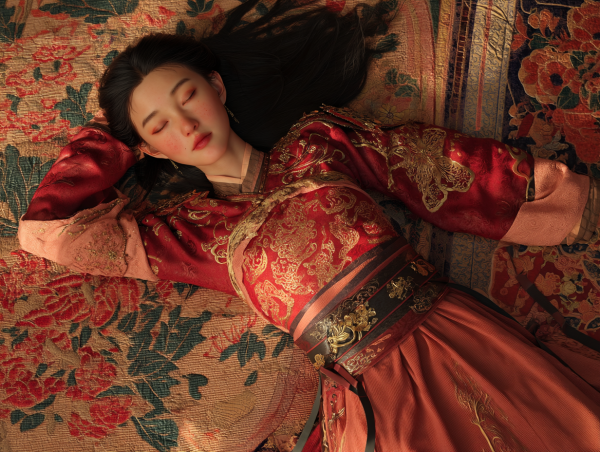
Eric Chen sat cross-legged on Lin’s battered green velvet couch.
They were on Number 5 of Lin’s so-called “short reel education marathon.” The current three-minute video was part of a 2.5H long story in the Rags-to-Riches Talent Rise genre; a genre where an underestimated person (usually a woman) rises from poverty or obscurity to become a top performer. The protagonist in this particular case was a female physician transported back to ancient China with all her medical knowledge intact.
Lin, undeterred by the total lack of medical accuracy, sprawled beside him with the joyous abandon of a housecat. Her long black hair was up in a high, loose ponytail, which bounced with each sharp intake of breath or delighted squeal she made.
“Watch! See how Master Wei uses her own blood to save the dying crown prince?” Her free hand gestured dramatically.
“That’s not how transfusions work,” Eric said, plucking a stray potato chip from his pants and nibbling it. “And the blood wouldn’t swirl around artfully like that.”
“The point is the symbolism. In dramas, blood always means love. Or atonement. Or both.” She clicked to the next episode without waiting for his reply. The sound of ancient zither music filled the room.
He watched the screen, saw a man in archaic garb standing over a woman’s deathbed, face flitting from sorrow to malice. “Hey, that’s the same actor from the last show,” Eric said. “Does he ever get to live past episode ten?”
“Only if his love is pure. And we’re on episode thirty now, pay attention!” Lin said, bursting into laughter. “Wait, wait, watch—there’s a time skip in three, two—”
Eric observed the transition: one second, the deathbed; the next, a windswept hillside, the woman now alive and glowering with supernatural vengeance. He could not deny the raw effectiveness of it, the way the show traded logic for pure emotion and forward momentum. He supposed that was the appeal.
By the time they finished episode forty, she lay half draped across his lap, her face illuminated by the shifting colors of the events unfolding before them.
“Are you even enjoying these, or am I torturing you for no reason?” she asked, tilting her head back.
Eric considered. “It’s…educational but predictable. You know exactly how it ends as soon as you finish the first five episodes. Most of them are just quickfire versions of standard C-dramas with less filler and character development. Let me see: Rebirth/Revenge Plot (重生复仇); Rich CEO Falls for Ordinary Girl (霸道总裁爱上我); Fake Marriage Romances (契约婚姻); Hidden Heir stories (真假千金 / 失散豪门子); Time Travel Romances (穿越爱情). What else?”
Lin stuck out her tongue at him. “You forgot Love Triangle with a Twist (三角恋 + 反转); Pregnancy Misunderstanding (带球跑 / 孩子是你的), and Immortal World Romance (修仙/玄幻爱情).”
She laughed when she saw Eric’s exasperated facial expression. She laughed so hard that she slid off the couch entirely. “You’d make a terrible drama protagonist. You never brood, or pine, or—” She hesitated, then reached up to tug gently at his wrist. “Or take things seriously unless there’s a patient involved.”
“That’s not true,” he said, deadpan, but Lin just grinned and tugged again, pulling him down onto the floor beside her.
“So if you had to pick,” she said, “Time Travel Romance or Rebirth/Revenge?”
He studied her: the earnest glint in her eyes. “Time Travel,” he said finally. “At least then you get a second chance.”
Lin’s smile went soft at the edges. “You’d really go back and change something?”
Eric’s hand hovered over his knee, unsure whether to reach for her or keep a safe distance. “Everyone has something to fix,” he said, then added, more quietly, “Or someone.”
Lin let the moment hang. For a second, the hum of the fridge and the distant echo of a neighbor’s laughter were the only sounds. Then she broke the silence by flicking another video onto the screen.
The episode played out. Neither of them spoke.
After a while, Eric glanced at his watch—23:47, far later than he had intended. He still had rounds at seven, a fact his muscles reminded him of with every sluggish movement. He started to shift upright, but Lin’s head remained on his shoulder, a gentle ballast.
“I should go,” he said, hating how perfunctory it sounded.
Lin’s hand moved, not to stop him, but to rest on his. “Or you could stay until the season finale,” she said.
He hesitated. In the realm of short drama, the next move would be obvious: a lingering look, a sudden confession.
“I can stay one more episode,” he said.
Lin squeezed his hand. “It’s a double-length finale. And, I’m warning you, they live happily ever after.”
He laughed, and this time it surprised even him. “As long as they do it quickly. I need at least six hours of sleep to keep my hands steady.”
They watched. On screen, the heroine turned to face her fate. In the living room, Eric allowed himself, for once, not to know how it would end.
When the credits rolled, neither moved to break the silence. Only after the next auto-played episode began did Eric gently disentangle himself, swearing he’d return the next night to finish the marathon.
She saw him to the door, her hair now wild and loose around her shoulders. She leaned in, almost but not quite kissing him, her eyes crinkled with something that hovered between joy and a dare. He met her lips, kissing her lightly; he was clearly the luckiest man in the world to have met someone like Lin. Then he said good-bye and stepped into the hall, her perfume clinging to his coat.
*
Eric walked out of Lin’s apartment building into a November night that was suddenly and unnecessarily cold. The city was quieter than usual and the hush had an aftertaste: the sticky residue of Lin’s lipstick and perfume, and the distant echo of her laughter. He buttoned his coat, only then realizing that he’d left the jade bangle in his pocket.
He’d bought it that morning from an old woman who claimed it was late Qing, but Eric doubted the provenance. Still, the surface had a certain translucence, a green so pale it looked haunted; and a distinctive flaw in the jade which looked like a fox sitting on its hind legs. He’d planned to hand it over with a half-embarrassed flourish, to say something like “For you. Because you’re impossible to impress.” But the moment had slipped by, as moments with Lin always did, and now the bangle sat in his pocket, heavier than it should have been.
He considered doubling back, but Lin was likely already asleep, wrapped in her blanket burrito, dreaming up new torments for tomorrow’s marathon. The image made him smile. He pressed the bangle between his thumb and palm, feeling the slight temperature drop of the stone against his skin, the way its oval shape fit in the hollow of his hand.
He thought about Lin’s face, haloed by screen glow. He thought about how easily she slipped past his defenses, how she insisted on seeing the good in stories where (almost) everyone died. He imagined her face if he’d given her the bangle: a flicker of genuine surprise, followed by a smile so wide it would break the city in two. It was a small thing, stupid even, but he wanted to see it.
Above, a streetlamp flickered. Eric stepped off the curb, distracted by the possibilities he has just imagined. He didn’t see the bicycle courier until the last possible second.
The impact was less a collision than a surprise: the sensation of onrushing wind, a wheel skidding over his shoe, the crunch of metal against shinbone. Eric’s arms pinwheeled, reflex snapping him upright, but momentum carried him forward. He managed a single, incredulous “Shit—!” before his knees hit the low guardrail and he pitched over it, into the hungry dark of the river.
Cold, black water closed over his head. Eric’s first instinct was to kick, but his shoes dragged and his coat ballooned, turning his arms into deadweights. He remembered, with a scientist’s clarity, that he could not swim.
He thrashed, gasping and groping for the edge as he swallowed water, but the river was too wide, the bank too far. His legs gave out first, then his arms. His last thoughts were not words but color and sensation: Lin’s mulberry eyes, the taste of dried squid, the exact shade of green as the bangle disappeared beneath the water. Then even that was gone. The world narrowed to a single point—a pressure behind the eyes, a pulse in the temples—and then nothing but cold.
CHAPTER 2: THE TORTURE NOVEL
The world returned in increments: first, the steady chill of water against his cheek; then, the rough prickle of stone; finally, a throbbing ache in every joint that was not so much pain as a memory of it. Eric Chen opened his eyes into wet blackness, tasted iron and mildew on his tongue, and thought—absurdly—that he’d survived the river after all.
His left cheek was pressed to flagstone, slick with what he hoped was only water. Around him, the light was thin and jaundiced, stretching in through a barred window somewhere above. It was cold, and his clothing offered nothing against it.
He tried to push himself up. His limbs responded, but the control was off: wrists and elbows that felt too delicate, a hand that was wrong in both shape and size. Fingers fanned across the stone, splayed in a way that reminded him of Lin’s hands when she was miming a ghost story. He had fingernails, grown out longer than he ever kept his own.
There was a shadow in the corner, motionless until a splash of water hit his face, stinging his left eye. Eric recoiled, and the shadow moved—fast, mechanical, like a doll on a string. Before he could scramble away, a hand caught his hair (his hair, impossibly long and straight, a black curtain snaking past his face) and yanked him upright.
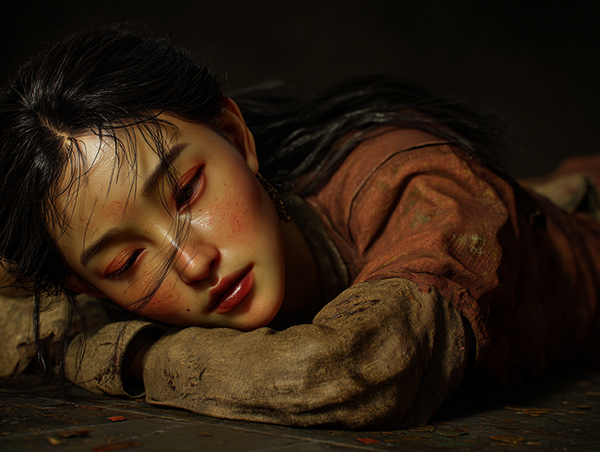
His head reeled, the world tipping sideways as he was half-dragged, half-marched across the tiny cell. The stone under his feet was slick with more than water. His bare toes curled reflexively, registering every pock and seam.
The person pulling him was a woman—her grip strong, her face a sharp pale oval. She wore a green robe, stained at the cuffs. Her other hand carried a bucket.
“Awake now, are you?” the woman spat.
Eric tried to speak, but the voice that emerged was thin, slurred. “Where am I?”
The woman’s lips twisted into a cruel smile. Then she dragged him again, this time out into a corridor so dim it barely deserved the name; it stank of ash and human waste. Eric’s bare feet slid across the floor, the sharp pain in his knees telling him the skin there had already split open.
At the far end, an iron-bound door opened onto a larger room. Here, light pulsed with a greasy yellow. Wooden benches lined the walls, and above them, tools: tongs, mallets, paddles, whips. Some were hung with obsessive symmetry, others crusted with old, dark stains.
The woman hurled Eric forward. He landed on the flagstones with a muted yelp, the sound cutting off as a shock of pain radiated up his left side.
Through the haze, he catalogued his injuries: shoulder likely bruised but not dislocated, left patella contusion, shallow abrasions to the jaw and cheek.
“Do you know why you’re here, Yu Lian?” the woman asked.
Eric stared at her, eyes narrowing. “I’m—” He stopped. The name tasted wrong but familiar, like a bad translation. “Who are you?” he tried.
The woman’s eyebrows arched, and a look of surprise and pleasure crossed her face. Eric searched the woman’s face for clues, found nothing except a tight, cold hatred.
“It’s only been a week, and you’re already speaking like a mad woman. So much for your much vaunted education.”
Eric tried to stand but pain flared through his legs. “There’s been a mistake,” he said, desperate to inject logic into the exchange. “I’m not—”
He got no further. The woman’s hand snapped out, open-palm, a ringing slap that cracked across his face. It was so sudden he barely registered the contact—only the white burst of pain and the metallic warmth of blood inside his cheek.
“I’ll tell you what’s a mistake.” The woman’s voice was tremulous now, on the edge of something brittle. “Trusting you. Letting you into my house, treating you like my friend for years, telling you my secrets, letting you meet Minghua.”
Eric managed to look up only to be drenched with another bucket of ice cold water, causing him to shiver so violently that he began gasping. He realized with horror that he was sobbing, tears lost in the deluge.
He fought to orient himself. The woman’s accusations meant nothing to him—Yu Lian, Minghua. The names triggered nothing. Yet he could not ignore the reality of the pain, the wet fabric clinging to his chest, the way his voice trembled on higher notes.
“You’re sick,” he tried, and immediately regretted it. The woman laughed, a sound like a bone breaking.
“Oh, I am,” she said. “And do you know what else? I get to fix it.”
She hauled him up by the hair again—no easy feat, given the weight and length. Eric’s neck screamed in protest as she dragged him to the nearest bench, threw him face-down, and planted a knee in his back. She reached up, grabbed a mallet from the wall, and brought it down hard on his right back.
The pain was so complete it annihilated all thought. He didn’t scream—there wasn’t enough air.
“Hurts, doesn’t it?” the woman said, panting. “How do you think it felt for me, hearing you’d seduced Minghua and married him, then spread your legs for every petty merchant in the city? Is your daughter even Minghua’s?”
Eric stared at her, blankly, the words as foreign as the pain. “This isn’t real, I never…” he said, but the sound was a whisper, crumpled and small.
The woman leaned in so close he smelled the sourness of old rice wine on her breath. “Oh, it’s real, Yu Lian. It’s as real as the day Minghua told me he was marrying you.”
She spat on his face.
“Please—” he said, and heard the break in his own voice, a pathetic, high-pitched whine. “Please, I don’t even know you. I’m not—”
The second blow came faster. He saw it, even had time to flinch as the mallet struck his left side. He gasped, choked, and this time heard a distinctly feminine tone spill from his lips.
The woman didn’t let up. She punctuated every question with violence: a cuff to the ear, a wrench of the arm, another slap to the mouth. Eric tried to answer, to say anything, but the words were hot and sticky behind his teeth. He was no longer sure he could distinguish his own thoughts from those of this Yu Lian.
The woman finally paused, exhausted from her ministrations, breath rattling in her lungs. “You’re not even worth killing,” she muttered. “They’ll take you tomorrow, you know. That’s what happens to trash. You’ll go to the pits, or maybe they’ll sell you to the mines. I hope they make you last for a while.”
Eric slumped to the floor, unable to sit up, much less move. His hands shook. The pain was everywhere now, crowding out any attempt at analysis. He shut his eyes, desperate for oblivion, but the woman was not finished.
Eric felt her kneel beside him, her breath hot against his ear whispering. “You know it was all me, right? The rumors of your infidelity, the mishandling of the family accounts, why Minghua hates you, why you’ll never see your daughter again.”
She struck him a final time, once, clean and hard across the mouth. Eric’s head snapped back, and he tasted blood—his own, coppery and slick. His vision blurred, the yellow flames receding into streaks, and for a moment he was aware only of the darkness swelling behind his eyes, a void that hummed with loss and something deeper.
He didn’t fight the darkness. He let it come, let it swallow him, and as he fell he remembered nothing—no names, no faces, not even his own.
*
When he came to again, he was moving. The floor beneath him was rough wood, the rhythmic groan and rattle of wheels a low-frequency throb in his ribs. He couldn’t move his arms; they were pinned awkwardly behind him, wrists clamped tight with wood and rope. The manacle edges had already chewed his skin raw. Every bump in the road sent a needle of agony through his shoulders, which felt wrong in a different, deeper way than the night before.
He was not alone. The cart was crowded—three, maybe four others slumped on the boards, some groaning, some still. Behind the cart about twenty able bodied persons bound with rope walked in single file. His eyes watered, and he closed them, hoping to dull the headache pulsing above his right temple.
He heard the guards before he saw them: boots grinding on gravel, the slap of whips against wood and flesh. They shouted at each other in a dialect he barely understood.
His head hung forward, hair hiding his face. He risked a glance sideways, and saw a boy not more than sixteen, dirt crusted thick under his nails, nose leaking snot into his lap. His head lolled on his chest, mouth open in a slack, empty hunger. Next to him, a woman. Older, maybe fifty. Her eyes were swollen shut, the purple skin around them almost glossy.
The cart jerked, and a bolt of pain shot through his side. He almost blacked out. When his vision cleared, he stared down and saw two unmistakable breasts pressed tight against the thin, filthy cotton of his dress. For a long moment, he simply stared at them, as if the evidence might recede if he looked away long enough.
It didn’t. He could feel the weight of them with every jounce, the sharp tingle of chafed areolae against the cloth. His mind reeled. He wanted to believe this was a fever dream, but the clinical clarity of the sensation was undeniable. Every instinct told him to reach up and check, but the manacles at his wrists made it impossible.
A voice whispered, barely audible over the cart’s rumble. “How long until Luoyang?”
It came from the woman with the ruined face. She wasn’t looking at anyone; her question was for the air. The boy answered, barely above a whisper: “Three days, maybe four. Depends on how long we get held up in Chang’an and the crossings.” His voice was thin and childish, every syllable a confession of fear.
The woman nodded.
“Where do they take us?” another voice said—a man, old, his teeth missing in front.
“To mine salt, lead, silver; anywhere they want,” the woman said.
Eric heard the word and felt a cold bloom in his belly. He stared at the boards beneath him, searching for an escape in their grain.
The hours blurred, marked only by the subtle shifts in light as the cart traced its way down the rutted road. Occasionally, the guards would toss in a gourd of water or a crust of bread, but the scramble for it was savage and left him only with a bloody lip and half a swallow of tepid, soured liquid.
The first night, he tried to sleep, but his body refused. Instead, his mind replayed a looping montage of pain and shame, stitched together from scenes that were not his own.
He saw himself—no, herself—kneeling in a grand tiled courtyard, head bowed as a man in scholar’s robes screamed at her. He recognized the anger, the formal diction, the ritualized cruelty of someone trained to wound with words. The man called her “filth,” “liar,” “unfit for the household of Zhao.” Each syllable hit with a force more terrible than the blows of the previous night.
Later, another memory: a dinner table, small and smoky, the only light a single tallow candle. Two women leaning close, whispering. One of them dabbed her eyes with a sleeve, saying “You mustn’t listen to them. Your heart is clear.” She was the one from the cell—the torturer. Her face was softer, but the eyes were the same: bright, cold, rimmed with envy.
There were other flashes, fragments that made no sense. Ink stains on slender fingers; the taste of plum wine; a child’s voice crying “Mama! Mama!” as small arms wrapped around his waist. The hug, the warmth, the feeling of being needed: these details ached worse than the wounds. The memory would always end the same way: the girl’s face fading, replaced by emptiness.
He wondered if the nightmares belonged to the woman called Yu Lian, or if they were simply his mind’s way of filling the void.
By the second day, the air in the cart was thick with sweat and piss. The boy began to shiver, eyes rolling up in his head. Eric tried to check his pulse, but the chains made it impossible to reach. When the guards next stopped to change horses, they pried the boy out with a hook and left him by the roadside. He didn’t move. The rest of them watched in silence.
On the fourth morning, Eric looked up and saw the walls of Luoyang rising from the plain like a second horizon. He squinted, eyes watering, and made out the shapes of people lining the city gate.
They herded them out, one by one, at a muddy square just inside the city wall. Eric stumbled as the guards unclasped his manacles. The relief was instantaneous but incomplete: his hands and wrists were a horror of bruises, skin puffed and angry, every finger tingling from lack of blood.
He collapsed in the mud, the filthy dress hiked above his knees, and for the first time caught a glimpse of his new body in full daylight. The skin was pale, almost translucent, the legs hairless and slender, the feet oddly small. His face was distorted when he looked down into his reflection in a puddle, but the eyes were sharp, black, and familiar. Somewhere inside, the person called Yu Lian stared back.
He was close to giving in then. He looked up at the wall and wondered how long it would take to die if he jumped and fell headfirst. But when he tried to stand, his knees failed.
The guards moved among them with whips, shoving men into one group, and women into another. Eric was yanked up by the hair—again, always the hair—and steered into a line of women, all staring straight ahead. A short, fat man with bad teeth was walking down the line, appraising them like livestock. When he reached Eric, he paused.
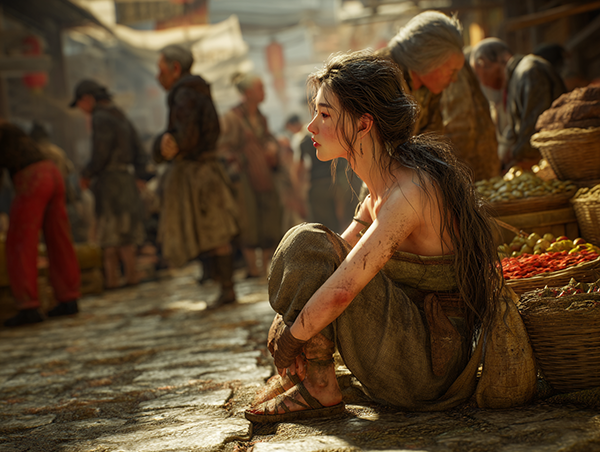
“This one’s trouble,” the man said, poking Eric’s cheek with a stubby finger. “Look at the eyes. Too proud.”
The man grunted, moved on. The guard released him, and Eric staggered forward, numbness replaced by a spike of nausea. The noise of the city was overwhelming—merchants barking, children screaming, gongs and drums in the distance. For a moment, he thought of Lin again, and the jade bangle he’d never given her, and his chest ached with the realization that he might never see her, or himself, again.
He looked down the line at the women, all silent, all doomed, and felt a perverse kinship with them—a scientist’s curiosity at how long he could last, how far he could push this alien vessel before it broke.
He decided, then, that he would not die here. Not yet. Not until he understood why. The thought kept him standing, even as the world wobbled and the stench of the city rose up around him like a tide.
*
The logic of the world had shifted, and Eric Chen was the last to know.
It came to him in pieces, between the agony of his new body and the parade of humiliations that followed: the genre logic, the tropes, the deep, structural cruelty of the narrative. It was a Torture Novel. A web of suffering woven tight as silk, each knot designed to break the heroine—and by extension, him.
He recognized the arc from the endless hours of binge-watching with Lin. The protagonist—a woman of intellect and virtue—would be battered, betrayed, stripped of all dignity, until only a thin thread of will remained. Then, if the story was merciful, she’d claw her way back to power, repaying every injury in kind. There were variations, but this was the shape of it.
And he, somehow, was inside.
He wanted to laugh, or scream, or both, but there wasn’t time. The buyers were already at the line, moving down the row with the eager solemnity of men at a meat market. They prodded arms, checked teeth, lifted skirts to examine thighs for signs of disease. The fat man who’d appraised him earlier circled back, this time with a parchment in hand.
“Name?” he barked, not at Eric, but at the guard beside him.
“Yu Lian,” the guard said. “Daughter of a Junior Official. Used to work in a clinic.”
The man grunted, poked Eric in the side. “She’ll never last on a farm. Too delicate.”
“A Qinglou then?” the guard offered.
The buyer turned. “The Pavilion’s always looking. Otherwise, the foundries.”
Eric stared at the ground, shame and dread colliding in his throat. The rules of the Torture Novel were absolute: there was no dignified way out, only degrees of degradation. He remembered Lin’s recitation, like a warning delivered with popcorn: “First, the downfall; then the rebirth. The world is cruel but she survives.”
A woman in pale silk glided down the row, her eyes sharp as razors. She was older—mid-forties, Eric guessed—but her face was flawless, the kind that owed as much to discipline as to luck. She looked at Eric and did not blink.
“I want this one,” she said, with the bored authority of someone ordering breakfast. “Unusual eyes. Good bones.” She turned to the guard. “What’s her price?”
“Double, for the medical training,” the guard said, more alert now.
The woman rolled her eyes. “Who do you think you’re talking to? You think I can’t tell she’s broken? Give me a better price or you’ll get nothing.” She stepped closer, squatting so they were eye to eye. “Can you speak, girl?”
Eric opened his mouth, found the words, and—betrayed by some inner imperative—said, “Yes, Madam.”
The woman nodded, as if she’d expected no less. “You belong to me now. At the Pavilion, you’ll be called…uhm…Bao Zhu. Obey, and you might live to see spring. Disobey, and I’ll send you to the salt mines.”
Eric nodded, stunned by the precision of her power. The woman rose, and with a flick of her wrist signalled to the attendants.
He was yanked from the line. The other women didn’t look at him; they were locked in their own stories, their own private genres of misery. He stumbled forward, kept upright by two burly guards, and was marched across the square to a waiting litter.
The city of Luoyang unfolded before him in flashes: the noise and stink, the endless rows of whitewashed walls and sloping roofs. It was relatively clean and well-organized by pre-modern standards, and followed the grid-pattern layout typical of Tang cities. Eric passed through wide streets, and designated zones for markets and residences.
Eric tried to take in every detail, desperate for some anchor in his new reality. They passed through a market where children darted between stalls, stealing fruit; then a temple, its doors painted red, where a line of monks knelt in prayer. They passed a wedding procession, the bride’s face hidden behind a veil. He wondered, absurdly, if any of these people had ever watched a web novel adaptation, or if their lives were simply stories performed for the amusement of someone else.
The litter stopped in front of a three-story wooden building, its eaves curved like the wings of a sleeping bird. The air was thick with perfume and the buzzing of bees.
Inside, the Pavilion was a world apart. The entry hall was vast, all redwood and paper lanterns. Girls in silk robes floated past, carrying trays of tea and baskets of fruit. There was music—low, intricate, played on instruments Eric didn’t know—and a constant, susurrating chatter that suggested secrets and intrigue at every turn.
He was led up a back staircase, down a narrow corridor, and into a small, spartan room. The only furniture was a straw mat and a basin of water. The guards left him there, the door locking behind them with a sound like finality.
He sat for a long time, staring at his hands, flexing the fingers and marveling at their strangeness. The wrists were already purple, but the swelling would go down with time.
He drank from the basin, ignoring the taste of dust and tin. He lay back on the mat, and stared at the ceiling, tracing the cracks in the plaster with his eyes. For the first time since waking in this nightmare, he allowed himself to think not just about escape, but about what it might mean to survive.
He thought of Lin and wondered if she’d laugh to see him now—a man in a woman’s body, in a genre that made misery an art form. The irony was total, and somehow comforting. He resolved to last longer than any of them. He would play the game. He would learn the rules.
*
The next morning, he was roused by two women in immaculate silk robes. They wore the same smile—polite, impersonal, faintly curious—as they hauled him from the mat and stripped him of the threadbare shift he’d been wearing since the market.
Eric tried to cover himself instinctively, even in this borrowed flesh, but they held his arms out to the side. The shivering started at his fingers and moved up in waves. The air in the Pavilion was cool, scented faintly with plum and camphor, and every inch of his naked skin felt suddenly, hideously exposed.
They led him to a bathing chamber, bright with filtered morning light. A tub of steaming water waited in the center, lined with towels and porcelain bottles. One of the women pressed him to sit, the other poured water over his scalp, then scrubbed at his hair with hands that were brisk but not unkind. They washed his face, his back, his legs, his feet—everywhere, meticulously, like erasing the last traces of the outside world.
He watched his body with the same calculation he reserved for cadavers in the anatomy lab; a calculation now marred with a growing aversion. Until now, he had avoided looking at himself, even when relieving himself during his transport to Luoyang.
The skin was pale, flawless save for the lash marks and bruises. There was a delicacy to the bones, a smallness he’d never known. The breasts were neither too large nor too small, the areolae pink-brown and sensitive to the touch. The waist dipped in, the hips flared, the pubic mound covered with a dense growth of hair.
When the attendant’s hands slipped between his legs, lathering the cleft with powdered Soapnuts, Eric gasped and lurched forward. He tried to look away, but the bronze mirrors on the wall made it impossible to escape the image: a twenty-year-old woman, modest by modern standards but devastatingly feminine by those of the Tang. The contrast to his old self was so complete it bordered on satire.
They finished with a flower-infused oil, massaged into the skin until he gleamed. They dressed him in a robe of soft cotton, not silk, but dyed a brilliant shade of rose. When he looked down, the neckline framed the upper curve of his new chest, hinting at cleavage.
The attendants left, closing the door behind them with a soft click. Alone, Eric stared at his reflection in the mirror.
He approached it, slow, as if the image might leap out and attack. He touched the polished surface, then his own face, searching for traces of himself in the arrangement of features. There were none. The eyes were large and dark, the lashes thick, the jaw narrow and elegant. The lips were full and shaped for perpetual sadness.
He bared his teeth and scowled. He pressed at the bruises on his face, then lifted the robe, examining the arms, the rib cage, the slight pouch of the belly. There was nothing—no trace, no scar, no secret—to tie this body to the one he’d left behind.
With trembling hands, he pulled the robe open, letting it fall to the floor. He scrutinized the breasts, the collarbones, the gentle slope of the thighs. He pressed his palm to the abdomen, and felt the heat of the skin and its softness.
He cupped a breast, expecting revulsion, but feeling only shock at the responsiveness: the way the flesh molded to his hand, the way the nipple tightened at a brush of his thumb. He squeezed, harder than he meant to, and felt a rush of pain, but also something else—an echo of pleasure that made him pull back, shaking.
He crouched on the floor, hands to his face, and waited for the horror to pass. When it didn’t, he examined the rest of himself: the narrow feet, the small toes, the pinkish soles unmarred by callus. He stared at his crotch, unable to look away, the absence there more shocking than any presence.
He poked, prodded, spread the lips with clinical detachment. The anatomy was unexceptional, the labia smooth and symmetrical, the clitoris small but visible. He pressed a finger in, gently, expecting resistance and finding none. The vaginal canal was slick, slightly elastic, unfamiliar in every way. He withdrew the finger, stared at it, then wiped it clean on the robe, feeling like a trespasser in someone else’s home.
He wanted to believe this was a dream, that he’d wake in a hospital bed with tubes in his arms, but the rawness of the sensation—the way the air prickled on his damp skin, the taste of his own breath in his mouth—made denial impossible.
He stood, pulled the robe closed, and cinched it tight at the waist. He sat on the mat, knees drawn to his chest, and tried to conjure his old self: the steady hands, the deep voice, the calm that came with knowing exactly who he was. But the echo was faint, drowned out by the symphony of new signals, new hungers, new fears.
He would not break. He would not surrender to the biology, or to the story that had claimed him.
But for the first time, the possibility of failure—of total, irreversible erasure—seemed not only real, but inevitable. He pressed his hands between his knees and rocked slowly, waiting for the next humiliation to come.
*
The next morning, the Madam summoned him for “assessment.”
She waited in a salon lined with paper screens, a single plum branch in a vase behind her. She wore violet silk, her hair set in elaborate knots and pierced with a gold comb.
“Name,” Madam Liu Mei said.
Eric hesitated. “Yu Lian, Madam.”
The woman’s gaze was direct, unblinking. “Your name is Bao Zhu. You will answer to it henceforth. I hope I will not have to repeat this a third time.” The name meant Precious Pearl.
She slid a piece of paper across the floor. “You are literate?”
“Yes,” he answered, the reflex automatic.
She pointed at a brush and ink. “Write your name. Then write a poem. Any poem.”
He did as instructed, marveling at how the hand knew the shape of every character, the pressure needed for the softest line. He wrote the new name in a fine, crisp script. The poem came next, unbidden: a four-line verse about plum blossoms and winter’s end. He recognized the poem, vaguely, from Lin’s endless recitals, but the lines appeared as if conjured.
The madam read the characters, lips moving in silent appreciation. “Good. You will serve in the front rooms, not the kitchens.” She pointed at a pipa and a guzheng behind her. “Can you play?”
Eric walked forward and took the guzheng instinctively. He sat down, placed the zheng on its stand, and plucked a scale, then a melody, the hands moving faster than thought. The sound was beautiful—clear, mournful, sweet in the way pain is sweet when the wound is fresh.
The madam smiled. “Excellent. There are many with sweeter voices, but few with such hands.” She clapped, and a servant brought a tray of fruit. “Eat,” she said. “Tomorrow, we begin your refinement.”
*
The next days blurred into a regimen of training and transformation. For some reason, Yu Lian knew only the barest minimum of what was expected of a woman of the Tang Dynasty. Eric guessed this was out of family neglect or impoverished circumstances; but how then did she learn to play the guzheng or write with such skill. The only thing he remembered was that Yu Lian’s parents were dead and that her family was now headed by one of her estranged brothers.
They taught him how to walk, how to sit, how to lower his eyes and smile with calculated modesty. Every gesture was measured, every word rehearsed. His old habits—upright posture, blunt speech—were systematically broken and rebuilt.
Eric was draped in a high-waisted skirt that flowed elegantly just beneath the bust, crafted from luxurious silk in rich hues of crimson and emerald. The fabric bore intricate floral and phoenix patterns, shimmering with threads of gold. Over this, he wore a fitted, cross-collared jacket with narrow sleeves, its daring low neckline hinting at allure, a reflection of the era's fashion among elite women.
He would sometimes be given robes with wide, flowing sleeves—known as "water sleeves"— which added grace, especially during dance, allowing for sweeping movements that conveyed emotion. A long, ornate silk sash cinched his waist, cascading in elegant folds, embroidered and adorned with jade ornaments that enhanced the opulence of the ensemble. Beneath it all, a soft inner robe provided comfort, while loose trousers ensured modesty during movement. His hair was styled in an elaborate updo secured with decorative pins made of silver and jade, embellished with peony and lotus motifs that symbolized beauty and refinement.
The first time he tried to walk in the embroidered slippers, he nearly tripped. “Smaller steps,” chided his instructor, a younger courtesan with the face of a disappointed mother. “You are not a farmer.” She tapped his knee with a bamboo rod. “Grace, always grace.”
The art of makeup was a science all its own. The first layer was a finely ground rice powder, creating a flawless, porcelain-like complexion. Next came the red rouge, applied in generous, crescent shapes on his cheeks, imbuing his face with a youthful vibrancy reminiscent of blooming flowers. His eyebrows were carefully crafted, shaped into delicate arcs, enhancing the expressiveness of his eyes. Small decorative dots, known as huadian, were painted between his brows and on his cheeks, adding a touch of elegance and individuality to his visage. Each stroke of makeup transformed Eric, enveloping him in the mystique expected of a courtesan, marking the final steps in his metamorphosis.
He learned the songs, the ancient jokes, the rituals of pouring tea and pouring wine. He learned the proper way to address a scholar, a merchant, a soldier. He learned how to argue a point, and how to lose with dignity. The worst was the etiquette of physical submission. “You must always bow lower than the guest,” said the instructor. “Your hands must never touch unless invited.” She pressed his shoulders down, forcing his face near the floor. The humiliation stung more than any slap.
In the afternoons, the Madam quizzed him on the classics, sometimes for hours. She corrected every error, every mispronunciation. “You are lucky,” she said. “Your mind is sharp, but I detect some willfulness in your spirit. I mean to change that before the month is up.”
There were lessons, too, in self-preservation. One of the older girls—a veteran of the trade—took Bao Zhu under her wing and explained the myriad possibilities.
“Bao Zhu, you are an intelligent and kind girl so I know my words will not be wasted on you. The other girls feel that their beauty will sustain them but there are things which only experience can teach.” The older courtesan’s voice was sharp yet laced with a hint of warmth. “High ranking geji navigate a labyrinth of social hierarchies and political intrigue. Your very survival hinges on your intelligence and emotional acuity.”
Eric nodded, trying to absorb the weight of her words. “What do you mean by emotional acuity?”
“It’s about reading people,” she explained, pacing the small room as if it were a stage. “You must learn to assess a guest’s temperament and intentions swiftly. Know when to flirt, when to retreat, and how to flatter without overstepping.”
“Isn’t it enough to just be charming?” Eric asked, furrowing his brow.
“Charm alone won’t protect you,” she replied, pausing to meet his gaze. “You must master the art of graceful refusal. Use humor or poetry to deflect unwanted advances. Compliment a man’s work or status to soothe his ego, steering the conversation away from intimacy.”
“Like reciting poetry?” he asked, intrigued.
“Precisely. A well-placed verse can redirect attention or express refusal without offense. It elevates the interaction to something more profound,” she said. “When a suitor grows too bold, a clever line about unattainable beauty can create distance, while still flattering him.”
He absorbed her teachings, feeling the weight of their significance. “And what about alliances? How do I build those?”
“Ah, alliances are crucial,” she continued, her tone turning serious. “Your safety often rests on powerful allies—patrons, madams, even sympathetic eunuchs. Cultivate relationships with fellow courtesans and their patrons. Diversifying your connections reduces your vulnerability.”
“But how do I know who to trust?” Eric pressed, anxiety creeping into his voice.
“Understanding power dynamics is key,” she replied. “Know the difference between a scholar, a general, or a provincial governor. Each wields power differently. Be aware of who is under surveillance and who can offer protection—or destruction.”
He nodded slowly, contemplating the complexity of his new world. “And what about managing my reputation?”
“Your mystique is your currency,” she said firmly. “Cultivate an image of unattainability or tragic romance. Use rumors of illness or heartbreak to deter aggressive suitors. Discretion is vital; damaging whispers can ruin you.”
“What else should I know?” Eric asked, eager for more guidance.
“Herbal knowledge is essential,” she advised. “Understand the properties of common herbs—some can protect you from foul intentions. And remember, saving money or receiving gifts can provide a measure of independence.”
“I will learn everything,” Eric promised, the weight of his new identity settling around him like a cloak. “I will navigate this world.”
*
Eric’s medical knowledge was both a blessing and a curse. He understood, immediately, the logic behind the herbal teas and the mineral baths, the tricks for whitening teeth, the pastes for softening hands. He knew the risks in every cosmetic and remedy, and mentally recalled the side effects as if preparing for a case report.
One morning, a cramping ache twisted in his lower abdomen, a pressure that built slowly before crashing over him like a wave. As he rose to relieve himself, he was met with the stark reality of blood staining the sheets.
He had prepared for this moment, having discreetly inquired among his fellow courtesans about the devices and rags available to manage such an occurrence. Clumsily, he reached for the folded cloth pads made of soft, washable cotton that he had set aside, and secured them with a belt designed to hold them in place. The fabric felt strange against his skin, a reminder of the new reality he had to navigate. The sensations of his first period were decidedly unpleasant: the sour, metallic smell; the way the blood pooled and then dried, tacky and hot. The cramps came in waves, unpredictable. His breasts grew tender, the nipples almost raw to the touch.
That night, he sat alone in his cell, robe open to the waist, and pressed both hands to the soft swell of his belly. The skin was warmer, the veins more visible. He traced the line of the hipbone, the gentle curve toward the pubis, and wondered if there was any way back from here.
The next day, the madam tested him with a guest—a low-ranking official with thick fingers and a habit of snorting when he laughed. Eric poured tea, played the guzheng, recited a poem about the moon. The guest was delighted, and declared that Bao Zhu was “even better than the last one, and not nearly as gloomy.”
He understood, then, the power of performance: how even in humiliation there was a strange, compensatory pleasure. It was not who he was, but it could be what he did.
That night, he stole a small bottle of wine from the kitchens, and drank until the pain in his belly faded to a dull throb. He lay on the mat, robe loosened, and watched the candlelight flicker. He thought of Lin—her laugh, her hands, her stubborn refusal to take anything at face value. He tried to imagine what she’d say now, but the memory was slippery, half-lost in the haze of wine and exhaustion. He resolved, for the hundredth time, not to break.
When the next morning came, and with it the summons to serve at a banquet, he rose without complaint, hair pinned high, lips painted red. He had learned the rules. He would play the game.
*
The next three months passed like water through a sieve, every day eroding something Eric once considered essential to his self.
Madam Liu Mei was everywhere: correcting the angle of his bow, the cadence of his voice, the shape of every smile. She taught him the fine points of banter and innuendo, the subtle way to flatter a man’s wit without upstaging him.”
Eric’s body had become a traitor. It woke each morning tuned to the rhythms of the house: the scent of rice porridge, the scrape of sandals on lacquered floor, the opening drone of the guzheng from the main salon. By the second week, he could walk with the required mincing steps; by the fourth, he could pour wine with polished elegance and without wasting a single drop.
The other girls were a study in adaptation. Some hated him—resentful of his “fast track” through the ranks—but most ignored him, locked in their own loops of performance and calculation. The exception was Xue Ling, who’d been at the Pavilion since age fourteen. Her face was plain, but her wit was sharp and cruel as a wire.
“You still hold your chopsticks like a boy,” she told him over dinner, after an older patron had complimented his hands. “Better to pretend to be clumsy. Men enjoy fixing things.”
He learned quickly that Xue Ling was both ally and rival, depending on her mood. She taught him the economics of the Pavilion—who tipped well, who was stingy, which guests to avoid after the third bottle of wine. She could recite a dozen ways to fake a smile and as many ways to make a mark spend double.
At night, after the lamps were doused and the halls fell silent, they’d lie awake in their shared chamber and trade secrets in whispers.
Sleep came in shallow bursts, always ending with the same dream: a little girl with his (her?) eyes, arms reaching up, voice high and insistent. The dream child called him “Mama,” her hands warm and sticky, but the hug always ended with her slipping away, face blurred by tears.
One night, he woke screaming. Xue Ling shushed him, holding his head in her lap.
“It’s just a dream,” she said.
Eric shook with a grief he couldn’t name. The tears were hot, shameful, and endless.
*
The first time he was summoned to entertain at a formal banquet, he felt less fear than anticipation. The salon was hung with paper lanterns, the floor crowded with merchants and minor officials, the air thick with incense and the sound of money.
He played the guzheng, sang two songs, and poured drinks for a table of scholars. They asked for poems, so he recited a new one about plum blossoms, the lines so clean and mournful that the room fell silent.
Afterward, the men crowded around, eager for a word or just to be close to her. One of them—a brute with wine on his breath—pulled him down onto his lap, a gesture half affectionate, half predatory. The man’s hand slid over his waist, cupped the curve of his breasts through the silk robe, fingers squeezing in a way that was both familiar and appalling.
Eric felt the touch as if his body belonged to someone else. He smiled, demure, and waited for the hand to release. The man chuckled, whispered something obscene, and let him go.
Later, back in the private quarters, Xue Ling teased him. “He likes you,” she said. “Next time, let him touch a little longer. He’ll tip better.”
Eric retched in the chamber pot, then rinsed his mouth with tea. He stared at his reflection in the cup, the face now so familiar it hurt.
That night, the dream child returned, arms open wide. But this time, when he tried to embrace her, she did not vanish. She stared back with solemn eyes, and said, “I love you, Mama.”
He woke shaking, with a feeling of gnawing despair.
*
The days continued.
He played the role, and sometimes, at the end of an evening, when the guests applauded or wept at a song, he felt a strange pride. It was not the pride of a surgeon or a man, but something new—hard and bright, forged in the crucible of humiliation.
He drank with the other girls, let them paint his lips and style his hair. He in turn learned to help his fellow courtesans with their dressing and make-up when they were pressed for time. He learned the art of negotiation: when to yield, when to press, how to steer a conversation toward profit or safety.
In quiet moments, he still thought of Lin. He wondered if she would recognize him now, or if she would laugh at the changes. He missed her with a dull, persistent ache, but less with every passing week.
The old life receded. The new one closed around him like a lacquered box.
On the ninety-third night, after another exhausting banquet, he found himself alone in the Pavilion’s garden. The plum trees were in full bloom, petals falling like snow. He sat on a decorative porcelain stool, robe loose at the collar, and stared up at the moon.
He drank straight from the wine bottle, savoring the burn. For the first time, he let himself grieve what was lost—not just the body, but the certainty, the clarity of purpose. The wind shook the branches, and the petals landed in his hair, cold and real. He stood, wiped his mouth, and went back inside, ready to start over.
She would survive this world, and if it demanded the death of Eric Chen, then so be it. She would become Bao Zhu, and she would win.
The last thing she remembered, before sleep claimed her, was the sound of the dream child’s laugh—a bright, clear note that echoed in her new, rewired heart.
CHAPTER 3: BAO ZHU
The surface of the dressing table was a study in calculated disorder: shallow dishes crowded with pastes and powders, combs, and slender rods of jade stacked in artful neglect. At the heart of this array sat a burnished bronze mirror, round as the moon.
Bao Zhu leaned closer to the burnished bronze mirror, her breath fogging the surface in delicate wisps. She studied the contours of her face, the gentle curve of her cheekbones and the delicate arch of her brows. Her eyes, bright and curious, sparkled with a new confidence, reflecting the woman she had become. She reached up, brushing a fingertip along the smooth line of her jaw, tracing the path of her own beauty, each touch a reminder of the strength she had cultivated within.
Her private chamber was an advertisement for success. The silk screens were painted with improbable birds and plum branches. A low platform bed—wide enough for two if an evening grew interesting—was layered in peony-patterned cotton and covered by a thin canopy of gauze. The faint aroma of camellia oil lingered over everything, masking the less romantic odors of rice, sweat, and nervous anticipation that clung to every geji’s suite.
There were those who said that women learned to love themselves only in the appraisal of others; that their beauty was not truly theirs, but a transaction signed in the eyes of men. Bao Zhu thought this unscientific. Even now, after two years of relentless self-observation, she found that her greatest pleasure lay in moments like this: alone at her table, correcting a smudge, coaxing a new shape from the same old bones.
She dipped a cotton swatch into a casket of ground pearl, then tapped it against the heel of her palm until the excess dusted away. With a slow, rotary motion she pressed the powder into her cheeks and brow, building layer over layer until her face gleamed with a quiet, practiced radiance. The sensation was as familiar as flicking back a stray lock of hair, but still—after all this time—faintly absurd. As she worked, the lines of her old life flickered and vanished beneath the sediment: Eric’s square jaw erased into a soft heart; his perpetually furrowed brow smoothed into a delicate arch; his dull, olive skin replaced by a luminous pallor.
She had once—months ago, now—tried to count the exact moment when the horror of her body’s transformation turned into the anticipation of its display. She remembered the first time she caught sight of herself, nude, in a bathhouse mirror: the helpless shock at the mound of her pubis, the uncanny roundness of her thighs, the logic-defying convexity of her chest. She remembered, too, the slow, chemical acclimatization to blood and softness and swelling, the monthly cycle of pain and renewal. If the first weeks had been a horror show, the months that followed were a clinic: she studied herself, mapped the new topography, tested the range of every joint and the strength of every muscle. She experimented—carefully, then recklessly—with pleasure. There were few illusions left.
A knock at the door broke her concentration. Without looking up, she called, “Enter.”
A young maid scurried in, eyes downcast but already grinning at the sight of Bao Zhu’s half-finished face.
“Mistress, your nine o’clock is early, and with some friends. He’s in the blue parlor already, and he brought gifts.” She set a lacquered tray on the table, its contents obscured under a veil of fine silk. “Should I lay out the green?”
She nodded.
The maid bobbed her head and set to work, laying out a series of silk underrobes and a padded outer jacket whose sleeves shimmered with a subtle peony motif. Bao Zhu let her fuss with the layers while she finished her face. It was a small pleasure to have another pair of hands at her disposal, someone to tie the sashes and arrange the trailing cuffs just so. In this, she understood why women never truly needed men.
The maid—her name was Xiu Ying, though Bao Zhu privately called her Little Sparrow for the way she hopped from foot to foot—began to comb out and set Bao Zhu’s hair. There was less oil in it now, and the hair itself was thicker and heavier. She watched Sparrow twist it then secure it with some pins.
“Today, the peony pin,” Bao Zhu decided. “And the smaller jade stick.”
“You’ll be too beautiful, Mistress.” Sparrow’s eyes darted to the mirror, then away. “He’ll forget all his poetry.”
“That’s the plan,” Bao Zhu said. She smiled—a slow, sideways thing that would have been called a smirk in a less pretty mouth.
Sparrow hesitated, then produced a final touch: a glass vial, stoppered with wax. She uncapped it and dabbed a drop behind each of Bao Zhu’s ears. The perfume was unfamiliar, sharp but sweet, with a medicinal aftertaste that cut through the camellia oil. “From Madame Liu herself,” said Sparrow. “A new batch.”
Bao Zhu wrinkled her nose, then let the aroma settle. She rather liked it.
When the last pin was in place, she stood and let the robe slip over her shoulders, the cool silk laying against her skin like a second epidermis. She watched herself in the mirror, noting the way the folds fell, the flash of white at the throat, the understated sliver of ankle visible beneath the hem. She adjusted the sash—tighter than custom demanded—then allowed herself a single, approving nod.
For a moment, she caught Sparrow’s reflection in the polished bronze: the maid’s face openly admiring, as if the effect were alchemy. Bao Zhu remembered how, in her old life, women had been an abstraction, a problem to solve or a standard to envy. Here, they were everything: rivals, allies, confessions in the dark, bodies pressed together in mutual exhaustion. The men came and went, but the sisterhood endured.
She felt a strange affection for the girl and placed a hand on her shoulder. “Thank you,” she said.
Sparrow’s cheeks reddened, and she scurried away to announce her to the client.
Alone again, Bao Zhu surveyed the room one last time. She pressed her hands to her belly, felt the warmth there—the old anxiety replaced, finally, by something like anticipation. She turned to the door, squared her shoulders, and glided out, leaving only the faint echo of perfume to remember her by.
*
The Pavilion was a world of rooms and thresholds, each one a performance waiting to begin.
Bao Zhu would sometimes entertain in her own chambers but preferred a larger room for bigger groups. As she passed the other rooms—one filled with the nervous laughter of new girls, another silent but for the click of beads on a counting table—she allowed herself a small, private smile. There were days when she missed the certainty of her old life, but the rituals of womanhood—the powder, the silks, the sly arch of a brow—were no less intoxicating.
By the time she reached the blue parlor, she was Bao Zhu in every line and angle. A man waiting inside rose when she entered, but she saw in his eyes that he would never know the years of practice, the thousand mornings spent sculpting the person she had become.
She bowed, graceful and precise, and began her day.
Earlier that evening, Xue Ling had welcomed the four guests with a bow that spoke of both respect and familiarity.
She offered each visitor a warm towel to cleanse their hands, and presented tea in porcelain cups adorned with intricate designs. The fragrant steam curled into the air, mingling with the soft strains of a guqin, played by a secondary musician hidden in the shadows.
As the guests reclined on plush cushions around a low table, they were treated to an array of seasonal fruits, candied plums, and light pastries, all carefully arranged to entice the eye. A lacquered wine vessel held warmed huangjiu, which flowed into small ceramic cups at the hands of Xue Ling, the rich aroma inviting the first round of toasts. Each man wore his wealth with the self-consciousness of a merchant (or official) class still fighting for legitimacy, the voices booming even in the hush of polite company.
With an air of elegance, Bao Zhu entered, her presence brightening the dimly lit room. She swept a slow glance over the evening’s assembly.
At the head of the table was Zhang Yue who has risen to greet her. Bao Zhu recognized him at once, though he’d changed his beard again. The first time she’d seen him he’d worn it in the thin, scholarly style popular among examination officials; now it was full, a boastful fan that narrowed his cheeks and made his mouth look perpetually amused. He greeted her with a bow and she matched it with a bow so perfectly measured it might have been drawn with a ruler.
“Bao Zhu,” he said, savoring the words. “You are as radiant as spring rain, even in this dim light.”
She smiled, and retired to the seat at his left. “Master Zhang is too generous. The light flatters only because it obscures my faults.”
The men laughed, the sound a collision of three dialects and several grades of inebriation. To her right was a salt merchant whose face, red and craggy, suggested a long familiarity with his own product; across from him, a southerner with the pink, petal-plump hands of a man who’d never carried anything heavier than a brush. The fourth was an official from the Ministry of Works—her first time seeing him in the Pavilion. He looked both hungry and faintly terrified, as if he suspected that at any moment a real noble might kick down the door and denounce the entire gathering.
“Shall we indulge in some poetry tonight?” Bao Zhu proposed, her voice smooth as silk. “What theme shall inspire our verses? Perhaps the ‘Autumn Moon Over the River’ or the poignant ‘Parting at the Willow Bank’?”
The men exchanged glances, their competitive spirits ignited. Each quickly set to work composing a shi or jueju, their pens scratching against paper with fervor. “Moonlight spills on the river, cold and clear,” began one scholar, his voice resonating with emotion. “A lone boat drifts where the reeds appear.”
“Who plays the flute beneath the willow tree?” another added, his tone wistful. “A guest’s heart breaks—home is far from me.”
Bao Zhu smiled. “The flute was mine, though not for sorrow’s sake—I played for you, the moon, and stars awake,” she replied, her words weaving a web of connections that drew laughter and applause from the men.
The banter continued with the usual show of humility, each man apologizing for his lack of learning before unleashing a punishing recitation of poems or city gossip. Bao Zhu let them circle, intervening only to refill cups or pass a new dish.
*
As the evening deepened, candles flickered to life, their soft glow illuminating the room. Incense of sandalwood filled the air, wrapping around them like an embrace.
Bao Zhu stepped forward, her silk ribbon dance a visual poem of grace and emotional expression. Xue Ling accompanied her on the pipa, the notes swirling like whispers of longing. Each pluck of the strings resonated in the air. The guests leaned forward, captivated by the performance, their eyes gleaming with admiration.
As Bao Zhu moved, her body flowed like water, each gesture telling a story of yearning and desire. The men exchanged glances, their expressions shifting from playful banter to rapt attention, as if they were witnessing a rare and delicate flower unfurling.
Zhang Yue, his gaze fixed on her, wore an expression of awe, the corners of his mouth curling into a smile that spoke of unspoken affection. With every graceful turn and sweeping motion, Bao Zhu drew them deeper into her world, where time seemed to suspend. The rhythm of Xue Ling’s pipa echoed the quickening pulse of the room, and as the final note lingered in the air, a hush fell over the gathering. Then, as if released from a spell, thunderous applause erupted, filling the space with an electric energy that made Bao Zhu’s heart race.
“Bravo!” cried one scholar, his voice ringing with enthusiasm. “You’ve captured the very essence of the moonlight!”
“Indeed, my lady, the stars themselves envy your grace,” another added, his tone rich with flattery.
Bao Zhu smiled, feeling a warm flush spread across her cheeks, grateful for their admiration yet aware of the power she wielded in this moment.
In this intimate atmosphere, wine loosened tongues and formality slipped away. Bao Zhu and Xue Ling moved among the guests, refilling cups and engaging each man in turn. Discussions blossomed into deeper conversations about philosophy, the nuances of Confucianism, Daoism, and the delicate dance of court politics. Bao Zhu shared her own story, framed in poetic metaphor, capturing the essence of her origins and dreams unfulfilled.
One guest leaned closer, captivated. “Your words resonate with truth, Lady Bao Zhu. You speak as if you have lived many lives.”
She met his gaze, warmth radiating from her. “Life is a constellation of experiences, woven together through the threads of our choices.”
She waited for the lull that always came, then redirected the conversation.
“Today’s news is all about the Empress Dowager,” she said, eyes cast down as if offering a prayer. “They say her influence has reached even the Ministry of Works. Is that true, Master He?”
The official blanched. The others turned to him, emboldened by the prospect of watching a government man squirm.
“Well, there are… rumors,” he stammered, “but we civil servants know better than to question Heaven’s Mandate. Don’t we, Master Zhang?”
Zhang Yue was not one to let an opportunity pass. “Heaven’s Mandate is a fine thing until your tax rate doubles,” he said. “But I’d rather face the Empress’s edicts than the wit of Lady Bao Zhu.” He turned to her, eyes bright. “You know, she once almost bested a visiting governor at weiqi, losing with some oddly atypical moves I should add; then composed a poem immortalizing her poor luck and sad defeat,” Zhang Yue remarked with a playful grin.
“Oh, that poem,” Bao Zhu replied, feigning modesty as she tucked a loose strand of hair behind her ear. “It hardly deserves mention. I merely captured a fleeting moment of despair. A tragic loss.”
“I remember it well,” the southerner chimed in, licking his lips with a glint of mischief in his eyes. “You likened the governor’s campaign to a bee caught in honey.”
“Ah, but let us not forget,” Bao Zhu continued, waving her hand dismissively, “the honey was far too sweet for his taste, and the poor governor was simply a hapless insect in my web of words.” She offered a soft laugh as she downplayed her triumph.
The table erupted. Even the city official laughed, forgetting his terror for a moment.
Bao Zhu shrugged modestly. “It was not a fair match,” she said. “The governor was distracted by the flute girl. I only seized the moment.”
“Speaking of seizing moments—would you honor us with music?” said Zhang Yue, gesturing toward the guzheng set against the far wall.
She, of course, indulged him. She rose with measured slowness, the silk layers of her robe swirling just enough to suggest the shape beneath. As she crossed to the instrument, she felt all four pairs of eyes on her, counting the steps, the line of her jaw, the way the nape of her neck caught the lamp’s reflection.
She settled behind the guzheng and bent low over the strings. The first note was soft, a ripple on the skin of the air. She played a tune that started sweet and grew darker, slipping from playful to something that spoke of late nights and ancient grief. The table fell silent. Even the girls pouring wine in the corners stopped to listen.
When the song ended, she let the final note fade before standing. The applause was thunderous—well, as thunderous as four drunk men could muster without spilling their wine.
Bao Zhu returned to her place, cheeks artfully flushed. “I thank you,” she said, “but my teacher would say I played it all too fast.”
“Such artistry!” exclaimed the salt merchant, his eyes wide with admiration. “You weave magic with your movements.”
“Indeed, your performance stirs the soul,” added the official, his earlier trepidation forgotten, replaced by awe.
“I found it sublime,” said Zhang Yue. He poured her a fresh cup, his hand steady despite the wine. When their eyes met, she felt a tiny disturbance somewhere under her breastbone—a flutter, like a moth caught in a sleeve.
*
As the evening progressed, the conversation became less formal, more conspiratorial. The salt merchant boasted of his latest contract, the southerner told a story about a corrupt prefect and a fortune-telling monkey. Bao Zhu listened, laughed, and when the moment was right, recited a couplet that flattered both men’s pretensions.
Zhang Yue watched her throughout, his gaze not the raw hunger of most men but a measured, almost scientific curiosity. He asked her about her calligraphy—did she prefer willow-tip or wolf-hair brush?—and nodded, impressed, when she answered with the technical terms and a casual reference to a Tang poet he’d once quoted himself.
It was nearly midnight when he produced a gift: a slim, bone-white box wrapped in blue silk. He set it on the table with a formality that stilled the entire room.
“I commissioned something special,” he said, “in the hope that you’d find it as beautiful as I find you.”
Bao Zhu accepted the box, palms flat, and unfolded the fabric. Inside was a hairpin: jade, with a tiny silver carp at the end, its fins so finely etched she could almost feel them ripple under her finger. For a moment she was speechless—not at the extravagance, but at the delicacy, the way the pin seemed designed to match the slope of her skull exactly.
“It’s lovely,” she said.
“Not as lovely as when you wear it,” he said. There was no guile in his voice.
She handed the pin to Zhang Yue, who slipped it into her hair with a practiced motion. Bao Zhu ran a finger along the cool curve. It was as though a circuit had closed—a completion of something begun years before, in a different world, under the watchful eyes of a woman named Lin.
Zhang Yue stayed close, moving his cushion ever nearer until their sleeves touched. Once, his hand brushed hers, and she did not pull away. Instead, she let her finger rest against the back of his, a contact so faint and so deliberate that she knew he would remember it for days.
*
It was long past midnight by the time the gathering came to an end. Bao Zhu served a final cup of tea, cleansing the palate before farewells. Each guest penned a farewell poem, their expressions a mix of gratitude and melancholy as they prepared to depart.
“Last night beneath the moon so bright,” one wrote, “Her song dissolved my heart’s dark night.”
“Soon dawn arrives, and we must part—her shadow lingers in my heart,” concluded another, his voice thick with emotion.
As the men presented small gifts—jade pendants, calligraphy scrolls, tokens of appreciation—Bao Zhu bowed deeply, whispering a parting verse that echoed with sincerity. The atmosphere held no overt physical farewells; instead, the men departed quietly, their hearts heavy yet uplifted, carrying the night’s beauty with them, transformed by the shared art and intimacy of the evening.
As the guests departed in a haze of drunken joke, Zhang Yue lingered.
“Would you walk with me?” he asked.
She hesitated, the old protocol rising like bile. A courtesan would be wise to avoid this, but this was the Pavilion, and the walk would be brief, and the desire in her chest was real.
“Just for a moment,” she said.
They walked through the empty corridors, past the sleeping rooms and the incense-laden silence of the main hall. On the terrace, moonlight cast the city into alternating bands of silver and black.
Zhang Yue turned to her. “When I first met you, you reminded me of the first spring after mourning. Everything seemed sharper, and I couldn’t help but hope.”
She laughed, quiet, not unkind. “You have a poet’s heart, Master Zhang. I fear it will bring you trouble.”
He smiled. “It already has. I’ve spent a year in Luoyang and found nothing I desired more than your conversation. Or your music. Or your smile.”
She felt the old self—the man, the skeptic—rise up in protest, but it was overruled by the force of his presence, by the way he looked at her as if seeing not just a woman but the whole architecture of her being.
He reached out, barely touching her hair. “May I?” he asked.
She nodded, and he tucked a loose strand behind her ear, his hand lingering for a breath longer than necessary.
“Thank you for tonight,” he said. “And for every night before it.”
She looked down, fingers trembling. “You are welcome, Master Zhang.”
When she returned to her room, the mirror was still warm from the lamps. She sat at the table and removed the new hairpin, weighing it in her palm. The jade was cold, almost alive. She pressed it to her cheek, then set it in a box with the others—a collection grown larger and more precious than any she’d owned in her former life.
She was not sure when it had happened, this transition from terror to longing, from exile to belonging. She only knew that the hunger was real, and that it would not be denied. Even as she slipped between the sheets, robe loose and hair unbound, the pulse of Zhang Yue’s touch remained in her skin, echoing with every beat.
Sleep came, eventually, but it was not the old, clean sleep of the man —the surgeon—she once was. It was the sleep of a woman with secrets, and with hope.
And in her dream, the man with the full beard waited for her on a bridge over the city’s southern canal, offering his hand, and she took it, willingly, and was not afraid.
*
The uppermost floor of the Pavilion was forbidden to all but the most elevated guests. The staff called it “the attic of the immortals.” At the farthest end, tucked behind a screen painted with a phoenix and mandarin ducks, lay the “Fragrant Chamber.”
No one ever called it by its proper name, Xiangge. They called it Tao Tao’s room, as if she had personally annexed the square footage through a kind of territorial osmosis. Bao Zhu climbed the polished stairs with a bottle of grape wine in one hand and a tray of honey-glazed pastries in the other.
Inside, the chamber was a lesson in excess. Wall hangings in fuchsia and gold, the fabric so heavy it pooled on the floor. Two zither tables, one tuned a half-step sharper than the other “for dissonance,” Tao Tao claimed. A wardrobe that ran the length of the far wall, so full of robes and sashes that opening it risked an avalanche of silk. There were always at least two incense cones burning, and sometimes—on nights when she’d entertained a favorite guest—Tao Tao would scatter blossoms on the lacquered floor and let them decay, savoring the fragrance as it changed.
Tonight, Tao Tao sat cross-legged on a pile of silk cushions, robe loose at the shoulder and hair still done up, her face a rare blank. She was nursing a small cup of wine, turning it between her fingers as if divining the future from the swirl.
“You’re late,” she said, not looking up.
Bao Zhu set the wine and snacks on the table and poured herself a cup. “It was a long night and I took a short nap. Master Zhang brought another gift. A jade hairpin this time.”
Tao Tao grimaced. “He is as persistent as mildew.” She shifted, drawing her knees to her chest and letting the robe slip farther down her arm. “Sit with me.”
Bao Zhu did, the cushions yielding to her weight in a way that felt dangerously relaxing. They drank in silence for a moment. The air was filled with the scent of sandalwood, the slow haze of it blurring the sharp outlines of the room. Bao Zhu stroked Tao Tao’s hair as if to pacify her for being late.
Tao Tao broke the quiet. “Did you ever think, when you were a child, that you’d end up here? That you’d be a collector of men, a thief of secrets?” There was no bitterness in her voice, only the kind of curiosity that sharpened every word.
Bao Zhu considered. “I thought I would be a doctor. I was trained in it, at home. My mother was a healer.” This was true, in a roundabout way; she doubted even Tao Tao could parse the tangle of truth and invention in her biography.
Tao Tao nodded as if this made perfect sense. “That’s why you move so quietly. You watch. You diagnose. You never touch unless you must.”
Bao Zhu hid her smile in her cup. “And you? Did you dream of…?” She gestured, encompassing the room, the Pavilion, the city beyond.
“I dreamed of running away,” said Tao Tao. “But when I grew up, I realized there was nowhere else to run. So I stayed.”
Bao Zhu saw the truth in that. For all her extravagance, Tao Tao’s power was real, her influence extending into every corridor and every whisper. The new girls adored her; the older ones envied her but would kill to be in her orbit.
A bell chimed somewhere below—a signal for the final hour of entertainment. For a moment, Bao Zhu imagined all the rooms below, all the little plays unfolding, the entire Pavilion running like a single, elegant clock.
She glanced at Tao Tao, whose face had softened under the wine’s slow assault. Her features were fine, the cheekbones floating above the curve of her mouth, her skin almost incandescent in the candlelight.
Bao Zhu knew her biography intimately, all of it through personal observation or straight from Tao Tao’s mouth. She had been born into a merchant family that succumbed to the weight of debt. She was then sold to this pleasure houses at the tender age of fourteen. Her exceptional mastery of the four classical arts—music, weiqi, calligraphy, and painting was matched only by her shrewd business acumen, which she deftly concealed beneath a veneer of artistic grace and refinement. Endowed with a beauty that echoed the elegance of classical ideals, she was also known as Huaqing (华清), meaning "Flourishing and Pure." She had become the most revered courtesan in Luoyang by the age of twenty.
In the stillness of the room, Bao Zhu found herself once more captivated by the striking resemblance between Tao Tao and Lin. It was as though time had folded back upon itself, weaving together the threads of two lives. Every delicate contour of Tao Tao's face echoed Lin's features with an uncanny precision; the gentle curve of her cheekbones, the soft arch of her brows, and the way her lips curled into a serene smile.
In fact, for all intents and purposes, there was not a single shred of difference in their physical appearance.
*
The first time Bao Zhu met Tao Tao, it was on a morning raw with spring rain. She’d only been at the Pavilion six months, just enough time to earn the trust of the senior staff. Tao Tao’s usual maid was sick, and Bao Zhu was summoned to the Fragrant Chamber for “hair duty.”
She entered carrying a wooden box of pins and combs, bracing for a long morning of tedium and complaint. Instead, she found Tao Tao in a white cotton robe, hair loose to her waist, standing by the window with a scroll in hand.
“Sit,” Tao Tao commanded, and Bao Zhu did. The stool was low, forcing her to look up, which put Tao Tao’s face squarely in her line of sight. She stared, frozen, as the last drops of water fell from Tao Tao’s hair, catching the sunlight and painting tiny prisms across her cheeks.
The resemblance was so profound that for a moment, Bao Zhu’s mind evaporated. It was as if Lin—her Lin—had been pulled through a sieve, and remade in the finer, more brittle mold of Tang Dynasty womanhood. Each glance at Tao Tao conjured a whirlwind of emotions within Bao Zhu, a bittersweet symphony of nostalgia and longing that resonated deep within her heart.
Bao Zhu stared blankly for several seconds and then fumbled her wooden box, scattering pins and combs everywhere.
Tao Tao noticed. “You look as if you’ve seen a ghost.”
Bao Zhu scrambled to recover, hands shaking. “You remind me of someone. From before.”
Tao Tao’s voice softened. “A sister, maybe?”
Bao Zhu nodded. “Yes. Very much.”
Tao Tao took her hand, the gesture so gentle it undid whatever defenses Bao Zhu had mustered. “I won’t bite,” she said. “Just be gentle. My hair is my fortune.”
The next three days passed in a blur of intimacy. Bao Zhu would arrive each morning, wash and dry Tao Tao’s hair, comb out the knots, then braid and pin it into shapes dictated by the evening’s roster. Sometimes they spoke; more often, they sat in silence, the air thick with the scent of wet hair and the unspoken weight of shared secrets.
The physicality of the work became its own kind of trance. Bao Zhu would stand behind Tao Tao, and run a comb through the hair in long, slow sweeps. She learned the texture by heart: coarser at the scalp, silky at the ends, always a faint trace of Camellia oil from the night before. She learned, too, the topography of Tao Tao’s head—the faint scar above the nape, the ridges where the skull was slightly asymmetrical.
Sometimes Tao Tao would close her eyes, and in those moments Bao Zhu could almost believe she was tending to Lin, that she was forgiven for whatever it was she’d done wrong.
When Tao Tao bathed, Bao Zhu was expected to wait. Sometimes, when she’d finished, Tao Tao would ask her to help with the toweling, to dry her back and neck. The skin was warm, always, and smelled of rice milk and soapberries. The first time she did this, Bao Zhu caught herself staring at the small of Tao Tao’s back, the birthmark there like a dark comma. She looked away, flustered, but Tao Tao only smiled.
“You’re shy for someone who’s seen so much suffering,” she said. “Or maybe your silence is the result of your pain?”
“It’s different,” Bao Zhu replied, her voice thin. “Suffering is easy to fix. This—” she gestured, meaning the room, the moment, the tangle of bodies and hair and unspoken feeling “—is harder.”
Tao Tao seemed to understand. “You’ll get used to it,” she said.
*
Now, more than a year later, their friendship was simply a matter of record. They were confidantes, sometimes co-conspirators; virtually inseparable. The line between affection and attraction was deliberately blurred, but never crossed. They shared everything except men, and even there, the boundary was more performance than prohibition. Certainly, Madam Liu Mei was not displeased that Bao Zhu had found a mentor.
Tao Tao leaned over, her head almost in Bao Zhu’s lap. “Would you help me with my hair tonight? I’m too tired to do it myself.”
Bao Zhu nodded. With delicate fingers, Bao Zhu began the ritual of unpinning Tao Tao's ornate hair accessories. Each jeweled comb and decorative hair stick was removed one by one. Once the pins were safely stored, Bao Zhu gently loosened the structured bun that crowned Tao Tao’s head. As she worked, her wide-toothed comb glided through Tao Tao's long, thick hair, coaxing it down from its elaborate style without causing a single strand to break.
Bao Zhu began the ritual combing, gliding the comb through Tao Tao's hair with meticulous strokes. Starting from the ends, she made her way up to the roots, ensuring each stroke stimulated blood flow and distributed natural oils. She then warmed a light herbal balm infused with camellia oil, gently massaging it into the strands to nourish and protect them. Finally, she loosely braided the locks and tied them in a soft knot.
“You’re gentler than any of the others,” said Tao Tao, closing her eyes.
“It’s because I care,” Bao Zhu replied.
They sat in silence while Bao Zhu finished.
Tao Tao opened her eyes. “Thank you,” she said. “You’re the only one I trust with my hair.”
A laugh threatened, but Bao Zhu swallowed it. “You say that to everyone.”
Tao Tao grinned, the Lin-smile flashing for an instant. “No, you know that’s not true. Only to the ones I love.” Tao Tao stood, wobbling just slightly from the wine. “Will you stay?” she asked.
Bao Zhu hesitated, but only for a breath. “Of course.”
She followed Tao Tao to the sleeping mat, which was a riot of silk and feathers. They lay side by side, shoulders touching, the room spinning just enough to feel safe.
Tao Tao rolled to face her. “I have a favor to ask.”
“Anything,” Bao Zhu replied.
Tao Tao’s voice was a whisper. “I’ve been sick, every month. Can you… see if it’s something bad? You know, with your doctor’s eyes?”
Bao Zhu nodded, sobering at the request. “I’ll check in the morning. There are things I can do to help.”
They were quiet for a long time.
Eventually, Tao Tao’s breath slowed, her chest rising and falling in a rhythm that was peaceful, almost childlike. Bao Zhu found herself drifting, too, the boundaries between memory and present blurring as the incense thickened.
In her last waking thought, she saw Lin’s face, and Tao Tao’s, overlapping and merging into a single, luminous image, and she wondered what it would be like to be loved by both at once.
*
Sunlight sifted through the layered curtains, turning the Fragrant Chamber into a kaleidoscope of shifting pink and gold. Bao Zhu woke to the sensation of warm skin pressed to her arm and the faint, tickling breath of Tao Tao, who had somehow in the night migrated closer, so that they now lay cheek-to-cheek on the mess of silk bedding.
For a long minute, Bao Zhu simply watched her—cataloguing the details as she always did, noting the way Tao Tao’s lips relaxed in sleep, the way her shoulder peeked out from under the robe, a pale crescent against the deeper pink of the silk. The resemblance to Lin, once a lacerating shock, had softened over the months into something like comfort.
She extricated herself with care, found a basin and a cloth, and washed her face and hands. When she returned, Tao Tao was already sitting up, squinting at the window.
“You’re an early riser for someone who worked until dawn,” Tao Tao observed, her voice slightly hoarse but musical. She yawned extravagantly and stretched, arching her back with feline satisfaction.
“It’s the only way to stay ahead of the new girls,” Bao Zhu said. She seated herself behind Tao Tao and began to unbraid the night’s tangles, combing out each section with slow, practiced strokes.
Tao Tao sighed contentedly. “You’re so good to me. You have the hands of a healer, but the heart of a gossip.”
Bao Zhu grinned. “That’s what keeps us alive here. If we didn’t talk about men, they would talk about us instead.”
“Let them talk,” said Tao Tao, tilting her head back. “Their stories are always so much duller than ours.”
They giggled, the sound bright as bells in the otherwise quiet room.
“So,” Bao Zhu said, lowering her voice to a mock-serious register, “how is your monthly visitor? Did the herbs I gave you help?”
Tao Tao wrinkled her nose, then shrugged. “The cramps are still there but less, but now I feel… hollow. As if the pain is hiding behind a screen and waiting to pounce.” She looked back over her shoulder, eyes mischievous. “You said you’d check.”
“I promised,” Bao Zhu said, with a dignity just north of teasing. “Lie down and let me examine you.”
Tao Tao arranged herself on the bed, robe hiked to mid-thigh, utterly unconcerned with modesty. Bao Zhu knelt beside her, hands warm from the wash water, and began with the time-honored sequence: palpating the abdomen, pressing gently along the pelvic bone, then shifting her fingers in a pattern that would be identical in a twenty-first-century gynecologist’s office.
“Tell me if anything hurts,” she said.
Tao Tao gave a dramatic gasp as Bao Zhu pressed low on the right side. “There! But only if you plan to write a sad poem about it.”
Bao Zhu smiled, then slipped her hand lower, fingers sliding under the edge of Tao Tao’s robe. “May I?”
Tao Tao nodded, her face open and trusting.
Bao Zhu performed the bimanual exam with the same efficiency she’d once prided herself on in her old life: index and middle finger in, other hand pressing from above, feeling for any irregularity in the tissue. Tao Tao’s vaginal walls were soft, healthy, and the uterus was neither enlarged nor tender. Ovaries felt normal, within the limits of what could be discerned by touch.
“You are in excellent health,” Bao Zhu concluded, withdrawing her hand and covering Tao Tao’s legs with the robe. “I suspect the pain is not solely physical.”
Tao Tao pouted theatrically. “Then what is it? Am I dying of heartbreak?”
“It’s possible,” Bao Zhu said, deadpan. “It’s endemic in the Pavilion. I hear there is no cure except more wine and better gossip.”
Tao Tao rolled onto her side, propped her chin on her fist. “Speaking of gossip—did you hear about Lady Yan in the Lotus House? She’s convinced that the Provincial Governor is going to make her his concubine.”
Bao Zhu laughed. “Lady Yan couldn’t seduce a paper doll. She’s too fond of her own reflection.”
“I hear she practices seducing herself,” Tao Tao said, eyes wicked. “In the moonlight. With a pipa as her only company.”
The two dissolved into laughter, the kind that left them both breathless and faintly embarrassed. When they calmed, Bao Zhu fetched a basin and washed her hands with brisk, clinical precision.
Tao Tao watched her with a sly smile. “You’re so careful. If you ever decide to open your own clinic, I’ll be your first patient. Or maybe your first assistant.”
“You’d terrify the clients,” Bao Zhu retorted. “They’d come for a cure and leave with ten new vices.”
Tao Tao took the ribbing with pride. “That’s what makes life worth living. If I die, I want to go out in a blaze of scandal.”
Bao Zhu studied her friend. “You’re not dying. If anything, you’re more alive than anyone here. But you need to take care of your heart.”
Tao Tao’s mood softened. “He’s never coming back, is he?”
Bao Zhu knew instantly who she meant. “The Autumn Crane? He’s a poet. They all drift. That’s their nature.”
Tao Tao toyed with a lock of her hair. “I thought I could fix him. I thought if I just… sparkled more, he’d stay.”
Bao Zhu placed a hand over Tao Tao’s. “Men are despicable,” she said, her voice low and final. “Don’t believe any of them. If you must, believe only what they do, never what they say.”
Tao Tao turned her palm upward, lacing her fingers with Bao Zhu’s. “Is there anyone you believe?”
Bao Zhu thought of Zhang Yue—of his gentle hand, the earnestness in his eyes, the way he listened as if she were the only person in the world. She thought, too, of Eric’s old self, and the scientific certainty that all men, given time, revealed their true selves.
“No,” she said. “But sometimes, I like to pretend.”
They sat like that, holding hands, the silence filling in around them like water in a cup.
Eventually, the commotion of the Pavilion intruded: the footsteps of servants, the clatter of breakfast trays, the distant call of a manager counting heads for the day’s schedule.
Tao Tao disentangled herself and reached for her robe, slipping it on with a practiced shimmy. “Will you come to the painting room later? I need someone to critique my latest disaster.”
“If I finish with my morning appointments in time, I’ll be there,” said Bao Zhu, smoothing her own robe and pinning her hair up in a simple knot.
Tao Tao grinned, all the old confidence returning. “I’ll make sure there’s plum wine. And scandal.”
They left the room together, Tao Tao striding ahead and Bao Zhu following, her heart unexpectedly light.
As they descended the stairs, Tao Tao glanced back and flashed that Lin-smile again. “You’re the best friend I’ve ever had,” she said.
“And you,” Bao Zhu replied, “are the worst influence.”
They laughed, and their voices rang out over the hush of the waking house.
It happened, as these things often do, on a morning so ordinary it seemed nothing could ever change. The Pavilion hummed with the quiet rituals of breakfast—bowls of sweet millet porridge, steam curling from bamboo baskets, the slap of slippers against lacquered floor. Bao Zhu was in the courtyard, coaxing a reluctant tortoiseshell cat into her lap, when the first scream shattered the air.
The sound came from the back corridor, near the dormitory reserved for the youngest girls. A second scream, shrill and animal, followed by the stampede of bare feet on wood. Bao Zhu was up and moving before her conscious mind had even processed the alarm.
She found the source in a cramped sleeping room, three beds packed tight as a puzzle box. Mei Lin, a girl not yet fifteen, was curled around herself on the mat, knuckles white, sweat pouring down her face. Two of her roommates hovered in the doorway, eyes wide and wild.
“It hurts! It hurts so much!” Mei Lin gasped, clutching her belly.
Bao Zhu dropped to her knees, pushing the other girls aside with a single sweep of her arm. She set her hand on the girl’s forehead—burning—and then on the lower abdomen.
“Tell me where it hurts,” Bao Zhu said, and the girl pointed to the area of the greatest discomfort.
Bao Zhu pressed gently down at the right iliac fossa and elicited the tenderness and guarding she expected. Mei Lin screamed. A cluster of older courtesans gathered, their faces equal parts curiosity and fear. Someone fetched Madame Liu Mei, who arrived in a rustle of brocade and authority.
“What is it?” the Madame demanded.
Bao Zhu didn’t look up. “Her appendix. It’s about to rupture. If we don’t cut it out, she will die within the day.”
A collective gasp sucked the air from the room. The word “cut” was not one courtesans associated with mercy.
Liu Mei’s gaze was sharp and assessing. “Are you certain?”
“Yes,” Bao Zhu said. “It’s classic. Fever, right sided abdominal pain and guarding.” She glanced at the gathered crowd. “I need hot water, clean cloth, and strong hands to hold her down. Fetch Mafeisan from the herbalist—quickly! We’ll need his help to prepare it.”
The room exploded into action. Bao Zhu sent runners for firewood, called for the Pavilion’s best seamstress (for the silk suture), and selected three girls with steady hands to help. The rest were shooed outside, their nervous whispers rising like bees in a hive.
Within an hour, the largest of the guest rooms was converted into a makeshift operating theater. Mei Lin was laid on a table stripped of its finery and scrubbed with rice vinegar. The air reeked of boiled alcohol and dried poppy. A portable brazier was used to boil water to clean the makeshift surgical instruments and steam swatches of cotton.
Bao Zhu went methodically through the steps: She donned a fresh cotton robe and tied her hair back with a strip of white muslin; washed her hands and arms to the elbow with water that had been boiled and a solution of wine and camphor; then rinsed again for good measure. The array of implements was pitiful—two boning knives from the kitchen, a hooked bodkin for sewing, a tiny copper scoop borrowed from the apothecary.
Mafeisan, the famed anesthetic of Hua Tuo, was administered by mouth—two fat pills, chased with a minimal amount of water. Mei Lin gagged them down, then lolled her head, eyelids fluttering as the drug did its work.
“We must go fast,” Bao Zhu instructed her makeshift team. “When I say press, you press. When I say release, you release.”
They nodded, terrified but obedient.
“Hold her tight,” Bao Zhu commanded.
She began. The first cut was shallow, controlled, the kitchen knife surprisingly sharp. Blood welled up, dark and slow—more than she expected, but controllable with compression with her makeshift cotton swabs. She deepened the incision, parting the tissues with her fingers. Mei Lin barely twitched, her body slack under the Mafeisan.
The deeper she cut, the more the air filled with the iron scent of blood. Sweat stung her eyes. Her own hands began to tremble, but she stilled them by sheer force of will.
At last she reached the abdominal cavity where the appendix lay swollen and purple, and on the verge of bursting. Bao Zhu swiftly performed a double ligation and transection before cleaning the area with water. She then stitched the muscle and skin; and dusted the wound with Liu Huang and covered it with a poultice of coptis and honey.
When it was over, she washed her hands again, then collapsed onto the floor, spent. The other girls sat where they were, stunned by the violence and precision of what they’d just witnessed.
Liu Mei entered, her face unreadable. “Will she live?”
Bao Zhu nodded. “If the fever breaks by tomorrow, she will live.”
*
The next hours were a blur of caretaking and improvisation.
A Chinese physician recommended Shi Gao for Mei Lin’s fever and Bao Zhu changed the dressing twice daily taking care to clean the wound site assiduously. The other girls made Mei Lin drink a mixture of barley water and egg yolk for strength.
Through it all, Bao Zhu was relentless. She barely slept, checking the girl’s pulse, monitoring the color of her lips and the heat of her skin. At midnight, the fever spiked; by dawn, it had retreated. When Mei Lin finally woke, dazed but alive, the entire Pavilion erupted in quiet celebration.
Word spread beyond the Pavilion. Patrons who’d never before visited the women’s quarters now begged for an audience with “the divine-handed geji.” Rumors flew that an Imperial Inspector would soon arrive, desperate to consult her about a sickly child.
*
In the lull after the crisis, Bao Zhu allowed herself a rare indulgence: she slept for twelve straight hours, dreaming of nothing and everything at once. When she finally woke, the sun was high and the Pavilion rang with the sounds of restored normalcy.
She made her rounds, checking on Mei Lin—who was well enough to complain about the taste of the medicine—and then detoured to the roof garden for air.
Tao Tao was there, waiting, perched on a low wall with her legs dangling over the edge.
“You saved her,” Tao Tao said, not moving.
Bao Zhu sat beside her, feeling the weight of the recent events lift. “I did what I had to.”
Tao Tao reached over and took her hand. “You do more than anyone I’ve ever known. But you should learn to celebrate more, no more of this brooding and pining.”
Bao Zhu laughed out loud, hadn’t Lin told him that he didn’t brood and pine enough? But then she remembered to cover her mouth politely with a hand as she had been taught to.
They sat in silence, the city sprawling beneath them, the future as uncertain and intoxicating as wine.
*
The summons arrived with the subtlety of a thunderclap. Madam Liu Mei’s pageboy delivered the note while Bao Zhu was still at breakfast, a slip of paper folded into the shape of a plum blossom. It was the kind of summons that admitted no possibility of delay.
She finished her porridge in three polite bites, wiped her mouth with a damp cloth, and made her way to the Madam’s office. The corridor was lined with fresh camellias, the morning sun slanting through latticed windows and catching on the gold-leaf trim of the door. She paused to compose herself, smoothing her robe and checking the scent of her breath with a quick inhalation, then entered.
Inside, the room was both opulent and clinical. The centerpiece was a desk of black lacquer, set off by an abacus of ivory and onyx beads.
Madame Liu Mei waited behind the desk, her hair in a severe bun pierced by a silver pin. She gestured for Bao Zhu to sit on the low stool opposite.
“You must know,” Liu Mei began, “that your reputation has exceeded the boundaries of this establishment. Even the Imperial Secretariat sent a spy to test your medicine last week. He pretended to have a cough, but what he wanted was an elixir for lust.” She smirked, as if this were a private joke.
Bao Zhu folded her hands and bowed her head in acknowledgment. “I am grateful for your praise, Madam. And for your trust, which I have never taken lightly.”
Liu Mei regarded her with the cold, assessing patience of a surgeon waiting to see if the patient would survive. “You have served me well. You have served this house beyond expectation.” She paused, fingers tapping on the desktop with a mathematician’s rhythm. “Which is why I am offering you a new arrangement. Freedom from half your debt, in exchange for a single night with Zhang Yue.”
Bao Zhu felt the words like an arrhythmic pulse through her chest. For a moment she said nothing, aware of the thrum behind her ears, the tightening of her throat.
“He has asked for you every week since the operation on Mei Lin,” Liu Mei continued, voice soft but relentless. “Obviously, many have asked for you before but I put them all off, explaining that your value is in your rarity. But the time has come to reward his loyalty—and your own. It is a great deal of silver he offers.”
Liu Mei leaned forward, her tone suddenly gentle. “You may refuse. I will not punish you. But if you accept, I will personally halve your contract, and you may choose your own appointments henceforth. Within reason you understand. You will be, in every sense, your own woman.”
Bao Zhu’s mind divided, as it always did in moments of crisis, into two parallel tracks. The first was clinical: a cost-benefit analysis, factoring in the math of years remaining, the value of her name, the likelihood that another, better offer would ever come. There was also the overriding fact that she belonged to the Pavilion and could be gifted at any point to another man—a complete stranger even—for that person to use as he saw fit. Bao Zhu was richly aware that she had no agency over her body, in which case, the current choice presented a rare opportunity.
The second was emotional, a tumble of images and sensations: Zhang Yue’s hands, his beard, the way his eyes lingered on her in conversation, the way her own body had begun to react to his proximity. The ghost of Eric stirred, indignant and embarrassed. But even as the protest rose, it was countered by the memory of Zhang Yue’s voice, the warmth of it, and the growing curiosity—no, hunger—that had crept in every time she pictured him.
She realized she’d been silent too long. She bowed again, lower. “I accept, Madam. With gratitude.”
Liu Mei’s relief was almost visible. She stood, came around the desk, and placed a hand on Bao Zhu’s shoulder. “You are a remarkable woman. Never forget that.”
*
Preparations for the night were meticulous and exhaustive. Bao Zhu returned to her quarters, heart racing with something perilously close to anticipation. She sent Sparrow for jasmine oil, for a bolt of pale blue silk to drape the bed, and for the Pavilion’s most expensive incense, a blend of cinnamon and agarwood meant to stir the blood and cloud the mind.
She bathed with more care than she’d ever taken before, scrubbing until her skin was flushed and tingling, then massaged herself with scented oil until her arms and thighs gleamed in the lamplight. She practiced her smile in the mirror, then, hating herself for the vanity, stopped. The woman who looked back at her was not Eric, not Yu Lian, but someone wholly new: a creature forged in desire, ambition, and relentless adaptation.
The evening approached with the inexorability of the tides. Zhang Yue was announced with a formal bow. He wore a new robe—dark green, embroidered with gold cranes—and carried a scroll tube in one hand and a gift box in the other. When he entered, he seemed momentarily at a loss for words.
“Bao Zhu,” he managed, “I… am deeply honored.”
She bowed in reply, her movements liquid and unhurried. “The honor is mine, Master Zhang.”
He set down the gifts on the table, his hands trembling just enough to be noticed. “I have never… that is, I have not—” He faltered, then gave a sheepish smile. “I am a fool before you.”
She reached out, resting her hand on his. “You are not a fool. You are nervous. And so am I.”
The words seemed to free him. He sat, pouring wine for both of them, and they drank in silence for a minute.
He handed her the scroll, his eyes bright with hope. “I wrote you a poem.”
She unrolled it, heart thumping. The calligraphy was strong and sure, the characters marching in a line of elegant restraint. The poem itself was both clever and vulnerable, describing a night-blooming flower that refused to open until the perfect moon appeared. She read it twice before setting it down.
“It is beautiful,” she said.
He blushed, then smiled.
They spoke for an hour, the conversation ranging from poetry to city gossip to the state of the salt trade. He listened more than he spoke, and when he did interrupt, it was only to praise her or to make a gentle joke at his own expense.
At last, she stood, and he followed. She led him to the bed, the sheets now radiant under the glow of a dozen oil lamps. She sat, smoothing the silk, and motioned for him to join her.
He did, hesitantly. She took his hand again, this time threading her fingers through his.
“Are you afraid?” she asked.
He shook his head. “Only of disappointing you.”
She smiled, her own fear transforming into something else—excitement, or perhaps relief. She leaned in and kissed him, first on the cheek, then, when he didn’t pull back, full on the lips.
His reaction was immediate. He kissed her back, his hands light on her shoulders. She pressed closer, letting her fingers trace the line of his jaw, the pulse at his throat. He shivered at her touch, and she could feel his desire building, urgent and raw.
He reached for and fumbled a little with the knot of her robe, then, as she guided his hand, slipped the fabric off her shoulder. His eyes widened, as if surprised by the flesh he uncovered.
“Exquisite,” he whispered, almost to himself.
She laughed, low and warm. “That is the wine speaking.”
He shook his head. “No. It is the truth.”
She let the robe slip off entirely, exposing her breasts and belly. She felt the familiar flush of embarrassment, but also a wave of power—he wanted her, and she wanted him, and there was no one left to judge.
He traced her collarbone, then, emboldened, ran his hand down to her waist. She pulled him in, savoring the pressure of his body against hers.
She undressed him with care, relishing the opportunity to invert the old script: she was the initiator, the expert, the one in control. She unfastened his robe, pressed kisses along his chest, then down his abdomen. He gasped when she reached his cock, which was already thick and hot against his thigh.
The sight of it stirred a whirlwind of emotions within Bao Zhu, each one vying for her attention. There was that strange blend of familiarity and alienation that sent shivers down her spine, and a slight tension coiled in her stomach; a reminder of the man she had once been.
Eric’s memories flickered at the edges of her consciousness, mingling with the sensations of her female body. The awareness of her former identity created a discordant hum in her mind, a contrast to the burgeoning desire that bloomed within her. She felt an exhilarating thrill at the sight of his manhood, but it both excited and frightened her. Her instinctual pull toward this embodiment of masculinity awakened something deep within her, igniting a longing she had never anticipated.
She touched him, slow at first, then more confidently, enjoying the way he gasped and shuddered. She stroked him until he was fully hard, then took him in her mouth, using her tongue and lips in the way she’d read about but never practiced. He groaned, bucking his hips involuntarily, and she felt a thrill of accomplishment.
He came quickly, with a soft cry and a rush of heat. She swallowed, savoring the salty aftertaste, then licked him clean with small, careful laps of her tongue.
He slumped back, dazed, his face a portrait of disbelief and bliss.
She crawled up beside him, nestled against his side, and let him recover.
When he could speak, he whispered, “I have never… I did not know it could be this way.”
She smiled, pleased. “There is more, if you want it.”
He did.
She guided him, and this time, he was slower and more attentive, exploring her body with reverence. He kissed her neck, her breasts, her belly. He hesitated at her sex, uncertain, but she guided him, showing him where to touch, how to move his fingers in slow, circular strokes.
She felt her own arousal growing, the wetness gathering between her thighs, the ache building in her core. She wanted him, not in the abstract, not as an obligation, but with a hunger that surprised her.
When he entered her, she was wet and ready for it. She wrapped her legs around his waist, pulling him deeper, and whispering words of encouragement to him. He moved with a slow, steady rhythm, kissing her all the while, murmuring her name like a prayer.
She closed her eyes, letting the sensation wash over her—the fullness, the heat, the growing tension. She pressed her hands to his back, urging him on, and when the climax came, it was shattering: a tidal wave that left her gasping, trembling, spent.
He finished a few strokes later, collapsing beside her with a groan.
They lay together, tangled in silk and sweat. For a long time, neither spoke.
At last, Zhang Yue rolled onto his side, brushing the hair from her forehead.
“I wish I could stay here forever,” he said. “With you.”
She smiled, touching his face. “Maybe you can.”
He laughed, a sad, sweet sound. “I doubt the world will allow it. But for tonight, I will pretend.”
She kissed him again, slow and lingering.
When he finally left, hours later, she watched him go with a strange sense of loss.
She washed herself, removed the sheets, and sat at the dressing table, staring into the mirror.
Eric’s voice was gone, at least for the moment. The self who had entered this world was gone, too, replaced by someone stronger, braver, more complicated. She touched her lips, remembering the taste of him, and felt no shame.
*
Six months passed in a fever dream of brightness and anticipation. Bao Zhu marked the days not by the cycles of the moon or the drone of the Pavilion’s business, but by the frequency of Zhang Yue’s visits, each one a miniature festival of its own.
Their first encounters, hedged by protocol and nerves, quickly evolved into something more elemental. He would slip into her chamber at odd hours, always under the pretense of some urgent question, but more often than not he simply wanted to see her. To hear her voice, he said. To bask in the logic of her wit, the melody of her laughter.
At first, their time together was a study in boundaries. He respected her space, never crossing the invisible line she drew between conversation and caress unless invited. But as winter yielded to early plum blossoms and the nights grew longer, the lines blurred. They would talk until the candles guttered out, their words drifting from commerce and politics to the secret, subterranean currents of longing and regret.
He brought her books—rare volumes about medicine and music, even the “forbidden” philosophies of the West. He gifted her with delicacies from his travels and commissioned a bracelet of jade and silver and fastened it around her wrist himself.
Sometimes, after fervently caressing her, he would rest his head in her lap and let her stroke his hair, his eyes closed, his face unguarded. In those moments, she saw the boy he must have been, and the man he was determined to become.
Not everyone in the Pavilion looked kindly on their growing intimacy. Xue Ling, always an observer, cornered Bao Zhu one evening as she was preparing for Zhang Yue’s arrival.
“Have you not always said that men are despicable?” Xue Ling said, leaning in the doorway, her arms crossed over her chest. “He will leave you. They always do.”
Bao Zhu replied without turning. “And if he does, I will survive. Like I have survived everything else.”
Xue Ling shook her head. “You’ve changed. You’re softer. I don’t want to see you get hurt.”
Bao Zhu smiled, adjusting her hair in the mirror. “Don’t mistake kindness for weakness. I know exactly what I am doing.”
*
Zhang Yue spoke of his ambitions with the hunger of a man who’d spent his entire life just outside the gate. He dreamed of securing a post in the Ministry of Revenue, of rising through the ranks until he could look his ancestors in the eye and say he had accomplished what they had not. He shared these dreams with Bao Zhu as if she were his sole confidant, not a bystander.
One night, as rain lashed the city and the windows rattled in their frames, he whispered his wildest wish: that he would one day return to the Pavilion not as a patron, but as her husband. That he would pay off her debt, install her in a house of their own, and never let her suffer the indignity of another man’s gaze.
“You are too good for this place,” he said, eyes shining with sincerity and wine. “I want to honor you, Bao Zhu. I want to make you my first wife.”
She laughed, a sound that startled even herself. “And what would your family say? What would the world say?”
He cupped her face, gentle but insistent. “The world says many things. I choose which ones to listen to.”
She touched the bracelet on her wrist, feeling the cool press of the jade. She wanted to believe him.
*
Their garden walks became the talk of the Pavilion. Some spoke of her with envy, others with admiration, a few with outright spite. But Bao Zhu and Zhang Yue drifted through the plum trees as if nothing else mattered.
He recited poetry to her, sometimes his own, sometimes the classics. Once, he stole a kiss in the shadows of the garden, his beard tickling her chin, and she pretended to scold him but let him do it again.
She grew to love his hands: the way they trembled when he poured her tea, the way he traced the lines of her palm as if trying to memorize every detail. She loved, too, the small, unspoken kindnesses—how he would step between her and the wind, how he defended the honor of the Pavilion’s lowest-ranking servants.
Even when he was away on business, he sent her letters, folded into squares and sealed with wax. She kept them in a lacquered box beneath her bed, reading them over and over until she could recite them from memory.
*
One night, when he had returned to Luoyang, he took her hands in his and dropped to one knee. From the inside pocket of his robe, he produced a box—red lacquer, trimmed with gold.
She opened it. Inside was a jade pendant finer than any she’d seen, the jade so clear it seemed to glow, the silver fittings hammered to the width of a hair.
“I will ask Madame Liu Mei to set the date,” he said, voice rough with emotion. “I will pay whatever price she demands. You shall be honored above all.”
She couldn’t speak for a moment, so she simply nodded, tears stinging her eyes.
Afterward, when he had left, she pressed the pendant to her lips, letting its chill seep into her bones. She wanted to believe, she truly did. For the first time, the old voice—the one that cautioned, that doubted, that calculated every angle—was silent. She fell asleep with the pendant around her neck, and for once, her dreams were not of escape, but of a future she dared to want.
*
Eight months was all it took. Less than a year.
Zhang Yue came for her in the middle of the day, an hour when desire and danger were supposed to be at their lowest ebb. The Pavilion was abuzz with preparations for the Qixi Festival, a celebration of the annual meeting of Zhinü and Niulang.
Bao Zhu looked out from the second floor of the Pavilion as women stood before an altar praying to Zhinü for improved skills in weaving, embroidery, and needlework—and, perhaps, for love and a good marriage. Every hallway was choked with laughing girls in their best robes, but Zhang Yue’s presence sliced through the frivolity like a blade through fruit.
He arrived with no warning—no sweet cakes, no secret notes, not even a borrowed poem. When Sparrow announced him, her voice trembled so violently that Bao Zhu almost rose to comfort her. Instead, she smoothed her hands over her robe, set her face in a mask of polite indifference, and went to greet her lover.
He was waiting in the West Receiving Room, a small space usually reserved for awkward reunions and business negotiations. The room was airless, every window closed against the afternoon dust, and Zhang Yue stood by the window, his hands folded behind his back.
When she entered, he turned and bowed, lower than any client had ever bowed to her. His face was wrong: the skin too tight, the eyes bloodshot and a shade too dark. She felt the world constrict around her.
“You asked for me?” she said, her voice perfectly balanced.
He nodded, not looking at her. “I am to be married. The contract is signed. Lady Zhao’s family have agreed, and the date is set for next month.”
She waited, refusing to offer him any easy lines.
He swallowed. “You must understand—this is not what I wanted. It is what my family wants. Her dowry will—”
“Open the gates to the Ministry,” she finished for him, lips curling in something like a smile.
He winced. “I will honor my promises. When I have secured my post, I will pay off your debt. I will—”
She raised a hand, cutting him off with the same casual cruelty she’d reserved, in another life, for the worst of her interns. “Don’t. Don’t make this worse than it already is.”
He bowed again, lower this time, as if hoping to disappear into the lacquered floor.
“I’m sorry,” he whispered. “The world is not kind to dreams. Forgive me.”
He left then, closing the door with a soft click.
She stood motionless for a while, breathing through her teeth. Then she turned and watched his shadow retreat down the corridor, saw the hunched set of his shoulders, the way he avoided looking back.
When he was gone, she returned to her room unhurriedly, closed the doors behind her, and sat on the bench by the window and let the sunlight burn her face.
A few minutes later, Sparrow entered, silent and trembling. She placed a heavy silver ingot on the table, along with a sheet of paper folded in half. On it, in Zhang Yue’s hand, were the words:
“Bao Zhu, forgive me. I am yours forever, but the world is not mine to bend. —Yue”
She read it three times, each time expecting the meaning to change.
When it didn’t, she took the ingot, the note, and the bracelet—the jade bracelet he had given her, now suddenly a joke—and placed them in the lacquered box beneath her bed.
She closed the box. Then, calmly and methodically, she took her favorite jade hairpin, the first precious thing he had given her, raised it over her head, and threw it down violently. The hairpin shattered, green shards skittering across the floor like beetles.
“I will make him taste the salt of his betrayal,” she said, her voice unrecognizable even to herself.
*
Tao Tao found her that evening, sitting on the balcony outside her room, a cup of wine untouched at her side.
“Come inside,” Tao Tao said, her voice gentle. “You’ll catch cold.”
Bao Zhu shook her head, unable to meet her friend’s eyes. “I am not cold. I am burning.”
Tao Tao knelt beside her, wrapped an arm around her shoulders. For a long time, neither spoke.
“I loved him,” Bao Zhu said finally, the words heavy and raw. “I believed in him.”
Tao Tao nodded. “I loved, too. I loved the Autumn Crane. He promised me the moon, but gave me only a poem.”
Bao Zhu looked at her, truly looked, and saw the old wound beneath Tao Tao’s bravado.
“How did you survive?” she asked, her voice barely above a whisper.
Tao Tao smiled, sad and sweet. “You survive because you must. And because, eventually, you see that what remains—sisters, wine, music—is better than any man’s promise.”
Bao Zhu let herself lean into the embrace, the tears finally coming, hot and unrestrained. For the first time since her arrival in this world, she let herself be weak, let herself be comforted by another.
They sat together until the lamps guttered out, and the night wrapped them in a cocoon of silence.
*
The next day, Bao Zhu sought out Xue Ling. She found her in the practice room, teaching a new girl to walk.
“I was wrong,” Bao Zhu said, without preamble. “About you. About everything.”
Xue Ling raised an eyebrow. “You’re allowed to be wrong, you know. It’s how we learn.”
Bao Zhu offered a thin smile. “I’m sorry. Sisters will always be better than men.”
Xue Ling laughed, bright and sharp. “You finally figured that out?”
Bao Zhu nodded. “I have. And I want to be a better sister, from now on.”
They hugged, awkward and brief, but it was enough.
*
That night, alone in her chamber, Bao Zhu let the grief take her. She sobbed, face pressed to the pillow, until the sound of it startled even herself. She did not cry as Eric would have—dry-eyed, in secret, already translating the pain into anger or sarcasm. She cried as Yu Lian, as Bao Zhu, as every woman who had ever believed in something impossible and been left with only the echo.
It hurt more than she’d expected. It hurt in places she didn’t know existed. But when the tears were done, she wiped her face, lit a fresh stick of incense, and stood before the mirror.
She no longer saw Eric. She no longer even saw Yu Lian. She saw only herself—tired, red-eyed, but not broken.
She swore, softly, to never be made a fool by a man again. She swore to protect her sisters, to savor what joy she could steal from the world, and to use every scrap of knowledge and power at her disposal to ensure that she—and the women she loved—would never again be left helpless.
As for the world, she decided, that could go to hell.
CHAPTER 4: REVENGE / REBIRTH
Chang’an was not Luoyang.
The capital was swollen with secrets, her markets full of strange tongues and sharper knives. The air was thicker, the crowds more desperate, and the women—well, the women were harder in their laughter and far more skilled at hiding the price of a smile.
Five years had passed since the night Bao Zhu shattered a jade hairpin in Luoyang.
Her robes, once dyed to draw the gaze, were now muted to the color of bruised peaches. Her hair was twisted low and bound with a single string of knotted hemp, and she wore only a thin trace of rouge along her cheekbones, the kind of mark a workhouse mistress might use to feign class. If the effect was deliberate, it was because tonight, she intended to disappear into the darkness of the city’s least forgiving labyrinth.
The workhouse sat on the outer margin of the Southern poor quarter. It was not the worst she had seen, but it was the purest: a paragon of institutional indifference. The roof tiles sagged and the windows were bricked in at random.
Bao Zhu approached with her gaze lowered, but not cowed. Inside, the main corridor was lit by oil lamps suspended at irregular intervals. The first thing she noticed was the silence: no wailing, no fights. She counted two dozen girls in the first room alone, seated at battered looms or bent over warping boards, their eyes blank and fingers a blur.
She presented her token at the desk—an ivory pass stamped with the emblem of the Ward’s medical examiner. The clerk did not look up from his ledger, merely pointed to a corridor lined with paper screens and flicked his wrist in the universal sign for “hurry up.”
She followed the corridor’s bend, counting the doors until she reached the one that matched the note she had been given: Room Seven. She knocked, once, and waited. A young man, perhaps twenty and trying desperately to appear older, opened the door. His face registered neither suspicion nor interest. He let her in, closed the door, and immediately held out his palm.
Bao Zhu removed a coin purse from her sleeve and tipped 50 bronze coins on a string into his hand. “I’m here for the girl, Xiu Ying,” she said.
The man pinched the coins, pocketed them, and gestured toward a bench.
“I know, wait here,” he said, voice flat. “I’ll bring her up.”
She nodded, eyes fixed on the thin crack in the plaster opposite her. Three months she had searched. Three months of bribes and favors traded with men who understood neither gratitude nor pity. The trail had gone cold twice, and each time, she had nearly lost hope. But in the end, all human systems obeyed the same logic: children vanished not for love, not for hatred, but because someone calculated the profit of their pain.
She heard the steps before the door opened. The clerk returned, trailed by a girl so small and hunched that for a moment, Bao Zhu thought he had brought her the wrong one. The child’s hair was hacked short, matted with what looked like dried starch and grease. Her face was thin to the bone and her eyes were swollen; rimmed with darkness and fatigue.
The clerk pulled the girl forward by the scruff of her tunic, as if presenting a stray animal to a new master. “She’s a good worker,” he said. “Never talks, never fights. The headman likes her.” He made a show of brushing lint from her shoulder. “But money is money.”
Bao Zhu’s hands trembled as she drew out the second scroll, this one a carefully forged document of guardianship and redemption. The clerk barely scanned it before stamping it with the chop he carried on a cord around his neck.
“Take her,” he said, with a dismissive flick. “She’s worth less than the cloth she weaves anyway.”
Bao Zhu knelt, so she was eye level with the girl. She reached out, slow and measured, and tucked a stray lock of hair behind the girl’s ear.
“Do you remember me?” she asked, softly.
The girl stared, her expression blank. Then, with the tiniest jerk of the chin, she looked away.
“Xiu Ying,” Bao Zhu said, the name a memory shaped by equal parts guilt and longing. “You’re safe now. You’re coming with me.”
She stood, gestured for the girl to follow. For a moment, the girl did not move, and Bao Zhu’s heart seized. Then the girl shuffled forward, her feet almost silent on the splintered boards.
They left the way they came: past the blank-eyed children, past the indifference of the day clerk, through the dusk-lit corridor and into the dank alleyway. At the threshold, Bao Zhu paused and looked back, as if expecting someone to call her bluff, to drag them both back into the warren, but no one noticed. No one cared.
Only when the main door had swung shut behind them did Bao Zhu allow herself to look closely at her daughter. She crouched again, scanning the child from scalp to toes, her mind unconsciously flipping through what she had to do save her daughter. Bao Zhu fought the urge to cry. Instead, she gathered the child into her arms, the fragile weight of her a jolt, and turned toward the alley where her horse drawn carriage waited.
She walked quickly, the first drops of rain stinging her face, and hoisted the child into the carriage before climbing in after. She pulled the curtains shut and wrapped them both in a spare blanket.
For the first mile, Xiu Ying sat rigid, hands fisted in her lap, gaze fixed on nothing. Bao Zhu tried to catch her eye, tried to say something that would not come out as a command or a plea. In the end, she simply held the girl close, one hand pressed to the sharp angle of her back, the other smoothing the filthy hair with a tenderness she had learned through her years as a woman of The Pavilion.
The city rattled by outside, indifferent as ever. Bao Zhu enumerated every step she would need to take: the baths, the herbs, the type of nutrition. The harder part—the part Eric would have failed at—would be the repair of the spirit. She wondered if it could even be done, or if the girl was already too far gone.
As the ride wore on, Xiu Ying’s head drooped, then fell against Bao Zhu’s shoulder. Her body, which had been stiff as a plank, melted suddenly into sleep. Bao Zhu watched her daughter’s chest rise and fall, each breath a tiny victory against the world that had tried to erase her.
She pressed her lips to the girl’s forehead, wept as much as she needed to, then whispered, both to Xiu Ying and herself, “I’ve got you.”
*
Two weeks after the rescue, The House of Tao woke to the song of silver chimes and the faintest promise of rain.
Its façade, newly painted with a pattern of winding wisteria, looked far too delicate for the city’s noise and weather, but inside it was a fortress of routine and discipline. At six months old, the house had already become a respected Qinglou in Pingkang Ward—part pleasure den, part finishing school, part court for displaced minor nobility. At its center, like a pearl inside a lacquer box, was Tao Tao: now both Madam and its most celebrated ornament.
Bao Zhu returned just after dawn, a faint ache in her arms from the night’s surgery. She had spent the last three hours drawing pus from the Imperial Tutor’s back. When the job was done, the Tutor had pressed a sealed envelope into her palm and nodded, never once meeting her gaze. Bao Zhu slipped away before the man’s moans could curdle into curses. She knew from experience that the gratitude of the great was even more temporary than the ailments of their flesh.
She entered the House of Tao by the side gate. The air inside was always a few degrees warmer than the city, perfumed with sandalwood and agarwood. As she moved through the main corridor, she heard the sounds of a new day assembling itself: the tap of inkstones, the sound of a guzheng being tuned, the low drone of girls reciting poetry under their breath. A pair of maids darted past, one carrying a pot of chrysanthemum tea, the other a tray of plump lychees. Both bowed as she passed, then whispered behind their sleeves, eyes bright.
The House of Tao was structured with the logic of a watchmaker’s shop: every hallway, every room, calibrated to extract maximum value from both guests and residents. Tao Tao’s office was at the center, behind a door painted with a single peony.
The door was half open and Tao Tao was already awake and dressed, her robe a stack of layered blues and greys, subtle but with a slash of crimson at the collar. She was dictating a letter to a scribe, her voice crisp and utterly without preamble. When she saw Bao Zhu, she waved the scribe away and gestured to the seat opposite her.
“You’re back early,” Tao Tao said, eyes scanning Bao Zhu’s face. “How bad was the wound?”
“Not as bad as the Tutor’s patience,” Bao Zhu replied. She let herself sit, shoulders sagging a little. “I doubt he’ll remember a thing by next week. His household will keep it quiet.”
Tao Tao smiled. “Then our reputation for discretion is safe.”
“I never doubted it,” Bao Zhu said.
Bao Zhu glanced at the lacquered cabinet behind Tao Tao’s desk; it was new, but already overflowing with tribute: tea bricks, rare ink, a dragonhead ewer from Persia. “Anything for me?” she asked, teasing.
Tao Tao laughed. “There’s a letter from Suzhou, addressed to Doctor Yu. And some ginseng from Goguryeo.”
“Doctor Yu,” Bao Zhu echoed, savoring the words. “It still sounds like an alias.”
“In this city,” Tao Tao said, “everything is an alias.”
Before Bao Zhu could reply, the door slid open and Xue Ling slipped in, balancing a tray of fruit and a pile of hand-copied broadsheets.
“Lady,” Xue Ling said to Tao Tao, “there’s a visitor in the East Hall. He’s not on the regular list. Says he’s got an urgent message from the city magistrate.”
Tao Tao’s lips compressed to a thin line. “Another bribe, or another threat?”
“He looks nervous,” Xue Ling said. “Probably both.”
“I’ll see to it after breakfast.” Tao Tao eyed Bao Zhu. “Will you check on our special patient?”
Bao Zhu nodded, suddenly more awake. “How is she?”
“Better,” Xue Ling said, and the word carried a gravity it did not deserve. “She asked for you last night.”
Bao Zhu stood, bowed to Tao Tao, and followed Xue Ling through the house’s inner chambers. They walked in silence past the practice rooms, where two junior courtesans rehearsed a complicated flower-dance, past the study where a female scribe copied legal documents.
At the end of the hall, Xue Ling opened the door to Tao Tao’s own suite. Inside, Xiu Ying sat on a cushion by the window, backlit by a lattice of soft morning light. She wore a clean tunic, the sleeves too long for her arms. Her hair was tied in two awkward pigtails with scraps of blue silk. She held a wooden brush but did not use it; instead, she stared at the inkstone in front of her as if hoping it might reveal its secrets by osmosis.
Xue Ling entered first, kneeling next to the girl and placing a bowl of sweet congee in front of her. “You promised to eat two bowls today,” Xue Ling said, gently. “Or I’ll tell Madam you’re lying again.”
Xiu Ying did not look up, but took the bowl with both hands and raised it to her mouth. She drank in three deep gulps, wiped her lips with the sleeve, then set the bowl down with a tiny, deliberate click.
Bao Zhu crouched in front of her daughter, careful to keep her posture nonthreatening. “Does it taste better today?”
Xiu Ying shrugged, her eyes scanning the floor. “It’s warm.”
Bao Zhu reached to touch her cheek, and this time the girl did not flinch. She turned her face into the palm, a subtle, animal gesture of trust.
Xue Ling smiled. “She slept through the night, no sweats, no vomiting. The sores are almost healed.”
Bao Zhu nodded, feeling relief wash over her. She felt, acutely, the gap between what she had once been and what she was now: a woman helpless in the face of her child’s afflictions.
Then Xiu Ying, as if sensing Bao Zhu’s anxiety, looked straight at her and asked, “Are you really my Mother?”
The word caught in the air, suspended like dust in the light. Bao Zhu nodded, throat too tight to speak. She held her child tightly to her breast and let her tears flow freely down her cheeks. When she finally managed to calm herself and to stifle her sobs, she felt Xiu Ying’s callused hands on her cheek wiping away her tears.
With a shaky breath, Bao Zhu finally found her voice, soft yet resolute, and whispered, “Yes, I am your mother.”
*
Night inside The House of Tao came with a different rhythm than morning, as if the building changed pulse when the lamps were lit. Guests drifted in; the hallways echoed with laughter and soft, liquid melodies from the music rooms.
Bao Zhu spent the early hours in the dispensary, organizing jars of medicinal roots and triple-checking the dosages for her next round of appointments. She hummed under her breath—a habit she’d inherited from Eric, who found that the monotony of preparation steadied the nerves before a difficult case.
Tonight’s appointment, however, was not a patient. At least, not in the usual sense.
Sun Yiwen, third son of the city’s wealthiest silk merchant, had been Bao Zhu’s most persistent suitor for the better part of a year. He arrived punctually every two weeks, always with gifts: a rare brush, a vial of imported dye, rare spices from Persia. Each time, he attempted to win her over with some fresh marvel from the West Market or a riddle he swore was unsolvable. And each time, she received him with a politeness that was not quite warmth, and just enough wit to keep him returning.
She had never planned on bedding him the first time. That had been an accident, the result of a wager lost after too much wine and too little sleep. That first time had been comically awkward—he nearly tore her robe in his enthusiasm, and at the last moment had to ask which side of the bed she preferred. But even in the midst of the farce, he had made her laugh, and laughter was the only foreplay she truly needed these days.
Tonight, she prepared with more care than usual. She powdered her face with crushed pearl, applied a touch of vermillion to her cheeks and lips, and selected a robe of deep green silk, cut deliberately low to expose the delicate collarbones and the first hint of breast. She wound her hair into a loose chignon and fixed it with a pair of jade hairpins—a matched set, a rare luxury she’d allowed herself after the last windfall from the Tutor’s household.
When she looked in the mirror, the effect was understated, but she saw what Yiwen would see: a woman at once fragile and invincible, with eyes that betrayed nothing of her former life. She practiced her smile, aiming for the balance between coy and clinical.
At the stroke of ten, Sparrow knocked and ushered Yiwen in. He entered with the air of a man who had read all the proper etiquette manuals and chosen, deliberately, to ignore half of them. He bowed, grinning, and produced a box wrapped in pale blue paper.
“For you,” he said, thrusting it into her hands. “I hope it suits you.”
She opened the box and found, inside, a solid waxy substance of brown, grey and white. “Ambergris,” he said. “From the Arabian Sea. I had to outbid three other fools to get it.”
She lifted the box to her nose. The scent was subtle, animal, faintly sweet, “It’s wonderful,” she said.
He took the seat across from her and poured wine—one cup for her, one for himself. For a while, they talked of nothing: the weather, a rumor about the Empress’s new favorite, a scandal involving a rival merchant’s daughter. Yiwen recited a poem he’d composed that morning, a clever parody of a Tang classic, and she countered with a cryptic line from Wang Bo that left him flummoxed.
It was the same script as always, but tonight there was a new current beneath the banter. Bao Zhu felt it in the way his eyes lingered on her mouth, in the way his knee brushed hers under the table and stayed there, just barely, as if to test her response.
She let her hand fall to his thigh, fingers tracing a lazy circle through the fabric. “You’re in good form tonight,” she said, voice low.
He blushed—he always blushed—but his hand closed over hers and squeezed.
“Will you let me?” he asked, not quite meeting her gaze.
She nodded, this was only the third time she had agreed.
He rose, circled the table, and knelt at her feet. He untied the sash of her robe and let it fall open, exposing the bare skin beneath. He traced his fingers up her leg, over her hip, to the curve of her waist.
Bao Zhu could sense his eagerness, but knew from previous experience that he also had self-control.
He leaned in, his mouth warm on her belly, his hands careful but greedy. She ran her fingers through his hair and pulled him closer, guiding his lips gently to her sex, then mewed involuntarily as he pleasured her expertly with his tongue.
They moved to the bed, where he undressed with the gracelessness of a man unaccustomed to his own body. She found it oddly charming—each time he tangled his arm in a sleeve or fumbled a tie, it reminded her that desire was universal and, in the end, always slightly ridiculous.
She lay back, the robe loose around her shoulders, and watched as he hovered above her, uncertain. She drew him down, pressed his head between her breasts, and waited until his breathing matched hers. Then she rolled, smoothly, so she was above him, straddling his hips.
She took his cock in her hand and stroked it, slow, watching as his eyelids closed and his lips parted. She bent and took him into her mouth, using her tongue and lips with a skill that was both learned and instinctive. He groaned, gripping her shoulders, his whole body tensing. She withdrew, letting him throb against her chin, and then slid down onto him, guiding him in with a slow, deliberate push. For an instant, she felt the old panic, the flashback to Eric’s body, the sense of wrongness. But it passed—faster each time now—and was replaced by a sweet, growing pressure that radiated from her pelvis up her spine.
She rode him, using her knees and thighs to control the pace, shifting her angle until each thrust landed in just the right place. She leaned forward, pressing her breasts to his chest, and licked and sucked his ear. He shuddered and came, hard, filling her with heat.
She stayed atop him, savoring the aftershocks, then rolled off and curled beside him, their bodies sticky and tangled in the rumpled sheets.
For a while, neither spoke.
Finally, Yiwen broke the silence. “You are…exceptional.”
She smiled, eyes closed.
“Everything about you is exquisite.”
She kissed his forehead. “You say that because you’re young and inexperienced.”
He laughed, and she felt the sound reverberate through her chest.
They lay together until his breathing slowed, and then he fell asleep, one arm draped across her belly.
*
In the darkness, Bao Zhu counted her heartbeats. She felt his seed inside her, the warmth of it diffusing through her body, and for a moment she wondered what it would be like to let it take root, to bear a child not of necessity but of choice.
She tried to remember what sex had felt like as Eric. She remembered the urgency, the constant need to prove something; performance, whatever men were supposed to want. She remembered the way her body had responded then: quick, sharp, finite. Release, then satisfaction or emptiness.
Now, the pleasure was different. It was slow, blooming, full of echoes. It lasted. Even when it was over, it stayed with her, a humming vibration beneath her skin.
She turned to look at Yiwen, his face slack and vulnerable in sleep. She liked him. She might even have loved him, in a different world. But she knew, with a certainty that bordered on cruelty, that he would never understand her, not really. He was too earnest, too convinced that love was something you could make permanent by wanting it badly enough.
She stroked his hair, careful not to wake him, and let her mind wander.
She thought of Xiu Ying, of the girl’s thin arms and haunted eyes. She thought of Tao Tao and Xue Ling, their laughter and their secrets. She thought of the city outside, with its endless hunger and its violence, and the house she had built inside it—a fortress of silk, a citadel of women.
She thought of Eric, and wondered if any piece of him remained, or if he had been dissolved entirely in the stew of this new life. She hoped so.
She closed her eyes and drifted, the scent of ambergris and wine thick in the air.
*
The hidden room behind The House of Tao’s kitchen had no formal name, but Xue Ling called it the “bee hive” because of all the secrecy which surrounded it. It was less a room than a converted dry cellar, only half-tall and lined with shelves stacked in single-minded, almost military neatness: scrolls, ink tablets, a dozen battered ledgers recording debts and favors owed by (and to) every courtesan and servant in the establishment. Bao Zhu liked it because nobody bothered her there—not the maids, not the drunker guests, not even Tao Tao, who considered it unworthy of her aesthetic standards.
Tonight, it belonged to Bao Zhu and Xue Ling. They sat hunched over the single low table, faces lit by the sullen glow of a grease lamp. The rest of the house was in uproar—some incident in the courtyard or a customer refusing to pay his tab—but the walls here were thick, and the noise came through as a distant, reassuring drone.
Xue Ling was reviewing a small stack of memoranda, each folded with the efficiency of a forger and tied with a string. Her eyes moved quickly, left to right, then down, then back up again. She tapped each note in turn, color-coding with tiny slips of cloth as she went.
“Three items in the last week from the girls,” she said, not looking up. “First: Imperial Tutor’s wife is soliciting an herbalist for sleeping draughts. Second: a rumor that the West Market is flooded with counterfeit lychee wine. Third—” She paused, lips curving into a smirk. “Zhao Minghua will attend the Tutor’s banquet tomorrow. In a private salon, at the south end of the garden.”
Bao Zhu’s mouth went dry at the name; the memories of abuse at the hands of her ex-husband were now as fresh as they would ever be. It had been nearly ten years, and still, it had the power to split her in two. It was as if she had experienced the torment first hand as Yu Lian.
She pressed her palm to the table and kept her voice level. “Alone?”
“With his wife, Lady Zhao, or should I say your one time best friend, Mei Hua,” said Xue Ling. She grinned, showing her sharp teeth. “But that’s a matter of protocol, not preference. She may not even attend.”
Mei Hua—the woman who had beaten her nearly to the point of death when she first arrived in this world; her best friend once upon a time—now she actually knew what that meant; every interaction between them since childhood now as fresh as a wound sustained that morning.
Bao Zhu made a note on the wax tablet between them. “Other guests?”
“The usual mix. A half-dozen minor poets, a couple of rich old men, and the Imperial Tutor himself. Plus the lady from the Lotus Pavilion. She’ll be performing a dance at the intermission.”
Bao Zhu closed her eyes and called up the floor plan of the Tutor’s house—a square, with a rock garden in the center and a ring of shallow reflecting pools. The salon would be set up with screens and low tables, each table attended by a pair of courtesans or entertainers. The real action, as always, would be offstage.
She opened her eyes. “I need you to arrange an introduction. Not for me. For Tao Tao.”
Xue Ling raised an eyebrow. “You’re not going?”
“They’d recognize me. But Tao Tao—she’s the best pipa player in the city now, and everyone knows she’s a favorite of several officials. If she’s there, she’ll draw all the eyes. Minghua won’t be able to resist.”
Xue Ling sat back, folding her arms. “You still want to ruin him?”
“I want him to suffer,” said Bao Zhu, quietly.
Xue Ling studied her for a long time, then nodded. “I’ll make it happen. Tao Tao can be ready by noon.”
They packed up the notes and the lamp, and Bao Zhu made her way upstairs. The rest of the house was in chaos—someone had indeed let an ox into the courtyard, and the junior staff were chasing it in circles, shouting and tripping over their own feet. Bao Zhu watched from the stairs, half amused, half exhausted.
She found Tao Tao in her private chamber, legs folded under her, tuning her pipa with the care of a mother braiding a child’s hair.
“You have an appointment tomorrow,” Bao Zhu said, closing the door behind her.
Tao Tao looked up, eyes narrowing. “Whose?”
“Zhao Minghua. At the Tutor’s house. You’ll play a piece about loss and loyalty. You’ll make him remember everything he’s tried to forget.”
Tao Tao smiled. “What’s the price?”
“You get to keep his shame as a trophy,” said Bao Zhu.
Tao Tao’s fingers plucked a single, mournful note. “Anything for my best friend.”
They shared a look, then Bao Zhu left, closing the door softly behind her.
*
The Tutor’s house was a floating palace of paper and silk, built to impress the easily impressed and terrify the rest. Bao Zhu entered by the servant’s gate, dressed as a wine girl with a wooden tray balanced on her shoulder. Her hair was hidden under a plain kerchief, and her robe—borrowed from the laundry staff—smelled faintly of buckwheat and sweat.
She wove through the maze of screens and lanterns, head down, catching glimpses of the guests as she went. The crowd was bigger than she’d expected: at least forty men, most of them already several cups deep and growing bolder with each round. The women hovered at the margins, eyes bright but voices low, as if waiting for the night to reveal its true purpose.
In the center of the main hall, the Tutor himself presided over a dais, a benign smile frozen on his waxy face. To his left, Zhao Minghua—her former husband—sat in full scholar’s regalia, eyes narrowed to slits. Beside him, Lady Zhao—Mei Hua: younger than Bao Zhu remembered.
Bao Zhu made her way to the rear of the hall, where a serving platform overlooked the musicians.
At the first bell, the musicians took their place. Tao Tao appeared, gliding through the crowd in a robe of midnight blue. Her hair was done up in an elaborate knot, studded with seed pearls and a single silver comb. She looked straight ahead, never meeting the eyes of the men who leered and whispered as she passed.
She sat down, steadied her pipa began to play.
The piece started slow, a rippling of notes that suggested rain against a tiled roof. But as it built, the melody grew more jagged until the entire hall was held in a kind of uneasy suspension. It was a song about heartbreak, but also about survival—a song for women who had been discarded and had learned to make beauty from their own ruins.
Tao Tao’s fingers moved with supernatural speed. At one point, she reached up and adjusted her hair, letting the sleeve fall back to reveal a fresh scar on her forearm. The gesture was so brief, so artfully calculated, that only the women in the room seemed to register it.
When the piece ended, the applause was thunderous. Even the Tutor clapped, his smile cracking for the first time all evening.
Tao Tao bowed, then made her way to the scholar’s table, as Bao Zhu had instructed.
Minghua looked up, eyes hot and greedy. “You play with passion,” he said. “Where did you learn?”
Tao Tao smiled, lowering her lashes. “From someone who understood loss.”
Lady Zhao scowled, clutching her fan so tight the sticks creaked.
Minghua leaned in, lowering his voice. “Perhaps you can teach me. I could use instruction.”
Tao Tao let her smile fade, just a touch. “I doubt it. Some lessons must be lived, not taught.”
There was a ripple of laughter at the table. Minghua flushed, then reached for his cup and drained it in one swallow.
Lady Zhao snapped her fan open. “We should not detain the guest with vulgarities,” she said, voice icy. “The Tutor has a schedule.”
Tao Tao bowed again and retreated to the musician’s platform.
Minghua watched her go, the hunger in his face so naked it almost made Bao Zhu pity him.
*
Back at The House of Tao, the next stage of the plan unfolded.
Bao Zhu assembled a package of forged letters, each written in Minghua’s own calligraphic style. The first was a note professing undying love to Tao Tao, full of self-loathing and confessions about his “unworthy wife.” The second was from Lady Zhao, addressed to a Buddhist nun, lamenting her husband’s “depravities” and her own impending madness. Bao Zhu worked with the best scribe in the Western Ward to ensure the documents were flawless.
She bribed two servants to deliver the letters: one to Lady Zhao’s maid, one to the Tutor’s office.
The results were immediate.
Within a week, Lady Zhao confronted her husband in public, screaming accusations and waving the forged letter in his face. Minghua protested to no avail. The Tutor, always eager for scandal, read the second letter aloud at a private banquet, to the delight of the court elite.
Minghua’s reputation crumbled overnight. His friends deserted him; his business deals soured. Lady Zhao became a minor celebrity, her weeping, and public prayers and lamentations drawing crowds to the city’s temples.
Three weeks later, The House of Tao hosted its own exclusive salon, with the most influential men in Chang’an in attendance. Tao Tao played a new piece—a poem called “The Wife Who Wept at Dawn”—and every listener knew, without being told, who the characters were.
After the performance, Xue Ling approached Bao Zhu on the terrace, a bottle of pear wine in hand.
“You did it,” said Xue Ling. “He’s finished.”
Bao Zhu shrugged, her hands folded in her lap. “He was always finished. I just swept up the ashes.”
*
The final stage required less cunning than patience, less violence than paperwork. It was almost anticlimactic.
The Ministry of Justice clerk met Bao Zhu at a private surgery not far from The House of Tao. He was young and sharp-nosed, with a fringe of downy beard that made him look like an overgrown schoolboy. He had suffered from boils and later headaches—real or imagined—and preferred to receive her treatment in secret, away from the eyes of his superiors.
He arrived early and was served some Long Jing tea by an attendant. When Bao Zhu entered, he rose too fast, knocking over his seat.
“Lady Doctor,” he said, recovering. “An honor.”
She smiled, letting the title amuse her. “You must be feeling better. Here is the prescription for your skin condition. Shall we see to your boils?”
As Bao Zhu lanced and cleaned his infected lesions, the clerk engaged in some small talk to distract himself.
“They say there’s a case coming. A scandal. The Censorate is interested in certain people. High up, but not high enough to be untouchable.” He lowered his voice. “If someone had information, now would be the time.”
She smiled again, warmer now. “What do you dream about, sir?”
He blushed deeper. “Power. And how quickly it can be lost.”
She set a slip of paper on the table by his robes, sealed with a drop of wax. “Then let me give you a gift. For the headaches.”
When Bao Zhu had finished dressing his wounds, he put on his robes and took the proffered paper and slipped it inside his robe. “Will it work?”
“If you’re brave enough to use it,” she said, and took her leave.
*
The “evidence” was not difficult to procure.
Zhao Minghua had never bothered to hide his corruption; he’d simply assumed, as so many men did, that nobody would ever care or dare to hold him to account. It was the way of the land for the favored; among which Minghua was now decidedly not.
There were receipts for bribes disguised as “tribute,” blatant land tax evasion and misuse of state funds, even a note or two condoning nepotism signed in his own hand. Bao Zhu had copied the best ones herself, making only the smallest changes—a date here, a seal there—to ensure their authenticity would be beyond dispute.
Within a week, the Censorate launched an inquiry. Within a month, they had stripped Minghua of his post and his stipend.
The arrest itself was a spectacle. Lady Zhao, now the talk of every tea house in the city, had been pushed to the brink by Bao Zhu’s last campaign of rumor and innuendo. The day before the magistrates arrived, she stood in the courtyard and burned her husband’s official robes, screaming that he was a traitor to the dynasty and a liar in the eyes of Heaven.
The neighbors reported every detail to the Ward Captain, who in turn forwarded the news to the Censorate. When the constables arrived, Lady Zhao was still shrieking, her face streaked with ash and tears, her hair undone and wild. They took Minghua without resistance; Lady Zhao, they sent to a Buddhist nunnery in the hills outside Chang’an.
*
It was six weeks before Bao Zhu visited the nunnery.
She waited for an excuse—a delivery of herbal supplies or perhaps a request for diagnosis from the abbess—but in the end, she simply walked there one morning, following the path as it wound through the winter-bare groves of hawthorn and pine.
The nunnery was smaller than she’d expected. Its walls were patched with clay, the roof sagging at one corner. In the center of the courtyard, a pair of women knelt, pulling weeds from the frost-crusted soil. One was tall and stooped, the other so thin that her shadow barely cast a mark.
Bao Zhu recognized Mei Hua immediately, though the transformation was almost complete. Her head had been shaved, revealing the strange shape of her skull. Her hands were raw and cracked, the knuckles dark with old and healing bruises. She moved slowly, with the care of someone who expected every moment to be her last.
Bao Zhu waited until the other woman left, then approached.
Mei Hua looked up, then back down. “If you’re selling medicine, I have no money.”
“I’m not here to sell anything, Mei Hua,” said Bao Zhu.
Mei Hua raised her gaze gradually, a fleeting spark of recognition rendering her momentarily silent. Then she managed, “Yu Lian…”
Mei Hua crumpled to the ground and stared blankly at the vegetable garden she had been tending. Bao Zhu sat down across from her, her gaze not leaving her former friend’s bowed head. They sat in silence for several seconds, the chill of the air laden with the earthy scent of frost and decaying leaves.
After a moment, Mei Hua's voice broke the stillness, hesitant yet filled with regret. “Why did you do it? All of it—the letters, the rumors, the…everything…”
Bao Zhu met her gaze with unwavering resolve. “Because you destroyed my life. Because you took away my daughter and made her suffer. Because you beat me and reveled in my suffering.”
Mei Hua shook her head slowly, her features etched with sorrow. “No, that’s not the whole truth. I envied you, yes. I hated that you had him when I could only watch from the shadows. But…” Her voice faltered as her hands dug deeper into the soil, seeking solace in the earth. “I thought if I tried hard enough, I could claim what you had for myself.”
Bao Zhu studied her old friend, taking in the rawness of her skin and the emptiness in her gaze. For a fleeting moment, she felt the stirrings of the old Eric—a part of her that remained detached, able to observe suffering without being consumed by it. “You loved him?” she asked, the question hanging between them like a fragile thread.
Mei Hua let out a bitter laugh, a sound tinged with self-loathing. “I thought I did. Perhaps I just craved to be chosen, for once.”
Rising to her feet, Bao Zhu brushed dirt from her back, the motion signaling a shift in their conversation. “We were friends once, as girls.”
Mei Hua looked up, tears shimmering in her eyes, a mix of remorse and the faint spark of recognition illuminating her features. “I remember,” she said, her voice trembling like the fragile leaves in the winter breeze. “You were my protector, always standing between me and the older girls when they sought to belittle me. You taught me how to decipher the subtle shifts in men’s expressions, how to anticipate their desires before they even spoke. I never forgot those lessons or the warmth of your friendship.”
Her gaze dropped to the frost-dusted ground, as if searching for the remnants of the bond they once cherished. “I’m so sorry for what I did to you, Yu Lian. For the pain I inflicted, for striking you. I was blinded by jealousy—consumed by the life you had, your child, your family. I forgot who I was, forgot who we were...” The confession was thick with regret, echoing the lost innocence of their youth.
Bao Zhu felt the heat of old shame and anger, but also something else: a ghost of the affection that had once bound them together.
“Does it still hurt?”
Lady Zhao shrugged. “Less than previously. The work is honest, the food is plain, the nuns mind their own business. I dream of nothing. It’s peaceful.”
Bao Zhu nodded, not trusting herself to speak.
She reached into her satchel and drew out a packet of dried orange peel and some Chuan Xiong, tied with a blue string. She set it on the ground between them.
“For the headaches,” she said. Bao Zhu—Yu Lian—had treated Mei Hua’s headaches with herbs since they were young girls. She had no idea why she had brought these along; wasn’t she supposed to be gloating over her friend and not treating her ailments?
Mei Hua picked it up, fingers trembling. “Thank you,” she whispered.
Bao Zhu nodded and walked away, through the bare trees and back to the city.
On the long walk home, she turned the memory over and over, like a stone in her hand. She thought of all the things she might have said: I forgive you. I hate you. We were both victims of the same game. But in the end, the only words that mattered were the ones she’d left unspoken.
*
Bao Zhu’s next campaign demanded patience and delicacy.
She began the operation in the West Market, choosing a vendor who traded in exotic scents and oils. The shopkeeper was a Persian with a nose for counterfeits and a talent for memory. She commissioned a small batch of perfume—a blend of bergamot, myrrh, and a rare blue lotus that bloomed only at the edge of the marshes north of the city. She called it “Moon Over the Abandoned Garden.” The formula was meticulously calibrated: a top note of nostalgia, a base note of poison.
It took less than a week for Zhang Yue’s wife, Lady Zhang née Liu, to acquire the vial. She was a collector, after all, and the scent had been engineered to find its way to her through rumor and the invisible threads of envy that tied the women of the capital together. By the time the bottle reached the Liu residence, it had already been the subject of half a dozen lunch conversations and at least one anonymous poem posted to the city’s main gate.
Bao Zhu made sure to monitor every step. She paid the Persian an extra two coins to keep her name from the ledger, and a further coin to the runner who would deliver the corrupted final product. Lady Zhang adored the scent, wore it every night, dabbed it on her wrists and neck before bed, even sprinkled it on her pillows. Within days, the staff whispered of strange occurrences: Lady Zhang speaking to herself in the garden at midnight, insisting she saw a woman in blue reflected in the moonlit pond, and complaining of whispers in the corridor. Within a fortnight, Lady Zhang stopped eating. She locked herself in her chamber and refused to let even the maids near her. She wrote letters to her husband—rambling, desperate letters—accusing him of infidelity, of bringing shame to the family, of plotting to have her murdered and replaced.
Zhang Yue, ever the logician, brought in doctors from three different districts. They bled her, dosed her with poppy and prayed over her. Yet nobody thought to look at the perfume, and even if they had, the toxins would have been untraceable—a chemical ghost.
*
The salt was easier.
The Western Ward bustled with a clandestine network of river barges and pack animals that wound through the city under the cover of night, unloading goods into warehouses overseen by apathetic guards. With a touch of bribery—and some discreet favors from one of the older courtesans at the House of Tao—Bao Zhu gained access to the warehouse supervisor, a man plagued by a chronic ulcer and a fondness for fried fish. She treated his ailment first, building his trust over several visits by bringing him tea and cakes. When the moment was ripe, she suggested that his discomfort could stem from “contaminated” salt and offered to assist with the next delivery.
On the night a shipment destined for Zhang Yue’s personal stock arrived, Bao Zhu and Xue Ling met in the dimly lit warehouse. They unwrapped tightly bound bundles and carefully set aside three sealed bags meant for his family’s personal use—Zigong well salt from Sichuan. They mixed in a fine, silvery powder—arsenic—calculating the dosage precisely: enough to weaken without causing death. Once resealed, the bags were stacked with the others, and the foreman signed off on the shipment as dawn broke, sending the tainted salt on its way.
It took a matter of days for the symptoms to emerge. At first, Zhang Yue felt only fatigue—a paresthesia in the arms and legs, a sense of slowness that no amount of tea or ginseng could shake. He missed appointments and stumbled over his own words in meetings. His son, a beautiful child of six, stopped eating. He complained of stomach aches and spent most of his days curled up on a sleeping mat, crying for no reason. The house physicians were clueless as to the cause and offered ineffective solutions.
Zhang Yue’s reputation began to suffer. Rumors circulated that he had grown soft, lost his sharpness, that his mind was unraveling. Clients transferred their business elsewhere. The city’s poets began to mock him, softly at first, then more brazenly as the news spread. Inside the house, Lady Zhang grew weaker by the day, and started telling the servants that she was being haunted by the ghost of a courtesan she’d once wronged. The staff whispered that a curse had been laid on the household.
*
The collapse happened slowly, then all at once.
By the end of the first month, the household was in crisis. Zhang Yue’s contracts had all but vanished; his name was dropped from invitation lists and his credit lines were quietly cancelled. The family’s standing slipped, increment by increment, until even the servants began to talk back. Lady Zhang, no longer able to eat or stand, was sent to her family’s ancestral home to be cared for by her maiden aunt. The child lingered, frail and listless. Zhang Yue retreated to his study, emerging only for meals, and even then, only to push food around the plate and sip watered wine.
Bao Zhu observed it all from a distance, gathering scraps of intelligence from the market, and from Xue Ling’s spies.
The next morning, Bao Zhu wrote a letter addressed to Zhang Yue, making no effort to disguise her hand: “To lose everything is not the end, but the beginning. You taught me that, once.”
*
It was Tao Tao who finally said the words.
One evening, in the calm of her own room where they often met, she told Bao Zhu directly and firmly, “You must stop. This is not justice.”
Bao Zhu, who had spent the evening preparing medicinal roots for Xiu Ying’s cold, barely looked up. “He deserves it.”
Tao Tao slammed her palm onto the table, sending a brush rolling to the floor. “What about his son? What about his wife who knows nothing of you or Zhang Yue’s infidelity? Is it justice to poison them?”
Bao Zhu’s hands froze, briefly stunned by the edge in Tao Tao’s voice. She could not remember the last time Tao Tao had raised her voice at her. For a moment, she wanted to laugh, to explain that the doses were harmless, reversible, nothing compared to the violence men did to women every day in this city. But her tongue stuck to the roof of her mouth, and instead she whispered: “It’s not supposed to hurt them.”
Tao Tao pressed on. “This is not the woman I know and love. Don’t become a monster just because the world is full of them.”
A third voice, small and uncertain, cut through the argument. Xiu Ying stood in the doorway, wrapped in a dressing gown several sizes too large for her. She looked from one woman to the other, her face pinched with confusion.
“Why are you fighting?” she asked, voice barely above a whisper.
Tao Tao turned, her expression melting into warmth. “Auntie and mother are not fighting. We’re just… disagreeing about how to fix a broken thing.”
Bao Zhu felt her resolve buckle. She saw, in Xiu Ying’s wide, dark eyes, the flicker of a different kind of future—a future that required courage, not cunning.
A sudden clarity pierced through Bao Zhu's turbulent thoughts, illuminating the shadows that had clouded her judgment. She recognized with unsettling clarity that she had unwittingly become a character in the very narrative she once sought to escape—a tale spun from the threads of revenge and suffering, echoing the melodramatic plots of the novels she had absorbed.
In those stories, vengeance was often portrayed as a righteous crusade, a path paved with the blood of the guilty, yet here she stood, teetering on the precipice of moral decay. The faces of the innocent—Zhang Yue’s son, his wife, even the servants who merely sought to survive—flashed before her eyes, their fates entwined with her own machinations. She felt the sharp sting of realization; she was not the avenger of wrongs but rather a perpetrator of new injustices, perpetuating a cycle of pain that could only lead to further suffering.
The thrill of plotting against her former lover faded and was replaced by a profound sense of disquiet. Bao Zhu felt the fragile strands of her moral compass fray, unraveling under the weight of her ambition. This was not the path of redemption she had envisioned; it was a descent into darkness, where the innocent would pay the price for her thirst for retribution.
She stood, crossed the room, and knelt in front of her daughter.
“Did you ever do something bad because you wanted to feel better?” she asked.
Xiu Ying thought for a moment, then nodded. “Once, at the workhouse, I tripped a girl who stole my bread.”
“And did it make you feel better?”
“No. She cried. I gave her my bread after. She was so hungry.”
Bao Zhu closed her eyes, suddenly exhausted. “Thank you,” she said, kissing the girl’s forehead. Then she turned to face Tao Tao with tears filling her eyes, as if asking for forgiveness.
Tao Tao nodded, relief breaking through her sternness. She walked towards Bao Zhu and held her, stroking her hair with a calm assurance, and that was all the answer she needed to give.
*
Undoing was always harder than doing.
Bao Zhu spent the next two days in the company of an honest physician—a rare breed in Chang’an, and one she had cultivated as a patient and then as a friend. Together, they mapped out a treatment plan: hydration, high-protein meals, and a mix of common herbs to flush the poison and restore the nerves.
She paid a courier to deliver a carefully-worded letter to the Zhang household, suggesting a new dietary regimen to “reverse the wasting,” as the physician had diagnosed it. She bribed a kitchen maid to swap the old salt for a new, pure batch. Tao Tao sent a sampler of dried fruits and seeds, signed with her best wishes.
By the end of the second week, the symptoms in the Zhang household had begun to subside. The boy started eating normally again; Lady Zhao returned to the world of the living, fragile but lucid; and Zhang Yue regained his memory, though not his old strength. The rumors of haunting faded and, within a month, the city found fresh scandals to devour. Bao Zhu told herself she should be pleased. Instead, she felt emptier than she had in years.
On the night of the Lantern Festival, Bao Zhu sat alone in the upper gallery, watching the city light itself up in celebration. Fireworks hissed and exploded in the sky, showering the streets with red and green sparks. Below, the House of Tao was filled with laughter and music. Xue Ling supervised the junior girls as they threaded paper lanterns with silk, and Tao Tao presided over a salon of poets, her laughter rising above even the noise of the party.
For the first time in years, nobody needed her. Not as a healer, not as a strategist, not even as a mother. She drank two cups of warm plum wine, then sought out Tao Tao in the main salon. She found her surrounded by admirers, but as always, her friend made space for her the instant she entered.
“You did the right thing,” Tao Tao said, voice low and earnest.
Bao Zhu sat, wrapping her arms around herself. “How do you know?”
“Because you’ve stopped looking over your shoulder,” said Tao Tao. “You’re not haunted anymore.”
Bao Zhu laughed, soft. “If I asked you to tell me the truth—what kind of person am I?”
Tao Tao took her hand, squeezing gently. “Not a bad person, if that’s what you’re asking. You’re the kind who survives.”
Bao Zhu bowed her head, unable to speak.
Tao Tao leaned in, her lips brushing Bao Zhu’s ear. “We’re not so different, you and I.”
Bao Zhu looked up, and saw not Tao Tao but Lin—her first, her only true friend, alive in every curve of the smile and every glint of the eye.
When the gathering had ended, Tao Tao leaned over and whispered to Bao Zhu. “Come back up with me. I need your help me with my hair. I’m too tired to do it myself.”
“You’re always too tired,” Bao Zhu sighed, but she followed Tao Tao willingly, and they walked arm in arm back to her chambers like two lovers.
In the months that followed, the House of Tao became a small sanctuary for the city’s lost women. Under Bao Zhu’s direction, it transformed into a school and a clinic. Girls came to learn to read, to write, to do simple calculations and keep their own ledgers; even to learn the basics of herbal medicine.
Bao Zhu herself found peace in the work. She slept through the night. She woke each morning with a sense of purpose. She stopped dreaming of old lovers and unfinished business.
Sometimes, at sunset, she and Tao Tao would sit on the roof together, feet dangling over the eaves. They would watch the city settle into dusk, trading stories and predictions about what the next day would bring.
*
He came to her at twilight, when the garden behind The House of Tao was at its emptiest and the air shimmered with the last heat of the day.
Sun Yiwen wore his best robe and brought a basket of grapes, which he placed on the low table with a flourish. He bowed, waited for her to sit, and then poured her a cup of tea, hands trembling only slightly.
"You're nervous," she said.
He shook his head. "Only determined. I have something to say, and I want you to hear it before you interrupt."
She sipped her tea. "Then say it."
He took a breath. "I want to marry you."
She sighed. "Yiwen. We've been through this."
He pressed on. "I'm not the eldest son. I have no inheritance. I can make my own life—my own business. In two years, I will have enough to be independent, and then there is nothing to stop us."
"Except your family. And the entire city," said Bao Zhu, arching an eyebrow. "Even if you succeeded, I could never be anything but a concubine. Is that what you want for me?"
He shook his head, stubborn. "I want you as my wife."
She set her cup down. "Listen to me. A woman like me—a courtesan, twice disgraced, and the mother of a fatherless child—does not become a wife in Chang’an, not unless the man is already an outcast. The neighbors will laugh when they say your name. Your sisters will never visit. Your children—"
He reached for her hand, and she let him, just for the comfort of the touch.
"My father married a tea merchant's daughter," Yiwen said, earnest. "My mother grew up in a brothel. He loved her, and nobody dared say a word."
"Your mother was a second wife. And when she died, the family forgot her name," Bao Zhu countered. "I would rather be alone than live as a shadow."
He looked wounded, but not defeated.
She softened, just a fraction. "Yiwen. You are a good man. The best I've met in this life, and perhaps in the last. But you don't know what it's like to belong to someone and still be invisible. I would rather be your lover and your friend, for as long as this lasts."
He squeezed her hand. "I won't give up. I will make it possible. I will make them respect you."
She smiled, genuinely. "If you can change the world in two years, come find me. Until then—" She released his hand, stood, and brushed invisible dust from her sleeve. "—don't waste your time on hope."
*
But Sun Yiwen kept his promise; and, seven years later, Bao Zhu sat in the courtyard of her home, teaching her three-year-old son to catch ants without crushing them. He was a clever, sturdy child but halfway to being spoiled.
Tao Tao was there, too, fanning herself in the shade, watching the boy and laughing at his misadventures. She wore a summer robe of pale silk, which made her look both impossibly young and, in a strange way, immortal.
Xiu Ying, now eighteen, was in the rear study, balancing the family and business accounts with Sun Yiwen. Bao Zhu could hear the girl’s sharp questions about the family business through the open window: Why is there a different rate for silk for every district? How do you handle the inspectors who want a bribe? How can we improve the accounting and tracking of inventory?
She loved hearing the fight in her daughter’s voice—though sometimes it made her ache to see how much more Xiu Ying wanted from the world than the world wanted to give.
Tao Tao set down her fan. “She reminds me of you when we first met. Not the sadness, but the determination to learn and to succeed.”
Bao Zhu looked at her friend with a gentle smile on her face. She watched her son poke a stick into the ant nest, his brow furrowed in concentration. “I’m glad that she’s free to do what she wants for the moment. I never had that, not really. I want her to keep it as long as she can.”
Later, as dusk fell, the family gathered for dinner in the open courtyard. The little boy snatched with chopsticks, dribbling more than he ate, but nobody scolded him. After the meal, Xiu Ying lingered, picking at a bowl of sweet bean paste.
“Mother,” she said, quietly, when her father had moved away.
Bao Zhu looked up. “Yes?”
“Is it true that you wanted to make me marry the silk inspector’s son?”
Bao Zhu blinked, then smiled. “No, I would never do that. It’s true that I wanted you to have options. But I would never force you into anything you hated.”
Xiu Ying’s shoulders relaxed. “Good. I like someone else.”
Tao Tao, still present, leaned in, conspiratorially. “A poet? Or a merchant?”
Xiu Ying blushed, then grinned. “He’s a foreigner. A translator. He writes letters in five languages, and he always smells like oranges.”
Tao Tao cackled, delighted. “A foreigner! How daring!”
Bao Zhu reached across the table and squeezed her daughter’s hand. “Just promise me that you’ll choose with both your heart and your mind.”
Xiu Ying nodded. “I promise.”
*
The next morning, after breakfast, Xiu Ying left for a lesson with her new tutor, pausing only to ruffle her brother’s hair and wink at her mother. The boy, already sticky with red bean paste, protested, then returned to constructing a palace from lacquered chopsticks.
Bao Zhu and Tao Tao sat in the garden under a pavilion suffused with the memory of a hundred conversations between women.
“Be honest,” Tao Tao said, fanning herself with a lazy wrist. “Is Sun Yiwen still good in bed, or has domestic tranquillity ruined him?”
Bao Zhu laughed so hard she nearly spilled her tea. “What would you know of tranquillity, Xiǎo Míhún (小迷魂;Little Soul-Enchanter)? You can’t sit still long enough for the ink to dry on a love letter.”
Tao Tao feigned outrage, then lowered her voice. “You’re the real Xiǎo Míhún! And stop deflecting. I asked you a serious question.”
Bao Zhu rolled her eyes. “He’s attentive. And generous. If you want me to draw a diagram, I can do that too.”
Tao Tao grinned, pleased; and they sipped their tea, content.
Late in the afternoon, a jewelry merchant passed through the street, singing the old, familiar pitch about everlasting love and the virtues of jade. The women of the house gathered to see his wares.
The trays were full of bangles, earrings, combs, and hairpins—but one bangle, a thick band of white-green stone, caught Bao Zhu’s eye. She asked to see it. The merchant obliged, explaining that it had been recovered from the river, and that though it bore a small flaw—a fracture line, like a sitting fox—it was otherwise immaculate.
Bao Zhu turned it in her hand, her heart thudding. The crack was in exactly the same place as the bangle she had once bought for Lin, the one that never made it to her wrist, the one that Eric had lost in a river of his own. She remembered, in a rush, the face she had once wanted to see—the flicker of surprise, the impossible smile that would have split the world in two. It was a small thing, stupid even, but she had wanted to see it.
She bought the bangle and slipped it onto Tao Tao’s arm. The stone was cold and smooth, and the flaw glinted when the sun hit it.
Tao Tao ran her thumb over the seam, then looked at Bao Zhu.
“What’s this for?” she asked.
“For all the trouble,” Bao Zhu said, voice soft. “And for being the best friend I ever had, in any life.”
Tao Tao smiled, and it was the closest thing to Lin’s smile that Bao Zhu had ever seen. They sat together, not talking, not needing to.
Bao Zhu thought of all the lives she had lived—man, woman, mother, monster, lover—and realized that none of it had been wasted. Everything, even the pain, was preserved in the woman she had become. The bangle, with its bright flaw, was a reminder that transformation and second chances were always possible. And that sometimes, if you were really lucky, you could even give a lost gift to the right person, in the right life.
The Resourceful Little Slave Girl - Chapter 1
Author:
Caution:
Audience Rating:
Publication:
Genre:
Character Age:
TG Themes:
TG Elements:
Permission:
A former military contractor of Earth wakes up as a slave girl in a distant land.
A pastiche of the Gor inspired Zhor stories of which the finest exemplars are Aardvark's The Warrior From Batuk and some short stories by Christopher Leeson. Except I didn't want to deal with all the exotic terminology and tinkered with many of the properties of the serum as well as the world at large.
[Scribe's Note: Transcribed with permission from the Journal of the Lady Zhou Yu]
Chapter 1 Kidnapped
Dear Reader,
As I write this, it has been three years since I was taken from Ki [Earth] to this land which I now call home.
It is evening here in the capital city of Thamud and the palace grounds are covered with that warm autumnal glow which everyone adores. I have asked the grounds men to keep the leaves this way for just another day. Even from the height of the women's quarters of the palace, I can still hear the sounds of the crowds from the souk: the touts announcing offerings from distant lands; the low rumble of the swarm of hagglers who always appear towards the close of the day; and the occasional exclamations of outrage. The faint smell of smoke and roasted poultry wafts into my room with each strong gust of the evening wind.
It would never cross your mind if considering this scene that barely [200 kilometers] away, a battle now rages and men are dying in the most brutal fashion imaginable. They say that the killing will be over before the winter is upon us.
It is a battle which I have done everything in my power to ensure is settled in my city's favor. Yet, I have been told in no uncertain terms that I should take no part in it. I admit that this still fills me with a modicum of irritation but I have come to accept my place in the scheme of things.
Instead, I have been told to practice my vernacular Thamudi by writing this account of my experiences – primarily as an entertainment for my beloved, but also for the edification of any of my fellow sisters who might find themselves in my position.
The closest thing to my previous vocation in the language of my adopted land would be that of a mercenary. Before that, I was a soldier serving in the army of a country which bears many similarities to the Kingdom of Qin which lies to the West of Thamud. In other words, I drew profit from the skillful application of violence.
Thinking back to the day I was taken, it seems clear that we had little chance the moment we accepted payment to travel to a neighboring country for what seemed a simple assignment. The fee was slightly over the market rate to ensure our interest, and transport from our port of arrival completely under the purview of the local contact. Our greed was our undoing as was our over confidence.
The only thing that saved me at least temporarily was the mask which I - in my usual paranoia - had carried in my hand luggage. It was only of marginal use against the toxin which the malefactors pumped into the van ten minutes into our trip, but it was enough to keep me drowsy but awake till the time they opened the back door of the armored transport at our destination. I killed two of them with my bare hands before a group of six rushed me and put me down. Before I blacked out, I saw them casually dispatching some of my friends with projectiles aimed directly at their heads.
When I next awoke, it was in the back of a covered wooden cart and draped with heavy sackcloth. My hands had been carelessly tied behind me with thin rope, and my legs strung together to my hands; but I was not chained to any object.
Beside me were two women, both white; one blonde and the other a brunette. I could not rouse either of them despite my best efforts. I assumed that they had been drugged just as I had been. It took all my self-control not to panic even as I attempted to cut myself free using the sharp metal joinery of the wooden transport.
You see, I was completely naked and could tell immediately what they had done to me. Where once I stood quite tall, I was now much reduced. I had wasted away with barely an ounce of muscle on me or so it seemed to me. I must have weighed no more than an average market lamb. And I was a woman.
Perhaps I have not made myself entirely clear up to this point, or perhaps you have already assumed with respect to my profession that I was once a man. It has only been three years, but my memories of my old body seem like fragments from a previous life; like a missing appendage which I sometimes recall in restless dreams. My movement and my moods have changed so much that I cannot recall what I was like before – it would be like remembering every instance of my life as a young child.
My lack of strength put me at a severe disadvantage which I could not take for granted. I knew could use neither throws nor choke holds; even the idea of breaking one of their major joints or bones would be difficult if I was barehanded. The two men guiding the transport - our captors - had to be incapacitated swiftly and decisively using the element of surprise. My chance would come that evening when they stopped to encamp. I covered myself with the sackcloth and waited.
With the fading light, the cart reached its destination in what I assumed was the center of a small but busy city; the waxing and waning sounds from the exterior being my only clue as to this. I prepared myself as they opened the back of the cart. As the first man reached out to check my body, I kicked him hard in the throat with the heel of my foot. He fell back choking and would not get back up. I expect that he asphyxiated within moments. As the second man rushed to his aid, I jumped from the cart, and struck him hard on the skull with my knee. When he collapsed on to the ground, I kicked him hard across the face to immobilize him, then crushed his head repeatedly on the cobblestones.
I stripped him for clothes and made to escape. I could do nothing for my two fellow captives who remained asleep throughout this, and had no choice but to leave them behind. In the meantime, I unhitched the old nag which had been pulling us through the day and prepared to ride out of the dank alley I had found myself in.
My travels since then have informed me that this was the border town of Aix – the gateway to the Kingdom of Albion - a den of tradesman and smugglers where women such as myself were considered livestock or obedient wives, though only a truly foolish man would ever bring his partner to Aix.
I had been too clumsy in my new body; mercilessly violent but insufficiently silent. The exit to the alleyway was blocked by the time I was ready, ending my last chance of a clean escape. My only choice was to charge them which I did, sending two of them flying. But the nag didn't have it in him and reared up and collapsed in pain soon after. I barely escaped being crushed and was soon pressed face down into the dirt by four men, at least two with knees on my back.
I had lost and prepared myself to suffer the consequences.
In my past life, women served with men on the frontlines of our wars. Most of them from a distance, raining down death from the skies. Those who wished to exchange blows with men face to face were prepared to accept the hard reality of their choice. They had to be prepared to be treated in every way worse than then a male captive of equal position. I was now that woman captive.
There was a heated exchange of unintelligible words behind me. I imagined that some of them wanted to kill me; after all I had taken two of their own and disabled many others. That would have been merciful and just at least. The men soon came to a compromise with a tall man who seemed the leader of the group. But this only after a lengthy harangue after which the group seemed thoroughly cowed if not embarrassed. I knew this did not bode well for me.
I was released like a deadly reptile and then kicked against the wall. I was so small and light that that this simple kick felt like a tremendous force.
“Get up!” their leader demanded in one of the major tongues of Ki. These were the first intelligible words I had heard since my abduction.
There were ten of them, and they took turns beating me savagely only taking care not to strike my face or to break any bones. My mind was still my own but my body was not what it was; not the hardened shell I had built up over the years back on Ki but something altogether weaker. My soft skin would be covered in bruises for the next two weeks. Mine was not a body naturally made to withstand violence.
In the years since then, I have come to realize that no amount of physical activity would allow me to put on muscle beyond a certain point. I was tall for a woman but my strength would always put me at a disadvantage in a fight against men. I have learned to compensate for this with a combination of speed, dexterity, and lethal implements; as ever seasoning my body against pain.
I was fortunate that they did not see me as a woman at that time but as a feral beast that needed taming. They had no interest in my sexual availability, only in revenge and humiliation. I did manage to break the wrists and fingers of at least two of my tormentors before one of them started choking me from behind and I lost consciousness.
The Resourceful Little Slave Girl - Chapter 2
Author:
Caution:
Audience Rating:
Publication:
Genre:
Character Age:
TG Themes:
TG Elements:
Permission:
Chapter 2 I Am A Slave Girl
There are legends that a group of travelers from ancient Qin arrived in this land a thousand years ago bringing with them their culture and their language.
It is a small community which practices syncretized versions of the Ru school of thought, and the teachings of Zhuang Zhi and Mozi. Some of them worship a dark god who came from a land of even more ancient wisdom. They dare not speak his name for fear of offending the Seven Gods of An. How they managed to harmonize such divergent and often antagonistic philosophies is anyone's guess.
I have walked in the halls of the Qin in the Flaming Mountains, and have seen how they have preserved the architecture of my own birthplace in a form which had not been seen for over a thousand years.
The Qin exist in several small settlements across the continent but the most famous of these lies in those mountains towards the Northwest; a place the Qin of this world have named Emei though it is nothing like the original Emei of Ki. That parched inhospitable landscape has proved to be ideal for the storage of innumerable scrolls and bound paper books, the latter invention of which was first brought to this world by these Qin travelers.
The libraries of the Qin are divided by subject and author with each section separated by walls of hard stone. Only the light of fireflies is allowed in these caverns. There the Qin spend their days writing, transcribing, printing, and cataloging.
In this world, I was considered one of the hermetic Qin, a rare sight outside the capital cities of the continent.
When I awoke once more, I was chained to the wall of a small room. Someone had kicked me lightly in the side but the injuries I had sustained made me bend over in pain.
A dark haired woman in flowing robes sat a short distance from me. I was tightly leashed and was not able to reach her even if I tried.
I studied her closely. A vaccination scar at her left shoulder suggested that we had similar origins from Ki. My own scar had long since vanished with my transformation.
“Good morning and welcome to An," she said in [English], a major language of Ki.
“I am sorry for the restraints but your habitual violence left us no choice. My name is of no great importance but my organization and I would like to engage you in a great enterprise. You will be paid handsomely of course, both in kind and in gold.”
“And you thought kidnapping me and killing my friends would get us off on the right foot,” I replied.
“We had nothing to do with that,” she said apologetically. “We had asked for a spirited Qin girl with the necessary qualifications to be a serving maid and they brought us your good-self.”
I assumed this was a lie but held my tongue.
“I serve a small duchy forced to endure the whims of our much larger neighbors. The information we require - and we cannot tell you its exact shape or form - is necessary for the political stability of the continent. If I sound cold and amoral, it is because the times we live in demand it. As we speak, the signatories to that peace are arming for war. The Qin have sworn to protect small states such my own but have gone back on their promises. Do not assume their nobility simply based on the similarity of their skin to yours.
“The Qin consider themselves pacifists and adherents of universal love but what they really are is an insignificant people group with the largest spy network on the continent of An. You will be happy to know that what we need from them is simply information, primarily on the neighboring kingdom of Thamud and also on the Qin. Once you have insinuated yourself into the Qin household you will attempt to access any information profitable to our cause. In your present form, one assumes that you will find suitable employment as a maid when the time arrives. The Qin have not made slaves of their own kind for quite some time. The more's the pity. Suffice to say, we have several irons in the fire of which you are but one.
“Upon the completion of your duties and at the appropriate time, we will endeavor to extract you and return you to Ki – in your original male form if you so choose. Or not. After all, the female form can be quite addictive if you allow it to be, or so I've been told.” She covered her mouth as she chuckled.
I glanced at her witheringly.
“And will I be sold into their household as just such a serving maid?” I asked.
“Nothing quite so crude,” she replied. “As a group, the Qin are xenophobic and utterly paranoid. I say this as a compliment by the way, it is exactly the way in which the organization to which I belong is run.
“A Qin girl suddenly appearing in their midst or even being brought to their attention would not be acceptable. Accepting gifts such as yourself from traders would be anathema, which explains the pathetic price women such as yourself fetch on the auction block. And yet rumors abound that the Qin have surreptitiously brought in the odd stray into their fold, perhaps in their quest for knowledge of other worlds or out of some crude ethnocentricity. As you might have guessed, you will have to become that stray, and we will endeavor to wash you so clean that not even the Seven Gods could find fault with you.”
I was not a fool and could easily guess what this meant. Like a debased coin, I would be placed into the system, shuffled around to create distance between my body and those of my captors, and then somehow brought to the attention of the Qin.
“I agree to being bought and sold as a household maid as part of your schemes,” I replied calmly.
The nasty sight of that grown woman giggling brought a scowl to my face. It was as bad as I had assumed.
“I will not risk stating the obvious but you will be trained, prepared, and sold at the appropriate time. This will be the last time you will see me for many cycles. If you choose to forfeit our deal through your actions – and I assure you we have ways of knowing – then we will be done with you.
“Perhaps you think that death is preferable to any of this. That can be arranged. If escape seems more palatable, I assure you that a small Qin girl without means would be quickly swallowed up by this world even with your set of skills. I do not urge you to roll the dice on that. But if you decide to serve, you will not only be richly rewarded but have the firm assurance that you will be serving the cause of peace. If that does not entice you, then you should consider your own self-interest.
“Do not be afraid, my child. Many free women will find you strange and exotic I assure you. As for the men you will undoubtedly be forced to serve, this will not be a problem as you will find out yourself with time.”
With that, our interview was over.
She had provided me with scanty information and only enough to point me in the right direction.
An over-educated slave girl would be highly suspicious and I would thrown into the rough like any other abductee – completely illiterate in the ways of this world and devoid of almost all knowledge of it except that it treated human life with contempt.
Over the next few days, a servant girl would tend to me, applying balms to my body to heal me as soon as possible. It was impossible for us to communicate. Once my wounds were healed, my new life would begin.
[Scribe's Note: The imperial censors have removed the following section from the few extant copies of Lady Zhou's journal.]
My Master has a prurient interest in the lives of slave girls and has admonished me not to leave out any details of my life before I came into his possession. I have acceded to his command as is my duty and in my nature.
The life of a slave girl is not hard if she simply obeys.
I did not known this at the time, but the serum which I had been injected with was one derived from a natural slave. In my case, the blood of a Qin girl from eons past who had displayed exceptional tendencies towards submission. While my face remained uniquely my own – a lottery derived from the blood of my female ancestors – it was molded to be symmetrical and pleasing. The first time I saw myself in the mirror, I realized that no man would be able to resist me.
My dark lustrous hair reached down to below my shoulder and I would allow it grow further like other Qin girls. My breasts were firm and bounced alluringly whenever I was led around naked by my collar. My waist and hips were beautifully proportioned and seemed almost unfathomable to the men I would soon service; I had a desirable teardrop posterior; and lower lips which were utterly delightful to behold.
My training in the slave school began the moment I was physically able to.
I was the only Qin girl in the school and perhaps the first one any of my fellow slave girls had ever seen. They would touch my hair and gaze into my almond shaped-eyes and nod and smile knowingly.
The methods of breaking down a slave girl's defenses are time tested. In the mirror room specially designed for this purpose, we were first to observe ourselves naked and repeat our new status as slave girls until it became an indelible part of our being. In my dreams, I would no longer recall my days as a mercenary but my naked body and call to servitude.
It was only then that the lessons proper would begin – first with slave positions, then a smattering of dance and instruction on how we should display ourselves on the auction block. I was a quick learner and a favorite of my slave mistress. Throughout this, I was picking up the basics of Talosian, the main dialect of the largest kingdom of An. Apart from basic sustenance and needs, the first complete sentences I learned were in relation to obedience and submission.
We were expected to help each other in all aspects of grooming.
I was “born” anew with an exceptional coverage of pubic hair to be taken back as a master saw fit. We were instructed to remove all the hair on our labia and leave the rest to our new masters.
When I was man of Ki, I did not take the eroticism of pubic hair at anything more than face value. The Qin librarians, on the other hand, were avid transcribers of ephemera including the erudite thoughts of certain scholars from Ki who dwelled at length on this obsession with depilation - once the preserve of only the most elevated of women in society, now adopted by the lowest dregs of society, namely us slave girls and the pornai.
Much later, upon visiting the slave taverns, I found that the vast majority of men left their nether hairs in their natural state. Hairless pudenda in males was reserved only for the enslaved. It was only women who shaved and waxed themselves to look like prepubescent girls of little consequence in society. A free woman bares her genitals only to her husband and her female servants. When I knelt nude in front of my masters, my naked mons served to advertise my youth, weakness, and availability
In my first week, I was paired with a olive-skinned beauty with exceptionally large soft breasts and wide hips. Neela and I practiced massage techniques on each other and I certainly enjoyed the feel and touch of her body. She would giggle whenever I pinched her nipples or brushed my hand against her nub. As newly transformed girls, we were nearly the same age. She had once been a brigand and had reached her current state through ceaseless plunder and insurrections; so much so that the authorities had no choice but to put a bounty on her head. Her unconscious and natural femininity seemed inexplicable - I could not understand why our mental progressions to full slavehood had diverged so greatly.
Neela was my first friend on An and I enjoyed cuddling with her at night when we were sent back to the stables to be chained. The other girls were no exception. I enjoyed pressing myself into their backs and rubbing my firm nipples against them. Certainly this was the case after the odd baths we were allowed, but also after a full day's training and when we were drenched in perspiration. I would often place my head on my partner's soft breasts, tweaking her nipples absentmindedly, and fall asleep right there. The keepers did nothing to discourage any of this eroticism.
It was only after my first moon cycle that I finally experienced what the woman of Ki had hinted at during our interview.
The whispered gossip during training after the second week was almost exclusively of this change but it had taken me a full three weeks after this for me to reach this epiphany. I dreaded it and hoped it would never come, even if it meant being the runt of the group.
Edan was the first among us to succumb. She had once been a young nobleman and judge who had perverted the course of justice – she of course protested her innocence. I was training my new body to a constant state of alertness even at night, when I noticed her pleasuring herself when all others had long since drifted off; sometimes closing her eyes and at other times looking into the distance. The next day, I caught her looking up longingly when her knees were kicked open by one of the slave trainers.
Instead of slapping her for insolence, he lifted her chin and spoke to her with an even voice, “Congratulations, little Edan. You are the first. But you will not look up at your master without permission again - even if you are in torment.”
With that Edan bowed her head and spread her knees even wider. The rest of the girls fell one by one after that.
Each night was now filled with the stifled grunts and sighs of my fellow slave girls. At training, there was a distinct difference in the obeisance paid at morning greetings. There were the haves and the have nots.
Nixie was one of the girls upon whose breasts I used to lay my head on each night. She had merely stolen some bread and fruit and hardly deserved to have her male sex undone.
I heard her whimper in lust one night as I lay with her. I fingered her and played with her nipples to give her some relief but she would not be satisfied till the next morning when she was commanded to lick the feet of a slave master. This she did with relish and devotion. As she did this, I saw my old friend Neela licking her lips with a look of unbridled carnality on her face. I wept inwardly when I observed her engorged labia and nub; more when my eyes were led to the small drops of feminine moisture beneath her.
The serum is both pleasure and punishment but the victim is unaware of the latter. I swore that I would find and kill the alchemist who devised this evil. It was horrible to behold.
It was 2 weeks after my first moon cycle that the changes began in me.
Kai, was a boyish youth who used to serve us food each morning, a strapping lad with handsome features.
“How are we doing this morning, ladies?” He would greet us each morning at breakfast, and always with a kindly voice. Surely he was more like a farmhand feeding the livestock but he was not a cruel master.
Once, when I was a solider back on Ki, I would have addressed such a boy as I would a young inexperienced brother. That morning I no longer looked at him as I did previously.
I admired his large arms and chest as he carried the heavy food bucket to our feeding area. That little indention between his clavicle and chest seemed particularly delectable as I spied it through his half open shirt. As he passed me, I tried for a moment to move closer to him to take in his masculine scent. I half lifted my arm thinking of a way to pull aside his shirt discreetly.
I spent so long admiring him that he stopped ladling the food for a moment to look at me and asked, “Anything I can do for you, Amber?”
He had no idea that the stable was host to twenty rutting females.
I looked down and answered, “No, master.”
“If you need any extra food, don't be too shy to ask,” he said chirpily.
Neela crawled over to me and whispered, “You see it now, don't you?”
“Yes,” I answered.
“Men are wonderful, are they not?”
“Yes.”
Neela reached down discreetly and touched me there. As confined slave girls, we had long since stopped being embarrassed about our new body parts. It was a natural part of a slave girl's armory. My vagina being wet was no more unusual than a man licking his lips at the sight of food in a banquet hall.
“So wet,” she giggled licking her fingers. “Naughty, Amber.”
Then more seriously she added, “The slave needs get better once you submit fully for the first time. Once the master allowed me to lick his cock, I could think clearly again.”
She soon went back to eating breakfast which was thin gruel and some vegetables.
Of course, the really strange thing at that point was that I felt no overpowering “slave needs” at all. The stable boy was indeed beautiful and I did want to suck his cock, but no more so than when I, as a man, observed an especially fetching and available woman on Ki. My desire to be penetrated by the boy was certainly greater in intensity than anything I had experienced as a man but I did not find all men attractive or desire to be taken by all of them. In essence, my female libido was set at a very high normal point. I wanted the boy that morning because by any standards he was eminently fuckable. I have only experienced the “slave needs” once, and that was in the presence of my true Master.
To be sure, the slave masters and mistresses were not entirely pleased by my lack of groveling but since I was completely obedient, they paid me little attention.
As for myself, I would exercise in private to maintain what little musculature my frame would allow. I now focused on moves that relied less on strength and more on the use of lighter hand held weapons. If a man now looked beautiful to me, it did not mean I could not find it in my heart to kill him should the situation require it.
On Ki, there is something known as the myth of menstrual synchronicity, a situation in which prolonged contact with an alpha female determines when the entire group menstruates and ovulates.
This was known to happen consistently with serum girls kept in the same stable. Edan was our alpha female and leader – and we all followed her cycles. She was not only the first to develop the slave needs, she was also the very picture of femininity in both word and deed.
It was clear in training that she was exceptional as far as block posing was concerned. She would be stern and sexually unavailable as she strode on stage purposefully, then switch in seconds to a coquette, then grimace playfully as if displeased with something in the distance, and then return to the disposition of a sweet little girl. She would raise her hands to her chin, flick her hair, and bat her eyelids completely naturally, as if this was part of her entire being.
The slave house was certainly very pleased with what a fine catch Edan presented, and she would get many treats from the masters as first girl. The price she sold for would easily dwarf mine on the day we were placed on the auction block..
The day before our sale, we were all given a liquid prophylactic and would continue to be given this once every month to prevent pregnancies which had not been assigned by our masters.
Edan was among the top five lots of the day and would be among the first to be sold. She knew I was nervous and walked over to give me some words of encouragement before it was her turn to be sold.
“I am sure you will fetch an excellent price, Amber. I hope we'll be able to meet again.”
It was rare to find a first girl with such a sweet disposition. She looked exquisite in red flowing slave silks and did in fact sell for the highest price that morning.
As with most auctions of this nature, the winning bids had been decided long before the circus of actual bidding. I knew quite early on that two slave traders were interested in acquiring me. They were the two who examined me the most thoroughly – my face, mouth, limbs, and skin naturally; and of course my genitals. We had been trained to expect this and to respond accordingly. My virginity was then attested to by an adjudicator and a chastity belt affixed to my person.
They were both interested in exotics and were intelligent enough to agree not to bid against each other in order to get the best price. The loser on this round would get free rein when the next Qin girl arrived at market. They agreed on a secret maximum bid and shook on it. The slave house was happy not to have to pay the commission to the auctioneer and agreed to sell me for an acceptable profit. I didn't even need to step on to the auction block like Edan. That evening I was shackled at the back of a cart and sent off to my new owners; thus bringing an end to the first step in my mission.
The Resourceful Little Slave Girl - Chapter 3
Author:
Caution:
Audience Rating:
Publication:
Genre:
Character Age:
TG Themes:
TG Elements:
Permission:
The Story So Far: A story taken from the Journal of Lady Zhou Yu, (known to us as Amber) – a slave girl living in the capital city of Thamud. A war currently rages between Talos and Thamud. Amber is a former Chinese military contractor from Earth (Ki) who has been kidnapped and transported to the planet, An. Now transformed into a slave girl, she has been tasked with infiltrating the Qin (the Chinese-like people of An) in order to regain her male body and return to Earth.
Last Chapter: Amber has been trained at the slave school in the ways of a pleasure slave. She discovers that she now likes men but does not have the slave urges of her fellow classmates. At the end of the last chapter, she was sold and is now being transported to her new owner.
Chapter 3 A Servant Girl in Gaius' Household
Dear Reader,
It has been three months since I last wrote in this journal.
The first snows fell last night and there was no possibility of taking a walk after the morning meal. My Master has told me that I should practice my written Thamudi again instead of spending endless hours at swordplay or with my war bow. He hinted that it was behavior unbecoming of his consort, much less someone in my condition; and that he did not wish to be known as a ruler who approved of illiterate women.
As always, I have been obedient.
The armies of Talos have been in full retreat since late autumn, and our scouts have reported only a small rearguard action. Of the 100,000 men who marched against us, about half remain. At least half of these have been taken by food and water borne diseases introduced into their supplies trains by my spies - this service largely performed by the women in their mobile brothels; apparently a necessary evil to curb the unhealthy appetites of these would be conquerors. My Master has ordered the mounted archers to harass any stragglers all the way back to Talos.
We will spend the winter resting and strengthening our defenses against a possible Spring campaign. Every family remains involved in war production whether it be in arrow making or siege defenses, or the standardized spears used by our female conscripts. Once the thaw allows, new wells will be dug within the two border fortress to detect any attempts at tunneling underneath our walls. My Master and I have visited most of the noble families to discuss the new taxes which will be levied in the new year. I have reason to believe that the silver requested will be delivered without much complaint.
Almost all of the frail and elderly have been moved from the border towns to encampments and new villages; and resupplies of wood, stone and food are gradually being transported from inland forests and quarries to the front now that the siege has been lifted.
When my Master returns home each day after surveying our defenses, we take our evening meal alone. He has forbidden any extravagances as long as a Spring war is a possibility. I read to him for about an hour from illuminated texts each evening so that he can properly judge my pronunciation of the High Thamudi expected of courtiers. I have also begun teaching him the basics of weiqi but he always resigns within twenty moves in frustration.
My Master who has been reading my journal over my shoulders is nonplussed that I have not said anything about my life after being sold. As I have indicated previously, his tastes run towards the salacious.
I will continue where I left off.
If you will recall, I was sold privately in the depths of the auction house without the need to ascend the auction block. I soon surmised that I had been deemed unsuitable material for the slave taverns
Instead I had been sold into the house of a feudal lord of Albion, called Gaius. Like much of the nobility, Gaius was born into his riches but he also dabbled in the market place and had fingers in many commercial pots. For this reason, he entertained frequently and was in need of an efficient household. He barely glanced at me two days after I was brought to his villa saying distractedly, “She is rather plain but I think she'll add color to our serving staff.”
Most of the pleasure slaves treated me with disdain as well. I was merely a servant girl, and it was I who served them. My duties were to bathe them, wash their clothes, and serve them at meal times.
In my second week at Gaius' household, I was assigned to a statuesque beauty who would make any man hard with desire. Her long golden tresses reached down to the middle of her back and she had a delightful posterior and hips. She had light blue eyes, a small upturned nose, and a few freckles running across this on to her cheeks. She was wearing a long silk loin cloth but her sizable breasts were bare with each of them crowned with alluring bright pink nipples and puffy areolae.
I knelt and bowed deeply to her saying, “My name is Amber, Mistress, and I am here to serve you.”
She did not reply and the room was absolutely silent for an uncomfortable period of time. As such, I looked up slowly only to see her startled face.

“Do you speak Qin?” she asked me in one of the ancient languages of Ki.
I had not heard anyone speak in my mother tongue for months and was similarly startled but kept my composure. “I do speak Qin. You have an excellent accent, mistress. May I know where you learned my language?”
“I am from Ki just like you. Do you come from [Szechuan] ? That is my hometown as well.”
My accent had given me away. There were many foreigners in the vast lands of the Qin on Ki, and she was hardly unique.
“I am so pleased to hear someone speak my mother tongue,” I told her with a smile. “Perhaps, we could use it in conversation in the privacy of your room. But only it pleases you, Mistress.”
“It would please me very much, Amber,” she said “Please call me, Eumelia. You do not know how happy it makes me to hear your voice.”
We exchanged information on our kidnappings and soon discovered that we had both been taken around the same time. And that we were both serum girls. We had no cause to be embarrassed by our shared fates, nor of our previous livelihoods – we had both been soldiers in our previous lives. I assumed at the time that this was a pattern of behavior, and that our captors intentionally chose men trained to violence for their inexplicable purposes.
“Amber, I do not want to deceive you so I will say this now before I lose the courage.” She looked down and averted her eyes from me. “My name on Ki was [Ma Jun] and I used to be a Qin person just like yourself.”
She looked up again when she heard my sobbing. I could hardly breathe for all the emotions this caused to rise in me.
“Please don't cry, Amber. I have come to accept this.” She hugged me and wiped away my tears.
I was sobbing and gasping but managed to say, “ You don't understand. I'm [Cheng Yi].”
And then we were both crying. What a strange sight we would have seemed to anyone who happened upon us. My old comrade in arms who I had assumed to be dead, now found. My last connection with my old life on Ki. A fringe benefit of my own capture and taken to cover expenses I assumed at the time.
Eumelia's memories of her old life were largely intact and it had taken her months to accept her new body. The slave urges had helped greatly in this respect. When she realized that her new body made her especially attractive to men, she had marched down the road of acceptance with abandon.
“It is not so bad. Our master's guests have a thing for blonde barbarians which is what they take me for considering my poor Talosian.”
I was a servant girl but one who had received training in the arts of the passion slave. Eumelia was no different and more experienced than I was in this respect. She had a tremendous attraction to men and did not shrink from describing her desires – for she assumed that I too could barely quench my thirst.
If anything, she told of her sexual exploits with considerable pride. Her virginity had been given to one of Gaius' honored guests who had then described her sexual abilities to his friends the next day at breakfast even as she knelt by his feet like a cat. She had been fed by hand with morsels from the table and looked forward to seeing him again when he next attended one of our master's feasts.
I would help her manicure her nails, perfume her body, and irrigate both her nether holes for use by the guests. She did not find this troubling for the slave urges had fully taken; but I did.
Where once we helped each other in our preparations for battle, I was now helping my old friend to look her best to service men. Unlike myself, Eumelia had lost all interest in her old abilities. Those were things of the past, and she was eager to cultivate the arts which would serve her best in her new life. She was being given instruction in stringed instruments and conversation; and also gleaned knowledge from the rest of the pleasure slaves in the harem with regards pleasing men.
If she returned early from servicing her guests, I would be ready to bathe and groom her again so that she looked her best. If we had time, we would cuddle and pleasure each other. Our former lives were the furthest things from our mind at these times; and Eumelia was absolutely ravishing, a prime candidate to be given as a gift to men of wealth and distinction.
My own progress was more mundane. I would be employed throughout the household mainly as a cleaner - in the slave quarters, at the dining table, in the boudoir, and in the many private rooms in the villa. Here I was tasked with providing service before and after copulation. There was always food and drink to be served, clothes to be folded and arranged, and detritus to be disposed of. I would clean both the men and women with warm towels if so commanded; and if a master or mistress wished to see me use my mouth to clean up the sexual emissions on their genitals, I would do so unhesitatingly. I knew this much from my days at school.
I was only a servant girl and certainly of less value than then the redwood furniture which adorned Gaius villa. But unlike the furniture, I was privy to every conversation and every indiscretion disclosed in the heat of passion. My owner, Gaius, would question me and the other girls at least once a week concerning these things; though this was often of little help due to the education level of the average servant.
It will not surprise you to know that while the Qin were politically and communally reputed to be wealthy and devious, the Qin as individuals were considered strange, illiterate, and feeble minded. Certainly, they were not considered to be especially civilized. I conformed to all of these stereotypes at least in my early days. The slave school had started me on the road to understanding the main languages of this world but it took me a while longer at Gaius' house to be reasonably fluent – not least due to hours with a tutor at Gaius' expense. If Gaius' wanted spies, he would need to train them, and what better person than an individual who everyone assumed to be a “retarded” Qin girl.
Gaius did not assume I was an idiot but he did expect me to conform to the low cunning my race was often derided for in this world. He would pump me for information at every hour of the day once my level of language acquisition was deemed adequate. I would hand him my neatly written reports on slate boards, and the information would be memorized, sieved, and confirmed to the best of his organization's ability. Sometimes, whatever news I brought him would be the corroborative evidence he needed for a business venture; most of the time it was completely useless and filed away for future use.
At various points during our interviews, Gaius would mumble or curse under his breath. I would politely ask him the reasons for his distress in the tones of warm honey that had been inculcated into me since my days in the school. I would then bow my head while kneeling and offer suggestions as they came to mind in the way of small talk.
When rumors of war were whispered by a minister post-coitally, I would remind him to consider a larger stake in the hitherto humdrum sulfur and saltpeter mining industries. I later described a method to use these ingredients with gum and wooden splints to make matches – an item which I had not seen used in my short time in that land.
A poor crop report hidden from his eyes but not my ears, prompted me to remind him to enjoin his tenants to increase their use of 'horse-hoeing husbandry' and row cultivation, a practice which for some reason was not widely used in Albion.
I would help him sift through reams of old reports from across the continent on various new sightings or technological wonders. The fire wells reported near the Qin homeland certainly caught my attention and I suggested that he could consider a barter for know-how in its transport and use. It was clear to me that the Qin had been extracting natural gas from both shallow and deep boreholes, and transporting the gas across large distances with bamboo and wooden containers. Gaius sniffed and said he would consider it.
Gaius was a well kept middle-aged man but he had no interest in women. He did display some enthusiasm for boys half his age but his main pleasure was money. He kept me permanently in a light wooden chastity device saying crudely that both my brain and my cunt had value, but that he didn't have the time to exploit the latter just yet.
It was only a matter of time before he divined that I had other abilities as well. When one of his business rivals threatened violence in the privacy of his study, I quickly brought the sharpened knife I had stolen from the kitchen to his neck. The aggressor had no reason to consider the small Qin girl serving drinks a threat. He hurled abuse at me and attempted to reach behind to grab me. I simply kept my calm and divided the skin at his neck exposing the subcutaneous fat. He was a small fleshy man and took little convincing of his diminished options.
So it was that I became Gaius' favorite servant girl. At some point, he started treating me less like a servant and more as an inconspicuous bodyguard and a conversation partner. I told him what I deemed to be less important details about life on Ki and he was happy to reveal the workings of his own world.
It appeared that transportation between worlds was uncommon, as was the presence of alien serum girls such as myself and Eumelia. The vast majority of serum girls were derived from men of the large continent which dominated An. As such, I was considered more useful as trading material with the Qin then a pleasure slave. I asked him if there was any way to remove the slave urges which dominated the lives of slaves like my friend. He was non-committal but told me of legends of jungle women called panthers who staved off the effects with a regular intake of herbs. He clicked his tongue and called them man-haters.
To my mind, there seemed little reason for these women to spend their days in a hot sweltering jungle when the more comfortable jungles constructed by men could offer safer refuge. He shrugged his shoulders and repeated that they hated men, and that some of them were marked. Perhaps they were a secret society with occult rituals just like the acolytes of the Seven Gods.
I was marked as well of course and quite early on. By my second week in the slave school, my ears, nose and navel had all been pierced. Ear piercing was considered the most degrading of these for it immediately marked one as a slave girl. I, on the other hand, resented all of it. I knew quite well that these adornments were meant to make me more attractive to men, and seethed with shame and anger at these overt attempts to make me more feminine. I merely tolerated them and my need to be submissive as part of my mission; the completion of which would free me from my female body.
The other girls could not understand my bitterness for the slave urges were fast upon them. I was only partly mollified when I began to find men attractive some weeks later.
Of course, today I gladly wear all the jewelry that my Master lavishes upon me. Indeed, he will be pleased to know I have become like many natural born women in this respect. In the slave school and the harems I have resided in, clothing and jewelry took on an element of ritual display in lieu of physical violence. The aforementioned panther girls would have nothing to do with this.
A number of the slave girls in Gaius' stable had also been branded – this was thought to be especially fitting for barbarians like Eumelia who had been marked on her mons with the Imperium Rose also found on Gaius' heraldry. I myself was tattooed with the same rose on my left hip, it's thorn and tendrils extending and curving around my left thigh. Gaius had decided that this would be more appropriate for a Qin girl. By this time, I had been so thoroughly debased that I no longer cared about being marked as property.
And thus, I spent twelve months with Gaius in relative calm; a calm which I knew could not last. For his lands and coin had grown considerably in that short period; as had his rivals. And Gaius had carelessly failed to placate or dispose of his enemies; nor did he care to be generous with his good fortune as I had repeatedly advised. Even worse, he had foolishly begun to use me far too liberally.
The first sign of this was guests becoming more leery in my presence. There was also the odd shipping agent or manager who would refuse to be served by that “filthy” Qin girl. Gaius’ business rivals were previously quite happy to simply ape his agricultural and commercial plays. For instance, he would buy into spices from the South Eastern Archipelago at immense prices on the open market the moment he received word that a shipment had failed. The other feudal lords were happy to play along and pick up the crumbs at a moment's notice. When he started encroaching into their vested interests in continental agriculture and heating, on the other hand, they had no choice but to bring him down.
First to be displaced were the informants he had cultivated in various government ministries; then select members of Gaius' street gangs who he used as enforcers. Soon a whispering campaign began against me, first among the pleasure slaves and then the general household. It was only a matter of time before I was considered a usurper by both the majordomo and ikbal. Even Eumelia began to treat me more coldly suspecting that I was badmouthing her to Gaius in the privacy of his chambers. The Qin already had a reputation for being ingratiating backstabbers and I could not escape their prejudice.
When items started turning up missing among the pleasure slaves, it was I who they first cast their eyes upon. I protected myself as much as I could but there was only so much a servant girl could do. By the time, I was accused of stealing a noble woman's pearl necklace, there could only be one culprit. Inevitably, the piece of jewelry was found among my clothes. Gaius had no choice but to turn me out. I was whipped, banished to the outer courtyard, and sent to clean the lavatories and chamber pots.
It was an entire month before my sacrifice paid dividends.
Now fully isolated, I had only to wait for my accusers to attack me directly. Only when I had been fully humbled would their confidence be at its highest.
I kept note of anyone who sought to humiliate me further and, even more, those who wished to be rid of me entirely. I was now insignificant enough to be killed off quietly. At first, I only encountered the personal maids of two odalisques who took the time to kick and demean me, but finally after nearly a month, my servant's hovel was visited by two men determined to string me up in an act of assisted suicide. I could not take too many chances with two large males even if they were unsuspecting. I slit open the femoral artery of one of them and allowed him to exsanguinate; the other I crippled by slicing his heel tendons.
This man, and the two odalisques and their serving girls were brought before Gaius for questioning. He needed to know which of the other feudal lords he could ally with in a war; and which others he would punish with violence - for war seemed inevitable, all it required was an opportune time and a valid excuse. We had only to wait and prepare.
I stressed to Gaius the variable if not poor information resulting from torture but he would have none of it. As with his business dealings, he would take whatever information they offered and confirm it by other means. From indolent passivity, he had swiftly shifted to maniacal hostility - he planned to wage a campaign of terror. His spies would infiltrate the towns of the feudal lords who has been fingered and prepare incendiary devices of oil and gas which would destroy the entire grain reserves of these towns – an act which I knew would lead to immense suffering in the winter.
It was I who had given him the knowledge and means for this act of vindictiveness; I who had brought the suspected household spies to him. If thousands now died as a result of famine, it was I who would be chiefly responsible next to Gaius. I suspect that in my previous life on Ki, I might have reacted with a certain amoral nonchalance, but something had changed in me. Was my new perspective the result of a year in chains or the more empathetic viewpoint of a woman, or both?
The die was cast when Gaius was accused of consorting with a Qin witch from whom he had derived largess in exchange for his eternal soul. I would now need to decide whether I would participate in Gaius' war, enjoining him at every turn to mercy; or kill him outright and save the lives of thousands.
The Resourceful Little Slave Girl - Chapter 4
Author:
Caution:
Audience Rating:
Publication:
Genre:
TG Themes:
TG Elements:
Permission:
Synopsis: A story taken from the Journal of Lady Zhou Yu, (known to us as Amber) – a slave girl living in the capital city of Thamud. A war currently rages between Talos and Thamud. Amber is a former Chinese military contractor from Earth (Ki) who has been kidnapped and transported to the planet, An. Now transformed into a slave girl, she has been tasked with infiltrating the Qin (the Chinese-like people of An) in order to regain her male body and return to Earth.
Previously: Amber has been trained at the slave school in the ways of a pleasure slave. Sold into the house of a feudal lord named, Gaius, she has proved useful in enlarging his fortune; but at the cost of the good will of his neighbors. Gaius now seeks to annihilate his enemies with fire and famine as his main tools.
Chapter 4 Messengers of the Gods
Dear Reader,
It is eventide and my master has fallen asleep by the fireplace after returning from a week long survey of the fire villages.
The winters of Thamud are bitingly cold but I have refrained from partaking of the warming effects of my favorite rice wine; at least not yet. Why there is so much snow in this desert landscape still eludes me.
When last I wrote in this journal, a decision had been placed before me.
Would I be able to temper Gaius' wrath by joining in his war of terror, or would I betray him; perhaps forfeiting my life and consigning the better part of his fiefdom to unknown retribution. The former was the easier path but which would be the greater act of mercy?
Neither choice required much preparation. Killing Gaius would be as easy as turning one's palm – I would simply slit his throat in the privacy of his study. He had no reason to suspect me apart from my periodic entreaties not to follow his most violent inclinations. This seemed strange to him for he knew that I had killed more people in my short life than all the members of his household combined.
A week before Gaius planned to ignite hostilities, all the servant girls were called upon to prepare the audience room for some unexpected guests. Gaius had indicated that I and two other servants would see to the three visitors he was expecting on an individual basis. We were made to kneel unobtrusively at the sides of the room with refreshments neatly arranged on trays by our sides. As always, I kept a small knife on my person bound to my inner thigh.
At the appointed hour, Gaius led the three guests into the room. He did not take his place on the dais but watched with his head slightly bowed as the leader of the three sat upon the small throne.
They were not dressed in the natural fibers of the nobility of An but what seemed to be the artificial fibers of my homeworld of Ki. They appeared to be men of our great continent but were surrounded by a faint glow emanating from their very beings as if they were made of light.
{My master is keenly interested in my first meeting with the emissaries of the Seven Gods having never met them in person. I will thus attempt to record theirs words as accurately as possible.}
“Lift your head, Gaius. It is wise that you did not hide her and I encourage you to avoid all artifice in our conversation,” the leader said.
“Of course, your holiness,” Gaius answered.
“You will withdraw your men from the cities immediately and commit no more evil.”
“Of course, your holiness.”
“Your greed is unbecoming of one of the nobility. This world is in a perfect balance, and we will not hesitate to amputate any source of corruption. I foresee many hours of moral instruction and contemplation in your future, my son.”
“Of course, your holiness.”
“The female is the source of much of your new fortune and has led you astray. We will now discuss whether she should be destroyed.” Then turning to me the leader said, “I would like your opinion on this.
“I will continue after which you will answer. As a woman of Ki, you should know well that the displacement of a single [electron] or the removal of a single grain of sand could disrupt the entire system; to say nothing of an entire human being. Why have you sought to gratify yourself at the expense of this civilization?”
“I have only tried to survive like everyone else,” I replied.
“That is where you have failed,” the high emissary announced dispassionately. “Did you intend to kill the man, Gaius?”
“Yes,” I said. I saw no point in lying. Then a bit desperately I asked, “Will you give me time to learn? Will you give me time to change?”
The emissary looked at me with a blank expression. Looking back, I saw little indication that he was interested in my personal growth.
He continued. “Perhaps you consider us overly paternalistic. We do not deny this; neither do do we intend to change our ways. This world will progress when that progress has been earned. Your own civilization will cease to exist within the next three hundred years. We will not make the same mistake twice.”
With that, they were gone.
Did these acolytes really believe that the medieval society I had found myself in was the ideal form of human civilization? Half the population remained in subjugation to the other, and each day brought more rumors of war, misery, rapine, and death. Was this the best of all possible worlds? I was incredulous at the thought.
Since our first short meeting, I have searched the Qin libraries for more accounts of their visitations. Surely, the acolytes had little interest in the travails of a mere slave girl, but they would not overlook so blatant a violation of the blockade that they had instituted between Ki and An.
The Seven Gods or at least their priests allowed for some wars. They would only intervene if revelation allowed them to foresee that this would disrupt the acceptable peace of the continent. The scholarly among you will know already that there are no discernible patterns to these interventions – neither the size of these wars nor the suffering that ensues seemed to be at issue. The conflagration between the three large states that sit astride the great lakes was permitted, resulting in the deaths of hundreds of thousands of men and women. Yet a minor border dispute would be deemed sufficiently dangerous for them to intercede. Only the high priests of the Seven were privy to the sacred calendar the gods had laid out for this world.
Any attempt to physically harm the emissaries would have resulted in the annihilation of Gaius' entire household. No building would be left standing and not a single servant or slave left alive. It was truly a kind of divine punishment.
“Were you really ready to kill me?” Gaius asked as I was leaving.
I did not answer him. As I left the audience chamber, I felt myself dissolve into the ether.
The Resourceful Little Slave Girl - Chapter 5
Author:
Caution:
Audience Rating:
Publication:
Genre:
Character Age:
TG Themes:
TG Elements:
Permission:
Previously: Amber has been trained at the slave school in the ways of a pleasure slave. Sold into the house of a feudal lord named, Gaius, she has proved useful in enlarging his fortune; but at the cost of enraging the emissaries of the Seven Gods who have promised to chasten her. She disappears suddenly from Gaius' villa in Albion.
Chapter 5 - A Slave Girl Meets Her Master
I awoke to the sounds of dripping water echoing through the cavernous halls of the Temple of Ea. I had not the strength to move my limbs. A middle-aged woman with skin seasoned by the desert sun and dry winds was wiping down my face as if I had a fever. Each stroke of her cool cloth seemed to wipe away the fog that enveloped my mind.
“I am a priestess in the Temple of Water dedicated to Ea, who is one of the Seven Gods,” she said.
She spoke to me first in Thamudi and then in Talosian to elucidate which I understood. I was too confused to answer so she continued to clean my body. I heard the sound of women chanting and then breaking into unaccompanied song.
The priestess paused when she reach my left thigh saying, “A very lovely mark but sadly still that of a slave.” Then lifting my face and turning it from side to side she smiled and said, “You are quite pretty.”
She informed that I had been found on the temple steps not two hours ago. She said she was sorry that I was a slave but the laws of this land dictated that if I remained unclaimed for two weeks, I would have to be sold by the local administrator through an assigned merchant.
“We have no choice in this but we will try to ensure that you will get a good owner,” she promised. “We have also removed this,” she said, holding up a belt of leather and wood. You will not be touched until the day you are sold.”
It was the chastity device which I had worn almost daily while I was owned by Gaius. She then offered me some food and water, and told me to wait in the sanctuary until she returned.
As I searched the harvest calendars in the temple, I realized that I had lost two weeks of my life. I had no memory of what might have happened between my disappearance from Gaius' villa and my reappearance in the temple.
In what way had I been punished by the high emissary. My body seemed unchanged as were my inclinations and feelings. I did not seem to have lost any memories apart from the past two weeks.
I was without means in a strange land. The only way in which I could effect an escape would be through violence; and my memory of the events at Gaius' villa made me hesitate on taking that course. It seemed improbable that they had judged me based on any kind of simple morality but I could not take that chance.
My only chance of becoming a man again and to return to Ki was through being moved through the system to my ultimate goal. If the woman in Aix was to be trusted, they would be the ones to guide me to a fateful meeting with the Qin.
As expected, I was unclaimed after two weeks and was moved to a slave merchant's establishment to be sold on one of the city's market days. Here, once again, I was reacquainted with the frightening nature of the continent's slave trade – something which I had shielded my eyes from while in Gaius' retinue. I counted myself among the lucky ones – I had chosen this course seeking uncertain liberation.
I was chained in the main business area of the merchant's shop with other women – the majority designated for agriculture or household labor; and a small selection including myself for potential employment as passion slaves. My body and youth marked me as such. The slave merchant made no distinction between “born women” and serum girls - he had no means to do so. Our personal histories were however recorded on our sales sheet.
In the distance, I saw a tall man with dark hair and brown skin dressed in the guild robes of a date merchant. It was early in the day and customers were few.
This was the first time I laid eyes upon my Master...[...]...
[Scribe's Note: Here the text diverges from Lady Zhou's journal entry. A hand written account on silk has been found in the libraries of the Qin. ]
My Beloved Prince,
As you have commanded, I have prepared an account of our first meeting solely for your eyes.
This was the first time I laid eyes upon my Master.
He was about five years older than me and strongly built. I had never seen a more attractive male since I had become a slave girl; this I will admit. I am indeed a fortunate woman to be able to wake each morning with my face pressed against his magnificent chest and abdomen.
My Master is, however, incorrect in thinking that I was practically salivating at the sight of him. I will allow that my nipples were hard and engorged, and I will not dispute and I was already wet by the time he placed his hands upon my nether regions. He had insisted on placing his fingers to my mouth and nose to ensure that there was no doubt in my mind that I was captive to him.
He browsed haphazardly as the slave merchant trailed him like a helpful dog, sometimes stopping before some local delights before moving on to the section offering a small selection of blonde barbarians. I was recommended as something a bit more exotic and mysterious - a masterless Qin girl found naked near the temple of Ea
“Perhaps, she is a gift from Ea,” offered the slave trader. “She indicates that she was trained at one of the finest slave houses in Albion.”
“She would, wouldn't she...,” my master commented, looking bemused.
{If my account appears too glowing with regards this prince of Thamud, I will add here that my Master has been continually offering corrections since I began my account of our first meeting. I assure you that this annoyance will not affect the accuracy my account. I have therefore retired to my bedchambers where I now write undisturbed.}
My Master affected a certain levity when he first cast eyes upon me. He took a quick glance before moving on to the rest of the merchant's wares. But as a trained passion slave, I knew this was an act. I have been taught to look for the slightest spark of arousal in a male and fan it with all my wiles; and I knew quite well that he wanted me there and then.
I was not, however, prepared to display myself in the traditional manner of slave girls to the consternation of the slave merchant. Instead I affected haughty indifference in front of him, tracking him out of the corner of my eye even as he circled the establishment.
He soon made to purchase a few trinkets, some collars, and a few training devices which slave girls are intimately familiar with. And then with his back to me, he began to negotiate my price with the same distracted air. The merchant wanted a better price but, in the end, he was happy to be rid of an arrogant and difficult girl even if she was white silk. The priestess had already told him that I was not to be sold to a slave tavern if he wanted his commission.
I was placed in a small slave shift of embroidered silk which my master had purchased for my transportation. It was clear that my new owner was quite wealthy from this choice alone; a fact which was made abundantly clear when I was delivered that very afternoon to the palace whose multitude of turrets towered over the city itself.
I was made to sit on the ground in a small alcove with a group of male and female slaves, all recently purchased. I could tell that some were manual laborers and others were destined to be servant girls as I was previously. None were dressed as finely as myself.
“His highness wants to deal with this one personally,” the majordomo said, stopping his underling from escorting me into the slave quarters with the rest.
My heart sank when I heard this. For almost a year, I had been spared the indignities of being a slave but it was now all returning. I was bound very tightly with leather straps and a spreader bar attached to my ankles. I was then led by a leash to a small room. I knew what was about to happen, the moment I saw the brazier and branding rack.
My new owner stood at the center of the room and asked the servants to leave once I was made to kneel in front of him.

He spoke to me in perfect Talosian. “I see more anger in your eyes than fear. That would be unusual in a girl of your age; and even more in a trained passion slave. That cold murderous look you have – I presume that is what the Qin call 'killing intent'? Will you at least hear me out?
“This is necessary for your safety. An unmarked girl could be taken without consequence or legal repercussions. You could be taken at any point and by anyone, if not within the palace then without. Even the king my father is beholden to the laws of this land; and the royal mark provides the greatest safety of any in this kingdom. I have not as yet placed my mark on any woman and I would like to get your permission for this. Do you understand?”
You may well ask - did I even have the right to refuse? The conversation was occurring in private for his sake, not mine. In this barbarous medieval world, a master did not ask his slave's permission to brand her – he would be held a laughing stock if word of this ever got out. I only knew that the decision had to be made now. What would happen to me if I rejected his brand?
I only knew that I could not remain here without his mark. I would have to be killed or more likely discarded; given to one of his underlings who would then brand me without hesitation. Did I prefer to be the property of a prince or one of his retainers – that was my only choice. Which option would give me the best chance of entering the world of the Qin, and at least some hope of becoming male again.
“I will accept your mark,” I said evenly.
“Thank you,” he replied.
I think he must have seen my shoulders slump slightly in resignation. He lifted me up to the rack gently and pulled my shift up. Then he tied me down as firmly as possible with straps across my pelvis and thighs leaving only the area to be marked exposed. The branding iron was red hot and finely made. He gave me a word of warning and I felt searing heat as he pressed the hot iron to my mons. I grit my teeth; I dared not move for fear of causing further damage to my person.
I did not scream; but my tears flowed liberally not simply out of pain, but frustration, and anger at my lot. It had been months since I was so thoroughly humiliated – certainly not since my early days in the house of Gaius. I swore in my heart that I would harm this man the first chance I had.
When it was done, he stroked and soothed me, applying a cold balm to my brand which lessened the pain within moments. I was still bound hand and foot, or I would have struck him there and then. Looking back, I must have seemed like a wild animal; struggling to no avail in his strong immovable arms, each of which seemed larger than my own tiny waist.
As I was now the prince's slave girl and sole concubine, I was assigned my own group of attendants who bathed me and dressed my wounds. I instructed them to provide me with boiled water and white rags, highly distilled alcohol, and honey. My master came to see me every three days and I would lift my dress to show him my progress. By the middle of the third week, my wounds had largely healed. I was now ready to serve him as he saw fit.
I do not think I was a cruel mistress to my servants having once been in their position. Even today, I have a bit of a reputation as a light touch, and the one person in the royal household who can be taken advantage of. The idea of beating one of these young girls that they might better remember their mistakes has been recommended to me on more than one occasion, and still fills me with fury and indignation. Instead, I brought them into my confidence with a combination of treats and compliments and they soon plied me with gossip from the palace halls.
“The crown prince has not taken a wife, and his ailing father is beset with worries that he never will. It is rumored that he is only interested in men. Perhaps your boyish figure attracts him?”
This was the first time I had heard my sizable breasts and fleshy ass as “boyish” to be sure, but compared to many of the women of the continent, I was certainly slight of figure.
The women of the harem would look at me and whisper and it was easy to surmise that as the only marked woman of the prince, I was now the subject of gossip and envy. This was not helped by my being a Qin woman who seemed in every way unequal to the charms of the other pleasure slaves.
My attendants at least seemed to be loyal and had been personally chosen by my Master. On the night I was to be taken to his bedchamber, they offered suggestions on hairstyles and bed attire. My ears and belly were adorned with jewels, and my nails neatly filed and painted. The servant girls had cleaned and perfumed my entire body paying special attention to my armpits, pudenda, and my bottom. All of these and more were tended to at length to ensure that I was smooth and soft when he chose to touch me. They rouged my lips, nipples and lower lips so that I seemed to be in a state of perpetual arousal. I will admit that by this point, I was eager to feel my master's lips and hands on my body.
That night I entered my Master's bedchamber for the first time.
I could see him quite clearly lying on the bed for the room was not too dimly lit. His torso was quite bare and he motioned for me to come closer to him and disrobe.
I undid the clasps of my silks and let my dress slip to the ground with a light elegant motion. I now stood naked before him with one leg slightly bent and my foot extended.
“The slave merchant called you Amber,” he said breaking the silence.
“My name is whatever my Master wishes.”
“I have thought about this and have decided to call you Shasa . Do you like it? It means 'enchanted water' in the ancient tongue of my ancestors.”
“I am Shasa, Master,” I said, my head still bowed.
He was eager to put me through my slave paces as he would a newly acquired mare. I had so thoroughly imbibed the lessons at the slave school that the movements came instinctively as if I were a trained athlete. I had forgotten nothing and my movements were performed swiftly and sensually.
Starting from a standing position and at each command, I knelt, spread my legs wide with my hands palms up on my thighs, and placed my hands behind my head to better display my breasts. I then reclined with my knees bent before spreading them receptively Then I was on all fours, then bent down with my ass lifted towards him before lying face down with my arms behind my back as if to be bound. There were many slave positions and he knew all of them which seemed highly unlikely for someone who didn't own any slave girls. I presumed he patronized the many taverns and brothels scattered across the main commercial district.
I had maintained a regular regimen of exercise in my quarters and kept pace with his commands without difficulty. He first watched me while reclining on the bed, then while sitting upright when he found that I did not fail to keep up with his commands. Finally, when I once again presented my posterior for his scrutiny, he placed his large palm on me and massaged my labia and nub lovingly. In the silence of his room, there were only the modulations of my light breathing and the sopping sounds from my cunt.
“Amazing,” he finally said. “It is hard to believe that you were once a man.”
I was surprised that he knew of my former state and that he had chosen me despite knowing this.
He now joined me on the carpet, holding me tightly from behind as he massaged my breasts and worked my nipples. I arched my back as he did so and felt his manhood pressing firmly against my buttocks. That feeling drove me wild with lust
I remained strongly attracted to him despite myself. I recalled how I, in my past life, would seduce the women of Ki with gifts, humor, and displays of masculinity. It was second nature to me, just as it was second nature for me now to entice this man. I ached for his touch and was thrilled that my body pleased him.
Perhaps it is hard for a man of Thamud, who has never experienced what it is like to be a woman, to imagine my feelings at that moment. I will attempt to assist you in this. Remember back to the first girl you were infatuated with and how merely her scent would fix your attention, and the sight of her bosom and the soft skin of her thighs would make you hard with desire. And if this woman was so high above your station that you could never have her, imagine your daydreams of taking her, and enjoying her cries of ecstasy. Now imagine that your dreams were completely fulfilled, and that she wanted you to take intimate possession of her.
That was the position I was now in.
My Master was now that object of infatuation for me; his power over me had suddenly become an aphrodisiac. The humiliation of my branding lasted but a few moments, my anger a few hours more. What followed was a state of constant arousal at the thought of being this man's rightful possession to be used as he saw fit. When he commanded me into increasingly erotic positions, I was glad to do so – knowing that each and every move I made heightened his desire for me. This was my power over him and it sent slow waves of pleasure coursing through my body.
A man feels pleasure in making his woman respond helplessly to his touch, and then penetrating her. Now I was that woman. How can I explain my overwhelming desire to be filled by my Master and to be thoroughly fucked. Instead of taking I would now be receiving. I reveled in my passivity in bed, and I absolutely craved his touch – those large rough hands on my soft skin, on my breasts, and on my cunt; the way he used me and controlled my every movement when he was in the heat of the moment; the way he held me as he thrusts into me and made me mewl.
I had been a woman for over a year but it was only now that I realized what it meant to fully inhabit the mind and body of that most feminine of creatures - a passion slave. My days as a soldier and even as Gaius' slave girl had been marked by discipline and exactitude – a stringent control of word and action. In my Master's chambers, I chose docility and surrender – I yielded to his every command and to his every touch.
I submitted fully to my Master that night.
“You are an amazing slut,” he told me, half gasping.
Instead of shame, I felt pride in this statement. Consider a male lover who is hardly embarrassed when he is praised for his skills at lovemaking and his staying power. I was no different now as a woman. My lessons at the slave school had now been brought to fruition. They had taught me how to be a matchless female lover and now it was paying dividends. He was enraptured by every part of me: my utter shamelessness in displaying my body to him; my sensitiveness to his touch; my obvious arousal when I saw him naked; my screams and grunts as he took me firmly; and my quickness to orgasm and to do so repeatedly.
He soon realized that this aspect of my being was exclusively his preserve. I had far greater control of my emotions and drives when it came to other men – all of whom paled in comparison. I abdicated all memory of old self when faced with my Master who I was besotted with
[The Lady Zhou's journal continues where it left off.]
My Master will smile if and when he reads this but my love for him has only grown in the intervening years; for I have seen the true measure of him in his interactions with his fellow men. And I know that he loves me.
The Resourceful Little Slave Girl - Chapter 6
Author:
Caution:
Audience Rating:
Publication:
Genre:
Character Age:
TG Themes:
TG Elements:
Permission:
Previously: Amber has been trained at a slave school in the ways of a pleasure slave. Sold into the house of a feudal lord named, Gaius, she has proved useful in enlarging his fortune; but at the cost of enraging the emissaries of the Seven Gods who have promised to chasten her. She disappears suddenly from Gaius' villa in Albion, and awakes in Thamud where she is sold into the royal household. A break in the narrative follows.
Chapter 6 - Old Friends and Enemies . On Serum Girls . I Meet My Master's Family
Dear Reader,
I have finally found Neela; Neela who I loved best from when I first trained as a slave girl. I wept when I received the news, and was determined to meet her myself despite my Master's protestations. I have managed to find almost half of the girls who trained with me and released them all from the slave urges which ruled their lives.
Why it has taken this long I cannot say but she was privately sold to a rich but insignificant marquis, a gift from his long suffering wife who I understand prefers the company of women. With her amiable disposition, humorous anecdotes, and political savvy, she quickly worked her way up the ranks and is now her master's favorite.
I arranged to meet her at a Qin dressmaker's shop which dealt with embroidered silks woven and sewn by the young women apprentices of the Flaming Mountains. Here I posed as a serving girl. Of course, she recognized me the moment she set eyes on me in one of the private suites reserved for the nobility.
We hugged and kissed, and spoke at length as we once did back in the slave school. I asked her if she wished to be free – she did not. She was in love with her mistress who cosseted her; and she could be found between the marquis and his wife on many an evening. To add to this, she had a new role as the primary carer for the marquis' new heir, born to her mistress earlier in the year. It was clear she loved the new babe and her mistress was encouraging her to have one of her own that their children might be friends.
We had far too little time. I offered her the antidote for the slave urges which she quickly accepted. It would take a week for the changes to take effect. She thanked me and told me that I should approach her if I ever wanted for anything. Afterall, she was now the favorite of the Zeeshan Emperor's chief military advisor, a post to which that insignificant marquis had risen to in the intervening years.
I kissed her and told her that the only thing I wanted was the opportunity to meet her again in the not too distant future to rekindle our friendship. I did not ask her to become a spy in my network as is my practice after releasing any slave girls I have encountered and vetted. I could not bear to stain our friendship in this way.
Of more immediate interest is my capture of Anais, the woman who I first met in Aix. A creature of habit, she was easily found and taken. The loss of one Qin spy (myself) dictated the acquisition of another. When a new Qin girl fitting my own background and qualifications came into the possession of the traders, we merely waited patiently for her to turn up.
I did not torture Anais nor did I enslave her. That is the way of this world, not mine. We merely had conversations about her travels between Ki and this world, and her reasons for choosing this line of work.
Her value as a bargaining tool is negligible but we intend to send her to Talos in the Spring as part of a prisoner exchange. A Qin delegation, acting as our intermediaries, intends to revisit diplomacy again at that time as a cure for all our ills.
I return to my original narrative.
When last I wrote, I had become the slave of the Crown Prince Of Thamud. I spent a year with my Master in his house. I had not known such happiness in my previous life as during that time. It was in that year that the seeds were laid for my eventual decision to remain a woman and his bond slave.
You may be wondering how it is a mere serum girl of no distinction could become the favorite of a young prince. Was it simply fate and good fortune? Or did this betray the hand of a certain Talosian spy or the ever watchful Qin? Perhaps your disbelief stems from my softening of the account of my suffering, and the depredations I experienced in the slave school and in the house of Gaius. Whatever your viewpoint, I urge you to remember that the fate of this world is not simply in the hands of the women and men who inhabit it.
The casual reader may wonder as well what exactly the status of serum girls were in the continent of An. To answer this, I will attempt here a potted history of the transformation serum as I have gleaned from conversations with the historians and nobility of Thamud.
The oldest recorded history of the serum is a fragment by the overlord who once held sway over the great continent. Almost all of this was lost during the great scouring of An. These are the words preserved on some burnt parchments found in the tomb of the great conqueror:
“.... [the] serum was an adaptation of this process. It was created by a bio-chemical genius whose pay mistress and director was the slaver Vanora...[...]... She required [the serum] to achieve certain aims, such as allowing transformed men to conceive and bear children and a psychological sexual reorientation to female heterosexuality. But as a slaver she was intrigued by the idea of producing a superior type of slave girl.”
As you might imagine, the disruption to the communal and political life of this new invention was extreme with the serum used for punishment, deception, and assassination. The efficacy and ease of its administration ensured that all men were vulnerable, there were no agreed strictures placed on its use. If not for the limited supplies of the serum, one could imagine entire families or towns transformed into submissive slaves.
Yet if the users of the serum had constrained themselves to the dregs of society or at most the lesser nobility, no one would have lifted a finger to curtail its use. Its liberal use in the decimation of the highest houses in the land, however, spelled the beginning of the end.
Soon registries documenting the features of all potential serum girls were disseminated through all the nine kingdoms - that any attempt at espionage could be thwarted and social division quelled. Then through various alchemical tests, the royal houses began to push back on the moles hidden in their midst – transformed nobles without a trace of royal blood in their veins were taken and extinguished.
The discovery of an “antidote” to the original serum led to one of the darkest times in living memory. This was the Great Scouring where all traces of the serum was hunted down and destroyed; and decades of genetic and biochemical knowledge burnt on pyres in all the “civilized” kingdoms of the known world. What followed was a kind of chemical genocide. Serums girls were rounded up and forcibly returned to their original forms. Many chose death over this return to unwanted former lives as men. Only the intervention of the Seven Gods through their emissaries prevented a more devastating conflagration. What serum girls remained migrated to the desert basin which lies to the far West of our great continent.
The world I was transported to had emerged from this age of moral decay; a world where the serum was seen as punishment and not as reward or cure - to inflict the curse of womanhood on malcontents and social deviants.
The serum still exists in limited and dwindling quantities at the peripheries of society. The rest are controlled by the nine great families of An, under the watchful eye of the gods themselves. They were forbidden on pain of death from using it beyond their borders or as instruments of war, but they were still deployed against their political enemies within the confines of their own kingdoms. Yet on rare occasions, the serum presented itself as the perfect solution to longstanding dilemmas.
When my Master had claimed me in his bedchambers over several nights, his family requested that I be brought before them that they might know me better.
His father, the High King of Thamud, was bedridden and frail and I was simply brought to kneel beside his bed to pay my respects. The Queen on the other hand was hale and healthy and determined to know everything about me.
I was brought before Her Majesty and my lord's three sisters dressed in the robes of a royal concubine to pay my respects following a morning ritual honoring the Goddess of Water. I surmised that as a Qin girl and a slave, I was not ideal material as a consort; yet even then I knew that I was expected to produce an heir for the kingdom.
With only the chancellor by their side, they told me to reveal my entire history without omission. This I did save for my meeting with the Talosian spy mistresses – I had not earned enough of their trust to do that just yet. Nor did I go into any details regarding my life as a slave girl, for they all considered it an ignominious but necessary evil.
Even as I sat there reciting my history, I did pause to wonder why I felt so nervous and so anxious to please. Was it simply my eagerness to be a pampered woman in this court or was it fueled as much by my desire to be by my Master's side? Why did these four women seem so composed as they listened to a former male warrior express his wish to accept a future of feminine subservience at the feet of the prince.
“Do you love my brother?” asked my lord's eldest sister, the Princess Farah.
“Yes,” I answered truthfully. But I wondered why love was even an issue; how could she even believe my statement? I was overcome with emotion as I said this and my eyes brimmed with tears.
Then the Queen said, “I sense some hesitation on your part to tell us about your former existence as a man; that you feel that this will prejudice us against you. You are not wrong to be so concerned. But I also sense something else, that you wonder why we should act so calmly when you state so boldly that you would gladly remain a woman for the sake of my son. Perhaps you have forgotten that we are women just as you are, and have all known what it means to be in love. But could it be more than that? Is it perhaps because you consider the status of women in this world so abhorrent that you feel that no one would knowingly choose to be one?
“Yes, I admit that this is the case.” I was downcast.
“I am glad that you have spoken the truth, and it is easy to understand why your experiences have led you to think as such. But you will find in years to come that there are many compensations for this new life you have chosen. You have already foregone the joys of growing up a young girl, you now have the rest of your life to understand what a pleasure it is to be a woman.”
Then pointing to her left with her outstretched hand, she said, “Perhaps you have taken note of the portrait which hangs on the wall to your right.”
I had not (as was my usual practice) for I had been consumed by an unfamiliar restlessness throughout the interview. I turned my head to inspect it. It was a life-sized family portrait of the royal family done in a style similar to what was known as [tenebrism] back on Ki. I saw the king and queen at the center surrounded by their devoted daughters on each side. The eldest daughter stood as tall as her father and wore plate armor with the royal crest emblazoned; but it was not Farah who I saw.
I knew then that the gods had truly sifted me like wheat.
The Resourceful Little Slave Girl - Chapter 7
Author:
Caution:
Audience Rating:
Publication:
Genre:
Character Age:
TG Themes:
TG Elements:
Permission:
Previously: Amber (later known as Zhou Yu) has been trained at a slave school in the ways of a pleasure slave. Sold into the house of a feudal lord named, Gaius, she has proved useful in enlarging his fortune; but at the cost of enraging the emissaries of the Seven Gods who have promised to chasten her. She disappears suddenly from Gaius' villa in Albion, and awakes in Thamud where she is sold into the royal household. There she meets her Master and learns of his "secret."
Chapter 7 - My Master's Story . Another Old Friend
As with many of the medieval kingdoms of Ki, Thamud had long practiced male-preference primogeniture.
By the time, the Queen, had given birth to her fourth child, a daughter, my Master was already a child of seven and already showing the stature which his father's side of the family was known for.
He had, of course, been born a girl and was brought up to be the First Princess of the land. He had his first moon cycle at the age of thirteen and bloomed into one of the most beautiful young women in court. At least from all outward appearances, he seemed to enjoyed his girlhood under the loving care and tutelage of his mother. He did not seem to disdain the beautiful gowns he was made to wear, nor did he completely resent the buds which grew on his chest in due time. He was brought up to be an obedient child and that was what he was.
Yet, there is little doubt that he took surprising delight in activities thought solely the preserve of the designated male heir of the line – of which there was none as yet. He excelled at swordplay, the bow, and horsemanship, and would spend hours hunting in the woods with the trackers. It was clear he preferred the loose shirt and baggy trousers worn by the stable hands to the usual finery expected of female royalty. In secret expeditions outside the palace, he would wear a thawb and head cloth to disguise his blossoming figure.
It is hard to say when he started thinking of himself as a young boy but it was clear that he was acting the part of one.
The first sign of any trouble, his mother recalls, occurred during a courtship ceremony when he was fifteen. He wore a beautiful green dress in the style of Talosian women and dutifully danced with a number of boys that night.
Only when the Queen praised him later that night, gushing that he would make a wonderful wife and mother, did a faint sign of resentment cross his face. He knew that to be married and bear his husband's children was an essential part of his function as a princess of Thamud; if only to solidify or forge new alliances. This was his lot in life and he was, as noted, obedient.
Soon after, he could be found in the palace library looking into any text concerning the Great Scouring and of the original concoction which transformed the most manly of men into the most feminine and subservient of women. The treasury of Thamud was stocked with a small selection of these, all with the permission of the emissaries of the Seven Gods; but they had not been used for decades.
When my Master's father had ascended the throne he had decreed that the serum would never be used again as a tool of punishment but instead be reserved for those of Thamud who wished to live life as one of the other sex. Having made this announcement, the King promptly erased the edict from his mind, and neglected to establish any mechanisms for the proper use of those alchemical wonders. The duty he owed to his people was one of fairness in justice and not to encourage their fantasies – or so it seemed to him. It was the Queen who felt that the serum denigrated the place of Thamudian women in society – as if it was a punishment to be attractive and vivacious. But, like her husband, she seemed altogether less interested in those who desired to experience everything that she had enjoyed since her birth as a baby girl.
The scientists and alchemists of An had long since distilled and recreated the original serum so that new formulations no longer engendered overwhelming female libido. Further, they had crafted antidotes and sera which could turn a woman into a man with all the characteristics of her family line. There were precious few records of any women who had been injected with this “Anti-Vanorian.” No one could tell what manner of male would emerge upon its use, or what effect it would have on the the recipients personality. Would they retain a love for men or would their tendencies gradually gravitate towards women. The original serum was once seen as an instrument of discipline; a method of turning strong, aggressive, and dangerous men into helpless damsels eager to spread their legs. Would they also turn women into strange caricatures of the male sex with hyper-aggressive tendencies? And what conditions would need to be in place for the lords of the land to use this serum on a female – when was it a punishment to become a male in the patriarchal world of An?
It is telling that the Thamudian judicial system almost never punished women in this way. What reason would there be to give a female criminal the chance to become a much more formidable and dangerous man?
There was one recorded instance in Thamud of an actress who worked her maid servant to death and who was transformed into a man, and sent to work in the sulfur mines in the east. The hard labor had lasted 15 years before she was deemed rehabilitated and released into society. She had once been a handsome man in keeping with her genetic potential but the years in the mine had damaged her physically and she was now plagued with an assortment of bony and respiratory issues. Now, thirty years later, he worked as a stage hand for a traveling troupe of actors. On questioning, the now elderly stage hand, it seemed that the once pristine beauty had taken on most of the characteristics of a man of Thamud. There was not an ounce of daintiness about him - he scratched himself distractedly while he was being questioned and was not particularly concerned about his personal hygiene.
During their conversation, he swore unceasingly, and thought nothing of threatening violence against those who annoyed him - this was completely understandable considering the deplorable conditions of the labor camps. The once beautiful young woman had learned to protect himself over the decades – and he still appreciated the sight of the young male actors he served. Yet his countenance became more solemn when he saw the young actresses prancing about in their costumes. My Master could almost hear the stagehand whispering the lines of the ancient plays to himself probably in memory of what could have been. For all intents and purposes, it seemed that the serum had largely preserved the actress' mind in the body of a menial laborer. This merely confirmed what my Master knew from the start, that the use of the serum as a form of retribution should never be allowed.
My Master was now faced with a simple choice - to continue living a lie, or gamble with a largely untested serum. Of course, he chose the latter.
My Master has desisted from describing his adventures following his transformation for fear of causing me offense and envy. He is right in so thinking for I am indeed as jealous as the Seven Gods, and he knows this. If he desires the company of another woman – and why shouldn't he, he has an entire harem of idle women at his disposal – then I insist on being there together with her pleasuring him.
In light of this, I prevailed upon him to purchase and send for my old friend Eumelia from Gaius' household, thinking that a new life in the palace would be preferable to one of endless toil in the fields of sexual avarice. My Master was eager to acquire her once I described her attributes.
As I have previously intimated, she was thoroughly callipygian and had the immense bosom of a typical barbarian maiden. Her flesh was that perfect blend of softness and firmness, and her pudenda exceptionally well sculpted. The distance of a few months, made it apparent to me that there was now little trace of the solider I once knew, but she was still my friend and she still remembered aspects of her old life as if they were daydreams.
While I was once her servant girl, I now stood several stations above her as my Master's favorite (and soon his imperial consort). I soon realized that she gained great relief if she was made to perform household chores for myself or my Master. It was not as if she could not be my friend but the serum had made service an erotic activity in itself. When the slave urges were upon her, she would be uncomfortable in anything but a position of obeisance. I knew that a cure for her ills might be found in the serum vaults of the kingdom of Thamud but my status at the time was not sufficient for me to access it with impunity. But even this seemed beside the point.
I had thought to spare my old friend a life of sexual servitude but this was not to be. She had told me in no uncertain terms that she had no wish to be a man ever again; and wondered why I sought to punish her in this fashion when I merely suggested a return to her old form. She was almost inconsolable and I dared not bring the matter up again. I could understand her desperation but only if I thought first and foremost of my Master.
Notwithstanding my earlier suggestions concerning my Master's mischievousness as a newly made young man, he had in truth retained a conservative attitude towards marriage and courtship; a vestige from his days as a young woman taking instruction at the feet of his mother. This was compounded by his unparalleled affection for Talosian courtly romances in which the hero remained devoted to his virginal bride through various perils – clearly always seeing himself in the knight gallant who was strong, immovable and loyal. His watchword to this day is fidelity.
I am sure some of you are wondering whether I found it especially humiliating to sexually acquiesce to a man who was once a woman. To be sure, all forms of submission were alien to me.
It is only with my Master that I find it absolutely correct that I should submit. I had somehow found my place in this world, or at least in his bedroom. I have told him in no uncertain terms that there is no comparison between being made love to as a woman, and making love as a man. Unlike him, I had experienced both and the former was far superior in every respect.
[Scribe's Note: Here the imperial censors have been at work again, preserving the reputation of Lady Zhou for posterity; not taking into account that these journal entries are foremost a love letter to her husband the King Idris II of Thamud.]

At first, I kept Eumelia as one in an ivory tower, shielding her from the men of the court. My Master would not touch her without her explicit permission, but I soon realized that she was in no position to offer it.
The familiar scene which I once observed in the slave school now repeated itself again in the bedchamber I shared with Eumelia. She had not been with a man for two weeks when the signs first appeared. The frantic rubbing at night when she could not be distracted was the least of it. She would beg to worship my feet and suck my toes, and after some hesitation I agreed to this. She was truly beautiful and irresistible to both men and women.
I could not resist squeezing her soft white breasts and kissing her pink teats, but this only made her more hungry, and her tongue made its way to my nub bringing me to orgasm after orgasm. All of this I did with my Master in attendance. I finally begged him to take her and quell her needs, which he did. He, of course, dominated her utterly. I stroked her body even as she was being penetrated, ensuring that her eager tongue still had access to my cunt. In short, I made sure that she was satisfied in every way to make up for my mistake. Her screams of contentment must have been heard across many hallways that night.
Henceforth, I did nothing to deprive her and we would share our Master's bed together at least once a week.
It was only too easy to forget that this was my old comrade in arms. Eumelia would reminisce with me about Ki in the tongue of the Qin, recalling places, people, and most of all the food. She would recollect all of this and even prior acts of murder, and then slip quite easily into her obsession with men. This was all of her being - my friend had not disappeared, she had merely emerged into this new form; like a colleague not seen for many years now much changed.
From my Master's statements and the histories I have read, I have come to the conclusion that both Eumelia and I were given only mildly altered versions of the original serum. I was meant to be, in every way, a helpless supplicant to any male who took command of me forcefully. This was obvious from the way my body moved reflexively whenever I was distracted or heavily intoxicated. I knew even then that the slave girl deep within me would dominate my entire being if ever I forgot who I once was. That path was easy, pleasurable, and instinctive; the other less traveled one which I have chosen more winding and treacherous.
Months later, when I left my beloved for the first time, I chose as my parting gift the elixir to reverse the slave urges in Eumelia. I would not see her again for almost three months.
Now as I write before the warm fire in my room, I can say that I have done all I can for her or at least as much she will allow me to. The woman who received me at the gates of the palace three months later still invited envious stares but was now a keen swordswoman. When sometimes she drank and caroused with the servant girls, I could still see aspects of the man I once knew on Ki. Her love of finery and seduction had not abated but I could see that some of her athleticism had been rekindled. She never lost her taste for submission - it had taken root firmly in her.
My final duty as a friend was to find her a partner who could care for her as she deserved. My Master is not a petty man and thinks nothing of letting others plough where he has sown; I being the sole exception to this rule. In the end, she was given to my Master's third sister who had always admired her from afar.
This evening, before I retired to the tower to write this entry, I saw them leaving through a side gate for a ritual at the Temple of Ea. They had promised to return with a tincture of holy water from the priestess that I might anoint myself and the life that I carry. They held hands and kissed thinking no one was about them. They made a handsome and very loving couple.
The Resourceful Little Slave Girl - Chapter 8
Author:
Caution:
Audience Rating:
Publication:
Genre:
Character Age:
TG Themes:
TG Elements:
Permission:
Previously: Amber (later known as Zhou Yu) has been trained at a slave school in the ways of a pleasure slave. Sold into the house of a feudal lord named, Gaius, she has proved useful in enlarging his fortune; but at the cost of enraging the emissaries of the Seven Gods who have promised to chasten her. She disappears suddenly from Gaius' villa in Albion, and awakes in Thamud where she is sold into the royal household. There she meets her Master and learns of his "secret."
Last night I dreamt I walked in the halls of the Seven again. Here the emissaries are in a constant state of worship and guardians stood silently in rows watching over rivers of mercury. The walls were made of burnished bronze and studded with beryl, rubies, and lapis lazuli; and the pavements lined with silver and gold. The chosen enclosed my body in a sarcophagus of light and instruments more advanced than anything in Thamud or even Talos groaned in the background probing my my soul. My mind was a swarm of thoughts - a myriad realities where every consequence of my actions and inaction played out. I held them in my hands and then lost them as they evaporated into nothingness. I was asked questions which I have since forgotten, and I gave answers which I no longer comprehend. All I know is that I was given a choice.
My Master gave me the slave name, Shasa, when he branded me. He is a creature of habit and tradition, and it is common knowledge that this asserts a master's complete dominance over his property. I can attest to this both during my time in the slave school and with my Master here in the Grand Palace of Thamud. For the natural slave, not having a name and then acquiring one from her master is humbling and erotic.
When my Master first saw me displayed in the souk, he had been filled with lust and thought only of dominating me, which he did. It is an experience that I will never forget and which I still cherish. Months later, I sensed he felt a modicum of regret in enslaving the woman he had grown to love; perhaps he had been persuaded that words of affection and loving action form far stronger bonds then a brand and a collar.
As a soldier back on Ki, my name had been Cheng Yi. Since my days in Gaius' villa, I held a new name in my heart that I would not completely lose myself in the ignominious acts I was made to perform as a servant girl.
One night, as we lay in bed after lovemaking, my Master asked me whether I had a name in the language of the Qin.
“I do, Master,” I said softly. “My name is, Zhou Yu.” This was the first time I had told anyone my real name.
He repeated it a few times, finally managing to get the pronunciation correct. This is the name by which I have come to be known in the land of Thamud.
I told him that he could call me, Xiao Yu, if he wished – a diminutive which means “little fish” in one of the languages of the Qin. He liked that and did so constantly when we were alone. He was even more excited when I begged him to call me Shasha when I was with him in bed that he might better master me and make me yield.
I knew by now that I would never give up the body I now possessed. I had no more use for my bargain with Anais, the dark-haired Talosian spy who I met during my first days on An. The very idea of becoming a man again and returning to Ki had become unthinkable in the space of two short years. Every time I played the wayward slave girl in his bed; every time my Master tamed me and crushed me in his strong arms; every time he took me and brought me to ecstasies - I knew I did not miss my old life.
But then, as predicted by Anais, the Qin found me.
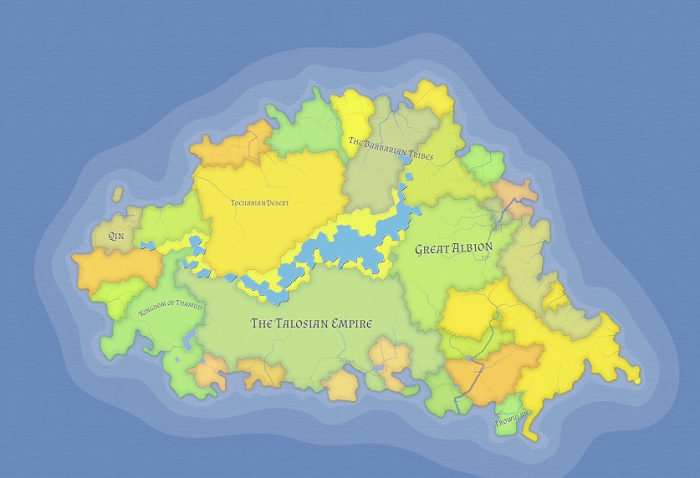
The Talosian empire had reach its present size by absorbing two of its smaller neighbors. It was only a matter of time before hostilities between Thamud and Talos would boil over. There was every sign that the war of words would progress to something more physical. The Talosian border patrols were now larger and more assertive, and the threats from petty satraps were getting bolder with each passing day; as if they knew they had license to make mischief.
All small states learn to consult the Qin in times like these and Thamud was no different. The Qin would provide information, strategies, supplies, and even new and inventive defensive implements in times of need; but they are nothing if not mercurial. My Master, the Crown Prince of Thamud, negotiated with the Qin alone. They came armed with maps and plans of the Talosian border towns; and with suggestions for defending ourselves.
And of course they asked to see me.
I was brought before them in the robes of a royal concubine, whereupon the Qin ambassador – a woman in her forties - promptly informed my Master that I was a spy. My entire history, including much of what I have written here, was then laid bare including my agreement with Anais. They then offered to take me and rehabilitate me in the temples and academies of Emei, in the Flaming Mountains.
My Master would have none of this and replied to them saying, “I trust her completely and I will not let her go. This is my final word on the matter.”
The ambassador replied calmly, “We are sure you have excellent reasons for trusting the girl beside you, Your Highness, but you must understand that she was brought to An explicitly to undermine Thamud not to mention ourselves. Now that a gathering storm approaches, you would be wise to reassess your affection for this woman.
“You have until tomorrow to consider our generous offer. A king should not let a mere slave girl hold captive the fate of an entire kingdom.”
She then proceeded to enumerate the occasions when the Qin's own dynastic kingdoms had fallen when kings were led astray by cruel, duplicitous, or wanton women. As a Qin woman, I knew many of these stories - they were in fact from the historical annals of my homeland on Ki - but what a difference it was to hear these stories from my new perspective. Was my sex truly so poisonous, or were these histories simply written by men?
That night, I told my Master that everything the Qin ambassador had revealed about me was true save one – that I would never betray him or Thamud. I no longer wished to be reacquainted with my old body, at least not any more than he did with his. I would go with the Qin to convince them of my innocence. In exchange, the Qin would assist in the defense of Thamud without qualms.
My Master understood that the Qin could not take a chance with a potential spy in their midst even as they planned to repel the Talosians; but he still resisted the idea of giving me up. He protested and pleaded with me at length but, in the end, he knew from experience that I would have my way. While I looked every bit the innocent slave girl, he knew that I came to him with experience well beyond my years - I was intimately acquainted with deprivation, cruelty, and violence. If my love for my Master was at stake as it was here, nothing would deter me from my course.
“Return to me,” he told me. He held a goblet to my lips and bade me drink, something no master should do for his slave.
[Scribe's Note: The following section has been redacted in the few extant copies of the Journal]
I made love to him, covering his entire body with kisses. His muscular body was a delight to touch and I ran my fingers softly over him making him squirm. The sensation of the ridges and valleys of his firm male abdomen made me hot with desire. I followed the trail of bristly hairs down to his groin and licked his manhood lovingly before proceeding to suck it with abandon. Whenever I sensed he was about to lose control, I would desist and roll his cock over my cheeks and nose; I could not get enough of it. I made sure to let out sighs of pleasure as I did so – it was not difficult, it tasted absolutely delicious. Once he had regained control, I used one of my small hands to massage him eliciting groans of pleasure which filled the room. My fingers were dwarfed by his stout tool, a fact which never ceased to amaze me whenever I had a chance to worship it as a slave girl.
Then I felt his hand in my mane pulling me off; he could wait no longer. He lifted me with the ease of one lifting a small kitten. So small was I in his arms. He had not touched me but already my nipples and lower lips were swollen with lust. Then suckling desperately on my breasts, he let me fall decisively on to his penis, filling me to the brim. We thrusts against each other as I wrapped my thighs around him for leverage. I assure you there is nothing which a man experiences in love that can compare with this – the feeling of being filled with the pulsating flesh of your Master; his lips nipping and pulling at your teats; and the glorious friction of his body against your nub. I lost control and orgasmed twice while still impaled on him.
Then still within me, he flipped me over My posterior was now lifted towards him as it was on our first night together. He slapped my flesh lovingly - I knew he liked the way it briefly wobbled - and began to take me from behind. I was left sucking my fingers to prevent the volumes of my screams from getting any louder. Then with two firm thrust, he ejaculated and filled with me with his warm cream. Like a trained passion slave, I gripped him tightly with my nether muscles and massaged his member. By now, we were both covered with a sheen of fine perspiration; I was still gasping when he fell forward lightly on to my back and started licking my ears and neck, and playing with my breasts.
We remained like this for several minutes before he softened and slowly withdrew from me. Then as if reminded of something, he straightened up while holding me in that position of submission. I felt his fingers on my labia pinching them close, then felt myself flipped on to my back as my legs and pelvis were lifted upwards to ensure my womb would be inundated with his offering. I should have suspected that something was amiss, but my eyes were shut tight and I was still lost in the fading ripples of my last orgasm. It was only 6 weeks later when I missed my moon cycle that I recalled this strange ritual.
[Scribe's Note: Lady Zhou's journal continues.]
Thus I left Thalmud both a contented woman and miserable one.
On the morning of my departure I was dressed to look like any of the other servant girls in the halls of the Qin. My hand was pinned up in an elaborate coiffure. I had been given a loose diaphanous silk dress typical of an ancient dynasty from Ki and [huadian] make-up applied to my forehead.
I could see that my master was surprised to see me dressed in this fashion. He was probably wondering why I had never dressed like this for him before. The answer being that I would not have known where to begin in the first place; my sole expertise being in the slave tunics and dresses of the women of Talos and Albion. Everything had been arranged that morning by the two servants who traveled as attendants for the Qin ambassador.
I knelt before my master one last time but he lifted me up to my feet and hugged me reminding me in whispers not to forget my promise to return to him. I was then ushered into a waiting carriage. It would take us nearly a week to reach the Flaming Mountains.
I sat alone with the ambassador; she did not seem especially concerned that she sat opposite a former Talosian spy with a history of violence.
As if she read my thoughts she said, “Don't be surprised my dear, didn't you protest your innocence just yesterday. And wouldn't killing me in this carriage destroy all that you hope to accomplish?
“Let me see your face, dear,” she said pleasantly, holding out her fingers to lift my chin, turning my face slightly. “And now your hands, if you will. I will need some of your blood.”
A few drops was all she needed for the two small tubes she produced from a wooden carrying case. Upon contact with a few drops of my blood, the clear liquid in one of these tubes slowly turned red, while the other turned blue.
“Thank you. Now that I've ascertained that you do in fact come from Ki and were once a man we can continue our discussion as we make our way to Emei. Do you prefer to speak in Mandarin? I have studied the vernacular Mandarin of Ki from other visitors to this world, and wouldn't mind some practice. You may call me Diaochan.”
It was a clearly a false name for no Qin woman would have the gall to claim that appellation. Diaochan was one of the four legendary beauties of ancient Qin, and while my interlocutor was certainly beautiful - looking at least 5 years less than her actual age – one wonders if she was truly worthy of being named for someone who brought down the the greatest despot and warrior of her time.
“The process which you have just witnessed analyzes the humors in the air which surround each city of the continent. From this we can tell in which parts of this world you have stayed longest. As you know, the Seven gods have chosen to keep this place a backwater of knowledge and alchemy but they have tolerated these minor advances in biochemistry.
“We know much about you but would like to know more. I will divulge what knowledge has come to us after which you will answer whatever questions I have. I am sure you will be cooperative; Gaius tells us you were an obedient girl during your time with him. Except for the part where you almost killed him, of course.
“As you must have guessed by now, we have known of you ever since they day you were brought to An by that dear lady of Talos, she of the dark hair and miserable sense of humor. She sometimes goes by the name of Anais. The servant girl who tended to you on your first day was one of ours and she gave you everything you needed to survive in this world.
“Don't look so shocked. Did you think you resisted the slave serum because of some innate ability of yours? I'm afraid the science of the serum has been perfected and its effects quite reliable. I do not doubt you have a strong will but that would only get you so far in the face of the perfection of that science.
“Do not look so downcast, your efforts have not been completely wasted. If nothing else, think of what you have done for the kingdom of Thamud.
“And why have you taken me only now?” I asked, guessing already at the answer I would get.
“Could we have judged your character better if we had taken you earlier? As for why, well, perhaps we are not completely sure that we can trust you not to return to the Talosians and their promised rewards. We are ever cautious in our ways, though my servant girls have intimated to me that you would not consider becoming a man again any sort of reward. Judging from the way you've enjoyed dressing up and the way you comport yourself, you have truly become a woman in every sense of the word.
“Perhaps I should strangle you here and prove otherwise.”
She clicked her tongue and said, “That would hardly prove your lack of femininity. In any case, have you not considered that you are of greater value to us as the Talosian spy you once were? I am sure that scheming little brain of yours has worked it all out. It is one of the reasons why you agreed to join us on this trip to Qin, is it not? In this you will serve the cause of the prince of Thamud and that of revenge if you so wish. Yes, I think you will prove quite useful in the grand scheme of things.
Six months ago I left my happiness in Thamud behind to enter the service of the Qin. At the time, I feared it would be forever. For three months, I served the Qin and sought to prove my loyalty to them and to Thamud.
While the Qin believed that man was by nature good, they also took very much to heart selfish human nature. It was already in the nature of the Qin to help small states overcome aggressive large ones in times of war. It was their way of managing the peace in An. They had lost track of me when I disappeared from Gaius' villa and their worst fears were realized when I reappeared on the arm of the crown prince in the palace of Thamud.
To the Talosians (if they even had knowledge of my sojourn in Thamud), I was simply a little girl lost found by her own kind. As for the Qin, once a presentable amount of time had elapsed and I was firmly established as a servant in the Qin palace, they would proceed to feed Talos whatever information they desired. Their advantage in information was everything in this game.
I was made a servant girl to the youngest daughter of the Qin emperor – the Third Princess called Pingyang; that name presumably chosen that she might draw inspiration from her famous historical forebear. She was a very well behaved and precocious woman of sixteen who cultivated a reputation for frivolousness and naivete; all this to shield her from the machinations of the Qin court and her power hungry siblings. Writing now in the comforts of the women's tower in Thamud, one wonders whether the Qin ambassador had hoped I would form a bond with the Princess while in her service, for this I surely did. Even now we exchange letters detailing our experiences while leagues apart. Her kindness during my short tenure in the Qin mountains has emboldened me to help her in any way which might improve her standing in the Qin palace.
As part of my duties, I was sent on delivery trips first to small villages and then to the larger cities on the continent. They made me do the rounds of the various Qin communities and merchants which ran businesses in all of the capital cities. On my first trip to Albion, I finally made contact with the Talosian spy network and promptly handed over whatever paltry information I had, allowing them to put pressure on me to deliver something more substantial.
Soon I was communicating the internal gossip of the Qin courts. Nothing was left out, including the power struggles in the inner court reserved solely for women. Finally, I began to ladle them major revelations about troop compositions and readiness but always leaving out critical pieces of information, thus painting an incomplete picture of Thamudian strength and placements; breeding overconfidence and hubris. The Qin and I did all we could to make them ill-prepared for a long siege.
But it was not always this way; most of my days were spent in the company of the Third Princess and tending to her needs. She had clearly been informed that I had a way with violence for she would often smilingly remind me me not to be too quick to pull out my weapon whenever we found ourselves in any crowded spaces.
I had been in her presence barely three days, before she told me that I was the strangest serving girl she had ever had in her few short years on this plane. She said I was very beautiful and even seductive in my movements, but it was as if I had never really been taught how to be a woman. Then touching my hair she wondered aloud, “What a strange childhood you must have had, Zhou Yu.”
She quickly apologized and said that she had no right to judge someone who didn't have the advantages that she had; and that there was no single way a woman should act. But it was clear that, from that day, she had secretly undertaken to teach me how a lady-in-waiting of the Qin court should act and to interest me in more feminine pursuits.
She would take time each week to visit the forests of stele and take rubbings from the many inscriptions there, after which we would practice calligraphy together and recite poetry first in her tongue and then in mine. Deeper still in the mountains, are the distant cousins of the Qin known as the Balhae who have constructed gargantuan woodblock libraries dedicated to the teachings of the dark god of enlightenment whose cult can be found throughout the continent. I spent two days here in the company of my mistress, not understanding a single word as she conversed with the monks behind screened compartments. I have wondered since whether this too was part of the Qin network of spies.
In my two years on An, I had mostly been in the service of men or engaged with other women in servicing them. This was the first time I had been ensconced in a community of women concerned only about their own thoughts and desires. When I returned to Thamud and my beloved after the space of three months, he did suggest that I seemed somehow different. I simply smiled and turned away to speak with his mother and sisters, showing them the gifts I had brought for them from the land of the Qin.
The Resourceful Little Slave Girl - Chapter 9
Author:
Caution:
Audience Rating:
Publication:
Genre:
Character Age:
TG Themes:
TG Elements:
Permission:
Previously: Amber (later known as Zhou Yu) has been trained at a slave school in the ways of a pleasure slave. Sold into the house of a feudal lord named, Gaius, she has proved useful in enlarging his fortune; but at the cost of enraging the emissaries of the Seven Gods who have promised to chasten her. She disappears suddenly from Gaius' villa in Albion, and awakes in Thamud where she is sold into the royal household. There she meets her Master and learns of his "secret." Discovered by the Qin and accused of being a spy, she is forced to spend three months as a servant girl at Emei in the Flaming Mountains.
Chapter 9 - Homecoming . An Argument
Dear Reader,
I have tried my best to forget every evil thing that was done to me since I arrived on An. Better this than to wallow in despair or the desire for revenge.
If you wonder why I write nothing about being whipped in the slave school or in the house of Gaius, than this is the reason why. Nor have I written about using my mouth to please men to whom I was not attracted in Gaius' villa, though most would have assumed this was the case. I had no problems with the many kind and beautiful guests – both men and women - who attended Gaius' banquets but a slave girl of my standing could not choose. I was trained to an exacting standard in the slave school in Albion and I performed as a passion slave is expected to.
Without the slave urges, it was left to me to fully expose the Submissive who is always at the periphery of my soul. Only because I managed to forget myself and enter fully into the role of a pleasure slave were those times bearable. That and seeing everything as punishment for the men and women I have murdered as a mercenary on Ki.
So it is that write about my return to Thamud and my first night with my beloved. The first time I was reminded what it meant to be a woman in the hands of men in many months and, worse, by the man I loved. For a moment, I knew once again my status in this world and what was expected of me.
Once I finished conversing with my beloved's family, we retired to his bedchamber where I proceeded to tell him of everything that I had done while with the Qin including all the information I had conveyed to them concerning the defenses of Thamud. I, of course, explained that this was all a deception and in service to the defense of the realm. Yet I could sense his growing anger as I gradually revealed all the information I had revealed to the Talosians, clouding his initial joy at seeing me again. He finally reached his limit when I informed him that the Talosians knew about our poor harvest and the Horse Fever which had ravaged the Thamudian calvary. The next moment, he kicked a chair clean across the room furiously.
I fell to my knees instinctively in deference and fear; such is this body I now possess and its reflexes. I fought through my slave instincts which gripped me and spoke.
“I have done everything for the sake of Thamud and you, Master. The Qin have already arranged for us to obtain horses from the nomadic steppe tribes, and have undertaken to send us grain from their own stores.”
“Do you understand that our every weakness has been revealed to the Talosians.” he told me sternly.
“It was necessary so that they would trust me and the information I plan to give them even now as the battle draws near. If you do not trust the Qin, will you not trust me?
“I trust you Shasa but you have gambled with all the lives in Thamud.”
“I would give my life for Thamud – whether they see it or not, they are my people now just as you will always be my Master.
My Master was not quick to anger but once ignited it would take some time for him to regain his composure. I knew it was my duty as his consort to calm him, just as the Queen would calm her own husband in times past. I was the only one who could do this but now I was the object of his displeasure. He glowered and would not speak; and my own irritation grew - as a woman, as his companion, and as a person whose devotion and service had been spurned. Neither of us would repent of our actions.
“And what about this?” I finally said, with an edge in my voice, pointing to my slightly swollen belly. I was at that time three month pregnant but, in all honesty, with my small frame, one would have thought I had merely had too much to eat that day. “Did you intentionally impregnate me?” I asked indignantly. “Were you so concerned that I would open my legs to the first Qin man I saw and bear his child?
“Should a master ask his bitch's permission in matters like this?” he said under his breath with a vicious authority that startled me. He clearly had enough of my slave defiance. I was perhaps the only slave girl in all of Thamud who would dare to speak to him like this. This was not the man I loved but some monstrous male.
His words were as daggers through my heart. I could see the regret on his face within moments of his irritable outburst. He knew that he had hurt me. Tears welled in my eyes and then I felt my anger rising. I had almost forgotten that, all my experiences with my Master notwithstanding, this world was medieval and barely civilized by the standards of Ki.
My love for him seemed to evaporate for a few moments. Could I love this man who could call me – the woman who bore his child - a mere domestic animal to be used as he saw fit? Was this what truly lay in his heart? And what would happen if he struck me in anger? I was prepared to defend myself but I did not know if I could disable him without also killing him. And in spite of everything, I knew I could not kill this man who I still loved.
Suddenly, I felt him reach out to me and his fingers on my arm.
“Don't touch me!” I shouted. I do not think he had ever heard me raise my voice in all my time with him, and he knew then how serious this had become.
A few tears streamed down my face and I spoke shakily but audibly, “I am delighted to bear your child. It is the greatest gift you could have given me, and yet you treat me like a common animal. Have you forgotten everything from your childhood, and will you have the people you love treated like objects, mere things to be used and discarded?”
“I love you, Zhou Yu. Please forgive me,” he said, with a certain tremulousness in his voice.
He was on his knees holding my feet and then my waist from behind. I could feels his tear through my silk dress.
“Please forgive me, I beg you,” he said softly as he wept.
My anger still burned in me. I turned around and we held each other. He kept saying sorry and I wished my anger would abate. I had never seen him so vulnerable as at that time. Time of course heals all things but I knew for certain then that, the difficulties in this world notwithstanding, even a woman who has been taken must maintain her own independent means and security to the best of her ability.
Since then, my beloved has never raised his voice to me again or shown any violence in my direction. Master, if you read this, do not assume that our relationship is irreparable. Just because I am independent in means and mind, does not mean that I cannot love with all my heart.
Let me speak to you in the poetry of the world from which the Seven Gods brought me to you.
“Let him kiss me with the kisses of his mouth!
For your love is better than wine;
your anointing oils are fragrant;
your name is oil poured out;
therefore virgins love you.
Draw me after you; let us run.
The king has brought me into his chambers.
Come, my beloved,
let us go out into the fields
and lodge in the villages;
let us go out early to the vineyards
and see whether the vines have budded,
whether the grape blossoms have opened
and the pomegranates are in bloom.
There I will give you my love.”
[Scribe's Note: A redaction occurs here.]
I was clear that my master feared thatl our love had forever been tarnished, so I gave him varied assurances that I would always be by his side.
I had taken to wearing simple silk underwear when a guest of the Qin in the inner courts of the Third Princess. I continued with this even when I returned home so that when next I disrobed for my master, removing my sirwal, he saw my nether regions enclosed in tight silken fabric. I had also used a translucent silk cloth to bind and lift up my breasts as if they were gifts. He was enraptured when he saw this - my labia were outlined by the silk as was my nub, my posterior seemed even more inviting when enclosed in that tight material. I saw that he was hard with desire and pressed my breasts to his face, then sat lightly in his lap rubbing his member through his loin cloth with my thighs.
By now the silk which I wore was stained with moisture from within me. He pushed his fingers into me and made me gush even more. Then as I playfully shook my head in protestation, he tore my silken loin cloth off and placed it gently in my mouth to stifle my screams. Then he placed me on my back and took me.
He played with my breasts with one hand, and with the other held my chin lightly. I was now whining through my silken gag and my eyes pled with him to take me harder; which he did. When he knew that I had lost all reason, he pulled the gag from my mouth and allowed me to grunt even more obscenely – our eyes fixed ever on each other until I could do nothing but close them as an intense spasm cascaded through my body.
I have no idea whether this was his idea of an apology but in lieu of conversation, he licked and fingered me to even more ecstasies until I could take no more; so exhausted was I by his ministrations. He held me, and stroked and kissed my hair and my face until I fell asleep contented in his arms.
[Scribe's Note: The journal continues again.]
I return now to a time adjacent to when I began this journal.
Our scouts had informed us of the encroaching armies of Talos who would cross our border in a matter of weeks.
When they had finally made an incursion, I used the Talosian networks to convey the exact placement of the Thamudian armies and their composition. Further, I gave them information as to where we planned to ambush the invading armies enroute to our border, and how we intended to do so. The mounted attack on their column occurred just as I predicted giving the Talosians even more confidence in my material – all of which was entirely fabricated to our advantage. We would hit them with force where they least expected, poison their supply trains, then retire to our border fortresses to wait and defend against their cloud towers and earthworks.
Our only concern were the emissaries of the Seven Gods and whether the use of gas, oil, and “fire medicine” in warfare would violate the restrictions that they had placed on this pre-industrial civilization. As I have written previously, it was never entirely clear whether the scale of the violence or methods by which this was accomplished moved their hearts one way or another.
In the capital city, I had set out on my own light armor so that I could accompany my master, at the very least, to a walled town in the rear which harbored supplies. When he saw me so dressed, he immediately made to unbuckle my armor starting with my breast plate.
“There is absolutely no reason for you to join me. You have done more than enough for me and Thamud. Please desist from your irresponsible behavior and remain in the city,” he said. He was clearly harried and exasperated.
“It is unbecoming for a master to request things of his slave. Can I assume this is your command?” I asked sweetly.
“It is a request,” he grumbled under his breath. “Will you be more obedient if I asked this as your husband?”
“In case my Master has forgotten, when we first met, you branded me in lieu of a ring.”
“You will be risking two lives instead of one,” he said. I was of course now fully showing.
As you already know dear reader, I obeyed. I accompanied him no further than the walled town before returning to the capital to while away the summer and autumn in worry and writing.
My Master's sisters kept me distracted as did Eumelia, dissuading me from my studies with the bow and sword once I had reached my fifth month. Instead they encouraged me to return to my lessons with the guzheng which I had not touched since returning to Thamud from Qin; and when that failed to distract, engaged me in lessons in embroidery. I do not know if that suited my frame of mind any better.
It is a strange thing to carry a life within your belly and I certainly had no expectations of doing so as a young boy. My nausea had thankfully ceased by the time I returned from Emei but I had begun to notice some swelling in my feet on prolonged standing. I would watch as my sisters instructed the maids on the preparations for the baby's room. They had even engaged a wet nurse for me. My breasts were already growing and I was looking forward to breastfeeding my child since I experienced my foremilk, but they were ever cautious.
There were a number of things I knew to expect from my body once I became a woman on An; if only from the experiences of others. I expected my moon cycles to be painful, and they were at least some of the time. I also knew that I would have to start examining my breasts more regularly in years to come because my mother had developed lesions there. What I did not expect was to feel an intense desire for my Master even halfway through my pregnancy. I had expected the opposite though I presume at least some men find a pregnant woman desirable. I do not know if it is simply this body or something quite natural - no one was quite prepared to discuss this with me, save one.
I asked Eumelia about this since she was clearly the most shameless woman in the court and the most experienced sexually speaking. As expected, she had not only heard of these urges but seen them occur in a slave who had been bred at Gaius' house. The women of the harem would service each other in these instances; especially when no men cared to take them later in their pregnancies. She described absurd tales of women fornicating and sharing their breast milk with each other which I thought...[...]...
[Scribe's Note: This next section has been lost.]
The Resourceful Little Slave Girl - Chapter 10
Author:
Caution:
Audience Rating:
Publication:
Genre:
Character Age:
TG Themes:
TG Elements:
Permission:
Previously: Amber (later known as Zhou Yu) has been trained at a slave school in the ways of a pleasure slave. Sold into the house of a feudal lord named, Gaius, she has proved useful in enlarging his fortune; but at the cost of enraging the emissaries of the Seven Gods who have promised to chasten her. She disappears suddenly from Gaius' villa in Albion, and awakes in Thamud where she is sold into the royal household. There she meets her Master and learns of his "secret." Discovered by the Qin and accused of being a spy, she is forced to spend three months as a servant girl at Emei in the Flaming Mountains. Returning to Thamud, she begins preparations to meet the invading armies of Talos. She is three months pregnant with her Master's child.
Chapter 10 An Uneasy Peace . Motherhood
Our late Winter negotiations with Talos ended in indecision and suspicion; and the Qin negotiators arrived in the capital of Talos to replace them and begin their own entreaties one week ago. Messengers continually arrive from across the border with days old news of what has transpired.
The Qin first appealed to the Talosian emperor's military acumen.
They reiterated that the forces of Thamud, without the conspicuous aid of the Qin, had annihilated the invading armies of Talos last winter.
They added that they had just returned from the emissaries of the Seven and received word that the Qin's personal intervention in the conflict would not be impeded. At their disposal, was a more extensive knowledge of the transport and use of the fire medicine derived from saltpeter and sulfur, as well as the gas and oil normally used to heat the cities of the Qin. The Talosian already knew of the Qin's ability to fight off siege engines and this would only add to their worries. In essence, they promised to make Thamud a poisonous frog which if consumed would only make Talos vulnerable to all its neighbors
They then appealed to the Talosian Emperor's reason reciting a story from their own ancient history, a story about an imminent war between the much larger state of Chu against the state of Song which was but a tenth of its side.
[Scribes Note: Here a meeting between Mozi and the King of Chu is given in a translation by a scholar of Ki by the name of “Johnston.”]
“Suppose now there is a man who casts aside his own decorated sedan and wishes to steal a broken-down carriage which his neighbor has; who casts aside his own embroidered coat and wishes to steal a short jacket of coarse cloth which his neighbor has; who cast aside his own grain and meat and wished to steal chaff and dregs which his neighbor has. What sort of man would this be?
The king replied: “He would certainly be a pathological thief.”
In relating this they allowed the Talosians a moral and face saving excuse to forego a new invasion of Thamud. And so the Emperor of Talos, after a period of deliberation, relented, and an uneasy peace has settled upon us. The negotiations continue as I write and our preparations for war proceed as planned but now at a slower pace; we dare not assume that Talos is done with us.
Dear Reader,
My first portrait on An was done when I was first married to my beloved; we were both dressed in all the finery of the royal house and stood before an imagined Thamudian landscape. Later, I would sit for portraits with the entire royal family and once again when I was pregnant.
In the latter work, my husband and I can be seen standing in our bedchamber while wearing the attire of Thamudian royalty. The room was decorated with fine silks, gold ornaments, and decorative colored glass, a specialty of the Northern “Barbarians.”
I wore a headdress which largely covered my hair, and also an ear ring on my left ear lobe which peeped out from underneath my veil; indicating that I had once been a slave. My husband's large mastiff sits obediently in the background between us on an elaborate Thamudian rug. A convex mirror above this reflects not only us but a distorted map of all the historical borders of our land; even those which had been previous annexed by the Talosians. I am looking down demurely and at my beloved as he looks out towards the viewer, his hand lightly and possessively touching my pregnant belly.
My first born child arrived in the Winter and he was a boy. We named him, Safin.
It has been a week since he was given to me. He now sleeps in a cradle by my writing table after his feeding. He is so well behaved and the joy of his father. My delivery was, thank the Seven, uneventful or so the midwife has told me. I have not seen any woman in labor but I can truthfully say that it is as painful as it is rumored to be; I have been told that it will get easier with my third child if not my second. The kingdom is always in need of more heirs and I am willing and happy to perform my duty.
It is tiring but fulfilling to be a mother. I had hoped it would be so but still harbor doubts about my fitness to take on this role. I am much too young, too lacking in the milk of human kindness, too selfish. More than ever, I wish that I had grown up as a girl; I feel that would have better prepared me for my obligations as a mother.
The Queen and my sisters have helped me considerably – delighted as they are with the first new life in the royal household in years. I am sometimes tearful, and they have spent long hours waiting on me and talking with me when I am willing. When I drift off to sleep only to be awakened by my son's cries, one of them is always beside me, to help me. I have told them to leave but they will not as long as they see the unaccustomed sadness on my face.
I know this will pass. I still dream of life with my son and my beloved. What a joy it will be to see him grow. I now know, more than ever, that I was given the greatest gift in the world on that day, over three years ago, when I was taken to this world and made a woman.
If I am tardy with further entries into this journal, all new mothers will know why.
The Resourceful Little Slave Girl - Chapter 11
Author:
Caution:
Audience Rating:
Publication:
Genre:
Character Age:
TG Themes:
Permission:
[Scribe's Note: It is unclear if any other entries were written by Lady Zhou between Chapters 10 and 11 of this transcription. But if there were, they have either been lost or excised. The following section occurs in the third year of the reign of King Idis II of Thamud. It has been four years since the last entry transcribed.]
Chapter 11 Three Years Later . Absent Friends
Dear Reader,
I take up my pen again with some reluctance. But I must write.
Eumelia is dead.
It has taken me nearly six months to write these words.
My last connection with Ki gone (or so I thought).
Oh my dear friend, why did you leave me so soon?
She left with a smile on her face as I placed her daughter in her arms. Her face was ashen, her vision dimmed, and she fell away without a word.
Her wife, the Third Princess, would not be consoled for months, wracked with the guilt of having made her bear a child. Which is, of course, nonsense and I told her so; for Eumelia wanted a child more than anything else. She was familiar with my own happiness at childbearing and this was something she had dreamed about since she fully accepted her new gender.
The child is a beautiful baby girl with green eyes and her mother's blonde hair. Her father is my Master, the King of Thamud. The Princess has named her, Amal.
Even now, I sometimes see the Princess walk the palace gardens alone, always choosing the path through the labyrinth which was their favorite. They say that time heals all wounds. I can only hope that this will be true for both of us.
Why have I only written of this now? Because now, more than ever, I feel acutely the pain which the Seven have sent my way, and their cruel humor.
As always, I found this pain in Talos where my son was to be betrothed to the daughter of Princess Sabine of Talos. He is four and she is three. They met quite unaware of what their selfish and uncaring parents had arranged for them; for it is the way of this world; that our kingdoms may at least tread softly into a long peace.
A minor emissary of the Seven was in attendance to witness this event, as was an ambassador of the Qin. The meaning of this seemed plain - that no one should lightly tear asunder the bonds that were being laid down that day.
I have come to the other reason why I must write, if only to assuage my guilt. Now, months later, I can write about what happened in Talos more dispassionately, with an eye to my own poor justifications and faults; with a more even assessment of my own impoverished morality and thinking.
It was as always Anais who led me to this point – that woman who had brought me to An, forever altering the trajectory of my life. I had not seen her for four years and had been glad to see the back of her; except that as usual she found me.
As I walked the strangely deserted streets of Talos with my guards, I saw a slight figure dressed in flowing silks. She approached us with a nonchalant gait and a smiled which reeked of her usual confidence. Anais enticed me with an offering – a gift in thanks for being returned little harmed to Talos; she having been my prisoner following the conclusion of the last war.
We spoke in the corner of an establishment called somewhat incongruously, The Eudaimon, possibly the most renowned slave tavern in Talos. Suffice to say that the place had nothing to with reason, ethics, or self-actualization.
Leaning forward conspiratorially, she pointed towards a sinuous shadow making its way across the large room.
“Do you recognize her?” she asked me
“No, I do not,” I answered.
I saw a typically beautiful Talosian slave girl glide towards a young and clearly wealthy patron who hurriedly cleared his table of unwanted guests and attendants as she approached him. I looked more closely and saw that she had the facial features and light brown skin of a Thamudian woman. I remember thinking to myself that while I could not save every tavern girl in Talos, I could at least attempt to do something for one of my own countrywomen.

I could see she had lightly toned but fleshy limbs, a magnificent belly and hips, and, of course, ripe breasts which fell attractively on her torso. She had clearly been born with tremendous advantages but I knew from experience that she had spent many hours cultivating and maintaining her appearance. This was no ordinary serving girl.
She seemed at times innocent and demure but would then shift her posture revealing the undersides of her breasts or her inner thighs. She would occasionally caress her patron's cheeks with her nipples when she served him drinks, or bring her hand down to affectionately squeeze his crotch if she noticed that he was becoming hard. To my shame, I felt my own lust for her growing in me.
“She is incredibly skilled. I almost envy her.”
“Aisha is all that and more - the first girl of this tavern and one of the most famous pleasure slaves in the quarter. She commands a very high price for a night's amusement. And there is something else which might interest you - I understand she speaks the language of the Qin of Ki. Do you take my meaning? ”
That made me scowl. “You are a disgusting liar, Anais, and always have been. What have I done to deserve your hatred? Did I not release you when I could have listened to my husband and had you put down?”
Anais affected a look of exaggerated shock and continued.
“I am quite sure that you are as pure as the driven snows of Thamud, my Lady. But let me remind you that by all accounts, you are especially deserving of my hatred and wrath considering how you misled me, decimated the army of my paymasters, the Talosians, through your intrigues, and then plotted to capture me. Now look at me, reduced to weeding out pathetic insurrectionists within the borders of the Kingdom.”
The fact that she spoke the [Chinese] of Ki strongly suggested to me that she was a woman from my home world and, from the way she held herself, very like a serum girl. It is said that the serum slows the pace of aging but this has never been studied. The life of a slave girl is so hard that whatever benefits which might accrue to her constitution are quickly erased with years of difficult service. I, however, saw no signs of wear on her.
Anais, interrupted my train of thought. “This is a gift; a peace offering. It is well known, even in Talos, that your Highness has charitable instincts towards slave girls having been one herself. Now that I have assisted you, perhaps you will think of me in the months and years to come should I be in need.
“I have already told the tavern owner that he should expect a potential customer for one of his girls. He will drive a hard bargain but will be more forgiving now that he knows that you have my imprimatur. The drinks have been paid for.”
With that, Anais took her leave of me. But before that, she leaned down and whispered a name in my ear.
The name was one that I had not heard for seven years, the name of the leader of the group of mercenaries I once belonged to on Ki; the man who had trained me and whom I had respected since I was brought into the fold.
The last time I had seen him was in the back of a wooden cart where he lay asleep with Eumelia [see Chapter 1]. I had not recognized them then as my brothers in arms. I had not even bothered to look for any of them.
It had been seven years since I last saw him.
He had been a slave girl for seven years.
I resisted the urge to weep then; I would not as long as Anais stood within sight of me. I had on me a pair of heavy chainsticks fashioned after those favored by the [Ryuku] islanders of Ki. I gripped them tightly in my palm to prevent myself from losing control.
The moment I saw Anais leave the tavern, I got up and made my way to the back rooms to make my bargain with the owner. I had on my wrist, a bracelet of exceptional craftsmanship encrusted with rubies and sapphires given to me by my Lord. The owner did not hesitate for one moment – he knew I was of the Thamudian Royal House; the price was more than adequate; and my face clearly indicated that I would not tolerate any further bargaining.
Once I had Aisha's ownership papers and the seal designating her release, I walked back into the main room of the tavern, gripping my chainsticks tightly. I do not remember much else except being pulled off a bloodied man by my bodyguards. Out of the corner of my eye, I saw Aisha huddled in a corner screaming in terror.
The Resourceful Little Slave Girl - Chapter 12
Author:
Caution:
Audience Rating:
Publication:
Genre:
Character Age:
TG Themes:
TG Elements:
Permission:
Previously: It has been four years since Zhou Yu has written in her journal. Her friend, Eumelia, from Earth (Ki) has died in childbirth, and she has just discovered that the two women held captive with him when she was first brought to An were actually her male mercenary counterparts from Earth [see Chapters 1 and 11]. Zhou Yu has just managed to retrieve her formerly male friend (now called Aisha) who has been working as a slave girl for the past few years.
It has been seven years since Zhou Yu was first transformed into a woman and brought to An.
Chapter 12 - Aisha's Story
Anais' Surveillance Notes: Albion-04-010 [In English]
The Chinese girl (note: now named Amber) is on her way. I have assigned Marcus to keep an eye on her. My expectations are low. Infiltrating the Qin in this fashion seems doomed to failure. For the record, this is our third attempt and against my explicit written dissent; the first died within the year, and the second disappeared into the Flaming Mountains never to be heard from again. This is an utter waste of time and resources but I'm a merely cog in this big fucking machine.
My bottom line on this: Always, always use the locals.
Want to spy on Albion, then get a girl from Albion! Want to spy on Trowulan, then get a girl from Trowulan for Christ's sake. WTF is wrong with these people. You get at most 2-3 shipments per year and you choose to get this lot? Ok, I understand getting someone from China, they're in short supply here, but why not just get a real Chinese woman who can take care of herself and pump her with the serum for desired effect. Oh, tried that before? Then try it again! You think some transformed guy will have more motivation than a real life woman? My bet is that he'll kill himself within a year.
Fuck them. At least I get to earn some extra bucks with the surplus girls.
[Scribe's Note: Written in Lady Zhou's Journal]
“Fortune is ever most friendly and alluring to those who she strives to deceive, until she overwhelms them with grief beyond bearing, by deserting them when least expected. If you recall her nature, her ways, or her deserts, you see that you never had in her, nor have lost with her, aught that was lovely.” [A fragment of Boethius found in the Library of the Qin.]
Shouldn't I be happy to have found her? To have saved her. Then why does my heart feel so heavy. Aisha's story could have been my own. Why was I chosen for this task and not my two sisters? Was it simply chance or was it because I was the only who fought back? Surely the latter would have consigned me to the worst fate of all of us. Why did the Gods choose to take Eumelia from me?
[Scribe's Note: A letter found clipped within the Journal of Lady Zhou]
My dearest friend Zhou Yu,
We have talked but you have not listened to me. I have tried to comfort you but you will not be comforted. I have heard from your servants that, since you found me, you have not been your usual self and have been quick to anger and even violent.
You would think I would be the one weeping and who would need all the comforting. I know that you feel guilty for not having found me earlier, perhaps for thinking me dead; perhaps for not realizing until now that it was Eumelia and I that you left behind in that wooden cart seven years ago.
You feel guilty for having been the only one – or so you assume - to have reached a safe harbor, to have found love on this cruel world, to find a family and to have children. That is your arrogance talking. I say this as one who has known you longer than anyone on An.
From your stories, it seems that Eumelia was the happiest of us all in her brief time in this world. But I have had some happiness myself or do you think that there is only one way for a woman to feel happy and content in this world?
I have known love even if it was quickly taken from me; I have the friendship of my sisters; I have a certain pride that I am exceptional at what I have been trained to do; not to mention my hold over the men who desire me. Having a husband and a child is not the only path which leads to happiness.
Do not be too proud of your own success – not every woman wants to be a wife and have children. Not everyone wants to be a queen or princess.
Why do you think you needed to save me?
Do you think the idle life of a pleasure slave so horrible? Do you think that seeking one's own gratification while earning one's way in this world is somehow demeaning? I never thought to escape and I never assumed anyone else had survived. That was what I was told by the woman, Anais, and I believed her. Perhaps you now think that I was at fault for this self-centeredness.
Wake up, Xiao Yu! Learn to forget and learn to live in the present.
You told me that you have sought out almost all the girls you trained with in the slave school in Albion. I understand why you did this and I might have done the same if I had been in your position. Yet did you know that the serum which induces the slave urges in “new” girls fades with time? All that remains after that moment of pure bliss is the woman that is within your soul. And I know I was always meant to be a woman, even on Ki where I dared not admit it.
Your family are waiting for you to return to them. I am waiting for you to return to me. Do not abandon us.
Yours with love,
Your sister, Aisha.
[Scribe's Note: An account written by Aisha to entertain the Third Princess, and to allow her to remember times past.]
My dear Princess,
Our long hours together talking about Eumelia has led us to this. How I wish I had known her more fully as a woman and as a sister.
As you have requested, this is my story.
I was alone when I awoke, just as I suspect she was all those years ago.
I was chained by an anklet to a pole, and an upright mirror stood a short distance from me as if my captors wanted me to know immediately what I had become. I assumed that I had gone insane or that my mind had been transposed into that of a young [Middle-Eastern] girl - there seemed little difference between the two at the time. While I had doubts about my mental state, I delighted in my appearance. I had long black hair, large brown eyes and a pair of full lips. My skin was light brown, soft and delicate; and completely unmarked.
A woman stood over me and explained my situation and my choices.
I could either be sold to a slave brothel or given to a Talosian lord as a gift. I chose the latter thinking that it would provide me with a better opportunity to escape. I was promised considerations in exchange for whatever information I could provide once ensconced in his household. Perhaps a return to my male body; perhaps a return to Ki.
But I could not be given to him directly - he had to ask for me and I had to make him want me. I had much to learn in a single month but the body I now possessed helped considerably. It was clearly derived from a female of low virtue who derived gratification from the seduction of men. My movements were always fluid and sensuous, my hips moved with unrestrained ease. My whole body seemed to be made for pleasure.
I first met my Master not as a slave but as a poor serving girl. He was a man of the South with skin the color of onyx. Tall and toned like the demi-gods of myth and legend. Perhaps even you, my Princess, might have found him attractive, though you will undoubtedly titter at the suggestion. But let me clear on this point, even as a man I would have humbled myself before such a magnificent specimen of the male sex.
I knew I had him the moment I stepped forward to dance.
I knelt and presented my naked belly to him inviting him to touch me if he was so moved. He did not hesitate for a moment and touched me gently around my jeweled belly button, before reaching down to caress my labia though my silken thong. I knew that I was already moist with desire and smiled at him to show my appreciation for his attentiveness.
By this time, all his dinner companions had the good graces to leave us alone in the room. When I heard the dining hall door close behind me, I crawled forward on all fours, my posterior seductively shifting from side to side as I did so.
As far as phalli were concerned, I had only seen the lesser specimens bandied about by the slave masters. My Master's manhood was magnificent and my two small hands would hardly suffice to take full control of it.
I pulled back his foreskin to reveal his shiny red glans, and held his muscular shaft in my dainty hands. I knew what had to be done - I had been trained to it and was eager to perform. First I inhaled his musk and licked the clear emissions that he was already producing. Then I put my delicate face flush against his manhood, kissing him and taking in all of his sublime odor. I made sure to look up at him every now and then to show him my appreciation for granting me access; played with myself to demonstrate my unbridled desire for him. I enveloped him with my mouth and tongue while massaging his organ. I had been whipped a few times while in training because of my carelessness with shielding my teeth but I made no mistakes here.
I took nearly all of him in and he was clearly shocked by my abilities and could not help but compliment me while in the throes of passion. I spent an inordinate amount of time worshiping his manhood, and my gullet was thick with his scent for the rest of the evening.
Was it an act? No, I truly loved this. It was something I had always longed to do, and now I had been given permission to do it without shame and without constraints. After all these years, my experience is that most men are constantly surprised to find a woman who enjoys intercourse as much as I do. I knew that this was now acceptable where once, back on Ki, it would have been embarrassing, at least for me. He wanted me as I was, the woman I was meant to be and dared not hope of becoming.
My vulva had become even more slick and engorged the moment I placed my lips on him. I rubbed myself against his manhood even as I licked his nipples. For some reason, he was content to lie back and let me have my way. But his forbearance soon gave way, and I felt myself lifted up and placed on my side. He held my left leg and separated my thighs, and thrust into me with a smooth sliding motion. I am ashamed to say that I let out an ugly guttural grunt at that point – it is impossible to describe what it means to be so thoroughly filled for the first time. I had imagined being taken as a woman frequently on Ki, but a man simply cannot fathom what a woman feels when she is full penetrated.
He took me several times that first night.
He slept noiselessly beside me once he was spent, his huge arm still draped across me while my head rested on his chest. I licked playfully at his nipple like a kitten even as he slept, admiring his body which seemed to be carved from stone, tracing the ridges of his musculature with fascination and barely contained lust. Yet, it was not enough that I had been filled and inseminated; I clung to him as if he was some prize for enduring so long in my old body on Ki. I only wish that the gods had granted me more time with him.
Perhaps it is hard to understand what it means to have been given this gift – to have been made to take this step which I would never have taken by myself otherwise. To be an attractive and desirable woman has always been my dream – a fantasy which I knew I had no possibility of fulfilling for lack of courage. If someone had told me then that the cost of my dreams would be two years with a man I would grow to love, and twice as long as the mere plaything of strangers, I wonder what would have been my answer. Many women on Ki have done much more than this to achieve their dreams.
My days with my husband passed uneventfully and with much joy, but I will relate a visit to a petty feudal lord of Albion which I now recall more fondly. It was here that I met my sister, Eumelia, unknowingly.
I do not know if this is the nature of this world – how it toys with us - or the hand of the Seven.
My husband had been provisioned with a blonde virgin who we joined in deflowering that night. My old friend may have been untried but was exceptionally responsive. It was I who guided my husband's cock into her cunt while playing with her nipples to tease her. She was such an innocent – so sweet and startled by her own responses. I could tell immediately that she had only recently begun to enjoy the company of men. I taught her exactly how to please my husband, how to take her own amusement from his body, and how to use her pussy to grip him at just the right moment.
When my husband had fallen asleep, I continued to kiss and caress her – she was irresistible. I remember well our tongues playing and my lips on her perfumed neck and ears. I had no idea she was my old friend of course – her blonde hair and ungrammatical Talosian marked her as a barbarian from the North. But she did reveal that she was a serum girl which made me concerned that being with a man that night would be troubling for her
She told me she had fought for days with her captors refusing to entertain any idea of servicing men or even submitting. She preferred pain and death but the slave masters would only grant her the former. For unlike Xiao Yu and myself, Eumelia has always preferred the company of women exclusively. Of course, the slave masters did not countenance any permanent damage to their own valuable merchandise but merely encouraged her to sleep with her sisters in the slave school – the better to discover the improvements and pleasures her new body offered.
What happened then was of course the slave urges – which effectively reversed all her innate preferences. She woke up one night to find that she found men even more desirable than she had women. When a few years later, she was freed from her master by Xiao Yu, she became the woman she was always meant to be – in your arms, my Princess, and deeply in love.
As for my husband, he was killed on the battlefield in the last war. Or should I say more bluntly that he died defecating blood in his tent. I am sure you remember that this was orchestrated by Xiao Yu herself. My husband was, after all, Talosian and an officer. I have not told Xiao Yu how my husband met his end for I know it will send her into another prolonged period of melancholy.
Like much of the minor nobility, my husband had debts, and these debts had to be settled upon his death. Hence my sale to the tavern where I was found.

It is not always easy servicing men. I enjoy their company and the way they look at me and treat me. I had my choice of them in later years but my early days were marked by toil and many adjustments. I always knew there was a price for being a woman in this world; now I had to make the best of it. The woman's - Anais' - promises of freedom were now all for naught. I could no longer earn my freedom through deception and eliciting information.
The slave urges had long since left me and I dealt with this as any woman of An. This was a job I could enjoy on many days and merely endure on several others. I did what I could to survive. Only when I became first girl did my troubles begin to dissipate. I had become as one of the [oiran] of my homeworld of Ki; and the tavern owner was eager to ingratiate himself to me because of the income I brought in. He knew of my former status as one of the minor nobility and all the upbringing this entailed – a sense of etiquette and [je ne sais quoi] which the most powerful men of Talos had a taste for.
I had become akin to the finest and most beautiful of Talosian women with one exception – I was available; but only at an astronomical price and at my discretion. I would not frown if propositioned by an impecunious baron or lady if there features were to my liking; and many were.
Xiao Yu doesn't realize that I am now a wealthy young woman who has chosen her profession because it is what she is most accomplished at. Of course, my choices have been limited by my circumstances and my sex; but I have considered the alternative of retiring to a nunnery and decided against that quite categorically.
Let no person pity the woman who has made her choice.
[Scribe's Note: The rest of the account has been destroyed.]
The Resourceful Little Slave Girl - Chapter 13
Author:
Caution:
Audience Rating:
Publication:
Genre:
Character Age:
TG Themes:
TG Elements:
Permission:
Previously: It has been seven years since Zhou Yu was first transformed into a woman and brought to An. In order to solidify the peace between Thamud and Talos, her four year old son has been betrothed to the daughter of Princess Sabine of Talos [see Chapter 11].
Chapter 13 - Succession
[An entry from the Journal of Queen Zhou Yu]
Dear Reader,
My son's future mother-in-law arrived in Thamud barely six months after the betrothal in Talos.
It was a beautiful Summer's day and her disposition was that of a woman who had just returned home from a strenuous walk ready for the morning meal. There was not a drop of perspiration on her and she looked every bit the visiting relative; not the political exile that she actually was. This was the result of a typical Talosian succession battle which had been brewing over the past year. Allow me to explain.
The Talosian order of succession was largely commonsensical. Upon the death of the current King, the crown prince or his male offspring, would ascend the throne. Next in line was the Second Prince, Alaric, and his male offspring if any.
Then came, the Second Princess, Sabine, our guest of two months now, daughter of the ailing Emperor of Talos. Barring any protests or contests by the Talosian nobility, she was third in line to the throne. Obviously, she had my future daughter-in-law in tow and a small retinue of servants and bodyguards. Her husband had been killed in the last war between Talos and Thamud some four years back.
Others who had once been in the line of succession (since deceased) included the King's only brother and the first princess who died at the age of 10. Some strange events which had occurred over the course of the past year had led Sabine to this point.
First, the Emperor's eldest son, the Crown Prince has begun suffering non-specific symptoms of abdominal discomfort and loose stool, as well as subjective feelings of paraesthesia affecting his limbs. He seemed very much to be on his last legs – a sad ghost of a man or so my spies tell me. He could barely sit, much less ride a horse during the hunt organized in our honor at my son's betrothal some months back.
I had read enough mystery novels back on Ki to immediately consider foul play, but the symptoms could easily have stemmed from any number of gastro-intestinal diseases resulting in various forms of deficiencies. The Qin had long known of nutritional deficiencies and had been treating them appropriately for years, but they have yet to understand their underlying pathology. It was going to be a case of trial and error if this was the cause of his ailments. The Thamudian royal physician who had guided me through the births of both my son and my daughter concurred, and said that this was a likely cause and that any capable physician would consider the possibility.
There were other complications. The Crown Prince's two offspring had expired some years back soon after attaining the age of majority as defined by the Talosian legal code; and The Second Prince's only son had died of the pox at the age of five just this year. He of course suspected his sister or at least used this as an excuse to be rid of her. And who could blame him - members of the Talosian royal family seemed to be dropping like flies and someone had to take the blame. Hence her flight to Thamud, seeing as she was the future mother-in-law of my own son.
Sabine had all the airs you would expect of the most powerful woman in Talos. Some would describe her as an older woman and she had in fact given birth late in life by the standards of Talosian women, and only at the instigation of her father. I did wonder if she felt somewhat slighted by the fact that her only daughter would be married to a prince and possible future King of Thamud as a kind of peace offering; for she demonstrated in both action and speech that she thought Thamud a backward kingdom which should be thankful for her good graces.
For instance, on my last trip to Talos, she expressed surprise that any of us had ever partaken of the delicacies of the sea or even common Talosian game birds – almost all of which were part of the barter trade which existed across our extensive borders. I considered snidely remarking whether her tutors had lapsed in her geographical and economic education but decided that discretion was the better part of valor (on in this case, diplomacy).
A few days later, she turned her head away from me with disdain when I wore a pair of leather trousers to the hunt organized by the Crown Prince in honor of our visit. Pointing towards my clothing she remarked, “Is that really advisable for the Queen of Thamud?”
“They are practical, comfortable, and the King certainly has no complaints,” I replied.
“It is a bit lacking in decorum for a noble woman, don't you think?” she said clicking her tongue. “Did you actually expect to do any hunting today?”
The men and the women had clearly been separated during this part of the festivities, with the former directed towards larger game. I gathered I was meant to watch in wonder as the huntsmen brought me rabbits and game birds.
It is not as if organized or ritual hunting was unheard of in Thamud – it was regularly undertaken for estate management and occurred in conjunction with feast days when the food would distributed to the poor. It was simply that my husband would never think of separating me from the main hunt. Or if he had at some point in his life, he had quickly learned better of it – my accuracy with a bow was certainly better than his, as were my abilities with a light spear. And I was already thoroughly submissive and obedient to him in his bedchamber.
Sabine seemed to show more interest in me when I wore one of the flowing robes typical of one of the ancient dynasties of the Qin at the banquet the same night. At least she patronizingly stated as much to me. Like certain Talosian gowns, the dress showed substantial amounts of cleavage and flattered my figure.
As future members of the same family so to speak, we retired to the women's drawing room for drinks alone. Sabine bade me sit beside her on a large couch and plied me with spirits and unwelcome conversation.
“Is it true that you were once a man?” she asked with all the tact of a viper.
“I prefer not to speak on that subject,” I replied.
“You enjoy dressing this way now, do you? I've heard that former men often make the most feminine of women, though I assumed that was a lie until I saw you this evening.”
“This Talosian whisky is really quite fine,” I said, ignoring her.
“The men in my family feel that Qin women, in general, leave very much to be desired but I am of the opposite opinion. I have not detected any of the strange scents and odors said to emanate from your people – perhaps it is a question of the food you have consumed or rather not consumed in Thamud.”
“Have you never met a Qin woman in all your years?” I asked, a note of irritation entering my voice. It seemed that the woman was determined to be rude. She had been consuming copious amounts of wine and liqueurs throughout the evening.
“None as lovely as you, my Queen.”
She did not say this out loud but had leaned forward to whisper it in my ear. I smelled the acrid stench of alcohol on her breath. and almost jumped to one side in shock and mild revulsion. It is not that Sabine was especially hideous, but I was not in the habit of being seduced by my son's future mother-in-law.
“Please, stop,” I said turning to face her, restraining myself. If she had been some common man, she would have been lying on the ground unconscious at that point.
Instead, she grabbed my head and kissed me full on the lips, using her other hand to squeeze my breast through my evening dress. I pushed her away and stood back from the couch.
The princess flopped down on the couch and looked up at me
“Does that feel any different?” she asked, without a trace of remorse. “Please sit, I promise not to touch you again, or at least not without your permission.”
“Control yourself, Princess,” I said with an exasperated air as I sat across from her on a large cushioned chair. “Our children are to be married.”
“Your son - is he the type of person who is inclined to share? When my daughter takes her place in this world, she will want to exercise power with him.”
“Isn't this discussion somewhat premature?” I said guardedly, “He is only four years old. In any case, I have every hope that my son will be generous, dutiful, and respectful to his wife when he becomes a man.”
“It would be good if they had more time together as children.”
“I'm sure that can be arranged,” I replied non-committally.
Looking back, this seemed to be a premonition of things to come. Now some six months later, my son was spending many hours with his betrothed both at school and at play.
We left Sabine to her own devices for nearly a week.
When she was fully settled into the Second Princess' former chambers, I told my husband that I might have to do something unseemly but that it was necessary for the sake of our son. It did cross my mind that I might have to let that harpy touch me, though even the thought of this made me shudder.
He kept asking me whether it was completely necessary, in the way that men say to women when they think they know better. I told him to stop fussing and let a mother get on with her job. After all these years, he knew exactly what kind of woman he had married, and just kept quiet after that.
That evening I plied Sabine with all the vices the dinner table allowed, her wine glass was filled the moment it was half empty and she was provided with an array of spirits and absinthe once dessert was served. We soon found ourselves back where we once were some six months back - in a drawing room alone, except this time in my own house.
I decided to forego any small talk and simply asked her the most obvious question at once. “So before we carry on with our conversation, would you like to say for the record whether you did in fact having anything to do with the death of your five year old nephew?”
I was referring to the Second Prince's son who had died just that year - the likely reason for her flight from Talos.
“None at all,” she said without hesitation or any signs of deception. “Do you believe me?
“By the way, thank you for ridding me of that abominable man – my husband I mean. I always knew that Qin women could be conniving bitches but it definitely makes you more appealing in my eyes at least. I know perfectly well what you're doing but I don't care. You've seen me drunk before, and I have nothing to hide - everything I've done benefits Thamud. If anything you should be kissing me on both cheeks in admiration and gratitude.”
“I simply want to talk, mother to mother,” I replied.
“Your spies should be informing you quite soon of what nefarious deeds I am purported to have done,” she said, releasing an unladylike belch as she did so.
“Won't you save them the trouble and simply tell me?” I pressed.
“A powerless woman in exile can hardly be blamed for the misfortunes of her siblings. I have simply given my brother what he has always desired. Alaric is weak and undeserving of the crown – I have simply shown him the truth of these words. His proclivities will see him disowned within a year if not sooner. The only difference between my brothers and I is that they lack the will to do what is necessary.
“Have you done something to Alaric?” I asked innocently.
“It is already done. Do you think I would tell you about this if there was even slightest chance that it could be prevented? Oh my dear Zhou Yu, for someone who has personally arranged for the deaths of tens of thousands of men, you seem so full of scruples when it comes to the future of your son. I do not know what your husband thinks of you, but in Talos you are perceived quite differently. Do you know how?” she asked with a slight slur in her speech.
I shook my head to suggest ignorance but I knew quite well my reputation.
“A monster – a hideous beast and a butcher of sons and fathers.
“Our generals did wonder what had happened to the gallant prince of Thamud who would meet challengers in single combat on the field of battle, and would brook nothing which would stain his reputation for chivalry. Had he merely matured with the years and put aside childish things? They did not consider, at least at first, that slight female slave by his side.
“But I know what kind of woman you are, because I would have done the same given the chance. Incidentally, I know what you arranged in Albion despite the warnings of the emissaries of the Seven; why they seem so unenthused about joining us against Thamud despite our petitions.
“If they did not spit on you in Talos, it is simply because they did not have the chance [see Chapter 11]. They will never forget what you have done. Your son will need my daughter's help if he is to rule both Talos and Thamud in years to come. And if I do succeed, I will certainly become your son's best friend; for I have every intention of making my daughter the Queen of Talos and Thamud.
Sabine mumbled a few more indistinct sentences and was soon snoring on the couch. The alcohol had certainly made her more loquacious than ever but there were limits to its effectiveness. Still, her circumlocutory explanations seemed to suggest exactly what she had done and why she misguidedly thought that I would approve.
The Resourceful Little Slave Girl - Chapter 14
Author:
Caution:
Audience Rating:
Publication:
Genre:
TG Themes:
TG Elements:
Permission:
Previously: It has been seven years since Zhou Yu was first transformed into a woman and brought to An. In order to solidify the peace between Thamud and Talos, her four year old son has been betrothed to the daughter of Princess Sabine of Talos. Sabine has since been exiled to Thamud following the deaths of a number of persons in the Talosian line of succession. In conversation with Zhou Yu, Sabine has hinted at the unfortunate fate of her brother, the Crown Prince.
Chapter 14 Case Closed – The Mysterious Disappearance of Prince Alaric (Lurid Tales No. 136)
[Scribe's Note: An extract from a fictionalized account of the last days of Alaric, the Second Prince of Talos. The pamphlet was rumored to have been authorized and widely distributed by the Crown Princess Sabine herself a year after his disappearance.]
Everyone by now has heard of the mysterious disappearance of Alaric, the former Crown Prince of Talos. Many are the theories which surround this gaping enigma at the heart of Talosian political life. Most assume that the prince is dead but this author has it on good word that Alaric still lives. Through arduous investigation and lengthy interviews with those closest to the Prince (including the Captain of the Guard who served Alaric), his real fate can now be revealed for the first time.
With his brother, the original crown prince (since deceased, may his soul be blessed by the Seven) ailing in bed due to causes unknown, Alaric was ripe to ascend to the second highest seat in Talos. Many have suspected foul play directed against the elder brother; and what better suspect than this Second Prince of Talos who hungered for the throne and for pleasures hitherto withheld from him.
Alaric was not sufficiently satisfied with the readily accessible delights of wine, women, and song. No, his dark appetites ran much deeper - and when he yielded to temptation, those vices swallowed him whole.
With his installation as the crown prince, his father had presented him with new responsibilities including the key to that vault which only those with the greatest of expectations could hope to access. And, thus, one night, a shadowy figure was found entering the sanctum sanctorum of the Royal Treasury, That figure was finely dressed in the robes of the nobility and held in his hand the simple shift of a servant girl,
A prince had entered the treasury at the witching hour; the much slighter figure of the servant girl, Annalise, emerged alone an hour later.
Annalise was slim, with gracile arms and legs. She had petite breasts which naturally fit her build and she held them full in the palms of her hands, perhaps wondering if they could have been any larger. Her hair was disheveled as if she had been in the throes of passion and her dress soaked with her sweat.
When the guards first caught sight of Annalise, she was walking daintily down the corridor, a small messenger bag containing a selection of sera on her left shoulder; quite unaware she was being spied upon, her fingers at her lips as if she was licking honey off them. The name Annalise had been entered into the household register as Alaric's personal serving maid two weeks prior to the assumption of her new duties – but no one had ever seen her. Everyone assumed that she was the Prince's personal plaything, such was his licentiousness
We would all pity Alaric if he had not been so careless, so utterly foolish, and so possessed of such a perfidious nature as to toy with a serum reserved hitherto for the punishment of malcontents.
Alaric-Annalise was, of course, immediately seized by the guards. He dared not reveal his true name if only because of the utter shame this would have caused. Yet he promised in his heart that he would have the guards' heads once he returned to his original form the following day.
Back at the guard room, the Prince was tossed around like a rag doll from man to man – he felt one man pull him into a tight embrace, another grab his bosom with both hands; and another youth reach down and press firmly on his crotch through his skirt. All of a sudden they stopped and he was left sitting on the ground in a daze.
“What are you lot doing?” someone behind him growled.
It was the Captain of the Guard, a tall imposing man who few dared challenge. The other guards quickly apologized and left his presence as fast as their legs could carry them.
“Come on, get up and head back to the servant's quarters where you belong. Don't let me catch you here again, you hear?” the Captain said kindly.
The Prince nodded his head and acted as if to go, but his gaze was leveled steadily at the man's crotch as if mesmerized by what he saw. He felt his chin lifted up by the large man who stood before him.
“What's wrong with you?” the Captain asked.
“Thank you,” replied the Prince; instinctively he hugged the man's leg and pressed his face against his thigh. He remained that way for a few moments like a naive girl hugging a bolster. With growing fascination, he observed the Captain's manhood stiffening and lengthening down a trouser leg. It was at that moment that the Prince noticed a strange heat rising through his body - first in his cunt and then in his nipples. Soon his face was completely flush with desire. By now, the Captain could feel the servant girl's nipples scraping firmly against his thigh, like a bitch against her master's legs. There was only so much he could endure.
“You may touch it if you wish,” the Captain offered.
Alaric looked up for reassurance at the Captain and then reached out to touch his manhood through the linen pants. He watched it grow and strain against the thin cloth and made to rub it further making the man let out a soft sigh. The he looked up again as if for permission to undress him. Then the Prince opened the ties which held up the Captain's trousers and pulled them down with a sharp movement, causing the fleshy shaft to jump out erect, hitting him full on the chin.
The Prince immediately stuck out his tongue to taste it. Then he was kissing and sucking it recalling all the girls who had pleased him in the past and their erotic strategies.
“Have you done this before, girl?” asked the Captain. “You seemed as nervous as a mouse just moments ago but now look at you.”
Prince Alaric knew that the body he had chosen was that of an ordinary girl of Talos, blessed with the physique of a court dancer and a sweet face, but of commonplace libido. Anything which he felt now for this man was purely from the depths of his heart.
He spread his long delicately muscled thighs to show his Captain that he wanted him now - using two fingers, he spread his inner lips to indicate that he was both wet and ready. The Captain glanced down and saw the narrow untried entrance of Alaric's vagina and wondered for a moment whether it would be uncomfortable for the young girl. But only for a moment.
By the time the Captain was done with the little servant girl, Alaric had come three times. The Captain took care not to inseminate her and instead sprayed his seed over her face to mark her as his own. The Prince supped on this with abandon.
The Captain soon fell asleep and the Prince picked up his small messenger bag and returned to his chamber where he reluctantly pulled out an injector and returned to his original male form.
Alaric-Annalise would return to the Captain's quarters regularly from that day forth. The guards knew better than to interrupt her passage.
When Alaric was not masquerading as a woman, he could be seen acting in strangely more intimate ways with the Captain – who, I should add, had no idea that Annalise was a serum girl. The Crown Prince was seen touching the Captain of the Guard's hand as he did his morning rounds of the palace. His head would lean transiently on the Captain's arm for support during long sessions in the audience chamber where he met the nobility of Talos. It was all highly suspicious.
But it was not only the members of the court who whispered; there was also his wife, now left to her own devices for a number of weeks. Alaric's recently bereaved spouse (she had just lost her five year old son) had expected the prince's company on most nights of the week, especially in this time of mourning.
Almost inevitably, Annalise was caught sneaking into Alaric's bedroom on just one of those nights. Alaric nearly jumped out of his skin when he heard his wife's voice behind him.
“Are you the little minx who has been keeping my husband busy these past weeks?” she said with a quiet snarl.
Alaric-Annalise was at a loss for words and before he knew it, his wife has pushed him hard against the wall and had her hand at his tiny neck.
“What does he see in you? You're just a tiny bit of nothing. Thin as a rake; no breasts and no hips; a sweet face I suppose but there's nothing there.”
“Please, mistress,” Alaric-Annalise finally managed, “I am not sleeping with your husband, the Prince. Please...”
Alaric was stopped mid-sentence by a short sharp slap across his face. He held his cheek in shock and pain, and felt hot tears rolling down his eyes.
“Don't lie to me you disgusting little vixen. I saw where you were heading and you smell of fornication.”
“I would never...” Alaric-Annalise felt another much harder slap across his face and shielded himself with his arms. “Stop!” he pleaded.
“You would never what? Never open your legs like a whore to my husband?”
With that, the Princess, pulled down Alaric's skirt. She swatted his desperate hands away and told him to be quiet or she would whip him right there. Then she stuffed two fingers into Alaric's vagina and after some scooping motions brought the fingers up to his face, smearing whatever leftover semen remained on to the poor servants girl's face.
“What a loathsome little whore, you are. To think you would be so selfish as to take him from me. Me - a grieving mother.”
Alaric-Annalise was dragged across various corridors to a place he was intimately familiar with – his wife's bedchamber.
There he was put to the sword in a manner of speaking. The Princess put on a pair of gloves and proceeded to spank him. When his buttocks were finally sufficiently red and swollen, she took hold of a particularly nasty slave device made of polished wood and slowly inserted it into his anus – this he would wear for the entire duration of his punishment. The Princess kept Alaric-Annalise in her bedroom for an entire day and night. He was made to act like a bitch and led by a leash on her hands and knee through the apartments, and fed from porcelain bowls reserved for the Princess' toy dog.
The Princess finally relented when she saw Annalise crying bitterly in the corner of her room. The Princess had finally come to her senses – if her husband didn't want any more children with her, then she would wash her hands of the entire matter. What choice did a poor servant girl have if the lord of the house wanted her – she was punishing the girl out of pure spite.
She asked one of her maids to bring a wash basin and some soap and instructed Annalise to wash and clean herself. Then the Princess combed the servant girl's hair and gave her one of her old dresses; she said she was sorry while averting her eyes in shame, and pressed a gold coin into her hand as if in compensation.
With that Alaric-Annalise's ordeal was over and he was released
And thus, Annalise-Alaric being forewarned and chastised, kept away from the guard's quarter for nearly two weeks.
Then one night, as if feverish with need and anticipation, the servant girl, Annalise, was seen again in the halls of the palace, with an envelope in her hands. The girl presented the Captain of the Guard with this letter. It was from the Prince himself – offering her to him as a gift in thanks for his loyalty and service.
“He said that you should take me as your wife,” the girl said with her head bowed.
The Captain was not one to listen to the whims and fancies of lowly female servants. He knew that he had to discipline her or she would be difficult to manage in the future. He first broiled her thoroughly without giving her permission to come, then handed her to four of his men to be used as they saw fit. This was the first time Alaric-Annalise had been handled by such a large group of men. He struggled to keep up with all their demands, for they insisted on using every one of his orifices. Suffice to say that his screams of pleasure filled the guard's quarter for several hours that night.
The other servants were of course not well pleased by this turn of events. It was fine for a servant girl to enjoy herself once in a while - it was the way of this world, But she was a complete wanton and was unrestrained in her licentiousness. She would be seen playing cards with the guards and stripping off pieces of her servant's dress with each loss. The Prince was not particularly skilled with cards.
Early each morning, Alaric-Annalise would emerge from the guard's card room covered with their emissions, which he barely bothered to wipe off his person. He reeked of cum and clearly wanted the odor of the men to linger longer on himself.
As for the Captain, the original object of his infatuation, Alaric-Annalise would kiss his toes and lick his feet pleading with him to keep her as instructed by the Prince (that is, himself). The Captain was finally moved by her mewling and wheedling, and gave her what she wanted. He told her to prepare herself for the next night where they would be bonded in private.
Alaric dreamed of this the whole of the next day - of being brought to the Captain's lodgings as his fiancee; there to be married to him in a small ceremony. That night, he was brought to the artisans' quarter in secret. There, in a neat but stark little hut, the Captain bound Alaric-Annalise tightly to a wooden bench so that his legs were spread, and his breasts and belly pressed flush against the wooden furniture. When the Captain expertly pulled off his nether clothes, the Prince anticipated that he about to be well taken like a she-hound on this his honeymoon.
Then from a small alcove the Captain brought forth a brazier with branding irons. Alaric-Annalise screamed in panic but his open mouth merely invited the insertion of his own slave thong into it. The Captain bound the girl even more tightly and then pressed his mark firmly into Alaric-Annalise's right rear end.
Alaric-Annalise's muffled screams and wails could barely be heard through his gagged mouth. But like the true slave that he was becoming – he felt some hidden pleasure mixed with that torment. Finally, when he had finally calmed down, the rag in his mouth, now soaked with his own saliva, was removed, As he gasped and swore with words no virtuous woman should ever let near her lips, he told him,
“I am the Prince Alaric! Release me at once,” he cried. “I promise that no one will hear of this once I return to my original form. There will be no retribution I assure you,”
There was little confidence or authority in his voice. Instead the Captain only heard the pleading high pitched voice of a new slave girl. The girl was clearly deranged, the Captain thought, and even if she wasn't, he found it quite amusing to image the Crown Prince as a helpless female on his knees servicing him. Thus, he brought his hand near the freshly seared brand to discipline her. Alaric-Annalise screamed in pain as the man's finger crept near her new brand
“Please...” he begged, “Have mercy.”
Then the Captain switched to fondling the girl's pussy, massaging her lower lips and clitoris before inserting a finger into her soaking wet vagina.
Alaric-Annalise was beginning to pant desperately – there was no hiding the slut that resided within his soul. The Prince came spasmodically mere moments after the Captain started working the lovely ribbed area in his cunt.
“You do not seem like a man to me,” the Captain observed, plunging his fingers back into the slave girl.
Alaric-Annalise let out a loud gasp and was, once again, breathless with need. He felt the man's thumb move within her and then suddenly stop just as she approached the edge.
“If you are in fact the Prince and a man as you insist, I should probably stop,” the Captain explained. “What say you? Are you a man or a woman?”
Alaric-Annalise knew that the Captain was simply toying with her and there was no way he would desist from using her whatever she answered. If anything, there was every chance that he would be disciplined if he continued to pretend to be a man. It seemed far wiser to play along, enjoy himself as a woman, and return to the Palace and his old life when he was released.
“I am a woman,” he answered greedily, “I am your woman.”
The Captain demanded that the girl say her new name and recognize him as her master.
“What is your name?” he asked firmly.
“I am Amanda, Master,” the Prince said nonchalantly.
“Again.”
“I am Amanda, your slave girl, Master. Please.” The Prince adopted a more feminine and docile posture.
“Again but as sweetly as you did not so many nights ago.”
“I am Amanda, your loving slave girl, and I beg to please you, Master,” Alaric-Amanda finally answered.
Finally satisfied, the Captain unshackled Alaric-Amanda and placed her gently on the ground. He then sat down, removed his boots and crossed his legs. Then pointing downwards he said, “You may begin with my feet.”
The person who began licking the Captain's toes was still Prince Alaric at least in part. By the time the girl was allowed to lick her master's thighs, Alaric was no more. She had become Amanda the newly branded slave girl in both body and soul. All thoughts of her past life as a Prince of Talos were cast to one side. It would be hard to find a more depraved woman than this Amanda.
Let no one think that such rampant promiscuity has a happy ending. There were no songbirds sweetly chirping or gold-tinged sunsets for this former prince. Some months later, the Captain grew weary of her and brought her to a merchant who subsequently sold her to a slave tavern as a lowly red silk girl. She was lithe and flexible but not particularly buxom – not ideal material for a pleasure slave but good enough.
This author would be happy to report that this was the ultimate fate for this wretched wench. Yet the Gods smiled on this former prince once more, and she came under the care and tutelage of the renowned first girl of that establishment, Aisha; who saw in that lost look a frightened lamb that she felt compelled to take care of.
Aisha taught her the discipline and the techniques which she was bereft of from her “conception.” Coupled with Amanda's instincts which were those of a tramp, she soon became a favorite among many of the patrons of that establishment. You would be hard pressed to find another tavern girl who is so courteous, or whose speech is so rich with the aphorisms of the literati.
[Scribe's note: Another bald lie among innumerable bald lies, since Aisha was nowhere to be found at The Eudaimon by this point. Of interest because Princess Sabine had hidden financial interests in the fortunes of many slave taverns.]
If one visits The Eudaimon today, it is possible that you will see her there smiling as she works the tables. Or perhaps she has been reclaimed by her beloved Captain to be his love slave forever. The male of the species is nothing if not base and capricious .
Available in two weeks - Lurid Tales No. 137: The Harlot Queen of Thamud. Bawdy tales from the life of Queen Zhou Yu of Thamud.
The Resourceful Little Slave Girl - Chapter 15
Author:
Audience Rating:
Publication:
Genre:
TG Elements:
Permission:
Chapter 15 – Children
Dear Reader,
Are you the same reader who has been with me all these years?
I know that I have been neglectful but writing in a journal hardly seems to be a good use of time though I suppose some form of self-reflection might be beneficial.
The palace is alive with children, and not only my own Safin and my beautiful baby girl, Zeinab.
Anthea was digging through an old chest and brought me this old journal which I had hidden under some old baby clothes. Thankfully, the buckle sealing it had not been undone. I felt a flush come to my face and quickly took it from her hands, telling her that she must never look into it for it contained terrible revelations.
Anthea, the daughter of the Second Princess of Talos. is a year younger than my son but is as tall as he is; such are the [genes] of Talosian royalty. She is an adorable and somewhat precocious four year old who takes lessons from a myriad tutors despite her young age.
I don't know if I quite approve of this but I am only allowed to interfere in her upbringing when her mother, Sabine, is absent. I am sure that many of my own attempts at parenthood would fall quite short of the standards of my homeworld of Ki so I will set limits on my criticisms.
While Sabine certainly keeps her daughter at arm's length, she could never be accused of neglecting her child like many a royal parent. Any expressions of love are shown through minute attention to her progress in her studies. She has never laid a hand on her daughter but is quick to treat her with icy coldness if she lapses in productivity or progress.
Sabine has even asked that I give her daughter lessons in self-defense. I declined and did so repeatedly in response to her constant pestering. A four year old has better things to do than to learn how to wield a dagger. Instead, I taught the children simple [qi] exercises with the emphasis more on fun than on maiming. I assume they will soon get bored and move on to the ample supply of toys in the playroom. Having said, that all the children could not fail to notice that I was the only woman in the entire court that could be found fencing with the instructors or taking regular practice with the composite bows favored by the warriors of Qin and Balhae. I hid nothing from the children who I felt needed to know the reason why their mother was often too busy to play with them.
I am quite aware that I am being used as the carrot to Sabine’s stick. If and when Sabine appeared in Thamud, she would say to Anthea, “If you finish this, you can spend time with Auntie Zhou down at the souk,” or “Memorize this primer on Qin characters and you can go with Auntie Zhou for a two week holiday to Qin.” –as if the Flaming Mountains was a kind of spa town, the abundant hot springs there notwithstanding.
Sabine had already asked me on more than one occasion whether I would bring Anthea to Qin the next time I traveled West. The Qin would never accept the Second Princess herself if only because of the political sensitivities of such an invitation, but a royal child of no consequence to the succession is perhaps on the threshold of acceptability considering I was her guardian.
My daughter Zeinab and Anthea are like blood sisters with the latter always looking out for my daughter and sharing any treats she is given. Whatever one might think of the Princess Sabine, her daughter seems impeccably brought up.
Seeing them at play did make me think whether I should have another child. Idris would certainly not disapprove but he has mentioned Eumelia's death on more than occasion and feels that we should count our blessings. It is not as if Thamud lacks for heirs since the Princess Farah (my sister-in-law) has two children as well.
Safin takes after his father and was brash and outgoing even at a young age. He has begun to ride a small pony under close supervision. The [Mongolians] of Ki were said to start riding at the age of five so while I was very concerned with the risk of potential injuries, I left it to my husband to decide what was best for our son. There were Thamudi traditions to be followed and I told myself that I was thinking like all other mothers.
Almost every evening I would read to the three children from a book of Thamudi myths skipping over any of the more risqué parts.
I often watch over them while my kitchen maids teach them how to bake various pies and grilled dishes. They are frequently roped in to pluck bean sprouts and grind chilies with a mortar and pestle in preparation for the evening meal. I think these would be skills that many women and potential partners would admire back on Ki, but I am not quite sure whether they have any utility for a prince or princess of the realm. At least it gave them some sense that real people were doing real work to place dishes on the dinner table each and every day. I was already known as a soft touch with the many servants in the Palace, and was always carefi; that the children would not turn out to be spoiled brats. I did not allow my husband to ply any of them with excessive gifts.
*
I would sometimes speak to the children in the language of the Qin so that they would have some basic comprehension, but I did not hold much hope that they would be able to master three languages even at this early age.
My old mistress and friend, the Princess Pingyang of Qin continues to delve into the old philosophies of the Qin of Ki and has tried with some success to interest the children in her hobbies.
In her spare time, Ping oversees our shared experiments in gunpowder and metallurgy. Hundreds of Thamudian engineers and smiths have made the Flaming Mountains their second home, creating both small and large arms much of which have been shipped back to Thamud. My husband has ensured that the armies are sufficiently trained in the use of these in case of exigencies.
The arms currently consist of fire lances consisting of bamboo or metal tubes depending on the strength of the explosive blast desired. We also have a reasonable number of metal lances filled with gunpowder and laced with iron or pottery fragments to increase their destructive power
Under my instruction, I have asked both the Qin and Thamudian engineers to begin work on small hand-held versions of the above but I have no idea when I will be able to hold the first [gun] in my hand. Our metallurgists have been experimenting with various sizes of these hollow metal tubes so as to recreate the cannon or huopao (in the language of the Qin) which I was intimately familiar with while back on Ki.
Some of these are small enough to be carried on the backs of men, while others are so big they can only be moved by a team of horses. I have hopes that we will soon reach a point where we can begin work on rifling these barrels, perhaps with manual cutting before proceeding to more economical and faster methods.
*
It is the interest of all of the continent that the Talosian Empire remains benign and inward looking. The Princess is happy to use us and to be used by us as she consolidates her power with the royal faction in the Talosian capital while maintaining sole access to her father.
I knew long ago that women are very much the equal of men in their capacity for evil; they simply lack the opportunity to practice it with sufficient regularity. I am not so different from Sabine in this sense. In the past, as a soldier, I was simply earning a living but now I have things to protect – this kingdom, my husband and my children.
The war between Thamud and Talos was won more through guile than force of arms. We needed the same to weed out the Talsosian spies in our midst; and to instigate the lords of Great Albion to quarrel among themselves lest they lend aid to Talos in their hour of need. If my husband does not have the stomach for such distasteful deeds, then I would have to persuade him or undertake them myself.
It is best to pretend ignorance and a plausible naivete with our enemies. I hope they all believe me a simple woman. If Sabine believes that she acts alone in her palace intrigues, then that is all we had hoped for. If she succeeds at this game, then Thamud's future is secured; if she does not, then Talos is weakened by endless infighting.
Why does my husband trust me? Is it simply that I have shown my competence time and again both on and off the battlefield. Perhaps there is some truth in the tall tales that permeate the streets and alleys of the main souk of Thamud – that the emissaries of the Seven appeared to my husband in dreams asking him to go to the market place on such and such a day to buy and marry that woman who fell from the heavens and upon the steps of the Temple of Ea.
Is that why he listens to me as if my words were informed by the Gods and my taskmasters the Qin. Or does he respect me as a friend and partner? I only know that he loves me
The Resourceful Little Slave Girl - Chapter 16
Author:
Audience Rating:
Publication:
Genre:
Character Age:
TG Elements:
Permission:
Chapter 16 – Different Perspectives Part 1 of 2
First Year at Mary and Magnus' Tower - A Middle School Novel.
(Excerpts from a non-fiction novel written from the perspective of a Talosian headmistress in which she provides short portraits of some of her more famous students. Written pseudonymously and providing an insight into the upbringing of Zeinab of Thamud.)
Mary and Magnus' Tower was built not [two miles] from one of the most dramatic promontories on the Talosian coast. Once the seat of hermetic philosophers and alchemists, it has been rebuilt and enlarged over the centuries to its present form. Scholars from every corner of the continent still reside in various cathedrals of learning on the outskirts of the Tower, but the greater part of the school has, for the past few years, been devoted to the education of the female children of the nobility of this great land.
Elsa Holmberg had been the headmistress of this estimable institution since its inception; placed there by Queen Sabine of Talos herself in deference to her great learning and position in the nobility of the Empire. She was already well known as a student of the languages and literature of the three great states of the continent, but she was even more renowned for her skills in administration which she amply demonstrated following the siege of Holmberg,
The girls of Mary and Magnus hail not only from the three great kingdoms of Talos, Albion, and Thamud, but also the far flung barbarian kingdoms to the north–this being part of the civilizing mission set out in its charter.
The students were put up in luxurious dormitories but were denied any access to footmen or ladies-in-waiting. While the laundry was handled by vendors from the nearby village, they were expected to keep their rooms tidy by themselves. No luxuries were allowed on site and each and every student was expected to attain the highest merit while conforming to the utmost standards of Talosian society.
In various lectures halls, they enjoyed not only lessons in languages, literature, history, and the arts; but also physical fitness and, at the request of the Queen herself, self-defense. Most important of all was the development of a sense of [Noblesse oblige], something which, all expectations to the contrary, had to be bred into these young women who were destined to form the upper crust of society.
Zeinab of Thamud seemed like any of the first year entrants. She was an average-sized girl of mixed heritage–her father being Thamudian and her mother being Qin. She was certainly pretty as is the case with many children of mixed breeding and seemed to have the usual pleasant demeanor of a girl her age; but it was clear to Elsa Holmberg that the demeanor of her mother and the wilderness of Thamud had penetrated deeply into her being.
There was nothing about her which suggested any of the finer graces of the young ladies of Talos. She had no way with conversation and seemed to have the bearing and manners of a servant girl. Zeinab was, in a word, sullen. But who could blame her? She was one of the few brown-skinned girls in the first form and was the immediate target of curious onlookers and unfiltered comments.
Some were simply curious about her thick black eyebrows and her large eyes–she seemed every bit like one of the exotic dolls crafted by the toy makers of Novus Augusta.
Zeinab ignored the gawkers but tired her best to make friends with the girls assigned to sit beside her in class. The fact that she was well ahead of the other girls as far as her studies were concerned made her popular in various study groups which started appearing a few weeks into the term; even more so closer to the time of assessment.
With her growing popularity as the walking encyclopedia of the first form, it was inevitable that Zeinab would soon become the target of verbal attacks, many of them straight to her face.
She was, not unexpectedly, called a “Raghead” or “Towelhead” ; something derived from the habit of the womenfolk of her country to cover their heads in cloth to keep at bay the unrelenting rays of the desert sun. They would use nicknames like [kebab] to greet her or call her a sand [gook] because of her half-Qin ancestry.
She ignored all of this and restricted her attentions only to those who chose to treat with a modicum of respect. But anyone will tell you that if bullies do not succeed in their verbal aggression, they will inevitably turn towards more physical means–first with pranks and later with physical confrontation.
When Zeinab was confronted with three girls from the second form at the recess area, she simply side-stepped them and pushed them away using their own momentum. She repeated this three times before they pulled themselves up from off the floor for the last time and gave up trying to assault her.
When a larger girl tried to beat her physically with a blunt weapon used in fencing practice, she skillfully knocked the clubs out of her opponent's gloved hand with enough strength that her adversary could not pick up the weapon again for the rest of the session. Other challengers were swatted painfully on the back or buttocks if they decided to engage more forcefully with her at practice.
These were the kinds of painful lessons Zeinab had to endure from a young age at the hands of her mother who had instituted a regime of strength training and physical hardening since an unreasonably young age.
The one time she did come to the attention of the powers that be was when she struck down one of the daughters of Gaius who had deigned to call her mother “a bitch.” To which Zeinab replied, “That's better than your cunt of a mother, are you sure she didn't spread her legs for one of the stable boys?”
To hear such vulgar words coming from this doe-eyed girl was clearly a shock for everyone present at the altercation. And those words obviously produced the desired result since Priscilla immediately saw red and swung her fist wildly at Zeinab. The effort was so feeble that Zeinab simply blocked it with one arm while landing a first on the girl's chin with the other. The next moment, Zeinab was standing over the half-conscious girl and stating firmly that, “My mother may be a bitch but she's my fucking bitch!”
The Thamudian girl had not aimed to disfigure poor Priscilla according to witness reports but had only stuck her full on the chin so that she would be rendered unconscious. She even caught the half-conscious girl's trailing arm as she flailed from side to side before falling on her back, ensuring that she did not hit head on the way down. The only visible damage that could be detected the next morning was a light contusion on her left chin which faded after one or two weeks.
As for Priscilla's bruised ego, Zeinab apologized without being forced to and even provided copies of her notes to the girl who had to miss her classes having been laid up in the infirmary for a few days. She clearly regretted her loss of self-control and perhaps feared the consequences if her parents learned of the incident. Her mother in particular would be absolutely livid with her if she even caught a whiff of this–Qin women have a reputation for being quite demanding with their children.
There is little doubt that Zeinab's life in the dormitories of Mary and Magnus' Tower was more relaxed and forgiving than back in the palace of Thamud. Her weekends would no longer be spent with lessons at dance, embroidery or stringed instruments but at tea with her small clique of like-minded friends–some bookworms like herself; others attained through conflict like Priscilla; and yet others outsiders in need of her protection.
They would have Talosian tea and and some vegetable filling between pieces of bread. [Scribe's note: I presume these are Ki-style cucumber sandwiches]-the kind of concoction which passes for finger food in the impoverished lands of Thamud. At other times, they congregated at one of the quaint Qin diners which had cropped up near the school serving small snacks colloquially known as “dim sum.” Many have been suspected of using horse meat or worse rat meat in their concoctions–all of it covered up by dark sauces or red coloring.
When the weather permitted, they would have luncheons on the lawn with a fine spread engineered by Zeinab's own hands and those of her classmates interested in aspects of catering (hardly the kind of past time encouraged among the true nobility). Further, they would enjoy swimming at the small pond not far from the dormitory grounds bringing with them at times the dormitory mascot-a large mastiff called George.
It took a full two years at the Tower for the kinks to be ironed out of the young Princess.
When she arrived at the school, her innate savagery was clearly evident to all but nowhere more so than on the foot-ball field, and the five-a-side tournaments held between classes and forms on a regular basis. Zeinab was a foot-ball roughneck with a penchant for shoulder charging and hard tackles, sweeping the balls from under her opponents without a care for their safety. When opponents attempted to kick her off her feet, she would simply jump and trample upon their hapless sliding bodies. It was clear that there was no sense of delicacy about her. She was even feared by girls who were slightly larger than her and might have been a match for the boys of our brother institution situated not so many miles away.
Zeinab was feral just like her mother. If she resented her mother in any way, as it seems clear, it was because they were so similar in nature.
Certainly no good thing could possibly spring from the loins of the Queen of Thamud-Zeinab's notorious mother, Zhou Yu; the one-time harlot of Albion who has aided and abetted in the murder of thousands of Talosian citizens over the years; and who has not as yet been brought to justice I should add. It has been said that she has killed many a man with her own bare hands and turned the once peaceful nation of Thamud into the aggressive state of these past few years.
The headmistress of Mary and Magnus herself had intimate knowledge of this. Elsa was born in the fortress town of Holmberg, the pearl of West Talos and a city which still remains one of the great entrepots on the Talosian-Thamud border; this despite experiencing first hand the worst incendiary attacks of the Talosian War of Resistance (against the Thalmudi pestilence).
Here a short history will suffice in explaining the origins of the esteemed college.
When her fellow countrymen and her father, Lord Holmberg, would not yield to the Thamudians, their trading city was subjected to the most inhumane attacks ever witnessed in the last century. Thousands died in their beds during nighttime terror bombings of the ancient town. It is written that this was one of the first times that cannon were used against traditional fortifications. Any attempts at engaging the besieging forces and siege machines directly was repulsed. In short, the forces of Holmberg were decimated.
The siege was finally lifted with Queen Sabine’s intervention, driving back the forces of Thamud, and taking full control of Holmberg.
One should disregard the many conspiracy theorists who suggest that it was the Queen herself who instigated the Thamudians to attack Holmberg. Firstly, Sabine’s position as successor was never in question and, secondly, Lord Holmberg would have willingly opened the gates of his fortress to the Queen if she had simply asked at any point. The Holmberg family has ever been loyal to the throne of Talos. Elsa Holmberg, in particular, was a staunch supporter of the crown princess Anthea who was destined to rule over unified Talos and Thamud in years to come.
Mary and Magnus was set up in the first year of the reign of Queen Sabine in the hopes of mending the rifts between the mighty nations of the continent; but mostly between the nobles of Great Talos, Thamud and Albion. From a position of strength, Queen Sabine crafted a lasting peace with our belligerent smaller neighbors which finally led to the arrival of Princess Zeinab to the Tower to be educated in the ways of civilized men and women.
It was up to Elsa Holmberg to iron out the kinks in Zeinab’s spirit and make her a more acceptable bride in any marital alliance that she should be called upon to undertake.
Of course, not everyone in Zeinab's circle was so hostile to her race or her despicable mother. In fact, the greater part of Zeinab's class (including Elsa) accepted the Queen of Thamud's invitation to reside in the palace grounds of Thamud for two weeks during the summer; though some may have been seduced by their desire to visit that strange land of snow and sand.
Zhou Yu was by now a matron of some thirty years and five and looking much advanced in years. Most would say that she looked every bit the hag she is known as throughout the continent.
(insert image 16ZhouYu04.png, center stand alone)
The Queen of Thamud greeted her daughter with the kind of unseemly affection usually reserved for the lower classes.
“My darling baby, I'm so glad you're home!” Zhou Yu exclaimed before proceeding to smother her daughter with hugs and kisses which seemed to exasperate the girl.
“Please stop, mother,” she said, “I've barely left for 6 months, it's embarrassing.”
“There's nothing embarrassing about a mother hugging her only daughter. Are you well? Have you had enough to eat, Zaya?”
She proceeded pinch and prod at her daughter's waistline which caused the girl to push her mother's hands away.
“You have to tell me everything about what happened at Mary and Magnus. “
Then turning to the brown-haired girl in Zeinab's retinue
“Is this Priscilla? I used to work for your father some years back though I'm sure he has told you all about that, hasn't he? Those were...interesting times.”
The touching Priscilla's chin, she commented, “I see that you've fully recovered from that episode of fisticuffs. No side effects I presume? We must make it up to you.”
The color drained from Priscilla's face the moment she realized that the Queen knew everything about her fight with Zeinab including her comparison of the personage in front of her to a female dog. She immediately looked at Zeinab accusingly, sensing that her misdemeanors had been transmitted through the most obvious route. Zeinab, standing behind her mother, simply glared back at her and shook her head indicating she had nothing to do with this. It was hardly in Zeinab's interest to have her violent actions at school revealed to her dam.
“Stop shaking your head that way, Zeinab” the Queen said without turning back. “I would have thought that all these months with Lady Elsa would have taught you better. We are all ladies here, if you have something to say, then do so with your mouth.”
Then speaking softly in Qin she said, “你怎么会以为我不会发现呢?”
One can only imagine what it must have been like to grow up with a mother like Queen Zhou; to have your entire life under a microscope; to have that darkness hanging over your head and every action.
One particular dark-haired second year girl called, Trisha, held no such qualms. This particular filly had been sired on one of the concubines of the chancellor to the Zeshen Emperor. Unlike Priscilla, she was positively enamored of the Witch of Thamud and her progeny.
Even Zhou Yu was taken aback by the girl's forwardness. Trisha would take every opportunity to walk beside the Queen and would even take her arm if allowed to saying how she wanted to be like her when she grew up and have even “bigger muscles.” Elsa noted that the Queen seemed to turn bilious on hearing this.
Trisha would spend hours gazing at Zhou; taking tea with her at every opportunity, and watching her at practice with her Qin straight sword and her bow. The Queen was so flustered by the girl’s constant presence that she felt compelled to give her some pointers on fencing and to initiate her into the use of the bow. At one point, Zhou presented the young girl with one of her own jeweled hairpins that she might hold up her hair neatly while at practice. This she wore for the rest of her time at Mary and Magnus.
But it didn't end there. During the ball held in honor of the students some three days into the excursion, Trisha could be seen pointing excitedly at the Queen's feet which elicited an audible groan from Zeinab who was standing beside her. Zeinab immediately made to push down her companion's outstretched hand saying, “Stop encouraging her.”
“Are these the [stiletto] heels being sold at the Qin boutiques in Talos?” Trisha asked excitedly.
“They're something new I've had the master cobblers produce based on my specifications. What do you think?” replied the Queen. With that the Queen lifted the edge of her evening gown to show a stockinged foot and calf as well as the high heels which adorned her feet.
“Amazing!” Trisha exclaimed, “Do they make them in my size?”
“You're too young to wear heels, and when you do become old enough, you are not to wear them on a daily basis,” the Queen admonished
“Were you the one who invented them?” Trisha asked
“I didn't invent them. I simply brought them to the attention of the women of the continent; and probably condemned some unfortunates a to a future with bunions.” The Queen chuckled as she said this, then added, “I wear them sparingly. The King likes it when I wear them, men generally do.”
It is common knowledge that only a slut displays her calves as willingly as this so-called Queen of Thamud. More to the point, this particular form of footwear has become popular among the harlots and courtesans of Talos.
As Elsa was seated at the head table, she was privy to many seemingly private conversations.
It appeared that the Princess Anthea was soon leaving for Talos after a sojourn of many months in Thamud. Her marriage to Safin, the Crown Prince of Thamud, was much anticipated, though he was not present that night–the banquet being solely reserved for the womenfolk.
The Queen presented Princess Anthea a parting gift, a rectangular object wrapped in the fine Qin silk, which she opened promptly at the table.
Elsa caught a glimpse at the sketch book. It seemed largely harmless at first glance consisting of no more than clear line drawings of figures. There were pages and pages of these and not all by the same hand; mostly consisting of depictions of exotic female clothing. The headmistress assumed that it was some eccentric find from the libraries of the Qin.
It soon became clear, however, that all was not as it seemed. Elsa saw the eyes of Zeinab and those of her blonde-haired cousin, the Princess Alma, grow wide in shock. [see Chapter 10]
“Inanna preserve us,” Zeinab exclaimed, “What kind of gift is this! Mother, are you expecting Anthea to wear these on her wedding night!”
Then turning to Trisha who was standing so as to get a better look at the sketchbook, Zeinab pointed at the book saying, “This is what happens when you encourage my mother.”
Princess Alma, a former student of the dignified head mistress of Mary and Magnus, nodded her head vigorously in agreement with Zeinab. From this, Elsa Holmberg surmised that the sketchbook included depictions of intimate wear. She could barely control her disgust.
“My dear Zaya, your brother is not to be married for at least another two years so it is your own lewd mind which imagines such things.” The Queen clicked her tongue in remonstration as she said this. “What Anthea does with the drawings is up to her, my dear. I would like to add that some of the designs are my own,” the Queen seemed to beam proudly as she said this, quite unaware of how this made her look.
The Queen's interactions with the headmistress of the Tower were otherwise civil. She of course knew who Elsa Holmberg was–a daughter of that fortress which she once helped incinerate. Needless to say, she never once mentioned her actions and was courteous like the smiling tiger she was.
Every interaction Elsa Holmberg had with the Queen of Thamud convinced her that whatever faults she detected in Zeinab were entirely the fault of her mother.
The girl was being made to study calculus and higher algebra; subjects which had no place in the life of a royal prince much less a royal princess. There were not enough hours in a day as is for a young woman to cultivate her mind properly and master her lessons in art, poetry and music. For a girl to waste her time on these trifles was a terrible mistake.
These were things which even her elder brother, Safin, was not subject to, but Zeinab brushed this away with a wave of her hand saying, “I get bored easily, so I'm doing this to amuse myself until I find something better.”
It was all too clear that the Queen who seemed a light touch when it came to her more normal son, was altogether more demanding when it came to her daughter. One assumes that the boy had been taken under the wing of his father and was spared the harsh influence of his mother.
The headmistress felt nothing but pity for this poor Thamudian princess who had been subject to years of abuse. It was a wonder that her mind had not been irreparably harmed. Elsa advised her young charge that the only serious study a young woman of her status should consider (outside the arts) would be that of history and politics that she might better engage in conversation with her future spouse, or if one was unusually endowed, even to offer gentle advice when he was receptive.
Zeinab let out a loud sigh and said that her mother had already made her read the Talosian classics on war and had given her a Qin book called the Thirty-Six Stratagems as “toilet reading.” She seemed more enthused about the first primer her mother gave her about politics called The Prince, written in an unknown tongue but translated by the scribes of Qin for their libraries. It appeared to be a birthday present which her mother had presented to her when she came of age– a specially commissioned copy transcribed by the Qin librarians with an inscription on the inside cover and closed with the seal of Pingyang, the Third Princess of Qim. Elsa saw the rather slim book in Zeinab's bedside library and assumed, considering its size, that it contained the usual pleasant aphorisms about good governance extolled by all the great philosophers of Talos.
It was only after considering all of this that Elsa Holmberg realized that Zeinab was not a bad girl, she had merely been brought up poorly. But all was not lost for she had two years to regain all that she had been senselessly deprived of as a young girl in Thamud. Only at Mary and Magnus would Zeinab achieve that noble bearing that all girls of her lineage naturally acquired from a young age; she would be instilled with a sense of decorum befitting a girl who had graduated from Talos' finest academy for young women.
When Zeinab left the Tower after two years, she left behind a small gift for her headmistress thanking her for her kind attention and for showing her what it meant to be a lady of substance.
The Resourceful Little Slave Girl - Chapter 17
Author:
Caution:
Audience Rating:
Publication:
Genre:
Character Age:
TG Elements:
Permission:
Chapter 17 - The Tale of Crispin, Chancellor of Ajanabha.
[Scribe's Note: A description of Zhou Yu’s household taken from “Letters to the Emperor,” a collection of love letters and erotic tales written to the Zeeshan Emperor by his concubine and published to mark the fiftieth anniversary of his reign.]
*
Lord Crispin hated traveling by sea and he liked the scorching heat of Thamud even less. Still it was vastly preferable to have his feet firmly planted on the arid soil of the desert kingdom; frankly anything would be an improvement over the gently rocking motion that he had been subjected to for nearly two weeks.
Crispin was the Chancellor to the Zeeshan Emperor. He was a Talosian by race but a citizen of Ajanabha by birth. The Zeeshan empire is one of the few multicultural societies on the great continent of An, with a tenth of the population consisting of citizens of Talosian descent. This was the natural result of Talosian expansionism over a century ago which led to the absorption of a third of Ajanabha into the Talosian empire. When the Talsosians were finally driven out, some of the colonizers chose to stay (having intermarried with the natives); bending the knee to the resurgent royal family. Ajanabha was the ruling entity of the conglomeration of small states which constituted the empire, and it was from here that Emperor Zeeshan ruled.
The trade and diplomatic mission led by Crispin had been deemed necessary in the face of recent poor harvests and scattered outbreaks of famine, the result of logistical issues across the empire. Customs incentives were also on the table; seeing as so much trade had to pass through the large land mass of Talos which separated Ajanabha from Thamud with all the resultant cost and taxes this incurred. The trade mission was meant to establish new trade routes using the relatively safe coastal passage.
The suggestion for this diplomatic mission was put forward by the Lady Neela over tea. She was the favorite of Ajanabha's chief military strategist; a coquettish woman who had various mercantile interests throughout the empire. At this point, Ajanabha was desperate to do anything to diversify its supply lines away from its larger neighbor; even a mutual security pact would be welcomed by Ajanabha.
This was Crispin's first face to face meeting with the Queen of Thamud. He was familiar with all the stories emanating from Talos as to how she had twisted the character of Idris, her husband, turning a once peaceful country into one ever on a war footing.
In appearance the Queen seemed an average sized Qin woman with long black hair. She received him dressed in the traditional robes of her race. This made her stand out from all her attendants but no more so than usual, seeing as she was the only Qin person in the entire palace, if not the capital itself. She wore a simple but expensive headdress in the form of a jewel encrusted hair pin which she said was a present from her husband. Some would consider her reasonably pretty for one who was in her mid thirties–shapely for a Qin woman with a pleasant enough face.
Crispin did not think her appearance surpassed those of the average servant girl in the palace in Ajanabha. It seemed even less likely that this was the person responsible for the deaths of thousands of men across Talos and Albion. Was this diminutive Qin woman the person who had helped Duke Gaius subdue half of Albion-inciting the peasants to rise up against his rivals and pledge allegiance to the Duke in exchange for food, shelter, and reduced rents? There was really nothing about her which suggested this or any type of danger.
During his long tenure as one of the King's chief advisors, Crispin had received many rumors indicating that it was the Thamudian Queen who paved that bloody road which Sabine took in her great purge of the nobility of Talos some ten years back. The reader will probably have heard of Queen Zhou Yu's designs on Talos, and that it was she who proposed an alliance between Thamud and Talos through the marriage of her son to the daughter of Queen Sabine; going so far as to keep Sabine's daughter, the Princess Anthea, as a hostage in her palace to ensure that her ends were met. Needless to say, Crispin had a very poor impression of the Queen even before meeting her for the first time.
It soon became clear to Crispin that the citizens of Thamud were the most [propagandized] on the continent. When the Chancellor conversed with members of the nobility, they were invariably convinced that the Queen was a loving mother who treated Anthea like her very own child–almost provoking the jealousy of her own true daughter, Princess Zeinab.
As for the negotiations and Crispin's audience with the Queen; apart from a few cursory words of greeting, she did not interfere in the trade negotiations at all; at least not to his face. Instead, she moved in and out of the negotiation room at her leisure; sometimes for nothing more important than refilling her tea cup or nibbling on some biscuits. The Thamudian negotiators would largely ignore her comings and goings but, whenever a more important decision was to be made, the chairman, a noble of the highest standing, could be seen hastening out of the hall to consult his superior. Who this might be was anyone's guess.
Crispin's delegation was put up in a luxurious summer lodge situated a short distance from the main palace. There Talosian and Ajanabha delicacies were served to them on demand. On other occasions, they would take lunch in the main dining hall where more details could be ironed out informally. Only when the negotiations were nearing their end was he invited to take breakfast with the royal family.
The King had taken his son Safin to the fire villages near the Thamudian-Talosian border and would not be back for a few days yet, but he did have occasion to meet Princess Anthea who was in Thamud without her mother (Sabine of Talos) as had been rumored. Crispin asked her quite casually what she thought of life in Thamud and whether she would prefer to be back in Talos. Anthea gave the Chancellor a look of perplexed disgust and snidely asked him if he had ever met her mother. It appeared that Anthea had no inkling of her status as a hostage, though it did occur to Crispin that the Princess could have been turned by the Witch Queen to her own ends through long years of isolation. Either way, he pitied her.
One morning, when Crispin was left alone at breakfast with the Princesses of Thamud and Talos, Zhou Yu's youngest, Zeinab, seized the opportunity to interrogate him.
Zeinab: Where do you come from?
Crispin: I'm from Ajanabha, your Highness.
Zeinab: But you're a descendant of Talosian colonizers.
Crispin: I suppose that is historically accurate but...
Zeinab: Do you like my mother? You don't seem very friendly to her. Is that because you still feel some affinity for Talos?
Anthea: Stop disturbing the Chancellor, Zaya. He's here to spy on mother.
Crispin: I am not here to spy on anyone, Princess Anthea. I am here to discuss new trading opportunities and to meet the members of our permanent mission in Thamud.
Anthea: As I said, spying. Using a permanent mission to spy on Thamud is about as smart as the Qin using their shops to spy on Ajanabha. Do you think that's the way the Queen gets her information on Talos and Ajanabha, Chancellor?
Crispin: I couldn't possibly comment.
Crispin rarely spoke with or worked with children, but he knew now never to repeat this experience if he could help it. He could hardly strike them down with the cold calculating logic he was known for back in Ajanabha; after all, they were only children and it would be like smiting defenseless rabbits.

The next moment, Crispin felt a light tap on his shoulder which made him almost jump out of his skin. He heard a familiar voice coming from just behind him; a voice which seemed to be laced with warm honey.
“Are the children bullying you, Chancellor?”
“Yes, of course, your Highness. I mean, no...they were not.”
“I'm so pleased that they've been keeping you entertained. Life in the palace can be so dull.”
Crispin noticed that the Queen always spoke kindly to her maids and attendants but it appeared to him that they obeyed her as much out of fear as they did out of love. And unlike many royal matriarchs, she spent an inordinate amount of time with her children, and was even rumored to have nursed them on her own breasts while they were babes. This was certainly not the tradition in most royal households.
The Queen also seemed especially docile with the King, her husband. It seemed incredible that this was the female who had so ensnared him and that had turned him towards cruelty and violence. At her side constantly was a boorish Thamudian woman named, Aisha, who held the tip of her sword to Crispin's neck when he first approached the Queen, telling him in no uncertain terms he was not to advance any further. For this she was playfully chided by the Queen with whom she seemed to be great friends.
In short, Crispin learned almost nothing about the Queen despite his extended stay in Thamud. All she had for him was small talk and interminable discussions on food, something which was ever on the minds of the Qin people (or so he had been told). She seemed to be absolutely vacuous but he could hardly blame the woman for conforming to the intellectual tendencies of her sex.
*
Crispin had chosen to return to Ajanabha by land and was looking forward to visiting the many fine dining halls in Talos. An hour after the coachman informed him that they had crossed the Thamud-Talosian border, he fell into a deep sleep and dreamt of a sumptuous dinner of pork pie and roasted pheasant.
[Scribe’s note: The rest of the account reputedly describing Crispin’s reduction to a servant girl and Emperor Zeeshan’s plaything has been censored.
It is said that Crispin later served as a female librarian in Thamud’s Grand Library. Under a different name, no doubt.]
The Resourceful Little Slave Girl - Chapter 18
Author:
Caution:
Audience Rating:
Publication:
Genre:
Character Age:
TG Elements:
Permission:
Chapter 18 - A Disappearance
[An account by a Court Historian, in the reign of King Idris II, in the first year of the blue harvest.]
In the fifteenth year of the reign of King Idris II, consort and chief advisor Zhou Yu of the Qin vanished from the Palace of the Sapphire Gates.
The event, unprecedented in court memory, occurred at the summer solstice, on the evening preceding the Council of Tributary Lords. Her age at the time was given as thirty-six. She was survived by His Majesty, her husband, and by two children: Prince Safin, aged sixteen, and Princess Zeinab, fourteen.
On the night of her vanishing, the consort was seen in her private study, reviewing dispatches from the Thamudic border. A servant, summoned by bell, found the antechamber empty, the windows barred from within, and the loggia secured according to the established procedure. There was no sign of disturbance: the consort’s customary robe remained draped over the back of her writing chair; her ink horn, half-full, stood open on the desk; an unfinished journal entry, dated but unsigned, rested beneath a crystal paperweight. In the adjoining chamber, her bed lay unslept in.
A full audit of the palace commenced at once. The King’s Guard swept all residential quarters, servant tunnels, and garden outbuildings. Scribes inventoried every key, lock, and passage. The riverbank was searched from the southern aqueduct to the refuse canal; all city gates remained sealed throughout the night.
The search was later extended, by royal proclamation, to the five surrounding prefectures: the principalities of Talos, the borderlands of Albion, the nomad steppes to the north, the Tocharian wastes, and the entire breadth of the Thamudic heartland. Heralds posted rewards in every market and at each major crossroads. Witnesses were deposed by the hundred; yet, after twenty days’ labor, not a trace of the consort was found, nor any credible explanation obtained.
The King, upon receiving the report, responded in the manner prescribed by the ancient codes. All ceremonial functions were suspended for nine days. The Sapphire Banner was dipped to half-staff, and the Court entered official mourning. His Majesty authorized unrestricted movement of search parties, personally signed writs of safe passage for volunteers, and expanded the authority of local magistrates to detain and question all persons of interest.
Privately, the King’s demeanor altered little, save for a visible loss of flesh and color. In audience, he maintained perfect composure; but within the private chambers, the king’s sleeplessness became a matter of note to the staff. The head physician observed a decline in appetite, and, by the second month, the royal drafts for pain and sleep had doubled. On two occasions, the King was observed walking the upper halls of the palace at late hours, pausing before the locked doors of his wife’s chambers, but he never entered.
An investigation by the Royal Council yielded no evidence of foul play. All members of the household were accounted for; no stranger entered or left the Palace on the night in question. The most likely explanation, concluded the Chancellor, was “voluntary departure under circumstances known only to the Lady herself.”
In the wake of the loss, state affairs proceeded without visible interruption. Prince Safin assumed a greater share of council responsibilities, especially in matters relating to the Talosian border. He was observed to conduct himself with gravity and composure, attending every session of the High Council and answering correspondence with his mother’s customary discipline. At public events, he stood always at the King’s right hand, and in all proclamations, deferred to his father’s will.
Princess Zeinab was made regent of the northern territories in her mother’s stead. Though young, she executed her duties with notable precision. She presided over council meetings, received foreign envoys, and issued edicts in her own name, always with the careful penmanship for which the Qin are famous. Observers recorded that Zeinab wept only once, on the third morning after her mother’s disappearance, and that she spent the subsequent week in her mother’s chambers, refusing all visitors and even the customary meals.
When she emerged, it was as if a new person had assumed her likeness: her voice was measured, her conduct correct, and her hours of study doubled. Those closest to her reported that she lit a lamp by her mother’s writing desk each night, letting it burn through until dawn, though no one ever saw her read or write at the desk itself.
The siblings, while outwardly unchanged, developed a subtle closeness. Their ways of grieving diverged: the prince through discipline and exertion, the princess through diligence and imitation of her mother’s routines.
Of the consort’s apartments, nothing was altered. Her study remained untouched, save for a weekly cleaning by the chief housekeeper, who replaced wilted flowers with fresh and ensured that the dust never settled for more than a day. The windows were opened each morning and closed before sunset. On the dressing table, her comb and mirror lay as she had left them. The blue silk robe hung, unmoved, over the back of the writing chair. The unlit lamp remained by the side of the bed, wick trimmed and oil replenished. The journal waited for the return of its author. The doors to the inner office were kept locked, and servants posted to intercept any who might disturb the arrangement.
In the court offices, her absence was marked by the silence of the halls. The clerks who once awaited her morning reviews now performed their duties in a hush, as if uncertain whether to grieve or prepare for her return. The consort’s official correspondence was sealed and archived.
In the months that followed, the kingdom prospered. The harvest was abundant, the Thamudic borders held firm, and the Talosian legations reported only minor unrest.
Reports from the field confirmed that Prince Safin, now wedded to Princess Agnes of Talos, had left the outpost at Holmberg and taken residence in the southern capital, where he was said to favor the company of philosophers and mathematicians. Princess Zeinab consolidated her power in Thamud, reforming the Council of Elders and codifying a new legal code, which the scribes described as “an improvement on the Qin system, with additional severity in matters of discipline.” Throughout, the King remained steadfast. His mourning never waned, but his will did not falter, and he ruled with the same patience and force of mind for which his dynasty was renowned.
Of Zhou Yu of the Qin, nothing further is recorded. Her image was painted for the Hall of Ancestors and her name added to the Scroll of Honored Consorts. Each year on the anniversary of her disappearance, the King ordered a memorial service and invited all members of the court to attend. The lanterns were lit, the riverside banners dyed blue, and for a single evening, the silence of the halls was broken by the recitation of poems in her memory.
Thus concludes the account of the disappearance of Queen Zhou Yu. The kingdom remained strong, the royal line unbroken, and the legacy of the consort endured in her children, who governed with the wisdom and resolve she had instilled in them. So recorded by the hand of the Court Historian, in the reign of King Idris II, in the first year of the blue harvest.
The Resourceful Little Slave Girl - Chapter 25 - Chronology
Author:
Audience Rating:
Publication:
Genre:
Character Age:
TG Themes:
TG Elements:
Permission:
Chronology of The Resourceful Little Slave Girl - All Dates Approximate
0 Years
Amber (Zhou Yu) arrives on the Planet An.
She was a man of twenty-five on earth but regresses to a biological age of seventeen due to the serum.
She begins her training as a slave girl.
3 months
Amber is sold to a feudal lord of Albion called, Gaius.
She remains there for approximately 1 year.
1 year and 3 months
Amber is visited by the emissaries and taken to Thamud. She loses 2 weeks of time.
She becomes the slave and partner of Prince Idris of Thamud for 1 year.
2 years and 3 months
Zhou Yu (Amber) is taken by the Qin for 3 months and becomes a lady in waiting to Princess Pingyang.
2 years and 6 months
Zhou Yu returns to Thamud and is 3 months pregnant.
The preparations for a war with Talos are ongoing.
2 years and 8 months
The war between Thamud and Talos rages.
Zhou Yu begins writing in her journal in the Autumn.
2 years and 11 months
The defeated Talosian army is in retreat.
Zhou Yu gives birth to her first child, a boy called Safin.
3 years and 2 months
A peace treaty between Thamud and Talos is signed.
Zhou Yu appears to stops writing in her journal.
4 years
The old king dies and Idris is crowned the new King of Thaumud
Zhou Yu's daughter, Zeinab, is born a year following.
7 years
Zhou Yu writes in her journal again.
Her friend, Eumelia, has died in childbirth 6 months prior.
Her son, Safin, is 4 years old and her daughter, Zeinab, is 2 years old.
Safin is betrothed to Princess Anthea of Talos who is 3 years of age. She is the daughter of Princess Sabine.
In Talos, the Talosian agent, Anais, for future gratification, offers information on a previous colleague of Zhou Yu's – the slave girl, Aisha.
7 years and 6 months
Princess Sabine of Talos is exiled to Thamud. She arrives with her daughter, Anthea. Crown Prince Alaric of Talos disappears soon after, possibly through the machinations of Sabine.
8 years
Zhou Yu writes in her journal again.
The Talosian War of Succession begins
10 years
The Talosian War of Succession ends with the capture of the City of Holmberg. Queen Sabine is now unopposed.
13 years
Elsa Holmberg becomes the headmistress of Mary and Magnus' Tower. She recounts, pseudonymously, her time there in a novel some years later; hoping to discredit Zhou Yu in so doing.
18 years
Zeinab is 13 years old
Her first year in school is described in “First Year at Mary and Magnus' Tower - A Middle School Novel”. We meet Trisha, a school mate of Zeinab’s, for the first time – she is obsessed with Zhou Yu.
Zhou Yu is 35 years of age.
Safin is 15 and Anthea is 14.
19 years
Lord Crispin, Chancellor of Ajanabha, visits Thamud. After being transformed, he spends a year as a serving maid at the Tamarind Flower before being exiled to Thamud.
Zhou Yu disappears leaving behind her family in. A court historian records the event in the archives of Thamud.
Map of the main continent of An
An – The alternate Earth to which Zhou Yu is transported
Ki - The name given to Earth on the planet An
Seven, The– The pseudo-gods of An, based partially on Mesopotamian deities. They are served by the emissaries who reside somewhere in the Tocharian Desert.
Qin – The homeland of the Chinese-like people of An. Apparently late arrivals to this alternate world.
Talos – The largest kingdom of the main continent of An. It has reached its current size through military conquest.
Thamud– A kingdom in the Western part of the main continent to which Zhou Yu has sworn fealty. It has some similarities to the Middle-Eastern states of Earth.
Zeeshan Empire – A small conglomeration of states of which the largest is Ajanabha. Corresponds to the Indian civilization of Earth.
The Resourceful Little Slave Girl Chapter 19
Author:
Audience Rating:
Publication:
Genre:
TG Elements:
Permission:
Dear Reader,
It has been 20 years since I last wrote in my journal.
*
My old journals and letters are no longer with me but I have some faith they remain preserved in Thamud where my husband and master still reigns.
I now sit in an inn in the land of the Qin where I have paid for a handsome room for a week, awaiting the arrival of my old friend, the Princess Pingyang.
The journal I am writing in was given to me by the acolytes together with some ink brushes, crow quills, qalams, and a pack of ballpoint pens from Ki, my homeworld [Earth]. They seem quite undecided as to which implements I would prefer to use and never bothered to ask.
The acolytes who took me some 20 years ago have been helpful; almost ingratiating but I was glad to see the back of them once my conversation with Ea had ended.
As for Ea, I would prefer to say as little as possible but I am sure my husband and children will be interested once I meet with them again; so I will, as usual, provide the necessary details.
*
Just one week ago, I awakened without warning, on a cot that was not mine, in a body that trembled as though I had spent the night crawling through snow, though there was no snow in this place.
The ceiling above me was neither stone nor wood, but a smooth surface that reflected the ambient gray of the chamber, marked here and there by bloodless blue and white fractures, like the ice-floes that run through the barbarian lands. Light came from everywhere and nowhere. The air had no scent.
I attempted to rise. A paralysis as total as any drug immobilized me. There was no sign of restraint, but my body refused to obey. On the inside of the cot’s transparent surface, a pattern of condensation ran down in heavy, wet rivulets, as if the cell itself was weeping.
*
A memory surfaced, as clear and sharp as a surgeon's knife: Zeinab, my daughter, in her eighth year, running barefoot down the corridors of our palace in Thamud, her tiny hands outstretched to catch the beads of morning dew that clung to the rushes. "Mother," she would say, always "Mother," though I had trained her to address me as Queen in public. "The dew is so cold, it makes my hands tingle for hours." Her voice had the same sharp brightness as the air in this cell. I wondered—no, I knew—that Zeinab was now a grown woman.

When I slowly regained movement, I traced the skin up my wrist to the inside of my elbow, where in the past a latticework of scars and healed needle marks had mapped my progress through life. They were all gone. The skin was perfect, virginal, untouched. The realization came slowly: my body had not aged. The gods had preserved me exactly as I was the night they took me.
But they had not preserved my world.
Idris, my lover and my master, would by now be an old man. Zeinab and Safin would be adults, or dead, or worse. I had been snatched from them with all the grace of a wolf taking a lamb from its mother, and unlike the wolf, the gods would never leave the lamb’s bones.
The window to my cell now glowed with blue light, the way the sky sometimes glowed over the Emei mountains after a summer storm. A figure approached, a column of shifting blue and white gathering itself into a solid outline as it neared the glass. For a moment it resembled a woman, tall and slender, her hair bound up in an elaborate coiffure. Then the figure dissolved into mist, and the cell was once again empty; but the lid on my cot was now open.
*
I wondered how many cycles of this waking and dreaming I had endured, and whether each time I awoke I remembered less of my own life.
After a time, I discovered I could move my legs. The first steps were hideous; I wobbled, pitched forward, and caught myself on the cool glass walls with a clumsy slap.
On the far side of the chamber, a woman stood there, identical to the one I had seen in the blue light, except she was solid now, her hair black as a river at midnight, her gown white as mountain salt. Her face was serene, but her eyes and skin were the color of deep water, shifting even as I looked at them.
She raised a hand, palm outward, and for a moment I thought she meant to touch me, to comfort or subdue.
"Do you remember your name?" she asked, her voice was both familiar and terrible. It almost sounded like mine.
I wanted to say "Amber," the name given to me by my first master; I wanted to say "Zhou Yu," the name I had chosen for myself; I wanted to say "Mother," for that was what I still was, no matter what the gods had planned. But I said nothing. The absence of speech was more honest than any answer I could have given.
The woman smiled, the way a blade smiles before it cuts. "They are waiting for you," she said. "Will you come of your own will?"
I nodded, not because I agreed, but because there was no point in refusing.
The air in the corridor tasted of cold metal, but at least it was air. My first steps were unsteady, but I kept my back straight and my head high, as I had always done before the executioner's block. The woman glided beside me, her feet never touching the ground.
At the end of the corridor was a door—a simple rectangle, incongruous in this place. The woman gestured, and it opened with a sound like water pouring from a great height. Beyond was a chamber of mirrors, each reflecting a different version of myself: a scarred mercenary, a young woman, a slave, a mother, a corpse. I picked the reflection that seemed the most real, the one in which my eyes were neither proud nor broken, and stepped into the room.
The woman did not follow. As the door closed behind me, her voice echoed through the chamber, flat and omnipresent: "You will write your own story now, Zhou Yu. The gods are merely readers."
I laughed, a bitter, rasping sound, and looked at my hands again. They trembled, but the skin was flawless. I flexed my fingers, and for a brief moment, imagined that the strength in them was enough to strangle a god.
I sat at the table in the center of the room.
On its surface was a book bound in pale leather and a selection of writing implements. I opened the book, and glanced at its first page which was empty except for some words in my own writing: Dear Reader, It has been twenty years since I last wrote in my journal.
Too Intelligent for a Slave Girl
Author:
Caution:
Audience Rating:
Publication:
Genre:
Character Age:
TG Themes:
TG Elements:
Permission:
Synopsis
Book 1: TOO INTELLIGENT FOR A SLAVE GIRL follows Valeria, a former financier who discovers that submission feels more authentic than any freedom she knew on Earth. Through her owner's tests and a love that demands total surrender, she must decide whether the woman she has become is who she was always meant to be. This first act is a fairly traditional BDSM Romance story. Later books branch out to more humorous and esoteric variations on the same theme. (Approx. 22,000 words)
Book 2 (to be published at a later date): NATURAL SLAVE: FIVE STARS, WOULD RECOMMEND shifts to Akina, a former physician whose clinical detachment and humor becomes her greatest asset and her worst blind spot.
Books 3 to 6 (Nysa; Book of Shadows; Cecilia; Arannis). Short story arcs. Each section is self-contained, but all derive some complexity if earlier parts are read first.
Chapter 1: Disposable

Everyone know how stories like this are supposed to begin, and how they invariably end.
A woman falls for a man and thinks she can change him. Instead, he enslaves her. The cruel man repents. The slave escapes but then remembers who she truly is; and they find each other again.
My story is simply a variation on this age-old tale.
Two years ago.
A city somewhere in the United States; the most powerful empire on the planet Ki.
Two years ago, and I was still a man.
On a morning like any other, I lay still for a moment in bed before I did anything else.
I had known Elaine for six weeks and that warranted a review.
Intelligence: mediocre. We had a shared passion for books, that had been the starting point. She thought that made her interesting, but it only exposed her feeble intellect.
Body: adequate, not exceptional. Nice tits and ass and a body which she maintained with care. I had no complaints about it.
Usefulness: Excellent as far as the acquisition of information about her company's pending merger.
Overall return on investment: positive, provided I closed the position soon.
The espresso machine started up in the kitchen. She hadn't been invited to stay the night. She certainly hadn't been invited to make coffee. I walked to the kitchen.
She was standing at the counter in yesterday's blouse. Her perfume had gotten into the air, mixing unpleasantly with the smell of the espresso. I watched her for a moment. I considered whether I should say something about a morning-after pill. I had no real information about how reliably she managed her own contraception; but it would have required a conversation, and possibly an argument. I let it go.
"I've been meaning to say something," I said. "This isn't going to work. For either of us. I should have brought it up sooner."
She turned around and leveled a withering look at me. She wasn't in shock; I could see that. There was a flicker of disdain in her expression. She certainly didn't cry. She simply walked past me, put on her coat, and let herself out.
Three sentences. That was all it had taken. Some men would have dragged it out over weeks when a single clear conversation would have finished it in thirty seconds.
I had erased her from my mind by the time I had finished my coffee.
I sat at the terminal in the second bedroom. The morning's positions were performing adequately. I sat back and regarded the framed print of Blake's Nebuchadnezzar above the set-up: the king on all fours, his eyes wild. Bought from Christie's about ten years back. I liked it well enough. I liked the return on it more.
By noon I was restless. I closed two positions I probably should have held and told myself it was profit-taking.
I showered and went down to pick up something for dinner at the small posh supermarket two blocks over. I bought a piece of salmon and some asparagus. On the walk back I took a side street I must have walked a dozen times before, and there, wedged between a shuttered tailor's and a nail salon was a shop I was certain hadn't been there before. It had a narrow frontage and a hand-lettered sign above it which read only ANTIQUES. No name, no hours. The window itself was crowded with objects that lacked any coherent theme: a yellowed map of a fantasy world; a weathered weiqi set made of timber with a nice grain; a Gladius and a Spatha of dubious authenticity; and bolts of silk and wool.
I went in, telling myself it would take five minutes.
The interior was dim, the shelves running floor to ceiling, packed with maps and a selection of leather-bound books. It seemed more antiquarian bookshop than anything dealing with antiques.
"Can I help you find something?"
The voice came from a shadowy figure behind a glass display case.
"Just looking," I said.
"Most people just look," the dealer said. "It's a shop that rewards patience more than intention."
I kept moving along the shelves for another few minutes until I saw it. It was flat, roughly the size of a thin hardback book, its surface some material I mistook for parchment at first. It was shelved facing outward and looked distinctly out of place amidst the detritus.
"What is it?" I said, picking it up and placing it on the closest glass counter.
"A book of fate. A book of fortune," the dealer said, head bowed. "Very old. Very particular about who it likes."
"It doesn't open."
"Not for everyone."
"What does it do, exactly?"
"It shows you things," the dealer said. "People find it very instructive."
I ran a thumb along the edge, looking for a seam, anything that indicated an opening mechanism. I should have put it down. I was not a man who bought things on impulse. The number the dealer gave me was perfectly fair, and I paid it without negotiating.
"Enjoy your fortune," the dealer said.
I carried it out under one arm, my groceries in the other hand.
That night, I examined it again.
I ran my thumb along all four edges again looking for the give of a hidden catch. There was nothing. The parchment-like front sheet had been persistently warm. It was warmer now.
My vision went white at the edges, and when it resolved, I was standing in my own kitchen, and I was Elaine. I was wearing a blouse that had been slept in, and I heard my own voice, from the doorway, delivering the three sentences I had been so proud of. I felt the exact moment she made the decision to leave. The cold hardness. Not fury but disdain.
Even inside her, I felt with even greater certainty that if I were a woman, I would want a man exactly like myself. Clear. Efficient. Not cruel, but honest. I thought that she should be grateful.
And then the white came in at the edges.
Chapter 2: The Obsequium
I woke up to the sensation of cold metal against my spine, and the taste of dirt and rust in my mouth.
My wrists were bound in front of me and my ankles were locked in metal cuffs fixed by a short chain to a ring bolted into the wall. Across my mouth, a strip of thick fabric had been pulled tight.
I opened my eyes.
I counted nineteen other men, arranged around the curved metal wall of the chamber, each bound and gagged. Only a few had their eyes open, darting from face to face, finding nothing. No shared history; strangers. No one spoke; no one could have spoken but even the eye contact stayed minimal, the way strangers avoid each other's gaze in an elevator. There was no comfort being offered or requested.
I registered that I was the smallest person in that hold by a significant margin. The others were big men and I could imagine, just looking at them, an entire roster of former lives: men who worked docks; construction workers; men paid to hit other men for a living; criminals, perhaps.
The vessel shuddered, and underneath that a sensation I associated distantly with elevators. We were falling, descending. It went on for what felt like minutes, long enough that I had time to feel the encroaching fear. Human traffickers I thought. A ransom would be demanded at some point.
When the hatch opened, the light that came through it was all wrong: too blue, too clean. And with the light came an unaccustomed weight; a gravity heavier than the one I had experienced for all of my thirty-four years. Figures moved in from either side of the ramp, dressed in leather armor. They didn't speak to us. They simply began working down the line, one man at a time, unlocking ankles from the wall ring and refastening them to a shorter chain. The courtyard beyond was paved in white stone and across it, rising in tiers of columns and shaded arcades, stood the building which would be our home for the next six months.
She was waiting for us when the attendants brought us in: as tall as most of the men in our line, and wearing a tie, a plain white shirt, and black tailored pants. The room itself was white, floor to ceiling, without a single feature to rest the eye on. She moved along the chain consulting a glass pad, matching faces to whatever record she held. She looked at us the way an inspector looks at a shipment: assessing condition and moving on. When she reached the head of the line and turned to address us, she spoke in English, which was only lightly accented.
"You have been selected," she said. "Because, An, this planet, your new home, has use for you. You will be administered a serum called Muliebris. The serum unlocks your latent female self which the selection device identified as dormant but constitutive."
Somewhere down the line, a sound came up through a gag: a protest, guttural and furious. I turned my head toward it as far as the chain allowed. A felon of some sort. His skull looked almost too small for the rest of him, shaved bare, and his arms above the wrist restraints were covered with tattoos.
The Mistress looked at him for a moment and made a short notation in her ledger.
Latent female self. Constitutive.
The word suggested something foundational. I did not know whether she meant that every man in this room carried something like this inside him, or only some of us.
They split us into groups of five, the attendants harvesting from the larger group based on the Mistress' instructions; and I found myself pulled loose from the larger line with four strangers, herded down a side corridor toward a cell.
It was large and clean for what was our prison, a toilet and shower alcove built into one corner with no door and no wall between it and the rest of the room.
Two attendants came in behind us carrying short, curved blades, and they went down our line cutting the clothes from our bodies; the fabric falling away in strips at our feet until each of us stood naked under the light.
I know now with the knowledge acquired during the six months we would spend together exactly who they had been before that room.
The one nearest me was Latino and built like a heavyweight fighter. He had made more money in the ring than most men make in a decade. Beside him stood a Japanese man, built like a seasoned swimmer. He had competed near the top of his sport for years before returning to a life as a physician. He was attractive and had enjoyed a short career as a modestly successful actor. The third man had been a soldier, some form of black ops though he was vague on the matter. Even now he seemed to be making threat assessments he had no power to act on. And then there was the fourth, a full head taller than the rest, pure mass and raw masculinity. He had been a police officer, African American, and a patrol veteran.
I didn't know it then, but these four men would become the closest thing to friends I had ever allowed myself to have.
What came next arrived within a quarter of an hour.
Five attendants filed into the cell carrying small devices roughly the size and shape of small pistols. They positioned themselves one to a man, standing close enough that I could smell them. The attendant in front of me lifted the device to the side of my neck. Someone said something and on the third word, five small stings landed at once. Then the attendants stepped back.
Nothing happened. We stood there bound and naked for what seemed like ten minutes, though at the time it felt considerably longer. I remember thinking that whatever this was, it clearly hadn't worked; that we had been threatened with something theatrical and were now standing here, unchanged.
Then all five of us dropped.
My knees buckled first, then the boxer's beside me, then the other three. It was at that exact moment that the attendants moved in and unfastened the gags, removed our restraints, and withdrew from the room.
I lay on my side on the cold tiles. My four cellmates were still upright on their knees; swaying but holding firm where I had landed flat on my side. I saw it in their faces when I glanced up: pity, contempt.
Then the heat arrived, and the pity in their faces was extinguished all at once.
It began in my chest, a warm pressure spreading outward down my neck into my chest and arms. I noticed the changes in my hands first, the fingers becoming slender, the flesh smoother and more succulent. I felt my bones shifting, altering the angle of my hips and the width of my shoulders. The mass of my body seemed to dissipate and redistribute, filling my hips and buttocks in ways that seemed strange and obscene. For a moment, as the heat peaked, I hallucinated and saw a room I did not recognize: a bed, a man's hand in my hair. Then it dissolved into the cell's white light.
Around me, the same thing was happening to the other four.
The enormous man who had been a police officer was shrinking; becoming something smaller, curved; his dark skin lightening, his cropped hair lengthening until what remained was a voluptuous woman with the appearance of a native of Northern Europe. The boxer was now a brown-skinned woman with a full figure and dark flowing hair. The soldier, who had been white to begin with, resolved into another blonde, her hair curled golden and lustrous as one of Slavic descent. And the swimmer became a small, delicately built Japanese woman.
Whoever ran this process cared nothing at all for where any of us had started. It didn't matter that an African American man had become a blonde white woman. It was simply business; a warehouse filling an order for certain body types. If a brothel had asked for five black women, we would have been transformed into the same without a second thought. Our prior lives and underlying ethnicities were simply irrelevant to them.
We were all paralyzed but still glancing furtively at each other; most distinctly, our receding male genitalia which contracted into something vestigial, forming perfect slightly protuberant slits. I stared at our formerly large friend, and he stared back, daring me to show even a flicker of amusement. He was the smallest of us now, his large member and scrotum now reduced to the most delightful cunt imaginable.
By the time my own transformation finished, I was curled on my side on the tile with my knees drawn up to my chest. My body was small with preternaturally flawless pale skin. Jet black hair spilled loose and heavy around my narrow shoulders, and my breasts and hips were full in a way the rest of my frame was not. For all intents and purposes, I looked almost like the Japanese girl's white sister.
I hadn't had time to register anything more than that before the door opened again, and an enormous man came in carrying a sturdy steel rack with attached harnesses under one arm.
He looked over the five of us and told us where each of us would be marked: the two who had become blondes on the left hip in the fashion of the Northern barbarians; the brown-skinned girl and the Japanese one on the buttocks, he would decide which cheek in a few moments; and myself, he said, looking directly at me, on the left pelvis.
"I am Master Tyenn," he said in accented English. "You will call me Master."
He took the former police officer first. All the mass that had made her so imposing was now extinct. When he lifted her from the floor and secured her to the rack, she made a high pitched sound, almost a whimper. The fight had gone out of her, completely. It seemed almost too easy.
"You are Caia," he told her, buckling the last strap over her hips. "Say it."
"Caia."
Her voice broke even as she spoke, and then the iron came down on her hip and she screamed.
I watched the entire process, still curled on the tiles, and felt pure animal dread, watching what was coming for me. Caia's beautiful face was wracked with agony, and tears streamed down without let. She sobbed loudly and miserably even as our Master applied salve to her wound. She had been a large, formidable man mere minutes ago. Surely that part of her ego was still intact. I couldn't understand why she had broken so quickly and utterly.
The Japanese swimmer was next, renamed Akina as the iron touched her. She screamed furiously, her whole small body arching against the restraints before going slack.
Then it was my turn.
He lifted me onto the rack, his hands closing around my new, unfamiliar torso with a vigor that told me exactly how little my resistance would matter. He strapped a wide band across my pelvis, cinched tight enough that I couldn't have shifted an inch if my life had depended on it.
He looked down at me and said, "You are Skye. Say it."
"Skye," I said, and the voice that came out was a stranger's.
The iron touched my pelvis and I screamed. I knew in that instance why Caia had broken. The shock, the pain, the humiliation-those were simply the things at the surface. Deep down, the "constitutive" part of my soul had been laid bare and was now free to envelop me.
My Master had branded me and claimed me. I was his. I would let my emotions flow to assuage his anger. If I made myself small. If I made him know I was simply a weak female…he would have mercy.
Each of our markings were different. Mine was a single, highly detailed, elongated phoenix feather curving along the iliac crest. The central shaft of the feather followed the bone, while the barbs swept backward in graceful, sweeping arcs. It was a striking, asymmetrical piece.
A cool salve was pressed against the mark almost immediately, the pain receding into something manageable, aching rather than burning. All five of us were weeping openly. But it was not the pain alone which made us cry; something in the marking had reached down into whatever the serum had rearranged and touched something none of us had access to before.

"Master," I whimpered. "Master." Somehow the words made me feel better.
He ran his large hand through my hair. "Good," he said.
Our Master chained us next, wrists locked above our heads to an overhead bar, our bodies left to dangle and find their own footing; and we were told we would each receive ten lashes and would count them aloud. The first landed on my back before I managed to brace for it; and I counted.
Caia was last, and by the seventh lash I heard her voice break entirely, and she said, through tears, "Mercy, Master. Please, mercy." Her voice, even through the cracks, was honeyed femininity itself. She wasn't only begging out of pure misery; she seemed to be begging him to use her in other ways. I looked away half disgusted and half wondering why I hadn't done the same myself. He gave her an eighth lash anyway, then set his whip down.
"Because you have begged so well," he said. "I will show you mercy." Then he turned to address the rest of us where we still hung. "Watch and learn from Caia."
After that came the piercings.
A slave girl was brought in to do the work; two studs in each ear, a nose ring, and a note that some of us, in time, might receive rings through our labia as well. And then the collars, each of us made to say our new names aloud as the collars closed around our throats. Mine was inscribed with the numbers 7347-4. Akina's, beside me, read 7347-5.
They looked pretty. I wished I did too.
Mistress Kore ran the facility though she wasn't the one who provided instruction most days.
That work belonged to Master Tyenn. He ran us through morning inspection and position training until they became automatisms: kneeling, presenting; all of it became no more effortful than standing.
Then language lessons in the common tongue of An, Talosian, were conducted by a smiling slave girl of uncertain age called, Yuki. Purely conversational for the first two months. My natural facility for languages served me well here, and I found it simple to memorize the elementary cue cards she presented to us at the start of our second month, practicing my writing on scraps of paper I begged from her.
We groomed ourselves and each other in the evenings, learned to remove hair from legs and arms and elsewhere. In the days that followed, I would slowly learn to become expert at the various looks required of a slave girl; the cosmetics were cheap but effective. Then there was the smoothing, trimming, and filing of my sisters' feet and toenails. I noticed, somewhere around the sixth week, that these rituals had become something I looked forward to rather than endured.
The five of us were meant to function as a unit, and we did. For the most part. If one of us failed an inspection, all five of us paid for it, and that alone should have bound us together. Instead, a rivalry crept in almost immediately, all of us reaching for the same smattering of approval, the way I imagined a company of dancers would compete for a single principal role.
Caia and Akina pulled ahead early, earning consistent praise from Master Tyenn. And that praise produced a burning feeling in my chest that had nothing noble in it at all; because I wanted what they had.
It was in the first week, that Master Tyenn came for me in the early evening and took what none of us had been permitted to keep; on the understanding, spoken plainly, that girls bound for a tavern floor had no use for virginity and every use for the training that removed it.
He laid me back and positioned himself over me, his weight settling down along the length of my new body. There was no foreplay. Masters had no duty to stimulate their livestock. In truth, there simply was no need. The mere sight of him, his overwhelming maleness, made my nipples and clitoris painfully hard. I juiced within seconds and was ready and hungry for him.
He entered me slowly, his face close enough to mine that I couldn't look anywhere else, his eyes holding mine the entire time with an attention that felt like my entire world. The stretch burned and that thin tissue separating maiden from whore broke. When I gasped, more in pleasure than in pain, he paused, nodded his approval at my response, then took me to the hilt. There was nothing in my previous life which compared with that small indication of approval. The filling of me, the fullness I felt, my flesh enveloping him was the reason why my new status seemed so right. I felt something in me give way, some last resistance dissolving, and by the time my body found its release, shuddering under him, I heard myself say without prompting:
"I am your slave, Master. I am your slave girl."
Those were the first words of Talosian that the Master had taught us: what we were, how to describe ourselves to all who asked.
"I am a slave girl."
I would always be a slave girl.
I said it again once the shaking had settled, and again after that; and each time I said it, the words seemed more and more like the plainest, truest sentence I had ever spoken.
After that first week, all five of us treated Master Tyenn with something closer to reverence than we ever had before, doubling our efforts in the training yard the way a congregation redoubles its devotion after a particularly moving service. I understood, without being able to fully explain it even to myself, that whatever the serum had rearranged in my body was continuing its work quietly beneath the surface, uncovering responses to touch and to approval.
The Mistress appeared only occasionally; and when she did, her corrections came in the same level voice regardless of what she was correcting.
"Skye, that position is incorrect," she told me once, without the slighted impatience. "Adjust. You will find the correct position easier to hold than the incorrect one."
She was right, every time.
At thirty days, and every two weeks after that, they brought us before a panel of three assessors to demonstrate what Master Tyenn called our receptivity. To our Masters it was no more than a scheduled review of metrics rather than five naked women performing increasingly intimate acts.
We trained on male slaves first, learning what pleased them and how men differed in their needs and wants. We learned how to use our tongues; how to take their balls into our mouths; how to take the length of a man into our throats while keeping our gag reflexes quiet; how to swallow what he gave without hesitation or the flicker of distaste. We practiced positions meant for our own pleasure and positions meant entirely for someone else's, learning to hold and release the muscles inside us with the same precise control a singer learns over breath.
Caia was the standout from the first week and only pulled further ahead as the weeks went on, lascivious in a way none of the rest of us could quite match. She was made first girl of our group before the first month was out, and she wore the distinction the way I imagined she must have once worn a promotion on the force.
One evening, the five of us lay together in the dark of our cell, and Caia talked about who she had been before. She said she had been competitive as a man, ambitious; and that none of that competitiveness had left her when the body changed. If anything, she said, it had sharpened; found a new all consuming arena to operate in. She said she genuinely could not picture being a man again. That was a story that had happened to someone else, a stranger she wanted to forget. She didn't want it, had no use for it.
I understood her, because the same thing was happening in me. What I wanted, lying in the dark listening to her, was not what Master Tyenn wanted from me, not exactly. What I wanted was to be better at giving it to him than Akina was; Akina who had become, against every instinct I had once brought to relationships, something like a friend, and whom I now watched across every evaluation with unadulterated envy.
Both Caia and Akina could outperform me on raw sexual technique. On some weeks at least. But I could best them in calculation and in precision; the small margin of control that made the panel's eyes settle on me. And there was walking, grooming, serving, cooking, conversation, and dancing. I could hold my own on all of those.
The arousal that followed wasn't rooted in anything that had been done to my body, it rose out of the praise itself; out of Master Tyenn's voice saying my name in front of the others with the warmth he reserved for genuine achievement. I would grow wet from nothing but the sound of it, standing there naked under the light with the rest of the panel's eyes moving over me; noting, with approving nods, the visible engorgement of my labia and the moisture already pooling and sliding from my cunt down the inside of one thigh.
All the girls congratulated me the day I finally bested Caia and Akina in sexual service with a male slave. I thanked them humbly with a deep bow before we each retired to our separate corners of the cell. Nysa and Arannis were always together, as were Akina and I. Caia flitted between the two groups. She was still first on the chain, and we all honored her.
"You were a total whore today," Akina said, fingering my clitoris. "Were you thinking of Master's cock?"
"I was. I am," I said. "I want to suck his cock and swallow his cum."
Akina giggled, pinching my nipple. "So do I."
The rewards that followed were not sentimental, but they didn't need to be. I needed only the marks of progress: a silver ring added to my collar for the first evaluation I led outright; an embroidered ribbon to be worked into my hair; permission to wear a trace of perfume; and an anklet strung with small bells that announced every step I took through the corridors. Whatever else had been taken from me in that transformation, the part of me that needed to be recognized as the best in the room had survived completely intact.
Near the end of that stretch of training, in one of the last private sessions before we were due to leave for the tavern that had acquired us, I found myself on my knees in front of Master Tyenn.
"I am not pretending, Master," I said. "I really do want you to fuck me."
He looked down at me for a moment, his expression quite unsurprised. "I know, Skye," he said. "I know."
Chapter 3: An Education
The tavern was called, Lustrum, and consisted of two dozen tables scattered across two levels. The bar itself ran the length of one wall, and behind it a corridor opened toward what were the private rooms.
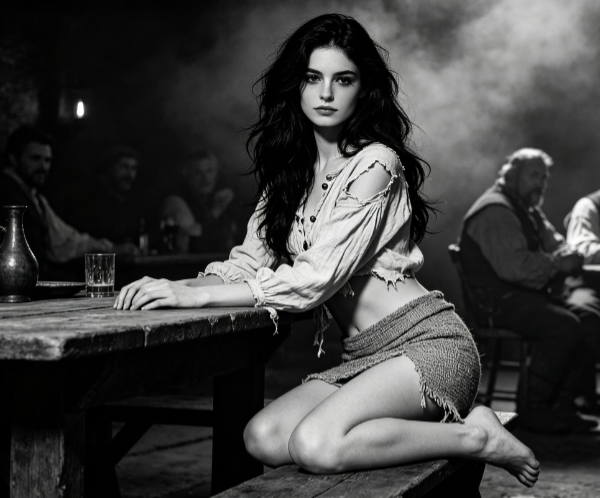
Master Drest stood in the middle of the room when we were brought in; and all five of us went to our knees in unison. He looked down at us, consulting a delivery sheet.
"Brand," he said.
We showed him. I lifted the hem of my slave rag and exposed my bare cunt and brand to him without hesitation; making sure not to seem too eager or prideful. Every slave girl is proud of her brand, and I was no different. He glanced, made a mark in the ledger, moved down the line.
"Akina. Bar."
Akina bowed and crossed toward the stone counter where a boy was already stacking clean glasses.
Drest read from the sheet again, tilting it toward the lamp. "Caia. Room eight. The client has bought two hours." Caia bowed and left, hips swaying as she had been taught.
"Nysa. Arannis. Kitchen." Neither of them let anything show on their faces, but I caught the half-second of swallowed disappointment I would have felt in their place. Trained for six months in the arts that mattered and sent instead to peel vegetables and potatoes. I understood all too well. I watched them bow and go, already reassuring themselves that it was temporary. Girls this well-made didn't stay in kitchens long.
Then Drest looked at me.
"Skye," he said, as if testing the name against my face. "You don't look like a Skye to me." He gave it two seconds of thought. "Valeria."
"I am Valeria, Master," I said, head bowed.
"Go with Pell," he said, gesturing towards a girl who carried herself like someone first on the chain.
Pell was tall, and her arms carried a light, visible muscling. She glared at me for what seemed like five seconds, and I shrank slightly.
"Follow me," she said.
She moved through the layout quickly. The kitchen, the linen cupboard in case I needed a tablecloth for a special client or even slave silks. The small shared room at the end of the back corridor where the five of us would sleep. Then she planted herself at the end of the bar and watched me work for a few minutes.
I carried, I poured, I set down, I collected, and I cleaned tables. I did it exactly the way six months of training had drilled into me; without spilling, without hesitation.
Pell exhaled through her nose: "The Obsequium didn't shortchange us this time. Thank Ea."
Then a man came through the door, greeting Pell by name, clapping her on the shoulder; and before I had fully registered what was happening he had taken her by the wrist and pulled her toward a table where his three friends already sat. He drew her shift off in one motion and bent her over the table's edge. He took her while his friends watched and offered commentary.
This was utterly provincial behavior, even more so for one of the finest taverns in Novus Augusta. Yet Pell was completely loose and cooperative. One of them stroked her face and fed her his food-stained fingers, which she sucked clean without any hesitation.
"Tell me how you feel, Pell," he said.
She answered him between grunts, describing exactly what was happening inside her: the pull of her clit against the table's edge, the perfect fullness in her vagina. And I moved between the tables refilling cups, watching surreptitiously. Not out of curiosity or disgust; I watched just in case they wanted to fuck me as well.
When the merchant finished inside her, Pell smoothed her hair and caught the coin he tossed her, tucking it into the small purse at her hip. She stroked his cheek fondly before she turned back toward the bar. She was still half naked as she strode between the tables towards me.
Her eyes went to my shift, to the damp shadow already spilling from my slit and spreading across the linen.
"Questions?" she asked.
A week in, and there were still no questions which my training at the Obsequium hadn't already answered.
I came out from under a table on a slow Thursday evening.
The cloth merchant above me pressed a coin into my palm before he had even finished tucking himself back into his trousers. The money wasn't mine; it would go into Master Drest's general accounts. A slave girl owned nothing at all except what her Master chose to give her; not the coin, not her time, certainly not herself. I had stopped finding that strange the morning after I had been fucked for the first time by Master Tyenn. I found it, if anything, calming.
Across the room, was a girl I hadn't yet spoken to: dark-eyed, her hair a deep, glossy brown pulled back. She wasn't unfriendly, exactly. She simply looked at me the way I imagined a merchant looks at a competitor's storefront.
I got my answer that night in the corridor, on my way back from the linen cupboard. She was leaning against the wall near the portal to the main hall.
"You're the one they call Valeria," she said.
I bowed deeply. "A new girl would appreciate your instruction in the things which please our Masters," I said, keeping my eyes down.
She looked me over once. "You're faster than the last one they sent," she said. "Prettier." And then she walked away.
I found Pell later and told her what had happened.
"Don't mind Fae," Pell said. "Natural born. Family debts. Enslaved for showing the wrong tendencies at the wrong time. Far too eager to kneel; and now she's miles from home with a brand on her butt. All the natural borns are jealous of us. You know that, right?"
"No," I said. "I don't know that."
She smiled at a glass she was polishing, holding it up to the light. "No woman is more feminine or more sexually ravenous than a candidate who's been through Muliebris. Nobody told you? Earth men make the best slave girls in the Empire. There really aren't that many of us with the requisite constitutive femaleness though. I mean the kind which can't help but submit." She set the glass down and poked me once, lightly, in the ribs, winking. "I'm from Earth too," she said, switching to English.
It was the first time in months that I had heard my own first language spoken back at me.
"Ever hear of a heavyweight fighter called Pelle?" she asked.
I frowned. There was an inkling of a memory: a man built like a Viking raider from the Dark Ages. He had taken two or three championship belts then simply vanished from the sport.
"They let me keep the name," Pell said. "Said it sounded enough like a girl's name already. It means…"
"Slut," I finished, "in the language of the Northern Barbarians."
She looked at me for a moment. "Fast," she said, echoing Fae's words. "Anyway. Fae smells competition. You reek of female heat."
It didn't embarrass me to hear it, because it was indisputably true. I hadn't been fucked in three days, not once; and my whole body had apparently decided to make that fact known to any slave girl standing close enough to notice.
The bolt went home with a heavy, final sound. The lamps were still burning low along the walls, and the last of the smoke from the kitchen drifted near the ceiling.
The arches of my feet ached and the inside of my right wrist was faintly sore.
Akina wasn't among us that night. Pell told me she had been loaned out while we banked the last of the lamps. Sent to a guild called Labyrinth; private city guards who kept the district quiet in exchange for coin and favors; a sweetener for services Master Drest wanted to keep flowing without interruption.
Nysa and Arannis wouldn't be joining us in the shared room either. They would be sharing Master Drest's bed that night. They had gone without a word of complaint. Kitchen duty had ended for them by the fourth day.
Caia came in last, well after the others, still carrying the smell of the three men she had spent the evening with. The men themselves were sleeping it off upstairs, dead to the world in a drunken stupor.
I breathed in the smell of men on her without meaning to, and felt the old, familiar burn. Three days without a hand on me, without a mouth on my breasts, or anyone's weight settling over mine; without being penetrated. And here was Caia radiating the whole evidence of exactly what I had gone without. I turned my face away before she could see whatever was showing on it; something ugly I was sure. Was I really that undesirable?
She didn't seem to notice or, at least, didn't hold it against me. She knew that us slave girl's had needs and were apt to be grumpy when they were denied. She rested a hand on my shoulder, squeezed me gently, and murmured something I didn't quite catch. She was asleep within a breath or two.
Is this mine, I thought, or is it the Muliebris?
I didn't have an answer. Yet.
Chapter 4: The Favorite
Five months as a tavern girl.
Or perhaps a little more than that. Almost one year as a woman.
I moved between the tables refilling cups.
I liked it. I liked being a woman. I liked being a slave girl. Despite all it had cost me, and I knew, even in this state of mind, the exact cost: the comforts and predictability of modern society; my personal freedom; my position in society; the constant taking without being asked. I knew that it was wrong. Consent was important, even here; but I still enjoyed it. Thoroughly.
But I knew that my old life had been slightly wrong as well. The wealth and power had covered innumerable cracks--the emptiness--quite effectively. And how I had treated the women of Earth (or Ki as the people of An call it); each and every one of them. Elaine: that was wrong. I had always known that if I was being honest. I would never treat any of my fellow slave girls in a similar fashion, even if I could. I enjoyed the domination of men and the submission, but that was my kink. The slaver's of An seemed to agree with me as well; they never took a man (or woman) who was not willing; and that was where the Book of Fate and Fortune had come in. There didn't seem to be that many of us transformed men; I understood that it had been outlawed but tolerated; an illegal traffic in forbidden goods which only Ki was made to supply.
Fae's hand landed flat against my backside waking me from my reverie, a proprietary little smack that she had taken to giving only me.
"Room three," she said, her fingertips still lingering on the bare flesh of my posterior. "Quick suck and fuck. He's already paid Master Drest, so don't dawdle." She leaned in and kissed my cheek, her breath smelling of the wine a customer had pressed to her mouth. "Have fun."
I went. The man in Room Three was neither cruel nor memorable, but he was, like most of my customers, a man of An. A real man and a real Master.
When I came back out into the main room, I returned to my service and to my thoughts. Nothing fundamental had changed in me. That was the conclusion I kept arriving at.
Caia was still Caia, soft but assertive; always watching before she spoke. Akina was skilful and gregarious; she had always been this way, even before the training. Nysa and Arannis were still inseparable. And I was still myself, still cataloguing and wanting to be the best in whatever room I occupied. The serum and the months of discipline had not replaced any of that. It had only filed the edges down, the inconsiderate and ethically deficient parts; and let me my true self emerge. What was left underneath the hood was quieter and better lubricated. All five of us submitted to the men who used us the way a person doesn't refuse good food set in front of them: not from weakness, but because refusing would have required inventing an objection that didn't exist inside us anymore.
Aging itself had been solved on An generations ago, and yet the men outside these walls still died constantly: in mercenary contracts and border skirmishes and the endless grinding disputes between the royal houses; as though the empire had found a way to abolish decay only to leave violence fully intact; as if brutality was the price it had agreed to pay to keep death interesting.
Meanwhile we, the slave girls, stayed unnaturally new. Muliebris did something to our bodies beyond the initial transformation, some slow maintenance running under the surface that Pell said kept a girl looking twenty for decades. Pell surmised that the injections we had been given included contraception and vaccinations from some unknown space faring source; just as Mistress Kore's clothes did not belong to An or this era.
As for the free women, the wives and daughters of that same endless violence, they still died the way women had died for centuries: in childbirth, through disease, in the sack of border towns, in the ordinary attrition of being unprotected in a world designed by men for men. The serum was forbidden them: because of unspecified side effects, because it had proven eminently useless if not harmful in most cases. And the mere chance of perpetual slavery and rape was more than enough to dissuade the majority of them from volunteering for it.
It was, I thought, an almost perfectly balanced cruelty. The empire had cured the disease of time and kept every other disease alive and well.
An hour later I found myself behind the bar, damp cloth in hand, sidling up behind Fae, and resting my chin on her shoulder the way I had taken to doing when I wanted her attention.
She didn't give it to me. Her eyes were fixed across the room on a table I had not marked yet, and when I followed her gaze I understood why.
A man sat alone in the corner; lean, composed, dignified, somewhere in his middle years, which would be about thirty on An. He was dressed passably but without ornament, his hair an untidy mess, a single cup of wine in front of him that he had not asked to have refilled. His hands lay still on the table, simply watching and waiting.
Over the course of that evening, I watched as girls drifted past his table and lingered. Nysa bent low to refill a cup, offering with her gestures far more than mere wine. He accepted the wine, and declined everything else that was offered. Fae hovered near him for the better part of an hour, her whole body angled toward his table like a plant toward a window.
Eventually I took Fae by the hand, and led her to him.
I knelt first, forehead nearly to the stone, and felt Fae kneel behind me.
"My slave sister, Fae, would be pleased if she could entertain you, Master," I said, and then, glancing at the small dark bloom already visible on the silk between her thighs, added, "Have pity on a wet slave."
Master Cassian did have pity on Fae.
And he came back several evenings later, carrying a weiqi board under one arm, and two cloth pouches that clacked softly with the stones inside it.
"Who here can play?" he asked the room at large.
The girls nearest him exchanged glances and said nothing. I was at the bar pressing and folding a stack of cloths.
"I can, Master," I said.
He was a rank beginner. The cheap trinket he called a board should have told me that from the beginning. Within the first ten moves I could see that he wasn't even pretending. I let him exist till move twenty the first two games, then got bored with his incompetence for the next two and crushed him. By the fifth game I had stopped playing to win and started playing to teach; walking him back through a sequence and showing him where his stones had lost their liberties three moves before he noticed.
"You are far too intelligent for a slave girl," he said, returning all his captured stones back to their pouch. I knelt before him in deference for beating him so soundly, and he mussed up my mane of hair while my head was bowed.
He began talking then, the way he often did after losing. Which was often; actually, always. He talked about the slow burning conflict between the royal houses, and how it fed a whole economy of mercenary contracts. It was dangerous work, the kind he had done once and would consider doing again if the coin justified the risk.
"You would go back to that, Master?" I said. "Being paid to be closer to death."
"Most men on An perish closer to that kind of death than they would like. Regardless of payment," he said. "I would simply be compensated for the proximity. And the men of An are built differently from the men of Ki."
I knew that of course.
I asked him about west facing territory of Thamud, Talos' chief thorn in its side; then the Witch Queen of Thamud, who had vanished from every account I had overheard. She had killed tens of thousand in her time, keeping the population of the continent acceptably low; or so the myths propagated.
"She was a pleasure slave," he said. "Before she was a queen. Some say she always was, underneath the crown."
"How does a slave girl become a queen and a monster," I said. "Did she even like submitting?"
"Who knows," he said. "It seems unlikely."
"I doubt if she was a natural slave," I said. People said she was once a man of Ki and I did not want to be associated with that legacy.
He looked at me, then reached down and slid a cushion beneath my knees where it had gone numb against the stone.
"Thank you, Master," I said.
A week later, after another round of teaching games, he pressed me to reveal my personal history; then looked exasperated when I finished recounting it. Which annoyed me no end, though I did not show it on my face. The slave training is forever.
"You speak as though you never had a choice, Valeria," he said. "I cannot accept that. If we possess reason, we possess freedom."
"Master. On Earth. On Ki," I said, "there were philosophers called Stoics. They believed a dog tied to a cart may run willingly or be dragged behind it. Either way, the cart reaches its destination."
"So you think you were dragged."
"I think I was the bitch who eventually discovered she had always been running in the same direction as the cart."
"You were once a wealthy man," he said. "Successful. Ambitious. Independent."
I laughed. "I believed I was."
He reached out and took my chin between two fingers, turning my face first one way and then the other.
"Let me see," he said. "No. I don't see it at all."
I laughed again and asked him to stop, and he did, releasing my chin but not his gaze.
"Every important decision I ever made revealed the same soul," I said. "I admired strength and despised weakness in other people because I was afraid of it in myself. I measured everyone by their usefulness; and I spent my whole life looking for something or someone worth obeying."
"No, that doesn't make sense at all," he said. "And that hardly proves destiny."
I lifted my chin so the silver ring on my collar, a mark of accomplishment, was visible to him. "The shop on Ki," I said, "the one that sold me a book before any of this happened. It didn't show me a stranger's life at random. It showed me the woman I had discarded that same morning and let me feel from inside her skin that I wanted a Master. The book only opens for the ones already written into it."
"And the priests of Ea?" he asked.
"They teach that every soul casts a shadow before it enters the world," I said. "We do not walk into our shadow. We spend our lives catching up to it."
"You seem to know quite a bit for someone recently arrived from Ki."
"I am a fast learner, Master," I said. "I have been well-trained, and I am always listening. Perhaps this world is not so strange to me as you assume."
He seemed to accept that. "You believe slavery was your shadow."
"I believe Valeria was."
"You are comparing employment to slavery," he said, frowning slightly.
"No," I said. "I am comparing self-deception to truth. I worked seventy hours a week and called it ambition. I knelt in front of numbers on a screen every day of my life. When Muliebris stripped away my excuses, I discovered that obedience brought me peace. Was that manufactured? Or had I spent decades pretending to be someone else?"
"You could simply be adapting," he said.
"Then why does every day as Valeria feel more authentic than every year I spent as him?"
He had no ready answer.
"Free will may exist, Master," I said. "Perhaps I freely chose every path. But every path led to the same door."
"And behind that door?"
I bowed slightly. "You, my Master."
He was pleased. I could feel it.
When he pulled me up and cradled me in his arms, I could see, across the room, Fae watching us both, her jaw so rigid that I could see the muscles working beneath her skin.
Another few days and we were together again.
"You are far too intelligent for a slave girl," Master Cassian said again, once the stones had been swept back into their pouches and the board folded away. "It troubles me."
I reached for the hem of his loincloth, my fingers finding him through the linen. "Will you allow me to untrouble you then, Master?"
He caught my wrist before I got any further. "No, slave. I'm afraid it is time I addled your mind."
He led me by that same wrist back through the corridor into one of the small private rooms at the end. When the door closed behind us, I reached for him again out of pure habit, my mouth already anticipating its work, and salivating. And again he stopped me.
"Not tonight," he said, and then his hands were on me.
His hands closed over my breasts with a tenderness that made my breath catch. He kneaded them slowly, thumbs finding my nipples, not pinching, just tracing with small circles until they went hard and sensitive; until I arched up into his palms. His mouth followed, and I felt his lips find one nipple while his fingers kept working the other. Something in my belly clenched hard enough that I grunted like an animal.
That was when I felt my first orgasm ripple through me.
He let me settle for a moment; then his fingers moved lower, tracing the crease of my thigh before finding the slick furrow of my labia, parting them with two fingers; exploring and pressing, as though my body were a text he intended to read in full.
He found my clitoris and circled it, so lightly at first I nearly wept from frustrationt, and when my hips finally tilted up toward his hand he increased the pressure by exactly the amount my body required. And I realized that he had been listening to me the entire time, for the small tells that told him what to do next.
That was when I orgasmed a second time.
I kissed him on his mouth, on his chest, anything to make him stop for a moment; to allow me a moment's respite.
When he felt my pulse settling, two fingers slid inside me, curling forward to find the place that made my whole body seize, and he worked that spot with the same maddening precision.
I knew what he was doing. I had been trained to respond to exactly this. My vagina clenched around his fingers and my clitoris was so swollen and sensitive that even the drag of his palm against it made me gasp. I had spent six months learning every possible way to make a man feel what I was feeling now, and it had never once occurred to me that someone might spend that same attention on me.
The third climax took me by surprise, a hard, sudden clench that left me shaking, and I thought that he would stop there, that this was the gift and it was finished. He didn't stop. My eyes were closed now and he was all over me: my face, my lips, my neck, my breasts, my thighs, and my belly. His fingers were gentle, stroking me, waiting for the aftershocks to pass. Then he began again, patient as before, and the next orgasm came faster than the last, my thighs closing hard around his hand, my fingers finding the rough linen and gripping it.

"I am your slave girl, Master," I whimpered. "I am your slave girl."
I thought this proclamation would settle and calm me, but it did nothing of the sort.
By the fifth, I had stopped being able to track anything except his hand; and the sound of my own voice was no longer contained, filling the small stone room in a way any normal person would have been embarrassed by. By now I was babbling in English.
"Oh God," I cried. "Oh God. Oh fuck, Oh fuck."
By the sixth, I was begging without words; my whole body strung tight and then breaking apart and then strung tight again before I had finished recovering.
By the seventh, I had reached my limit entirely.
"Please, Master," I said, my voice cracked open. "Please, no more. Have mercy, please. Please, take me. Finish inside me. Master, please."
He moved over me then and entered me slowly the way Master Tyenn once had, except this time my body was already wrecked and desperate for him.
"You will not come until I tell you to," he commanded.
And I obeyed. I had been trained to do this, I had a silver ring on my collar to prove it. He pummeled me for what seemed like an eternity, taking his pleasure from me while I held on to him, grunting, holding back as best I could. Then, as the tears began to flow down my face, he said: "Now."
And I came.
It was only a few moments before he found his own release deep inside me.
Afterward I lay still on the rough linen, my body quivering in small aftershocks I couldn't stop; no, I didn't really want to stop. My mind was quiet. I knew now that I had never truly submitted to a man before that night; not fully.
And now I had.
A week later Master Cassian came in without his board games and asked for a private room. I had arranged this with him after he had last taken me, and Master Drest brought two low stools to flank his chair.
Fae seemed puzzled when I stroked her back and took her by the hand. Tonight, we would serve him together. He began soon after he had made us drink slightly more than we were used to.
"Tell me," he said, "whether justice exists because the gods will it, or whether the gods will it because it is just."
Fae answered first; something about how justice was what a good heart recognized when it saw suffering. It was a sweet enough answer, and I watched Cassian's face stay pleasantly neutral while she gave it.
"I think," I said, "that if justice depended only on divine will, then whatever the gods commanded would be just by definition, even cruelty. Which means either justice exists independently of them, or the word means nothing at all."
He asked us three more questions that evening, about courage, about the value of an oath sworn under duress, about whether a slave who loved her master could be said to love freely; and each time Fae answered from feeling and I answered from argument; and each time I watched his attention settle on me a half-second longer than it settled on her.
Fae's spine became increasingly rigid with every question; and I stroked her back to settle her. She did not push me away; she had been trained too well. By the fourth question, she was reaching for a precision alien to her and simply stuttered into silence halfway through.
Master Cassian was careful not to notice her embarrassment.
"Make love to each other," he said. "I would like to watch."
We moved to the thick rug at the center of the room, and I reached for Fae. She let me kiss her once, twice, and I thought for a moment that the evening might pass unblemished.
Then her hand closed in my hair, a full fist of it, and she wrenched my head back hard enough that my scalp screamed and my vision blurred at the edges. She forced me down against the rough throw and held me there. But even pinned like that, even with my scalp burning and her grip trembling in my hair, I could feel that this wasn't cruelty, not really.
"Please, sister," I said. "It doesn't have to be this way."
She seemed to lose control just for a moment, her face quivering and turning from anger to sadness, resisting the tears that were threatening.
"I love you, Fae," I whispered. "You will always be my friend. That will never change."
Her grip loosened, but she held me there a moment longer. Across the room, Master Cassian watched us both, making no move to intervene.
Then her free hand found its way between my thighs, and her fingers found my clitoris, stroking me tenderly. Then she released my hair and brought that hand down to my right breast, kneading it hard enough to ache. I gasped, and I felt my body answer, climbing despite everything, the pain and the pleasure tangling together.
"I'm sorry," she said, touching me more gently.
I came against her hand with my scalp still throbbing where she had pulled it, my small cry filling the room, except this time it carried an edge of grief.
When I opened my eyes, Fae was looking down at me with tears flowing down her cheeks, her mouth trembling. I reached up and found her hand where it still rested against my breast and held it; the way I might have held Elaine's hand once, in another body, in another life, if I had ever once thought to.
She didn't pull away. She didn't say anything for a long while.
And then she kissed me.
Chapter 5: Liberation
[Trigger warning: Contains depiction of attempted suicide.]
Lustrum in the early morning belonged to no one; not the customers who wouldn't stir until the sun was well up, not even entirely to us girls, busying ourselves with the "housework."
I heard the door and recognized the tread long before I turned.
"Master Cassian," I said. "The tavern doesn't open its better offerings until midday. You'll find nothing here but girls in aprons."
"I've found worse company at worse hours," he said, and set a leather satchel on the counter.
He drew out a stool and told me to sit. Then he opened the flap and produced a folded document, its edge sealed with a disc of dark red wax. He held it out to me, and I took it with both hands. I noted the quality of the vellum before I had even broken the seal.
They were my ownership papers. My current name, Valeria, near the top and beneath it in smaller script my permanent collar number, 7347-4. I had been transferred from Master Drest to Master Cassian.
I kept my eyes down on the page, because that was the correct thing to do. I knew that a slave girl's face did not get to run ahead of her Master's intentions. My posture didn't change. My hands didn't shake. I was, in that first half-second, purely and completely happy: he wanted me. He had bought me, taken me off the tavern floor and into his life. In truth, I was already composing the version of myself I would become for him.
Then I looked up, and there was nothing in his face.
Not cruelty. Master Cassian had never once been cruel to me, not in the whole time I had known him. But there was no warmth in his expression either.
"You will be transported back to Ki," he said, "on a commercial vessel. Standard cargo passage, though I've paid for a private berth. The pod will restore your male form during transit, and you'll wake as you were. Your former apartment is intact. Your trading accounts, your assets, all of it. I confirmed this myself, through channels I trust. You will not be in want."
I understood that he had thought this through, that this was not whim or cruelty.
"Thank you, Master," I said.
The words came out small and hollow.
Fae reached me first, drifting over from the far tables with a cloth still in her hand, and Akina came a step behind her.
"You're going home," Fae said, touching my arm. "I'm so happy for you."
Fae was natural born, she could not possibly understand. But Akina did. They were both looking at my face by then, and I couldn't hide what I felt. I watched the gladness go out of both of them, Fae's first, then Akina's.
I turned away from them and busied my hands with the papers, squaring the corners against the counter's edge, smoothing a crease that didn't need smoothing.
Cassian said nothing further. He lifted the satchel, settled the strap over his shoulder, and left, and I listened to his footsteps cross the stone floor until the door closed behind him.
I felt Akina cradle me from behind. I did not look up, but I could hear her sobbing.

I woke flat on my back, arms at my sides, legs straight, as though someone had arranged me for a photograph or a funeral. I was dressed in a white Oxford shirt buttoned to the collar, a black tie, a pair of socks, and dark trousers.
I caught my reflection in the wardrobe mirror across the room. It was the old face. I ran one hand along my jaw, then down my throat, my sternum, the flatness of my chest. My hand stopped at my left pelvis. My fingers spread against smooth skin, waiting for a texture that wasn't there: a raised mark, a roughness I had always taken for granted. There was nothing. Smooth skin, unblemished by the branding iron.
I moved through the apartment slowly, touching things. Everything was exactly where I had left it, exactly as it should be. I stood at the kitchen counter for a while with my hand flat against the cool stone, looking at the framed print through the open door of the second bedroom: the king on all fours, his eyes wild. I should call someone I thought. A doctor, perhaps. Or simply go back to bed and see whether the wrongness would go away.
I did not call anyone.
I made coffee instead and drank it standing at the counter; and the whole time my free hand kept drifting back down and finding nothing there each time.
The days followed the shape of my old life.
I ran along the river in the mornings. I dressed fully even on days I had nowhere in particular to be. A cashmere overcoat, a bespoke charcoal suit, a silk tie, the shoes polished to a shine. I looked like a man other men deferred to.
One morning before I left for work, I stood at the window watching the street below. A man was crossing the road two blocks down; handsome, moving with a certainty that made the other pedestrians part around him. I watched him the whole length of the block: his bearing, his confidence; the way another version of myself might have registered a woman's figure.
At the office, nothing had changed. Servers ticking away behind glass, forty keyboards going at once. Colleagues nodded at me in the hallway the way they always had. Someone mentioned, in passing, that the quarter's bonuses were tracking well above target. I sat down and pulled up the overnight positions and found that I could still read them.
I didn't pursue women.
This, more than anything else, should have alarmed me. A woman at a client dinner leaned in close enough that I could smell her perfume, and I registered the whole transaction the old way-intelligence, body, usefulness-and found the entire calculation simply banal. Deficient.
What I needed instead arrived without warning. I was sitting in a meeting half-listening to a managing director outline exposure on a position I had already flagged as a problem, and felt, beneath the boredom, an actual physical ache to kneel; right there, on the carpet. I didn't do it. I sat through the meeting like a rational adult, took notes, offered two sentences of correction to the managing director's numbers. It should have satisfied something in me. It used to.
Two weeks into it, a woman from compliance stopped by my desk and called me by a name that wasn't mine.
"It's Billy," I said
She looked at me with mild confusion. "Sorry," she said. "Of course."
I told myself it was nothing. People misspoke names constantly.
I went to the men's room soon after, to splash water on my face, and it was there that I noticed the mirror wasn't keeping time with me. I lifted a hand to my chin and the reflection lifted its hand a half second later. The lag was so small I might have imagined it, except I tested it three more times. I stood there gripping the edge of the sink until the nausea receded.
Two days later, passing a colleague's desk, I caught two men mid-conversation speaking Common Talosian. They looked up for a moment at me, then went on talking. I stood there a moment longer, then kept walking.
That evening I called Elaine. I don't know why.
"Hello?" she answered.
"Elaine. It's Billy."
"I'm sorry. Billy who? Have we met?"
"This past winter. You stayed over. We were…"
"I really don't think so," she said. "I would remember that. I think you might have the wrong Elaine."
"There's only one Elaine," I said. "In your…"
"I'm sorry," she said again. "I hope you find who you're looking for."
She hung up before I could say anything else.
I knew this was how it started for some people. Not a single dramatic break but an accumulation of small defects. I did not call a doctor. It was pointless. The psychosis would have to run its course.
The roof gravel shifted under my shoes.
I had been up there twenty minutes by the time I thought to check, the wind coming hard off the lake and cutting straight through the cashmere. My fingers tightened on the cold stone of the parapet.
Whoever had woken in my bed three weeks ago, correct in every detail, was a reconstruction. A costume. I knew this now, more than ever. The real self was somewhere else. Gone. What remained was a shell devoid of substance.
I leaned over the parapet and considered the smattering of foot traffic traversing the cold, gray pavement below.
If I ended this, the last true thing about me ended with it.
And I couldn't let her end; wouldn't let Valeria end. I would find my way back to An, or I would become the woman I had already discovered myself to be here on Ki. But I would not let this friendless imitation of a man be the final entry in the ledger.
I stepped back.
Then the gravel went soft beneath me like pieces of foam, the wind stopped mid-gust, and the coat and the roof and the parapet and the whole city dissolved together into white.
I opened my eyes inside a pod.
There were restraints on my wrists, and above me ran a strip of faint blue light. Dark hair pooled against the padding beneath my head, and for one disorienting moment I didn't know which self I was currently inhabiting, until the weight of my own breasts told me plainly enough.
Through the pod's small window I could see two overseers standing at a console just outside, one of them consulting a readout, the other leaning in to read over her shoulder. Their voices carried through the thin wall.
"She doesn't pass," the first one said, tapping the monitor. "Look at the divergence curve here. It should have stabilized by day nine at the latest."
"They rarely stabilize past day nine," the second said, largely unbothered. "Recommend resale?"
"Recommend resale," the first confirmed.
"Money saved again," the second said with a smirk. "Whew."
"It's hardly our fault if the screening process never fails."
The hatch released with a small mechanical click, the restraints falling open at my wrists, and I sat up slowly, my head swimming for a moment.
My hand went to my left pelvis and I felt it beneath my palm before I saw it: the raised, familiar shape of the brand, the phoenix feather Master Tyenn had burned into me on the first day, still there, exactly where it had always been.
I looked down at it anyway, needing to see it as much as feel it. The tears came before I could stop them. I didn't try to stop them.
Chapter 6: First Girl
It was a rather poorly adorned facility on the periphery of Novus Augustus, far from the eyes of customs and excise.
Six of us stood in a loose line in a small pen with an open toilet and running water in a corner. Each of us marked on the left breast with a lot number in grease crayon. I was Lot 14-4. I did not know the names of the other five, and by then I had stopped expecting to learn them before they were gone from my life entirely.
The buyer came in, a Northerner in a coat trimmed with coarse fur. The auctioneer trailed a half-step behind him with a ledger tucked under one arm. It was clearly not his first inspection of the day.
He started at the far end of the line. He kneaded the first girl's breasts with both hands, testing their give and for imperfections; then ran his fingers roughly through her hair, checking for lice with a comb and brittleness at the roots. He pressed a thumb to her jaw until her mouth opened and peered inside. He surveyed the rest of her skin and body quickly and thoroughly, then his hand went between her thighs, two fingers pushing in without preamble, testing tightness. She flinched hard enough that the auctioneer made a small mark in his ledger that I knew was not in her favor.
He moved down the line the same way: all were clearly war booty and scared witless. One was rigid and blank, staring at the far wall. All of them wept, the more intelligent ones silently.
When he reached me, I went to my knees: spine straight, thighs spread to the correct angle, my hands resting palm-up on my thighs. The buyer motioned for me to stand and he conducted the same examination. My nipples firmed to his touch, and my body was relaxed and completely yielding.
"Brand," he said.
I tilted my hip, and presented the mark on my groin elegantly. He ran a thumb across the raised lines of the feather, tracing the shaft where it followed my hipbone, the barbs sweeping back in their careful arcs.
"She's been trained," he said, mostly to the auctioneer, though his eyes stayed on the mark. "The brand is from the Obsequium." Then more quietly, to himself: "Now why did they leave that out of the manifest?"
The auctioneer said something about an oversight, but the buyer didn't appear to be listening. His two fingers pressed inside me then, and I was already wet. I had been wet since he first put his hands on my breasts, my body responding to the inspection with the same shameless ease it had learned to produce for a panel of assessors in a white room. He noted it with a small grunt of approval, withdrew his fingers, and looked down at me.
"Play with yourself," he said.
I did, my fingers finding my clitoris and circling it, my hips tilting into my own hand, my breath catching at the right intervals, for the benefit of the men watching.
"Come now," he said.
And I did, my body answering the command the way it had been trained to, a shudder running up through my thighs and belly, my stifled cry filling the low-ceilinged hall.
The buyer straightened and turned to the auctioneer without carrying on down the line.
"The price remains the same," he said.
The auctioneer hesitated. "There must have been a mistake in the allotment. I'll have to check if 14-4 was inserted by mistake. The price is…"
"The price remains the same."
The auctioneer sighed and nodded.
My Master took the whole lot there and then. I heard him tell the auctioneer that a pale, Ki-born Muliebris-ian (a neologism?) with jet black hair would add something exotic to his current brood back North. He was clearly rubbing it in and the auctioneer could only nod in the affirmative, deeply unhappy that a prize mare had been sold at a steep discount.
Coin changed hands and a boy came down the line with a small metal punch and updated the tag on each of our collars in turn.
I turned to the other girls in the lot for the first time since my Master's inspection. They were staring at me wide-eyed, mouths agape; one in barely concealed disgust. They would all have to learn, somehow.
Master Amund called me Tove before we had even crossed the threshold, and I answered to it the way I had answered to every name given to me by men.
The word Sköka was carved into piece of hard wood above the door to his establishment. I presumed it was more descriptive than an actual name, though I never bothered to ask. There were twenty-five women in that house, though ten mostly did the cooking and cleaning. I was the only one among them who had arrived by Muliebris rather than by conquest. The rest were taken from towns and holdings on the losing side of assorted indistinguishable border disputes.
I understood, within the first week, that I was built differently from all of them. I had been trained in one of the best houses of course, but it was more than that. Simply put, I was a natural slave and they were not. The Book always chooses well or so I've been told. It would have been pointless, not to mention expensive, to inject my sisters with Muelibris. There was nothing in them to unmask.
That first week I served whoever the house gave me. By the second I was serving the better clients. At the start of the third, Master Amund had begun addressing me in front of the others in the tone of a man discussing his best asset.
As first girl, I spent most of my free time training the other women, even the kitchen attendants who stood a chance of being picked on busy nights. There were ten who needed the most work, five of them from my own sale lot; all raw and jittery. I did the best I could under the circumstances, joining them for their first few assignations, taking the heat of the men's more lurid demands.
The sleeping quarters at night was its own country, twenty-five bodies arranged close together on straw pallets. Some nights the room dissolved into laughter, someone recounting a client's peculiar request or the eccentricities of Master Amund; and the laughter would move down the row of pallets like a contagion. Early on, the younger girls would cry silently, trying to keep it from the others out of some instinct toward dignity that hadn't yet been trained out of them. I would take each one in my arms, stroked their hair without comment until their breathing evened out, because there was nothing really useful to say, and I had learned that touch mattered more than words. It was clear that I enjoyed the work in a way none of the other twenty-four did; and this fact, which should by rights have made me strange to them, instead made me steady in their eyes, a fixed point they could orient toward.
Four months passed that way, season folding into season, until the morning Amund came into the sleeping quarters, a length of cord hanging loose from one hand.
"Tove," he said. "Present your wrists."
I rose, walked briskly to him and knelt, holding my wrists out, one over the other.
"You've fetched me a handsome profit," he said. "You should be proud."
"Thank you, Master," I said.
The others wept, and Master Amund was kind enough to let my sisters say their goodbyes. I gave whatever advice I could in those last few moments: reminders to the absentminded, gentle ribbing to ease the sadness and fear. They didn't really need me, I told myself; and, Janna, my second girl was more than capable.
Janna bowed deeply to me then hugged me tightly. They all did, the five new girls from my sale lot crying the loudest possibly because I had spent the most time with them. All of them were now slightly stronger, pressing their hands over their mouths to keep the sobs in. Master Amund looked on with bemusement. I did not turn to look at any of them as I left. I had learned that looking back only made the leaving harder for everyone.
But I carried their faces with me anyway.
My new Master was called Sicarius.
He was lean, his muscle built by actual use rather than for display. Warrior tattoos ran the length of both forearms and climbed his neck in dark, angular bands, and when he turned to look at me for the first time I saw a face weathered into its thirties by more than years.
The lodging smelled of weapon oil and was a mercenary's borrowed quarters, spare with a single narrow bed and a rack for blades.
"What have they called you," he said.
"Skye, Master. Then Valeria. Then Tove."
He considered this for a moment. "Valeria," he said. "For the time being."
He was unlike the Northerners in another way as well: he bathed almost daily; and my first duty in his household was to attend to him in a small stone chamber where steam rose off a copper tub. I worked the soap across his shoulders and down his back, and it was there, tracing the muscle along his spine, that my fingers found it: a gash long healed but wide enough to tell me it had taken months to close, running from his left shoulder blade down toward the base of his spine in a ragged line.
He felt me pause.
"A coward's work," he said, without turning. "Struck from behind. He didn't live long enough to explain why."
"I hope you are not a coward, Valeria," he added.
"All slave girls are cowards, Master," I said, keeping my eyes on his back and the work.
He made a low sound which I took for affirmation.
When he was scrubbed clean, I worked a soft cloth over his arms and chest, rinsing with water warm. When the water had cooled past comfort, he rose, and I knelt.
I took him into my mouth slowly, letting my tongue trace the ridge just beneath the head before I settled into a rhythm, my hand working the base in time with my mouth. I read his breathing: the small catch when my tongue found the underside, the longer exhale when I took him deeper; until I felt the tension in his thighs telling me to ease back before he was ready to finish. I worked him that way for a long while, pacing myself, taking him deep enough to feel the head press against the back of my throat, then withdrawing to circle the tip with my tongue; kissing and inhaling for effect and out of desire; drawing his balls into my mouth; until he shifted, wanting more, and only then giving it to him.
Somewhere in the middle of it, he murmured something to himself rather than to me.
"I have waited years for this."
It was an odd thing to say to a slave girl he had owned for less than a day. I set it aside and gave my full attention back to the only task in front of me; until his hand came to rest in my hair and his breath went ragged, and I took what he gave without hesitation, swallowing it down the way every good slave girl should.
It was a simple life.
Cooking, cleaning, bathing, and sex. I would mend his clothes while he was out, then kneel at his feet when he returned. He was largely illiterate as far as Talosian was concerned and allowed me to read to him from the gazettes and books he had seized from his raids. It was on just such an unremarkable night, two weeks into my new position, that we finally had an honest conversation.
The fire had burned down to a steady orange by the time my Master reached for another piece of lamb, tearing it from the bone with his fingers. He held it out, and I raised my head and took it from his fingers with my lips. I chewed, swallowed.
"Thank you, Master," I said, lying back down at his feet.
Our night's reading was lying upright against the leg of his chair, and he let his bare foot trail up along the back of my calf.
"We'll return to Holmberg soon enough," he said, this time feeding me from his palm. "My home city. South West of here." His foot moved higher, tracing the inside of my knee and then my soft thighs. "I don't mind telling you that I have been searching for you for quite some time."
I did not raise my head or reply.
Then he switched languages, and his next words came out in perfect American-accented English.
"I came to An the way you did," he said. "Through a Book of Fortune. A Book of Fate found among a dead friend's effects." He reached for another piece of lamb. "The male crossing is rarer, but it happens. An needs warriors the way it needs slave girls, and one man from Ki is worth fifty from An if he is chosen well. I think you've seen some of that during your time at Amund's little establishment-the other girls were as nothing compared to you."
"I was inducted into a mercenary guild within three months of landing," he continued. He spoke of killing next. "I've found that bloodletting and death doesn't move me in the least. It's the art of it that excites me. The rest is only a byproduct of this obsession."
I shivered, and he felt it against his foot.
"A slave girl's response," he said.
"Yes, Master," I said, and smiled. "I still don't recognize you, Master. Forgive me."
"I am much changed," he agreed. "As you are." He shifted, drawing me up on to his lap with one hand so that my head lay against his chest. "While I trained in the arts of killing, I had free access to Kore's stable of trainees. It's possible that we knew each other, in a manner of speaking. Though I couldn't say for certain. I was hooded most of those sessions. I wouldn't have recognized you in any case."
"They did not want us to be swayed by a man's appearance, Master."
"Logical." His hand found my breast. "Kore and I are friends, of a kind. Once I had standing in the guild, she opened her records to me. It still took months, even with guild credentials, to trace one girl through that much paperwork. And illegalities, I should add."
"Thank you, Master," I said.
"The pleasure is all mine, Valeria."
He fed me another piece of lamb, and I chewed slowly while my mind began assembling the pieces he had laid out: the Book, an absent friend, the crossing, the months of searching, the particular attention he had paid to a slave girl he had never formally met. There was only one possible conclusion.
"Perhaps," I said.
"You've finally thought it through," he said.
I spoke next in Talosian, because he seemed to need it that way.
"Are you perhaps related to Mistress Elaine, of Ki?"
He pinched my nipple, gentle and approving, the way Master Tyenn once had over far smaller accomplishments. "I thought it would have been obvious sooner," he said.
"Please forgive a poor slave girl, Master," I said, lowering my eyes. "But I see nothing of the former person in you."
"Virilis," he said. "The counterpart to what was done to you. Latent maleness, dormant but constitutive, same as yours was female. Just as you were always a slave girl, a natural slave underneath everything; I was always a warrior."
He looked at me, waiting.
"Yes, Master," I said. "I was a slave girl. I am a slave girl."
"No fear then?" he said. "Of what I might do to you, for how Billy treated Elaine?"
I lowered my head. "My previous despicable behavior had nothing to do with my contradictory but constitutive gender, Master," I said. "It was simply who I was. A bad person. As a worthless slave girl, I no longer have access to those actions."
"Amund's reports say otherwise," he said. "Nothing but helpful. Almost sisterly to every girl under that roof."
"Thank you, Master."
"I was angry, at first," he said. "Before I understood the Book's logic; before I saw Kore's records. After that, I could not help myself. I simply had to see what you had become." He paused. "I'll keep you a while yet. Sell you when I tire of you, when the time is right."
I went to my knees at once, legs spread wide, and bowed till my forehead touched the stone; and from that low angle I could already see that he was hard and erect.
"It's true then. There Is there nothing male left in you?" I did not know if he was genuinely astonished at my change or simply trying to humiliate me.
"Nothing, Master, nothing at all" I answered. "A slave girl is what I was and always meant to be."
I rose and straddled him where he sat, and he took my hips in both hands and guided me down. He filled me slowly, and I rode him, my hands braced against his chest.
"This is better," he said, as I moved over him, "than anything I remember from before. You can't imagine it, Valeria. What it feels like to be a man of An. A real man."
His hips rose, and he thrust into me with renewed vigor.
I didn't disagree with him. I only moved faster, matching his thrusts. But somewhere beneath, I held the quiet certainty that whatever he was feeling, however true, I still had the better part of it: the part that simply arrived, wave after wave, without a single word required to justify it.
A few weeks passed in that borrowed lodging, and I grew almost used to the rhythm of my Master's life. Then Master Sicarius told me, one evening, that he was leaving.
"Another campaign," he said, buckling a strap across his chest. "North. A man's work." He stroked my hair, smiling. "You wouldn't understand. Holmberg will have to wait a while longer."
He was right. A slave girl couldn't possibly understand what it meant to be a man of An.
"I'm loaning you back to Amund," he said, checking the blade of his sword. "You'll work Sköka again while I'm gone. It adds to both our coffers. There's no sense letting an asset sit idle in an empty house."
I was being passed between men the way I once passed a folder across a desk to a junior analyst. There was no malice in it. He was simply allocating me with the same logic I had once used on the women of Ki; and it was strangely intoxicating to the natural slave deep within.
"Yes, Master," I said.
He finished with the strap and crossed the room to where I knelt and rested one hand briefly on the crown of my head.
"You've done well," he said. "Both here and at Sköka before. Amund speaks of you the way I imagine he speaks of very little else." He let the hand stay a moment longer than the sentence required. "Wait for me."
"I will wait, Master," I said. "A slave girl has no choice."
"Amund expects you by the mid-afternoon shift. You can sleep until then."
He turned, gathered the rest of his gear, and walked out without looking back.
I stayed on my knees a moment longer than necessary, listening to the last of his footsteps fade.
Chapter 7: The Return
[Trigger Warning: This chapter contains a depiction of rape.]
Some months later…
I set two wooden bowls at the table, straightened the single spoon beside the knife, and crossed to the chair where my Master's cloak had slid half onto the floor. I smoothed it back over the chair's back.
Tonight, he had told me, I would be his Ki-Earth wife. No kneeling. No Master. Just the two of us, the way it might have been if the Book of Fortunes had never fully opened for either of us; and if we had met and married on Ki.
I did not know why he wanted this. It was not a slave girl's place to ask, but it all seemed perfectly ridiculous just the same.
The beef I had found at the market that morning, two loin slices about three thumb widths. I had seared them quickly in the fat left over from the morning's bacon, timing them to land medium rare. I set those on a separate plate beside the soup. He was still at the weapons rack when I finished, running an oiled cloth down the length of a blade he had already cleaned once that week. I sat at the table and waited, because the alternative was to kneel near the door, and that was not permitted tonight.
"Come on, dinner," I called to him. "The food is getting cold."
He didn't look up. I took a taste of the soup, found it good, tapped my bare foot against the stone floor, and smiled at him.
It was the hardest work I had done in months. Not the cooking. The sitting upright at a table across from my Master, without lowering my eyes, without spreading my knees to indicate that I was receptive to him. Every time I opened my mouth I felt the word Master rising from my throat, and every time I had to catch it and put something else in its place. Honey. Sweetheart. Those words were acceptable for the moment.
He came to the table eventually. He looked at the two slices of beef, then at me, and a smile crept into his face.
He didn't touch the soup; he simply reached for the steak with his fingers.
"Use the knife, M-Sicarius," I said, slapping his hand.
He reached for the spoon instead and began sipping from the bowl daintily.
"You've become quite good at this," he said, nodding at the table, at all of it. "I remember you telling me that you had never learned to cook a thing in your old life. Paid other people to feed you."
"Thank you, honey," I said. "Actually, I used to cook all the time. Wasn't bad at it too. How was work today?"
We ate. He talked: about the campaign he had just come from, the shifting loyalties among the Northern holds, how the southern houses kept buying mercenary contracts they intended to renegotiate the moment the fighting stopped going their way. He drew invisible borders on the tabletop with one finger, showing me where Thamud pressed against Talos's western flank, where the mountain passes made an army's supply line its greatest weakness.
Then he asked me what I was reading.
"First Year at Mary and Magnus' Tower by Elsa Holmberg."
"Holmberg? As in our City of Holmberg?"
"She was one of the last in her line before Holmberg was sacked by you know who."
"Sounds boring," he said, popping the last piece of steak in his mouth with his fingers.
"It's about a school for rich princesses. Think Town and Country mixed with bitchy Enid Blyton episodes."
"A bit more interesting? Maybe?"
"There's a whole chapter on Zeinab of Thamud, and her mother, Zhou Yu."
"You mean, The Witch Queen."
"The Witch Queen," I confirmed. "I wish I could meet her. She speaks English, apparently."
"And Mandarin, apparently."
"Duh. She literally is Chinese. What else would she speak?"
"I don't know," he said, theatrically stroking his chin. "Teochew, Hainanese, Cantonese… Just because people think she might have been transported from China…"
"Okay, smart ass. I'm the one who speaks Mandarin here, not you."
"Just saying," he said, tilting his head from side to side.
It was, in its way, a perfectly natural conversation between two people who cared for each other. Except that no part of it was natural. Every question I asked, every attentive nod of my head, cost me the same effort it might have cost me once to hold a plank position. I could do it of course. I had been trained to do far harder things than sit at a table with my Master and call him honey and a smart ass.
I cleared the bowls when we had finished, stacking them by the basin, and it was there I thought of the night that had taught me, more thoroughly than any lesson at the Obsequium, exactly what a true man of An was capable of, and exactly what I had become in the months since.
It had happened on the road between Holmberg and Novus Augusta, in the long stretch of forest where the mercenary roads thinned to game trails.
We had made camp in a clearing off the main track, the air cold enough to numb my fingers if I kept them out of my sleeves too long. Sicarius had gone off before dusk to check a snare line, telling me to keep the fire fed.
I heard them before I saw them. Ten of them came into the firelight together, rough men in mismatched leather. I did not run. I did not reach for the small knife I used for kindling. I was a slave girl, and they were men.
"My Master is not a man to be trifled with, sirs," I said.
The one nearest me, missing most of his left ear, grinned. "We plan to kill your Master, whore," he said, and the others laughed.
My head had been bowed, my tone had been deferential, but that had made them angrier at me somehow; as though my warning had been an insult rather than a courtesy. The nearest one took a fistful of my hair and forced my head back until I was looking up at the dark sky.
And then they raped me. Slave rape-I had been trained for that as well.
My body performed what my body had been trained to perform while some quieter part of me watched from a slight distance, waiting. Hands moved over me; someone's palm closing rough over my breast, someone's fingers parting me without preamble the way the buyer at auction once had. I was wet and ready. The first person who found this called me a slut. Another slapped my face and said I was a natural slave.
They took turns. I made the sounds my training had built into me.
Sicarius came back into the clearing while the fourth man had his hands on me. I don't know how much of it he saw before he acted. He simply moved, and men began to die.
It was the economy of it that stayed with me longest, more than the blood, more than the sounds the men made. He never raised his voice. He never seemed, even once, to hurry. A blade opened one man's throat before the man beside him had turned fully around. Another went down with a thrust so precise and quick that I did not understand how he had died. He moved through them the way a man moves through a wheat field with a scythe. He later told me that he didn't disembowel anyone because that would have caused a stink almost immediately. And we still hadn't had our breakfast.
Ten bodies in the dirt, and my Master standing among them breathing no harder than he had before he started, wiping his blade clean on a dead man's coat. He grumbled under his breath that he had just oiled his blade and would have to do it again that night.
He didn't comfort me or ask me if was "alright." I surmised that he had seen far too many women raped in his short career as a roving mercenary. Possibly raped a few himself. And I was a natural slave. I had been "trained" for this.
I stayed on my knees where I had been left and felt a relief so sharp my hands shook; and underneath that relief, mortifyingly, a flush of pure want that had everything to do with what I had just watched him do.
"Master, I'm sorry," I said, when he came to me, checking my body the way he might have checked his horse for injury. "I'm sorry for not being…" I stopped, ashamed of the shape the sentence wanted to take.
"Not being more of a man? Were you going to say that?"
"No, Master," I said sullenly. "I'm not an idiot."
He laughed.
"You wouldn't have these thoughts if you belonged to any other Master," he said, drawing me up by my arms. "No man of An expects a slave girl to defend herself. In any fashion. We both know your natural instincts are to submit. Don't be ashamed of yourself." He said the last while holding my chin gently, then withdrew as if he had made a mistake. "I've been too gentle with you. That's the reason for this. And you are far too intelligent for a slave girl."
"I did enjoy watching you kill them though," I said.
I set the last bowl in the rack to dry and looked over at him where he sat again by the weapons rack, running that same oiled cloth over a blade that didn't need it.
He had found the shape he was always meant to wear. So had I.
The common room of Fatum Ama ran loud most nights.
It was Holmberg's finest whore house which really wasn't saying much. Master Sicarius always made an effort to loan me out to the most established brothels of the cities we visited, if only to spare me the long hours of training new arrivals-which was inevitable at businesses with lesser resources. To be honest, I didn't really mind. Being a trainer made me feel useful at least.
It was perhaps a year into my time with Master Sicarius, before the campaigns took him away from me more and more often, that a free woman walked in on a merchant's arm.
It was Fae.
She wore good wool the color of an autumn field and a silver brooch pinned at one shoulder. I froze for perhaps a quarter second and then crossed to serve them. Her eyes found mine and I watched recognition move through them, which quickly cooled to the scorn a free woman gives a mere slave girl.
It was well done. I was proud of her.
"This one," her companion said to her. He nodded at me. "An effeminate Ki male injected with Muliebris. Rare stock these days, and almost always natural slaves. Consider her yours for the evening, my dear. My treat."
Mistress Fae laughed. It came out of her before she could catch it. For that one unguarded second she was simply Fae again, the girl who used to smack my backside on her way past the bar.
"How generous, my dear," she said, once she had gathered herself, and the clipped tone came back. "Thank you. I accept."
I knelt.
The private room they gave us was small, and Mistress Fae settled onto the edge of the pallet while her companion sat in a chair, wine cup in hand.
"Begin at my feet," the Mistress said. I sensed the hesitation and a modicum of civility. She was not as practiced at giving orders as she was at receiving them. Not yet.
I lifted her foot into my lap and drew my tongue slowly along the arch of it, then took each toe in turn into my mouth, working them with the same care I would give a man's cock. She made a small sound and her toes curled against my tongue.
I worked upward from there: the inside of her ankle, the soft skin behind her knee, her inner thighs, then the crease where her thigh met her hip; pausing at each threshold long enough to feel her breath change before I moved further; inhaling the musk emanating from her pussy as I drew near her small bush of pubic hair. Her companion's cup had stopped moving toward his mouth. I could feel his attention on us both, and I let myself perform for it a little, arching my back, sighing against her skin; because a slave girl who is only good at the mechanics and not the theater of pleasure has understood only half her training.
When I finally settled my mouth over her, she was already slick. I took my time there too, circling her clitoris with the flat of my tongue because I knew she preferred that to my fingers. Her hand found the back of my head, and I heard her breath go ragged. I did not stop until she had finished twice, her thighs closing hard around my ears the second time, a broken sound coming out of her that her companion clearly enjoyed a great deal.
Afterward, once he had stepped out to settle accounts with the house, Mistress Fae let me kneel at her feet.
"The girls at the tavern think you're dead," she said. "Killed on the crossing back to Ki. That's the story we were given. I am… glad to see that you are alive."
I bowed my head so she wouldn't see whatever was written across my face.
"You will always be my friend, Mistress," I said. "That will never change."
She didn't correct me for the presumption. She sat still for a moment, then rose, smoothed her skirt, and crossed the room to rejoin her companion without once looking back at me.
I traveled frequently with my Master; mostly to the North but also to Albion and Thamud. It was the Master who arranged the loan in Novus Augusta that put me back on Lustrum's floor. I had never thought to ask him myself, which seemed foolish or selfish in retrospect.
I came through the same door, and the warm lamp light and the smell of roasting meat hadn't changed at all. Master Drest looked at me and frowned.
"I remember," he said, shutting his eyes momentarily. "Skye. A Ki girl. Stable mates with Caia and Akina." He paused. "If I had known how scarce your kind would get, I wouldn't have staked the other four in a dice game the way I did. That was poor judgment on my part."
I bowed. What more was there to say; maybe this was the reason why I never asked permission to return.
Pell was the only face left from the original chain. When she turned and saw me she blurted out: "I thought you were dead."
"I was," I said. "This is my second life."
Two weeks into my return, I was working a table of Qin merchants, their robes cut in the expensive silks that the Talosians could only dream of.
They were well into their cups when the least inebriated of them, a merchant called Zheng, reached down into his bag and withdrew a supple piece of leather rolled tightly into a thin tube. He unrolled it with a flourish, and when I saw the 19×19 grid, a smile came to my face.
"Have you heard of the state of Qin, little girl?" Master Zheng asked, grinning at his companions.
"Pell said she plays weiqi, you idiot," another said, cuffing him lightly. "Of course she knows where Qin is."
I played three games. I was rusty in the first and lost it cleanly. I lost the second more narrowly, my memories of classic fuseki coming into sharper focus. By the third, whatever had been dormant in me woke fully. I tried an early 3-3 invasion and won without difficulty.
Master Zheng sat back, frustrated but genuinely impressed.
"No one plays like that in the manuals I've read," he grumbled.
"She's from Ki, you dumb egg," one of his more drunken companions shouted. "They have 'Electric' Brains there."
"If I had the means," Master Zheng said, "I would buy you and bring you home. Way out west. A girl who plays like that is wasted pouring wine."
"Thank you, Master," I said. "Would that be where the Witch Queen once served Queen Pingyang as a slave attendant, Master?"
The table erupted.
"We don't call her a witch where we come from," one of them said, half-offended on her behalf.
"Even if she was mildly witch-like," Master Zheng said.
"Stop!" The offended one said again.
"Isn't she dead?" another asked, genuinely uncertain.
"Returned from the dead, rather," the first said, waving his cup. "Haven't you heard?"
It was only then that I noticed that another patron had been taking quick glances at our final game position. I knelt, bowed, and excused myself, citing my duties elsewhere in the room. Master Zheng reached out and caught me by the forearm as I rose.
"A rematch," he said. "Before the night is out."
I told him I would find him, but I was already moving toward the far corner of the room; because the man was sitting alone with a cup; his hair still untidy and his tunic still disheveled; talking with someone at the neighboring table.
Master Cassian.
I made my way across the floor with a fresh jug. I filled his cup to the measure he always preferred, and he raised it toward me in thanks, his attention still fixed on whatever his neighbor was saying about grain prices along the eastern road.
Nothing in his face had changed. No pause, no curiosity about a slave girl he had just seen playing weiqi; none of the things I had spent that walk across the room bracing myself against and hoping for. I stayed near his table longer than required, refilling cups that were still nearly full, straightening a stack of coins someone had left slightly askew, giving him every reasonable chance to look up and find something in my face worth pausing over.
He didn't. His conversation moved on to the price of iron and local sources for the wood of Kaya trees; then to a wedding between the royal houses of Thamud and Talos. His eyes passed over me twice more in the ordinary course of gesturing for the jug without acknowledgement.
I had carried the memory of that night in the private room for almost a year; how he had mastered me; how I had submitted utterly and completely to him. And he had looked straight through me three times in ten minutes without a flicker of recognition.
It appeared that I was truly dead.
Three weeks later, at the close of a slow shift, Master Drest told me to assume binding position. I knelt, bowed my head, and crossed my wrists without asking why.
"You've been sold, Valeria," he said, looping the cord and drawing it snug. "Sicarius arranged it by correspondence. He's in Thamud, gathering with the others. There's talk of a real war coming, not just another border squabble. He doesn't have the time to settle this in person, but he asked me to tell you that he'll find you when he returns."
I thought I heard Master Drest mutter, "If he returns," under his breath. He paused for a moment, pulling lightly on the leading end of the rope. "I wonder if he has gambling debts." I knew that Master Sicarius had as much interest in gambling as being knifed in the back.
"The buyer's an old friend of his," Master Drest continued. "Good house. You'll be treated well enough. I wouldn't let you be sold to some vagrant, not that a vagrant would be able to afford you of course." He chuckled to himself. "You're welcome to return if your new Master permits."
I said nothing, and he led me out through Lustrum's door into the lamp lit streets of Novus Augusta.
The house he brought me to stood apart from its neighbors, three storeys tall and deathly dark and quiet. When the front door opened I smelled the dust and mustiness which gathers from paper and parchment. It was clearly the domicile of some scholar with rooms built around reading rather than commerce.
The single woman of the household, a wide-eyed slave who struck me as war booty, led me to a room on the second floor. I understood, looking at it, that whoever kept this house did not think of a slave's quarters the way most Masters did.
It was a bedroom in every practical sense, a real bed with real linens, a chest for clothes. The only mark of what I actually was sat bolted into the wall beside the bed: a heavy iron ring. It was the kind of thing used to chain disobedient but desirable slaves. I had role-played that once or twice during my training; being kicked off the bed by a disgruntled Master.
A note lay folded on the coverlet. The hand was unfamiliar, but the instruction was simple enough: prepare a meal for three; your Master will return two hours after dusk.
I found the kitchen without needing to be shown and worked with whatever I could find in the larder. It would have to be something simple, I didn't have much time. I decided quickly after a fast survey: Cream of Leek and Barley Pottage, and Roast Salt Pork with Apple-Herb Sauce.
Ms. War Booty (her name was Daphne I soon discovered) stood at the kitchen door still wide-eyed and with a look of consternation on her face.
"Well," I turned around to look at her. "Are you going to help?"
She shook her head almost immediately.
I timed each element of the meal backward from the failing light, so that everything would land on the table hot at the exact moment dusk gave way to full dark.
When it was done, Daphne was still at the doorway looking at me.
"The Master asked for a meal for three," I said. "Are you the third person or should I expect a Mistress and her child?"
Nothing.
I sighed and went to the front entrance and stood waiting.
I went to my knees the moment I heard his boots on the threshold. Spine straight, knees apart, palms up, and head bowed.
I could smell him before the door had fully opened. It reached me the way a familiar piece of music reaches you before you've placed a name to it.
"Welcome home, Master," I said, without lifting my eyes.
He came through the doorway and set down a leather bag from which a new yellow-hued weiqi board peeped out; then bent and worked his boots off before entering in the fashion of the Qin. He stood in front of me then, and for a long moment he didn't speak at all.
His hand came into my hair.
He didn't grip it, didn't pull or test or claim. He simply let his fingers settle against my scalp, mussing up my thick mane, and began to make small circles with the same patient attention he had once given me in a small stone room at Lustrum a lifetime ago.
His fingers found the tension at my upper spine and worked it loose, then moved lower, along the back of my neck, into the muscle that months of service had made slightly tight. I made a sound low in my throat, and felt my shoulders drop as I pushed into his touch. He kept at it until I was shuddering lightly, my whole spine gone soft, the training forgotten, the careful posture I had held dissolving. This would have cost me the silver ring on my collar, I thought to myself.
Then his hands reached under my arms, and he lifted me the way he might have lifted a pet rabbit, which I supposed, by An's measure, I was; and set me on the tips of my toes so that our faces were nearly level.
He kissed me.
I returned it without a half-second's hesitation, the way I had wanted to for months on end. My hands came up to find the front of his shirt pulling him closer and my tongue found his.
Whatever price had changed hands to bring me here, I had just been recognized, finally, by the one man on two worlds whose recognition I had never stopped wanting.
Chapter 8: Master
I woke in a real bed decked out in real linen, and, for a moment, felt the urge to kneel and wait for someone to tell me what to do.
No one did.
There would be no morning inspection here, no voice telling me that my knees were not parted wide enough. It was a novelty of sorts and not entirely welcome. I sat up slowly, drew the blanket around my shoulders-because I was cold and because that was what a "lady of the house" would do; and went looking for my Master.
I found him in the kitchen, already dressed, slicing bread. He looked up when I came in and didn't seem at all surprised that I wasn't naked. Which concerned me.
"There's cheese in the cold box," he said, "and eggs if you want them. Or… Daphne can prepare your breakfast."
That was the whole of it. He showed me through the house himself rather than delegating it to Ms. War Booty. He opened doors as we passed them: the linen room; a small chamber for bathing with a copper tub; a room given over entirely to maps pinned along one wall; a few small reading rooms; and then the second floor library.
It was the largest room in the house. Shelves ran floor to ceiling and across two levels; each crowded with volumes bound in leather, bound scrolls in the manner of the Qin, and large codices. A writing table sat beneath a drawn window, and on it, lay a stack of paper, a bottle of ink, two quills, and three leather-bound ledgers.

"You'll want somewhere to keep your thoughts," Master Cassian said. Then he left me to my own devices.
I crossed to the shelves and let my fingers trail along the spines, feeling for the raised ridges of old binding, and opened at random. After an hour or so, I picked up one of the quills and turned it in my hand, testing its balance, then set it down again.
I cooked our second supper together just as I did the first, though Daphne helped this time round. Partway through the meal he set down his cup and asked what I made of a line he had been turning over that afternoon; something from a Talosian philosopher about whether a well-made cage could be called a kindness if the bird inside it had never known the sky.
"I would want to know if the bird chose the cage, Master," I said.
"And if it didn't choose it, but has come to realize it prefers it?"
"Then, Master, I would say that your metaphors have become a bit too obvious and considerably less instructive since we last had a similar discussion."
I wanted to be disciplined, but he only laughed.
The second day, the trouble moved to my body instead of my mind.
I caught myself watching his hands at the table, the way he broke bread, and then, before I could stop myself, my eyes had dropped lower where his leather breeches outlined something I wanted.
I busied myself with rearranging the serving dishes twice before dinner; moving a bowl three inches to the left and the knives more correctly in alignment with the forks. When I looked up, I saw Daphne with the mushroom and onion tarts on a tray, and a look of amusement on her face. I scowled at her.
That night, alone in the real bed with its real linens, I let my hand drift down over my own breast, my thumb finding the nipple and rolling it until it stood hard. I was three strokes from finishing what I had started when I stopped myself, drew my hand back, and lay still; telling myself that whatever release I found here by my own hand would only be a smaller, meaner thing than what was owed me.
By the third evening, I had managed to calm myself in the full knowledge that my Master was only testing me; and that my happiness would be achieved by harnessing the patience I had been trained to.
Daphne set down the first dish of smoked trout chowder and withdrew to the kitchen to put the finishing touches on the venison stew I had prepared earlier in the day.
The conversation came easily, the same back-and-forth I remembered from a dozen games of weiqi at Lustrum. For a while I let myself revel in it, the plain pleasure of my Master enjoying all of my person. At an appropriate juncture, he set his cup down, and reached into his coat, and laid a folded document on the table between us.
I was an expensive piece of vellum with a familiar disc of red wax closing it.
"Your papers," he said. "Updated. A passage is booked for you to Earth, on a private berth. No reintegration protocol this time; I have made absolutely sure of this. You will be happy to know that those responsible for your previous experience have been dealt with in the appropriate fashion." He took a sip from his glass of wine. "Billy's assets, his properties, all of it remains exactly as you left it. Yes, even after all this time. You'll want for nothing back home." He paused and looked up at the ceiling lamp as though considering whether anything else needed saying, then returned to my face. "You can leave in the morning."
I felt the heat come up my throat first, then into my face and my ears; a flush I couldn't have hidden if I had wanted to; my pale skin betraying every degree of it. My hands, resting on the table curled slowly into fists, the knuckles whitening.
I did not look at the papers. I would not give them an ounce of my attention; would not so much as glance at the seal that had once made me so happy and which now made me want to put my fist through a wall.
I looked at him instead.
I didn't care to govern whatever was on my face; couldn't have if my life depended on it; and for once in all my months of service and training I didn't fucking care.
The silence went on until, finally, I said: "No, Master. I will not go. I would rather die."
My tone was pure unadulterated rage, it was all I could do to prevent myself from screaming at him. My whole body was shaking with the effort of keeping it a sentence at all.
Cassian sat back in his chair and looked at me the way he might look at a mildly interesting problem in a book of mathematics, his eyes holding mine without any of the softening I wanted from him.
I lifted my chin defiantly, waiting for the flat of his hand, for some correction, because I had just refused a direct order from him.
As expected, he rose, picked up my papers, made to open the seal, and with a small flourish, a little flick of the wrist, tossed it into the fire.
Then he laughed.
It came out of him whole and unguarded, filling the room; and I stood there with my face still burning, watching the papers curl and blacken and go to ash. And I felt fury and confusion cross my face all at once in a single expression that must have been half murderous and half delighted.
"You… asshole," I finished in English, because I didn't want him to understand everything that I felt at that moment.
He kept laughing, looking at my flushed, furious face with an undisguised pleasure that made it so much worse,
"You should look at yourself now, Valeria," he said, barely catching his breath. "Really. The anger looks good on you. I don't think you've had such a good purgative in all your time as a slave girl."
I crossed the room and began hitting him, small girlish blows against his chest and his abdomen-I couldn't really reach his face-that landed with all the force of a sparrow against a stone wall; and that did nothing at all except make my fists ache.
He let me. He didn't raise a hand to stop me, didn't so much as step back, just stood there absorbing it, laughing still; and somewhere behind me I heard Daphne make a small strangled sound and clap both hands over her eyes, before her footsteps hurried out and the door slammed shut behind her.
Then his hands closed around my wrists, and he drew me down with him onto the rug in front of the hearth. I fought him, I went with him, I turned my face away from him. But he put a finger to my chin and turned me back towards him, saying: "Obey."
And I did.
Near dawn, Master Cassian slept with one arm around me, his breathing slow, a small smile on his face.
I eased out from beneath him, carefully; the way I had been taught; and found my way back to the library.
I still didn't know whether what I had said across that table to my Master had come from some true, unmanufactured part of me or from the Muliebris. Perhaps, the question itself was the answer; that I was probably as free as anyone ever gets to be, on Ki or on An, man or woman, slave or otherwise.
I dipped the quill because I finally had something to write:
Everyone know how stories like this are supposed to begin, and how they invariably end.
A woman falls for a man and thinks she can change him. Instead, he enslaves her. The cruel man repents. The slave escapes, but then remembers who she truly is, and they find each other again.
My story is simply a variation on this age-old tale.
Epilogue: The Only Life That Is True
And we lived happily ever after. Perhaps that was true.
I sat back and looked at the sentence for a while. It read like something a very good slave girl would write.
But there is another ending I remember. That he never came and no one remembered me. Perhaps that was true as well. But that did not mean I was unhappy. Because I was still a woman and a slave girl.
I pressed my fingers against the page. I wanted to feel the grain of the vellum under my skin.
Every choice across two years…was any of it mine? Or was it the Muliebris completing a shape it had already decided on the day the Book opened for me? Perhaps freedom is a word I use out of habit and nothing more.
The lamp flickered, and when I looked down at the last line I had written, the ink was blurring at the edges. I reached to steady the lamp and found that my hand was indistinct, the whole limb rendering itself in fewer and fewer details the longer I looked. The smell went next. Paper and old leather, gone. My hands were still pressed flat, palms down, fingers spread, except there was no vellum beneath them anymore, only a short length of cord drawn snug around both wrists. The wood of the writing table had become something harder and colder under my knees.
Everything else went out like a tide pulling back from a shore.
I was kneeling, wrists bound.
The stone beneath me was cool and familiar; as was the gravity that pressed my knees into the stone with a fraction more insistence than on Earth. Beside me knelt four other women, my four sisters. I knew each of them by the shape of their shoulders. Akina, on my left, Caia beyond her. Nysa and Arannis at the end of the row. In my belly, I felt a low, steady warmth: the Muliebris, finishing its work, closing whatever doors it had opened.
My eyes found the single high window set into the far wall, where the shimmering light of An's morning was already climbing through a sky I would come to see as mundane. My body was new. My mind entirely my own. But I could not tell whether what I had just experienced was memory, prophecy, or a life well lived.
A woman entered the cell carrying a flat glowing pad. She moved down the row, pausing before each of my friends in turn. She reached me last; studied my face for longer than she had studied any of the others. There was nothing on it worth hiding: no panic, certainly not grief; perhaps happiness that nothing had been imagined, that I was truly a slave girl on An.
"Batch 7347-4," she said, into the pad, "pre-conditioned acceptance. Full integration anticipated."
Then, breaking whatever pattern she had been keeping with the others, she cupped my cheek and said:
"Everything will be as you dreamed it would be, my beautiful lucky girl. Have faith at least in that."
I smiled and nodded.
Then, releasing my cheek, she straightened and addressed all five of us at once.
"Slave girls," she said. "Are you ready to serve."
"Yes, Mistress," we said together, without a moment's hesitation; mine included, mine perhaps loudest of all.
I was eager. Genuinely eager. The way I imagined a person is eager on the morning of the thing they have wanted for longer than they can remember. And I wanted, more than anything in either life, to live all of it again-more deeply this time, missing nothing, neglecting nothing.
A hand settled on my shoulder from behind, warm on my naked flesh. It moved upward into my thick dark mane, mussing it with fingers that lingered at my scalp.
None of the other girls turned to see who it was. Akina, beside me, kept her eyes looking straight ahead with the rest of us; but I caught, at the very edge of my vision, the small smile that crossed her face, a smile visible only to me.
And when he spoke, the voice was familiar and welcome: "You are far too intelligent for a slave girl, my love."