

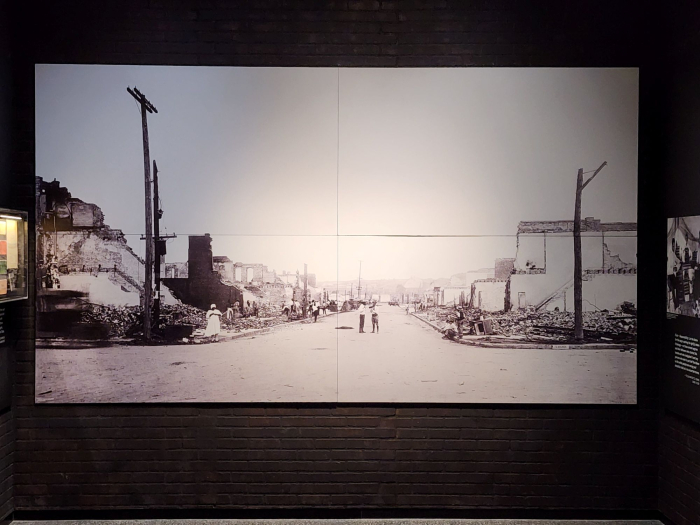
I just read today that one of the last survivors (and the oldest) of the Tulsa Race Massacre has died.
https://www.nytimes.com/2025/11/24/us/viola-fletcher-dead.ht...
Viola Fletcher, who as a child in 1921 saw her affluent Black neighborhood torched by white citizens in what became known as the Tulsa Race Massacre — one of the most violent acts of racial violence in American history — and who, a century later, testified in Congress to the terror she witnessed in the hope of winning reparations, has died. She was 111 and the oldest survivor of the attack.
…
Viola’s family fled in a horse and buggy. As they were leaving Tulsa, she recalled, she saw ash falling on the streets, reminding her of snow. She also saw, as other witnesses did, an airplane dropping what looked like firebombs. She passed piles of corpses. She saw a white man blow off a Black man’s head with a shotgun, she said.
…
The family’s flight from the massacre concluded 30 miles northeast of Tulsa in a wooded area called Claremore, where they found safety, living in a tent. The women went to the bathroom in the woods, three at a time for safety. The family used sticks, string and rocks to catch rabbits for food. They trapped lightning bugs in a jar for a light at night.
…
As an adult, Ms. Fletcher spent most of her life working as a maid for white families in Bartlesville, a town north of Tulsa.
“As she washed their dishes and tucked their little ones into bed,” the journalist Wesley Lowery wrote in a 2023 profile of Ms. Fletcher for The Washington Post, “she wondered whether they were among those responsible, yet never held accountable, for her own childhood’s destruction.”
…
I used these events as background for my story Winnie Winkle Flies Again, where the main character Louie/Winnie rescues a young girl, Molly.
I didn’t give Molly an age, but she would have been about the same age as Viola. I had Winnie fly Molly west to Langston. While Molly’s family fled east to “a wooded area called Claremore”. Claremore was incorporated in 1883. The town and its area were the setting for the musical Oklahoma.
I’m not sure why the family stayed in the woods. They may simply have felt safer camping out with other black families. But many towns barred blacks from residing there.
It’s interesting that she lived and worked in Bartlesville. I have a picture of my Great Aunt Lillian and another woman, possibly my Aunt Nevella, from 1919 when they lived in Bartlesville. But I think they had moved to Tulsa by the time Viola was working there as a maid.
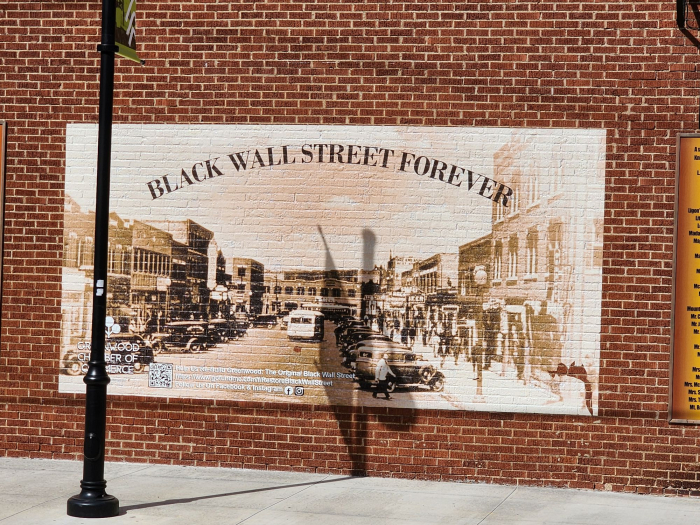
Langston University, a land grant college and the westernmost of the Historically Black Colleges and Universities now has a branch on North Greenwood Avenue. This is across the freeway and just north of the Greenwood District.
I have ideas for another little adventure for Winnie partly set in Bartlesville with some more historical tie-ins. Got to get writing!

Comments
Society Easily Hates
I've read several different accounts of the Tulsa massacre, none quite agreeing why it began. The black community in Tulsa was one of the most prosperous in the nation. The jealousy, hatred toward such a well knit and financially community of non whites could have been enough to ignite a riot. All it needed was an ignition. A black boy got into an elevator with a white woman was all it took.
Camping in the woods was one of the few safe places for anyone of color after the riots. Cities and towns in Oklahoma did not want blacks settling in them. Blackwell, Oklahoma was one of the places I worked centuries ago. In historical context I mention what signs it had up at each end of town. "Nigger Don't Let The Sun Set On Your Black Ass Here".
The hate didn't only infect Tulsa, it had spread across a good proportion of north eastern Oklahoma.
For whatever reason, humans seem to have a need to hate everyone who isn't like themselves ever since Cain slew Able.
Hugs gillian1968
Barb
And we laughingly call ourselves civlilized. Those who don't study history are bound to repeat it.
Oklahoma born and raised cowgirl
Not only in Oklahoma
My father, born in 1910 in Goessel Kansas, told of a town near where he grew up that had a sign like that on the bridge going into town. He said that one time when he had occasion go to that town early in the morning he saw black men hanging from that bridge.
Hugs
Patricia
Happiness is being all dressed up and HAVING some place to go.
Semper in femineo gerunt
Ich bin ein femininer Mann