
"Best thing," he said, "is if that Guy-guy just disappears."
Not This Guy -4-
by Suzan Donamas
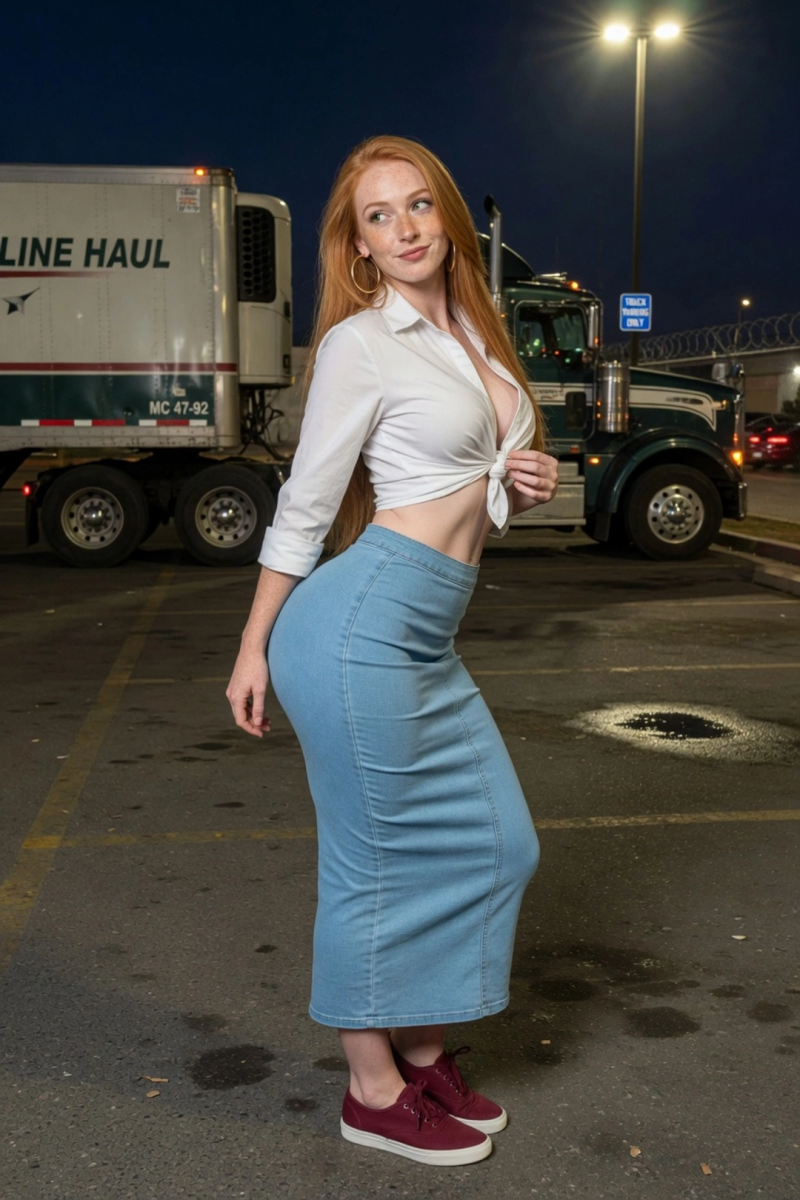
The cab of Gypsy smelled like diesel and distance and something underneath both of those that I was already starting to think of as just Rollie. The bench seat was wide enough that there was a foot of space between us, and Rollie used about half of it, his hand finding my knee every few miles in the way of a man checking to make sure something valuable was still there.
The radio played country at low volume. Outside, Florida went about its business — flat and green and enormous, the sky doing things with clouds that you don't see in Illinois.
I was aware of the leather curtain behind the seat in the way you're aware of a fire in a room. Not looking at it. Knowing it was there.
"You can crawl back and sleep if you want," Rollie said. "There's a bunk back there. You get used to the noise."
I looked at him.
"The engine noise," he said, with the specific innocence of a man who knows exactly what he's said.
"I'm fine up here," I said.
He nodded at the road and put his hand back on my knee.
*
Somewhere north of Tampa, he pulled the billfold out of the conversation the way you pull a bad tooth — directly, without preliminary.
"Best thing," he said, "is if that Guy-guy just disappears."
I had the billfold on my lap. I'd been looking at it without quite opening it. "Disappears," I said.
"We can probably find someone to buy the cards and the license. Get a hunnerd, maybe two."
I opened it. The Diners Club card. The company American Express. Guy Wendell's driver's license with the broad jaw and the duck-butt and six feet one inch printed under his photograph.
"And for me?" I said.
"Florida ID cards only run about thirty dollars if you don't want the best there is." He sucked his teeth. "Best thing is to see what they got — take a name that fits a description close enough to you. Or you can have a custom one made, whatever name you like. Florida cards don't have pictures, so."
I held the license at arm's length. The face in the photograph looked back at me with polite incomprehension.
"Twenty-three," Rollie said. "That's what we put on it. I know you look nineteen, but twenty-three and nobody looks twice." He glanced over. "They might figure your face for nineteen, but your body says a mite older." He reached over and held my breast for a moment with the frank appreciation of a man making a point, and I felt the heat go through me from that and looked out the window at the palms.
"Gwen," I said. "For the first name. That's what came out at the Waffle Barn and I don't think I want to change it."
"That's pretty," he said. "And the last name?"
I thought about it for a mile or two. Wendell was gone, or going. Whatever name I picked was going to be the name I answered to, signed checks with, introduced myself by, for the rest of whatever life I was building at seventy miles an hour up a Florida highway. That seemed like it deserved more than thirty seconds of thought.
But then again, thirty-eight years of Guy Wendell had also not been chosen.
"My mother's maiden name was Delahoussie," Rollie offered.
I got the giggles. I couldn't help it — Delahoussie hit something and wouldn't let go, and the bourbon voice laughed for a good quarter mile.
"You don't like Delahoussie," he said.
"I can't be somebody who makes me laugh every time I sign a check," I managed.
"How about Telford," he said.
I said it. Gwen Telford. It sat in the cab for a moment and neither of us hated it.
"Where's that from?" I asked.
"Last name of the first girl I ever kissed," he said. "Behind the Methodist church. Hannibal, Missouri."
I looked at the highway and thought about being named after the first girl Rollie Blankenship kissed behind a Methodist church in Hannibal, Missouri. It should have seemed strange. It didn't seem strange at all.
"Gwen Telford," I said again. "Okay."
"Now," said Rollie, "where's Gwen Telford from?"
This was the other problem. The bourbon voice was a surprise — lower and warmer than you'd expect from the face — but the vowels were pure Illinois, flat and nasal and honest about it. You couldn't claim Georgia or Alabama or anywhere south of a certain line.
"Kansas City," Rollie said. "That's flat and nasal too, just with a little western twang on it. You been living there. And Springfield, Illinois for where you're from originally — born there, grew up there. That oughta satisfy anyone that you got a right to put an r in warsh."
I tried it. Said something with a warsh in it. It was not much of a stretch.
"Springfield," I said. "I can do Springfield."
"Born there, moved to Kansas City." He looked over. "Now where are you?"
I looked out the window at the highway. At the flat green nothing of central Florida going past at speed.
"In a truck," I said. "Going north."
"That'll do for now," he said, and put his hand back on my knee.
*
I was thinking about the leather curtain again. I was thinking about Rollie's voice when he sang along with the radio, the way it sat low in his chest, and I was thinking about his hand on my knee and his hand on my breast and the particular way he'd looked at me across the empty stool at the Waffle Barn counter. I was thinking about the bunk behind that curtain, and about how much of the drive to Charlotte was still ahead of us, and I was aware of a heat in my body that was not going anywhere on its own.
Guy Wendell had been attracted to women for thirty-eight uninterrupted years. The spring had been thorough.
I licked my lip. Rollie asked if I was thirsty.
"Yes," I said, because it was easier than the truth.
He reached behind the seat without looking and came up with a thermos. Coffee, strong and not terrible. I drank some and put the cap back on and set it on the seat between us.
A sign went past. Jacksonville, eighty-four miles.
I looked at the sign and I looked at Rollie's forearm on the gearshift and I looked out at the highway and I was aware that my whole body was making an argument that my brain was pretending not to hear.
"You're doing that lip thing again," Rollie said.
"What lip thing," I said.
"The one that's gonna get us pulled over."
"What does that even mean?" I said. "Who's going to pull us over?"
"I am," he said. "Ima pull us over and we'll pile in the back and tear off a piece of heaven."
The heat went straight through me and south and I felt my face go red.
"We're on a highway," I said. This was true and completely irrelevant and we both knew it.
Gypsy eased onto the shoulder. Gravel popped under the tires. Rollie set the brake and the engine idled and he looked at me with those faded blue eyes and didn't say anything at all.
I looked at the leather curtain.
"Jacksonville's only eighty-four miles," I said. One last argument for civilization.
"Mm-hm," said Rollie.
I went over the seat.
*
"Works better if you're on top," he said, clambering over after me. "More room that way."
He was right. The bunk was narrow and warm and smelled of him and the cab was louder back here than up front, which turned out not to matter in the least. He got his jeans down around his knees and I stripped and got on top of him and yeah, that was going to work a great deal better.
Half an hour later, give or take, we were on the road again and I had the giggles.
I was sitting sideways on the bench — I'd discovered I liked sitting sideways so I could look at him without turning my head — and every few miles something would come up from inside me and come out as a giggle and I couldn't entirely stop it. Rollie drove with the specific serenity of a man who has done a good job.
"What's funny," he said.
"I am," I said. "I'm funny." I looked at my hands on my knees — the wrong hands, the right hands. "Guy Wendell would not believe this day."
"Guy Wendell sounds like he needed to fall in a spring," Rollie said.
I thought about that for a mile. The apartment in Rockford that smelled like nobody was ever home. Walt at the office. The quarterly numbers.
"He really did," I said, and the giggle came back, and Jacksonville was getting closer and somewhere between here and there I was going to become Gwen Telford of Springfield, Illinois and Kansas City, Missouri, twenty-three years old, and none of that felt like a problem.
Rollie's hand found my knee again.
The radio played.
If you liked this post, you can leave a comment and/or a kudos!
Click the Thumbs Up! button below to leave the author a kudos:
And please, remember to comment, too! Thanks.

Comments
fade out
This chapter could work as an ending if it had to, although seeing more of Gwen's new life would also be good.
No Guy Left
And why would Gwen knock back the gift of being 23 again?