
Author:
Caution:
Audience Rating:
Publication:
Genre:
Character Age:
TG Elements:
TG Themes:
Permission:
SYNOPSIS: In 1566 Constantinople, a Janissary is bitten by an ancient vampiress and awakens transformed; first into something between genders, then, through blood and hunger, into a woman. Across five centuries she moves through mercenary camps, European brothels, the court of Versailles, Victorian England, two World Wars, and the New World; feeding discreetly, loving unwisely, and burying everyone she touches. Her body is clay, shaped by desire and will. And the woman who made her has been watching all along,
Chapter 1 - The Sultan's Path - Constantinople, 1565

"I've been waiting for you," she said.
But for how long?
In the dreams, there had been a woman. Dark hair like a mane; lips whispering words I could barely hold; eyes that looked through me to a self I hadn't known was there.
I walked the Sultan's path at twilight with a sharpened blade in my fist and no memory of having drawn it. The corridor stretched ahead of me like a throat; marble walls inlaid with tiles of lapis and turquoise, hanging lamps casting pools of amber.
The first eunuch had barely raised his hand before I opened his neck. My instructor would have been proud. What little blood that ran from him was thin, spreading across the white marble in a shape that made me think of wings.
I stepped over him and kept walking.
There had been others. Three, perhaps four; I was losing count. All of them had worn that same ashen look. One had been leaning against a pillar, half-conscious, and my blade had found his ribs before he could straighten. Another had simply stared at me as though he had been waiting for someone to finish what had already been started.
"I've been waiting for you," she said.
Her hair was so black it seemed to withhold light.
Emine. That was her name, I knew it without being told.
"Drink," she said.
There was a goblet in my hands. And I drank; the liquid warm, thick, and faintly sweet.
Her fingers found my wrist, and then she was beside me, close enough that I could smell her beneath the incense: something old and strange like the air in a sealed tomb.
"There are powers older than empires," she said. "Older than the faiths that name them. There are those of us who have walked since before your Prophet, before the Messiahs, before the first temples were raised to any god."
I reached for her and found her skin cool and smooth beneath the silk. She placed her hand on mine, and my calloused fingers found the warmth between her thighs and the slick, swollen heat of her sex. I pressed deeper, my thumb finding the hard pearl of flesh at the apex; circling, rubbing; and her breath came in short, sharp gasps.
"I knew I was right to choose you, Hasan ibn Selim," she said.
Her mouth was on my neck now, and I pushed two fingers inside her and felt her clench. I looked down and saw my hand disappearing into the dark fold of silk between her legs, my fingers glistening when they withdrew before plunging back. She hissed and bit her lip. I wanted to consume her.
"Join me," she said.
Then her teeth sank in.
The pain was exquisite, a pleasure so intense it bordered on annihilation. We were tangled together in silk and blood, and for one moment I saw us from above: two women intertwined on the cushions in the golden light.
I closed my eyes and I saw my mother's face. Not as she was when I was taken, weeping at the door of a stone house in a village whose name I had been taught to forget; but as she had been at the church. The little church with its domed ceiling painted blue, its icon of the Savior with his blessed countenance and flat black eyes. Then the surahs and hadiths of my adopted faith. Iblis. The djinn who whisper in the ears of the sleeping.
I shoved her.
"Servant of Satan," I gasped. The words came out in a language I hadn't spoken in twenty years. Then again, in Turkish, louder: "Şeytan'ın kulu!"
She reclined among the bloodied cushions and looked up at me, amused. She did not argue. She did not plead. She simply watched.
And I ran.
The dead eunuchs lay where I had left them, grey and deflated, and I leapt over them without looking down. The palace was a blur of tilework and shadow. I heard no alarm, no shouts.
The courtyard. My mare was tethered where I had left it. The guards, if there were any guards alive to speak of, did not stop me.
I rode with one hand on the reins and one hand pressed to my neck.
The wound burned; and something was changing.
Chapter 2 - Blood Fever - Wallachia, 1565
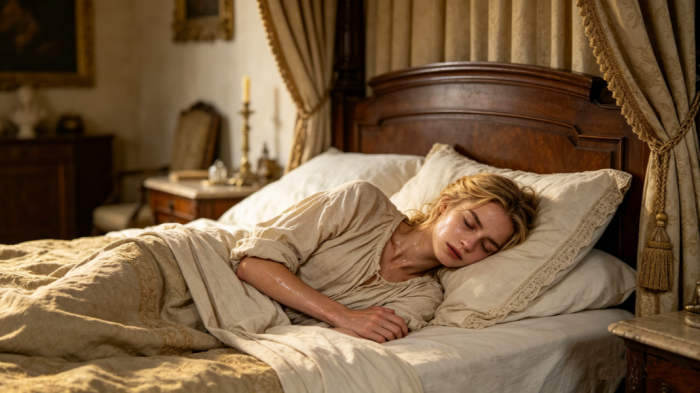
Voices.
The smell of damp stone and something medicinal. Then darkness again, pulling me back under.
The next time, I caught words.
"Male, certainly, but look at the…"
"A hermaphrodite, I've read of such cases in…"
"…angel or demon, that is what I want to know."
The voices swam above me like fish in muddy water. I tried to open my eyes and managed only enough to see the dance of firelight and the heavy shapes of fabric hanging from the walls. This was not the palace. This was not any place I knew.
I tried to move my arms and found that I could not.
The darkness took me again.
When it released me the third time or the tenth, the voices had consolidated into two. One was thick and gravelly, the other was higher and in the careful diction of the educated. I lay with my eyes closed and listened.
"Three days now," the gravelly voice said. "Three days and still changing. You've never seen anything like it, Mihnea. Admit it."
"I will admit it freely, my lord. I have not."
"The hair alone. I swear it was brown or black when we brought him in. Look at it."
A pause. The scratch of a quill on paper.
"Blond, quite remarkably blond. And the skin…"
"Like cream. Like a babe's skin. Not a mark on it."
I opened my eyes.
Two faces hovered above me. The first belonged to a large man with a scar bisecting his left eyebrow, his dark beard trimmed close. The second face was narrower, older, with the pallid complexion of someone who had spent his life indoors with books.
"Water," I said. Then, because the word had come out in Turkish and the faces above me showed no comprehension: "Apă." Romanian. Pulled from somewhere deep, from the village, from the life before.
The large man laughed in delight.
"It speaks! And in the tongue of the land, no less." He snapped his fingers and someone beyond my vision brought a cup to my lips. I drank.
"My name," I said, and then stopped, because the name that almost rose to my lips was Hasan. It would have to be my old name. "Stepan. My name is Stepan. If you could provide safe harbor to a fellow Christian…"
"Stepan," the large man repeated. "I am Boyar Radu. Well, Stepan. You present me with a problem. My men found you collapsed on the road five days ago, half-dead. They brought you here because I am a generous man, and because they thought you might be something valuable."
"I don't understand."
"No," Radu said. "I don't suppose you do." He straightened and made a gesture. "Mihnea, the mirror."
The physician moved to a side table and returned with a hand mirror, the kind a woman might keep on her dressing table. He held it above my face.
The person in the mirror was not me.
She was young, terribly young, no more than sixteen or seventeen to look at her; with an androgynous face framed by pale blonde hair that fell past her shoulders. Her skin was white and smooth and flawless, and her eyes were lighter than they should have been.
I stared at this stranger. She stared back. Her mouth opened when mine opened, forming a small, silent circle of incomprehension.
"You see the difficulty," Radu said.
"This is sorcery. A trick." My voice came out thin, girlish; a stranger's voice from a stranger's throat.
"Three days we've watched it happen," Radu said. He was enjoying himself, that much was plain. "When they carried you in, you were a man, or at least a boy. Dark hair, dark skin, lean as a hunting dog. Then the fever took you, and you began to change. The hair first, then the skin. Then…" He gestured vaguely at my chest.
I looked down.
The blanket had been pulled back at some point during my delirium, and I was naked beneath it. What I saw made no sense. My chest, which had been flat and hard with muscle, now bore two small breasts; barely more than the buds of a girl just entering womanhood, with pale pink nipples. My waist had narrowed. My hips had softened, rounding outward with a layer of fat; and when I strained against the leather straps binding my wrists to the bedposts, the muscles that responded were thin and unfamiliar.
"Fascinating, isn't it?" Mihnea said, leaning in with his leather-bound notebook. He peered at my chest with the detached interest of a man examining a rare specimen of butterfly
"Mihnea." Radu waved a hand. "Enough poetry. Show me the rest."
The physician pulled the blanket away entirely, and I was exposed from throat to ankle, bound and bare on the boyar's bed.
I had never been a modest man. Military life stripped that from you early. But this, being laid out like a specimen, unable to cover myself, unable even to turn away, this was something different.
Between my legs, the evidence of my manhood remained, but diminished. What had been a grown man's equipment now looked almost childlike: smaller, withdrawn, nested in a sparse thatch of fine blonde hair. My thighs were soft and round, my knees smooth and pristine.
Radu reached down and touched me there. Casually, the way you might test the firmness of a pear at market, holding the soft shaft between his fingers, then cradling my much reduced scrotum in the palm of his right hand.
I jerked against the restraints. The leather bit into my wrists.
"Still male," Radu observed, rolling my diminished flesh between his thick fingers with the same unsentimental assessment he might give a coin of questionable minting. "But barely. Mihnea, do you think this will change too?"
"It is... possible, my lord."
"Mm." Radu released me and brought his fingers to his nose, inhaling slightly. "Extraordinary. Truly extraordinary. Write it all down."
"My lord, the scholarly implications alone…"
"Yes, yes. Write it down and then leave it. I want to have a word with our guest in private."
Mihnea hesitated. Caution, perhaps; or the remnant of whatever oath physicians swore. But Radu was already looking at him with the impatience of a man who did not ask twice, and the physician gathered his writing implements and retreated through the heavy oak door. It closed behind him with a sound like a coffin.
I heard the bolt slide home from the inside.
"Now then," Radu said, moving around the bed. "My servants have already cleaned you. Thoroughly. Bathed you, oiled you to my preference."
"Release me," I said.
"In time, perhaps. But I am a curious man, Stepan. And curiosity must be satisfied."
"I beg you, as a fellow Christian."
He was behind me now. I craned my neck but could not see him. All I could hear was the sound of heavy cloth falling on to the stone floor.
"Shh." His hand settled on the small of my back; his thumb traced the ridge of my spine where it met the new curve of my waist. "You know, you really are quite remarkable. More woman than man now, I'd say. This waist and these hips…" His hand slid lower. "And yet still this…" His other hand reached beneath me, finding and cupping what remained of my sex, rolling it almost tenderly; and I wished that I could will my body to die. "So small now. Like a boy's. A little boy's prick on a girl's body."
I thrashed but the restraints held.
"Stop." The word was barely a whisper. "In the name of God... "
"Which god would that be?" Radu asked.
And then he was in front of me, naked and corpulent; the blunt, terrible pressure of him, positioning himself. He entered me without pause or preparation, and the pain was a white-hot lance that drove the breath from my lungs. He was enormous inside me, and every thrust was a violation that tore through my body and my understanding of myself.
"There," he said, as though commenting on the weather. "That's it. You take it well, for the first time. Or is it?" He was gripping my hips with both hands now, his thick fingers digging into the soft new flesh. "Such a girlish little body. Such pretty skin. I could sell you for a fortune in any market from here to Venice."
He leaned forward and put his mouth close to my ear.
"You'll learn to enjoy it," he whispered. "They always do. I'll keep you fed and warm, and in return…"
I turned my head.
Later, I would try to recall what had happened in that moment; what instinct overtook me. But in that instant, there was no thought; there was only the proximity of his throat and a hunger that rose in me like a tide.
It was nothing like the goblet Emine had given me in the palace. This was alive. I drank the way a man dying of thirst drinks water; without thought, without restraint, in great desperate swallows that filled my throat.
Radu screamed but my teeth tore through his windpipe and all that was left was gurgling. I drank deeply and felt the changes as they happened. Each swallow of blood reshaped me from the inside out. The transformation that had taken three days of fever now accelerated in minutes, fueled by Radu's intoxicating blood. I drank until the beating stopped; then drank beyond that, drawing the last dregs from a body that had gone slack and hollow against the bed.
When I released him, he slid to the floor like a sack of wet grain.
The hunger was sated; more than sated, I felt gorged, swollen with stolen life, and in its place was something I had never experienced before. Power.
I pulled at the leather strap binding my right wrist. It snapped like a thin thread.
The left followed, then the ankle restraints. I sat up on the bed and looked down at myself. The body below was undeniably female now: full-breasted, wide-hipped, the skin luminous. When I touched my face, I found high cheekbones, a narrow jaw, and lips that felt swollen and lush.
Between my legs, the transformation was now complete.
Radu lay on his back on the stone floor. He was looked as though every drop of pigment had been drained from him along with his blood; a waterskin that had been wrung dry.
I moved.
First, Radu's clothes thrown carelessly on the floor. Then the bedside table: his coin purse, heavy with gold and silver. A ring set with a dark stone, possibly garnet. A small dagger with a bone handle, sharp enough to shave with. Mihnea's leather-bound notebook, left as ordered. I took everything. Rolled the coins and jewelry into a pillowcase and knotted it.
The bolt on the door slid back at my touch. The corridor beyond was dark, the great hall at the end of it cold and empty, the fire banked to embers. A guard sat slumped in a chair by the main door, his chin on his chest. I passed within arm's reach of him. He did not stir.
Outside, the air was cold and clean. The stables were twenty paces from the main building. Inside, a dozen horses stood in their stalls, drowsing. I could smell them.
I mounted one, and the wind caught my hair and whipped it behind me. And I rode.
Chapter 3 - The Ditch Beyond the Reeds, Near Győr, Autumn 1591
For over twenty years I kept myself empty.
Twenty-five years of chewing bread that tasted like sawdust, drinking water that sat in my gut like a stone, watching my skin go the color of old tallow while the thing inside me gnawed at the walls of its cage.
I had made a bargain with myself in the dark hours after Wallachia: I would not feed. I would not become what Emine had made me. I would starve the creature down to nothing. It didn't kill me. It simply hollowed me out. Now I understood what they meant by the Nesuferitul.
By the autumn of my twenty-fifth year of fasting, I looked like a boy of fifteen who had been raised on thin soup and bad air. My cheeks were sunken, my skin a dull, unhealthy grey; my chest flat, my jaw soft and beardless.
The Hajduk irregulars that patrolled the marsh roads west of Győr would pick fights with Ottoman scouts, stripping the dead for pocket money. They called me István and assumed I was simply a runt. A late bloomer, a boy whose balls had not yet dropped.
"You'll fill out," the sergeant told me once, clapping me on the shoulder.
I smiled and said nothing. I was very good at saying nothing.
That morning, the sergeant sent seven of us through the reeds to cut off a band of Ottoman stragglers reported near an irrigation ditch south of the road. The intelligence was secondhand but we went anyway.
I carried a short sword and a buckler that felt too heavy. The weakness was constant now. I compensated with the animal instinct that the thing inside me provided even in its diminished state.
It was not enough.
The ambush came from the willow scrub to our left. Two akıncı riders burst through the curtain of branches, swords already swinging. Behind them came three foot irregulars.
Our column shattered. A German with a red beard took a saber across his face before he could raise his guard. The blade opened him from jaw to temple. To my right, a Hungarian whose name I'd never learned caught a spear thrust in the belly and sunk into the mud.
I raised my sword and managed a parry, barely deflecting a blow. The training was still there but not the strength. The irregular who had swung at me saw how the sword wavered in my grip and laughed. He swung again and I stumbled backward, my boot catching in the mud. I went to one knee and the weakness washed through me, my vision bleaching at the edges. I was saved momentarily when the sergeant engaged the Turk.
This is how I die, I thought, on my knees in a swamp, too stubborn to have done the one thing that would have kept me alive.
Then a hand found my boot.
The gutted Hungarian had dragged himself through the mud to where I knelt. He was dying. I could hear it in his labored breathing. But his hands were bloody, and when his fingers closed around my ankle, they left a smear of red across the leather.
The smell was intoxicating.
The blood was a vibration that resonated in every inch of my starved and shriveled flesh. The thing inside me didn't gnaw at its cage, it tore through the bars.
The first swallow was like breathing after being held underwater. I gorged on the dying man, taking what blood was left in him, leaving him a shriveled husk. I had no recollection of crossing the distance to the first Turk. One moment I was on my knees in the mud having my fill, the next I was on him, dragging him sideways off the bank and into the reeds.
His blood was thick and warm and indescribably alive. The starved thing fed with a fury that obliterated thought. I heard wet, tearing sounds and understood dimly that they were coming from me.
The second Turk was charging, screaming, his sword raised, his face contorted with horror.
I struck him full on the chest and bore him down into the mud. His sword swung pathetically as my fingers tore into his chest, tearing his ribs apart. I consumed his heart whole, then I turned to the rest of the main vessels and the blood pooling in the cavity of his chest, pressing my mouth to the wound like a lover's kiss, drinking him down in great shuddering gulps.
I was remembering now. Each soul had its own flavor, its own signature of experience.
The third man was running. I caught him in four strides. When I was done, I knelt in the rushes, waiting. Inside me, the thing that had been starving for twenty years was purring.
I could feel the changes already. Warmth flooding into my extremities, my skin tingling as color returned to it. My hands were filling out, the skin softening. My face felt different when I touched it: the jaw slightly narrower, the cheekbones higher, the lips fuller than they had been that morning. I pressed my hands flat against my ribs and felt the tissue there, swelling, budding.
Twenty years. Twenty years of discipline, of denial… all lost.
"István," the sergeant said. "What... happened here?"
He was ten paces away, the last of our company. Sometime between the last Turk and this moment, I had devoured every one of them.
I wiped my mouth with the back of my hand. "I handled it," I said.
My voice was higher than it had been that morning. The sergeant heard it. I watched his eyes flicker down to where my doublet strained, then back to my face. Filled, flush, and female.
He did not have the chance to ask again.
Chapter 4 - The Baggage Train, 1593, Near Székesfehérvár
My life as a woman was both harder and easier.
Before the men woke up I would begin with hauling water, then scrubbing pots and then stirring whatever Greta told me to stir. I had learned to love the mornings for their simplicity, for their honest demands.
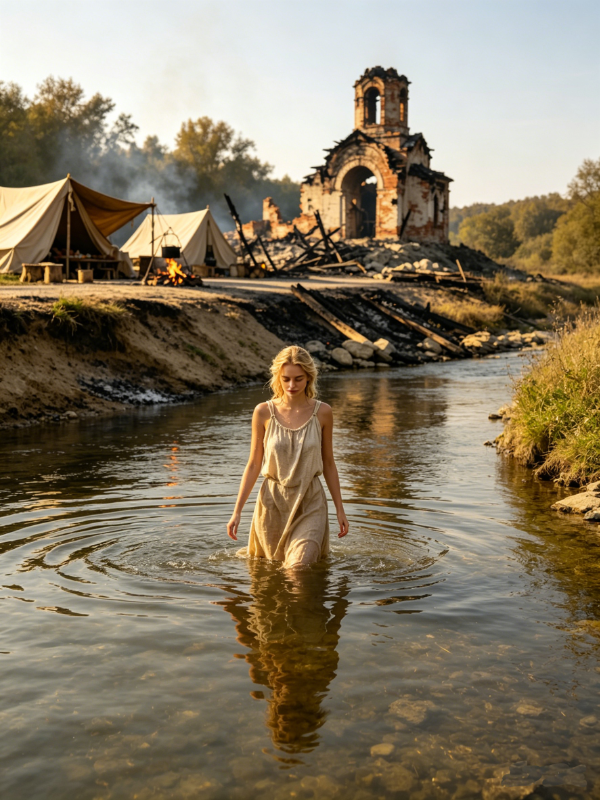
The mercenary camp occupied a muddy clearing beside a road that led, supposedly, toward Komárom, though no one seemed in any particular hurry to get there. The company had made camp beside a half-burned roadside chapel simply because it worked to block the wind.
I knelt at the bank and worked the shirts against a flat rock. Then, because the morning was still early and the camp still half-asleep, I unlaced my bodice, pulled my shift over my head, and waded in to my waist. My skin prickled but didn't numb, another way my body had stopped playing by the rules of mundane humanity. The water ran over my belly and between my thighs.
"Christ's wounds," a young voice muttered.
It was one of the new men filling canteens some ways upstream. One was an old Swabian who carried a halberd. The man who had spoken was younger, leaner, and clean shaven; a mere foal. He tilted his head and gazed firmly at my bosom.
He was attractive and I didn't shrink. My former male inclinations were nowhere to be found, quenched by blood and feeding. Instead, I smiled, arched my back slightly and raised my arms to pull back my hair in a tight knot. My breasts were large, high, and youthful. I scrubbed them both with a small rag, then between my legs, unperturbed by their witness; then walked back to the bank giving them full sight of the hair now matted to my lush lower lips.
I wiped myself down quickly and put on the clothes Greta had handed down to me: an off-white linen shift, a faded red wool bodice that laced up the front, and a dark skirt
It was better this way. Better than murder and rape.
I had learned that in the weeks since the boyar's estate, since the starvation and the slaughter. As a woman, I could control the hunger. I could feed gracefully and precisely, taking just enough from a sleeping drunk or a wounded straggler to sustain myself without killing.
The two men, now joined by a few of their company, murmured appreciatively.
"What's your name," the younger one called out.
"Stefánia," I said. "And yours?"
"Martin," he said. "This is my cousin, Johann."
"You are very beautiful, Stefánia," Johann said looking down.
"What he means is that we would appreciate your company one of these evenings. If you're available of course."
I nodded. "You should speak to Greta," I told them, and returned to the cookfire.
Back at the camp, Greta was peeling onions with a short knife. She didn't look up when I sat down beside her.
"You've been here two weeks," she said.
"I know."
"You're a good girl, Stefánia. Helpful, obedient. But every man in this camp is looking at you like you're the last lamb before Lent."
I said nothing. The fire crackled and spat.
"The women who follow this company," Greta continued, "we eat because we're useful. I cook. Marta mends. Old Katya tells fortunes."
"I help with the cooking and I am learning to mend."
"I know you are. But you must know what it means for a woman to travel in this company. Especially a young woman like yourself."
"I do know."
"Good, then listen to me." She set the knife down. "Choose the first one yourself. If you wait, someone will choose for you, and it might not be gentle. Even worse, you might not be paid." She said the last part in good humor.
I stared at the fire.
"I've known girls who thought they were above it," Greta said. "All of them learned quickly what it meant to be a woman traveling among men."
She was right. I had lived by the sword for years and never thought less of myself for the killing. I knew full well this was what the women in a baggage train did. It was far better than starving to death or being raped.
"I am not too proud," I said. "I will choose."
Greta nodded, as if I had confirmed something she had already settled in her mind. She handed me an onion.
"Good. Now make yourself useful until then."

Miklós found me in the early afternoon, while I was hauling a bucket of slop towards the ditch behind the horse lines. He served as the company's runner; carrying messages, settling debts, arranging the kinds of transactions that officers preferred not to do in person.
"Stefánia," he said, falling into step beside me as though we were old friends taking a stroll. "I have news that will improve your evening."
"I doubt that."
"Are you familiar with József Báthory?"
I shook my head.
"A Hungarian gentleman, traveling with the company under some arrangement with the captain. He has seen you and made a request."
I set the bucket down.
"He will pay, of course," Miklós continued. "Handsomely I should add. For an evening in his wagon."
It appeared that someone had chosen for me.
"And if I refuse?"
Miklós shrugged. "Greta said you had agreed to this. Was she mistaken?"
This was better, I reminded myself.
"No, she was not mistaken," I said. "Thank you, Miklós."
Greta came for me an hour before sunset.
She took me by the elbow and steered me toward the sutler's wagon at the edge of camp; a heavy, canvas-topped affair that smelled of dried herbs. She heated water in a small pot over a candle, testing it against her wrist until satisfied. Then she took a rag, dipped it, and began to wash my face. She was quite thorough, working around my eyelids, the bridge of my nose, and behind my ears.
When she was done, she applied a small amount of goose fat to my lips. My body received the same treatment. She paid particular care of the parts which would receive the most attention from my customer. My breasts of course, but also my arms, thighs, and belly. The perfume she applied to each part was cloying and slightly rancid.
Then she handed me a new shift and laced up my bodice, tighter this time, cinching it until my waist narrowed and my breasts rose above the neckline. The pressure was uncomfortable, but it seemed to straighten my posture, forcing my shoulders back.
Throughout all of this, I said nothing. I watched it happen as though from a great distance, as though the body being prepared belonged to someone else; a doll perhaps, or a puppet. The old soldier in me understood something of this
"Here." Greta held up a piece of polished brass.
I looked.
The girl in the mirror looked more fetching than I had ever felt. Her hair caught the candlelight and her eyes were large and blue.
"Good," Greta said, tucking the brass away. "Now go and enjoy yourself."
The wagon was larger than I expected. A single lantern hung from a hook on the canvas roof. Inside, a narrow cot had been made up with a wool blanket. A small trunk served as a table, with a cup and a bottle of wine set on it.
József Báthory entered at dusk, ducking through the canvas flap. He immediately made himself comfortable on the cot, sitting opposite the trunk and reaching for the wine.
"I'm sorry if I startled you," he said. "It's been a long day."
He was clean shaven, perhaps thirty, and my woman's body told me that he was handsome. Greta had chosen well, at least in this regard.
"I am not startled, Sir."
"Of course not. That's sensible. What's your name?"
"Stefánia."
He nodded, offering me the cup. "Come to me, Stefánia."
I shifted closer to him.
"I'm not going to hurt you," he said.
I nodded warily, but there was a kind of weary sincerity to his words.
He reached out and touched my hair and I felt myself lean into his palm. The warmth of his skin against mine was intoxicating. I was always cooler than the living, and his large masculine hand satiated a barely acknowledged hunger.
I had suspected this for some time. In my two weeks with the company, my eyes had begun to wander: the shape of a man's chest under a shirt had become delectable; the way certain men moved, the younger ones especially, produced a heat in my belly; the bulges in their trousers made my nipples harden.
Now, with József's hand on my face and his body close enough that I could feel the warmth radiating from him, the suspicion became certainty. I wanted him. Not as a woman is supposed to want a man, demurely and with reluctance, but with a directness that would have appalled the man I had been.
I kissed him first.
His mouth was warm and tasted faintly of the wine. He made a low sound of surprise, then his hands were in my hair, kissing me with devastating tenderness. His tongue found mine, and we teased each other, the sensation sending a shiver through my body.
He helped me unlace my bodice, humming to himself. Then the shift came off over my head, and I was bare before him from the waist up, my breasts pale in the lantern light, the pink nipples tightening in the cool air. He looked at me as if enraptured.
"Beautiful," he said, touching the side of my breast delicately, feeling it's smooth responsive skin. "Truly, a work of art."
His mouth found my throat, then hunted lower. When his lips closed around my nipple, I gasped and gripped his shoulders, and my hips moved against him involuntarily, seeking pressure, seeking contact. He stayed me with a hand, finding my skirt damp with lust.
"Patience," he said.
He laid me back on the cot and undressed me the rest of the way, sliding the skirt down my hips, his fingers grazing the soft skin of my thighs. Then I lay naked before him, shamelessly; and filled with hunger.
He undressed himself quickly, and I saw immediately that his body was lean and hard, the muscles of his abdomen clearly defined. I touched him gingerly with the tips of my fingers, licking my lips unconsciously, which made him let out a small chuckle.
When I looked up at him, he was still smiling broadly, observing me as I explored.
He was hard and fully erect and did nothing to hide himself from me. It was not his confidence that troubled me, it was my own. Something had changed fundamentally in me and it was far worse than I had initially feared.
The sight of his manhood did not fill me with the slightest bit of revulsion or disgust. Instead, what I felt was pure, unbridled lust and fascination. I cradled his tight sack in my palm, then worked myself up his shaft, admiring its girth and length. I pulled back the foreskin and exposed the smooth helmet underneath. Then leaned forward, fighting the urge to plant my lips on it.
He had bathed and perfumed himself before arriving, which was a surprise. I had no idea a man would do this for a mere whore. But his male musk was still under all of that, and I breathed in deeply filling my nostrils with his scent.
"They told me you were a mere maid," he said. "Not something so… wanton."
I pursed my lips, gazed up at him, and pretended to sulk. "Would you prefer that I acted the innocent virgin, my Lord?"
He laughed softly, then gasped as I took him between my lips.
The taste was stronger, cleaner; his maleness engulfing my senses. I lapped him gently, tasting him, bringing him deeper into my mouth. I wanted him; all of him; the mere sensation of his hardness in my mouth made me slick; the smoothness at the tip of his cock was nothing less than ambrosia.
At some point, he began to slowly thrust into my mouth, carefully so as not to gag me. I made sure not to injure him, hiding my teeth behind my lips. He seemed to harden even further in my mouth which seemed to surprise him.
"Oh, sweet Jesus," he groaned
It was obvious that he could control himself no longer. He seemed almost in a rush to enter me now, pushing me back on the cot, placing himself hurriedly between my legs. When he slipped into me, we both stopped.
There was a sharp tearing beneath that made me cry out for a moment, my fingers digging into his back. He froze above me, surprised.
"You're…" he started. "But…"
"Don't stop," I whimpered. "Please. Don't stop."
He moved again, my wetness easing his way. His throat was inches from my mouth, the vein blue beneath his skin. I could have taken from him so easily… I turned my head and bit the pillow instead and let the pleasure take me.
It was as delicious as when I took someone's blood; waves of it, cresting and breaking, making me tighten on him, extracting every scrap of friction until I shuddered. He followed moments later; he had barely lasted a minute.
He lay upon me, utterly drained, falling into a deep sleep. I could feel him gradually softening inside, but I was not fully satisfied. The hunger was so profound it frightened me. When he slipped out of me, I glanced down at his manhood and considered taking it into my mouth again; so sure was I that I could get another erection out of him. But I resisted and settled for his lips and gentle nips and licks of his skin, occasionally drawing a few drops of blood.
Near dawn, he rose seemingly refreshed, dressed, and set something on the trunk. A whole forint, much more than a soldier's daily wage.
Then he was gone. The canvas flap swayed in his wake, and I was alone with a hunger between my legs.

Greta was waiting at the cookfire. She said nothing when I approached, she simply held out her hand.
I gave her the coin. She raised it towards the light then took out her purse and deposited it. Then she counted out forty kreuzers. "Your cut," she said. "As this is your first time. Next time, I will take half. That's the standard rate."
She stroked my head gently for a moment, then told me to get changed. There was work to be done in the camp. That was all. No questions about how it had gone, no sympathetic clucking or congratulatory warmth.
Later that night, when the work was done, I lay in my blankets among the other women, listening to the sounds of the camp settling into sleep. I could still feel how it felt to have him inside me, a tenderness that was half-pain and half-something else. And when I shifted my thighs I felt the slickness there and the memory of the pleasure rose up like heat from a banked fire.
And then the other hunger came.
It arrived the way it always arrived; gradually, then all at once. A tightness in the throat. A sharpening of the senses until I could hear the heartbeats of every person within fifty paces. The sound was maddening, like a feast being described to a starving woman. The previous evening's intimacy had done something to the curse, had stirred it or stoked it.
I lay rigid in my blankets and counted heartbeats. Marta's-slow, thick with sleep. Katya's-irregular, the stuttering rhythm of an old woman's overtaxed heart. Too close. Too known. If I fed from them, there would be questions.
I rose quietly and moved through the camp, keeping to the shadows. Far from the camp's edge, I found what I was looking for, what I had sensed. A deserter, or what was left of one. He had crawled this far before the wound in his side had drained his will. Now he lay propped against a fallen log, his breathing shallow and ragged. He was young, his uniform crusted with mud and blood.
I knelt beside him, and he opened his eyes for a moment.
"Angel," he murmured. "Are you an angel?"
"Yes," I said.
I pressed my mouth to the soft skin below his jaw and bit down gently, carefully, the way I had taught myself. The blood came in a warm rush, and I drank in measured sips. Just enough to silence the hunger.
Then I walked back through the camp and settled back between the women. In the darkness, I could feel my skin tighten and smooth, my breasts press more firmly against the linen of my shift. The curse fed on blood, and blood fed the curse. It was not lost on me that the more I fed, the more beautiful I would become; and the more beautiful I became, the more men would want me.
When Greta shook my shoulder the next morning, the camp was already stirring with the clatter of pots and the cursing of men.
"Up, girl," she said. "A second man has already asked. He saw you at the stream and would like to meet you before we move off to the border."
I reached for the basin of water beside my blankets, dipped the rag, and began to wash myself. Then the goose fat on my lips, and the bodice, laced tight.
Outside, men moved in the grey light, and somewhere among them a man was waiting for me, and beyond him another, and another after that. I laced the bodice tighter and stepped out into the morning.
Chapter 5 - The Monastery of Snakes, Carpathian foothills, c. 1605
Five weeks without feeding and the world had taken on the quality of a painting left out in rain, the colors bleeding, the boundary between solid and phantom growing unreliable.
I had learned of the monastery from a dying priest in Sibiu, a man whose blood informed me of a place in the Carpathian foothills where monks of the Hesychast tradition kept prohibited books and did not turn away those marked by afflictions. I had committed the directions to memory and set out the following morning.
Weeks of fasting had reduced me to something barely recognizable. My body had retreated from its feminine fullness the way a tide retreats from shore, leaving behind an ambiguous terrain that was neither man nor woman.
The monastery gate was oak and set into a wall of rough stone. The man who appeared in the doorway was stooped and grey.
"You've come a long way, stranger," he said. "I suspect you carry a burden heavier than most."
"Heavier than you know."
He nodded. "I am Brother Gavril. Come in. You look as though you haven't eaten in some time."
He led me through the gate and across a courtyard. The monastery was modest: a chapel with a domed roof, a long dormitory building, and a kitchen from which the smell of bread drifted.
We sat on a stone bench among the herbs of a small garden. Gavril brought bread and some wine. I ate slowly. The food tasted like nothing, another consequence of the fasting.
Gavril watched me eat, his hands folded over the prayer rope at his belt.
"You know what I am." I said at last.
"I know what you might be," he corrected. "I have read accounts. But I have never met one in the flesh, if you'll forgive the expression."
Before I could respond, the garden gate crashed open.
The man who staggered through was tall, his hair wild and unwashed.
"Strigoaică!" he shrieked. "I know what you are! I've seen your kind on the battlefield!"
I continued with the bread, barely looking up.
"Hush, Nicodim," Gavril said, his voice dropping to a soothing measure. "Sit down, my dear friend."
"They walk among the dying!" the man raved, pacing in a small circle. "I saw one at Mohács. It drank from the wounded while the cannons still fired! It took my soul, my eternal soul, God help me… " He slapped his skull with both hands repeatedly as though trying to physically beat the memory out of himself.
"I have sinned terribly, Brother. They are beautiful and terrible… beautiful and terrible… I laid down with one, Brother. God help me, I laid with one and enjoyed it. I want to confess my sins."
"You have confessed them many times, Nicodim." Gavril rose and placed both hands on the man's shoulders. "And each time I have told you that if we confess our sins, he is faithful and just to forgive us our sins and to cleanse us from all unrighteousness. You must only believe."
"I do believe," Nicodim said.
"Then you are forgiven. You are safe. This person is a guest. Come, let me take you to Brother Teodor. He has your medicine prepared."
The wild-eyed man allowed himself to be guided, but over his shoulder he fixed me with one last look.
When Gavril returned, he settled back onto the bench as though nothing had happened.
"Nicodim was a mercenary," he said. "He arrived here two years ago, quite broken. He speaks of many things that most dismiss as ravings. But God's creation contains more wonders than our scripture and the church fathers have named." He met my eyes. "And I believe you did not come all this way for bread and water."
He came for me after compline.
"Follow me," he said.
We moved through the monastery's winding corridors in near darkness, then descended a narrow staircase I had not noticed during the day.
At the bottom, Gavril unlocked a heavy oak door. The smell that emerged was unmistakable: old parchment, ink, and leather. The chamber was small, carved from the living rock beneath the chapel. Shelves lined every wall, packed with texts whose spines were cracked and darkened with age.
"I have studied creatures like you for thirty years," Gavril said, setting his lamp beside the manuscripts. "Through texts, through correspondence, through the testimony of men like Nicodim. But I have never had the opportunity to examine one directly. Will you permit it? In exchange for other forms of knowledge."
"An examination…" I said.
"A scholarly one. I am not a physician, but I am meticulous. And what I learn may help us in unexpected ways." He paused. "First, our agreement. I will share everything I know; every text, every theory, every scrap of knowledge I have gathered. In exchange, I ask only to observe and document. Nothing more."
I studied his face. This was not Radu. This did not seem like a man who took.
"Very well," I said.
I unlaced my shirt and pulled it over my head. Then the trousers, the worn boots, and the binding cloth I had wrapped around my chest more out of habit than necessity. I stood naked before him in the candlelight.
My breasts were barely there; small swellings, the nipples flat and pale, like those of a girl of twelve who had only just begun to change. My waist curved inward slightly, and my hips held a shadow of width that contradicted my otherwise boyish frame. Between my legs, what remained was vestigial, my cock shrunken to something no larger than a child's thumb, resting against a scrotum that had drawn up and tightened into soft folds that suggested, unmistakably, the beginning of labia. The whole arrangement looked unfinished, as though God had only taken half a rib from Adam.
Gavril looked up from his notebook. "May I?"
I nodded.
He knelt before me with the careful deliberation of a man examining a manuscript page. His calloused fingers were gentle as they parted the folds, tilting the lamp closer. He turned the diminished shaft this way and that, pressed lightly on the tissue surrounding it, felt the shape of what lay beneath the drawn-up scrotum.
His touch was entirely without desire. He made notes in his book. Small, precise drawings. Measurements estimated by eye. When he was done, he stood and stepped back, and I dressed quickly.
"Thank you," he said.
We turned to the manuscripts.
The illustrations were old: Strigoi with elongated limbs and hollow eyes; Revenants dragging themselves from shallow graves; and others, male, female, hermaphrodite; drawn with a precision that suggested the artists had seen what they depicted.
"The Brides of Constantinople," Gavril said, tapping a passage in Greek that I could not read. "An account from the eleventh century. A sect of blood-cursed beings who served in the Byzantine court. They could shift their forms through the consumption of blood; male to female, old to young; even taking on the features of specific individuals." He translated as he read, his finger tracing the lines. "'The blood sustains more than just life, it shapes the vessel. Or, perhaps, the blood allows the vessel to become what it desires."
I traced the illustrations with trembling fingers. One showed a figure mid-transformation, caught between two bodies. Another depicted a woman of extraordinary beauty feeding from the throat of a sleeping emperor.
"When you feed," Gavril continued, closing the Greek text and opening a Latin one, "youth is preserved and feminine traits intensify. When you starve, you revert. You become ambiguous." He gestured at my body. "As you are now."
"Yes," I said. "But there is more. Different victims yield different gifts. I've absorbed languages, memories, even mannerisms through feeding. Not completely, but enough. A merchant I fed from in Brașov; I woke knowing a few sentences of Yiddish I had never learned. A Frenchman gave me an ear for Occitan. It is fragmentary, perhaps dependent on how much I take from each of them."
Gavril set down his quill.
"And the female form," he asked. "Did you desire it?"
"No!" I answered, a bit too vehemently. "Never. I have never had the desire to be female."
"Nevertheless, what you say aligns with the older accounts. The Brides were said to retain their victims in small ways; adopting gestures, speech patterns, even physical features." He leaned forward. "Tell me, have you ever tried to direct it? To hold an image in your mind as you feed; a specific face, a specific form?"
"No."
"I believe you could. The texts suggest that the blood is clay, and the mind is the potter's hand. If you were to imagine a form as you fed; truly imagine it, hold it fixed in your thoughts; the transformation might follow your will rather than your hunger."
I stared at the manuscripts. Had there been something in me which had wished for this? To be a woman?
"Is that all you have?" I asked.
"There is nothing more in this library, but there is a community in Buda," Gavril said. "Ottoman merchants, scholars, physicians. There might be those who know of your kind among the infidels. And if you choose to feed discreetly, you might attain the knowledge you seek."
Buda had been conquered by Suleiman the Magnificent in the middle of the last century.
"Remember that you are still a child of God. The hesychast practice katharsis, the purification of the mind through the repudiation of all temptation. You have told me in confession that you repressed your desires for twenty years before Satan devoured you. You must do so again or your very soul might be in peril. The hunger shapes more than just your body. It shapes your mind, your desires, your very self. Be careful what you become."
I left before dawn, while the monks were at matins.
The Carpathian foothills fell away behind me as I walked east toward Buda, and I could feel the emptiness in my veins waiting to be filled.
Chapter 6 - The Velvet House - Buda, c. 1618
The mirror was Venetian glass, a luxury only I was afforded since it was a gift from an admirer.
I watched myself in it, naked and freshly oiled, the rose-scented unguent gleaming on my skin.
The bath girls had come at dawn, as they did every third day, and stripped me of every hair below my eyebrows. What remained was a body smooth as polished stone. My breasts had filled out beautifully since the last feeding; heavy enough to draw the eye, firm even without a corset, the nipples pink and responsive. My waist curved inward dramatically above my hips and below, between porcelain thighs, there was the soft, plump cleft.
I turned in the mirror to examine the rest: the swell of my backside, the long line of my back, the unblemished expanse of pale skin that stretched from my shoulders to the cleft of my buttocks.
The Seven Stars or Yedi Yıldız as the Ottoman clientele preferred to call it, occupied three floors of a stone building at the Víziváros, along the Danube riverbank. My chamber was on the uppermost; small but private.
A harem slave, that was the fantasy I had been hired to embody
The chemise went on first. It was of fine silk imported at considerable expense and clung where the oil still lingered. Through the fabric, the dark circles of my nipples were plainly visible, as were my nether lips. This was, of course, entirely by design.
Next the fitted trousers (Şalvar) of blue brocade and an Ottoman-style robe (entari) which in this incarnation owed more to European fashion than the Harem-i Hümâyun. The neckline plunged lower than any respectable Ottoman woman would have tolerated, framing my breasts and pushing them upward so that the upper curves spilled over the chemise like cream from a bowl. The effect was not especially decorous but not undeniably indecent. It lay somewhere in between, allowing men to imagine the unwrapping.
I practiced while I pinned my hair. "Efendim, bu akşam çok naziksiniz," I said to the mirror. Hungarian for the local merchants: "Igen, uram, nagyon kedves." German for the Habsburgs who still slipped across the border on unofficial business: "Ich bin Ihnen sehr dankbar, mein Herr," and French for the Jesuits and diplomats: "Vous êtes trop aimable, monsieur."
Each language I had taken from the men who had attended me; through blood of course but also through conversation and literary tokens I requested of them. I could argue points of Hanafi jurisprudence with a scholar or debate the merits of Copernicus with a Jesuit astronomer, because the men who frequented the Seven Stars paid not merely for beauty but for the illusion of a woman who could match their intellect while submitting to their wills and desire.
The door opened and Ilona entered without ceremony.
"Turn," she said.
I turned. She circled me once, her gaze moving from hem to hairline. Then her hands were at my neckline, tugging the chemise lower, adjusting the entari's bodice until my breasts were pushed higher, the upper globes fully exposed, the nipples barely concealed beneath a single layer of translucent linen.
"Four whole years here," she said. "And still you still play the modest maiden. Why?" She shook her head. "The kethuda knows exactly who you are."
"Men like mystery and naïveté," I explained.
"Not with this man, you know that."
She pulled the chemise aside, exposing my left breast entirely. She ran her thumb across the nipple once, firmly, and it stiffened obediently under her touch. Then she tucked the fabric back into place, but loosely, so that the slightest gesture would displace it again. She repeated the adjustment on the right, her fingers quick and impersonal, pinching the nipple between thumb and forefinger to ensure it pressed visibly against the silk.
"Better," she said, patting me on the cheek.
She crossed to my writing desk and slid open the drawer. From her sleeve she produced a leather purse and counted out coins with the speed of a moneylender.
"Twenty-five thalers. Your share for the month."
About forty forints by the current exchange rate. A Hungarian cavalryman earned perhaps ten in the same period, if he was lucky and his captain was honest. A rural laborer might not see that sum in an entire year.
"The kethuda requested you specifically," she said, turning as she made to leave. "Don't disappoint."
The envoy. Atakan Kethuda. His blood had tasted of cloves and saffron; and in the weeks since his last visit, I had dreamed of the warm rush of his memories. The hunger stirred in my belly and I pressed my thighs together against the sudden warmth between them. Both hungers seemed intertwined and inseparable.
His cock tasted of clean skin and rosewater; which was to be expected since I had bathed him before taking him into my mouth.
My world had narrowed to the weight of him on my tongue, the thick, veined shaft that filled my mouth, the musky scent of his groin where I had buried my nose. The envoy sat with his back against the bolsters, his kaftan open, his shalvar long since disposed of.
I could not explain the hunger. There was mere desire of course, though few of my fellow workers professed to enjoy this act to this degree. No, it was something older and deeper than lust, a thirst that lived in my marrow, and it fastened itself to the maleness of him.
I drew back and held him in my hand, studying him. His cock was thick, dark, and circumcised; its glistening head flushed purple and red. A bead of moisture gathered at the slit, and I licked it away with the tip of my tongue, tasting him. He enjoyed this I knew, the tentative kisses and licks.
The shaft pulsed in my grip. I traced the largest vein with my lips, feeling the blood rush beneath the skin; my nostrils firm against the hard flesh. I would not take him this way, but my mouth watered nonetheless.
"Stefánia," he breathed. His voice was strained, the cultivated restraint of an educated man beginning to fray at the edges. His hand found the back of my head; not pushing, there was still some inhibition due to his religion.
My eyes were still on him when I took him back into my mouth. I wanted to swallow him whole, draw from him everything he contained: his warmth, his vitality, the life that pulsed through his body. My nipples hardened, and the wetness between my legs became a slow, insistent trickle down my inner thigh. Each motion of my mouth along his shaft seemed to pull something from him and with each pull I felt myself growing stronger.
He had lasted longer than most but I could feel the moment approaching.
"Turn around," he said, his voice tense.
I obeyed. I turned my bare posterior to him, my face pressed down into the cushions. My hairless sex was exposed and slippery, and I felt him hesitate, torn between touching me and the urgent need to enter. I felt him slide into me, and I encouraged him with a long seductive sigh. His rhythm was unhurried, the restraint of a man who had no desire to spend himself so quickly. But I had no intention of prolonging this. I pushed back against each thrust, taking him deeper, clenching around him. I felt the hot pulse of his release within a minute. He groaned, making two more futile thrusts, and collapsed against my back, his breathing heavy, his skin damp with sweat.
Within seconds his weight went slack, and he slept. Not the gradual drift of a satisfied man but the sudden, heavy unconsciousness of someone whose reserves had been emptied. I eased myself out from under him and arranged the cushions around his body.
He slept for two hours while I prepared a meal and some condiments.
When he woke, he seemed quite refreshed. He blinked, found me, and smiled.
"I must have been more tired than I thought," he said, sitting up and reaching for the wine I had already poured.
"The road from Constantinople is long, Efendim." I handed him the cup and settled beside him on the divan, close enough that my thigh pressed against his. "You carry the weight of empires on your shoulders."
He drank, and we talked. He knew I was discrete and I made sure that my breasts and cunt were ever at his disposal even as we did this.
Atakan was a steward attached to the provincial governor's household and his mind was as finely calibrated as any instrument. He spoke of the tensions along the Habsburg border and the movement of sipahi cavalry toward the frontier.
"You have heard, no doubt, that in Prague the lords have taken to throwing one another from windows." He seemed to enjoy this, the misfortunes of your enemies always brings delight I understood. "The Emperor's men were seized and cast down from a great height. A dragoman in my pay tells me that they lived, which the Catholics have called a miracle. The Protestants suggests they survived by falling on to a dung heap. A divine dung heap one presumes." He chuckled to himself, then grew more serious. "For now, it is far away. But do not be deceived by distance. There are fortunes to be made not by loyalty, but by timing."
In my years at this house, I had already begun lending small discrete sums to Ottoman officers of high repute in return for gifts and patronage. I was now ready to turn my thalers into cloth or even horses if the signals pointed to escalation.
I took his flesh in my palm and began to stroke it gently, easing it erect again. "My love," I said. "Do you remember the Armenian to whom you provided safe conduct?"
He lay back on the cushions. "The one who wanted to discuss standardized duties at our border? Wasn't he Greek?"
"Yes," I said. "The very one. He wishes to send you some gifts in appreciation for your help. Would next week be appropriate?"
"Of course. Tell him that the silk brocade and ambergris he sent the last time was quite exceptional. Perhaps he could find it in his heart to find me some gold threaded fabrics this time?" He smiled and tweaked my nipple playfully. "Does Ilona know that her favorite is playing at being a merchant in her spare time?"
I had no time answer. He pulled me to him, his hands brushing aside my loosely worn robe to cup my breasts. I allowed it with feigned reluctance; a small shake of the head, a murmured protest, then the slow yielding that made men feel they had conquered.
My head was on his chest and I tilted my head as though in pleasure and drew my fingernail across the soft skin below his clavicle. A small cut, no larger than a scratch from a brooch pin. The blood welled in a thin crimson line, and I pressed my lips to it:
The dusty heat of a childhood courtyard in Edirne, pomegranate trees heavy with fruit. Karakaş Mehmed Pasha, the new governor of Buda. Transylvania and its ruler, Bethlen Gábor. The Protestant nobles looking to him for protection from the Emperor and his successor.
I drank sparingly. Three swallows. Then I kissed the wound close and nuzzled against his throat as though I had simply been nipping at his skin in passion.
He left an hour later, adjusting his robes. I stood at the door and watched him descend the stairs, his step only slightly less vigorous than when he had arrived. Outside, the muezzin called the faithful to evening prayer, and I stood at the window listening, my lips still warm with blood.

She arrived on a Tuesday, though I did not learn her name until that evening.
I noticed her first in the common room, where Ilona allowed select guests to mingle before making their choices. The woman sat apart from the others, a cup of sherbet untouched before her. Her dark hair was pulled back severely and she wore a traveling cloak of good wool over a silk gown. Her eyes found mine across the room and something in my blood responded, a resonance I had not felt since I was first drawn to Emine.
That evening, she sent word through the madam that she wished to see me.
I waited in my room, dressed in the manner of a Viennese Kurtisane: a gown with a low, square neckline that exposed the shoulders and upper chest; a tightly fitted bodice; and a full skirt. I stood as she entered, curtseying.
"Come to me, little one," she said, motioning with her hand.
I did so, and she kissed me.
Her mouth was warm and commanding. One hand gripped the back of my neck; the other worked the laces of my bodice. Within moments my gown was pooled around my waist and her mouth was at my breast. I gasped and arched into her, seeking the fingers which were gliding along my inner thighs.
She sat back on the divan and pulled me on to her. Her fingers had not left my cunt, two fingers thrusting rhythmically, sometimes withdrawing almost completely before pushing hard against my cervix. She turned my head to face her even as she did so.
Her face was impassive, even as my own was twisted in barely contained pleasure. I was mewling now, my breath hitching with each thrust of her hand; but she was still detached, observing. Then she nodded as if to give me permission, and I came, a whole body spasm that left me jerking in her arms.
When I was done, I clung to her, head on her chest. I looked up at her stolid eyes and pleaded. "More, please…"
Instead, she released me, allowing me to fall gently to her feet.
She extended one bare foot.
"Kiss it, Stefánia," she said.
I looked up at her. The old soldier in me recoiled but that man was barely a whisper now. The hunger that lived in me obeyed a different chain of command.
I lowered my head. Her right foot was slender, the arch high, the skin smooth and warm. It was unquestionably beautiful. I pressed my lips to the instep and felt a shiver pass through me. Her toes were long and elegant, and I took them into my mouth one at a time, laving each with my tongue, tasting the faint salt of her skin and something beneath it; the sweetness of ancient blood. My eyes closed. The sensation of submission was intoxicating, and I hated myself for it, but I did not stop. I licked the sole of her foot from heel to toe, and she watched me with detached satisfaction.
"Good," she said. "Now come higher. Feed."
She parted her thighs, and I knelt between them and pushed back the hem of her gown.
The scent of her reached me before my mouth did: rich and dark, like ripe figs warmed in the sun; an undertone of musk that made my head swim.
Her sex was beautiful in its own way: the outer lips full and dark, fringed with fine black hair trimmed short with scissors, parting to reveal the glistening pink within. The inner folds were delicate and intricate, deepening in color from rose to dusky crimson toward the center. At the apex, her clitoris stood swollen and proud beneath its hood.
I leaned in and pressed my mouth to her.
The taste was warm and salty-sweet. I licked along the seam, parting her folds with my tongue, exploring the ridged texture of her inner walls where they met the wet heat of her opening. She was impossibly soft there, yielding and responsive, and when my tongue found her clitoris and circled it, she made a low sound, guttural and approving, that sent a flood of wetness between my own thighs.
I sucked her clitoris between my lips, flicking it with the tip of my tongue, and her hips lifted off the divan. Her hand found my hair and gripped. I was drowning in her; the taste, the texture, the velvet clench of her thighs around my ears. I slid two fingers inside her, curling them upward, and felt her tighten around me, her inner muscles gripping.
"I know what you are, little one," she said.
I tensed. My fingers stilled inside her, but I did not withdraw.
"Don't stop," she admonished but there was laughter in her voice. "We'll talk after."
I did not stop. I worked her with my fingers and my tongue until her back arched off the divan and her thighs clamped around my head and she came with a shuddering cry that she muffled with the back of her own wrist. The contractions pulsed around my fingers, and I stayed there through all of it, licking her gently through the aftershocks, savoring all of her until she pushed my head away and brought her lips to mine again, as if in thanks.
We drank wine in the aftermath, both of us flushed.
"Do you know my name?" she asked.
The memory was there, a gift from her. "Leyla, from Salonika."
Leyla reclined against the cushions, her gown in disarray, and regarded me.
"Watch," she said.
Her face changed. Not gradually, not with the fevered agony of my own first transformation, but with the fluid ease of water finding a new vessel. Her jaw squared. Her cheekbones sharpened. The fullness of her lips thinned, and a shadow of stubble darkened her chin. For a moment, a lean, handsome man looked at me from Leyla's face. Then the features softened, flowed, and the woman returned.
"Some of us are made," she said. "Crafted with care by our creators. Shaped, instructed, given the tools to manage what we have become." She tilted her head. "Others, like you, are tainted at birth, abandoned before the transformation is perfected."
"Emine," I said. The name tasted like ash.
"Your maker? Yes. I know of her, though our paths have rarely crossed." Leyla took a sip of wine. She is an old one, very old; though like most vain women she doesn't care to be reminded of it. She has gone by many names: Enheduanna; Eudokia; Elvira. She has not begotten a child for at least half a millennia, or so my sisters tell me."
Leyla stroked my cheek with the tips of her fingers. "I like you, Stefánia. You have a pleasing personality. Perhaps it is because you are a Christian." She laughed.
"Tell me how to reverse it," I said. "How to return to what I was. Please, sister."
"And so polite too," she added. "Which is why I sought you out. My sister, Elizabeth, informed me of a vampir who starved herself senselessly for twenty years. You poor uneducated thing."
She set down her cup and looked at me with something that might have been compassion.
"You left your mistress before being fully formed. You will remain hungry until you find your maker and demand what she failed to give you." She waited, letting the words settle. "There is no going back to the man you once were. There is only forward, and forward means learning to manage what you are."
"I wish I had the time or authority to teach you," she added, more softly. "But that privilege belongs to Emine, and she is not here. I have given you what I can." She reached across and touched my cheek again. "It was wise that you came to Buda, to this velvet house. But feed discreetly, if you know what is good for you. The Christians and the Turks agree on very little, but they agree on burning what they cannot explain."
"And you?" I asked. "What do you do?"
"I move. I change. I become someone new before the questions begin." She stood and began to rearrange her clothing. "Our kind are hunted by those who fear what they cannot understand. The moment they begin to notice that you do not age, that your beauty does not fade, it might be too late."
She fastened her cloak at the throat and looked back at me.
"When you tire of Buda, and you will tire of Buda; come to France. The courts there are filled with women who trade in appearance and desire, and a creature like you will find ample cover among them." She smiled. "Find me in Paris, in ten years or twenty. Ask for Leon de Vries. I may be wearing a different face, but I will know yours."
Then she was gone.
I sat in the dim light and pressed my fingers to my mouth. I could still taste her on them.
I blew out the lamp and sat in the darkness, listening to the sounds of the brothel below; and I began, reluctantly, to plan.
Chapter 7 - The Sun King's Mirrors Versailles, c. 1683
Nearly a hundred years as a woman, and my vanity had only grown with each new incarnation.
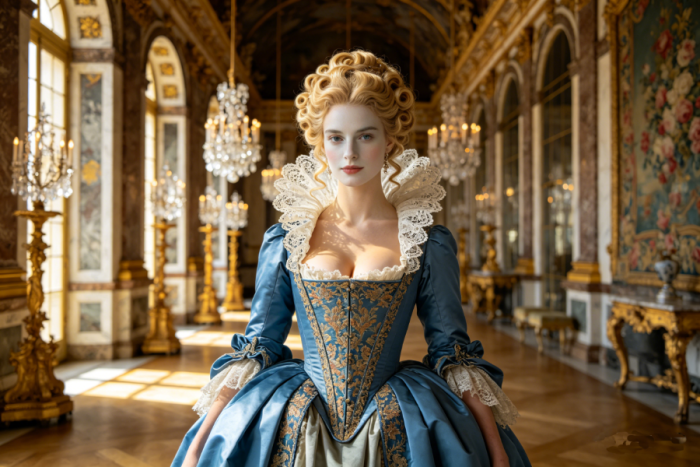
Stéphanie de Villon was a woman of exquisite construction: golden hair arranged in elaborate curls, a swan's neck rising from a cascade of Alençon lace. The gown was a confection of blue silk over a few petticoats that widened my hips to fashionable proportions. The bodice was of brocade and heavily boned, my breasts pushed upward until the upper curves trembled with each breath. I adjusted the fichu at my neckline, pulling it lower until the dark shadow of my cleavage was visible but the nipples remained hidden.
My already pallid skin was further whitened with Venetian ceruse; to appear without it would have been unconscionable. I dabbed it along my collarbone and across the swell of my breasts.
When the court was at mass, I dismissed the servants and slipped from my apartment. The Comte's private library occupied a room on the ground floor of his wing. The shelves rose to the ceiling, packed with volumes in Latin, French, Italian, and Greek. Under glass cases along one wall lay artifacts: a Byzantine reliquary, a bronze head from Africa, and a sealed jar containing something dark and desiccated.
I worked methodically, starting at the eastern wall. My fingers traced the spines: Histories of the Levant. Diplomatic correspondence. Jesuit mission reports from Constantinople.
Then I found it; a slim volume bound in calfskin, its distinctly unappealing title stamped in gilt: My Journeys (On the Marvels of Traveling). An excerpt from an Arabian travelogue translated by a Jesuit priest. I opened it carefully and scanned the pages.
In the Harem of the Sultan, there resided a woman called Emine, a favorite of remarkable beauty who, by the testimony of the eunuchs, did not age in the manner of other women.
...the death of this Emine occurred in childbed, though "death" may be an insufficient word. The delivery chamber was sealed by order of the Valide Sultan, and none were permitted to view the aftermath save the Valide herself. I learned of this through an interview with one of the Valide's trusted servants some years later, the very same from whom I gleaned stories of the Imperial Harem and its ways as recounted earlier in this volume. Of the incident she indicated that the consort's room was awash with blood, the midwife drained completely and grey as ash, the favorite mutilated beyond all recognition...
I set the travelogue aside and moved to the Comte's writing desk, where a stack of leather journals sat beside an inkwell. His private diaries. The Comte had been busy. His journals documented encounters with immortal beings across Europe; not as folklore or superstition, but as business arrangements. Financial agreements. Political intermediaries. And there, recurring like a refrain: La Dame Pâle. A woman who created companions and maintained a network of influence spanning centuries.
The library door creaked open.
The Comte de Montmorency stood in the doorway, a candle in one hand. He was a man of fifty, handsome in the ruined way of the French aristocracy, good bones obscured by excess, intelligent eyes dulled by wine. I had been introduced to the court as his young mistress, a minor heiress from Lorraine, his pet curiosity, his magnificent investment. He looked at me, then at the open journal, and smiled.
"We had an agreement," he said. "Your body in exchange for access."
"I grew impatient with the schedule."
He closed the door behind him and crossed the room. His hand found my breast through the silk of my bodice, gripping it roughly, his thumb pressing hard against the nipple through layers of fabric. He fancied himself a libertine, the kind who confused cruelty with sophistication.
"You forget yourself, Stéphanie." He squeezed harder, enjoying the give of my supple flesh under his fingers. "I installed you here, I clothe you, I presented you to the court…"
I caught his wrist.
The techniques Leyla had taught me in Buda were not merely physical. I held his gaze and pressed his hand more firmly against my breast, then guided it lower, across the rigid stomacher, down to the front of my skirts. His breathing changed. I leaned in close enough that my lips grazed his ear.
"Kneel," I said.
He knelt.
There was no resistance. There never was, not anymore. The Comte, whose ancestors had been Constables of France, whose name appeared in the genealogies of half the noble houses of Europe, sank to the floor with the obedience of a well-trained hound.
I lifted my skirts. I wore nothing beneath them. The Comte's face was level with my sex, and I gripped the back of his head and pulled him forward.
"Gently," I instructed.
He obeyed. His tongue found me with the desperate attentiveness of a man who had learned, through repeated instruction, exactly how I wished to be served. I leaned back against the chair, my eyes flitting over his journals, as the top of his head moved between my thighs. The sensation was pleasant enough. His tongue was practiced now, circling my clitoris with the careful pressure I preferred.
"Is it to your liking?" I asked, my eyes still fixed on his journals.
"Completely, mistress," he said. He returned to his work, making small, muffled sounds of abject devotion.
When I was finished with him, I turned his head to one side and pressed my lips to the soft skin behind his ear. The cut was small. A nick, really. He barely flinched. I drank three swallows, enough to taste the shape of his recent conversations, the names of his correspondents, the location of the cardinal's letters. Then I kissed the wound closed.
"Thank you, my Comte," I said. "You've been most generous."
He blinked at me from the floor, dazed and diminished, and I left him there among his books and secrets.
The salon of Madame Giselle Fournier was, by common agreement, the most dangerous room in Versailles that did not contain the King.
The room was stifling, and I could taste the heartbeats of every person in it. A duchess whose husband had recently been appointed ambassador to the Sublime Porte was holding forth on the barbarism of Turkish coffee. I positioned myself nearby and listened, filing away the names she dropped while offering sympathetic noises at appropriate intervals. An elderly marquis attempted to corner me near the harpsichord, his hand finding the small of my back with the practiced ease of a man accustomed to female availability. I deflected him with a smile and a murmured excuse about the heat.
It was there, beside a marble bust of Marcus Aurelius, that the Chevalier Armand de Ségur found me. He wore the black coat of a physician beneath a modest wig, and he had been watching me for weeks.
"Mademoiselle de Villon," he said, bowing precisely. "You look remarkably well this evening."
"You are too kind, Chevalier."
"Not at all. I speak as a physician. Your complexion, for instance." He tilted his head, studying my face. "Flawless. Not a single mark. No scarring from smallpox, no blemishes of any kind. For a woman who claims provincial origins, where the pox rages unchecked, it is quite extraordinary."
"Good fortune and clean living," I said. "My mother was meticulous about hygiene."
"Your mother," he said, quite undeterred. "Yes. Tell me, where precisely in Lorraine does your family hold their estates? I have some acquaintance with the region."
"Near …pinal. A small holding. It is unlikely that a man of your standing would know it."
"You're right, I would not. Because I have made inquiries, and no family named Villon holds property within fifty leagues of …pinal." He said this pleasantly, as one might comment on the vintage of a wine.
Around us, the salon continued as if nothing was amiss. My own expression was perfectly agreeable. "Then you must allow me to bring you there," I replied. "When the Comte feels able to make the journey, of course."
"I find it curious," de Ségur said, raising his voice just enough that the three nearest guests could hear, "that a woman of your... constitution shows such remarkable resistance to aging. The Comte de Montmorency introduced you to court four years ago. You have not changed by so much as a single line. Your skin, your hair, your figure, all precisely as they were. I have been a physician for thirty years, Mademoiselle. Nature is not so generous."
"Perhaps Nature makes exceptions for those who do not bore her," I replied, snapping open my fan.
The nearest guests had turned. A baroness with rouged cheeks and predatory eyes was listening openly now.
"Perhaps," de Ségur said, undeterred. "Or perhaps the exception is of a different kind entirely." He stepped closer. "I have examined the Comte recently. He is a man in precipitous decline. Pale. Weak. Drained, one might say, of his essential humors. And yet his mistress blooms like a rose in winter. It raises questions. About the nature of the arrangement. About the nature of the mistress."
"I am young and he is old. I take what I need while he takes whatever his heart desires. Gluttony is the vice of those who eat too much, but not of those who eat well," I replied. "You forget yourself, Chevalier."
"On the contrary. I remember everything perfectly." His eyes moved down my body. "I have observed certain irregularities. Your hands, for instance, the set of your shoulders, the musculature of your forearms when you raise a glass." He was performing now, and he knew his audience. "It is my professional opinion that you are not a woman in truth, Mademoiselle. You are either a very clever young man, or something far rarer. A hermaphrodite, perhaps; a creature of uncertain sex passing itself off as a lady of quality."
The silence that followed suggested the ravenous attention of the entire salon.
"A fool's lips enter into contention, and his mouth calleth for strokes," I informed him, over slitted eyes. "You will retract that."
"I will not. And I will say further that the Comte, who has sponsored this deception, is either a fool or a conspirator." De Ségur turned to address the room with the confidence of a man who believed himself protected by truth. "I challenge the Comte de Montmorency, or this thing…" He gestured at me."…to settle the matter with steel."
The Comte was not present. He was in his chambers, weakened from weeks of my feeding.
I closed my fan. "Might is the queen of the world, not opinion; but opinion is that which makes use of might," I said. "The Comte is indisposed, but I accept your challenge, Chevalier. I trust you have no objection to being defeated by a woman."
A murmur ran through the salon. De Ségur's composure flickered, then he bowed stiffly and withdrew.
I turned back to the room. Madame Fournier was staring at me with undisguised fascination. I raised my glass to her and drank.
The cardinal's correspondence was kept in a locked chest.
The Comte had arranged access through his connections with the Archbishop's secretary, a transaction that cost him two hundred livres. I worked through the papers: bundles of letters tied with faded ribbon, sealed with wax that crumbled at my touch.
Most of it was ecclesiastical tedium. Disputes over benefices, complaints about Huguenots. But buried among the dross, I found what I was looking for.
The letters were written in a cipher that mixed Latin with Greek, but I had absorbed enough from the Count's blood to recognize the system. One correspondent signed herself only with a symbol but the cardinal's marginal notes identified her plainly: Emine, qui se nominat La Dame Pâle.
I read for two hours, translating as I went. Emine had created companions across centuries. A Byzantine soldier in the eleventh century was the latest; a Cappadocian Father her most infamous. "She does not create equals," the cardinal had written. "She creates mirrors, then shatters them."
The freshest documents were letters from informants across Europe, dated within the last decade. Reports of a blonde woman of unusual beauty working in a brothel in Buda. The same woman traveling with a party of irregulars near Komárom. A creature of shifting appearance seen in the company of an Armenian merchant. Each report was addressed to Emine, care of intermediaries in Venice, Paris, and London.
She had been watching me. Every city, every identity, every bed I had occupied. And the intermediary in Paris was the Comte de Montmorency.
I found him in his chambers, propped against pillows, looking ten years older than when I had first arrived at Versailles. His skin had the yellowish tinge of a man whose blood had been thinned too many times.
I set the letters on his lap. "How long?" I asked.
He did not pretend to misunderstand.
"Since before I met you," he said. "She contacted me through a Venetian intermediary. Offered me... knowledge. Protection. Access to circles I could not have entered otherwise. In exchange, I was to provide shelter for a creature she described as her wayward child."
"And report my movements."
"Yes."
I sat on the edge of his bed and took his wrist. His pulse was thin and rapid. "Tell me everything," I said, and pressed my mouth to the vein.
The blood was watery now, depleted, but the memories were still vivid, now that I knew where to look: I was to be made comfortable; not to be allowed to leave without her knowledge; promises of knowledge, of youth, of discipleship. Beneath it all, the Comte's own craven certainty that he could manipulate something beyond his comprehension.
I released his wrist and wiped my mouth with the back of my hand.
"Where is she now?"
"Everywhere," the Comte groaned, cradling his arm. "The New World. The Levant. She changes her name, her appearance, her sex. She watches you as would any concerned parent. She loves you, Stéphanie."
I almost spat.
I gathered the letters and the journals and tied them into a bundle. Outside, the rain had stopped, and the first grey light of what would be a consequential dawn was beginning to show through the curtains.
It had rained the night before, and the grove beyond the Orangerie smelled of wet grass and the faint sweetness of rotting oranges.
The dew was heavy on the ground, soaking through my shoes as I walked to the clearing. I had not changed into men's clothing. I wore a simplified riding habit, the skirt shortened to mid-calf; but I was still unmistakably a woman.
They stood at the edge of the clearing in a state of visible distress, two minor nobles who had agreed to serve a physician's honor. Dueling was illegal under the King's edicts, and dueling against a woman was the kind of spectacle that attracted the wrong sort of attention. De Ségur had already removed his coat, his shirtsleeves rolled to the elbow. He held his smallsword with the easy grip of a man who had practiced regularly.
My own sword was borrowed from the Comte's collection; a clean, well-balanced blade with a simple guard.
"I had hoped the Comte would come himself," de Ségur said. "But this will serve to prove my point."
"En garde, Chevalier," I said.
He attacked first, which I had expected. His style was French and classical: the lunge direct, the blade seeking center line. But there was calculation beneath the orthodoxy. His first thrust aimed low, toward my hip; a location designed to draw blood and shame, to force me to lift my skirt or expose the shape of my body beneath the fabric.
I parried in quarte and disengaged, stepping offline. The old reflexes were there; faster and more precise than anything a human woman should possess and I had to throttle them deliberately. I had to fight like a gifted amateur, nothing more.
De Ségur pressed forward. A feint to my shoulder, then a cut toward my forearm. I deflected and riposted, my blade kissing the air beside his cheek.
"You fence well," he said, circling. "Unusually well for a lady of provincial upbringing."
"My father employed a master-at-arms. He was Italian."
"How convenient."
He lunged again. This time, I let him come deeper before I parried, binding his blade and redirecting it wide. The movement brought us close, corps-à-corps, and I could smell his blood moving beneath his skin. Then I stepped back and thrust.
The blade caught his forearm, a shallow slice precisely placed. Blood welled in a thin red line and dripped onto the wet grass. De Ségur hissed and stepped back, his sword arm faltering.
The hunger rose in me like a hand closing around my throat.
Two more exchanges, then I beat his weakened blade aside and set my point against his throat. A single bead of blood appeared there.
"I yield," he said.
I withdrew my blade and knelt beside him as he sank to one knee, cradling his cut forearm. The gesture appeared solicitous, a woman's natural compassion, the witnesses would later say, shown even to the man who had insulted her.
What they did not see was my hand closing gently around his wounded arm, my thumb pressing against the cut, and that blood reaching my lips surreptitiously.
His pupils dilated. His jaw slackened. The rigid intelligence behind his eyes softened into something pliant and confused.
"You were mistaken, Chevalier," I said softly, though our seconds were close enough to hear.
"I was mistaken," he repeated. His voice had gone flat and obedient.
"Will you apologize?"
"I apologize," he said. "I apologize unreservedly. Mademoiselle de Villon is... she is entirely what she claims to be. I was deceived by my own jealousy. Forgive me."
I helped him to his feet and pressed my handkerchief against his wound. The seconds were already murmuring among themselves, relieved and scandalized in equal measure.
"Think nothing of it," I said, and smiled like a woman who had already forgiven everything.
The candles had burned low by the time I finished.
The Comte's bedchamber was the finest room in his wing. The remains of a supper lay on a side table: wine; sweetmeats to improve his chlorosis. He lay on his back in the center of the bed, naked, his arms arranged at his sides. A dagger protruded from his chest at a slight angle.
I had drained him first, of course.
Beside him, the Chevalier de Ségur slept the heavy, dreamless sleep of laudanum. I had summoned him to the Comte's chambers that evening using the hold I had established, and he had come like a man sleepwalking. I made him disrobe and placed the dagger in his hand. All he had to do was slip the blade between the Count's ribs and lie down beside him. Which he did, without complaint.
Two men, naked, in a bed. The scandal would be prodigious. The investigation would be cursory. To investigate would be to acknowledge, and to acknowledge would be to implicate oneself in the knowing.
I paused at the door and looked back once.
The candlelight made the scene almost beautiful. It could have been a painting: The Death of the Libertine, perhaps, or Justice Among the Aristocracy.
I closed the door and descended the servants' staircase.
The carriage was waiting in the stable yard, arranged through the same network of discreet contacts I had cultivated during my years at court. Dawn was breaking over Versailles as we pulled away. The palace rose behind me in the grey light, its windows beginning to catch the sunrise.
Leyla had told me to come to France, and though I did not find her, France had given me what it could. The hunger stirred in my belly, patient and familiar.
Chapter 8 - The Ash Orchard - Rural Kent, England, c. 1790
He was looking at me again but I ignored him. The work required all my concentration or I would hear no end of it. I had already consulted Jean-Baptiste's Instruction pour les jardins fruitiers et potagers; it wasn't that complex.
I was perched on a wooden ladder, a small pruning saw in my right hand. The trees must be guided, not forced; overgrowth is the main enemy; sunlight and air are essential; and every cut has a consequence. It was simple.
"That branch has seen better days," he said. He had been by my side for the past ten minutes, ale in hand, holding the ladder steady.
"Hush!"
"But…"
"I saw Jean-Baptiste instruct his gardeners to do it in this manner."
"Do you mean La Quintinie from that book you borrowed?"
"And who else would that be, my dear?"
He gave my posterior a small squeeze through my skirt. I did not object.
"Mrs. Beecham is watching," I warned, leaning into his hand.
He looked around but the old biddy was nowhere in sight. "Mrs. Beecham wonders why a French girl from Lyon is acquainted with various persons from Versailles. Who have been dead this hundred years, I should add."
"That is easily answered. I visit them in my dreams. And I speak to Mrs. Beacham of nothing but the price of fish and bacon."
Behind me, the house stood solid and unpretentious; red brick darkened by age, the chimney already sending up a thin ribbon of smoke where I'd banked the fire before coming out. The front garden was a modest affair of herbs and Chamomile.
I cut away cankered wood and removed such fruit as showed rot, then pared a little lichen from the bark where it lay too thick.
"Come down," he said, patting the back of my thigh. "You've been up there too long."
He helped me down, glanced about once more, and kissed me lightly on the cheek.
"The western trees lean," he said. "The ground is over-wet on that side. I could build a drainage channel, run it down toward the brook."
"You could also eat your breakfast first."
"I am at breakfast." He took another draught of his ale and smiled. "The Ashford commission is settled by the by," he said, settling himself on the stone bench beneath the oldest apple tree. "They require the full survey by Michaelmas. The line of the canal must take account of the chalk near Wye.."
"And if you go about?"
"Three miles more, half a year's additional labour, and a conversation with Lord Faversham concerning his hunting grounds, which I would as soon avoid."
"Then go around," I said. "Lord Faversham will survive the inconvenience."
"Spoken like a woman who's never had to explain hydraulic engineering to a man whose primary qualification is that his grandfather owned the land."
It was my turn to rub his shoulders. He looked up at me, squinting against the early light, and I bent to kiss him, my dark hair falling across his face. His hand found the back of my neck, holding me there for as long as propriety permitted.
"I'll be home before dark," he said.
"I shall expect it. A wife has her claims."
"I declare myself the most willingly governed husband in Kent."
He gathered his coat and his leather satchel of drawings and walked out through the garden gate, his mind already at work on the problem ahead. I watched him until he reached the lane, until the hedgerow swallowed him.
I sat down on the stone bench.
The hunger had been growing for eleven days. I had managed it carefully for years, discrete trips to Canterbury, where the poorhouse afforded a steady supply of the dying and the delirious from whom a few careful mouthfuls could be drawn without detection. But the new warden was vigilant. I would have to go to London, and London lay a day's journey by coach.
Excuses would have to be made.
Four years can be measured in many ways.
In Thomas's case, it was measured in commissions: the canal at Ashford completed, the bridge at Faversham redesigned, a new drainage system for the Romney Marsh that had earned him a modest reputation and a steadily growing correspondence with engineers across the south of England.
In mine, it was measured in the small, warm body that sat cross-legged on the hearth rug, frowning at a hornbook with the intense concentration of a general surveying an unfamiliar battlefield.
Elinor had Thomas's grey eyes and my dark hair, though hers fell in soft curls where mine hung straight.
I had not expected her. For centuries, I had assumed that my body's transformations had rendered conception impossible; that whatever Emine's blood had wrought was too unstable. I had been wrong. I now knew that the same will that shaped my features when I fed could also open doors I had assumed were sealed.
I had wanted a child. My body had obliged.
"Mama," Elinor said, jabbing her finger at the hornbook. "This letter is broken."
I set down my mending and leaned over her shoulder. "That's a 'G,' darling. It's not broken. It simply has a tail."
"Why?"
"Because the man who designed it thought it needed one."
"I don't like G."
"You don't have to like it. You only have to read it."
I had learned more languages than I could reliably count. Ottoman Turkish, Greek, Romanian, Hungarian, German, French, Latin, Italian, and Arabic; absorbed through blood, study, and the long attrition of centuries. I had debated Jesuit astronomers, French philosophers, and Ottoman scholars.
And none of those conversations were as dear to me as the sound of Elinor's voice.
"C-A-T. Cat!" She looked up at me, and I gathered her against my chest and held her there, my face buried in her hair.
She would not always smell this way. She would grow old. She would lose the radiance of her skin, and she would die. While I would not. But she was here with me now.
That evening, the three of us occupied our usual positions: Elinor drowsing on the rug, her hornbook abandoned beside her; Thomas at his desk, bent over a drawing of what appeared to be a lock gate mechanism; and I in the chair by the fire, darning one of his shirts.
Thomas looked up from his work and caught my eye and nodded his head at our sleeping child. I shook my head: Let her be, she's peaceful. He smiled and returned to his drawing.
I could have lived inside that moment forever.
Then Thomas coughed.
It was nothing exceptional, and he pressed the back of his hand to his mouth and frowned. But the cough came again, deeper this time, and when he pulled his hand away there was a faint pink smear on it. Not much.
"Thomas," I said.
He looked at me, then reached for his handkerchief and pressed it to his lips, and when he took it away, the white linen was stained with a shade of red that no amount of washing would remove.
First the walks.
Thomas had always walked the property each morning before settling at his desk. Then one morning he did not walk but sat on the stone bench and watched the garden from a distance.
Then the appetite.
His plate went from full to half-full to nearly untouched. The doctor from Canterbury came twice, bled him once, prescribed rest and fresh air and a tincture of laudanum that did nothing except grant him a few hours of quiet. Consumption, the doctor said.
I did not leave his side. Instead, I watched him waste away in front of me. My own hunger was irrelevant. I changed his sheets and spooned broth between his cracked lips and held the basin when the coughing came.
One evening in the fourth week, I sat at his bedside wringing out a cloth in cool water. Elinor was asleep in the nursery having been told that Papa was tired and needed quiet.
I was wiping him down when his hand found my wrist.
His grip was weak but his eyes were clear. The fever had broken an hour earlier, leaving him in that strange state where the dying sometimes see and say things more plainly.
"You're changing again," he said.
"Thomas…"
"Hush, my sweet." He considered my face and let his gaze move down to my chest, where the bodice hung looser than it should have. "I've watched it happen before. After Elinor was born, you went to London to check on your inheritance again and came back softer. Fuller." He paused to breathe. "You never age, my love. Three years, four, seven now. Hours in the orchard and in the sun. Not a single line."
"You're feverish," I said, realizing that carelessness and vanity had undone me. "You should rest."
"There is no need to hide, Anne. I have wondered for years. I just never knew how to ask."
"Please…" I said, "do not hate me. I could not bear it." The tears that followed were full of every lie I had told him, every performance of normalcy.
"I could never do that," he said. "Will never do that."
I set down the cloth and decided on the truth.
"I need blood," I said. "To maintain this form. To remain as you see me. Without it, I change. I become… something else."
"If only you had told me earlier," he sighed. "You could have taken your fill from me."
I shook my head and sank my head into his chest, wiping my tears on his nightshirt.
"How old are you?" he asked, stroking my hair.
"Old enough to walk the sun king's palace. Old enough to see kingdoms fall and empires pass away."
"I guessed correctly. An immortal. I thought you might have been a princess or a queen in another life. You had such fine ways when we first met." He coughed and drew his breath slowly for a few moments. "Or that you were an angel sent to torment me with happiness."
Thomas raised his wrist.
"Take what you need," he said.
"No," I said. "Never."
"This isn't for me. This is for Elinor. She needs her mother whole."
"There are other ways," I said.
But he was insistent. Our child could not be alone; not now and certainly not in the years to come. His skin was thin and papery, the veins visible beneath it like channels on a map. The hunger rose in me, now that he had offered, and I hated it with a thoroughness that surprised me.
I lifted his wrist to my lips.
His blood was thin but it was warm, and it tasted of everything I was about to lose. I felt my skin soften and the fullness return to my body.
"There you are," he said. "There's my Anne."
He pulled me to him, and we kissed for the last time.
He died that night, and I sat beside him until dawn.
The house was quiet now. Thomas's study door stood closed. His boots sat by the kitchen door where he had left them, his coat still hung on its peg. I had a basin of water before me and vegetables from the garden that needed to be washed. I saw through the little window that the trees of our small orchard needed pruning again.
"Mama."
Elinor stood in the kitchen doorway, her dark curls crushed on one side from sleep. She held her arms up.
I dried my hands on my apron and gathered her to me. Her arms went around my neck and her face pressed into my shoulder. She was all that I had left. And I would be with her till the very end; when she finally grew old, when she returned to be with her father.
Thomas's blood was still in me, and my body was pliant, responsive like clay. I closed my eyes and concentrated.
The skin at the corners of my eyes creased and the flesh beneath my jaw softened, losing its taut definition. A thread of grey appeared at my left temple, then another at the right. The skin of my hands coarsened slightly, the faintest suggestion of age spots appearing at the wrists. My breasts settled lower against my ribs.
That would be enough for another five years at least.
When I opened my eyes, Elinor was staring at me, her small hand reaching up to my cheek. She would forget this, like all children.
The woman reflected in the basin water was a distortion; not the ageless creature who had moved through courts and battlefields and brothels for two centuries. She was a widow of perhaps thirty-five, tired and grief-worn, with grey beginning at her temples and lines of care around her mouth. She looked like a woman who had loved someone and lost him. She looked like someone who belonged to the world she inhabited.
"Don't be sad, Mama."
I wiped the tears from my eyes and gave her a smile. "Let me show you something."
I carried her out the back door, across the yard. The morning was cool and the apple trees were in the first stage of blossom.
"Look," I said, tilting her so she could see. "Do you know what those are?"
"Flowers," Elinor said.
"Apple blossoms. Your father planted these trees the year before you were born. And in autumn, they'll give us apples."
She reached for the nearest branch, her small fingers grasping at a cluster of buds. I held her steady while she touched them.
There is only forward, someone had told me once.
I pressed my lips to my daughter's temple and breathed.
Chapter 9 - The Anatomist, London, 1835
The toast was burning.
I could smell it from the parlor, where I sat pretending to read the morning gazette. Elinor's kitchen was always producing some small domestic crisis or another: a pie crust collapsed, a scullery maid in tears over a dropped tureen.
"You're not reading that," Elinor said, appearing in the doorway with a fresh rack of toast and a pot of marmalade. "You've been staring at the same page for ten minutes."
"I am reading it. There is a very interesting article about the price of wool."
"You don't care about the price of wool, Mama."
"I care enormously about wool. I have investments. I am wearing wool at this very moment."
She set the toast rack down and kissed the top of my head, then settled across from me at the small table by the window. The townhouse on Lamb's Conduit Street was comfortable without being ostentatious; her husband's solicitor's income provided well enough, and Elinor had inherited her father's talent for making a modest space feel ample.
"You look well this morning," Elinor said, pouring herself tea. She said it casually, but I caught the slight narrowing of her eyes. Her dark hair was threaded with a bit of silver at the temples and gathered in a practical knot at the nape of her neck. She was forty-three but still quite attractive.
"What is it now, dearest?" I didn't look up from the wool report.
"Mrs. Pemberton asked me last week whether you'd found some elixir at the apothecary. I told her you simply refused to age out of sheer stubbornness."
"Mrs. Pemberton should take less nightcaps and cigarettes."
That made Elinor tut; it wasn't polite to proclaim another's vices so loudly.
I had aged myself as delicately as I dared. A line here, a softening there; grey at the temples progressing to grey throughout, though I confess I had been less thorough than I should have been. At seventy, I ought to have looked seventy. Instead, I presented perhaps sixty. Vanity, the old vice. I could shed an identity and cross borders but I could not quite bring myself to look properly old.
The door to the parlor burst open and two small bodies hurtled through it with total disregard for the furniture. The boy, William, launched himself at my knees. His sister, Charlotte, followed at a more considered pace and stood beside my chair with one hand on the armrest.
"Grandmother," William announced, "I have found a beetle."
"Have you indeed."
"It is in my pocket."
"Then I suggest it stay there until after breakfast."
Charlotte tugged at my sleeve. "Grandmother, I should like to hold the beetle."
"No one," I said, "is holding any beetles at the breakfast table."
I offered them both a piece of toast halved. Then the nursemaid appeared in the doorway, flushed and apologetic, and collected them both. I watched them disappear up the stairs and fought the urge to follow them.
I drew Thomas's pocket watch from the folds of my shawl and checked the time. Half past eight. The appointment was at ten.
"An appointment?" Elinor said.
"Yes, with a physician."
Elinor's cup paused halfway to her lips. "Are you unwell?"
"Perfectly well. It is a consultation. Nothing to concern yourself with."
She set the cup down. "Mama?"
"Elinor, there is absolutely nothing the matter. It concerns my hobbies. You are familiar with those, aren't you?"
"You mean the strigoi and the Brides? The Illuminés; Swedenborg, and the Masons?" Elinor made a low grumble but didn't press further.
I rose and smoothed my skirts. Elinor walked me to the front door. I turned and took her in my arms.
She was taller than me by an inch. I held her, my face pressed against her shoulder, breathing her in. Her scent was distinct despite the faint sweetness of rose water she had dabbed behind her ears.
"Mama," Elinor said, her voice careful. "You're squeezing rather hard."
I released her and stepped back. "I shall be back for supper."
"Promise?"
"I promise."
The coach stopped before a modest house of brown brick. A brass plate beside the door read: DR. J. HARROW - PHYSICIAN & ANATOMIST
I paid the driver and went in.
The office was a cabinet of curiosities masquerading as a consulting room. Anatomical drawings covered nearly every surface of the walls; muscles flayed and labelled in precise Latin script. Glass specimen jars lined the shelves: a human hand carefully dissected to display the small muscles; a uterus with ovaries and fallopian tubes still attached by some vivisectionist's art; and a human brain halved to display the hypothalamus and pituitary.
The man himself was thin to the point of severity, with sharp cheekbones and wire-rimmed spectacles. He extended his hand as his footman closed the door behind me.
"Mrs. Vale," he said. "A pleasure to make your acquaintance."
"Dr. Harrow." I took the chair he indicated.
"You wrote to me regarding a matter of some delicacy," he said. "You wished to discuss certain legends pertaining to blood-taking immortals, with particular reference to the Brides of Constantinople."
"I did."
"Then allow me to provide some context. The legends of blood-drinking entities are as old as civilization itself. The Lamia of Greek mythology for instance, a woman transformed by the gods into a creature that devoured children and drank the blood of young men. Lamashtu of Mesopotamian tradition, a demoness who preyed upon pregnant women and infants. In both cases, note the association with feminine corruption and sexual transgression."
I shifted in my chair and my foot began to tap against the floor.
"The connection between blood-taking and feminine sexuality persists through the medieval period: the succubus, the revenant bride, Black Sabbaths and their attendant sacrifices." He paused to adjust his spectacles. "All of which you know, I suspect."
"I do."
"What interests me is not the mythology but the mechanism. I have been conducting research into the properties of blood for some years: its composition, its decay, its capacity to carry information between bodies. I believe that the blood of a male donor carries within it the essential pattern of maleness, not merely in its gross physical properties but in its organizing principle. And conversely for female blood."
I knew this. I had lived this.
"Furthermore," Harrow pressed on, apparently oblivious to my mood, "I have observed in certain marine organisms the capacity to change sex in response to environmental conditions. A female wrasse, when the dominant male is removed from a group, will transform herself into a male. The gonads restructure. The behavior shifts entirely." He spread his hands as though presenting evidence to a jury. "Is it not possible that the condition you investigate represents an analogous process in a higher organism?"
"I did not come here for a lecture on Greek mythology or fish," I said. "I came because your correspondence suggested you possessed knowledge that I do not. If that was a misrepresentation, Doctor Harrow, I should like to know now, before I waste any more of the morning."
He regarded me across the desk and sat back.
"Then perhaps you should tell me what you know."
I gave him a smattering of truth, all told in the third person.
I ended with a couple who once resided in Bath, the husband deceased some decades ago. "He died of consumption," I said. "Or so the doctor believed. He wasted away over the course of six weeks."
"And did this woman love her husband?" he asked.
"With all her heart, though that hardly seems relevant under the circumstances; unless you are implying a moral basis to the corruption."
"I understand now; everything is perfectly clear," Harrow said, nodding sagely. He removed his spectacles and set them on the desk.
"It is painfully clear," he said solemnly, "that you are an idiot."
I stood. The chair scraped against the floor behind me, and I reached for my shawl. "Thank you for your time, Doctor. I shall not trouble you further."
"No, not an idiot," he continued, as though I had not moved. "An imbecile."
I turned.
"No," he said decisively. "A cretin. That's what the Swiss call poor creatures like yourself. Those born without the capacity to see what is directly in front of them."
His face was changing.
It was fluid, effortless, like water finding a new shape. The thin, scholarly face filled with a lean androgynous beauty that I had last seen in a room above a brothel in Buda, more than a hundred years ago.
"Leyla," I said.
She sat behind Harrow's desk in Harrow's black coat, her dark hair cropped short in a man's style.
"Hello, Stefánia," she said.
My hands had balled into fists at my sides. The relief of seeing her was tangled so thoroughly with fury that I could not separate the two. "You let me sit here for half an hour listening to a lecture about fish."
"The wrasse was a nice touch, I thought."
"I will strike you."
"You will not." She took my hand in both of hers as if in apology. "Sit down, Anne. I did not arrange this meeting to discuss marine biology. I am here to help."
I did not sit. "Help? In what way?"
"As a physician, I have learned to convey bad news directly and without subterfuge. Your husband, Thomas. You drained him."
"I did no such thing. I fed from Thomas once. Once, and only because he offered, and only at the very end when he was already dying. I was careful. I have always been careful. I fed in Canterbury, from the poorhouse…"
"Not the blood, Stefánia." Her tone seemed almost consolatory. "The bed."
I stared at her.
"Every time you lay with him," she said. "Every time you took him inside you, every time his body gave itself to yours. You drew from him. You drained him the way a river drains a bank; slowly, imperceptibly, over years. And he withered."
"No."
"The consumption was not consumption. It was you."
"No." I said it again, but my world was breaking together with my voice.
I thought of Thomas's cough. The first spot of blood on his handkerchief. The way his appetite had diminished. I had sat beside him and nursed him and wept for him, and all the while…
"Every night," I said. My voice was barely audible. "Every night we…"
"Yes."
My knees gave. My hands pressed flat against the cold boards and my vision blurred with tears that I could not stop and did not try to.
Our final communion, the blood from his wrist. There you are. There's my Anne. I had told myself it was the consumption. But I must have known. It was obvious.
"I was too harsh," Leyla said. She was beside me now, cradling me. "Your sister provided you with knowledge that was not easily decipherable. That is her way. A bad habit which I have failed to correct."
I could not speak. The tears came in silence, which was worse than sobbing, because there was no release in it; only the steady, unrelenting knowledge of what I had done.
Elinor.
Elinor, whom I had held this morning with unusual intensity. Elinor, whose cheek I had kissed a thousand times. Elinor, whose hair was prematurely greying; whose children I had gathered in my arms and bounced upon my knee.
"The children," I whispered.
"No, there is no risk there."
"But the possibility… It is a possibility, is it not?"
"Not to my knowledge."
"To your knowledge…"
I looked up at her. The decision was already forming inside me, cold and absolute, and with the terrible clarity of someone who has just seen the truth.
"I have to leave her," I said.
Leyla frowned.
Somewhere across the city, in a comfortable townhouse on Lamb's Conduit Street, my daughter was clearing the breakfast things and wondering when I would return for supper.
I had promised her. I had promised.
The solicitors and bankers in Amsterdam, here in London, Frankfurt. I could arrange everything in a matter of weeks. There would be enough for Elinor, William, and Charlotte to last them many lifetimes over.
I rose from the floor and wiped my face with the back of my hand, and I did not look at Leyla, because I knew that if I saw compassion there, I would break entirely. Instead, I straightened my shawl and smoothed my skirts and walked toward the door.
"Child," Leyla said. "Where will you go?"
I stopped but did not turn.
I thought of the apple trees in Kent, planted by a man whose death I had caused. I thought of Elinor reaching for apple blossoms with small, trusting fingers.
"Forward," I said. "There is only forward."
I opened the door and walked out into the grey London morning, and I did not look back.
If you liked this post, you can leave a comment and/or a kudos!
Click the Thumbs Up! button below to leave the author a kudos:
And please, remember to comment, too! Thanks.

Comments
Outstanding
A completely different take on vampires. I'll try not to do a spoiler because this story needs to be read to be fully appreciated.
Let me just say that you demolished most of the traditional myths and depicted the changed with human emotions.
Brava!
Thank you for reading
Thanks for the positive comment!
This was a long one, but well worth reading
I completely agree that this story shows vampires in a totally different light. I'm glad that the Hunters did not play a prominent role in this story, but they needed to be present to let us know that not all vampires had morals or ethics when passing through the world.
There were times when I could understand what our heroine was dealing with. Someone said it better than me, but no parent should outlive their children.
Wonderful story.
Thank you!
Thanks for reading and commenting...
Extraordinary
Careful, detailed, nuanced . . . a character arc spanning five hundred years, and in each age, subtle evidence of growth. What makes all that even more impressive is that you produced it all less than a month after the absolutely masterful Better Make Sure I Look Pretty.
I usually avoid vampire stories; I’ve known people who suck the life out of others so I can’t find it in me to romanticize it. But, when I saw you were the author, I had to give it a go. And I’m a sucker for stories about people moving through the fabric of history, absorbing it all. Always learning. I adored Highlander, the series. So that part of the story really spoke to me.
After Leyla said Emine had pretended to be her in London, I did wonder if they were the same person. A passing thought, though. Sister or mother probably makes less of a difference, a few centuries into the project. Creating a “sister” identity was a smart way to keep tabs over the years.
— Emma
Thanks for reading.
Thanks for the comments. Some of the stories were half-written, abandoned, and restarted - like the Snow in Midsummer story. I will probably avoid doing historical stories in the future though - doesn't seem much demand for this kind of thing. it's especially noticeable at Fictionmania where a lot of "classic" history-based TG fiction is largely ignored.
Hmmmm . . . .
Well, maybe. But I think your numbers of reads, kudos and such would tick up if you posted this in somewhat smaller pieces. After experimenting a bit, I usually aim for installments in the 3-6k range. People see 40k and get intimidated!
— Emma
I agree with Emma..
Fist of all, that this is another excellent story, with some outstanding characterisation. I love the way that you have explored historical events too,and I suspect that other readers here enjoy that too.
Unfortunately, I have found the length of the story, or, to be precise, the length of the post, really difficult to negotiate.
I have had to resort to reading a bit, and then having another run at it, and so on. I still have yet to finish, but I am enjoying it a lot, despite not usually being a fan of "vampire stories".
My biggest problem is that sometimes the browser crashes, and locating where I was up to when it happened is quite an arduous task. For me, at least, splitting into a number of chapters, each posted separately would make it easier to navigate.
Come what may, please carry on posting stories here. Your writing is outstanding, and your characters are both engaging and fascinating.
Thank you
Lucy xx
"Lately it occurs to me..
what a long strange trip its been."
Could be a problem
Actually, when I checked back here on one occasion, I noticed the whole page had crashed and disappeared, and the text was gone. I had to repost the whole text. If that happens again, I might have to split it into 2 parts. But don't know if that's allowed after posting the thing as a Solo piece.
Thank you!
Thank you Samantha for making it easier for this bear of little brain.
Best Wishes
Lucy xx
"Lately it occurs to me..
what a long strange trip its been."