
The Fall of the Absolute
by Karen Page
Chapter 1
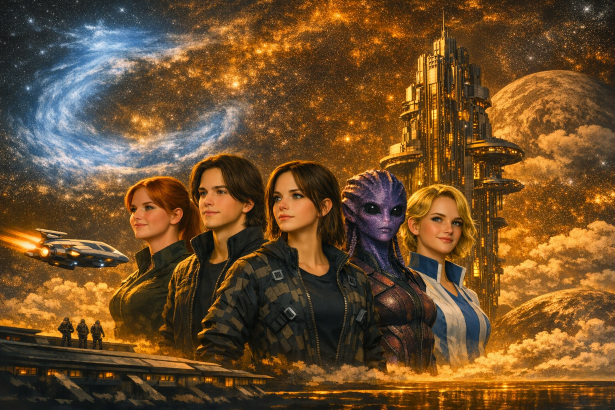
Prologue
For most of its history, humanity assumed the universe kept its secrets through distance. Light took time. Ships took longer. Even the boldest dreams of interstellar travel were framed as a patient project for future centuries, not a decision that could be taken, and completed, between one heartbeat and the next.
That assumption ended with Aurora, the Star Bright test craft built to prove a single, dangerous idea; that space could be treated less like an ocean to cross and more like a page to be turned.
The flight itself was planned. The surprise was who was watching.
The first jump was modest by later standards. Three hundred and fifty kilometres into Earth orbit in under a second. A few weeks later Aurora stepped beyond the Solar System, one hundred and fifty light years in three seconds, returning with its crew alive and its instruments calm, as if physics itself had simply agreed to new terms.
What humanity did not anticipate was that the universe had been measuring for that threshold for a very long time. Far from Earth, sensors built by minds older than human civilisation registered the signature of an interdimensional tunnel forming and collapsing, cleanly, repeatably, and with intent. A new species had acquired the one capability the Council could not afford to ignore.
The Reginaddes arrived soon after the first test, neither invaders nor benefactors, but envoys responding to a signal that meant history had shifted.
They chose their moment carefully, appearing at a global economic summit where the world's most powerful leaders were already in one room. Their message was delivered with calm precision and unmistakable gravity. Humanity was not alone and never had been. The inhabited galaxy was bound, imperfectly, tensely, but deliberately, by the Rohastin Council, an ancient institution that existed to stop interstellar capability from turning into interstellar extinction.
Humanity was invited to join. Not because the Council wanted another voice, but because the technology that had just appeared on the galactic stage forced a choice: either bring this new species into the framework of treaties and expectations, or leave it outside, unaccountable, misunderstood, and dangerously easy to misjudge.
There was a condition. The Rohastin Council did not recognise fractured authority. Membership required a single diplomatic voice, a single set of commitments, and a single point of accountability. Earth could take its seat among the stars only if it could speak as one.
The announcement cracked the world open in ways no war ever had. Governments scrambled. Markets reeled. Faiths re-examined their foundations. Ordinary lives continued, school runs, hospital shifts, late buses, under a new and unsettling fact; the sky was no longer empty, and Earth's future was now part of other peoples' politics.
While humanity argued about how to respond, another species watched with growing alarm. The Yvestigans carried their own histories, their own prophecies, and their own fear of what a sudden human ascent might mean. To them, Aurora's signature was not a curiosity. It was an omen. They acted in secret. Sabotage, covert interference, and attempted assassinations designed to slow the new species before it could settle into the wider galactic system. When the Yvestigans attempted to kill a human inside the Rohastin Council chamber they were expelled. Exile did not dissolve hostility. It only pushed it into quieter, darker places.
On Earth, Aurora's success rewrote assumptions faster than laws could follow. The Interdimensional Drive collapsed traditional distance. Defence strategies built around reaction time became theatre. Space agencies rewrote missions, industries went obsolete, and the old comfort of borders began to feel like a story people told themselves rather than a rule the world obeyed.
For the first time in history, nations voted not as rivals but as a species. The referendum was stark. Accept membership in the Rohastin Council and the obligations that came with it or retreat inward and attempt to navigate an interstellar future alone.
The answer was decisive. An Earth Government formed, not to erase nations or cultures, but to carry responsibilities that could no longer belong to any single state. Interstellar diplomacy, planetary defence, and regulation of technologies capable of reshaping civilisation became shared obligations. Humanity took its seat in the Council chamber, a young voice among ancient ones, and the balance of the region shifted.
For centuries, Council species had coexisted without truly intertwining. They met, traded, negotiated, and kept polite distance. Humans disrupted that equilibrium simply by insisting on contact that was more than transactional, by treating the Council not as a static treaty machine but as a living community that could evolve. To some, that was recklessness. To others, it was the first honest sign of hope in a long time.
Among the Council's oldest traditions were prophecies. For some, they held hope. For others, they held fear. The Yvestigans feared the prophecy about humanity's rise once they joined the council. Then there was the prophecy about someone who would save the human race by creating a ship capable of interstellar travel. Those two prophecies had come to pass.
There was a third prophecy. One that was still shrouded in mystery. The Trinity. The Oracle had said The Trinity wasn't about Earth but about the Rohastin. There were three titles involved. The Saviour, the Enabler and the Knot. Jennifer was the Knot, and her parents had the other two titles. Nobody apart from The Oracle knew what the Knot meant and he refused to say more.
Becky Head did not build the Interdimensional Drive because a prophecy required it. She built it because she could not accept a universe of locked doors. Ashleigh, the person who kept Becky from burning herself out, became the steadying presence that made Aurora possible to fly, and possible to survive. Their work became legend almost immediately, the kind of story that spreads through a civilisation because it offers both warning and promise.
Their daughter, Jennifer, grew up after the threshold had been crossed. Alien languages appeared alongside school subjects. Diplomatic visitors became familiar faces. The fact that humanity's future was braided with other species' futures was not philosophy. It was background noise. Yet Jennifer's life, in its daily details, remained stubbornly human. Friends, music, lessons, and the private determination to be known for who she was, not for what people expected her to become.
She knew the stories told about her family in careful, reverent tones. What she did not know was how quickly those stories would stop being history and start being instructions written in other people's fear.
The universe had noticed humanity because Aurora's tunnels announced a capability the Council had learned to respect. What came next would not be decided by prophecy alone, nor by the Council's caution, nor by old enemies pushed into exile. It would be decided by choices, human choices, made in a galaxy that was suddenly paying attention.
The cradle was behind them. The stars were no longer distant. And the first question of humanity's new era was not whether it could reach other worlds, but what kind of presence it would become once it did.
Expansion was not as quick, or as tidy, as the optimistic headlines predicted. EarthGov existed for two years before the first colony truly took root, and even that began as something closer to a proof of concept than a grand national plan.
Soon after the referendum, Star Bright built two exploratory craft to explore the regional star systems. Astronauts and scientists queued for early missions, mapping nearby unclaimed systems and identifying worlds that were, by sheer luck, already close enough to human biology to settle without terraforming. In the first six months, four such planets were found.
Grant Collins, the first Canadian trillionaire, turned that discovery into a dare that he would fund. He challenged the University of Toronto to design an expedition that could live on 18 Scorpii c for one week, safely and cleanly, and then leave without contaminating the world. The project drew in dozens of departments and produced the first practical standards for off world living, habitats, water, power, medical contingencies, and the uncompromising rule that no waste, human or otherwise, would be allowed to touch the planet.
Star Bright offered logistical support, moving hardware, maintaining a communications hub, making the impossible feel merely complicated. People who had dismissed the challenge as academic theatre realised, abruptly, that it was real.
The students succeeded. Nobody died, helped by the fact that the planet had a breathable atmosphere, accessible water, plant life, and a small ecology of native animals. But success has a habit of becoming permission. Once the week ended, other teams asked to go. Then other universities. Then other countries.
What began as a week-long field exercise grew into a rotating presence. A broken arm justified a medical team. A month became a season. A season became permanence. Someone brought their family. Others followed. Children appeared. A school opened, because even on a new world, life insists on continuing.
Infrastructure followed. A two-pad hopper control system became the first true permanent structure. When a satellite link to Earth-1 was requested, it was clear the settlement was not going away. Some suggested naming the planet after Collins, but he refused. The students had been the first to set foot there, and they deserved the honour. After a brief parade of terrible ideas, such as Earth Two and Dirt, the name the students had always used endured. The planet became Scorpion. The founding settlement became New Toronto.
With New Toronto, humanity became multi planetary and, more quietly, multi system. It was an insurance policy written in stone and routine. If Earth failed, the species would not vanish with it.
It was not like the old terrestrial age of exploration, where distance enforced separation and news took weeks to catch up. Scorpion might have been dozens of light years away, but a hopper could bring someone back to Earth in seconds. Messages carried a tiny delay, just under a second, enough to remind everyone that physics still existed, but not enough to feel like absence. Colonists remained connected to humanity even as they looked out across a vast, empty landscape and understood they were, in the most literal sense, alone.
Other changes arrived in quieter ways. In her second week as human ambassador to the Rohastin Council, Georgina Harries travelled to the Yvestigan home world with Vers'am, the Council's head. It took a week to secure the meeting, and another measure of courage to step into a place that had recently tried to turn a new species into a warning.
The Yvestigan leader greeted them without hostility. With Earth now a Council member, they said there would be no direct attacks on humans. They had failed to prevent humanity's admission, and nothing remained that could stop humans from becoming the Council's most powerful species. It sounded like a concession. It did not feel like peace.
Chapter 1
Jennifer looked out from the roof viewing area. It was her go to place when she wanted to take in the landscape and get away from everything. Not really her thinking place. She was always thinking about something. It was her place not to think. It was her place to dream and hope. At night, if it wasn't cloudy, the stars would appear, and she would look up, wondering which species roamed the ones she gazed at. It was one of the areas students had discovered, but the school had already made it safe, knowing that one day students might find it.
Sometimes she thought life had a plan. She knew that some regarded prophecies with the highest respect and would go out of their way to help ensure they happened; or to try and stop them. Her Ma and Mum had prophecies about them, and she knew she did too. It was why, when she was offered a place at the school on the Rohastin Station, she refused. She wanted a life without someone pointing out she was one of the Trinity.
Like all school children, she took the entrance exam for Hayfield Music School. When she was invited to sit the second exam, she got scared. She was surprised when she got a letter stating someone from the music school would come to her current school and interview her.
"Why don't you want to come to Hayfield?" Kirsty Turner asked.
"Sorry?" Jenny asked, surprised. She'd expected questions about her life, or what she did.
"The second test. Your answers weren't in keeping with the first test. It was like you were deliberately trying to avoid getting chosen. I'll ask the question again. Why don't you want to join Hayfield?"
Jenny shrugged, not knowing what to say. Kirsty waited, watching Jenny's body language.
"I just want an ordinary life." What she didn't say was she didn't want the expectations to follow her. She wanted to just be anonymous and to lead her life without that weight.
"Don't you like playing the French Horn and Piano?"
Jenny gave a small smile. "Yes, and I can still play them if I go to Hayfield or not."
"Touché," Kirsty muttered. "What you do after Hayfield is up to you. But at the end of the day, the choice is yours and your parents. If you don't want to go, then that is fine. I was just curious."
"There are only twelve places. I don't want to be selfish. If I went, someone else wouldn't."
"What if you look at it differently. I know your birth mother was a psychiatrist at Hayfield. I know your aunt and uncle went to Hayfield. Yet you are only looking at it from one perspective. What if by not going, someone else doesn't get the benefit of you being there?"
"Are you saying a study partner might need me?" Jenny asked, slightly intrigued at the idea.
"You do know the lingo. Study partners are a two-way street. Hayfield can be stressful for any student. Study partners need each other." Kirsty paused, letting that idea germinate. She then threw another unexpected change of direction. "I believe you're due your lunch. If you aren't interested, let me know after you've eaten. If you are, we can talk, and I can assess you properly to see if an offer can be made."
During lunch, she sat thinking, ignoring the other girls she often sat with. Kirsty had thrown her into a spin, and she wished Kelly was around. She'd have loved to have talked with her about it. Kelly was someone she could always talk to; but she'd moved away a year ago. Her dad got promoted and they now lived in London.
All her life her parents had let her make significant decisions herself. She'd been trusted to go with her Ma to meetings. Her Ma had given her the choice about extra help with lessons. Her Ma had let her listen in while the scientists developed Aurora. Now she was being asked to make another major choice.
She suddenly jerked around, making the two others at the table jump.
"Are you okay?" asked Patricia.
"Yes. I just realised that the choice isn't now. I've been thinking about it all wrong. Right now, it's 'Do I listen?'. I might not have to make the bigger choice, and I should worry about that later."
Patricia and Andrea glanced at each other. Jenny was such a great girl, but sometimes they didn't get her. "Yay. You seem happier."
"I am," Jenny said, and started to eat. "Thank you for putting up with me."
When she went back to see Kirsty, she was packing a sandwich container in her bag. "Come on in Jenny and shut the door. How was lunch?"
"As good as school lunches go, it was fine. How was yours?"
"Delicious. That was very polite of you to ask."
"When my Mum joined the project, she took me under her wing. Sometimes my Ma would work long hours, and Mum made sure I had what I needed. She taught me to how not to rush into something, and to consider the other person. For instance, with a visitor you should ask how they are. I found that hard, but it has become second nature. Well, most of the time."
"Did you learn more from your Ma or your Mum?"
"Different things from each of them," Jenny said after a moment's thought. "Social skills more from Mum. How to face fear and never giving up probably more from Ma. I always learnt a lot from others in the team. Some I've seen basically every day since Star Bright was created."
"You probably know more about Hayfield than a lot of the other children who would join. Things you shouldn't know."
"Probably not much. My aunt and uncle never talked about it. But even before I knew my aunt and uncle, I learnt that somethings shouldn't be discussed. I never discussed what my Ma was researching with anybody. Nobody at school knew about Aurora until my parents were kidnapped. Even my best friend didn't know until she was told."
"Hayfield has changed over the years. It isn't exactly the same school as when your aunt and uncle were there. If you did come to Hayfield, you would have to start from scratch. You won't get any help because they went there or because your mother worked there."
"All I really know is they came out playing instruments really well and can cook like a top chef. I hope that part hasn't changed."
Kirsty studied Jenny's face and posture. Either Jenny didn't know more about the school, or she was very shrewd in how she framed it to just mention the public face.
"I'd like to offer you a place at Hayfield Music School. If you accept, then your parents will be asked. Before you give your permission, I need to mention some school stipulations. The parents aren't told where the school is. You will live there until you finish. You wouldn't go home for school holidays."
Jenny steeled herself and took the plunge. "I'll accept on two stipulations. One, I will not discuss with you or any other school staff, including Dr Ruiz, what Star Bright does or any of its technologies. I'm aware that I should keep no secrets from my study partner, so I won't include them in my stipulation."
"And your second stipulation?"
"That I wish to be introduced as Jennifer, not Jenny."
"The secrets of Star Bright would never be discussed. You are going to the school. The school is interested in you getting the most out of the school, not some fishing exercise. You aren't the first pupil to go to Hayfield who has an interesting background. As for being called Jennifer, that is perfectly fine. I will mark that down as your preference. How you introduce yourself to those in your year is up to you."
"You're very good," Jennifer said, feeling slightly giddy at the decision. "We went from me not wanting to go, to deciding the opposite."
"You did that all by yourself. I just gave you the facts."
Jenny got a grip, and said sombrely, "I worry about my Ma. She lost a son and first wife. Now she is losing me."
"She isn't losing you. You are just going to school. You can still write to her and your Mum. And before you say it, I know it isn't the same."
Kirsty watched the young girl. Yet again she was thinking of others before herself. "Think back over the years. How much leeway have your parents given you to make your own decisions. Your first paper indicated it was a lot higher than most parents."
Jenny thought and then nodded. It was true. Her parents sometimes pointed out why something was bad, but the choice was always hers.
* * *
"I thought you'd be up here," Theo said. He sidled up next to her, and they put their arms around each other. "It's a big day."
"I was just thinking about when I had my interview for coming here," Jennifer said. "I can't believe we've been here six years."
"I remember that day, meeting you as I was collected by Kirsty to come to the school. I was shell shocked and you looked so confident. You'd done so much before joining the school, you didn't seem phased."
"And six years later, you wouldn't be," Jennifer reassured. "At least the weather is nice to sit here. We've officially finished and just waiting to leave. For the first time in a long time, we have nothing to do."
"I know. It seems ... strange. I've said goodbye to the ones I could find. A lot were readying for The Leaving."
"Ever since the school got the new mini hoppers, it's become so different. My uncle mentioned about The Leaving once. His took two hours. Now they arrive at the destination in seconds."
"We better get changed," Theo said, getting up. He held out his hand which Jennifer took and pulled her up. "Did you know that before the hoppers, they used to change out of school clothes at their destination?"
"Even The Leaving is impacted by Star Bright technology."
Theo's mop of dark brown tousled hair and startled look were what Jennifer remembered about her first sight of him. His early days when he'd not grown into himself. Now he was tall, slender, and well-toned. His hair was swept to one side in a neat and very sophisticated look. It was still longer than a traditional male style, but that helped with school trips.
As they went down the stairs to the sleeping wing, Theo wondered what Becky and Ashleigh were like. He'd seen them on the television once or twice. They seemed to be private people who didn't like the limelight. He remembered some of the early 21st century technical entrepreneurs who seemed to get a thrill out of being interviewed. If they were anything like Jennifer, they would be wonderful people.
"Have you two been on the roof again?" Hope said as they made their way down the corridor.
"Guilty as charged," Theo laughed.
Jennifer stopped and looked at Hope. "Don't tell me you haven't been thinking about what you'll miss from school?"
"There is too many good memories here to even think about," Hope said. "But life moves on. The four of us have an adventure ahead of us. We've been trained for a different type of task than your aunt and uncle were."
Jennifer nodded. "A new world, a new hope and new dangers. Come on Theo. Let's get changed. We don't want to hold up proceedings."
He laughed. "We've time, but yeah."
They slipped into their rooms. On top of their shared bed were the clothes they were going to wear. Their leaving outfits. The last school photographs, taken as they left, would be forever immortalised in these clothes. It was clothes they would wear for such a short time as they didn't want to reveal where they were going."
"Do you regret not going the university route?" Theo asked, as he undressed.
"No. We've already got a degree. There is time for other things later, but I think the training we will get next is going to be more important."
She glanced shyly at him, and he stopped and came across to her, putting his arms around her waist and cuddling her. Her back to his front. His arms across her belly. Leaning her head back their cheeks touched before he turned his head to kiss her.
Eventually they broke apart and they finished getting changed. Even putting on different underwear. What was worn at the school stayed at the school. It was an old rule, but one still observed.
"I remember when my cousin got married. She had a special going away outfit," Theo said. "It's kind of like that."
"Do I look okay?" Jennifer asked, giving a small spin.
"You look perfect, as always."
She blushed and checked in the mirror that her commitment brooch was straight. Some ex-pupils would wear them for the rest of their lives. Jennifer knew she would rarely get the opportunity after today. It was too much of an identifier. It wouldn't lead back to the school, but it was unusual enough that people might remember her by.
Jennifer was still feeling introspective. "We've changed so much."
"I've hardly changed," Theo laughed. "You don't squeal as much."
"I've never squealed much," Jennifer complained.
"Jen. The first day you got here, we went down to our year room to meet the others, and you gave the almightiest squeal I've ever heard."
"Yeah, but I'd just seen Kelly; my bestist friend who I'd not seen for a year. I thought I wouldn't get to see her again until I left here. And before you say it, I know bestist isn't a word, but it should be. Language evolves."
Theo laughed. It was a carefree laugh. Seeing her so earnest reminded him that she might be six years older, she was still the same person. She had grown. The school had taught them both so much, but at the end of it, she was still her. Just as Kirsty had said in one of their early sessions. The school doesn't change the core person. It doesn't change what they stand for.
There was a knock on the door, and Jennifer rushed to open it. It was her room. Theo's room was through a connecting door, but it hadn't been used apart from storing clothes for three years.
It was Kirsty, their designated support psychiatrist. "I just need to check that you've changed out of all your school clothes."
"The only things we're wearing are our brooches. You mentioned we could still wear them."
"Of course. They are unique to the two of you. I've checked Kelly and Hope. You should also take your Rohastin Station device. You will need that if you ever return to there. Why don't you meet with the rest of your year in the entrance hall."
"Thanks for everything," Jennifer said, and with a sudden urge gave her a hug. "I'm sorry Charlotte wasn't here to say goodbye. I hope her first foster mum is okay. I'd have never had been as fit as I am if it wasn't for her. Though I still don't get her love for rugby."
Kirsty laughed. "I know what you mean. I'll pass on your words. It's been an interesting six years. I still remember our first non-human concert at the Rohastin Station. Our first outreach concert rather than for any other reason."
Theo laughed. "I don't think that one will ever be surpassed. I knew you had connections there, but an ambassador's grandchild hugging you like that."
Jennifer blushed. "I think we should get downstairs to meet the others before you reminisce about the other four concerts on alien home worlds."
"Spoil sport," Theo said, his eyes twinkling.
Kirsty opened their bedroom door and ushered them out.
The entrance hall was mostly plain. The only major thing in it was a large painting of the only pupil who'd died at Hayfield. Eugene had died at the previous school location, but the occasion of his death was still marked and carried through to the new building with respect and honour. The school was such a close-knit community, the thought of any of them dying would be devastating.
When she'd heard the story soon after joining the school, Jennifer knew her birth mother had tried to save him. She sobbed, and nothing anybody could say would calm her tears. Only Rachel Ruiz, the current school head, had understood and Theo hovered in bewilderment as Rachel took Jennifer to her office. When Jennifer had calmed down, Rachel gave a single instruction. To tell Theo. It was the first secret that Jennifer had told him. It was only the following year, on the anniversary of Eugene's death that she felt able to tell Kelly.
"We're ready," Rachel Ruiz said, coming into the school entrance. "If you'll make your way outside. Duncan is standing by."
Duncan was the new head pupil. He had a big job following on from Kelly, but Jennifer had no doubt he would make the position unique to him, just as Kelly had done things slightly differently from the joint heads of Jacob and Sebastian.
"Good luck to you all," said Hope as they started to make their way to the door. "I love you all."
That stopped them all and they were all hugging each other. Six years of friendship. Six years learning all about themselves. Six years of support and love. Knowing they weren't going to see each other tomorrow was a jolt. It was the end of their time together. They would stay in touch, like they were still in touch with those that had left the year before and the year before that. It just would never be the same again.
Jennifer and Kelly hugged. Kelly whispered, "See you tomorrow at nine in the morning."
"See you then," Jennifer whispered back.
"Let's do this," Kelly said to the whole year.
And together they made their way out into the May sunshine. At least the weather had held. The last two Leavings had been wet, and it really didn't work as well doing the ceremony inside and then dashing to the vehicles.
"Today is their Leaving," Duncan called as they made their way out. "Today we wish them well. We don't do this in sadness, though we are sorry you are going. But in joy that you have learnt. You are ready to face the world. A world changed and a world still changing. The challenges of today won't be the challenges of tomorrow. But Hayfield has given you the tools to not just face the challenges yourself, but to help others face them too."
"They have our stamp of approval," called out Hillary, the head of year three and there was the sound of the pupils stamping their feet against the gravel.
Tears came to Jennifer's eyes. She remembered stamping her feet the previous years. The heartbreak of seeing friends leave. Now she was leaving herself and it felt different than she thought. She was pleased she was leaving. You never stay at school forever. They would understand when it was their turn.
They all waved and made their way towards the small hoppers. They would program in their destination and go. Once they got off at the other end, the pods would return, the location where they'd gone a secret.
The house was one of the London redevelopment projects that had taken place over the last five years. Since commutes were so quick, people decided they didn't want to live in the centre of the capital anymore. They wanted to live somewhere nicer. Somewhere with space for families. A garden community which might be somewhere warmer. It was just as quick to commute from France, Spain, or the Bahamas than it was from within England. Some said that life was cyclical. What was once in fashion would become fashionable sometime later. The regeneration meant apartment blocks and old small terrace houses were demolished. Nobody wanted to live in them, and hundreds were abandoned. Replacing them were houses like elsewhere in the country. The population of Greater London was the lowest in over a century, but the quality of life was the highest it had ever been.
It wasn't their first time in the house. They'd been several times over the preceding two months to furnish it and get some clothes. It wasn't their forever home, but they knew it wasn't going to be somewhere they were very often. Their job was elsewhere. This was somewhere safe. Somewhere they could be themselves. A place they could play their instruments and repair their souls.
It was early afternoon when they got there, and Theo had carried her over the threshold. It was rather symbolic, as they'd been in the house several times. But this was different. They weren't awaiting deliveries of furniture or hanging clothes in the wardrobe. This was their home. This is where they could eat when they wanted and go to bed when they wanted. Their life was no longer restricted by school rules.
"I think we should get some food in," Theo suddenly blurted.
Jennifer looked across and saw he was nervous. She wondered if he'd been thinking about the lack of school rules. "That sounds a good plan. Shall we get a bite to eat on the way? I fancy a jam doughnut."
It was two hours before they got back, their arms not carrying that much food. They would be spending the night but tomorrow they would be on training. It might be a few months before they were back. Any milk left in the fridge would certainly not be drinkable when they returned.
When things were stored, Jennifer put her arms around Theo. "What's wrong? You seem lost."
He turned and looked at her. "I am a bit. I've grown up always surrounded by rules. I didn't have the freedom you had before Hayfield. Even though there weren't many rules, there was structure. I think I'm more bewildered than anything else; unsure what we can and can't do."
"What do you want to do?"
He gave a small smile which she recognised. She gave a returning grin. "I think that's a great idea."
She rushed and closed the curtains in the living room. "The bedroom is too far."
That didn't just break any remaining thoughts of the old school rules. It smashed them into tiny bits.
"So, this is freedom," Theo whispered to her later. "I think I can live with that."
If you liked this post, you can leave a comment and/or a kudos!
Click the Thumbs Up! button below to leave the author a kudos:
And please, remember to comment, too! Thanks.

Comments
Yea, another interstellar drive story,
I can't wait to see what Jennifer gets up to and what being "the knot" means.
Hugs
Patricia
Happiness is being all dressed up and HAVING some place to go.
Semper in femineo gerunt
Ich bin ein femininer Mann
Aptly put.
We all need "A place they could play their instruments and repair their souls."
a long time
hard to believe this all started 22 years ago with a strange attraction to concrete cows you have took us on a wonderful journey. thank you for bringing us along and sharing your wonderful talent with us.
The Saga Continues
Aurora's crew and children are becoming citizens of the interstellar society. I can't wait to see how Jennifer fits in.