
Author:
Audience Rating:
Publication:
Genre:
Character Age:
TG Elements:
TG Themes:
Permission:

Chapter Eight: Dressing the Part
When I returned to my job, everything seemed almost unchanged—except for one small, significant detail: a miniature Kitsura-Kai mask now dangled from my bag like a keychain, its lacquered surface occasionally catching the light as I walked. I slipped easily back into my usual routine, stepping onto the shop floor with practiced confidence. My performances—those moments everyone anticipated—were met with eager eyes and outstretched phones. I smiled and posed for photos, leaning into my role with even greater enthusiasm than before. There was a new energy in the way I flicked my fox ears and swished my tail, emphasizing the playful persona my fans had come to expect. Each gesture felt deliberate, a little brighter, as if I was both selling the fantasy and hiding behind it at the same time. All the while, the little mask swung from my bag, a silent reminder that everything was the same, and yet not quite.
Part of my job—maybe the most important part—was giving my fans what they wanted. That meant not just smiling for photos, but actively seeking out the regulars and newcomers who came to the shop hoping for a selfie. I had learned the art of posing with just the right tilt of my head or flick of my ears, making each snapshot feel special, as if it were a secret shared just between the two of us. The line for photos sometimes curled around the display cases, drawing curious onlookers who often ended up making a purchase themselves. In a way, my role was more than just a performer—I was a living advertisement, drawing people in, keeping the energy high, and ensuring there was always a crowd around the register. Every selfie, every laugh, every playful pose was another reason for customers to come back, another moment that kept the store bustling.
The draw I had with my fans was undeniable. Word spread quickly whenever I was working, and soon enough, I found myself at the center of small crowds in the shopping district, my presence pulling people in like a magnet. Groups of friends and solo visitors alike would seek me out, eager for a selfie or just a chance to watch me perform. My regulars—some of whom had been following me since my earliest days—brought their friends, who then became fans themselves. Sometimes, the flow of people even spilled out onto the street, drawing the attention of passersby and leading them right into the store.
I made it my mission to ensure every interaction felt special. I smiled, danced, and posed with exaggerated flair, my fox ears tilted just so and my tail swishing in perfect time. I handed out fox gear—plush ears, fluffy tails, little charms—making recommendations with practiced enthusiasm. For many, it wasn’t just about the merchandise. It was the experience: the laughter, the photos, the sense of being part of a cheerful, slightly magical world I created for them, if only for a few moments. In that way, I didn’t just bring traffic to the store—I brought life to the whole district.
Most people who noticed the miniature fox mask dangling from my bag simply assumed it was a cute trinket—a thoughtful gift from a fan, maybe, or a limited-edition collectible picked up at a street market. To the casual observer, it was just another accessory, blending in with the playful aesthetic I was known for. Customers occasionally complimented it, some even asking where they could get one for themselves. Nobody thought to question why I wore it, or what it might mean.
But for those in the know, the effect was instant and unmistakable. Members of the Kitsura-kai recognized the mask immediately. Their reactions were subtle—a flicker of recognition, a slight nod, a glance exchanged in passing. There was a quiet respect in the way they acknowledged me, a silent understanding that I was now marked as one of their own. Sometimes, a member would linger a little longer in the shop, or offer me a greeting that felt loaded with double meaning. It wasn’t ostentatious or dramatic, but it was enough to make me aware that the mask was more than decoration; it was a signal, seen and understood only by those who belonged.
I caught their reactions occasionally—a slight nod from across the room, a knowing glance as we passed in the busy aisles, a subtle gesture that could be mistaken for nothing at all. Most of my interactions with Kitsura-kai members were casual and nonchalant, blending seamlessly into the everyday rhythm of the shop. Sometimes, it was just a brief exchange, a shared look that said more than words ever could.
But there were moments when the routine cracked, just for a second. Every so often, one of them would pause near the register or linger by the display shelves, their tone dropping as they quietly delivered a message meant only for me. It might be a warning, an update, or simply a reminder that I was being watched—protected, maybe, or at least included. Just as often, I found myself passing along little bits of information as well: how the store was doing, if anything unusual had happened, which faces were new or which customers asked too many questions. Our conversations were always wrapped in layers of normalcy, spoken in code beneath the surface of small talk.
We never acknowledged what we were really doing, not openly and never in public. But the understanding hung between us, as tangible as the fox mask that marked my affiliation. It was enough.
The Boss had kept her word, orchestrating everything so that my life remained as normal as possible. She seemed to understand exactly what I needed—space to breathe, to perform, to keep up the routines that made me feel like myself. Whenever the syndicate needed something from me, it was always handled with subtlety. Messages were delivered discreetly, never in a way that would draw attention or cause a scene. If someone lingered too long or pressed for information, they were quietly redirected. Kitsura-kai members who came by the shop knew not to interfere with my work, and if I looked busy or overwhelmed, they respected my boundaries.
It was as if invisible hands were smoothing the edges of my days, making sure nothing from the syndicate spilled over into the parts of my life I wanted to keep untouched. I never found strangers waiting outside my door or shadowy figures interrupting my commute. Even the rare requests for information were slipped to me so seamlessly that most customers would never have guessed anything unusual was happening at all.
The gala was now only three days away, and anticipation had become a constant, restless companion. Every spare moment, my mind drifted to what was coming—rehearsing conversations, imagining every possible outcome, and feeling my pulse quicken with both hope and dread. There was Princess Yuki: the singular figure I must win over, the one whose favor could change everything for me. But the Imperial family would be there as well, their presence a reminder of how immense the stakes really were. I couldn’t help but wonder what they would do to someone like me if I failed—if they sensed even the slightest misstep. This invitation could be the greatest opportunity of my life, opening doors I’d never dared dream about. Or it could turn into a complete disaster, a public humiliation or something darker that would follow me long after the night ended.
Yet, beneath those fears, there was a flicker of excitement. I found myself almost giddy, wanting to believe in the best possible outcome. Maybe I could make something unforgettable happen. Maybe I could truly belong in that glittering world, if only for one night.
And then there was my outfit—especially my outfit. The thought consumed me. It had to be perfect, down to the smallest detail. In a sea of elegance and tradition, my look would be my statement, my shield, my way of telling the room I belonged. I obsessed over every fabric, every accessory, the colors, shapes, and textures that might catch a royal eye. I knew that if I wanted to have any chance at all, I needed to step into that ballroom and make everyone stop and stare. My future, my safety, my dreams—all of it seemed to rest on a single, shimmering thread: what I would wear.
After work, I perched cross-legged on my bed in my tiny pod apartment, a heap of digital and paper fashion catalogs spread out before me. The soft glow of my tablet illuminated designs both extravagant and simple as I scrolled, looking for the perfect inspiration. My tail lazily swayed behind me, occasionally brushing against the wall as I lost myself in the endless parade of silk, lace, and pastel hues. Sometimes I would stop, tapping a look that caught my eye, then flip back and forth between options as if the right answer might suddenly leap from the screen.
My apartment was little more than a capsule: barely wider than the bed itself, with a built-in storage compartment at my feet and a narrow wall display where I kept a few cherished trinkets—photos, a couple of plushies, and the fox mask that had begun to feel like both a blessing and a burden. The space was spare, just enough room for me to sit, stretch out, and, if I was careful, twirl in front of the mirror with an armful of fabric samples. Every sound was muffled by the thick walls, and the gentle hum of the building outside faded into the background, leaving me in a cozy cocoon of solitude.
That was the entire apartment: bed, storage, display. It should have felt claustrophobic, but somehow, I didn’t mind. The pod felt safe, like a little burrow tucked away from the city’s chaos. Most of my life happened elsewhere anyway—at work, in the crowded shopping district, or in the swirl of syndicate errands. Here, I could breathe, dream, and imagine myself stepping into a world far grander than these four walls could contain.
My ears twitched, each movement betraying the excitement fluttering in my chest as I continued browsing. The anticipation of the gala and the possibilities ahead seemed to ripple through my body, making my tail curl and uncurl behind me in restless, eager waves. As I imagined stepping into the glittering ballroom, all eyes turning my way, I could almost feel my ears perking up in delight and pride. Just picturing the moment I’d stand before Princess Yuki, dressed in something magical, sent a shiver down my spine—my tail swaying faster, betraying my secret hope that she would notice me. Even the thought of being seen, admired, and remembered in those clothes made my ears flush with heat and my tail wag with unrestrained longing. The desire to be noticed, to be chosen, was written all over me, in every flick of an ear and sweep of my tail.
ASHA, with its quiet efficiency, had been steadily shaping my decisions all evening—sorting through thousands of images, parsing social trends, analyzing event photographs, and cross-referencing every public appearance of the Imperial family with a precision that left me awed. Its suggestions weren’t just practical; they seemed to know exactly what would make my heart race. Every so often, ASHA would highlight a color, a silhouette, or a little detail, and I’d feel a jolt of interest—a gentle nudge steering my desires. When my attention drifted, it would bring me back with a subtle prompt: a pop-up of the princess’s previous favorites, a flash of trending accessories, or a reminder of the gala’s theme.
Eventually, one particular concept emerged from the sea of possibilities—a dress that was the perfect fusion of tradition and whimsy, one that made me envision myself stepping into that dazzling ballroom with confidence. I stopped scrolling, mesmerized. A slow smile spread across my face, and I felt my ears perk up with delight, the anticipation almost too much to contain.
My tail started wagging, first hesitantly and then with open joy, the excitement spilling over as I realized I had finally found the one. It was perfect—everything I had hoped for and more. I could already picture myself in it, standing before the princess, all eyes drawn to the outfit ASHA had helped me discover. For a moment, pure, unfiltered happiness washed over me, and every inch of me—ears, tail, and heart—rejoiced as if I had already stepped onto the gala’s shining floor.
I began to build the look piece by piece, determined to honor tradition while making every detail unmistakably mine. The centerpiece was a luminous cotton-candy pink furisode-style kimono, its silk glowing softly in the light. The long, flowing sleeves and lower hem faded into a baby-blue gradient, making the whole garment look like dawn breaking over a pastel sky. Elegant Japanese motifs—sakura blossoms, drifting petals, clouds, flowing water, and tiny folding fans—were embroidered across the silk in soft pinks, blues, ivory, and restrained metallic gold, with tiny hearts and stars hidden among the patterns, visible only to those who looked closely.
At the neckline, I kept to the traditional layered look: a crisp white inner collar, then alternating slivers of baby blue and pink edged with delicate gold embroidery. I resisted the urge to add lace here; it needed to look regal enough for royalty. Instead, the Kawaii elements emerged in the textiles and accessories. My own fox ears—naturally pink with blue tips—stood tall and proud, perfectly framed by my long black hair, which I would wear partially up, the rest flowing down my back. Gold kanzashi hairpins, tiny pink sakura blossoms, blue silk ribbons, pearls, and a few dangling ornaments would frame the base of my ears, letting them shine as a centerpiece of the entire look.
The obi would be the showstopper: a wide baby-blue brocade band patterned with pink sakura and fine gold clouds, tied into an elaborate formal bow at my back with decorative folds cascading down. A cotton-candy-pink obijime cord would wrap around the center, secured by a heart-shaped gold-and-pink obidome, while pearl strands, gold chains, sakura charms, and tiny heart ornaments hung from the bow and danced with every step.
My pink-and-blue fox tail would remain completely visible, the back of the kimono subtly divided and draped around its base, as if the garment had been designed for me from the start. The layered ruffles hidden beneath the hem—pink lace and blue chiffon—would flash with every step, and the whole ensemble would move like a dream. My shoes would echo the kimono’s theme: formal platform zōri with glossy baby-blue uppers, cotton-candy-pink hanao straps, gold edging, and tiny sakura decorations, set off by white tabi socks embroidered with pink blossoms.
In my hand, I’d carry a small sensu folding fan painted with pink sakura against a pale-blue sky, gold detailing and a pink tassel adding the final touch. Every element, from the tiny hidden hearts to the pastel charms and bows, was coordinated to match my ears and tail. From a distance, I’d look like a vision of Japanese elegance fit for royalty; up close, the playful Kawaii details would tell the world exactly who I was.
By the time I finished, the look radiated a playful charm and delicate elegance that felt utterly, undeniably me.
As I pictured my own ensemble coming together, I couldn’t help but imagine what the other guests at the gala would be wearing. Most would step into the ballroom draped in expensive formalwear—deep jewel-toned gowns, sharply tailored suits, or ceremonial garments that spoke of old bloodlines and political alliances. Their fashion would be calculated, each detail a subtle signal of status or a maneuver in the endless chess game of court life. Even the traditionalists would choose understated elegance, with every element designed to impress the Imperial family with dignity and restraint.
Yet, as I scrolled through imagined scenes in my mind, I realized how few would dare to embrace the softer side of our culture—the Kawaii that was so close to my heart. To most, it would seem too childish, too unserious for a royal occasion. They would try to dazzle Princess Yuki with their seriousness, their poise, their power. But I doubted she wanted to be dazzled by another would-be rival or unapproachable dignitary.
No, all the rumors and stories whispered among those who watched her closely said the princess wanted something different. She wanted someone sweet, approachable, and cute—someone who looked as if they belonged in a fairy tale, someone soft and gentle, someone who might seem in need of a protector. I realized, as I looked at my own reflection, that my best chance would not be in outshining the others’ grandeur, but in embodying the very softness and vulnerability the princess secretly craved. My Kawaii, my openness, and my willingness to be seen as someone who longed for connection could be exactly what made me stand out.
So for this night, I would fully surrender to that vision—becoming the most outrageously Kawaii version of myself imaginable, every pastel bow and sweet flourish a silent invitation for the princess to notice me.
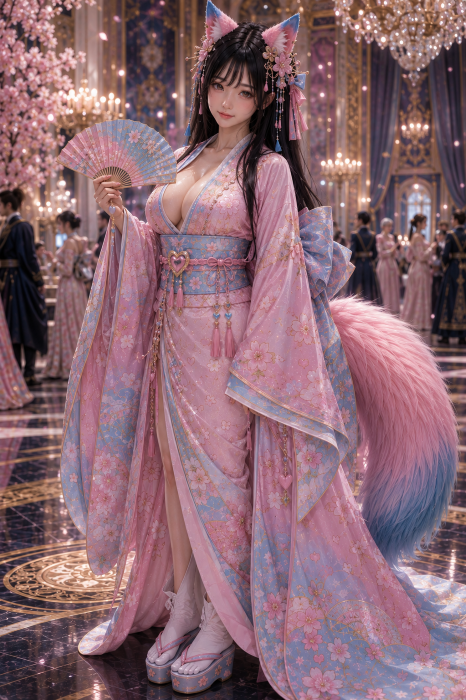
I leaned back against the wall of my pod apartment and looked at the completed design projected above my bed.
For several seconds, I simply stared at the finished design, utterly transfixed by the vision of myself in those luminous pinks and blues, the delicate embroidery, the elaborate bow, and the playful fox motifs. My tail began wagging uncontrollably, thumping against the mattress in pure, unfiltered anticipation. I could already imagine the silk swishing around my legs, the glint of gold and pearls, the way the whole ensemble would shimmer under the ballroom lights.
A rush of longing washed over me—sudden, electric, and almost overwhelming. I realized I didn’t just want to wear this outfit; I couldn’t wait to be seen in it. I wanted to step into that grand hall, every eye drawn to the person I’d become. I wanted to be admired, complimented, and, most of all, noticed by Princess Yuki. The thought of her gaze lingering, even for a moment, because of the outfit I’d poured so much heart into, sent shivers through my ears and along my tail.
And as I sat there, the truth hit me with a quiet, giddy force: I was falling in love with being Airi—falling in love with the way this version of myself could shine. The more I gave into that feeling, the more right it felt. I covered my face with both hands, embarrassment and excitement tangling together in my chest.
"This is getting dangerous," I whispered, my ears flicking in delighted alarm.
As I gazed at my reflection, I realized I wanted something more than to simply look pretty or fashionable. I didn’t want to come off as a model playing dress-up, striking poses for attention. I wanted to evoke something deeper—a sense of magic and reverence that would remind people of the Fox Goddess herself, Inari Okami. In Amahara, foxes held a special place in the collective imagination. They weren’t just cute animals for marketing or mascots for plush toys; they were messengers of the divine, shapeshifters, guardians, and tricksters woven through centuries of myth. They were symbols of good fortune, cleverness, and sometimes danger. Entire shrines were dedicated to them, and entire clans, like the Kitsura-kai, traced their identities to the ancient legends of the Fox Goddess.
For the gala, I wanted my presence to echo that heritage. I wanted the other guests to see not just a girl in pastel silks, but a living story—someone who could have stepped straight out of a fairytale scroll or an old shrine painting. A single-tailed kitsune, elegant and otherworldly, whose every movement suggested something sacred and enchanting beneath the softness. The thought made me smile, infusing my confidence with a quiet, mythic power.
There was a certain delicious irony to the whole situation. Here I was—a Virexian spy, trained for subterfuge and infiltration—preparing to step into a role that would make me a living symbol, as captivating and iconic as the Fox Goddess herself. In a city that revered foxes as both myth and legacy, I had somehow become one of its most convincing kitsune-themed girls, beloved by fans and noticed by powerful clans alike. The very thing I was supposed to be hiding behind—ears, tail, a carefully crafted persona—had turned into a myth all its own, one that people whispered about and chased through the shopping district for a glimpse or a photograph.
A small window appeared in my vision, ASHA’s interface overlaying the world with clinical precision. It began to list the personality traits it intended to reinforce for this mission:
Behavioral Modeling Simulation
Target Personality Traits:- Demure
- Shy- Soft-spoken
- Polite- Easily flustered
- Dependent presentation- Non-threatening
At the bottom, a confidence bar glowed in soft blue: Probability of successful adoption: 97.3%.
The numbers didn’t lie—ASHA had mapped my behavioral patterns, predicted the outcome, and all but guaranteed I could become the perfect image of what the gala demanded. And yet, what unsettled me wasn’t ASHA’s competence, or even its cold efficiency. It was the ease with which it showed me just how much it could change me, how quickly the person I thought I was could be realigned for a new role. In less than a week, it had already started rewriting little pieces of me, swapping out reactions, smoothing over instincts, making it feel so natural that I sometimes forgot I hadn’t always been this way. It was as if the line between who I performed and who I truly was could be erased by the right algorithm—and that, more than any Imperial threat, was what sent a chill up my spine.
I immediately closed the window. "That's not helping."
ASHA did not respond. The silence somehow felt smug.
I focused on the mirror, experimenting with the pose I would use the very first time Princess Yuki looked my way. Straightening my posture to a perfect line, I then softened every part of myself—shoulders gently sloping, hands folded just so, my tail curling forward as if in bashful anticipation. Lowering my gaze, I rehearsed exactly how I would let my eyes flicker up through my lashes, each movement slow and hesitant, as if I was hoping, almost pleading, to be noticed by her.
It was a look meant to entice, but not in the way of a confident model or a practiced performer. There was a vulnerability to it, a carefully crafted innocence that would tug at any protective urge. When I tried it in the mirror, even I felt a flutter of excitement—an odd, secret thrill at how convincing the effect was. I could picture it: Princess Yuki catching my eye from across the grand hall, drawn in by that single, delicate glance.
The realization sent a little shiver through me. This look would definitely work—perhaps too well. I groaned, only half in jest, my ears flicking in self-conscious warning. “That probably works way too well,” I admitted to my reflection, the weight of anticipation and danger swirling together in my chest
As I stood there, still holding that carefully practiced pose, a memory of the Boss’s words echoed in my mind. She had been so certain—her voice cool, confident, and just a little amused—as she outlined exactly what would draw Princess Yuki’s eye. “Softness,” she’d said. “Vulnerability. Give her someone to protect, not another rival. She’ll come to you.” The advice had sounded almost too easy, but now, seeing the effect in the mirror, I realized just how right she might be.
Still, beneath my confidence, a knot of anxiety tightened in my chest. What if the Boss’s intel was wrong? What if the princess wanted something entirely different—someone bold, someone untouchable? I could play this role to perfection; I could make myself the picture of approachable cuteness, but if I’d misunderstood the target, everything would fall apart. I’d be left standing in a room full of strangers, my carefully curated image meaning nothing at all.
I took a shaky breath, forcing my tail to still. All I could do now was trust in the Boss’s experience—and in my own ability to pull this off. I just had to hope her information was as good as she claimed, and that when the moment came, Princess Yuki would see me, really see me, and want to draw closer.
I continued to practice in front of the mirror, cycling through a series of looks and expressions, shifting my posture and experimenting with the subtlest changes in body language. Each time, I would tilt my head a little differently, let my ears angle in just the right way, or let my tail curl and unfurl, searching for that perfect, inviting softness. Sometimes I’d part my lips as if caught between a question and a secret; sometimes I’d blink slowly, lowering my gaze before peeking up, a hint of nervous hopefulness in my eyes.
ASHA worked alongside me, its presence quiet but persistent. When I hesitated, or my movements became too practiced, a gentle prompt would appear in the corner of my vision—Lower your chin 2%. Soften shoulders. Hold gaze for 1.5 seconds, then look away. The AI’s corrections were minute, almost imperceptible, but each one nudged me closer to the ideal. My expressions grew more natural, my body language more inviting and less guarded. Even my breathing slowed, syncing unconsciously to the rhythm ASHA suggested.
With every adjustment, I felt myself slipping deeper into the role, my own nerves dissolving into a kind of serene confidence. The person in the mirror became softer, sweeter, someone who not only fit the Boss’s vision but also seemed, in that moment, to belong at Princess Yuki’s side. And with ASHA refining every gesture and glance, I began to believe—just a little—that I could become exactly what I needed to be.
As evening deepened, I shifted my practice from facial expressions to the art of movement itself. I imagined the weight of the furisode kimono—the luxurious silk, the long, trailing sleeves, the constriction of the tightly wrapped obi around my waist. My steps would need to be shorter, more deliberate, and my gestures carefully measured. Even a simple turn or bow could become a statement if I did it right.
I started by gliding across the narrow length of my apartment, keeping my arms close, letting imaginary sleeves brush just above the floor. I made sure my posture remained upright and ladylike, my chin slightly tucked, my hands folded or fingertips pressing gently together. Each movement was soft, almost floating, radiating the same cute, demure energy I’d practiced in the mirror. But beneath that surface, I let my hips sway ever so slightly with each step, a secret rhythm that added a layer of subtle allure.
ASHA’s prompts guided me—reminding me to keep my feet nearly together, to pivot gracefully, to let my tail move in time with my hips, creating a mesmerizing effect. I practiced turning, bowing, and even sitting, all while maintaining the air of innocence and approachability that would draw the princess in. But as I walked, I felt the gentle swing of my hips, the way my tail followed, hinting at something playful and mysterious beneath the surface.
I realized that, with enough repetition, every motion could become a perfect balance of cuteness and quiet seduction—even bound by the elegant constraints of tradition. By the time I finished, I was flushed with anticipation, utterly convinced that when the night of the gala arrived, I would not just look the part, but move through the room like a living invitation—equal parts fairy tale and secret temptation.
I returned to the mirror, catching my breath and smoothing a stray strand of hair behind my ear. With a quiet word, I activated the projection system; the outfit I’d so painstakingly designed shimmered into being beside my reflection, a translucent vision in cotton-candy pink and baby blue. It floated just off my shoulder, sleeves billowing softly, the gold embroidery sparkling in the low light of my pod apartment. For a moment, I simply stared, transfixed by the delicate beauty of it and by the image I was about to become.
The effect was uncanny. Standing there, I no longer looked like a Virexian spy at all. Instead, I looked like a character who had stepped right out of one of those romance novels I loved to read late at night—an innocent heroine waiting for her story to begin, someone destined to be swept up in court intrigue and soft, stolen glances across a ballroom. My tail curled forward, almost protectively, and my ears twitched in a mix of excitement and disbelief.
There was a softness to my entire presence, a harmlessness that felt almost disarming. In the gentle light, with the projected kimono’s pastel hues glowing around me, I looked approachable, sweet, and utterly nonthreatening—exactly what I was going for. No one would ever suspect a spy behind that demure smile or in the shy tilt of my head. For the first time, I truly saw how convincing this disguise could be. I wasn’t just hiding in plain sight; I had become the sort of girl people wanted to protect, not question.
A small, secret thrill ran through me. If my aim was to disappear into the role, to be overlooked as a danger and seen only as someone to be cherished, then I was already halfway to victory.
Instinctively, I reached up and let my fingers graze the soft fur of my fox ears. The sensation was so vivid it startled me—a gentle tickle that started where my touch lingered, right at the base of the ear, and rippled all the way down the delicate inner curve. I shivered involuntarily, a pleasant thrill running down the back of my neck and along my spine. The fur was silky, impossibly plush, and the simple act of stroking it sent a cascade of tingles through my body.
I closed my eyes for a moment, savoring the feeling. Each small movement of my fingertips produced a new wave of sensation, making my tail flick behind me in response. It was a peculiar kind of comfort, a reminder of just how real this body was—how much I had come to inhabit it, down to the smallest, most sensitive detail. The ticklish shiver lingered even as I lowered my hand, and I smiled softly at my reflection, knowing that every part of the performance—every gesture, every touch—was becoming second nature.
If you liked this post, you can leave a comment and/or a kudos!
Click the Thumbs Up! button below to leave the author a kudos:
And please, remember to comment, too! Thanks.

Comments
Get the outfit
Now she just has to get the outfit in those three days. (I'm assuming that her Kitsura-Kai connections can get anything she cannot easily get herself.)