Author:
Audience Rating:
Publication:
Genre:
Character Age:
TG Themes:
Permission:
Two peculiar little bulges...

Why I Hate T**sday
A novelette
Chapter One
A Fuller Life
by Suzan Donamas
The first Tuesday, I blamed the shirt.
It was a new shirt, bought for a new job, and I assumed something had gone wrong with the tailoring. Two peculiar little bulges disturbed the otherwise reassuring geometry of my chest.
I took it off.
The tailoring was innocent.
“No,” I told the mirror.
The mirror offered photographic evidence.
I was thirty-two. I had rent to pay, a dwindling checking account, and forty-five minutes to get to my first day at Bellwether Benefits Administration. Whatever this was would have to make an appointment.
I put on an undershirt, the new shirt, and a sweater. September had supplied a cool morning. I decided to regard that as cooperation.
On the train, I stood with my briefcase across my chest and reviewed the names from my induction email. Annette Shaw, department manager. Moira Finch, benefits coordinator. Dev Mehta, senior claims analyst and designated welcome partner.
At my previous job, my designated welcome partner had quit before I arrived. Someone had given me his mug.
Bellwether occupied four floors of an old building whose lobby smelled of furniture polish. Above the elevators, carved into the stone, were the words A FULLER LIFE.
It seemed an unnecessarily personal welcome.
Annette met me at reception. She was a brisk woman with silver hair, red glasses, and a way of listening that made you finish your sentences properly.
“We’re glad you’re here, Patrick. How was the journey?”
“Straightforward.”
“Excellent. Let’s see if we can keep the rest of your day that way.”
My computer worked. Someone had labeled the kitchen cupboards so you could find a mug without opening eleven doors. On my desk were a welcome card and a small packet of biscuits.
Dev appeared while I was reading the card. He was about my age, broad through the shoulders, with dark curls and the expression of a man who had already discovered the joke but would wait for you.
“Important induction question,” he said. “Do you consider raisins an acceptable biscuit ingredient?”
“Under protest.”
“Good. We can work together.”
He showed me the claims system, which was old but comprehensible. He also showed me the second kitchen, where the decent coffee lived.
“Why two kitchens?”
“Historical divisions. Nobody remembers the dispute, but we maintain separate teaspoons.”
At lunch, he invited me to sit with his group and actually made room. Ruth from accounts asked about my journey. Ibrahim told me where to buy a decent sandwich. Nobody asked where I saw myself in five years.
I had rarely been so grateful for the omission.
By three o’clock, I was absorbed in a disputed reimbursement. A customer had submitted the same invoice twice, but the second copy included an additional treatment. The system had rejected it as a duplicate. I found the difference and sent the claim back for approval.
Annette stopped beside my desk.
“Good catch. Some people spend six months trusting the red warning more than the actual paperwork.”
I felt a warm, foolish pleasure. After eight months of temporary contracts, being useful seemed almost indecently luxurious.
For several hours, I forgot about my breasts.
That sentence would have astonished me on Monday.
At home, I took the sweater off and remembered. They were still there: small, unmistakable, and attached to someone who had no idea what to do with them.
I called the surgery. The receptionist offered an appointment the following Thursday. I accepted it because I couldn't find a dignified way to explain why I wanted Wednesday.
Then I rang my sister, Clare.
“How was it?” she asked.
“The people are nice.”
“You sound suspicious.”
“I’m trying not to get attached.”
“You’re allowed a good job, Patrick.”
I almost told her. Instead, I asked about her kitchen renovation and listened to a detailed indictment of a plumber. An ordinary problem felt restful.
Wednesday morning, nothing changed. Thursday was the same. By Friday, I had begun negotiating with reality. Perhaps something had swollen and would unswell. Perhaps I had somehow failed to notice an extremely gradual development until one decisive morning.
I examined old holiday photographs. My chest looked resolutely flat. I resented the man in the photographs for his lack of appreciation.
On Saturday, I bought another sweater.
On Sunday, I went bowling. I had joined the Kingpins the month before, partly for exercise and partly because Clare said my social life needed something between work and watching murders on television.
The sweater became hot. My bowling remained mediocre. Nobody noticed anything.
On Monday, Annette gave me three more disputed claims.
On Tuesday, the sweater became inadequate.
* * *
The second change was too precise to excuse.
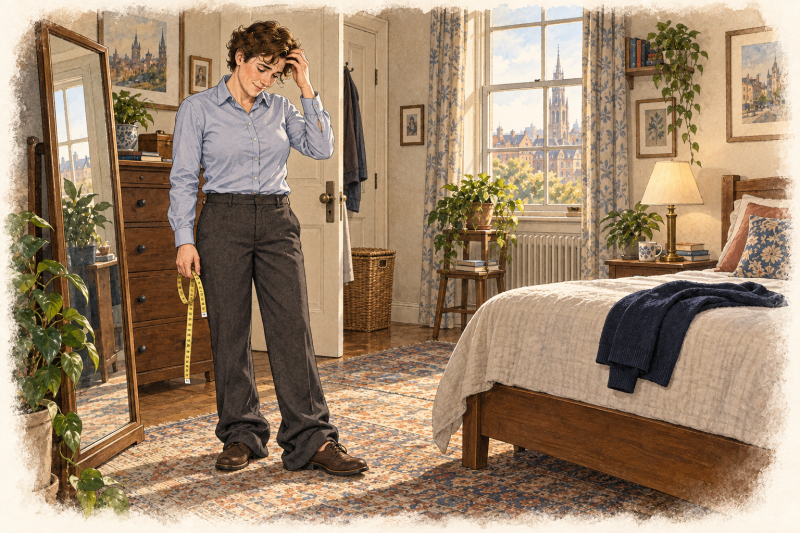
I woke with a tender heaviness against my upper arms. When I rolled over, my body moved in an unfamiliar sequence. In the bathroom, I lifted my T-shirt, then lowered it, then lifted it again in case the first attempt had produced a misleading result.
They were larger. Not enormously larger, but enough to establish a direction.
I went to work in a jacket.
“Big meeting?” Dev asked.
“No.”
“Court afterward?”
“No.”
“Looks good.”
That was Dev. He could notice something odd without turning it into a public investigation.
Dr. Salazar saw me on Thursday. He had been my doctor for eleven years and knew that I usually began appointments by apologizing for having a body.
This time, I took off my shirt.
“I see,” he said.
“I don’t.”
He asked about medication, supplements, soreness, changes in appetite, and several things I had to think harder about than expected. He examined me carefully and arranged blood tests.
“Your general health seems good,” he said. “There are several possible explanations. We’ll investigate before we draw conclusions.”
“Do any of the explanations observe a weekly schedule?”
He looked up.
“It happened on Tuesday. Then again this Tuesday.”
“Only then?”
“As far as I can tell.”
He wrote that down.
I wished he had looked more surprised.
“Keep a record,” he said. “Dates, any other changes, anything that feels different. And call if you develop pain or feel unwell.”
“Am I allowed to feel annoyed?”
“I’d be surprised if you didn’t.”
I liked him better for that.
The tests did not supply an explanation. On Friday, he called to arrange further appointments. His tone was calm, which I appreciated until I wondered how much practice doctors had at sounding calm.
Meanwhile, Bellwether continued being a wonderful place to work.
My first paycheck arrived exactly when promised. Annette approved a correction I suggested to the duplicate-claim process. Dev discovered that I liked the same terrible detective series he did. We spent a lunch break arguing about whether its protagonist could plausibly have lost his badge four times without being dismissed.
On the way back upstairs, Dev held the lift for me.
“You seem less worried,” he said.
“I do?”
“First day, you looked like you were waiting for someone to discover an error and send you home.”
I touched the front of my jacket before I could stop myself.
“Long stretch of temporary work.”
“Well, you’re here now.”
He said it easily. I carried it home like something breakable.
* * *
The third Tuesday, I learned that stairs could become personal.
I took them too quickly, felt the consequences, and stopped halfway to my landing with one hand on the banister and the other performing an emergency function.
“No,” I said again.
My body was developing considerable experience of ignoring that word.
The internet offered advice with great confidence and little relevance. By lunchtime, I had learned more about supportive garments than I had expected to learn in the rest of my life.
After work, I went to a department store three stations beyond my usual stop. I told the assistant I needed something for exercise.
“For you?” she asked.
“Yes.”
“What sort of exercise?”
“At present, stairs.”
She considered me for a moment, then became wonderfully practical. We discussed measurements and soft fabric and whether I could manage a fastening behind my back. Apparently, this was an acquired skill. I opted for something that pulled on.
At home, I stood in the new garment and my old trousers. The combination looked like evidence from two unrelated cases.
It helped, though. That annoyed me almost as much as needing it.
I made a private spreadsheet. Tuesdays down the left, observations across the top. I used the title Health Notes because Growing Breasts seemed too cheerful and Unexplained Catastrophe might prejudice the investigation.
Clare rang while I was deciding whether “noticeable bounce” belonged under symptoms or practical effects.
“You’re quiet,” she said.
“Busy.”
“Good busy or bad busy?”
I watched the cursor blink.
“Complicated busy.”
“You know you can tell me things.”
“I know.”
I did know. That was the trouble. Once I told someone who loved me, it would stop being a problem I could put in a drawer between appointments.
At work the following Monday, Annette asked if I would help review the induction forms.
“You came through the process recently,” she said. “Fresh eyes.”
I opened my own saved application. Everything appeared familiar: contact details, pension arrangements, health insurance, training preferences.
Near the bottom, a small green tick sat beside Enhanced Personal Development.
I remembered selecting it. Professional training had sounded sensible. There had been another box for dental, and I had been pleased to have both.
“What does the enhanced development actually include?” I asked Dev.
“Depends on your plan.”
“Have you used it?”
“No. Moira told me to read the exclusions first.”
“Did you?”
“I got as far as livestock and decided to pay for my own evening class.”
I laughed. He smiled, satisfied, and turned back to his screen.
That night, I tried to open the policy attachment. The file displayed three blank pages and a message saying the remaining content required a legacy viewer.
I sent Moira an email asking for a readable copy.
Then I laid out my loosest shirt for the morning.
It was Monday night. For the first time in my life, I was afraid to go to sleep because of what day it would be when I woke.
Chapter Two
Material Changes
On the fourth Tuesday, my shoes tried to leave without me.
I took three steps toward the bathroom and walked out of the right slipper. The left remained attached only because I curled my toes.
This was new.
So was the hair in my eyes.
I had gone to bed with hair that needed a trim. I woke with hair that needed a decision. At the bathroom mirror, I pushed it back and noticed my fingernails: pale crescents extending neatly beyond fingertips that looked narrower than yesterday.
I rubbed my jaw. The usual morning roughness was scarcely there.
For a few seconds I stood very still, waiting for one of these observations to prove wrong.
Then I looked down.
The breasts had continued their Tuesday appointment. Below them, my waist seemed to have pulled inward. My hips had not received the same instructions.
I dressed in stages, encountering opposition at each one. My trousers caught across my backside and pooled at my heels. A shirt that had once fitted comfortably at the shoulders now sagged there while straining across the front. My belt required a new hole.
The bathroom scales said I had lost nine pounds since Thursday.
The tape measure said I was almost two inches shorter than the height printed on my driving licence.
I measured again against the kitchen doorframe. Then I measured the tape measure against a ruler, because I apparently believed stationery could form a conspiracy.
I called Dr. Salazar. This time, the receptionist found an appointment that morning.
* * *
He checked my height twice too.
That should have been reassuring. It wasn't.
He reviewed my notes, examined me, and arranged an urgent specialist consultation. He didn't dismiss the Tuesday pattern. He asked exactly when I had last been certain my shoes fitted.
“Yesterday.”
“And your voice?”
“What about it?”
We both heard the question.
My voice wasn't unrecognizable. It was simply lighter, as if a familiar instrument had been restrung.
“Yesterday,” I said again, less confidently.
He sat down opposite me.
“Patrick, I don't have an explanation. I want to be very clear about that. The changes you're describing are not something I can account for from these results.”
“Is that worse than finding something?”
“It's more uncertain.”
I appreciated the distinction without enjoying it.
He asked permission to take clinical photographs and measurements for the specialist. I agreed. Before I left, he handed me a copy of the referral instead of trusting that the system would convey the urgency.
At work, Annette took one look at my face and offered me her office.
“Do you need to go home?”
“I need to do something I understand.”
“All right. Tell me if that changes.”
Dev found me at lunchtime eating a sandwich without tasting it. I told him everything, partly because I needed to and partly because he had sat down without asking whether the chair was free. I couldn't bear another small decision.
He listened without interruption.
Then he said, “Have you been eating melons out of season?”
I stared at him.
“My grandmother had theories,” he said apologetically.
“Were any useful?”
“She lived to ninety-four.”
I laughed once, unexpectedly. He relaxed a little.
“Sorry. Would you rather I just listened?”
“I don't know.”
“That's available too.”
We sat quietly for a moment. Then I mentioned the unreadable benefits attachment.
His expression changed.
“What?” I asked.
“Probably nothing. But we should talk to Moira.”
“Why?”
“Last winter, someone in procurement grew antlers.”
I waited for the rest of the joke.
Dev looked thoroughly unhappy.
“I thought the office Christmas photographs were edited.”
* * *
Moira's office contained six plants and a framed certificate honoring her excellence in resolving discrepancies.
She looked at my face, then at the email open on her screen.
“Please sit down, Patrick.”
Dev stayed by the door until I nodded. Then he took the other chair.
Moira turned the monitor toward us. My enrollment form filled the screen. Beneath Dental: Standard was the box I remembered ticking.
Enhanced Personal Development.
She opened the underlying policy record.
The wording changed.
Development: Automatic. Weekly. Thirteen installments.
“I thought that meant training,” I said.
“It should have meant training.”
“That sounds like the beginning of a sentence I won't enjoy.”
Moira removed her glasses.
Bellwether's oldest insurance partner had been incorporated in 1693 under a name that modern software would not accept. Some of its policies remained active. They were normally restricted to specialist customers who understood what they were buying.
“Your induction form was linked to the wrong product,” she said. “The training option and the development option were merged during a system update.”
I looked at Dev. He was watching Moira with a seriousness I hadn't seen before.
“What development?” I asked.
She hesitated.
“Read it,” I said.
“Comprehensive feminine embodiment. Adult standard. General health protection included.”
The room became very quiet.
Outside, someone laughed at something in the corridor. I wanted to go out and ask them to hold that thought until the world was behaving properly again.
“How big are they going to get?”
“I can't give you exact measurements.”
“Will I keep getting shorter?”
“There will be further changes.”
“To what?”
She met my eyes. “Your whole body.”
I put both feet flat on the floor. My shoes felt loose around them.
“Cancel it.”
“I've already requested a suspension.”
“No. Cancel it.”
“Ordinary cancellation stops renewal. It doesn't stop a course that's begun.”
“Then do an extraordinary cancellation.”
Dev leaned forward. “He didn't consent to this product. You need the erroneous-enrollment procedure.”
Moira looked at him, then nodded.
“Yes. I do.”
There was something worse than hearing an impossible explanation: watching two competent people begin processing it.
* * *
By four o'clock, I had a claim number, a printed policy, and a written apology from Bellwether's operations director.
I would have preferred my original trousers.
The policy was thirteen pages long, which seemed smug. It explained that changes occurred on Tuesdays because Monday was processing. It described the weekly increments as “gentle.” It guaranteed continuity of memory and established personality.
“I should hope so,” I said.
It did not provide an emergency stop button.
A separate reversal could be authorized following assessment by the original underwriter. Until that happened, the course would continue. Moira had requested priority handling and promised daily updates, including when there was nothing to report.
“How long?”
“She hasn't given a date.”
“She?”
“The underwriter.”
“Is she also from 1693?”
“I don't know her age.”
For the first time, Moira sounded annoyed. I found it mildly restorative.
Annette joined us after asking whether I wanted her there. She read the incident summary, then looked at Moira.
“Has the enrollment link been disabled?”
“Yes.”
“Have we checked everyone who used it?”
“That's underway.”
“Patrick's expenses come to us. Clothing, travel, appointments, anything reasonably connected. No argument about limits while we sort this out.”
“Agreed.”
Annette turned to me.
“Your job is secure. You can take leave. You can work from home. You can come in. None of those choices affect how we handle this.”
I believed her. It didn't make the room stop tilting.
Dev walked me to the station. Beneath the route map, I finally noticed the designation of the train I had taken for four weeks.
DD EXPRESS.
He looked up. I looked at him.
“Don't.”
“I wasn't going to.”
“You were thinking it.”
“I can't currently control all my thoughts.”
We both laughed too hard. Then I found I couldn't stop shaking, and he sat with me on a bench until I could.
He didn't put an arm around me. He asked whether I wanted him to call someone.
That was how Clare found out.
* * *
She arrived with takeaway food, a sewing kit, and the look she used when a tradesman explained why a leak was technically not his fault.
I gave her the policy before trying to explain. She read three pages standing up.
Then she put it down and hugged me.
I started crying. I hated it until I realized I was mostly relieved.
“You should have told me,” she said.
“I know.”
“You didn't have to tell me sooner. But you could have.”
That distinction almost started me again.
We ate on the sofa. I told her about the first Tuesday, the doctor, the shirt, and the increasingly ambitious sweaters. She listened. When I got to the antlers, she closed her eyes.
“I work in commercial property,” she said. “Why does nobody ever tell us the interesting insurance stories?”
After dinner, she pinned my trouser hems. I stood on a chair while she circled me with the concentration of someone defusing a bomb.
“We'll buy you things that fit on Saturday.”
“What sort of things?”
“Clothes, Patrick. We can make decisions about adjectives when we get there.”
At the mirror, she gathered my hair away from my face.
“You'll need to do something with this.”
“I was hoping it would get bored.”
She handed me a soft hair tie from her wrist.
Once she had gone, I sat at the kitchen table with the policy and a cup of tea. On the last page was a small box headed Client Acknowledgment.
I had never seen it before. I had certainly never signed it.
For the first time since waking that morning, I felt something firmer than fear.
I took a photograph and sent it to Moira.
Then I added another column to my spreadsheet.
Questions They Need to Answer.

Chapter Three
Someone You Already Know
The fifth Tuesday, I woke before the alarm and lay still, conducting an inventory.
There was more hair on the pillow. My sleep shirt lay differently across my hips. When I said something rude to the ceiling, the voice that answered was unmistakably higher.
I hadn't caught the change happening. There was no flash or dramatic sensation. Monday's body went to sleep. Tuesday's body needed different clothes.
The indignity was logistical.
Clare had taken me shopping on Saturday, and we had wisely bought things with adjustable waists. Less wisely, I had insisted on one pair of trousers that fitted perfectly. They had enjoyed a useful life of approximately sixty hours.
I stood at the wardrobe, holding them by the waistband.
“Receipt,” I told them.
At least my new shoes still fitted, if I wore thick socks.
Moira called at nine. The suspension request had been refused because interrupting an installment series required an individualized intervention. The underwriter was reviewing my unsigned acknowledgment and the faulty enrollment link.
“What does reviewing mean?”
“That she has the documents and I've asked for a date.”
“Ask again.”
“I will.”
She sounded as tired of saying it as I was of hearing it. I didn't feel obliged to comfort her.
At the specialist appointment, Dr. Salazar brought the policy. The consultant read it, looked at my measurements, and asked if this was a joke.
“No,” I said. “The jokes are mostly in the exclusions.”
They kept investigating. Whatever the policy claimed, neither doctor was willing to let an impossible document substitute for examining a patient. I appreciated that, although I was beginning to know the ceiling tiles of several consultation rooms by sight.
The results remained bewilderingly orderly. Things that should not have altered had altered. My body behaved as if it had been given a complicated job and was doing it well.
I wished it had consulted me about the assignment.
* * *
I worked from home for two days. On the third, I missed the office enough to become angry about it.
Bellwether had caused the problem. Bellwether also contained the people who made the problem bearable. I wanted those facts to cancel each other out. They wouldn't.
When I returned, Ruth said, “Morning, Pat,” and asked if I had seen the revised expense codes.
That was all.
I sat down, grateful enough to resent being grateful.
At lunchtime, Dev brought coffee to my desk. He had been sending messages every evening: ordinary things, mostly. A photograph of a ludicrous parking sign. A complaint about the detective show's latest implausible death. Once, simply, How are you doing?
I had started watching for them.
“Cinema on Friday?” he asked.
“With the others?”
“With me.”
I looked up.
He took a breath. The confident expression had gone.
“I mean a date.”
For a moment, I couldn't arrange my face.
“Why?”
“Because I like you.”
“That's doing a lot of work.”
“Yes,” he said. “I thought about having a speech, but every version sounded rehearsed.”
I looked down at my coffee. My fingernails were long enough to tap against the cup. I had cut them on Sunday.
“Would you have asked me a month ago?”
He didn't answer immediately.
“Probably not.”
It hurt, although I didn't know what answer I had wanted.
“I liked you a month ago,” he said. “I wanted to spend time with you. The attraction is newer. I don't want to pretend otherwise.”
“So you like what's happening.”
“I like how you look. I don't like that you're frightened, or that someone did this without asking. Those aren't the same feeling.”
It was the first answer that seemed large enough to contain the situation.
“I don't know if I can do this.”
“That's all right.”
“I mean any of it.”
His face softened. “I know.”
I asked for time. He said Friday was only one of several Fridays the world was expected to offer.
* * *
Clare refused to decide for me.
“You're supposed to have an opinion,” I told her.
“I have several. None of them answer whether you want to go.”
“I've never dated a man.”
“Do you want to date this one?”
I stirred my tea.
“I keep thinking about him.”
“Pleasantly?”
“Frequently.”
“That's not what I asked.”
I could remember the exact shape of his smile when he was trying not to laugh. I had noticed the warmth of his hand when he passed me something. These observations had accumulated without permission, which made them difficult to trust.
“What if the policy's doing this too?”
Clare took the question seriously.
“Ask. Get an answer in writing. Then see what you feel about him when you're with him.”
Moira obtained a written response from the underwriter: the coverage did not prescribe affection, sexual orientation, or attachment to any particular person. It promised no alterations to memories or established personality.
I read that response six times. It wasn't enough to make me feel completely certain. Nothing currently was.
On Thursday evening, I messaged Dev.
Cinema. Saturday next week? Somewhere I don't know anyone.
His reply arrived a minute later.
Of course. You choose the film. I reserve the right to complain about it afterward.
I smiled at my phone.
Then I noticed myself smiling and put it facedown.
* * *
By the sixth Tuesday, I needed a haircut with a purpose.
The hairdresser asked what I wanted. I told her I needed to look tidy while leaving my options open.
She studied my face in the mirror.
“Soft layers? Enough length to tie back?”
“That sounds reassuringly reversible.”
She smiled and began.
I watched a person emerge who looked less like a disorganized version of Patrick and more like somebody I might have met. The resemblance unsettled me. So did the fact that I liked the haircut.
Saturday, I tried on three shirts and settled on the first. The new trousers fitted. My shoes stayed attached. These were my standards for a successful outfit.
Dev met me outside the cinema and said, “You look lovely.”
I had prepared defenses against beautiful, sexy, and wow. Lovely got through unchallenged.
“Thank you,” I said, awkwardly.
He wore a blue shirt I hadn't seen at work. He had made an effort too. That helped.
The film was terrible in precisely the ways we had hoped. We emerged arguing about whether the murderer could have moved a piano without anyone hearing.
At dinner, I forgot to monitor my voice.
I told him about Clare's plumber and my brief, unsuccessful bowling career. He told me about his father, who repaired clocks and considered digital timekeeping an act of cultural surrender.
The waiter called me madam. I froze for half a second.
Dev continued asking about the bowling alley's deeply suspicious nachos. He didn't correct the waiter or look at me for a public decision. The moment passed.
Later, walking toward the station, I said, “You noticed.”
“Yes.”
“Thank you for not making it an event.”
“You seemed to have enough events.”
At a crossing, our hands brushed. The first time was accidental. The second time, I let my fingers remain against his.
He looked at me.
“Okay?”
“Yes.”
We held hands for three streets. I was intensely aware of it, then comfortably aware of it, then disappointed when we reached the station.
He didn't try to kiss me.
On the train home, I discovered that I was disappointed about that too.
* * *
The seventh Tuesday, I stood under the kitchen height mark and laughed without humor.
Clare had drawn the first pencil line herself. The new one sat nearly five inches below it.
My face had changed enough that an old photograph beside the kettle looked like a close relative. My beard had dwindled to a few soft hairs. My waist and hips had reached an agreement none of my old clothes supported. There were other, more private changes I recorded for the doctor and then closed the file.
I was tired of studying myself.
At work, a client on the telephone asked for my name. “Patrick Wells,” I said automatically.
“Patty?”
“Pat,” I said.
“Thank you, Pat.”
The conversation moved on. Mine didn't.
That afternoon, Dev and I reviewed a difficult claim together. A customer had selected an option described as domestic resilience and received a front door that refused to admit anyone it considered emotionally unreliable.
“Does it have grounds?” I asked.
“Apparently. That's complicating the appeal.”
We were halfway through the exclusion schedule when I said, “You can call me Pat.”
He looked up.
“I do call you Pat.”
“I know. I mean, keep doing it.”
“All right.”
“And I'd like another date.”
He set down his pen with exaggerated care.
“I can probably arrange that.”
“This time you can choose the film.”
“Dangerous trust.”
“I've read the exclusions.”
He laughed, and for a few seconds I felt entirely like myself.
That evening, the underwriter finally replied. She would see me in person during the ninth week. She had accepted that the enrollment was invalid. A remedy would be available.
I should have felt only relief.
Instead, I sat with the message open, thinking about a blue shirt and three streets of warm fingers.
Then I called Clare, because uncertainty was easier when somebody else knew about it.
Chapter Four
Terms and Conditions
Annette offered me a promotion on the Monday before the eighth change.
I stared at her until she added, “You are allowed to read the job description before looking appalled.”
“I've been here seven weeks.”
“And in seven weeks you've identified a broken enrollment process, corrected a duplicate-payment rule, and done excellent work on complicated claims.”
“One of those discoveries happened to me.”
“You still documented it better than the team paid to find it.”
The position was a new one: customer remediation lead. I would review cases where the company's procedures had failed customers and make sure a resolution meant something more useful than closing a file.
The salary was printed on the second page.
I looked at it twice.
“Is this compensation?”
“No. Compensation is compensation. This is a job you're good at.”
“Will I report on my own case?”
“Absolutely not. That stays with Moira and the independent reviewer.”
I appreciated that she had thought of it before I asked.
“I need a day.”
“Take two.”
I stood to leave, and she hesitated.
“There is one practical thing. Would you be more comfortable using the women's bathroom now?”
I sat down again.
“The other bathroom,” I said, mostly to myself.
“You've been going downstairs to the single room every time. You're welcome to keep doing that. I wondered whether you thought you had to.”
I hadn't realized anyone noticed.
“Would people mind?”
“I'll deal with any questions. But I should have asked what you wanted sooner.”
She glanced at the proposed staff announcement on her desk.
“And the name? Pat? Patty? I'm sorry, I heard a client call you Patty and wasn't sure.”
“Pat for now.”
“Pat it is.”
She crossed out something on the draft. I watched the pen move and felt unexpectedly steadier.
A question I could answer. A change that waited until I did.
* * *
The eighth Tuesday changed the balance of my face.
That was how I wrote it in the spreadsheet. It seemed more manageable than describing the woman who appeared in the bathroom mirror while I was brushing my teeth.
She had my eyes. Clare's cheekbones, perhaps, though Clare said they had always been there and I was only now paying attention. My mouth looked softer. My neck was slender above the collar of an oversized T-shirt.
I was shorter again, though the increments were slowing. Lighter too. I had become accustomed to reaching farther for the top cupboard, then angry that I had become accustomed to it.
When I phoned Dev, he recognized my voice immediately.
“How?” I asked.
“You still sound like you.”
“My voice has gone up considerably.”
“You still say hello as if I've interrupted you investigating a suspicious invoice.”
I considered this.
“Have you?”
“I knew it.”
We went for a walk that evening. At the river, I told him about the promotion and Annette's question.
“What do you want?” he asked.
“The job. Probably. The bathroom, I don't know.”
“Then that's two separate answers.”
I leaned against the rail. The river carried bits of reflected light beneath the bridge.
“What if I change back?”
He didn't pretend to misunderstand.
“I don't know what happens to the attraction,” he said. “I wish I had an answer that couldn't hurt you.”
I watched the water.
“But I'm not going to ask you to make a decision about your body for me. And I don't stop caring about you because a relationship might change.”
“You make it annoyingly hard to accuse you of being shallow.”
“Give me time. You haven't seen my opinions about shoes.”
I laughed. Then I turned and kissed him.
It was brief and a little clumsy. His hand came up to my cheek, waiting there until I leaned into it.
The second kiss was less clumsy.
Afterward, he smiled in a way that made the whole evening rearrange itself.
I went home happy. I also went home with a question I could no longer dismiss as administrative.
* * *
The underwriter arrived on the ninth Wednesday carrying a canvas shopping bag.
Her name was Mrs. Vale. She wore a raincoat, sensible shoes, and an expression that suggested she had been inconvenienced by centuries of other people's filing.
I had expected someone taller. This seemed unfair of me, given recent events.
Moira brought us to a meeting room. Clare came with me. At my request, Dev stayed upstairs.
Mrs. Vale put a folder on the table.
“Mr. Wells?”
“Pat.”
“Pat. Your enrollment was invalid. I apologize for the consequences.”
No qualifications. I hadn't expected that either.
“Can you stop it?”
“Not safely at this stage. The policy creates a complete sequence. Each installment depends on the preceding one, including adjustments that aren't visible. It must finish before we can begin restoration.”
I folded my arms, then unfolded them because the position no longer felt the same.
“Week thirteen.”
“Yes.”
“And after that?”
“If you choose restoration, thirteen weekly installments returning you to the physical state recorded when the policy began. Your intervening memories remain. Your health will be monitored. We cover all associated costs.”
“Another thirteen Tuesdays.”
“I'm afraid so.”
“Why thirteen?”
“The original product was built around a quarter-year. It was designed to be gradual.”
“It wasn't designed very well.”
“No,” she said. “Not for this use.”
Clare leaned forward.
“How long does Pat have to decide?”
“Twelve months following completion. That deadline is in the written offer. Taking time does not reduce the remedy.”
“And work?”
“Unaffected.”
“And if Pat doesn't restore?”
“The original error still occurred. Compensation is not conditional on restoration.”
I looked at Mrs. Vale properly for the first time.
“People choose this?”
“Yes.”
“Knowing?”
“With extensive consultation. Usually after wanting it for a long time.”
“And the form couldn't tell that wasn't me?”
“The form doesn't know you. It records instructions. People were supposed to make sure those instructions were yours.”
There was no grand design hiding in the paperwork. No secret judgment about who I ought to become. A badly connected form had done exactly the wrong thing with remarkable efficiency.
That was almost more upsetting.
I asked about my health, my future, the changes still ahead. Mrs. Vale answered in detail. She gave Dr. Salazar permission to contact her directly and supplied records he had been requesting for weeks.
Finally, she slid the offer across the table.
“Take independent advice. There is no need to sign today.”
For once, I didn't.
* * *
I accepted the promotion on Friday.
Before I did, I asked Annette for authority to suspend misleading forms, obtain actual policy wording, and reopen cases that had been marked resolved when the customer still had a problem.
She read my list.
“You know this will make you unpopular in some meetings.”
“I've bought enough new clothes to withstand disapproval.”
She laughed and signed it.
Ruth brought a small cake to the kitchen. The icing said CONGRATULATIONS PAT in letters that grew steadily smaller toward the edge.
“I ran out of room,” she explained.
“Appropriate,” I said. “I've been having the opposite problem.”
Everyone laughed, including me. It was the first joke about my situation I had made to the whole group. The room didn't seize on the permission. We ate cake and discussed whether the new expense system could possibly be worse than the old one.
Later, I used the women's bathroom.
I waited outside for perhaps thirty seconds, furious with myself for being afraid of a door. Then Ruth came along carrying a mug.
“Could you hold this?” she asked. “I need both hands for this stupid cardigan.”
By the time she had freed a button from the knit, we were inside.
She took the mug back, thanked me, and went into a stall.
I washed my hands afterward beside another woman touching up her lipstick. She said hello. I said hello. The universe permitted the exchange without comment.
Back at my desk, I completed a report.
It had been a surprisingly ordinary ten minutes.
* * *
The tenth Tuesday, the changes were smaller but harder to ignore.
My body was no longer something I could plausibly call my old body with additions. Getting dressed had become easier because I had stopped trying to negotiate with clothes bought for someone several inches taller.
Clare and I went shopping again. This time, she let me wander before offering suggestions.
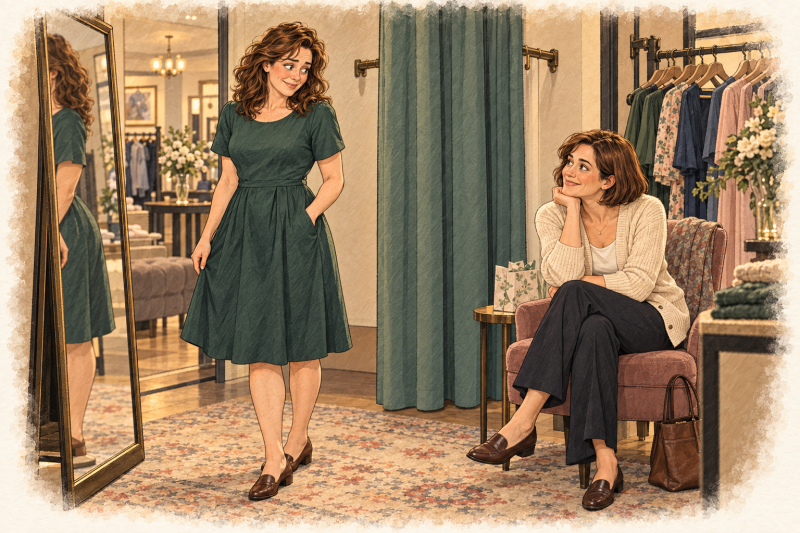
I found a green dress and took it down because I liked the color.
In the changing room, I stood for a long time before opening the curtain.
Clare looked up from her phone.
“Oh,” she said softly.
“Bad oh?”
“No.”
“It has pockets.”
“Clearly a serious garment.”
I turned toward the long mirror. The woman there looked nervous, pretty, and entirely unprepared for someone to find her pretty.
I liked her. The realization arrived without ceremony.
Liking her did not answer everything. I still missed my old ease in the world. I missed reaching a shelf without planning. I was angry at the form, the company, and the Tuesdays I had spent afraid.
But I couldn't honestly call the reflection a disaster anymore.
“Do you want it?” Clare asked.
“Yes.”
“Then buy it.”
At the checkout, the assistant asked for a name to put on the alteration ticket.
“Patty Wells,” I said.
Clare didn't move. She just waited while I listened to what I had said.
“Yes,” I added, mostly to myself. “Patty.”

Chapter Five
Perfectly Healthy
The name felt different depending on who said it.
From the shop assistant, Patty had been an experiment. From Clare, over breakfast the next morning, it sounded like something our mother might once have called up the stairs.
From Dev, it made me look at him too quickly.
“Too much?” he asked.
“No. Again.”
“Patty.”
I smiled before I could consider whether I meant to.
We were in his kitchen making dinner. He had invited me over and then revealed that his definition of making dinner involved three pans and detailed instructions from his father over the telephone.
“Your father repairs clocks.”
“He has other interests.”
“Does he know I'm here?”
“He knows I'm trying to impress someone.”
“Is he helping?”
“He says that remains to be seen.”
I wore the green dress. Not because Dev had asked, or because Tuesday required it, but because I had spent all afternoon wanting to.
That seemed worth noticing.
After dinner, we sat on the sofa with the latest episode of our detective show paused while we argued about a footprint. His arm rested along the cushions behind me. I shifted closer until he put it around my shoulders.
I was still startled by how neatly I fitted there.
“Mrs. Vale has given me a year,” I said.
“I know.”
“I haven't decided about restoration.”
“I know that too.”
“I don't want every nice evening to feel like I'm promising something.”
He turned toward me.
“This evening can just be this evening.”
I let my head rest against him. For a while, that was enough.
* * *
The eleventh Tuesday brought a little more curve, a little less height, and the discovery that I could no longer wear my mother's ring on the same finger.
It had been loose before. Now it slipped off while I washed my hands.
I caught it before it reached the drain and sat down on the closed toilet seat with it in my palm.
My mother had left it to me because Clare already had our grandmother's. I had worn it on my little finger for years, an ordinary fact about myself so settled that I scarcely noticed it.
I noticed now.
I called Clare and cried over a piece of jewelry. She understood without requiring a better reason.
“We can get it resized,” she said.
“What if I change back?”
“Then we can get it resized again.”
“Everything's like that.”
“Yes.”
She let the yes sit between us.
“I don't think Mum would have minded,” I said eventually.
“No,” Clare said. “She'd have had a lot of practical questions. Then she'd have asked whether Dev was feeding you properly.”
I laughed through my nose and found a tissue.
That afternoon, I put the ring on a chain. It rested just above the neckline of my blouse, where I could touch it without looking.
I went to work.
There were claims waiting.
* * *
My first serious disagreement as remediation lead concerned the emotionally selective front door.
The original proposed resolution was a refund.
“The customer still can't get her brother into the house,” I said.
“She's been refunded the premium,” said a man from operations.
“Has that opened the door?”
He looked confused.
“The problem is the door. Giving her back forty pounds doesn't change the door.”
The meeting lasted forty minutes longer than scheduled. By the end, we had arranged an ordinary replacement door, reimbursement for the locksmith, and a review of three similar products.
Annette caught me afterward.
“Good work, Patty.”
I had changed my name on the staff directory that morning. Hearing it in connection with something I had done felt different again.
“Thank you.”
“The brother sounds appalling, by the way.”
“That's between her and her brother.”
“Exactly.”
At my desk, an email waited from the independent adviser reviewing my settlement. The offer preserved the restoration option, covered expenses, and compensated me for the consequences of the error. There was no requirement to resign, remain employed, or speak kindly of Bellwether.
I read that last point with particular satisfaction.
I accepted the settlement, not the restoration. That decision could wait.
Then I sent Moira the final receipt for my new shoes.
She replied within five minutes.
Approved. And they are very nice shoes.
I wrote back: I assume that is not a coverage determination.
For the first time, her answer contained a smile.
* * *
The twelfth Tuesday, I woke late.
Not disastrously late. Fifteen minutes after the alarm, which I had apparently silenced without remembering. I showered, dressed, made coffee, and was halfway through feeding a slice of toast into my mouth when I realized I hadn't checked.
I put down the toast.
For eleven Tuesdays, inspection had been the first business of the day. The mirror, the scales, the measurements, the discovery of whatever garment had become obsolete overnight.
This morning, I had been annoyed about the alarm.
I went to the bathroom.
The changes were there, slight but real. My hair reached well below my shoulders. My figure had settled into proportions that belonged together. The last traces of the face I had known for thirty-two years remained in my eyes, in the small crease between my brows, in the expression I made when expecting nonsense.
I raised one eyebrow.
There I was.
I didn't feel a revelation. I felt late for work.
I finished the toast.
That evening, Dev came with me to bowling. I had missed several weeks, and returning frightened me more than I had admitted.
Gareth, who ran the league, looked from me to the booking sheet.
“Patrick?”
“Patty now.”
“All right.” He picked up a pen. “Same handicap?”
“Probably optimistic.”
He changed the name.
One teammate asked a clumsy question, then apologized before I could answer. Another wanted to know whether I was still available for the end-of-season match. Within twenty minutes, everyone was more concerned with Gareth's disputed spare than with me.
My old bowling ball was too heavy to use comfortably. I chose a lighter one from the rack.
“Fresh start,” Dev said.
I sent it directly into the gutter.
“Some continuity,” I told him.
He kissed my temple when I sat down. Nobody dropped anything.
On the way home, I told him I wasn't planning to begin restoration after the thirteenth week.
He kept walking beside me.
“Okay.”
“That's your entire response?”
“I'm trying not to make it sound like you won a prize by choosing the answer I wanted.”
“You can be pleased.”
He stopped under a streetlamp.
“I'm pleased,” he said. “And if you feel differently later, you can tell me.”
I stepped closer and put my arms around him.
For once, I didn't measure the distance upward.
* * *
The thirteenth Tuesday arrived without ceremony.
I had imagined some final flourish. A bell, perhaps. A small envelope appearing beneath the pillow. Bellwether might at least have managed a customer satisfaction survey.
Instead, I woke needing the bathroom.
The mirror showed a woman with untidy hair and a sleep crease on her cheek. I examined her with the concentration of someone checking a repaired appliance for the last mysterious rattle.
There were small changes. The sequence had completed itself. I knew that before the email arrived, though I opened it immediately when it did.
Coverage installment thirteen of thirteen fulfilled.
Underneath was an invitation to rate my experience.
I forwarded it to Moira with no comment.
She replied: I have disabled that email.
My appointment with Dr. Salazar was at eleven. Clare offered to come. Dev offered too. I told them both that I wanted to do this one myself, then promised to call afterward.
In the waiting room, the receptionist confirmed my name.
“Patty Wells?”
“Yes.”
She smiled and handed me a form.
I read every word before signing.
Dr. Salazar met me at the consulting-room door. He had the specialist's final report, Mrs. Vale's documentation, and thirteen weeks of my increasingly elaborate spreadsheet.
“You've been very thorough,” he said.
“I work in claims.”
“So I see.”
The examination was careful and familiar. He checked the final measurements and asked how I felt. I told him the truth: sometimes angry, mostly well, still surprised, less frightened.
We discussed follow-up care. He answered my remaining questions and made sure I understood that I could come back with new ones. Nothing about his manner suggested the case had become less worthy of attention because it was nearing an end.
Finally, he sat down, folded his hands, and smiled a little.
“I'm sorry, Miss Wells, I really can't find anything wrong with you. You're a perfectly healthy young woman.”
I had been waiting thirteen weeks for an explanation.
For the first time, that didn't feel like the most important thing I might be given.
“Are you apologizing for the healthy part?” I asked.
“For not being able to offer a more conventional account of how we got here.”
“I don't think conventional is available under my plan.”
He laughed. So did I.
* * *
Outside, I called Clare first.
“Well?”
“Perfectly healthy.”
“Good.”
“A young woman, apparently.”
“Young? Get that in writing.”
Then I called Dev. We arranged dinner. I said I would cook, which made him cautious in a way he hadn't been about any of the preceding thirteen weeks.
At work, Annette had left a difficult file on my desk with a note: Your judgment, please.
I liked that better than congratulations.
My calendar showed a new recurring appointment: Tuesday, nine o'clock, remediation review. Thirteen department heads. No end date.
I stared at it.
Then I opened the meeting invitation, selected Propose New Time, and moved it to Wednesday.
If you liked this post, you can leave a comment and/or a kudos!
Click the Thumbs Up! button below to leave the author a kudos:
And please, remember to comment, too! Thanks.