
Author:
Audience Rating:
Publication:
Genre:
Character Age:
TG Themes:
Permission:
"Desert Valley's different," she said.
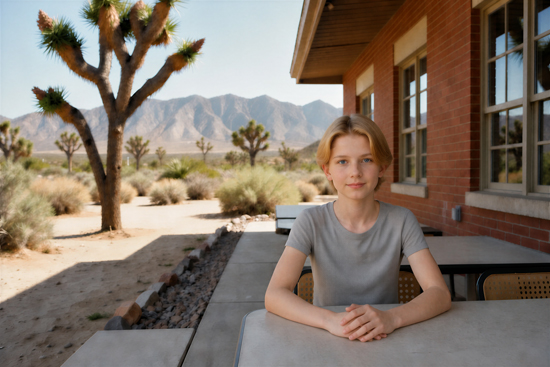
Desert Valley
by Suzan Donamas
"Leland McIan," the teacher called, and I answered, "Here," but it came out embarrassingly high. I wanted to try again, remembering this time to pitch my voice down, but two of the boys in class were already grinning at me. I gave up after pretending to clear my throat, as if some sort of congestion caused my voice to sound odd.
I didn't fool anyone and I knew that, feeling my face turning red. This was homeroom on the first day of class in my junior year, 1965. We'd moved from Esau, Kansas, to Desert Valley, California, two months before, and I didn’t know anyone at school or anywhere else in town for that matter. I scanned the room the way I'd learned to — not obviously, just enough to know who was watching and how.
Most of them had already lost interest. One hadn't.
The boy one row over and one seat ahead smiled at me. Which was confusing, because he'd answered to the name Brock Atterbury in a deep baritone that filled the room without effort. He looked like the voice, too — probably six feet tall or more, muscles filling out his short-sleeved shirt, a brush of dark brown hair above a square face. The kind of boy who had never once wondered how a room was going to treat him.
He grinned when he saw me looking back, easy and unguarded, and I ducked my head so he couldn't see me blush.
Two rows back, a dark-haired boy was watching Brock with an expression I couldn't read from the side. He wasn't smiling.
The first boy's grin wasn't the grin I knew. The ones I knew had an edge to them, something that understood what it had found. This one didn't seem to know yet.
I wasn't sure that was better.
###
The trailer was cool when I got home, Jocelyn having left the window unit running before her lunch shift. She'd taped a note to the refrigerator the way she always did: chicken in the fridge, don't wait up, love you. I ate standing at the counter without tasting it and watched the light change on the desert outside the kitchen window. Three Joshua trees stood at the edge of the scrub where the lot ended, their arms crooked in different directions like people who couldn't agree on anything. Desert light was different from Kansas light. More honest about what it was.
She came in a little after ten, still in her uniform, smelling of coffee and the particular tiredness of being pleasant to strangers for money. I was at the table pretending to do homework.
"How was it," she said, not quite a question.
"Fine."
She poured herself a glass of water and leaned against the counter looking at me with that careful look she had, the one that meant she saw more than I'd given her. Jocelyn had been beautiful once in a way that got written down — Miss Jefferson County 1948, a photograph of which still lived in a shoebox under her bed that I wasn't supposed to know about. She was still beautiful, just quieter about it. She understood certain things without being told.
My father, Arthur, had said once that her beauty was wasted on a boy like me. He'd meant to be insulting. I was never sure he was wrong.
"Anyone give you trouble?"
"No," I said.
She nodded, accepting this, which didn't mean she believed it. There was an understanding between us about how much I would tell her and how much she would ask. It had developed after Esau without either of us deciding on it. She knew that the wrong question could cost us both something.
"Desert Valley's different," she said, more to herself than to me.
"Yes," I said.
She kissed the top of my head on her way past and went to change out of her uniform. I sat there a while longer with my book open in front of me. I thought about how it would be to never wonder if the world would treat me fairly. That kind of confidence belonged to people like Brock, not to me.
Then I turned off the light and went to bed.
###
We were lab partners by random seat assignment. Atterbury and McIan, Mr. Hooper's third-period biology class, two stools pulled up to a black-topped table with a textbook between us and a tray of equipment neither of us had touched yet.
Brock sat with the ease of someone who had never had a reason not to. He took up space the way big people do, without thinking about it, one arm resting on the table, his worksheet pushed to the side. He'd already written his name at the top in large, unhurried letters.
"You're from Kansas," he said.
"Yes."
"What's it like?”
"Flat," I said. "Green. Different from here."
He nodded as if this confirmed something. "My uncle lives in Wichita. Says the winters are bad."
"They are."
He looked at me for a moment in that way he had, direct without being aggressive, and I kept my eyes on the textbook. I had learned not to look back too readily. Looking back invited things.
"You always this talkative?" he said.
It surprised a laugh out of me before I could stop it, and for a moment I hated myself for it because I knew what my laugh sounded like. Too light, too easy, not the kind of laugh that came out of boys like Brock Atterbury.
He went still in a way that wasn't quite stillness. More like attention, suddenly organized around a point.
I looked down at the worksheet.
"Atterbury and McIan," I said. "We should probably start."
He looked at the worksheet for a moment before answering. "Yeah," he said. "Probably."
But he didn't reach for it right away. And across the room, from a table near the window where he sat with two other boys, the dark-haired boy from homeroom — Roger Doyle, I'd learned his name by then — watched us with an expression I recognized without being able to name it yet. Patient. Certain. The look of someone who has already made a decision and is simply waiting for events to catch up.
I picked up my pencil and wrote my name at the top of the page.
###
He caught up with me after biology on a Tuesday, falling into step beside me in the hallway with the ease of someone who hadn't planned it and wasn't pretending he had.
"Hooper's going to put us on the frog unit next week," he said.
"I know."
"You squeamish?"
"No," I said. "Are you?"
He looked at me sideways. "I dissected a rattlesnake once. Found it dead out past the edge of town."
"What was it like?”
"Exactly what you'd expect," he said. "But more so."
I laughed before I could help it, that same light sound I'd produced in class the week before, and he slowed almost imperceptibly the way you slow when something surprises you and you want another moment of it.
I straightened my face and shifted my books to the other arm.
"McIan," he said, and stopped walking.
I stopped too and turned. He was looking at me with that organized attention, not saying anything, as if he'd stopped because he had something to say and had now forgotten what it was. After a moment he shook his head slightly.
"Nothing," he said. "See you Thursday."
He turned back the way we'd come. I watched him go without meaning to.
Roger Doyle was at the lockers ten feet away. I don't know how long he'd been there. He wasn't looking at me. He was looking at Brock's back as Brock walked away, and his expression was the one I'd seen in homeroom on the first day — unreadable from the side — except that I was seeing it straight on now, and it was readable after all.
He felt me watching him and looked over. We held each other's gaze for a moment, neither of us pretending we hadn't seen what we'd seen.
Then he turned back to his locker and I went to class.
###
He found me between fourth and fifth period, in the narrow corridor outside the gym where the lockers ended, and there was nowhere particular to be. I'd noticed him following me from a distance and had slowed without meaning to, the way you do when you already know what's coming.
"McIan," he said.
I stopped and turned. Up close, Roger Doyle was compact and dark, with the kind of face that would have been handsome if it weren't so certain of itself. He was in his football jersey though it wasn't a game day, the number 34 in faded gold. He stood the way boys stand when they want you to know they could take up more space if they chose to.
"You're the kid from Kansas," he said.
"Yes."
"Brock said." He looked at me steadily. "Brock talks to everybody. That's how he is. He doesn't mean anything by it."
I waited.
"He's got a girlfriend," Roger said. "Penelope Bell. You probably haven't seen them together yet, but you will. She's a varsity cheerleader. They've been together since sophomore year."
"Okay," I said.
Something moved behind his eyes. He'd expected more resistance, or more fear, and my flatness was making him recalibrate. "I'm just letting you know how things are," he said. "Since you're new."
"That's considerate," I said.
He looked at me for a long moment. I kept my face neutral, which I was good at, which was something Esau had taught me. The boys in Esau had taught me a great deal.
"Brock has a future," Roger said. "Football. Probably a scholarship. He doesn't need complications."
The word landed carefully, neither here nor there. Complications. It was almost elegant, the way it said everything without saying anything.
"I'm sure he doesn't," I said.
Roger held my gaze another moment, then nodded once as if something had been settled, and walked back the way he'd come. I watched him go. The jersey. The set of his shoulders. The particular quality of his certainty about Brock's life and what it required.
I thought about what it cost a person to be that certain about someone else's future.
Then the bell rang and I went to class.
###
She found me at lunch on a Wednesday, three weeks into the school year, setting her tray down across from mine with the particular confidence of someone who has decided something and sees no reason to be subtle about it.
"You're Leland," she said. It wasn't a question.
"Yes."
Penelope Bell was pretty in a way that was easy to categorize — dark blonde hair, good cheekbones, the kind of careful put-together that took effort and wasn't supposed to look like it did. Varsity cheerleader, I'd gathered by then, which meant she moved through the school with a social immunity most people spent years trying to cultivate. She didn't need to be sitting with me. That she was doing it anyway meant something.
"Brock talks about you," she said, opening her milk carton with two precise movements.
"Does he?”
"He says you're smart. That you're good in biology." She looked up at me with clear gray eyes that were doing something more than making conversation. "He talks about you the way he talks about football. Like he's thinking about it even when he isn't saying anything."
I looked at my tray.
"That doesn't bother you," I said. It came out more careful than a question.
She considered this with apparent seriousness. "I think people are who they are," she said. "Pretending otherwise just wears you out." She took a bite of her sandwich and looked out across the cafeteria to where Brock sat with Roger and two other boys from the team. "Roger thinks you're dangerous."
"I know."
"Roger thinks a lot of things." Something in her voice was fond and dismissive in equal measure, the way you speak about someone whose limitations you've accepted. She looked back at me. "He's not completely wrong about the danger part," she said. "He's just wrong about you."
I didn't answer that.
"I'm not your enemy," she said. "I just thought you should know that. Since you probably assumed I was."
I had assumed that. I'd been revising the assumption for the last three minutes.
"Brock's lucky," I said finally. "To have someone who understands him."
She smiled at that, small and a little sad. "We understand each other," she said. "It's a different thing."
She finished her milk, picked up her tray, and left with the same decisiveness with which she'd arrived. I sat there a moment looking at the space she'd vacated. Across the cafeteria, Brock was laughing at something Roger had said, his head tilted back, and Roger was watching him laugh with an expression that had nothing to do with the joke.
I picked up my fork and finished my lunch.
###
Jocelyn was working the dinner shift. She'd left a casserole in the oven on low and a note on the refrigerator that said back by ten, love you, the same note she always left with the details changed. I ate alone at the table watching the light go out of the sky over the Joshua trees, their shapes going dark and strange against the orange, like something from a dream you couldn't quite remember in the morning.
I did the dishes. I did forty minutes of homework. Then I turned on the television because the silence had a quality I didn't want to sit with.
It was a movie, already twenty minutes in. I didn't know the title. There was a man in it who moved a certain way, spoke a certain way, and within thirty seconds I understood what the movie thought of him. He was the kind of man movies made into a villain or a tragedy, and this one was making him into both. The other characters spoke about him in lowered voices. A woman recoiled from him in a scene that was played for something between horror and pity. Later, a group of men caught him alone, and the camera cut away, and when it came back, he was on the ground, and the men were walking away, straightening their jackets, and the movie treated this as a kind of order being restored.
I watched it to the end. I don't know why. There was something almost necessary about it, the way it was necessary sometimes to press on a bruise to confirm it was still there.
I turned off the television and sat in the dark for a moment.
Then I got up and went to Jocelyn's room.
Her closet smelled like her, the particular combination of her perfume and the cedar blocks she kept on the shelf. I knew where everything was without looking. I had been in here before, not often, just sometimes, on evenings like this one when the silence got a certain weight to it.
The dress was blue, a soft wool crepe she'd worn to church in Esau before we stopped going. I lifted it from the hanger carefully and held it against myself and looked in the mirror on the back of the closet door.
I looked for a long time.
The boy in the mirror looked back at me, holding the blue dress against his chest with both hands, and his face was the same face it always was — the face that had cost them Esau, Kansas, the face that had made my father Arthur blame him for things that had nothing to do with faces — and the dress didn't change that. But it changed something. What it changed I couldn't have said.
I hung it back carefully, exactly as I'd found it. I closed the closet door.
I went to bed and lay in the dark listening to the desert, which made almost no sound at all. When I cried I did it quietly, the way I'd learned to, without moving much. After a while I stopped and just lay there.
Outside, the Joshua trees stood in the dark doing whatever it is strange things do when no one is watching.
###
It was a Friday in October, the air finally cool enough to mean it. Brock caught up with me after sixth period in the parking lot, his shoulder pads still on under his practice jersey, helmet hanging from one hand.
"Walk with me," he said. Not quite an order. Not quite a question either.
We walked to where his car was parked at the far edge of the lot, a 1959 Ford Fairlane in a green that had faded to something almost gray. He unlocked the passenger side first, which I noticed, and we got in and sat there without him starting the engine. The practice field was visible through the windshield, other boys moving across it in the late afternoon light.
"Roger says I should stay away from you," he said.
"I know."
He looked at me then. "How do you know?"
"He told me."
Brock was quiet for a moment, his hands on the steering wheel though we weren't going anywhere. "What else did he tell you?"
"That you have a future. That I'm a complication."
He made a sound that wasn't quite a laugh. "Roger thinks a lot of things."
"Penny said the same thing."
That surprised him. He turned to look at me more fully and I kept my eyes on the practice field. I had learned to be careful about how much I looked at him directly. It was like looking at the sun, not because he was radiant, exactly, but because too much of it did something to your vision.
"You talked to Penny," he said.
"She talked to me. There's a difference."
He was quiet again. A group of boys crossed the practice field and one of them looked toward the parking lot and Brock shifted slightly in his seat, something automatic, a recalibration I recognized without wanting to. The cost of being seen.
"I don't know what Roger thinks he's protecting," Brock said, but he said it to the windshield.
I could have said something then. There was a true thing available and we both knew it was there, sitting between us on the bench seat like an object neither of us was willing to pick up first.
"He's protecting you," I said. "That's what he thinks."
Brock turned to look at me, and I made the mistake of looking back. This close, his eyes were a dark hazel that shifted toward green in the afternoon light, and he was looking at me the way he had in biology that first day, attention organized around a point, except now there was nowhere to look away to.
He reached over slowly, giving me time to move if I was going to, and pushed the hair back from my face. Just that. His hand was large and warm and slightly rough from the football and he tucked the hair behind my ear and let his fingers rest there a moment against my jaw.
I held very still.
"Leland," he said. Just my name. Like he was confirming something.
"Don't," I said. Not because I wanted him to stop. Because I knew what happened next, had always known, and the knowing sat in me like a stone.
He took his hand back slowly. He didn't apologize. We sat there a moment longer in the cooling car while the light changed on the practice field and the other boys moved across it throwing a ball back and forth, easy and uncomplicated, belonging to a world that had a place for them.
"I should get to practice," he said.
"Yes," I said.
I got out of the car and walked back across the parking lot without looking back. I knew he watched me go. I could feel it the way you feel weather coming, something in the quality of the air.
I walked home. It took forty minutes. I didn't mind.
###
The following Monday, Brock nodded at me in the hallway in the way you nod at someone you know without stopping. In biology, he was friendly in the careful way of someone who has decided on a distance and is maintaining it. He answered when I spoke and spoke when necessary and did not look at me the way he had looked at me in the car.
I understood. I had expected it. Understanding it and expecting it did not make it feel like less.
Roger was everywhere that week in the way he hadn't been before. In the hallway outside biology. At the edge of the parking lot after sixth period. In the lunch line on Tuesday directly behind me, not speaking, not needing to. His presence was the message. He had seen something or sensed something and had moved from warning to surveillance without any visible escalation and the smoothness of it told me he'd been waiting for a reason.
I thought about Esau. About Danny Firth and Carl Wessel, who had been friends since third grade and stopped being friends over me, which was not a thing I had wanted or invited but which had happened anyway because of what I was, which was something I hadn't chosen either. Danny had wanted to protect me from Carl and Carl had wanted to protect Danny from something he couldn't name and I had stood in the middle of it being the problem everyone agreed on even when they agreed on nothing else.
Roger was Carl. I knew that now with a flat certainty that had no heat in it. He would do what Carl had done, which was find the people who needed to know something and tell them, framing it as concern, which it also genuinely was, which was the complicated part.
The question was what he'd seen. Whether it was enough.
On Friday Brock wasn't in biology. Mr. Hooper said nothing about it. His stool sat empty beside mine and I worked through the lab alone and wrote both our names at the top of the worksheet out of habit before crossing his out.
That was when I knew it had already happened.
###
He was waiting by the Joshua trees at the edge of our lot on a Saturday morning, sitting on the hood of the Fairlane with his hands in his jacket pockets. I don't know how he knew where I lived. Penny, maybe. It didn't matter.
Jocelyn was at work. The desert was quiet the way it was on weekend mornings, just the sound of a dog somewhere and the wind moving through the Joshua trees, which made a dry sound, like paper.
I stood at the edge of the lot and looked at him.
"They're sending me to a school in San Diego," he said. "Miramar Academy. I leave Thursday."
I nodded.
"It was my dad mostly. Roger talked to him, but — my dad had already looked at Miramar. Last spring, after my grades slipped. He had the brochure in his desk drawer. Roger just gave him a reason to take it back out." He said it without accusation, just information, the way you report weather. "My dad was in the navy. He thinks structure is the answer to most things."
"Is your mother in agreement?"
He considered this. "My mother does what my dad decides." He looked down at the hood of the car. "I wanted to tell you myself. I didn't want you to just come to school and find the seat empty."
Something moved in my chest at that and I kept my face still. "I already knew," I said. "Friday. When you weren't in biology."
He looked up at me. In the morning light, he looked younger than he did at school, or maybe just less armored. The football, the jersey, the baritone that filled rooms — none of it was present here. He was just a sixteen-year-old boy sitting on the hood of a faded green car in the high desert, looking at me like I was something he was going to have to learn to stop looking at.
"I don't think I'm what Roger thinks I am," he said.
"No," I said. "You're not."
"But I'm not—" He stopped. Started again. "I don't know what I am."
"I know," I said.
He nodded slowly. The wind moved through the Joshua trees again. I thought about the blue dress in Jocelyn's closet and the boy in the mirror and all the things neither of us had words for, not in 1965, not in Desert Valley, California, possibly not anywhere.
"Penny knows," he said. "She's not — she's okay. She's good."
"I know," I said. "She's good."
He was quiet a moment. "I'm sorry about Roger."
"Roger did what Roger does," I said. "It's not your fault."
He looked at me for a long time. I let him, this once, without looking away. There was nothing left to protect, and it seemed wrong to waste it.
"Leland," he said, and stopped.
"It's all right," I said. "You don't have to."
He nodded. His jaw worked once. He got off the hood of the car and stood there a moment, not moving toward me, not moving away. Then he put out his hand, formally, like something he'd seen adults do, and I shook it, and he held it a second longer than a handshake required, his thumb moving once across my knuckles, and then he let go.
He got in the car. I stood at the edge of the lot and watched him drive out to the road and turn south toward town and disappear.
The Joshua trees stood behind me making their dry sound in the wind.
I went inside.
###
The seat one row over and one ahead was filled on Monday by a boy named Gareth Pulos who had transferred from Barstow and who had nothing particular about him that I could see. He arranged his things on the desk with a kind of stolid efficiency and answered to his name in a voice that was neither high nor low and did not look at me once.
I was grateful for that.
Biology was the same. Mr. Hooper moved through the lesson and I took notes and answered when called on and worked through the lab with a girl named Susan Marsh who had been my partner once before when Brock was absent and who was pleasant and competent and asked me nothing about myself. The stool beside mine was occupied by a sophomore boy I didn't know who sat slightly too far from the table and watched the clock.
At lunch I sat where I usually sat and ate what I usually ate. The cafeteria was loud in its ordinary way. Penny came through the line and saw me and lifted her chin in a small acknowledgment, not stopping, carrying her tray toward the table where Amanda Knox was saving her a seat. She looked composed and fine. I thought about what it cost her to look that way and whether it cost her anything at all and decided I didn't know enough about Penny to answer that.
Roger Doyle walked past my table without looking at me. His mission was accomplished. There was nothing left to surveil.
After school I walked home the long way, out past the edge of town where the houses thinned and the desert reasserted itself. The Joshua trees were everywhere out here, standing at their strange angles in the thin October light, their arms going in all directions as if each one had separately decided on a different way to manage the situation. They were not beautiful in any way that was easy to explain. They grew in a place that offered them nothing and they grew anyway, thorny and stubborn and indelibly themselves, and after a while you had to call that beautiful because there was no other word that fit.
I stood there a while looking at them.
Then I went home.
###
That night Jocelyn worked the late shift. I ate alone and did my homework and after a while I turned off the television without turning it on first, which was something.
I went to her room. I opened the closet and stood there in the smell of cedar and her perfume and looked at the blue dress for a long time without taking it down. Then I took it down and held it against myself and looked in the mirror on the back of the door.
The boy in the mirror looked back at me.
I didn't know what he was. I didn't know what word applied to him or whether any word that existed in 1965 would have fit without costing him something. I knew that Brock was on his way to San Diego and that Roger Doyle would have a good season and that Penny and Amanda Knox would find their own way through, because people like Penny generally did. I knew that my father Arthur thought I was the cause of things I hadn't chosen and that my mother Jocelyn thought I was innocent of the same things and that both of them were probably partly right in ways that didn't help me much.
The boy in the mirror held the blue dress against his chest and looked back at me and didn't have any answers either.
After a while I hung it back carefully and closed the closet door and went to bed.
Outside the Joshua trees stood in the dark, thorny and indelible, growing in the only place they knew.
If you liked this post, you can leave a comment and/or a kudos!
Click the Thumbs Up! button below to leave the author a kudos:
And please, remember to comment, too! Thanks.

Comments
Fabulous
Wow! What an amazing piece of writing. I am so jealous; I just wish I could have written something as evocative as this.
I just hope there is a sequel.
Please, Suzan.
A view inside someone's head
A view inside someone's head that is nothing like anything I've known before.
Thank you.
Very Nice
Very nicely written.
Cindy Jenkins