
"I heard you," he said. "I ain't deaf."
The Marrying Kind
by Suzan Donamas
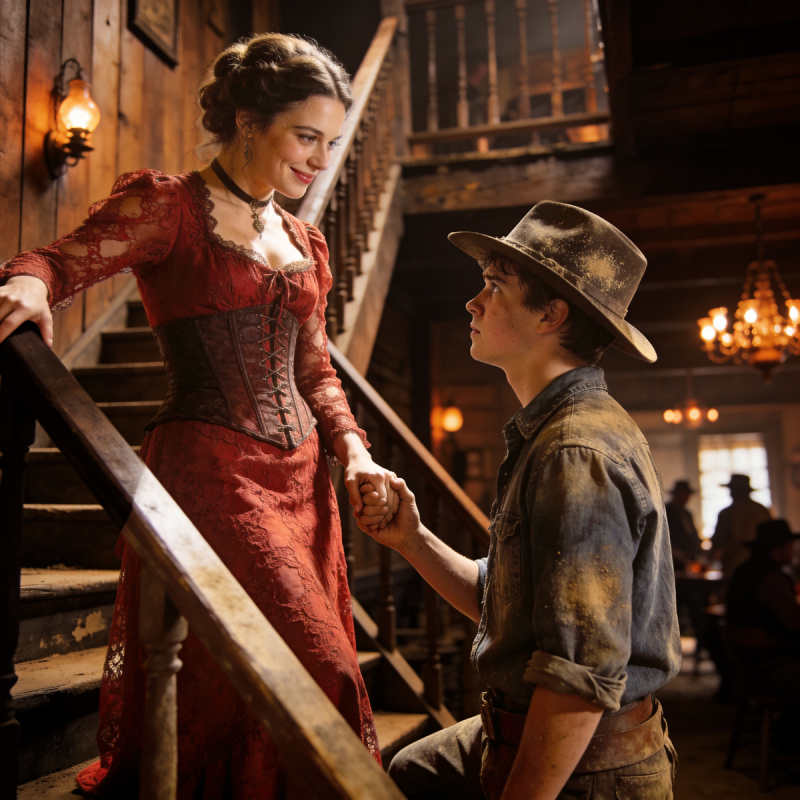
"You know what you're getting, cowboy?" she asked bluntly. Always better to make sure things were understood.
"The purtiest gal in this here saloon," said the young man who was barely more than a boy.
Sam behind the bar laughed and she shot him a look. "Not exactly," she said. "I'm the purtiest whore in the place, I reckon, but I ain't akchally a gal."
The young man didn't laugh, and he didn't leave. That was the first interesting thing about him.
She'd watched a hundred of them take the news. Most went one of two ways — the fast redface and the muttered no offense, ma'am, backing toward the door like she was a rattler coiled on the stairs; or the mean turn, the ones who acted like she'd cheated them at cards just by existing. She'd learned to read which was coming before the words landed. It was a survival skill, same as knowing which whiskey was watered.
This one just tilted his head, like a dog hearing a far-off whistle.
"I heard you," he said. "I ain't deaf."
"Then you heard me plain."
"I did." He turned his glass a slow quarter-turn on the bar, the way a man does when he's deciding whether to say a true thing out loud. He was young — old enough to be standing where he stood, young enough that it still showed at the corners of him, in the sunburn and the too-new hat. "Reckon I knowed 'fore you said it. Somethin' in how you carry. Wasn't lookin' to be fooled."
Sam had stopped laughing. Down the bar he found a glass that needed polishing very badly.
"Most men," she said carefully, "when they don't get fooled, they get angry about it."
"Most men are in a hurry to be somebody they ain't." He looked up at her then, full on, and there was nothing sly in it, nothing hunting. Just a plain, tired honesty, the kind you only find in people who've had to travel a long way to get to it. "I been ridin' three weeks with eight fellas who never once said a true word about theirselves. I'd pay just to sit with somebody who did. The rest ain't my business unless you make it so."
She was quiet a moment. In the long mirror behind the bottles she caught herself — the paint, the curls, the low lamp softening all of it into somebody she'd built on purpose, plank by plank, out of a life that had handed her the wrong lumber. She'd heard the purtiest gal in the saloon a thousand times and let it slide off like rain. She was not ready for I'd pay just to sit with somebody who did, and she felt it land somewhere it had no business landing, in a woman who'd long since stopped keeping any soft rooms unlocked.
"Well," she said, and had to clear her throat and start again. "Well. That's a dollar for the whiskey and the company. The other's extra, if it comes to it."
"If it comes to it," he agreed, and smiled — not at the pretty gal, not at the whore, but at her, the whole plank-built honest wreck of her. "For now I'd just take the company."
*
They took a table in the corner, away from the piano's worst notes.
His name was Tom. He said it like a thing he was handing over, not just telling. He'd come up the trail on a cattle drive that had paid less than promised, which was every cattle drive. He talked the way lonesome men talk when they finally find a patient ear — in a rush at first, then slower, then in the long easy silences that are the real conversation underneath the words.
She told him her name too. Not the house name, the one Sam hollered up the stairs. Her own, the one she'd chosen for herself the day she'd decided to stop answering to the wrong one. Etta. She didn't tell many. He received it like something breakable and set it down gentle.
"Etta," he said, trying the shape of it. "That suits."
"It ought to. I picked it." She surprised herself with the tartness, and he laughed, a real laugh, and she found she liked being the reason for it.
The whiskey went down and the lamps burned lower and the saloon thinned out around them the way a saloon does, the noise leaking away into the night until it was mostly just the two of them and Sam wiping down the far end and pretending not to listen.
She watched Vera go up the stairs on the arm of a cattle buyer — Vera, who told anyone who'd hold still that this one might be the one, that a girl couldn't work a place like this forever, that someday a decent man would see past it all and take her off to a little house with a porch. Every girl in the place had some version of that dream folded up small and kept somewhere dry. It was the thing that let them climb the stairs. Someday. Somebody. A porch. A name that was Mrs. Somebody instead of a house name hollered up a staircase.
"You got a faraway look," Tom said.
"Just watchin' Vera sell herself a story on the way up the stairs." Etta turned her glass. "They all got it. The dream. That some fella comes through and don't just pay for the evenin' but pays for keeps. Marries 'em. Carries 'em off. Little house, a porch, a mess of children hollerin' in the yard." She heard the bitterness come into it and didn't stop it. "It's a nice dream. Keeps 'em warm."
"You don't got it?"
"I had it." She said it flat, so it wouldn't shake. "I got over it."
"Why'd you get over it?"
And because he'd been honest with her all night, because he'd handed her his name like a breakable thing, she gave him the true answer instead of the easy one.
"Because that dream ends in a yard full of children, Tom, and I can't give a man that. Whatever else I am, whatever I built, that's one door I don't get to walk through. A man wants to marry, he wants a family, and I'm the one kind of woman who purely cannot make him one. So." She lifted her glass a little, a small toast to nothing. "The other girls get to dream about the porch. I stick to the parts I can actually have. It's cheaper on the heart."
She expected him to look away. That was where they always looked away — not at what she was, but at what she couldn't be. It was the loneliest look in the world and she'd made her peace with it, more or less, the way you make peace with weather.
Tom didn't look away.
He was quiet a long moment, turning something over, and when he spoke his voice had gone low and careful, like a man stepping onto ice he thinks might hold.
"I got two," he said.
"Two what?"
"Children. Little ones. A boy who's four and a girl not yet two." He kept his eyes on her. "Their mama took a fever last winter and didn't come out the other side. They're with my sister back home and she's good to 'em, but she's got six of her own and she's wore down to nothin', and every night on that trail I laid awake thinkin' what in God's name I was gonna do — a man alone, no wife, two babies that ain't got a mama." His jaw worked. "I don't need a woman to make me a family, Etta. I already got the family. What I ain't got, what them children ain't got, is somebody to love 'em. That door you're talkin' about — the one you can't walk through?" He shook his head slow. "I already walked through it. I'm just standin' on the other side of it with my hands full and nobody to help me carry."
The piano had stopped. Somewhere a horse shifted in the street. Etta found she could not get a breath to sit right in her chest.
"You don't know what you're sayin'," she managed. "You had two drinks and you're lonesome and come mornin' —"
"Come mornin' I'll still have two babies that need a mama and no notion where to find one." He reached across the little table, not grabbing, just laying his rough hand near hers, close enough that she could take it or not. "I ain't askin' you to answer tonight. I ain't even sure what all I'm askin'. I'm just tellin' you that the one thing you're so sure shuts you out — that's the very thing makes you the answer to my particular prayer. Ain't that a peculiar joke for the Lord to make."
She looked at his hand on the table and the years she'd spent building herself plank by plank out of the wrong lumber, and the little dry folded dream she'd told everyone, including herself, that she'd thrown away, and she found that she had not thrown it away at all. She'd only put it somewhere she thought she'd never have to look.
"A porch," she said, and her voice broke clean in half on the middle of it.
"Got one already," Tom said gently. "Faces west. Catches the evenin' light real fine." He turned his hand over, palm up, an open door of its own. "There'd be room on it. If you wanted."
Etta the whore, the purtiest in the place, the woman who'd made her peace with weather, put her hand in the hand of a young widower she'd known for the length of one honest evening, and let herself — just for a moment, just to see if the boards would hold — walk out onto the far side of a door she'd sworn was locked.
They held.
If you liked this post, you can leave a comment and/or a kudos!
Click the Thumbs Up! button below to leave the author a kudos:
And please, remember to comment, too! Thanks.

Comments
Oh wow!
Did not see this ending coming at all. Sure, Tom was still going to want Etta, but the door analogy was unexpected. The closure of being able to walk through the door was perfect. Thanks Suzan!
>>> Kay
Beautiful
Sometimes dreams can come true.
Well doggone !
That was one mighty pretty story, maam, and it was well wrote too, I recon!
There's all sorts of folks out there and just because you ain't met them don't mean someday they are gonna come sweep you off your feet and make you truly happy. That's what keeps many of us gettin' up in the mornin', putting on our pretty frock and our make up and smilin' at the world - one day, our cowboy might come a callin'!
I'll be watchin' fer more of your tales, miss Suzan!
Hugs&Kudos!!
Suzi