
Author:
Caution:
Audience Rating:
Publication:
Genre:
Character Age:
TG Themes:
Permission:
b86fb093-725f-412a-ac2e-ae408fced560.png (680.81 KB)
For a while, Archie kept remembering Jamie’s garden.
The memory came uninvited. He did not mean to visit again, and again. The memory had no business in his imagination right now. It belonged to early summer, to sweet warm beer and dewy grass stains, to Jamie’s mother’s kitchen light falling yellow across the patio while everyone pretended not to be waiting for someone else to be the first to do something reckless.
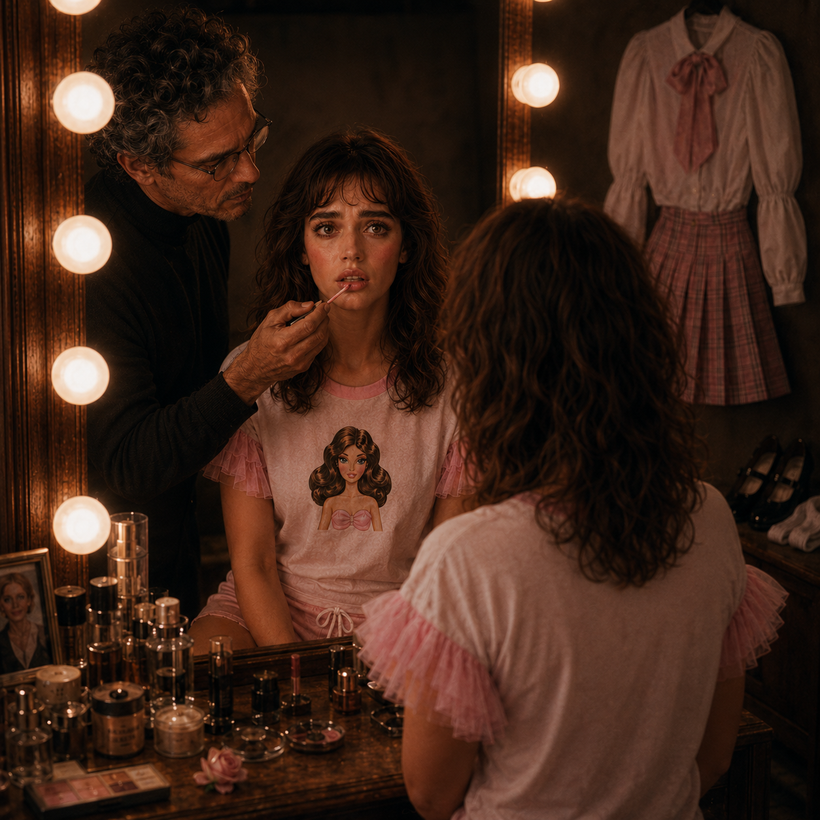
It had nothing to do with the chair, or the bulbs of the vanity mirror, or the Barbie shirt stretched tight and stupid across his chest.
It had nothing to do with the hair touching his neck.
That was what kept catching in his mind between memories of freer times: his hair. Not the length itself, not anymore, because after a while the body made arrangements with almost anything. It was the surprise of it. A soft brush at the corner of his jaw when he moved, completely unfamiliar as a sensation. A dark, smooth piece falling forward and being tucked away by Bonnard’s hand before Archie had fully registered that it was there.
There. No.
He blinked and tried to find the thought again.
Jamie’s garden.
He had been sixteen. Four cans, too quickly, and only because Jamie had done three, and then also because beer, in terrible quantities, seemed like one of those doors boys leap through without hesitation. For half an hour Archie had felt as if someone had loosened a wire inside him.
His arms had stopped asking where to go. His laugh had come out too loud and nobody had punished it. He had said something stupid to a girl he knew from his History class and she had laughed as if the stupidity was encouraged, for one night only. He had stood on a chair, actually stood there, one trainer on the plastic seat and one foot still on the ground, halfway to something, and felt the garden open beneath him like a stage he had not deserved but had somehow been given.
He had thought, with a seriousness that now made him ashamed, this is me.
Not the usual me. The real one. The one he would become once the fear wore off. Once he became a man.
Then, later, he had been sick behind the shed while Jamie sang along badly to a folk song, seemingly learned by heart or passed down from relatives, that Archie did not know. He had sat on the grass with his back against the fence, damp through his shirt, and understood with a slow, sour humiliation that the beautiful half hour had not been character. It had been chemistry. Things had moved inside him, while his mind sold him a romantic story; and then gave way to the inevitable.
Still, he had wanted that feeling back.
The private belief that if something outside him could quiet the officious little clerk in his head, the one who checked his hands and voice and face and every fractional proof of inadequacy, then perhaps the self underneath might not be so disappointing.
He didn’t like remembering the desperate want inside of him.
The room brought the memory back, then blurred it, and let it pass away.
It wasn’t drunkenness. Not that. He knew drunkenness. Drunkenness had made him reckless and simple and warm in the throat. This was not as simple.
The warmth here was lower and slower. It lay behind his eyes. It sat in his shoulders until they forgot what they had been holding. It hummed in silence, and settled into pauses. It lived in the spaces between a question and his ability to answer it. It had a smell that passed straight through him, and a taste that felt upside down on his tongue..
The music kept starting again without having stopped. Soft piano, almost too pretty to notice, then strings under it, then the piano again, the same little figure. He would catch it, hate it, try to count against it, and then his attention would slip sideways to the vanity bulbs, to the powder smell, to the pale mark where Bonnard’s hand had rested on the counter, to the white thing on the wall that he was absolutely, definitely, not looking at.
He was afraid. He supposed that was a good thing: fear meant he was measuring danger. Fear meant there was some part of him standing outside the process and adjudicating over it.
If he was afraid, then he was still in control. If he was in control, then he was still intact, in all the ways that mattered to him.
Bonnard moved somewhere behind him. A drawer sighed open. Something glass touched something wood.
Archie tried to turn the sounds into a list. Lists helped. Lists were proof of alertness.
Bottle. Brush. Drawer. Chair. Door. Mirror. Wall.
Wall. No.
Bottle. Brush. Drawer.
Music. Hair against neck.
His mouth was dry. He swallowed. It felt like something passed down his throat along with the saliva.
The room was warm enough that the air seemed almost physical, a soft fabric pressed over his face and passing in each direction at an unnamed pace. Not enough to choke him. Never enough to arrest, or disturb. Only enough to make every breath feel a little more like it was being conducted on his behalf.
Bonnard came back into view in the mirror with a small bottle between his fingers.
Archie stared at it before he understood he was staring.
"Your skin is very blotchy. Did you know that? Blotchy.” The words were spoken as lightly as if Bonnard were noting that a tablecloth had creased; with a near-academic interest.
Archie pulled himself upright. "I don’t care. I don’t even know what blotchy means.”
Bonnard looked at him in the glass. A small, calm look. No triumph in it. No raised brow. Nothing he could hate with any dignity.
"No. But you keep checking."
Archie looked away at once. He wasn’t sure if he had been looking, but looking away made it true in an instant.
He felt this new truth arrive in his face: a flush under the flush, heat gathering beneath skin that Bonnard had already described as if it were communal property. He wanted to say that checking was not caring. That he had eyes, and nowhere else to look. He wanted to say that a person could look at a festering wound without wanting it cleaned.
The thought began cleanly, then caught on the music.
A wound. Cleaned.
The white sleeve on the wall was visible in the mirror’s edge. It might have been there before. It could have been. He did not remember. He looked away.
Memory had begun arriving with gathered seams in it. One moment there had been only the garment bag. Then perhaps a hanger. Then fabric. Or perhaps he had avoided looking because the room had known he would eventually look anyway.
White fabric. A rounded shoulder. A cuff.
He fixed his eyes on the counter instead.
Bonnard opened the bottle.
"I’m not wearing makeup," Archie said. The words came quickly. Too quickly, perhaps, as if he had been waiting for a chance to sound like himself and had used the first one too hard.
Bonnard put a little of the liquid onto his fingers. "It would be unhelpful to think of it that way."
"It is makeup."
"It is a way of making distress less visible. It will help you perform more confidently.”
Archie held onto the arms of the chair. Distress less visible.
He hated the phrase, but understood its appeal. It was disgusting, the tidiness of it, the way Bonnard could make a violation of his will sound like generous gift by turning it around in his hand. But some tired part of Archie, some shamefully practical part, knew what it meant to have distress visible. He knew the social nakedness of shamed red cheeks.
Bonnard stepped closer. "Hold still."
"No." Good. That was good. That had come out clean.
But Bonnard did not argue. He waited.
The waiting filled with everything Archie was trying not to notice. His legs were cold despite the heat. The chair was too soft. The music gathered patiently in the corners. There was a smell of powder and clean cloth and something floral that seemed to open at the back of his throat. Bonnard’s hand hovered near his cheek, not touching, just near enough that resisting became an act, a performance, a thing requiring energy and audience and continuation.
Archie’s chin lifted by a fraction. Not permission. Not surrender.
Only a loosening, a small mechanical failure in the muscles of refusal.
Bonnard touched his face. The primer was cool.
He had expected something obvious. Greasy. Heavy. He had expected to feel makeup go on him as a female layer, a slick declaration he could identify easily and recoil from.
Instead it was nothing, almost. Coolness along his cheek. A dewy stain. A brief pass under his eye. A sweep at the side of his nose. Bonnard’s fingers moved with no more intimacy than was necessary, which made the intimacy harder to decline.
Archie’s anger arrived after the first cheek was done. It came up hot, found no point of impact, and spread uselessly through him.
The other cheek. Under the eye. Along the jaw.
He was going to pull back. He was sure of it. Then the brush of fingers became the lifting of the chin, and the lifting became the instruction to look slightly up, and by the time he identified the sequence as something he should have interrupted, Bonnard had stepped away.
Archie stared into the mirror. Nothing had happened. Something had happened.
That was the first small panic. His face had certainly not become a woman’s. It had not become painted, or comic, or transformed enough to provide him with the relief of clear horror. It had simply become less sharp. The shiny heat around his eyes had been softened. The red patches had quietened. His skin looked a little more even. He could intuit what blotchy meant, now, and supposed Mr Bonnard was right, while wondering why nobody cared to tell him before.
"There," Bonnard said, smiling.
The word landed too close to praise. Archie flinched.
Bonnard noticed and did not press. He had a way of placing a fact in the room and leaving Archie alone with it until it became larger than the words that had made it.
"There" stayed in the mirror. There, as if something had improved. There, as if his face had cooperated.
The white sleeve in the corner of his eye had become a blouse.
Archie did not know when the rest of it had entered the picture. Perhaps his eyes had moved. Perhaps the mirror had always contained more than he admitted. White blouse, puffy at the shoulders, a collar too narrow and crisp to be casual. The sort of collar that made a neck look accountable.
Beneath it, blurred by the angle, pink plaid. His attention slipped to it and stuck.
Bonnard picked up a small palette.
Archie saw colour in it. Pale green. Beige. Soft corrective shades. Nothing vivid enough to defend against.
"No."
The word was weaker this time. He heard it, and the hearing made him needier, almost frantic. He wanted to repeat it with force, to prove the softness had been accidental, but Bonnard had already lifted the brush.
"This is for the redness."
"I said no."
"I heard you."
"Then why are you doing it?"
"Because you are still red."
The simplicity made Archie dizzy.
He wanted to make a bigger deal of this. It was not about redness. It was not about whether his skin could be made neat enough for lights and cameras and whatever obscene, embarrassing purpose Bonnard kept drawing him toward against his wishes.
It was about control. It was about whether his face had the right to remain in the condition it naturally lived in. Nude, blotchy, whatever. It was about whether shame could be left visible as shame, or covered up so thoroughly that it looked like something else.
His thoughts rose in a cluster, collided, lost their order. Redness. Rights. Face. Mine.
The brush touched beside his nose. A small, soft stroke. The cluster broke apart. Archie relaxed his muscles.
The room seemed to take advantage of scale. That was what made it so difficult to fight. Nothing happened loudly enough, or brightly enough. The brush touched, lifted, touched again. A patch of redness disappeared under a colour Archie would never have noticed before. The correction was too slight to dignify a struggle and too intimate to endure peacefully.
Another touch under his eye. Another near his mouth.
The mouth.
No, not yet. He did not want to think about his mouth. Once he thought about a part of himself in this room, Bonnard seemed to find it. Archie looked hard at his knees instead. He felt a connection between those two parts; his knees and his mouth, as though even in their exposed positions they were a source of safety. They were where Archie was, in all of this.
The pink shorts looked far worse viewed from above, than they were when dangled from Mr Bonnard’s hand. Archie’s thighs looked pale and underprepared beneath them, as if he had been interrupted during something private. The Barbie shirt made no sense with his legs, with his face, with anything. He tried to feel some comfort in that. Wrongness was a kind of defence. A boy in a ridiculous shirt was still a boy. A boy in a ridiculous shirt could still show people the ridiculousness and expect them to understand.
Bonnard tapped the brush once against the palette.
The sound made Archie blink twice, rapidly.
"Look up."
He looked up. No. He had not meant to.
The objection in his mind came a moment late, and because it came late it sounded like a lie. Bonnard corrected under the other eye without comment. The brush moved in small strokes. Archie stared at the ceiling, where one of the lights had a faint dust ring around it, and tried to keep his anger intact by naming things.
Ceiling. Bulb. Brush. No.
Music. Perfume. Wall. No. Don’t look.
White blouse. No.
His thoughts trailed off, not into sleep, not into comfort, but into a deeply crowded softness where each object seemed to call his attention and spend it before he could use it. The room did not make him dreamy. It made him bad at deciding what mattered most. It confused his priorities.
The brush left him. Bonnard reached for a sponge.
Archie saw the movement and understood only as the sponge touched beneath his eye.
Concealer. He knew the word and hated knowing it.
The vocabulary had entered him by force of proximity. Extensions. Primer. Corrector. Concealer. Powder. Words that should have belonged to other people, to bathrooms and girls and his mother’s careful little bag before weddings. Now they had uses on him. They arrived with procedures attached.
The sponge tapped. Again. Again.
Bonnard did not talk much while he worked. That left Archie in the thick of it: the soft blunt pressure of the sponge, the warmth of Bonnard’s hand near his jaw, the faint smell of product, the mirror altering by increments. His own breathing began to sound too loud. He tried to quiet it, then became ashamed of having quieted it, then forgot why he had been ashamed because the sponge touched the corner of his eye and he had to stop himself flinching.
Each correction removed a little of himself from his face.
That was the part that made him wriggle in his seat. Not being ‘made over’. Not yet. Something colder, and quite administrative in feeling. His face had been angry, blotched, and swollen because he had suffered. Bonnard was making it possible for the room to deny how much. He was making it harder for Archie to see himself.
Archie gripped the chair arms. He wanted to feel ugly again. He wanted to feel like that was the direction he was heading in, rather than the opposite. He wanted to look like a person something was happening for. The mirror kept offering a person something was being done to.
Bonnard put the sponge down. Archie’s first breath afterwards shook. He hoped Bonnard had not noticed. Of course, he had.
"There is a difference," Bonnard said, "between stopping and undoing."
That was all. He left Archie with it, and stepped away.
The skirt was clearer now. Pink plaid, hanging below the blouse in disciplined pleats. The pleats were the problem. If it had been garish, if it had sparkled, if it had been stupid enough, he could have hated it. This was not stupid. It looked faintly normal. It may have been somebody else’s. His heart quickened at the thought.
It looked like an established system. It looked like corridors. Bells. Reports. Someone saying stand properly without raising their voice. Someone noticing whether socks were level. It looked like submission to the kind of transformation that everybody must go through as they grow up.
It looked like being returned to a smaller version of himself and then held there. University rose in him suddenly, vivid and wounded, half-betrayed.
Exeter. A grand old room he had never been to but had furnished in his mind with escape. He had imagined arriving there and becoming difficult to discern, like all great men. Nobody knowing which jokes had made him flush in Year Nine. Nobody knowing Jamie. Nobody knowing that Amy sometimes looked at him with a tenderness that felt like being undressed.
He had not thought of university as escape because that made it sound childish. He had called it independence; though all that was on his mind now was escape.
The skirt on the wall made the distinction feel thin.
Bonnard took up powder. Archie did not ask quickly enough. The brush was already moving over his forehead, wide and soft and strangely pleasant, almost like a massage, giving the feeling of skin being levelled flat. He hated the simple pleasure of it. Not pleasure, exactly. Relief. The soft sweep reduced the shine, cooled the little heat left by the earlier layers. He knew he should prefer discomfort. Discomfort proved it was wrong. Discomfort meant he was in control. Instead his body accepted the brush before his mind could instruct it otherwise.
"For the lights," Bonnard said.
The lights. The assessment room came back in fragments: the platform, the rows, the ornamental flowers donated from gardens around town, the old women at trestle tables, teachers smiling at the cruel village tradition. Boys laughing too loudly. Jamie surviving by turning mockery into adulation. Amy somewhere in the room. His mother, doubtless anxious about the worst case scenario.
His face under lights. This face.
"I’m not going back," he said.
The words came out smaller than he meant because his mouth would not move freely around them. Too much pressure and the gloss would tack. Too much anger and he would feel the pink stretch and shine. He had to speak carefully now, which made his carefulness sound like obedience.
Bonnard worked powder along the bridge of his nose. “Quite. You are not ready to go back."
The agreement cut low and deep. For half a second, Archie wanted to take shelter in it. Yes. Not ready. That was true. Never ready. Going home. But Bonnard had named the panic correctly. Archie could not go back like this. He could not be seen half changed, half crying, half made-up, half himself, contorted in stress and shame and misery.
Then, he understood the shape of the comfort. Not ready did not mean free. Not ready meant further preparation. It meant being pushed further, and further, fighting all the way, until… some miracle finality, where Bonnard was satisfied with his subject and Archie was confident enough to channel the charisma needed to play this off coolly. He struggled to imagine such an equilibrium. They surely couldn’t both be happy.
His breathing caught. The powder smell thickened with it, dry and sweet. He breathed too quickly, then too shallowly, because the room seemed to enter with each breath.
Powder. Perfume. Warm bulbs. Clean fabric. The faint plastic scent from the rollers waiting somewhere out of sight.
Waiting.
No. He did not know about rollers yet. Or he did. Had he seen them?
A drawer had opened. Plastic had clicked.
He looked at the counter. Bonnard had not taken them out.
Not yet.
Archie was sweating under the powder. A different compact opened.
This time he recognised the danger a beat sooner.
Blush.
"No."
The brush touched high on his cheek. It didn’t matter if he didn’t want to.
The colour was so slight that it made his refusal feel excessive, which was another form of humiliation. A soft warmth. Barely there. Barely anything. Another satisfying brush stroke. Just enjoy it while it’s there. It bloomed over the corrected skin as if the face itself had produced it.
"No," he said again, but now the word had to contend with evidence. The blush was already there. His face had accepted it. The mirror had accepted it even faster. He squinted to find himself as Bonnard added the same to the other side.
Archie sat still because moving would give Bonnard another reason to steady him, and being steadied had become more frightening than being altered. The blush settled. The room seemed to pause around it, giving him time to see.
It suited the shirt. The thought arrived like a sabotage from inside his own skull.
He looked down, then back, hoping the angle would break it. It did not. The Barbie shirt had been easier when nothing agreed with it. Earlier it had screamed against his raw face and damp eyes, a bright stupid thing thrown over the wrong body. Now the mirror had begun arranging small excuses around the offence. The warmth in his cheeks echoed the pink lettering. The evened skin reduced the ugliness that had kept the shirt separate from him. His longer hair, resting against his neck, made the neckline less absurd.
Not right. Never right. But less random, and more ready.
It had looked worse before. Now it looked more natural. Not quite his, but something it made sense for him to wear.
The grief of that was sudden and ridiculous. He missed the incoherence. He missed looking awful in a way that proved something had gone wrong. Bonnard had not made him beautiful. He hadn’t turned him into a woman - or worse. Archie did not think that. He refused that. But he had made the humiliation less easy to disown.
“A joke, if arranged carefully enough, and told expertly enough, can actually make a really intelligent point.” Bonnard watched him absorb the thought.
Archie looked away before it finished.
"I hate it," he said. “I hate being a joke.” He needed the words outside him, and so offered them freely to Mr Bonnard, even doubting as they passed why he would confide in such a man.
"Yes."
Bonnard’s answer was calm enough to make Archie want to plead. No, listen. I mean really. I mean this is still hate. I mean don’t take my quietness as anything else. I mean I’m here. I’m still here. I can see what you’re doing.
But pleading would make a shape of him. A smaller one. He swallowed it.
The small tube was already open when he noticed it.
That was how the room kept winning: not by hiding things, exactly, but by making him late to them. A smell, a thought, the skirt, the memory of Jamie’s garden, a brush moving, the music softening, the sleeve on the wall, and then the object had crossed the distance.
Something touched his mouth. He jerked back too late.
The cap clicked on. "What did you do?"
"Lip balm."
Archie leaned toward the mirror. Pink.
Not lipstick. That would have been easier. Lipstick had the dignity of outrage, and it was more drag than femme. This was a tint, a gloss, a soft wet colour pretending to be care. It caught the light at the centre of his lower lip and made his mouth look tender, which was the one thing a mouth should never look when the person inside it was furious. It felt like a violation of one of his safe spaces.
"You put colour on my mouth."
"Your lips were dry."
"It’s pink."
"Yes." Bonnard did not elaborate. He did not need to. The colour elaborated itself, made their own point expertly enough. Archie could feel it now that he had seen it, damp and faintly tacky, making him conscious of each breath and each swallowed word. His mouth was no longer the place speech came from. It was an object on his face.
Every protest would move through pink. His place of safety was pink. His means of control, the source of his charm, all pink.
He pressed his lips together. A tiny tack as they parted. He stopped.
The softness in his head deepened, or perhaps his panic rose into it and could not find the top. He wanted to wipe the gloss away. He wanted to scrape at it. He wanted to smear the entire face into something ugly and undeniable.
His hand twitched. Bonnard did not move.
That made him needier, absurdly. A part of him wanted to be stopped before he had to decide, and if he made the decision to leave then he’d have to face it, out there, the consequences of not going through with this obligation. If Bonnard caught his wrist, then resistance could remain pure because failure would be out of his control. If Bonnard commanded him, Archie could obey and hate the command.
Instead the decision belonged, horribly, to him.
He kept his hands down. For now.
The shelf beneath the uniform had produced socks, seemingly out of nowhere. White knee-high socks, folded with their cuffs aligned.
Beneath them, glossy black Mary Janes, equally materialised from thin air.
The shoes frightened him only slightly more than the blouse. He did not understand that at first, only felt a colder pressure behind his ribs. Shoes meant walking. Shoes meant this condition, moving through space, to wherever it was told to go. Clothes could be forced onto someone for a room, for a photograph, for a ritual. Shoes implied duration. Choice. A route. Corridors. Steps taken under observation.
The straps were narrow. The buckles small and bright. He wondered if they were new, or simply polished into an other-worldly glimmer.
He imagined his feet in them and felt his breath catch so sharply that Bonnard looked up, looking even a little concerned under his fixed attentive glare.
"You keep finding the next thing," Bonnard said.
It was softly said. Almost incidental. Archie wanted to cry because it was true.
His eyes kept doing it. Betraying him. Going ahead of him. Sleeve, skirt, socks, shoes, ribbon. He kept finding them. Each object became horrible not only because it waited for him, but because he understood its order. His mind, which was supposed to be defending him, kept assembling the outfit.
"I don’t want any of it," he said.
"No. That’s not for you. Those are somebody else’s.” Bonnard gave him the agreement and nothing else.
The silence after it was full of all the things agreement had not saved. Archie felt a thick warm tear form in the corner of one eye, which he focussed his entire being on absorbing back inside.
A drawer opened. This time the tweezers were in Bonnard’s hand before Archie knew why his stomach had tightened.
They were too small to be frightening, which was why they frightened him. His mother had used tweezers in the hallway mirror when he was little, leaning close with one eye narrowed while he waited beside her, impatient, holding his schoolbag. An ordinary object. Domestic. Almost silly. And painful, so he had heard. He feared that subversion from the soft sweep of the brushes to the sharp, cold point of a metal instrument. It felt surgical, clinical, transformative. It felt less relaxing. It felt like something he couldn’t wash away.
Bonnard lifted his chin. Archie’s skin remembered being touched and answered with warmth before his mind finished objecting.
"What are you doing?"
"Finding the line."
The words were quiet.
Archie waited for more because they did not make enough sense. Bonnard did not give more. The tweezers moved toward his brow.
“N-no.”
The first pluck happened through the word. A tiny pain. Bright. Precise. Then gone forever. Barely anything.
Archie went completely still. The scale of it was unbearable. A hair. One hair, perhaps a tiny second one. Nothing a person could shout or stomp about without sounding ridiculous. Nothing that could be presented to a normal room as evidence of harm. Yet the meaning of it opened violently inside him.
Removed. Not covered. Not softened. Not coloured. Removed. Stolen.
The second pluck came while he was still trying to understand the first.
His throat made a small sound.
Bonnard stepped back to look.
Archie lifted his hand.
"Don’t touch." Bonnard hissed.
Archie stopped. Not gradually. Not after thought. Stopped. His hand hung in the air with the shame of his body’s quick obedience. Then he lowered it, because the command was the only truth in the room and pride had arrived too late.
The little stings above his eye burned.
"You took it," Archie whimpered. The sentence came out stunned, almost childish.
Bonnard looked at him for a moment. "Yes. It was mine to take.”
"That isn’t makeup."
"No."
Then Bonnard put the tweezers away. He left Archie with the thought of the difference, and why he had allowed it to happen.
Something in Archie sank. Makeup could be temporary. He needed that belief. Primer, powder, gloss, blush - all humiliating, all intimate, all wrong, but theoretically removable. Water, tissue, soap, privacy. He had been holding those words somewhere in reserve.
The brow hair had no tissue solution.
It would grow back. Of course it would. The rational part of him knew that. The rational part of him was also becoming harder to locate in his mind. Somewhere behind the music. Behind the warmth. Behind the powder smell. Behind the white sleeve and the pink mouth and the tiny sting where Bonnard had taken a part of his face too small to mourn and too real to deny.
"Stand for a moment."
The instruction came so quietly that Archie began to obey it before he knew whether he intended to. He was beginning to hate that too. Being surrounded by only one truth, and always somebody else’s.
He pushed up from the chair too quickly. The room tilted.
Not dramatically so. Not enough to call it dizziness. Nothing like being drunk - in fact, nothing useful at all. Just a soft giving-way at the ankles, a little weakness passing through both legs at once, as if the carpet had moved up to meet him and the rest of him had failed to follow.
His hand reached out. It grabbed at the only stable thing in reach. It found Bonnard’s arm.
Bonnard was beside him. Of course he was beside him. The room had placed him there, or Bonnard had placed the room there, or Archie’s body had simply chosen the nearest stable thing before pride could object.
His fingers closed around a sleeve. Solid underneath. More solid than Archie expected. Bonnard was thinly built, neat, precise, but his arm under the fabric was strong. Not bulky. Not theatrical. Just certain. A body that knew where it stood.
Archie held on for one second too long. He realised it while still holding.
"I - I didn’t -" His voice broke against the pink dampness of his mouth.
Bonnard did not move away. He did not smile. He only looked at Archie with that calm, composed face, his expression neither reassuring nor unkind. Assurance lived in him without effort. Control did not have to assert itself because it had never left.
Archie let go. The place where his fingers had held Bonnard’s arm felt hot.
"You stood very quickly," Bonnard said.
That was all. No accusation, yet no comfort. Only a fact with Archie’s shame inside it.
A new drawer opened. Pink and white plastic lay in rows. This time they weren’t in his mind.
Rollers.
The word arrived with a strange, slow drop in his stomach.
“N-no. Please.”
Bonnard began placing them on the counter.
"No."
The second no sounded further away, as if carried on a different frequency.
The sweetness from the spray had not been sprayed yet. He knew that because Bonnard had not picked it up. But he could already smell it somehow, or imagine it, or remember some future version of it from the row of rollers and the music and the warmth. Anticipation became sensory before the event.
His attention scattered.
Rollers. Door. Brow. Gloss. Looking, always looking. Skirt Shoes. Bonnard’s arm. No.
Bonnard lifted the comb.
"Rollers are like a good joke,” he said.
Archie almost laughed because the sentence was obscene. Then it frightened him.
A joke. Not an act. Not a single thing to refuse. He had to be a good sport, like everyone else. Be part of the joke. Everything had its time, and this was his. This was his way of making him remain patiently waiting to perform long enough the purpose of the day slipped and confused in his mind, scattering his thoughts and bringing only the room into focus.
The comb entered his hair.
"No," Archie whispered in his mind, but the word had nowhere to go, so he didn’t utter it aloud.
"Watch."
He watched. Bonnard parted the hair at his temple, drawing the natural strands and the added length together until they became one section. Archie felt the comb travel over his scalp. The line it made was clean, almost cold. Then Bonnard’s fingers smoothed the section with a pressure near tenderness and not tenderness at all.
The first roller touched him. Hard plastic against long soft hair.
The length wound around it, both his and not his. The extensions lost their separateness under Bonnard’s hands. That was the private violence of it. Archie had been surviving them as additions, false pieces temporarily attached to him. Bonnard treated the whole length as one material. Hair to be sectioned. Hair to be set. Hair that had accepted the future shape before Archie had agreed it was his.
Both his and not his.
The clip snapped. His scalp tightened. Small sound. Small pull. His breathing caught. Another section. The comb again, slow enough that anticipation stretched.
Archie tried to follow the pattern as if understanding could recover power. Part, smooth, wind, clip. Part, smooth, wind, clip. Each cycle drew him further into the chair. His head grew heavier one little fixture at a time. Moving became complicated. Looking away tugged. Lowering his chin tugged. Resistance became full of small physical consequences. He longed for these instincts to move, to shift, or run, to simply pass and leave him to sit silent and still until this was all over.
The room smelled of plastic, powder, and heat. Then Bonnard sprayed something fine into the air. The sweetness settled on him.
It came down in layers. Not only the spray. The old perfume in the chair. The powder from his face. The cosmetic smell from the counter. The faint warm electric scent of the bulbs. He breathed in and lost, for a second, the beginning of his own next objection.
Not forgot. Lost entirely.
The anger was still somewhere. He could feel the colour of it. But the music had widened again, soft piano folding into strings, and Bonnard’s hand was at the side of his head, firm enough to place him, gentle enough that fighting it would look frantic.
He tried to gather himself around no.
The roller touched. The word scattered. By the fourth roller, he had stopped speaking.
By the sixth, he noticed he had stopped speaking. By the eighth, the act of noticing had become another thing he could not really find any purpose for, and so let go of it.
Bonnard turned the chair slightly toward the mirror. Archie looked because the mirror was there, because the chair had turned, because looking had become the smallest available task.
The rollers lifted the hair back from his face and made his eyes seem too large. The gloss had settled into his mouth until the pink no longer looked placed there so much as encouraged. The blush made him look warm rather than blotched. The brows, even with only that tiny theft of hair, opened his expression in a way he hated more because he could not call it dramatic.
The Barbie shirt was still awful. Of course it was.
But his face had been hard at work making room for it. It was as if his body was desperate to make it work; and it was winning the battle.
Archie stared at the reflection and waited for clean disgust to rise. He needed it with an almost sensual pull. Disgust would clear the fog. Anger would make the picture simple again. A boy. A joke. A room. A villain. A door.
What came instead was attention. He noticed the wet point of light on his lower lip.
He noticed the way one roller, high near the crown, gave the set a shape that was not pretty yet but intended to become so.
He noticed that his cheeks, no longer blotched, made his eyes look more helpless.
He leaned forward a little. Barely. Enough.
Bonnard did not smile. "There," he said, almost absently.
Archie sat back as if the word had touched him.
"No."
The denial came like a reflex. Too thin. Too late. A ribbon tied after the parcel had been opened.
Bonnard adjusted a roller. "Careful."
The word went through Archie’s scalp before it reached his mind. He had moved too quickly. The roller had shifted. Careful meant do not disturb it. Careful meant the thing done to him now required his assistance not to become worse.
He sat still. The stillness entered him as practicality and left as shame.
Bonnard moved behind him. "What frightens you?"
The question floated in the warm air.
Archie knew better than to answer.Then he answered. "People."
The word came out small and bare.
Bonnard let it remain that way. People.
The shame of it unfolded in the silence. Not clothes. Not even Bonnard. People. Eyes. Recognition. The outside world not as rescue, but as witness.
"They’ve already looked," Bonnard said at last. “They’ve already laughed.”
"Not like this."
He heard the need in his own voice and hated it. Not like this. It sounded almost like an appeal. Do not make them see me before I am ready. Do not send me out half made. Do not leave the joke visible and the answer unfinished.
Bonnard did not soothe him. He did not need to. Archie’s own mind completed the cruelty.
Jamie had been looked at. Jamie had made himself larger than the laughter. Jamie could wear stupidness like a silk armour because everyone knew what his angle was, or at least he had that hidden ability some men do, where he could make them believe he had what he needed.
Archie just absorbed laughter. It soaked into him. It stayed. The uniform on the wall did not look like laughter.
That was the problem waiting beneath all the others.
It did not look like panto. It did not even look like punishment in the easy, brutal way. The blouse was too crisp. The skirt too orderly. The socks too cleanly folded. The shoes too ready for walking.
It looked like classification. It looked like it had been made just for him, in some unseen test that was arriving to his doorstep at any moment.
Bonnard said, "Look at the blouse."
Archie looked at the skirt. He did not mean to. The pleats held him.
"Not that," Bonnard said.
The correction was quiet, and because it was quiet, Archie obeyed it with a little wounded start.
He looked at the blouse. White. Puffy. Crisp. A collar made to frame a face and hold it responsible.
The ribbon lay beside it, pink and narrow. Flat now. Harmless now. In his mind it found his throat.
"It’s childish," Archie said. “Stupid.”
The answer felt familiar enough to be a shield. Bonnard did not take it from him. He only tilted it.
"Does it make you feel childish? Just looking at it?”
The question entered before Archie could close against it. He did not answer.
Childish would have been safe, because it located shame in the garment. Does it make you feel childish brought the shame back into the body looking at it. The shame was in Archie, for even sharing a room with it, though he couldn’t place why, and lacked the mental dexterity to puzzle out why.
He felt suddenly small in the chair, knees together without remembering when they had moved that way, hands folded because leaving them loose made him feel messy. The rollers made his head feel held. The gloss made his mouth feel watched.
He thought of the corridors outside. He thought of his childhood home. He thought of school. He thought of teachers saying, "shirt tucked in", "speak up", "don’t mumble", "come on, Archie", with the same weary expectation that his body would always give him away.
He thought of university as a place where nobody would really be able to make him feel wrong.
Then he looked at the uniform and felt, with a sickening clarity, that it knew him already. That it knew he was wrong.
"I’m going to university," he declared, as though calling out his last and best idea, to nobody in particular.
It sounded absurd in the room. A complete non sequitar, like quoting a bus timetable during a medical procedure.
Bonnard was quiet long enough for the outburst to thin, and nearly disappear.
Then he said, "Yes." No argument. No prohibition. Nothing Archie could use.
The yes widened around him until it meant nothing useful. Yes, and? Yes, perhaps. Yes, in the old version of the story. Yes, if the person in the chair remained capable of reaching it. Yes, as a fact that had not yet met the stronger facts gathering in the room. Yes: Mr Bonnard knew the truth under the truth. It wasn’t about university, it was about becoming.
Yes meant becoming. Even set at their distance apart, Archie knew that Mr Bonnard understood him completely. He was becoming.
Archie stared at his own mouth and wished he had not spoken at all. The gloss caught the light again. His hand rose.
This time he meant it. Wipe it away. Smear it. Ruin the little wet shine. Turn his face back into evidence. He could almost feel the back of his hand across his mouth, the pink dragged sideways, the ugliness returned.
Halfway there, he stopped. The thought arrived before Bonnard could. It would smear. It shouldn’t smear.
For one suspended second his hand hung in the air. He was not protecting the gloss. He hated the gloss. He hated the mouth it had made, soft and visible, hated that every word had to pass through it, hated the way it made silence look more natural than speech.
But wiping it would spread the colour beyond the line Bonnard had made. It would make his mouth more obvious.
It would give Bonnard another reason to come close.
He lowered his hand into his lap. The obedience was almost nothing. That was why it was unbearable. He shifted back into his seat, and let his lips curl out into a self-abusing pout.
Bonnard watched him in the mirror. "Good."
Archie’s whole body heard. Not pleasure. He would not call it pleasure. It was relief, which was worse in some ways because relief did not need his agreement. Relief only needed the threat of something worse withdrawn.
"Don’t," Archie said.
Bonnard did not ask what he meant. He knew, and left Archie with the knowledge of being understood.
The door became necessary after that. Not chosen. Necessary.
The room had grown too full. The sweetness of the spray seemed to be inside his nose even when he breathed through his mouth. The music had stopped being background and begun touching the spaces between thoughts. The uniform waited in fragments his mind kept assembling. His face in the mirror was too calm to belong to him. His hands had learned their place too quickly.
He stood. Too fast.
The rollers pulled, a bright little pain across his scalp, and for a second the pain nearly made him sit again. That nearly was humiliating enough to carry him across the room.
He reached the door and closed his hand around the handle.
It did not move.
He tried again, harder, as if the first attempt had only been part of the room’s softness, as if metal might become honest if he put enough panic through it.
Nothing.
The simplicity of the locked door stunned him.
After all the perfume, the brushes, the questions, the mirror, the careful little thefts and soft corrections, there was still this. A lock. A direct fact. Something not psychological at all.
He turned back. "You locked it."
Bonnard stood by the counter. "Yes."
"You said I could leave."
"When you were dressed."
"I am dressed."
Bonnard’s eyes moved over him once. No linger. No relish. Just an inventory Archie felt as if it had been read aloud. Rollers. Blush. Gloss. Barbie shirt. Pink shorts. Bare legs. No socks. No shoes. No explanation fit for the corridor.
"You keep asking whether it is allowed," Bonnard said. "I am asking whether it is finished.”
Archie did not understand at first. Then he did, and wished he had not. He glanced at the clothes on the wall, that he knew were not his. His easy way out.
The question was not whether Bonnard had the right to lock the door, to touch his face, to place him beneath lights, to turn the whole day into a sequence of humiliations so careful they could not be interrupted without making him look ridiculous. Of course he did not. Of course it was wrong.
But in here wrongness had become weak.
Working was stronger. The lock was working. The makeup was working. The rollers were working.
The thing on the wall was working because Archie could no longer look at himself without understanding what it would organise inside of him.
"Not really," Bonnard said then, answering the older claim. I am dressed.
Archie looked at the door again, then caught himself in the side mirror.
Not the vanity mirror, with its lights and front-facing mercy. This was a harsher angle: bare legs, pink shorts, mouth shining, rollers high around his head, one hand still on the handle.
She looked like she was making a scene before she was ready.
Archie froze. She.
The word had happened inside him.
Not spoken. Not believed. Not wanted. It had simply risen to meet the image before he could stop it, because the mirror had supplied a person quickly and grammar had followed. A girl at a dressing-room door. A girl not yet finished, panicking too early, about to embarrass everyone by being seen before the work was done.
His stomach dropped so hard he thought he might be sick.
No.
He tried to correct the sentence. He looked like he was making a scene. He lifted his hands to his head and rested his palms on his temples in shock, as if hoping to open something up and let the terrible thought fall out.
But the correction came late and thin, and the first version remained in the glass, breathing through his pink mouth.
He stepped away from the door.
The walk back to the chair was only a few steps, but every step had to negotiate with what Bonnard had done. The rollers tugged if he moved too quickly. The shorts brushed high on his thighs. The gloss asked his mouth not to tremble. The powder held his face together better than he could. He sat down carefully because careless sitting would make the whole image worse.
Carefully. The word hurt.
He placed his hands in his lap, folded over one another.
Bonnard had not told him to. The silence noticed. That was enough. Archie felt comfort in the chair, in the sense that he had come to his senses, and done the right thing. He had to finish.
Bonnard came behind him and corrected one roller that had shifted during the door attempt. A tiny return to order. The lightest tug. The smallest proof that even resistance could be folded back into preparation.
Archie stared at his hands. They looked obedient when folded.
He spread his fingers. They looked sulky. He folded them again. Almost cried. Stretched them back out. Much better. More obedient, now. Under his control.
Bonnard allowed him the small privacy of not mentioning it.
For a while, there was only the room.
Warmth. Music. Powder drying on skin. The rollers’ tiny pulls. The wall.
The uniform had become the most resolved thing in his world. It did not move, which made it seem patient. The blouse would cover all shame. The skirt would explain the shimmer of his legs. The socks would make the shoes possible. The shoes would make it clear that this was all a choice. The ribbon would tell the face what it was for.
He did not want to wear it. He just wanted not to be as he was now. The difference was small enough for his senses to explore comfortably, safely, as if there were one nook in his thoughts that Mr Bonnard couldn’t see.
"It doesn’t look like a joke," Archie said.
He had not known he would say it.
Bonnard did not answer quickly. The silence gave the sentence time to become irreversible.
Outside, somewhere beyond the wall, a door closed in the town hall. An ordinary sound. A hard, public sound. For one second Archie imagined the wider building around them: corridors, noticeboards, tea urns, volunteers, dull carpet, someone laughing too loudly near a table of cakes. Normality existed close enough to hear.
It did not come in.
"No," Bonnard said at last. "It doesn’t."
Nothing more. Archie waited for the next line, the explanation, the humiliating conclusion. Bonnard did not supply it. That was his method, Archie was beginning to understand. He did not always finish the cruelties. He brought Archie close enough to them that Archie had to look down and discover the drop himself.
It does not look like a joke. But you will.
Therefore Jamie could not save him by laughing. Therefore Amy could not pretend not to understand. Therefore his mother might understand too quickly. Therefore university was not a future self waiting somewhere clean and untouched, but a story he had been telling about distance, and a distance that now seemed further than at any time since his birth.
No.
The word rose in him, large and hot.
His mouth stayed closed. It wasn’t for him. It couldn’t cross the barrier.
Pink. Careful.
Bonnard began putting away some of the cosmetics.
A compact closed. A brush slid into its place. A cloth passed over the counter.
"What happens now?" Archie’s voice sounded raw beneath the polished mouth.
Bonnard did not look up. "Now you wait."
"For what?"
"For it to settle."
Archie did not know whether he meant the hair, the makeup, or the thought. Perhaps it was all of them, or something else. Waiting became its own procedure.
Minutes passed, or something like minutes. Time in the room had no clean edges. The music repeated without admitting repetition. The warmth pressed close. The perfume and powder sat in his throat. The rollers held him in small, constant negotiations with stillness. Every so often he became aware of his mouth again and had to resist the urge to press his lips together to feel that satisfying sweet tack of their parting.
The uniform waited. The thing on the wall, filling his mind with poison. He tried to imagine it on someone else.
On Jamie, it became comedy instantly. Jamie would bow in it, shout something filthy, make the socks part of a joke before anyone else could. He could drag the whole outfit into his orbit and survive it.
On Archie, even in imagination, the uniform did not become funny.
It became correct.
No.
Not correct. Coherent. A subtler word, and much more dangerous.
He thought of Amy and then could not. Her face rose too clearly. Not laughing, worse. Stricken and tender. Seeing him softened and arranged, recognising some private thing she had loved in him made public and visible and available for comment. Made into a joke. He had resented her tenderness sometimes because it seemed to know too much. Now he wanted to crawl back inside it and hide.
He thought of his mother. Stopped.
He thought of University. The word dimmed before the room reached it.
He tried harder. Lecture halls. Freshers. A student card. A room of his own. New sheets. Things he could picture without knowing how they really looked. Nobody knowing him. Nobody knowing which parts of him had always been easy to bruise.
Nobody knowing. Nobody looking. Nobody to laugh at him.
Bonnard’s earlier question returned without needing Bonnard’s voice. Was that independence, or only privacy from evidence?
Archie’s eyes filled. The makeup held him together. That made him lonelier than crying would have. He was alone under the mask.
He leaned back slightly. A roller tugged. He corrected his posture at once. Again, practical. Again, humiliating.
The body learned the room faster than the mind could protest it. Sit this way. Do not touch the mouth. Do not move the head too quickly. Do not smear. Do not loosen. Do not make it worse. Every rule arrived as self-preservation. Every act of self-preservation left him more arranged.
Bonnard noticed the posture correction. He said nothing. It was right. It didn’t require correction.
Archie was filling in his own silences. The silence praised him anyway.
He shifted in the chair. His knees had come together. He had not done that. Except he had.
They were pressed neatly, almost primly, beneath the hem of the shorts. For one angry second he moved to separate them, to sit with his legs apart in the broad, careless way Jamie would have done without needing to think about it.
The shorts pulled. The exposed skin of his thighs seemed suddenly louder. His knees came back together. It wasn’t right.
The movement was small. Almost invisible. A correction nobody had asked for.
Archie stared at the uniform until the pleats blurred. Fear remained. Desire emerged.
He clung to that, but it had changed allegiance. It no longer pointed simply at Bonnard, or the lock, or the door. It pointed at smudging. At being seen half finished. At the Barbie shirt without the blouse. At bare legs without socks. At knees clutched close beneath shorts that no longer looked like spare clothes now that his face had started taking ownership of them. At the raw boy beneath the preparation becoming visible and making everything even more humiliating.
He closed his eyes.
The thing on the wall remained behind them: blouse at his throat, skirt at his waist, socks pulled up smooth, shoes buckled, ribbon placed. His face above it, softened enough that the room would not have to work so hard.
He opened his eyes quickly. The mirror was waiting. Not complete. Nowhere close.
But close enough for dread to track over his brain, physically and with harsh track.
"I’m not wearing it," he said, to himself. He needed to hear the sentence.
Bonnard was cleaning a brush in small, neat circles. "No."
Relief came first. Then the shape inside it. Archie heard it in the silence. Not yet.
The warmth deepened, or he sank further into it. It was hard to tell. The room seemed to breathe more slowly than he did, and after a while his breathing tried to match it. He fought that, then noticed he was fighting his own lungs, then became so frightened by the uselessness of that fight that he had to look at the wall again.
The uniform looked less frightening than the mirror.
Then the mirror looked less frightening than the door. Then the door looked impossible. Locked. Impenetrable. The edge of the world. Everything he needed right here. The comfort beneath him, the safety between his legs. The pink filter for his words. That pleasant tugging constriction in his hair, as every follicle was locked right where it needed to be.
His attention moved between them, searching for a place that did not alter him by being seen. There was none.
Bonnard moved somewhere behind him, quiet and unhurried, arranging things Archie could not see.
Archie did not turn.
In the glass, the softened face watched the uniform. Pink mouth closed. Hands folded. Knees together. Rollers still. A body waiting because it had learned, in small practical ways, that waiting was safer than making a mess.
The thing on the wall waited too. Archie watched it carefully. It had all the time in the world, in a world of its own.
If you liked this post, you can leave a comment and/or a kudos!
Click the Thumbs Up! button below to leave the author a kudos:
And please, remember to comment, too! Thanks.

Comments
It feels like seduction
Maybe that’s what Dallas was suggesting, in her comments about classic interrogation techniques. Bonnard doesn’t seem to be all that interested in the answers Archie is providing, and doesn’t ask all that many questions. But he is extracting information, nonetheless. All of it pointing toward the conclusion that seemed to have been predetermined before he head Archie into the private room. Archie is being seduced into accepting a very one-sided view of who he is, and, perhaps more importantly, who he could be.
Everything we’ve read so far suggests that Archie was coddled and cosseted as a child. By his mother, and by the (female) teachers in his life. He is even indulged by his girlfriend, but the pattern was clear long before then. What we can’t know is whether that is nature or nurture. Whether one led to the other. It is possible, of course, for “delicate” boys to get over it and become vigorous, even domineering, men. Theodore Roosevelt provides one of the best examples. The screening process this fictional society uses appears to foreclose that possibility for late bloomers.
Of course, a boy who presents as delicate and soft may be trans, but that’s not inevitable. Nor does presenting in a more robust, “masculine” way preclude the possibility that a boy is trans, and is just faking it. Indeed, in a society organized like the one in the story, there would be a high premium on doing precisely that. Indeed, I imagine that even a boy who was secretly trans would work very hard at creating a highly believable masculine persona, since the alternative isn’t just to be female, but to be no different than a slave.
Which is Archie? So hard to say! Formed and shaped by the women in his life, he seems malleable and soft, incapable of resistance. His body’s default is to become smaller; less offensive. Frequently, we are told that he brings his knees together. Clasps his hands in his lap. The schoolgirl uniform he sees in the mirror appears to fascinate him even as it repels. It is an escape from the constant effort to prove himself; an escape from the adulthood he was preparing for. Presenting it, leaving it there, not forcing the matter just yet . . . that is all part of Bonnard’s seduction. He is letting time, and the room, the music, the scents, the cosmetics, and the clothes work on Archie, wearing away his resistance.
Alright. Enough. You’ve got me where Archie is, I think: repulsed and fascinated. Unable to look away. That’s . . . some good storytelling.
— Emma
Excruciating
This chapter plays out like Archie's been in the room for an hour, but the chapter probably really lasts five minutes. It feels like an hour to Archie because of the way Bonnard is playing him. Bonnard does this for a living; he's seen Archie's type come through before, and he knows he can torture them in exactly this way.