
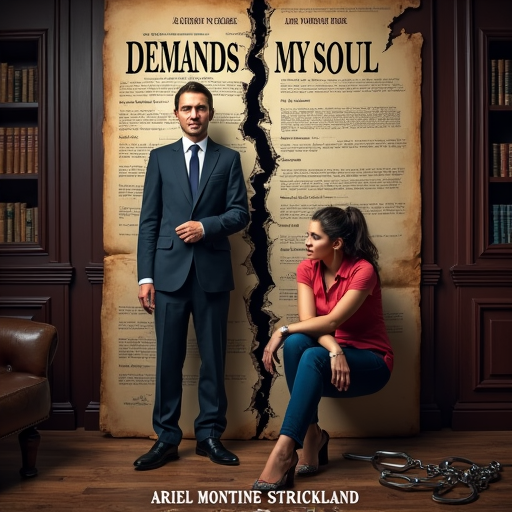
Demands My Soul
A Transgender Heroine's Journey & Romance Novel
From THE ONE Universe
Chapter 17: The Hearing Begins
By Ariel Montine Strickland
What will Beau's testimony do to Craig's case against Delores in the preliminary hearing held?
Copyright 2025 by Ariel Montine Strickland.
All Rights Reserved.
Opportunity: Would you like to read a story not yet presented on BCTS for free? All that is needed is to become a free member of Ariel Montine Strickland's Patreon to read the all-new book by chapters, Things We Do for Love. Please Don't Miss It!
Author's Note:
"Love so amazing, So divine, Demands my soul, my life, my all"
The author was inspired by these words in writing the title and this novel and gives thanks to THE ONE above.
Chapter 17: The Hearing Begins
The Fulton County Courthouse stood like a monument to justice on Pryor Street, its neoclassical columns and granite facade projecting an authority that made Delores's stomach clench as she climbed the steps beside Rebecca Chen. The October morning was crisp and clear, but she felt none of the autumn beauty—only the weight of what was about to unfold inside those imposing walls.
"Remember," Rebecca said quietly as they approached the security checkpoint, "this is just a preliminary hearing. Judge Morrison, no relation to your family, despite the name, is simply determining whether there's sufficient cause to proceed with a full trial."
"And if she decides there isn't?"
"Then Craig wins by default, and you're left with the pittance your parents allocated for 'moral failures.'" Rebecca's voice was grim but determined. "But that's not going to happen. We have a strong case, and we have something Craig doesn't expect."
"What's that?"
"Your brother Beau."
Delores had spoken to Beau only once since his return from Iraq three days earlier, a brief phone call where he had assured her that he would be at the hearing and that he had "some things to say that might surprise everyone." She hadn't known what to make of that cryptic statement, but the certainty in his voice had given her hope.
Now, as she spotted him across the courthouse lobby, she barely recognized the man who had left for deployment eight months ago. He was leaner, more weathered, carrying himself with the careful alertness of someone who had spent months in a war zone. But more than the physical changes, there was something different in his bearing—a settled confidence that spoke of hard-won wisdom.
He wore his dress uniform, the chaplain's insignia clearly visible on his uniform jacket. There was the addition of the collar worn by Episcopal Reverends. When he saw her, his face broke into a smile that was both familiar and transformed, and he crossed the lobby with purposeful strides.
"Delores." He embraced her without hesitation, and she felt tears spring to her eyes at the uncomplicated affection in the gesture. "I'm sorry I couldn't get here sooner. The flight from Virgina was delayed. I had to go to Virginia to pick up some documents."
"What kind of documents?"
"Seminary transcripts, ordination certificates, theological position papers." His smile grew more mysterious. "Let's just say I've been doing some homework while I was in Virginia."
Craig appeared at the far end of the lobby, flanked by two attorneys in expensive suits and a woman Delores didn't recognize. When he spotted Beau in his chaplain's uniform, his expression shifted from confident to uncertain, as if he was trying to calculate the implications of his brother's unexpected transformation.
"Timothy," Craig said as he approached, his voice carefully neutral. "I wasn't sure you'd be here."
"Her name is Delores," Beau replied quietly, his tone carrying an authority that made Craig take a step back. "She's been Delores for sixteen years, Craig. She's our sister, and if you can't see that, then you're the one who's lost sight of family values."
"I see you've been influenced by some very progressive ideas while you were overseas," Craig said, his lawyer's instincts kicking in. "Perhaps we should discuss this privately before—"
"There's nothing to discuss privately. I'm here to testify on behalf of my sister, to speak the truth about THE ONE's love and what family really means." Beau's voice carried the conviction of someone who had wrestled with angels and emerged transformed. "I'm here as an ordained minister in the Episcopal Church to challenge the religious arguments you're using to justify your greed."
The word 'greed' hung in the air between them like an accusation, and Delores saw Craig's mask of professional composure slip for just a moment, revealing the uncertainty beneath.
Inside the courtroom, the atmosphere was charged with tension and expectation. Judge Patricia Morrison, a woman in her sixties with silver hair and sharp eyes, presided from the bench with the kind of authority that came from decades of sorting through family disputes and human frailty.
Delores sat at the plaintiff's table with Rebecca, her hands folded in her lap to hide their trembling. Behind her, she could feel the presence of her chosen family, Maria, Paula, Dr. Martinez, several members from her support group, and Serina, whose steady presence gave her strength.
Across the aisle, Craig sat with his legal team, occasionally glancing back at the gallery where several people Delores didn't recognize had gathered. Potential witnesses, she realized. People prepared to testify about her character, her relationships, her worthiness to inherit her parents' estate.
"This is a preliminary hearing," Judge Morrison announced, her voice carrying clearly through the courtroom, "to determine whether there is sufficient cause to proceed with a full trial regarding the estate of Harold and Margaret Morrison. Mr. Craig Morrison has challenged the inheritance claim of..." she paused, consulting her notes, "Ms. Delores Morrison, on the grounds that she has failed to meet certain conditions outlined in the deceased's will."
Craig's attorney, a sharp-faced man named Whitfield, rose to present their opening argument. His voice was smooth, professional, designed to make discrimination sound like reasonable moral standards.
"Your Honor, this case is fundamentally about honoring the clearly expressed wishes of the deceased. Harold and Margaret Morrison were devout Christians who believed strongly in traditional family values. They included specific moral requirements in their will because they wanted their estate to support behavior that aligned with their deeply held religious convictions."
He gestured toward a stack of documents on his table. "The evidence will show that the individual currently known as Delores Morrison is legally and factually Timothy Morrison, a male who has chosen to live in violation of his birth-assigned gender. Furthermore, recent surveillance has documented that this individual is engaged in a homosexual relationship, directly violating the will's requirement for moral behavior consistent with traditional values."
Delores felt her cheeks burn with anger and humiliation. The way Whitfield spoke about her—as if she were a fraud, a man in disguise, a violation of natural order—made her want to stand up and scream the truth of who she was. But Rebecca's hand on her arm kept her seated, kept her focused on the larger battle they were fighting.
"The deceased had every right to distribute their estate according to their moral convictions," Whitfield continued. "This court should not substitute its judgment for theirs, should not override their clearly expressed wishes simply because modern society has different views on these matters."
When Rebecca rose to respond, her voice carried a different kind of authority—the moral authority of someone fighting for justice rather than justifying prejudice.
"Your Honor, this case is indeed about honoring clearly expressed wishes—but not the wishes of the deceased. This case is about honoring THE ONE's clearly expressed wish that all people be treated with dignity and respect, regardless of their gender identity or sexual orientation."
She moved to stand directly in front of the judge, her posture confident and commanding. "The opposing counsel would have this court believe that discrimination is acceptable if it's dressed up in religious language, that prejudice is permissible if it's written into legal documents. But the law is clear—inheritance conditions that violate public policy are unenforceable, and discrimination based on gender identity and sexual orientation violates the most fundamental principles of human dignity."
Rebecca gestured toward Delores. "Ms. Morrison is not Timothy in disguise. She is a woman who had the courage to live authentically despite the cost, who has built a life of meaning and contribution, who deserves equal treatment under the law regardless of what her birth certificate says or who she chooses to love."
Then came the moment that would change everything. Rebecca called Beau to the witness stand, and he rose from the gallery with the bearing of someone who had found his calling and was ready to answer it.
The bailiff swore him in, and Beau placed his hand on the Bible with the reverence of someone who had spent months studying its true meaning. When he stated his name and occupation for the record, his voice carried clearly through the courtroom: "Beauregard Morrison, ordained transitional deacon in the Episcopal Church, currently pursuing ordination as a priest."
The murmur that rippled through the courtroom was audible, and Delores saw Craig's face go pale as he realized what was about to happen.
"Reverend Morrison," Rebecca began, "you are the brother of both the plaintiff and the challenger in this case?"
"I am the brother of Delores Morrison and Craig Morrison, yes."
"And you have recently returned from military deployment overseas?"
"I have. I spent eight months in Iraq working security and as a chaplain while completing my Master of Divinity degree through correspondence with Virginia Theological Seminary."
"Can you tell the court about your theological education and how it has informed your understanding of this case?"
Beau straightened in the witness chair, and when he spoke, his voice carried the authority of someone who had wrestled with scripture and emerged with deeper understanding.
"Your Honor, I was raised in the Southern Baptist tradition, which taught me that THE ONE's love came with conditions, that divine acceptance required conformity to human interpretations of morality. But my seminary education opened my eyes to the true message of scripture, that THE ONE's love is radical, inclusive, transformative."
He paused, his gaze moving to Delores with unmistakable affection. "I studied the original Greek and Hebrew texts, learned about the cultural contexts of biblical passages, discovered how much of what I had been taught was human interpretation rather than divine command. And I realized that my sister Delores is exactly who THE ONE created her to be, not a mistake to be corrected, not a test to be endured, but a beloved daughter whose authentic life is a gift to the world."
The courtroom was completely silent now, everyone hanging on Beau's words as he continued his testimony.
"The opposing counsel has argued that my parents' will should be honored because it reflects their religious convictions. But I submit to this court that those convictions were based on fear rather than faith, on human prejudice rather than divine love."
His voice grew stronger, more passionate. "THE ONE's love doesn't come with gender requirements. THE ONE's love doesn't demand that we conform to other people's expectations of who we should be. THE ONE's love sees the heart, the soul, the authentic self that exists beneath all our performances and pretenses."
Beau turned to look directly at Craig, his expression sad but determined. "My brother Craig is using our parents' inability to accept Delores as justification for his own greed. He's taking their fear and turning it into a weapon against our sister's right to exist. That's not honoring their memory, that's betraying everything they should have stood for as people of faith."
"Objection!" Whitfield was on his feet, his face flushed with anger. "The witness is offering theological opinions, not factual testimony."
If you liked this post, you can leave a comment and/or a kudos!
Click the Thumbs Up! button below to leave the author a kudos:
And please, remember to comment, too! Thanks.


Comments
Powerful
Delores has found a true defender and champion in Beau.
Real love is fueled by compassion and understanding, not by greed and a lust for power. It doesn't sneer or laugh at the less fortunate or invent new ways to make them miserable.
I am not religious but this story enshrines the true spirit of Christianity, not the shiny suit of Sunday-in-Church.
Changed Chapter and REAL unconditional love
Hi Y'all,
You may notice if you are re-reading this that the chapter is much shorter instead of a super-sized one. I cut the original chapter off and left a mini cliffhanger. After that point I added to the story enough added text that I felt the chapter had to be split. With this change the entire book is 32 chapters and about 74,000 words. Since much of the next chapter is a repeat, I'm planning to post 2 chapters on the same day when the next chapter premiers on BCTS.
Folks that display REAL unconditional love still exist even when it seems that the 'Christian' (not my definition) Nationalist don't. But you can see that there are exceptions to the generalities of any group. I know about a wonderful Episcopal Church in the Denver area that the people really practice REAL unconditional love that sees souls and not shells. Beau is a composite of many Episcopal Clergy that I know about who are genuine.
Sure, we all have our failures since we are human, but I don't want my worth to be judged by my failures, so I try not to judge others for theirs. But I can say when I've been hurt and I can make choices to try to minimize my exposure to people who have hurt me since I don't want to be hurt again. Beau might seem like a unicorn, but I can vouch that I have personal experience to my great delight knowing normal people who practice true love like Beau does in this book.
In the Love of THE ONE,
Ariel Montine Strickland