
Author:
Audience Rating:
Publication:
Genre:
Character Age:
Other Keywords:
Permission:
 |
(Volume One)
Chapter 6/15
Copyright © 2026 Tara Nicole Miller
All Rights Reserved. Word Count 5,100 |
The Curious Incident of the Bathroom in the Daytime
"A grown-up is a nasty, smelly, dangerous thing. He knows it all, and if he doesn’t know it, he’ll make it up."
~ Roald Dahl, The Witches
The quiet coldness of Mr. Wormwood had a way of seeping into everything. He didn't make a scene; he just watched. His eyes were everywhere, and I knew he was still watching me. It made my tiara feel a little heavier, and my sparkly shoes a little less bright. I stopped wearing the tiara to school.
But the day the conflict came to a head, I wasn't wearing my tiara. I was just being myself. Plain, boring, Sage. I was just a girl in the bathroom.
I had to go after lunch, and I went to the girls' bathroom, as I always did. It was a normal day, a normal trip, and a normal bathroom. I was washing my hands and humming a little song when I saw him in the reflection of the mirror behind me. Mr. Wormwood. He was standing in the doorway, his arms crossed over his chest, his eyes cold and still.
I gasped, put my wet hand over my rapidly beating heart, and froze.
"Young man," he said, his voice flat. "The boys' bathroom is down the hall."
My heart continued to beat a tiny drum in my chest, then a big bass one. I didn't say anything. I couldn't.
"You heard me," he said, stepping into the doorway. "Boys' bathroom. Down the hall. Now."
He didn't yell. He didn't say anything mean. He just said the words, as if they were a simple instruction, like "turn left" or "the bus is here." But the words felt like they were made of ice.
I just stood there, my hands still in the water, my heart beating in my throat. He wasn't going to move. He was just going to stand there until I went to the boys' bathroom.
I knew that going to the boys' bathroom would be a lie, as well as being really embarrassing. It would be a lie that he was telling, and a lie that I would be living. I didn't want to live that lie. I wanted to tell him that I was a girl. I wanted to tell him that this was my bathroom. But the words wouldn't come. They were stuck somewhere between my heart and my mouth.
It was in that moment, in the silence of the girls' bathroom, with the cold eyes of Mr. Wormwood on me, that I learned a terrible new truth about the world. I learned that some people's ignorance is so powerful that it can make a truth feel like a lie. And a lie, the truth. And in that moment, I knew that my mom and dad's armor wasn't strong enough to protect me from everything. I was on my own. I was just a little girl, and he was a big man, and there was nothing I could do.
My mom knew something was wrong the moment I got in the car. I was quiet, my hands were clammy, and my shoulders were hunched, a small, deflated shadow in the passenger seat. She didn't press me. She just turned the radio off and drove in silence, her hand on my knee.
When we got home, she made me hot chocolate with extra marshmallows, a special treat for bad days. As I sat at the kitchen table, slowly sipping the warm potion, she sat across from me and just waited.
I didn't want to talk about it. It felt too big and too ugly to put into words. But then I saw my mom's face, so sad and so full of worry, and the words just tumbled out. I told her about the bathroom, about him calling me "young man," about the coldness in his eyes.
Her face went pale, and her eyes, so full of warmth a moment ago, now looked like a storm was brewing in them. She didn't say anything. She just got up and went to the phone. She made one call to my dad at his office, her voice low and tight. I couldn't hear what she was saying, but I knew. I knew everything was about to change.
Dad came home earlier than usual, his face a hard mask that mirrored mom's. He didn't even stop to take off his coat, just knelt on the floor and pulled me into his arms. The way he held me was different, not the playful, happy hug I was used to, but a tight, fierce embrace, as if he could shield me from the world with his own body.
"What did he do?" he threw out to the room, the universe, his voice low and tight, his eyes never leaving Mine.
Mom told him everything, her voice shaking with a quiet rage. "He stood there and told her the boys' bathroom was down the hall. Just like that. Like it was a simple instruction. Like she was a boy."
Dad closed his eyes for a moment, his jaw clenching. He took a deep, shuddering breath and looked at his wife. "We're going to that school," he said, his voice a low rumble. "Now. I don't care what time it is. We're going."
Mom shook her head. "It's after five, Michael. He's not there."
"He's there," he said, his voice filled with a terrible certainty. "He's there. He's a man who has no life. He's there."
He was right.
When we arrived at the school, the lights were on in the principal's office. The parking lot was empty save for our car. The cold was a physical thing, a living, breathing monster that swirled around us. Dad walked ahead, his shoulders set like a soldier marching into battle. He didn't even knock. He just opened the door and walked in.
Mr. Wormwood looked up from his desk, a flicker of surprise in his cold eyes. He rose to his feet. "Can I help you?" he asked, his voice still that flat, affectless tone.
Dad didn't answer. He just stood there, a great, broad man, a wall of indignation. He didn't yell. He didn't make a scene. He just looked at him with an intensity that made the room feel suddenly very small.
"My daughter came home from school today," Dad said, his voice as low and steady as a heartbeat, "and she told me what you said to her in the bathroom. You shouldn’t be in the girls’ bathroom to begin with. What are you?"
A flicker of something—a mixture of annoyance and disdain—crossed Mr. Wormwood's face. "I'm not sure what you're referring to, sir," he said, his voice still calm, "but I can assure you that I was simply following school policy, and was completely within my rights as a school administrator."
"School policy?" Dad said, his voice gaining a dangerous edge. "School policy is to make sure our children are safe. You made my daughter feel unsafe. You made her feel like a lie. You made her feel small and worthless."
"It's a matter of biological fact, sir," Mr. Wormwood said, his chin lifting a little. "Your so-called daughter is a boy. A poor excuse of one, if I may say."
That was when the war began. It wasn't a shouting match. It was something far more terrifying. Dad didn't raise his voice. He just looked at Mr. Wormwood, and in his eyes, he was not a man, but a warrior.
"My daughter is a girl," Dad said, his voice a whisper, but it was a whisper that felt louder than a shout. "And if you ever, for one second, make her feel like she is anything else, I will do everything in my power to make sure you never work in a school again."
And then, he didn't say another word. He just stood there, and in the silence, Mr. Wormwood understood. This wasn't a conversation. This was a promise.
When we got back home, my dad's face was a closed book, just like Mr. Wormwood's. But his eyes were a different kind of cold. They were the cold steel of a warrior, not of a coward. He sat me on his lap and held me tight.
"You are a girl," he said, his voice as firm as a rock. "And you will use the girls' bathroom. Always. Do you understand?"
I nodded, my head against his chest.
"If he persists, if he doesn’t back down, we are going to fight this," he said. He didn't say "we'll talk to him." He said "we will fight this."
And that's when I knew. This wasn't a talk. This was a war. My parents, my warriors of love, were going to battle a man with a cold heart and a the majority stake in a one-sided argument, and I was going to be the reason for it. My heart, so small just a moment ago, felt a little bit bigger. I was still scared. But I also felt a little bit like a warrior. With just a little Maid Marian thrown in for good measure!
The days after the big talk between my dad and Mr. Wormwood were strange. My mom started driving me to school again, and now she walked me to the front door, her hand on my back like a shield. I didn't see Mr. Wormwood at first. It was like he was a ghost, a cold shiver of ectoplasm that followed me without being there. The normal noises of the school had come back, the happy chatter and the clatter of shoes, but the air around me felt a little different. It felt like I was being watched from behind a two-way window.
And I was. He wasn't in the hallway anymore, but I would catch glimpses of him through the glass of his office door. His eyes, cold and empty, would flicker over me, and he would turn away so fast it almost seemed like I had imagined it. He didn't say anything, but he didn't have to. The silence was louder than any words he could have used. It was the silence of a person who has made up his mind, a silence that said, "You are a problem I cannot solve. You are a truth I do not want to see."
I had moments of little-girl-anger and confusion. I wanted to run up to him and shout, "I'm a princess! I'm a warrior! My dad said you can't be mean to me!" But a bigger feeling, a quieter one, took over. I thought about the way my dad had gone into that school, so big and so strong, to fight for me. And I thought about how he had won, not by yelling, but by just being brave and telling the truth. I had a different kind of armor. My dad had taught me how to fight, but I knew, in my heart, that there was another way.
One night, I went to my mom in the kitchen. She was making dinner, and the air was full of the good smell of garlic and tomatoes. I held up a little drawing I had made. It was of a flower, a very sad, gray one, and a little girl was watering it with a watering can filled with tiny, sparkly hearts.
"What is it?" my mom asked, her voice soft.
"It's a garden," I said. "And the flower is Mr. Wormwood. He's so sad and gray, and he needs some love."
My mom stopped stirring the sauce and just looked at me. Her eyes were so big and so full of something I couldn't understand. "You want to... water him?" she asked.
"I think he's angry because he's sad," I said, a little sad myself. "He's like that dog you told me about, the one who was mean until you loved her."
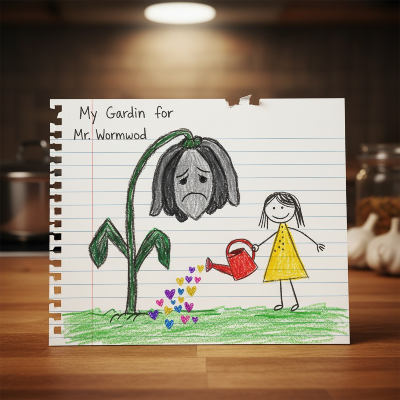
My mom put the spoon down on the counter and knelt on the floor to look at me, her face right in front of mine. "He's not a dog, sweetie. He's a man. And some men... they don't want to be watered."
"Maybe he just doesn't know what it feels like," I said, my voice full of a new kind of certainty. "Maybe nobody has ever watered him before."
My mom didn't say anything for a long time. She just held my drawing and looked at me, and I knew she was deciding something important. Finally, a small, quiet smile came to her face.
"Okay," she said, a new kind of courage in her eyes. "We'll water him. We'll make him some cookies."
And so we did. We made a huge batch of oatmeal cookies, the kind with brown sugar and a little bit of cinnamon, and we put them in a pretty tin with a red ribbon. My mom helped me tie a note to the top of the tin. My handwriting was a little wobbly, but it said, "Dear Mr. Wormwood, I hope you have a nice day. Love, Sage."
And the next day, in the early morning quiet, with the cold still holding the world in its grip, we went back to the school. This time, my mom walked with me all the way to his office door. She didn't say a word. She just held my hand, and when we got there, she let go. I took a deep breath, and I walked up to the big door, my heart beating in my chest like a tiny drum. I put the cookies down on his desk and I walked away. I didn't look back. I just walked. I had left my armor at home. I was just a little girl, and I had left a whisper of my love behind, a small hope, a small prayer to perhaps give a a little drink to a very, very dry wildflower.
Whan that Aprille with his shoures soote,
The droghte of March hath perced to the roote,
And bathed every veyne in swich licóur
Of which vertú engendred is the flour~ Geoffrey Chaucer, The Canterbury Tales: General Prologue
A Piece of Work
"What a piece of work is a man! How noble in reason, how infinite in faculty! ...in action how like an angel!"
~ William Shakespeare, Hamlet
The atmosphere in the school shifted, subtle at first, then sharp and defined, like the sound of a closing lock. The kindness that had been my armor had lost its magic against the cruel logic of the headmaster. Mr. Wormwood had shed his fear, and what was left was a raw, naked anger. I didn't see him around the school as much, but I saw the results of his quiet work everywhere.
It started with small things, a sideways glance from a new teacher, a cold shoulder from an old friend. Then came the whispers, a faint, unsettling hum that followed me in the halls. I knew he was behind it. I could feel his hatred like a cold wind at my back, urging them on. But the whispers were nothing compared to what came next.
It started with a boy named Roger. He was a small, scruffy boy, the kind you would never have noticed before. But suddenly, he was everywhere I was. He was at my locker, at my desk, and always, always, he was waiting by the girls' restroom.
The first time it happened, my heart leaped into my throat. I went to the bathroom during lunch, and he followed me inside. My mind went blank with shock. He just stood there, smiling, his hands in his pockets. The other girls turned and gasped.
"If he gets to use the girls' bathroom, so do I," he said, his voice a mocking sing-song, echoing off the tiles. "It's nicer in here! Gosh, it even smells nice!"
I didn't say anything. I just stood frozen by the sink, my hands clenched into fists, my eyes burning. He laughed and walked out. The next day, he did it again. And the day after that. It was like a game to him, a cruel show that Mr. Wormwood had most certainly directed from his wormy perch. His words, a mockery of my very being, were a public performance, and I was the humiliated star. The bathroom, which had always been a quiet and safe place for me, was now a stage for my public shaming.
I began holding it, not drinking water, trying to avoid the bathrooms entirely. The anxiety was a hard knot in my stomach. The humiliation was a hot, terrible blush that spread up my neck and across my face. I was an actress in a play I hadn't auditioned for, a princess in a costume that everyone was laughing at. This wasn't just mean; it was a carefully constructed plot to make my life at school untenable.
I knew my parents would be furious. I knew they would fight. But I also knew, with a certainty that settled deep in my bones, that this school had become a place where I could no longer belong. It was a place where my light was not welcome, and the battle was no longer in the shadows. The monster had shown his face, and his hatred was now an open, terrible wound.
The air at our dinner table was thick and heavy, a strange and unwelcome guest among the smells of pan-seared salmon and roasted root vegetables. We ate in a silence that was different from our usual cozy quiet. I could see the worry lines around Daddy’s eyes, even though he had washed off the day’s dirt from his construction sites. He looked at Mom, and then his gaze settled on me.
“Well,” he began, his voice a quiet rumble that broke the stillness. “There’s no easy way to say this, so I’ll just say it. Your mom and I have been talking, and we think it’s time for a change.”
My heart leaped into my throat. I put my fork down, the clink of metal against the plate loud in the silence. I knew what was coming. Daddy wasn’t talking about changing the brand of milk. “Do I have to pretend to be a boy again?” I cried.
“Of course not, sweetie. Never. The school,” he went on, his voice still low, “the people in it… they’ve made it so that you can’t be you. We could fight, go to the school board, maybe even go to court. And we’d probably win. But that’s not the point anymore.” He took a slow, deliberate breath. “The air there, it’s been… poisoned. It’s no longer a place where you can be a child, where you can be true to yourself, without fear.”
He looked at Mom, who nodded in agreement, her eyes full of a fierce love that matched his.
“And,” Daddy said, his eyes meeting mine, “I’ve gotta be able to look myself in the mirror. And I can’t do that knowing that my little girl is going to a place every day that makes her feel unsafe. This isn’t surrender, or an all-out retreat, honey. This is a tactical retreat.”
My eyes began to sting. I looked down at my plate, a little piece of carrot, singed and smoky, sat alone by my fork. It felt like that carrot was another imperfection in our otherwise wonderful life, another small thing that was still wrong. It looked heavy somehow. Dad’s words made sense, a terrible kind of sense. I knew he was right. I could feel the poison every time I stepped onto the playground, every time I went to the bathroom.
“But what about my friends?” I whispered, my voice barely audible. “What about Olivia and Lily, and Chloe?”
Daddy reached across the table and took my hand, his palm warm and reassuring. “We’ll get you a phone, a tablet, whatever you need to keep in touch. We’ll have them over every weekend if you want. A true friend can’t be taken away by a bully or a principal. This is about you, baby girl. It's about getting you to a place where you can be you, and that is a place that is safe and full of people who will love and respect you just for being you. You're our river. And we'll go anywhere to make sure you can flow freely.”
The silence that followed was different this time. It wasn't heavy or tense. It was the silence of a decision made, of a new path chosen. I still wanted to cry, and I knew I would many times in the coming days. The air in our dining room seemed to clear, a new, clean wind blowing through it. It was sad, yes. But it was also the beginning of something new.
Tears of the Four Musketeers
"One for all, and all for one."
~ Alexandre Dumas, The Three Musketeers
The air in our house felt different after that night. Lighter, but also buzzing with a kind of nervous energy. Boxes started to appear, big brown ones with black marker scrawls on them: "KITCHEN," "LIVING ROOM," "SAGE'S ROOM." My own room was a mess of boxes and bubble wrap. Mom and Dad would talk in low voices at night, and I heard words like "deposit," "closing," and "new school." The moving date was a little over a month away, which seemed like forever and no time at all.
Mom took me to the store to get my new phone. It was a pink kid's iPhone, small and smooth and light in my hand. I felt like a grown-up, holding that tiny rectangle of glass and metal. It was a lifeline to the world I was leaving behind. I spent the first night getting all my games and apps on it, and then, with my heart thumping, I put in Olivia’s number.
The next morning, at recess, I found Chloe, Lily, and Olivia on the swings. They were laughing and kicking their legs high into the air, and for a moment, everything felt normal. I sat down on the swing next to Chloe.
"Guess what?" I said, holding up my phone. "I got a phone! For my very own!" I giggled.
They all stopped swinging. Their eyes went wide with excitement as they took turns holding the shiny pink box. We quickly exchanged numbers, tapping them into our screens like we were unlocking a secret code. But then my throat got tight, and the words just tumbled out.
"I'm moving," I said. "We're moving in a month. To a new town. To Denver."
The smiles slid from their faces. The bright playground suddenly seemed gray. Lily's eyes filled with tears, and Chloe’s mouth dropped open. Olivia just stared at me, her expression a mix of shock and betrayal. She was silent for a long moment before she finally spoke.
"Why?" she whispered. "Because of what happened?"
I nodded, feeling tears start to sting my own eyes. "It's because of him. Because of Mr. Wormwood, and all the people he’s turned against me, us. Dad says the air here is... poisoned."
The words hung in the air between us. We sat there, a silent, heartbroken circle on the swings. We had all been so happy to be the Four Musketeers again, and now our group was being broken.
"But... what about us?" Lily said, her voice a small sob.
"We have our phones!" I said, trying to sound brave. "We can call each other! We can text! And my parents said you can all come over and have sleepovers at our new house."
Olivia looked at me then, her eyes full of the same fierce resolve I had seen on my dad's face. She slid off the swing and reached into her pocket. She pulled out a half-eaten lollipop and broke it cleanly in half. She put one piece in her pocket and held the other out to me.
"One for all," she said, her voice a little shaky, but sure. "And all for one."
I took the lollipop and broke off two more pieces, giving one to Lily and one to Olivia. We each held our small piece of candy, a promise that our friendship was bigger than any bully, any bad principal, or any distance. We had a code, a creed. We had a bond that not even moving could break.
My room was a mess of boxes, but I wasn't really packing things. I was packing up a life. I held up my favorite stuffed animal, a worn-out unicorn with a single, bent horn. I feel like that sometimes. It had been with me through so many secret missions and backyard adventures. Putting it in the box felt like putting a piece of myself away.
The room was starting to feel strange. The walls were bare where my drawings and pictures used to be, and the floor was covered in dust bunnies from places the vacuum never reached. Each empty space was a memory, a ghost of a time I wouldn't have anymore. It was a sad feeling, like saying goodbye to an old friend.
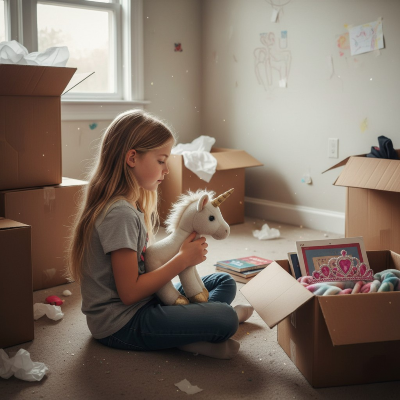
"Crumpled pictures of memories, time after time." ~ Cyndi Lauper
But there was also a little bit of magic in it. As I packed my books and toys, I was also packing up all the feelings and ideas they held inside. The princess in her costume box, the little girl who watered a sad, gray flower with her heart, the musketeer who broke a lollipop into four pieces—all of it was going with me. My tiara, nestled safely in a box of old blankets, would be there to remind me that even though this head was feeling uneasy, it would find a new place to rest. I wasn't leaving myself behind; I was just getting ready for a new chapter.
The radio was on in my room, its familiar tunes a comforting backdrop to the rustle of packing tape and the thud of books going into boxes. I was on my knees, trying to get my closet cleaned out, when a song came on, and I just froze. It was Cyndi Lauper. Her voice was like a hug and a little whisper at the same time. I felt all the nervous energy of the day melt away. I dropped what I was doing and lay down on my bed, pulling my old unicorn close. I closed my eyes and let the song take over.
The music started, and it felt like she was singing just for me. "Lying in my bed I hear the clock tick, and think of you." I wasn’t thinking of one person, but of all of them, my friends—the life I was leaving behind. The song was a story I was already living. I’d been caught in so many circles of confusion; the bullying, the whispers, all of it. The confusion of a world where a man could use a little boy as a weapon against me.
Then the song moved on to the good parts, the warm nights, the laughter with the Four Musketeers. All of it was almost left behind. It was all a suitcase of memories now. That’s what I was doing—packing a suitcase of crumpled pictures, pictures that weren’t always real, but that I could feel so much. The smell of popcorn at the movies with my family, the hoar frost glowing on the McDonald’s hill, the taste of a broken lollipop. The memories weren't perfect; they were crumpled from being held on to so tight.
But then the song promised, "If you're lost, you can look and you will find me, time after time." I knew that was true. Mom and Dad would always be there. My friends would be, too. It was a beautiful thought, and it filled my heart until it felt like it would burst. All the sadness and the worry and the love and the hope just got all mixed up. A single tear escaped from under my closed eyelid and slid down my cheek. It was a tear for everything that was ending, and for everything that was about to begin.
The final month at school is a strange, quiet time. It's filled with a kind of bittersweet peace, a stillness before a storm. The whispers still follow me, and the air is still cold, but it can't touch me anymore. The knowledge that I'm leaving, that my parents are fighting a different kind of war for me, is a shield.
Mr. Wormwood, as you guessed, is not above gloating. He is too much of a coward to do it openly, of course. His cruelty is a small, quiet thing, a whisper in the ear. I see him in the hallway near my locker, pretending to be on his phone. As I walk past him, he lets the phone drop just enough so I can hear his voice.
"A smart little princess knows when to run, doesn’t she?" he says, his voice a low, evil rumble.
I don't respond, but I feel his words like a slap. My heart pounds against my ribs, but for some reason, it isn't with fear. It's a new kind of feeling, a mix of disgust and pity. I'm not a runner. I'm a warrior. But I'm also just a little girl who knows when a garden is beyond her power to fix.
As for the bully, he stops. Roger, the boy who followed me into the bathroom, doesn't even look at me anymore. It’s as if the cruel joke has lost its purpose now that the audience is leaving. The bathroom is a sanctuary again, a quiet, almost subliminal place where little girls can just be themselves. There’s a clean scent in the air. The whispers outside are just static. My friends, the Four Musketeers, become an even tighter, unbreakable circle of protection. They walk with me to class and meet me for lunch. We talk and giggle and make plans for the final sleepovert before the big move, which will be at Olivia’s house. In the face of all the noise and nastiness, their friendship is the quietest, most powerful thing in the world to me.
And then, just like that, the month is over. The moving van arrives, the boxes are packed, and my bedroom is nothing more than four walls and a window. My old life is a memory, and my new one is a promise.
To be continued...
In the world of Rhapsody, where the lines between art, memory, and political gravity blur, these two pieces stand as pivotal pillars. They represent the artful reclamation of a voice that refuses to be silenced by the cold white rooms of the past or the walls of ice in the present.
Here is a glimpse into the sound and soul of the journey:
I wrote Stockholm Syndrome after thinking about how much I love the world and humanity even though so much of the world hates me as a transwoman. Humans are flawed, the world is flawed, but we have all built a great thing here on Earth. I am heartened that, while it may seem slow for us transwomen, it always progresses, the arc of history always bends toward justice. What used to be a feature intended for human survival has now become a bug, and our hardware makes it a long slog to debug our preconceptions. Yes, the world is effed up, but no, it's not as bad as it was. I love it anyway. I love people anyway. And I dance anyway.
Explore the rest of my videos on my YouTube channel: Tara Nicole Miller on YouTube
If this song or Sage’s journey touched your heart today, please consider heading over to YouTube and giving the video a 'Like.' It’s a small click for you, but it’s a huge signal to the 'machine' that our voices matter and our stories deserve to be heard.
If you liked this post, you can leave a comment and/or a kudos!
Click the Thumbs Up! button below to leave the author a kudos:
And please, remember to comment, too! Thanks.

Comments
I was reminded a few days ago……
Of a song that has meant much to me through some of the most difficult times of my life. Reading this made me think of a line from that self-same song:
And though we try to change the world
A flower when it's cut will surely die
So why do men with so much hate
Destroy what they cannot create
While we all stand by
This posting made me cry. Even now, some twenty minutes after I first read it, I am still fighting off the tears. I am sure that we all know someone like Wormwood, a person so entrenched in their own anger and misery that all they can see is their own need to destroy any beauty that dares to exist near them. The only way they can feel anything is by burning down any light which pierces the gloom they have created.
But the thought of his using another child as his weapon disgusts me - especially in light of the fact that he more than likely included that child’s parents in his manipulations. That any despicable person like that is involved in shaping the future of our country is reprehensible - but unfortunately it is probably more common than we like to admit.
My oldest son is a teacher; he teaches high school and junior high school students in history. He works at an inner-city school district by choice. He is also the assistant director of athletics and coaches cross country, indoor track, and outdoor track. To say he interacts with a lot of students is an understatement. The stories he has told me of how some of the teachers, and perhaps worse, the school administration acts to some of the minority students is frustrating - even angering. His school has a significant number of LGBT students, who are fairly well supported. I have even been asked to speak to some of the students. But in this day and age, students from minority populations are still treated as second class; distinctions that should not be made based on race or religion are still made.
Not overtly, but subtly - a lack of support at times when it is most needed. A lack of compassion when it should be put forth. The little actions which should be taken, but are not. Their subtle actions destroying that which they cannot create, all while most of the population just stands by and watches.
It is time that we stop standing by, time that we start standing up.
This has been a wonderful story, and I am truly looking forward to seeing more of it - but this chapter left me feeling down.
D. Eden
“Hier stehe ich; ich kann nicht anders. Gott helfe mir.”
Dum Vivimus, Vivamus
It wouldn’t be a true story
It wouldn’t be a true story without moments like this. Chapters like this. Even the best, strongest, most supportive parents can’t protect their children from all of the evil of the world. And when that evil is wrapped in authority, with all the weight of rules, regs and policies behind it, sometimes the best course is to walk away. It’s not right, but it’s less wrong than forcing a child to face that kind of poison, day in and day out. I really, really hope that their new school situation is better.
I also hope that Sage’s dad finds a way to ruin Wormwood, now that Sage is outside of the monster’s reach. I’m petty, that way.
— Emma
It’s not petty…….
When it’s the right thing to do. It’s called justice, and unfortunately it seems to be in short supply these days.
D. Eden
“Hier stehe ich; ich kann nicht anders. Gott helfe mir.”
Dum Vivimus, Vivamus