
Author:
Audience Rating:
Publication:
Genre:
Character Age:
TG Elements:
TG Themes:
Permission:
Willow House
For several days, nothing happened.
He used the time to deal with the less dramatic parts of his future. There were university forms to complete, financial documents to review, an advising appointment to schedule, and an online orientation module that seemed determined to explain parking permits in greater detail than necessary.
The rest of his time went to his car.

He had been meaning to work on it since before graduation, but St. Catherine’s, Samantha, and the increasingly complicated aftermath of both had consumed most of his attention. Now he spent long afternoons in the garage with the hood raised, his oldest clothes stained with grease, a radio playing from the workbench, and an assortment of tools spread around him.
The work was familiar. Predictable.
A bolt either turned or it didn’t. A belt was worn or it wasn’t. An engine did not ask him to wear lipstick, send photographs, or answer to a different name.
For a few hours at a time, he belonged entirely to himself again.
That was what made the message harder when it finally arrived.
Samuel was sitting at his desk that evening, comparing course descriptions, when his phone vibrated beside the keyboard. There was no name attached to the conversation. There never was.
Everything is arranged. Willow House is expecting Samantha tomorrow. Be there at nine.
He read the message twice.
Part of him had been waiting for it. Another part had begun to hope the silence meant the whole thing had somehow ended.
Samuel set the phone facedown and stared at the half-completed schedule on his laptop.
Willow House was not completely unfamiliar to him. He had seen the name on donation boxes around town and attached to occasional fundraising announcements, though he had never given it much thought. A quick search had told him the rest.
The organization supported single mothers and their children through educational programs, family assistance, and reliable care outside school hours. During the academic year, it offered tutoring, homework help, donated school supplies, and occasional evening programs. Summer created a different problem. Schools closed, but jobs did not. Willow House filled that gap with a weekday program where children could spend the day reading, playing, working on art projects, and participating in supervised activities while their mothers were at work.
It was not a massive institution. The photographs showed one main building, a modest playground, several classrooms, and a multipurpose hall used for community events. Between employees and volunteers, the summer program appeared to involve no more than a few dozen people.
None of that made Samuel feel better.
The work itself sounded worthwhile.
The fact that Samantha had been volunteered for it did not.
He turned the phone over again.
There were no further instructions.
For the rest of the evening, he tried to concentrate on his university schedule. Instead, he kept wondering what exactly had been arranged, how much Willow House had been told, and what Samantha was expected to do once she arrived.
The following morning, Samuel waited for Lily to leave.
He sat at the kitchen table pretending to read an email while she moved through the house collecting everything she had forgotten. First her purse. Then her travel mug. Then the folder she had left on the counter. She reached the front door, stopped, and returned for her phone.
“You know,” Samuel said, “most people gather their belongings before they leave.”
“Most people don’t have an internship designed to destroy their will to live.”
“You’ve been there two weeks.”
“And look what it’s done to me.”
She found her phone beneath a cushion and pointed it at him. “Are you staying home today?”
“Probably not.”
Lily paused.
“Seeing your mysterious friends again?”
Samuel kept his eyes on the laptop. “Maybe.”
The garage door closed a minute later. Samuel listened until her car had disappeared down the street, then waited another thirty seconds before shutting the laptop.
His transformation took less time than it had before the salon appointment.
Not little time. Just less.
He put on Samantha’s underwear, fastened the bra, and stood in front of the suitcase while trying to decide what a new volunteer was supposed to wear.
The message had not mentioned a dress code. That meant either there wasn’t one or someone had deliberately decided not to warn him.
He chose the most casual option available.
The jeans were the pair Natalie, Maddie, and Riley had insisted he buy at the mall.
“I already own jeans,” Samuel had protested when Natalie placed them over his arm.
“Samuel owns jeans,” Riley had replied.
Maddie had nodded solemnly. “Samantha cannot spend her entire life stealing clothes from a man.”
“He isn’t a man. He’s me.”
At the time, Samuel had assumed the distinction was another excuse for them to make him buy something. Now, as he stepped into the jeans and pulled them over his hips, he saw what they had meant.
They were undeniably different from his own.
The denim was softer and more fitted. The rise sat higher, and the pockets seemed designed by someone with a personal objection to carrying objects.
Still, they fit.
More than that, they made the lower half of the outfit look deliberate in a way Samuel’s regular jeans never would have.
He disliked when his friends were right.
The black T-shirt seemed ordinary until he put it on. Its sleeves were shorter, the fabric lighter, and the cut narrowed slightly at the waist. It also settled differently over Samantha’s bra, making the shape beneath it more noticeable than he had expected from something so simple.
Samuel adjusted the neckline, then turned sideways in front of the mirror.
The outfit was about as casual as Samantha could look while remaining unmistakably Samantha.
He added soft pale-blue Mary Jane flats made from subtly textured fabric, with rounded toes and narrow straps across the insteps. The result looked feminine but practical enough for a first day spent filling out paperwork or carrying boxes.
At least, that was what he hoped.
The wig came next.
Emily’s instructions had sounded simple in the salon: secure the cap, align the front, adjust the sides, then work through the fibers gently from the ends upward. Alone in his bedroom, each step required far more concentration.
He brushed the light-brown waves until they fell smoothly around his shoulders and tucked one side behind his ear.
Makeup went better than it had the week before.
The mascara still required several attempts. The blush needed correcting. He removed and reapplied the lipstick after noticing the line had drifted beyond one corner of his mouth.
But when he finished, Samantha looked presentable.
Samuel picked up the handbag and checked his reflection one final time.
“Volunteer work,” he murmured. “How dangerous could it be?”
The question followed him downstairs.
Willow House stood on a quiet street near the edge of a residential neighborhood.
The building had probably served another purpose decades earlier. It was two stories tall, built from warm red brick, with white trim around the windows and a covered entrance facing a small parking lot. A newer wing extended from one side, connected to the original structure by a glass hallway. Behind a low fence, brightly colored playground equipment rose above a stretch of carefully maintained grass.
A painted wooden sign stood near the driveway.
WILLOW HOUSE FAMILY SUPPORT CENTER
Beneath it, in smaller letters:
Helping Families Grow Stronger
Samuel parked near the back of the lot.
Several cars were already there, along with two minivans and a small bus bearing the Willow House logo. Women in casual clothing moved between the vehicles and the building, some carrying bags of supplies. Through the open playground gate, he could hear children shouting.
Samuel opened the door.
The reception area was smaller than he had expected. A curved desk occupied one side of the room, opposite a seating area furnished with mismatched but comfortable chairs. Children’s drawings covered a large bulletin board beneath a banner reading OUR SUMMER AT WILLOW HOUSE. A glass display case held photographs from previous programs, volunteer certificates, and several engraved plaques thanking local donors.
The woman behind the desk looked up as Samantha entered.
She was in her fifties, with short silver-blond hair and reading glasses hanging from a chain around her neck.
“Good morning.”
Samuel tightened his grip on the handbag strap.
“Hi. I’m Samantha. The new volunteer.”
The words came out more nervously than he intended.
The receptionist’s face brightened immediately.
“Samantha Brooks?”
“Yes.”
“Oh, wonderful. We’re so glad you made it.” She stood and came around the desk. “I’m Helen. I’ve been told we were expecting you, but I didn’t realize you’d be here this early.”
Samuel glanced toward the clock. It was eight fifty-three.
“I didn’t want to be late.”
“You’re going to fit in just fine.”
The warmth of her welcome made him feel strangely guilty.
Helen gestured toward the hallway. “We’ve been hoping to fill that last volunteer position for weeks. Summers are always difficult, but this one has been particularly tight. A few of our regular volunteers had to change their plans at the last minute.”
“So I heard.”
“We really are grateful. The children arrive with more energy every morning, and somehow we have less of it every year.”
Samuel smiled politely.
Helen picked up the phone at the reception desk and pressed one of the internal extensions.
“Marianne? Samantha is here.”
She listened for a moment.
“Perfect. I’ll keep her with me.”
After replacing the receiver, she pointed toward the collection of drawings on the wall.
“Marianne coordinates the summer volunteers. She’ll walk you through everything today.”
A door opened at the end of the hallway, and a woman hurried toward them. She looked to be in her late thirties, dressed in navy slacks, a cream blouse, and practical flats. A staff badge hung from a blue lanyard around her neck.
“Samantha?”
Samuel nodded.
“I’m Marianne Cole.” She shook his hand with the practiced confidence of someone who introduced herself many times each week. “Welcome to Willow House.”
“Thank you.”
Marianne thanked Helen and led Samantha through a set of double doors.
Marianne walked quickly but explained everything with ease.
“This wing is primarily for our summer program. We divide the children into age groups, though they come together for meals, outdoor activities, and some of the larger projects. The younger group uses the rooms on this side. Older children are farther down the hall.”
They passed an open doorway where a group of children sat on the floor around a volunteer reading aloud. A little boy near the back looked toward the hallway and stared openly at Samantha until Marianne moved on.
“The kitchen and dining room are through there,” she continued. “The multipurpose room is at the end. We use it for indoor games, staff meetings, performances, and community events. Our offices are upstairs, along with two smaller meeting rooms.”
“How many children are here?”
“This summer? Thirty-two enrolled, though daily attendance varies depending on their mothers’ schedules. We have eleven regular employees involved in the program and a larger group of volunteers rotating throughout the week. Willow House as a whole stays fairly small. Even when you include administrative staff and everyone helping with events, there are fewer than forty of us.”
That explained why the vacancy had mattered.
One missing volunteer in an organization this size would not disappear into a spreadsheet.
Marianne pushed open a door marked VOLUNTEER SERVICES. Her office was narrow but orderly, with two chairs facing a desk, filing cabinets along one wall, and a calendar covered in color-coded notes. A garment rack stood near the window.
“Have a seat. We’ll go over your schedule first.”
For the next twenty minutes, Marianne explained the summer program’s routine. Samantha would normally arrive before the children, help prepare the activity spaces, remain with an assigned group through the day, and stay for a brief staff meeting after the final child had been collected. Duties shifted according to need. Some days she might assist with reading and crafts. Other days she would supervise games, serve lunch, or help prepare materials for special projects.
Samuel listened carefully, occasionally writing notes on the folder she gave him.
His schedule had already been entered.
Three days a week.
Eight thirty until four thirty, though meetings sometimes ran later.
Marianne slid two forms across the desk. “These are acknowledgments for the policies we’ll cover today. Most of your onboarding was completed before you arrived, so this is mainly confirmation.”
Samuel looked over the pages.
He signed where Marianne indicated.
“Now,” she said, rising, “uniforms.”
Samuel glanced toward the garment rack.
Marianne opened a cabinet instead and removed two opaque plastic packages. Each had a white label with Samantha’s name and size printed on it.
“We give every regular summer volunteer two,” she explained. “That way, when one inevitably ends up covered in paint, juice, glue, or something no one can identify, you still have a clean one for the next day.”
She placed both packages on the desk.
“You can request another if you need it. Just let me know.”
Samuel touched one of the plastic bags. The folded fabric inside was impossible to see clearly.
“Thank you.”
“We also need your photograph for the staff badge. Wearing it will let you use the volunteer entrance after today, and it helps the mothers, children, and other staff learn who everyone is.”
“Okay. Where do we take it?”
“Downstairs, but you’ll need to change first.”
Samuel looked at her.
Marianne smiled, apparently mistaking his silence for confusion.
“We photograph everyone in uniform. You may as well stay dressed afterward since you’ll be spending the rest of the day with us.”
“Of course.”
There was always a uniform.
Samuel picked up the packages.
“The changing room is across the hall,” Marianne said. “Take whichever one you open first. They’re identical.”
Samuel entered the nearest stall and locked it behind him.
For a moment, he stood with the plastic package in his hands.
The outfit he had chosen that morning suddenly seemed like an enormous waste of time.
He tore open the bag.
White fabric appeared first.
A blouse.
It had short sleeves, a small rounded collar, and simple white buttons down the front. Beneath it lay pale sky-blue fabric patterned with broad, clearly defined vertical white stripes.
Samuel lifted the second garment.
Of course it was a dress.
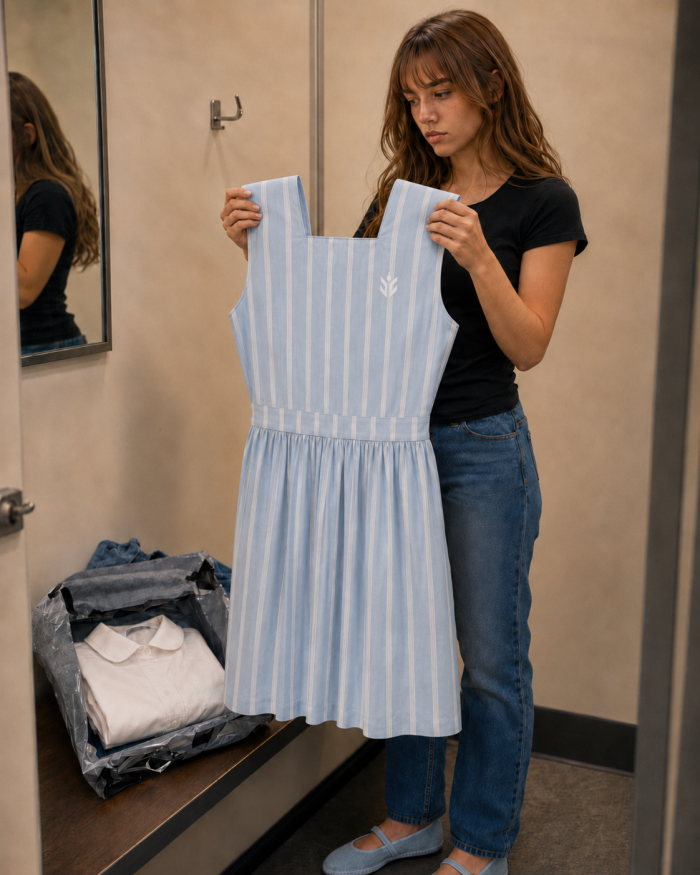
More specifically, it was a pinafore. The wide shoulder straps joined a square bib in the front, leaving space for the white blouse beneath it. The waist was fitted without being tight, and below it the skirt opened into a fuller, softly gathered shape that appeared designed to fall to the knee. A small Willow House emblem had been embroidered in white near the upper corner of the bib.
It was practical.
Modest.
Clean.
And unmistakably feminine.
Samuel examined it for several seconds before looking at himself in the mirror.
“You couldn’t have used polo shirts?”
The uniform offered no defense.
He removed the black T-shirt and jeans, folding them carefully onto the bench. The blouse came first. Its shape was less fitted than the shirt he had worn, but the thin fabric still settled over the bra in a way that made the garment beneath it impossible for Samuel to forget.
The pinafore fastened with a concealed zipper along one side. He stepped into it, pulled it upward, and slid his arms through the wide straps. The waist fit more comfortably than he expected.
He closed the zipper and smoothed the skirt.
The broad white stripes brightened the pale sky-blue fabric without making it look childish. Paired with the white blouse and the pale-blue Mary Jane flats he had worn that morning, the uniform had the polished cheerfulness of something designed to reassure parents.
Samuel turned toward the mirror.
The girl looking back at him seemed younger than she had in jeans, though not quite like a student. The square bib and fuller, neatly gathered skirt made her look approachable, organized, and far more prepared to supervise children than Samuel felt.
A small pocket was hidden along each side seam.
He tested one.
His entire phone fit inside.
“At least someone here believes in basic human rights.”
He placed his folded clothes and the second uniform in one bag Marianne had provided earlier and left it inside the changing room. Then, he returned to her office.
Marianne looked up and smiled.
“Perfect. How does it fit?”
“Fine.”
“Nothing pulling at the shoulders?”
Samuel moved his arms experimentally. “No, it’s okay.”
“Good. The company that supplies them is usually reliable, but their idea of sizing changes whenever they feel creative.”
She stepped around the desk and adjusted one of the pinafore straps where it had twisted slightly.
“There. You’ll also need to keep your hair tied back while you’re working directly with the children.”
Samuel touched the loose waves around his shoulders.
“Oh.”
“It’s mostly hygiene and safety. We deal with food, paint, glue, outdoor activities, and children who occasionally grab whatever happens to be within reach. Long hair becomes inconvenient very quickly.”
That seemed reasonable.
Unfortunately.
“I don’t have anything to tie it with.”
“We keep extras.”
Marianne opened a drawer and handed him a plain brown elastic.
Samuel had practiced a low ponytail exactly once, under Emily’s supervision. At the salon, it had seemed manageable. Standing in Marianne’s office while she waited, his fingers abruptly forgot what they had learned.
He gathered the hair at the nape of his neck, trying not to pull hard enough to shift the wig. Several strands escaped around his face. He looped the elastic once, nearly lost it, then managed a second loop before deciding a third might be dangerous.
The ponytail sat slightly off-center.
Samuel looked at it in the small mirror beside the filing cabinet.
Marianne considered the result.
“You may want it a little tighter once you start moving around, but that will work for today.”
The fact that she did not offer to fix it was somehow worse.
“Great.”
“You’ll get used to it.”
Samuel suspected people had been saying that to him far too often.
The photograph was taken against a pale wall near reception.
Helen set a small camera onto a tripod while Marianne adjusted the staff badge equipment on the desk beside her.
“Stand on the blue mark,” Helen instructed.
Samuel stepped into place.
The uniform skirt brushed his knees. The low ponytail rested against the back of his neck, and the small embroidered Willow House logo sat prominently on the bib.
The flash went off.
A few minutes later, a plastic card emerged from the small printer on the reception desk. Marianne attached it to a dark-blue lanyard and handed it to him.
Samuel looked down.
The photograph was better than he had expected. Samantha’s makeup appeared natural, her light-brown hair neatly pulled back, and the white blouse brightened her face against the navy uniform.
Beneath the photograph, black letters read:
SAMANTHA BROOKS
SUMMER VOLUNTEER
There it was.
Not written in marker on a coffee cup.
Not typed in a private group chat.
Printed beside the Willow House logo, laminated and official.
Samuel slipped the lanyard over his head. The badge settled against the pinafore bib.
“Welcome to the team,” Marianne said.
“Thank you.”
The words felt strange.
Not false.
Just strange.
The remainder of the day passed through policies, schedules, emergency procedures, and introductions Samuel struggled to remember.
He learned which doors remained locked during program hours, where the first-aid supplies were kept, and how children were released only to adults listed on their authorized pickup forms. Volunteers were never to be alone with a child behind a closed door. Any injury, argument, concerning statement, or unusual behavior had to be reported to a staff member.
By lunchtime, he had met enough people that the names began blurring together. Most welcomed him with the same relief Helen had shown. Several mentioned how badly they had needed another regular volunteer. One woman clasped both of Samantha’s hands and told her she was an answer to prayer, which seemed excessive considering Samuel had not yet done anything.
The children remained mostly at a distance. He saw them in the halls, heard them in the dining room, and passed the playground while one group organized a water-balloon relay. A few noticed the new uniform and stared. One girl offered a shy wave before hurrying after her friends.
Samuel returned it.
He spent the afternoon completing training modules and helping Marianne sort materials for the following week. It was not difficult work, but by four o’clock his scalp felt warm beneath the wig.
One by one, mothers arrived to collect their children.
The reception area filled with hurried greetings, backpacks, half-finished stories, and reminders about forgotten water bottles. Some women still wore office clothes. Others arrived in medical scrubs, restaurant uniforms, or work boots. Most looked tired.
The children rushed toward them anyway.
By four thirty, the halls had fallen quiet.
Marianne collected a folder from her office and motioned for Samantha to follow.
“We meet every afternoon after the last pickup. Usually twenty or thirty minutes, unless we’re preparing for an event or something caught fire.”
“Does that happen often?”
“Literally? No. Metaphorically? Constantly.”
The daily meeting took place in the multipurpose room. Folding tables had been arranged in a loose rectangle facing a portable whiteboard. Fewer than two dozen people occupied the chairs, some still wearing the same striped pinafores as Samantha, others dressed in staff polos or business-casual clothes. Coffee cups, water bottles, notebooks, and leftover craft supplies covered the tables.
Samuel entered beside Marianne.
Then he saw a familiar face.
Samuel stopped for half a step.
The knot in his stomach tightened so suddenly that he nearly missed whatever Marianne said beside him.
It was Daphne.
She was already seated near the front.
Unlike the summer volunteers, she did not wear the striped uniform. She had on tailored dark trousers, a pale-blue blouse with the sleeves folded neatly at her forearms, and understated flats. Her hair fell in smooth dark waves around her shoulders. A Willow House identification badge hung from a slim lanyard at her neck.
Daphne looked toward the door.
Their eyes met.
For a moment, her expression did not change.
Then she smiled.
She stood and approached them with the easy confidence of someone who belonged in the room.
“You must be Samantha.”
Samuel kept his face still.
“Yes. I am.”
Daphne extended her hand.
“Thank you so much for agreeing to volunteer. I’m Daphne. I’m handling logistics for our summer events this year, though I’ve been helping at Willow House in one way or another for a few years.”
Samuel accepted her hand.
Her grip was warm and brief.
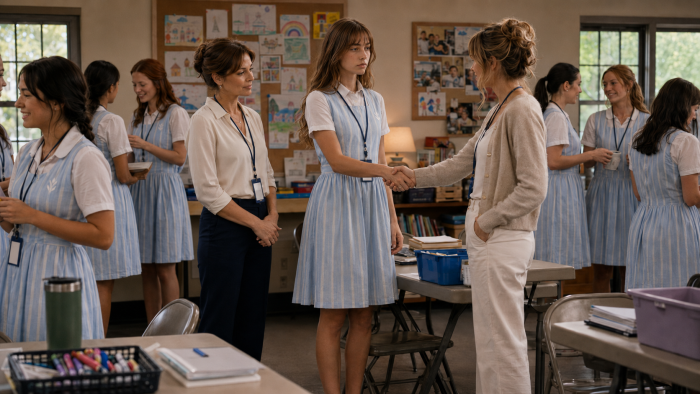
“Nice to meet you,” Samuel said in Samantha’s practiced voice.
The lie came more smoothly than it should have.
Daphne’s smile remained perfectly pleasant.
“You too. I know your first day is mostly paperwork, but I promise it gets more interesting once the children are involved.” She glanced at the slightly uneven ponytail. “And louder.”
“So I’ve noticed.”
“If you have any questions, or if you need help finding anything, please come to me.”
For one second longer, Daphne held his gaze.
Nothing in her expression suggested recognition beyond what she had claimed. Nothing indicated that this meeting was anything other than an introduction between two strangers.
Then Marianne touched Samuel lightly on the arm.
“Let’s get you seated. We’re about to begin.”
Daphne stepped aside.
“I’ll see you around, Samantha.”
Samuel followed Marianne toward an empty chair.
Marianne began the meeting with attendance updates and a review of the following day’s activities.
Samuel tried to listen while remaining aware of Daphne several seats away. She took notes throughout the meeting, occasionally adding a date or correcting a delivery time when Marianne asked. She did not look toward him again.
Near the end, Marianne closed her folder.
“One final item before we leave. As most of you know, we’re approaching one of the more important evenings on the Willow House calendar.”
Daphne rose and moved toward the whiteboard.
“The Patron Reception,” she said.
Several people around the table nodded.
Daphne picked up a marker and wrote the date across the board.
“The invitations arrived this morning, so you’ll receive yours before you leave. For anyone new, the Patron Reception is our opportunity to thank the sponsors already supporting Willow House and introduce potential new partners to the summer program.”
She spoke without notes.
“It isn’t the annual gala itself. Think of it as the evening that helps make the gala—and a large part of the coming year—possible. We share the summer program’s progress, introduce some of the projects the children are preparing, and speak with donors about sponsorships, auction contributions, and underwriting.”
Samuel glanced toward the date.
The reception was just two weeks away.
“We need everyone there,” Daphne continued. “Not simply as extra hands. Sponsors respond to the people doing the actual work. They want to meet staff members and volunteers, hear your experiences, and see that Willow House is more than a name on a donation form.”
A young woman sitting beside Samuel leaned closer.
“Translation,” she whispered, “we smile at rich people while they drink tiny glasses of expensive water.”
Samuel turned slightly toward her.
She appeared about his age, with curly blond hair pulled into a loose bun and a volunteer badge that read JENNA.
Daphne continued speaking at the front.
“Dress expectations and assignments will be shared closer to the event. For now, please save the date and make sure we know about any unavoidable conflicts by the end of the week.”
Jenna lowered her voice again.
“They give everyone two tickets.”
“Why?”
“One for us and one for a guest.”
Samuel looked at her.
“A guest?”
“Date, boyfriend, girlfriend, friend, cousin. Whoever.”
“I don’t have a date.”
Jenna shrugged. “Neither do half the people here.”
“Then why give us two tickets?”
“Because the room looks better full, and unused tickets don’t impress sponsors.” She smiled. “You must bring somebody. That’s basically the only rule.”
At the front of the room, Daphne began passing a stack of cream envelopes down the tables.
One reached Samantha.
His name was written across the front in dark-blue ink.
Ms. Samantha Brooks
Samuel opened it carefully.
Inside was a heavy invitation edged in the same navy used throughout the Willow House branding.
THE BOARD AND STAFF OF WILLOW HOUSE
CORDIALLY INVITE
SAMANTHA BROOKS AND GUEST
TO THE ANNUAL PATRON RECEPTION
The rest of the card listed the date, time, and venue.
And guest.
Jenna glanced over.
“See? No escaping.”
Samuel looked toward Daphne.
She was discussing table arrangements with one of the staff members, her expression focused and professional. If she noticed him staring, she gave no indication.
That familiar knot formed again beneath his ribs.
Ms. Samantha Brooks had been invited to a reception.
And Samantha Brooks was supposed to arrive with someone beside her.
Samuel lowered his eyes to the second ticket.
Who was he supposed to ask?
If you liked this post, you can leave a comment and/or a kudos!
Click the Thumbs Up! button below to leave the author a kudos:
And please, remember to comment, too! Thanks.